FLUIDS WITH ANGLE-DEPENDENT
POTENTIALS
GLEN R. WALKER
A thesis submitted for the degree of Doctor of Philosophy
at the Australian National University Canberra
P R E F A C E
This dissertation is an account of work carried out between February 1980 and February 1983 at the Department of Applied Mathematics, Research School of Physical Sciences, Australian National University, for the degree of Doctor of Philosophy.
All the work in Chapters 2 to 7 is a result of close collaboration between my supervisor, Dr Derek Chan and myself. In section 2.3 and Chapter 4, the work is a joint effort with Steven Carnie and
Derek Chan; while that in section 5.3 is in collaboration with Dr Derek Chan and Dr John Mitchell.
This work has not been submitted to any institute of learning for any degree.
P U B L I C A T I O N S
'Thermodynamic properties of a fluid of hard spheres with water like dipole and quadrupole moment', Chem. Phys. Lett., _79_, 588, 1981. (with Steve Carnie and Derek Chan)
'Statistical Mechanics of Ion-Dipole-Tetrahedral Quadrupole Mixtures', Molec. Phys., 4_3, 1115, 1981. (with Steve Carnie and Derek Chan)
'A non-linear truncation scheme for the Ornstein-Zernike equation for dipolar fluids', Molec. Phys., , 881, 1982.
A C K N O W L E D G E M E N T S
This work was supported financially by the Commonwealth Government of Australia through a Commonwealth Postgraduate Research Award with a supplementary award from the Australian National University.
I am grateful for the help and encouragement received from all members of the Department of Applied Mathematics. In particular, I would like to thank my supervisor Dr Derek Chan, for his guidance throughout the past three years, and Professor Barry Ninham for his helpful advice.
During the last hectic days of the preparation of this thesis, I received tremendous support and help from Phil Hodgkin, Nicholas King and Jane Dixon, for which I am grateful. Special thanks go to
Diana Alex for all the sacrifices she made to finish this thesis on time.
V
ABSTRACT
In this thesis integral equation techniques, developed in liquid state physics over the last twenty years, are applied to a study of fluids with angle dependent potentials.
In particular, multipolar fluids and liquid crystals are studied. There are many similarities and contrasts in the mathematical
formalism and physical principles used in modelling these two fluids. These are introduced in Chapters 1 and 2.
In Chapter 3, an isotropic system of dipolar hard spheres is studied using a non-linear truncation of the hypernetted chain
closure of the Ornstein-Zernike equation. This enables dipolar fluids with low density to be investigated. The mathematics developed to do
this also enables the Percus-Yevick closure to be used. The effect of water-like quadrupole moments on dipolar hard spheres is discussed in Chapter 4. It is shown that schemes developed for axial
quadrupoles are easily adapted to water-like quadrupoles. The results indicate that the quadrupole moment is an important influence on the macroscopic properties of water.
Many of the important applications of polar fluids are a result of their behaviour in external fluids. A number of interesting issues arise when one tries to develop a formalism for describing the effects of a field on polar fluids. Some of these are discussed in Chapter 5.
molecular properties are included via the direct correlation function. In a certain limit this expression is the same as that of the
vii
CONTENTS
PREFACE ii
PUBLICATIONS iii
ACKNOWLEDGEMENTS iv
ABSTRACT v
CHAPTER 1. INTRODUCTION
1.1 Introduction 1
1.2 Modelling liquids 2
1.3 Angle-dependent potential A
1. A Electrostatic interactions 6
1.5 Correlation functions 12
1.6 Dipolar liquids 16
1.7 Dipoles in a field 17
1.8 Tetrahedral quadrupole 19
1.9 Liquid crystals 23
CHAPTER 2. SYMMETRY AND THE ORNSTEIN-ZERNIKE EQUATION
2.1 Rotational invariant 28
2.2 Other symmetries 31
2.3 Interaction potential involving ions, dipoles
and quadrupoles 33
2. A Ornstein-Zernike equation 38
2.5 Correlation functions in an isotropic system AO
2.8 0-Z equation for cylindrically symmetric systems 47
References 50
Appendix 2.1 Wigner D-Functions 51
Appendix 2.2 Rotational invariants 52
Appendix 2.3 3-J and 6-J symbols 54
Appendix 2.4 Transformations 56
Appendix 2.5 Cylindrical invariants 59
Appendix 2.6 Isotropic systems and totally aligned
systems 59
CHAPTER 3. ISOTROPIC SYSTEM OF DIPOLES
3.1 Introduction 64
3.2 Perturbations, simulations and integral equations 66
3.3 A mathematical result 70 .
3.4 Percus-Yevick closure 71
3.5 The Hypernetted chain approximation 74
3.6 The work of Gaylor, Isbister and Watts 77
3.7 Lado's scheme 78
3.8 Truncated HNC closure 79
3.9 Discussion 85
References 88
Appendix 3.1 Expansion of Boltzmann factor related
formulae 91
Appendix 3.2 Expressions for a(MNL/mn) 96
CHAPTER 4. ION, DIPOLE AND QUADRUPOLE MIXTURES
4.1 Introduction 98
ix
4.3 Tetrahedral quadrupole fluid in MSA 104
4.4 Thermodynamic perturbation theory 110
4.5 Conclusion 126
References 128
CHAPTER 5. DIPOLES IN A FLUID
5.1 Introduction 131
5.2 Ferrofluids 132
5.3 Shape dependence 134
5.4 Totally aligned particles 138
5.5 Imperfect alignment 141
5.6 Discussion 147
References 148
Appendix 5.1 Shape dependence 150
CHAPTER 6. FLUIDS IN AN EXTERNAL FIELD
6.1 Introduction 154
6.2 Integro-differentiation 155
6.3 Free energy 158
6.4 Modelling surfaces 163
6.5 Approximations for c 165
6.6 Electrical double layer 168
6.7 Summary 176
References 177
Appendix 6.1 Translation of the potential field 178 Appendix 6.2 Uniform application of external field 179
Appendix 6.3 Free energy expression 180
CHAPTER 7. LIQUID CRYSTALS
7.1 Introduction 185
7.2 Molecular properties 186
7.3 Order parameter 187
7.4 Temperature dependence of free energy 188
7.5 Isotropic-Nematic transition 19 2
7.6 Local structure 195
7.7 Landau de Gennes expansion 201
7.8 Elastic constants 202
7.9 Alignment of liquid crystals at a wall 205
7.10 Discussion 212
References 214
Appendix 7.1 Direct correlation function 215
1
CHAPTER 1
1.1 Introduction
It is difficult to relate the properties of liquids to the properties of the individual molecules. The high density and the lack of a long-range structure in liquids prevent the techniques which have been used with reasonable success for either gases or solids from being used for liquids.
In this thesis, attention is focussed on those liquids in which the intemolecular interaction depends on the orientations of the molecules. In particular, polar fluids (i.e. fluids with permanent electrical moments) and liquid crystals are considered. Because of the complexities mentioned in the preceding paragraph, the model system of the liquid needs to be very simple.
The physical principles of the behaviour of polar liquids and liquid crystals are described in this chapter with the mathematical formalism being developed in later chapters. The mathematics needed to describe the anisotropic interactions in these liquids (Chapter 2) can become quite complex and a reasonable understanding of the
physics of the system is needed to understand the approximations used. Even though some of the symmetry properties of molecular
interaction can help to simplify the mathematics, the problem of describing these liquids is still a daunting task.
I n most l i q u i d s — l i q u i d h y d r o g e n and h e l i u m b e i n g t h e m a j o r e x c e p t i o n s — t h e r e l a t i o n s h i p b e t w e e n t h e m i c r o s c o p i c p r o p e r t i e s o f t h e c o n s t i t u e n t m o l e c u l e s and t h e m a c r o s c o p i c p r o p e r t i e s of t h e l i q u i d can be d e s c r i b e d w i t h c l a s s i c a l s t a t i s t i c a l m e c h a n i c s . The H a m i l t o n i a n u s e d i s one i n wh i c h t h e e f f e c t s of i n t r a - m o l e c u l a r m o t i o n h a s be e n a v e r a g e d . ( F o r t h e l i q u i d c r y s t a l wo rk, b e n d i n g of t h e a l k y l c h a i n s may n e ed t o be i n c l u d e d b u t a t t h i s s t a g e s h a l l be i g n o r e d . ) The H a m i l t o n i a n f o r N m o l e c u l e s c an t h e n be w r i t t e n a s
2 N p.
H = £ ~ I- u ( 1 , 2 , . . . ,N) ( 1 . 1 ) N . , Zm.
i = l l
w h e r e u ( l , 2 , . . . , N ) i s t h e i n t e r a c t i o n p o t e n t i a l of N m o l e c u l e s s i t u a t e d a t r i , r r and h a v i n g o r i e n t a t i o n s tOi , w2 , . . . , w an d p^ and nr a r e t h e a b s o l u t e v a l u e of t h e momentum and mass of t h e i t h p a r t i c l e . H e r e 1 d e n o t e s t h e p o s i t i o n r ^ and t h e o r i e n t a t i o n .
The p r o p e r t i e s of t h e i n d i v i d u a l m o l e c u l e s a r e r e p r e s e n t e d by t h e t e r m u ( 1 , 2 , . . . , N ) . Our a p p r o a c h i s t o u s e an e x p r e s s i o n f o r u ( l , 2 , . . . , N ) wh i ch i n v o l v e s t h e p r o p e r t i e s of t h e m o l e c u l e and t h e n u s e s t a t i s t i c a l m e c h a n i c s w i t h t h e H a m i l t o n i a n ( 1 . 1 ) t o c a l c u l a t e t h e l i q u i d p r o p e r t i e s .
F o r a p a i r of a r g o n a t o m s , u ( l , 2 ) c a n be a p p r o x i m a t e d by
u ( 1 , 2 ) = UQ( | r 1 - r 2 | )
wh e r e u ( r ) i s d e p i c t e d i n F i g . 1 . 1 .
3
H e r e a h a s r o u g h l y t h e same v a l u e a s t h e d i a m e t e r of t h e a r g o n
spheres, the argon atom will be described in this thesis in terms of a soft sphere. Superimposed on the repulsion is a longer-ranged van der Waals attraction.
Liquid argon is a particularly simple example of a fluid since the interaction between the constituent atoms depends only on the separation of the atoms.
1.3 Angle-dependent Potential
For the carbon dioxide molecule, the analogy with the sphere is less appropriate than an ellipsoid or the spherocylinder. To
illustrate the problem of such a shape dependence, a fluid of hard spherocylinders is considered. Two spherocylinders are depicted in Fig. 1.2.
5
separation r between the centres of the two particles but also on the following orientations:
(i) the orientation of molecule 1 (ii) the orientation o)£ of molecule 2
(iii) the orientation r of the intermolecular axis.
in Fig. 1.3(a-c) are in contact even though their inter-particle
separations are different. Such a point may seem trivial until one
needs to describe the macroscopic properties of a dense system of
these particles. Any statistical mechanical treatment must omit
configurations in which two such bodies overlap and this demands the
knowledge of not only the positions of the particles but also their
orientations. Statistical mechanic® techniques that have been
developed for 'simple1 fluids must be adapted to deal with
orientations, yet still remain computationally efficient. This is a
difficult problem.
Similar problems occur for any fluid in which the interactions
depend on the orientations (i)-(iii). For example, fluids in which the molecules have permanent multipoles would experience similar
problems. In the next section the interactions of such molecules are
discussed.
1.4 Electrostatic interactions
The interaction between a pair of argon atoms (a-rgrm atora$ has
no permanent multipole) consists of a short-ranged repulsion and a
longer-ranged van der Waals attraction. In most molecules, however,
there are permanent electrical moments which can interact with the electrical moments of other molecules. Such a moment is the result
of an asymmetry of the electron distribution. In our idealised
model, we view the electrical moment as being imbedded in the body
representing the molecule. This added interaction is then given by
the laws of electrostatics.
The electrostatic potential at t^ due to charges imbedded in a
"k-alvao g,
7
Fig. 1.4 Charges q , q ,q situated at r , r , r .
[image:17.539.57.514.61.778.2]n y • t t . t .
* £ > - ? + ^ + 0i j - ? i 1 + • • • • ( i - 3)
t
i,j
t
T h i s e x p r e s s i o n u s e s C a r t e s i a n c o - o r d i n a t e s . The ter ras Q, y, 0 a r e ✓ V ~
r e s p e c t i v e l y g i v e n by
N
Q = £ q . ( 1 . 4 )
i = l 1 N
h = E q. r . ( 1 . 5 )
i = l 1 ~1
1 2
0. . = £ q . ( 3 x . x . - r <5..) ( 1 . 6 )
ij
2
l
l j
i jT
The N c h a r g e s q i a r e s i t u a t e d a t r ^ = ( x 1, x 2, x 3) . A l s o
( 1 . 7 )
t = (1.8)
Q i s t h e t o t a l c h a r g e , y i s t h e p e r m a n e n t d i p o l e , and 0 i s t h e q u a d r u p o l e . T h e s e e l e c t r i c a l moments w i l l be u s e d f r e q u e n t l y d u r i n g t h i s t h e s i s .
9
Fig. 1.5 Field due to Dipole
For the special case of all the charges lying on a single line the quadrupole is given by
2 °L 0 0
H
00 - 0.
(1.9)
- 1
i=l
(
1.
1 0)
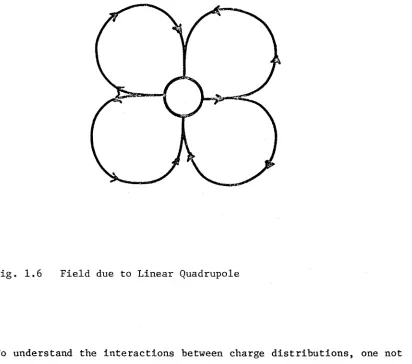
Here the z-axis is parallel to the line of charges and hence to the dipole moment. The field due to such a quadrupole moment is
[image:19.539.44.514.46.764.2]Fig. 1.6 F i e l d due to L i n e a r Q u a d r u p o l e
To u n d e r s t a n d the i n t e r a c t i o n s b e t w e e n cha rg e d i s tributions, one not
o n l y needs to k n o w the fields p r o d u c e d by the charges but also their
r e a c t i o n to an ap plied e l e c t r i c field. F o r instan ce c e r t a i n
o r i e n t a t i o n s of the charg e d i s t r i b u t i o n are e n e r g e t i c a l l y less
f a v o u r a b l e than others. To c a l c u l a t e f a v o u r a b l e orienta t i o n s , one
n e e d s to k n o w the e l e c t r o s t a t i c energy:
E Q i|>(0) + y V iKO) + y E E
2
9 lKO) 3x. 3 x .
i J
• • • (1.11)
H e r e c a r t e s i a n co- o r d i n a t e s h ave b een used. ^(0) is the
[image:20.539.63.475.51.415.2]The first term is the energy of a charge Q in an electrostatic potential ^(o) . The second term is the familiar - pjE| cosQ for the interaction of a dipole with the electric field E = - V ijj(o) where 0 is the angle between the dipole and the electric field. The
third term is the interaction of the quadrupole with the gradient of the electric field.
One can see that it is energetically favourable for the dipole to lie parallel to the electric field and for a linear quadrupole to lie parallel to the direction in which the field is changing most rapidly (i.e. perpendicular to the field lines).
By knowing that a dipole produces a field as illustrated in Fig. 1.5 and that it is energetically favourable for another dipole in the vicinity of the first dipole to lie parallel to the local field, one
can see that the arrangements of dipoles illustrated in Fig. 1.7 will themselves be energetically favourable. Each of the dipoles lies in the other's field. This sort of analysis will be useful when
discussing arrangements of molecules in liquids.
Finally, since the field produced by a charge distribution and
the reaction of a charge distribution to an applied field can be
written entirely in terms of the electrical moments, we shall therefore characterize a given charge distribution as the sum of
electrical moments
i.e. total charge + dipole moment + quadrupole moment + ...
Higher multipoles are only important in the intermolecular
interactions if the molecules are separated by very small
distances. For a fluid it is expected that the effect of the
multipoles higher than quadrupole on the macroscopic properties is
negligible.
1.5 Correlation functions
In section 1-2 to 1-4 the relation between molecular properties
and molecular interactions have been described. The next stage is to consider the effects of molecular interactions on macroscopic
properties of liquids. To do this, we make use of the pair correlation function g(l,2) defined by
p(l) g(1,2) p(2) dld2 = probability that a molecule can be found in
the volume dr^, about r (, and within an orientation dm^ of , and
similarly a molecule can be found in a volume d r2 about r2 and
within an orientation d w 2 . The notation 1 will denote the co
ordinate (£l*^l) anc* ^1 infinitesimal dr^ d w 1 . Here p(l) is
the number of particles per unit volume with position r^ and orientation a)j_ .
Some of the qualitative features of g(1,2) are immediately
13
F i g . 1 . 8 P o s s i b l e a r r a n g e m e n t s o f m o l e c u l e s i n a L i q u i d
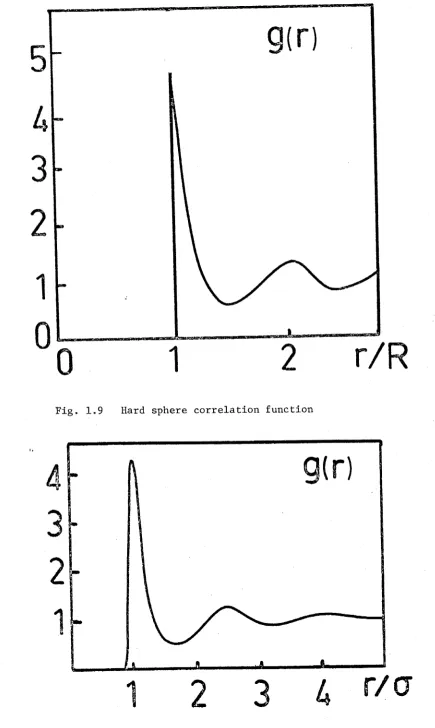
s p h e r e s a r e h a r d , t h e r e i s no p o s s i b i l i t y of t h e c e n t r e s o f t h e s p h e r e s b e i n g c l o s e r t h a n t h e s p h e r e ' s d i a m e t e r R. T h u s , f o r s e p a r a t i o n s l e s s t h a n R
g ( l , 2 ) = 0 .
The i n t e r n a l p r e s s u r e of t h i s s y s t e m r e s u l t s f rom t h e t i g h t p a c k i n g a r r a n g e m e n t . T h i s means t h a t t h e r e i s a s t r o n g p o s s i b i l i t y of f i n d i n g p a i r s of s p h e r e s s e p a r a t e d by d i s t a n c e s i n t h e r a n g e R t o R ' , w h e r e a s r e l a t i v e l y few p a i r s of s p h e r e s a r e s e p a r a t e d by
Fig. 1.9 Hard sphere correlation function
1 2 3 4 r/d
[image:24.539.62.497.54.782.2]15
I f t h e s p h e r e s a r e s o f t , t h e y can be s e p a r a t e d by d i s t a n c e s l e s s t h a n R. The c o r r e l a t i o n f u n c t i o n f o r s o f t s p h e r e s s h o u l d r e s e m b l e t h a t drawn i n F i g . 1 . 1 0 . T h i s i s v e r y s i m i l a r t o t h e c o r r e l a t i o n f u n c t i o n of l i q u i d a r g o n . At t h e h i g h d e n s i t i e s f ound i n l i q u i d s , i t seems t h a t t h e c o r r e l a t i o n f u n c t i o n i s m a i n l y d e t e r m i n e d by t h e
s h o r t - r a n g e d r e p u l s i v e c o r e r a t h e r t h a n t h e s l o w l y v a r y i n g c ompone nt s of t h e p o t e n t i a l s u c h as t h e va n d e r Waals a t t r a c t i o n . T h i s n o t i o n , o r i g i n a l l y u s e d by van d e r Waals i s t h e b a s i s of many numeric? schemes i n l i q u i d s t a t e p h y s i c s .
I f t h e s p h e r e s a r e imbedded w i t h d i p o l e s , t h e n t h e c o r r e l a t i o n f u n c t i o n h a s an add ed c o m p l i c a t i o n . The o r i e n t a t i o n of t h e d i p o l e i mbedded i n one p a r t i c l e ca n i n f l u e n c e t h e o r i e n t a t i o n of t h e s u r r o u n d i n g d i p o l e s . The c o r r e l a t i o n f u n c t i o n must r e f l e c t t h i s o r i e n t a t i o n d e p e n d e n c e . I t must d e pe nd on t h e o r i e n t a t i o n of e a c h p a r t i c l e as w e l l as t h e o r i e n t a t i o n of t h e i n t e r m o l e c u l a r a x i s . A v e r a g i n g o v e r t h e s e o r i e n t a t i o n s y i e l d s a f u n c t i o n s i m i l a r t o t h o s e
shown i n F i g u r e s 1 . 9 and 1 . 1 0 d e p e n d i n g w h e t h e r t h e s p h e r e s a r e h a r d o r s o f t . A g a i n , t h i s a g r e e s w i t h van d e r Waals n o t i o n of t h e l i q u i d i . e . t h e number of p a r t i c l e s a t a d i s t a n c e r f rom any g i v e n p a r t i c l e i s l a r g e l y d e t e r m i n e d by t h e s h o r t - r a n g e d r e p u l s i v e f o r c e r a t h e r t h a n t h e l o n g e r - r a n g e d d i p o l e - d i p o l e i n t e r a c t i o n . T h i s p r i n c i p l e w i l l be u s e d f r e q u e n t l y i n t h i s t h e s i s .
1.6 Dipolar fluids
Consider a fluid in which the molecules have a permanent dipole moment. A simple model of the molecule is a hard or soft sphere imbedded with a dipole. As will be seen in later chapters the effect of the higher multipolar interaction in liquids can be appreciable. There are, however, a number of reasons for neglecting higher moments
at this stage. It is of interest to investigate the effects of the dipole-dipole interaction without the complicating effects of dipole- quadrupole interactions, quadrupole-quadrupole interactions, etc. Secondly the long-range nature of the dipole-dipole interaction can cause problems with numericalschemes, so it is important to develop a scheme that can handle the interaction. If this can be done, one can have confidence in applying these schemes to more complicated models.
Recently, a large amount of work has been devoted to the
statistical mechanical study of dipolar fluids. This work has mainly centred on the calculation of the pair correlation functions and dielectric properties. While a certain degree of success has been achieved in modelling most aspects of the correlation functions, the same cannot be said for those aspects concerned with dielectric behaviour.
17
m a i n l y d e t e r m i n e d by t h e r e p u l s i v e f o r c e s r a t h e r t h a n t h e
d i p o l e - d i p o l e i n t e r a c t i o n ca n be u s e d as a b a s i s f o r p e r t u r b a t i o n l i k e s c h e m e s .
However as t h e d e n s i t y i s d e c r e a s e d , t h e g a p s b e t w e e n t h e p a r t i c l e s become l a r g e r and t h e l o n g e r - r a n g e d component of t h e p o t e n t i a l becomes r e l a t i v e l y more i m p o r t a n t . F o r a p u r e l y d i p o l a r f l u i d , t h e c o r r e l a t i o n f u n c t i o n w i l l a p p r o a c h
g ~ e x p ( - 3 UDD) ( 1 . 1 2 )
wh e re
3 = 1/ kT ( 1 . 1 3 )
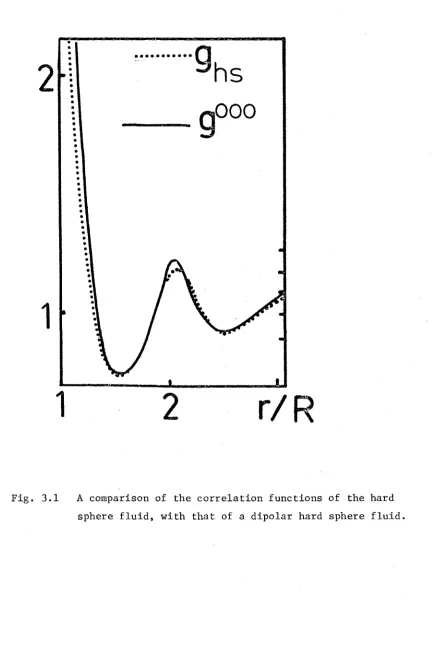
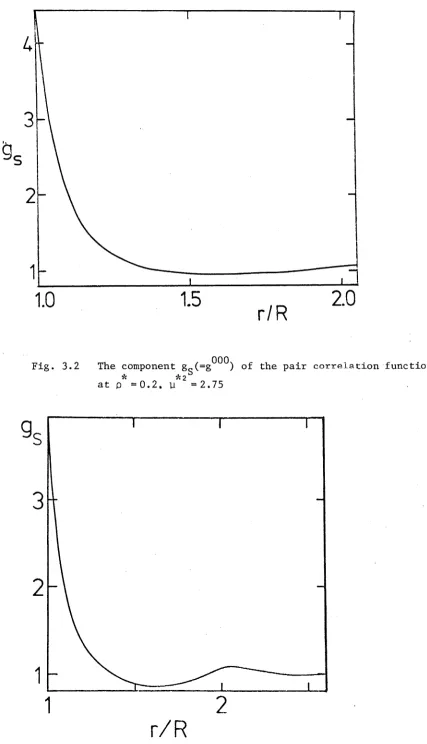
and U i s t h e d i p o l e - d i p o l e i n t e r a c t i o n p o t e n t i a l . I n C h a p t e r 3 a n u m e r i c a l scheme w i l l be d e v e l o p e d t h a t h a s t h i s c o r r e c t low d e n s i t y l i m i t and y e t s h o u l d be r e a s o n a b l y a c c u r a t e f o r h i g h e r d e n s i t i e s . The scheme ca n a l s o be u s e d f o r i n v e s t i g a t i n g t h e s h o r t c o m i n g s of u s i n g a p e r t u r b a t i o n - l i k e scheme b a s e d on va n d e r Waal s c o n c e p t of l i q u i d s . I t ca n t h e n h o p e f u l l y be u s e d i n a r o b u s t scheme t h a t g i v e s r e a s o n a b l e r e s u l t s o v e r a w i d e r a n g e of d e n s i t i e s and d i p o l e moments.
1. 7 D i p o l e s i n a F i e l d
an a n g l e 0 w i t h t h e e x t e r n a l f i e l d E w i l l be p( 0) = p e x p ( - 3 IEI c o s 0 )
o 1
0 = 1/kT
( 1 . 1 4 )
At h i g h e r d e n s i t i e s t h e r e w i l l be a d i s t o r t i o n of t h i s due t o t h e i n t e r a c t i o n b e t w e e n d i p o l e s . F o r s m a l l f i e l d s , p ( l ) w i l l be g i v e n by
p ( l ) = pQ e x p ( - b|e |c o s0 + / d2 c ( l , 2 ) p ( 2 ) ) ( 1 . 1 5 )
wh e re c ( l , 2 ) i s t h e d i r e c t c o r r e l a t i o n f u n c t i o n of t h e b u l k s y s t e m . [ c ( l , 2 ) w i l l be d i s c u s s e d i n c h a p t e r 2 . ] Thus t h e d e n s i t y p ( l ) d e p e n d s on c o r r e l a t i o n s i n t h e l i q u i d and s i m i l a r l y t h e c o r r e l a t i o n s d e p e n d on t h e d e n s i t y p ( l ) . Much of t h e p r e v i o u s work h a s b e en c o n c e r n e d w i t h t h e d e n s i t y r a t h e r t h a n t h e c o r r e l a t i o n . I n C h a p t e r 5, t h e l a t t e r i s s t u d i e d .
19
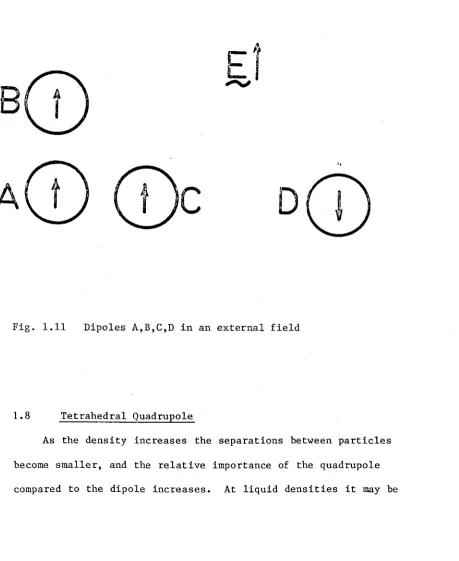
other. Because it lies anti-parallel to the external field, dipole D will be energetically unfavourable. The net effect is the production
of chains that repel each other. This chain formation has been observed in the so-called 'ferro-fluids' - colloidal dispersions of ferromagnetic grains.
Fig. 1.11 Dipoles A,B,C,D in an external field
1.8 Tetrahedral Quadrupole
[image:29.539.45.504.199.760.2]expected that the effect of quadrupolar interactions are significant. Previous calculations have only investigated the linear (axial) quadrupole i.e. the quadrupole of a series of charges lying on a single line. The field due to such a quadrupole is shown in
Fig. 1.6. In an applied field, such a quadrupole favours a direction perpendicular to the field whereas the dipole favours a direction parallel to it. If the permanent charge distribution of a particle is such that it has a dipole moment and a linear quadrupole moment, then it favours a direction at an angle to the field, the angle depending on the relative strengths of the dipole and quadrupole. Since the quadrupole decreases the alignment of the dipoles with the field, it can be expected that its neglect can lead to an
overestimate of the dielectric constant. Numeric^schemes [1] have shown that this overestimate can be appreciable even for moderate values of quadrupole moment.
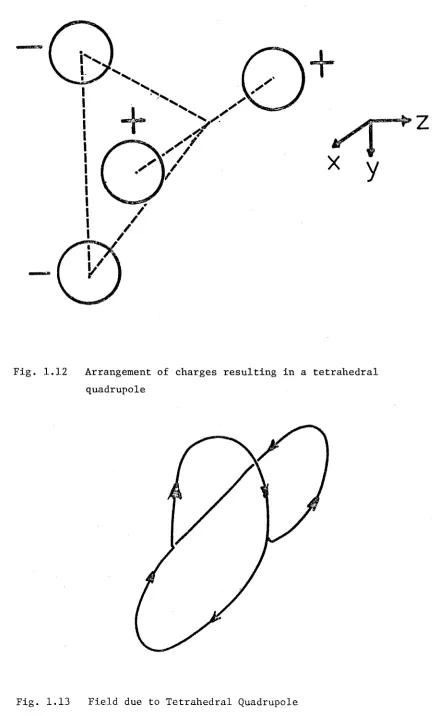
If in our simple picture of the molecule, the charges do not lie on a single line, then the quadrupole is more complicated. This would be the case with most molecules. For example, consider the
21
Fig. 1.12 Arrangement of charges resulting in a tetrahedral quadrupole
[image:31.539.50.486.58.774.2]U n l i k e t h e l i n e a r q u a d r u p o l e i t i s n o t c y l i n d r i c a l l y s y m m e t r i c , and so an e x t r a a n g l e i s n e e d e d t o t h e f i e l d due t o s u c h a q u a d r u p o l e moment.
The e f f e c t of an e x t e r n a l e l e c t r i c f i e l d on s u c h a p a r t i c l e i s a l s o more d i f f i c u l t t o d e s c r i b e . P e r h a p s t h e s i m p l e s t e x p r e s s i o n f o r t h e e l e c t r o s t a t i c e n e r g y i n a f i e l d E i s g i v e n i n t e r m s of t h e
m o l e c u l a r f r a me ( s e e F i g . 1 . 1 2 )
E = ( 1 . 1 5 )
The p a r t i c l e w i l l t e n d n o t t o a l i g n w i t h t h e f i e l d b u t i t s
o r i e n t a t i o n w i l l dep en d on t h e o v e r a l l symmetry of t h e l o c a l f i e l d r a t h e r t h a n t h e g r a d i e n t i n j u s t t h e one d i r e c t i o n , a s i s t h e c a s e w i t h t h e l i n e a r q u a d r u p o l e .
I n C h a p t e r 4 we f i n d t h a t i n s p i t e of t h e d e c r e a s e i n s ymmetr y, t h e t e c h n i q u e s t h a t ha ve b e e n u s e d f o r l i n e a r q u a d r u p o l e s can j u s t a s e a s i l y be u s e d f o r ’ t e t r a h e d r a l ' q u a d r u p o l e s and d i p o l e s .
T h i s i s an i m p o r t a n t s t e p , s i n c e t h e q u a d r u p o l e moment o f w a t e r r e s e m b l e s t h a t of t h e t e t r a h e d r a l q u a d r u p o l e . We ca n g a i n some i d e a s a b o u t t h e i m p o r t a n c e of t h e d i p o l e and q u a d r u p o l e moments of t h e w a t e r m o l e c u l e i n d e t e r m i n i n g t h e p r o p e r t i e s of w a t e r . F o r e x a m p l e , we would l i k e t o know wh a t e x t e n t t h e q u a d r u p o l e moment d e t e r m i n e s
23
1.9 Liquid Crystals
Thermotropic liquid crystals do not have an isotropic
liquid-solid transition as the temperature falls but exhibit a number of
transitions from an isotropic liquid phase through ordered phases to
a solid phase. In the ordered phases, there is no lattice structure
as in the solid, but there is considerable rotational order. For
example, in the 'nematic' phase the molecules tend to align with a
A
certain direction n called the 'director'. Yet, the positions of
the centres of the molecules are disordered as in a liquid. (See
Fig. 1.14)
Fig. 1.14 Arrangement of molecules in a nematic. The director in n
The isotropic-nematic transition has a number of interesting
features. It is a first order phase transition yet in many ways
resembles a second order transition. There are discontinuities in
the density, the internal energy and entropy, but these are small.
response functions of the isotropic phase (e.g. induced
birefringence) begin to diverge as the critical temperature, T c , is
approached from above. The phase change - occurs before the divergence is observed. This pre-transitional behaviour is usually not found in
first-order phase transitions.
It is thought that the small change of entropy means that
fluctuations are much more likely and this leads to pre-transitional
behaviour. The arrangement of the molecules in the isotropic phase just above T c does not resemble that in Fig. 1.15 as much as that in
Fig. 1.14
25
The fact that the isotropic phase does not exhibit a preferred
direction over a macroscopic length scale can be explained in terms
of a local director. In Fig. 1.14 this would be n . It is
postulated that in both the isotropic and nematic phases the local
director meanders through the liquid. In the isotropic phase, this
meandering would have no long-range correlation whereas in the
nematic phase it would favour a direction parallel to the bulk
director.
In Chapter 7, a general theory for the isotropic - nematic
transition is developed using the direct correlation function c(l,2).
The direct correlation function would include the effects of both the
short ranged repulsions and the longer range attractions. These have
been the centre of attention over recent years. The similarity in the local structure at T^ is both the isotropic and nematic phases is
used to quantify certain terras in the direct correlation function. By assuming that the distribution in a small volume (“ 20 molecules)
about the local director is the same for both phases, one can
calculate macroscopic properties in terms of the properties in this
small volume.
The theory can be extended to study properties of the nematic
phase. One consequence of the long range director of molecules is
the anisotropy of macroscopic properties. For example, the
refractive index and dielectric tensor are anisotropic. One property
that will be studied using the theory is the elastic behaviour of the
nematic phases. Stresses applied to the nematic phase could result
This behaviour is characterised by the elastic constants K^. The
are calculated in terms of the direct correlation function.
Moreover, the theory will be used to study the behaviour of the
nematic phase near a wall. The wall can have the effect of ordering
the molecules. In the past this has led to a number of birefringence
studies and theoretical studies for the fluid near the single wall.
The above theory applied to the system of two walls between which
there is a nematic liquid crystal.
References
[1] Patey, G. N . , Levesque, D . , Weis, J.J., 1979, Molec. Phys., 3 8 , 1635.
CHAPTER 2
SYMMETRY AND THE ORNSTEIN-ZERNIKE EQUATION
2.1 Rotational Invariant
The main problem in dealing with molecules that interact via anisotropic potentials is to find an adequate yet simple description of the angular dependence. In general, 3 Euler angles are needed to specify the orientation of a molecule _ to describe the axis of the molecule (polar and azimuthal angles) and another to specify the
rotation about that axis. The interaction potential depends not only on the orientation of both molecules but also on the orientation of the intermolecular axis. To deal with the 3 Euler angles, a
generalised spherical harmonic called the Uigner D-function is
used. It describes the 3 angles in much the same way as a spherical harmonic does with 2 angles. In the case where there is no
dependence on one of the angles the Wigner D-function is proportional to the spherical harmonic. The general properties are listed in Appendix 2-1.
The interaction potential can be written
u ( 1,2)
m 1n 1Ä1
m l £ u m 2n 2^2 (r) D m in i i i
m 3n 3Ä 3
m2m 2
m 2n 2^2 & 1
m 3n 3^3 D0 t 3<E>
(wi)
n l D
n 2n 3 (a)2)
29
where r is the intermolecular separation, is the orientation of
molecule 1, 002 is the orientation of molecule 2, r the orientation
of the intermolecular axis, all w. r.t. to some laboratory frame S.
Thus (£1 represents the 3 Euler angles needed to describe the
rotation of the frame S so that S lies parallel to 1. Translational
invariance has been assumed. Futhermore, the intermolecular
potential has rotational invariance. These two invariance properties
are the result of the intermolecular potential depending only on the
position and orientation of one molecule relative to the other. If
the observer, being the origin of a frame of reference, moves to one
side or cartwheels, he still sees the same separation and relative
orientations and thus the same intermolecular potential. To invoke rotational invariance one writes the potential as seen from some
reference frame T which results from the original frame S being
rotated. Since the potential as seen from frame S is the same as the one seen from frame T, the potential is independent of the rotation
T «- S . In Appendix 2.2 it is shown that this implies the potential
can be written as
(
2.
2)
y v where
mn£ 1
yv
*
31
and r m n £ \ ^ - y ' v' X' >
is a W i g n e r 3-J symbol. T h e impo r t a n t p r o p e r t i e s of the 3-J symbo ls
and the m a n n e r in w h i c h they limit the range of s u mmations in (2.2)
and (2.3) are g iven in A p p e n d i x 2.3 and [1] and [2]. By using the
form (2.2) the a n g u l a r p r o p e r t i e s of the p o t e n t i a l are s e p a r a t e d f rom
the r- dependence. O u r d e f i n i t i o n of the so-ca l l e d ’r o t a t i o n a l
inva ria nt ' is the same as that in [3] w h i l e that of B l u m [4-6] yv
( d enoted by a caret) is g i v e n by
»£) = (“ ) y ((2m + 1) (2n + 1) • (2.4)
2.2 O t h e r s y mmetries
T h e r e are some f u r t h e r s y m m e t r i e s w o r t h menti on ing .
(i) P e r m u t a t i o n of m o l e c u l e s
T h e r e is no reason w h y one m o l e c u l e sho ul d be lab elled 1 and not
the other; h e n c e
u( 1,2) = u ( 2 ,1) .
In terms of the r o t a t i o n a l i n v a r i a n t s
m n £
yv
m n £ u
yv (r) $ m n £
(m i ,U2,r)
u ( 2 , 1 )
in n V
ra’ n ' V , >.
V v * ( r ) ( “ 2 . S1» - <2 - 6 ) y * v*
wh e r e - r i s t h e o r i e n t a t i o n of some f r a m e i n wh i ch t h e z - a x i s i s a n t i - p a r a l l e l t o t h e z - a x i s of r . T h i s i m p l i e s
U m" ‘ ( r ) = ( - ) P + V + » + n unm l ( r ) < ( 2 . 7 )
pv - v - p
( i i ) M o l e c u l a r s ymm et ry
Most m o l e c u l e s h a v e o b v i o u s s ymmetry p r o p e r t i e s and we s h a l l
e x a mi n e t h e c o n s e q u e n c e s of some o f t hem.
( a ) I f t h e m o l e c u l a r p r o p e r t i e s a r e s y m m e t r i c a b o u t t h e z - a x i s , t h e n t h e r e i s no d e p e n d e n c e on t h e r o t a t i o n y a b o u t t h a t a x i s . T h i s i m p l i e s
f ( 1 , 2 ) = E f m n 1 ( r ) $>m n 1 (ü) ! ,0)2 , r ) . ( 2 . 8 )
o o o o ~ ~
( b ) I f m o l e c u l e s h a v e C2V s ymme tr y ( i . e . a 2 f o l d r o t a t i o n a b o u t
t h e z - a x i s as w e l l a s a r e f l e c t i o n symmetry i n t h e x - y and y - z p l a n e s ) i t ca n be shown [4] t h a t
V11 n Z ( r ) = V’J n f' ( r ) y , v e v e n . ( 2 . 9 ) p v ± p * v
33
( i i i ) Combined M o l e c u l a r Symmetry
I n ( i i ) , s y m m e t r i e s of t h e i n t e r a c t i o n p o t e n t i a l a r o s e when c h a n g e s i n a m o l e c u l e d i d n o t a l t e r t h e m o l e c u l e ' s p r o p e r t i e s .
However t h i s i s a s p e c i a l c l a s s of s y m m e t r i e s s i n c e some s y m m e t r i e s i n v o l v e b o t h m o l e c u l e s . C o n s i d e r , f o r e x a m p l e , a p a r t i c l e i mbe dde d w i t h a t e t r a h e d r a l q u a d r u p o l e . A r o t a t i o n of t h e p a r t i c l e t h r o u g h an a n g l e of tt/2 a b o u t t h e z - a x i s i s e q u i v a l e n t t o c h a n g i n g t h e s i g n o f t h e q u a d r u p o l e moment. I f a n o t h e r p a r t i c l e i s s i m i l a r l y r o t a t e d , i t s q u a d r u p o l e moment i s a l s o c h a n g e d . T h u s , t h e r o t a t i o n of b o t h
p a r t i c l e s l e a v e s t h e q u a d r u p o l e - q u a d r u p o l e i n t e r a c t i o n u n a l t e r e d . The s y m m e t r i e s i n v o l v i n g b o t h p a r t i c l e s a r e more d i f f i c u l t t o f i n d .
2 . 3 I n t e r a c t i o n P o t e n t i a l I n v o l v i n g I o n s , D i p o l e s and Q u a d r u p o l e s The e l e c t r o s t a t i c e n e r g y of a s y s t e m o f p a r t i c l e s w i t h c h a r g e s and p e r m a n e n t ( n o n - p o l a r i z a b l e ) moments c an be r i g o r o u s l y w r i t t e n a s t h e sum o f e n e r g i e s of e a c h p a i r of p a r t i c l e s
N
i . e . u ( l , 2 , - * * , N ) = E £ u ( i , j ) . ( 2 . 1 0 ) i - 1 j > i
The l a t t e r e n e r g y u ( i , j ) c a n be w r i t t e n i n t e r m s of t h e c h a r g e ,
d i p o l e moment and q u a d r u p o l e t e n s o r of p a r t i c l e s i and j . T h i s c o u l d be done u s i n g t h e e q u a t i o n s o f C h a p t e r 1 t o d e t e r m i n e t h e e l e c t r i c a l f i e l d p r o d u c e d by p a r t i c l e i and t h e n c a l c u l a t e t h e e l e c t r o s t a t i c e n e r g y o f p a r t i c l e 2 l y i n g i n t h i s f i e l d . E q u a t i o n ( 1 . 3 ) d e s c r i b i n g
a r e ference frame as s o c i a t e d w i t h that charge distribution. A.
p a r t i c u l a r l y c o n v e n i e n t frame of r e ference is one in w h i c h the
m o l e c u l a r z-axis lies p a r a l l e l to the dipole. S i m i l a r l y e q u a t i o n
(1.11) d e s c r i b i n g the e l e c t r o s t a t i c e n e r g y of a charge d i s t r i b u t i o n
lying in an e l e c t r i c field is w r i t t e n w i t h a frame of r e ference
a s s o c i a t e d w i t h that charge d i s t r i b u t i o n . G i v e n that u(l,2) needs to
be c a l c u l a t e d for a r b i t r a r y s e p a r a t i o n s and o r i entations, c h a n g i n g
f r o m one frame of reference to the o ther is not p a r t i c u l a r l y
convenient.
I n stead, the i n t e r a c t i o n of e ach charge in p a r t i c l e 1 w i t h
each c harge qj » in p a r t i c l e 2 is summed:
T h e d ash indic a t e s q u a n t i t i e s a s s o c i a t e d w i t h p a rticle 2. Self
terms of the s e p a r a t i o n of the centres of the particles, r, the
o r i e n t a t i o n of e ach particle, as w e l l as the o r i e n t a t i o n of the
i n t e r p a r t i c l e axis. T h e r e s u l t i n g e q u a t i o n [1,2] is uU,2) = Z Z
Tr~"-~r'-i j '-i -j
(
2.
11)
ener g i e s h a v e been ignored. The t erm
u ( l , 2 ) = Z (_)m + u (2£ + 1)! ( 2 m ) !( 2 n ) !
l/2 Q P(l) Q V (2)
^ m n
m,n
P»v
(
2.
12)
E m, n
H,v
35
H e r e £ m + n and t h e r a u l t i p o l e moment Q^1 ( 1 ) i s d e f i n e d by m
( 1 )
-m _m r D
pa oy ( u i ) ( 2 . 1 4 )
wh er e t h e c o - o r d i n a t e of c h a r g e a i s ( r , 9 , d> ) i n t h e m o l e c u l a r 0 - a ’ a ’ Ya
a x i s s y s t e m . The r e l a t i o n s h i p b e t w e e n Q u and t h e m u l t i p o l e moments m
of e q u a t i o n s ( 1 2 . 1 —1 8 ( a ) ) o f [2] i s m
ou to
u- u
( m - y ! ) ( m + y 0V
2O)
m ( 2 . 1 5 )
T h e s e c a n be r e l a t e d t o t h e t o t a l c h a r g e , d i p o l e moment and
q u a d r u p o l e moment u s i n g ( 1 2 . 1 . 1 6 ) , ( 1 2 . 1 . 2 2 ) - ( 1 2 . 1 . 2 4 ) of [ 2 ] , F o r e x a m p l e Q° = q i s t h e n e t c h a r g e on t h e m o l e c u l e ; and i f t h e
m o l e c u l e h a s a d i p o l e moment, y , a l o n g t h e z - a x i s ; Q° = y . The s y m m e t r i e s d i s c u s s e d i n s e c t i o n 2 . 2 g i v e us i n f o r m a t i o n
mnl
a b o u t t h e c o e f f i c i e n t s u ( r ) . F o r d i p o l e s , l i n e a r q u a d r u p o l e s o r any a x i s y m m e t r i c m o l e c u l e , y = v = 0 • F o r m o l e c u l e s w i t h C2V
symmetry s u c h as w a t e r and t e t r a h e d r a l q u a d r u p o l e s , we n e ed o n l y y, v = - 2 , 0 , 2 and
mn£ u
yv ( r )
mn£
u,
-4= y ± v ( r ) ( 2 . 1 6 )
I f we a r e d e a l i n g w i t h a l i n e a r q u a d r u p o l e , t h e o n l y n o n - z e r o m u l t i p o l e moment i n ( 2 . 1 2 ) a r e Q° = q t h e n e t c h a r g e , Q° = y t h e d i p o l e moment and Q® = 0 = - 0 t h e l i n e a r q u a d r u p o l e moment
Z Z
charge-charge
U cc = q $0° 000 r = 9 r » (2.17)
charge-dipole
1/2 - _ 2
U CD = 3 9b $0 00 1 1(i£l»^2»r) r , (2.18) dipole-dipole
U DD = ~ 30 / y $o o 112 r » (2.19)
charge-quadrupole
U CQ = 3 / q0L $00 022(^1>£2>£) r , (2.20)
L
dipole-quadrupole
uDq = " 105 ^ p0L $00 123 (“ 1»“ 2»5.) r , (2.21)
L
quadrupole-quadrupole
UQ Q = 3(70) 1/2 0L 2 t00224 (<Sl,S2,r) r'5 , (2.22)
li L
In (2.18) and (2.20) the position vector r is directed towards the
higher multipole. We note that for this ion-dipole-linear quadrupole
system the molecules have axial symmetry so we always have
y = 0 = v .
If instead of a linear quadrupole, the charge distribution has a
tetrahedral quadrupole
3 7
t h e n o n - z e r o m u l t i p o l e moments a r e Q° = q , Q° = p and
Q2±2 = ( 2 4 ) - 1/ 2 = ( | ) 1 / 2 £L ( 2 . 2 4 )
C o n s e q u e n t l y t h e c h a r g e - c h a r g e , c h a r g e - d i p o l e and d i p o l e - d i p o l e i n t e r a c t i o n s f o r t h i s c a s e i s t h e same as t h a t g i v e n by ( 2 . 1 7 ) - ( 2 . 1 9 ) . I n t e r a c t i o n s i n v o l v i n g t h e t e t r a h e d r a l q u a d r u p o l e a r e of t h e f orm
c h a r g e - q u a d r u p o l e
UCQ = ( 1 0 / 3 ) 7 qOT $ 022( wi>w2 , r ) r , ( 2 . 2 5 )
dipole-quadrupole
UD0 = " 7° / y0T ^ 123^ 1 >^2»£.) r , ( 2 . 2 6 )
quadrupole-quadrupole
UQ 0 = 2 ( 7 0 ) 1 / 2 e 2 4'224(<Si,iS2,r) r' 5 , ( 2 . 2 7 )
w i t h
0 2 2 0 2 2 0 2 2
$ in o 0 1 N> + $ 0 2 > ( 2 . 2 8 )
1 2 3 1 2 3 1 2 3
$ in <Q> 0 1
N
> + $ 0 2 > ( 2 . 2 9 )
2 2 4 2 2 4 2 2 4 2 2 4 2 2 4
$ C
M
C
M
•O
II
I +
Thus by comparing (2.20)— (2.22) with (2.25)— (2.27) we see that the potentials involving the tetrahedral quadrupole can be obtained from those for the linear quadrupole by the substitution
0L +
(i) V2
$qq mnl $mnl
(2.31)
2.4 Ornstein-Zernike
As yet, the method of calculating the correlation function from the interaction energy has not been described. In this thesis, this will be done using integral equation techniques. The development of the integral equation techniques is not given here, but may be found in any of the books on the subject [10-12]. For a potential of the form (2.10) it is found that
h( L ,2) = c(l,2) + / p(3) c( 1,3) h(3,2) izf%Tp- (2.32)
and
Jtn(l + h ( 1,2)) = h ( 1,2) - c(l,2) - 8 u(l,2) + B(l,2)
0 = 1/kT (2.33)
39
certain integrals. Equation (2.32) is called the Ornstein-Zernike
(OZ) equation and (2.33) its closure. For hard particles these need
to be supplemented by the equation
h( 1,2 ) = -1 (2.34)
for all separations and orientations in which particles 1 and 2
overlap. For hard spheres of diameter R this becomes
h(l,2) = - 1 for r < R . (2.35)
There are a number of well known approximations to the closure
(2.33).
(i) Hypernetted Chain Approximation (HNC):
B( 1,2) = 0 (2.36)
or
Än(l + h ( 1,2)) = h ( 1,2) " c(l,2) - 3u(l,2) (2.37)
(ii) Percus Yevick ( P Y ) :
(iii) Mean Spherical Approximation (MSA):
c( 1,2) = - ßu (1,2 ) (2.39)
The MSA and PY closures may be regarded as linearised forms of the
HNC.
2.3 Correlation functions in an isotropic system
For an isotropic system the correlation functions (g,h,c) will
have the same symmetries as the potential. By appealing to
translational and rotational invariance of the the bulk fluid, we can
use the following expansion
f (1,2) = E fmn^ (r) (aj1,w2 ,^) (2.40)
yv yv ~
mnl
where f = g,h,c. For axisymmetric potentials, only r (r) are oo
non-zero, whereas in molecules with C 2 v syraraetry> y = v = - 2,0,2 and
fmn£ (r) = fmn£ (r) . (2.41)
yv ± y ± v
For molecules with tetrahedral symmetry (e.g. tetrahedral
quadrupoles) there is a further symmetry: f(1,2) is invariant under
the rotation of both molecules by tt/2 about the z-axis of the molecular frame. For tetrahedral quadrupoles, this is equivalent to
reversing the sign of each charge. This symmetry implies
are fm n ^ (r) ancj 0 (r) . Thus, symraetry can reduce the
oo ± £ x ^
number of coefficients which we need to solve. The problem is to m n l write the 0-Z equation and associated closures in terms of f (r)
yv and solve for these functions. The 0-Z equation takes the form of a
convolution of the variables r i - r_2, r 2 ~ £ 3 , r 3 - r 1 ; so that by
taking the three dimensional Fourier transforms it can be written as
h(1 ,2 ) = c(1 ,2 ) + 1 / dc^3 c( 1,3) p h ( 3 ,2) (2.42)
where
~ N „ ~mn£ ,, N mnJl , " h( 1,2) = l h (k) $ (o)1? u}y, k)
yv yv ^ ~
ra,n, £ y v
h ^ V ) = 4n i* /P dr r 2 j, (kr) h " l(r)
yv J J £ yv
o
(2.43)
(2.44)
and j ^(kr) is a spherical Bessel function of order £ (see Appendix
2.4). There is also a similar set of transformations for c. We can
construct a multiplication table for the angular convolution in
(2.24) using the result
/ d w 3 (u)!, u>3, k) (w3, o)2, k)
x x , xm+n+n* ^ 2L + h fl' £ L ^ r l ’ £ Li n m ' y v A ' _ l2n + 1J [0 0 0 j V n' n*
Li
m n ' L ( f *
% v ' (“1* ^3> k)
(2.45)
The range of the sum over L is limited by the properties of the
1 ’ i L m n' n
summarized in Appendix 2.3. We substitute (2.42) into (2.43) and use
(2.45) together with the orthogonality condition (see Appendix 2.1)
--l-7T-? / du>i / do)2 / dk $^*(0)!, 0)2, k) (ü>i,U)2,k)
( 8 7T ) ^ M
1
(2.46)
(2m+l) (2n+l) (2£+l) ^mm' ^yy' ^vv' ^ i V
to obtain
mn£ yv (k)
Amn£ = c (k) +
yv
z (_ )^ n+n' r1" 1 ’
n ' l ' r v 0 0
b o 1" m 1' n
£1 r 2 % + 1 n' ' l2n'+ 1
N ~mn'l' . ~ n ’nl'' .
J C (k) p h , (k)
J yv v v | V < n'
(2.47)
which is equivalent to equations (2.18)-(2.21) of [5]. Following
Blum [4] we define the linear combinations (see Appendix 2-4)
jrmn
x, yv(k) (“ ) X E
£mn£
yv (k) (2.48)
and use the properties of the 6-J symbol to get
pmn h
x, yv(k) c x, yv(k) + l n\v'
1 2n' + 1
'Mnn
c I
x, yv'
,, \ rn n (k) p h
43
w h e r e n ' > x and | v f
j
< n ' . E q u a t i o n ( 2 . 4 9 ) whi ch i s e q u i v a l e n tt o e q u a t i o n ( 2 . 3 3 ) of [ 4 ] , i s a g e n e r a l r e s u l t wh i c h r e s e m b l e s t h e 0-Z e q u a t i o n f o r a s i m p l e f l u i d m i x t u r e s i n c e a l l a n g u l a r v a r i a b l e s h a ve b e e n removed and t h e f u n c t i o n s depe nd o n l y on t h e m a g n i t u d e of
t h e wave v e c t o r .
The t r a n s f o r m a t i o n i n ( 2 . 4 8 ) i s a g e n e r a l i s a t i o n of W e r t h e i m ' s c h o i c e of h+ and h a s a l i n e a r c o m b i n a t i o n of h ^ and h^ f o r t h e c a s e of d i p o l a r f l u i d s [ 7 ] , F o r e a c h a l l o w e d v a l u e of x , ( 2 . 4 9 ) s e p a r a t e s i n t o a s e r i e s of s i m p l e r e q u a t i o n s of t h e u s u a l 0- Z f orms w i t h b l o c k m a t r i x s t r u c t u r e . The a bo ve e q u a t i o n s can be g e n e r a l i s e d
i n t h e u s u a l way f o r m i x t u r e s .
2 . 6 C y l i n d r i c a l Symmetry
The c o r r e l a t i o n f u n c t i o n s n e e d n o t a l w a y s h a ve t h e same s y m m e t r i e s a s t h e i n t e r a c t i o n p o t e n t i a l . W hi le t h e i n t e r a c t i o n p o t e n t i a l o n l y d e p e n d s on t h e r e l a t i v e p o s i t i o n s and o r i e n t a t i o n s of t h e m o l e c u l e s , t h e same i s n o t a l w a y s t r u e of t h e c o r r e l a t i o n
f u n c t i o n s . C o n s i d e r , f o r e x a m p l e , an ' a l i g n e d * f l u i d ( i . e . a f l u i d i n w h i c h t h e m o l e c u l e s h a v e a p r e f e r r e d o r i e n t a t i o n ) . Two s u c h f l u i d s woul d be
( i ) a s y s t e m of d i p o l e s u n d e r t h e i n f l u e n c e of an e x t e r n a l f i e l d E .
( i i ) a n e m a t i c l i q u i d c r y s t a l .
lie anti-parallel to E whereas in (ii) there is no distinction between r and - n .
The correlation functions of an aligned fluid depend not only on the orientations of the molecules relative to each other, but also their position and orientation relative to the preferred direction. (This direction shall hereafter be referred to as the 'principal axis’.) Thus these correlation functions still have translational invariance but the rotational invariance has been replaced by a more restricting condition. Whereas the interaction potential is
unaffected by the rotation of the frame of reference about any axis, the correlation functions are generally affected by all rotations except those about an axis parallel to the principal axis. In Appendix 2.5 it is shown that the correlation functions can be written (for cylindrically symmetric particles)
f(l,2) = E f”^ ( r ) («1, o»2, r, z) (2.50)
Tm n ^(l,2, R, S) = Dm (a)!) Dn (u>2) / (r) ^ (2.51)
pv o p - 1 ov o Ä ~ X , y - v
measured w.r.t. a frame S, in which the z-axis is parallel to the principle axis. This result is a simple consequence of rotating the frame of reference about the principle axis. In the case of
rotational symmetry, the coefficient degenerates into the following form
^mnl
PV (r)
^mnl /m n 1> p
where the notation on the r.h.s. is the same as eqn. (2.2).
2.7 Symmetry of dipoles in an external field
A system of dipoles under the influence of an external field E
is an example of an 'aligned' fluid. Therefore, its correlation
functions f(1,2) (f = g,h,c) can be written
f(1,2) „ rmnE f l,(r) N mnf.¥ (c^, u>2 ,
yv yv
Clearly f(l,2) remains invariant under the permutation of molecules
and so
h“ n- (r) = ( - ) ^ hmni (r) (2.53)
yv -v-y
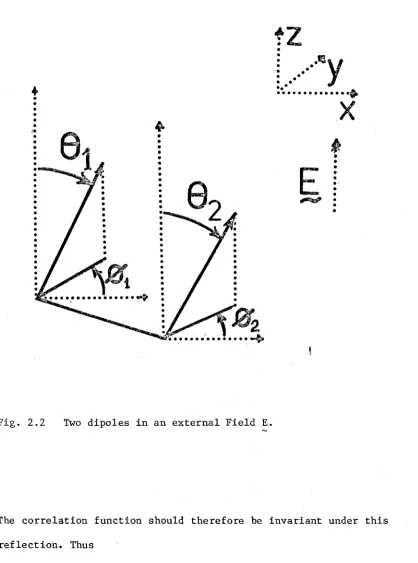
There is another symmetry which is not so obvious. Consider the
dipoles in Fig. 2.2. The centres lie in the plane of the page (x-z
plane) and generally their axes lie out of the plane. If both
molecules are reflected about the x-z plane
(i) y • E remains constant
(ii) r • 2-1 eg
)
2
-1 remains constant
Fig. 2.2 Two dipoles in an external Field E.
The correlation function should therefore be invariant under this reflection. Thus
.mn£, mn. L
h (r) = h (r)
[image:56.539.59.477.51.614.2]2.8 0-Z e q u a t i o n for c y l i n d r i c a l l y symme t r i c sys tem s
If it exists, the 3 - d i m e n s i o n a l F o u r i e r t r a n s f o r m f of a
c y l i n d r i c a l l y i n v a r i a n t f u n c t i o n f takes the form
f = E f ^ ' j C k ) Z 1? ", ( coi, o)2 , k, z)m.Z
m* n (2.55)
whe re
2mn£ m' nt(k)
Z , 2
4tt(i ) / dr r j £(kr) fm ,n ,(r) o
(2.56)
In terms of this F o u r i e r tra ns for m, the 0-Z e q u a t i o n for a
c y l i n d r i c a l l y s y m m e t r i c s y s t e m bec o m e s
vy v y
p=0 r ' p ^ l ’ V ^ ’ 1 ' ^ ’
rmnL.v -mn£,. . „ „ ~mn'£f, . "m'n l' . r
h (k) = c wii (k) + E Ep^ c yyii. (k) h , (k) [Q Q £' £" £
(2.57)
f1' r ' J) (2t+ 1) (P n’ m 'l fp n ' m ’)(-)X + P' ’•A' X"
L>
'o 0 0 J L0 u'-v' 1
w h e r e the den s i t y
p( w)
p=0
p P (cos9) P P
(2.58)
w h e r e 9 is the se cond E u l e r angle of u> .
Th e e x p r e s s i o n (2.57) is too c o m p l i c a t e d to be useful. It is
only for sp ecial cases w h e r e the d e n s i t y e x p a n s i o n (2.58) is simple
that these e q u a t i o n s d e g e n e r a t e into u seful forms. F or instance, the
as given by (2.47). In Appendix 2-6 it is shown to be true and
- )
■m n -p v
Z ^ mnJL J h (r) A ' OO
(2.59)
where the LHS is the coefficient of mn
JL
coefficient of $ oo
mn L an(j r h s is the pv
Another special case is a system of totally aligned molecules. In Appendix (2.6) it is shown that the equations (2.57) reduce to
+ E l ' l "
1" 0
-l’(k)
c h
-TOO
(2£ + 1) (2.60)where
h( 1,2) = E h'(r)P (cos9) (2.61)
This agrees with another derivation [13].
2.9 Summary
The angular dependence of the interaction potential and the correlation functions anions can be contained in a set of orthogonal functions. For all the systems described, the interaction energy can be written
mn v / ,nm2 , ^,
E u (r) $ (ui, u>2, r) pv p v ^ ~ ~ u ( 1,2)
c o r r e l a t i o n f u n c t i o n s f ( 1 , 2 ) ( f = g , h , c ) can be w r i t t e n
f ( 1 , 2 ) „ .n r n i, v ,mn,L E f ( r ) $ ( u i , (Do, r ) ,
yv yv ~
f o r an i s o t r o p i c s y s t e m a n d
f ( 1 , 2 ) E f mn^ ( r )
yv yv
l
VWi , ^2» E> 5.)
f o r an a l i g n e d s y s t e m .
.mn/,
The p r o b l e m i s t o c a l c u l a t e t h e c o e f f i c i e n t s f ( r ) f ro m t h e yv
m n^
f u n c t i o n s u ( r ) . T h i s i s done w i t h t h e u s e o f t h e O r n s t e i n - yv
Z e r n i k e ( 0 - Z ) e q u a t i o n . The 0 - Z e q u a t i o n h a s b e e n w r i t t e n i n t er ras mn
of f ( r ) i n ( 2 . 4 9 ) f o r t h e b u l k s y s t e m s and i n ( 2 . 5 7 ) f o r t h e yv
a l i g n e d s y s t e m . T h e r e a r e an i n f i n i t e number of c o e f f i c i e n t s mn/
f ( r ) and some t r u n c a t i o n n e e d s t o be made. yv
The 0-Z e q u a t i o n i s s u p p l e m e n t e d by t h e c l o s u r e r e l a t i o n . A p a r t from t h e MSA wh i c h i s e x p e c t e d t o be i n a c c u r a t e , t h e c l o s u r e s a r e n o n l i n e a r f u n c t i o n s of t h e c o r r e l a t i o n f u n c t i o n s and t h e i n t e r a c t i o n p o t e n t i a l and h e n c e t h e o r t h o g o n a l f u n c t i o n s $ and ¥ . T h e s e n e ed t o be e i t h e r e x p a n d e d i n t h e $ ’ s and 'F’ s and a p p r o x i m a t e d . The c l o s u r e r e l a t i o n w i l l be d i s c u s s e d i n d e t a i l i n t h e work on d i p o l e s .