2012
Europe Direct is a service to help you fi nd answers to your questions about the European Union.
Freephone number (*):
00 800 6 7 8 9 10 11
(*) Certain mobile telephone operators do not allow access to 00 800 numbers or these calls may be billed.
More information on the European Union is available on the Internet (http://europa.eu).
Cataloguing data can be found at the end of this publication.
2012 EU Youth Report
Th e adoption of the 2012 Joint Report of the Council and the Commission on the implementation of the renewed framework for European cooperation in the youth fi eld (2010-2018) coincided with the Cypriot Presidency of the Council of the European Union; a Presidency which has youth at the centre of its priorities. It also coincided with a period of a fi scal and economic crisis, which threatens to transform today’s youth, into a “lost generation”.
Th e Cyprus Presidency has worked Towards a Better Europe; an EU more relevant to its citizens and to the world; more eff ective, contributing to sustainable growth, social cohesion and job creation through effi cient and integrated policies, on the basis of the underlying principle of solidarity. We believe that the participation of young people and youth organisations in this ongoing eff ort is instrumental. At the same time, we understand that it is imperative to work consistently for the implementation of our political commitments towards youth, in order to empower young people to realise their full potential.
Th e Joint Report summarises the results of the fi rst work cycle of the renewed framework (2010-2012) and proposes priorities for the next cycle. It presents statistics on how the fi nancial crisis has aff ected the situation of young people in the EU. It also highlights that the EU should focus more on the consequences of the current crisis on young people, particularly on their social inclusion, health and well-being.
Creating more and equal opportunities for all young people in education and the labour market, promoting active citizenship, social inclusion and solidarity are the pillars upon which our eff orts should be based. All tie in well with Europe 2020, Youth on the Move and the Youth Opportunities Initiative. Th e EU should do its utmost to encourage young people to become involved in shaping the EU’s future. In this context the creation of new cross-sectoral partnerships and development of joint projects and initiatives in the youth sector is vital.
I would like to congratulate all those who have contributed in the compilation of this report for their remarkable work.
Foreword of the Cyprus presidency
2012 EU Youth Report
We live in challenging times. Youth unemployment rates have increased by more than 50 % since spring 2008, with almost one in four young people in the labour market today without a job. Th is is more than double that of the total working population. Th is unacceptable situation has far-reaching social consequences for young people, who face a higher risk of falling into poverty and not being able to aff ord a home or establish their own family. Th is can have a detrimental impact on their health and well-being.
If we fail to invest in young people now, the result may create a society where young people are disengaged or alienated. We have to do more for young people and with young people to improve this situation. Mobilising all policy areas that have an impact on young people, at diff erent levels of governance, and developing cross-sectoral solutions is key. At the same time however, young people should be more involved in shaping the policies that aff ect them.
Th e 2012 EU Youth Report, the fi rst joint report by the Council and the Commission in the youth fi eld, documents how the Renewed Framework for European Cooperation in the Youth Field (2010-2018) – also referred to as the EU Youth Strategy – has played an important role in supporting national youth policy since it entered into eff ect in 2010. It presents what EU Member States and the Commission have done to implement the EU Youth Strategy over the past three years, and sets Employment, Social Inclusion and Health & Well-being as priorities in the youth policy fi eld for the next three-year cycle.
I would like to thank all Member States and especially the Council of Youth Ministers for their eff orts, and for expressing a shared commitment in addressing young people’s concerns and interests. I also thank the European Youth Forum for its voice in developing EU actions in the youth fi eld and for its input feeding into this reporting exercise.
Together, this package clearly shows that many good practices in proactive youth policies exist at local, national and European levels, but it also reveals that a lot remains to be done for young people across the European Union and beyond.
I hope that the EU Youth Report 2012 inspires and provides the necessary evidence for new policy activities to fully understand what it means to be young in Europe today, and, most of all, to help reinforce our determination to address the considerable challenges faced by many young people across the EU.
Foreword of the European Commission
2012 EU Youth Report
Table of contents
1. 2012 EU Youth Report
1
2. Joint Report of the Council and the Commission on the implementation
of the renewed framework for European cooperation in the youth fi eld
7
3. Results of the fi rst cycle of the Open Method of Coordination
in the youth fi eld (2010-2012)
19
1. Introduction 25
2. General Overview of Youth Policy 29
2.1. Youth policy: a policy based on evidence 31
2.2. Legal framework and national youth policy environment 31
2.3. Implementation of the fi rst cycle of the EU Youth Strategy 36
3. Youth Employment and Entrepreneurship 41
3.1. Commission initiatives and action 43
3.2. Summary of initiatives and action at national level 45
3.3. Youth-led initiatives and action 50
4. Education and Training 53
4.1. Commission initiatives and action 55
4.2. Summary of initiatives and action at national level 57
4.3. Youth-led initiatives and action 60
5. Social Inclusion 63
5.1. Commission initiatives and action 65
5.2. Summary of initiatives and action at national level 67
5.3. Youth-led initiatives and action 73
6. Health and Well-being 75
6.1. Commission initiatives and action 77
6.2. Summary of initiatives and action at national level 78
6.3. Youth-led initiatives and action 80
7. Youth Participation 83
7.1. Commission initiatives and action 85
7.2. Summary of initiatives and action at national level 86
7.3. Youth-led initiatives and action 91
8. Voluntary Activities 95
8.1. Commission initiatives and action 97
8.2. Summary of initiatives and action at national level 98
8.3. Youth-led initiatives and action 101
9. Culture and Creativity 105
9.1. Commission initiatives and action 107
9.2. Summary of initiatives and action at national level 108
9.3. Youth-led initiatives and action 111
10. Youth and the World 113
2012 EU Youth Report
4. Status of the situation of young people in the European Union
141
1. Introduction 145
2. Demography 149
2.1. How many young Europeans are there? 151
2.2. Past and future trends in European youth population 151
2.3. Increase in the mobility of young Europeans 157
3. Youth Employment and Entrepreneurship 159
3.1. Introduction 161
3.2. Transition from education to employment 161
3.3. Th e position of young people in the labour market 165
3.4. Support for the transition to employment 178
4. Education and Training 183
4.1. Introduction 185
4.2. Formal education 185
4.3. Non-formal education and training and youth work 191
4.4. Learning mobility 193
5. Social Inclusion 197
5.1. Introduction 199
5.2. Moving towards autonomy: young people leaving the parental home 199
5.3. Levels of poverty and social exclusion 201
5.4. Aspects of poverty and social exclusion 206
5.5. Groups at risk of social exclusion 211
6. Health and Well-being 215
6.1. Health and risks 217
6.2. Mental and psychological distress 228
7. Youth Participation 231
7.1. Introduction 233
7.2. Young people’s interest in politics 233
7.3. Young people’s participation in representative democracy: voting, standing in elections and joining
a political party 235
7.4. Other forms of participation by young people, ranging from engagement in civil society to public
demonstrations 238
7.5. Fresh opportunities for participation off ered by the new media 241
8. Voluntary Activities 245
8.1. Introduction 247
8.2. Youth participation in voluntary activities 247
8.3. Encouraging youth participation in voluntary activities 250
9. Culture and Creativity 255
9.1. Introduction 257
9.2. Cultural participation 257
9.3. Youth and use of ICT 260
9.4. Fostering creativity through education 264
10. Youth and the World 265
10.1. Introduction 267
10.2. Young people’s engagement with global issues 267
10.3. Cooperation among young people from diff erent continents 268
11. Annex 271
11.1. Table of abbreviations 273
Joint Report of the Council
and the Commission on the implementation
of the renewed framework for European
2012 EU Youth Report
1. INTRODUCTION
Th e Council Resolution on the renewed framework for European cooperation in the youth fi eld (2010-2018)1,
also known as “EU Youth Strategy”, requires an EU Youth Report to be drawn up at the end of each three-year cycle, with a dual objective: namely to evaluate the progress and to serve as a basis for establishing a set of priorities for the coming work cycle.
Th e draft Joint EU Youth Report is accompanied by two Commission Staff Working Documents: one which reviews the situation of young people in the EU and one which analyses actions taken under the renewed framework.
2.
IMPLEMENTATION
OF THE RENEWED
FRAMEWORK FOR EUROPEAN
COOPERATION
In 2009, the Council endorsed a renewed framework for European cooperation in the youth fi eld (2010-2018), based on the Communication ‘EU Youth Strategy: Investing and Empowering’. By reinforcing cooperation and sharing good practices, the renewed framework’s two overall objectives are to:
(i) create more and equal opportunities for all young people in education and in the labour market, and
(ii) promote the active citizenship, social inclusion and solidarity of all young people.
Th e renewed framework is action-based. As illustrated by the tree diagram, it branches out into eight policy areas (‘fields of action’): education & training; employment & entrepreneurship; social inclusion; health & well-being; participation; culture & creativity; volunteering and youth & the world.
The framework is rooted in the following instruments: evidence-based policy-making; mutual learning; regular progress-reporting, dissemination of results and monitoring; structured dialogue with young people and youth organisations and mobilisation of EU programmes and funds. This framework sees youth work2 as a support to all fi elds of action
2012 EU Youth Report
3. EUROPE 2020 – SUPPORTING
YOUTH IN A CONTEXT
OF CRISIS
Europe is undergoing a crisis that has hit young Europeans with unprecedented levels of unemployment and the risk of social exclusion and poverty. Europe 2020, the EU strategy for smart, sustainable and inclusive growth, sets the framework for a coordinated European response in order to emerge stronger from the crisis and to improve the long-term prosperity of Europe’s citizens.
Europe 2020 focuses strongly on young people, with a headline target of reducing early school-leaving and increasing tertiary attainment. Two other headline targets also share a clear youth dimension – to reduce the risk of poverty and to increase the share of the population in employment.
Furthermore, the fl agship initiative entitled Youth on the Move3 promotes youth mobility, while young people are
also included in An Agenda for New Skills and Jobs4 and
A Platform against Poverty and Social Exclusion5. In this
regard, the Council has developed these initiatives further by adopting conclusions on the Youth on the Move initiative – an integrated approach in response to the challenges young people face6 and on the social dimension of education and
training7.
[On 26 November 2012 the Council also reached political agreement on a Council Recommendation on the validation of non-formal and informal learning.]
In the second European Semester of economic policy coordination, the European Commission emphasised the need to act towards reducing the unacceptably high rate of youth unemployment. Th e Annual Growth Survey 2012, which sets
2012 EU Youth Report
out priorities for action at EU and national levels in order to boost growth and jobs, called on Member States to support youth employment. Concrete recommendations included promoting quality apprenticeships and traineeships, as well as entrepreneurial skills. It also called for reforms in employment legislation and in education and training. Expressing concerns that the social tissue of the EU is being put to the test, the Commission also called on Member States to protect the vulnerable, with regard to social protection, inclusion strategies and access to services ensuring integration in the labour market and society8. Country-specific recommendations9
have been adopted according to the particular situations of individual Member States.
Against this backdrop, the European Commission proposed a dedicated Youth Opportunities Initiative (YOI),10 which
aims to mobilise resources and increase eff orts to drive down youth unemployment and develop employability of young people. In this context, the Commission urged Member States to make better use of the European Social Fund to support young people. Commission action teams are assisting eight Member States11 where youth unemployment rates are above
average. Furthermore, the recent ‘Employment Package’12
includes a fi rst progress report on the YOI and a consultation on a new quality framework for traineeships. Th e Council has dealt with youth unemployment and social inclusion by adopting conclusions on the active inclusion of young people:
combating unemployment and poverty13 and promoting
youth employment to achieve the Europe 2020 objectives14.
Th e Commission is also endeavouring to lift obstacles that EU citizens, including the youth, encounter when invoking their rights as EU citizens, notably their right to free movement within the EU, including for volunteering, study or work.
Efforts to boost the employability, learning mobility and participation of young people are supported through the current Lifelong Learning and Youth in Action programmes, which –from 2014 onwards – will be succeeded by a new EU programme targeting education, training, youth and sport.
4. THE FIRST CYCLE
OF THE RENEWED
FRAMEWORK (2010-2012)
Nearly all Member States report that the renewed framework has reinforced existing priorities at national level, with several Member States emphasising its direct impact. Lithuania, for example, mentions the renewed framework as a guiding document for developing its own National Youth Policy Programme, Austria mentions that the link between youth policy and labour market policies has been strengthened, and dialogue with youth has been further developed in the Flemish Community of Belgium.
Th e renewed framework advocates a cross-sectoral approach at all levels in implementing the youth policy framework. Most Member States report having a national youth strategy or a cross-sectoral plan targeting youth. All but two Member States have an inter-ministerial working group on youth or some other institutionalised mechanism. While some National Youth Reports set a good example, such groups oft en consist of diff erent actors and stakeholders in the ‘core’ youth policy fi eld, with little or no involvement from other government ministries, thereby limiting their cross-sectoral nature.
Against this background, it is recommended that the Commission and the Member States put a greater focus on developing cross-sectoral cooperation in particular with a view to examining how the approaches and methods of youth policy andyouth work can be made use of in other relevant sectors. Th e creation of new cross-sectoral partnerships and development of joint projects and initiatives in the youth sector should be supported.
Youth work supports many fields of action. A majority of Member States report that they have taken measures to recognise, support and further developyouth work in line with the Council Resolution on youth work15. In July 2010,
2012 EU Youth Report
4.1. IMPLEMENTING THE EIGHT
FIELDS OF ACTION
In each of its fi elds of action, the renewed framework proposes initiatives for the Member States and/or the Commission. Below is an overview of measures taken at EU level and those reported by Member States for the work cycle 2010-201216.
Education & Training
Th e Commission and Member States are working together to improve education and training through the ‘ET2020’ framework17. In this context, the Council adopted conclusions
in response to the Commission communication that presented a strategy for the modernisation of Europe’s higher education systems in 201118, and the Commission is preparing an
initiative on ‘Rethinking education: Investing in skills for better socio-economic outcomes, which is due to be launched later in 2012 to support policy development on skills and competences.
Th e renewed framework focuses primarily on non-formal and informal learning as a complementary tool, in order to acquire the cross-cutting skills19 that are much appreciated
in the labour market20. Th e Commission proposed a draft
Council recommendation on the recognition and validation of non-formal and informal learningin September 201221,
and is also working on tools to make it easier to record the skills acquired through non-formal and informal learning.
Both the Commission and Member States actively support youth organisations as an important provider of non-formal learning opportunities. Many Member States22
emphasise the role of youth work in reaching out to early school leavers and helping them to get back into education or work. In this context, they have recently taken action to raise awareness of non-formal and informal learning and to recognise learning outcomes at national level.
16 Activities in the Strategy’s fi elds of action are further described in the Staff Working
Document accompanying this Communication.
17 OJ C 119, 28.5.2009, p. 2.
18 OJ C 372, 20.12.2011; COM(2011) 567.
19 See also framework on key competences for lifelong learning (OJ L 394, 30.12.2006). 20 Eurobarometer survey ‘employers’ attitudes to skills’.
Employment & Entrepreneurship
Youth employment was the overall thematic priority of the first Trio Presidency after the entry into force of the renewed framework. During this period, the Council adopted resolutions on the active inclusion of young people23 and the
role of youth work in promoting employability of young people.
According to National Youth Reports, several Member States have changed their labour laws or applied tax incentives to improve access to the labour market for young people. Th ese are frequently combined with programmes to allow young people to gain work experience, including abroad. Many young people benefi t from counselling, off ered by education institutions, employment services or youth information services. Many countries offer targeted support, courses, counselling or work placements, to unemployed or vulnerable young people. Traineeships are frequently available as part of formal education and several countries have dual track education systems combining classroom teaching with apprenticeships24.
2012 EU Youth Report
actions, which fed into a Council Resolution25 highlighting
the need for access to labour market information, non-formal learning, a quality framework for internships, focus on fl exicurity and equal access to mobility. Th e recommendations and the best practices from Member States inspired subsequent Commission initiatives, such as the draft recommendation on non-formal and informal learning and in the wider context of the Youth Opportunities Initiative.
Entrepreneurship education is being increasingly promoted in most European countries. To date, eight countries have launched specifi c strategies, while 13 others include it as a part of their national lifelong learning, youth or growth strategies26.
At EU-level, youth entrepreneurship was given a more visible profi le during European Youth Week, raising awareness of the value of entrepreneurial skills and of starting a business as a career option. Also, a number of actions are currently being taken to support entrepreneurial learning at all levels of education.
It is recommended that Member States and the Commission maintain their joint eff orts to fi ght youth unemployment and further develop cross-sectoral initiatives in this fi eld.
Health & Well-being
At EU level, young people are a particular target group of EU health initiatives put in place to tackle smoking, alcohol related harm, nutrition, obesity and drug-use.
All but two Member States report that they have taken concrete measures to follow up the Council Resolution on the Health and Well-being of Young People27. Many Member States28 mention initiatives
that focus on specifi c issues, such as alcohol, tobacco or healthy nutrition, or emphasise the value of peer-to-peer education in promoting healthy lifestyles.
Social Inclusion
EU initiatives to combat youth unemployment also make important contributions to the social inclusion of young people. A majority of Member States29 also addressed youth
as a specifi c target group during the European Year of 2010: Combating Poverty and Social Exclusion. Th ese initiatives stress the need to fi ght poverty from an early age in order to break the inter-generational cycle of poverty.
Many Member States30 confi rm the importance of a
cross-sectoral approach to social inclusion, linking it with education, employment or health policies, for example. Many of them report on specialised training programmes for youth workers, youth leaders and young people to develop intercultural awareness and combat prejudice. A number of Member States31 cited examples of youth-targeted support measures
related to housing.
2012 EU Youth Report
Participation
Youth participation has figured prominently on the EU youth policy agenda in recent years. Participation is key to youth policy in all Member States and many activities have been carried out, including the development of structures for involving young people in decision-making and review of the quality of participatory mechanisms. Activities were also undertaken to promote wider involvement of youth in participation, including production of relevant information material and room for more dialogue online.
Th e Council confi rmed its dedication to this fi eld by making ‘youth participation in democratic life’ the overall priority of the second Trio Presidency in the youth fi eld (mid 2011-2012), in line with Article 165 TFEU. Th e Council also adopted a resolution on new and eff ective forms of participation of all young people in democratic life in Europe32. Structured
Dialogue has become an increasingly infl uential instrument for involving young people in decision-making. All Member States have set up National Working Groups to organise consultations with young people in their countries and to feed into EU-level debates.
Th e Commission took steps to strengthen the evidence base on participation through the Eurobarometer on ‘Youth on the Move’33 and a forthcoming study on changing patterns of
youth participation. It furthermore initiated two processes that will come to fruition in the next three-year cycle: namely re-developing the European Youth Portal34 as an interactive
platform for online engagement, and a ‘Youth on the Move Card’ which would further enable youth mobility and participation through incentives, information and support services.
Young people’s participation in political processes is taking place in new ways, e.g. through signing petitions, making statements online and in social media etc.
Consequently, Member States and the Commission should identify which forms of participation meet the demands of young people and provide them with diverse forms of support.
32 OJ C 169, 9.6.2011, p. 1.
Voluntary Activities
Member States and the Commission have worked together to implement the Recommendation on the Mobility of Young Volunteers across the EU35 in an expert group. Around half
of the Member States36 report that they have raised awareness
about opportunities for mobility of young volunteers further to this recommendation. Alongside the European Voluntary Service, a number of Member States report having bilateral or multi-lateral exchange programmes.
Several Member States37 report that they have developed
national volunteering schemes or have established a new civic service. Many Member States quote the Youth in Action programme, particularly the European Voluntary Service (EVS) as an important, if not the main source for youth volunteering in another country. A number of countries conduct bi-lateral or multi-lateral exchange programmes. In a number of countries, prevention of exclusion is part of broader youth strategies and funding schemes, also covering volunteering.
Member States actively undertake eff orts ensuring that the value of volunteering experiences is duly recognised, through e.g. Youthpass, outreach to the labour market or social recognition. Also, a number of Member States pursue strategic approaches to promoting youth volunteering for example to achieve social goals. Th e European Year of Volunteering (2011) involved young people and youth organisations in emphasising its youth dimension.
Given that overall, data show that participation in cross-border voluntary activities still concerns a minority of young Europeans, the Member States are invited to take note of the potential barriers to volunteering and consider possible actions/measures to tackle these barriers38.
Culture & Creativity
Member States and the Commission cooperate closely in this area through a European Agenda for Culture39. Th e Council
emphasised the importance of creativity, culture and the role of young people in a number of its conclusions40. Under the
renewed framework, a study on youth access to culture in
35 OJ C 319, 13.12.2008, p. 8. 36 Doc. 13707/12 ADD 1, p. 75. 37 Doc. 13707/12 ADD 1, p. 69.
38 Council Recommendation of 20 November 2008 on the mobility of young volunteers
2012 EU Youth Report
Europe from 201041 included good practices and proposals
to address obstacles such as cost and distance.
Although the Member States acknowledge the links between culture and creativity and youth policy, the National Youth Reports do not report many activities in this fi eld of action.
Youth & the World
Th rough the youth partnership with the Council of Europe, the Commission organised and contributed to high-level youth policy symposia in its Eastern and Southern neighbourhoods42.
Th e Council adopted Conclusions on the Eastern Dimension of Youth Participation43 designed to reach out further into
Eastern Europe and the Caucasus. Moreover, a decision was taken to set up an Eastern Partnership Youth Window to fund more opportunities for youth partnerships and cooperation under the Youth in Action programme. Activities were organised in Europe and China throughout the 2011 EU-China Youth Year. Th e Commission also contributed to the UN Year of Youth and its youth summit in Mexico in 2011; it also co-organised two policy conferences as part of a bilateral cooperation agreement with Canada.
Member States report that they had been active in this fi eld of action prior to 2010, and they continue to underline its relevance. Almost half of the Member States44 report that they
have addressed this issue in their education curricula or as part of youth policy strategies. Most Member States provide opportunities for young people to exchange views with policy-makers on global issues.
4.2. IMPLEMENTATION
INSTRUMENTS
Th e renewed framework applies a set of dedicated instruments to pursue activities in the eight fi elds described above. Th e following paragraphs assess to what extent these instruments have been used successfully in order to achieve the overall objectives of the strategy, based on the Commission’s assessment and inputs from the national reports provided by Member States.
Evidence-based Policy-making
Further to the renewed framework, the Commission – together with experts nominated by Member States and youth stakeholders – developed a dashboard of EU Youth Indicators, which was released in 201145. This dashboard
presents 40 indicators covering all eight fi elds of action.
During the fi rst work cycle of the renewed framework, the Commission carried out two studies46 and conducted a Flash
Eurobarometer-survey on youth (Fl319a and Fl319b). Th e EU-CoE youth partnership also contributed to strengthening the evidence-base for youth policy in Europe through the European Knowledge Centre on Youth Policy (EKCYP) and its National Correspondents and the Pool of European Youth Researchers (PEYR).
Mutual Learning
Further to the renewed framework, a number of diff erent events contributed to mutual learning, including through peer learning activities, conferences and seminars, high level fora or expert groups as well as through, studies and analyses.
Aside from opportunities to exchange experience during conferences and at meetings of Directors-General for youth, a Commissionstudy47 documents the fact that the
development of EU Youth Indicators has not only improved the recognition and visibility of youth policy, but has also triggered positive developments in Member States, both in pursuing cross-sectoral co-operation and in applying an evidence-based approach. Expert groups with national representatives are in place to review the Dashboard of Indicators and to implement the Council Recommendation on the Mobility of Young Volunteers across the EU. Mutual learning was also achieved through a specific peer-learning activity on cross-sectoral cooperation48.
A new expert group on peer-learning on the “creative and innovative capacity of young people and their skills acquired through non-formal and informal learning relevant for employability”was set up in May 201249. Th is is a useful
2012 EU Youth Report
It is recommended that the coordination of the peer learning activities is further developed. The Commission and the Member States should consider how the data and examples of best practices in Member States could be better used to produce more eff ective mutual learning exercises in the future.
Regular Progress-reporting, Dissemination
of Results and Monitoring
For this reporting exercise, the Commission developed an online questionnaire which addressed specific concrete action lines mentioned in the renewed framework. This made it possible to conduct a comparative assessment of the National Youth Reports submitted by all Member States, Norway, Switzerland, Montenegro and Croatia50.
Input was also provided by the European Youth Forum, the representative platform of international non-governmental youth organisations and national youth councils.
In addition to releasing the Staff Working Document to the EU Youth Report, all National Youth Reports are made public on the Commission’s website. Th is Report should be properly distributed on the national level within the Member States. Th is is in line with the renewed framework, which calls for broad dissemination of the results of the reporting exercise.
Th e Commission and the Member States should consider how the indicators, data and examples of best practice in Member States could be better used with a view to producing more comprehensive EU youth reports in the future.
Structured Dialogue with Young People
and Youth Organisations
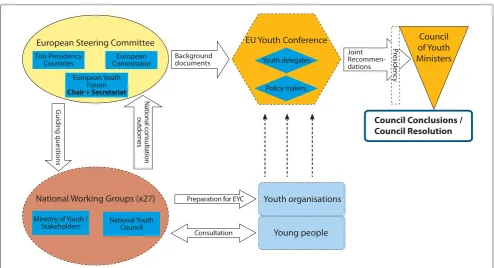
Th e Structured Dialogue with young people provides a good framework for consultation, peer learning and the sharing of experience among national policy-makers and young people in the youth fi eld. Every six months, EU Youth Conferences are organised by the country holding the Presidency, with the support of the Commission. Th ese conferences bring together young people and policy-makers from across the EU to discuss the results of the Structured Dialogue and to make joint recommendations which are fed into the process through which the Council adopts resolutions or conclusions.
50 These four non-EU countries responded to the Commission’s invitation to EU candidate
All Member States established National Working Groups for Structured Dialogue with young people early in the fi rst cycle. Th e Structured Dialogue – which is an elaborate and formal method of consultation with young people – has become a vibrant and integral part of youth policy-making. Th e consultations during the fi rst Trio Presidency (2010-11) resulted in valuable joint recommendations between youth policy-makers and young people on the most pressing employment issues.
In 2011, a second cycle of Structured Dialogue started with the theme of youth participation. A great number of youth leaders and young people were directly involved in the process.
For the improvement of the consultation process and its monitoring, the participation of other experts at local, regional, national and European level in the National Working Groups should be promoted, depending on the relevant thematic priority of the Structured Dialogue. Moreover, the results of the Structured Dialogue should be disseminated to cross-sectoral stakeholders. Th ere should be a clear role for youth researchers in the process.
2012 EU Youth Report
Mobilisation of EU programmes
Th e Youth in Action programme is a key instrument to support the renewed framework. Alongside the Lifelong Learning programme, it has contributed to the learning mobility of young people. It focuses on non-formal learning activities for young people, youth workers and youth organisations. In line with the renewed framework, it promotes a sense of citizenship and solidarity among young people and places the emphasis on youth work, volunteering and civic activities as a suitable environment in which to acquire transversal skills. Th is programme involved around 150 000 and 185 000 participants in 2010 and 2011 respectively, which was a noticeable increase compared to the beginning of the programme (111 000 participants in 2007).
Almost all Member States report having used other sources of EU funding, such as the European Social Fund, the European Regional Development Fund and/or PROGRESS to integrate young people into the labour market. Th e cohesion funds have also been used to support the development of active
5. THE NEXT CYCLE
OF THE RENEWED
FRAMEWORK (2013-2015)
Strengthening the link between the renewed
framework and Europe 2020
According to the Council Resolution on the renewed framework for European cooperation in the youth fi eld, a number of priorities for European cooperation will be set for each work cycle to contribute to the fi elds of action identifi ed under the framework. Th e priorities for the next cycle are to be adopted on the basis of the current EU Youth Report.
The EU presidencies focused in the first cycle on ‘employment and entrepreneurship’ and ‘participation’. Th e renewed framework and its fi elds of action together encompass the full range of issues that concern young people in transition, albeit aff ecting them to diff ering degrees. More importantly, the renewed framework acknowledges and reinforces inter-relationships between these fi elds and among stakeholders, to deliver eff ective instruments to achieve policy coordination and synergies.
Th e EU and National Youth Reports confi rm the robustness and relevance of the renewed framework and its two overall objectives: (i) creating more and equal opportunities for all young people in education and in the labour market, and (ii) promoting citizenship, social inclusion and solidarity. Both tie in well with Europe 2020, the Annual Growth Survey 2012, Youth on the Move and the Youth Opportunities Initiative.
2012 EU Youth Report
Th e Commission supports the eff orts of Member States with new EU initiatives, such as Your fi rst EURES job, which helps young people fi nd a job abroad, support to the development of Youth Guarantees51 and a quality framework for traineeships,
in which youth work can play a valuable role in partnership with education institutions and employment services. It has also increased possibilities for learning mobility through the Lifelong Learning52 and Youth in Action53 programmes.
Furthermore, the cross-cutting tools developed under the Renewed Framework can serve to foster partnerships between diff erent actors involved in delivering support to young people in all the diff erent aspects of transition, including employment services, education institutions, youth work, social services, employers and young people themselves.
Stronger cooperation on the ground can be beneficial in off ering tailor-made approaches, especially to young people with more complex life situations or that are hard to reach through conventional methods. The renewed framework can also play a role in the promotion and recognition of non-formal and informal learning through youth work and in encouraging participation in youth organisations as means to gain transversal skills. It can thereby contribute to strengthening synergies between diff erent forms of formal, non-formal and informal learning.
Th e situation on the labour market and unemployment has related social eff ects. Th e Annual Growth Survey 2012 refers to clear signs of increases in the number of people at risk of income poverty, notably child poverty, and social exclusion, with acute health problems and homelessness in the most extreme cases. A growing group of young people are at risk of social exclusion.
Young people are at serious risk of social exclusion and poverty – A headline target of Europe 2020 is to reduce the share of the EU population at risk of social exclusion and poverty by 20 million, or 25 %, by 2020. Th e share of young people at such risk is higher than that of the general population. Between 2009 and 2010, the increase in the number of young people at risk was signifi cantly higher than for the total population. Also, young people’s well-being is under pressure – While high unemployment rates have resulted in more low-income families and jobless households, and with young people being most at risk of poverty and social exclusion, the crisis has also had an impact on the health and wellbeing of young
51 The Commission intends to propose by the end of 2012 a Council recommendation
on guidelines to establish youth guarantees.
52 130 000 company placements in 2012 in other EU countries for university-level and
people. Unemployment, impoverishment, inadequate housing conditions and family disruptions signifi cantly increase the risk of mental health problems such as depression, alcohol abuse disorders and suicide. As detriments to health and well-being can oft en last for life, they have a particularly serious impact on young people.
Th e renewed framework can play a role in the participation of all young people in various aspects of society. It addresses a multitude of challenges linked to exclusion, alienation and young people’s eff orts in building an independent life and a responsible life. For the coming years, the renewed framework should increasingly focus on social inclusion as well as the health and well-being of young people.To this purpose, it needs to step up its focus on participation in democratic and societal activities, as well as build on youth work in developing young people’s life skills, their overall personal development and a sense of belonging to the society in which they live.
In order to better respond to the challenges listed above, the Member States and Commission should explore ways of further developing expertise and availability of examples of best practice in the areas where the Open Method of Coordination (OMC) could be used to create added value. It is proposed that the specifi c areas of social inclusion as well as the health and well-being of young people could benefi t from this type of cooperation.
Taking implementation forward
Cross-sectoral cooperation can be further improved across all policy areas that aff ect young people. Member States and the Commission should seek to further enhance cross-sectoral cooperation at national and European level. Additional eff orts should be made to strengthen the evidence base of youth policy and to share examples of good practice through mutual learning.
2012 EU Youth Report
Th e Commission will develop the initiative of the ‘Youth on the Move Card’ in order to make it easier for young people to be mobile across Europe. It will also reach out to, and facilitate dialogue with, all young people, particularly those with fewer opportunities, through the new interactive tools of the European Youth Portal. Youth policy will also explore measures to foster the creative and innovative potential of young people when attempting to tackle challenges related to employment, employability and inclusion54.
The Youth in Action programme and the future EU programme targeting youth, and other benefi ciaries will play a particular role in supporting these initiatives.
6. CONCLUSIONS
Th e implementation of the fi rst three-year work cycle of the renewed framework, covering 2010-2012, demonstrated that it is both lasting and fl exible as a framework for a whole range of actions – by the Commission, Member States and other relevant stakeholders. Th e renewed framework, with its cross-sectoral and all-inclusive perspective, has been greeted with interest and has inspired not only EU Member States, but also countries outside the EU.
The renewed framework has served as a vehicle to forge links between fields of action, including employment & entrepreneurship, education & training and social inclusion, to develop multi-faceted solutions in support of young people. Th is has proved relevant for examplein looking for answers to address the current high levels of youth unemployment and to support the growing number of young people who are not in employment, education or training. Youth work has contributed to young people’s development and has the potential to do more in all fi elds of action.
Th e participation of young people in democratic life is central to youth policy. Deepening and widening the dialogue with young people not only raises both the quality and legitimacy of youth policy, but also raises expectations for the EU and its Member States to deliver. Th e EU should do its utmost to encourage its young people to become involved in shaping the EU’s future, particularly on those issues which – as successive consultations and opinion surveys have demonstrated – matter most to them. In this context youth organisations and youth work play a key role.
In order to further its contribution to Europe 2020, the second three-year work cycle of the renewed framework (2013-2015) should in the fi rst place address the challenges facing young people as a result of the crisis. Emphasis should continue to be placed on employment and entrepreneurship, increasing access to work, along with developing the innovative and creative capacities of young people. It should also increasingly focus on social inclusion, health and well-being.
Results of the fi rst cycle
of the Open Method of Coordination
in the youth fi eld (2010-2012)
COMMISSION STAFF WORKING DOCUMENT
Accompanying the document
COMMISSION COMMUNICATION
Draft 2012 Joint Report of the Council and the Commission on the implementation
of the renewed framework for European cooperation in the youth fi eld
Executive Summary
EXECUTIVE SUMMARY
Background
Th e EU Youth Strategy
In 2009, the Council endorsed the renewed framework for European cooperation in the youth fi eld (2010-2018), known in short as the EU Youth Strategy1. Its objectives are to:
(i) create more and equal opportunities for all young people in education and in the labour market, and
(ii) promote the active citizenship, social inclusion and solidarity of all young people.
Th e EU Youth Strategy advocates a cross-cutting approach, branching out into eight different policy areas (‘fields of action’), which are the following: Education and Training, Employment and Entrepreneurship, Social Inclusion, Health and Well-being, Participation, Culture and Creativity, Volunteering, and Youth and the World.
Th e EU Youth Strategy and its implementation are based on the Open Method of Coordination, addressing both the Commission and Member States to take specific actions in the above-mentioned ‘fields of action’. To this end, it proposes a set of instruments which include: evidence-based policy-making; mutual learning; regular progress-reporting; dissemination of results and monitoring; Structured Dialogue with young people and youth organisations; and mobilisation of EU programmes and funds.
Th e EU Youth Strategy invited the Commission and Member States to implement the strategy by fostering cooperation that cuts across all of the various policy fi elds concerned. Such an approach should be pursued at all levels, and policies can be improved by sharing good practices. Youth work should be supported, developed and recognised for its economic and social contribution.
EU Youth Report: reporting on progress and looking ahead
The period covered by the EU Youth Strategy is divided into three-year cycles, with the requirement to produce an EU Youth Report at the end of each cycle, the fi rst of which will be drawn up in 2012 and ‘consist of […]a joint Council-Commission report (political part), and supporting documents (statistical and analytical part). Th e EU Youth report will evaluate progress made towards the overall objectives of the
framework, as well as progress regarding the priorities defi ned for the most recent work cycle and identify good practices. […] Th e EU Youth Report should also serve as a basis for establishing a set of priorities for the following work cycle.’
This Staff Working Document supports the Commission Communication which presents the draft joint report on the EU Youth Report to the Council. Summarising the results of the fi rst cycle (2010-2012), it presents the actions taken at EU-level and in Member States, as well as initiatives taken by young people themselves. Separate chapters report on achievements in all eight ‘fi elds of action’ of the strategy, the general organisation and approach to youth policy, and the Structured Dialogue between young people and policy-makers. Th e references made to Member States’ activities are based on National Youth Reports submitted by them2. Young
people are represented in the report by the European Youth Forum, which is an umbrella organisation of approximately 40 National Youth Councils and more than 60 international non-governmental youth organisations in Europe.
A second Staff Working Document supporting the Commission Communication on the EU Youth Report 2012 provides a comprehensive picture of the situation of young people in Europe based on the latest available data, statistics and research. It portrays trends and developments in young people’s conditions in diff erent areas, corresponding to the ‘fi elds of action’. It builds on the dashboard of EU youth indicators, which is an overview of 41 indicators that measure the most crucial aspects of the lives of young people in Europe3.
Results of the fi rst cycle of the Open Method
of Coordination in the youth fi eld
(2010-2012)
Actions at EU level
Th e Europe 2020 strategy for smart, sustainable and inclusive growth puts young people high on its agenda and embraces a number of concrete initiatives to support them in getting jobs and dealing with related challenges during this crisis. Young people are the target group of the fl agship initiative ‘Youth on the Move’, which promotes mobility as a means of learning. Th ey are also impacted by two other fl agship initiatives, ‘An Agenda for New Skills and Jobs’, which aims to improve
1 Council Resolution of 27 November 2009 on a renewed framework for European
2 Separate contributions were submitted by the three language communities of Belgium.
Executive Summary
employability and employment opportunities for young people, and ‘A Platform against Poverty and Social Exclusion’, the aim of which is to combat poverty and exclusion from an early age.
In response to the unacceptably high youth unemployment rates, the Commission proposed a comprehensive set of measures under the ‘Youth Opportunities Initiative’ and urged Member States to make better use of the European Social Fund (ESF). It also proposed tailor-made national approaches to youth unemployment through its Country Specifi c Recommendations under the European Semester and through dedicated action teams set up to assist those Member States with above average unemployment rates.
To better prepare young people for the labour market, including in the medium term, and in line with the Europe 2020 benchmarks on tertiary education and early school leaving, the Commission intensifi ed its eff orts to ensure that young people acquire the relevant skills for the labour market and to improve education and training. Th e main initiative in this fi eld is the strategic framework for European cooperation in Education and Training, which was adopted in 2009 for the period up to 2020 (ET 2020). In this context, the Commission presented a strategy for the modernisation of Europe’s higher education systems in 2011.
Th e Youth in Action and the Lifelong Learning programmes support learning mobility in both formal and non-formal education. Projects supported in 2011 under the Lifelong Learning programme involved more than 530 000 participants, while Youth in Action projects involved more than 180 000 young people.
Th e Commission is also endeavouring to lift obstacles EU citizens, including the young, encounter when using their EU rights, notably their right to free movement within the EU be it for leisure, volunteering, study or work4.
Th e EU Youth Strategy contributed to these eff orts by making youth employment the overall thematic priority during the fi rst Trio Presidency. Th is resulted in recommendations and proposals for action through Council resolutions addressing the social inclusion of young people, and the role of youth work in employability and accessing jobs. During the same period, the Structured Dialogue between young people and policy-makers focused on youth employment. Th e resulting
participation is important not only to increase citizenship, social inclusion and solidarity among young people; it also helps young people to acquire valuable cross-cutting skills that add to their employability. Th is work led to Council conclusions and resolutions that emphasised the need for an inclusive approach to participation and to broaden the range of tools for youth participation. It addressed interaction with young people from EU neighbouring countries, especially in Eastern Europe, and ensured better outreach to include young people with fewer opportunities. It also looked at the creative potential of young people themselves in terms of developing opportunities for youth participation.
Actions in Member States
All Member States submitted reports on how the EU Youth Strategy has been implemented at a national level during the period 2010-2012. Th ese reports were drawn up in response to a comprehensive questionnaire covering all aspects of the EU Youth Strategy5. Norway, Switzerland, Montenegro, and
Croatia submitted such reports voluntarily. Th e National Youth Reports can be downloaded from the Commission’s website.
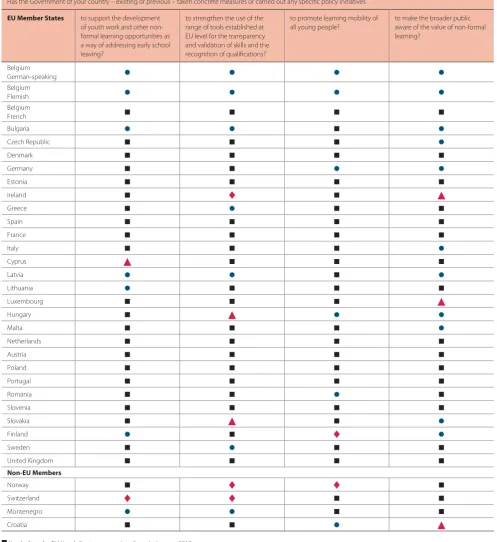
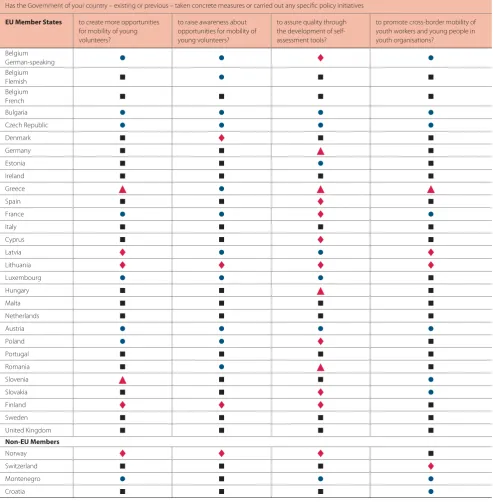
Th is report presents a summary of actions taken, including tables indicating the aggregate responses of all National Youth Reports to the various questions. It analyses trends in the ‘fi elds of action’ and provides an overview of national policies, the use of funds in each country, as well as specifi c projects and initiatives. As mutual learning is key to the implementation of the European Youth Strategy, examples of good practice from the Member States are highlighted throughout the report.
Executive Summary
people before the EU Youth Strategy came into eff ect in 2010. Th is was also the case in the areas of combating homelessness and fi nancial exclusion; support of youth organisations and recognition of their important role in promoting participation from an early age.
Th e Structured Dialogue between young people and policy-makers has been successfully established. National Working Groups have been set up and Member States are ready to enhance the transparency and visibility of the process and monitor its follow-up.
Actions by young people
Th e European Youth Forum (YFJ) also contributed to this report by describing its activities and appreciation of measures in all eight ‘fi elds of action’. Th e YFJ is a key player in the Structured Dialogue, with its President acting as chair of the European Steering Committee.
YFJ has been very active in the fi eld of Employment and Entrepreneurship, including the submission of various position papers that have fed into the Commission’s policy preparations. As youth organisations are an important provider of non-formal learning, the YFJ has also been active in promoting better recognition and quality of non-formal education.
Introduction
Introduction
1
Th is part of the EU Youth Report assesses the implementation of the EU Youth Strategy at national and EU level during its fi rst three-year work cycle. Separate chapters cover all eight ‘fi elds of action’ of the Strategy.
Each chapter consists of three sections. Th e fi rst provides an overview of initiatives taken at EU level during 2010-2012. Th e second includes a summary and a brief assessment of the initiatives and action taken at national level. Th is section is based on National Youth Reports submitted by all Member States6 and Norway, Switzerland, Montenegro and Croatia.
Th ese reports were drawn up in response to a comprehensive questionnaire covering all aspects of the EU Youth Strategy7.
Th e third section presents measures taken by young people themselves, represented by the European Youth Forum – a body which represents some 90 National Youth Councils and international non-governmental youth organisations in Europe.
National Youth Reports can be downloaded from the Commission’s website.
6 Separate contributions were submitted by the three language communities of
2. General Overview of Youth Policy
General Overview of Youth Policy
2
2.1. YOUTH POLICY: A POLICY BASED ON EVIDENCE
This EU Youth Report has been drawn up thanks to a framework for reporting and monitoring of youth data, research and policy activities. Th is framework is anchored in the EU Youth Strategy, which stresses the importance of evidence as a basis for policy.
EU Youth Policy is measured through a dashboard of EU youth indicators, which was drawn up in 2011 on the basis of a mandate from the EU Youth Strategy. An expert group fed into this dashboard8, which presents 40 indicators in all
eight ‘fi elds of action’ of the EU Youth Strategy. Eurostat set up a sub-section on youth on its website, displaying latest available data for the indicators. Th e expert group on EU youth indicators meets annually to review the dashboard. Th e Commission also released a study9 showing how Member
States work with youth indicators.
The Commission furthermore conducted a Flash Eurobarometer-survey on youth (Fl319a and Fl319b) in early 2011. Th e data collected further contributed to the dashboard of EU youth indicators and a Commission benchmark on mobility.
Th is evidence-base was further enriched by fi ndings from a cluster of five youth-oriented socio-economic research
projects supported under the 7th EU Research Framework
Programme, focusing on marginalised groups of young people and their inclusion in society (young homeless people; young people from a public care background; ethnic minority youth including Roma and young unemployed).
The results and recommendations of these projects are
summarised in the forthcoming policy review10 Social
Inclusion of Youth on the Margins of Society: More Opportunies, Better Access and Higher Solidarity and were discussed at a European Conference by European and national policy-makers, youth researchers and practitioners in the youth fi eld (November 2011).
Th e Commission is supported in its evidence-based approach to youth policy by its partnership with the Council of Europe (CoE) in the youth fi eld. Th e EU-CoE Youth Partnership manages the Pool of European Youth Researchers (PEYR) and the European Knowledge Centre on Youth Policy (EKCYP). It also has a comprehensive online database with knowledge on the situation of young people in Europe.
Th e Education, Audiovisual and Culture Executive Agency (EACEA) also provides support in monitoring data and statistics in the youth fi eld
2.2. LEGAL FRAMEWORK AND NATIONAL YOUTH POLICY ENVIRONMENT
Th is chapter provides a general overview of how the Member States and participating non-EU countries – 31 in all – structure their youth policy in terms of legislation, policy strategies and inter-ministerial cooperation. It also presents
how these countries perceive the impact of the EU Youth Strategy at the national and local levels as well as other linkages between youth policy at national and EU level.
2.2.1. Youth laws or national legislation on youth
Responses in National Youth Reports11
Does your country have a ‘youth law’ or legislation that specifi cally refers to youth issues,
or laws containing a section addressing the needs and/or rights of young people? Total Belgium Non-EU countries
EU countries excl. Belgium
Yes 27 3 3 21
No 6 1 5
8 SEC(2011) 401.
10 Kutsar, D. and Helve, H., 2012. ‘Social Inclusion of Youth on the Margins of Society: More
General Overview of Youth Policy
2
Although most Member States report to have legislation that specifi cally refers to youth issues, or laws containing a section addressing the needs and/or rights of young people, the responses do not easily lend themselves to analysis. For instance, some countries which answer in the affi rmative to the question whether they have specifi c legislation on youth make reference to legislation on children. Most countries operate with an overlap in age between children and young people (children defi ned up to the age of 18 and young people usually from the age of 15), and in some countries the division between children and youth is vague. It should be noted that several of the countries reporting that they do not have a ‘youth law’ or specifi c legislation on young people, may have specifi c
legislation on children, defi ned up to the age of 18 Many Member States refer to specifi c youth laws (see Table 2-A). In countries with a federal structure, the regions are autonomous on youth issues: In Belgium, the three Communities have separate youth legislation, and legislation on youth is in place in all 17 Autonomous Communities of Spain. In Austria and
Germany, national legislation is supplemented by legislative acts at Federal State level. In Italy legislation in this area only exists at regional level.
Whereas most Member States have legislation on young people, such legislation is in most cases recent, which suggests that youth legislation is an area still under development.
Ta ble 2-A: Overview of youth laws or national legislation on youth (Web-links included where provided)
EU MEMBER STATES
BELGIUM: Laws and legislative acts pertaining to young people’s rights and well-being exist in all Communities (Flemish, French and German-speaking). BULGARIA: The Family Code (2009, amended 2010) settles relationships between parents and children. Other legislative acts cover various issues relating
to youth, among them employment, health, physical education and sport.
CZECH REPUBLIC: A number of laws address young people’s rights, welfare and care services, social protection, education, etc. DENMARK: There is no specifi c youth law or youth legislation.
GERMANY: Legislation on child and youth (adopted 1990) available online at http://www.gesetze-im-internet.de/sgb_8/ (in German). ESTONIA: The Youth Work Act was adopted in 1999; the renewed law came into force in 2010.
IRELAND: The Youth Work Act was adopted in 2001: http://www.irishstatutebook.ie/pdf/2001/en.act.2001.0042.pdf (in English). GREECE: A number of laws concern young people’s rights to education and
information, health and social protection, youth participation in elections, entrepreneurship and employment, etc.
SPAIN: At regional level, there exists specifi c legislation on youth, such as training, employment, health, housing, education, environment, culture, sports, tourism and recreation, associations, voluntary work, etc.
FRANCE: There is no specifi c youth law. However, legislation which covers young people exists in various areas, such as education, employment, social aff airs, health, justice, professional training, etc.
ITALY: No national youth law, but some legislation exists at regional level.
CYPRUS: The main legislation concerning youth is the Youth Board Law of 1994 (available in English). Additionally, there are other laws addressing the needs/rights of young people.
LATVIA: The Youth Law is from 2009 and was amended in 2011: http://www.likumi.lv/doc.php?id=175920 (only Latvian).
LITHUANIA: The Law on a Youth Policy Framework (2003) outlines the main concepts of youth policy, defi nes youth policy areas and establishes principles of the implementation of youth policy.
LUXEMBOURG: There is a Youth Law (2008) and a Law on Youth Volunteering (2007).
HUNGARY: There is a law on the Children and Youth Fund (1995) and a Regulation of the Ministry of Youth and Sports on the Functioning of the National Children and Youth Fund and the Regional Youth Services (1999).
MALTA: No legislation on youth but a Commissioner for Children Act, Chapter 462 of the Laws of Malta: http://www.mjha.gov.mt/LOM.aspx?pageid=27&mode=chrono&gotoID=462 (English version).
NETHERLANDS:
The Youth Care Act 2005 and the Social Support Law 2007 address child and youth issues. A new youth law will soon replace the Youth Care Act. Youth Care Act: http://english.minvws.nl/en/folders/djb/2005/youth-care-in-the-netherlands.asp Social Support Act:
http://english.minvws.nl/en/themes/social-support-act (English version).
AUSTRIA: There is a Federal Youth Promotion Act (2001): http://www.en.bmwfj .gv.at/Youth/YouthPromotion/Seiten/default.aspx
POLAND: The Act on promotion of employment and labour market institutions (2004) outlines special measures for unemployed under the age of 25. PORTUGAL: All youth legislation (latest revisions in 2011) is available online at http://juventude.gov.pt/Legislacao/Paginas/Legislacao_Juventude.aspx
(in Portuguese). There are youth protection acts in all nine regions. English versions are available upon request. ROMANIA: The Romanian Youth Law was adopted in 2006.
General Overview of Youth Policy
2
2.2.2. National Strategies and Action Plans or cross-sectoral strategies specifi cally referring to youth issues
Responses in National Youth Reports
Does your country have a National Youth Strategy and/or Action Plan, or a cross-sectoral
strategy specifi cally referring to youth issues? Total Belgium
Non-EU countries
EU countries excl. Belgium
Yes 28 3 4 21
No 5 5
Even in the absence of a National Youth Strategy or action plan, Ireland and Spain stress that strategies existed previously and that new strategies are expected to be in place by the end of 2012. Portugal and Spain are currently draft ing a White Paper on Youth. All ongoing processes mention that consultations with young people are an inherent element in the development of youth policy. In Austria a national Action Plan for the Rights of Children and Youth has been in place since 2004.
As is true for youth legislation, National Youth Strategies and action plans are in many cases relatively recent. A substantial number of countries in which strategies are already in place, report ongoing processes to develop new strategies. Th is again suggests that youth policy is an area of increasing importance at national level.
2.2.3. Institutional mechanisms aimed at cross-sectoral youth policy
Responses in National Youth Reports
Does your Government have an inter-ministerial working group on youth or any other
institutionalised mechanism for ensuring a cross-sectoral approach to youth policy? Total Belgium Non-EU countries
EU countries excl. Belgium
YES, such an institutional mechanism has existed since before the EU Youth Strategy
came into force in January 2010. 27 1 4 22
YES, such an institutional mechanism was established after the EU Youth Strategy
came into force in January 2010. ● 4 2 2
NO, but we have an ongoing initiative to establish such
an institutional mechanism in 2012. 1 1
NO, we do not plan to establish such an institutional mechanism. 1 1
Th ere are many examples of standing working groups or advisory bodies with representatives of diff erent ministries. In the French community of Belgium, a permanent inter-ministerial Conference on Youth has existed since July 2011 at the level of Ministers. In Cyprus, an inter-ministerial Consulting Committee on Youth consists of representatives of 10 ministries and various government agencies. In the Czech Republic, the Youth Chamber, which is an advisory body to the Youth Minister and consists of representatives from various ministries and youth stakeholder groups, has been transformed into an effi cient instrument for the implementation of youth policy. In Spain, the Inter-ministerial Commission for Youth
comprises a senior representative of each ministry plus the president of the National Youth Council, and its role is to propose government programmes and measures in the youth fi eld. Th e Council of Youth Aff airs in Lithuania consists of 6 representatives of diff erent ministries and 6 representatives of the Lithuanian Youth Council, and submits proposals on youth policy to the Ministry of Social Security and Labour.
Several Member States mention that the EU Youth Strategy’s emphasis on a cross-sectoral approach has played an important role for the recognition of youth policies and strategies at national level.
France
Policy in favour of young people