This is a repository copy of The Developmental Social Contract and Basic Income in Denmark.
White Rose Research Online URL for this paper: http://eprints.whiterose.ac.uk/135246/
Version: Accepted Version
Article:
Haagh, Louise Anne orcid.org/0000-0003-1187-067X (2019) The Developmental Social Contract and Basic Income in Denmark. Social Policy and Society. pp. 301-317. ISSN 1475-3073
https://doi.org/10.1017/S1474746418000301
[email protected] https://eprints.whiterose.ac.uk/
Reuse
Items deposited in White Rose Research Online are protected by copyright, with all rights reserved unless indicated otherwise. They may be downloaded and/or printed for private study, or other acts as permitted by national copyright laws. The publisher or other rights holders may allow further reproduction and re-use of the full text version. This is indicated by the licence information on the White Rose Research Online record for the item.
Takedown
If you consider content in White Rose Research Online to be in breach of UK law, please notify us by
1 The Developmental Social Contract and Basic Income in Denmark
Abstract
I I
D - D I argue that implementation
since the 1990s of the flexicurity regime labour flexibility with social transfers and training - has stretched the developmental tradition that historically has fed the case for broadly inclusive reforms. Historically, incorporating stratifications linked with developmentalism have supported attained high equality in Nordic states. This Equality Paradox may explain why rising inequality in Denmark (and other countries) makes a case for basic income but the source of this inequality neo-liberalism - also puts it at risk. The developmental rights tradition in Denmark helped cushion the inherent instability and punitive tendency of the flexicurity model. Yet flexicurity also corroded developmentalism, generating a complicated scenario for basic income reform.
Introduction
Taking Denmark as my example, in this paper I argue conceptualizing the Nordic welfare state in developmental egalitarian terms aids in clarifying the political status of basic income in the Nordic context. A ro- , I argue the developmental and rights-bases of Nordic welfare states have been under-assumed in favour of labour process or class-coalition models. I argue instead that formation of a broadly incorporating developmental social contract tradition has contributed to a high level of social embeddedness of public governance and shaped the evolutionary logic of the Danish welfare state. Public sector capabilities linked with developmental governance have been the foundation for recurrence of steps towards basic income in Denmark. However, neo-liberalisation in the form of flexicurity (Kongshøj-Madsen 2003) entails recent partial transitions to basic income from within the public sector can go in different directions. Below, I first briefly situate the Danish case within the contemporary discussion of basic income and the Nordic model. I then look critically at the conceptualisation of the Nordic model in comparative typology literatures. Next, I argue a developmental form of egalitarianism helped cushion inherent punitive tendencies within the flexicurity model, yet flexicurity remains unstable. Last I discuss how this complicated scenario explains the catalytic role of basic income, as alternative responses to exhaustion of flexicurity have impacts are likely to shape how the direction of social incorporation in Denmark is changed.
i. Basic Income and Social Democracy
In the core literature, basic income can appear to be presented as an alternative to Nordic-style social democracy. In his classic work, vP defined his project against
-(n.30, 248, 28) models, and social democracy as the pursuit o
2 opinion polls claim to be positively inclined towards basic income, scepticism is more marked in Nordic countries (European Social Survey 2017, Figure 1).
Yet, analysing Nordic welfare state institutions in more general terms as governance systems presents a more complex picture. Our understanding of the status of basic income today depends greatly on how broadly we contextualise the proposal. At one level, I argue we can characterise the emergence of steps towards basic income in Denmark as a response to the exhaustion of dysfunctional regimes to sanction the unemployed that emerged in the course of the 2000s. However, the forces at work are politically complex. T
developmental traditions with a punitive regime that violates important personal freedoms led to sanctions being called into question, and partial steps to basic income coming about. Yet, if the developmental tradition thus came to the aid of basic income, will basic income come to the aid of the tradition that historically brought universal ideals such as linked with basic income into being?
To answer this kind of question we need to move beyond the descriptive focus on individual institutions and sectors of the evolutionary literature. W
T “
2005,19) of the mode of governing in this case the competition economy - that brought the offending policy sanctions - about. In this context, partial steps to basic income may be playing midwife to the gestation of a bureaucratically simplified competition economy. In sum, the emergence of flexicurity, leading to sanctions, represents in reality a struggle within the Danish state between two very differently modes of governance - developmental or through the market. It is when we understand the Danish welfare state as a resilient but increasingly strained developmental governance system that we can see how steps towards basic income in Denmark today are fraught with tension.
ii. The Developmental Social Contract and the Danish Welfare State
The Danish welfare state is recognized to share features with the Anglo-liberal type, although inclusion in basic universal schemes in both cases amount to very different welfare models, with punitive benefits in the second case, but not the first (Esping-Andersen 1990, 25-28; Kildal and Kuhlne 2005, 20). Pinning down what universalism in practice entails is difficult (Kildal and Kuhlne 2005 17-19; Christensen 2015). Below I will discuss how models of social incorporation can help by showing how combinations of schemes drawn along the lines of pure universalism and developmental stratification reinforce each other in raising the level of social inclusion.
3 education, in 1914, pushed by an emergent education movement in the country-side across the Nordic region (Sandberg 1979, 225-226).
Hence, public incorporation of Nordic society abated competitive forces before capitalism proper
set in. T (Chang 2009; Kananen
2014, 36-48, 50), and shaped emerging labour market institutions through occupational policies.
H - as in the US (Thelen 2004, Archer 2007), shaped
exclusively through direct engagement with capital. The Danish social democratic party emerging in the 1870s did not create or represent the whole of the popular democratic tradition.
Advocacy for basic income in Denmark also bear traces of the developmental contract tradition. Hohlenberg, who in the 1930s viewed BI as a radical alternative to majoritarian social democracy (Birnbaum and Christensen 2007), formed part of a wider folk education movement. In the 1970s,
BI was presented as
(Meyer et al 1978).
Today, a developmental form of social contract in Nordic states can be identified descriptively in two features of governing. First, as shown in Graph 1 (a,b), the Danish public finance system entails a high level of socialisation, and public spending is resiliently more human development-orientated compared with other countries. In addition, Nordic public policy tends to promote equality and incorporation along human development dimensions. Notably, the importance of -related social in the Nordic model is stressed and related with trust formation by Birnbaum et al (2017,4), and with developmental freedom and public property rights in economic stability (Haagh 2012). Here I argue however both phenomena are a consequence of a wider, dynamic developmental governance model that cannot be reduced to parts, static norms, or particular items of spending. This model is distinctive not for its focus on age categories as much as the support of developmental processes and social relations. High social spending on specific risks is an important background factor, but does not explain how the system works or is reproduced. I will argue here that adaptation of developmental norms to the reframing of new problems can be shown to regenerate developmental governance and expectations through everyday practical reasoning within institutions of education, occupation and public administration. The upshot is a form of active democratic tension and resistance which in turn can be shown to have had an important role to play in recent moves to, and debates about, basic income in Denmark.
To further explain, where market-based rights-obligations structures tend to emphasize job-readiness, compulsion, punishment and individualised responsibility through direct contracting, developmental governance model tends to have a humanistic orientation, in the following three senses: The structure of education prioritises personal and social development. The governance of contributory expectations emphasizes incentives over exclusions or punishment. And, cooperative values and practices tend to be inculcated and governed through socialisation rather than compulsion. To exemplify, in the Danish education system, historically, a solidaristic element is exemplified in regulation to promote parity in resourcing for students in public and private schools (Haagh 2012, Undervisningsministeriet 2004). A humanist element is involved in state intervention to delay exams, and suppress competition (Steinmo, 2010, 71), and in an
4 education courses. The upshot is, reciprocity in society tends to take a general social and temporal (inter-generational, cross-class) rather that direct form.
If then both market and developmental governance have self-reinforcing properties, and stand in tension, within individual systems, historically, the Nordic pull more towards the developmental logic. Moreover, overall functionality of developmental governance entails this form is more stable. After the 1990s, however, changes in social policy in Denmark as in other Nordic states, imposed by global pressures, entailed a push towards the market model, without abandoning the developmental contract model. Next I explore how the focus on developmental governance extends on prevailing models of welfare comparison and social incorporation.
iii. Comparative Capitalism, Social Incorporation and the Equality Paradox
The extant comparative welfare literature groups states according to how different actors have shaped capitalist development. The welfare literature focuses on labour process, and the Varieties of Capitalism on the organisation of business. A problem however with an account of modernity as thoroughly capitalist is that equating economic formalisation with capitalist development, presents an unrealistic idealisation of informal society. In basic income debates this has led to a tendency to see basic income as a source of escape from moder
income is likely to emerge from within the public sector.
A - E -Andersen (EA) to
set the Nordic states apart. Specifically, there is a disjuncture between how Esping-Andersen
N A EA
action (1985, 57-78) and class-coalitions (1990, 16-18) e.g. bargaining within production
(formalisation), explained N Y
-commodification (1990, 21-26), the granting of security outside production, defined its form.
An alternative to thinking of freedom as security outside the formal economy is to enquire how individuals attain states of enjoying economic stability through the democratic development of shared property rights in multiple sources of security generated within society. Relatedly, Offe
(1984, 42) suggested sm might bring a basic in come
Yet arguably, the tendency in question is not inherent in capitalism but in variants where as in Nordic states public support of human development has gained ascendency. This brings into view the role the public sector plays in shaping the direction formalisation takes. Hence, Denmark did not become more egalitarian (than Germany) only in the 1990s as suggested in recent analysis of the Danish case within the Varieties of Capitalism literature (Thelen 2014, 9-13). Thelen is right liberalisation (after the 1990s) was more egalitarian in Denmark compared with other countries. However, Denmark becomes less egalitarian and more punitive compared with the past (Haagh 2001; Torfing 2004; Larsen and Andersen, 2009; Caswell, Larsen and Marston 2010).
Accordingly, to explain how developmental incorporation has sustained high social equality in Denmark, and recent strain in this model frames the basic income debate today, below I adapt Korpi
5 KP sought to explain how paradoxically - public pensions systems characterised by inequality produced overall equality among pensioners. They reasoned that bringing social group stratifications within the public system ultimately led to more redistribution (the redistribution paradox). Accordingly, in Figure 4.a, Diamond No 5 KP pension system based in a combination of basic and contributory provision, resulting in high coverage, class inclusion, and low inequality.1C KP
the sense that, today, the link between targeting and inequality is less clear (Marx et al 2013, Brady and Bostic 2013). Yet, critics can say this and be right only because society has changed away from a form of social incorporation that promoted stable inclusion towards a labour market based on greater income stratifications and precarity. Where inequality in the market is higher, the public sector has to work much harder to even it out. This is also Hills (2015, 38) conclusion when he
equality in a given society. 2 My argument is that the only way a scale effect can be (and in Nordic
states has been) achieved is by promoting equality and developmental security both within and outside production. Consequently, I suggest we need to rework the redistribution paradox as a broader Equality Paradox: developmental governance is an instrumental factor in translating the effect of basic universality in particular schemes into universalism in inclusion or in effect (Figure 3). This involves four basic adaptations of KP
First, a basic distinction needs to be made to interpret KP I between targeting by design and effect. Targeting by design involves means-testing through a particular scheme: in theory all are entitled if in a certain situation. Targeting by effect occurs where only certain groups enjoy real advantage from a certain scheme - what Esping Andersen referred to as - . The implication for basic income debates is important, by revealing how despite the universal (strict egalitarian) design of the scheme, a basic income may operate as an anti-poverty, targeted scheme by effect.
1 In diamonds 1-4 large chunks of society is left to find informal or private cover. In the case of Diamond 2, the British
model of public provision, there is universalism, but at a low level.
2 Hills (40) suggest the erroneous public perception that the poor have become more costly is related to a moral bias
6 Consequently, second, to show how in the case of Denmark - incorporation works through developmental governance, it KP model beyond pensions. Denmark introduced an effective two-tier pension system later than other Nordic states, in 1987. However, considering the two-tier income insurance model in Denmark (basic assistance and voluntary unemployment insurance contributions), dating to 1907, Denmark already had an encompassing model of welfare. In addition, the Folk education systems is in effect a two tier system: in countries like Denmark and Sweden, private schools charging small fees, yet heavily subsidized by the state (in
D schools (Haagh 2012).
Differently shaped two tier systems are endemic across human development supporting institutions in Nordic states. Indeed it is because this is true that basic income fits well within the developmental social contract tradition in Nordic states.
T I KP
of diluting class. KP argue a feature of Nordic incorporation is that defection is avoided because upper classes have the opportunity to pay into systems that protect their market earnings. So described however their model is made to sound a bit too much like a (static) class interest calculus. Another way of putting their argument is to say citizens in Nordic states are moved to support overall universality of outcome through socialisation in developmentally structured shared institutions.3
Accordingly, fourth, I KP
developmental governance supports universalism in effect over time. Conversely, where developmental governance is curtailed, universalism begins to leak. The first, affirmative, proposition is that developmental governance supports a positive mutual effect between different aspects of freedom within and across the design of different welfare schemes. Developmental freedom is broadly the freedom to be secure in life-course terms (Haagh 2007, 2015). Independence freedom is the freedom to enjoy security in your own name, as of individual right. Cooperative freedom is the freedom to choose affiliation. The Danish (and Finnish) UI systems share certain liberal rights features with a basic income institution which speak to these forms of freedom combined. Unlike in other European systems, state-backed occupational insurance in Finland and Denmark is voluntary. (Indeed it may be no accident that BI experimentation is more advanced in Finland and Denmark). Although BI is non-contributory and UI is contributory, both are based on individual entitlement unrelated to spousal income and means. Both enhance economic stability: BI offers low, permanent security, and UI longer-term, generous, wage compensation. Finally, BI supports autonomy of action, UI voluntarism in contribution. In all, both BI and UI though different - compare favourably with contemporary means-tested basic assistance schemes along dimensions of simultaneously -respect for individual and developmental status of persons. My point here is, this human-centredness in design and effect of welfare transfers is rarely achieved through a single scheme.
3 In support of this, attitudes coherent across dimensions) in Nordic states
7 BI advocates often argue against public subsidy of the UI system, given the more generous level of UI compared with basic (non-contributory) security. In simple fairness terms they have a point. However, public subsidy of the UI system has not only enabled redistribution within the UI system.4
In addition, through interstate comparison we can surmise a more secure occupational system attained through standards, wage bargaining, and income-related insurance (UI) - has the effect of
5 In the 2000s, Denmark and Britain both had the most generous level of basic
assistance in the EU relative to the lowest wages. But in Denmark the level of both are much higher than in the UK (Haagh 2012, 575).6 The period in which Denmark came closest to a BI scheme e.g.
when administration of basic assistance was most lax, in the late 1970s and early 1980s, coincided with the height of affiliation to occupational schemes. Accordingly, in Diamonds 6 and 7 in Figure 4.b I suggest a resilient (if strained) model of Developmental Equality has obtained in Denmark and other Nordic states. 7 A basic income could play a pivoting system stabilising role in
consolidating such as model today, under certain conditions. For example, presence of more developmental security systems makes it likely different groups benefit in a real way from basic income. Individuals and institutions can plan to combine basic income and other schemes (sabbaticals might be negotiated if unions are stronger, for instance). KEEP8
However, we also see a reversed effect. Looking at incorporation models over time, we can surmise that corrosion of developmental forms of governing imperils incorporation in both so-called liberal (Anglo-Saxon) and social democratic (Nordic) models. Leakage results from corrosion, when barriers to entitlement entail persons drop out of formal systems of work or income support.
Next I discuss how resilient elements of developmental governance have worked to contain this form of leakage in Denmark, yet the practice of flexicurity has corroded developmental governance, generating a complicated backdrop for the debate about BI reform.
iv. W D F “ D ‘
Effect
In the post- D
E
-conservative market-contractualism during the 2010s (Petersen 2017, 152), defined by the rise of directly punitive sanctions. The punitive turn in state governance across
4 Without tax subsidy, premiums on lower earners would have the effect of excluding them (Bjørn and Høj 2014, 10;
Haagh 2013b)
5 Within Europe, the Danish UI system applies the lowest sanctions on voluntary quits, and also operates the most
flexible contribution requirements, and the shortest waiting period, Bjørn and Høj 2014, 9-20)
6 The lowest value of income protection in Britain is the highest relative to the average wage in the OECD, at 70 %.
D OEECD H H
wages inequality is lower in Denmark, and in absolute terms, average wages are higher, the absolute value of the lowest level of income support is higher in Denmark compared with Britain. The lowest level of income support is far more generous in Denmark, than in any of seven most similar European countries examined. For a single person over 25 it was about 7,800 kr per month in 2013 after tax (Bjørn and Høj 2014, 23-24), compared with about 2,756 kr in Britain, not counting housing support in either case.
7 Diamond 7 is more like the Danish system, with elements of compulsory and voluntary social and occupational
insurance, the latter subsidized by the state.
8 In Denmark, for instance, public funding and tripartite governance have joined up historically in defense of
8 mature economies since the 1990s can be viewed as an evolutionary response to the withdrawal of developmental protections within production (Haagh 2018): The tendency of ubiquitous competition to exclude large sectors of the population that predictably follows, leads to the
“
res B I
D
sanctions regime and eventually generating opposition to sanctions.
As in other countries, in Denmark state-led attempts to ligthen the bureaucratic divide between different classes of basic benefits (e.g. basic unemployment,
sick-Arbejdsmarkedstyrelsen 2007, 10-14) has been under way since the early 2010s. This exemplifies how in general a silent transition to BI is occurring within European welfare states. At the same time, the balance between market-administrative and developmental governance shapes how this is occurring. Implementation of British and Danish sanctions regimes since 2010 has been described as intense (OECD 2012), in both cases affecting about 25 per cent of benefit claimants every year (Adler 2016, Haagh 2018b). However, in the UK, the roll-out of Universal Credit (simplification through uniting 7 different benefits) since 2014 has not led to abatement of sanctions (WPC 2017, Haagh 2018). By contrast, in the Danish case, a public culture of rights-scrutiny can be shown to have had a manifest impact on changes in the sanctions regime. Danish authorities have taken a lead in investigating and publishing health outcomes of sanctions, detailing the numbers receiving medication and effects on individuals facing homelessness or addiction to drugs, leading to suggestions for revision of practice (Ankestyrelsen 2017, 16-17). One public report noted that municipalities that had a high use of sanctions were less effective (Arbejdsmarkedstyrelsen 2008, 4-5, 20-22), and another suggested over-complication of the system might be at stake, and sanctions
A -15). In 2014, government-led investigations
ensue in a more marked fall in sanctions following a reform of the system. As a share of unemployed, the number peaks at 23.9 % in 2011, and then begins gradually to fall, with a more marked fall in 2014, to 16.6 % of all benefit recipients.(Beskæftigelsesministeriet 2016a, 5).
There is evidence that the more diverse form of developmental security in Denmark has softened the impact of sanctions. As distinct from Britain (Clasen 2001), Danish sanctions regimes have two levels, which reflect the composite character of economic security. In the UI system, less sanctions are given, and claimants can anticipate sanctions (Bjørn and Høj 2014), indicating a measure of control prevails.9 In the basic assistance (BA) system, sanctions are more frequent, but have three
distinctive features (compared with Britain): they are shorter, and more health-contained and education-defined. First, in the BA system, 96 % of all sanctions are point sanctions, reducing benefits for up to one or two days in a month (Beskæftigelsesministeriet, 2016; Klos 2014, 20), compared with 81 % in the UI system (ibid. 15). Second, there is evidence social workers in municipalities avoid sanctioning vulnerable groups, and this explains why those sanctioned are in
better health (Caswell et al (2011, 10).10 T
9 In 2011-1, in all 3.8 % of unemployed men, and 2.3 % of women, on UI benefits were sanctioned, compared with an
average of sanctions of all unemployed in municipalities, of 28.8 % (Kors, 2014, 6). Within Europe, the Danish UI system applies the lowest sanctions on voluntary quits, and also operates the most flexible contribution requirements, and the shortest waiting period (Bjørn and Høj 2014, 9-20)
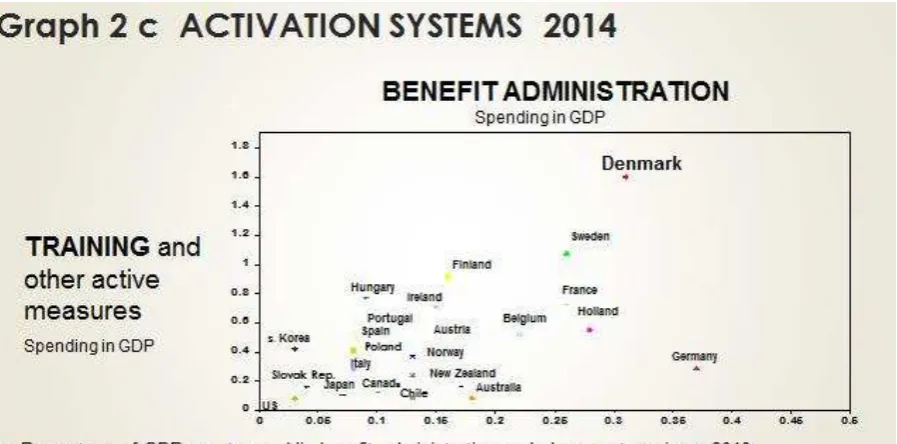
9 men in particular (Caswell et al 2011, 41). The positive role of education relative to administration in Denmark is shown in Graph 2 (a-c).11
As discussed, a s of
sanctions entail citizens disappear from records and lose entitlements in effect. Leakage is occurring but is comparably less severe in the Danish case.At its height, in 2010, self-support without income, (or in Danish selvforsørgelse uden indtægt), affected around 20 thousand individuals, or 15 per cent of the self-supporting population, and 0.6 of the economically active labour force. By 2015 the size of this excluded population was halved, albeit still affecting just under 2 per cent of the unemployed (non-student) population (Table 1). By comparison, in Britain, it is estimated non-take up of benefits doubles, from a third to two-thirds of individuals entitled, during the implementation of sanctions (The Money Charity 2016).12
The lower levels of leakage in Denmark can be presumed linked with a more developmental administration of sanctions. In addition, the process of public scrutiny led to a gradual reversal of the punitive administration of sanctions. Graph 2 (a-c) shows how in 2010 Denmark rackets up its spending on both administration and training, in the attempt to make flexicu
(typically compulsory) education. By 2014, however, this rushed response to administratively enforced education is somewhat contained, coinciding with a fall in sanctions (below). Meanwhile, the level of education spend is sustained.
Eventually, state commissioning of experiment with administration of sanctions encouraged several municipalities to try out lifting sanctions. Kalundborg reported a doubling of activation rates after participation was made voluntary (Cuber 2018, Solås 2018). Aarhus municipality combined the lifting of conditions with external funding to offer the unemployed additional resources to support self-employment. The processes of implementation of experiments and reasoning about sanctions reveal how reproduction of developmental and solidarity norms intercede. In the case of Århus, social workers interviewed reported how initial scepticism was overcome through implementation,
13 Leaders
within political parties supportive of sanctions report a concern that lifting sanctions should not employment services should be converted to a form of public outreach when activation is made voluntary (Gejl 2016). There is also evidence of solidarity among better-off groups within the UI system and those on basic assistance. The managing director, Simon Bauer, of th UI M A TV M A-Kasse, 2012) expressed opposition to sanctions for both groups. An unemployed person should be thought of as
- -motivation that Bauer believes drives
behaviour, regardless of status.14
11 In Denmark public investigations found an average error rate of 320 per cent in muncipalies, against under 4 per cent
in the UI system (Arbejdsstyrelsen 2012, 6-7).
12 The manifest and growing presence of leakage in Britain, is represented in the holes at the bottom of Diamonds 1 and
2 (Figure 3).
13 Fredericksen (2018) and Jensen (2018).
14T D J
10 In sum, taking the factors discussed into account it is plausible to argue transitions to basic income in Denmark are emerging from within the Danish developmental system of governing, yet this transition is complex. Consequently, below I discuss how conversion of basic assistance systems to BI would address dysfunctions in postwar welfare design, yet entrenchment of the flexicurity ideal imperils the occupational governance of work that has been a dynamic factor in high social equality.
v. Developmental Governance, Flexicurity and the BI Proposal in Denmark
Basic income reform the lifting of conditionalities and means-tests in access to basic security addresses short-comings in the postwar welfare model that flexicurity deepened. In the 1970s, debates about poverty traps linked with means-testing in Europe and America focussed on earnings disincentives: why give up public assistance for a paid job? As administration and compulsive regimes intensified after the 1990s, the poverty trap was compounded by class, security, administration, and ownership traps. In conditions of rising market uncertainty, the
model regenerated an old stygmatizing divide, between owning and non-owning citizens: means-tests entail a person must exhaust all savings before qualifying for public assistance (as noted, in Denmark this illiberal policy did not obtain in the occupational system). The ownership trap keeps those on assistance poor and without aspirations. In addition, i
fear of losing all, as savings must be exhausted before help is at hand. Basic income would resolve these basically unjust and unproductive status distinctions.
Consequently, BI H
effective function by consolidating “
ives, and services that support such lives,
to function better. We have very elementary evidence from experiments of this potential effect. In Århus, for instance, findings of a 2016/7 experiment that followed 100 unemployed who received development grants without conditions (mentioned above) highlighted how in a majority of cases some was a precondition for productive plans. This involved permission to prioritise spending on means to function, in the form of personal infrastructure, such as a bicycle, a computer, work-tools, or a driving licence, or/and spending on personal health and appearance, like dental
treatment or glasses.15“
major barrier to productive endeavour. In one case, where a person decided to use his development grant to buy a van to start a business, social workers had to consider legally take ownership of the van, or just it, to enable the experiment to continue.16
To further understand the challenges connected with both developmental governance and basic
income reform in Denmark it is important to appraise D as
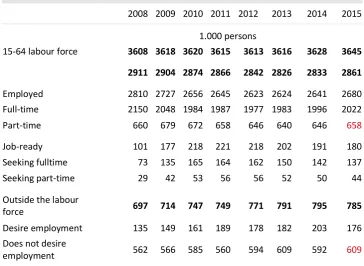
prescribed. First, flexicurity failed to incorporate. If we count everyone under the age of 64 not in -workers in Denmark in 2015 was around 1 million people, that is nearly a third of the labour force (of 3.37 million, Table 2).17 The main effect of flexicurity was to
15 Århus Kommune 2017.
16 Interview with senior social workers in Århus municipality, 5th December 2016. Several other recipients wanted or
needed to own equipment, e.g. an industrial oven to faciliate a bakery business, fitness equipment, coffee-making equipment, tools to support a gardening business, and so on. Århus Kommune 2017, pp 11-13.
17 This figure includes the rounded up data given by Danmarks Statistik of the following categories: those in receipt of
11 hollow out developmental incorporation systems without replacing them with dynamic alternatives. To illustrate, when Hills (2015, 38) remarks that Danish social policy became more targeted after the 1990s, he is not wrong, except the model became more targeted not by design, but effect. The two-tier model, based on basic combined with contributory (developmental top-up) security was not abandoned, but cuts in entitlement (such as from four to two years in 2010) entailed a large chunk of the labour market an estimated 80,000 persons since 2010 (Kirk 2015) fell outside the developmental (UI) system, becoming instead reliant on means-tested support. Table 3 shows how legislation to force individuals to become more job-ready facilitated the change. This raises the question, is flexicurity moving Denmark towards Esping-A - -universalism, and would basic income facilitate this transition?
Second, flexicurity did not work as a market-clearing system either. A hall-mark of flexicurity is high turn-over, with opening of 25 per cent of all employment positions on an annual basis. Average tenure is lower in Denmark than in other Nordic states. Yet, age-cohort data suggests flexicurity still
conforms to a degree with Esping-A “
-duration) jobs is always full, but the passengers change. Even at the height of flexicurity, short job duration is more markedly linked with youth status than the generic .18 This shows Denmark still has a developmental economy, but on a
MAYBE T
O h progress to quality jobs, and occupational stability and standing, remain. The period of flexicurity has seen a seminal shift away from youth entering manual occupational training systems, from over 40 % in the 1990s (Anker 1999), to just under 20 % in the late 2010s (Tesfaye 2013).19 Hence, third, it is not clear flexicurity has been a source of upgrading
development. According to Hansen et al (2017, 4-5), businesses have responded to low-tax and high-fire incentives by pursuing wage compression rather than production innovation, resulting in a flat-productivity strategy (Productivity commission 2014, cited in Hansen et al, 4).
v. The Politics of Alternative Basic Income Transitions in Denmark
To surmise, what we are seeing in Denmark is a form of stalemate, in the form of a slow decay of developmental governance: Flexicurity cannot incorporate, yet the sanctions system and absence of nnot be born. In this context, it is interesting to revisit the current status of developmental governance and the BI debate.
First, though the developmental security tradition has been challenged, it has proven adaptable. The automatic linkage of union and UI membership was untied by legislation in the 1990s as part of liberalisation reforms. In addition, UI funds lost members by legal disqualification (above). Yet the fall in membership is less than expected, at around 4 per cent during the 2010s (Danmarks Statistik
pically on early retirement transfers, e.g. either UI-
-
students not in work (344,000).
18 Over 50 per cent of women in their late teens change job on an annual basis. By age 35, the share of women who do
so is under 20 per cent, and then as for men starts to drop (Ilsøe 2017)
19 A government target of 30 % (Jyllandsposten 2018) suggests Danish policy markers are concerned about the fall, but
12 2017a). Surveys indicate many members lost as a direct result of eligibility cuts intend to return (Danske A-Kasser 2014). UI institutions have adjusted to adversity by extending eligibility for the unemployed and students (ibid).
The general reasons Danish citizens have for joining developmental insurance institutions remain the same: The UI funds still generate a longer and more generous level of income cover.20 In the
period October 2016 till June 2017, a fall of just under 3,000 paying (employed) members, was more than made up by an increase of about 10,000 young student members (Danmarks A-Kasser 2017a,
1).21 F UI
still operate in many ways as an occupational system. In their on-line platforms UI institutions
T
cross-occupational unions. In sum, the evident advantages of developmental security and solidarity systems, combined with new low- or non-payment options - may help explain how the occupational systems -despite being challenged - remain powerful inclusion structures in Denmark today.
Nevertheless, the question remains how occupational systems can remain broadly inclusive in the face of a high level of non-employment participation, and a clientelist social transfer system that works more as a passification than an effective inclusion structure.
On the one hand, several employers groups in Denmark have shown interest in basic income reform, and as in other countries - tie it to further flexibilisation of the market in labour. Asked to imagine a basic income economy, the former CEO of a large super-market chain in Denmark saw BI as complementing the existing system of collective frame bargaining, combined with greater flexibility in (local) labour relations (Josefsen 2018). Employers, he argued, would benefit, because workers
not
This possibility is contested by labour leaders and MPs of the core left party in Denmark - Enhedslisten who envisage that under a future (low) basic income, workers who wish to attain an acceptable standard of living would be forced to work with less protections (Sørensen 2016). Any vulnerability would lead to exclusion. Basic income is the so-called red rose with blue thorns.22
SorgenFrei, leader of the largest public sector unions, believes the power of collective bargaining
structures would be eroded by high local- -liberals
(Sorgenfrei 2018). Wage bargaining has already been heavily decentralized in many areas in Denmark. Supposing a basic income is low, and built up systems of developmental security are traded for a basic income reform, it is reasonable to suppose basic income could erode the value of wages, the power of workers, and the wider extension of security systems.
20 The labour market remains considerably more secure for average earners in Denmark compared with other countries.
The maximum rate to which the 90 per cent cover could go in Denmark in 2013 was 17,336 kr, compared with flat rate for UI contributors over 25 years in Britain of 2,756 per month, e.g. 15.9 per cent of the Danish rate. In Denmark the average compensation rate of a whole unemployment period in 2011 was 67 percent (Bjørn og Høj 2014, 27-28) to 100 % of average salary, but 88 % for those (previously) earning 2/3 of the average wage. For the UK the rates are 28 and 33 percent.
21 A slow seminal decline in union membership following the global trend since the 1970s has stabilised. Between
2015 and 2016, membership grew at a very small percentage of 0.4 (Danmarks Statistik 2017a).
22 This reference was made several times from representatives of the Danish socialist party, Enhedslisten at a conference
13 Sørensen (2016) is concerned that proposing a basic income as a form of simplification of welfare payments as a whole, by introducing a principle of strict equality as a dominant distributive norm, in practice would place many vulnerable groups at risk. In this scenario, vulnerable individuals must apply for additional assistance on a case by case basis, where otherwise systems might be in place that offer assistance and sustain wider social solidarity norms. Sørensen recommends instead an offensive strategy based on collective work reduction without reduced pay to a 30 hour week, combined with a reversal of progressive tax cuts, and an end to sanctions within both UI and basic assistance (ibid. 11).
W I “ “
route to basic income reform, e.g. basic income traded for the developmental systems of spend and regulation, I do not agree this trade-off is necessary (Haagh 2011). Sørensen wants an offensive
B
fits within this strategy, and does not need to entail breaking with public subsidy of other developmental security systems.
The strategy I suggest of a careful reworking of developmental systems has some similarities and differences with other proposals that involve a partial adaptation of flexicurity systems. As an
example, Ha -
BI UI
three month duration, and a public job guarantee (at the minimum wage). The proposal rests on a renewal of the old Swedish activation system, or Rehn-Meidner model, built on equalisation of wages in industry through collective means, placing thus the burden on employers of the cost of competition and economic adjustment (ibid., 5). T H sets the employment and unemployment systems together. It is a systemic proposal that by scope recognizes how the economy functions as a governance system. Moreover, it recognizes the unsustainable character of a competition model based in bare labour flexibility. Yet the question is whether a more radical break with the flexicurity model is required.
H -readiness, and to that end continues to
cut life-course security in favour of enhancing labour mobility. A three-month UI cover for all is comparably very short. In addition, the premise individuals should choose UBI or activation generates a direct form of state administration of employment transitions which opens the door to reintroducing behaviour controls down the line: their proposal in fact is not a UBI scheme, in the sense that a UBI is not continuous or guaranteed separately and through the life course. Hansen et al rely on raising wages as an innovation-inducing strategy. This to some extent shuts over the extent to which high effective economic stability in society and for individuals in Nordic states emerged historically through the democratic development of shared property rights in stability. E.g. it was through public owning of both the rules (developmental governing) and the resources (public finance and services) that a comparably high level of effective freedom evolved.
14 (and stabilisation) of money economies, such as proposed by Christensen (2019, 90-91) is a solid basis for reworking developmentalism and the rights-based public services tradition in a way basic income fits within it. The idea of basic income sitting within a wider collective reclaiming of development is not radical in a Nordic context. An oft-forgotten historic aspect of Nordic public policy is heavy regulation of land and national ownership of natural resources (Sanders et al 2016), and of course public money (Ferguson 2008, 48-49, 125). On some accounts the popular money economy, that is, the dissemination of property ownership and the wide circulation of money, was not an Anglo-liberal but Nordic invention (Sandberg 1978). In this sense, democratic (liberal) capitalism is in fact quintessentially Nordic. In all, a BI H
goal of raising the (effective) wage level, although the quid pro quo is greater reliance on non-wage (such as developmental, social, and occupational) incentives to encourage contribution to society on a voluntary basis.
Conclusion
In summary, four broad points may be drawn from my discussion of the role of basic income in contemporary welfare state transformation in Denmark. First, an Equality Paradox may explain why basic income is emerging more rapidly in high equality countries such as Denmark, in which developmental incorporation translates universalism de jure into high levels of inclusion de facto. Second, however, the forces that in this argument make universalism effective and sustainable are under increasing strain. However, we can see that competing forces are playing themselves out in the context of state administration of flexicurity policy.
Denmark can be considered a best- BI
on social transfer combined with education makes it plausible. Hence, third, the Danish case - transition to basic income within and beyond Europe today. European states are stumbling towards basic income almost unconsciously, as those in charge of social transfer systems are trying to streamline systems based in increasingly complicated and randomised labour stratifications. In this context, basic income can be a catalyst for two quite different developments, either a reworking of developmental governance or a further extension of the market. The concern in the second case is that if in the Danish case - a BI were to be traded for a further corrosion of developmental security it would become in effect - if not by design - a targeted anti-poverty scheme, defined by those depending on it enjoying an overall much
lower share of social resources. This BI
suffers in Nordic states.
15
Y
16 Table 1 Self-supporting population with and without private and public income
Year A Economically Active Population B Self-supporting without income or public support C Unemployed population
a. Brutto / b. on transfers
not in work, excluding those in study c. b, but
including those in study D Self-supporting without income, public support, transfers from own enterprise
D as % of
Ca, Cb, B , A
a. b. c.
2010 3,348.200 129,300 163,454 20,151 12,3 - 15,6 0.6
2011 3,344.400 130,000 159,241 17,654
2012 3,339.300 132,600 161,236 13,483
2013 3,339.000 132,100 153,082 11,947
2014 3,349.800 134,200 133,243 11,684
2015 3,367.700 134,700 122,519 656,000 1000,000* 10,971 8,95 1,67 8,1 0.32
2016 3,394.200 137,600 -
Change 2010- 2016
* This number includes the rounded up figures given by Danmarks Statistik of the following categories: those in receipt
UI
population no in work UI-
-
[image:17.595.56.421.471.737.2]and students not in work (344,000). Source: Beskæftigelsesudvalget 2017, BEU Alm.del Bilag 250 Offentligt 2016/7, http://www.ft.dk/samling/20161/almdel/BEU/bilag/250/1765825.pdf, and Danmarks Statistik 2016: Stigning I arbejdsstyrken, https://www.dst.dk/da/Statistik/nyt/NytHtml?cid=20990
Table 2 Labour Market Incorporation, thousands
2008 2009 2010 2011 2012 2013 2014 2015
1.000 persons
15-64 labour force 3608 3618 3620 3615 3613 3616 3628 3645
2911 2904 2874 2866 2842 2826 2833 2861
Employed 2810 2727 2656 2645 2623 2624 2641 2680 Full-time 2150 2048 1984 1987 1977 1983 1996 2022
Part-time 660 679 672 658 646 640 646 658
Job-ready 101 177 218 221 218 202 191 180 Seeking fulltime 73 135 165 164 162 150 142 137
Seeking part-time 29 42 53 56 56 52 50 44
Outside the labour
force 697 714 747 749 771 791 795 785
Desire employment 135 149 161 189 178 182 203 176 Does not desire
employment 562 566 585 560 594 609 592 609
17 Table 3 Legal Adjustments to UI Benefit Entitlements
2006 2010 2011 2012 2017 The
2025 plan Qualifying
age for -entitlement raised to 62
Halving of Period of entitlement from 4 to 2 years
P -entitlement Period cut from 5 to 3 years
Tax
deductions for those in work raised, the real value of
D UI benefits is reduced Minor change considered, repeal holiday-daypay savings
Plans to double the contribution
made by the UI system to the state. The government rationale is that digitalisation of the system has or will entail savings
Pension ag raised to 67
Minimum contribution period doubled from 6 months to 1 year
Deductions against pensions introduced
The value of
D
regulated to increase at a lower rate than wages, at about a 10 % difference
“
shall no longer be covered by collective
bargaining wages-levels, but set at highest
Average-age Retirement Principle introduced Many lose effective entitlement because pensions are house-hold
means-tested, but
entitlements are not
At the same time, scope f extending
for another year is introduced
Plans to further extend
the tax measures
introduced in 2012
18 References
A M A N L B “ T -First Century, Journal of Law and Society, Vol. 43, No. 2, June, pp. 195-227.
Ankestyrelsen, 2017, Ankestyrelsens praksisundersøgelse om kommunernes anvendelse af sanktioner over for uddannelses- og kontanthjælpsmodtagere, Marts
Arbejdsmarkedstyrelsen 2012, Beskæftigelsesudvalget 2012-13 BEU alm. del Bilag 19 Offentligt, Status fra Tilsynsafdelingen 1. halvår 2012,
Arbejdsmarkedsstyrelsen 2007, Forenkling af sygeopfølgning i jobcentrene. Afbureaukratisering på beskæftigelsesområdet Fase 2 temaanalyse Arbejdsmarkedsstyrelsen, 30. November
Arbejdsmarkedsudvalget (2. samling) AMU alm. del - Bilag 80 Offentligt
Arbejdsmarkedsstyrelsen, 2008 Evaluering af NY CHANCE TIL ALLE Afslutningsevaluering December 2008,
Archer, R. 2007, Why There is No Labour Party in the United States, Princeton: Princeton University Press
Barse, M., 2018, Aktivering af K F I N Å VI DK
15th January.
Beskæftigelsmnisteriet Analyseenheden, 2016, Philip, Ulla N. og Sørenen, L.,Analyse Effekt af at få en sankionfr ldie I kontanthjælpsystemet, November
Beskæftigelsesudvalget, Bilag 250, 2. June, 2017, BEU Alm.del Bilag 250 Offentligt 2016/7,
B “ C E A ‘ B I Johannes
H B I “ V I -17.
Bjørn, N.H. and Høj, A.K. 2014, Understøttelse ved ledighed in syv lande, Det Økonomiske Råds Sekretariat, Arbejdspapi 2014:2.
Brady, D. and Bostie, A. 2013, Paradoxes Lost and Found: The Dimensions of Social Welfare Transfers, Relative Poverty and Redistribution Preferences, http://pseweb.eu/ydepot/semin/texte1314/BRA2014PAR.pdf
C O D T D F “ I I L D N
New York: Macmillan
19 Caswell, D., J.E. Larsen, and G. Marston, 2010, Unemployment ci
Classification systems and employment services in Denmark and Australia. Critical Social Policy, 30(3):384-404.
Chang, H.-J., 2009. Under-explored Treasure Troves of Development Lessons Lessons from
the Histories of Small Rich European Countries (SRECs)
in M. Kremer, P. van Lieshoust & R. Went (eds.), Doing Good or Doing
Better, Amsterdam
University Press, Amsterdam
Christensen, E. 2017, På Vej til Borgerløn, Forlaget Hovedland
C J “ I C P A P C B
“ P Social Policy and Administration, 35 (6): 641-657.
Clasen, J. and Clegg, D., 2006, Beyond Activation, European Societies, 8 (4), 527-553.
Cuber, Dannie, 2918, job advisor in Kalundborg job centre, testimony given on the occasion of the Basic Income in Danish conference, Christiansborg, 15th March 2018
D “ F M L
Danske A-K A-K
Danmarks A-K A-K P D
https://www.a-kasser.dk/popularitet.html
Danmarks Statistik 2016, “ A
https://www.dst.dk/da/Statistik/nyt/NytHtml?cid=20990
Ervik, R., Kildal, N., and Nilssen, E. 2017, New Contractualism in European Welfare State Policies, London: Routledge
Esping-Andersen, G., 1985, Politics Against Markets The Social Democratic Road to Power, Princeton: Princeton University Press
Esping-Andersen, G., 1990, The Three Worlds of Welfare Capitalism, Cambridge: Polity Press.
European Social Survey 2017, http:// www.europeansocial survey.org
Ferguson. N, 2008, The Ascent of Money, London: Allen Lane
Fredericksen (2018), Interview with Anne-Marie Fredericksen, senior consultant social worker, Social and Employment Services (Sociale Forhold og Beskæftigelse), Aarhus Council, Aarhus, 5th December
20 Gejl, T. 2016, Speech to the Nordic conference on Basic Income Pilots, 22-23 September, held at Christiansborg, Copenhagen
Greve, B., 2017, Konsekvenser for det lighedsprægede velfærdssamfund, presentation to the conference, "Den danske model og velfærdssamfundet under pres", Christiansborg, 9. februar
H H L J I H M A A O N E
“ N J W L Studies, Vol. 7, No.2, pp.3- 8.
Hills, J 2015, Good Times Bad Times THe Welfare Myth of Them and US, Policy Press.
Hvid, M.L. 2016, Indentured servitude and convict labour in the Danish-Norwegian West Indies, 1671 1755, Scandinavian Journal of History, 41:4-5, 541-564,
Ilsøe, A. 2017, Udfordringer for den danske aftalemodel og flexicurity, paper presented to the
D C th February
2017.
Jensen, 2018, Interview with Vibeke Jensen, Head of Department,
(BeskæftigelseschefBeskæftigelseschef) , Social and Employment Services (Sociale Forhold og
Beskæftigelse), Aarhus Council, Aarhus, 5th December 2016
Jensen, H. 1936, Dansk Jordpolitik 1757-1919, København, Gyldendanske boghandel Nordisk Forlag
Jonassen, C. T. 1983, Value Systems and Personality in a Western Civilization: Norwegians in Europe and Beyond, Columbus: Ohio State University Press.
Josefsen, A., 2018, speech given to the conference Borgerløn på Dansk (Basic Income in Danish), held at the Danish Parliament, 15th March 2018, Owner of the leadership firm Alfred AS, and former
Administrative Director of IRMA
J F E th March 2018.
Kananen, J., 2014, The Nordic Welfare State in Three Eras, Surrey: Ashgate.
ILO (International Labour Organisation) 2004, Income Security for a Better World, Geneva: International Labour Organisation.
K N K “ T N W M I U N
Foundations of the Welfare State The Nordic Experience, London: Routledge
Klos, M., 2014, Rådighed og sanktioner, AK-Samvirke Maj 2014 Version 3
21 Kongshøj-M P F y through Labour Market Policies and Institutions in D I P A C “ Employment Stability in an Age of Flexibility, Geneva: International Labour Organisation.
K W P J T P ‘ d Strategies of Equality: Welfare
“ I I P W C A I A “
Review, Vol. 63, No. 5, 661-687.
K V “ “ -metoden: Så skæres der igen et par skiver af P 15th october
K A W H G P E C F TH J L K
D “ W D -1293
Larsen, C.H., Andersen, J.G. 2009, How New Economic Ideas Changed the Danish Welfare State The case of Neoliberal Ideas and highly Organised Social Democratic Interests, Governance, vol. 22, no. 2. April
Loftager, J. 2004, Politicsk Offentlighed og Demokrati I Danmark, Århus Universitetsforlag
M I “ L V G T P ‘ ‘ I)A
Discussion Paper Series, IZA DP No. 7414, May
Meyer, N. I., K. Helveg Petersen, Sørensen, V. 1978, Oprør fra Midten, Gyldendals Bogklub: Nordisk Forlag
Min A-Kasse, 2012, 12 September, Debat om Dagpenge Regler med Simon Bauer fra Min A-Kasse, https://www.youtube.com/watch?v=6A9Y61E80SY
Nordjyske 2016 105, Sanktioner mod kontanthjæpsmdaeeskal unrsøgs, 4 April.
N T “ Jordpolitik, Stockholk: Tidens Förlag
Offe, C., 1984, Contradictions of the Welfare State, Cambridge: MIT Press.
Oesch, D. 2006, Redrawing the Class Map Stratification and Institutions in Britain, Germany Sweden, and Switzerland, Palgrave
Petersen, J H F U T ‘ “ P : The Changing Normative
Basis of D W “ N C E W “ P E
by Rune Ervik, Nanna Kildal, and Even Nilssen, London: Routledge
Sandberg, L.G. T C I “ H C “
E G W W I J E H V XXXIX N M
22 Sanders, A.R.D., Sandvik, P.T., and Storli, E., 2016, Dealing with Globalisation: The Nordic Countries and Inward FDI, 1990-1930, Business History, 58:8, 1210-1235
Solås, Solveig. 2018 social worker, testimony given on the occasion of the Basic Income in Danish conference, Christiansborg, 15th March 2018
Sorgenfrei, B., 2018, speech given to the conference Borgerløn på Dansk (Basic Income in Danish), he;ld at the Danish Parliament, 15th March 2018, Sorgenfrei is Leader of the Danish labour union
FTF
Standing, G, 2014, The Precariat Charter, Norfolk: Bloomsbury
Standing, Guy, 1999, Global Labour Flexibility, Basingstoke, Palgrave.
Statistisk Årbog 2016, Danmarks Statistik:
http://www.dst.dk/Site/Dst/Udgivelser/GetPubFile.aspx?id=22258&sid=staa
Steinmo, Sven, 2010, The Evolution of Modern States, Cambridge: Cambridge University Press.
“ “ C A M I T P Sociology of the
Welfare State, S. Svallfors (Ed.), Stanford: Stanford University Press.
Svallfors, S. 2006 The Moral Economy of Class, Cambridge.
“ F B “ U N D -11.
Tesfaye, M., 2013, Kloge Hænder et Forsvar for Håndværk og Faglighed, Gyldendal
The Money Charity, 2016, http://themoneycharity.org.uk/money-statistics/ July 5th, 2016
Thelen, K. 2014, Varieties of Liberalization: The New Politics of Social Solidarity. New York: Cambridge University Press.
Thelen, K. and Streeck, W. 2005, Beyond Continuity: Institutional Change in Advanced Political Economies Oxford: Oxford University Press.
Thelen, K. 2004, How Institutions Evolve: The Political Economy of Skills in Comparative-Historical Perspective, New Yorl: Cambridge University Press.
Torfing, J., 2004, Det stille sporskifte i velfærdsstaten. En diskursteoretisk beslutningsprocessanalyse, Aarhus Universitetsforlag
23
T C W M “ M O C B “ B I
Edited by Peter Evans, Dietrich Rueschemeyer, and Theda Skocpol, Cambridge: Cambridge University Press
Undervisningsministeriet 2004 Bilag 3.,Privatskoler i Danmark, http://pub.uvm.dk/2004/oecd/bil03.html, points 95 97.
V P P B I and Social Democracy, Social Europe, April, https://www.socialeurope.eu/44878
Van Parijs, P. and Vanderborght, Y 2017, Basic Income A Radical Proposal fore a Free Society and a Sane Economy, Cambridge: Harvard University Press
van Parijs, P., 1995, Real Freedom for All What (if Anything) can Justify Capitalism?, Oxford: Clarendon Press.
Vanderborght, Y., (2006) 'Why trade unions oppose Basic Income', Basic Income Studies, Vol 1, no 1,pp 1 20
WPC I C I - Oral Evidence Session, 12 January 2017, http://data.parliament.uk/writtenevidence/committeeevidence.svc/evidencedocument/work-and-pensions-committee/universal-basic-income/oral/45336.pdf
Øhlenschlæger 2018,
28 Appendix