Int. J. Electrochem. Sci., 11 (2016) 4865 – 4877, doi: 10.20964/2016.06.1
International Journal of
ELECTROCHEMICAL
SCIENCE
www.electrochemsci.org
Application of Pd-modified Nickel Foam Cathodes to the
Process of Alkaline Water Electrolysis
Boguslaw Pierozynski*, Tomasz Mikolajczyk
Department of Chemistry, Faculty of Environmental Management and Agriculture, University of Warmia and Mazury in Olsztyn, Plac Lodzki 4, 10-957 Olsztyn, Poland
*
E-mail: [email protected]
Received: 21 February 2016 / Accepted: 17 March 2016 / Published: 1 May 2016
This work presents an investigation of hydrogen evolution reaction (HER) through the process of alkaline water electrolysis (AWE), performed by means of pure and palladium-modified nickel foam cathodes, and stainless steel anodes. Temperature-dependent kinetics of the HER were studied in 2 and 8 M KOH, over the temperature range: 20-60 oC through a.c. impedance spectroscopy and d.c. galvanostatic electrochemical experiments. The charge-transfer resistance, exchange current-density for the HER and other electrochemical parameters for examined catalyst samples were presented.
Keywords: Renewable energy; Alkaline water electrolysis; Pd-modified Ni foam; HER; Impedance spectroscopy
1. INTRODUCTION
both in the automotive market, as well as in stationary and mobile energy sectors right beyond the year 2020 [2-10].
Present work makes an extension to some former HER studies carried-out on catalytically active cathode materials (Pd-, Pt- and Ru-modified Ni foams), produced from this laboratory [11-13]. Here, pure and Pd-modified Ni foam HER cathodes were electrochemically evaluated in a small, laboratory-made alkaline water electrolyser unit.
2. EXPERIMENTAL
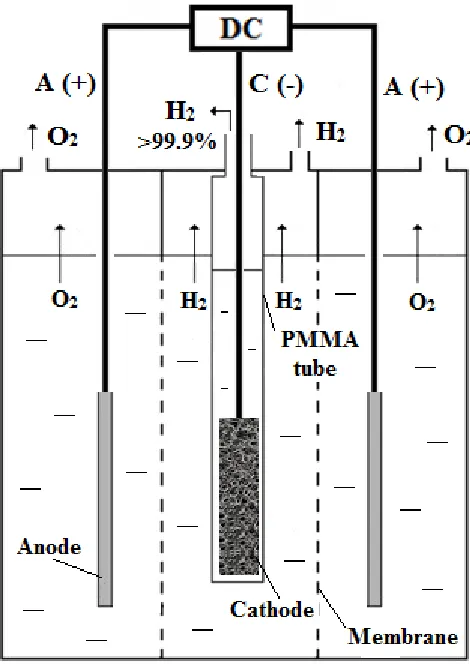
[image:2.596.178.413.356.688.2]Aqueous, 2 and 8 M KOH solutions were prepared from potassium hydroxide pellets (Sigma-Ultra, KOH content: ≥85%, K2CO3 content: ≤2.0%). All solutions were made up using a Direct-Q3 UV ultra-pure water purification system from Millipore with 18.2 M cm water resistivity. A PMMA (polymethyl methacrylate)-made, 750 cm3 in volume, alkaline water electrolysis cell used in this work, is illustrated in Fig. 1.
The cell is divided into three zones, where a middle part contains cathode (nickel foam-based cylindrical electrode, formed from 4×4 cm MTI nickel foam sheet), which is separated from two stainless steel-made (AISI 321: 5×4×0.1 cm) anodes by Zirfon Perl UTP 500 (polyphenylene sulphide/zirconium oxide) membranes delivered by Agfa-Gevaert N.V. In addition, a reversible Pd hydrogen electrode (RHE) was installed in the proximity of the cathode (working electrode), to act as a reference electrode for constant-potential HER impedance measurements. Prior to being installed in the electrolyser, Zirfon membranes were rinsed in ultra-pure Millipore water and soaked in 2 M KOH solution for 24 hours. Stainless steel anodes were polished with emery paper down to 2000 grade and de-greased with acetone. All procedures used for the preparation of Ni foam cathodes and the palladium RHE were as those described in our earlier works in Refs. [11-16].
Alkaline water electrolysis (AWE) experiments were carried-our under galvanostatic mode (at 0.5 and 1.0 A) by means of the Solartron 12,608 W Full Electrochemical System, consisting of 1260 frequency response analyzer (FRA) and 1287 electrochemical interface (EI). All information on the performed a.c. impedance measurements (including details of the fitting procedure) could be found in Ref. [11].
3. RESULTS AND DISCUSSION
[image:3.596.141.453.425.678.2]3.1. Galvanostatic AWE experiments on pure and Pd-modified Ni foam materials in 2 and 8 M KOH solutions
Figure 3. Cell voltage as a function of time over a 24-hour period, examined at 70 ºC in 2 & 8 M KOH (other details as in Figure 2 above).
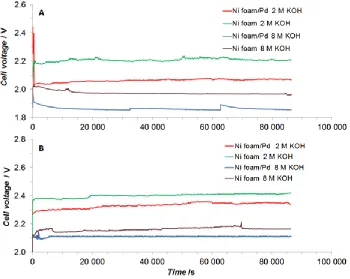
Fig. 2 shows the results of galvanostatic AWE tests carried-out over the period of 24 hours for pure and Pd-modified Ni foam cathodes in 2 M KOH (at 50 ºC) for two cathodic current-densities of jc= 2 (Fig. 2A) and 4 (Fig. 2B) mA cm-2. Average cell voltages at the current-density of 2 mA cm-2 for Ni foam and the Pd-modified Ni cathodes were 2.28 and 2.06 V, correspondingly, where voltage fluctuation range for both electrodes came to about ± 35 mV. Furthermore, for the current-density of 4 mA cm-2 (Fig. 2B) an increase of the average cell voltage was recorded: by 220 and 300 mV for pure and the Pd-modified foam electrodes, respectively. However, the voltage oscillation for both electrodes stayed at the same level.
Fig. 3 presents the cell voltage as a function of time over a 24-hour period, recorded for pure and the Pd-modified Ni foam cathodes, but in 2 & 8 M KOH at 70 ºC for two current-densities of jc= 2 (Fig. 3A) and 4 (Fig. 3B) mA cm-2. Here, average cell voltages at the current-density of 2 mA cm-2 for pure and the Pd-modified cathodes were 2.20 and 2.05 V (2 M KOH), and 1.97 and 1.87 V (8 M KOH), correspondingly. The voltage fluctuation range for all electrodes was around ± 25 mV in 2 M KOH and ± 30 mV in 8 M KOH. Then, for the cathodic current-density of 4 mA cm-2
[image:4.596.125.475.73.352.2]
large to start with and difficult to be properly estimated, was approximated through the appropriate Cdl measurements). Thus, in case where no straight current-density comparisons could be made, making direct analogies between the cell voltages obtained in this work and those of other stated articles [17-21] would not be very meaningful.
3.2. Temperature dependent a.c. impedance behaviour of the HER on pure and Pd-modified Ni foam cathodes
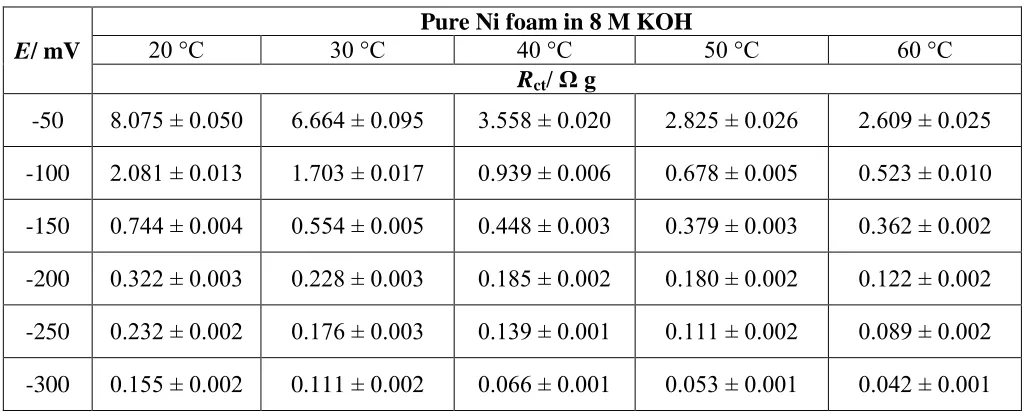
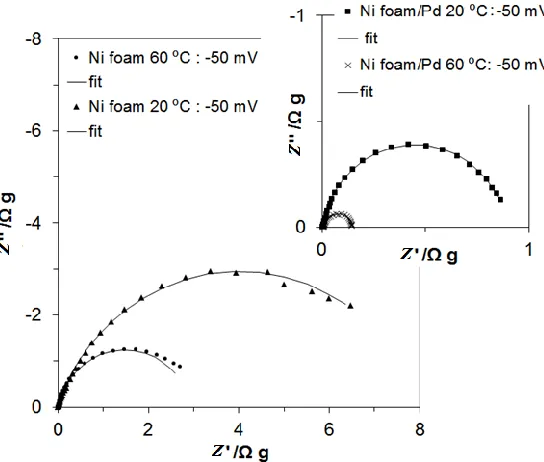
The results of a.c. impedance measurements conducted directly in the alkaline water electrolyser on pure and the Pd-modified nickel foam cathodes are presented in Figs. 4 and 5, and Tables 1 and 2 for 2 M and 8 M KOH solutions, respectively.
Table 1. Electrochemical parameters for the HER on cathodically activated, pure and Pd-modified Ni foam electrodes in contact with 2 M KOH, studied over the temperature range 20-60 ºC.
E/ mV
Pure Ni foam in 2 M KOH
20 °C 30 °C 40 °C 50 °C 60 °C
Rct/ Ω g
-50 12.208 ± 0.140 5.313 ± 0.115 3.858 ± 0.057 2.375 ± 0.031 1.907 ± 0.066 -100 6.664 ± 0.072 3.293 ± 0.044 2.354 ± 0.029 2.022 ± 0.019 0.948 ± 0.020 -150 2.010 ± 0.017 1.154 ± 0.009 0.974 ± 0.008 0.960 ± 0.008 0.408 ± 0.007 -200 0.638 ± 0.005 0.563 ± 0.007 0.397 ± 0.003 0.380 ± 0.004 0.199 ± 0.003 -250 0.299 ± 0.003 0.275 ± 0.003 0.210 ± 0.002 0.184 ± 0.003 0.127 ± 0.004 -300 0.194 ± 0.002 0.150 ± 0.002 0.135 ± 0.002 0.109 ± 0.002 0.093 ± 0.003 -400 0.103 ± 0.002 0.067 ± 0.002 0.071 ± 0.002 0.053 ± 0.002 0.041 ± 0.002
Cdl/ μF g-1 sφ1-1
[image:5.596.37.561.327.765.2]
Pd-modified Ni foam in 2 M KOH Rct/ Ω g
-50 1.254 ± 0.007 1.025 ± 0.022 0.812 ± 0.009 0.496 ± 0.007 0.394 ± 0.004 -100 0.701 ± 0.004 0.681 ± 0.005 0.575 ± 0.007 0.381 ± 0.004 0.328 ± 0.005 -150 0.428 ± 0.004 0.425 ± 0.005 0.366 ± 0.002 0.267 ± 0.004 0.244 ± 0.004 -200 0.265 ± 0.002 0.255 ± 0.001 0.244 ± 0.003 0.181 ± 0.003 0.176 ± 0.003 -250 0.176 ± 0.003 0.155 ± 0.001 0.144 ± 0.002 0.131 ± 0.003 0.118 ± 0.002 -300 0.124 ± 0.002 0.105 ± 0.001 0.090 ± 0.002 0.096 ± 0.001 0.077 ± 0.002 -400 0.052 ± 0.001 0.053 ± 0.001 0.053 ± 0.001 0.047 ± 0.002 0.036 ± 0.001
Cdl/ μF g-1 s φ1-1
[image:6.596.43.557.551.757.2]-50 101,770 ± 804 101,120 ± 2,993 130,021 ± 2,513 139,138 ± 4,344 165,813 ± 4,352 -100 103,332 ± 1,219 110,063 ± 1,818 123,516 ± 3,228 129,696 ± 3,723 154,245 ± 5,138 -150 113,161 ± 2,667 99,659 ± 2,653 111,113 ± 1,520 145,691 ± 6,274 163,423 ± 6,691 -200 110,639 ± 1,940 95,957 ± 2,246 127,213 ± 5,337 146,609 ± 7,436 174,609 ± 8,243 -250 105,950 ± 3,928 84,307 ± 4,021 121,952 ± 4,082 161,152 ± 14,138 188,857 ± 12,983 -300 92,193 ± 4,800 80,889 ± 4,512 132,230 ± 9,253 162,798 ± 11,520 194,536 ± 13,573 -400 59,475 ± 4,463 60,568 ± 4,943 150,727 ± 18,937 121,541 ± 16,363 173,588 ± 20,023
Table 2. Electrochemical parameters for the HER on cathodically activated, pure and Pd-modified Ni foam electrodes in contact with 8 M KOH, studied over the temperature range 20-60 ºC.
E/ mV
Pure Ni foam in 8 M KOH
20 °C 30 °C 40 °C 50 °C 60 °C
Rct/ Ω g
-400 0.062 ± 0.001 0.043 ± 0.001 0.040 ± 0.001 0.034 ± 0.001 0.032 ± 0.001 Cdl/ μF g-1 sφ1-1
-50 8,513 ± 281 17,396 ± 352 20,102 ± 192 16,100 ± 386 26,280 ± 435 -100 7,025 ± 162 13,719 ± 454 12,331 ± 345 13,808 ± 454 16,132 ± 465 -150 6,119 ± 266 9,256 ± 445 9,123 ± 373 11,119 ± 321 12,451 ± 415 -200 6,139 ± 328 6,929 ± 472 7,437 ± 402 7,955 ± 173 8,440 ± 235 -250 5,228 ± 367 6,222 ± 358 5,435 ± 396 7,030 ± 380 6,612 ± 880 -300 4,063 ± 336 4,430 ± 471 4,666 ± 876 3,400 ± 242 3,892 ± 356 -400 3,599 ± 347 3,622 ± 369 3,598 ± 441 2,525 ± 470 3,652 ± 691
Pd-modified Ni foam in 8 M KOH Rct/ Ω g
-50 0.814 ± 0.008 0.778 ± 0.005 0.631 ± 0.005 0.403 ± 0.004 0.286 ± 0.002 -100 0.636 ± 0.003 0.532 ± 0.006 0.435 ± 0.005 0.306 ± 0.002 0.264 ± 0.002 -150 0.397 ± 0.003 0.267 ± 0.002 0.220 ± 0.002 0.201 ± 0.003 0.121 ± 0.001 -200 0.217 ± 0.001 0.129 ± 0.001 0.123 ± 0.001 0.126 ± 0.001 0.085 ± 0.001 -250 0.127 ± 0.001 0.079 ± 0.001 0.074 ± 0.001 0.070 ± 0.001 0.065 ± 0.002 -300 0.077 ± 0.001 0.067 ± 0.001 0.051 ± 0.002 0.048 ± 0.001 0.040 ± 0.001 -400 0.040 ± 0.001 0.034 ± 0.001 0.036 ± 0.001 0.035 ± 0.001 0.031 ± 0.001
Cdl/ μF g-1 sφ1-1
-50 95,330 ± 5,717 131,293 ± 11,325 169,925 ± 7,474 199,554 ± 4,868 226,679 ± 4,941 -100 94,384 ± 4,293 141,866 ± 3,514 146,430 ± 8,407 155,336 ± 2,805 157,527 ± 2,345 -150 89,780 ± 7,514 128,868 ± 5,688 132,654 ± 3,225 139,254 ± 2,625 149,820 ± 7,755 -200 81,120 ± 1,805 124,200 ± 5,474 131,000 ± 4,250 133,363 ± 3,005 138,507 ± 5,388 -250 76,550 ± 944 115,252 ± 6,473 120,301 ± 4,854 124,154 ± 1,234 129,968 ± 4,584 -300 68,539 ± 989 88,545 ± 1,089 111,234 ± 3,684 112,352 ± 1,173 109,234 ± 14,890 -400 79,698 ± 2,032 79,679 ± 8,320 121,720 ± 2,620 103,713 ± 11,547 117,236 ± 13,785
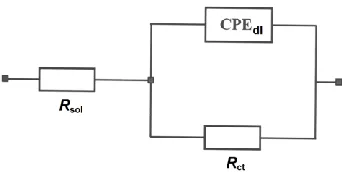
semicircle (practically overpotential independent) corresponds to the porosity of the electrode, whereas the low-frequency response is related to the kinetics of the hydrogen evolution reaction [22-25]. However, as the high frequency semicircles were not well-pronounced at higher temperatures, the porosity response was not included in the impedance fittings/calculations (all fittings were performed with a simple CPE-modified Randles equivalent circuit model, see later Fig. 6).
Figure 4. Complex-plane impedance plots for the HER on pure and Pd-modified (inset) Ni foam electrodes in contact with 2 M KOH, recorded at 20 and 60 ºC for -50 mV (vs. RHE). Solid lines correspond to representation of the data according to the equivalent circuit shown in Figure 6.
[image:8.596.182.411.172.359.2] [image:8.596.159.431.464.695.2]
Figure 6. An equivalent circuit used for fitting the HER impedance data for pure and Pd-modified Ni foam electrodes, obtained in 2 and 8 M KOH. The circuit combines a constant phase element (CPE) for distributed capacitance; Rct and Cdl (as CPEdl) elements correspond to the HER
charge-transfer resistance and double-layer capacitance components, and Rsol is solution
resistance.
Thus, both Ni foam-based electrodes exhibited single, “depressed” semicircles (a single-step charge-transfer reaction) at all potentials, at the temperature range of 20-60 ºC in both electrolyte solutions (see examples of the recorded Nyquist impedance plots in Figs. 4 and 5). Moreover, comparison of Faradaic reaction resistance (Rct) and double-layer capacitance (Cdl) parameters for the HER at the examined Ni foam-based cathodes (derived by means of an equivalent circuit illustrated in Fig. 6) is shown in Tables 1 and 2. The CPE element was used in the circuit in order to account for the so-called “capacitance dispersion” effect [26, 27].
Hence, at 20 ºC and 2 M KOH for cathodically activated Ni foam and Pd-modified foam electrodes the recorded Rct parameter diminished from 12.208 and 1.254 Ω g at -50 mV to 0.103, and 0.052 Ω g at the potential of -400 mV vs. RHE, correspondingly. A radical reduction of the Rct parameter (by ca. 9.7 and 2.0× at −50, and −400 mV, respectively) results from the catalytic nature of nanocrystalline palladium deposit. Interestingly, these surface-deposited Pd nanoparticles (ca. 10 nm and 0.1 wt. % Pd [11, 12]) caused a significant enhancement of electrochemically available surface area, as compared to that of the nickel foam baseline cathode. Thus, for the Pd-activated Ni foam, the recorded values of the Cdl parameter at −50 mV came to 101,770 μF g−1 sφ1−1, which is ca. 12.2× greater than the Cdl derived for the baseline Ni foam cathode: 8,321 µF g-1 sφ1-1 (Table 1). Now, when these capacitance values (recorded for the electrode weight of 0.560 g) are referred to that commonly used value of 20 F cm-2 in literature for smooth and homogeneous surfaces [28, 29], electrochemically active surface area of examined cathodes could be estimated at 233 cm2 (pure Ni foam) and 2,850 cm2 for the palladium-modified foam electrode. Furthermore, a considerable reduction of the Cdl parameter with increasing overpotential is an outcome of partial blocking of electrochemically active electrode surface by newly formed H2 micro-bubbles within highly porous Ni foam entity.
increasing temperature, the Cdl parameter recorded at individual overpotentials kept slowly rising (see Table 1 again). This phenomenon could be explained in terms of additional access to the catalyst surface, gained within the porous electrode structure at higher temperatures (enhanced process of hydrogen bubble removal accompanied by increased conductivity of the electrolyte).
[image:10.596.149.435.322.700.2]In 8 M KOH solution, the recorded Rct and Cdl parameter values (see Table 2) followed the same trend as those obtained in 2 M KOH. Hence, the charge transfer resistance Rct kept decreasing upon rising temperature and cathodic overpotential. It should also be noticed that the Rct values derived in 8 M KOH solution were generally smaller than those recorded in 2 M potassium hydroxide electrolyte (compare the corresponding results in Table 1 with those of Table 2). Again, at fixed temperature the Cdl parameter exhibited significant reduction with increasing overpotential, while temperature increase for the set overpotential resulted in significantly rising double-layer capacitance values (Table 2). Finally, dimensionless φ1 parameter [11] of the CPE circuit (see Fig. 6 and Tables 1, and 2), varied between 0.79–0.98 (2 M KOH) and 0.81–0.95 (8 M KOH), respectively.
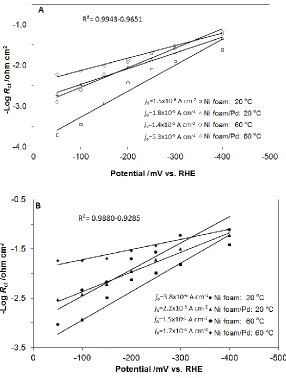
Furthermore, a graph of –log Rct vs. overpotential (see Figs. 7AB) showed relatively good linear dependence for both examined electrodes and electrolyte solutions, over the studied overpotential range. The exchange current-densities (j0) for the HER were calculated through the Butler-Volmer equation (see e.g. Ref. [14]), based on the relation between the j0 and the Rct parameters for overpotential approaching zero [30-32]. Hence, the calculated values of the j0 parameter came to 1.5×10⁻⁶ A cm−2 (at 20 °C) and 1.4×10⁻⁵ A cm−2 (at 60 °C) for the unmodified Ni foam in 2 M KOH. However, significantly increased j0 values, namely: 1.8×10⁻⁵ A cm−2 (at 20 °C) and 5.3×10⁻⁵ A cm−2 (at 60 °C) were recorded for the Pd-modified nickel foam catalyst material in this electrolyte (see Fig. 7A for details). On the other hand, the calculated HER exchange current-densities for 8 M KOH were significantly increased, namely by 2.5× (Ni foam at 20 oC), 1.2× (Ni foam/Pd at 20 oC), 1.1× (Ni foam at 60 oC) and 3.2× (Ni foam/Pd at 60 oC).
It should be stressed that the HER exchange current-density values for the Pd-activated nickel foam (derived at 20 °C) presented in this paper compare fairly well with the corresponding j0s values recorded for 3D porous Ni-based electrode entities: (1-6)×10−5 A cm−2 [22, 23, 33]. Furthermore, in some HER articles [25, 34] electrochemical results for catalytically-modified cathodes are presented with respect to unmodified (initial) geometric surface area of a baseline material. Hence, such-calculated exchange current-densities: (1.0-9.5)×10−3 A cm−2 come close to those quoted for platinum electrodes. Therefore, for a spongy-type entity such as Ni foam electrode, some electrochemical results might suitably be presented as per electrode mass. Otherwise, the results should be given with respect to the Cdl-estimated, electrochemically active surface area of the catalyst-modified electrode.
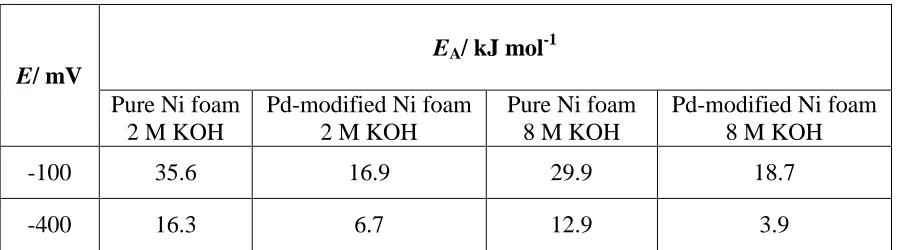
Table 3. Apparent activation energy parameters for the HER, obtained on cathodically activated, pure and Pd-modified Ni foam electrodes in contact with 2 and 8 M KOH solutions, studied over the temperature range 20-60 ºC.
E/ mV
EA/ kJ mol-1
Pure Ni foam 2 M KOH
Pd-modified Ni foam 2 M KOH
Pure Ni foam 8 M KOH
Pd-modified Ni foam 8 M KOH
-100 35.6 16.9 29.9 18.7
-400 16.3 6.7 12.9 3.9
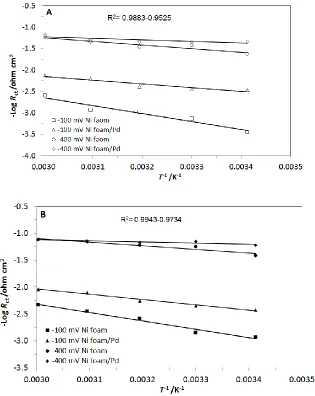
In addition, Figs. 8AB present −log Rct versus T −1
[image:11.596.50.500.481.606.2]
Figure 8. Linear plots of −log Rct versus T-1 for the HER preformed on pure and Pd-modified Ni foam electrodes in 2 (A) and 8 (B) M KOH solutions, at the stated overpotential values.
4. CONCLUSIONS
A key objective of this work was to verify the stability of prepared cathode composite materials by conducting extended alkaline water electrolysis experiments. The results presented in this work proved that palladium-modified Ni foam would be well-suited as a new type of cathode for alkaline water electrolysers, not only because of its long term catalytic stability, but also thanks to its exceptional corrosion resistance at high pH values and large, specific electrochemically active surface area. Furthermore, Ni foam-based cathodes would be less expensive and complicated to produce on a commercial scale, as compared to typical 3D porous type, nonhomogeneous Ni-based electrodes.
[image:12.596.139.454.81.477.2]
References
1. K. Zeng and D. Zhang, Prog. Energy Combust. Sci., 36 (2010) 307. 2. K. Christopher and R. Dimitrios, Energy Environ. Sci., 5 (2012) 6640.
3. S. Vengatesan, S. Santhi, S. Jeevanantham and G. Sozhan, J. Power Sources, 284 (2015) 361. 4. M. Momirlan and T.N. Veziroglu, Int. J. Hydrogen Energy, 30 (2005) 795.
5. R. Solmaz, Int. J. Hydrogen Energy, 38 (2013) 2251.
6. A. Manabe, M. Kashiwase, T. Hashimoto, T. Hayashida, A. Kato, K. Hirao, I. Shimomura and I. Nagashima, Electrochim. Acta, 100 (2013) 249.
7. M.M. Rashid, M.K.A. Mesfer, H. Naseem and M. Danish, IJEAT, 4 (2015) 80.
8. S.A. Grigoriev, V.I. Porembsky and V.N. Fateev, Int. J. Hydrogen Energy, 31 (2006) 171. 9. M. Granovskii, I. Dincer and M.A. Rosen, J. Power Sources, 157 (2006) 411.
10. W. Kreuter and H. Hofmann, Int. J. Hydrogen Energy, 23 (1998) 661.
11. B. Pierozynski, T. Mikolajczyk and I.M. Kowalski, J. Power Sources, 271 (2014) 231. 12. B. Pierozynski and T. Mikolajczyk, Electrocatalysis, 6 (2015) 51.
13. B. Pierozynski and T. Mikolajczyk, Electrocatalysis, DOI 10.1007/s12678-015-0290-x. 14. B. Pierozynski and L. Smoczynski, J. Electrochem. Soc., 156(9) (2009) B1045.
15. B. Pierozynski, Int. J. Electrochem. Sci., 6 (2011) 63. 16. B. Pierozynski, Int. J. Hydrogen Energy, 38 (2013) 7733.
17. Ph. Vermeiren, J.P. Moreels, A. Claes and H. Beckers, Int. J. Hydrogen Energy, 34 (2009) 9305. 18. D. Pletcher, X. Li and S. Wang, Int. J. Hydrogen Energy, 37 (2012) 7429.
19. D. Pletcher and X. Li, Int. J. Hydrogen Energy, 36 (2011) 15089.
20. M.P.M. Kaninski, S.M. Miulovic, G.S. Tasic, A.D. Maksic and V.M. Nikolic, Int. J. Hydrogen Energy, 36 (2011) 5227.
21. X. Qian, T. Hang, S. Shanmugam and M. Li, ACS Appl. Mater. Interfaces, 7 (2015) 15716. 22. M.A. Dominguez-Crespo, E. Ramirez-Meneses, A.M. Torres-Huerta, V. Garibay-Febles and K.
Philippot, Int. J. Hydrogen Energy, 37 (2012) 4798.
23. M.A. Dominguez-Crespo, A.M. Torres-Huerta, B. Brachetti-Sibaja and A. Flores-Vela, Int. J. Hydrogen Energy, 36 (2011) 135.
24. R. Solmaz, A. Gundogdu, A. Doner and G. Kardas, Int. J. Hydrogen Energy, 37 (2012) 8917. 25. C. Hitz and A. Lasia, J. Electroanal. Chem., 500 (2001) 213.
26. T. Pajkossy, J. Electroanal. Chem., 364 (1994) 111.
27. B.E. Conway and B. Pierozynski, J. Electroanal. Chem., 622 (2008) 10. 28. A. Lasia and A. Rami, J. Appl. Electrochem., 22 (1992) 376.
29. L. Chen and A. Lasia, J. Electrochem. Soc., 138 (1991) 3321.
30. J.G. Highfield, E. Claude and K. Oguro, Electrochim. Acta, 44 (1999) 2805. 31. R.K. Shervedani and A.R. Madram, Electrochim. Acta, 53 (2007) 426.
32. S. Martinez, M. Metikos-Hukovic and L. Valek, J. Mol. Catal. A Chem., 245 (2006) 114. 33. J.M. Jaksic, M.V. Vojnovic and N.V. Krstajic, Electrochim. Acta, 45 (2000) 4151.
34. V.M. Nikolic, S.Lj. Maslovara, G.S. Tasic, T.P. Brdaric, P.Z. Lausevic, B.B. Radak and M.P.M. Kaninski, Appl. Catal. B-Environ., 179 (2015) 88.