This is a repository copy of The “good workplace”. White Rose Research Online URL for this paper: http://eprints.whiterose.ac.uk/151416/
Version: Accepted Version Article:
Gomez, R., Barry, M., Bryson, A. et al. (3 more authors) (2019) The “good workplace”. Journal of Participation and Employee Ownership, 2 (1). pp. 60-90. ISSN 2514-7641 https://doi.org/10.1108/jpeo-09-2018-0024
© 2019 Emerald Group Publishing. This is an author-produced version of a paper
subsequently published in Journal of Participation and Employee Ownership. This version is distributed under the terms of the Creative Commons Attribution-NonCommercial
Licence (http://creativecommons.org/licenses/by-nc/4.0/), which permits unrestricted use, distribution, and reproduction in any medium, provided the original work is properly cited. You may not use the material for commercial purposes.
[email protected] https://eprints.whiterose.ac.uk/
Reuse
This article is distributed under the terms of the Creative Commons Attribution-NonCommercial (CC BY-NC) licence. This licence allows you to remix, tweak, and build upon this work non-commercially, and any new works must also acknowledge the authors and be non-commercial. You don’t have to license any derivative works on the same terms. More information and the full terms of the licence here:
https://creativecommons.org/licenses/
Takedown
If you consider content in White Rose Research Online to be in breach of UK law, please notify us by
The “Good Workplace”: The Role of Joint Consultative Committees, Unions and HR policies in Employee Ratings of Workplaces in Britain
January 2019
Purpose: This paper takes a serious look at the relationship between joint consultation
systems at the workplace and employee satisfaction, while at the same time accounting for the (possible) interactions with similar union and management-led high-commitment strategies. Approach: Using new, rich data on a representative sample of British workers, we identify workplace institutions that are positively associated with employee perceptions of work and relations with management, what in combination we call a measure of the “good workplace”. In particular, we focus on non-union employee representation at the workplace, in the form of joint consultative committees (JCCs), and the potential moderating effects of union representation and high-involvement human resource (HIHR) practices. Findings: Our findings suggest a re-evaluation of the role that JCCs play in the subjective well-being of workers even after controlling for unions and progressive HR policies. There is no evidence in our estimates of negative interaction effects (i.e., that unions or HIHR negatively influence the functioning of JCCs with respect to employee satisfaction) or substitution/moderation (i.e., that unions or HIHR are substitutes for JCCs when it comes to improving self-reported worker well-being). If anything, there is a significant and positive three-way moderating effect when JCCs are interacted with union representation and high-involvement management.
Originality: This is the first time -- to the authors’ knowledge -- that comprehensive measures of subjective employee well-being are being estimated with respect to the presence of a joint consultative committee (JCC) at the workplace, whilst controlling for workplace institutions (e.g., union representation and human resource policies) that are themselves designed to involve and communicate with workers.
Key Words: working conditions; managerial ratings; worker representation; unions; works
councils; HRM.
1. INTRODUCTION
In 1985, Richard E. Walton published "From Control to Commitment in the Workplace." The
argument was simple: there are often two radically different strategies for managing a
workforce. For simplicity, Walton spoke of these profound differences as reflecting the
choice between a strategy based on control of workers and a strategy based on
eliciting commitment from them. He began the article with a tale of two real-life
establishments, each under the control of the same parent firm, but with vastly different
management practices, outcomes and employee satisfaction levels (Walton, 1985).1 It took
empirical researchers nearly a decade or more to appreciate Walton's title, not to mention
evaluate or extend his conclusions. During this period, the wide variability in the way
employees experience their day-to-day working lives (Green and Whitfield, 2009; Addison et
al., 2013; Forth, Bryson and George, 2017) became increasingly apparent; i.e., variation that
today is observable not only across industries but also within firms (Barth et al., 2016).
This variation in workplace quality, evidenced in both qualitative and quantitative
accounts, is especially pertinent in countries like Britain, where sectoral bargaining is rare,
employer associations are weak and union coverage rates low (Traxler, 1995; Teulings, and
Hartog, 1998; Traxler et al, 2001; Addison et al., 2013; Bryson et al., 2017). In this context,
the question becomes how to understand the nature of employee well-being when
local-management has such a wide degree of discretion?
Until recently, two approaches have dominated the study of employee well-being and
job satisfaction in Anglo-American economies. The first focuses on the correlates of poor
working conditions and how these might be offset through job design/enrichment schemes
(Hackman and Oldham, 1976; Morgeson et al., 2006) and/or better managerial practices and
‘technologies’ (Black and Lynch, 2001; Bloom and Van Reenen, 2010; Bloom et al., 2012).
The other approach, rooted in employment relations scholarship, examines how workplace
outcomes can be improved through employee voice and involvement at work (Guest and
Pecci, 2001; Bryson, Charlwood and Forth, 2006; Addison 2009).
With respect to the latter, apart from some notable exceptions (see Taras and
Kaufman, 2006; Gollan, Kaufman, Taras and Wilkinson, 2015; Kaufman, 2017), studies of
unionism have dominated the employment relations/worker representation literature. This is
partly because as an institution, even as membership and coverage have declined,
unionisation is still the dominant form of representative voice in most Anglo-American
countries. There is also evidence that unions, at least in Britain and the United States, tend to
form as a response to poor working conditions (Bryson and Freeman, 2013). The idea is that
through the provision of collective bargaining and grievance systems, unionised workers gain
a modicum of “voice” which they can then use to improve working conditions and solve the
public-good provision problem common in voluntary forms of collective action (Booth 1985,
1995). Unionisation should therefore lead to improved well-being for workers and a positive
association between unionism and measured job satisfaction.2
2 The fact that union members were originally found to be less satisfied in their jobs was a bit of a puzzle to labour relations scholars, further exacerbated by the fact that unionised workers were (and still are)
This emphasis on employee satisfaction is important as a growing number of recent
studies are establishing causal linkages between worker well-being and individual
productivity (Oswald, 2015) as well as between employee job satisfaction and
establishment-level performance (Bockerman and IImakunnas, 2012; Bryson, Forth and Stokes, 2017). The
question in this paper is whether non-union voice -- if formally established at the workplace
through some kind of joint consultation committee or employee forum -- is similarly
associated with better employee outcomes and greater job satisfaction.
Unfortunately, this is not a question with a ready-made answer, as there are virtually
no large-scale empirical studies, beyond case analyses (Gollan et al., 2015; Kaufman, 2017),
relating non-union representation to employee well-being or job satisfaction (Wilkinson et
al., 2018b). As noted by one recent study, there is a lack more generally of empirical research
“into the prevalence, determinants and outcomes of [non-union] employee representation at
the workplace-level” (Forth et al., 2017). Instead, the non-union voice literature in Europe
focuses on German codetermination /works councils (Addisson, 2009) or “investigations of
the structures and outcomes of social dialogue at sectoral and national levels” (see Keller and
Weber, 2011). In Britain, the literature has historically been concerned with the potential
threat that non-union voice plays in relation to traditional unionisation (Danford et al., 2005;
Brewster et al., 2007).
In this paper, we address the lack of empirical evidence between non-union voice and
employee ratings of management and the job, by focusing on a British variant of the
German-style works council, i.e., the joint consultative committee (JCC) or employee forum. We
focus on JCCs whilst controlling for the presence of traditional collective bargaining and
human resource practices that independently provide voice and employee
involvement/commitment. Using a new and unique cross-national dataset – the State of the
Workplace Employment Relations Survey (SWERS) – we investigate the role that JCCs play
in what workers themselves tell us are “good” places to work.3 We draw from a
representative sample of British workers found in SWERS focusing on questions that capture
the nature of the employment relationship and access to voice. SWERS has already been used
in an Australian study of employer and workplace outcomes (Wilkinson et al., 2018a), but
has hitherto been unused in Britain.
In addition to following the traditional literature that links union representation with
self-assessments of working conditions, a secondary focus of the paper is to distinguish
non-union consultative voice from seemingly ‘similar’ high involvement human resource (HIHR)
practices.4 Despite the often blurred use of terms such as ‘high-performance’ to mean ‘
high-commitment’ or ‘high-involvement’ (Kaufman, 2012), we focus only on management
practices that are associated with employee involvement and enhanced worker well-being,
thereby excluding from this definition pure “high-performance” techniques such as selective
recruitment, performance appraisals, incentive pay and so on. Our focus on involvement-led
HR is also distinguishable from the recent literature depicting management as a ‘technology’
(Bloom et al., 2017). This management-as-technology literature has a distinctive ‘industrial
3 A recent literature in the United States – and research program based at the Great Place to Work Institute ™ -- has focused on the “good workplace” and those employer practices that are associated with a host of positive employee and employer outcomes (Kruse, Freeman and Blasi, 2010, 2015).
See: http://www.greatplacetowork.co.uk/index.php
engineering/scientific management’ feel with its emphasis on target setting, high-powered
incentives and monitoring (Bryson, 2017; Bloom and Van Reenen, 2011).
It is important to note, however, that employee-led initiatives, like unions and works
councils, are established by employees to improve employee well-being and to alter
associated working conditions. Management-led initiatives, on the other hand, such as HIHR,
primarily focus on performance outcomes and the adoption of policies that make it easier for
employees to perform their assigned roles. Hence, the former might rather align to voice from
an employment relations theory perspective while the latter might rather align to effective
communication from an HR-management theory perspective.
The added motivation for including HIHR as an “independent” predictor of employee
assessments of work and management is that this relationship is still contested in the
literature. While many features of HIHR can drive up job quality -- enriching workers
experience and at the same improving workplace performance (Parker and Wall, 1998;
Kochan and Osterman, 1994; Applebaum et al., 2000; Saridakis et al., 2017; Bryson, 2017)
--there is also, if implemented poorly, the labour intensification potential of “high
-involvement” practices. These can result in adverse consequences for workers including poor
health, increased risk of injury, greater absenteeism and turnover (Pfeffer, 2018; Godard,
2004; Ramsay, Scholarios and Harley, 2000).
The paper proceeds as follows. Section 2 reviews the existing literature on non-union
voice in the British context (e.g., works councils versus JCCs) and explores the potential
interactions these institutions might have with collective bargaining coverage and
high-involvement HR. Section 3 describes the SWERS dataset, together with the specific measures
of worker representation and HR used in the analysis, and outlines the methods employed in
our quantitative analysis. Section 4 presents the results of our analysis. Section 5 concludes
2. THEORETICAL BACKGROUND AND EXISTING EVIDENCE
There are two main areas of literature that this paper adds to. The first concerns itself with
our primary outcome, subjective assessments of worker well-being, summarized here as
overall employee or job satisfaction, which collectively might be considered as an appraisal
of the workplace as a whole. The second is the non-union voice literature as it pertains to
Britain, which historically has been studied under the banner of ‘joint consultation’ (Johnson,
1952; Wheelwright, E, 1954; Joyce and Woods, 1984; Gospel and Willman, 2003).
Beginning with the former, the employee job satisfaction literature is vast and at this
point decades removed from the original labour economics literature (Freeman, 1978; Borjas,
1979) and the management field experiments which it spawned (Hackman and Oldham,
1976; Fried and Ferris, 1987). In short, it is not reducible for the purposes of this paper.
There is a subset of this literature, however, which is more manageable and which
relates to the objectives of the paper; i.e., studies relating unionism or management practices
to worker satisfaction (Böckerman, Bryson and IIlmakunnas, 2012). The fact that the two
areas – union and HRM impacts on employee satisfaction -- are rarely studied together limits
our pool of relevant literature even further (see Pohler and Luchak, 2014).
Surprisingly, non-union employee representation, though re-emerging in Britain as an
area of active research, is virtually unexplored in the employee satisfaction literature.
Our study fills this gap by linking what is already known from the union and HR studies on
employee satisfaction to the hypothesized relationship between workplace consultation and
subjective worker well-being. The focus is on what occurs at the workplace and employee
perceptions of what is “good” in that context.
Finally, there is a literature which has examined the substitutability/complementarity
of non-union voice and HR practices with respect to union membership (Brewster et al,
-- are studied in concert. We begin with a brief summary of joint consultation in Britain and
then propose a series of four hypotheses that relate employee satisfaction to JCCs and our
two other workplace institutions.
2.1 The Practice of Joint Consultation in Britain, 1916 to the Present
There is a long history with worker consultation in Britain. It stretches back to the early part
of the 20th century when labour-related conflict spawned a welfare capitalist movement
intent on preserving the market economy but infusing it with a strong dose of industrial
democracy (Webb and Webb, 1897; Poole, 1986; 1989; Frege 2005). The early proponents of
consultative systems were not intent on replacing collective bargaining or management-led
approaches, rather they envisaged a third pillar upon which worker-management relations
could stand to overcome problems of mutual interest and benefit.
This achieved most fulsome expression in the British civil service under what became
known as the “Whitley system”; named after J.H. Whitley who was Chairman of House of
Commons Committees and later its Speaker in the early 1900s. In 1916, in what at the time
was described as an atmosphere “idealism” and post-war “reconstruction” planning
(Wheelwright, 1954), a Cabinet Committee on Reconstruction was set up with the title “The
Committee on Relations between Employers and Employed”. Whitley was Chairman of this
committee and charged it with recommending ways of achieving permanent improvement in
industrial relations. The Whitley report proposed that a series of committees be set up in each
industry, made up of employee and management representatives, in order to exchange
information and deal with issues of mutual relevance. Emphasis was laid on the principle of
“self-government in industry” (Johnson, 1952) and these Whitley Councils, as they became
known, were to appear at three levels: national, district and workplace level. They were
presence in Britain, there is still a legacy-effect present in the public sector. As noted in a
recent review of consultation systems in Britain (Adam, Purcell and Hall, 2014), JCC
presence of any kind (workplace or higher) is three times greater in the public sector than in
private industry (i.e., present in 65 percent of public sector establishments versus 20 percent
in private industry).
Despite the ‘success’ in the Civil Service, “Whitleyism” never fully took hold
elsewhere. While the Government of the day accepted the report and recommended the
establishment of National Joint Industrial Councils, it left it up to employers and trade unions
to adopt the consultative scheme to their own requirements. Most simply ignored the
consultative dimensions and the ones that did establish a council, established traditional
collective bargaining relationships within them (Gospel and Willman, 2003). During the
interwar depression and industrial unrest of the 1920s, both institutions – collective
bargaining and consultation -- contracted even further.
Yet, despite falling far short of its original purpose, joint consultation left its mark on
industrial relations in Britain. The joint industrial councils were revived and actively
supported by government during the 1930s and 1940s in response to the Second World War
and were once again used to “aid in reconstruction” efforts afterwards (Milner, 1995).
Moreover, even as this phase of joint consultation waned in the face of post-war demands by
unions for traditional collective bargaining and employer reticence to accept workplace level
representation, the institution never fully faded away.
In fact, well into the 1970s, worker representation remained a viable political question
in at least two dimensions. First, were demands for the establishment of worker
representation on the board of firms in publically owned industries. The other was the rise of
tripartite arrangements such as the Health and Safety at Work Act (HSWA) of 1974, which
By the early 1980s, however, the political environment towards industrial democracy
and collective bargaining changed markedly. With the election of Margaret Thatcher and her
government’s removal of immunities and imposition of restrictions on union activities,
membership and union coverage began to shrink almost immediately. Interestingly, it was at
this time, however, that employers began adopting ‘alternative voice’ systems, in part to fill
the void left by a lack of trade union representation but also as part of a broader strategy of
management-led employee engagement strategies. Even though it is clear from various waves
of the British Workplace Employment Relations Survey (WERS) that employers have, at
least since the 1980s, favoured direct forms of communication (e.g., via worker meetings,
problem-solving circles and briefing groups etc.) over representative voice; joint consultative
committees (JCC) have always remained an option (Bryson, Willman, Gomez and
Kretschmer, 2013).
From the early 2000s onward, when Tony Blair’s New Labour Government adopted
the EU Directive on Information and Consultation of Employees (ICE), joint consultation
through the vestige of the JCC system, was once again poised to re-emerge. Interestingly, the
stated commitment to consultative structures at the workplace has grown even further under
Theresa May’s leadership of the Tory party– e.g., Prime Minister May made worker
representation in industry a priority of her stillborn campaign for leadership of the party5 and
has followed through with the commissioning of the 2017 Taylor Review; two in a series of
indications that “employee voice” is squarely on the agenda of the Government(O’Connor,
5 Even though she was acclaimed when her only opponent bowed out of the race for party leader, Theresa May’s first and only speech of that campaign on July 11, 2016 had some direct language regarding the role of
2017). It is also the case that trade unions and employers are not, as was previously the case,
in opposition mode to these proposals (O’Connor, 2017). Studies taking a closer look at
employee involvement and consultative voice in the form traditionally found in Britain –
through joint consultation committees– are therefore particularly relevant now.
2.2 Employee Satisfaction: The Role of Union and Non-Union Worker Voice
What is the relationship between employee representation and well-being at work? As noted
in the introduction, the empirical literature has historically been somewhat mixed when it
comes to relating employee satisfaction to union membership (Bryson, Cappellari, and
Lucifora, 2010; Green and Heywood, 2015), with a majority of the early studies finding a
negative correlation between job satisfaction and unionisation (Bryson et al., 2004). The
reasons are many and summarised in a recent meta-analysis of the union job satisfaction
literature by Laroche (2016): e.g., union ineffectiveness in fixing underlying managerial
problems, union effectiveness and the raising of expectations; unions’ ability in securing job
security and increasing tenure hence inducing voice-related complaining; or sorting by
worker-type (e.g., less ‘agreeable’ workers tend to prefer unions).
More recently, the inclusion of relevant conditioning variables and efforts to
overcome perennial endogeneity problems associated with union organizing in the face of
already poor performing firms and less agreeable ‘voice-prone’ workers, have found positive
union associations with pay satisfaction and other aspects of the job (Hipp and Givan 2015;
Bryson and White, 2016a, 2016b; Laroche, 2016, 2017). This gives rise to the following
hypothesis:
Hypothesis 1: In unconditional cross-section estimates, the union-employee satisfaction relationship is likely to be negative. With our full set of controls
and typically ‘hard-to-observe’ worker attitudes added to standard
Interestingly, the new empirical studies establishing neutral or positive associations between
unions and employee satisfaction have appeared at the tail end of a steep decline in the
number of workers covered by collective agreements in Britain (Bryson, Freeman, Gomez
and Willman, 2017). And yet, British employers appear to still value worker input into
decision making processes, as evidenced by the fact that since the early 1980s the percentage
of workplaces (and workers) with no formal mechanisms for employees to express their voice
has remained steady at around 20 percent (Willman et al., 2006; Bryson, 2016). This is due to
the surge in non-union forms of voice, most of which involve direct forms of two-way
communication between employees and management but which include representative
structures as well (Gollan et al., 2015).
The literature on non-union representative voice has tended to focus on works
councils (WCs), mainly in Germany where they have a long history and are underpinned by
statutory protection (Frege, 2002; Addison, 2009). In Britain, by contrast, the equivalent of
works councils – joint consultative committees (JCCs) -- have only recently come under
active scrutiny, in part because they are often seen as creatures of the employer with
traditionally little or no legal support and no real say over key aspects of decision-making at
the workplace (Dobbins and Gunnigle, 2009).
Yet evidence from recent papers suggests that workplace consultation and meaningful
engagement, even in the Anglo-American world where it is often thought to be insufficient,
might play a more important role than previous thought (Wilkinson et al., 2014; Bryson,
2017). In particular, the presence of non-union voice (JCC/employee forum) with (or
without) unionisation seems to impart a significant advantage in organizational and employee
outcomes, as compared to firms with no representation whatsoever (Wilkinson et al., 2018).
This is suggestive that the two forms of representation – union and JCCs -- are complements
and Wood, 2005; Godard, 2007). The question increasingly appears to be how faithfully do
JCC’s reflect joint employee-employer concerns and how do management techniques and
unions assist (or detract from) these parallel consultative workplace institutions? (French,
2001; Brewster et al., 2007; Pohler and Luchak, 2014)
This gives rise to the second hypothesis tested in the paper:
Hypothesis 2: In both unconditional and conditional estimates, the relationship between non-union voice – as measured by the presence of a joint consultative committee (JCC) at work – and employee satisfaction should be positive. We do not expect the relationship to be strongly affected by union presence or HIHR, meaning that we should not see the coefficient size diminish (or significance levels to drop) when union presence and HIHR are controlled for.
2.3 Employee Satisfaction: The Role of Management Practices
The main contention of the ‘mutual gains’ literature (Kochan and Osterman, 1994) is that
firms and their employees benefit from the adoption of progressive employee management
practices. These practices have a separate and earlier history and are known as “hig
h-involvement”, “high commitment” or “high performance” workplace practices (Walton,
1985; Lawler, 1986; Appelbaum, 2000), though the latter term has problems in that it
sometimes conflates performance-management with employee engagement. For firms, the
benefits of a “commitment” over “control” approach accrue through improvements in
labour productivity and profitability, while for employees they arise through intrinsic
rewards related to engaging in enjoyable work, control of their own work environment,
having a “say” at work more generally, and feeling part of the enterprise.
The literature on these new-style HR management practices, though contested
(Kaufman, 2012), has developed rapidly in the intervening quarter century, particularly
in economics, where the study of internal management had long been neglected (Grund et al.,
2017; Lazear 2000). The study of “management” is no longer the preserve of business school
production process, i.e. a ‘technology’ entering the production function alongside capital
and labour (Bloom and Van Reenen 2012 (BVR forthwith)). However, the practices
deemed critical in this framework are not necessarily those likely to offer a ‘say at work’ or
elicit employee engagement. For BVR the core set of practices are target setting,
monitoring, and high-powered incentives – arguably the pillars of the scientific
management orientation propounded by Taylor and adopted by generations of industrial
engineers. BVR find strong correlations between these practices and firm productivity and
performance within and across countries (Bloom et al., 2014). Indeed, they argue
differences in managerial practices account for a substantial part of the variance in
productivity across firms within industries, thus helping to explain the huge heterogeneity in
firm performance within industries and even within some firms (i.e., across workplaces)
emphasised by recent scholarship (Syverson, 2011). BVR maintain these practices are not
simply correlated with better performance, rather they have a causal impact on
productivity and performance (Bloom et al., 2017).
This is a controversial stance. Others argue that what works for some firms may
not work for others, either because the success of management practices is contingent on a set
of “hidden from view” attributes such as firms’ competitive strategies, or because they are
contingent on the other policies and practices deployed by the firm –what are referred
to as ‘external and internal fit’ respectively (Milgrom and Roberts, 1995; Huselid,
1995; Becker and Huselid, 1998). The implications are that firms may need to
experiment with various practices before identifying what works for them, while the
internal fit perspective suggests the precise configuration of HRM practices is likely to
matter.
Notwithstanding these objections, if the sub-set of practices emphasised by BVR are
set of practices, even if they do benefit employees. The core HR practices highlighted in
the early high commitment management literature were those that transformed job and
work organization through the devolution of control to workers, offering the autonomy
required to optimise working arrangements (Lawler, 1986; Walton, 1985). Additional
support, through on-going training, is thought necessary to underpin the transition to such a
system and maintain it in the face of worker turnover and modifications to production
(Forth and Millward, 2004; Appelbaum et al., 2000). This ‘high-involvement’ HR model
is a fundamentally different perspective on what might “work” when compared to BVR’s
conception, stemming largely from the assumption that performance improvements brought
about by transforming HR occur because they engage employees in their jobs and consult
them in decision-making more generally at the workplace.
Although there is debate about the optimal configuration of HR practices and whether
the returns to such practices are homogeneous across firms and workplaces, there is
increasing evidence suggesting that firms can and often do increase productivity via
investments in high-involvement HR practices. There are studies in addition to BVR’s to
suggest this is the case, and many of these include a more complete set of HR practices,
including those that have the potential to raise employee involvement (see reviews by Wood
and Bryson, 2009; Bloom and Van Reenen, 2011; Saridakis et al., 2017).
In terms of the mechanisms by which commitment-led HR improves productivity
there is suggestive evidence that it accrues through employee engagement and through
improvements in workers’ well-being. One study has identified a causal linkage
between individual worker happiness and individual productivity (Oswald et al., 2015)
while other recent studies suggest this link also exists at an organizational level (Bryson et
It is therefore possible that the high-involvement variant of HR management benefits
firms by increasing worker wellbeing first. The literature on links between HR practices
and employee wellbeing also suggests that what matters is the intensity with which
the HR system is implemented by management: i.e., “shallow” or “below average” HR
adoption can actually reduce employees’ intrinsic job satisfaction and organizational
commitment6, while more intensive high-involvement HR use is positively associated
with both outcomes (White and Bryson, 2013).
This gives rise to the third hypothesis tested in the paper:
Hypothesis 3: In both unconditional and conditional estimates, the relationship between high-involvement human resource (HIHR) practice adoption and employee satisfaction should be positive. We do not expect the relationship to be strongly affected by JCCs and union presence, meaning that we should not see the coefficient size diminish (nor significance levels drop) when JCCs and union presence are controlled for.
2.4 Possible Interaction Effects
The theory and evidence surveyed above is suggestive that joint consultation, union
representation and high-involvement HR are all related to employee satisfaction in a positive
manner, with the ‘trickiest’ relationship involving unions. Given the strong selection and
endogeneity effects associated with the union relationship (Laroche, 2017), the unconditional
estimates are likely to be negative (as has been found in the prior literature) but using a set of
controls that capture most of the job-related and attitudinal dispositions of workers associated
with more negative appraisals of the workplace (as is now common in the recent literature),
there is likely to be a small but positive relationship between union coverage and employees’
wellbeing in cross-sectional estimates.7.
The other two main-effect relationships with respect to employee satisfaction–
between joint consultation and high-involvement HR respectively – are expected to be
positive, so the question is whether the positive coefficients remain empirically relevant when
all three workplace-based institutions are simultaneously estimated. If one or the other
reduces in magnitude, this is suggestive that if, for example, high-involvement HR is in place
and actually works, a separate conduit for employee consultation (i.e., a JCC) may not be as
necessary or impactful.
Perhaps more important than even the main-effect and mediating relationships, are the
possible synergies between union representation, high-involvement HR and JCCs, in which
case we need to be attentive to the potential for interaction/moderation effects. In our case,
the relationship between JCCs and overall employee workplace satisfaction could be
moderated by union presence, but it may also be moderated by HIHR: e.g., workers in HIHR
workplaces may have more to gain from having a JCC present. Moreover, the moderating
effect of union presence may itself depend on HIHR presence (or lack thereof); i.e., even if
the worker is unionised, they may not be able to feel the benefits of a JCC if they work for a
‘control’ versus ‘commitment’ employer, whereas if they have a very high-involvement
employer but are not unionised, the role of a JCC may be exacerbated beyond that predicted
by either moderator alone. There is also finally the ‘black hole’ (Guest and Conway, 1999) or
‘silent’ (Willman, Gomez, and Bryson, 2006) workplace where no evidence of any formal
HR system (progressive or otherwise) or union voice is found. Measured against this
comparator, one would expect to find a marked difference in employee satisfaction scores
amongst respondents with access to a JCC or with access to all three systems versus those
with none.
The question is how robust to the inclusion of control variables and interactions with
the two other workplace institutions – high-involvement HR and/or union representation –
will the JCC relationship be? We do not believe that the evidence, however scant, is
suggestive of a strong moderating relationship between JCCs and the presence a union or
high-involvement HR. Our review of the literature suggests that there is a direct benefit from
having a JCC that should remain salient in estimates where all three dual interactions are
controlled for and when we estimate the coefficient attached to having all three systems in
place.
This gives rise to our fourth and final hypothesis:
Hypothesis 4: When JCCs are found in combination with both union presence and above average high-involvement HR (in a three-way interaction term), the moderation/interaction effects with respect to employee satisfaction are likely to be positive but not strong enough to reduce the independent or ‘main effects’ of joint consultation and high-involvement HR.
3. DATA AND METHODS
3.1 The Data
The data used in this study were obtained through a custom-designed survey instrument, the
State of the Workplace Employment Relations Survey (SWERS). The survey itself comes
from a broader project funded by the Australian Research Council (ARC), Social Science and
Humanities Research Council (SSHRC in Canada) and Industrial Relations Counsellors (IRC
in the US) examining employment relations outcomes in four countries: Australia, United
States, Britain and Canada including nationally representative surveys of employees and
managers. Unlike past employee voice surveys, the entirety of the employment relationship
as well as relevant worker and employer outcomes, rather than simply representation and
The employee surveys were given to separate panels of respondents in the four
countries pre-assembled by a professional organisation survey company, Opinion Research
Corporation (ORC), who conducted the survey on our behalf. The survey research firm,
considered the world leader in this technique, has a large representative panel of employees
and managers in all four countries. It then blends in requests to other panel members having
the needed characteristics until an (approximately) nationally representative sample is
obtained over key observables, which in our case were standard demographics for employees
(e.g., age, gender, marital status, immigrant status, education). This is in effect a form of
‘quota sampling’ with online (as opposed to telephone) respondents. Quota sampling does not
have a sampling frame and as such does not generate a response rate since there is no
randomly drawn target sample from which a proportion of valid responses can be drawn
(Dodge, 2006: 428).
The surveys were completed in 2016 with a sample of roughly 2000 employees from
each of the four countries. Respondents employed in workplaces with only more than 20
employees were included, as we wanted to engage with workplaces of sufficient size to have
some chance of having formalised workplace systems in place. This paper uses only the
British employee data from SWERS, giving us a sample of 2,042 employees.
3.2 Measures and Methodology
Key Dependent Variables
As we are interested in estimating the relationship between JCCs and employee satisfaction,
whilst controlling for any mediating or moderating associations among union representation
and high-involvement HR practices, it is necessary in our case to be able to collapse a series of
questions that identify employee satisfaction into composite scores so that they can be used as
To achieve this, we first separate questions that ask about fixed characteristics of the
workplace and management from those that ask about attitudes or impressions of management
and work. Of the 84 questions asked in the SWERS survey about jobs and the workplace, we
identified 16 questions as being ‘strongly’ attitudinal in nature, and hence candidates for our
employee satisfaction measure.
As a second step, we run factor analysis on these 16 questions, which are all based on
the same 1 to 7 ordinal scale running from ‘strongly disagree’ to ‘agree strongly’, and find that
they fall into two separate factors: one for attitudes towards the job (7 questions) and another
for attitudes towards management (9 questions). Both factors have Cronbach alphas over 0.90.
The two factors were also highly correlated with each other, with a correlation coefficient of
0.82, suggesting that a latent “overall employee satisfaction score” was also present (results
available upon request). To simplify matters and given the high degree of inter-correlation, we
only focus on the job satisfaction measure.
Table 1 presents the 7 questions asked in the survey that coalesced around job/work
related factors: a variable capturing employee attitudes towards the job itself and includes
measures such as ‘how satisfied the employee is about his or her job’, and ‘how attached he or
she is to their work’. Based on the high Cronbach alpha (0.93) among these 7 measures of
satisfaction with the “job”, we take this as our overall employee or workplace satisfaction
dependent variable.
[Table 1]
Key Independent Variables
Our measure for the presence of non-union voice comes from a question that asks employees
if the workplace has an internal joint consultative committee (JCC) that meets to discuss
workplace/employment issues. Specifically, respondents are coded 1 if they answer ‘yes’ to
some kind of internal joint consultative committee, staff advisory association, plant council, or
workplace employee forum so managers and elected/selected employee representatives can
meet and discuss issues of relevance?” and 0 otherwise. 8
Similarly, to capture the relationship between unionisation on employee attitudes, we
look at respondents that responded affirmatively to whether they were represented by a union
at their current unit or workplace. These individuals were coded 1 if they said ‘yes’ and 0
otherwise (‘don’t knows’ and non-responders were excluded from the analysis).
The last of the three core independent variables in our analysis is the high-involvement
human resource (HIHR) variable, which is a composite variable of 6 questions pertaining to
high-involvement management policies. The 6 items do appear to be picking up the same latent
construct, as evidenced by a Cronbach alpha of 0.89. Table 2 describes the questions used in
this composite HIHR score.
[Table 2]
As all of these questions are on 1-7 scales, the variable is defined as:
[1] hihrmotherwise score > median hihrm score
The use of a “threshold” which is converted to a 1 or 0 outcome is in keeping with the way we
coded union and JCC presence and also with the notion developed in Section 2 that “shallow”
HR can actually reduce employees’ intrinsic job satisfaction and organizational
commitment, but more intensive HRM use is positively associated with both in the
literature (White and Bryson, 2013).
Thus, our empirical specification is as follows:
[2]
where represents our 7 item measure of employee job satisfaction (e.g., attitudes
towards the job as our overall workplace satisfaction score), is a vector of all three of our
two-way interactions between , , and , and is a vector of relevant
covariates. Two key parameters in our regression specification are therefore , which
identifies the main-effect of JCC presence and the three-way interaction estimate of unions,
joint-consultative committees and HIHR on employee assessments of their workplace. If the
inclusion of yields a coefficient that is significant and large,
whilst also pulling down any estimate of it would point to a strong moderation effect at
work with respect to JCCs and our other two workplace-based institutions.
To control for heterogeneity that may potentially confound the relationship between
committee, union, HIHR and our dependent variables, we include four categories of covariates
in our vector : a) worker demographics, b) workplace/job characteristics, c) market / industry
characteristics and d) typically hard-to-observe personal preferences. Worker demographics
include information on gender, age, education, occupation, race, immigrant status and marital
status, as these are all factors related to the employee that may play a role in the model.
Workplace characteristics include variables such as the employee’s tenure at the organization,
organization size and ownership structure (e.g., private, public, not-for-profit). We also control
for market characteristics that may affect the organization by controlling for the type of
re-organization, downsizing, bankruptcy etc.. Lastly, despite this being a cross-sectional dataset,
we can control for typically hard-to-observe ‘fixed-attributes’ of individual respondents via
self-reported questions that capture whether a respondent prefers “moving often between
employers/jobs” (versus remaining loyal to their existing employer) and whether they have a
strong “belief in a free market economy” (over a mixed or more publicly controlled economic
system).
3.3 Empirical Caveats
There are three cautionary notes to keep in mind when interpreting our results. First, we are
unable to make causal inferences about the relationship between workplace characteristics
and employee ratings of their working environment because our data do not permit us to take
account of non-random worker sorting across workplaces that may be linked to the sort of
ratings they provide. Nor can we account for non-random employer selection of workers
from the queue of those wishing to work at their workplace. We know from other studies that
this type of sorting does take place. For instance, past research shows that more (less) able
workers tend to sort into (out of) workplaces offering performance-related pay (Lazear,
1990), while other studies depict a queue for union jobs comprised of those in the lower half
of the ability distribution, from which employers pick the most able, resulting in
positive-selection into union workplaces from the middle of the ability distribution (Abowd and
Farber, 1982). These sorting processes can affect employees’ ratings of their jobs and
workplaces if they are (un)successful in obtaining the sort of job match they would prefer.
Similarly, employers may choose HR practices to ‘fit’ with the workers they are able to
recruit. If they are successful in this and workers are exposed to the sorts of HR practices
deemed fit for them, this may lead to a higher employee rating for those practices than if a
Second, we need to acknowledge that employee reported practices and employer
reported practices typically differ. This is because employee perceptions of workplace
policies may differ from managerial implementation. An extensive literature, for example,
about the role of line managers in bridging the divide between top management directives and
front-line employee perceptions, raises this very issue (Russell, et al, 2018; Alfes et al.,
2012). The implication of this literature for our empirical results is as follows: should we find
a positive correlation between JCC presence and employee job/work satisfaction
(conditioning on observable individual and workplace characteristics) it may be the case that
those with well-functioning JCCs are more likely to report their existence than those
employees with ineffective JCCs. This would represent an upward bias. At the same time, it
might also be true that dysfunctional JCCs would also be more likely reported as present in
the workplace, in which case the bias would be downward between reported JCC and
employee job/work satisfaction. In other words, the extremes may attract attention (at either
end of the performance spectrum) but the middling JCCs may be misreported as “0”. At
present, we do not have a way of disentangling these differences between employee reported
practices (perceived) and employer reported practices (implemented), but we do want to alert
readers that the perceptions of employees and employers typically differ in the literature and
can be at work in influencing any positive (or potentially negative) findings.
Finally, as all employees are answering from a single survey there is as always the
potential for common method bias (CMB) influencing our results, a point somewhat related
to the concern above. Our strategy was to use procedural (ex ante) measures in the survey
design to control for CMB rather than any statistical (ex post) techniques. This involved
assuring respondents that this was not an industry or management led study and instead an
academic research project that would be fully anonymous (the implication being that
did is that we counterbalanced question order wherever it made sense. This is a remedy often
used to control for priming effects, item-context induced mood states, and other biases related
to the question context or item embeddedness (Podsakoff et al, 2003). Specifically, we
counterbalanced the order of our explanatory (independent) variables (such as presence of a
JCC which called for "yes" or "no" answers) and the outcome (dependent) variables of
interest (i.e., job/work satisfaction responses on 1-7 Likert scales). In principle, this has the
effect of neutralizing some of the biases that affect a respondent’s retrieval stage by
controlling the psychological cues prompted by the question context. As much as possible,
though, we grouped attitudinal responses after the presence/non-presence questions. This is
because the primary disadvantage of counterbalancing is that it may disrupt the logical flow
and make it impossible for survey respondents to progress logically from general to specific
questions, something often recommended in the survey research literature (Podsakoff et al,
2003).
With these caveats in mind, we can still compare unconditional estimates of the
relationship between JCCs and employee satisfaction against estimates conditioned on a
fulsome set of observed covariates as well as any potential moderating effects based on
interactions with union presence and management-led involvement schemes.
4. RESULTS
4.1 Descriptive Statistics
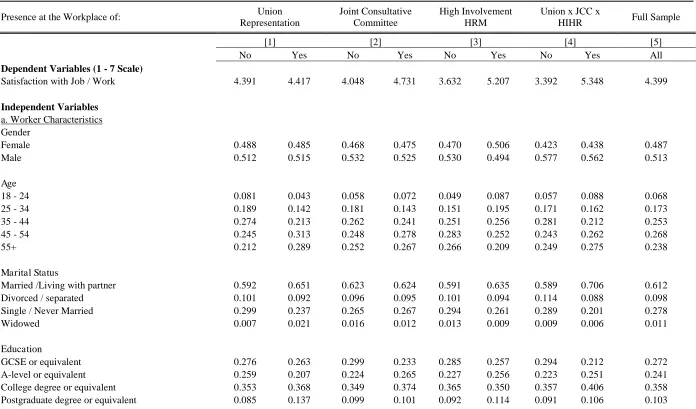
Table 3 uses data from SWERS to illustrate the overall and relative satisfaction of workers in
Britain. It offers a descriptive breakdown of our independent variables by looking at the data
through the presence (or lack thereof) of our three key explanatory variables – i.e., union
recognition, JCC and HIHR management. The final column of the Table reports the results
[Table 3]
Looking across the first three rows of Table 3 one sees the mean ratings of our dependent
measure of workplace wellbeing: i) satisfaction with the job. The descriptive results show for
the most part that union versus non-union workers (column 1) demonstrate very little obvious
differences in satisfaction levels whereas the presence of a joint-consultative committee
(column 2) or a high-involvement management approach (column 3) are associated with
noticeably (positive) differences in mean scores as compared to employees without these
workplace systems/institutions. The three-way interaction in column 4 – i.e., having union
recognition, joint consultation and high-involvement management at your workplace (which
is 11 percent of our sample, see Table 4 last row) – displays the highest relative satisfaction
scores (5.348 out of a possible score of 7). This is suggestive of positive synergies when all
three key independent variables are found present together; whether this is a significant
moderating (interaction) effect remains to be seen, as we still have to conduct regression
estimates that control for observed differences in other relevant independent variables and all
two-way interactions.
The lower rows of Table 3 display sample means of our independent variables, again split
by the presence (or lack thereof) of union recognition, joint consultation or a
high-involvement management approach. Some regularities deserve mentioning: e.g., employees
with union presence and joint consultation tend to be older (29 and 27 percent of the union
and JCC sample are aged 55 plus versus 21 and 25 percent in the respective non-union and no
JCC categories) and more likely to be found in larger workplaces (43 and 44 percent of the
union and JCC employee sample are found in employers with more than 5,000 employees
versus 33 and 27 respectively in the non-union and no-JCC sample). The high-involvement
HR group appears to differ from JCC and union respondents in that they are younger (only 21
non-high-involvement category) and located in smaller to mid-size employers (33.9 percent of
employees in high-involvement firms had 5,001 or more employees versus 39 percent of
non-high-involvement firms). Interestingly, while the simultaneous presence of the three
workplace systems (union x JCC x high-involvement) looks somewhat similar to the JCC
category, education appears to differ. There is a larger proportion of respondents with a
college/university degree (40.6) or post-graduate degree (10.6) amongst three-way
respondents than in any of the other categories.
Descriptive Evidence on Employee Satisfaction and Presence of Joint Consultation
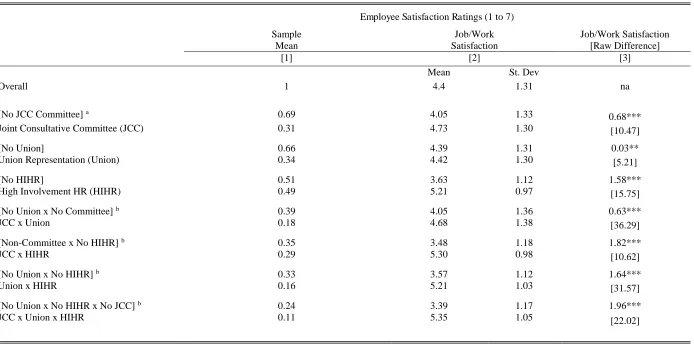
There is another way to reformulate the unconditional (raw) differences in employee
satisfaction in relation to each key independent variable (i.e., presence of union recognition,
JCC or high-involvement HR) and all two-way and the three-way interaction terms. This is
done in Table 4 which shows markedly higher satisfaction ratings amongst employees with
access to a JCC (row 1) and high-involvement HR (row 3). The mean differences in
job/workplace satisfaction found in column 3, between presence and non-presence of JCCs
and presence versus non-presence of high-involvement HR are large (0.68 and 1.58
respectively relative to a mean score of 4.40). These differences are also significantly
positive. Union recognition displays the smallest difference (a positive 0.03 difference),
which given the cross-sectional nature of our data, is perhaps not surprising since there is
evidence in the literature that contextual factors related to unionised workplaces as well as
‘selection’ effects are likely at play in mediating the employee satisfaction ratings.
[Table 4]
Interestingly all three two-way interactions (rows 5 to 7) and the single three-way
interaction term (row 8, where a respondent has a union, JCC and high-involvement HR at
effect’ measures, with the largest differential occurring when JCCs are interacted in a
three-way combination with HIHR and union (1.96 points greater). Union presence again does not
appear to influence employee satisfaction (negatively or positively) in any of the two-way
interactions.
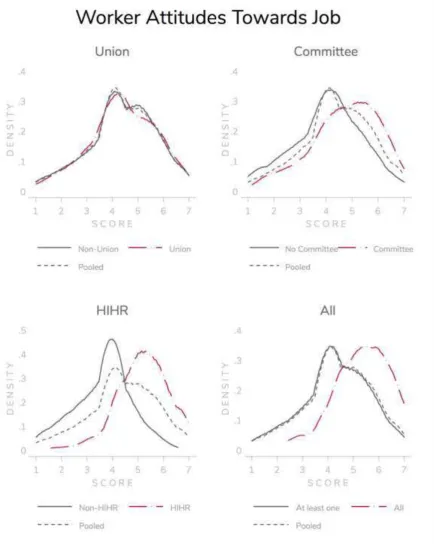
This can be seen even more clearly in Figure 1, which plots the distribution of employee
ratings for our job/work satisfaction measure by presence of either a union, JCC,
high-involvement HR or all three systems versus none. It is clear that having all three systems
present at work is associated with a pronounced shift in the scores rightward (i.e., towards the
maximum score of 7) with a rather thin tail of low scores (under 4) and a mass of responses at
5 and above. This is true of the high-involvement score distribution and for JCC presence as
well. Union presence, on the other hand, is indistinguishable from the non-union and overall
distribution of employee rating scores.
[Figure 1]
In sum, these descriptive statistics point to important “JCC”and “high-involvement HR”
associations with respect to employee satisfaction, however measured. The latter --
high-involvement HR – is associated with the highest employee satisfaction scores, followed by
JCCs and a distant third being union presence, which on balance is associated only slightly
positively with job/work satisfaction. Coupled with evidence in Table 4 that the interaction
between JCC and high-involvement HR (row 6) produces employee satisfaction scores larger
than between union x JCC (row 5) or union x HIHR (row 7), this points to the potentially
positive role being played by formal joint consultative voice systems and high-involvement
managerial practices at work.
However, one should exercise caution as across the sample of employees being studied,
there are some important differences in the nature of the workplaces (such as in size of
and education etc.,) of respondents. So, the next step is to more formally ‘test’ our four
hypotheses with empirical estimates of the union/joint consultation/high-involvement-related
associations derived from statistical models that control for observed differences in employee
and workplace characteristics.
4.2 Empirical Models of Employee Satisfaction: A Test of Our Four Hypotheses
Table 5 reports overall employee satisfaction rating differences between workplaces that have
union recognition, joint consultative committee structures, and high-involvement human
resource management practices and those that do not. These estimates condition on variables
that are judged to be relevant predictors of employee satisfaction as well as typically
hard-to-observe fixed ‘attributes’ of workers that may also play a role in selection to a union or
having access to a non-union voice system. All of the control variables were described in
section 3.2 above. As a means of providing a standardized estimate of effect size, we will
concentrate on the standardized ‘employee satisfaction’ estimates found in Table 5 for the
interpretation of our results and commentary on our four hypotheses, and allow readers to
look at the results for the unstandardized job satisfaction results in our Appendix A1 table
separately. All tables report OLS regression estimates of our dependent variable (i.e., our 1 to
7 scale measures of overall employee satisfaction) while our key independent measures are
all dummy variables showing the rating differences among employees having union
recognition, a JCC present or high-involvement HR versus those that do not.
[Table 5]
Table 5 estimates of employee satisfaction differences related to union, JCC or
high-involvement presence are derived from two sets of specifications, the first set of four
right-hand side controls added, and the second set (columns 5 to 8) is estimated with the full-set of
two-way interaction terms and our single three-way interaction term, again with progressively
more right-hand side controls added. The final column (8) represents the fully-specified
model with all controls and all possible interactions added.
Hypothesis 1: Employee Job Satisfaction and Union Recognition
Table 5 shows that much like our unconditional results, there is no significant difference in
overall employee satisfaction between union and non-union employees, conditional on
having a JCC and a HIHR management approach in place. This is so in the first specification
(column 1) which only controls for observed demographic characteristics such as age, gender,
marital status, education, and immigrant status up to the last specification (column 4) which
controls for workplace, industry and hard-to-observe personal attributes. In other words, the
‘main effect’ of unions in these cross-sectional specifications appears to be “zero”, a finding
in keeping with recent literature showing a tug of war between positive union “treatment”
versus negative “selection and sorting” effects at the workplace (Laroche, 2016). But as
these main-effect results are not significant, we consider this a weak confirmation of our first
hypothesis.
Hypothesis 2: Employee Job Satisfaction and Joint Consultation Committees (JCCs)
The unconditional results in Table 4 (column 5) and Figure 1 showed a positive difference of
about 0.70 points – with respect to an average overall employee satisfaction score of 4.40 (or
0.5 of a standard deviation) -- for employees having a joint consultative committee at work.
When we examine Table 5, we see that the JCC relationship diminishes in magnitude to
roughly a quarter of the unconditional value. Specifically, Table 5, column (4) yields a
standardized Beta estimate of 0.12. Though diminished in magnitude from the unconditional
significant (at the 1 percent level). So it seems that after controlling for union recognition and
potentially substitutable high-involvement systems at work, the independent relationship
between JCC presence and overall employee satisfaction (the ‘main effect’) is significant and
remains so across all specifications (columns 1 to 4) that control for a host of right-hand side
variables.
In columns 5 through 8, where we add our interaction terms in addition to controlling
for individual and workplace-related variables, the main effect of JCC presence does not
diminish and in fact increases to 0.1554 in the final fully interacted model estimate. We
consider these estimates as a confirmation of Hypothesis 2.
Hypothesis 3: Employee Job Satisfaction and High-Involvement Human Resource (HIHR) Management
The evidence of high-involvement HR and self-reported employee well-being was predicted
to be positive, especially as we created a variable from our dataset that was meant to capture
not just lukewarm but intense adoption of the high-involvement approach -- something noted
in the literature as being highly relevant to the effectiveness of HR systems (see White and
Bryson, 2013). The unconditional results in Table 4 and Figure 1 indicated that the largest
differences, relative to unions and JCCs, resided between workers that had a
high-involvement HR system at work and those that did not. The difference was 1.58 points (Table
4, column 5, row 3) on a mean score of 4.40 in overall employee satisfaction (or over a full
standard deviation higher score from having high-involvement HR versus not).
The conditional estimates in Table 5 column 4 show that after controlling for
simultaneous presence of a union and a JCC, as well a host of individual and workplace level
controls, the relationship between high-involvement HR and overall employee satisfaction
falls to a standardized Beta of 0.576, a result that is still large and significant. The results are
to 8 ), i.e., the main effect coefficient rises to 0.6208 (see Table 5, column 8), suggesting that
like JCCs and union presence, the HIHR main effect is not being moderated by JCCs or
unions in these data.
Hypothesis 4: Overall Employee Satisfaction and the Three-Way Interaction between JCC, HIHR and Unions
To test for our three-way interaction (treated here as the relationship between JCCs and our
dependent variable, moderated by union and HIHR presence), we estimated a model that
included all three independent variables, all three pairs of two-way interaction terms, and the
three-way interaction term (see equation 2). The unconditional estimates in Table 4 showed a
positive relationship when JCCs were interacted with HIHR and union presence (a difference
in satisfaction score of 1.96 in Table 4, last row, column 5). This positive three-way
interaction remains positive and significant in the regression analysis across columns 5
through 8 in Table 5, and thus we find evidence for “moderation” of the JCC relationship in
these results.
Though Table 5 gave us the result that the association between JCC and employee job
satisfaction differs according to the presence of a union and HIHR, it is still not entirely clear
how it differs. The positive coefficient of the interaction term suggests that it becomes more
positive when a union and HIHR are present; however, the size and precise nature of this
relationship is not easy to discern from examination of the coefficients alone, and becomes
even more so when one or more of the dual interaction coefficients are negative, as is the case
with the dual interaction term Union_X_HIHR (see Table 5, columns 5 to 8).
To overcome this and enable easier interpretation, we use a formulation proposed by
Dawson (2014) to plot the three-way interaction relationship found in estimation (8) from
Table 5, so we can interpret it visually. This is done by calculating predicted values of our
presence or non-presence of a union and HIHR respectively) and showing the predicted
relationship (“simple slopes”) between JCC and overall employee satisfaction under the
presence or lack thereof of union and HIHR.
The significance of the three-way interaction term (i.e., the coefficient in eq.2)
determines whether the moderating effect of one variable (i.e.., HIHR) on the JCC–overall
employee satisfaction relationship is itself moderated by (i.e., dependent on) the other
moderator (i.e., union presence). Given that it is significant then the next challenge is to
interpret the interaction.
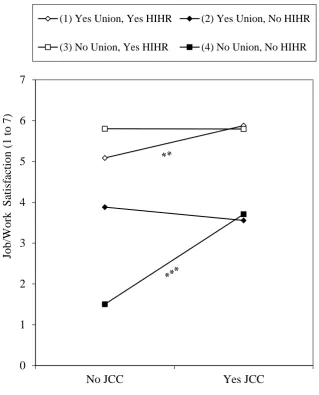
As mentioned, a useful starting point is to plot the effect. Figure 2 shows a plot of the
situation described above, with the relationship between JCC presence and employee job
satisfaction moderated by both HIHR and union presence. The plot reveals a number of the
relationships mentioned. For example, the association between JCCs and overall workplace
satisfaction for unionised workers is essentially “zero” when the individuals are working in a
non-HIHR workplace (slope 2; back diamonds) or when a non-union worker is working in an
HIHR workplace (slope 3; white squares). The relationship is positive and somewhat larger
for unionised workers who also have HIHR present at the workplace (slope 1; white
diamonds), but the moderating relationship is greatest for those who have neither a union nor
HIHR present at the workplace (slope 4; black squares). This is where the JCC moderating
relationship is strongest.
[Figure 2]
In other words, Figure 2 reveals that the possible synergies from having all three
systems at work, as they relate to employee satisfaction, do appear salient. This is therefore a
confirmation of our fourth hypothesis that the JCC relationship is positively moderated by the
5. CONCLUSIONS
Our paper has explored for the first time in a large-scale representative dataset, the
relationship between JCCs in Britain and employee satisfaction. In particular, we focused on
the relationship between JCCs and employee well-being whilst controlling for
high-involvement HR practices and union presence, which though in decline since the 1980s is
still found in roughly 10 percent of all workplaces in Britain (with 5 employees or more) and
covering roughly one third of all workers. We examined JCCs as direct contributors to
employee well-being and the potential interactions with existing union representation and
high-involvement HR management.
The findings reveal two important facts: i) a revaluation of the relevance and role that
JCCs play as a workplace institution in Britain, given that JCCs are associated positively with
the subjective wellbeing of workers, and ii) the ‘independently positive’ role that high
-involvement/commitment HR policies play in fostering satisfaction and wellbeing at work.
Given that the main effects of JCCs and high-involvement HR remain significant in every
one of our estimates and rise in magnitude with the addition of controls and our interaction
terms, demonstrates no evidence of negative moderation (i.e., that non-union voice in the
form of JCCs substitutes for unions or is a proxy for more inclusive HR policies) at work.
There is a positive three-way interaction effect (i.e., JCC association with respect to
employee job satisfaction is higher in the presence of HIHR and unions at the workplace),
but this does not wipe out the main effects of JCC or HIHR. This suggests that unions, JCCs
and HIHR can coexist without compromising employee well-being and in the former two
cases, have large independent associations that require further exploration. Having
demonstrated a positive employee satisfaction link using the SWERS data, examining the