Teaching Verbal
Interaction
and Culture
C h a n t a l C rozet
M asters Thesis
A ustralian N a tio n a l U niversity
D epartm ent o f Linguistics
Table of Content
pages
Acknowledgements v
Introduction vi
Chapter One
Reflection on the treatment of spoken skills and culture in second language teaching theories and methodologies
1.1 Introduction . 1
1.2 Approaches to teaciting a second language from 4 antiquity to 15th Century.
1.2.1 Teaching of Sumarian, archaic Egyptian and 4 ancient Greek as second languages.
1.2.2 Teaching of Greek and Latin to Romans. 8 1.2.3 Teaciting of Latin and other vulgar tongues 10
(12th-15th Centuries).
1.3 Approaches to language teaching from the 16th to 17th 14 Centuries.
1.3.1 Ascham 16
1.3.2 Montaigne and Comenuis 16
1.3.3 Locke 17
1.4 Approaches to language teaciting in the 18th, 19th and 18 early 20th Centuries.
1.4.1 The Grammar-translation method. 18
1.4.2 The Direct method. 21
1.5 Approaches to language teaching in the 20th Century 22
1.5.1 The Audio-lingual method. 26
1.5.2 The Situation method and the Audiovisual 27 method.
1.5.3 The Silent way. 29
1.5.4 Suggestopedia. 30
1.5.5 Community Language Learning. 31
1.5.6 The Total Physical Response. 31
1.5.7 The Communicative Approach. 33
1.5.8 Canale and Swain’s model of Communicative 35 competence.
1.5.9 Bachman's model of Communicative 37 Competence
Conclusion 43
C hapter Two
A conceptual fram ework for the teachable components ofvei'bal interaction
2.1 Introduction 46
2.2 The conceptual framework 46
2.2.1 Typology of cultural traits 48
2.2.2 Pragmatic norms 61
2.2.3 Norms of interaction 66
2.2.4 Kinesic features and Prosodic features 73
2.2.5 Spoken grammar 77
2.2.6 Colloquial lexicon 79
2.2.7 Pronunciation 81
Conclusion 83
C hapter Three
Definition of pedagogical principles for the teaching of verbal interaction and culture
3.1 Introduction 84
3.2 What is communicative competence? 84
3.3 Second Language Acquisition research and 99 the teaching / learning of verbal interaction.
3.4 Definition of pedagogical for the teaching of verbal interaction and culture.
Chapter
Foiur
A m e t h o d o l o g y f o r t h e t e a c h i n g o f v e r b a l i n t e r a c t i o n a n d c u l t u r e
4.1 In tro d u c tio n 145
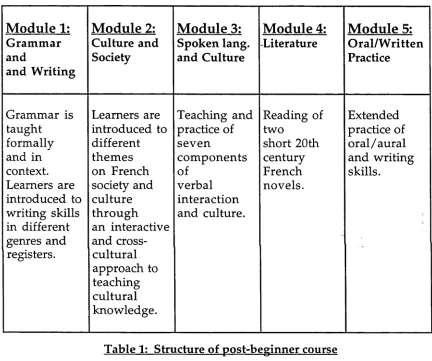
4.2 S tru c tu re of the la n g u a g e co u rse in to w h ic h the m o d u le w as in teg ra te d .
146
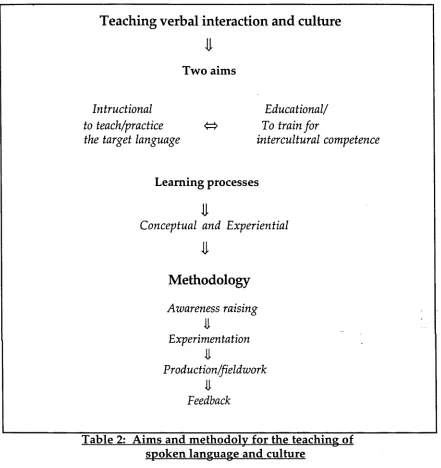
4.3 M acro -m eth o d o lo g ical ste p s fo r th e teach in g of verbal in te r a c tio n a n d cu ltu re.
155
4.4 T he m icro teach in g co m p o n en ts: th e p ro g ra m m e for teach in g c o n te n t a n d sam p les of c la ssro o m activities.
171
4.5 E v a lu a tio n of th e m o d u le a n d c o n c lu d in g rem ark s. 193
C o n c lu sio n 199
C onfusion 202
R eferences 215
Ackno wie dgements
I w ould like to express my g ratitu d e to different people w ho have su p p o rted
me d u rin g the last few y ears w h ile I have b een stu d y in g to w a rd s the
com pletion of my MA thesis.
Firstly, I w ould like to thank my supervisor, D r Liddicoat, for the intellectual
rigour w ith w hich he has guid ed me, for his encouragem ent th ro u g h o u t the
vears and perhaps above all for his g en u in e com m itm ent to the im p ro v em en t
of language teaching. I also w ould like to thank him for speaking my m o th e r'
tongue w ith me w h e n ev e r he h a d a chance to an d because of th at for
understanding my French m ind an d em otions.
N ext I w ould like to th an k my s tu d e n ts in the French p ro g ram of the
D ep artm en t of M odern E u ro p ean L anguages for letting me ex p erim en t o n '
them a new approach to teaching spoken language and culture. I have valued
highly the discussions I have h ad w ith them on ways to im prove language
teaching.
Finally I w ould like to th an k my h u sb a n d and four children for having
accepted my lack of availaibility to them while I have been stu d y in g and
Introduction
For many years, as a French language teacher in Australia, I had heard m yself
often say to my students: "yes, this is gram m atically correct, b u t w e (French
people) just w o u ld n 't say it th a t w ay". I w ould then inevitably launch into
lenghty explanations, giving anecdoctal evidence of why "we w ould not say it
that way" b u t the other way, th a t is "the socially and culturally a p p ro p ria te
way". My explanations and anecdotes how ever had always left me w ith som e
sense of frustration, that it was n o t quite enough, that there was m ore ab o u t
hum an verbal interaction in a foreign language than I taught my stu d en ts, j
therefore naturally became very eager to find out w hat was in the gap betw een
"gram m atically correct" and " c u ltu ra lly ap p ro p ria te " language use. I h ad
intuited that the answ er to my qu est w ould lead me to fully rethink my view s
on the nature of language and in p a rticu la r of spoken language. I had also
hoped that this rethinking w ould lead me to review my approach to language
teaching and my general sense of purpose for practicing this profession.
It is w ith this frame of m ind that I have em barked into postgraduate research,
to find out the links betw een spoken language and culture and to explore th e
implications of that know ledge for language teaching.
To answ er my questions I have tu rn e d to research in discourse analysis - in
particular pragm atics, conversation analysis and cross-cultural com m unication
- as well as research in Second L anguage A cquisition (SLA) and second
language pedagogy. Despite my ap p etite for "reliable academ ic know ledge" I
was also always acutely aw are th at research on spoken language alone w o u ld
not provide all the answers,..
This thesis is therefore an account of a reflection on the n atu re of sp o k en
language and its relatio n sh ip to cu ltu re as w ell as the p re se n ta tio n of an
explorative e n d eav o u r into a new w ay of teaching verbal in te rac tio n in a
foreign language. Considerable references are m ade to the teaching of spoken
French since it is the language I am teaching. The overall arg u m e n t of the
thesis is how ever applicable to all foreign language teaching situations.
C hapter one is an historical overview of the treatm en t of spoken skills an d
culture in second language teaching theories and m ethodologies. We felt it w as
im portant to situate one's w ork w ithin the field in which it operates. It w as a
way to ensure that the argum ent we sustain th ro u g h o u t the thesis is linked to
the w ork of many others in the p ast w ho have sought to im prove language
teaching and in particular the teaching of spoken skills.
In chapter two our prem ise is that culture in everday verbal interaction is not
easily identifiable. We argue that the invisible, intangible cultural features of
language use constitute the basis on which the visible, tangible linguistic form s
of language is created. We su g g est th at the invisible cu ltu ral fea tu res of
language use have to be m ade explicit in order to be teachable. We p resen t
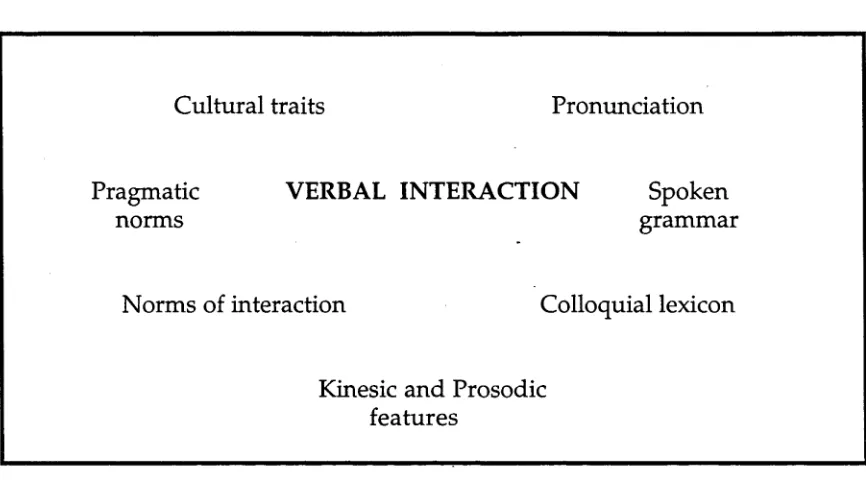
seven teachable com ponents of language use in which culture can be found.
C h ap ter th ree recognizes th at k n o w in g w here to find cu ltu re in v erb al
interaction does not imply autom atically know ing how to teach the c u ltu ral
em bedim ent of spoken language. Futherm ore this chapter show s that teaching
language as an expression of cu ltu re pushes the b o u n d aries of tra d itio n a l
language teaching and expands the notion of "com m unicative com petence"
into "intercultural com m unicative com petence".
C hapter four offers a m ethodology for the teaching of verbal interaction and
culture which stems from my experience as a language teacher w ho has tried to
im plem ent a new approach to teaching spoken language. A detailed account is
g iv en on w h a t has a ctu ally h a p p e n e d in th e classro o m in term s of
m ethodology and learning tasks. This account includes also a reflection on
w hat has happened and w hat we can learn from it.
Chapter 1
Reflection on the treatm ent of spoken language skills
and culture in second language teaching
theories and methodologies
1.1 Introduction
The aim of this first ch ap ter is to give an historical perspective to the
propositions we m ake in subsequent chapters for an approach to teaching
everyday verbal interaction as an expression of culture. We w ish to show
that any new direction in language teaching is p art of a natural historical
developm ent tow ards a better u n d erstan d in g of the nature of language use
and of teaching a second language. By natural historical development w e in fer th a t any p e rs o n a l in q u iry in to a n ew la n g u a g e te a c h in g
th eo ry /m e th o d o lo g y does not h a p p e n in isolation from the past or the
current w orks of others w ho have shared and continue to share the sam e
interests. We suggest that observing past and current approaches to language
teaching allows us to reflect on w hy we are doing (on a personal level) w hat
we do today in a particular w ay. Giving a historical context to a personal
inquiry and experience is therefore a w ay to better understand, and hence
also a w ay to better articulate, this experience.
As the object of this thesis is to give p articu lar focus to the teaching of
verbal interaction and culture in a second language we have sought to trace and observe the specific treatment of spoken skills th roughout the history of language teaching. That is we have sought to understand how the teaching
of spoken skills has been approached in the past and how this tells us about
past conceptions of the nature of spoken language and the goals of language
teaching. O ur observation is m eant to provide an overview rath er than a
detailed account of the trea tm e n t of spoken skills in all theories and
methodologies of language teaching know n to this day. This w ould be a very
w orthw hile task b u t w ell beyond the scope of our study. O u r overview
therefore presents a lim ited diachronic description of the histo ry of the
teaching of one language skill. It aim s solely at supporting ou r argum ent
that spoken language as used in everyday verbal interaction o u ght to be
tau g h t as a carrier as w ell as a p ro d u ce r of highly v alu ab le cu ltu ral
know ledge and that in tu rn this perspective on spoken language im plies a
new language pedagogy.
Many scholarly works have been w ritten on the history of language teaching
(see for example: M ackey 1965, Rivers 1968, Kelly 1969, Titone 1968, Stern
1983, Larsen-Freeman 1986,P uren 1988, Germain 1993).
For our study, to cover the periods from antiquity to the first p art of the 20th
century, we chose to concentrate m ainly but not exclusively on the w orks of _
Kelly, Stern, L arsen-F reem an an d G erm ain for the follow ing reasons.
G erm ain offers the m ost com prehensive chronological history of language
teaching from 5000 years ago up until the 1980's. Stern offers a sketch and an
analytical description of recent and current trends from 1880 to 1980. He
therefore covers in details the period we are m ost interested in. Kelly chose
a them atic approach to a history of language teaching which has allow ed
him to offer a reflective in sig h t an d "describe the ideas th at m ake up
teaching m ethods" (Kelly 1969). Larsen-Freem an focuses on the presentation
and reflection on e ig h t w e ll-k n o w n lan g u ag e-teach in g m eth o d s still
currently in use. The four au th o rs m entioned above pro v id ed us w ith a
chronological developm ent of language teaching and a detailed description
and reflection on theories and m ethodologies know n up u n til to d ay in
m ainly W estern E urope and the U.S.A. We have ad d ed to our fram ew ork
developm ents in language teaching in the 90's w hich were not covered by
any of the four authors.
We are aw are that our inquiry is necessarily biased and lim ited since it
cannot consider the history of language teaching in orate (non-literate)
societies for the lack of available records and it does not consider language
teaching in other parts of the w orld ap art from alm ost exclusively W estern
Europe, N orth America and Australia.
For our convenience we have divided the history of language teaching into
four periods as follows:
Period one: A ntiquity to 15th C entury
Period two: 16th and 17th C enturies
Period three: 18th, 19th and early 20th Centuries
Period four: 20th C entury
We will start developping our argum ent from period one but will discuss in
m ore d ep th developm ents in language teaching in the 20th century and
m ore specifically from the period of the em ergence of the commurvucative
approach in the 1970's until the m ore recent developm ents of the 1990's.
In order to sustain clarity and focus in our argum ent we have chosen to
exam ine the four historical periods of language teaching m entioned above
using five referential aspects of language teaching.
Each period was therefore observed u n d er the five following headings:
1) Purpose of Second Language Teaching (SLT) in the relevant period.
2) Identification of the m ain language skills em phasized in the theory or
m ethodology u nder scrutiny, as w ell identification of the m ain features of
the teaching approach used.
3) Explicit a n d /o r implicit links m ade by the theory or m ethodology on the
links betw een spoken language and culture.
4) Description of the role of learn ers' first language in the given theory or
m ethodology.
5) D escription of the p articu lar aspects of spoken language the theory or
m ethodology focuses on.
Stern (1983:77) has p o in ted out th a t any historical survey of language
teaching should distinguish betw een ideas and actual practice. O ur survey
distinguishes betw een the tw o but is also a blend of the two as we believe
ideas and practice are intim ately related. Practice can lead to new ideas and
vice-versa. It is not our p u rpose to trace in very specific term s for example
w h eth er M ontaigne's ideas on language teaching did or did not have a
significant im pact on lan g u ag e teaching. A ny new idea or practice in
language teaching is bound to m ake an im pact on those w ho are open to
them. The im pact an encounter w ith a new idea or practice m ight have on
different in d iv id u als is not u p to historical analysts to decide. W hat is
certain is that ideas and practice in any field become part of a collective mind
w hich pushes tow ards future developm ents. O ur overview of the treatm ent
of spoken skills throughout the history of language teaching is an attem pt to
gain insight into the collective m ind of language teachers and linguists of all
tim es w ho have contributed to our cu rren t u n derstanding of the nature of
lan g u a g e , its re la tio n s h ip to so c io -c u ltu ra l e n v iro n m e n ts a n d the
im plications of these progressive u n d erstan d in g s for the language teaching
profession.
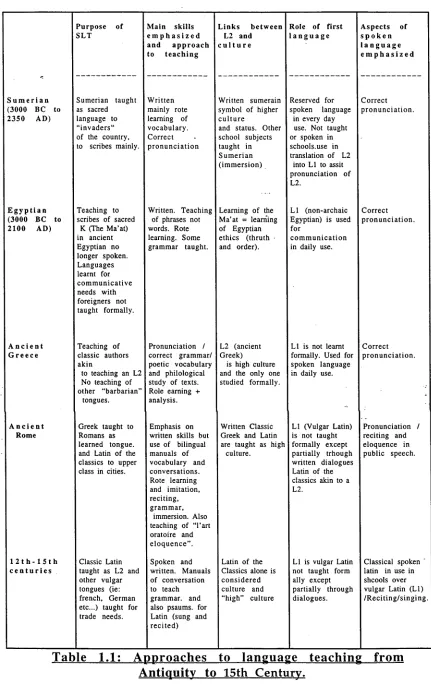
1.2 Approaches to teaching a second language from antiquity to
15th Century (see table 1.1 pl4)
1.2.1 Teaching of Sumerian, archaic Egyptian and Ancient Greek as second
languages.
Since the beginning of time h u m an beings have taught them selves foreign
languages from direct contact w ith foreigners w hen they have needed to
comm unicate w ith others w ho did not speak the same language. The history
of this inform al "lan g u ag e teaching" or for th at m atter any "form al"
language teaching w hich m ight have taken place in o ra te /p re -lite ra te
societies in ancient times is of course not recordable.
Any record of language teaching therefore alw ays comes to us th ro u g h a
w ritten m edium .
A lthough w ritten language ap p eared about -10,000 years ago in selective
populations around the w orld (Kaplan 1986:9), the first w ritten evidence of
the teaching of a second language appears to date from 5000 years ago w hen
w riting started to be more w idely used (Germain 1993:21).
A ccording to (Germain 1993) - w ho derived m ost of his inform ation from
Kramer (1957) and Kramer (1963) - d uring the Sum erian civilisation (today
near Bagdad in Irak), the w ritten form of Sum erian language (cuneiform
w riting) w as first tau g h t to Sum erian scribes and later to the elite of the
A kkadian people w ho had invaded Sumer. After the A kkadians took over
Sum er, A k k ad ian becam e the d o m in a n t lan g u ag e used in daily life.
Sum erian quickly became a dead language and as such it really became a
second language for the inhabitants of Sum er w ho no longer used this
language in their everyday interactions. The w ritten form of Sum erian was
then the only language tau g h t form ally in schools. As a sacred language
w hich "froze" the m ost valued body of know ledge in this society, w ritten
S um erian w as the em b o d im en t of "hig h " cu ltu re and hence of social
p ro m o tio n .
Regardless of political or historical explanations, the association of "w ritten
language" w ith the m ost valued form of recording "cultural know ledge"
seem s therefore to have existed since ancient times and persists up until
today. Spoken S u m erian and later sp o k en A k k ad ian in Sum er, the
languages of everyday use, w ere not tau g h t or even spoken in schools as
they w ere not associated w ith "v alu ed " cultural or other content. O ral
com m unication used in the practice of teaching was in Sum erian. The fact
that subjects other than language (ie: science, agriculture, m edicine etc...)
w ere also tau g h t in the w ritten form of Sum erian - a "d ead " language -
shows, in this society, the undervaluing of everyday spoken language as an
appropriate m edium to carry know ledge. We will observe th roughout this
chapter over and over again the clear disproportionate distribution of social
and political pow er betw een spoken language of everyday use perceived as
"cu ltu reless", and w ritten form s of languages tau g h t in schools as the
hallm ark of the only valued form of cultural expression.
The only aspect of spoken language taught formally in the schools of ancient
Sum er w as correct p ro n u n c ia tio n of the w ritte n form of S um erian.
Teaching focused on the rote learning of lists of w ritten w ords or symbols.
W ith regard to the linguistic situation of ancient Egypt and, as in ancient
Sumer, the only language taught form ally w as a form of archaic language
w hich had very few links w ith the language people used in their everyday
interactions. Only archaic Egyptian was taught in schools. In this sense it can
be considered to have been a second language of young Egyptians - m ainly
scribes to be - w ho had to learn it.
W hat is of interest to us is that the reason w hy only archaic Egyptian was
taught formally as a "foreign" language w as that it was the language of "the
M 'at", the ethical code of conduct of this society. The M 'at was considered to
be the m ost valued body of know ledge that schools or any educator had the
duty to teach.
A gain we find here a case w here the h ighest expression of cu ltu re is
associated w ith w riting expression through a language which was not used
by the people of this society in everyday verbal interactions.
The correct pronunciation of the M 'at w as the only "spoken skill" form ally
tau g h t in ancient Egypt. Em phasis w as given to m ainly rote learning of
maximes from the M 'at.
A part from archaic Egyptian, other languages were learnt by E gyptians in
ancient Egypt out of necessity. They w ere languages m ainly governm ent
a d m in istra to rs n e ed e d to lea rn to c o m m u n icate w ith "c o n q u e re d "
foreigners in the Egyptian Empire. A ccording to Germain (1993:36) there are
no records of how those languages w ere learnt but he assumes they w ere not
taught in schools but learnt through direct contact. The inference here is that
language needed for direct use in ordinary life did not need to be taught.
In Ancient Greece we find the sam e situation as the two cases m entioned
above. Only the language of classical authors was taught in schools. It w as an
archaic form of language for the students w ho had to learn it. The Greek of
the classic authors was far rem oved from the Greek language people spoke
in daily life. Again in this case, the only language taught institutionally was
very d istan t from the language of com m on use. We argue that the early
historical split betw een a higher and low er form of language w ithin the
sam e society created a p a rtic u la r arch ety p e in the w estern E u ro p ean
collective m ind for the co n cep tu alizatio n of w h at constitutes v alu ab le
language teaching. This archetype is still deeply ingrained w ithin us and can
be sum m arized as follows: w hat is regarded as a higher form of language is
generally associated w ith "w ritten language" and "high culture" w hile a
perceived low er form of language is generally associated w ith "spoken
language for daily use" and is considered "cultureless". We will come back
to this distinction later in our argum ent.
The Greek of the classic authors w as of course representative of the only
form of valued cultural know ledge. Correct pronunciation of classical Greek
was taught as a "spoken skill". G reat em phasis was given to the stu d y of
gram m ar, poetic vocabulary and the philological study of texts. The study of
a "second" language in this sense differed from the study of Sum erian and
ancient Egyptian in th at it required some analytical stu d y by learners as
opposed to rote learning.
Languages other than Greek w ere not studied in ancient Greece as they were
regarded as "b arb arian " uncivilized languages, in other w o rd s languages
which were not carriers of a culture w orthy of study.
The tendency of any society to teach only w h at it values w ithin the limits of
the cu ltu re it p ro d u ces seem s to be intrinsic to the n a tu re of h u m an
societies. Not m uch has changed in this regard since antiquity.
1.2.2 Teaching o f Greek and Latin to Rom ans
In ancient Rome, education was bilingual. Students learnt and w ere taught _
different subjects (ie: m athem atics, geometry, philosophy, law etc...) in either
Greek or Latin (Germain 1993: 43- 47). Greek was taught as a learned tongue
as Greek culture - w orks of the classics - was highly valued. Latin was taught
through the study of the classical authors, also regarded as high culture.
In schools (reserved to the elite in the cities) focus was given to the study of
w ritten skills. Rote learning, im itation and reciting w ere im portant aspects
of the teaching approach.
S tudents learn t G reek and L atin (as fo u n d in the classics) as second
languages as they w ere not the languages they spoke at home. Vulgar Latin,
far rem oved from classical Latin, w as the dom inant first language for daily
verbal interactions.
Classical Latin and Greek w ere "learnt" as spoken languages rather than
"tau g h t form ally" in an institution. In the confinem ent of their hom es,
children of the R om an aristocracy w ere tau g h t "to speak" the learned
tongues (classical Greek and Latin) from an early age by a slave or a servant
employed for this purpose.
O ur point is that in ancient Rome focus in schools w as not given to the
study of spoken skills in a second language because w hat was regarded as
valuable cultural know ledge was accessed through the study of w ritten texts
in Greek and Latin. This also points to the fact that the study of language was
valued prim arily because it gave access to high culture and not for its
inherently "language" value as a m edium of comm unication.
With regard to the teaching of spoken language, it is interesting to note that
in ancient Rome, as reported by M arrou (1960) and Titone (1968), m anuals of
w hat was called "daily conversation" (quotidiana conversatio) were used in
schools. There w ere not in fact tran scrip ts of everyday conversations as
literally spoken by people but a presentation of w ritten language shaped into
dialogues for a more accessible - as in m ore "lively" - delivery of a targeted
body of knowledge. In this case, the m anuals of conversation used in ancient
Rome were m ainly used to teach gram m ar. Germ ain (1993) rem inds us that
it was com m on in an tiq u ity fo r"d ialo g u es" using the w ritten form of a
language to be used to present a given content:
"II faut preciser que la presentation d'ecrits sous une forme dialoguee n'est
pas nouvelle: meme la p lu p art des ecrits philosophiques de Platon (5e-4e
siede avant notre ere) se presentent sous la forme de dialogues" (Germain
1993:45)
We m ust add that in ancient Rome the teaching of oratory skills w as of
significant im portance in the later years of schooling. O rato ry skills
however, although a form of spoken skills, had more to do w ith the ability
to dem onstrate style and eloquence in public speeches using classical Greek
or Latin than the ability to com m unicate in daily verbal interaction w hich is
w hat we mean today w hen we refer to spoken skills in a foreign language.
1.2.3 Teaching of Latin and other vulgar tongues (12th-15th Centuries)
D uring the m iddle-ages in Europe, after the fall of the Roman em pire Latin
in schools was taught as both a spoken and w ritten language. Spoken Latin
was taught through the rote m em orization of dialogues and also psalm s
which students w ere required to sing. Singing w as also used to m em orize
gram m ar (ie: cases, verb endings etc...)
From the 12th century onw ards, n atio n al languages (ie: French, Italian,
Spanish etc...) started to em erge and to com pete m ore and m ore w ith Latin
in the school systems. As national languages became the m ain m edium of
comm unication in daily life rather than Latin they started to first be "used"
in schools betw een teachers and students d uring classroom interaction and
then they started to be taught formally.
A pproaches to teaching n ational languages in schools (know n then as
"vulgar tongues") follow ed the ap p ro ach used until then to teach Latin
(Puren 1988:24-33 and G erm ain 1993:51-65). That is, great em phasis w as
given to gram m ar and vocabulary. Following the tradition in the teaching of
Latin of using dialogues, the teaching of "vulgar tongues" also m ade a great
use of dialogues. As gram m ars of the new ly formed national languages were
not available as yet, the use of dialogues w hich attem pted to reproduce the
language of use in everyday life w ere p o p u lar teaching m aterial (Germain
1993:58).
It is interesting to note that tow ards the end of the m iddle ages although
n atio n al lan g u ag es, the "v u lg ar to n g u es", w ere slow ly a p p e a rin g in
education as a legitimate teaching subject, Latin which was becom ing a dead
language was still the m ain and only language taught in schools. According
to Puren (1988:24) in France for instance it was only during the second half
to be taught more widely.
As in the case of vulgar Latin in antiquity, "vulgar" tongues tow ards the end
of the m iddle ages - "vulgar" from the Latin vulgaris m eaning m u ltitu d e - represented the languages spoken by "the m ultitude", that is the m ajority of
the "common" people. It is w orth noting that spoken language as "language
used by the m ajority of a people" has ten d ed in the p ast to be alw ays
undervalued over the learned tongues used by "a m inority of people", the
intellectual elite. It is therefore not only w ritten language w hich has been
valued over spoken language. Language used only by the elite has tended to
be valued more than language used by "the people". We will argue m ore
strongly later that it is in p art the recu rren t biased perception of spoken
language of ev ery d ay life as n o t w o rth y of teaching because of its
"culturelessness" which has prevented us from seeing and appreciating the
rich cultural com ponent em bedded in everyday verbal interaction.
Summar y
In Antiquity, it was through the learning of a second language, m ainly in its
w ritten form, that a people could gain access to w hat w as considered the
realm of high culture. C orrect p ro n u n ciatio n of the w ritten form of the
second language was the m ain aspect of "spoken skills" teachers focused on.
First languages used in daily verbal interactions w ere not perceived as
carriers of valuable cultural content and they w ere hence not considered
w orthy of being formally taught in schools.
From Antiquity to the m iddles ages, from the records available we can say
that second languages w ere taught as either dead or semi- living languages
depending on their exact sphere of use in a given society. Second languages
taught in schools were learnt to access w hat w as perceived as the higher
expression of culture in society. G enerally speaking, as in the case of the
everyday life) was not used or used very little in the school environm ent, as
it w as considered too "vulgar", not suitable enough for use in a learned
environm ent. E xplanations about any aspect of a second language w ere
given in the second language itself. Learners also learnt a second language
th ro u g h im m ersion by learning other subjects in the second language.
A pproaches to teaching focused m ainly on the teaching of vocabulary using
rote learning and gram m ar as em bedded in "sacred" or literary text. The
only aspect of spoken language taught or rather practiced formally - m ainly
th ro u g h reciting, and later singing in the -M iddle ages - w as correct
pronunciation. W hen dialogues were used to teach a second language as in
A ncient Greece and Rome and later th ro u g h o u t Europe, it w as m ainly to
give a m ore lively context for the illustration of gram m atical correctness.
These d ialo g u es w ere n o t faith fu l tra n sc rip tio n s of ev ery d ay sp o k en
P u r p o s e o f S L T
M a i n s k i l l s e m p h a s i z e d a n d a p p r o a c h t o t e a c h i n g
L i n k s b e t w e e n L 2 a n d c u l t u r e
R o l e o f f i r s t l a n g u a g e
A s p e c t s o f s p o k e n l a n g u a g e e m p h a s i z e d
S u m e r i a n S u m e r i a n t a u g h t W r i t t e n W r i t t e n s u m e r a i n R e s e r v e d f o r C o r r e c t ( 3 0 0 0 B C t o a s s a c r e d m a i n l y r o t e s y m b o l o f h i g h e r s p o k e n l a n g u a g e p r o n u n c i a t i o n .
2 3 5 0 A D ) l a n g u a g e t o “ i n v a d e r s “ o f t h e c o u n t r y , t o s c r i b e s m a i n l y .
l e a r n i n g o f v o c a b u l a r y . C o r r e c t p r o n u n c i a t i o n
c u l t u r e
a n d s t a t u s . O t h e r s c h o o l s u b j e c t s t a u g h t i n S u m e r i a n ( i m m e r s i o n )
i n e v e r y d a y u s e . N o t t a u g h t o r s p o k e n i n s c h o o l s . u s e i n t r a n s l a t i o n o f L 2
i n t o L I t o a s s i t p r o n u n c i a t i o n o f L 2 .
E g y p t i a n T e a c h i n g t o W r i t t e n . T e a c h i n g L e a r n i n g o f t h e L I ( n o n - a r c h a i c C o r r e c t
( 3 0 0 0 B C t o s c r i b e s o f s a c r e d o f p h r a s e s n o t M a ’ a t = l e a r n i n g E g y p t i a n ) i s u s e d p r o n u n c i a t i o n .
2 1 0 0 A D ) K ( T h e M a ’ a t ) i n a n c i e n t E g y p t i a n n o l o n g e r s p o k e n . L a n g u a g e s l e a r n t f o r c o m m u n i c a t i v e n e e d s w i t h f o r e i g n e r s n o t t a u g h t f o r m a l l y .
w o r d s . R o t e l e a r n i n g . S o m e g r a m m a r t a u g h t .
o f E g y p t i a n e t h i c s ( t h r u t h a n d o r d e r ) .
f o r
c o m m u n i c a t i o n i n d a i l y u s e .
A n c i e n t T e a c h i n g o f P r o n u n c i a t i o n / L 2 ( a n c i e n t L I i s n o t l e a r n t C o r r e c t
G r e e c e c l a s s i c a u t h o r s a k i n
t o t e a c h i n g a n L 2 N o t e a c h i n g o f o t h e r “ b a r b a r i a n "
t o n g u e s .
c o r r e c t g r a m m a r / p o e t i c v o c a b u l a r y a n d p h i l o l o g i c a l s t u d y o f t e x t s . R o l e e a r n i n g + a n a l y s i s .
G r e e k )
i s h i g h c u l t u r e a n d t h e o n l y o n e s t u d i e d f o r m a l l y .
f o r m a l l y . U s e d f o r s p o k e n l a n g u a g e i n d a i l y u s e .
p r o n u n c i a t i o n .
A n c i e n t G r e e k t a u g h t t o E m p h a s i s o n W r i t t e n C l a s s i c L I ( V u l g a r L a t i n ) P r o n u n c i a t i o n /
R o m e R o m a n s a s w r i t t e n s k i l l s b u t G r e e k a n d L a t i n i s n o t t a u g h t r e c i t i n g a n d l e a r n e d t o n g u e . u s e o f b i l i n g u a l a r e t a u g h t a s h i g h f o r m a l l y e x c e p t e l o q u e n c e i n a n d L a t i n o f t h e
c l a s s i c s t o u p p e r c l a s s i n c i t i e s .
m a n u a l s o f v o c a b u l a r y a n d c o n v e r s a t i o n s . R o t e l e a r n i n g a n d i m i t a t i o n , r e c i t i n g , g r a m m a r ,
i m m e r s i o n . A l s o t e a c h i n g o f ‘T a r t o r a t o i r e a n d e l o q u e n c e ” .
c u l t u r e . p a r t i a l l y t r h o u g h w r i t t e n d i a l o g u e s L a t i n o f t h e c l a s s i c s a k i n t o a L 2 .
p u b l i c s p e e c h .
1 2 t h - 1 5 t h C l a s s i c L a t i n S p o k e n a n d L a t i n o f t h e L I i s v u l g a r L a t i n C l a s s i c a l s p o k e n
c e n t u r i e s t a u g h t a s L 2 a n d w r i t t e n . M a n u a l s C l a s s i c s a l o n e i s n o t t a u g h t f o r m l a t i n i n u s e i n o t h e r v u l g a r o f c o n v e r s a t i o n c o n s i d e r e d a l l y e x c e p t s h c o o l s o v e r t o n g u e s ( i e : t o t e a c h c u l t u r e a n d p a r t i a l l y t h r o u g h v u l g a r L a t i n ( L I ) f r e n c h , G e r m a n
e t c . . . ) t a u g h t f o r t r a d e n e e d s .
g r a m m a r , a n d a l s o p s a u m s . f o r L a t i n ( s u n g a n d r e c i t e d )
“ h i g h ” c u l t u r e d i a l o g u e s . / R e c i t i n g / s i n g i n g .
[image:21.525.37.468.13.705.2]1.3 Approaches to language teaching from the 16th to 17th
Centuries (see Table 1.2 ).
Language teaching in W estern Europe d u rin g the Renaissance developed in
different directions. Firstly, it was m arked by a renewed interest in the study
of classical texts in their p u rest form. It w as perceived th at d u rin g the
M iddles Ages classical Greek an d Latin had been invaded by im purities
which had to be rem oved in o rd er to avoid spreading barbarism s (Kelly
1969:36). This teaching by the book led to the p ro d u ctio n of com plex
gram m ar books to support the linguistic analysis of classical texts. Studying a
language (ie: Latin or Greek) w as no longer prim arily a w ay to access high
culture as it had been in the past. It became an intellectual exercise in itself
(Germain 1993:60).
In time, the aw areness that this "purist" approach to language teaching was
ineffective becam e w id esp read (Puren 1986:25) and new ap p ro ach es to
language teaching started to be articulated by different thinkers. They are the
ones we will explore now for our argum ent because they rep resen ted the
seeds of future developm ents.
We w ill look at lan g u ag e teach in g ideas in the w orks of A scham ,
M ontaigne, Locke and Com enius as representatives of the major progressive
trends in language teaching d u rin g the 16th and 17th centuries. We will
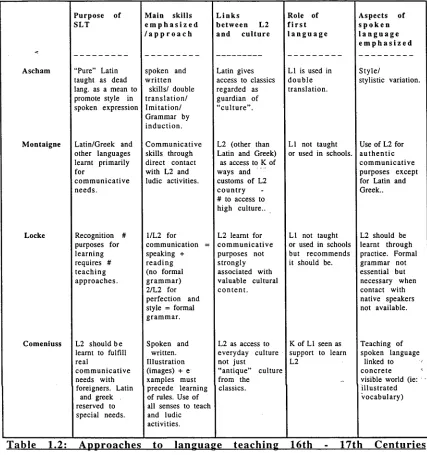
concentrate only on features of interest to us (see Table 1.2).
W hat is com m on to the four thinkers m entioned above is the idea that a
second language is best taught using an inductive approach, that is through
direct exposure to the target language. "D irect exposure" though did not
necessarily equate using the language in authentic verbal interaction. It
rather m eant practising the language through, for instance, translation or
ludic activities because direct contact w ith native speakers, alth o u g h an
ideal, was not an easily accessible reality.
P u r p o s e o f S L T
M a i n s k i l l s e m p h a s i z e d / a p p r o a c h
L i n k s b e t w e e n L 2 a n d c u l t u r e
R o l e o f f i r s t l a n g u a g e
A s p e c t s o f s p o k e n l a n g u a g e e m p h a s i z e d
A s c h a m “ P u r e " L a t i n t a u g h t a s d e a d l a n g , a s a m e a n t o p r o m o t e s t y l e i n s p o k e n e x p r e s s i o n
s p o k e n a n d w r i t t e n
s k i l l s / d o u b l e t r a n s l a t i o n / I m i t a t i o n / G r a m m a r b y i n d u c t i o n .
L a t i n g i v e s a c c e s s t o c l a s s i c s r e g a r d e d a s g u a r d i a n o f “ c u l t u r e " .
L I i s u s e d i n d o u b l e t r a n s l a t i o n .
S t y l e /
s t y l i s t i c v a r i a t i o n .
M o n t a i g n e L a t i n / G r e e k a n d o t h e r l a n g u a g e s l e a r n t p r i m a r i l y f o r
c o m m u n i c a t i v e n e e d s .
C o m m u n i c a t i v e s k i l l s t h r o u g h d i r e c t c o n t a c t w i t h L 2 a n d l u d i c a c t i v i t i e s .
L 2 ( o t h e r t h a n L a t i n a n d G r e e k )
a s a c c e s s t o K o f w a y s a n d c u s t o m s o f L 2 c o u n t r y # t o a c c e s s t o h i g h c u l t u r e . .
L I n o t t a u g h t o r u s e d i n s c h o o l s .
U s e o f L 2 f o r a u t h e n t i c c o m m u n i c a t i v e p u r p o s e s e x c e p t f o r L a t i n a n d G r e e k . .
L o c k e R e c o g n i t i o n # p u r p o s e s f o r l e a r n i n g r e q u i r e s # t e a c h i n g a p p r o a c h e s .
1 / L 2 f o r
c o m m u n i c a t i o n = s p e a k i n g + r e a d i n g ( n o f o r m a l g r a m m a r ) 2 / L 2 f o r p e r f e c t i o n a n d s t y l e = f o r m a l g r a m m a r .
L 2 l e a r n t f o r c o m m u n i c a t i v e p u r p o s e s n o t s t r o n g l y a s s o c i a t e d w i t h v a l u a b l e c u l t u r a l c o n t e n t .
L I n o t t a u g h t o r u s e d i n s c h o o l s b u t r e c o m m e n d s i t s h o u l d b e .
L 2 s h o u l d b e l e a r n t t h r o u g h p r a c t i c e . F o r m a l g r a m m a r n o t e s s e n t i a l b u t n e c e s s a r y w h e n c o n t a c t w i t h n a t i v e s p e a k e r s n o t a v a i l a b l e .
C o m e n i u s s L 2 s h o u l d b e l e a r n t t o f u l f i l l r e a l
c o m m u n i c a t i v e n e e d s w i t h f o r e i g n e r s . L a t i n
a n d g r e e k r e s e r v e d t o s p e c i a l n e e d s .
S p o k e n a n d w r i t t e n . I l l u s t r a t i o n ( i m a g e s ) + e x a m p l e s m u s t p r e c e d e l e a r n i n g o f r u l e s . U s e o f a l l s e n s e s t o t e a c h a n d l u d i c a c t i v i t i e s .
L 2 a s a c c e s s t o e v e r y d a y c u l t u r e n o t j u s t
“ a n t i q u e ” c u l t u r e f r o m t h e c l a s s i c s .
K o f L I s e e n a s s u p p o r t t o l e a r n L 2
T e a c h i n g o f s p o k e n l a n g u a g e
l i n k e d t o c o n c r e t e v i s i b l e w o r l d ( i e : i l l u s t r a t e d v o c a b u l a r y )
Table 1.2: A p p r o a c h e s to l a n g u a g e t e a c h i n g 16th - 17th C e n t u r i e s
The inductive approach also im plied then that a second language w as best
learnt in the way a first language w as learnt (Kelly 1969:39), that is w ithout
any formal teaching of gram m ar. The inductive approach, as understood in
this period of language teaching history, suggested that a second language
had to be "used" and not just "learnt as rules of w riting" to be acquired. The
teaching of gram m ar w as not excluded altogether from the language
teaching cu rricu lu m b u t it w as d elay ed to m ore ad v an ced stu d ies of
[image:23.525.45.472.39.494.2]1.3.1 Ascham
A scham (16th c en tu ry ) ad v o cated the use of d o uble tran sla tio n and
im itation for an inductive teaching of gram m ar (Germain 1993:71-72). He
saw the teaching of Latin in its purest form as a way to prom ote style in both
spoken and w ritten expression. As a su p p o rter of the inductive approach,
Ascham was a p ro g ressiv e th in k er in his tim e b u t overall he w as still
preaching for an education in the classic, hum anist tradition giving m ost
importance to the teaching of Latin as access to high culture.
1.3.2 M ontaigne and Comenius
M ontaigne, on the other hand, as early as the 16th century prom oted very
strongly the idea th at second languages o u ght to be tau g h t prim arily to
acquire com m unicative skills. In the case of languages other than Greek or
Latin in M ontaigne's view - shared by C om enius in the 17th cen tu ry -
(Germain 1993:71-98) second languages ought also to be learnt to gain access
to know ledge of w ays and custom s of a foreign culture. This w as an
innovative idea a t the tim e since "cu ltu re" until then had been only
associated w ith the study of selected w ritten texts. Thinkers like M ontaigne
expanded the concept of "culture" as a valuable body of know ledge from
culture as found in the classic authors to include culture as found in the
customs of a foreign people. M oreover this "other" form of culture was to be
acquired through com m unication w ith the speakers of a second language.
A part from the recognition of c u sto m s/w a y s of life as valuable cultural
content, R enaissance th in k ers such as M ontaigne and C om en iu s also
in tu ited the d istin c tio n W id d o w so n (1978) w as later to m ake explicit,
betw een "usage" of language as know ledge of forms and "use" of language
as the ability to use the target language for communicative purposes.
language classroom as visual aids for the learning of vocabulary, also
insisted on the im portance of u sing all of the learner's senses to optim ize
language learning (Germ ain 1993: 85-98). In a seed form C om enuis' ideas
suggested that language learning w as not a solely intellectual activity. It
involved an engagem ent of the learner as a physical and non physical entity.
This is a view we share and will elaborate on further in our discussion.
1.3.3 Locke
Locke's ideas on language teaching in the 17th Century add to those we have
m entioned above in th at he recognised the need to develop different
language teaching approaches to su it the varied p urposes learners m ight
have for learning a language. For exam ple, learners seeking to achieve
com m unicative com petence in a second language (the m ajority of learners
in his view ) should learn th ro u g h using the language by speaking and
read in g it. In Locke's view know ledge of gram m ar for com m unicative
competence was absolutely unnecessary.
In the 16th and 17th C enturies, learners' first language w as largely used to
su p p o rt the learning of a second language either by w ay of translation or
through explanation in learners' first language.
C om enius like M ontaigne suggested the use of ludic activities to teach
languages in cluding role-plays to p ro m o te learn ers' use of the targ et
language (Germain 1993:93).
Su mma r y
D uring the 16th and 17th C enturies Latin in W estern Europe w as still the
m ain second language tau g h t in schools. The Renaissance m ovem ent had
sought a strict interpretation of the classical authors and had given em phasis
teaching gram m ar as separate from the teaching of literature. L anguages
other than Latin w ere not w idely taught in schools. Learners' first language
was used more in the language classroom than it had before m ainly through
translation exercises. Very little em phasis w as given to the teaching of
spoken skills.
Some prom inent thinkers of that period how ever, like M ontaigne, Locke
and Com enius w ent against the m ain current and prom oted the teaching of
languages, Latin and other languages, for com m unicative purposes. They
also recognised the value of studying a second language to access culture as it
is em bedded in the custom s and w ay of life of a foreign people. This
awareness represented a first step tow ards the conceptual linking of culture
to language as everyday verbal interaction. H ow this linking operated w as
not clear at the time b u t at least there w as an aw areness that learning a
foreign "spoken" language w as a key to culture as experienced in the
customs and ways of everyday life.
Progressive ideas such as those of M ontaigne, Locke or C om enuis, w o u ld
have to w ait several cen tu ries before th ere w ere tak en u p ag ain or
rediscovered by ed u catio n alists w ith an in terest in language teaching.
D uring the 18th and m ost of the 19th centuries language teaching w as yet to
sink into more restricted view s of w hat constitute valuable language and
culture learning.
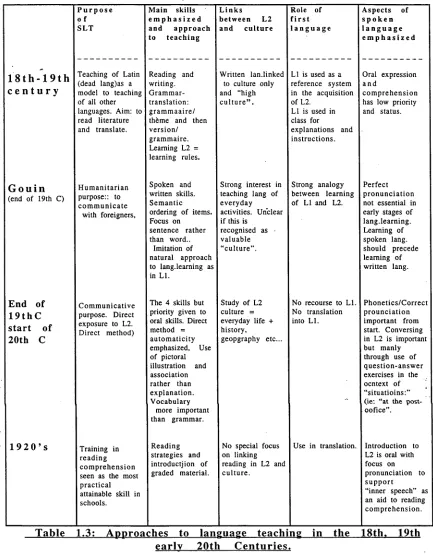
1.4 Approaches to language teaching in the 18th, 19th and early
20th Centuries (see table 1.3 below)
1.4.1 The Grcimmar-Tanslation m ethod
In the 18th century, the G ram m ar-Translation m ethod started to become the
G reek and of living languages such as French, Spanish etc... (G erm ain
1993:101). It is also d u rin g this period th at the use of the learners' first
languages to explain the gram m ar and syntax of Latin or other second
languages taught in schools became w idespread (Kelly 169:43-44).
The aim of the G ram m ar-T ranslation m ethod w as not prim arily to teach
learners to speak in the target language. Focus was given to the learning of
g ram m ar th ro u g h the stu d y of lin g u istic form s an d the practice of
tran slatin g , w ritin g and read in g skills (Stern 1983:454). As learning a
language was m ainly associated w ith learning a dead language (ie: Latin) by
definition not a language of use, learning a language w as m ainly perceived
as an intellectual training of the m ind (Larsen-Freem an 1986:44). Learning
spoken skills w as not essential and, as Kelly (1969: 122) has noted, for that
reason dialogues, w hich had been used extensively in previous periods,
w ere excluded from the language classroom in the 19th century. Their
d isa p p ea ran c e from the language classroom w as a statem en t th at the
P u r p o s e o f S L T
M a i n s k i l l s e m p h a s i z e d a n d a p p r o a c h t o t e a c h i n g
L i n k s b e t w e e n L 2 a n d c u l t u r e
R o l e o f f i r s t l a n g u a g e
A s p e c t s o f s p o k e n l a n g u a g e e m p h a s i z e d
1 8 t h - 1 9 t h c e n t u r y
T e a c h i n g o f L a t i n ( d e a d l a n g ) a s a m o d e l t o t e a c h i n g o f a l l o t h e r l a n g u a g e s . A i m : t o r e a d l i t e r a t u r e a n d t r a n s l a t e .
R e a d i n g a n d w r i t i n g . G r a m m a r -t r a n s l a -t i o n : g r a m m a a i r e / t h & m e a n d t h e n v e r s i o n / g r a m m a i r e . L e a r n i n g L 2 = l e a r n i n g r u l e s .
W r i t t e n l a n . l i n k e d t o c u l t u r e o n l y a n d “ h i g h c u l t u r e ” .
L I i s u s e d a s a r e f e r e n c e s y s t e m i n t h e a c q u i s i t i o n o f L 2 .
L I i s u s e d i n c l a s s f o r
e x p l a n a t i o n s a n d i n s t r u c t i o n s .
O r a l e x p r e s s i o n a n d
c o m p r e h e n s i o n h a s l o w p r i o r i t y a n d s t a t u s .
G o u i n ( e n d o f 1 9 t h C )
H u m a n i t a r i a n p u r p o s e : : t o c o m m u n i c a t e
w i t h f o r e i g n e r s ,
S p o k e n a n d w r i t t e n s k i l l s . S e m a n t i c o r d e r i n g o f i t e m s . F o c u s o n s e n t e n c e r a t h e r t h a n w o r d . .
I m i t a t i o n o f n a t u r a l a p p r o a c h t o l a n g . l e a r n i n g a s i n L I .
S t r o n g i n t e r e s t i n t e a c h i n g l a n g o f e v e r y d a y a c t i v i t i e s . U n c l e a r i f t h i s i s
r e c o g n i s e d a s v a l u a b l e “ c u l t u r e ” .
S t r o n g a n a l o g y b e t w e e n l e a r n i n g o f L I a n d L 2 .
P e r f e c t p r o n u n c i a t i o n n o t e s s e n t i a l i n e a r l y s t a g e s o f l a n g . l e a r n i n g . L e a r n i n g o f s p o k e n l a n g , s h o u l d p r e c e d e l e a r n i n g o f w r i t t e n l a n g .
End of 1 9 1 h C start of 20th C
C o m m u n i c a t i v e p u r p o s e . D i r e c t e x p o s u r e t o L 2 . D i r e c t m e t h o d )
T h e 4 s k i l l s b u t p r i o r i t y g i v e n t o o r a l s k i l l s . D i r e c t m e t h o d = a u t o m a t i c i t y e m p h a s i z e d . U s e o f p i c t o r a l i l l u s t r a t i o n a n d a s s o c i a t i o n r a t h e r t h a n e x p l a n a t i o n . V o c a b u l a r y
m o r e i m p o r t a n t t h a n g r a m m a r .
S t u d y o f L 2 c u l t u r e = e v e r y d a y l i f e + h i s t o r y ,
g e o p g r a p h y e t c . . .
N o r e c o u r s e t o L I . N o t r a n s l a t i o n i n t o L I .
P h o n e t i c s / C o r r e c t p r o u n c i a t i o n i m p o r t a n t f r o m s t a r t . C o n v e r s i n g i n L 2 i s i m p o r t a n t b u t m a n l y t h r o u g h u s e o f q u e s t i o n - a n s w e r e x e r c i s e s i n t h e o c n t e x t o f “ s i t u a t i o i n s : ” ( i e : “ a t t h e p o s t - o o f i c e ” .
1 9 2 0 ’ s T r a i n i n g i n r e a d i n g c o m p r e h e n s i o n s e e n a s t h e m o s t p r a c t i c a l a t t a i n a b l e s k i l l i n s c h o o l s .
R e a d i n g s t r a t e g i e s a n d i n t r o d u c t j i o n o f g r a d e d m a t e r i a l .
N o s p e c i a l f o c u s o n l i n k i n g r e a d i n g i n L 2 a n d c u l t u r e .
U s e i n t r a n s l a t i o n . I n t r o d u c t i o n t o L 2 i s o r a l w i t h f o c u s o n p r o n u n c i a t i o n t o s u p p o r t
“ i n n e r s p e e c h ” a s a n a i d t o r e a d i n g c o m p r e h e n s i o n .
Table 1.3: Approaches to language teaching in the 18th. 19th
early 20th C en tur ies .
In the G ram m ar-T ranslation m ethod, w ritten language alone w as linked to
culture, and to 'high culture" only. The learners's first language was used as
a reference system for the acquisition of the targ et language. T hat is
gram m ar of the learner's fisrt language was used to guide the selection of
w hat ought to be taught in the target language. Teaching a foreign language
was largely a com parative exercise of LI and L2 gram m ars.
[image:28.525.39.472.20.575.2]2.4.2 The Direct m ethod
T ow ards the end of the 19th century and the beginning of the 20th century,
dissatisfaction w ith the G ram m ar-T ranslation m ethod became w idespread.
Various new m ethods appeared at that tim e which can all come u nder the
label of "Direct m ethod" for they shared m uch in com m on (Stern 193:456).
The French reform ist G ouin for instance in his book L'art d'enseigner les langues (Gouin 1880) p u t forw ard some of the m ain features of the direct m ethod to teaching a second language: spoken skills should be taught before
w riting and reading skills, the target language alone should be used in the
language classroom and translation should be avoided at all cost. In G ouin's
theory, focus w as given to the d escrip tio n of "activities" in the target
language not of the m echanics of com m unication. G ouin pro m o ted the
linking of form s to m eaning and hence p ro p o sed th at the teaching of
sentences was m ore useful than the teaching of decontextualised w ords. He
did not show how ever any aw areness of the cultural com ponent em bedded
in daily verbal interaction nor did other advocates of the Direct m ethod in
this historical period. G ouin's m ain m erit is that he tried to base his teaching
m eth o d o lo g y on som e sort of self-m ade theory of bo th the n a tu re of
language and language acquisition (Stern 1993: 153). The attem pt of basing
language m ethodology on a theory of language and language acquisition
(regardless of w hether it was w ell-founded or not) w as new at the time.
G ouin's w ork was therefore innovative in this respect too.
The m ain aspects of spoken language em phasized by m ost supporters of the
direct m ethod were: correct pronunciation from the beginnning of language
instruction, focus on "autom atic" use rath e r than analysis of the target
language, em phasis on sentences rather than w ords and on vocabulary over
conversation.
In the direct m ethod, the teaching of culture was associated w ith b u t not
part of language learning. Culture, as adjunct know ledge to language, m eant
studying both the fine arts and people's daily lives.
Summar y
In m any ways the Direct m ethod did not conceptualized m any new ideas on
language teaching rath er it applied m any ideas w hich had already been
proposed by thinkers such as M ontaigne, Locke or C om enius (ie: learning
th ro u g h direct contact w ith second lan g u ag e, illu stra tio n ra th e r th an
translation of vocabulary, inductive learning of rules, culture as w ay of life).
The m ain m erit of the Direct m ethod w as to have reacted ag ain st the
dow ngrading of the teaching of spoken skills by the gram m ar-translation
m ethod. It p ro m o te d oral com m unication as the p rim a ry p u rp o se of
language teaching as op p o sed to lan g u ag e teaching as an intellectual
exercise.
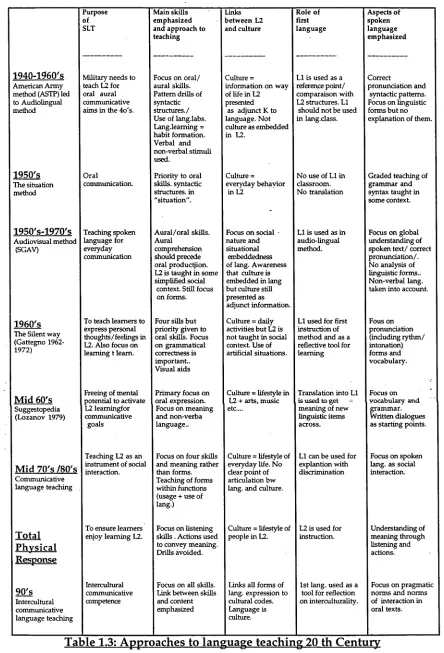
1.5 Approaches to language teaching in the 20th Century (see table
1.4 below).
In the first quarter of the 20th century, different developm ents in language
teaching took place in Europe and the U nited Sates. M arked differences in
language teaching developm ents w ithin the same historical period illustrate
the confusion, or m ore p o sitiv ely view ed, the ongoing search in the
language teaching profession for w h at ought to be tau g h t in the language
classroom and how it ought to be taught.
For exam ple in France, after the first w orld w ar and u n d e r governm ental
instruction, a softer version of the direct m ethod w as im plem ented in
schools labelled "La m ethodologie active" (Puren 1988). A lthough this new
"active m ethodology" was no m ore than a return to the teaching of form s as
in the G ram m ar-T ranslation m ethod, it still gave some focus to spoken
language. As in the direct m ethod it em phasized correct p ro n u n ciatio n
through im itation. Its "innovative" developm ent was to allow again the use
of the learners' first language in the classroom to explain new vocabulary
and gram m ar. The French active m ethodology recognized (or re-recognised)
that reflection on the target language structures was essential for successful
learning outcom es. It rejected the strict u se-o f autom atic learning of the
Direct m ethod.
M eanw hile, d u rin g the same period in the U nited States, language teaching
was taking a different direction in some aspects. In 1924 the results of a long
term stu d y on the outcom es of language learning in high schools and
universities indicated that not enough time w as allocated to language classes
to p ro d u ce satisfactory learning outcom es (Brown 1980). C onsequently, it
w as recom m ended th at schools aim ed at reaching "attainable goals" in the
language classroom . Reading and the learning of gram m ar w ere perceived
as attainable goals an d this led to a retu rn of the G ram m ar-T ranslation
m ethod (Brown 1980:241). The teaching of spoken language was no longer a
priority except for the teaching of pronunciation. In our historical survey of
language teaching w e have noted over and over again that w hen spoken
language is not given a priority in the language classroom, the only spoken
skill w hich alw ay s receives som e atten tio n is the teaching of correct
p ro n u n cia tio n .
Both the F rench "activ e m eth o d o lo g y " a n d the A m erican " re a d in g
approach" despite their differences w ere essentially conservative reactions
against the Direct m ethod.
In the 20th C entury, apart from early differences of orientations in language
teaching betw een E urope and the U nited States w hat is im portant to note is
that from the period of W orld W ar II o nw ards language teaching on both
continents was going to be associated w ith the linguistic sciences. This
period m arked the beginning of the scientific era for language pedagogy
(Germ ain 1993:137). L anguage educators and linguists from th at tim e on
were going to try to engage in a dialogue trying to give a scientific basis to the