The efficiency and effectiveness of
Centrelink and the Job Network
Jennifer Lee Thompson
A thesis submitted for the degree of
Doctor of Philosophy
of
The Australian National University
Declaration
I declare this thesis is the product of my own independent research. It contains no
material that has been accepted for any other degree or diploma, or any copy or
paraphrase of another person’s material except where due acknowledgement is given.
Jennifer Thompson
I would like to express my deep gratitude to the members of my advisory panel for sharing their knowledge and providing guidance during the research and writing of this thesis. I am especially indebted to my supervisor, Professor Richard Mulgan, for his thoughtful advice and encouragement. It is also a pleasure to thank my advisors, Dr Ann Nevile and Professor Deborah Cobb-Clark, for their invaluable contribution.
I would also like to thank the scholarship committee of the Graduate Program in Public Policy at the Crawford School of Economics and Government for awarding me a share of the Sir Roland Wilson Scholarship in 2003. The Crawford School also provided funding for the costs related to obtaining Freedom of Information documents from the Department of Employment and Workplace Relations. I am also thankful to Julie Wickens from the Department of Veterans’ Affairs for her assistance with customer satisfaction data related to veterans and to members of the Centrelink Privacy and Information Access Team for providing infomation about the satisfaction of Centrelink customers. Very helpful IT support was provided by Sandie Walters and Tony Varty.
Abstract
When announced, the Australian government was confident that Centrelink and the
Job Network would lead to improved efficiency and effectiveness. These outcomes are commonly associated with the application of new public management reform
where service provision is separated from policy departments. However, in the public management literature there is widespread debate about the merits of whether this purchaser-provider form of new public management is successful. This thesis employs a case study approach in evaluating Centrelink and the Job Network as examples of new public management reform in which delivery is externalised from the policy departments. Both longitudinal and cross-sectional analysis seeks to determine whether efficiency and effectiveness have improved over a period that includes from when these services were delivered by departments of the state through to delivery by Centrelink and the Job Network.
A central theme in new public management reform is that cost savings are delivered if the public sector separates its services delivery components or delivery is undertaken in competitive markets. To assess whether cost savings have been achieved, this thesis takes account of the costs involved in providing income support and employment services and links these to the programs delivered over a period of time before, during and after the introduction of Centrelink and the Job Network. The data sources for the efficiency evaluation are the annual reports and financial statements of the relevant organisations.
Supporters of new public management reform claim that separating service delivery leads to an improved quality of delivery for the end-users of services. In examining this claim, the thesis measures service effectiveness according to the results of customer satisfaction surveys. The satisfaction survey instruments examined for this purpose were obtained through Freedom of Information requests to the Department of
Employment and Workplace Relations and Centrelink.
improvements have not taken place since the establishment of Centrelink and the Job
Network.
The cross-sectional analysis compares the efficiency and effectiveness of Centrelink to the services delivered by the Department of Veterans’ Affairs (DVA) - a department that delivers similar programs to Centrelink, but has not undergone a split in its policy and service delivery functions. This analysis shows that DVA is able to deliver income support payments at a similar cost per customer as C entrelink’s delivery of the age pension and disability support pension. Also, DVA is able to
achieve very high levels of customer satisfaction in the delivery of its services.
Contents
Table of Contents
Chapter 1: Introduction...1
Aim and scope...3
Defining the terms... 4
Efficiency...4
Effectiveness...5
Method of inquiry... 6
Thesis structure... 8
C onclusion... 10
Chapter 2: The context - Public sector reform...11
Historical background... ...11
Public sector reform in the late 20th century... 14
The drivers of reform ... 15
Ideological drivers...16
Theoretical drivers...18
Environmental drivers...24
Sum m ary...30
Establishing Centrelink and the Job Network...31
Background...31
Agencification... 34
Outsourcing...35
Sum m ary...36
Public sector reform in practice... 37
Theoretical concerns...38
Operational concerns...41
C onclusion...49
Chapter 3: Designing an evaluation for measuring efficiency and effectiveness 51 The foundations and theory of evaluation... 51
Purpose
...
55Parameters
...
64Methods
...
68Conclusion...78
Chapter 4: Efficiency in public sector reform ... 81
The meaning of efficiency... 82
Sum m ary
...
87Assessments of Centrelink and the Job Network... 88
Centrelink
...
89Job N etw ork
... 97
Sum m ary
...
109Conclusion... 110
Chapter 5: Efficiency - the overall costs...113
The overall picture... 114
Income support for job seekers and employment programs... 118
Staffing... 121
Conclusion
...
129Chapter 6: Efficiency and social security programs...131
Social security programs...133
Pension payments
...
137Allowances
...
141Parenting Payment
...
146Family Payments
...
150Sum m ary
...
154Proportional changes to income support payments...156
Sum m ary
...
160Centrelink’s efficiency indicators...161
Efficiency dividend
...
161Contents
Conclusion...
166
Chapter 7: Efficiency and employment programs... 169
Expenditure from annual reports... 170
Specific labour market programs... 174
Costs per customer
...
181Conclusion... 185
Chapter 8: Cross-sectional analysis - the efficiency of Centrelink and the
Department of Veterans’ Affairs...
189Conclusion... 196
Chapter 9: Measuring customer satisfaction... 197
Theoretical background...198
Introduction
...
198Customer satisfaction and service quality
...
200Measuring customer satisfaction... 204
Introduction
...
204Constructing models that fram e the measurement o f satisfaction and service q u a lity
...
205The elements o f customer satisfaction measurement in a service environment.210 The methods fo r obtaining customer satisfaction data
...
219Conclusion... 224
Chapter
10:The job seeker satisfaction survey instruments... 227
Customer satisfaction survey instruments...228
Customer satisfaction surveys fo r the Department o f Social Security
...229
Customer satisfaction surveys fo r the Commonwealth Employment Service ....237
Customer satisfaction surveys fo r the Job Network prior to the Job seeker
Omnibus survey...256
Job seeker Omnibus surveys...261
Conclusion...270
Chapter 11: The service effectiveness of Centrelink... 273
Accuracy...274
Privacy...277
Treatment by staff...278
Waiting times...283
Registration of job seekers...284
The provision of employment services information... 286
Provision of information - Choice of Job Network Provider... 288
Self-help facilities...293
Administration of the activity test...296
Overall satisfaction... 300
Merging the results... 306
Conclusion...309
Chapter 12: The service effectiveness of the Job N etw ork... 311
Confidence in Job Network member...312
Gaining employment...315
M otivation...313
Treatment by staff... 318
Information quality... 321
Measures of satisfaction... 323
Satisfaction with jo b matching services...323
Satisfaction with job search training...326
Satisfaction with intensive assistance services...327
Overall satisfaction...329
Merging the results... 330
Contents
Chapter 13: Cross-sectional analysis - the service effectiveness of Centrelink and
the Department of Veterans’ Affairs...333
C onclusion... 337
Chapter 14: Conclusion... 339
Implications for new public management theories... 342
Future research... 344
C onclusion...346
Bibliography...351
List of Tables
Chapter 5: Efficiency - the overall costs
Table 5.1: Centrelink staffing, 1997-98 to 2003-04... 122
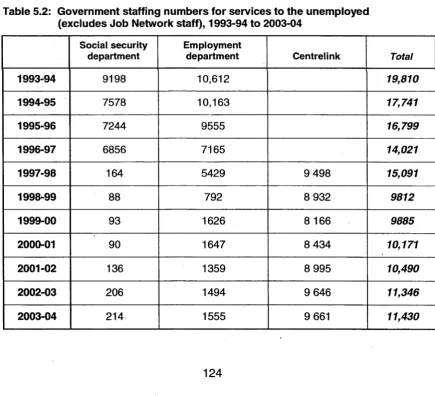
Table 5.2: Government staffing numbers for services to the unemployed (excludes
Job Network staff), 1993-94 to 2003-04... 124
Table 5.3: Estimated total staff numbers for services to the unemployed, 1993-94 to
2003-04...128
Chapter 6: Efficiency and social security programs
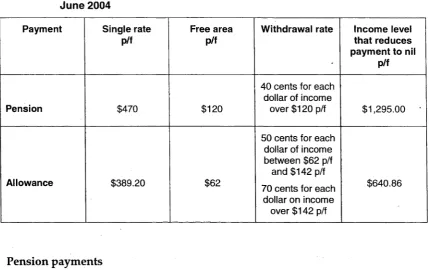
Table 6.1: Comparison of pensions and allowances - rates and income tests,
June 2004...137
Table 6.2: Customer numbers for the major pension payments - June 1994 to
June 2004...138
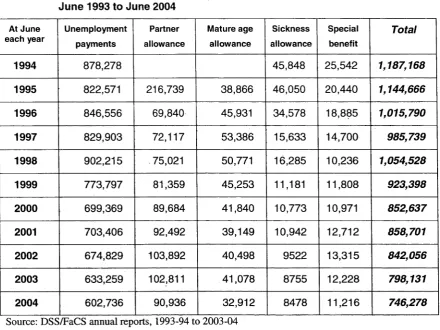
Table 6.3: Customer numbers for the major allowance payments - June 1993 to June
2004... 143
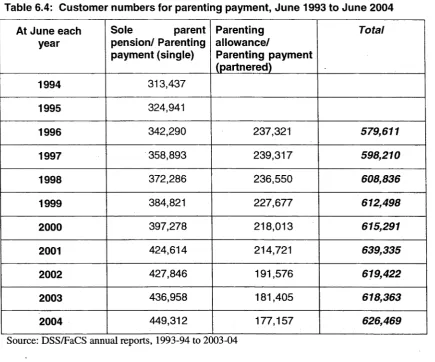
Table 6.4: Customer numbers for parenting payment - June 1993 to June 2004
147
Table 6.5: Customer numbers for family payments - June 1993 to June 2004... 152
Table 6.6: Percentage change in number of customers, administered and departmental
costs during 1993-94 to 2003-04... 157
Table 6.7: Percentage change in number of customers - administered and
departmental costs in the four years PRIOR to Centrelink, 1993-94 to 1996-97
... 158
Table 6.8: Percentage change in number of customers, administered and departmental
costs in the four years AFTER Centrelink, 1997-98 to 2000-01... 159
Table 6.9: Centrelink’s net operating results, 1997-98 to 2003-04, (actual $ )... 163
Chapter 7: Efficiency and employment programs
Contents
Chapter 8: Cross-sectional analysis - the efficiency of Centrelink and the
Department of Veterans’ Affairs
Table 8.1: Payment types - percentage of total costs that consist of departmental
costs, 2003-2004... 193
Chapter 9: Measuring customer satisfaction
Table 9.1: The service quality determinants of Parasuraman, Zeithaml and Berry..213
Table 9.2: Service elements identified in six customer satisfaction survey instruments
... 216
Chapter 10: The job seeker satisfaction survey instruments
Table 10.1: Customer satisfaction surveys for the Department of Social Security ..236
Table 10.2: Customer satisfaction surveys for the Commonwealth Employment
Service...245
Table 10.3: 1998 Centrelink survey groups and quotas... 247
Table 10.4: 1999 Centrelink survey groups and quotas... 249
Table 10.5: Comparison of the question topics and number asked in the 2000 and
2001 job seeker satisfaction surveys of Centrelink... 252
Table 10.6: Customer satisfaction surveys for Centrelink - 1998 to 2002... 255
Table 10.7: 2001 Job Network survey groups and quotas... 259
Table 10.8: Customer satisfaction surveys for the Job Network - 1999 and 2001 ..261
Table 10.9: Service elements and weightings for the Centrelink Customer
Satisfaction Index... 263
Table 10.10: Comparison of results from overall satisfaction question to the customer
satisfaction index... 267
Table 10.11: Job seeker omnibus surveys - 2003 to 2004...269
Chapter 11: The service effectiveness of Centrelink
Table 11.1: Satisfaction levels to questions about staff attitudes from the 1986
Department of Social Security survey...280
Table 11.2: Job seekers’ perceptions of staff service aspects of the Department of
Chapter 12: The service effectiveness of the Job Network
Table 12.1: Question comparison - Improving chances of gaining em ploym ent.... 317 Table 12.2: Job seekers’ perceptions of staff service aspects of the CES and the Job
Contents
List of Charts
Chapter 5: Efficiency - the overall costs
Chart 5.1: Overall costs of income support and employment programs, 1993-94 to 2003-04... 115
Chart 5.2: Administered costs of income support and employment programs,
excluding education funding, 1993-94 to 2003-04...116 Chart 5.3: Departmental costs of income support and employment programs, 1993-94 to 2003-04...117 Chart 5.4: Cost of income support for job seekers, employment programs and number
of unemployment payment recipients, 1993-94 to 2003-04...120
Chapter 6: Efficiency and social security programs
Chart 6.1: Administered costs of social security programs, 1993-94 to 2003-04.... 133 Chart 6.2: Departmental costs of social security programs, 1993-94 to 2003-04...134 Chart 6.3: Pension payments - administered costs per customer, 1993-94 to 2003-04 ... 139 Chart 6.4: Pension payments - departmental costs per customer, 1993-94 to 2003-04 ... 140 Chart 6.5: Allowance payments - administered costs per customer, 1993-94 to 2003-04... 144 Chart 6.6: Allowance payments - departmental costs per customer, 1993-94 to 2003-04... 145 Chart 6.7: Parenting payments - administered costs per customer, 1996-97 to 2003-04... 149 Chart 6.8: Parenting payments - departmental costs per customer, 1996-97 to 2003-04... 150 Chart 6.9: Family payments - administered costs per customer, 1993-94 to 2003-04
... 153 Chart 6.10: Family payments - departmental costs per customer, 1993-94 to 2003-04 ... 154 Chart 6.11: Centrelink’s key performance indicator - price per customer, June 98 to
Chapter 7: Efficiency and employment programs
Chart 7.1: Employment services - administered and departmental costs, 1993-94 to
2003-04...170 Chart 7.2: The percentage of the total costs of employment services that comprise
departmental expenses, 1993-94 to 2003-04... 172 Chart 7.3: The percentage change in departmental and administered expenses,
1993-94 to 2003-04 (calculated in real terms using 2004 dollar values)... 173 Chart 7.4: Category one employment services - administered and departmental costs,
1994-95 to 2003-04... 179 Chart 7.5: Category two employment services - administered and departmental costs, 1994-95 to 2003-04...180 Chart 7.6: Administered costs per customer of employment services, 1994-95 to 2003-04... 183 Chart 7.7: Departmental costs per customer of employment services, 1994-95 to
2003-04... 184
Chapter 8: Cross-sectional analysis - the efficiency of Centrelink and the
Department of Veterans’ Affairs
Chart 8.1: Administered costs of DVA service pension and DVA disability pension, 1999-00 to 2003-04...191 Chart 8.2: Departmental costs of DVA service pension and DVA disability pension, 1999-00 to 2003-04...192 Chart 8.3: Administered costs per customer of Centrelink and DVA pensions, 1999-GO to 2003-04... 194 Chart 8.4: Departmental costs per customer of Centrelink and DVA pensions, 1999-
GO to 2003-04... 195
Chapter 11: The service effectiveness of Centrelink
Chart 11.1: Percentage of customers satisfied with the accuracy of DSS and Centrelink information, 1986 to 2005... 275 Chart 11.2: Percentage of customers satisfied with the privacy aspects o f DSS and
Contents
Chart 11.4: Percentage of customers satisfied with DSS and Centrelink waiting times, 1996 to 2005...283 Chart 11.5: Percentage of customers satisfied with the overall registration processes
of CES and Centrelink, 1995 to 20 0 5 ... 286
Chart 11.6: Percentage of customers satisfied with the employment services
information received from CES and Centrelink, 1993 to 200 5 ...287 Chart 11.7: Proportion of job seekers who choose their Job Search Training or
Intensive Assistance provider, 2001 to 2 0 0 2 ...290 Chart 11.8: Reasons for choosing a Job Network member, 2000 to 2002...291 Chart 11.9: Percentage of customers satisfied with Centrelink’s self-help facilities,
1999 to 2005 ...295 Chart 11.10: Percentage of job seekers satisfied with the information provided by
CES and Centrelink about rules and responsibilities, 1993 to 2005...299 Chart 11.11: Percentage of job seekers satisfied with the overall employment services
of CES/DSS and Centrelink, 1993 to 2005... 302 Chart 11.12: Consolidation of DSS/CES and Centrelink satisfaction ra tin g s...307
Chapter 12: The service effectiveness of the Job Network
Chart 12.1: Aspects related to job seekers’ confidence in and motivation from their employment service providers (intensive assistance services), 1997 to 2005 ..314 Chart 12.2: Job seekers’ satisfaction with employment service providers improving
their chance of employment, 1993 - 2005 ... 316 Chart 12.3: Percentage of customers satisfied with aspects of C ES’s and Job
Network’s information, 1993 to 2005... 322 Chart 12.4: Percentage of job seekers satisfied with Job Matching services, 1993 to
2005...324 Chart 12.5: Percentage of job seekers satisfied with Job Search Training services, 1997 to 2005 ...326
Chart 12.6: Percentage of job seekers satisfied with Intensive Assistance services, 1995 to 2005 ...328
Chapter 13: Cross-sectional analysis - the service effectiveness of Centrelink and
the Department of Veterans’ Affairs
Contents
List of Diagrams
Chapter 3: Designing an evaluation for measuring efficiency and effectiveness
Diagram 3.1: Organisational structures 1993 to 2 0 0 4 ... 63
Chapter 10: The job seeker satisfaction survey instruments
A B S A u s tr a lia n B u re a u o f S ta tis tic s
A C O S S A u s tra lia n C o u n c il o f S o c ia l S e rv ic e s
A N A O A u s tr a lia n N a tio n a l A u d it O ff ic e
C A T I C o m p u te r - A s s is te d T e le p h o n e In te r v ie w
C E S C o m m o n w e a lth E m p lo y m e n t S e r v ic e
D E E T D e p a r tm e n t o f E m p lo y m e n t, E d u c a tio n a n d T r a in in g
D E E T Y A D e p a r tm e n t o f E m p lo y m e n t, E d u c a tio n a n d T r a in in g a n d Y o u th
A ff a irs
D E S T D e p a r tm e n t o f E d u c a tio n S c ie n c e a n d T r a in in g
D E T Y A D e p a r tm e n t o f E m p lo y m e n t, T r a in in g a n d Y o u th A ff a irs
D E W R D e p a r tm e n t o f E m p lo y m e n t a n d W o r k p la c e R e la tio n s
D H S D e p a r tm e n t o f H u m a n S e rv ic e s
D S S D e p a r tm e n t o f S o c ia l S e c u r ity
D V A D e p a r tm e n t o f V e te r a n s ’ A ff a irs
IC C S In s titu te fo r C itiz e n - C e n tr e d S e r v ic e
O E C D O r g a n is a tio n fo r E c o n o m ic C o o p e r a tio n a n d D e v e lo p m e n t
N C A N a tio n a l C o m m is s io n o f A u d it
P fW A P re p a r in g fo r W o r k A g r e e m e n t
Chapter One
Chapter 1: Introduction
In the late 1990s the regional office network of the Department of Social Security (DSS) and, within the employment department, the Commonwealth Employment
Service (CES) were replaced by alternative service delivery mechanisms. A
specialised government service delivery agency, called Centrelink, was established to deliver all of the network services of DSS, including functions of the CES relating to the registration and assessment of unemployed people. The employment assistance functions of the CES became outsourced to private and non-profit firms, collectively called the Job Network, that compete in a tender and performance-based process to deliver the government’s employment services. These changes were introduced as part of an international trend in reform called ‘new public management’1. These reforms recommend the introduction of changes to improve the efficiency and effectiveness of publicly-funded services.
The Australian government believed Centrelink and the Job Network would introduce substantial and long-term benefits. The then employment Minister (Vanstone 1996) considered Centrelink would offer “significant potential for service improvement and
efficiency savings’’ (p.51) and the Job Network would “achieve better value for money” (p. vii) and “significantly enhance the quality of services to job seekers”
(p. 13). Furthermore, the employment department has noted that “[t]he Minister also
explained that rather than simply cutting spending within the existing policy
framework, the Government sought improvements in efficiency and effectiveness
through structural reform.” (DEWRSB 2000c, p. 12)2.
This thesis examines Centrelink and the Job Network as examples of organisations
reflecting the new public management approach to service delivery in the public
sector where service provision is separated from the policy department. Aspects
related to the efficiency and effectiveness of these organisations is considered. The
question asked is whether there is firm evidence that efficiency and effectiveness have
improved since that time when these services were delivered by DSS and the CES.
Traditionally, the approach to organising public bureaucracies involves the provision
of state services being undertaken by large departments that combine policy
development and service delivery within a hierarchical structure. However, this
traditional bureaucratic model is considered rule-bound, fostering inflexible decision
making and promoting a risk adverse culture that reduces the effectiveness of
programs. In addition, the theories behind new public management suggest that
bureaucrats under the traditional model are driven by personal preferences that results
in budgets being maximised, producing wastage and inefficiencies.
Alternative methods of service delivery, such as Centrelink and the Job Network, are
based on the belief that purchaser-provider models and competitive markets are more
efficient and effective than the traditional bureaucratic approach. However, achieving
the expected efficiency and effectiveness outcomes by reforming bureaucratic
structures is far more uncertain than it is guaranteed and many writers caution against
the use of structural solutions in the search for performance and service improvements
(Boyne 2003a; Hood 2000; Kettl 1997; Peters and Savoie 1994; Pollitt 1995; Rhodes
1994).
Chapter One
Aim and scope
The aim of this thesis is to explore public sector reform of the late-twentieth century through the examples of Centrelink and the Job Network. To understand why these arrangements have come about, what it was hoped would be achieved, whether or not it appears reform has been successful and what the results imply for the theories that support new public management. The thesis is particularly concerned with the relationship between reform and its intended effects, comprising the commonly stated
objectives of public sector reform - improving efficiency and effectiveness. Whilst many other impacts, both positive and negative, are also associated with public sector reform, they are not the central concern of this thesis. This is not to suggest other impacts are less important for the purpose of research. All impacts of reform, major and minor, stated and unintended, should be understood and carefully weighed in decisions that adjust and restructure the ways that government programs are delivered.
Centrelink and the Job Network provide high-profile and large-scale examples of organisations that contribute to the debate about the impacts of public sector reform where service delivery is separated from policy departments. They were chosen for this study for a number of reasons. Both are closely connected and deal with a common customer base - job seekers. Part of the reasons put forward for establishing Centrelink was to absorb some of the functions previously provided by the CES, thereby facilitating the introduction of the Job Network. An advantage in examining Centrelink and the Job Network is the organisations offer for analysis two different types of new public management reform that exemplify purchaser-provider
arrangements - agencification and outsourcing. In addition, an important
consideration is being able to track over a lengthy period the criteria chosen for measuring the performance of the organisations before, during and after reform. Lastly, the reform is able to be linked with the objectives of new public management - efficiency and effectiveness.
arrangements, in terms of the costs and the services provided, or the impact on service
effectiveness, as defined by end-user satisfaction. This thesis seeks to close this gap.
The evaluation does not examine the extent that structural reform is responsible for
achieving greater cost efficiencies or improved customer satisfaction. The reasons for
improvements in efficiency and effectiveness are many and the extent that any single
variable is responsible is a complex issue that requires sophisticated analysis. But, the
first step in this process is to establish whether the desired objectives of efficiency and
effectiveness have been achieved. If it is the case that efficiency and effectiveness are
improved, then further research may proceed to examine whether or not, or to what
extent, the structural reforms that resulted in the establishment of Centrelink and the
Job Network are responsible.
The thesis also makes no claim of being able to generalise the findings to the wider
sphere of public sector reform. The circumstances surrounding reform are highly
variable and the results contingent on numerous factors. However, the thesis does
provide a distinctive method of examining the outcomes of public sector reform that
may have application to other case studies. In addition, key findings may be linked
with other research, providing a broader platform to develop generalisations about the
success or failure of public sector reform.
Defining the terms
Foremost in conducting an evaluation of efficiency and effectiveness in public sector
reform is to be clear about the way these terms are defined. The means by which
efficiency and effectiveness will be measured in this thesis is cost efficiencies and
customer satisfaction respectively. This section provides a brief explanation for
adopting these definitions.
Efficiency
Chapter One
While efficiency in the context of public sector reform is commonly undefined, the generally accepted use of the term is connected with the relationship between inputs and outputs and achieving value for money (Pollitt 1998).
Centrelink and the Job Network are not exceptions in being associated with reform that is generally concerned with cost savings. One of the key considerations that guided the reform was “in a tight budgetary environment, to achieve better value for money in the expenditure of taxpayers’ funds” (Vanstone 1996, p. 2). This key objective most likely relates to the more familiar input-focused definition of
efficiency, in which a decrease in inputs is sought while the same amount of outputs is maintained. However, an output-focused efficiency meaning, in which an increase in outputs is sought, for the same level of inputs, is also possible. Using this common public sector approach to efficiency, this thesis will adopt a definition that is inputs- outputs focused and seeks to understand the costs of the arrangement, while taking account of the services provided.
Effectiveness
Generally, evaluations of effectiveness consider whether program goals are reached. For instance, in the case of the Job Network, effectiveness evaluations commonly judge the impact of this reform on achieving sustained employment outcomes for job seekers. These evaluations are important in determining the impact of reform on disadvantaged groups and contribute to debates about the role of government and how publicly-funded services should be delivered.
A consideration of the level of service quality is commonly linked with efficiency
reforms to ensure that lowering inputs, while maintaining outputs, is not achieved at
the expense of quality (Boyne, Farrell, Law, Powell and Walker 2003).
When
combined with the results of the efficiency analysis, the definition of effectiveness
chosen for this thesis provides a more complete picture of the overall outcomes of the
reform, as account is taken of measures that consider inputs, outputs and quality.
Method of inquiry
In the context of evaluating public sector reform it has been noted that “evaluation
requires not only precise measurement and methodological rigour, but also theoretical
depth” (Boyne, Farrell, Law, Powell and Walker 2003, p. 5). When these authors
emphasise the role of theory in the evaluation design process, they are placing value
on the importance of developing questions that enable conclusions or judgements to
be formed that connect with the objectives of the program being evaluated. In this
way, an evaluation is able to provide information that assists in theory development
and has practical implications for program design. This evaluative approach, as
acknowledged by Boyne and his colleagues, is most commonly associated with Chen
(1990) who emphasises the importance of examining the theory that drives a program
and conducting evaluations with the program theory in mind. Using a theory-driven
evaluation approach, this thesis seeks to understand the program theories relevant to
the application of new public management. These theories are outlined in Chapter 2
of this thesis. In addition, the choice of efficiency and effectiveness, as the evaluative
criteria, enables an analysis that takes account of the principal outcomes supported by
the theories underlying new public management.
Chapter One
before extensive changes were announced that altered the administrative arrangements.3
Data for the efficiency analysis was sourced from the publicly available annual reports and financial statements of the relevant departments. These documents provide comprehensive descriptions of the programs delivered and the costs involved in their delivery. The reports are also prepared in accordance with requirements applying throughout the Australian Public Service and this ensures consistency and comparability in the information provided by the different organisations over time.
Throughout the analysis all costs are converted to 2004 dollar values and these are calculated according to increases in the Consumer Price Index. This approach enables changes in the value of the dollar to be taken into account and ensures the comparison of costs over different periods is not rendered meaningless. All amounts are provided in Australian dollar values.
For the effectiveness criteria, the data was sourced from numerous job seeker satisfaction surveys. Most of these surveys are undertaken by specialised consumer research companies and the data contained in these surveys is extensive. However, as these surveys are not publicly available, a Freedom of Information request was required to gain access. Appendix 1 lists the surveys provided as part of this request. The methodologies used in these surveys are of a high standard and the results provide the opportunity to make reasonable general observations about the trends in job seekers’ satisfaction.
In addition to the longitudinal assessment, a cross-sectional analysis is also undertaken comparing Centrelink to the services delivered by the Department of Veterans’ Affairs (DVA). This department is an example of an organisation that
delivers similar programs to Centrelink, within a comparable environment, but DVA
has not undergone a split in its policy and service delivery functions.
Thesis structure
This thesis comprises 14 chapters with the first three chapters establishing the scene.
The next ten chapters are concerned with the central question of the thesis - whether
there are indications that improvements in efficiency and effectiveness have taken
place since Centrelink and the Job Network replaced the previous delivery
arrangements. The final chapter concludes the thesis.
This introductory chapter establishes the framework for the research, briefly setting
the scene and explaining the methods by which the inquiry of efficiency and
effectiveness is undertaken. Chapter 2 places the research into the overall context of
public sector reform and describes the theories that support new public management
reform. Other drivers of reform, in addition to the theoretical drivers, are discussed
and this leads to a description of the circumstances surrounding the establishment of
Centrelink and the Job Network. Chapter 2 then proceeds to consider the reforms in
practice and, recognising that new public management reforms are not always
successful, examines theories contrary to those that support the reforms and discusses
potential problems with the implementation of public sector reform. Chapter 3
establishes how the evaluation will be conducted. An account of evaluation theory
and practice assists in this process. Three central elements of a sound evaluation
approach are identified - the purpose, parameters and methods of evaluation. The
requirements for meeting these three elements are discussed in the explanation of the
evaluation methodology adopted for this thesis.
Chapter One
8, the evaluation is undertaken of whether improvements in efficiency have taken place since Centrelink and the Job Network were introduced. Data is examined to determine the costs of the arrangements and take into account the services provided. The assessment includes an analysis of the issues that relate to staffing, given the
substantial resources that are invested in the number of staff for service delivery organisations. On the basis of the findings it is concluded that Centrelink and the Job
Network are not more efficient than the previous structures of delivery and, therefore, that one should be guarded about claims suggesting Centrelink and the Job Network are more efficient in their delivery than DSS or the CES.
In using the attribute of end-user satisfaction as an indicator of service effectiveness, Chapter 9 explores the meaning of satisfaction, including the theories relating to its formation and measurement. The main problem identified with customer satisfaction
involves the subjective nature of its measurement and how this produces wide variations for customer satisfaction results when, objectively, the same quality of service is delivered. Chapter 10 provides detailed descriptions and an assessment of the job seeker satisfaction survey instruments used in this thesis. Chapters 11,12 and 13 examine the findings of the satisfaction surveys to determine whether improved levels of satisfaction are evident in the period since Centrelink and the Job Network replaced DSS and the CES. For Centrelink, surveys from the employment department suggest improvements in customer satisfaction have occurred since 2003. However, contrary findings from Centrelink surveys, and other factors, suggest improvements in customer satisfaction levels may not have taken place. For the Job Network, the analysis indicates no increases in the satisfaction of job seekers have occurred.
Chapters 8 and 13 undertake the cross-sectional comparisons of efficiency and effectiveness with the services delivered by DVA. The results suggest a combined approach to policy development and service delivery can be as cost effective and deliver as high a quality customer service as externalised delivery arrangements.
Chapter 14 concludes the thesis and contains three parts. The first part provides a summary of the main findings. The second part discusses the implications of the
C onclusion
This investigation into whether the claims of greater efficiency and effectiveness of
Centrelink and the Job Network are reliable provides an opportunity to explore a
tangible application of new public management reform in which service provision is
separated from policy departments. The findings add to the body of evidence that
demonstrates the combined approach of developing policy and delivering services
within a single department can be as efficient and effective as externalised delivery
structures. Therefore, the findings cast doubt on claims that reforming public sector
delivery systems to establish purchaser-provider arrangements that separate service
delivery or outsource its provision, will provide improved efficiency and
effectiveness.
Chapter Two
Chapter 2: The context - Public sector reform
The purpose of this chapter is to position Centrelink and the Job Network into the wider context of public sector reform. The chapter begins by undertaking a brief historical account of the development of the modern public sector. Against this background, attention is turned towards the reasons why new public management reforms came about. Three main drivers of reform — ideological, theoretical and environmental — are discussed. The chapter is then able to situate and explain the people and events that led to the establishment of Centrelink and the Job Network and considers the types of new public management reform these agencies represent.
Finally, in recognising the desired outcomes of public sector reform do not necessarily eventuate, the chapter also explores reasons why new public management reforms may not be successful. First, contrary theoretical positions to the ideas of new institutional economics are examined and an alternative theory, stewardship theory, is described that offers a different explanation for the motivations of bureaucrats. Second, operational aspects that may be compromised by public sector reforms are discussed.
Historical background
defence, administering internal systems of justice to ensure citizens behave according
to society’s laws and providing public goods that would otherwise not be available
(Emy and Hughes 1991, p. 382).
These ideas suggested a minimal role for
government in regulating the economy and reversed the system of mercantilism that
had previously operated.
It was believed that minimal state intervention and
unfettered market processes would provide incentives for self-betterment and lay the
foundations for increased standards of living.
However, industrialisation, combined with a laissez-faire approach by government,
provided wealth for some, but great hardship for many others. On this point, in
writing about the origins of the modern state, Woodrow Wilson considered that in the
United States “[t]he government had, in fact, been originated and organized upon the
initiative and primarily in the interest of the mercantile and wealthy classes.” (quoted
in Raadschelders 2000, p. 509). During this early period, populations grew, cities
expanded and problems, such as inadequate housing and poor health, became
widespread.
In addition, the exploitation of workers, particularly the working
conditions of children, became a concern and the role of government in an economic
system that resulted in such hardships was subject to much debate.
Furthermore, the structure of public bureaucracies in Anglo-American countries that
were based on systems of patronage where public officials were commonly politically
prejudiced and highly corrupt was questioned.4 By the mid-nineteenth century there
was strong pressure for governments to intervene in economic systems to alleviate the
socially undesirable impacts of unbridled capitalism and to respond to the highly
inefficient public sector bureaucracies that had developed as a result of employment
based on obligations, rather than abilities.
State involvement in the economy led to the development of the welfare state that
promoted an interventionist role for governments in relation to the wellbeing of its
citizens. Changes to remove the patronage elements of public sectors were also
progressed. For example, in the United Kingdom, the Northcote-Trevelyan Report of
Chapter Two
1853 transformed the British civil service and introduced examinations for entry and merit-based promotions to establish a qualified civil service that would serve the
government of the day and be unaffected by the political system (Duggett 1997).
In Australia, the colonial powers also sought to combat corruption as a major priority and took their cues from the Northcote-Trevelyan reforms. Each of the six governing colonies established legislative frameworks embodying principles similar to those introduced into the United Kingdom and that, in time, would be adopted by the Australian government for the federal public service (Australian Public Service Commission 2003).
Of particular concern in the United States was solving the administrative chaos that would occur upon each change in elected government as a multitude of persistent office seekers petitioned the President and Congress for employment under the ‘spoils system’ (United States Office of Personnel Management 2003). The administrative reforms embodied in the Civil Service Act of 1883 replaced the spoils system with a merit-based system of public service recruitment and promotion, except for the most senior levels that remained political appointments.
The rise of industrialisation had also led to the development of ideas about the ways that large-scale, mass production could be organised. A number of writers from this period, such as Charles Babbage, Henri Fayol, Federick Taylor and Max Weber, sought to identify universal principles of design and management that would result in the one best way to organize and accomplish activities. With the role of the public sector expanding, the principles developed by such writers were incorporated into public bureaucracies as governments searched for structures that were believed to provide honest, efficient and effective means for developing and delivering public programs.
These pressures and the solutions offered led to the development of the classical or
formal organisational structures developed that were based upon a division of labour
and hierarchical authority.
Public sector reform in the late 20th century
During the twentieth century, governments at all levels expanded in their size, scope
and degree of control in society. Factors such as the Great Depression and two world
wars have been put forward to help explain the high levels of government intervention
that developed. During the 1950s and 1960s the adoption of Keynesian economics
supported interventionist government policies and consequently expansive social
programs were pursued by Anglo-American governments. Whilst the traditional
model of public administration operated virtually unquestioned during this time, in the
latter half of the twentieth century many countries began to question whether their
public services could be made more efficient and effective. Such questioning resulted
in the planned restructure of public bureaucracies that involved a deliberate change to
the structures and processes of public sector organisations with the objective of
getting them to run better (Pollitt and Bouckaert 2000, p. 8).
The ideas underlying the reforms and the approaches adopted are commonly referred
to as ‘new public management’, although understanding exactly what this means is
not straightforward (Hood 1991). Thomas writes that:
New Public Management is clearly a many-splendoured thing. As critics have
noted, it is not a unified and consistent set of principles, but rather an
agglomeration of ideas about how governments should redefine their roles and
change how they deliver services. (Thomas
1998,
p.369)
Chapter Two
public sectors. However, the solutions adopted in new public management are derived from a shared belief and there is a common set of interventions that are chosen from, providing a framework enabling new public management to be
discussed. This shared belief is that private sector management techniques and competitive markets are more efficient and effective than traditional public bureaucracies. For example, it is argued that hierarchical control results in delayed decision-making, while adhering to rules and regulations leads to inflexibility, unnecessary formalities and reduces the capacity of bureaucrats to take risks. The common set of interventions put forward by new public management include:
• a change in focus from inputs and processes to outputs and outcomes;
• the use of private sector management practices;
• an increase in program measurement such as performance indicators and standards;
• the growth of smaller, specific and autonomous organisations that replace large, multi-function, hierarchical departments;
• the use of contractual or contract-like arrangements in place of authority relationships;
• the development of market or market-like devices for the delivery of public services;
• an intermingling of the boundaries between the public and private sectors; and
• an emphasis on cost-cutting. (Hood 1991; Pollitt 2002)
These commonalities in beliefs and interventions are sufficient for new public management to be “counted as a single movement” (Mulgan 2003, p. 151).
The drivers of reform
p. 10). However, the Minister also thought “the pace of change has been neither as fast, nor as far reaching, as required” and “the Government intends to accelerate the process of public service reform as an integral element of the broader reform agenda” (Reith 1996, p. 10).
This section of the chapter examines the drivers of public sector reform in the second half of the twentieth century, examining the reforms that had taken place prior to
Centrelink and the Job Network and seeking to understand why the Minister for the public service considered substantial public sector reform remained an urgent requirement.
Ideological drivers
An ideology is a set of beliefs and values that influence behaviours and act as justifications for action. The ideological drivers of public sector reform often link to deeply held and generally unquestioned beliefs about the nature of people in society, the role of institutions and how governments play into this. Therefore, operating as powerful drivers of reform, ideological value patterns enable specific political interests and agendas to develop that facilitate the introduction of reform.
The ideological frameworks most commonly associated with public sector reform are
neo-liberalism and individualism (Bevir and Rhodes 2003; Pollitt 1990).
Neo-liberalist ideology advocates free trade and deregulation and a key influence is the philosophy of Adam Smith who, in the eighteenth century, promoted free enterprise and a reduced role for the state in the economy (Emy and Hughes 1991, p. 383). Individualism promotes the merits of individual rights, including the role of the state in supporting an individual’s right to act in self-interest, provided the liberties of others are not infringed. The ideology of individualism is concerned that a powerful bureaucracy may expand to the point that individual liberties are undermined.
In his account of public sector reform in New Zealand, Scott (2001) recognises the
Chapter Two
(1996) acknowledges the power of ideas in giving leaders the confidence to introduce specific policies, he considers contemporary reform is related to ideas and practices that promise improvement in government services, with ideology not figuring prominently.
However, the views of Scott and Schick about the role of ideology in the development of public sector reform are not necessarily shared and may be self-serving. Other writers consider the role of ideology to be very powerful in providing the platform that public sector reform is built upon and an important part of the explanation for the introduction of reforms (Argy 2001; Bevir and Rhodes 2003; Peters and Savoie 1998; Pollitt 1990; Tupper 2001).
The ideological framework of new public management is commonly found in the statements of political leaders. For example, Margaret Thatcher, the British Prime Minister credited with leading the way in public sector reform, commented that government had, “to put its faith in freedom and free markets, limited government and strong nation defence” (quoted in Rhodes 1994, p. 140).
Theoretical drivers
Closely linked to ideological drivers are the theories that support the general
directions that have been progressed in public sector reform since the late 1970s. It is often the case that the role of theory is ambiguous, as reformers do not necessarily account for the theoretical underpinnings of their reforms. Perhaps one of the few exceptions is the country of New Zealand in which the direction of reform was highly structured and strongly influenced by the application of economic and administrative theories (Boston, Martin, Pallot and Walsh 1996, p. 16).
In analysing the literature, two major schools of thought are identified as important influences for the design of public sector reforms in the late-twentieth century. These schools are the highly analytical propositions put forward by the ‘new institutional economics’ and the more pragmatic suggestions contained in ‘managerialism’.
New Institutional Economics
New institutional economics describes a field of study that combines a number of disciplines within an economic framework (Scott 2001). These disciplines include organisational theory, political science, sociology and law. New institutional economics is differentiated from the ‘old’ institutional economics that took a more traditional microeconomic view and treated transactions either as market exchanges or deviations from these (Coase 1998). New institutional economics takes a broad focus and considers that institutions governing the performance of an economy have a particular influence. Accordingly, the discipline uses the tools of economic theory to study the institutional environment, including the interrelated structure of firms and the institutes of governance, incorporating the legal, political and cultural systems (Coase 1998; Williamson 2000).
The central focus of new institutional economics is to frame relationships in terms of contracts, either implied or explicit, where the parties have different interests, but
Chapter Two
alignments encompass public choice theory and agency theory.5
Public choice theory
Public choice theory was developed during the 1960s and brings an economic approach to the study of bureaucracies that is based on the purposive behaviour of bureaucrats. The theory places central importance on the behaviour of bureaucrats who are believed to choose among a set of possible actions that will maximise their personal utility (Niskanen 1971). This contrasts with the sociological perspective that underlies traditional accounts of bureaucracies and places the behaviour of individuals as subordinate to the study of organisations themselves.
In the economists’ theory of the firm, the central motivation of a business person is to maximise the profits of the firm as this ensures organisational survival and is a rational means to provide individual utility maximisation. Similarly, Niskanen postulates that for bureaucrats the central motivational preferences are commonly linked to actions that maximises returns. For example, salary, public reputation, power, patronage and output of the bureau, constitute variables that are involved in the rational choice of bureaucrats and are associated with budget maximisation (Niskanen 1971, p. 38). Public choice theory also explains how bureaucrats maximise their budgets by accumulating tasks within their policy areas, taking advantage of their monopoly environments and hiding the actual costs of producing services (Pollitt, Birchall and Putman 1998).
Niskanen’s public choice theory does not necessarily infer that public bureaucracies are inefficient, although this link is often made. Rather, public bureaucracies are considered wasteful in producing more services than required or in offering a superior service when a mediocre service would suffice. Alternatively, the utility maximising
behaviour of public servants provides the incentive to produce as little services as
possible and thereby retain funds for other purposes or assist in the bid for additional
funds (Peters and Savoie 1998).
A modification to public choice theory explains the acceptance by senior bureaucrats
of the downsizing that often takes place in public sector reform. The ‘bureau-shaping
model’ proposes that budget maximisation is only one of a wide range of options that
bureaucrats adopt in pursuing self-interested goals (Dunleavy 1985). An alternative
strategy is for bureaucrats to reshape their organisations to retain high profile and high
status tasks. In this way, the model accounts for bureaucratic acceptance of the
common public sector reform strategy of separating service delivery components from
departments. This disaggregation creates smaller departments that concentrate on
high status policy development tasks. The bureau-shaping model also adds more
scope for non-pecuniary elements to influence the motivations of bureaucrats without
sacrificing the core of public choice theory’s assumption of utility maximising
behaviour.
Agency theory
Chapter Two
A large part of the literature dealing with agency theory examines the problems of information asymmetries and the risk of principals being captured by agents acting opportunistically (Arrow 1964; Eisenhardt 1989; Jensen and Meckling 1976; Nilakant
and Rao 1994; Schick 1996). Information asymmetries occur because agents,
compared to principals, are likely to know more about their own performance. As a result, principals may incur high costs in retrieving the appropriate information to ensure that agents are honouring the terms of contracts. The capture of principals takes place because agents may provide information that influences principals to take action that is more beneficial for the agents than it is for the principals.
In the public sector a number of principal-agent relationships operate, for example: purchasing departments-service delivery agencies; mangers-subordinates; politicians- bureaucrats; and, consumers-service providers (Ferris and Graddy 1998). In the context of public sector reform, the principal-agent relationship that receives most attention is between elected politicians and bureaucrats. This is because bureaucrats have greater access to information about government programs than politicians and in agency theory this information asymmetry suggests there is a risk of politicians becoming captured by the bureaucracy.
Concerns about the capture of elected representatives by the bureaucracy played a significant role in the public sector reforms introduced in New Zealand (Schick 1996). The Treasury briefing to the incoming Labour government in 1987 highlighted the risk of such capture:
It can be suggested however that the relationship favours the bureaucracy, that elected representatives are at a disadvantage in relation to their own bureaucracy simply because of an information asymmetry. The problem that the bureaucracy may hold better information about how government services actually operate creates the potential for opportunism or subgoal pursuit by the bureaucracy including shirking, budget maximisation and generally inefficient policies for society as a whole. (New Zealand Treasury 1987, p. 44)
measurable, providing incentives to ensure the appropriate use of information and
implementing monitoring systems.
Managerialism
The less analytical school of thought that is applied to the changes introduced with
new public management is managerialism. Managerialism is associated with a variety
of meanings (Lynn 1998), although it is widespread for the term to be used
synonymously for new public management. This arises because managerialism is
commonly used to describe the adoption within the public sector of private sector
management practices. In this way, managerialism refers to the earlier phase of new
public management in which the public sector introduced managerial devices such as
corporate objectives, performance monitoring, program budgeting and a generalist
senior executive.
Aucoin (1990a, p. 117) links managerial reforms to the influential work by Peters and
Waterman,
In Search o f Excellence (1982).From their management consultant
perspective, Peters and Waterman identify a number of practices applied by
apparently successful corporations and put these forward as a guide for other private
sector businesses to adopt.6 The 1992 book by Osborne and Gaebler,
Reinventing Government, is also considered influential in the adoption of private sector practicesin the public sector (Barzelay 2000). The similarities between these two books have
been noted and it is suggested that Osborne’s and Gaebler’s book is an adaptation for
governments of the earlier work by Peters and Waterman (Pollitt 2001).
Osborne and Gaebler (1992) criticise hierarchical, centralised bureaucracies and argue
the public sector needs to become more flexible, innovative and entrepreneurial to suit
the rapidly changing modem environment.
According to Osborne and Gaebler
(1992), entrepreneurial governments focus on results, empower citizens, are driven by
organisational missions, redefine clients as consumers, prevent problems before they
emerge and decentralise authority.
6 Some twenty years after In Search of Excellence, M. Chapman wrote In Search of Stupidity
Chapter Two
Managerialist ideas and the blurring of private sector and public sector practices were part of the scenery from the late 1960s. This period can be linked to the establishment of generic business schools that placed emphasis on concepts such as output budgeting and performance measurement, regardless of whether these concepts were original or reinvented. These business schools sought to distance their teachings from
the traditional field of public administration that during the 1950s had become fractured with disagreements between the classical and neo-classical streams of thought (Kettl 2000a). In addition, public administration was confronting alternative approaches that were developing, such as the new institutional economics. Many commentators consider the discipline of public administration lacked any firm theoretical guidance at this time and the structure and role of the public sector was open to question (Greuning 2001; Kettl 2000a; Perrow 2000).
Evidence that governments were examining the operation of public administration during this period is found in the civil service enquiries established in a number of countries. For example, in the United Kingdom a Commission on the Civil Service chaired by Lord Fulton, reported in 1968 (Duggett 1997). One of the concerns of the Fulton Commission was the lack of interest in management shown by the Administrative Class.7 The Fulton Commission’s report likened the civil service to amateurs and used the Administrative Class as an example of this. The report defined amateur as meaning generalist or all-rounder, rather than suggesting that an administrator lacked abilities. However, it was envisaged that future appointees would have a greater technical expertise in economics, planning, research, accounting and law (Duggett 1997).
Similar to the United Kingdom, in the early 1970s the new Labor government in Australia established a Royal Commission to consider federal government administration. The Commission was headed by Herbert Coombs, a highly regarded senior public official from previous Australian governments and a former Governor of
the Commonwealth Bank. When the report of the Commission was presented some two years later it argued that a more efficient public service was possible with a decentralised structure that emphasised managerialist features (Guthrie and Parker
1998).
In 2005, the newly appointed Public Service Commissioner, Lynelle Briggs, acknowledged the significance of the Coombs Report noting that:
The Coombs report marked a watershed in administrative thinking and reform —
recommending far-reaching changes to the structures and direction of public
administration. The report’s key themes; its imagined future:
• increased responsiveness to the elected government
• improved efficiency and effectiveness, with devolution and a
stronger emphasis on results, and
• greater community participation in government
have been a catalyst for, and have strongly influenced public sector reform for the
past 30 years. (Briggs, Great Expectations: The Public Service of the Future,
Speech to NSW Forum of Commonwealth Agencies, 17 March 2005)
E n v iro n m en ta l d rivers
The literature on late-twentieth century public sector reform makes numerous references to events and people that figure prominently in the reform process. Gill (2000, p. 57) refers to these as “practical triggers” of reform because they explain how ideas based on ideology and theory can emerge into action given the appropriate situation. Such practical triggers are discussed in this chapter under the heading of ‘environmental drivers’. While ideologies and theories set the direction for change, the environmental drivers provide the imperative or opportunity for change. Environmental drivers are distilled into three main categories - the economic environment, influential people and opportunity events.
Economic environment