RIT Scholar Works
Theses
Thesis/Dissertation Collections
1999
Jazz as inspiration
Cosmo Barbaro
Follow this and additional works at:
http://scholarworks.rit.edu/theses
This Thesis is brought to you for free and open access by the Thesis/Dissertation Collections at RIT Scholar Works. It has been accepted for inclusion
in Theses by an authorized administrator of RIT Scholar Works. For more information, please contact
Recommended Citation
Jazz
asInspiration
by
Cosmo
A. Barbaro
A
thesis
submittedto the School for American Crafts in
partialfulfillment for
the
Master
Thesis Committee
Leonard Ursa
chief advisor
Approvals
date:
Thesis Committee Approval
Terry Hunt
associate advisor
#
1
date:
<1-
12.-
1'1'
John Beck
associate advisor
#
2
date:
i-
B-
7r
RichTannen
chair person
date:
1
/ll/
'j
7
I, Cosmo
A.
Barbaro, hereby grant permission to the Wallace Memorial Library of R.I.T. to reproduce my thesis in whole
or in part. only with my permission. Any reproduction will not be for commercial use or profit.
Signature:
1wouldliketotake thisopportunityto thanka number of peoplethatmade itpossibleformeto
completethetaskatiiand. Firstand most
importantly
Iwouldliketothank myparents.Dr. CosmoBarbara,
andCharlotte Barbara
fortheir understanding, compassion,supportand patience'sduring
mytimeatR.I.T. Thetimeand professional guidance ofLeonard
Urso,
a professional metalworker/painter,wasgreatly
appreciated and admired.Terry
Hunt acuttingedgedesigner,
was akey
memberof mineduring
mythesisprocess, and alwayshadtime foraesthetic andtechnicalquestions. Hissupportalongwith
Doug
Sigler.
andStephen Proctormade myjourney
much smoother. AnotherimportantmemberofmycommitteewasJohn
Beck,
who was pivotalintheresearch,comprehension,and aptitude ofthemusicalaspects ofmythesis.
Finally
1wouldliketo thankmypeer,boththe undergraduate,and graduatestudents,forthere
impute
onmywork.Without
theguidance oftheseindividuals,
my
proposal wouldhave
title
page1
approvals
2
acknowledgments
3
table
of contents4
chapter
I
1.
introduction
5
2.
preliminary
workleading
up
to thesis
proposal6-8
3.
musicbackground
9-10
chapter
2
1.
examining
the
musical elements11-13
2.
development
ofthe
sofa14-16
3.
design
andimprovisation
oflamps
17-21
4.
final
progression ofthe
hall
table
22-23
chapter
3
1
. conclusion24-25
list
ofillustration
26-49
end notes
50
bibliography
51
musical selections
52
1
.Louie
Armstrong,
black
andblue.
1 920
2.
Benny
Goodman,
don't be that
way,1937
elements
that
delineated the jazz
styles ofthis
era.The
goal ofthe thesis
wasto
exploreways of
translating
these
elementsinto forms for
furniture,
through the
use ofanalyticaland
intuitive
processes.The idea for
this
project wasto
select a specificjazz
tune
andcritically
evaluatethe
musical elementsfound in
the
selection.Once
the
analysisis
complete,
it becomes
the
basis for
the
design
process.Essentially,
I
amallowing
these
elementsto
direct
metowards
amusically inspired
outcome; thus
creating
abody
ofworkthat
conveys asense of movement and gesture
directly
relatedto the
music selected.Analysis
ofthe
musical selection
implements intuitive
processes as well.1The issue
ofthe
viewerin
relation
to
whatthey
envision asthey
interact
withthe work,
was a concern of minefrom
the
start.I
cameto
the
conclusionthat the
viewerdoes
nothave
to
respondto the
musical
influence. The
viewer can relateto
many
things
whenviewing my
work.I hope
that the
form
and gesture ofthe
worklead
eachindividual in
adirection
that
implies
movement.
Form,
movement and gesture willideally
convey
themselves to the
viewerthrough the treatment
ofmaterials,
andtechnique.
Viewers have different tastes
andstyles,
and whatis
clear andjustified in my
mindmay have
no connectionto
someonewho
is viewing
the
workfor
the
first
time.
Another
goal wasto
selectatopic that
would create afresh
outlook for my
design
process,
and create ainspiration that
woulddrive
me with a passionthat
did
notexist
in
past years.1
discuss
whatled
meto
my final
proposal.It
wasthe
winter quarter ofmy
second year atR.I.T.,
andthe term
project wasto
design
a chest ofdrawers. The
chest startedlike
every design I produced,
whileattending
the
School for American Crafts.
The
conceptual
designing
workbecame
one of pain and suffering.My
frustration
wasthe
result of
having
nodirection in my design
process.It
was notuntilI built
the
chest ofdrawers
that
I
realizedwhy
I
washaving
such ahard
time
designing
furniture.
I had
noconcrete
foundation
to
base my hypothesis
on.It
wasthrough
a series ofdesign
critiques with
Doug
Sigler
that
directed
meto
solving
this
problem.He
sat medown
andexplained
that I
neededsomething
to
guideme;
like
a source ofinspiration.
It
was afterthis
discussion
that
I decided
to
re-thinkmy ideas
and usethe
advice givento
me.The
inspiration for
this
piece wasbased
upon well-dressed male whofrequented
nightclubsduring
the
1920's. The
workbecame
adesign I
call occasionalliquor
chest(Figure #1).
It
wasto
function in
aliving
room,
den,
orany
place usedfrequently. This
pieceis
astorage unit
that
holds
whateverthe
userdesires;
i.e.
beverage
ofchoice, utensils,
andany reading
material.The issue
ofform
movement,
and gesturebecame
the
parametersfor
the
design.
The lines
ofthe
legs
and railsbecame
the
framework that
presentedthe
display
surfaceto
the
viewer.A
system of exoticfabrics,
such as silk wouldbe
organized
into
severallayers.
For
examplethe
ensemble could consist of an outerframework
whichis
usedto
draw
the
viewerinto
the
detail
ofthe
clothing.The
underneath of
the
jacket
would reveal a more refined materialthat
complimentedthe
outer
frame. The difference is
the
underneathlayers
would contain a significant amountof
detail.
The detail
that
I had in
mind wasthe
button,
possibly
opal,
cufflinks,
tie,
tie
types
ofmaterials,
andfinishes
used.I
wastrying
to
relatethe
idea
ofhow
peoplewouldview
this hypothetical individual. What kind
of environmentthis individual
has
createdvisually?
The
concept was successfulin emphasizing
the movement,
gesture and alsocreating
afoundation
to
referencefrom.
The
chest was adirect
result ofhow
I
viewedthis individual.
The
mainline
ofthe
chest
is
the
maplestructure,
which createsthe
frame
that leads the
eyeto the
sidepanel,
which arethe
front, back,
and sides.The
mapleframe
becomes the
mainensemble,
whichleads
the
viewer's eyeto
abeautifully
blistered
surface.In
combinationwith
the
inlay
detail,
the
panelbrings
the
viewerin
for
a closerinspection.
Once
againthe birds-eye
plains canbe
examinedto
reveal even moredetail,
which showsup
onthe
side of
the
cabinet.This is
in the
form
ofaninlay
detail
ofebony
that
resembles amusical note
(Figure
#2).
If the
viewer opensthe
doors
ofthe
chest,they
willfind
another
layer
of refinementshowing
anebony molding
that
is
adjacentto the
smallerinlay. When viewing
the
drawers,
the
same care anddetailing
is
evident;
since eachdrawer
uses ahalf
blind,
and athrough dovetail that
constitutesthe
sameidea
asthe
cabinet
frame. The dovetailed
drawer
becomes
the framework
that
leads the
viewerto
the
bird's
eyedrawer
bottom
(Figure #3).
The
inlay
details,
aluminumballs
andpulls,
relates
to
the
buttons,
cufflinks,
and shoes ofthis
welldressed individual (Figure
#4)
The
stepped progression ofthe
top
does
whatthe
cabinet anddrawers
do,
whichis
to
bring
the
viewerin for
a closerinspection.
The
overallform
ofthe
top
reminds me ofthe
final
part ofthe
dress
ensemble,
which,in
this case,
is
ahat (Figure #4).
Exploring
this
design
process resultedin
the liquor
cabinet.Confidence
and selfesteem was
something
I
felt
unsure about;especially
whenit
wasnecessary
to
completesome
flaws
werediscovered in both
the technique
anddesign.
For instance
a majordesign flaw
cameup in
the
construction ofthe
doors.
Poor
modeling
techniques lost
precious
time
because I
initially
did
not solvethe
mechanics ofthe
hinging
system.This
was a mistake
in
the technical
drawing
that
couldhave been
avoidedif
an accuratedrawing
and mockup
was completedbefore
the
actualbuilding
began.
Another
problemwas
the lack
of scaled andfull
size modelsto
guidemy
aestheticdecisions.
In
additionto these
problemsI consistently found
myself employedin
time
consuming
details,
suchas
the
use ofinlay
and steppeddetails.
Although I discovered
a number of problemswith
my
process, the
piece was a major successbecause it
created a series ofbrainstorming
sessionsthat
led
meto discover
my
thesis topic.
Technical
aspects wereimmensely
improved
by building
the
frame
and panel chest.Evaluating
the
processI
went
through
as abasis for
the
development
ofthe chest, I
reflected upon what otherinspiration
couldbe
applicableto the design
and actual construction.It
wasthen that
I
decided why
not use music asthe inspiration?
The
process wouldbe
similarto that
opinion,
the
phrase music soothethe
savagebeast is very
true.
Although many
ofpeople
do
not realizeit
musicis
a part of everyone'slife
that
sets some sort oftimed
schedule.
I
askthe question;
what wouldthe
worldbe like
withouttime?
I
envisionchaos and an end of
the
worldtype
scenario.An
obvious reactionto this
questionis If
there
is
notime
wouldthere
music?Time is
animportant
part of musicthat
residesin
the
rhythm ofthe
tune,
whichis
the
foundation
ofthe
composition.Other important
day
to
day
implications
of music residesin the different
cultural and religious possibility.Black
spirituals andhymnals
are one example, andhave been
practicedby
indigenous
people of
Africa for
centuries.The African
spiritualshave
aheavy
influence
onBlues,
and
Ragtime
styles of music.(Oliver,
6)
aMusic has
been
very
influential
partofmy
life that has its
rootsfrom my
father,
Cosmo
A.
Barbara,
whois
aDirector
ofPercussion
Study
atEdinboro
University
ofPennsylvania.
I
grewup
listening
to
alltypes
ofJazz, Classical,
and alsomany different
tribal
and culturaltypes
of music.Although I
never pursued a professionin
music,
I had
a
heavy
influence from my father. Music
has
remained a constantthroughout my
life,
and
has
been
animportant
socialinfluence
aswell.Music drives my
ambitionto
live
andachieve new
heights
by letting
my
mindbe free
to
dream.
I
enjoy
all aspects ofmusic,
from
the
conceptual aspect ofthe
musical score and mainideas behind
the music, to the
reproduction of
the
notesthrough the
use ofinstruments,
to
finally
the
reaction ofthe
audience or
listener. When
at aconcert,
look
around and seehow
much peopleenjoy
the
music.This is
exciting, and almost magicalto
watch, anddemonstrates
how
important
musicis in
our society.My
life
experience with music andthe
influences
from
I tried to
createsomething
new andexciting for my
design
processby
selecting
apiece of music and
analyzing
the
musical elements.Each design is
the
result ofthe
Before
I begin discussion
onworks,
it is necessary
to
understandhow
musical elementsfunction.
When
discussing
musicalelements,
I
amreferring
to
melody,harmony,
texture,
rhythm,
thematic processes,
andthe
many
sub-categoriesthat
fall
under musical elements.
The first
elementthat I
willdiscuss is
rhythm.Rhythm
functions
asthe
base
that
supports all other elements.In
Musical
Structure
andStyle
Ball
states:Rhythm,
the
mostbasic,
andpossibly
the
mostimportant
ofthe
musicalelements, is
oftendefined
asthe temporal
aspect of music2.There is
adanger inherent
in
dictionary
definitions,
and we shall seethat
rhythmconsist of much more
than this
simpledefinition
implies.
Music is
atemporal
art.What is
the
composertrying
to do
withtime
whenhe
writesa piece of music?
How
arethe
elements of musicdeployed in
time
to
result
in
a coherent and expressive composition?How
arethe temporal
aspects of
tone
made understandableto
the
listener?
These
questionsare
basic
to the
art of music andto
our ownunderstanding
of music(Ball,
48).
bIt
was notmy intent
to
become
a musicianthrough this
thesis,
but it
wasvery
important
I
understandthe
subject.The
book Musical
Structure
andStyle
was anexcellent source
to
begin my
research,
sinceit
allowed meto
critically
evaluatethe
music with some
intelligence.
There
arethree
levels
ofrhythm,
beat,
meter,
andforeground
rhythm.The beat
refers
to
a standard unit of measuredtime in
music.Meter is
the
organization ofbeats
into
groupsthat
canbe
playedin
duple
ortriple
groupings.3Foreground
rhythmis
aphenomenon where
two
levels,
beat
and meter are notsounded,
but
ratherinferred
onthe
listener
from
actualtones
played.The
composeris
free
to
combinethese
techniques
in any
numberof waysto
gain rhythmicstability in
the
piece.2
In
musicthe
wordtemporal
refersto
time,
even or uneven groupings ofnotesDupl
three.
3
Melody
is the
mostrecognizableelementthat
listeners
can associate oridentify.
It is
commonly
referredto
asbeing
horizontal in
format,
containing
a combination offoreground
rhythms.Melody
has many different
characteristicsthat
makeup
its
complexity.
There
aremany
types
of melodies suchas, contour/shape, range, type
ofmovement,
character,
andlength. A melody
can movein
only
three
directions;
up,
down,
andalong
ahorizontal
plane.The
shapethat
amelody
takes
is
referredto
asmelodic contour.
The
range of amelody is
the
distance from
the
highest
noteto
the
lowest
note,
and canvary in the
type
of movement.The
type
of movements amelody
can
do is divided into two
categories,
1)
step-wise,
and2)
skip-wise.Step-wise melody
allows
the
outline of ascale;
eachtone
progressing
to the
nextadjacenttone.
Skip-wise
melody
movesin
a progression ofthirds
or morefrom
tone
to tone.
The
overalllength
ofa
melody falls
underthe
concept, tonality.
This
principle statesthat
amelody
will movefor
a period oftime
before
resting.The resting
pointis
called acadence,
andthe
distance from the
start ofthe
melody
to the
cadenceis
the
overalllength
ofthe
melody.The
character ofmelody is
basically
the
composer's unique use ofall melodic elementsthat
createits
own observabletraits.
The listener
reactsto
aselection of music whichthen
inspires the
personto
adopt adjectivesto
describe how
the
piece affectedthem..
Musical
texture
refersto
the
overallcomplexity
of a melody, whichis determined
by
density,
range, textural
type,
and polyphonicdevices.
Density
refersto
how thick
orthin
sound willbe.
Range
is the
tonal
distance from the highest
to
the
lowest
voice.It
also refers
to the
distance
from
the
lowest
noteto
the
highest
note of a melody.Textural
type
may be
the
mostdifficult to
understand.As
ananalogy,
if
one wereto
observe apiece of
cloth,
it may
appearto
be
course orfine,
narrow,
orwide, thick
orthin.
The
same can
be
saidfor
a piece of music.Textural
types
canfall
underthree
different
The
last
musical elementis harmony. As previously
discussed,
musicis
anumberof melodies
that
areinterwoven in
someway
that
creates apleasing
soundto
our ear.
In
this
caseif the
melody
were relatedto
aline,
it
would appearhorizontally.
The
art ofcombining two
or more melodiclines is
called counterpoint, andthe
verticalrelationships
that
are created aredefined
asharmony.
The
mostbasic
unit ofharmony
is
called achord,
which representsthe
sounding
ofseveraltones.
Different
chordshave
different
tonal qualities,
which resultin
a phenomenonknown
asharmonic
progression.Harmonic
progressionis
criticalin
creating
motionin
music andis
often referredto
asthe
vertical aspect of music.This basic understanding
of music wasapreliminary
guideto
designing
my
body
of work.
By
studying
these
elements,they
allowed meisolate,
andapply
these
elementsto
forms
offurniture. This is
the
analytical partoflistening
to
aselection,
whichis
fifty
percent of
the
design
process.The
otherfifty
percent residesin
my intuitive
reaction ofBefore
the
body
of work startedI decided
to
enlistthe
help
ofa professionalin
the
area ofJazz.
My father,
Dr.
Barbara,
recommended names ofprofessionalmusicians
in
the
area.I
contactedJohn
Beck,
head
ofthe
percussiondepartment
atthe
Eastman
School
ofMusic,
and askedhim if he
wouldbe interested
in
being
a member ofmy thesis
committee.I
presentedmy
thesis
proposalto
Mr.
Beck,
andhe subsequently
became
avalued resourcethroughout the
project.After
the
first
presentation,
he
recommended
I
research musicfrom
the
1920's,
andhe
gave me alist
ofJazz
playersand
tittles,
that
fell
underthe
styleknown
asNew
Orleans
style.The
processbegan
withmy
listening
to
a number ofdifferent
artistsfrom
this
time
period.I
startedby
researching Dixieland Jazz
artists,
andswing
artists,
such asCab
Calloway,
Count
Basie,
Dizzy
Gillespie,
Duke
Ellington,
Benny
Goodman,
andLouie
Armstrong. After acquiring
andlistening
to
several compactdisks,
I
selected a versionby
Louise Armstrong.
In the
selection processLouie
Armstrong
music,
particularly Black
and
Blue,
interested
mebecause my feelings
weredriven
partly
by
the music,
but
alsoby
the
history
ofJazz.
The
development
ofJazz in the
United States
is
a vitalcontribution
to the
world ofvisualandperforming
arts.When jazz first flourished in New
Orleans,
it
was associated withhouses
ofill
repute.
This notoriety led
citizensto look down
uponthis type
of music.Americans
viewed
jazz
asbelonging
to
something
unlawful.It
is
also afact
that the
prejudicetowards this
music was attributedto
the African
American
developing
this
style.Jazz
fought
an uphillbattle
to
gainprominence, this I
relateto,
sinceI
am alsofighting
to
gainrecognition as a
furniture
designer.
Once I decided
onthe
musicalselection,
I listened
to the
tune
analyzing
the
musical elements.
This
process wasvery difficult
atfirst,
because I
was not sureif I
wasutilizing
the
musical elements correctly.Although the
design
ofthe
chestis
similarto
reference
to
an audible one.I
neededto
make surethat
my
conceptfor
designing
apiece of
furniture
from
a piece of music was plausible.Black
andBlue
(track
#1)
wasselected
for
a number of reasons.The
richness and subtle voice ofLouis
Armstrong
gained
my
attention.The
slowed rhythm and overallmelancholy feel
that the tune
creates also attracts
my interests.
The interaction
ofsoftmelody
with alight
harmonic
progression stimulated
the
intuitive
aspectin
my
decision
making
process.The design format
started asI discussed
in
my
introduction.
I listened
to the
song
numeroustimes,
andcritically
evaluatedthe
musical elements.The
elementsbecame
the
parameterthat
influenced
the
design,
whichis illustrated
in
figure
5.
This
sketch
visually identifies
whereI
placedthe
musical elements.In the
beginning
I
wasconcerned about
justifying
the
elements ofthe
song
to the
piecethat
was created.The
form
ofthe
sofa was a reactionto how the
song
made mefeel.
I
started withthe
slow rhythmthat
showsup
in
the
overall gesture andtransitions
from
the
base
to the
rails.The
asymmetry
ofthe
sofais
adirect
result ofthe
harmony
in
the
tune,
whichhas
a wide range ofmovementvertically.I
wasrelating
this
idea
to
the
clarinet part
in the
Armstrong
selection,(track
#1)
The
selection ofthe
materialsis
aresult of
the tonal
colorofthe
song.The fiddle-back
eucalyptus and newbuck leather
were an
ideal
selectionbecause
they
werevery
similarto
soft warmfeeling
that
the
piano,
trumpet,
and clarinet createdin
the
main melody.Once
the design
wasfinalized,
I had
to decide how to
build
the
piece.The
design
resultedin
avery
technically
challenging
piecethat
required an unconventionalbuilding
process.All
ofthe
forms
resultedfrom
one curve.The
front,
back
and sideswereall
designed from
one curve, which created a curved miteredjoint
at allfour
corners.
The
sofa was constructed withfour
surfacesthat
had
the
same curve.This
design
requiredthe development
of a newtype
ofjoinery,
whichI
called a curvedthe
piecewiththe
grain oriented vertically.The first
wasto
draw
an accuratefull
sizedrawing
ofthe sofa,
andthen
build
a moldto
producethe
desired
curve.The
Mold
was76
inches
long by
41 inches
wide,
and was usedto
pressthe
sides andback.
The
veneer was
book-matched
the
entireway
aroundthe sofa,
and pressedto
a core ofthree layers
of1/8 inch
bending
ply
andtwo
layers
of3/8
inch
bending
ply.The
curve onthe
front
was shapedfrom
a solid piece ofcherry, andthen
veneeredwith white glue andpressed with an
iron.
Once
all ofthe
parts werecompleted, I
cut out allthe
profiles andbegan
construction.The
construction startedby
fitting
the
front
two
corners, andthen
scribing
the
back
ofthe
sidesto the
back
ofthe
sofa.This
wasextremely
time
consuming
and notvery
cost effective.I
felt extremely
gratifiedby
solving
avery
challenging
joinery
system.The
second majorobstacle encounteredin
the
design
wasthe
problem of upholstery.Originally
I
wasgoing to
upholsterthe arms, seat,
andback,
but decision
was changed after a conversationwithTerry
Hunt.
He
suggestedthat I
expose
the
veneeredback,
and changedthe traditional
upholstersofato
abench
stylepiece.
Although
the
back
was notupholstered,the
sofais
very
ergonomically
correct,
animportant feature from
the
start ofthe
design.
This
sofa wasvery challenging
andrewarding
processto
gothrough.
However
there
were someissues that
neededto
be
addressed,like
building
time,
transition
from
element
to
element, design process,
decision-making
skills,
and a re-evaluation ofthe
piece
during
the
building
process.The
question ofhow
muchinfluence
ofthis
design
results
from
the
musicalsource,
and what was carried overfrom my
previousdesign
vocabulary.
These
questions setthe
tone
for
the
remainderofdesigns in the
body
ofThe first
critiqueinspired
meto
drastically
vary
the
scalefor
the
remainderofmy
designs.
I
wantedto
show workthat
was related aesthetically,but
also contained a widerange of proportions/scale.
I decided
to
select a piece ofJazz
musicthat
precededthe
New
Orleans
style,
whichis commonly
referredto
asSwing.
Benny
Goodman's
tune,
Don't Be That
Way
wasthe
composition ofmy
choice.(Track
#2)
This
process wassimilar
to the sofa,
but
there
were several styledifferences
between New
Orleans
styleand
Swing
stylethat inspired my
work.A
very
cleardifference between New
Orleans
style and
Swing
is
that
Swing
was pre-writtenby
a composerfor
a group.Music
wascomposed
for
eachinstrument
in
avery
specificfashion,
andintended
for
dance.
The
improvisation
was not as prominentin this
style ofjazz
asit
wasin New
Orleans,
andBe-Bop
formats.
Improvisation
was present,the difference
being
that
the
soloist andthe
place where
it
occurred was predetermined.This
canbe
realizedby listening
to the
musical selection
accompanying
this
paper.The
number ofplayers changedsignificantly,
increasing
from five
to
fifteen,
which givesSwing
more volume.One only
needs
to listen
to the
numerous performances ofthe
samesong
to
realizethat the tune
varies
little
from
performanceto
performance.Improvisation
asperformed, in the
New
Orleans
style,
yields adifferent
version ofthe
tune
eachtime
it's
performed.In
generalthese
differences along
withthe
vertical aspects ofswing led
meto
selectBenny
Goodman.
I
proposed a series oftwo
lamps,
which relatedto the
couchdesign.
Design
andImprovisation
wasthe title
ofthe
second part ofthe
body
of work.I
chooselamps
asthe
type
offurniture,
for
several reasons.Lighting
is
popularin furniture
design,
andI
amstrongly interested in
building
this
type
ofwork.Swing,
as a style ofjazz,
is
avery
vertical stylethat
incorporates
complexharmony
yielding
considerable aesthetic possibilities.I
felt
that
there
wouldbe
nobetter
of
the
music.I
alsowantedto
acquirea newtechnique
for my
building
vocabulary.Among
these techniques wiring
washigh
onthe
list,
along
with new metaltechniques
like spinning,
and plating.Details like
the
design
ofthe
clusterhead
werethe
exciting for
me
to
design,
and examplescanbe
seenin
figure
16.
Originally
I
wanted an old clusterhead that
utilizedthe
pull chainsto turn the
incandescent light
on and off.However
this
changed
to
avery
modern version sincethe
design incorporated
afairly
shallow shade.The light
sourcebecame
two
50-watt halogen bulbs
that
operated on adimmer. The
design,
ofthe
clusterhead,
is
illustrated in figure
7.
Because the design
wastraditionalin its
appearance, I
wanteddetails,
like
the
cord and plug,to
have
avery
1930's flare
The design
wasvery
quick andspontaneous,
which wasdue
to
thefoundation
that
I had
created when
working
onthe
sofa.This
system ofdesign,
which started withthe sofa,
carried
itself
throughout
all ofthe
designs in this
body
ofwork.The
rhythmbecame
the
foundation for
the
design,
which wasvery
energetic,
and alive.The
twisting
body
directly
relatedto the
harmony
ofthe
song.Originally
the
melody
andits
accompaniment was accentuated
through
aninlay
detail
ofcontrasting
material,
such asaluminum and wood.
However this design detail
was eliminated and replacedby
the
unique characteristic of
the Amboyna
burl
veneerthat
was appliedto the
curvedform.
Transition became
a concern onthis
piecebecause
I
felt
that this
was an areathat
waslacking
in
the
sofa.The
transitions
begin
whenthe
base
meetsthe
middle part ofthe
lamp;
andthen
from
the
middle sectionto the
ball,
andfrom
the
shadeto the
finial. This
is
shownin figure
15, 16,
and17.
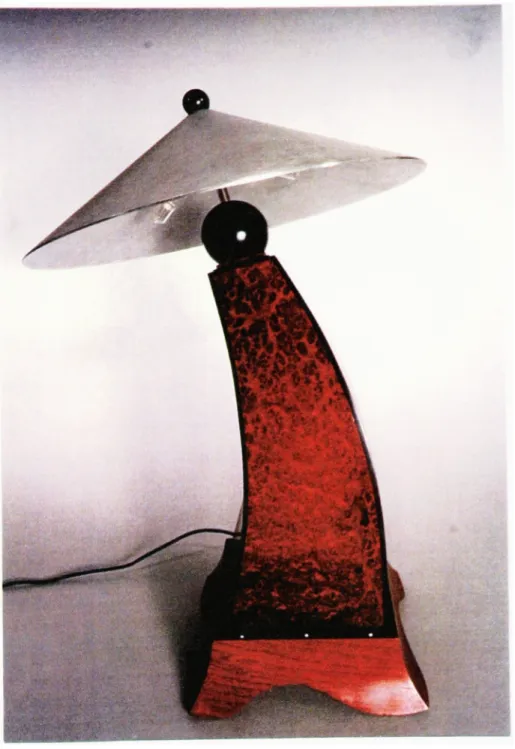
My
first
table
lamp
(figure 1
1)
wasthe
result ofthe design process,
whichbecame
the
overalltheme
for
the
series.This
lamp
uses gesture characteristicthat
blend
well withthe
musicselected.The
pieceis beautiful
to
look
at andfunctions
superbly.
Function
was a major concern ofmine,because
ofthe
heat
generatedby
cluster
head,
andthe distance from
the
top
ofthe ball
was a matter oftrial
and error.A
majorconcern
in
regardsto the type
oflighting
used was safety.This
questionchallenged me
through
outthe
building
process.I
solvedthis
issue
quiteeffectively
by
adding
adimmer
switch,
which also enhancedthe
aesthetics ofthe
design.
The
trade
off
in using halogen
wascertainly
a give andtake situation,
whilehalogen
lighting
produces
heat,
it
offersthe
best quality light
onthe
market.This
lamp
presented mewith an unexpectedgratification
in that the
angled cast shadow created a piecethat
wasdrastically
different
when viewedduring day
light hours.
This
was avery
nicesurprise,
because I had
no preconceptions ofhow the
lamp
wouldlook
at night.Initially,
the
first designs
ofthe
floor
lamp
werebasically
extruded versions ofthe
table lamp. This design
was a variationin form
and material, and containstwo
light
sources.
However
afterstudying
this
design I decided that I
was nottruly
utilizing
the
idea
ofimprovisation
asthoughtfully
asI
could.I
wentback to the
drawing
and cameup
with a
design
that
differed
drastically
from
the
first
sketches.The
first step
wasto
writedown
all ofthe
qualities ofthe
floor
lamp,
such asasymmetry, contrast,
heaviness,
onelight
source,
andimplied
gesture.The
floor
lamp
was animprovisation taken
from
the
table
lamp's
aesthetic qualities(figure 18-21).
These
werethe
qualitiesI
wantedto
keep
in
mind whendesigning
the floor lamp.
Improvisation
ofthe table
lamp
was muchlighter
in
appearance,
and containedtwo
light
sources.Details became important
to
the
design,
such as what
type
ofcord,
plug
andlight
sourceto
use atthe
bottom
ofthe
lamp? I
wasvisually responding
to
the
appliedlines
that
were onthe
original sketch ofthe table lamp.
The floor
lamp
started withthe
base,
whichwas a mitered and shapedto
appearthat
there
was a railcoming into
the
foot. After shaping
the
form,
the
surfacewas veneeredwith
curly
ash.Four slightly
curvedlaminations
grew out ofthe
base
with a piece ofsandblasted glass
running
between them
andconnecting
atthe top.
All
ofthe
into
a sphere.The
sphereholds
a piece of sandblasted glassthat
was slumped over aceramicmold.
Slumping
over a mold resultedin
glassthat
had very loose folds
that
were random
in its
appearance.The
non-controlled appearance ofthe
shadefit
perfectly
into this
lamp,
because the
body
ofthe
lamp
needed somefreedom. The
cordis
cleverly
hidden in
one ofthe
laminations,
giving
the
appearancethat the
central pieceof glass was
lighting
the
top
clusterhead.
Solving
the
lighting
issue
was again a matterof
trial
and error.The incandescent
andhalogen light
sourcesthat I
wasusing
in the
bottom
ofthe
lamp
created a concernfor
a potentialfire.
I
found
the
solutionby
using
aflorescent
bulb
that
was equivalentto
a40
wattincandescent,
yetonly burned
at1
1
watts.
This type
ofbulb lasts up
to
7 time
longer
than
anincandescent.
The
top
clusterhead is
comprised ofthree 1
00-watt halogens
that
wereon adimmer that
was wiredunderneath
the
base.
The
clusterhead
wasbrass
and patinaedbluish
greens with anormal
house hold
ammonia.The
middle section ofthe
lamp
originally had
four
laminations. These
consisted oftwo
excitedcurly
ashlaminations,
andtwo
beautifully
subtle
dyed
costellolaminations.
As
the
lamp
came closerto completion,
I
re-analyzedthe
laminations
anddecided
to
eliminatethe
light
energeticlaminations.
I did
this
eventhough
I felt it diverged slightly from
the
music.The
end result was alamp
that
was76
inches in
height,
and19
inches
wide.The
shade was switchedfrom
the traditional
downward
shadein
the
initial drawings
to
atorch
stylelamp.
Work
onthis
floor
lamp
wasboth challenging
andtime
consuming.The light
functions
magnificently,
andthe
materials compliment each other.The
amountoftime
that
this
piece required was not costeffective.4
The
result ofthe
design
andimprovisation
processresultedin
two
very
different
lamps
that
compliment each otherin
an unusual manner.
The
table
lamp
is
asymmetrical,gestural, exciting,
heavily
proportioned,
dark toned
materialsthat
arein
contrast withthe brilliant
aluminum, andvery free in its design. In
stark contrastthe
floor
lamp
wasvery
controlled.The
slenderfloor
lamp
seemedto
be
more subduedthan
the table lamp.
This
piece wasvery light in
materials,
design,
proportion,
and utilizesthe
idea
of contrastdifferently.
In the
processof
creating
these lamps
I
learned
newtechniques
anddeveloped different
design
The final
progression movedto
a selectionfrom
the
1 950's
entitledMoanin',
performed
by
Art Blakey. This
style ofjazz is
calledbop
orbe-bop,
andis
the
nextjazz
style
that
developed
after swing.I feel that
be-bop
wasthe
logical
progressionin
this
musicalgenre.
Although
there
are numerous styles ofjazz,
be-bop
reflected similarstylistic qualities as
Dixieland
leading
to
alogical
progression and conclusion.Included
in
the
similaritiesis
the
use ofimprovisation
and counter-melodiclines
to
develop
my
next piece.
Be-bop
is
consideredto
be
afinal intensification
ofswing
through
improvements
in improvisation.
(Oliver,
293)
cWhat
Bop
in
general,
andParker
especially
did
wasto
increase
the
expressivecharge of
jazz improvisation:
they
used more chromaticand convoluted melodiclines in
whichthe
more complex organization of pitch and rhythmimplied
agreater number and
variety
ofpassing
harmonies....
explicit polyrhythms wereimportant
,arising
between the
soloist anddrummer through
a constantjuggling
of
shifting
accentswithin small note values(Oliver,
294).
dThe
Be-Bop
styleis particularly difficult
to
understand, and atthe time I
washaving
aparticularly difficult
time
translating
the
musicinto furniture forms. As
a resultI
set ameeting
withJohn Beck.
I
explainedhow
arrived atthe final design.
In addition,
Mr.
Beck
played sections ofthe tune
in
orderto
help
me comprehendthe
music.This
allowed me
to
explorethe
elements more clearly.Moanin'
was a unique combination of
swing
andbe-bop. The hall table
wasthe
last
pieceto
completethe
body
ofwork.The design
was adirect
result ofthe
Art
Blakey
quartets unique
ability
to
float between
the
main melodies andheavy
use ofimprovisation.
I
envisionedthe
slightsweep
ofthe
legs
andfoot treatment to
representthe
rhythmthat
is
the underlying
structure ofthe tune.
The
rhythmleads up
to the
melody
andimprovisation that
occursin
a symbiotic affair.The
curved red woodburl
top
consisted of
two
piecesthat
weresplit and profiledto
opposethe
heavy
improvisation
in
the
selection.Listen to
Moanin'
The
end result ofthe table
wasa success.By
building
this
piece, a numberofissues that I believed
in
were reinforced.First,
the issue
oftime
wassuccessfully
resolved since all of
the
previous piecestook too
long
to
complete.Time consuming
details
wereminimized,
and as a resultthe
hall
table
wasbuilt
in
aweek.The
vastimprovement
ofmy
technical
ability
to
produce a piece offurniture
with equaldesign
CONCLUSION
I feel
that
this
body
of workis
aprototype,
andtesting
groundfor future
designs.5
If there had been
a concretebasis
and experienceto
use as asource, the
resultsmay
have been different. The
question mustbe
askedhow
much ofmy designs
truly
utilizedthe
musical source.This issue
challenged methroughout the
year, andI
couldonly
respond
to the
questionby
experiencing
the
processitself.
The
resultsin
completing
this
body
of workhave successfully
addressedthis
question.I
believe
that
the design
challenge of
using
music as aninspiration for
designing
furniture
wasfruitful.
The design
processthat began
withthe
sofa and endedwiththe
hall
table
improved
drastically
throughout
each piece.One
improvement that
wasvery
evident wasthe
ability
to
make smoothertransitions in the design.
In
thebeginning
I
was a slowerbuilder,
and a strongerdesigner,
but
nowI
feel
that
my
technical
skillshave
improved
greatly.
The only way
to
become
a more efficientbuilder
is
to
createmany different
pieces
in
a settime
frame. This is
the
reasonwhy I
wantto
be
employedby
someonewho produces a
large
volume ofwork, withhigh
quality
standards.This
experience willfurther
help
meto
develop
correct proceduresin
gaining entry into
the
right market aswell as
allowing
meto
retain,
andimprove
onthe
skillslearned.
Mr. Beck
asked meif I
could accommodate anindividual
who was notin
ahigh
tax
bracket
individual?
This
presentedthe
question couldI do
this,
andhow
wouldI do
it? I feel that
the
answerlies in
the
building
experience andgearing
one selftowards
aproduction mode
that
addresses material,time,
andthe
consumer.It is my belief that
if
a person's workcontains
strong formal
qualities,it
shouldbe
ableto
retainits
aesthetic5Furniture
making has
notbeen
formally
acceptedby
the
visual artsin
general.This
conceptis
relatively
new andis just
beginning
to
be
recognizedfor its
artisticqualities
in
more cost-effective materials.The
key
is
to balance
design,
building
time,
and cost of material.
I
am proud ofthe consistency
andquality
exhibitedin
my
thesisbody
ofwork, whichis
a result of amaturing
processthat began in
my
second yearin
l^BHBBOS^0
^^^^ W?'
^H
feH_H
^HlF|
11 V11 1
in
ill
III
^HIIII
^H :. . '1
H
, ;|
. . . . wl^^wl^^Kf^^B^SSKlE^i1
H 1
. : .. 1 . . " . H '
^B ^1
.H 1
. 1 ^1 H V : ...
|
l
'' ' ' . '
^K^I^ra^ffl^^Sl^^^
l
1
^^fcO
H
. . ;-:, . . I1 .
w
.: V.
^ar;K. ToaJPeE .:.
";.'' ;'. ' ' ... "' VT^J^H . .
H
>^H
1':' ' . . ^^H Vh " '; . :
^1 ~..-. . . ..'. :. ..
:
^^^HBnnniffii
. . . '.:''".
' '
End Notes
A.
.Ball,
Timothy.
MusicalStructure
andStyle.
, page48
B.
Oliver,
Paul. The New
Groove
Gospel,
Blues
andJazz.
, pages4-6,
C.
Oliver,
Paul. The New
Groove
Gospel,
Blues
andJazz.
, page293.BIBLIOGRAPHY
Ball,
Thomas
A., 1995,
Musical
Structure
andStvle.
New York:
Oxford
University
Press.
Collier,
James
Lincoln,
1983,
Louis
Armstrong,
andAmerican Genius.
New York:
Oxford
University
Press.
,
1989,
Benny
Goodman
andthe
Swing
Era.
New
York:
Oxford
University
Press.
Connor, Russell,
D. 1996.
Benny
Goodman: Wrappin Up.
Lanham,
MD: The
Scarecrow
Press
Giddens, Gary, 1998,
Visions
ofjazz,
the
first
century.New
York;
Oxford
University
Press.
Gleason,
Ralph
J.,
1995.
Celebrating
the
Duke,
andLouis, Bessie, Billie, Bird, Carmen,
Miles, Dizzy
and otherHeroes.
New York: Da Capo Press.
Gottlieb,
Robert.
1996, Reading Jazz,
A
gatheringofautobiography, rep.New York:
Pantheon
Books.
Oliver,
Paul.
1986, The
New
Groove.
Gospel,
Blues
andJazz.
New York: