European
Policy
Studies
CEPS Working Document
No. 227/August 2005
Integrated Border Management
at the EU Level
Dr Peter Hobbing
Abstract
Thinking ahead for Europe
In times marked by trends as diverse as economic globalisation, international migration as well as fear of terrorism and organised crime, the efficient handling of borders has become an issue of political priority, in the EU and across the world. Modern, economy-oriented states have to rely on a flourishing trade and offer a comfortable degree of security to their citizens. The formula commonly chosen in combining these two objectives is that of ‘integrated border management’, which represents the delicate attempt to marry security concerns with trade facilitation.
If the implementation of this innovative approach is already proving to be a challenge to well-established nation states, it becomes a genuine balancing act for an incomplete federation such as the EU, with its sensitive mix of a single external border and 25 separate legal/administrative systems. This working paper seeks to illustrate the difficulties encountered by the EU and develop solutions that should firmly go into the direction of a coherent, communitarian approach in border management, such as that sketched out by the recent Council Regulation No. 2007/2004 establishing the European Border Agency (FRONTEX).
Peter Hobbing is an Associate Research Fellow at CEPS. His professional background at the European Commission has included relevant positions in the DGs responsible for trade control (TAXUD) and security (JAI/JLS); he also gathered operational experience in border matters as an officer of the German border security services. This paper was prepared for the Challenge (Changing Landscape of Liberty and Security) Conference on Implementing the Hague Programme: Operational and Legislative Functions on Justice and Home Affairs, Brussels, 30 June and 1 July 2005.
CEPS Working Documents are published to give an indication of the work within various research programmes at CEPS and to diffuse relevant works from external experts in these fields. Unless otherwise indicated, the views expressed are attributable only to the author in a personal capacity and not to any institution with which he is associated.
ISBN 92-9079-586-4
1. External borders: The ‘skin’ of the Union... 1
2. A border concept appropriate to the EU... 2
2.1 IBM concepts outside the EU... 2
2.1.1 EU enlargement and new neighbours... 2
2.1.2 North America... 3
2.1.3 The customs approach ... 5
2.2 The complex elements of an EU approach... 7
2.2.1 A chequered legal landscape... ... 7
2.2.2 …and the adverse effects of key decisions from the past ... 9
3. Integrated border management ‘EU-style’: Current tools and their deficiencies... 10
3.1 The original set of Schengen instruments from 1985-90... 10
3.2 From Amsterdam to Laeken... 12
3.2.1 Border-related measures (phase 2): The concept of burden-sharing... 12
3.2.2 Internal measures (phase 2): Joint centres and other alternatives to border checks... 15
3.2.3 Measures at the international level and on technical infrastructure... 17
4. Current initiatives in light of The Hague Programme... 18
4.1 European Border Agency... 18
4.2 Proposal for a European border code... 20
4.3 Proposal for a regime of local border traffic... 20
4.4 Statements in The Hague Programme on border management... 20
5. Conclusion... 22
| 1
I
NTEGRATED BORDER MANAGEMENT
AT THE
EU
L
EVEL
CEPS
W
ORKING
D
OCUMENT
N
O
.
227/A
UGUST
2005
P
ETER
H
OBBING
1.
External borders: The ‘skin’ of the Union
External borders and their crucial role for the smooth working of the Single Market, the Area of Freedom, Justice and Security and other basic objectives of the Union have long been recognised. ‘Union’ and (common) ‘border’ have formed an inseparable pair of notions since the early days of the common market and the EEC customs union in the 1960s. Of course, one has always discussed the degree to which borders were operated well but their raison d’être as such was hardly ever challenged, almost as little as the importance of skin to the well-being of the human body.
It took a little longer, however, before the act of handling such borders (jointly or not) had moved on as a separate issue into the spotlight of public attention. This occurred when people became aware of the daily realities of ‘Schengenland’, e.g. that ‘their own’ borders with the neighbours had disappeared, and that it was not ‘their’ police any more who were in charge of the new common borderline, far away from home. Discussions sprang up, inside the territory, as to whether ‘these foreigners on the border’ would do a good job in keeping the border tight, or create loopholes that allowed organised crime and illicit migration to penetrate all the way through the Union. Right on the border, discussions went in the opposite direction: ‘Why is it just us who bear all the responsibility and the financial burden?’ Weak links in the border chain, the need for burden-sharing and solidarity soon became the keywords and phrases of an EU-wide debate.
It was the merit of the Laeken European Council of December 2001 to have sensed these tensions and initiated a discussion on a new topic called ‘integrated border management’, which would take into account the interests of those both on the border and far away from it. Although the identification of the problem did not lead to immediate solutions, the debate was well received and it has stayed in the headlines ever since.
It is therefore no surprise that The Hague Programme touches this popular subject; if there was anything surprising about the programme, it would be its assumption that there was something like ‘the integrated management system for external borders’ (European Council, 2004, item 1.7.),1 which existed as a pre-defined concept and has been just waiting for instalment. In reality, integrated border management2 is a term with a rather short history and a wide spectrum of meanings – certainly not a good starting point for a precise programme (Box 1). There is not one ‘run-of-the-mill’ approach for all situations; solutions must be tailor-made in accordance within the economic and political context.
1
This is contrary to the EU Constitutional Treaty of December 2004 (OJ C 310 of 16.12.2004), whose Art. III-265 mentions the introduction of an integrated system.
2
Box 1. Brief history of the term ‘integrated border management’
IBM, now definitively en vogue, seemed entirely unknown until the mid-1990s. Currently it provides the keyword for innumerable reform projects around the world and appears on government websites from Azerbaijan to Zambia.* The various contents being as heterogeneous as the regions involved, there is at least the common understanding that IBM relates to ‘lean government’ approaches and that border procedures should be governed by modern economic strategies rather than slow bureaucratic structures. The concept needed for the EU borders is naturally different from that appropriate for the North American NAFTA countries or even from that proposed by the EU for new neighbours in the east.
* See for example Zambia (http://www.sars.gov.za/siyakha/about_transformation.htm).
The purpose of this paper is to provide greater clarity with regard to determining 1) what one should understand by ‘the’ system of IBM tailor-made for the EU, and 2) to what extent The Hague programme appears helpful in implementing this objective.
2.
A border concept appropriate to the EU
A tour d’horizon of IBM concepts applied elsewhere shows to what extent these are adapted to the specific needs of their situation, before looking at the EU, whose specific territorial situation with a fragmented borderline and patchwork structure of legal systems requires a particularly complex solution.
2.1 IBM concepts outside the EU
In contrast with the EU, IBM elsewhere has mainly to do with greater efficiency in border-related cooperation at the nation-state level.
This is particularly true for the former communist countries in Eastern Europe with a tradition of hermetically tight borders that served for defence purposes, but had no major role to fulfil with regard to the movement of persons and goods. Within the same region, one also finds the opposite challenge of merely administrative demarcation lines between former Soviet or Yugoslavian republics, which now have to be upgraded to international borders.
In other parts of the world such as the North American continent, IBM is mainly seen as a strategy to pool the resources of the various government branches in a border-related assignment, whereby this increasingly implies the involvement of private operators and citizens (the ‘border community’). Cross-border ventures between border agencies of two countries are also undertaken.
2.1.1 EU enlargement and new neighbours
For the newly independent states in Eastern Europe and the Balkans, there has been a direct link between border management and the setting-up of a market-oriented economy combined with democratic institution-building.
During the first phase of PHARE and TACIS programme assistance, considerable attention was paid to the development of efficient border structures, mainly under the auspices of the customs and transport regulation.3 The objective, then still traditionally phrased as “improving the
3
effectiveness of border controls”, soon switched to the more business and trade-oriented language of “effective border management” (1997) and finally “integrated border management strategy” (European Commission, 1999).
IBM as it has emerged as a joint concept from the PHARE, TACIS and CARDS assistance programmes came to comprise the following basic elements:
• comprehensive tackling of the interrelated problems of trade, transport, insecurity, criminal smuggling and, where necessary, the development problems of the border regions themselves;
• strict requirements for the numerous authorities and agencies (especially border control and customs, but also transport, health, veterinary services etc.) to cooperate on common problems, rather than working separately and often at cross purposes; and
• strong encouragement for neighbouring countries to cooperate in managing shared borders (European Commission, 2002a).
These basic principles further include the understanding that the various administrative branches upgrade their internal organisations by establishing smooth cooperation between their central and local levels, between border crossings and the green/blue border, and by setting-up an efficient equipment, communication and database infrastructure. Another feature is the professionalism of services provided: the countries concerned are strongly advised to release the military from any functions in border control, all the more where this is done with the involvement of poorly-trained conscript soldiers. Border controls should be ‘Schengen-compatible’ in the sense that they conform to the Schengen Catalogue on external borders control (Council, 2002).
This four-fold concept of IBM – in the sense of (i) a comprehensive approach to border problems across (ii) administrative and (iii) national dividing lines under the management of (iv) dedicated professional skills – today serves as an uncontested international standard. It is widely referred to by international organisations such as NATO (2003), the OSCE (2003), the Centre for the Democratic Control of Armed Forces (DCAF, 2004)4 and in the Stability Pact (2003), and the not only in the Balkans but also for use in other regions (the Caucasus and Central Asia) (NATO, 2004).
The EU CARDS formula, although a strikingly concise and reliable guideline in many respects, is missing one important feature for success, which is cooperation with the private sector, especially in the transport sector. Not only can due involvement of citizens and economic operators help to further streamline border-related procedures, insider tip-offs are also a valuable information source for the detection of illicit trafficking of all kinds (WCO, 1999).
2.1.2 North America
North American borders face completely different problems, such as established demarcation lines for centuries and the fact that the US-Canadian (8,895 km) and US-Mexican (3,141 km) borders have particularly experienced a dramatic increase in cross-border movements of both persons and goods during the past 40 years. These factors result in a different approach (Box 2).
4
Box 2. Comparison of the NAFTA and EU approaches to borders
Unlike the European Union, there has been no radical change in NAFTA clearance procedures: owing to its design as a (mere) free trade area, NAFTA could not altogether renounce internal border checks as does a customs and passport union such as the EU. Checks at the EU external borders are valid for the entire customs/passport territory as they are based on common rules for the crossing of the border (including joint lists of countries subject to a visa requirement or exempt from it)* as well as a common customs tariff (European Commission, 2005). Free trade areas grant preferential treatment to goods** originating in the territory of other partners but they maintain the general requirement of controlling all cross-border movements (i.e. to establish whether the goods in question originate in a member country of the free trade area (FTA)). Furthermore, FTAs as commodity and service-oriented ventures have had, from their very outset, no impact on immigration requirements. So far, NAFTA has no intentions of introducing any basic changes to this situation.***
* See section 3.1.1 below.
** Art. 102 (1) NAFTA Agreement of 1992 (retrieved from http:// www.nafta-sec-alena.org/ DefaultSite/index_e.aspx?DetailID=80).
*** General visa requirements for citizens from other NAFTA countries remain valid. As a special facilitation, there is now, in the US, a TN Visa for Canadian and Mexican Professionals, allowing the latter to engage in “business activities at a professional level” (see http://www.usimmigrationsupport.org/visa_tn.html). Also, technical border arrangements allow for the speedier clearance of “pre-cleared travellers”. A task force on “The Future of North America” recommends, however, creating a “common North American security perimeter by 2010 with combined visa, visitor screening, cargo inspection and political asylum policies” (see http://www.washingtontechnology.com/news/1_1/security/25775-1.html).
In view of this situation, the primary objective of North American IBM initiatives has been to reduce the “long waits to cross the border” without sacrificing the “correct balance between facilitation and control” (Waller Meyers & Papademetriou, 2000). Between Canada and the US, the issue is pursued by means of the Smart Border Action Plan of December 2001 identifying 30 items of enhanced cooperation, notably through coordinated features of immigration and goods control (biometric standards, joint inspection systems, refugee/asylum processing, etc.) (ibid.). Integrated border and marine enforcement teams (IBETs) have been created to implement a harmonised approach to Canadian and US efforts in targeting cross-border criminal activity;5 grassroots border communities consisting of business associations and citizens groups have become involved in contributing to the streamlining of border procedures in order to reduce the “long waits”. A similar ‘smart border’ partnership6 is intended between the US and Mexico, however, with more emphasis on security than facilitation aspects.
In terms of IBM, the North American approach is marked by a broad involvement of all border-related government agencies as well as representatives of the civil society. This is combined, on the other side, with a rather traditional nation-state concept allowing for neither a general abolition of controls at borders with befriended nations nor the granting of any substantive cross-border powers to neighbouring enforcement services – thus representing an essential difference to the EU-Schengen situation.
5
IBETs include core agencies such as the Royal Canadian Mounted Police, Canada Customs and Revenue Agency, Citizenship and Immigration Canada, the US Customs Service, the US Border Patrol and the US Coast Guard (the latter now being in the US Homeland Security Department). Each of the IBETs along the border may include other core agencies such as the Ontario Provincial Police. See Customs Canada, Fact sheet “Canada-United States Integrated Border Enforcement Teams” (retrieved from http://www.cbsa-asfc.gc.ca/newsroom /factsheets/2002/sep/teams-e.pdf).
6
Despite excellent contacts in terms of intelligence-sharing, the NAFTA countries grant each other no rights for cross-border enforcement action: between Canada and the US, agreement exists that, during the hot pursuit of criminals, services would inform each other through a pre-established notification system, with the receiving side picking up the pursuit at the earliest possible opportunity. But as one US Homeland Security official puts it: “We never cross ourselves into Canada [for enforcement activities] and never ever into Mexico”.
In terms of a future vision of border management, more hope seems to be based on technological devices rather than on trust between the neighbours: the smart border of the future will rely heavily on pre-arrival screening of passengers and goods as well as advanced technology to track the movement of cargo and the entry and exit of individuals.
Whereas in many EU member states, the border control staff has been drastically cut down, sometimes close to zero(!),7 there is a continuous upward trend in the US: after the sharp staff increases following the 9/11 events,8 the Homeland Security Department continues to tackle border problems by recruiting large numbers of additional border inspectors. “In 2006, [the] Department of Homeland Security would have 8,500 more employees than it had in 2004. Many of those jobs would go for more Customs and Border Protection officers, Border Patrol agents and TSA screeners.” (See Barr, 2005).
2.1.3 The customs approach
EU customs – as a trade and economy-oriented administration – has always been two steps ahead of police and border guards in streamlining European borders and the procedures related to their crossing (Hobbing, 2003), with many of the measures being labelled as ‘service to the border-client’ (Box 3).
Box 3. Development of a common EU customs administration
The joint EU customs territory (‘customs land’) with a common external tariff was already completed by 1 July 1968, as opposed to Schengenland whose nucleus saw the light of day not before 1995. Customs administrations very early operated joint (juxtaposed) border installations (early 1960s), a Community-wide mechanism for fraud-combating (Naples Convention of 1967) and customer-oriented programmes stipulating a business-enhancement role of customs. Further, they concluded Memoranda of Understanding (MoU) with the transport community (since the 1980s) and engaged in joint vocational training of customs officials (Matthaeus programme of 1991).*
* Council Decision of 20 June 1991, Official Journal L 187, 13.07.1991, p. 41
It is no surprise, that the term ‘IBM’, when used in a customs context, is primarily understood as a reference to trade facilitation projects, the most prominent of which are the WCO/UN-ECE Single Window Approach (a single-border declaration for all administrative purposes) (United
7
Owing to the Schengen Agreements, Belgium, Denmark, Luxembourg, the Netherlands, Portugal, Spain and Sweden have no external land border to control any more; France, Germany, Italy and others are to follow in 2007, leaving the control task to the eastern members Finland, Poland and Hungary. For details see Box 4 below.
8
Nations, 2003), the Time Release Study (comparative testing of the speed performance of customs and their efficiency in clearing goods) (WCO, 2002) and the WCO Data Model (management of cross-border trade by means of an interconnected electronic environment).9 Beyond this, there are other approaches – still business based – but in the clear perspective of rendering the fight against fraud more effective, in particular the trafficking of drugs and other illicit commodities: the WCO Action/Defis, recently renamed the WCO Business Partnership,10 incorporates a number of MoU initiatives formerly established to take advantage of field expertise in detecting irregular practices employed by competitors.
Only after the 9/11 events did customs come to associate itself with the IBM concept predominating in the police world, i.e. to define it primarily as inter-agency cooperation at the national and/or international level (WCO, 2004). At the EU level, there is specifically the attempt “to find solutions that can marry security concerns and trade facilitation” (European Commission, 2003). In its 2003 Communication on a simple and paperless environment for customs and trade, the Commission develops a concept that on the one hand provides traders with equal electronic access to border procedures throughout the Union and on the other allows it to perform, on the basis of the comprehensive trade data obtained, a large-scale analysis of specific crime risks. On top of this, a second Communication, transmitted to the Council and Parliament under the same cover, directly addresses “the role of customs in the integrated management of external borders” (ibid., p. 35), expressly underlining its complementary character in relation to the police/Schengen IBM Communication of the previous year:
Both Communications are complementary and constitute the first stages in the overall strategy that the Commission is proposing for integrated and effective management of external borders, the aim being to achieve a coherent framework for joint action at EU level.
In the security-related context of the 2003 Communication, customs IBM is based on the following features:
• uniform protection of the external border – member states must ensure that the principal security risks are addressed in a timely and harmonised manner at each point on the external (customs) border;
• border responsibility is to be sharedby all agencies involved, with customs having the lead responsibility in “all matters relating to the control of legally and illegally traded goods”;
• the set-up of a multi-disciplinary authority responsible for safety at external borders – this is originally referred to the Common External Border Practitioners Unit and is now to be understood as a reference to the new European Agency for the Management of Operational Cooperation at the External Borders (EBA);
• the establishment of effective and rapid systems for information transmission between all the agencies involved, including reference to the PROSECUR procedure, proposed by the police/Schengen Communication (European Commission, 2002); and
• the possible set-up of rapid response teams to deal with unexpected risks, including creation of a‘European reserve unit’.
9
For further information, see www.wcoomd.org/ie/En/Topics_Issues/FacilitationCustomsProcedures/ DataModelBackground.html.
10
Customs has thus established a seamless link with the Schengen border approach; but it should be recalled that this is just one of the two customs legs and that the distinct trade-facilitation approach remains equally valid. The second difference is that customs does not have to worry about the diversity in legal matters, which plays such an important role in the Schengen context. There is established European customs legislation in contrast to the 25 different legal orders existing for the administration of Schengen.
2.2 The complex elements of an EU approach
After the rather concise description of national IBM systems elsewhere in the world or within the closed circuit of customs administrations, one may be surprised as to how complex a system is necessary to run the complicated EU external border.
Not that the EU land border is any greater than that, for example, of the US: on the contrary, the border is currently much shorter (7,169 km vs. 12,034 km). It will catch up with the US only after all the current candidates including Bulgaria, Romania and Turkey have been accepted into Schengenland.11 Finally, the geographical profile is certainly not more demanding than that of the Western Balkan countries.
Most of the complication is caused by the unfinished status of the EU as neither a nation state nor a full-size federation. The border thus resembles a scattered line surrounding a colourful patchwork of separate territories. The so-called ‘EU border’ is subdivided into a number of loosely connected national segments, each of them attended to by separate services. As a consequence, EU-specific IBM needs to take care – beyond the normal challenges – of the reconciliation between the many bits and pieces found on the chequered Union map. Unlike the US, there is nothing such as a coherent EU territory characterised by a single legal system and protected by a single border service performing its duty from coast to coast.
2.2.1 A chequered legal landscape...
At this stage, the EU consists of 25 separate legal systems, 13 of which are found (together with those of Norway and Iceland) within the territory of Schengenland. Border management is performed by 15 distinct national services, each exclusively responsible for one special section of it. But, following the gradual abolition of internal border controls, the respective shares of the border have become increasingly unbalanced (Box 4).
EU border management is not confined to the simple checking of passports and the prevention of illicit movements across the green border. The requirements are more complex. As border staff are bound to carry out their assignments in taking account of the “interests of all parties” (Art. 6, Schengen, 1990), and in particular, refuse entry to foreigners “representing a threat to public policy, national security or international relations of any” Schengen member, they must possess a considerable knowledge of the political/legal situation in other countries as well as the appropriate language skills.
11
Box 4. The balance of border management responsibilities
In the beginning, things were rather balanced and just: each state would bear the burden of its border. With the opening of internal borders, more and more countries were relieved from control tasks on the land borders and the remaining ones bore an increasingly unequal share. In the early Schengen days of 1995, the heavy weights France and Germany still managed about 98%, by 2003 their share had shrunk to 42% and with the gradual accession of the Eastern neighbours, it was further reduced to 20% (and with the likely accession of Switzerland this will decrease to 0!). Together with Norway, Finland and Greece, the main burden is shifting to the shoulders of the newcomers such as the Baltic countries, Poland, Slovakia, Hungary and Slovenia, and later also to Bulgaria and Hungary (see Hobbing, 2003, p. 6).
Border management implies considerable financial spending, especially if done on behalf of the entire Schengen group. For example, Poland assumes the need to recruit 4,000 additional border staff in order cope with the new challenge. There is furthermore the need to upgrade border-crossing installations, surveillance equipment on the green border, linguistic and other special training for control staff, etc. Some assistance is provided by the so-called ‘Schengen facility’, a head-start funding programme providing the newcomers with approximately €963 million (€280 million thereof for Poland) over the period 2004-06 to improve infrastructures at frontiers, staff training, etc.12 But expenses are a continuing matter that require solutions beyond 2006: for this reason, it is a longstanding objective pursued by the Commission (European Commission, 2003, para. 46), that the external border has to be managed in explicit solidarity among the member states.
Nevertheless, burden-sharing represents an extremely delicate issue given that solidarity is understood by the ‘old’ member states (France, Germany, Italy, Spain and the UK) as a two-way concept, foreseeing financial burden-sharing in return for Union involvement in the operational management of the border, in particular in terms of the possible creation of a European border police.13 As the German Minister of the Interior Otto Schily put it, the member states concerned should pay for their own border expenses, if they reject any operational involvement by the others (Kubosova, 2005). The Eastern members in turn vehemently oppose the operational involvement and all the more the “more radical ideas of pan-European border police forces”.14 Definitely not a promising prospect for the new European Border Agency that took office just a few weeks ago!
12
Concerning the individual funding amounts for the Schengen facility, see the discussion in section 3.2.2 below.
13
The G5 Declaration of 12 May 2005 states, “5. The European Border Agency must above all be an operational tool that enables in particular the initiation of intensified joint operations at the EU’s external borders. Risk analysis must drive the Agency’s activities to provide a clear basis for the implementation and evaluation of the joint operations. We undertake to assign to the Agency on detached duty suitable personnel to support or assist its proper functioning. We are studying the idea of a‘European Border Intervention Police Force’ which would allow deployment, in times of crisis, of specialized national pre-identified resources in our countries so as to intervene on the European external border.” (Retrieved from http://www.ambafrance-us.org/news/statmnts/2005/europe_shengen051205.asp).
14
2.2.2 …and the adverse effects of key decisions from the past
In light of these difficulties, it is an entirely legitimate question to ask whether this complicated situation could not have been avoided right from the beginning, by ‘tidying up’ the European landscape and creating a single European legal system combined with a single public service.
From a utilitarian point of view, such a scenario might have come in quite handy; it would, however, not have corresponded with the historic visions of the time. The founding fathers of the EU did not envisage European integration by the merging of legal systems – not even their harmonisation or approximation was part of the plan. European unification was intended to occur by economic factors, i.e. the pooling of coal and steel industries of the former enemies in order to prevent future wars.15
Justice and home affairs remained a stepchild of European integration for other reasons as well: public opinion would easily accept the transfer of sovereignty rights in the economic field, but not so in judicial and law enforcement matters, which are widely considered as areas close to the heart of a nation. Every state has insisted on keeping its own criminal law system while most citizens felt (and still feel) some unease towards the idea of being tried by a judge from other than their own nation. Also, there was no strong lobbying group that would have pushed for the abolition of law enforcement borders as business and trade had done since the 1950s regarding the free movement of goods and services.
When the opening of internal borders became definitive in the 1980s with the granting of the ‘four freedoms’, including the free movement of persons, police and criminal justice agencies – entirely surprised by the events – feverishly started to think about ‘compensatory measures’ that could confine the risk of criminals abusing open borders. Up to that moment, European police and judicial services had been operating far apart from each other, almost as distantly as with countries overseas; possible assistance requests were handled through complicated and highly inefficient diplomatic channels.
Despite considerable progress made during the 1990s with justice and home affairs becoming the third pillar of the EU, prospects have remained limited, i.e. a genuine alignment of systems was never envisaged. The Tampere European Council of October 1999 clearly downsized all expectations: instead of any full harmonisation, which had proved futile even on certain secondary battlefields of economic legislation,16 there could just be mutual recognition of diverging criminal justice systems (European Council, 1999).
To a still lesser degree, few prospects would materialise for any sort of European public service at the operational level: even in traditional first pillar areas such as customs, it was never seriously considered to enforce Community legislation by means of a European customs guard. Besides practical considerations, there is the subsidiarity argument of Arts. 5 and 10 TEC, which leaves it in principle to the member states to ensure the implementation of Community policies (Pappas, 1992).
15
See the Schuman Declaration of 9 May 1950 (retrieved from www.historiasiglo20.org/europe/ anteceden2.htm).
16
3.
Integrated border management ‘EU-style’: Current tools and their
deficiencies
IBM rules cannot easily be located within just one framework; they are spread across a number of legal and administrative instruments. They represent a multi-layered compilation of provisions, with only the basic ones found in formal legal texts such as the Treaty on the European Community or the Schengen instruments of 1985-90, while much of the rest has been adopted through informal arrangements, e.g. the Common Manual on external borders adopted by the Schengen Executive Committee (Council of the European Union, 2002a) and the Catalogue of Best Practices drawn up by the Working Party on Schengen Evaluation.17 Further elements that make the IBM mechanism work practically are found in bilateral/multilateral arrangements among individual member states or between them and third countries.
This situation is rather characteristic of the unsecured terrain on which the European Area of Freedom, Security and Justice had to be built. Owing to the reticence of the political level to endow justice and home affairs with formal legal tools, practitioners took refuge in ‘practical’ solutions in order to cope with the day-to-day real world problems they were faced with after the abolition of the internal borders. A good part of the scepticism of civil liberties groups (Peers, 2005) is founded on the democratic deficit of an important share of the Schengen acquis.
Another dimension of the IBM mechanism should be noted: not all measures from the Schengen tool set are directly border-related – some of them concern the internal territory but are still crucial to enhancing border efficiency.18 Both types were already contained in the original instruments of 1985-90 but have developed decisively since.
3.1 The original set of Schengen instruments from 1985-90
During the early Schengen phase of the 1990s, the specific border-related mechanisms had to be based on a very small number of instructions from the original instruments themselves (so-called ‘common uniform principles’).
Art. 6 of the 1990 Convention19 is widely considered the centre piece of the Schengen system (Niemenkari, 2002 and Council, 2002). Border checks must be a) systematic (“All persons shall undergo at least one such check”); b) equivalent all along the border (“An equal degree of control shall be exercised at external borders”); and c) take account of the interests of all Schengen parties (“taking account of the interests of all Contracting Parties”). The further rules contained within may be seen as aimed at implementation of these basic principles.
The Convention, still in its external borders chapter,20 stipulates important details for the crossing of borders in terms of formal requirements (only at determined crossings and at fixed opening hours, Art. 3) and material ones (“not be considered to be a threat to public policy, national security or the international relations of any of the Contracting Parties”, Art. 5). Another cornerstone of the early IBM system is found in the visa chapter, with its uniform set of visa rules for short-term visits not exceeding three months (Art. 10). There are ancillary
17
The text is expressly labelled as “explanatory and having no legally binding status”; see Catalogue of Best Practices on External Borders Control, Removal and Readmission: Recommendations and Best Practices of February 2002 (retrieved from http://ue.eu.int/uedocs/cmsUpload/catalogue20EN.pdf).
18
The Schengen catalogue even mentions “four tiers” of the border model: activities in third countries, international border cooperation, measures at external borders – border management (border checks and border surveillance) (ibid., part 1, Introduction).
19
Hereafter this is abbreviated as ‘SCH90’ for the sake of convenience.
20
provisions with a border impact such as the liability of carriers (Art. 26), liability of those providing assistance to unlawful immigration (Art. 27) and – of a highly practical importance – the Schengen Information System (SIS), to which authorities responsible for border checks and issuing visas are expressly entitled to access (Art. 101).
These relatively few provisions were insufficient, however, to thoroughly shape Schengen-wide border management in view of obtaining a “uniform and high level of external border control” (Council, 2004b). The other elements needed were created outside the narrow context of the conventions, e.g. the joint list of countries whose nationals were subject to visa requirements21 and the uniform format for visas22 established as part of the Single Market legislation.
The most pressing need occurred in the practical field, as national services – once the Schengen ‘laboratory’ had started its operation with just seven member states participating on 26 March 1995 – were incapable of implementing rules and practices in a uniform way (Callovi, 2004). Additional guidance was thus provided in a more informal way through the Common Manual (Council, 2002a) adopted as an ad hoc emergency measure, established and regularly adjusted by the Schengen Executive Committee. The manual was largely confidential and not made public before its declassification in 2002.23 In its current version, it contains 239 pages of practical instructions and numerous specimens of travel documents and visas.
Among the measures available inside the Schengen territory, the highest importance is generally attributed to those that allow member states’ enforcement services to act at or even across the internal border lines where routine controls have been abolished. This is seen as a compensatory measure in cases where the controls at the external border may prove insufficient to filter out instances of illegal immigration; in addition, they are considered as a defence against the infiltration of criminals originating in other parts of Schengenland.
The most cited mechanism is the safeguard provision of Art. 2(2) SCH90, whereby member states may reintroduce controls at the internal borders “where public policy or national security so require[s]”, often considered an ‘emergency brake’ of a primarily psychological value allowing hesitant parties to accept the abolition of controls that would otherwise have been rejected (Callovi, 2004). On the other hand, Art. 2(2) is often seen as the main tool for repressive governments to undermine the principle of free movement in favour of a “predominance of the security rationale” (Apap & Carrera, 2003).
It seems, however, that the practical importance of this provision is largely overestimated, as the temporary reintroduction of controls occurs rather rarely, while enforcement services have in the meantime established more refined and less cumbersome ways to counter illicit movements.24 (See Box 5.)
Another pillar of the compensatory framework consisted of the provisions on police cooperation (Art. 39, SCH90). This mechanism was considered very advanced at the time of its creation, notably by allowing cross-border enforcement operations (surveillance of presumed criminals (Art. 40) and hot pursuit (Art. 41)), direct communication between local services (Art. 46(2)) and exchange of liaison officers (Art. 47). It should be remembered that before Schengen, police
21
Council Regulation (EC) No. 2317/95 of 25 September 1995 determining the third countries whose nationals must be in possession of visas when crossing the external borders of the member states, based on Art. 100c TEC, OJ L 234, 3.10.1995, p. 1.
22
Council Regulation (EC) No. 1683/95 of 29 May 1995 laying down a uniform format for visas, OJ L 164, 14.7.1995, p. 1.
23
Council Decision 2002/535/EC, OJ L 123, 9.5.2002, p. 49.
24
as well as judicial cooperation in Europe would at the most cover the exchange of information (and similar basic forms of assistance) and be operated through diplomatic channels; its efficiency had accordingly been very low. Development showed, however, that even this ‘advanced’ Schengen state of play was quickly outdated.
Box 5. Application of the safeguard provision at internal borders
According to official statistics cited by Statewatch,* Art. 2(2) border checks have taken place, during the 2001-02 period on 172 days, i.e. 1) they occurred approximately every 13th day somewhere along the 13,736 km of internal borders and 2) the chances of encountering such checks on the internal border of a given member state would be just 1 in 82. In addition, one should recall that when reintroduced the checks often do not concern the entire national border line, but just sections of it.
Moreover, routine checks have proven – even long before the opening of the borders – a rather ineffectual tool in the fight against crime. In the densely populated areas of central Europe, there were so many ways to circumvent official border crossings via the green border and rural roads (Trees, 2000), that even among enforcement specialists the abolition of border controls was not considered a great loss for crime control.** This became particularly visible at the end of the 1970s, when prominent hostages taken by terrorist groups such as the German Rote Armee Fraktion (RAF) were ‘shipped’ across European borders several times in order to change hiding places as noted by Boock (2002). The author himself can confirm from his border guard experience on German borders with neighbouring countries in the 1980s (France, Switzerland, CSSR and East Germany) that only the highly militarised borders in the East (‘iron curtain’) provided relative impermeability.
* Statewatch European Monitor (Vol. 3, No. 4, February 2003), as cited by Apap & Carrera (2003), p. 6.
** This was the result of a series of meetings held at Interpol Paris/Lyon 1989-92 under the heading “The Planned Single Market and Crime Control in Europe”.
3.2 From Amsterdam to Laeken
During the first years of operation of the Schengen system, it had already become obvious that expectations were not met at the external border where the existing rules and resources turned out to be insufficient for ensuring coherent border management (European Commission, 2002, paras. 12-14). Nor were they met inside the territory where even the advanced police powers of the Schengen Convention considerably lagged behind the freedom of movement granted to citizens (including criminals) through the Single Market. Politicians and practitioners thought about remedies that were first of all found at the bilateral level and later on encouraged by the EU.
A great step forward was made by the Amsterdam Treaty of 1997 – whose Art. 62 foresaw Community competence for the crossing of external borders, rules on visas, etc. – and the integration of the Schengen acquis into the EU legal framework on 1 May 1999.
Yet in terms of IBM, progress was equally shared by the EU and member states working at the bilateral level, as regards both border-related and internal measures.
3.2.1 Border-related measures (phase 2): The concept of burden-sharing
coordinated way; and 3) the permanent need to reconfirm the mutual trust among those member states that had already abolished internal border controls – with their possible return to those controls overhanging the Union like a Damocles sword.
The Commission programme of May 2002
The signal for concrete action was finally given by the Laeken European Council of December 2001 stating that a “better management of the Union’s external borders will help in the fight against terrorism, illegal immigration networks and the traffic in human beings” (European Council, 2001, Conclusion No. 42). The Commission Communication towards integrated management of the external borders of the member states of the European Union, delivered upon the Council’s request in May 2002 (European Commission, 2002), focused on the following five categories of suggestions:
• Common corpus of legislation
Given the continuing reticence of member states to tackle the sources of divergence in the law enforcement/criminal justice field, the Commission confined itself to proposing a very modest programme of ‘legislation’, i.e. 1) the recasting of the Common Manual on checks at the external border, known for its rather doubtful legal status; 2) the introduction, into the Common Manual, of certain ‘best practices’ from the Schengen catalogue; and, 3) the production of a practical handbook for use by border guards.
More ambitious items concerned the “standards and procedures to be followed by Member States in carrying out checks” and the creation of a “genuine inspection function at the external border”, which have eventually led to the proposal for a “Code on the rules governing the movement of persons across borders” (or Community Border Code, see European Commission, 2004) currently pending in the European Parliament, and the invitation by The Hague Programme to submit “a proposal to supplement the existing Schengen evaluation mechanism with a supervisory mechanism, ensuring full involvement of Member States’ experts, and including unannounced inspections” (see European Council, 2004, p. 14).
• Common mechanism for coordination and cooperation
A so-called ‘External Borders Practitioners Common Unit’ (EBPCU) was intended to become the central steering body for the EU’s IBM, responsible for carrying out risk analysis, facilitating operational projects on the ground and devising a common strategy for coordinating national policies. The EBPCU functions were initially attributed to the (loosely organised) Council Working Group SCIFA+, but as a result of increasing doubts about the capacity of SCIFA+ to meet the challenges involved, the idea of a permanent structure in the form of an agency soon came up. This new approach eventually led to the creation of the European Border Agency FRONTEX (see section 4.1 below).
Another root of the EBA lies in the ad-hoc centres created by the member states, each specialised in one type of border management field (Germany: land borders; Greece/Spain: maritime borders; Italy: airports; Finland: risk analysis; Austria: training; and the UK: control and surveillance technologies).
• Common, integrated risk analysis
This item would require in the first place the identification of common risk indicators. Constant monitoring of these indicators would then allow drawing conclusions for an EU-wide border risk-analysis.
• Staff and inter-operational equipment
Suggestions were made to harmonise member states’ border infrastructure, both in terms of staffing (e.g. common training modules and joint language courses) and equipment (e.g. develop joint policies for expensive high-tech equipment such as helicopters). This would gradually reduce quantitative and qualitative disparities likely to create security distortions. Long-term this strategy is expected to include the option of setting-up a college for European border guards.
• From financial burden-sharing to the European Corps of Border Guards
The burden-sharing concept is based on the observations developed above, i.e. that the responsibility for managing the common border is very unequally distributed among the shoulders of just a few member states, which in addition tend to be among the least privileged in economic terms.
Well aware of the delicacy of the (third-pillar related) terrain and national sensitivities, the proposal exploited the burden-sharing argument in a limited fashion. More specifically, it did not go beyond a partial compensation of national expenses nor did it invoke the responsibility side of the argument in favour of those member states that wanted to share not only expenses but also active responsibility for the actual management of the border.
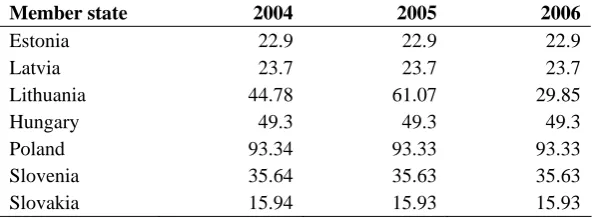
[image:18.595.104.402.532.641.2]The temporary solidarity instruments subsequently put in place (the Schengen facility) amounted to a total of €960 million, which was foreseen to upgrade border equipment and training levels in seven new member states during the period 2004-06. A more progressive framework was expected for the period 2007-13, but with the recent set-back at the June 2005 European Council budget negotiations, it is yet uncertain what resources will be available for the new border. Table 1 shows the amounts envisaged for each country.
Table 1. Schengen facility budget (€ millions)
Member state 2004 2005 2006
Estonia 22.9 22.9 22.9
Latvia 23.7 23.7 23.7
Lithuania 44.78 61.07 29.85
Hungary 49.3 49.3 49.3
Poland 93.34 93.33 93.33
Slovenia 35.64 35.63 35.63
Slovakia 15.94 15.93 15.93
Source: European Commission, “Justice and home affairs issues both new and crucial to EU enlargement process” (retrieved from http://europa.eu.int/comm/justice_home/fsj/enlargement/wai/fsj_enlarge_ intro_en.htm).
The European Corps of Border Guards (ECBG) was thought to perform the following tasks under the command of the Practitioners’ Unit (EBPCU):
- exercise the full prerogatives of public authority needed to perform these tasks; and
- respect the national authorities’ powers in matters not covered by Title IV (visas, asylum, immigration and other policies related to the free movement of persons) and Title X (customs cooperation) of the EC Treaty.
The ECBG would be open at all hierarchical levels to qualified nationals of any EU member state.
Despite its moderate ambitions, the project encountered strong objections from some of the member states concerned, i.e. those situated on the external border (e.g. Poland and Finland), while being supported notably by France and Germany.25 It was therefore abandoned and in November 2003 replaced by the less operational proposal for a European Border Agency.
3.2.2 Internal measures (phase 2): Joint centres and other alternatives to
border checks
Internal enforcement cooperation in the late 1990s was marked by the attempt to establish more efficient cross-border solutions, in particular to create alternatives to the old-fashioned and cost-intensive reintroduction of checks in the sense of Art. 2(2) SCH90.
Joint enforcement centres
From the perspective of avoiding bureaucratic communication structures in cross-border cooperation and taking advantage of direct personal contacts, a number of joint centres have been set up that host representatives of various enforcement services from both sides of the border (Maguer, 2002). A forerunner was the French-German Police and Customs Cooperation Centre (PCCC) based in Kehl on the Rhine border, inaugurated in 1998 on the basis of the intergovernmental Mondorf Agreement of 9 October 1997, concluded in conformity with Art. 46 SCH90.26
Officers from police forces (Police Nationale, gendarmerie for the French and Landespolizei Baden-Württemberg and Rhineland-Palatinate, Bundesgrenzschutz for the German side) as well as French and German customs units work together under one roof, thus helping to address security deficits in the border regions caused by the fact that the law enforcement intervention has, in principle, to stop at the internal border. The PCCC’s role concerns information exchange and coordination but there is no operational remit. Another prominent example is the Police Euregion Maas-Rhine with a trilateral commissariat (Belgium, Germany and the Netherlands).27 Owing to the positive results obtained by the Kehl centre, this has become a model for regional enforcement cooperation implemented at numerous other locations throughout the Schengen territory and beyond, sometimes in the form of trilateral and quadrilateral structures: besides more than a dozen PCCCs created so far, there are also a number of police-only bodies called
25
It should be added that some member states conducted test runs of joint teams operating on the common external border, e.g. Germany in December 2002 in cooperation with Greece, Italy and the UK, whereby the foreign officials, vested with public authority on the basis of a special provision of the German border guard law (BGS-Gesetz), were able to carry out passport controls, and other activities.
26
For details see Hobbing (2003), p. 19.
27
‘Joint Police Stations’ (JPS). The further extension of these joint structures has been expressly welcomed and encouraged at the EU level by the Commission Communication on police and customs cooperation of 18 May 2004.28
Alternative checking methods
A pragmatic alternative to border checks developed by French services relies on the routine stops of French motorway users at the toll stations – without any inconvenience to other users, customs and police staff may single out individual cars or trucks and conduct checks.
Within a zone of 20 km from the borderline, such checks rely on Art. L611-9 of the Code on the Entry and Residence of Foreigners of 1 March 2005,29 while in other parts of the territory these may be based on other national provisions in accordance with Art. 2(3) SCH90.30
‘Security partnership’ – A new generation of bilateral agreements
Given that EU or Schengen-wide solutions such as the Convention on Mutual Legal Assistance in Criminal Matters31 are not likely to be put in place rapidly,32 member states have taken bilateral action to overcome the vacuum.
A series of bilateral agreements have been concluded by Germany with Switzerland (1999), Belgium, the Czech Republic (2000), Denmark (2001), Poland (2002), Austria (2003) and the Netherlands (2005) (see Schmidt-Vockenhausen, 2005), and there is also a new Benelux treaty on police cooperation that was concluded in 2004.33
The new agreements go beyond the limits of classical assistance in some striking ways and are considered a sort of ‘quantum leap’ in international police matters: hot pursuit, observation and undercover investigation are no longer subject to limitations in time or space (in the past, cross-border action – if allowed at all – was confined to a cross-border zone and certain time limits); enforcement officials are entitled to arrest offenders on foreign territory when caught in the act and surveillance may also take place as a preventive measure; local police offices may in urgent cases file requests for mutual assistance directly with a foreign authority (previously there was a multi-step procedure involving central authorities); staff engaged in cross-border operations can in certain cases be vested with public authority of the foreign state when acting under the orders of that state; the agreements cover the transmission and verification of DNA profiles; and, enforcement staff may spontaneously undertake cross-border threat prevention steps in cases of
28
European Commission (2004a), Communication, Enhancing police and customs cooperation in the European Union, COM(2004) 376 final, Brussels, 18.5.2004, p. 10 (retrieved from http://europa.eu.int/eur-lex/lex/LexUriServ/site/en/com/2004/com2004_0376en01.doc).
29
Code de l'entrée et du séjour des étrangers et du droit d'asile (retrieved from http://www.association-diem.org/code-entree-sejour.htm).
30
Art. 2(3) states, “3. The abolition of checks on persons at internal borders shall not affect...the exercise of police powers throughout a Contracting Party’s territory by the competent authorities under that Party’s law, or the requirement to hold, carry and produce permits and documents provided for in that Party’s law.”
31
Convention on Mutual Legal Assistance on Legal Matters, OJ C 197 of 12 July 2000.
32
So far, only three member states have ratified the Convention: Spain, Portugal and Denmark.
33
emergency. Furthermore, the agreements foresee various forms of cooperative activities such as joint patrols, surveillance and investigations) (seeSchmidt-Vockenhausen, 2005).34
Another move forward was made by seven ‘core’ members of Schengen (Austria, Belgium, France, Germany, Luxembourg, the Netherlands and Spain). They decided to launch a ‘Schengen-3’ arrangement35 signed on 27 May 2005, which would intensify cooperation by means of data exchange on potential terrorists and other criminals (so-called ‘risk persons’), armed flight attendants and major football events (for example, the FIFA World Championship in 2006).
3.2.3 Measures at the international level and on technical infrastructure
It is self-evident that a comprehensive IBM approach has to be seen in a wider context and cover aspects of international cooperation as well the technical infrastructure, as both are indispensable to ensure the smooth running of the system. Although this paper does not intend to enter deeply into the subject, the following references seem important.
At the international level, action should concern activities in and arrangements with countries of origin and transit(Callovi, 2005), whereby the focus would first be on the issuing of visa and other consular issues as well as readmission/return matters (dialogue on migration and asylum).
Second, there is the technical border cooperation with neighbouring countries (e.g. new neighbours in the east) as well as traditional trading and political partnerships (e.g. the US and Canada), the intention of which is to enhance security but also to create a smoother system of managing borders and anticipating problems. In this context, recent arrangements with the US on the advanced transfer of passenger name records and data (PNR; see Council, 2004)36 and container security (CSI; see Council, 2004d) are notable, as they embody mechanisms that lead to a ‘virtual forward-shift’ of the borderline, giving border staff added time for control purposes.
Similarly, the internal technical infrastructure in terms of data and communication systems represents a cornerstone of the EU’s IBM: without the SIS linking relevant authorities – regardless of their geographical location in central offices in the capitals, as border staff right on the front line or consular representations abroad – a coordinated operation of border matters would be unthinkable. Of course, through the rapidly changing European landscape and the increasing number of participating countries and services, existing technologies become outdated. It is the challenge of the years to come to adapt the infrastructure to the new situation.37 The envisaged SIS II system will be able to accommodate links with all 25 member states together with new visual features to enrich the content of the databases (fingerprints, photos, etc).38 SIS II will share its technical platform with the future Visa Information System
34
A major instance of cooperation referred to is the 2003 G8 summit held in Evian, when a German police force of 1,000 officers equipped with armoured water-cannon vehicles assisted the Swiss authorities in maintaining public order. See “Engagement de policiers allemands pour le G8”, UDC, Berne (retrieved from http://www.svp.ch/?page_id=460&l=3).
35
See Nachrichten Überblick (retrieved from http://pocket.nachrichten.at/politik/innenpolitik/360885).
36
EU-US Agreement on Passenger Name Records (PNR) of 28 May 2004, OJ L 183, 20.5.04, p. 83 (retrieved from http://europa.eu.int/comm/external_relations/us/intro/pnr_agreement0504.pdf).
37
European Commission (2003b), Communication, Development of the Schengen Information System II and possible synergies with a future Visa Information System (VIS), COM(2003) 771 final, Brussels, 11.12.2003.
38
(VIS, Council 2004a), whose purpose it is to render visa application procedures more transparent, facilitate consultations and avoid abuse in the form of ‘visa shopping’.39
4.
Current initiatives in light of The Hague Programme
In 2005, the central event in border management has – so far – been the establishment of the EBA,40 based on Council Regulation (EC) No. 2007/2004,41 with a seat in Warsaw42 and the Finnish Colonel Ilkka Laitinen appointed as executive director.43 This event definitely outshines all the rest but it should not be forgotten that further developments such as the Community Border Code, currently being discussed by the Council and European Parliament, and the proposed regulation for local border traffic between the EU and third countries equally merit attention.
4.1 European Border Agency (FRONTEX)
In comparison to the original concept of a European Border Guard, the EBA may appear a more modest achievement, given that it foresees no direct operational assignments and would not match the ‘blue helmet’ border force image that the Belgian presidency had originally had in mind back in 2001.
Yet the EBA represents not only a realistic implementation (resentments against any type of multinational force were too strong at the time) but also one that seems able to adapt to challenges arising in the future. There is a solid financial and organisational basis as a Community body (Arts. 15 and 29)44 and a clear hierarchical structure integrating the former ad-hoc centres of the member states as “specialised branches” of the agency (Art. 16). Unlike intergovernmental agencies such as Europol, the EBA has its own staff (Art. 17), and thus does not have to rely on liaison officers detached from the member states and who are still mainly responsible to the latter. The current staff amounts to 26 officials, but will eventually be increased to 100.
39
For further details, see “EU Visa Information System gets go-ahead”, IDBAC website (retrieved from http://europa.eu.int/idabc/en/document/2186/330). The first step will be the processing of alphanumeric data and digital photographs of visa applicants, to be implemented by the end of 2006. Among other things, the VIS database will include personal identification information, the status of the visa, the issuing authority and a record of persons liable to pay board and lodging costs. The second step will consist of the addition of biometric data to the VIS and will start, if possible, by the end of 2007. This second step should be taken in coherence with the choice of biometric identifiers in the field of visas and taking into account the outcome of the on-going technical developments. Some individual member states will be allowed to store fingerprints and facial images earlier than other member states.
40
The official denomination of the EBA is the European Agency for the Management of Operational Cooperation at the External Borders of the Member States of the European Union.
41
Council Regulation No. 2007/2004, OJ L 349, 25.11.2004, p. 1
42
Decision taken by JHA ministers on 14 April 2005, turning down the further candidatures by Hungary, Estonia, Slovenia and Malta (see the EU Observer of 15 April 2005).
43
See “Finn to head EU borders agency”, EU Observer, 26 May 2005 (retrieved from http://www.euobserver.com/?sid=22&aid=19163).
44
The agency’s role is based on the following cornerstones in terms of assignments, i.e. to:
• assist member states in training matters (Art. 2(1)(b));
• carry out risk analyses (Art. 2(1)(c));
• follow-up on research relevant for border control and surveillance (Art. 2(1)(d)); and
• support member states in organising return operations.
Although operational action remains the prerogative of the member states (see clause no. 4), the Agency appears to have sufficient means to put its own stamp onto this sector as well. The EBA is responsible not only to 1) coordinate operational cooperation among member states (Art. 2 (1)(a)); 2) evaluate, approve (!) and coordinate proposals for joint operations and pilot projects made by member states, but also to 3) launch its own “initiatives” in this field (Art. 3 (1)). Further, member states shall report to the Agency on operational matters occurring outside the framework of the Agency (Art. 2 (2)).
EU-wide coherence of operational border management can further be promoted through the EBA’s competence over:
• evaluating the results of joint operations (including the establishment of a “comparative analysis in view of enhancing the quality, coherence, and efficiency of future operations”, Art. 3 (3));
• co-financing such operations (Art. 3 (4));
• developing and applying a common integrated risk analysis (Art. 4);
• establishing a common core curriculum for border guards’ training (Art. 5);
• following the development of research related to control and surveillance equipment and disseminating results to member states (Art. 6);
• providing “organisational and operational assistance” to member states in cases of need and at their request, including the “deployment of its experts for support” (Art. 8); and
• facilitating operational cooperation with third countries (Art. 13).
With this wide spectrum of operations-related tasks, the Agency will doubtlessly be able to decisively contribute to the shaping of a Union model of operational cooperation. Further incentives such as financial subsidies and the offer of practical help through EBA staff on the spot appear quite tempting and hard to resist in situations of need. One can thus assume that at mid-term, mutual trust between the EBA and national authorities will build up and requests for operational assistance will become more frequent. In the end, the difference between the EBA expert teams and rapid reaction forces in the sense of the 2002 Communication may be hardly visible.
Also, doors seem to be open to any subsequent development. As the Agency is tasked to commission an independent external evaluation of its performance (Art. 33), such a study would include the item of the “need for and feasibility of setting-up a European Border Guard” as requested by the European Parliament.45
45
4.2 Proposal for a European border code
46In conformity with the announcement in its 2002 Communication,47 the Commission undertook to “clarify, restructure, consolidate and develop rules on border controls on persons” developed within the Schengen intergovernmental framework and give it a “Community character”. It hereby tackles the main criticism expressed towards the rules of the Common Manual and other acts originally adopted by the Schengen Executive Committee, i.e. their doubtful legal status as well as the parallel existence of “many overlapping sources”.48
Presented in May 2004, the proposal is the first to be treated according to the new legislative procedure for border measures in force since April 2005 following agreement on The Hague Programme,49 i.e. qualified majority voting in the Council and co-decision within the Parliament. Major changes proposed by the Parliament include the treatment of asylum seekers, checks on family members of EU citizens, non-discrimination standards to be respected by border guards and new procedural rights for persons checked at the border.
4.3 Proposal for a regime of local border traffic
50This proposal is to be seen in the context of the ‘fortress Europe’ discussions of recent years, in which the EU has been widely criticised for introducing a new ‘iron curtain’ between the new member states and neighbours in the east.51 Although the proposal cannot do away with the basic visa requirements imposed by the Schengen mechanism, there are a number of ways to soften the rules. The facilitation measures proposed centre around a special ‘L’ visa for border residents (‘L’ being taken from ‘local’).
The advantages granted to holders of an ‘L’ visa would be numerous:
• As a multiple-entry visa, it is issued for at least one year and for a maximum of five years, entitling the holder to stay in the border area of the issuing member state for seven consecutive days maximum and without exceeding, in any case, three months within any half-year period.
• The issuing member states may decide to reduce or waive the visa fees normally foreseen.
• Specific border crossing points open only to border residents may be set up or specific lanes reserved for border residents at ordinary border crossing points.
The implementation would be by the member states concerned, i.e. by conclusion of a specific agreement with the neighbouring country (e.g. Poland with Ukraine).
4.4 Statements in The Hague Programme on border management
A first reaction by border professionals towards The Hague Programme may be that of disappointment, since there is no specific header foreseen for their topic.52
46
See European Commission (2004).
47
See para. 22 on short term measures, European Commission (2002).
48
See Peers (2005).
49
Decision by the European Council of 5 November 2004.
50
European Commission (2005a).
51
See for example “Poland’s EU border challenge”, Radio Netherlands, 1.5.2004.
52