Int. J. Electrochem. Sci., 10 (2015) 10454 - 10461
International Journal of
ELECTROCHEMICAL
SCIENCE
www.electrochemsci.org
Short Communication
On
the Temperature Dependence of Hydrogen Evolution
Reaction at Pt-modified Nickel Foam Catalyst Material
Boguslaw Pierozynski*, Tomasz Mikolajczyk
Department of Chemistry, Faculty of Environmental Management and Agriculture, University of Warmia and Mazury in Olsztyn, Plac Lodzki 4, 10-957 Olsztyn, Poland
*
E-mail: [email protected], [email protected]
Received: 14 September 2015 / Accepted: 2 October 2015 / Published: 4 November 2015
This article presents the temperature-dependence of hydrogen evolution reaction (HER), studied at Pt-modified nickel foam material in 0.1 M NaOH solution for the temperature range: 20-60 oC. Catalytically-modified (by spontaneous Pt deposition) nickel foam exhibited radical facilitation of the HER kinetics (examined by means of a.c. impedance spectroscopy), as compared to those recently reported on pure and Pd-activated Ni foam samples. The presence of a catalytic, nanoparticle Pt additive was demonstrated through a combined SEM/EDX examination.
Keywords: Nickel foam; Catalytic Pt modification; HER; Electrochemical impedance spectroscopy
1. INTRODUCTION
spontaneous deposition) are presented, comparatively to those of as received and Pd-activated Ni foam catalyst materials, as recently reported in other publications from this laboratory [20, 21].
2. EXPERIMENTAL
Pure nickel foam sheet was acquired from MTI Corporation (purity: > 99.99 % Ni; thickness: 1.6 mm; surface density: 346 g m-2; porosity: 95 %). Spontaneous deposition of Pt (see details on the spontaneous Pd/Ru deposition on Ni foam substrate given in Ref. 16) on nickel foam samples (ca. 1.1×1.1 cm) was performed from chloroplatinic acid hexahydrate (CPAH, Sigma-Aldrich) solution (0.0005 M CPAH, pH= 1.0, tdep.= 30 s, Tdep.= 293 K, ms= 41.2 mg with estimated 0.18 wt.% Pt).
Electrochemical a.c. impedance experiments were performed by means of Solartron 12,608 W Full Electrochemical System (1260 frequency response analyzer and 1287 electrochemical interface) over the temperature range: 20-60 oC. A suitable correction was introduced [22], in order to account for a small, but considerable temperature shift of the Pd RHE over the studied temperature range. All other information concerning: preparation of electrolytes, electrochemical cell, counter and reference electrodes, as well as specific pre-treatments applied to these electrodes and employed protocols for electrochemical measurements have recently been discussed in other works from our laboratory [20, 21]. In addition, SEM/EDX spectroscopic characterization of examined Pt-based Ni foam samples was performed by means of JEOL JSM-7600F/X-Max SDD Oxford Inca 250 integrated SEM/EDX equipment unit.
3. RESULTS AND DISCUSSION
3.1. SEM/EDX characterization of Pt-activated nickel foam electrode
[image:2.596.223.370.508.722.2]
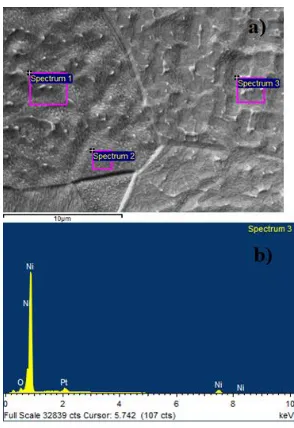
Fig. 1a above presents SEM picture of Pt-modified (ca. 0.18 wt.% Pt) nickel foam electrode, recorded for a magnification of 3,500× and an acceleration voltage of 2 kV. The presence of small Pt nuclei could clearly be observed in this figure. On the other hand, Fig. 1b refers to Pt detection on the Ni foam substrate, achieved by the SEM/EDX analysis. The amount of Pt catalyst deposited on the nickel foam substrate was evaluated by means of a weighing method, where levels of nickel dissolved during the Pt deposition process were spectroscopically estimated (via a complexometric method by means of WTW Photo Flex Turb spectrometer). Furthermore, SEM-estimated (see again Refs. 20 and 21 for details) Pt average grain size came to 9.1 ± 3.1 nm.
3.2. A.c. impedance behaviour of HER on Pt-activated Ni foam material in 0.1 M NaOH
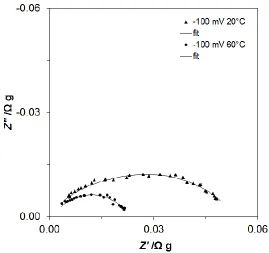
Figure 2. Complex-plane impedance plots for the HER on Pt-activated Ni foam electrode surface in contact with 0.1 M NaOH, recorded at 20 and 60 oC for -100 mV vs. RHE. Symbols represent experimental results; solid lines correspond to representation of the data according to CPE-modified Randles equivalent circuit.
[image:3.596.162.431.266.519.2]
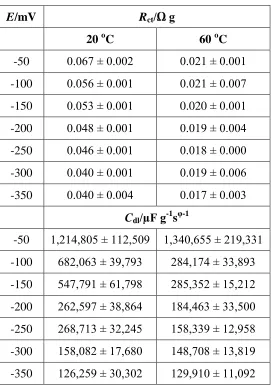
Table 1. Electrochemical parameters for the HER on Pt-activated Ni foam electrode in contact with 0.1 M NaOH, recorded at 20 and 60 oC. The results were obtained by fitting the CPE-modified Randles equivalent circuit to the experimentally obtained impedance data (reproducibility usually below 10 %, 2 = 310-4 to 210-3; dimensionless φ parameter, which determines the constant phase angle in the complex-plane plot of the CPE circuit, oscillated between 0.45 and 0.83.
E/mV Rct/Ω g
20 oC 60 oC -50 0.067 ± 0.002 0.021 ± 0.001 -100 0.056 ± 0.001 0.021 ± 0.007 -150 0.053 ± 0.001 0.020 ± 0.001 -200 0.048 ± 0.001 0.019 ± 0.004 -250 0.046 ± 0.001 0.018 ± 0.000 -300 0.040 ± 0.001 0.019 ± 0.006 -350 0.040 ± 0.004 0.017 ± 0.003
Cdl/µF g-1sφ-1
-50 1,214,805 ± 112,509 1,340,655 ± 219,331 -100 682,063 ± 39,793 284,174 ± 33,893 -150 547,791 ± 61,798 285,352 ± 15,212 -200 262,597 ± 38,864 184,463 ± 33,500 -250 268,713 ± 32,245 158,339 ± 12,958 -300 158,082 ± 17,680 148,708 ± 13,819 -350 126,259 ± 30,302 129,910 ± 11,092
Faradaic reaction resistance (Rct) and double-layer capacitance (Cdl) parameters for the HER, recorded on the platinum-modified nickel foam (at 20 and 60 oC) in function of cathodic overpotential, are presented in Table 1. Electrochemical parameters were derived based on a constant phase element – CPE-modified Randles equivalent circuit model (see e.g. Fig. 4a in Ref. 20), where the CPE element was used in the circuit in order to account for the capacitance dispersion effect [23, 24], represented by deformed semicircles in the Nyquist impedance plots of Fig. 2.
Hence, for the Pt-activated Ni foam electrodes the recorded Rct parameter decreased from 0.067 and 0.021 Ω g at -50 mV to reach 0.040 and 0.017 g at -350 mV for 20 and 60 oC, correspondingly. Simultaneously, the Cdl parameter significantly reduced from 1,214,805 to 126,259 µF g-1sφ-1 at 20 oC and from 1,340,655 to 129,910 µF g-1
[image:4.596.164.435.163.549.2]
newly formed H2 bubbles, especially evident at increasing cathodic overpotentials. These results are in contrast to those recently recorded on the Pd-modified Ni foam in Ref. 21. Hence, at the overpotential of -50 mV, the Pt-activated foam electrode exhibited nearly 22.8× diminished the Rct parameter (and ca. 5.9× increased Cdl) at room temperature, as compared to that of the Pd-modified nickel foam catalyst. Hence, having subtracted the effect of electrochemically accessible surface extension, it could be assumed that for two similar catalytic systems, the Pt-based electrode is ca. 4 times as catalytic for the HER (at an initial overpotential value) as the palladium-activated Ni foam material. Similar trend is observed at another potential extreme (-350 mV), where the surface-normalized (based on the recorded ratio of the double-layer capacitance parameter) enhancement of the HER kinetics for the Pt-activated Ni foam (in relation to that of the Pd-modified foam material) came to 5.2× at 20 oC and 10.5× at 60 oC (see Table 1 here and Table 2 of Ref. 21 for details). However, superior HER kinetics on the platinum-modified nickel foam electrode (being in a stationary mode) results in a rapid reduction of the electrochemically available surface area, due to extensive accumulation of hydrogen microbubbles (contrast to the behaviour observed at less catalytic Pd-activated Ni foam [21]). As a consequence, the HER kinetics recorded in Table 1 for 60 oC was practically overpotential independent. Further enhancement of the HER kinetics for this spongy-type cathode arrangement would require that e.g. an ultrasonic or a mechanical H2 bubble removal setup be imposed.
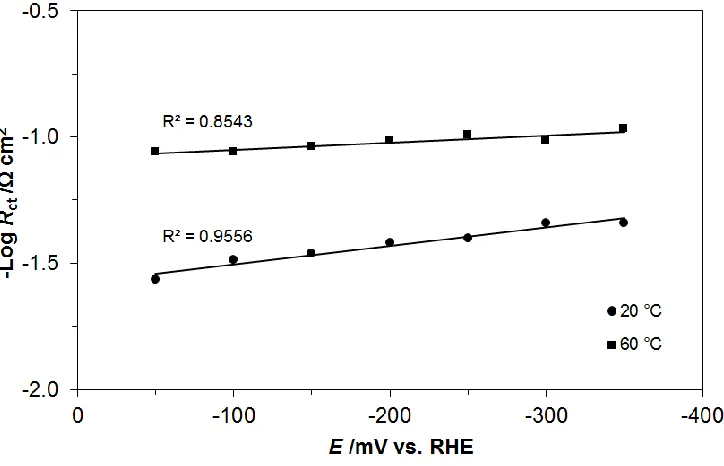
Figure 3. Linear plots of –log Rct in function of potential (vs. RHE), obtained for the HER on Pt-modified Ni foam electrode in 0.1 M NaOH solution, recorded at 20 and 60 oC (symbols refer to experimental results; solid lines are data fits).
[image:5.596.117.479.385.618.2]
Thus, the impedance-originated values of the j0 parameter for the Pt-modified nickel foam electrode came to: 3.3×10⁻⁴
and 1.2×10⁻³ A cm-2 at 20 and 60 oC, respectively. These results are in contrast with radically lower values of the exchange current-density, recently recorded [21] on pure and the Pd-activated nickel foam electrodes, namely: 1.2×10⁻⁶
and 2.0×10⁻⁵ A cm-2 (Ni foam cathode), and 1.3×10⁻⁵
and 1.4×10⁻⁴ A cm-2 for the palladium-modified cathode for 20 and 60 oC, correspondingly. Most importantly, the impedance-estimated values of the j0 parameter for highly-dispersed, nanoparticle Pt/Ni foam composite electrode came fairly close to that widely accepted j0 (3×10⁻⁴ to 7×10⁻⁴
[image:6.596.96.490.305.549.2]A cm-2) in literature for polycrystalline Pt, Pt(hkl) and Pt/C hydrogen evolution catalysts in alkaline media [28-30]. It should also be stated here that the recorded in this work values of the j0 parameter for the Pt-modified nickel foam were significantly greater than those commonly quoted for Ni porous structures in literature, including: pure and Ru-modified Ni foam [20], (La, Ce)/Ni electrodes [31], electrodeposited porous Ni layers [10], etc.
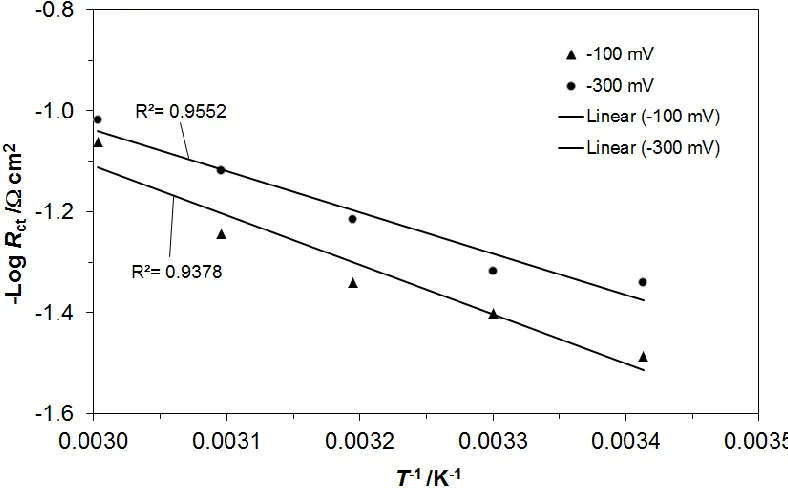
Figure 4. Plots of –log Rct vs. T-1 for the HER conducted on Pt-modified Ni foam electrode in 0.1 M NaOH solution, at the overpotential values of -100 and -300 mV.
4. CONCLUSIONS
Platinum-activated Ni foam material (Pt nanodeposit at ca. 0.18 wt.%) demonstrated radically enhanced catalytic HER activity in alkaline solution (based on the recorded exchange current-density and electrochemical activation energy parameters), as compared to those of as received and Pd-modified nickel foam cathodes. The above was observed over kinetically-controlled, low overpotential range, being primarily a result of exceptional HER activity of a catalytic Pt additive. However, superior HER kinetics on the Pt-modified catalyst led to substantial blockage of its electrochemically active surface, being especially challenging at most cathodic overpotentials. Hence, proper surface restoration treatment would be required (e.g. realized by means of an intermittent ultrasonic procedure or through rapid and continuous electrolyte flow) in order to maintain electrode’s HER catalytic properties at high and relatively constant level.
Finally, the results obtained in this article indicated major prospects for Pt nanodeposit-modified (at nearly trace catalyst level) nickel foam cathodes in commercial alkaline water electrolyser technology.
References
1. B.E. Conway and B.V. Tilak, Adv. Catal., 38 (1992) 1.
2. J.Y. Huot and L. Brossard, Int. J. Hydrogen Energy, 12(12) (1987) 821. 3. H.E.G. Rommal and P.J. Morgan, J. Electrochem. Soc., 135(2) (1988) 343. 4. D.M. Soares, O. Teschke and I. Torriani, J. Electrochem. Soc., 139(1) (1992) 98.
5. N. Krstajic, M. Popovic, B. Grgur, M. Vojnovic and D. Sepa, J. Electroanal. Chem., 512 (2001) 16.
6. V. Paserin, S. Marcuson, J. Shu and D.S. Wilkinson, Adv. Eng. Mater., 6 (2004) 454. 7. S. Inazawa, A. Hosoe, M. Majima and K. Nitta, SEI Tech. Rev., 71 (2010) 23.
8. E. Verlato, S. Cattarin, N. Comisso, A. Gambirasi, M. Musiani and L. Vazquez-Gomez, Electrocatalysis, 3 (2012) 48.
9. I. Bianchi, E. Guerrini and S. Trasatti, Chem. Phys., 319 (2005) 192.
10. L. Vazquez-Gomez, S. Cattarin, P. Guerriero and M. Musiani, Electrochim. Acta, 53 (2008) 8310. 11. S. Fiameni, I. Herraiz-Cardona, M. Musiani, V. Perez-Herranz, L. Vazquez-Gomez and E.
Verlato, Int. J. Hydrogen Energy, 37 (2012) 10507.
12. Y. Liu, C.M. Hangarter, D. Garcia and T.P. Moffat, Surf. Sci., 631 (2015) 141.
13. X. Qian, T. Hang, S. Shanmugam and M. Li, ACS Appl. Mater. Interfaces, 7 (2015) 15716. 14. P. Kim, J.B. Joo, W. Kim, J. Kim, I.K. Song and J. Yi, J. Power Sources, 160 (2006) 987. 15. Y. Suo and I.M. Hsing, J. Power Sources, 196 (2011) 7945.
16. A. Dutta, S.S. Mahapatra and J. Datta, Int. J. Hydrogen Energy, 36 (2011) 14898.
17. R.M. Modibedi, T. Masombuka and M.K. Mathe, Int. J. Hydrogen Energy, 36 (2011) 4664. 18. B. Beyribey, B. Corbacioglu and Z. Altin, GUJS, 22(4) (2009) 351.
19. J. van Drunen, B.K. Pilapil, Y. Makonnen, D. Beauchemin, B.D. Gates and G. Jerkiewicz, ACS Appl. Mater. Interfaces, 6 (2014) 12046.
20. B. Pierozynski, T. Mikolajczyk and I.M. Kowalski, J. Power Sources, 271 (2014) 231. 21. B. Pierozynski and T. Mikolajczyk, Electrocatalysis, 6 (2015) 51.
22. A. Prokopowicz and M. Opallo, Solid State Ionics, 157 (2003) 209. 23. T. Pajkossy, J. Electroanal. Chem., 364(1-2) (1994) 111.
25. J.G. Highfield, E. Claude and K. Oguro, Electrochim. Acta, 44 (1999) 2805. 26. R.K. Shervedani and A.R. Madram, Electrochim. Acta, 53 (2007) 426.
27. S. Martinez, M. Metikos-Hukovic and L. Valek, J. Mol. Cat. A: Chem., 245 (2006) 114. 28. T.J. Schmidt, P.N. Ross Jr. and N.M. Markovic, J. Electroanal. Chem., 524-525 (2002) 252. 29. W. Sheng, H.A. Gasteiger and S.H. Yang, J. Electrochem. Soc., 157(11) (2010) B1529. 30. B.E. Conway and B.V. Tilak, Electrochim. Acta, 47 (2002) 3571.
31. M.A. Dominguez-Crespo, A.M. Torres-Huerta, B. Brachetti-Sibaja and A. Flores-Vela, Int. J. Hydrogen Energy, 36 (2011) 135.