White Rose Research Online URL for this paper: http://eprints.whiterose.ac.uk/131558/
Version: Accepted Version
Article:
Chubala, Chrissy, Suprenant, Aimee, Neath, Ian et al. (1 more author) (2018) Does Dynamic Visual Noise Eliminate the Concreteness Effect in Working Memory? Journal of Memory and Language. pp. 97-114. ISSN 0749-596X
https://doi.org/10.1016/j.jml.2018.05.009
[email protected] https://eprints.whiterose.ac.uk/ Reuse
This article is distributed under the terms of the Creative Commons Attribution-NonCommercial-NoDerivs (CC BY-NC-ND) licence. This licence only allows you to download this work and share it with others as long as you credit the authors, but you can’t change the article in any way or use it commercially. More
information and the full terms of the licence here: https://creativecommons.org/licenses/ Takedown
If you consider content in White Rose Research Online to be in breach of UK law, please notify us by
Does Dynamic Visual Noise Eliminate the Concreteness Effect in Working Memory?
Chrissy Chubala, AimŽe M. Surprenant, Ian Neath
Memorial University of Newfoundland, Canada
Philip T. Quinlan
University of York, UK
Correspondence:
Ian Neath
Department of Psychology
Memorial University of Newfoundland St. JohnÕs, NL A1B 3X9
Canada
email: [email protected] voice: 709 864 8495 fax: 709 864 2430
In Press: Journal of Memory and Language © 2018, Elsevier.
This paper is not the copy of record and may not exactly replicate the final,
Abstract
Dynamic visual noise (DVN), an array of squares that randomly switch between black and white,
interferes with certain tasks that involve visuo-spatial processing. Based on the assumption that
the representation of concrete words includes an imagistic code whereas that of abstract words
does not, Parker and Dagnall (2009) predicted that DVN should disrupt visual working memory
and selectively interfere with memory for concrete words. They observed a reversal of the
concreteness effect in both a delayed free recall and a delayed recognition test. In six studies, we
partially replicate and extend their work. In Experiments 1 (delayed free recall) and 2 (delayed
recognition), DVN abolished, but did not reverse, the concreteness effect. Experiments 3 and 4
found no effect of DVN on a prototypical working memory task, immediate serial
recall: concreteness effects were observed in both the control and DVN conditions. In contrast,
Experiment 5 showed that DVN abolished the concreteness effect in an immediate serial
recognition test. In the final experiment, subjects did not know whether they would receive an
immediate serial recall or an immediate serial recognition test until after the list had been
presented. Nonetheless, DVN had no effect on immediate serial recall but once again eliminated
the concreteness effect on immediate serial recognition. The results (1) extend the effects of
DVN on the concreteness effect to working memory tasks, (2) suggest that immediate serial
recall and immediate serial recognition are more different than similar, and (3) have implications
for theories of DVN, the concreteness effect, and models of memory.
Keywords: memory; visual working memory; concreteness effect; serial recall; free recall;
Does Dynamic Visual Noise Eliminate the Concreteness Effect in Working Memory?
Although there are any number of manipulations an experimenter can use to disrupt
performance on a memory test, it is those manipulations which cause selective impairment that
are of primary theoretical interest. For example, if the experimenter unexpectedly pokes the
subject at a critical time, performance on the memory test may suffer, but for uninteresting
reasons. In contrast, a manipulation that selectively impairs memory for one class of items but
has no effect on memory for a different class of items provides information that can be used to
adjudicate between different theoretical accounts.
Parker and Dagnall (2009) reported a previously unknown example of selective
interference: Dynamic visual noise eliminated the standard memory benefit for concrete words
over abstract words. Whereas Parker and Dagnall argued that their results bore implications for
theories of working memory, their examination of the interaction between dynamic visual noise
and concreteness was limited to delayed free recall and delayed recognition tasks. Our first two
experiments were replications of their two long-term memory experiments. Given Parker and
DagnallÕs explanation in terms of working memory, the remaining experiments examine whether
the same pattern obtains in tasks more closely associated with working memory, immediate
serial recall and immediate serial recognition.
The Concreteness Effect
The concreteness effect refers to the finding that lists of concrete words are generally
better remembered than otherwise comparable lists of abstract words. This ÒstandardÓ
concreteness effect has been observed with many different tests, including immediate serial
recall (Walker & Hulme, 1999), immediate free recall (Romani, McAlpine, & Martin, 2008),
delayed recognition (Groniger & Groniger, 1982), paired associates (Paivio, 1967), and
reconstruction of order (Neath, 1997).
A number of different explanations for the concreteness effect have been offered, and we
defer a more detailed review until the general discussion, but the most influential is based on
PaivioÕs (1971, 1991, 2007) dual coding theory. The ÒdualÓ refers to a distinction between
symbolic (verbal or propositional) systems and specific sensorimotor (imaginal or analog)
systems. In terms of the concreteness effect, the specific sensorimotor system invoked is based
on visual imagery, but this is just one of many possible types of imagery (e.g., auditory imagery,
odor imagery, etc.). As applied to the concreteness effect, this view assumes that abstract words
are represented in memory by a single verbal or linguistic code whereas concrete words have an
additional form of ÒimagisticÓ representation. The reason for the superior memory for concrete
words, then, is that if the verbal code is insufficient to support memory for the word, there is a
second imagistic code available. In contrast, if the verbal code is insufficient to support memory
for the abstract word, there is no other code to fall back on. Numerous studies provide support
for this view. For example, subjects frequently self-report using visual imagery when processing
concrete but not abstract words (Paivio, Smythe, & Yuille, 1968). This is consistent with
dual-coding in that there is no specific image that can be generated for an abstract word. Generating
visual images takes time, and therefore dual coding theory also predicts that if presentation of the
to-be-remembered items is too rapid for the slower imagery processes to run to completion, then
the concreteness effect should disappear; and it does (Paivio & Csapo, 1969). In contrast, other
stimulus variables such as frequency and familiarity still produce effects even with
If the dual coding account of the concreteness effect is correct, manipulations that
selectively interfere with visual processing should affect memory for concrete but not abstract
words. Parker and Dagnall (2009) reasoned that a manipulation that interferes with the formation
of the imagistic code should render memory for concrete words comparable to memory for
abstract words because both would be restricted to a solely verbal code. They tested this by using
dynamic visual noise, a procedure previously shown to interfere selectively with visual working
memory.
Dynamic Visual Noise
Dynamic visual noise was developed by Quinn and McConnell (1996), following up on
an earlier report by Logie (1986). In their study, Quinn and McConnell used a display of 320 ×
320 squares, each of which was randomly set to black or white. Then, once per second, a random
291 of the 102400 squares changed from their initial color to the other. The to-be-remembered
words were presented auditorily. Two conditions were tested. In the rote instructions condition,
subjects were asked Òto commit the words to memory by adding each word to the one heard
previously and to repeat them subvocallyÓ (p. 205). In the visual mnemonic condition, the
subjects were asked to associate six concrete words with the number words (the pegwords) ÔoneÕ
to ÔsixÕ, respectively, which signaled each wordÕs position within the list, and to create a visual
image of each word. Following a 10 s delay, each number was presented as a test cue in both
conditions, beginning with 1, and the subject was asked to recall the word with which it was
associated. The dynamic visual noise was presented throughout the study phase, the retention
interval, and the recall test.
Quinn and McConnell (1996) found that memory performance in the rote instructions
condition was impaired by dynamic visual noise. They replicated this result with two additional
experiments and concluded that dynamic visual noise selectively interferes with imagistic
processing. However, Quinn and McConnell did not vary the concreteness or abstractness of
study words; study lists were restricted to words that were high on both imageability and
concreteness. The deleterious effect of dynamic visual noise on memory for words using visual
mnemonics has been replicated a number of times (e.g., Andrade, Kemps, Wernier, May, &
Szmalec, 2002, Experiment 1; McConnell & Quinn, 2000; Quinn & McConnell, 1999).
Quinn and McConnell (1996) explained the effects of dynamic visual noise within the
framework of working memory initially proposed by Baddeley and Hitch (1974). Within this
framework, a distinction is made between the system that handles verbal information, the
phonological loop, and the one that handles visuo-spatial information, the visuo-spatial
sketchpad. In the verbal domain, irrelevant speech has been shown to interfere with verbal
material assumed to be processed by the phonological loop (for a review, see Neath, 2000).
Quinn and McConnell suggested that dynamic visual noise was an analog of irrelevant speech,
interfering with visuo-spatial information assumed to be processed by the visuo-spatial
sketchpad.
Whereas the initial paradigm involved dynamic visual noise throughout the entire task,
Quinn and McConnell (2006) later demonstrated that no impairment occurred when dynamic
visual noise was presented only during the retention interval. In contrast, when dynamic visual
noise occurred only during encoding or only during recall, memory for words that were studied
with a pegword visual mnemonic were impaired whereas those studied by rote were not. Other
researchers report similar null results when the dynamic visual noise occurs only during the
dynamic visual noise on memory for items that should be processed visually, such as matrix
patterns or Chinese characters (with subjects who did not know Chinese), and Avons and Sestieri
(2005) similarly found that dynamic visual noise during the retention interval had no effect on
short-term memory for matrices. In this respect, dynamic visual noise differs from irrelevant
speech, which has been shown to affect memory performance when it occurs during the retention
interval (Miles, Jones, & Madden, 1991; Norris, Baddeley, & Page, 2004).
Whereas the basic finding of Quinn and McConnell (1996) has been replicated, other
experiments with different memory tests have not always found a detrimental effect of dynamic
visual noise. For example, Ueno and Saito (2013) found that dynamic visual noise during
encoding had a detrimental effect on memory for words studied as paired associates, but had no
effect on the serial recall of individual words. One implication of these results is that Òpaired
associate memory is more reliant on visual codes than serial-order memoryÓ (p. 1870).
St. Clair-Thompson and Allen (2013, Experiment 3) found no effect of presenting
dynamic visual noise during encoding on the immediate serial recall of digits, whether the recall
direction was forward or backward. A subsequent experiment included dynamic visual noise
during both the encoding and recall periods, and under these conditions, dynamic visual noise
affected backward but not forward recall. It had previously been suggested that backward serial
recall, in contrast to forward serial recall, might use a visuo-spatial representation (Li &
Lewandowsky, 1995), which may account for the finding. St. Clair-Thompson and Allen noted a
distinction between visual short-term memory and visual imagery, and suggested that dynamic
visual noise affects the latter but not the former.
Taken together, the literature briefly reviewed above suggests that dynamic visual noise
analogy with irrelevant speech. One striking similarity is that both manipulations result in a
larger decrement with a larger dose. For example, a number of researchers have shown that the
more the dynamic visual noise changes, the larger its effect (Dean, Dewhurst, Morris, &
Whittaker, 2005; McConnell & Quinn, 2000; Quinn & McConnell, 1999). In the irrelevant
speech literature, a similar finding is the changing state effect, in which the more the irrelevant
auditory items change, the larger the disruption (e.g., Beaman & Jones, 1997). However, there
are a number of notable differences that call this analogy into question. First, in contrast to
irrelevant speech, dynamic visual noise seems to have no effect if it occurs only during the
retention interval. Second, and again in contrast to irrelevant speech, dynamic visual noise does
not appear to affect performance on immediate serial recall tasks.
It may be the case that the analogy between irrelevant speech and dynamic visual noise
fails because verbal/phonological information is processed differently than visuo-spatial
information. A number of researchers who have not invoked irrelevant speech as an analog have
nonetheless couched their account within the working memory framework. For example, Parker
and Dagnall (2009; see also Ueno & Saito, 2013) proposed that dynamic visual noise selectively
impacts the storage and processing of visual representations in working memory. By this view,
there is no need for parallels with irrelevant speech. Rather, dynamic visual noise has particular
and selective effects when the subject is actively using imagistic processing. This can account for
many of the results noted earlier, including the lack of an effect of dynamic visual noise on
concrete words when the subject is induced to use rote rehearsal (Quinn & McConnell, 1996).
Dynamic Visual Noise and Concreteness
At the time of Parker and DagnallÕs (2009) paper, very little research directly compared
PaivioÕs dual coding theory, Parker and Dagnall (2009)Õs account proposed that abstract words
are represented only in one code (the phonological loop); that is, there is no imagistic
component. In contrast, concrete words give rise to both a phonological representation and an
imagistic visual representation based in visual working memory. If this is the case, Parker and
Dagnall reasoned, then dynamic visual noise should selectively affect memory for concrete
words but have no effect on memory for abstract words. They reported two experiments that
tested this prediction.
Parker and Dagnall (2009) used auditory presentation of the to-be-remembered items, but
instructed subjects to look at the dynamic visual noise. They used a relatively high rate of change
in which a random 50% of the squares changed every 250 ms. In their Experiment 1, a list of 30
words (15 concrete and 15 abstract) was presented, followed by a 5-minute filler task. Subjects
were then asked to freely recall as many of the words as possible. Half of the subjects saw static
visual noise during study and the other half saw dynamic visual noise. In their Experiment 2, a
list of 24 words (12 concrete and 12 abstract) was presented at study (along with 6 additional
words to serve as primacy and recency buffers), followed by a 5-minute filler task. At test,
subjects were given 48 words and were asked to indicate which words they had seen during
study. Again, half of the subjects saw static visual noise during study and the other half saw
dynamic visual noise. In both experiments, a typical concreteness effect was observed in the
static condition: more concrete words were recalled and recognized than abstract words.
Although the prediction was for the elimination of the concreteness effect in the presence of
dynamic visual noise, Parker and Dagnall found it was reversed: dynamic visual noise impaired
memory for the concrete words to such an extent that abstract words were now better recalled
The Current Experiments
The results reported by Parker and Dagnall (2009) raise two important issues. First, their
finding that dynamic visual noise reversed the concreteness effect was unexpected. Although
observed in two studies, the authors had predicted only the elimination of the concreteness effect,
not its reversal. Second, it is not clear why tests of long-term memory were used to test the
predictions of a visual working memory theory. In both experiments, memory was tested after a
5-minute filler task. Although working memory would be involved in the initial encoding of
stimuli in delayed tests, a stronger test of Parker and DagnallÕs hypothesis would have employed
tasks that more directly tapped working memory rather than relying on long-term memory. For
example, concreteness effects have previously been observed in both immediate serial recall
(Walker & Hulme, 1999) and immediate serial recognition (Romani, McAlpine, & Martin,
2008). If the Parker and Dagnall/dual coding theory is correct, dynamic visual noise should
similarly eliminate (or reverse) the concreteness effect in these working memory tasks.
The experiments in the current paper were designed to address these two issues. To
address the first issue, Experiments 1 (delayed free recall) and 2 (delayed recognition) were
designed as replications of Parker and DagnallÕs Experiments 1 and 2, with the goal of
examining the generalisability of their effects and, in particular, the reversed concreteness effect
in the presence of dynamic visual noise. To address the second issue, the remaining experiments
focused on tasks more closely associated with working memory to assess whether the same
pattern is observable with immediate rather than delayed testing, given the putative short-term
time course of visual working memory. Therefore, Experiments 3 and 4 used immediate serial
recall; Experiment 5 used immediate serial recognition; and Experiment 6 used both immediate
Experiment 1 Ð Delayed Free recall
Experiment 1 was designed to replicate Experiment 1 of Parker and Dagnall (2009).
Subjects saw 30 words, half of which were abstract and half of which were concrete, followed by
a 4-minute distractor task of generating country names. This was then followed by a free recall
test. There are two major differences between the current study and that of Parker and Dagnall.
First, the words were presented visually rather than auditorily to ensure that subjects were
looking at the screen and therefore seeing the dynamic visual noise. With auditory presentation,
subjects could conceivably complete the task with their eyes closed, processing the
to-be-remembered auditory stimuli while avoiding the effects of visual noise. The concreteness effect
has been demonstrated with both modalities (e.g., Neath, 1997). Second, a large pool of words
was generated using the recent Brysbaert, Warriner, and Kuperman (2014) norms for
concreteness, and each subject saw a random subset of this pool.
Subjects
Sixty volunteers recruited from Prolific Academic (ProlificAC) participated in this study
and were randomly assigned to one of two groups: control or dynamic visual noise. As in all
subsequent studies, each was paid £8.00 per hour prorated to the time needed to complete each
study. For this and all subsequent experiments, the following inclusion criteria were used: (1)
Native speaker of English; (2) approval rating of at least 90% on prior submissions at
ProlificAC; and (3) age between 19 and 39. The mean age was 31.12 (SD = 5.52, range 19-39);
27 subjects self-identified as female and 32 self-identified as male. The sample size was larger
than the sample size of 44 of Parker and Dagnall (2009) because pilot data revealed slightly
larger standard deviations than in the Parker and Dagnall study.
There were two independent variables: (1) word type (abstract versus concrete), which
was manipulated within subjects, and (2) study background (dynamic visual noise or control),
which was manipulated between subjects.
Stimuli
The stimuli were 151 concrete (e.g., bear, drill, frost, mole, skate, tree) and 151 abstract
(e.g., blame, debt, frisk, midst, scoot, trend) one-syllable nouns from Brysbaert et al. (2014). The
set was constructed by initially selecting only those single syllable nouns that were known by all
of the raters in Brysbaert et al.Õs study to equate familiarity. The resulting pool was then reduced
until the abstract and concrete words were equated for number of phonemes, frequency,
orthographic neighbourhood size, and frequency of orthographic neighbours. Details are in the
appendix. The full set of stimuli are published online as supplementary materials.
Procedure
Subjects first answered questions about their age and sex. After reading instructions on a
computer screen, the subjects then clicked on a button to begin. Thirty words were shown one at
a time for 2 s each, in white font against a black rectangle in the centre of the screen. Fifteen
words were abstract and fifteen were concrete. The specific words used and the order of the
words was randomly determined for each subject. Thus, a given subject saw only 15 of the 151
concrete and only 15 of the 151 abstract words.
In the control condition, no visual noise was present; the background was solid black. In
the dynamic visual noise condition, an area of 800 × 500 pixels (width × height) was filled with
squares 10 × 10 pixels in size. Each square was randomly set to either white or black. The middle
of the screen, just large enough to display the words in 28 point Helvetica font, remained solid
randomly to either white or black. On average, then, half the squares changed from white to
black or black to white every 250 ms. As in Parker and Dagnall (2009, Experiment 1), the
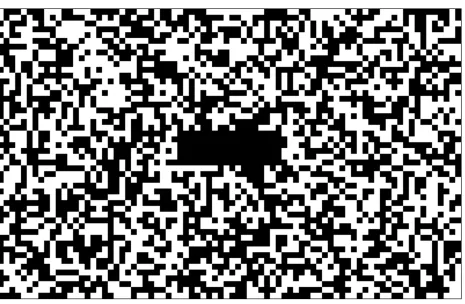
dynamic visual noise was shown only during presentation of the study list. Figure 1 shows a
static version of the display.
Following presentation of the 30 words, the subjects were given 4 minutes to type in as
many names of countries as they could.1 Following this, they were asked to type in as many
words from Phase 1 as they could. There was no time limit on the test.
Results and Discussion
There was no difference in performance on the distractor task: The mean number of
countries entered in the control group was 25.17 (SD = 9.78), compared to 27.67 (SD = 12.71) in
the dynamic visual noise group, t(58) < 1.
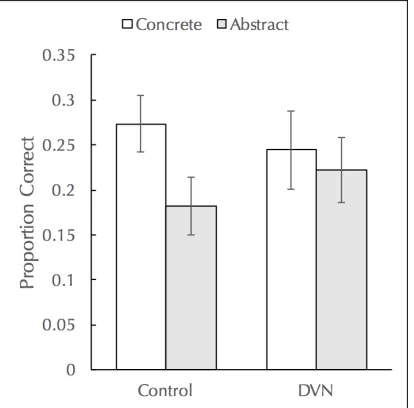
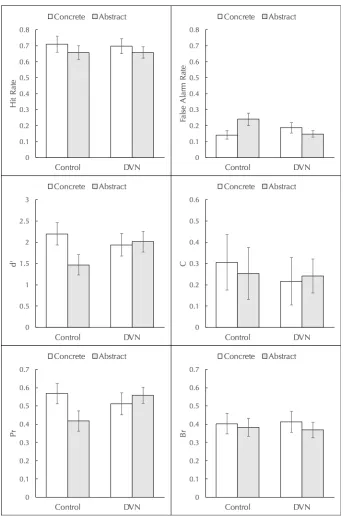
As can be seen in Figure 2, dynamic visual noise abolished, but did not reverse, the
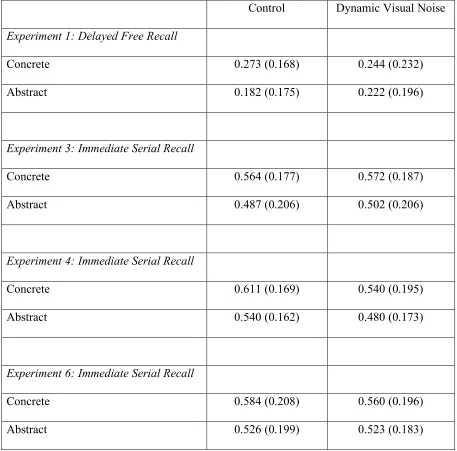
concreteness effect (the means and standard deviations are shown in Table 1). The proportion of
words recalled was analyzed by a 2 (word type: concrete vs. abstract) × 2 (noise condition:
control vs. dynamic visual noise) mixed factorial ANOVA. The main effect of word type was
significant, F(1, 48) = 13.259, MSE = 0.007, h2p = 0.186, p < 0.01, such that concrete words (M
= 0.258, SD = 0.202) were better recalled than abstract words (M = 0.202, SD = 0.185). The main
effect of noise condition was not significant, F(1, 58) < 1; the proportion of words recalled in the
control condition (M = 0.228, SD = 0.177) did not differ from the dynamic visual noise condition
(M = 0.233, SD = 0.213).
1 Parker and Dagnall (2009) asked subjects to write down the names of towns and cities in the
Importantly, a significant interaction between word type and noise condition was
observed, F(1, 58) = 4.899, MSE = 0.007, h2p = 0.078, p < 0.05. As shown in Figure 2, there was
a concreteness effect in the control group, with better recall of concrete (M = 0.273, SD = 0.168)
than abstract (M = 0.182, SD = 0.175) words, t(58) = 2.056, p < 0.05. In contrast, there was no
difference between recall of concrete (M = 0.244, SD = 0.232) and abstract (M = 0.222, SD =
0.196) words in the dynamic visual noise group, t(58) < 1.
These results confirm the original prediction of Parker and Dagnall (2009): in the absence
of dynamic visual noise there was a standard concreteness effect, with concrete words better
remembered than abstract words. In the presence of dynamic visual noise, however, there was no
difference in recall of concrete and abstract words. The results differ in that Parker and Dagnall
found that dynamic visual noise produced a reversal of the concreteness effect, whereas we
found that dynamic visual noise merely eliminated the standard effect. We shall revisit this
contrasting pattern of findings following exposition of Experiment 2, which was designed as a
replication of their recognition experiment.
Experiment 2 Ð Delayed Old/New Recognition
Experiment 2 was designed to replicate Experiment 2 of Parker and Dagnall (2009).
Subjects saw 30 words, half of which were abstract and half of which were concrete, followed by
a 4-minute distractor task of generating names of countries. This was then followed by a
recognition test. As in Experiment 1, we used visual rather than auditory presentation to ensure
that subjects saw the dynamic visual noise.
Subjects
Sixty different volunteers from Prolific AC participated and were randomly assigned to
19-38); 32 self-identified as male and 28 self-identified as female. Unlike with free recall, pilot
studies with recognition showed no differences in variability and therefore the sample size was
chosen to match that of Parker and DagnallÕs (2009) Experiment 2 (n = 30 per condition).
Design
There were two independent variables: (1) word type (abstract versus concrete), which
was manipulated within subjects, and (2) study background (dynamic visual noise or control),
which was manipulated between subjects.
Stimuli
The stimuli were identical to those used in Experiment 1.
Procedure
With the exception of the initial instructions, the procedure was identical to that of
Experiment 1 until the end of the 4-minute country naming task. Following this, subjects were
given a recognition test. A prompt (ÒWas this word shown in Phase I?Ó) and a word were shown,
and the subjects were asked to click on a button labelled ÒYesÓ or a button labelled ÒNoÓ. Sixty
words were shown; 30 were old words from the study phase, and 30 were new words, of which
half were abstract and half were concrete. The words chosen to be old and new items, and the
order of the test items, were randomly determined for each subject.
Results
There was no difference in performance on the distractor task: The mean number of
countries entered in the control group was 31.30 (SD = 9.35) compared to 31.13 (SD = 13.02) in
Recognition performance was analyzed using two different measures of discriminability
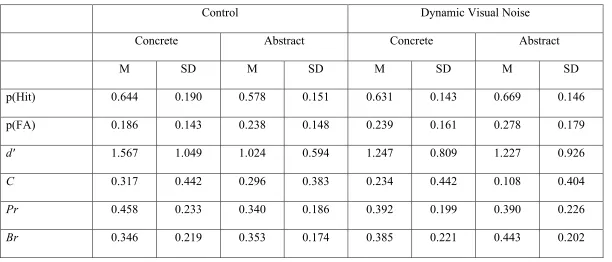
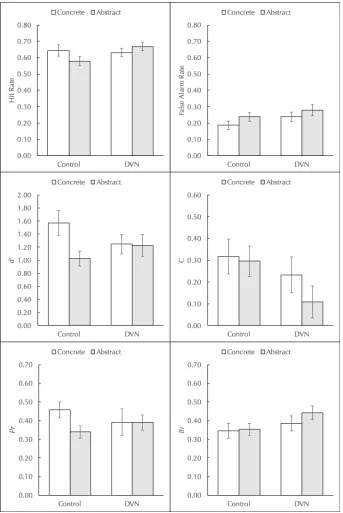
and bias: d′ and C, and Pr and Br.2 Table 2 shows these values, along with hit and false alarm
(FA) rates. As can be seen in Figure 3, dynamic visual noise abolished the concreteness effect as
measured by both d′ and Pr. For each measure of discriminability and bias, as well as for hits and
false alarm rates, a 2 (word type: concrete vs. abstract) × 2 (noise condition: control vs. dynamic
visual noise) mixed factorial ANOVA was conducted. We present the results for hit and false
alarm rates, d′ and C data, and Pr and Br data in turn.
Hits and False Alarms. For the proportion of hits, there was no main effect of word type, F(1, 58) < 1, with equivalent hit rates for both concrete (M = 0.637, SD = 0.167) and
abstract words (M = 0.623, SD = 0.154). There was likewise no main effect of noise condition,
F(1, 58) = 1.207, MSE = 0.037, h2p = 0.020, p > 0.25, with equivalent hit rates for the control (M
= 0.611, SD = 0.173) and the dynamic visual noise groups (M = 0.650, SD = 0.145). There was,
however, a significant interaction, F(1, 58) = 6.216, MSE = 0.013, h2p = 0.097, p < 0.05.
Whereas the hit rate was higher for concrete than abstract words in the control condition (0.644
vs. 0.578), t(58) = 2.052, p < 0.05, this was reversed for the dynamic visual noise condition
(0.631 vs. 0.669), although this latter difference was not significant, t(58) = 1.421, p > 0.15.
2 Subjects who had a hit rate of 1 or false alarm (FA) rate of 0 were given scores of 0.99 and
0.01, respectively. Pr is also known as the corrected recognition score because it is calculated as
the hit rate minus the false alarm rate. Br is the probability of saying ÒoldÓ to an item when
uncertain and is simply p(FA)/(1- Pr) (see Feenan & Snodgrass, 1990). A value of 0.5 for Br
indicates a neutral response, with smaller values indicating a conservative bias and larger values
The false alarm data showed a different pattern of results. There was a main effect of
word type, F(1, 58) = 5.198, MSE = 0.012, h2p = 0.082, p < 0.05, with a higher false alarm rate
for abstract words (M = 0.258, SD = 0.164) than for concrete words (M = 0.212, SD = 0.153).
There was no effect of noise condition, F(1, 58) = 1.709, MSE = 0.038, h2p = 0.029, p > 0.15,
with statistically equivalent false alarm rates in the control (M = 0.212, SD = 0.146) and the
dynamic visual noise condition (M = 0.259, SD = 0.170). The interaction was not significant,
F(1, 58) < 1.
d′ and C. For the d′ data, there was a significant main effect of word type, F(1, 58) =
5.949, MSE = 0.400, h2p = 0.093, p < 0.05, with better performance for concrete words (M =
1.407, SD = 0.943) than abstract words (M = 1.126, SD = 0.778). The main effect of group was
not significant, F(1, 58) < 1, with equivalent performance in the control (M = 1.296, SD = 0.888)
and dynamic visual noise conditions (M = 1.237, SD = 0.862). Importantly, the interaction was
significant, F(1, 58) = 5.124, MSE = 0.400, h2p = 0.081, p < 0.05. In the control condition,
performance was better with concrete than with abstract words, t(58) = 3.032, p < 0.01, but in the
dynamic visual noise condition there was no difference between the two types of words, t(58) <
1.
For the C data, the main effect of word type was not significant, F(1, 58) = 1.660, MSE =
0.082, h2p = 0.028, p > 0.20, with equivalent values for concrete (M = 0.275, SD = 0.440) and
abstract words (M = 0.202, SD = 0.402). The main effect of group was likewise not significant,
F(1, 58) = 2.177, MSE = 0.254, h2p = 0.036, p > 0.10, with comparable performance in the
control group (M = 0.307, SD = 0.410) and the dynamic visual noise group (M = 0.171, SD =
Pr and Br. Analyses of the Pr and Br data revealed the same pattern as that observed in
the d′ and C data. For Pr, there was a significant main effect of word type, F(1, 58) = 4.568, MSE
= 0.102, h2p = 0.073, p < 0.05, with better performance for concrete (M = 0.425, SD = 0.217)
than abstract words (M = 0.365, SD = 0.207). The main effect of group was not significant, F(1,
58) < 1, with equivalent performance in the control (M = 0.399, SD = 0.217) and dynamic visual
noise conditions (M = 0.391, SD = 0.211). Importantly, the interaction was significant, F(1, 58) =
4.285, MSE = 0.024, h2p = 0.069, p < 0.05. In the control condition, performance was better with
concrete than with abstract words, t(58) = 2.995, p < .01, but in the dynamic visual noise
condition there was no difference between the two types of words, t(58) < 1.
For the Br data, the main effect of word type was not significant, F(1, 58) = 1.288, MSE =
0.805, h2p = 0.022, p > 0.20, with equivalent values for concrete (M = 0.366, SD = 0.219) and
abstract words (M = 0.398, SD = 0.192). The main effect of group was not significant, F(1, 58) =
2.093, MSE = 0.060, h2p = 0.035, p > 0.15, with comparable performance in the control group (M
= 0.349, SD = 0.196) and the dynamic visual noise group (M = 0.414, SD = 0.212). The
interaction was not significant, F(1, 58) < 1.
Discussion
As in Experiment 1, the results of Experiment 2 confirm the original prediction of Parker
and Dagnall (2009) that dynamic visual noise eliminated the mnemonic advantage for concrete
words over abstract words. As in Experiment 1, the results of Experiment 2 did not replicate their
reversed concreteness effect. The hit rate data came closest to showing a reversal of the
concreteness effect, but the numerically higher hit rate for abstract over concrete words in the
dynamic visual noise condition did not reach the adopted significance level. For the two
There are two notable differences between the current experiments and those of Parker
and Dagnall (2009) that may have led to the contrasting pattern of findings. The first is the
change in presentation modality from auditory to visual. We chose visual presentation to ensure
that subjects were looking at the dynamic visual noise. To our knowledge, all instances of
dynamic visual noise occurring simultaneous with verbal stimulus presentation have involved
auditory presentation. As a consequence, there are no previous comparable extant data.
Nonetheless, it is not clear how or why presentation modality would alter the direction of the
concreteness effect.
A second notable difference between the studies is the stimulus set. Parker and Dagnall
(2009) used a small set of 15 concrete and 15 abstract nouns in their Experiment 1, and 24
concrete and 24 abstract words in Experiment 2. The abstract and concrete words had similar
values for meaningfulness, frequency, number of syllables, and length, but could have varied on
other dimensions. All subjects saw the same words. In contrast, we used a pool of 151 concrete
and 151 abstract words that were equated on more dimensions, including contextual diversity
and orthographic neighbourhood measures. Moreover, the norms used for frequency and
concreteness were more recent than those employed by Parker and Dagnall. Each subject saw a
random subset of words from the larger pool, a method that minimizes the possible effects of any
odd or unusual words. It may be that their particular sample of concrete and abstract words led to
the appearance of a reversal that is otherwise absent in broader stimulus sets.
It is also noteworthy that Parker and Dagnall (2009) were at something of a loss to
explain their reversed concreteness effect, stating that Òthe reason for this [reversal] remains to
highly concrete words by dynamic visual noise Òdisrupts processingÓ of the corresponding
wordÕs logogen. We revisit this issue in the General Discussion.
Experiment 3 Ð Immediate Serial Recall
Experiments 1 and 2 here, as well as the two experiments by Parker and Dagnall (2009),
used delayed tests in which the role of visual working memory or short-term memory is
minimized. Given that Parker and DagnallÕs proposed explanation emphasizes working memory,
the purpose of Experiment 3 was to examine whether dynamic visual noise interacts with the
concreteness effect when the task is more closely linked to working memory. The prototypical
working memory task is immediate serial recall; in fact, the original theoretical account of
working memory had its basis in four benchmark effects observed in immediate serial recall tests
(Baddeley, 1986). Ueno and Saito (2013, Experiment 1) used a 2 (memory task: paired
associates vs. immediate serial recall) × 2 (word type: high concreteness vs. low concreteness) ×
2 (noise condition: presence vs. absence of dynamic visual noise) design. They found no
interaction between dynamic visual noise and concreteness on the serial recall test. However, as
noted above, a number of studies have found that the effects of dynamic visual noise increase
when the rate of change increases (Dean et al., 2005; McConnell & Quinn, 2000; Quinn &
McConnell, 1999). Ueno and Saito used the same slow and small percentage change that Quinn
and McConnell (1996) used, only 291 squares in a 320 × 320 display changing once per second.
It is possible that with 50% of the squares changing 4 times a second, an effect might have been
observed. Therefore, Experiment 3 used the same dynamic visual noise manipulation as in
Experiments 1 and 2, but manipulated dynamic visual noise within subjects, just as Ueno and
floor effects, and we also used visual rather than auditory presentation to ensure that subjects in
the dynamic visual noise condition could not help but process the noise.
Subjects
Thirty different volunteers from Prolific AC participated. The mean age was 27.77 (SD =
5.35, range 20-38); 16 subjects self-identified as male, 13 self-identified as female, and 1 did not
answer the question. The sample size was half that of the previous experiments because of the
change from a between- to a within-subjects design.
Design
The two independent variables, both manipulated within subjects, were the word type
(abstract vs. concrete) and the background visible when the words were displayed (dynamic
visual noise vs. control). The dependent variable was the proportion of words that were correctly
recalled in order.
Stimuli
The stimuli were identical to those used in Experiments 1 and 2.
Procedure
Subjects first answered questions about their age and sex. After reading instructions on a
computer screen, subjects then clicked on a button to start the first trial. A list of 6 words were
shown one at a time for 1 s each. At the end of the list, the subject was prompted to type in the
first word, then the second word, and so on. Subjects were instructed that they needed to make 6
responses before they could start the next trial, and that they should either guess if they were
unsure, or else click on the ÒSkipÓ button to indicate they did not remember the word. The
There were 22 trials in total. The first two trials were unscored practice; one practice trial
used abstract words whereas the other used concrete words, and one practice trial involved
dynamic visual noise during encoding whereas the other was a control trial with no dynamic
visual noise. The specific pairing of abstract/concrete with dynamic visual noise/control was
determined randomly for each subject. For the remaining 20 trials, ten used abstract words and
ten used concrete words. The specific words used in each list, the order of the words, and the
order of the conditions was randomly determined for each subject. A given word could appear
only once during the entire experiment.
Results and Discussion
The results are shown in the upper row of Figure 4: A concreteness effect was observed
in both the control and the dynamic visual noise conditions. The overall mean proportion correct
in each condition is shown in Table 1. The proportion of words correctly recalled in order was
analyzed with a 2 (word type: concrete vs. abstract) × 2 (noise condition: control vs. dynamic
visual noise) × 6 (serial position: 1 Ð 6) repeated measures ANOVA. There was a significant
main effect of word type, F(1, 29) = 20.038, MSE = 0.049, h2p = 0.409, p < 0.01, with better
memory for concrete (M = 0.568, SD = 0.170) than abstract words (M = 0.494, SD = 0.194). The
main effect of noise condition was not significant, F(1, 29) < 1. The mean proportion of words
correctly recalled in order was comparable in the control (M = 0.526, SD = 0.181) and dynamic
visual noise conditions (M = 0.537, SD = 0.185). The main effect of position was significant,
F(5, 145) = 89.405, MSE = 0.049, h2p = 0.755, p < 0.01. None of the interactions were reliable;
the only interaction with F > 1 was word × position, F(5, 145) = 1.979, MSE = 0.031, h2p =
0.065, p = 0.085. Concrete and abstract words did not differ at the first or final positions, but did
The data were rescored using free recall rather than serial recall scoring. With free recall
scoring, a correct response includes recalling a word from the list in an incorrect position. This
increased the overall proportion correct in all conditions by approximately 10% but otherwise
had no effect on the results. There was a significant main effect of word type, F(1, 29) =10.119,
MSE = 0.054, h2p = 0.259, p < 0.01, with better memory for concrete (M = 0.654, SD = 0.148)
than abstract words (M = 0.599, SD = 0.181). The main effect of noise condition was not
significant, F(1, 29) < 1. The mean proportion of words correctly recalled in any order was
comparable in the control (M = 0.624, SD = 0.159) and dynamic visual noise conditions (M =
0.628, SD = 0.171). The main effect of position was significant, F(5, 145) = 54.897, MSE =
0.062, h2p = 0.654, p < 0.001. None of the interactions were reliable; all were F < 1. Thus, the
pattern of results is identical regardless of whether strict serial recall or free recall scoring is
used.
Dynamic visual noise did not eliminate the benefit for concrete over abstract words in an
immediate serial recall task. This result replicates the null result of Ueno and Saito (2013) even
though a more ÒpowerfulÓ manipulation of dynamic visual noise was used which had been found
in Experiments 1 and 2 to affect memory for concrete items. It also replicates the null results of
Castellˆ and Campoy (in press). However, there is one obvious difference, other than the test,
between Experiment 3 and Experiments 1 and 2: In the first two experiments, dynamic visual
noise was manipulated between-subjects whereas the third experiment used a within-subjects
manipulation. Experiment 3 was run as a completely within-subjects design because that is the
common design when exploring other working memory phenomena, such as the interaction
between concurrent articulation and phonological similarity (e.g., V. Coltheart, 1993) or the
1984). Moreover, it was also the design used by Ueno and Saito (2013). A number of researchers
have shown that manipulating dynamic visual noise within subjects does impair memory. For
example, Dent (2010) found that dynamic visual noise manipulated within subjects affected
memory for colours. Similarly, Dean et al. (2008) found that dynamic visual noise manipulated
within subjects affected memory for textures. Nevertheless, it is possible that the failure to find
an effect of dynamic visual noise in Experiment 3 was due to the design and therefore we
conducted Experiment 4 to test this possibility. Like Experiment 3, Experiment 4 examined the
effects of dynamic visual noise on immediate serial recall of concrete and abstract words. Unlike
Experiment 3, however, the dynamic visual noise versus control conditions were run as a
between-subjects manipulation, as they were in Experiments 1 and 2.
Experiment 4 Ð Immediate Serial Recall
Experiment 4 was nearly identical to Experiment 3 except that dynamic visual noise was
manipulated between-subjects rather than within-subjects.
Subjects
Sixty different volunteers from Prolific AC participated. The mean age was 28.35 (SD =
5.87, range 19-38); 35 self-identified as male, 23 self-identified as female, and 2 did not respond
to the question. The sample size was double that of Experiment 3 due to the change from a
within- to a between-subjects manipulation of dynamic visual noise.
Design
The two independent variables were word type (abstract vs. concrete), which was
manipulated within subjects, and the background visible when the words were displayed
(dynamic visual noise vs. control), which was manipulated between subjects. The dependent
Stimuli
The stimuli were identical to those of Experiments 1-3.
Procedure
The procedure was nearly identical to that of Experiment 3, except for the following.
There were 18 lists rather than 22; however, there were now 9 lists per condition (abstract or
concrete), due to the between-subjects manipulation of dynamic visual noise.
Results and Discussion
The results are shown in the middle row of Figure 4 and are the same as those observed
in Experiment 3: A concreteness effect was observed in both the control and the dynamic visual
noise conditions. The overall mean proportion correct in each condition is shown in Table 1. The
proportion of words correctly recalled in order was analyzed with a 2 (word type: concrete vs.
abstract) × 2 (noise condition: control vs. dynamic visual noise) × 6 (serial position: 1 Ð 6) mixed
ANOVA. There was a significant main effect of word type, F(1, 58) = 25.234, MSE = 0.031, h2p
= 0.303, p < 0.01, with better memory for concrete (M = 0.576, SD = 0.118) than abstract words
(M = 0.510, SD = 0.110). The main effect of noise condition was not significant, F(1, 58) =
2.306, MSE = 0.337, h2p = 0.038, p > 0.10, with comparable proportions of words correctly
recalled in order in the control (M = 0.576, SD = 0.159) and dynamic visual noise conditions (M
= 0.510, SD = 0.176).3 The main effect of position was significant, F(5, 290) = 128.622, MSE =
0.046, h2p = 0.689, p < 0.01. As in Experiment 3, none of the interactions were significant; the
only interaction with F > 1 was word × position, F(5, 290) = 1.531, MSE = 0.015, h2p = 0.026, p
3 Reporting means of 0.576 and 0.510 for concrete and abstract (respectively) and also for
control and dynamic visual noise (respectively) is not an error but a coincidence. As the text
> 0.15. Concrete and abstract words did not differ at the first position, but did differ at other
positions, although this trend was not sufficient to support a significant interaction.
As in Experiment 3, the data were rescored using free recall criteria: If the subject
reported a word from the list, it was counted as correct regardless of its position. There was a
significant main effect of word type, F(1, 58) = 22.191, MSE = 0.021, h2p = 0.277, p < 0.01, with
better memory for concrete (M = 0.655, SD = 0.099) than abstract words (M = 0.605, SD =
0.092). The main effect of noise condition was not significant, F(1, 58) = 2.378, MSE = 0.241,
h2p = 0.039, p > 0.10, with comparable proportions of words correctly recalled in order in the
control (M = 0.658, SD = 0.134) and dynamic visual noise conditions (M = 0.602, SD = 0.150).
The main effect of position was significant, F(5, 290) = 78.089, MSE = 0.134, h2p = 0.574, p <
0.01. None of the interactions were significant. All had F < 1 except for word type × noise, F(1,
58) = 1.143, MSE = 0.021, h2p = 0.019, p > 0.25; and for word × position, F(5, 290) = 1.119,
MSE = 0.018, h2p = 0.019, p > 0.35. As in Experiment 3, the pattern of results are the same
regardless of whether serial recall or free recall scoring is used.
Thus, dynamic visual noise had no effect on memory for concrete or abstract words in an
immediate serial recall task regardless of whether the dynamic visual noise was manipulated
between subjects (Experiment 3) or within subjects (Experiment 4). These two null results
replicate the null result reported by Ueno and Saito (2013).
Immediate serial recall differs from delayed free recall and delayed recognition in a
number of ways, with the most obvious being the delay and the importance of order information.
In order to assess whether these differences are the reason for the lack of an effect of dynamic
visual noise, Experiment 5 also used an immediate test that requires order information:
words followed immediately by a second short list. The second list is either the same as the first
or has two adjacent items transposed, and the subjectÕs task is to indicate whether the lists are the
same or different (see, e.g., Allport, 1984; Gathercole, Pickering, Hall, & Peaker, 2001;
Kinsbourne, 1972).
Two prior studies have examined whether a standard concreteness effect obtains in
immediate serial recognition. Walker and Hulme (1999) reported no concreteness effect, but they
used a small set of items and analyzed only a span score based on the number of trials correct.
Romani et al. (2008) used both a large and a small set of items, and observed a concreteness
effect with the large pool but not with the small pool, but they analyzed only proportion correct
as the measure.
Experiment 5 Ð Immediate Serial Recognition
Experiments 1 and 2 here, as well as the two experiments by Parker and Dagnall (2009),
used delayed tests in which the role of visual working memory or short-term memory is
minimized; in all four experiments, dynamic visual noise interacted with concreteness.
Experiments 3 and 4 used an immediate serial recall test which is directly linked to working
memory but found no effect of dynamic visual noise, replicating the results of Ueno and Saito
(2013). The purpose of Experiment 5 was to use a different immediate test that, like immediate
serial recall, also requires order information to assess whether the detrimental effects of dynamic
visual noise are limited to delayed tests that de-emphasize order information.
Subjects
Sixty different volunteers from Prolific AC participated and were randomly assigned to
one of two groups (control or dynamic visual noise). The mean age was 29.40 (SD = 5.50, range
Design
The two independent variables were word type (abstract vs. concrete), which was
manipulated within subjects, and the background visible when the words were displayed
(dynamic visual noise vs. control), which was manipulated between subjects.
Stimuli
The stimuli were identical to those of Experiments 1-4.
Procedure
Subjects first answered questions about their age and sex. After reading instructions on a
computer screen, they then clicked on a button to start. Six words were shown one at a time for 1
s each in white font against a black rectangle in the centre of the screen. A prompt then appeared,
ÒIs this the same order or a different order?Ó and then six words were again shown at the same
rate. Half the time, the second list was identical to the first; the other half of the time, two
adjacent items were transposed. The computer randomly transposed either items 2 and 3, items 3
and 4, items 4 and 5, or items 5 and 6. At the end of the second list, the subject clicked on either
the ÒSameÓ or the ÒDifferentÓ button.
In the control condition, no visual noise was present; the background was solid black. In
the dynamic visual noise condition, the noise accompanied presentation of the first list of 6
words but was not present for the second list. There were 32 lists, half of which were the same in
both presentations and half of which were different across the two presentations. Sixteen lists
had abstract words and sixteen had concrete words. The specific words used, the order of the
words, and the order of the conditions was randomly determined for each subject.
We first report proportion correct so that the results may be compared to those of Walker
and Hulme (1999) and Romani et al. (2008). In addition, we classified correct decisions on
different trials as hits, and correct decisions on same trials as correct rejections (MacMillan &
Creelman, 2004). This allowed us to analyze not only hits and false alarms, but also two different
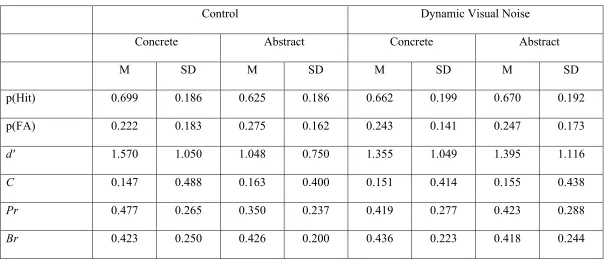
measures of discriminability and bias: d′ and C, and Pr and Br. Table 3 shows these values, along
with hit and false alarm rates. As can be seen in Figure 5, dynamic visual noise abolished the
concreteness effect as measured by both d′ and Pr. For each measure of discriminability and bias,
as well as for proportion correct, hits and false alarm rates, a 2 word type (concrete vs. abstract)
× 2 noise condition (control vs. dynamic visual noise) mixed factorial ANOVA was conducted.
We discuss the results for proportion correct, hit and false alarm rates, d′ and C data, and Pr and
Br data in turn.
Proportion Correct. For proportion correct, the main effect of word type just failed to
reach the adopted significance level, F(1, 58) = 3.567, MSE = 0.008, h2p = 0.058, p = 0.064. The
proportion correct for concrete words was 0.725 (SD = 0.136) compared to 0.694 (SD = 0.133)
for abstract words. The proportion correct in the control condition (M = 0.707, SD = 0.129) was
the same as in the dynamic visual noise condition (M = 0.711, SD = 0.136), F(1,58) < 1.
However, the interaction was significant, F(1, 58) = 4.058, MSE = 0.008, h2p = 0.065, p < 0.05.
In the control condition, the proportion correct was higher for concrete (M = 0.740, SD = 0.133)
than abstract (M = 0.675, SD = 0.119) words, t(29) = 3.346, p < 0.01. In the dynamic visual noise
condition, there was no difference between the proportion correct was for concrete (M = 0.710,
SD = 0.140) and the proportion correct for abstract (M = 0.713, SD = 0.146) words, t(29) =
Hits and False Alarms. For the proportion of hits, there were no significant effects. The hit rate for concrete words (M = 0.681, SD = 0.192) did not differ from that for abstract words
(M = 0.648, SD = 0.188), F(1, 58) = 1.757, MSE = 0.019, h2p = 0.029, p > 0.15. The hit rate in
the control condition (M = 0.662, SD = 0.188) was the same as in the dynamic visual noise
condition (M = 0.666, SD = 0.194), F(1,58) < 1. The interaction was not significant, F(1, 58) =
2.757, MSE = 0.019, h2p = 0.045, p > 0.10.
The false alarm data also showed no significant effects. The false alarm rate for concrete
words (M = 0.232, SD = 0.162) did not differ from the false alarm rate for abstract words (M =
0.261, SD = 0.167), F(1, 58) = 1.307, MSE = 0.019, h2p = 0.022, p > 0.25. Similarly, the false
alarm rate in the control condition (M = 0.249, SD = 0.173) did not differ from the false alarm
rate in the dynamic visual noise condition (M = 0.245, SD = 0.157), F(1, 58) < 1. The interaction
was not significant, F(1,58) < 1.
d′ and C. For the d′ data, the main effect of word type just failed to reach the adopted significance level, F(1, 58) = 3.515, MSE = 0.494, h2p = 0.057, p = 0.066, although numerically
performance was higher for concrete (M = 1.462, SD = 1.046) than abstract words (M = 1.222,
SD = 0.959). The main effect of group was not significant, F(1, 58) < 1, with equivalent
performance in the control (M = 1.309, SD = 0.942) and dynamic visual noise conditions (M =
1.375, SD = 1.074). Importantly, the interaction was significant, F(1, 58) = 4.797, MSE = 0.494,
h2p = 0.076, p < 0.05. In the control condition, performance was better with concrete than with
abstract words, t(58) = 3.071, p < 0.01, but in the dynamic visual noise condition there was no
difference between the two types of words, t(58) < 1.
Pr and Br. The results of the analyses of the Pr and Br data revealed the same pattern as
was observed in the d′ and C data. In the Pr data, the main effect of word type just failed to reach
the adopted significance level, F(1, 58) = 3.548, MSE = 0.032, h2p = 0.058, p = 0.065, although
numerically performance was again higher for concrete (M = 0.448, SD = 0.270) than abstract
words (M = 0.386, SD = 0.264). The main effect of group was not significant, F(1, 58) < 1, with
equivalent performance in the control (M = 0.413, SD = 0.257) and dynamic visual noise
conditions (M = 0.421, SD = 0.281). Importantly, the interaction was significant, F(1, 58) =
4.001, MSE = 0.032, h2p = 0.065, p = 0.05. In the control condition, performance was better with
concrete than with abstract words, t(58) = 3.347, p < .01, but in the dynamic visual noise
condition there was no difference between the two types of words, t(58) < 1.
In the Br data, as with the C data, both main effects and the interaction had F(1,58) < 1.
Discussion
When proportion correct was the measure, the control condition of Experiment 5
replicated the finding of Romani et al. (2008) of a concreteness effect with a large set size.
Experiment 5 also found the same interaction between dynamic visual noise and concreteness in
an immediate memory task as was found in the delayed free recall and delayed recognition tasks
in Experiments 1 and 2. That is, dynamic visual noise eliminated the benefit for concrete over
abstract words, as measured by proportion correct, d′ and Pr. Thus, the detrimental effect of
dynamic visual noise on the concreteness effect is not restricted to delayed tests that do not
emphasize order information. This extends the findings of Parker and Dagnall (2009) and reveals
that the interaction between dynamic visual noise and word concreteness is the same in both
However, the results for serial recognition differ strikingly from those for serial recall
(Experiments 3 and 4). Although the two tasks appear similar Ð they are both immediate tests
that require order information Ð and have generally been treated as similar in the literature
(Baddeley, Chincotta, Stafford, & Turk, 2002; Gathercole et al., 2001), they do differ in
potentially important ways. For example, if subjects are aware that the test is immediate serial
recall, they may encode and process the words differently than if the test is immediate serial
recognition because in the recall task they have to actually generate and type in the words
whereas in the recognition task they merely have to click on a button. The purpose of the final
experiment was to determine if differential processing prior to test was playing a role in causing
the different results for these two tests.
Experiment 6 Ð Immediate Serial Recall and Recognition
Experiment 5 used immediate serial recognition and found that dynamic visual noise
eliminated the concreteness effect whereas Experiments 3 and 4 used immediate serial recall and
found no effect of dynamic visual noise. The purpose of Experiment 6 was to assess whether
knowledge of the type of up-coming test was a cause of the contrasting patterns of findings
across the pervious experiments. Now, subjects saw lists of 6 concrete or 6 abstract words, but
did not know the type of test until after the list had been presented. Such a manipulation was
deemed important so as to examine the degree to which memory performance was dependent on
selective processes deployed in expectation of a particular type of test (cf. Duncan & Murdock,
2000).
Subjects
Sixty different volunteers from Prolific.AC participated and were randomly assigned to
20-38), 33 identified themselves as female, 26 identified themselves as male, and 1 did not
respond to the question.
Design
The two independent variables were the type of word, abstract or concrete, which was
manipulated within subjects, and the background visible when the words were displayed: no
noise or dynamic visual noise, which was manipulated between subjects. Although type of test,
immediate serial recall or immediate serial recognition, was manipulated within subjects, the
purpose of the experiment was to compare performance with Experiments 3/4 and 5,
respectively, rather than to compare serial recall with serial recognition.
Stimuli
A new set of stimuli were created because the additional trials in this experiment meant
that a larger number of words was needed. The stimuli were generated in the same way and were
equated on the same dimensions as in the previous experiments, and details of the 196 concrete
and 196 abstract 1 syllable nouns are in the appendix.
Procedure
The procedure was almost identical to that in Experiment 4 (for the serial recall trials)
and Experiment 5 (for the serial recognition trials). Both types of tests were described to the
subject prior to the beginning of the experiment. On each trial, the subject did not know the type
of test until after the final word had been shown. There were 64 lists, half of which were
followed by a serial recognition test and half of which were followed by an immediate serial
recall test. The 32 serial recognition tests were the same as in Experiment 5. The number of
often. The type of trial (concrete or abstract), the specific words, and the order of the tests were
all randomized for each subject.
Results
Serial Recall. The results from the immediate serial recall trials are shown in the bottom
row of Figure 4 and are the same as in Experiments 3 and 4: A concreteness effect was observed
in both the control and the dynamic visual noise conditions. The overall mean proportion correct
and standard deviations are shown in Table 1. The proportion of words correctly recalled in order
was analyzed with a 2 (word type: concrete vs. abstract) × 2 (noise condition: control vs.
dynamic visual noise) × 6 (serial position: 1 Ð 6) mixed ANOVA. There was a significant main
effect of word type, F(1,58) = 25.998, MSE = 0.015, h2p = 0.310, p < 0.01, with better memory
for concrete (M = 0.572, SD = 0.200) than abstract words (M = 0.525, SD = 0.189). The main
effect of noise condition was not significant, F < 1, with the proportion of words correctly
recalled in order in the control group 0.555 (SD = 0.242) the same as in the dynamic visual noise
group 0.542 (SD = 0.189). The main effect of position was significant, F(5,290) = 117.819, MSE
= 0.033, h2p = 0.670, p < 0.01. As in Experiments 3 and 4, none of the interactions were
significant; the only interaction with F > 1 was word × group, F(5,58) = 1.182, MSE = 0.015, h2p
= 0.020, p > 0.25.
As in the two previous serial recall experiments, the data were also scored according to
free recall criteria and re-analyzed. There was a significant main effect of word type, F(1,58) =
38.066, MSE = 0.013, h2p = 0.396, p < 0.01, with better memory for concrete (M = 0.644, SD =
0.176) than abstract words (M = 0.593, SD = 0.170). The main effect of noise condition was not
significant, F < 1, with the proportion of words correctly recalled in the control group 0.621 (SD
position was significant, F(5,290) = 77.101, MSE = 0.035, h2p = 0.571, p < 0.01. None of the
interactions were significant; the only interaction with F > 1 was word × group, F(5,58) = 2.559,
MSE = 0.013, h2p = 0.042, p > 0.10. The pattern of results with free recall scoring was therefore
the same as with serial recall scoring, as in the two previous experiments.
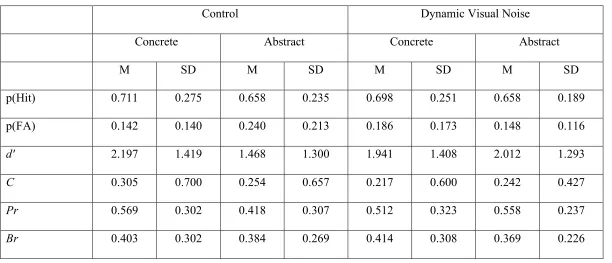
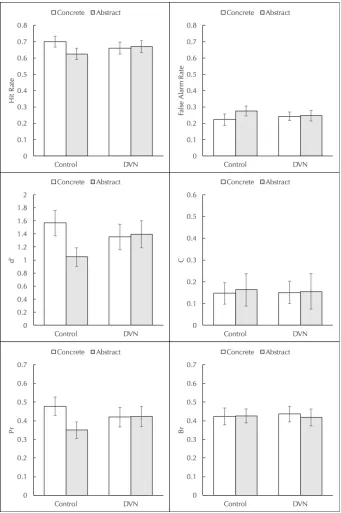
Serial Recognition. As can be seen in Figure 6, dynamic visual noise abolished the
concreteness effect as measured by proportion correct and by both d′ and Pr, just as was found in
Experiment 5. The proportion correct, hit and false alarm rates, and each measure of
discriminability and bias, were analyzed with a 2 word type (concrete vs. abstract) × 2 noise
condition (control vs. dynamic visual noise) mixed factorial ANOVA. We discuss the results for
each measure in turn.
Proportion Correct. For proportion correct, the main effect of word type was not
significant, F(1, 58) = 2.765, MSE = 0.008, h2p = 0.046, p > 0.10. The proportion correct for
concrete words was 0.773 (SD = 0.158) compared to 0.746 (SD = 0.142) for abstract words. The
proportion correct in the control condition (M = 0.749, SD = 0.158) was the same as in the
dynamic visual noise condition (M = 0.770, SD = 0.143), F(1,58) < 1. However, the interaction
was significant, F(1, 58) = 9.424, MSE = 0.008, h2p = 0.140, p < 0.01. In the control condition,
the proportion correct was higher for concrete (M = 0.788, SD = 0.154) than abstract (M = 0.710,
SD = 0.155) words, t(29) = 3.178, p < 0.01. In the dynamic visual noise condition, there was no
difference between the proportion correct was for concrete (M = 0.758, SD = 0.164) and the
proportion correct for abstract (M = 0.781, SD = 0.121) words, t(29) = 0.991, p > 0.15.
Hits and False Alarms. For the proportion of hits, there were no significant main effects.
The hit rate for concrete words (M = 0.704, SD = 0.261) did not differ from that for abstract
SD = 0.255) was the same as in the dynamic visual noise condition (M = 0.702, SD = 0.220),
F(1,58) < 1. The interaction was not significant, F(1, 58) = 1.823, MSE = 0.015, h2p = 0.016, p >
0.15. This is the same pattern as in Experiment 5.
For the false alarm data, there was one difference from the results in Experiment 5. In
that experiment, there were no significant effects whereas in this experiment, the interaction was
significant. The false alarm rate for concrete words (M = 0.164, SD = 0.158) did not differ from
the false alarm rate for abstract words (M = 0.194, SD = 0.176), F(1, 58) = 1.872, MSE = 0.015,
h2p = 0.031, p > 0.15. Similarly, the false alarm rate in the control condition (M = 0.191, SD =
0.186) did not differ from the false alarm rate in the dynamic visual noise condition (M = 0.167,
SD = 0.147), F(1, 58) < 1. However, the interaction was significant, F(1, 58) = 9.577, MSE =
0.015, h2p = 0.142, p < 0.01. As can be seen from the means in Table 4, the false alarm rate was
higher for abstract words in the control group, but was lower for abstract words in the dynamic
visual noise group.
d′ and C. For the d′ data, there was a significant main effect of word type, F(1,58) =
5.195, MSE = 0.625, h2p = 0.082, p < 0.05, with better performance for concrete (M = 2.069, SD
= 1.401) than abstract words (M = 1.740, SD = 1.314). The main effect of group was not
significant, F(1,58) < 1, with equivalent performance in the control (M = 1.833, SD = 1.400) and
dynamic visual noise conditions (M = 1.976, SD = 1.134), d = 0.105. Importantly, the interaction
was significant, F(1,58) = 7.684, MSE = 0.625, h2p = 0.117, p < 0.01. In the control condition,
performance was better with concrete than with abstract words, t(58) = 2.075, p < .05, d = 0.535,
but in the dynamic visual noise condition there was no difference between the two types of
words, t(58) < 1, d = 0.053. This is almost the same as in Experiment 5, except there the main