This is a repository copy of
Simulation of Waste Heat Recovery System with Fuzzy Based
Evaporator Model
.
White Rose Research Online URL for this paper:
http://eprints.whiterose.ac.uk/134144/
Version: Accepted Version
Proceedings Paper:
Chowdhury, J.I., Soulatiantork, P. orcid.org/0000-0003-3212-8220 and Nguyen, B.K.
(2018) Simulation of Waste Heat Recovery System with Fuzzy Based Evaporator Model.
In: 2017 11th Asian Control Conference (ASCC). 2017 11th Asian Control Conference
(ASCC), 17-12-2017-20-12-2017, Gold Coast, Australia. IEEE , pp. 2143-2147. ISBN
978-1-5090-1573-3
https://doi.org/10.1109/ASCC.2017.8287506
[email protected] https://eprints.whiterose.ac.uk/
Reuse
Items deposited in White Rose Research Online are protected by copyright, with all rights reserved unless indicated otherwise. They may be downloaded and/or printed for private study, or other acts as permitted by national copyright laws. The publisher or other rights holders may allow further reproduction and re-use of the full text version. This is indicated by the licence information on the White Rose Research Online record for the item.
Takedown
If you consider content in White Rose Research Online to be in breach of UK law, please notify us by
© © 2017 IEEE. Personal use of this material is permitted. Permission from IEEE must be obtained for all other
uses, in any current or future media, including reprinting/republishing this material for advertising or
promotional purposes, creating new collective works, for resale or redistribution to servers or lists, or reuse of
any copyrighted component of this work in other works
Simulation of Waste Heat Recovery System with Fuzzy Based
Evaporator Model
J. I. Chowdhury, P. Soulatiantork, B. K. Nguyen, Member, IEEE
Abstract—The organic Rankine cycle (ORC) is one of the
promising waste heat recovery (WHR) technologies used to improve the thermal efficiency, reduce the emissions and save the fuel costs of internal combustion engines. In the ORC- WHR system, the evaporator is considered to be the most critical component as the heat transfer of this device influences the efficiency of the system. Although the conventional Finite Volume (FV) model can successfully capture the complex heat transfer process in the evaporator, the computation time for this model is high as it consists of many iterative loops. To reduce the computation time, a new evaporator model using the fuzzy inference technique is developed in this research. The developed fuzzy based model can predict the evaporator outputs with an accuracy of over 90% while it reduces the simulation time significantly. This model is then integrated with other components of the ORC to simulate a completed ORC-WHR system for internal combustion engines. The influence of operating parameters on the performance of the WHR system is investigated in this paper.
I. INTRODUCTION
Most of the energy produced by internal combustion engines is expelled to the environment via the exhaust and coolant systems. The expelled energy makes the engine running cost high and is one of the major causes of global warming and environmental pollution. In order to reduce fuel consumption, waste heat recovery (WHR) has been used to collect the heat from the exhaust or coolant and convert it into either mechanical or electrical power, which increases the thermal efficiency of the engine (1).
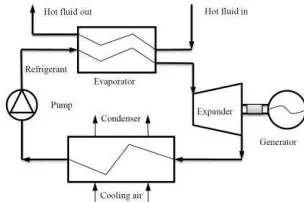
[image:2.596.362.514.252.353.2]The ORC WHR system consists of four major components: pump, evaporator, expander and condenser, as shown in Figure 1. Liquid refrigerant is pumped to the evaporator where it is heated and vaporized by the heat sources. This vaporized fluid is then expanded and produces mechanical energy output through the shaft of the expander.
Figure 1. Components of a typical Organic Rankine Cycle (ORC)
WHR system
technique is a highly time consuming method since it consists of many iterative loops (5, 6), therefore, it has a limitation in real time control applications. In order to reduce the computation time of the evaporator model, a new evaporator model using the fuzzy inference technique is introduced and described in this paper. The developed fuzzy based evaporator model is then integrated and simulated with models of other components in the WHR system to investigate the effect of operating parameters on the performance of the WHR system.
II. FUZZY BASED EVAPORATOR MODEL
Among the conventional heat exchangers available in the market, a plate heat exchanger has a large heat transfer area along with high compactness which is suitable to recover a maximum amount of heat from the heat sources (5). This type of heat exchanger is therefore used as the evaporator for the simulation in this research. The geometrical dimensions and parameters of the selected evaporator are listed in Table 1.
TABLE I SPECIFICATIONS OF THE EVAPORATOR (7)
A generator is normally coupled with the expander shaft to
convert mechanical energy into electrical power. Exhaust products from the expander pass through the condenser where secondary cooling fluid removes extra heat and converts the exhaust back to a liquid.
The operating conditions of the ORC have a significant influence on the thermal efficiency and heat utilization of the WHR system. Two classified operating conditions of the ORC waste heat recovery system can be observed: subcritical and supercritical. The operating pressure of the subcritical ORC is below the critical pressure of the working fluid; while the supercritical ORC is run at a pressure higher than the critical pressure.
Modelling of the evaporator in the ORC WHR system has been addressed in several reports (2, 3). Despite high accuracy and robustness (4), the finite volume modelling
J. I. Chowdhury is now with the Cranfield University, Cranfield, MK43 0AL, UK (email: [email protected]).
P. Soulatiantork is with the Queen’s University Belfast, Belfast BT9 5AH, UK (email: [email protected]).
Symbol Parameter Value
A Heat transfer area of the evaporator 5.78 m2
L Length of the plate 0.478 m
W Width of the plate 0.124 m
Np Number of plates 100
[image:2.596.320.535.643.705.2]The fuzzy technique introduced by Mamdani & Assilian (8) is used to develop the evaporator model in this research. The proposed fuzzy-based evaporator model consists of three inputs and two outputs and is shown in
Fig. 2. The mass flow rate of refrigerant mr , the mass flow
rate of hot fluid mh and
the temperature of hot fluid Th are considered as the
inputs of the model; whereas the evaporator heat input
Qev and the
B.K. Nguyen is with the University of Sussex, Brighton, BN1
9QT, UK (phone: +44 (0)12-7387-2869; email:
Figure 2. Fuzzy inference system for evaporator
evaporator outlet temperature Tev are considered to be the
outputs of the model. The fuzzy-based evaporator model represents the nonlinearity of the system by a logical mapping of its input variables to the output variables. The fuzzy logic is used to predict an unknown output of a system by establishing the degree of matching among the known inputs and outputs relationships. The development steps of the fuzzy-based evaporator model can be described as follows:
Step 1: Variables identification
The minimum and maximum values of the inputs and
[image:4.596.316.540.67.154.2](a) (b)
Figure 5. Fuzzy surface of the evaporator outlet temperature with respect
to mr and mh (a), and with respect to mr and Th (b)
outputs variables of the fuzzy model are as follows:
[mr min , mr max ] [28.6 (gm/s), 255 (gm/s)],
[image:4.596.315.556.198.295.2](a) (b)
Figure 6. Fuzzy surface for the evaporator power with respect to mr
and
[mh min , mh max ] [50 (gm/s), 300 (gm/s)], [Th min ,Th max ]
[403 (K), 525 (K)], [Qev min ,Qev max ] = [-11 (kW), 80 (kW)]
and [Tev min ,Tev max ] [336 (K), 517 (K)], respectively.
These ranges were identified from the inputs and outputs of the WHR system and adjusted from the knowledge and experience of the system and were normalized over the
mh (a), and with respect to mr and Th (b)
interval [0, 1], as shown in Figs. 3-4. The actual crisp values of the model parameters are calculated from the normalised
values as follows: mr 28.6 226.4 mr;
mh 50 250 mh
; Th 403 122Th; Tev 336 181Tev
; Qev 11 91Qev
where mr
, mh
, Th
, Tev
and Qev
are the normalised values of their corresponding variables.
Step 2: Fuzzification
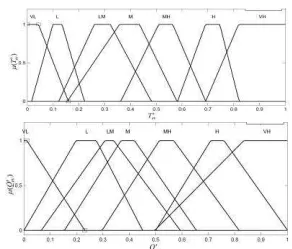
The variables ranges identified in step 1 are divided into several linguistic levels. The linguistic levels assigned to the input and output variables of the model are as follows: VL: Very Low; L: Low; LM: Low to Medium; M: Medium; MH: Medium to High; H: High and VH: Very High. The input and output membership functions are shown in Figs. 3 and 4.
Step 3: Fuzzy rules and fuzzy reasoning
The fuzzy rules of the evaporator model are created using the above fuzzy sets of the input and output variables and can be presented as follows:
Figure 3. Membership functions of input variables. Rule i : IF mr is
i AND mh is
i AND Th is
i THENTev is
i AND Qev is
i (1)where i 1, 2, 3...n , n is the number of fuzzy rules,
i ,
i ,
i ,
i ,
i are the i th fuzzy sets of the input and outputFigure 4. Membership functions of output variables
variables of the fuzzy system.
The fuzzy rules used in this model are shown in Figs. 5-6.
Step 4: Defuzzification
The centroid defuzzification method (9) is used in this paper to convert the aggregated fuzzy set to a crisp output
value Y from the fuzzy set in V R . The crisp output
[image:4.596.114.252.405.592.2] [image:4.596.103.249.617.742.2]0
Finite volume model Fuzzy based model Ramp profile Ma ss f low rate (gm /s) E vap o ra to r out le t te m p e ra tu re ( K ) E v ap o ra to r p o w e r (kW ) T e m p e ra tu re ( k ) 300 200 100 0 550 500 450 400
0 500 1000 1500
Time (s)
Figure 7. Heat source mass flow rate and temperature
70 60 50 40 30 20 10 0
500 1000 1500
[image:5.596.69.276.63.363.2]Time (s)
Figure 8. Prediction of the evaporator power with respect to ramp profile.
[image:5.596.322.536.82.196.2]440 430
Figure 10. Overall model of the ORC-WHR system.
a) The mass flow rates of the pump and through all other
components are assumed to be equal,
m
p
m
r ,i
m
exp
m
c .b) Pressure at the pump outlet is equal to the pressure of
the evaporator and at the expander inlet, such that
420
410
P
p,o
P
ev,i
P
ev,o
P
exp,i .400 390 380
c) Pressure at the expander outlet and in the condenser is
equal to the pressure at the pump inlet, such that
370
0 500
Time (s) 1000 1500
P
exp,o
P
c
P
p,i .Figure 9. Prediction of the evaporator outlet temperature with respect to ramp profile.
V
( y). ydyd) The enthalpy at the pump outlet and at the evaporator
inlet are equal,
H
p,o
H
r,i .e) Enthalpy and specific volume of the refrigerant at the
pump inlet is a function of inlet pressure,
Y
V
( y)dy(2)
H
p,i
,
p
f (P
p,i)
and the temperature of therefrigerant at the inlet of the evaporator is a function of
The crisp value of Qev
above expression.
and Tev were calculated using the the enthalpy and pressure at the pump outlet,
T
r,i
f (P
p,o, H
p,o)
.To predict the fuzzy model outputs, the evaporator is simulated with the heat source shown in Fig. 7 and a random ramp profile of refrigerant flow rates. The fuzzy
model outputs, Qev and Tev , are compared with the
conventional FV method (7) and presented in Figs. 8-9. The RMSE and congruency of fit between the fuzzy model
and the FV model for the Qev are 0.95 kW and 93.68%,
and for Tev are 1.48 K and 89.16%, respectively. Results
show that the developed fuzzy model can be used to estimate the evaporator outputs accurately. The time used for the simulation of the random heat source in the fuzzy- based model is 5.19 s, compared to 3820.6 s of the FV model.
III. OVERALL MODEL OF WHR SYSTEM
The overall model of the cycle shown in Fig. 10 is built by interconnecting all subcomponents in the WHR system. The inputs and outputs of the adjacent components are as follows:
TABLE 2 OVERALL MODEL PARAMETERS
Input variables Output variables
N p , Pp,i , Pp,o, mh ,Th Qev ,Tev ,Wp ,Wexp,Qc
By interconnecting the individual inputs and outputs of each component, a set of overall model inputs-outputs can be defined and listed in Table 2.
IV. SIMULATION RESULTS
A generic heat source in terms of variable mass flow rate and temperature (Fig. 7) defined by Quoilin et al. (10) is used for the investigation of the waste heat recovery system at supercritical condition. The working fluid of the ORC used in this simulation is R134a, which is widely used for commercial purposes, readily available and has a high auto- ignition temperature. To investigate the effect of operating parameters on the system output, a random pump speed profile ranging from 200RPM to 1750RPM, and its corresponding mass flow rate (Fig. 11) is used in the simulation. The range of the mass flow rate profile of the selected pump is from 28.8 gm/s to 249.5 gm/s. The pump outlet pressure is set to 6 MPa. This value is well above the critical pressure of the R134a refrigerant which is 4.06 MPa.
The outputs of the fuzzy based evaporator are shown in Figs. 12-13. In Fig. 12, it shows that the minimum and maximum heat absorbed by the evaporator is 4.17 kW and 61.8 kW, respectively. Fig. 13 shows the evaporator outlet temperature under the variable heat source and random refrigerant flow rates at the evaporator. The evaporator temperatures in this simulation are varied from 379 K to 448 K.
Mass flow rate Temperature
Finite volume model Fuzzy based model
Ma s s f lo w r a te of r e fri g e rant ( gm /s ) E v ap o ra tor p o w er ( kW ) E v ap o ra to r o u tl e t te m p e ra tu re (K ) C yc le e ffi c ien c y (% ) H e a t re c o v e ry ef fi c ie n c y ( % )
250 200 150 100 50 00 500 1000 1500
Time (s)
Figure 11. Mass flow rate of refrigerant
18 16 14 12 10 8 6
0 500 1000 1500
[image:6.596.329.509.57.258.2]Time (s)
Figure 15. ORC ycle efficiency
70 60 50 40 30 20 10 0
0 500
Time (s) 1000 1500
45 40 35 30 25 20 15 10
0 500 1000 1500
450 440 430 420
Figure 12. Evaporator heat input Time (s)
Figure 16. Heat recovery efficiency
410
400 The heat power Qh in Eq. 6 is the total available heat
390 380 370
0 500 1000 1500
Time (s)
capacity of the heat source which is calculated by
[image:6.596.78.257.59.459.2]Qh mh (Hh,i Hh,ref ) (6)
Figure 13. Evaporator outlet temperature
where H h,i and H h,ref are the heat source enthalpies at
10 9 8 7 6 5 4 3 2 1 0
0 500
Time (s) 1000 1500
the inlet of the evaporator and at the reference temperature of 303 K, respectively.
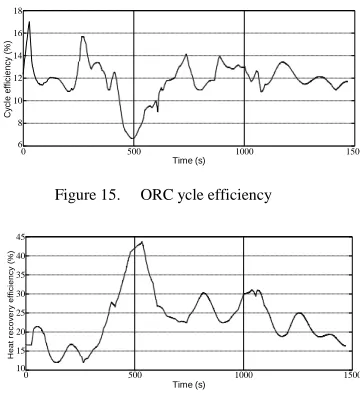
The cycle efficiency of the ORC depends on several factors including the temperature of the evaporator, heat of vaporisation, pressure ratio at the expander, etc. Fig. 15 shows the cycle efficiency of the ORC-WHR model for the selected heat source. The cycle efficiency varies from Figure 14. Expander power output.
The expander power output is shown in Fig. 14 In this simulation, the maximum power output of around 9 kW is observed.
The performance of the ORC-WHR system is calculated by two basic parameters: cycle efficiency and heat recovery efficiency as follows:
around 6.6% to around 17%, depending on the combination of the mass flow rate and temperature of the hot fluid and refrigerant. The WHR system in this simulation is able to recover up to 44% (Fig. 16) of the heat from the specified heat source as shown in Fig. 8. It can be seen from Figs. 15 and 16 that the trends of the cycle and heat recovery efficiency are opposite to each other.
V. CONCLUSIONS
In this research, the development of the fuzzy based WNet cy ev Qev hr h (3) (4)
evaporator model and its integration with other components in the ORC-WHR system have been presented. The performance of the fuzzy base evaporator model and the WHR system including cycle and heat recovery efficiency has also been investigated.
The fuzzy-based model proposed in this paper does not
where cy is the cycle efficiency, which is the ratio of
net work output to the heat recovered at the evaporator,
hris the heat recovery efficiency which is defined as the
amount of heat recovered from the given heat source. Qev
is the evaporator power which is one of the outputs of the fuzzy based evaporator model.
require complex mathematical formula and iteration loops; therefore, it can reduce the simulation time significantly. The investigation of the ORC based WHR model in this paper can provide an overall mapping and characterization of the output ranges of the waste heat recovery system with respect to different input ranges. The developed model is suitable to predict the effect of mass flow rate of the refrigerant on the evaporator outlet temperature, which is the
The net work output Wnet in Eq. 5 is calculated by critical parameter for the control of the WHR system in real
subtracting the pump work
work as follows.
W p from the expander gross
time.
ACKNOWLEDGMENT
Wnet (Wexp Wp ) (5) The authors gratefully acknowledge the Queen’s
Sciences Research Council (EPSRC) for their support in this research.
REFERENCES
[1] Glover, S.; Douglas, R.; Glover, L.; McCullough, G. Preliminary
analysis of Organic Rankine Cycles to improve vehicle efficiency.
Proc. IMechE D J. Automob. Eng. 2014, 228, pp.1142–1153.
[2] Quoilin, S.; Aumann, R.; Grill, A.; Schuster, A.; Lemort, V.;
Spliethoff, H. Dynamic modeling and optimal control strategy of waste heat recovery Organic Rankine Cycles. Appl. Energy 2011,
88, pp. 2183–2190.
[3] Feru, E.; Willems, F.; Jager, B.D.; Steinbuch, M. Modeling and
control of a parallel waste heat recovery system for Euro-VI heavy-
duty diesel engines. Energies 2014, 7, pp. 6571–6592.
[4] Karellasa, S.; Schuster, A.; Leontaritis, A.-D. Influence of
supercritical ORC parameters on plate heat exchanger design. Appl.
Therm. Eng. 2012, 33, pp. 70–76.
[5] Sun, J.; Li, W. Operation optimization of an Organic Rankine Cycle
(ORC) heat recovery power plant. Appl. Therm. Eng. 2011, 31, pp.
2032–2041.
[6] Patiño, J.; Llopis, R.; Sánchez, D.; Sanz-Kock, C.; Cabello, R.;
Torrella, E. A comparative analysis of a CO2 evaporator model using experimental heat transfer correlations and a flow pattern map. Int.
J. Heat Mass Transfer 2014, 71, pp. 361–375.
[7] Chowdhury, J.I., Nguyen, B.K., Thornhill, D.: Modelling of
Evaporator in Waste Heat Recovery System using Finite Volume Method and Fuzzy Technique, Energies, 2015, 8, (12), pp. 14078- 14097.
[8] Mamdani, E.H., Assilian, S.: An experiment in linguistic synthesis
with a fuzzy logic controller, International Journal of Man-Machine Studies, 1975, 7, (1), pp. 1-13.
[9] Ross, T.J.: Fuzzy logic with engineering applications (John Wiley,
Chichester, U.K., 3 2010).
[10] Quoilin, S., Aumann, R., Grill, A., Schuster, A., Lemort V.,