333International Journal of
ELECTROCHEMICAL
SCIENCE
www.electrochemsci.org
Short communication
Charge Dependent Capacitance of Stern Layer and Capacitance
of Electrode/Electrolyte Interface
Aljaž Velikonja1
, Ekaterina Gongadze1, Veronika Kralj-Iglič2 and Aleš Iglič1,* 1
Faculty of Electrical Engineering, University of Ljubljana, Tržaška 25, SI-1000 Ljubljana, Slovenia
2
Faculty of Health Studies, University of Ljubljana, Zdravstvena 5, SI-1000 Ljubljana, Slovenia *
E-mail: [email protected]
Received: 2 July 2014 / Accepted: 8 August 2014 / Published: 25 August 2014
The influence of potential dependent relative permittivity of Stern layer on the capacitance of electrode-electrolyte interface is studied theoretically. A decrease of capacitance at larger magnitudes of electrode surface potential is predicted. At large electrode surface potentials the capacitance of metal-electrolyte interface is determined solely by the capacitance of Stern layer, whereas the contribution of the capacitance of diffuse layer is negligible.
Keywords: capacitance, electric double layer, Stern layer, relative permittivity, water ordering
1. INTRODUCTION
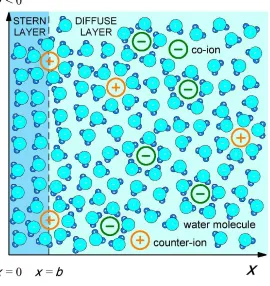
Figure 1. Schematic figure of the Stern layer (0 x b) and diffuse electric double layer (b x ) . Outer Helmholtz plane (OHP) is located at the distance of closest approach (b) which is approximately equal to the hydrated radius of the counter-ions. The water dipoles are oriented within Stern layer as well as around counter-ions and co-ions in the bulk solution. The symbol denotes the surface charge density of the metal surface.
Most of the theoretical models of electrolyte solution in contact with charged surface assume that the relative (dielectric) permittivity is constant everywhere in the electrolyte solution [2-7] and do not consider the space dependence of relative permittivity of electrolyte solution near the charged surface [1] . Therefore the classical Gouy-Chapman theory of electric double layer [8,9] has been generalized by taking into account the water polarization in electrolyte solution near the charged surface resulting in spatial decay of relative permittivity in close vicinity of the charged surface [10-16] .
In this work we adopted Stern model [17] as a combination of Gouy-Chapman and Hemholtz models [18] where the outer Helmholtz plane (OHP) define a border between Stern layer and diffuse layer (Figure 1). The relative permittivity of Stern layer is calculated for different values of surface charge density of the metal surface within a simple theoretical model of orientational ordering of water. The total (differential) capacitance of the metal-electrolyte interface (Cdiff ) is calculated using the formula [19]:
1 1 1
diff S DL
[image:2.596.167.437.79.365.2]and diffuse layer capacitor (CDL).
2. THEORETICAL MODEL
2.1. Capacitance of metal-electrolyte interface
In the above Equation 1.1 the influence of the final size of molecules is taken into account only by the distance of closest approach (b) (Figure 1) in the first term for the capacitance of Stern layer CS S 0/b. Here 0 is the permittivity of the free space and S the electric field dependent relative permittivity of the Helmholtz/Stern layer. The capacitance of the diffuse layer (xb) in the second term (CDL) also depends on the size of molecules, which can be described within different theoretical approaches [20-21,10,11,5] . However, in this work we would like to keep all formulas analytical and simple. To this end CDL is calculated within Gouy-Chapman model for point-like ions from Grahame equation [1,16,19]:
12 2
0 0 0 0
2 cosh( ( ) / 2)
( )
DL r
d
C e n e x b
d x b
. (2.1) Hence
12
0 2
0 0 0 0
1 1
2 cosh( ( ) / 2)
diff S
r b
C
e n e x b
. (2.2)
Here n0 is the bulk number density of salt ions, e0 is the unit charge, r is the constant permittivity of diffuse electric double layer in the region b x and 1/kT, where kT is the thermal energy.
Close to the charged metallic surface, i.e. for small values of x, the relative permittivity r
strongly depends on the distance from the charged metallic surface [10,11,13-16] . For simplicity reasons in this work the permittivity of diffuse layer (for xb) in Equation 2.1 (r) is considered independent on the electric field strength [1,19] , while due to strong orientation of water molecules in Stern layer the dependence of relative permittivity of Stern layer (S) on the electric field strength [15] is taken into account. This means that also the capacitance of Stern layer (1st term on the right hand side of the Equation 2.2) depends on the electric field strength.
2.2. Capacitance of Helmholtz/Stern layer
In this subsection we shall first derive the electric field dependence of relative permittivity in Stern layer (S). In the second step the dependence of capacitance of Stern layer
0 / S S
In the model a single water molecule is considered as the sphere with the point-like rigid (permanent) water dipole located at its centre [13,16]. The permittivity of the sphere is 2
n , where 1.33
n is the optical refractive index of water [13] . The polarization of water molecules P in Stern layer (0 x b) can be expressed as [13,16] :
2
0 0 0
2
( )
3 w
Pn p n pE
L , (2.3) where n0w is the constant (bulk) number density of water molecules, Eis the magnitude of the electric field strength, n2 is the optical refractive index of water, p0 is the magnitude of the water external dipole moment, L
u coth
u – 1/u is the Langevin function and
2n2
/ 2. In Stern layer (0 x b) the magnitude of electric field strength E is constant for given , therefore also relative permittivity (S) is constant for given . The relative permittivity in Stern layer can then be written as (see also [13]) :2
2 2
0
0 0 0
0 ( ) 2 3 w S
P n p p
n n E E E n
L , (2.4)
and finally the capacitance of Stern layer in the region 0 x b:
0 2 2 0 0 0 ( ) 2 3 1 w
S n p
b
C E
n n p
E
L . (2.5)
For xb we assume constant relative permittivity r 78.5 at room temperature.
2.3. Boundary conditions
The boundary conditions at x0 and xb are :
0 0 x S d dx
, S 0 r 0
x b x b
d d dx dx
, x b x b
, (2.6) where is the surface charge density of the metallic surface at x0. Due to constant electric
field strength in Stern layer 0
x x b
d d
dx dx
it follows from Equations 2.6 :
0 x b r d dx
. (2.7)
The boundary condition 2.7 can be used in the region b x to solve Gouy-Chapman equation and calculate the value of electric potential ( xb).
3. RESULTS AND DISCUSSION
2 0
0
0 0
0
3 w
E E n
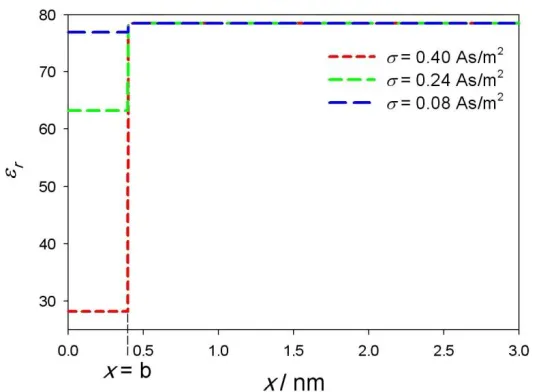
[image:5.596.189.405.241.405.2] . (3.1) Inserting the calculated value of E in Equation 2.4 yields the value of relative permittivity in Stern layer (S) for given surface charge density . Figure 2 shows the relative permittivity S as a function of surface charge density . It can be seen that S strongly decreases with increasing magnitude of , which can be explained by saturation of orientational ordering of water dipoles in strong electric field at large values of [16,24,25]. For illustration Figure 3 shows the space dependence of relative permittivity for three different values of .
Figure 2. The relative permittivity S in Stern layer 0 x b as a function of the magnitude of the surface charge density of electrode surface (). The values of model parameters are : distance of closest approach b0.4 nm, p0 3.1 D and concentration of water n0w/NA = 55 mol/l.
[image:5.596.163.430.512.708.2]
The electric potential dependence in the diffuse region b x is calculated from Gouy-Chapman equation [1,3,4]:
2
0 0
0 2
0 2
sinh( ( )) r
e n d
e x
dx
, (3.2) where the volume charge density of electrolyte solution 2e n0 0sinh( e0 ( ))x is taken into account. To calculate from Equation 3.2 the dependence ( )x for xb, the boundary condition defined by Equation 2.7 should also be considered.
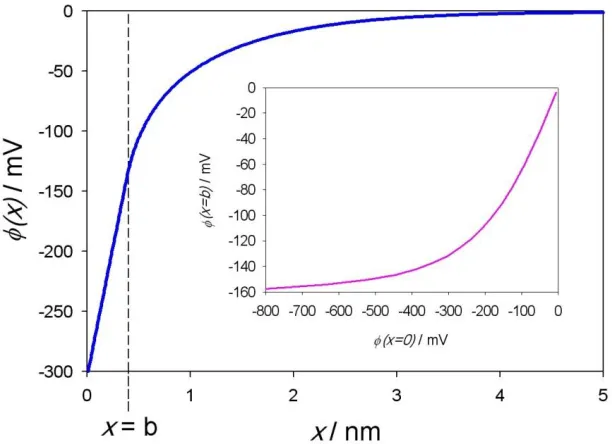
Figure 4. The calculated electric potential ( )x as a function of the distance from the charged metallic surface. The model parameters are: surface charge density 0.21 As / m2, bulk concentration of ions n0/NA = 0.1 mol/l, distance of closest approach b0.4 nm, p0 3.1 D and concentration of water n0w/NA= 55 mol/l. The inset shows the interdependence between the potentials (xb) and (x0) calculated for different .
Figure 4 shows the space dependence of the electric potential ( )x . The linear space dependence of electric potential in Stern layer 0 x b was determined by integration from the boundary conditions x0 (first Equation 2.6) and not from Eqution 3.2. The inset in Figure 4 shows the interdependence between electric potentials at x0 and xb. Note that in Equation 2.1 for capacitance of diffuse layer CDL appears the potential (xb) [19] and not (x0). For better understanding Figure 5 shows also the dependences of the surface potentials (x0)
[image:6.596.144.450.221.443.2]Figure 5. The calculated electric potential (x0) as a function of the electrode surface charge density . Inset shows the dependence of (xb) on . The values of model parameters n0/NA, b, p0 and n0w/NA are the same as in Figure 4.
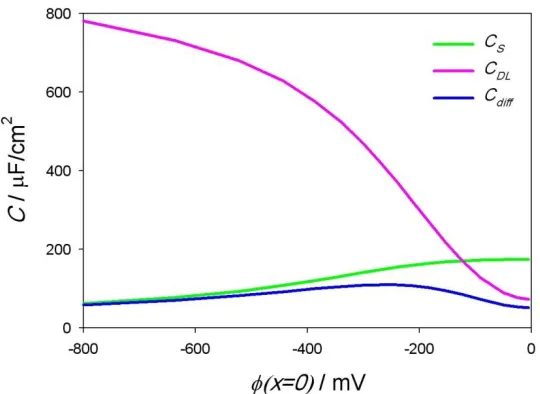
Figure 6 shows the capacitances of Stern (CS) and diffuse layer (CDL) and the total capacitance (Cdiff ) as functions of the surface potential (x0). It can be seen in Figure 6 that diffuse layer capacitance CDL increases, while Stern layer capacitance CS decreases with increasing magnitude of (x0). As the capacitance Cdiff is calculated by Equation 1.1, this explains why at larger magnitudes of surface potential (x0) the contribution of CDL to
diff
C is negligible and Cdiff CS as presented in Figure 6.
Figure 6. Differential capacitance of Stern (CS) and diffuse layer (CDL) and the total capacitance (Cdiff ) as a function of the surface potential (x0). The values of model parameters
0/ A
[image:7.596.162.432.489.686.2]
Figure 7 shows the calculated capacitance of electrode-electrolyte interface (Cdiff ) for relative permittivity in Stern layer which depends on surface charge density of electrode ( S( )) ,
determined as described above, and for the case of constant value of relative permittivity in Stern layer (S 30). It can be seen that in the first case of S( ) the capacitance Cdiff exhibit a maximum and subsequent monotonous decreasing of Cdiff with increasing magnitude of
(x 0)
. On the contrary, for constant S 30 there is no maximum in Cdiff and its decrease at large magnitudes of (x0). The maximum in dependence of Cdiff on surface potential
(x 0)
and decrease of Cdiff at large magnitudes of (x0) can be predicted also at constant relative permittivity by taking into account the finite size of ions (volume excluded effect) within Bikerman model [6,16,23]. In accordance, it was shown recently [16], that combination of volume excluded effect [20] and space dependence of relative permittivity in electrolyte solution [13] predict stronger decrease of Cdiff at large magnitudes of (x0) as predicted within pure Bikerman model .
Figure 7. Differential capacitance of metal-electrolyte interface (Cdiff ) as a function of the surface potential (x0) for the case voltage/surface charge dependent relative permittivity of Stern layer (Figures 2 and 3) and constant permittivity in Stern layer. The values of the model parameters are the same as in Figure 4.
4. CONCLUSIONS
neglected . To this end the influence of conductivity of diffuse layer on the capacitance of Stern layer can not be described within the presented model.
Obtaining the charge/potential dependence of relative permittivity in Stern layer, the capacitance of electrode-electrolyte interface as a function of electrode charge/potential is calculated. A decrease of capacitance at larger magnitudes of electrode surface potential is predicted. It is also shown that at large electrode surface potentials the capacitance of metal-electrolyte interface is determined solely by the capacitance of Stern layer, whereas the contribution of the capacitance of diffuse layer becomes negligible.
ACKNOWLEDGEMENTS
This work was in part supported by the Slovenian Research Agency (ARRS).
References
1. H. Butt, K. Graf and M. Kappl, Physics and Chemistry of Interfaces, Wiley-VCH, Weinheim (2003).
2. W. Schmickler and E. Santos, Interfacial Electrochemistry, Springer, Heidelberg (2010). 3. S. McLaughlin, Annual Review of Biophysics and Biophysical Chemistry, 18 (1989) 113-136. 4. G. Cevc, Biochimica et Biophysica Acta, 1031 (1990) 311–382.
5. V. Kralj-Iglič and A. Iglič, Journal of Physics II, 6 (1996) 477–491.
6. M.Z. Bazant, M.S. Kilic, B. Storey and A. Ajdari, Advances in Colloid and Interface Science, 152 (2009) 48-88.
7. I. Bivas and Y.A. Ermakov, Advances in Planar Lipid Bilayers and Liposomes 5 (2007) 313– 343.
8. M.G. Gouy, Journal de Physique et Le Radium (France), 9 (1910) 457-468. 9. D.L. Chapman, Philosophical Magazine, 25 (1913) 475-481.
10.C.W. Outhwaite, Molecular Physics, 31 (1976) 1345–1357. 11.C.W. Outhwaite, Molecular Physics, 48 (1983) 599–614.
12.T. Nagy, D. Henderson and D. Boda, Journal of Physical Chemistry B, 115 (2011) 11409– 11419.
13.E. Gongadze and A. Iglič, Bioelectrochemistry, 87 (2012) 199–203.
14.R. Misra, S. Das and S. Mitra, Journal of Chemical Physics, 138 (2013) 1147 15.E. Gongadze and A. Iglič, Acta Chimica Slovenica, 61 (2014) 241–245.
16.E. Gongadze, A. Velikonja, Š. Perutkova, P. Kramar, A. Maček-Lebar, V. Kralj-Iglič and A. Iglič, Electrochimica Acta, 126 (2014) 42-60.
17.O. Stern, Zeitschrift für Elektrochemie, 30 (1924) 508-516.
18.H. Helmholtz, Annals of Physics, 7 (1879) 337-382.
19.V. Lockett, M. Horne, R. Sedev, T. Rodopoulos and J. Ralston, Physical Chemistry Chemical Physics, 12 (2010) 12499–12512.
20.J. Bikerman, Philosophical Magazine, 33 (1942) 384–397.
21.T. Grimley and N. Mott, Discussions of the Faraday Society, 1 (1947) 3–11. 22.M. Eigen and E. Wicke, Journal of Physical Chemistry, 58 (1954) 702–714. 23.A. A. Kornyshev, Journal of Physical Chemistry B, 111 (2007), 5545-5557. 24.F. Booth, Journalof Chemical Physics, 19 (1951) 391-394.
26.Z. Arsov, M. Rappolt and J. Grdodolnik, ChemPhysChem, 10 (2009) 1438–1441. 27.H. Wang and L. Pilon, Electrochimica Acta, 64 (2012) 130– 139.