Contents lists available atScienceDirect
Journal
of
Computational
Physics
www.elsevier.com/locate/jcp
A
novel
coupling
of
noise
reduction
algorithms
for
particle
flow
simulations
M.J. Zimo ´n
a,b,∗
,
J.M. Reese
c,
D.R. Emerson
daSchool of Mechanical, Aerospace and Civil Engineering, The University of Manchester, Manchester M13 9PL, UK
bJames Weir Fluids Lab, Mechanical and Aerospace Engineering Department, The University of Strathclyde, Glasgow G1 1XJ, UK cSchool of Engineering, The University of Edinburgh, Edinburgh EH9 3JL, UK
dScientific Computing Department, STFC Daresbury Laboratory, Warrington WA4 4AD, UK
a
r
t
i
c
l
e
i
n
f
o
a
b
s
t
r
a
c
t
Article history:
Received1September2015 Receivedinrevisedform13May2016 Accepted23May2016
Availableonline27May2016
Keywords: Noisereduction Particle-basedsimulations Moleculardynamics Dissipativeparticledynamics Windowedproperorthogonal decomposition
Waveletthresholding
Proper orthogonaldecomposition (POD) and itsextension basedontime-windows have beenshowntogreatlyimprovetheeffectivenessofrecoveringsmoothensemblesolutions fromnoisyparticledata.However,tosuccessfullyde-noiseanymolecularsystem,alarge numberofmeasurementsstillneedtobeprovided.Inordertoachieveabetterefficiency in processing time-dependent fields, we have combined POD with a well-established signal processingtechnique,wavelet-basedthresholding. Inthisnovel hybridprocedure, the wavelet filtering is applied within the POD domain and referred to as WAVinPOD. The algorithm exhibits promising results when applied to bothsynthetically generated signalsand particledata.Inthiswork,thesimulationscompare theperformanceofour newapproachwithstandard PODorwaveletanalysisinextractingsmoothprofiles from noisy velocity and density fields. Numerical examples include moleculardynamics and dissipativeparticledynamicssimulationsofunsteadyforce- andshear-drivenliquidflows, as well as phase separation phenomenon. Simulation results confirm that WAVinPOD preserves thedimensionalityreductionobtainedusingPOD,whileimprovingitsfiltering propertiesthroughthe sparserepresentationofdata inwaveletbasis. Thispapershows thatWAVinPODoutperformstheotherestimatorsforbothsyntheticallygeneratedsignals andparticle-basedmeasurements,achievingahighersignal-to-noiseratiofromasmaller number of samples. The new filtering methodology offers significant computational savings,particularlyformulti-scaleapplicationsseekingtocouplecontinuuminformations withatomisticmodels.Itisthefirsttimethatarigorousanalysishascomparedde-noising techniquesforparticle-basedfluidsimulations.
©2016TheAuthors.PublishedbyElsevierInc.ThisisanopenaccessarticleundertheCC BYlicense(http://creativecommons.org/licenses/by/4.0/).
1. Introduction
Particle-basedsimulations, e.g.molecular dynamics,are wellsuited toinvestigatetheeffectsoffluid–solidinteractions andarewidelyusedtostudyabroadrangeofcomplexphysicalphenomena[1].Forexample,moleculardynamics(MD)can beperformedtosolveclassicalmany-bodyproblemsfromvariousfields,includingrheology,tribology,andbiologicalsystems atthemolecularscale.Dissipativeparticledynamics(DPD)isanotherparticle-basedmethodthatisgainingpopularityand
*
Correspondingauthorat:SchoolofMechanical,AerospaceandCivilEngineering,TheUniversityofManchester,ManchesterM139PL,UK. E-mail address:[email protected](M.J. Zimo ´n).http://dx.doi.org/10.1016/j.jcp.2016.05.049
can be viewedasa coarse-grainingofmoleculardynamics (aDPDparticleis acollectionof MDmolecules),allowing for mesoscalemodellingofcomplexfluids,e.g.surfactantsolutions.
Inparticlesimulations,thesystemevolvesfromsomeinitialconditiontoafinalstate,preservingconstraintsofmotion. The outputofthecalculationisasystemvariable, X,asafunction oftime.Accordingtothequasi-ergodichypothesis,the meanvalueofasampledquantity,X
(
t)
,foranequilibriumsystemisequaltoitsensembleaverage,X.Ingeneral,themean ofapropertyisoftensubjecttofluctuationsmakinganystatisticalinterpretationofthedatachallenging.Uncertaintyinthe measurements isincreasedthroughthermalfluctuationsintroducedbythermostats andsamplingwithafinitenumberof particles.Theseeffectsaregenerallyreferredtoasnoise,andamajorchallengeinparticlesimulationsistofilter,orde-noise, the fluctuationsto obtain an accurate ensemble prediction.Toproduce a goodapproximation, cumulative averaging over large time intervalscan beperformed, butthecomputational intensityofthe simulationsis thensubstantially increased. Additionally, inunsteady flow simulations, it isdifficult to establishthe numberof time-stepsover whichthe averaging should performed. The development ofan efficientfiltering technique that provides clean particle distribution functions andsmoothgradients,particularlywhencouplingacrossdifferentlength andtime-scales(multi-scale modelling),ishighly desirable.Proper orthogonal decomposition (POD) is a statistical method that identifies a low-dimensional spaceby separating independentvariations fromlinearlydependentaspectsofdata.Inother words,itextractscorrelationsfromthe measure-ments through a low-rankapproximation. The use ofPOD in interpreting coherentstructuresin turbulence isnow well established [2]and the technique has recentlybeen applied as a noise reduction tool for MD andDPD simulations [3]. Waveletthresholding,ontheotherhand,isanon-linearprocedurepioneeredbyDonohoandJohnstone[4]that was pro-posedfromseveraloptimalitycriteria,suchasasymptoticminimax.Itallowstheanalysisofsignalsatdifferentresolutions andsmoothsoutunwantedvariationsatachosenlevelofdetail.Bothtechniqueshavehadsomesuccessbutretaincertain weaknesses. Classicalorthogonal methodsrequirelarge matricestoextractde-noised information,whereas wavelet-based thresholding issensitivetothe choiceoffiltersusedforthewavelettransform(WT).Waveletthresholdingcanalso over-smoothanalysedsignalsorintroduceGibbs-likeoscillations[5],anddoesnotreducethedimensionalityaswellas POD.
The aimofthisworkistodevelop amethodwiththecapabilitytoimprovethe efficiencyofestimatingtheunknown structuresfromparticle-basedsimulation bysolvingthestatisticalinverseproblem.Wewill brieflyoutlinethetheoretical basis of POD and wavelet transforms, along withtheir application to noise filtering. For particle-based simulations, we discussanextensiontoPODbasedontimewindows(WPOD)[3].Byconsideringtheirstrengthsandweaknesses,wepropose anewapproach,WAVinPOD,whichshowsgoodpotentialforimprovingtheanalysisofsimulationdata.Ourmethodallows foramoreefficientnoisereduction,obtaininghigheraveragesignal-to-noiseratiosandsmallererrorsinL2 andFrobenius norm thaneitherPODorwaveletthresholdingalone.Ourpaperisorganisedasfollows:thebasictheoryforthemethods is briefly described inSec. 2,followed bythe resultsofapplying WAVinPOD,POD, andwaveletthresholdingto synthetic signals. Acomparisonoftheperformanceofeachtechniqueinde-noisingparticle-basedsimulationsispresentedinSec.4, followedbysomeconcludingremarksonthenewapproach.
2. Theoreticalbackground
ThissectionprovidesabriefmathematicaldescriptionofPODandwaveletthresholding.Ournovelprocedure,WAVinPOD, isalsointroduced.AmoreextensivediscussiononproperorthogonaldecompositioncanbefoundinRefs.[2,6,7],andamore detailedreviewofwavelettheoryisgiveninRefs.[8–10].
2.1. Properorthogonaldecomposition
Proper orthogonal decomposition is often used for finding a low-dimensional approximate description of high-dimensionaldatathatcontainsalargenumberofinterrelatedvariables.Inadditiontoorderreduction,PODisalsoapplied forfeatureextractionbyrevealingcoherentstructureswithinthedata.Themethodwasintroducedtotheturbulence com-munitybyLumley[11].However,thesameprocedurewasdevelopedindependentlybyseveralgroupsandisknownunder different names, including PrincipalComponentAnalysis andthe Karhunen–LoéveDecomposition, depending on the area of application.
ThebasisofPODistodescribeafunction, f
(
t,
x)
,asafinitesumofitsvariables:f
(
t,
x)
≈
rn=1
α
n(
t)φ
n(
x),
(1)wheretandxrepresentthetemporalandspatialcomponentsofthedata,respectively.Whenr(atotalnumberofelements) approaches infinity, theestimate becomes exact.Applying POD establishes aset oforthonormal basis functions(modes),
φ
n(
x)
,suchthatthefirstk<
r termsprovidethebestapproximationofthefunction f(
t,
x)
.Definean element A(
τ
s,
x)
ofwill determine the optimalapproximation of the matrix, Ak
(
Ak≈
A)
,by first performing singular value decomposition(SVD)oftheoriginalrealmatrixA1:
A
(
τ
s,
x)
=
UVT
,
(2)where,incaseoffull SVD, U
∈
R
N×N,V∈
R
M×M are orthogonalmatrices, thesuperscript T indicates amatrixtranspose since A∈
R
,andisanN
×
Mdiagonalmatrix.InEq.(2),columnsU andV areleftandrightsingularvectors,respectively. Singularvectorscanbeconsideredasrotationsandreflections,andasastretchingmatrix.Diagonalentriesof
,called singularvaluesofA,arenon-negativenumbersarrangedindescendingorder,s1
≥
s2≥
. . .
≥
sr≥
0.Thenumberofnon-zerosingularvaluesdefinestherankoftheoriginalmatrix A (r
=
rank(
A)
=
min(
N,
M)
).Equation(2)canalsobe expressedin theformA
(
τ
s,
x)
=
Q VT=
rn=1
qnvTn
,
(3)where Q
=
U, A representsthefunction f
(
t,
x)
fromEq.(1),qn isacolumnmatrixcorresponding toα
n(
t)
,andvTn isatransposeofavectormatrixrepresenting
φ
n(
x)
.ThedescriptioninEq.(3)isanaccurateapproximationasthedata-sethasafinitesize.Toconstructanoptimallower-rankestimateof A,foradeterminedvaluek
<
r,thediagonalmatrixkcanbe
obtainedbysettingsk+1
=
sk+2=
...
=
sr=
0,resultinginAk
(
τ
s,
x)
=
UkVT
=
kn=1
snunvn
.
(4)Throughoutthiswork,therankofthebestmatrixapproximation,k,willbereferredtoasthenumberofdominantmodes.
2.1.1. NoisefiltrationwithPOD/WPOD
Properorthogonal decompositionmayalsobe consideredasan energydecompositionwhich hasthecapabilityto filter out low energyspectra(i.e. noise)fromrawdata.Ifthe previouslyconsidered matrix, A,is nowa collectionof M noisy measurementsat N instantsintime,itcan berepresentedasa compositionoftheform A
=
Atrue+
B,where Atrue isanN
×
M matrixthatcontainsthetruesignal,andB isamatrixthatdenotestheunwantednoise.Ingeneral,we onlyknow theoriginalmatrixAandweneedtoremovethenoisetoextracttheinformationcontainedin Atrue.Forthespecialcaseof asyntheticallygeneratedmatrix A,wewillknowAtrue andcorruptthesignalwithartificiallygeneratednoise,represented bymatrixB.UsingPOD,wecanremovethenoisefrommatrix Abycreatingacorrespondingapproximationmatrixofrankk, Ak,that containsallthecorrelationsfromtheoriginaldata,i.e. Ak
≈
Atrue.Theapproximationisobtainedbytruncating thesingular valuesasdescribed inEq.(4); such aprocedureis referredto astruncatedSVD. The keypropertyof PODis that Akisoptimalinthesensethatmin Atrue−
Ak2F=
min(N,M)n=k+1 sn2,where
.
F istheFrobeniusnorm.Inthecaseofsimulationdata,Grinberg[3]developedan extensiontoPODforparticlemeasurementsthat isbasedon time-windows and generallyreferred to asWPOD; inthe approach, the datais definedas A
=
NPODNtst,where NPOD is the numberof time averages used, Nts defineshow many observations are inone average,and
t isthe simulation
time-step.Inthiswork,WPODisutilisedtofilteroutnoiseinmolecular simulationsbasedontheapproachpresentedby Grinberg(note,inGrinberg’spaperthematrix A isdefinedas TPOD).Foraset ofnoisy observations(snapshots) A
(
τ
s,
x)
, definedasafield atpositionsinspacexR
d,d=
1,
2,
3 andatdiscretetimesτ
s, s=
1,
2,
...,
NPOD,WPODcalculatesaset oforthogonal basis modesby applyingSVDto thePOD window, SVD
(
A)
.Throughout thiswork,the singular vectorsare referred toastemporalorspatial PODmodesdepending onwhethertheyholdinformationeitherabouttheshapeofthe signal orits time nature. Inthe caseofthe matrix A(
τ
s,
x)
, atemporal PODmode (related to temporalcoefficientα
k
(
t)
fromEq.(1))correspondingtomodenumberkisaleftsingularvector,uk(columnkofmatrixU),andaspatialPODmode
isarightsingularvector, vk.
ToobtainthebestestimateofAtrue,thenumberofsingularvalueskneedstobecarefullydetermined.Themainrationale ofusingSVD(orEVD)tofilteroutnoiseisbasedontheassumptionthat,unlikeunwantedfluctuations,important(coherent) structuresareenergetic.Onenaturalcriterionforchoosingkistoselectthecumulativepercentageoftotalenergy(e.g.90%) that theselectedmodescontribute.Theenergythresholdisoftenchosen arbitrarily,anditcan dependonsome practical detailsofaconsidereddata-set.Inthecaseofparticlesimulations,definingacut-offbasedonenergyposesdifficulties,as itoftenhappensthatstructuresofinterestcontainverylittleenergywhencomparedtodominantfeatures.Forthatreason, some additional criterianeed to be metin order toestablish an appropriate subset ofsignificant modes. In the present work,apartfromstudyingtheenergycontentofeigenvalues,mostofthedataisanalysedwiththelog-eigenvaluediagram (LEV) [12] andby investigating thesmoothness oftemporalmodes [3]. Insome cases, thechoice ofk isverified witha recentlyproposedsingularvaluehardthreshold(SVHT)[13].
Fig. 1.One step of DWT with filter banks.
2.2. Multiresolutionandfastwavelettransform
Multiresolution theory developedby Mallat[14] andMeyer[15] introduces the orthogonaldiscrete wavelettransform (DWT), wherea signal isanalysed at scales varying by a factor of2. The transformutilises a shifted andscaled mother wavelet,
ψ
,formingabasis(children)definedasψ
j,m(
t)
=
1
√
2j
ψ
t
−
m2j2j
,
(5)where 2j isadiscrete dilationparameter,an integer j
∈
Z
representsa scaleresolution,andm2j isa discreteshift (m∈
Z
).The mother waveletsatisfies the admissibilitycondition,Cψ=
+∞0
ψ (ω) 2
ω d
ω
<
+∞
, whereψ(
ω
)
=
+∞−∞
ψ(
t)
e−iωtdt. Waveletfunction,togetherwithadilatedandtranslatedscalingfunctionφ
s (father),φ
sj,m(
t)
=
1 √
2j
φ
st−m2j 2j
,decomposes thesignalintocoefficientsgivenasfollows:
f
(
t)
=
m∈Zcj0,m
φ
sj0,m(
t)
+
j,m∈Z
dj,m
ψ
j,m(
t).
(6)The coefficients in Eq. (6) are obtained by integrating the product of the functions with the signal; cj0,m
=
f
, φ
sj0,mis a smoothed (coarse) approximation, dj,m
=
f
, ψ
j,mare the finescale details atdifferent resolutions
−
J≤
j<
0 and 0≤
m<
2−j, where J isthe maximumnumberof decompositionsand j≤
j0.In other words,thedetails, dj,m, andtheapproximation,cj0,m,areprojectionsofthesignalontocertaincomplimentingsubspaces.
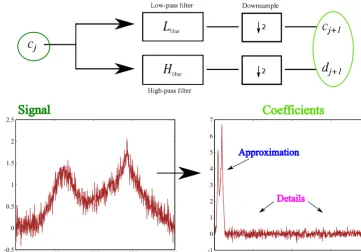
Mallat[9]andDaubechies[16]establishedalinkbetweenfilterbanksinsignal processingandwavelets,allowingfora fastdecomposition.Thefastwavelettransformalgorithmdoesnotmakeuseofthewaveletandscalingfunction,butofthe quadraturemirrorfilters(QMFs)2 thatdescribetheir interaction.Inthefasttransform,thesignalisconvolvedwithbotha high-passfilter(Hfilter,determiningthewaveletfunction),whichproducesthedetailsofthedecomposition,andalow-pass filter, (Lfilter, associated withthe scalingfunction) whichgives the approximation ofthe signal. The process is shownin Fig. 1.Givenasignal f
∈
R
M,thefastwavelettransformcanconsistofmaximum J=
log2M levels(e.g.forM
=
512 onlyJ
=
9 stagesofdecompositionarepossible).Ateachstage,thetwosetsofcoefficientsareproducedbyconvolvingthesignal withthelowandhigh-passfiltersfollowedbydyadicdecimation.Thesignalnowhashalfofthenumberofsampleswhich means that the scale isdoubled. Details,dj+1,are storedwhile the smoothedimage (approximation, cj+1) of thesignalisagainconvolvedwiththeQMFsresultinginafurthersetofcoefficients. Theprocessisrepeateduntiladesiredlevelof decompositionisreached.Thisalgorithmprogressivelydrainsthesignalofitsinformation.Theapproachcanbeperceived as a mathematical microscope allowing us to see the signal at different dyadic magnifications, offering a powerful way ofdecomposing datainto its elementaryconstituents acrossscales. Inverting thedecomposition withan inversewavelet transform consists of inserting zeros (upsampling) between samples and convolving the results with the reconstruction filters.Ifthesignallength isnotapowerof2,thenextendingthesamplesisneeded.Inthepresentwork,thesymmetric boundary value replication is applied [17]. The algorithm can be naturally extended to encode two-dimensional signals (e.g. images) [9].This kind of two-dimensional transformleads to a decomposition of the signal into four components: approximationanddetailsinthreeorientations(horizontal,vertical,anddiagonal).
2.2.1. Signalde-noisingwithwavelets
Thereexistmanyvariantsofwavelet-basedde-noising[9].Theproceduresconsistofwaveletdecomposition, threshold-ingofthedetailcoefficients,andapplyingtheinversetransformtoreconstructthesignal.DonohoandJohnstone[4]showed thatde-noisingcanbeperformedwithhardthresholding,definedasTH
(
dj,m)
=
dj,m1
{|dj,m|>Tu},aswellaswithsoftthresh-olding(waveletshrinkage),TS
(
dj,m)
=
max0
,
1−
Tu |dj,m|dj,m,where
1
isanindicatorfunctionandTu isathresholdvalue.Here,wefocusonlyonthesecondapproachwithauniversalthreshold:
Tu
=
σ
n2 log
(
M).
(7)The white noise level estimate is definedas
σ
n=
MAD/
0.
6745, with MAD being the medianabsolute deviation3 ofthefinescalewaveletcoefficients[18].Softthresholdinghastheabilitytoefficientlysmooth thesignalbutwithlossofsome characteristics,e.g.peakheights,over-smoothingtheedges.Thehardthresholdmethodgenerallyreproducessharpnessand discontinuitiesofthesignal better,butatthecostofvisualsmoothness(cangenerateGibbs-likeoscillations)[18].Asmost ofthesimulationresultsarecorruptedbycorrelatednoise,alevel-dependentvarianceestimationintroducedbyJohnstone andSilverman[19]canbeemployed.
Inthepresentwork,forsimplicity,onlyfiltersassociated withDaubechies familyoforthogonalwaveletswere utilised [16],particularlydb3 anddb4 astheyprovidedagoodcompromiseintermsofsignal-to-noiseratioandsmoothnessofdata reconstruction;the numbers,3 and 4,define how manyvanishingmoments are used.Mostapplications, includingnoise reduction, requirethat a function is approximatedwith few non-zerowavelet coefficients, i.e.has sparse representation. Thisdependsmostly on theregularity ofthe signal, thenumberof vanishingmoments of
ψ
andthesize ofits support [9].Daubechies wavelet familyis the most populardue to its orthogonal andcompact support abilities. However, other wavelets,suchastheCoiflets,SymmletsofDaubechiescanbeusedforefficientdataprocessingofferingdifferentbeneficial properties.Forexample,thelinear-phasebiorthogonalfilterscanperformsymmetrictransformssolvingtheproblemofedge discontinuities.2.3. WaveletthresholdingwithinPOD
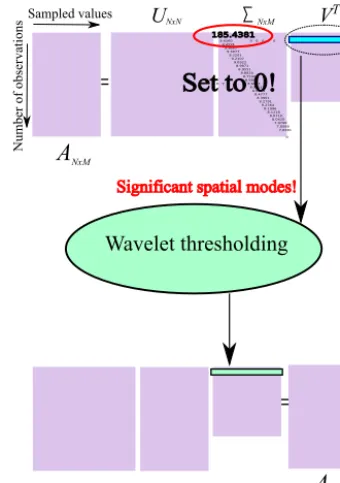
InordertoachieveabetterefficiencyofPODinprocessingnon-stationaryfields,wecombinedthemethodwith wavelet-based filteringwithfixed threshold(see Eq. (7)). In thisnewprocedure, waveletthresholding isapplied within the POD domainasshowninFig. 2.AsignificantbenefitofthisapproachisthatapplyingwaveletfilteringintheSVDdomain pre-servesthedimensionalityreduction.Waveletde-noisingisusedtoeliminateremaininghighfrequenciesfromthedominant modeswhich wouldrequire larger amounts ofdata forPOD orWPOD alone. Inthe following sections,it is shownthat WAVinPODoutperformstheotherestimatorsinde-noisingsyntheticandparticlemeasurements.
Combining the wavelettransform andSVD(or EVD) hasalready beenproposed inliterature. Most ofthe procedures involveusingSVD (orEVD)fornoise levelestimation,transforming asignal to thewaveletdomain, andperformingSVD (orEVD)onthechosencoefficients,orthewholematrix,asinBakshi’sMultiscalePCA[20] oritsextension–multivariate waveletde-noisingdevelopedbyAminghafarietal.[21].However,thesemethodsappeartobecomputationallyexpensive, consideringthenumberofoperationsperformed,makingthemunsuitableforde-noisingparticle-basedsimulations.
Inthispaper,unlessstated, theleft singularvectorsarising intheWAVinPODanalysisareleftunchanged.Applyingthe same filteringto un and vn incaseswhere N
M maynot offermuch improvementin noise reduction.This isduetothefactthatprocessingshortfunctionsweakenstheirorthogonalityproperty,resultinginunwantedaliases.However,when
N
∼
M,processingbothsetsofvectorscanaddtotheperformanceasdiscussedinthefollowingsection. Moreprecisely,thegeneralprocedureforWAVinPODde-noisingisasfollows:•
Step1:PerformSVDonmatrixdataA.•
Step2:Definethenumberkandsetsn=
0 forn>
k.•
Step3:Performawavelettransformofthekmodescorrespondingtothemostenergeticsingularvalues.•
Step4:Applywaveletde-noising(softorhard)todetailcoefficientsandreconstructthemodeswiththeinversewavelet transform.•
Step5:MultiplythematricesaccordingtoEq.(4)toobtaindataapproximation.When themethodisapplied during asimulationrun, themoving windowisusedinthe samemannerasinWPOD(see Sec.2.1.1).
3. Analysisofsyntheticdatacorruptedwithnoise
Thissection presentstheresultsofapplyingPOD,waveletthresholdingandWAVinPOD tosyntheticallygenerateddata. Thesestudiesallowastraightforwardcomparisonoftheeffectivenessofthemethodsinanalysingvarioussignals.Alldata processingwasperformedusingthecommercialsoftwarepackageMATLABR2014b(theMathWorksInc.,Natick,MA,2014). Three objective measures,averaged signal-to-noise ratio(SNR), relative errorinthe L2 matrix norm,
δ2
,anderror inthe matrixFrobeniusnorm,δ
F,wereappliedtoarangeofacceptedtestproblems.Foreachobservation,SNRwascalculatedasa ratioofthesummedsquaredmagnitudeofthetruesignal tothatofthenoise,andexpressedinthelogarithmicdecibel scale.TherelativeerrorsintheL2andFrobeniusnormsaregivenas
δ
2=
Atrue
−
Ak2 Atrue2, δ
F=
Atrue
−
AkF AtrueF,
(8)where Akis ade-noisedmatrixobtainedwithone ofthemethods.The L2 normofmatrixAisdefinedasthemaximum singular value of A,
A2=
s1. Theerror in L2,i.e.δ2
, comparesthe energycontent of Ak withthe originalmatrix. TheFrobenius normtakesall entriesofthedifference, Atrue
−
Ak,asa singlevector andmeasures itslength.Itthenindicateswhichoutputhastheshortestlengthoferrors[22].
Twodifferentoscillatingsignalshavebeenproposedthatimitatespatiallyvariablefunctionsarisinginvariousscientific problems.Thefirstinitiallysmooth N
×
Mdatamatrixwasgeneratedasfollows:A1true
(
t,
x)
=
sinπ
x M cosπ
t N+
0.
8e(−3πx/M)sin9
π
x M,
(9)loopingovert
=
1:
N andx=
1:
M.Thesecondsetofsignals, A2true,wasconstructedwiththefollowingMATLABcode:s = 0 : 0 . 0 1 : (M∗0.01−0.01);
y ( 1 , s /0.01)=3∗sin( s ) +sin( 0 . 5∗s + 40) + 2∗sin(3∗s− 6 0 ) ;
for t =1:N
for x =1:M
A_true ( t , x )= y ( 1 , x )∗cos(pi∗t /N)+ +sin( 0 . 5∗t +40)∗cos(pi∗x /M)+ +(0.01∗t +2+sin( t ) ) . ^ 2 ;
end end
In both cases the signals were of length M
=
1000 and initially only N=
20 observations were used. The number of time-samplesrequiredtode-noiseasignalisofsignificanceasitdefinesforhowlongthesimulationhastoruntoprovide enoughstatistics.Theranksofsmoothmatrices,equaltok1=
2 andk2=
3 for A1true andA2true,respectively,wereincreased by corrupting each signal with addedwhite noise.4 The resultingnoisy data-sets, A1 and A2,were full-rank because of the partial de-correlationofthe disturbed datapoints. In areal situationwe will not knowtheoriginal signal, butonly corrupted measurements,andoftenwearenotsureoftheirnature.FortheanalysiswithPODandWAVinPODwehaveto relysolelyonexaminationoftheeigenspectruminordertoestablishan adequatenumberofk fortheapproximation.The previouslylistedcriteriawereutilisedheretofindthenumberofsignificantmodes.The maindrawbackofusingwavelettransformandmultiresolutionanalysisistheamountofparameters thatneedto be considered apriori, e.g. motherwavelet,number ofvanishingmoments andlevelsof decomposition.Thechoice ofan appropriate model isoften problematic and maylead to data misinterpretation if anydeviations fromit appear. In this case, we knowthat the signalsto be recovered are smooth, thereforewaveletshrinkage should be usedinstead ofhard thresholding.ThefiltersassociatedwithDaubechieswaveletdb3 appearedheretogiveagoodrepresentationofpolynomial behaviourwithinthesignals.WhenapplyingwaveletthresholdingtospatialmodesobtainedwithSVD,thechoiceofwavelet basisislesscriticalthanapplyingthetransformdirectlytothenoisydata.Itisduetothefact,thatWAVinPODfiltersonly components ofthesignal that havealreadybeen partiallyde-noised.Forclearcomparison, the samewaveletparameters areusedforwaveletthresholdingappliedtorawdata(WAV)andWAVinPOD.
AtfirsttheoriginalmatrixA1true wascorruptedwithnoiseofstandarddeviation
σ
n=
0.
1,producing A1 withSNR≈
12.4 dB (see Fig. 4(a)). AfterapplyingSVD tothe whole matrix,the criteriafordetermining k were utilised. Tests mentionedFig. 2.Graphical representation of WAVinPOD algorithm.
Fig. 3.Investigating criteria for the choice of significantk; LEV diagram with the 1st and 3rd eigenvector and relative energy of the first three eigenvalues.
inSec.2.1.1 managed torecoveranaccurate numberofsignificant modes.The firstandsecond eigenvalue,
λ
n=1=
s21 andλ
n=2=
s22,were the mostenergetic containing together 96.
7% oftotal variance (E1λ=
91% and E2λ=
5.
7%).In practice,it iscommon toselectlevels ofenergythreshold between70% to95% [23].It isevident that thefirst twomodesretained mostof the significant information;the third eigenvalue correspondedto only 0.
22% of the totalenergy. When the LEV diagram, log10(λ
n)
, was plotted, the firsttwo eigenvalues also appeared to be fast-decaying(see Fig. 3), whilethe otherpointsformed almostastraightline.ChoosingthetruncationbasedonLEVismotivatedbytheideathat, ifhighermodes representuncorrelatednoise,thenthecorrespondingeigenvaluesshoulddecayexponentiallywithincreasingmodenumber [24].TheeigenvaluesthataredistinguishablefromalmostastraightlineontheLEVdiagramrepresentvaluableinformation. Correspondingeigenvectorsweresmootherthanothertemporalmodeswhichclearlycontainedhigh-frequencyoscillations as shown in Fig. 3. The choice of k was further confirmedby applying the SVHT [13], which suggested a threshold of
th
=
4.
5982 for known noise, andsimilar th=
4.
7231 for unknown variance andβ
=
N/
M=
20/
1000=
0.
02; the third singular value was smaller than the threshold, s3=
3.
5179<
th resulting in only two modesbeing recovered. We also proposeusingtheσ
n estimatedfromthe finestwaveletcoefficients(see Eq.(7)) incaseswherenoise levelisnotknown apriori.Inthisapproach,aslightlysmallerthresholdwas obtained,th=
4.
4097,butsufficienttoretain thesamenumber [image:7.561.179.366.323.485.2]Fig. 4.Reconstruction of synthetic signals, initially corrupted with Gaussian noise (SNR=12.4134 dB), with POD, 1D WAV and WAVinPOD.
Table 1
Comparisonofde-noisingefficiency.
Method SNR [dB] δ2 δF t[s]
Signal with Gaussian noise SNR=12.4134 dB; [N=20,M=1000]
POD 22.7478 0.0453 0.0617 0.02
1D WAV 25.2223 0.0388 0.0452 0.13
WAVinPOD 33.3264 0.0147 0.0178 0.04
Signal with Gaussian noise SNR=12.3998 dB; [N=240,M=1000]
POD 32.5555 0.0130 0.0198 0.08
2D WAV 34.2217 0.0120 0.0167 0.13
WAVinPOD 37.7215 0.0077 0.0114 0.1
The enhanced signalsobtainedwitheachtechnique are plottedevery5thobservationinFigs. 4(b)–4(d).Table 1 sum-marisesvaluesofaveragedSNRs(indB)anderrorsin L2 andFrobeniusnormforeachreconstructionalongwiththetime (inseconds)ittooktoperformeveryoperation.ForbothWAVinPODandPOD,thetimerequiredtodeterminewhichEOFs were significantwas notincludedinthefinalestimationofcomputationalcost.Inother words,theprocessingtimes pre-sented here depict how long it took to perform the whole algorithm withpre-defined k. The number oftime samples required tode-noisethe signal isofsignificance asitdefines forhowlong thesimulation hasto runto provideenough data.As expected, PODdidnot recoverthesignal wellfora smallnumberofobservations;the reconstructedmatrixhad SNR
=
22.7478 dB,δ2
=
0.
0453 andδ
F=
0.
0617.Better resultwas obtainedwith1D waveletshrinkage,over 10% higherSNR thanPOD,14% and27% lower
δ2
andδ
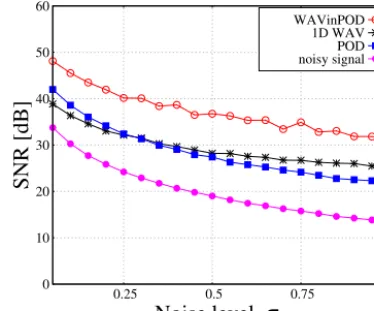
F,respectively.ApplyingWAVinPOD wasthemostsuccessfulinextractingthebet-Fig. 5.PerformanceofWAVinPOD,comparedwithWAV2inPOD,PODand1DwaveletthresholdingforincreasingnoisevariancemeasuredinSNR(a).In(b) and(c)onlyWAVinPOD,PODand1DWAVareconsideredforclarity.Analysedmatrix A1isasetof
N
=20 oscillatingsignalsoflengthM
=1000.For WAVinPODandWAV2inPOD,2modesweresubjecttosoftwaveletthresholdingwiththedb
3 filterand6 levelsofdecomposition.terthan PODandwaveletshrinkage,respectively)andthesmallest
δ2
=
0.
0147 andδ
F=
0.
0178,representingareductioninerrors of60% forWAV and70% forPOD.The one-dimensional wavelettransformmethodappeared to bethe slowest, aboutt
=
0.
13 s.Performing the 2D transformis faster(in thiscase, only t=
0.
03 s), butforsuch a small N the noise reduction wouldbelesseffective: SNR=
21.6070 dB,δ2
=
0.
0893 andδ
F=
0.
0906.In general,ifonly asmallnumber oflongdataarraysisavailable,N
M,itismorebeneficialtode-noiseeachsignalseparate,asthereareinsufficient observa-tionstolookforcorrelationsbetweenthem.Properorthogonal decompositionwas fasterthanWAVinPODbutitproduced the worst approximation.A similardiscrepancy was observedwiththe smallernumber oftime samples;for N=
10 the signal-to-noise ratioforWAVinPODwas SNR=
30.5314 dB, whilewaveletshrinkagewith1DtransformandPODprovided SNR=
24.7175 dBandSNR=
19.6530 dB,respectively.Anotheranalysiswas performedinorderto determinehowmanytime-samples ofthesignal withsimilar noiselevel, SNR
=
12.4566 dB,wouldberequiredforPODtoachieveacomparablede-noisingperformanceasWAVinPODwithN=
20. In thiscase, around 240 samples(12 times more than for WAVinPOD)allowed PODreach SNR=
32.5555 dB. The two-dimensionalde-noisingwithwaveletshrinkagealone recoveredbetter SNR=
34.2217 dB,while WAVinPODagain outper-formedbothtechniquesachievingthehighestSNR=
37.7215dBandlowesterrorsinnorms,δ2
=
0.
0077 andδ
F=
0.
0114.Whena largernumberofobservationsare available,i.e.thetemporalmodesarelonger, applyingwaveletthresholdingto dominantleft andright singular vectors(referred to asWAV2inPOD) maybe beneficial, because the additional transfor-mation doesnot stronglyaffect theorthogonality ofmodes. For N
=
240,WAV2inPOD recovered thebest approximation with SNR=
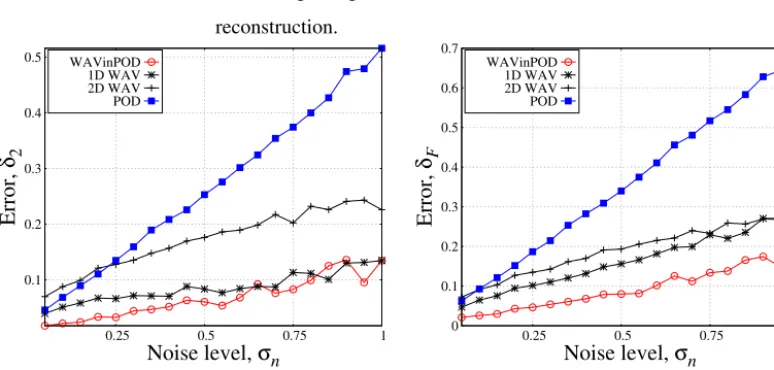
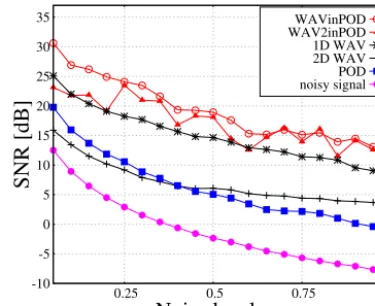
39.8888 dB. However, as our goalis to decrease the number ofmeasurements requiredfor data extraction, WAVinPODisstillthepreferredde-noisingapproach.Fig. 5 illustrates the performance of each method, measured withSNR (see Fig. 5(a)) and errors (see Figs. 5(b) and 5(c)) oftheapproximations,forincreasingnoiseleveladdedtothematrix A1
[image:9.561.178.366.54.207.2] [image:9.561.78.465.229.414.2]Fig. 6.Comparisonofallthemethodsappliedtothematrix A1 with N=10 oscillatingsignalsoflength
M
=1000. ForWAVinPODandWAV2inPOD, 2 modesweresubjecttosoftwaveletthresholdingwiththedb
3 filterand6 levelsofdecomposition.show that WAV2inPOD does not provide a higher SNR gain than the original procedure for thin data-sets, i.e. N
<<
M. It is thereforepreferabletousethe lesscomputationally expensiveoption,WAVinPOD. Thesameconclusions were drawn for a smallernumber ofsignals, N=
10,where all themethods performednoticeably worse than WAVinPOD, asshown in Figs. 6(a)–6(c). For clarity, the errors in norms for WAV2inPOD are not included in the plots. When the number of time-samplesisincreased,WAVinPODandPODresultsconverge;thisispresentedinFig. 7,wheretheerrorinL2normof de-noisedapproximationsisplottedagainst theincreasingsizeof A1.Incontrast,itcanbeobserved thatprocessingboth setsofdominantmodes,i.e.performingWAV2inPOD,canofferfurtherimprovementindataqualityforlarger N.As mentioned before,POD has the potential to successfullyextract a clean signal andoutperforms theensemble av-eraging thatis widelyapplied inparticlesimulations.Nevertheless,themethod stillrequiresa relativelylarge numberof samples in orderto de-noisethe data.Combining POD withwavelet thresholdingimproves the computational efficiency of thenoisereduction process.Forasmallnumberofobservations,POD managesto retainthe meanshapeofthesignal butdominantmodesstillcontain someenergycorresponding tounwantedfluctuations. InWAVinPOD,wavelet threshold-ing filtersthedominantspatialmodesfromall thedisturbanceswithoutmodifyingthesignal’sprofile(themostenergetic structure). This canbe observedby performing thewavelet transformonthe originalclean signal anditsreconstruction. Fig. 8(a)showsasparserepresentationofthesmooth signalat6 levelsofresolutioninthewaveletdomain.Thepeaksat thebeginningoftheplot(ontheleft)aretheapproximationcoefficients,cj0,m,whichcontainthecoarseinformation.
Mov-ing fromleft-to-right showsdecompositionof thesignal fromcoarse-to-fine resolution.The fine detailcoefficients, dj,m,
[image:10.561.83.470.233.415.2]Fig. 7.Comparisonofallthemethodsappliedtothematrix
A
1withincreasingnumberofoscillatingsignals.ForWAVinPODandWAV2inPOD,2modeswere subjecttosoftwaveletthresholdingwiththedb
3 filterand6 levelsofdecomposition.NotetheconvergenceofWAVinPODandPODforN
=M=1000; WAv2inPODproducedthelowestδ2forN
>300.Fig. 8.Wavelet transform coefficients; 6 levels of decomposition performed withdb3.
Additional analysis was performedon matrix A2 (see noisy data in Fig. 9(a)). Again,all the criteriaforselecting the numberofsignificant modesrecovered a rankequivalent tothe dimensionalityoftruedata-set,k
=
3,with N=
20. Ap-proximationsofA2true (showninFig. 9(a)),initiallycorruptedwithnoiseofstandarddeviationσ
n=
0.
5,obtainedwithPOD, [image:11.561.79.455.253.583.2]Fig. 9.Reconstruction of synthetic signals, corrupted with Gaussian noise (SNR=19.7711 dB).
It isimportant tomentionthat waveletthresholding alonedoesnot reduce thedimensionalityofa matrixaswell as POD or WAVinPOD. Both methods based on SVD produce approximations with rank equal to the number of dominant modes. For thecase of N
=
240 observations(see Table 1), 2D waveletanalysisproduced a matrix ofrank=
20 (for1D WAVrank=
80),whereasPODandWAVinPODresultedinamatrixofrank=
2.Singularvaluedecompositiongivesthebest rankreductioninallnormsthat areinvariantunderrotation[25].Thelowrankofthematrixisimportantifcompression of thedata isof interest.Transferring the original matrixwithrank 240requiressending 240×
1000=
240000 samples of information. When therank is loweredto 20, the matrixcan be representedby 3 components that together contain 240×
20+
20×
20+
1000×
20=
25200 elements,whichisalmostanorderofmagnitudelowerthanfortheoriginalset. Havingan approximation ofrank=
2 furtherreducesthesize ofthematricesresultinginonly2484samplesof thedata (about96timeslessthantheoriginal!).ItshouldbestressedthatusingWAVinPODallowsnotonlysuccessfulextractionof informationfromdisturbeddata,butalsoreducesthecomputationalcostoffurtherprocessingorstorage.4. Removingnoisefromsimulationresults
Fig. 10.Resultofde-noisingmatrix
A
2(N=20 oscillatingsignalsoflengthM
=1000)withPOD,1Dwaveletthresholding,andWAVinPOD.ForWAVinPOD andWAV,softwaveletthresholdingwiththedb
3 filterand6 levelsofdecompositionwasused.The molecular dynamics simulations were carried out using the open-source mdFOAM solver which is implemented withintheopensourcefluiddynamicstoolbox,OpenFOAM,anddevelopedandmaintainedbyresearchersattheUniversity ofStrathclydeandtheUniversity ofEdinburgh.5 Themodelfluidswere eitherliquidargonina kryptonchannel orwater flowing betweentwo siliconwalls. All of the parameters from the MD simulations are presented in reduced units; the reference values are linked to the Lennard-Jones (L-J) potentials. For water,the quantities for length, energy andmass, respectively,were:
σ
r,H2O=
3.
1589·
10−10 m,
r,H2O
=
1.
2868·
10− 21J,mr,H2O
=
2.
987·
10−26kg,andforargon:
σ
r,Ar=
3
.
405·
10−10m,r,Ar
=
1.
6568·
10−21J,mr,Ar=
6.
6904·
10−26kg.WeusedtherigidTIP4P/2005watermodelasdescribedbyAbascalandVega[28].FortheDPDmodelling, thiswas performedusingDLMESO6 andthedimensionlessparameters wereconvertedtophysicalunitswiththereferencevaluesofthecut-offradius,rcutr
=
6.
46·
10−10m.Thiswascalculated withoneDPDparticlerepresenting3watermolecules,basedontherelationdescribedbyGhoufiet al.[29].TheDPDenergy was kBTr=
4.
114·
10−21 J(wherekB isBoltzmann’sconstantand Tr=
298 K),andthemassofonewatermolecule was mr=
2.
987·
10−26kg.ParametersforDPDthatenforceproperwatercompressibilityforthesystemweretakenfromGrootandWarren[30].
ThefirstsimulationsweremodelledwithMDandconsidereddifferenttypesofflowinvolvingliquidargoninakrypton nanochannel:flowdrivenbyaperiodicallyoscillatingforcewithandwithoutroughnessandflowgeneratedbyanoscillating upperwall.Foreachcaseaperiodicdomainwithdimensions:25
×
50×
10(
x×
y×
z)
,withthewallthicknesssetto5in reducedunits.TheLennard-Jonesparametersdescribingargon–kryptoninteractionwere:σ
Ar−K r=
1.
02σ
r,Ar andAr−K r
=
1
.
18r,Ar, taken from Sofos et al. [31] and Gotoh [32]. The motion of fluid particles was weakly coupled to a thermal
Fig. 11.ResultofapplyingWPODtothedevelopedvelocityfieldfromanMDsimulationofaperiodically-pulsatingflowinasmoothchannel;
N
ts=1 and NPOD=4000.reservoir via the Berendsen thermostat. In order to not affect the calculations, the thermostat was applied only to the velocity componentperpendiculartotheflow direction.Basedonthe equipartitiontheorem,suchaconfigurationensures that each degree of freedom ofthe systemisclose to therighttemperature [33]. Forall simulations, thecomputational domain was dividedinto M
=
500 horizontalbins, wherethesamplingof observablestook place.Afterthetarget values ofsteady-statehadbeenreached(temperature T=
1 anddensityρ
=
0.
8187),thedensitycontrollerwasswitchedoffand eitheran oscillating forceof Fx=
0.
6sin(
0.
0125·
2π
t)
was appliedtoevery argonparticleinthefillregion,ortheupperwall wassettomove withavelocity V
=
0.
5sin(
0.
0125·
2π
t)
.The time-stepforeachsimulationwassettot
=
0.
0025 in reduced units, but the data was sampled every 100th time-step,tw
=
100t
=
0.
25 in order to ensure statisticalindependence.
ThemovingwindowwasutilisedinthemannerasdescribedbyGrinberg[3].WhiletheWPODwindowmoved through-outthesimulation,thematrixwasbeingupdatedevery Ntsoftw samples.Toallowastraightforwardcomparisonofallthe
de-noisingmethods,inmostofthecasesnoaveragingwasappliedprior todatafiltering,i.e.Nts
=
1.Westress thatPODandWPODessentiallydifferonlyintheimplementation.Therefore,theresultsobtainedfromPODwithamoving window are labelledin figures as POD approximations. Waveletthresholding and WAVinPOD were applied to the samewindow,
TPOD. Thewaveletfilterwas againchosen fromDaubechies family,butin thiscasethedb4 was utilised with8levels of decomposition,inordertorecovermoresmoothness.
Fig. 12.Analysisofde-noisingperformance;
N
ts=1 andN
POD=4000;forWAVinPODandWAVsoftwaveletthresholdingwiththedb
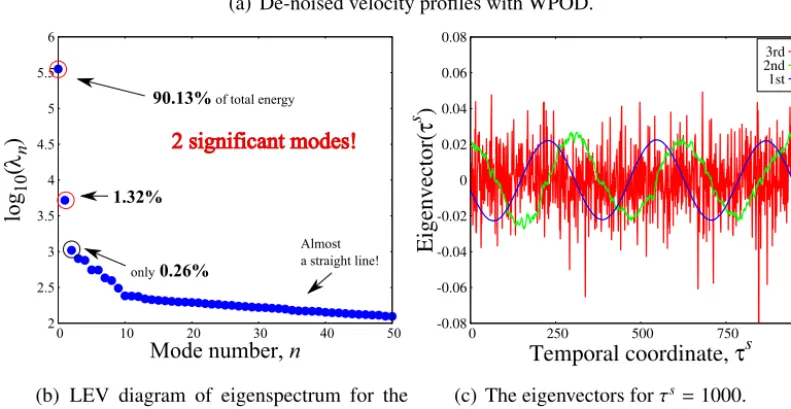
4 filterand8levels ofdecompositionwasused.the followinganalysis: examination ofthe energylevels of theeigenspectrum, the rateofdecay ofthe eigenvalues, and studyingthesmoothnessoftheeigenvectors.Thefirsttwoeigenvalues werethemostenergetic.TheLEVdiagramis illus-tratedinFig. 11(b);itcan beseenthat
λ
n=1=
s21 andλ
n=2=
s22 are decayingmuchfasterthantheother eigenvalues,i.e. theycorrespondtothedominantmodes.Eigenvalueswithk>
2 representfeatureswithashortcorrelationtime(noise).As showninFig. 11(c),the1stand2ndeigenvector(orleftsingularvector)describedtheoscillating natureofthedatawhilst theremainingmodescontainedhigherfrequencies.Inaddition,itshouldbestressedthatthefirsteigenvectorwassmoother thanthesecond one,whichwasslightlydisturbed.Thisobservationsuggeststhatnoisehadnotbeenentirelyfilteredout fromthesecondmode.WealsoutilisedtheSVHTforsingularvalues,buttheestimatedthresholdwastoolow,evenwhen the noiselevel was determined fromwaveletcoefficients. This isdue tothe fact that simulationdata oftensuffers from correlatednoiseforwhichtheoptimalthresholddevelopedbyGavishandDonoho[13]hasnotbeenderived.However,we observedthatifthesquarerootofthestandarddeviationusedinEq.(7)isinsertedintotheformulaforSVHTwithknown noise, thesame numberk is retainedas thevalue established withother tests. For all thesimulations discussed inthis section weutilised thisapproach.This strategyisbasedsolelyon theexperienceandfurtherinvestigationoftheoptimal universalthresholdforde-noisingparticledatashouldbeconducted.Fig. 13.Filteringvelocitydatawithsmallernumberofobservations:
N
ts=1 andN
POD=400;forWAVinPODandWAVsoftwaveletthresholdingwithdb
4 filterand8levelsofdecompositionwereused.Fig. 14.Snapshot of the channel with introduced roughness.
Fig. 15.FilteringvelocitydatawithWPODwith
N
ts=1 andstatisticalaveraging.Refinementofthegridindicatesthepositionofthecavityinthelower wall.Fig. 16.Comparisonofvelocityprofilesobtainedwithde-noisingtechniques;
N
ts=1 andN
POD=10000.NotethatWAVinPODandWPODproducedalmostidenticaldistributions.
Fig. 17.ComparisonofWPODand WAVinPOD(withthe
db
4 filter and8resolutions) fordecreasingnumberofvelocitymeasurements.Bothmethods [image:17.561.73.467.489.666.2]Fig. 18.Filtering velocity data from the oscillatory Couette flow simulated with MD; comparison of WPOD, WAVinPOD and WAV de-noising technique.
employedinordertoimprovethequalityoftheresults,asimulationhastobeeitherperformedseveraltimes,or,inthecase ofperiodicoscillations,lefttorunforlongenoughtogatherasufficientnumberofsamples.Inthesimulation,afullperiod translated to 320 velocitymeasurements as 80
/
tw=
320, wherethe data was output ateverytw
=
0.
25 interval. Inotherwords,inthecollectionofN
=
10000 samples,therewere31fulloscillations,whichwereusedtoobtainanensemble solution. Fig. 15(b) compares thequality of cumulative mean(average of 31full periods) andtheWPOD approximation. The latter clearly extractedsmoothervelocity profiles forthe samenumberof measurements (N=
31×
320=
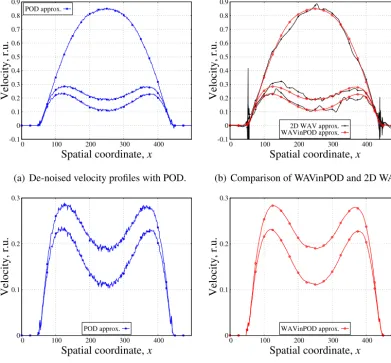
9920).To obtain acomparablelevelofde-noisingwithstatisticalaveraging, muchmoredatawouldhavetobe collected,increasing the computational cost.Furthermore,WPOD (orWAVinPOD) donot requireanyapriori informationregardingthe nature of the oscillations, which is clearly beneficial, e.g. when the frequency of fluctuations changes over time. Applying 2D waveletthresholdingalonedidnotproducesatisfactoryresultsasshowninFig. 16.Furtherimprovementofthede-noising efficiencycanbeobtainedbyutilisingWAVinPODasillustratedinFigs. 17(a)–17(b).Ifthevelocityapproximationproduced withWPODforN=
10000 measurements(seeFigs. 15(a)and15(b))isconsideredasadesiredsolution,theSNRofvelocity profilesrecoveredwithWAVinPODforNPOD=
500 hadSNR=
32.2875 dB,whileWPODprovidedSNR=
28.8545dB(about 12% lower). In general, for a decreasing number oftime samples, WPOD retains more noise, while WAVinPOD removes additionaldisturbancesenhancingtheanalysisofslipvelocityattheroughsurface.Fig. 19.Statistical averaging and WPOD low-rank approximations of the velocity measurements from a water flow simulation performed with MD.
Fig. 20.ComparisonofWPOD,WAVinPODandwaveletshrinkage(withfilter
db
4,8resolutionsandk
=1)inde-noisingvelocitydatafromsimulationof unsteadywaterflow.WAVinPODoutperformedWPODandstatisticalaveraging,extractingsmoothprofilesevenfor5timessmallerN
=NPOD=1000 andFig. 21.Snapshots of the first and last time-step of the DPD simulation.
Fig. 22.ComparisonofWAVinPOD,WPODand2DWAVappliedtothedensityfieldfromaDPDsimulationofaphaseseparationphenomenon;
N
ts=10and
N
POD=2000.profiles with M
=
500 samples obtainedfromtheshear-driven flowinduced by an oscillating upperwall(see Figs. 18(a) and 18(b)).TheresultswerecomparedinFigs. 18(c)–18(d)withasmallerdata-setcontaining onlythelast N=
600 mea-surementsinordertoestablishwhetheranyofthemethodscanreducethecomputationaltimerequiredtoextractsmooth data that is easy to analyseandprocess. Waveletthresholding within POD extractedsimilar quality velocity profiles but WPOD required10×
moresnapshots;WAVinPOD producedan ensemblewith18% higherSNRthan WPOD,ifweassume thatthetruesolutionisasetofprofilesobtainedwithWPODforNPOD=
5000.Two-dimensionalwaveletthresholdingwithdb4 and8resolutionswasagaintheleastsuccessful.Ourcriteriafordeterminingthenumberofsignificantmodesrecovered
k
=
2 foreachdata-set.Molecular dynamics can be applied to many real-life problems,e.g. forstudying water flow in nanostructured mem-branes. However, such modellingisquite challenging; thecomplexity of thewater systemrequiressmall time-stepsand the simulationsoftencontain substantialstatisticalnoisethat iscomputationally demandingto reduce.Inorderto assess howde-noisingtechniquescanimprovetheanalysisofsuch data,weappliedWPOD,WAVinPODandwaveletshrinkageto anoscillatingPoiseuilleflowofwaterbetweentworigidplanarsiliconwalls.Theproportionsofthecomputationaldomain were kept the sameasin theprevious MD simulations; theperiodic channel haddimensions:25
×
50×
10 (x×
y×
z)
, with thickness of the walls set to 5, expressed in reduced unitsfor water. Water molecules were driven by a force ofFx
=
0.
6sin(
0.
0125·
2π
t)
(againwithdifferentreducedunitsthanforargon).Asmallertime-step,t
=
0.
0012,was usedin orderto captureallthe importantdynamicswithwrite-interval
tw
=
0.
12 (datawas output everyτ
s=
100t). The
system’stemperaturewassettoT
=
3.
816,andwaterdensitywasρ
=
1.
047.Atfirst,allthefilteringmethodswereapplied to N=
5000 andM=
500,resulting,apartfromwaveletthresholding,inmuchimprovedinstantaneousdataquality.Figs. 19(a) and 19(b) show how WPOD with k
=
1 performed in comparison with statisticalaveraging over the full oscillatory period (oneperiod every 80/
tw≈
666 observations) forthe same data-set; it can be readilyobserved thatIn order to show the versatility of WAVinPOD, we applied it to densityfields from a simulationof phase separation phenomenonperformedwithDPD.Thestudiedsystemconsistedofaperiodicboxfilledwith3000particles,dividedinto 2species(1500each).Theparticlesfrombothspecieshadthesamesize,andeachbeadhadamass
=
1inDPDunits,but weresettorepeleachotherinordertoformtwolayers,asshowninFigs. 21(a)–21(b).WeappliedWAVinPODtogetherwith WPODtodensityprofilesobtainedfromM=
400 binsspanningthex-direction.Thesimulationrunforτ
s=
20000,andanensembleofNPOD
=
2000 averagesofNts=
10 sampleseachwasformed.InFig. 22(a),theoriginalprofilesforbothspeciesareplottedagainstWPOD andWAVinPOD approximations.Theprofiles wereextractedbyretainingonlyk
=
2 modesand usingthedb4 filterwith8decompositions.Bothde-noisingtechniquesproducedsimilarresults.However,whenthedensity profileswereplottedatdifferentinstances(seeFig. 22(b)),itwasclearthatWAVinPODprovidedsmootherestimates.Again, applying waveletthresholding alone resulted in poorfiltering quality. It should be stressedthat no additional averaging couldhavebeenperformedwithoutlosinginformationonhowthesystemwasevolving.5. Conclusionsandremarks
We haveintroduced a novel de-noisingtechnique forunsteady signalsthat couples waveletthresholding withproper orthogonaldecomposition,WAVinPOD.OurprocedurecombinestheoptimaldimensionalityreductionofPODwiththe time-frequencylocalisationpropertiesofwavelets.Thenewmethodwasappliedtoanumberofoscillatingsyntheticsignalsand unsteadyparticle-baseddatatoinvestigateitscapabilitiestoreducenoise.Itwasshownthatthemethodologyoutperforms theothertechniquesinextractingsignificantinformationfromcorruptedmeasurements.WedemonstratedthatWAVinPOD isbeneficial inreducing noiseinoscillatory flows,andcan successfullyextractsmooth profilesofthe properties.Relative tostandardstatisticalaveraging,WPOD,andwaveletshrinkage,WAVinPODachieveshighersignal-to-noiseratiosandlower errorsinFrobeniusandL2normsatreducedcomputationalcost.EnsemblesolutionsobtainedwithWAVinPODallowamore accurateanalysisofresultsobtainedwithparticle-basedsimulations,includingmoleculardynamicsanddissipativeparticle dynamics.Thisworkhasthereforeprovidedacontributiontothechallengeofimprovingthecommunicationinmulti-scale modellingthatcouplesamoleculardomaintocontinuum-baseddomain,suchasfluiddynamics.
PerformingWAVinPOD requiresan estimate ofk, whichdenotes thenumberofsignificant structurescontainedinthe data. Numerous criteriafor determining which orthogonal modesare dominant have beenlisted inthis work. Selection of PODmodesfor separatingthe ensemblesolution fromfluctuating components canbe done adaptively.It can also be performedbytheuserattheendofthesimulationrunaspartofpost-processing.Inaddition,we proposedapplyingthe singular value hard threshold to automate the filtering process ofWAVinPOD. However, asthe method was specifically designedforsystemscorruptedwithwhitenoise,SVHTdoesrequiresomemodification.Furtherstudywillbeperformedin ordertooptimisethethresholdestimate,andprovideasoundmathematicalexplanation.
AlthoughWAVinPODisshowntobeavaluabletoolforremovingnoisefromparticle-basedsimulations,thereisaclear scopetoextenditsapplicability.Onepossibleextension isitsapplicationtodirectsimulationMonteCarlodatatoanalyse problemsinrarefiedgasdynamics.Thiswillbethesubjectoffurtherresearch.
Acknowledgements
Theresearch leadingtotheseresultswasperformedatSTFCDaresburyLaboratory andreceivedfundingfromtheUK’s Engineering and Physical Sciences Research Council (EPSRC) underGrant EP/I011927/1. Results were obtainedusing the ARCHIE-WeSt High PerformanceComputer, underEPSRC grant EP/K000586/1. The authorswould liketo thank EPSRC for their supportofCollaborativeComputationalProject 12(CCP12)andfundinginthe formofEPSRC DoctoralPrize. Sincere gratitudegoestoDr.LeopoldGrinbergforhisguidance.
References
[1]G.Karniadakis,A.Beskok,N.Aluru,MicroflowsandNanoflows:FundamentalsandSimulation,Springer,2005.
[2]P.Berkooz,G.Holmes,J.L.Lumley,Theproperorthogonaldecompositioninthe analysisofturbulentflows,Annu.Rev.FluidMech.25 (1)(1993) 539–575.
[3]L.Grinberg,Properorthogonaldecompositionofatomisticflowsimulations,J.Comput.Phys.231 (16)(2012)5542–5556. [4]D.L.Donoho,J.M.Johnstone,Idealspatialadaptationbywaveletshrinkage,Biometrika81 (3)(1994)425–455.
[5]R.R.Coifman,D.L.Donoho,Translation-InvariantDe-Noising,Springer,1995.
[6]P.Holmes,J.L.Lumley,G.Berkooz,Turbulence,CoherentStructures,DynamicalSystemsandSymmetry,CambridgeUniversityPress,1998. [7]A.Chatterjee,Anintroductiontotheproperorthogonaldecomposition,Curr.Sci.78 (7)(2000)808–817.
[8]M.Farge,K.Schneider,Analysingandcomputingturbulentflowsusingwavelets,in:M.Lesieur,A.Yaglom,F.David(Eds.),NewTrendsinTurbulence, vol. 74,Springer,2002,pp. 449–503.
[9]S.G.Mallat,AWaveletTourofSignalProcessing,2edn.,AcademicPress,1999. [10]M.Vetterli,J.Kovaˇcevi ´c,WaveletsandSubbandCoding,vol.87,Prentice–Hall,1995.
[11]J.L.Lumley,Thestructureofinhomogeneousturbulentflows,in:AtmosphericTurbulenceandRadioWavePropagation,1967,pp. 166–178.
[12]J.M.Craddock,C.R.Flood,Eigenvectorsforrepresentingthe500mbgeopotentialsurfaceovertheNorthernHemisphere,Q.J.R.Meteorol.Soc.95 (405) (1969)576–593.
[13]M.Gavish,D.L.Donoho,Theoptimalhardthresholdforsingularvaluesis4/sqrt(3),IEEETrans.Inf.Theory60 (8)(2014)5040–5053.
[16]I.Daubechies,TenLecturesonWavelets,vol.61,SIAM,1992. [17]G.Strang,T.Nguyen,WaveletsandFilterBanks,SIAM,1996.
[18]D.L.Donoho,De-noisingbysoft-thresholding,IEEETrans.Inf.Theory41 (3)(1995)613–627.
[19]I.M.Johnstone,B.W.Silverman,Waveletthresholdestimatorsfordatawithcorrelatednoise,J.R.Stat.Soc.,Ser.B,Stat.Methodol.59 (2)(1997)319–351. [20]B.R.Bakshi,MultiscalePCAwithapplicationtomultivariatestatisticalprocessmonitoring,AIChEJ.44 (7)(1998)1596–1610.
[21]M.Aminghafari,N.Cheze,J.-M.Poggi,Multivariatedenoisingusingwaveletsandprincipalcomponentanalysis,Comput.Stat.DataAnal.50 (9)(2006) 2381–2398.
[22]T.J.Ross,FuzzyLogicwithEngineeringApplications,JohnWiley&Sons,2009.
[23]I.T.Jolliffe,Discardingvariablesinaprincipalcomponentanalysis.I:Artificialdata,Appl.Stat.(1972)160–173. [24]D.S.Wilks,StatisticalMethodsintheAtmosphericSciences,vol.100,AcademicPress,2011.
[25]D.Achlioptas,F.Mcsherry,Fastcomputationoflow-rankmatrixapproximations,J.ACM54 (2)(2007)9.
[26]M.Deng,L.Grinberg,B.Caswell,G.E.Karniadakis,Effectsofthermalnoiseonthetransitionaldynamicsofaninextensibleelasticfilamentinstagnation flow,SoftMatter11 (24)(2015)4962–4972.
[27]M.P.Allen,D.J.Tildesley,ComputerSimulationofLiquids,ClarendonPress,Oxford,1987.
[28]J.L.F.Abascal,C.Vega,Ageneralpurposemodelforthecondensedphasesofwater:TIP4P/2005,J.Chem.Phys.123 (23)(2005)234505.
[29]A.Ghoufi,J.Emile,P.Malfreyt,RecentadvancesinManyBodyDissipativeParticlesDynamicssimulationsofliquid–vaporinterfaces,Eur.Phys.J.E 36 (1)(2013)1–12.
[30]R.D.Groot,P.B.Warren,Dissipativeparticledynamics:bridgingthegapbetweenatomisticandmesoscopicsimulation,J.Chem.Phys.107 (11)(1997) 4423–4435.
[31]F.D.Sofos,T.E.Karakasidis,A.Liakopoulos,Effectsofwallroughnessonflowinnanochannels,Phys.Rev.E79(2009)026305. [32]K.Gotoh,LiquidstructureandLennard-Jones(6,12)pairpotentialparameters,Nature239 (96)(1972)154–156.
[33]A.I.Khinchin,MathematicalFoundationsofStatisticalMechanics,CourierCorporation,1949.
[34]N.V.Priezjev,Effectofsurfaceroughnessonrate-dependentslipinsimplefluids,J.Chem.Phys.127 (14)(2007).