City, University of London Institutional Repository
Citation
:
Stigliani, I. and Ravasi, D. (2016). Combining qualitative methods to study collective cognition in organizations. In: Elsbach, E. and Kramer, R. M. (Eds.), Handbook of Qualitative Organizational Research: Innovative Pathways and Methods. (pp. 444-453). USA: Routledge. ISBN 9781848725096This is the accepted version of the paper.
This version of the publication may differ from the final published
version.
Permanent repository link:
http://openaccess.city.ac.uk/13919/Link to published version
:
http://dx.doi.org/10.4324/9781315849072Copyright and reuse:
City Research Online aims to make research
outputs of City, University of London available to a wider audience.
Copyright and Moral Rights remain with the author(s) and/or copyright
holders. URLs from City Research Online may be freely distributed and
linked to.
1
Combining qualitative methods to study collective cognition in organizations
Ileana Stigliani, Imperial College London
Davide Ravasi, Cass Business School
ABSTRACT
2
Introduction
The study of collective cognition in organizations can be traced back to the early 1980s,
when strategic management scholars started being interested in the interpretive side of
organizations (e.g., Daft and Weick, 1984; Kiesler and Sproull, 1982; Sims and Gioia, 1984;
Weick, 1979). These studies mostly focused on the role of managerial cognition in
influencing strategy formulation (e.g., Huff, 1982, Porac et al, 1989; Porac and Thomas,
1994) and strategic outcomes (e.g., Barr et al., 1992; Barr, 1998; Thomas et al., 1993). Ever
since, a rise of interest towards cognitive processes in organizations has diffused throughout
different areas of managerial scholarship drawing upon advances in cognitive and social
psychology (see Kaplan 2011a for a more comprehensive review).
Early attempts to study cognition in organizations relied upon graphic representations,
collectively referred to as casual maps (Huff et al., 1990) or cognitive maps (e.g., Barr et al.,
1992; Bougon, 1992; Bougon et al., 1977; Fiol and Huff, 1992, Laukkanen, 1994), to visually
capture the content and structure of managers’ beliefs about key organizational phenomena
and their links to decision-making.
Despite a call for further research using visual representations to collect and analyse data
in organizations (see Meyer, 1991), cognitive mapping was gradually replaced by alternative
approaches privileging verbal reporting to visual reporting. In particular, spurred by rising
interest in how language constitutes ad constructs social reality (Alvesson and Kärreman,
2000), qualitative research on cognitive processes inside organizations turned to examine
how conversation, narratives, and accounts shape the convergence around collective
interpretations (e.g. Balogun and Johnson, 2004, 2005; Cornelissen, 2012; Donnellon, Gray
and Bougon, 1986; Gioia, Thomas, and Clark, 1994; Kaplan, 2008; Maitlis, 2005; Maitlis and
3
In recent years, however, the visual dimension in the study of organizational processes has
received renewed attention (Meyer et al., 2013). Inspired by a broader material turn in the
social sciences (Hicks and Beaudry, 2010), more recent studies have started investigating
how material practices and artifacts support collective cognition. This research shows how
organizational members typically rely on various artifacts to develop collective
interpretations as they formulate strategies (e.g., Buergi, Jacobs & Roos, 2004; Denis,
Langley & Rouleau, 2006; Heracleous & Jacobs, 2008; Kaplan, 2011b), exchange knowledge
across occupational communities (e.g., Bechky, 2003; Carlile, 2002), and develop and
evaluate new ideas (e.g., Hargadon and Sutton, 1997; Sutton and Hargadon, 1996). However,
while these studies provide robust evidence that material artifacts and practices may support
the development of individual and collective interpretations, they told us less about how they
do so.
In our study of how designers develop new ideas (Stigliani and Ravasi, 2012), we
combined ethnographic observation, grounded theory and visual narrative analysis to unravel
the transition from individual to collective level in prospective sensemaking. We argue that
the combined use of these three methodologies allowed us to provide a deeper and more
nuanced understanding of how material practices influence the development of collective
interpretations. Ethnography helped us map and unpack the material practices designers
engage in when developing new ideas. Interviews and grounded theory helped us articulate
informants’ interpretations of these practices, and capture the underlying cognitive processes.
Finally, visual narrative analysis helped us systematically track changes in the evolving
collective interpretations, and link together practices and processes in a longitudinal fashion.
By doing so, our study provides insights into innovative forms of data collection, analysis
and interpretation, which, we argue, compensate the limitations of more traditional
4
section we review these approaches by explicitly focusing on those studies investigating the
links between material artifacts and cognition.
Traditional approaches to the study of materiality and cognition
Research across the social sciences is directing increasing attention to how materiality and
visual engagement with reality influence cognitive work. In reviewing extant research on the
topic, we identified different methodological approaches, which roughly fall into two main
groups.
Experimental studies of materiality and cognition. Some cognitive psychologists argue that cognition is “distributed” in that it does not consist only of individuals’ mental
representations and operations, but also interacts with a material environment “rich in
organizing resources” (Hutchins, 1995: 2). Central to this perspective is the notion of
“cognitive artifacts” – such as calendars, to-do lists, computational artifacts, or simply a string
tied around the finger – defined as “artificial devices that maintain, display, or operate upon
information in order to serve a representational function and that affect human cognitive
performance” (Norman, 1991: 17). These artifacts serve as “cognitive extensions” that
facilitate various mental processes by extending the capacity of the brain to store and process
information (Clark & Chalmers, 1998; Clark, 2008). Research in cognitive psychology also
shows that individuals may acquire and process information verbally or visually, and that the
strategies they employ have different effects on memory and judgment (Paivio, 1971;
Kosslyn, 1976). Visual imagery is also believed to facilitate the comprehension and store of
verbal information (Garnham, 1981; Wyer & Radvansky, 1999).
Research on creative cognition – an approach to the study of creativity based on the
experimental methods of cognitive science – adds to this line of thinking, suggesting how the
exposure to visual stimuli influences the activation of generative cognitive processes (e.g,
5
visual patterns, mental models, category exemplars, etc.), which are then modified through
exploratory cognitive processes (e.g., attribute finding, conceptual interpretation, etc.) (Finke
et al., 1992).
Collectively these studies look at artifacts as resources or stimuli to investigate the
fundamental mental processes, such as attention, memory, problem solving and creativity,
triggered by said artifacts. Although insightful in unpacking the main mechanisms underlying
collective cognition, the results of laboratory experiments cannot be easily transferred and
applied to organizational contexts, where complex patterns of interactions among people, and
between people and artifacts unfold over time.
Natural studies of materiality and cognition. Research in the sociology of science has shown how scientists use a variety of tools, documents, and instruments to shape the
collective production of new belief structures. Knorr-Cetina (1981), for instance, talked about
the scientist as a practical reasoner, the scientific laboratory as “a local accumulation of
materialisations from previous selections”, and the scientist’s work as an activity “consisting
in realising selectivity within a space constituted by previous selections” (1981: 6). Later on,
she developed the notion of “epistemic objects” (Knorr-Cetina, 1997) as objects of enquiry –
such as a molecule, a production system, a disease or a social problem – argued that the
“openness” of these “epistemic objects” facilitate scientific inquiry and the production of new
knowledge (Rheinberger, 1997).
In organization studies, research on organizational artifacts has highlighted how
physical objects are used to support cognition in situations characterized by a certain degree
of ambiguity, and, in some cases, it has traced explicit connection with individual and
group-level sensemaking (Bechky, 2008; Pratt & Rafaeli, 2001). The concept of organizational
artifact was introduced by students of organizational culture to indicate visible and tangible
6
organizational artifacts influence how individuals interpret organizations and organizational
members. Organizational artifacts such as logos, buildings and products influence how
stakeholders develop an understanding of an organization (Rafaeli & Vilnai-Yavetz, 2004).
Other artifacts, such as office décor, uniforms, and other personal objects represent cues that,
combined with pre-existing social categories (acting as frames), help members make (and
give) sense of the relative position of other members within the social structure of the
organization (Elsbach 2003, 2004; Pratt & Rafaeli, 1997).
Later studies have shown how artifacts affect the social processes through which
interpretations are transformed and transferred across different groups and/or professional
communities inside organizations (Bechky, 2003; Carlile, 2002, 2004; D’Adderio 2001,
2003; Henderson, 1991, 1998). Because of different background and experiences, different
occupational communities tend to develop different understandings of organizational tasks,
which in turn may hamper coordination and collaboration across community. Some artifacts,
like drawings, machines, etc., that are shared by two or more communities can serve as
“boundary objects” (Carlile, 2002, Bechky, 2003) facilitating the transfer and sharing of
interpretations and knowledge across communities, and helping members to make sense of
their respective contribution to a common task. Collectively, these studies look at artifacts as
ways to store and transmit the social knowledge of a community, and to retrospectively
reconstruct the meaning structures they embody (see Meyer et al., 2013).
By relying on ethnographic observations and interviews, these studies insightfully
pointed out that material artifacts are deeply intertwined in the socio-cognitive dynamics
unfolding in various organizational contexts. As mentioned earlier in this chapter, these
scholars mainly used ethnographic data of how artifacts are used, exchanged and negotiated
to infer the underlying cognitive processes. The limitation that we see in this approach resides
7
of practices, rather than explicating these processes by fleshing out the links between
cognition and material artifacts and practices.
In the next section, we describe how we approached the study of these links by
combining different methods of data collection and analysis.
How we studied collective sensemaking in an organizational setting
In our study of how designers develop new ideas (see Stigliani and Ravasi, 2012), we
were guided by the purpose to investigate how material artifacts – and the practices through
which they are produced and attended to – facilitate cognitive work in collective
sensemaking. We considered a design consulting firm as an appropriate setting to our
research purpose, because designers often face ambiguity regarding both the solution to the
problem they address and the context within which this solution will be implemented (Clark,
1985; Lawson, 2005), and use various types of artifacts, such as drawings, sketches, and
models, to support their interpretive processes (Boland & Collopy, 2004; Sutton & Hargadon,
1996). Our findings show the interplay between material and conversational practices in the
collective sensemaking process, and in particular show how material practices support the
cognitive sub-processes involved in the gradual organization of individual interpretations,
and the integration of ill-defined early ideas into more refined shared understandings.
In approaching this study we followed common recommendations for ethnographic work
(e.g. Jorgensen, 1989; Spradley, 1980; Van Maanen, 1979), and we collected data by
combining participant observation of three new product development projects, 56 formal
semi-structured interviews and archival data, consisting in company- and project-related
documents, as well as pictures and copies of the material artifacts created by designers during
the projects. As explained more extensively in Stigliani and Ravasi (2012), we analyzed these
8
Step 1. Using participant observation to trace individual and group-level practices of
sensemaking. Building on the idea that the conversational practices that underpin the
production of new knowledge structures are “materially mediated” by textual and
representational artifacts (Knorr-Cetina, 1999; Orlikowski, 2007), we began our investigation
by carefully mapping the material artifacts that members produced and used in the course of
the projects, and the practices that they engaged in as they did so. We did so through deep and
prolonged ethnographic engagement with our research site, as the first author spent ten-month
as a participant observer in three development projects.
Consistently with a practice-based approach to organizational analysis (Feldman and
Orlikowski, 2011), we understood practices as recurring, routinized activities aimed at
accomplishing a specific task and associated to specific artifacts (see Table 3 in the published
article). Extracting practices from the general ongoing flow of activities performed by
designers was based not only on our observations, but – consistently with the idea of practices
as being meaningful to the practitioner – also on what informants consistently referred to and
labeled as distinctive subsets of activities.
For example, across the three projects observed, we noticed that during team meetings,
designers would engage in the tentative grouping and re-grouping of Post-its or cards
representing preliminary ideas to trace connections across them and surface possible patters.
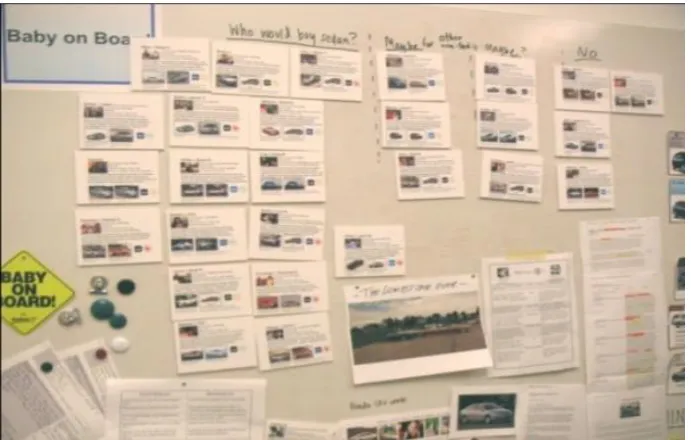
For instance, during the initial phase of one project, members used cards including
demographic information about the informants they had interviewed (age, number of kids,
owned cars) and significant quotes from these interviews (see Figure 1). By grouping ad
re-grouping these cards based on variables like daily schedules, lifestyles, aspirations, emotional
needs, and purchasing behaviors, members eventually identified three main groups
characterized by different needs and consumption patterns. Informants referred to this
9
Figure 1. Bucketing at Continuum
Step 2. Using grounded-theory to articulate cognitive processes. In a second step of
analysis, we used interview data to investigate the cognitive sub-processes that, according to
informants, material practices and artifacts supported and enabled. In our interviews we asked
informants to explain how and why they engaged in these practices, and how doing so helped
them accomplish their tasks. Following recent research on sensemaking (e.g. Corley & Gioia,
2004; Maitlis 2005), we turned to common procedures for grounded-theory building (Gioia et
al., 2012; Locke, 2001) to analyze our data. We used interview transcripts to capture
informants’ interpretations of the previously mapped material practices, and we used these
interpretations to bring to the surface the cognitive processes underlying these practices.
When explaining how the production and use of material objects helped them produce ad
refine new ideas, informants repeatedly used metaphorical expressions suggesting their
material engagement with abstract cognitive structures, i.e., “organizing thoughts”, “parking
ideas”, “connecting brains”, etc. For instance, informants mentioned how the practice of
“bucketing” described earlier helped them “sorting things out”, an expression that suggested
10
tentative ideas into broader categories, based on patterns of differences and similarities (see
Stigliani & Ravasi, 2012).
Past research on collective cognition has drawn attention to the importance of metaphors
in the negotiation of a consensual understanding of social reality (e.g. Donnellon et al., 1986;
Gioia et al., 1994). We used the metaphors that informants’ spontaneously produced to
account for their material practices (embodying their first-order interpretation of these
practices) to infer and theorize the underlying cognitive processes (articulated as a
second-order interpretation). Metaphors of physical engagement with cognitive structures, in this
respect, helped us overcome the common difficulty to articulate one’s cognitive processes and
vividly label these processes for further analysis.
Step 3. Using visual narrative analysis to associate material practices to cognitive
processes. Combining the map of practices resulting from ethnographic observations with
informants’ accounts of how these practices supported their cognitive work, we produced a
multi-phase, multi-level grounded model of how material practices support collective
sensemaking efforts. This phase largely relied on what we refer to as “visual narrative
analysis” (not described in detail in article, for the sake of simplicity and space saving). We
define visual narrative analysis as the investigation of a process through the systematic
collection and analysis of the material artifacts produced and used during such process (for a
similar method see Kaplan, 2011b) to document evolving mental structures (concepts,
relationships, etc.) resulting from individual and collective cognitive work and embodied in
the these artifacts.
Analyzing visual artifacts longitudinally in chronological order, helped us reconstruct how
new understandings of users, needs, and relevant design attributes were tentatively explored,
connected, refined, discarded, and eventually organized around a new “big idea”. This
11
needs inspired the evolving artifacts that eventually allowed designers to bring order in their
exploration of consumers’ needs by visually (and conceptually) arranging them in a hierarchy.
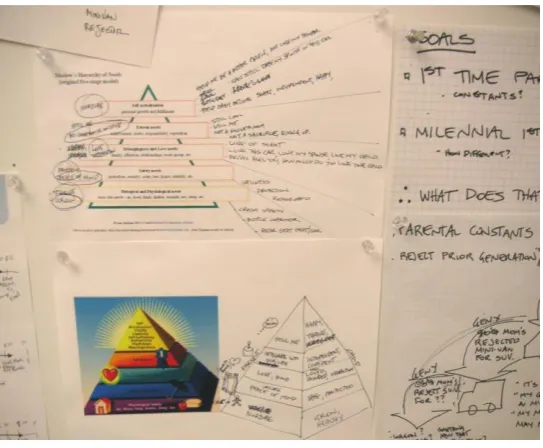
When printed on paper, the idea of a hierarchy of needs lent itself to various visual
manipulations as team members collectively attempted to merge ideas and link various
insights from early stages (see, for instance, Figure 2), until the group converged on a visual
representation of the “Vehicle hierarchy of needs” (undisclosed for confidentiality reasons).
The new representation was used as a platform to produce further visual artifacts that
gradually integrated emerging understandings of user needs, consumer categorization, and
product features, to outline potential areas of innovation (undisclosed for confidentiality
[image:12.595.92.364.383.607.2]reasons).
Figure 2. Early visual manipulations of Maslow’s Hierarchy of Needs.
The fundamental notions behind Maslow’s model, then, triggered the initial idea of
hierarchically arranging consumers’ needs emerging from earlier field work in a pyramid. But
it was the visual representation it inspired that offered an infrastructure to gradually organize
insights emerging from the discussion (by providing an implicit relational structure to be
12
tentative representations that the team produced), to facilitate the integration of different
members’ ideas (as two or more members physically added their ideas to the emerging
framework by writing on a common board), and the establishment of visual linkages among
different elements of the task (by using a mix of tables and color codes). In other words, it
was the embodiment of Maslow’s ideas into a more general visual representation that
supported “organizing thoughts”, “building on each other’s ideas”, “keeping the bread
crumbs” and other cognitive processes that underpinned the collective sensemaking process.
By combining the results of this visual narrative analysis with the results of the grounded
theory analysis, we managed to associate the different artifacts produced by designers at
different steps of the projects to changes in the evolving collective interpretations, and by
doing so to link together practices and processes in a longitudinal fashion and to produce a
more general process model of how material practices support the transition from individual
to group-level sensemaking (Stigliani and Ravasi, 2012).
The benefits of combining different qualitative methods
The combination of different qualitative methods allowed us to gain a deeper and more
thorough understanding of the cognitive processes supported and facilitated by performing
certain material practices. Had we used only one single method, we would have probably not
captured the links between the different elements of our model. As mentioned earlier,
participant observations of how designers work in group allowed us to identify the
micro-practices designers engaged in (e.g. “browsing and collecting”, “bucketing”, etc.). Had we
relied only upon the analysis of only this type of data, we would have probably missed the
underpinning cognitive processes. As cognition mostly unfolds in people’s minds, we needed
to triangulate insights from observations (that in the first place hinted to the development of
13
Our interviews had an open format in order to elicit informants’ cognitive interpretations
of their material practices without “leading the witness”. Initially, designers were not aware
of the unfolding of their cognitive processes, and simply tended to consider the artifacts they
created as simple “tools of the trade”. As mentioned earlier, while invited to reflect on how
these artifacts, and the associated practices, helped them accomplish their tasks, they often
used metaphorical expressions. These metaphors proved very useful for us in order to flesh
out the links between materiality and cognition and for informants in order to reach a higher
awareness of how the engagement with materiality supports the development of their
interpretations. In other words, these metaphors were useful to explain in an analogical way
cognitive processes of which designers had only limited awareness, and that could not be
illustrated in an analytical way. Our informants considered the increased awareness that they
developed while the first author was in the field as important to explain their “technologies”
when pitching their work to clients, and emphasize better the added value of their peculiar
approach to problem-solving. In addition, the use of visual data (in the form of pictures,
diagrams, frameworks, sketches) to complement verbal reporting (both as field notes and
interview transcripts) helped us “reveal the data at several levels of analysis, and to induce
the viewer to think about substance rather than about methodology (Meyer, 1991: 232).”
Given the benefits illustrated above, we argue that the combination of traditional
qualitative methods, and the use of visual data as a complement to narrative data can prove
useful in understanding organizational phenomena that involve multiple dimensions (in our
case material, verbal and cognitive) and that happen at different levels of analysis (in our case
individual, and group levels).
For instance, combining ethnographic fieldwork and accurate tracking of visual artifacts
may illuminate our understanding of how “strategy tools” come to be and influence decision
14
(Vaara and Whittington, 2012) has draw attention to the vast array of artifacts – Porter’s Five
Forces, portfolio matrixes, scorecards, etc. – that strategists use to make, illustrate and justify
decisions. Some of these artifacts are available as relatively standardized templates,
popularized and supported by textbooks, articles and consulting practices; others are
produced spontaneously by strategists as they address relatively unique ad context-specific
problems (see for instance Gioia & Chittipeddi, 1991). Most of these tools combine concepts
and metrics with visual representations of these concepts and the relationships among them.
Visual narrative analysis of how these tools are implemented in the context of a specific
decision making process may improve our understandings of how available tools are
introduced ad adapted in organizations or crafted and developed in the course of strategic
planning.
We see a second promising application of this method in the investigation of boundary
objects. Past research has focused on the social interactions that unfold around these objects
(e.g., Carlile, 2002; Bechky, 2003), but has not systematically examined whether and how
visual and material properties of these objects affect the function they perform. In this
respect, a comparative analysis of different objects used in similar settings, or a longitudinal
analysis of changing properties of the same object may improve our understanding of how
material artifacts enable interaction at the boundary between different groups and
communities.
Finally, we believe that the application of our method to visual or material artifacts
produced by informants as part of data collection may open up new and exciting
opportunities for the use of artifacts in the investigation of organizational phenomena. Our
study applied visual narrative analysis to naturally-occurring data – artifacts produced by
informants as part of their daily work practices. Consulting practice have begun to explore
15
artifacts to articulate their understanding of the organizational identity and strategy (Jacobs
and Heracleous, 2007, 2008). Future research may build on these experiences to develop
visual methods of data collection that can be applied longitudinally and/or cross-sectionally
to capture cognitive structures and processes that would otherwise be more difficult to access
16
References
Alvesson, M. and Karreman, D. 2000. Taking the Linguistic Turn in Organizational Research Challenges, Responses, Consequences. The Journal of Applied Behavioral Science, 36(2): 136-158.
Balogun, J., and Johnson, G. 2004. Organizational Restructuring and Middle Manager Sensemaking. Academy of Management Jorunal, 47(4): 523-549.
Balogun, J., and Johnson, G. 2005. From Intended Strategies to Unintended Outcomes: The Impact of Change Recipient Sensemaking. Organization Studies, 26(11): 1573-1601. Barr, P. S., Stimpert, J. L. and Huff, A. S. 1992. Cognitive change, strategic action, and
organizational renewal. Strategic Management Journal, 13, Special Issue, 15–36.
Barr, P. S. 1998. Adapting to unfamiliar environmental events: a look at the evolution of interpretation and its role in strategic change. Organization Science, 9, 644–69.
Bechky, B. A. 2003. Sharing meaning across occupational communities: The transformation of understanding on a production floor. Organization Science, 14 (3): 312-330.
Bechky, B. A. 2008. Analyzing Artifacts: Material Methods for Understanding Identity, Status, and Knowledge in Organizational life, In David Barry and Hans Hansen (Eds.), the Sage Handbook of the New and Emerging in Management and Organization. London: Sage.
Boland, R.J. & Collopy, F. 2004. Managing as Designing. Stanford (CA): Stanford University Press.
Bougon, M.G. 1992. Congregate Cognitive Maps: A Unified Dynamic Theory of Organization and Strategy. Journal of Management Studies, 29(3): 369-389.
Bougon, M.G., Weick, K. and Binkhorst, D. 1977. Cognition in Organizations: An Analysis of the Utrecht Jazz Orchestra. Administrative Science Quarterly, 22( 4): 606-639.
Buergi, P., Jacobs, C. D. & Roos, J. 2004. From metaphor to practice in the crafting of strategy. Journal of Management Inquiry, 14(1): 78-94.
Carlile, P. R., 2002. A pragmatic view of knowledge and boundaries: Boundary objects in new product development. Organization Science, 13: 442-455.
Carlile, P. R., 2004. Transferring, translating and transforming: An integrative framework for managing knowledge across boundaries. Organization Science, 15: 555-568.
Clark, A. 2008. Supersizing the Mind: Embodiment, Action, and Cognitive Extension. New York: Oxford University Press.
Clark, A. & Chalmers, D. 1998. The extended mind. Analysis, 58: 7–19.
Clark, K. B. 1985. The Interaction of Design Hierarchies and Market Concepts in Technological Evolution, Research Policy, 14(5): 235-251.
Corley, K. G. & Gioia, D. A. 2004. Identity Ambiguity and Change in the Wake of a Corporate Spin-off. Administrative Science Quarterly, 49(2): 173-208.
Cornelissen, J. P. 2012. Sensemaking Under Pressure: The Influence of Professional Roles and Social Accountability on the Creation of Sense. Organization Science, 23(1): 118-137. D’Adderio, L., 2001. Crafting the virtual prototype: How firms integrate knowledge and
17
D’Adderio, L., 2003. Configuring software, reconfiguring memories: The influence of integrated systems on the reproduction of knowledge and routines. Industrial and Corporate Change, 12: 321-350.
Daft, R. L. and Weick, K. E. 1984. Toward a model of organizations as interpretation systems. Academy of Management Review, 9(2): 284–95.
Denis, J.L., Langley, A. & Rouleau, L. 2006. The power of numbers in strategizing. Strategic Organization, 4 (4): 349-377.
Donnellon, A., Gray, B. and Bougon, M.G. 1986. Communication, Meaning, and Organized Action. Administrative Science Querterly, 31(1): 43-55.
Elsbach, K. D., 2004. Interpreting Workplace Identities: The Role of Office Décor”. Journal of Organizational Behavior, 25: 99-128.
Elsbach, K. D., 2003. Relating Physical Environment to Self-Categorizations: Identity Threat and Affirmation in a Non-Territorial Office Space. Administrative Science Quarterly, 48: 622-654.
Feldman, M. S. and Orlikowski, W. J. 2011. Theorizing Practice and Practicing Theory. Organization Science, 22(5): 1240-1253.
Finke, R. A., Ward, T. B. & Smith, S. M. 1992. Creative cognition: Theory, research, and applications. Cambridge, MA: MIT Press.
Fiol, C. M., and Huff, A.S. 1992. Maps for Managers: Where do we go from here? Journal of Management Studies, 29(3): 267-285.
Garnham, A. 1981. Mental models as representations of text. Memory & Cognition, 9: 560−565.
Gioia, D. A. & Chittipeddi, K. 1991. Sensemaking and sensegiving in strategic change initiation. Strategic Management Journal, 12 (6): 443-448.
Gioia, D. A., Thomas, J. B. & Clark, S. M. 1994. Symbolism and strategic change in academia: The dynamics of sensemaking and influence. Organization Science, 5(3): 363-383.
Gioia, D. A., Corley, K. G. and Hamilton, A. L. 2012. Seeking Qualitative Rigor in Inductive Research. Notes on the Gioia Methodology. Organizational Research Methods, 16(1): 15-31.
Hargadon, A. and Sutton, B. I. 1997. Technology Brokering and Innovation in a Product Development Firm. Administrative Science Quarterly, 42(4): 716-749.
Henderson, K. 1991. Flexible sketches and inflexible data bases. Science, Technology, & Human Values 16: 448-73.
Heracleous, L. & Jacobs, C.D. 2008. Crafting strategy: The role of embodied metaphors. Long Range Planning, 41(3): 309-325.
Hicks, D. & Beaudry, M. C. (eds.). 2010. The Oxford Handbook of Material Culture Studies. Oxford, UK: Oxford University Press.
Huff, A. S. 1982. ‘Industry influences on strategy reformulation’. Strategic Management Journal, 3, 119–31.
Huff, A. S., Narapareddy, V. and Fletcher, K. E. 1990. ‘Coding the causal association of concepts’. In Huff, A. S. (Ed.), Mapping Strategic Thought. Chichester, New York: John Wiley and Sons, 311–26.
18
Jacobs, C. D. and Heracleous, L. 2007. Strategizing through playful design. Journal of Business Strategy, 28(4): 75-80.
Jacobs, C. D. and Heracleous, L. 2008. Crafting Strategy: The Role of Embodied Metaphors. Long Range Planning, 41(3): 309–325.
Jorgensen, D. L. 1989. Participant Observation. A methodology for human studies. Applied Social Research Methods Series. Vol. 15. Thousand Oaks, CA: Sage.
Kaplan, S. 2008. Framing Contests: Making Strategy Under Uncertainty. Organization Science, 19(5): 729-752.
Kaplan, S. 2011a. Research in Cognition and Strategy: Reflections on Two Decades of Progress and a Look to the Future. Journal of Management Studies, 48(3): 665-695.
Kaplan, S. 2011b. Strategy and Power Point: An inquiry into the epistemic culture and machinery of strategy making. Organization Science, 22(2): 320-346.
Kiesler, S. and Sproull, L. 1982. Managerial response to changing environments: perspectives on problem sensing from social cognition. Administrative Science Quarterly, 27(4): 548– 70.
Knorr-Cetina, K. 1981. The Manufacture of Knwledge. An Essay on the Constructivist and Contextual Nature of Science. Oxford, UK: Pergamon Press Ltd.
Knorr Cetina, K. 1999. Epistemic Cultures. How the Sciences make Knowledge. Cambridge, MA: Harvard University Press.
Kosslyn, S. M. 1976. Can imagery be distinguished from other forms of internal representation? Evidence from studies of information retrieval time. Memory & Cognition, 4: 291−297.
Laukkanen, M. 1994. Comparative Cause Mapping of Organizational Cognitions. Organization Science, 5(3): 322-343.
Lawson, B. 2005. How designers think. The design process demystified. Architectural Press. Locke, K. 2001. Grounded Theory in Management Research, London: Sage.
Maitlis, S. 2005. The social process of organizational sensemaking. Academy of Management Journal, 48(1): 21-49.
Maitlis, S. & Lawrence, T. B. 2007. Triggers and Enablers of Sensegiving in Organizations, Academy of Management Journal, 50: 57-84.
Meyer, A.D. 1991. Visual Data in Organizational Research. Organization Science, 2(2): 218-236.
Meyer, R., Hollerer, M. A., Jancsary, D. and Van Leeuwen, T. 2013. The Visual Dimension in Organizing, and Organizational Research. The Academy of Management Annals, 17(1): 487-553.
Norman, D. A. 1991. Cognitive artifacts. In J. Carroll (Ed.), Designing interaction. Cambridge, U. K. Cambridge University Press.
Orlikowski, W. J. 2007. Sociomaterial Practices: Exploring Technology at Work. Organization Studies, 28(9): 1435-1448
19
Porac, J. F., Thomas, H. and Baden-Fuller, C. 1989. ‘Competitive groups as cognitive communities: the case of Scottish knitwear manufacturers’. Journal of Management Studies, 26, 397–416.
Porac, J. F. and Thomas, H. 1994. ‘Cognitive categorization and subjective rivalry among retailers in a small city’. Journal of Applied Psychology, 79, 54–66.
Pratt, M. G. & Rafaeli, A. 1997. Organizational dress as a symbol of multilayered social identities. Academy of Management Journal, 40: 862-898.
Pratt, M. G. & Rafaeli, A. 2001. Symbols as a language of organizational relationships. Research in Organizational Behavior, 23: 93-132.
Quinn, R. W. and Worline, M. C. 2008. Enabling Courageous Collective Action: Conversations from United Airlines Flight 93. Organization Science, 19(4): 497-516. Rafaeli, A. & Vilnai-Yavetz, I. 2004. Emotions as a connection of physical artifacts and
organizations. Organization Science, 15(6): 671-686.
Schein, E. H. 1985. Organizational culture and leadership, San Francisco: Jossey-Bass.
Sims, H. P. and Gioia, D. A. 1984. Performance failure – executive response to self-serving bias. Business Horizons, 27(1):64–71.
Sonenshein, S. 2010. We're Changing—Or are We? Untangling the Role of Progressive, Regressive, and Stability Narratives During Strategic Change Implementation. Academy of Management Journal, 53(3): 477-512.
Spee, A.P. & P. Jarzabkowski, 2009. ‘Strategy tools as boundary objects.’ Strategic Organization. 7.2: 223-232.
Spradley, J. P. 1980. Participant observation. Orlando, FL: Harcourt Brace Jovanovich College Publishers.
Stigliani, I. and Ravasi, D. 2012. Organizing Thoughts and Connecting Brains: Material Practices and the Transition from Individual to Group-Level Prospective Sensemaking. Academy of Management Journal, 55(5): 1232-1259.
Sutton, R. I. & Hargadon, A. 1996. Brainstorming groups in context: Effectiveness in a product design firm. Administrative Science Quarterly, 41(4):685-718.
Thomas, J. B., Clark, S. M. and Gioia, D. A. 1993. ‘Strategic sensemaking and organizational performance: linkages among scanning, interpretation, action, and outcomes’. Academy of Management Journal, 36, 239–70.
Vaara, E. and Whittington, R. 2012. Strategy-as-Practice: Taking Social Practices Seriously. Academy of Management Annals, 6(1): 285-336.
Van Maanen, J. 1979. The Fact of Fiction In Organizational Ethnography, Administrative Science Quarterly, 24(4): 539-550.
Weick, K. E. 1979. The Social Psychology of Organizing, 2nd edition. Reading, MA: Addison-Wesley.