1
Tele‐pharmacy in rural Scotland: a proof of concept study
1
2
3
Keywords
4
Community pharmacy, remote supply, technology
2
Abstract (248 words)
1
Introduction:
2
Technology enables medical services to be provided to rural communities. This 3
proof of concept study assessed the feasibility and acceptability of delivering 4
community pharmacy services (CPS) (including advice, sale of over‐the‐counter 5
products and dispensing of prescriptions) by tele‐technology (the Telepharmacy 6
Robotic Supply Service (TPRSS)) to a rural population in Scotland.
7
8
Methods:
9
Data collection included: postal surveys to local residents; focus groups/ 10
interviews with pharmacists, other Health Care Professionals (HCPs) and service‐ 11
users, at baseline and follow‐up; TPRSS logs. Interviews/focus groups were 12
audio recorded, transcribed and thematically analysed. Descriptive statistics 13
were reported for survey data. 14
15
Results:
16
Qualitative results 17
Pre‐installation: residents expressed satisfaction with current pharmacy access. 18
HCPs believed the TPRSS would improve pharmacy access and reduce pressure 19
on GPs. Concerns included costs, confidentiality, patient safety and ‘fear’ of 20
technology. 21
Post Installation: residents and pharmacy staff were positive, finding the service 22
easy to use. 23
Quantitative results 24
Pre‐installation: almost half the respondents received regular prescription 25
medicines and a third used an over‐the‐counter (OTC) medicine at least 26
monthly. More than 80% (124/156) reported they would use the TPRSS. There 27
was low awareness of the Minor Ailment Service (MAS) (38%;59/156). 28
Post Installation: prescription ordering and OTC medicine purchase were used 29
most frequently; the video‐link was little used. Reasons for non‐use were lack of 30
need (36%;40/112), and linkage to only one pharmacy (31%;35/112). 31
32
Discussion:
33
CPS delivered remotely using tele‐technology are feasible and acceptable. A 34
larger study should be undertaken to confirm the potential of the TPRSS to 35
3
4
1
(Main paper word count 2973 words)
2
3
INTRODUCTION
4
There are ever‐increasing demands internationally for health services. In the UK 5
one response has been the re‐design of health services delivery, to include a 6
more formal role for community pharmacy‐delivered clinical services.1
7
8
In Scotland community pharmacy services (CPS) include pharmaceutical advice 9
on prescribed medicines, medicines management for chronic conditions, 10
support for self‐care of minor illness and access to over‐the‐counter (OTC) 11
medicines, including pharmacy (P) medicines (medicinal products which are 12
sold/supplied from registered pharmacy premises under the supervision of a 13
pharmacist2.
14
15
However, people living in remote and rural areas may not have easy access to 16
pharmacy services and may resort to unnecessary GP consultations, or travel 17
long distances to access a community pharmacy3. This represents a source of
18
inequality in the provision of health care in the UK4.
19
20
Advances in technology have seen the introduction of a number of technology 21
enabled health care services (e.g. tele‐medicine5,6) which enable remote
22
provision, reducing inequalities of care for people in rural settings7. In the UK
23
such approaches have not been used in the pharmacy context although there 24
examples from the USA, and Australia, largely in the hospital setting . 25
26
In this proof of concept study, video‐linkage technology was integrated within a 27
medicines’ supply robot (The Telepharmacy Robotic Supply Service (TPRSS)), to 28
provide CPS to a rural area in North East Scotland, currently without a registered 29
community pharmacy. The aim was to determine the feasibility and 30
acceptability of the TPRSS. 31
32
The specific objectives were to: describe the public and professional perception 33
of the need for a TPRSS and the types of services that might be appropriately 34
delivered and accessed using this technology; refine the specification of the 35
TPRSS and install it in a rural location; describe the TPRSS services accessed by 36
the public; assess service‐user satisfaction with the TPRSS; explore the impact of 37
the TPRSS on staff (pharmacy and non‐pharmacy) at base and remote sites and 38
make recommendations for TPRSS refinements. 39
5
METHOD
1
Design 2
The study was a mixed methods, case study design. The TPRSS was situated in a 3
rural Post Office four miles from the ‘base’ pharmacy in a small village in North 4
East Scotland (population 1300). Data collection methods included: population 5
based postal questionnaire surveys; focus groups and interviews with 6
pharmacists, other staff and service users, at both baseline and follow‐up; and 7
data retrieved from the internal TPRSS logs. 8
9
Intervention 10
The TPRSS comprised a medicines supply robot (supplied by ARX) which stocked 11
and supplied OTC medicines and dispensed prescriptions, a video‐conferencing 12
facility with a high‐definition camera, a touch‐screen facility, an integrated 13
telephone, a prescription bar‐code reader, payment capability, and associated 14
hardware and software at the base and remote sites. These are described in 15
more detail below. 16
17
The TPRSS included: 18
acute and repeat prescriptions deposit, and scanning. The prescription 19
was dispensed at the base pharmacy based on the scanned data, 20
delivered back to the remote site and loaded into the kiosk, and the 21
original form was collected. A six digit code was sent to the patient’s 22
mobile telephone or landline (as specified by the patient), which they 23
used to confirm their identity when collecting their prescription from 24
from the kiosk. 25
sale of OTC medicines which were stocked the kiosk 26
virtual face to face advice from the community pharmacist using the video 27
link. When a customer in the remote site required a consultation, they 28
called up the pharmacy staff at the base community pharmacy using a 29
touch screen, and initiating the call. 30
the Minor Ailments Service (MAS)8‐ this service allows patients in eligible
31
groups to obtain medicines for the treatment of common illnesses, on the 32
NHS, free of charge from the community pharmacy 33
sale of P medicines to individuals on a named patient basis 34
health promotion campaigns consistent with the Scottish Public Health 35
Service Core Contract campaign9
36
37
Flow charts and standard operating procedures (SOPs) were developed for all 38
6
The service was publicised using flyers and posters in relevant local locations, a 1
leaflet drop to all households in the local community and coverage by national 2
and local radio, television and newspapers. 3
4
Training
5
Pharmacy staff at the base site were trained in the SOPs and the use of the 6
equipment. They also received training to adapt their current consultation 7
practice to the video‐link technology10. In addition, Post Office staff at the
8
remote site received training so that they could provide technological support 9
to users if needed. 10
11
Participant Recruitment 12
13
Baseline: Local residents
14
15
The electoral roll was used to identify local residents. An invitation pack (letter, 16
participant information sheet and consent form) inviting recipients to 17
participate in a focus group, was sent to a random sample (n=40) derived using 18
a random number generator. Those residents on the electoral roll not invited 19
to the focus group, were mailed a questionnaire pack, containing an invitation 20
letter, a questionnaire for completion and a reply paid envelope. Only one pack 21
was sent per household (n=385). 22
23
Baseline: Local health care professionals 24
25
Healthcare professionals (local community pharmacists (n=3), GP surgeries 26
(n=2) (GPs, nurses, practice manager, practice pharmacist)) based in the nearest 27
town and providing services to residents in the remote site, were invited to take 28
part in an interview. They were initially approached by telephone with further 29
information emailed. All staff at the base pharmacy were invited to take part in 30
an interview. The initial approach was by the pharmacy manager, with further 31
information provided by the research team. 32
33
A purposive sample of eight pharmacists from the wider local area were invited 34
to participate in a focus group. They were selected to represent different 35
pharmacy roles and community pharmacy type (multiple/independent), and 36
7
1
Follow up: Local residents 2
3
People using the service were invited to take part in an interview by indicating 4
willingness in the follow up questionnaire. This was either self‐selected when 5
using the TPRSS or was in response to a second mailed distribution, four months 6
after TPRSS installation, to all local households. 7
8
Follow‐up: Healthcare professionals 9
All professionals involved in delivering the TPRSS were invited to a second 10
interview. 11
12
Data Collection 13
Baseline 14
Interview and focus group schedules were designed to explore stakeholders’ 15
perceptions of the need for a TPRSS and to identify their expectations and 16
concerns. Interviews and focus groups were conducted face‐to‐face in their 17
work place, at the post office, or at the university, digitally recorded and 18
transcribed verbatim. The survey, developed by the research team to address 19
the research questions and based on findings from the baseline focus groups, 20
was sent to local households (see supplementary material S1). Sections included 21
questions on: current use of prescription medicine service; accessing OTC 22
medicines; preferred TPRSS hours of service; expectations of the TPRSS; and 23
demography. The survey was pre‐piloted on staff within the University and 24
piloted with 50 residents from different households randomly selected from the 25
electoral register. Following minor modifications, the survey was distributed by 26
post followed by reminders at two and four weeks. 27
28
Field notes 29
During the seven months of TPRSS implementation, an onsite researcher 30
recorded anonymised field notes of TPRSS use including operational issues and 31
other observations. 32
33
TPRSS log 34
The TPRSS internal log recoded all interactions with the kiosk. Data on the 35
number and type of products purchased, and prescription forms deposited and 36
dispensed items collected was retrieved. 37
38
8
The follow‐up survey included: demographics; use of the TPRSS; satisfaction 1
with the service; reasons for non‐use; and willingness to participate in an 2
interview. 3
4
Data Management and Analysis 5
The data was stored following NHS Research Governance guidance for security 6
and confidentiality. Quantitative questionnaire data were entered into an SPSS 7
database (version 23), analysed and reported using descriptive statistics. 8
Qualitative interview/focus group data was analysed using content analysis 9
supported by NVivo. 10
11
Ethical approval was granted by the North of Scotland Research Ethics 12
Committee, 14/NS/0052 (23.04.2014).
13
14
9
1
Results 2
Response rates and demography 3
4
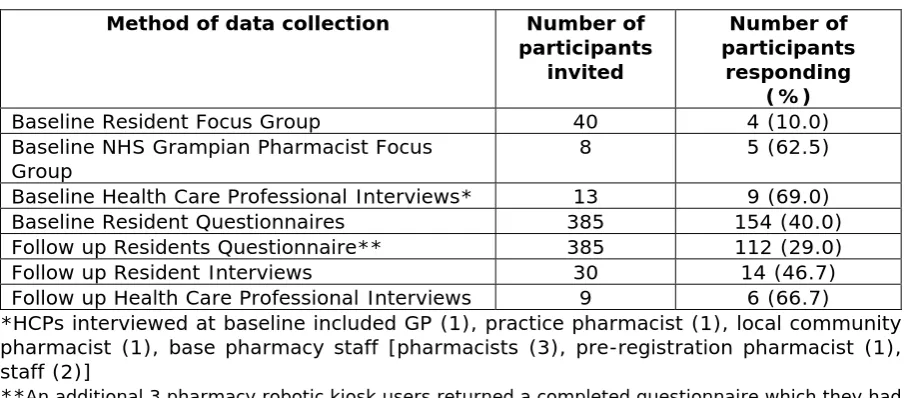
The response rates for each phase of data collection are shown in Table 1. 5
6
[insert Table 1 about here] 7
8
The participant demography for respondents to baseline and follow‐up 9
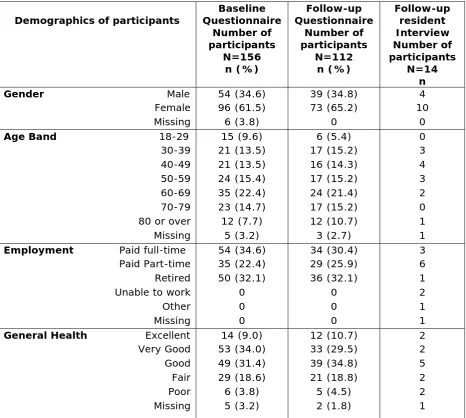
questionnaires and follow‐up interviews is reported in Table 2. 10
11
12
[insert Table 2 about here] 13
14
Survey respondents were mostly female (61%;96/156). The majority 15
(74%;116/156) rated their health as good/excellent and received regular 16
prescriptions (79%; 124/156). Almost half (49%; 76/156) received a prescription 17
monthly or more frequently, a large majority of which (83%;130/156) were 18
dispensed by a community pharmacy, were sent directly from the GP surgery 19
(53%;82/156) and were collected by the participant themselves (25%;39/156). 20
One third of participants (35%;54/156) claimed to use OTC medicines once a 21
month or more frequently, obtained from the supermarket (42%;65/156) and 22
community pharmacies (39%;61/156). One third of participants (38%;59/156) 23
were aware of the minor ailment scheme and 22% (35/156) of these were 24
registered on the scheme. 25
26
Baseline Findings
27Participants in the residents’ focus group were satisfied with the current 28
pharmacy service provision, particularly highlighting the existing prescription 29
collection and delivery service from the Post Office. They did not consider their 30
village to be remote in comparison with other Scottish villages. Whilst they 31
acknowledged the convenience of purchasing OTC medicines from local shops 32
and supermarkets in town, they also expressed the need for the TPRSS to 33
provide MAS. Participants recognised the benefits of the proposed service for 34
the elderly and those with limited access to transport. The link between the 35
TPRSS and only one of the four community pharmacies in the nearest town was 36
perceived to be a barrier to use. Limited mobile phone signal, the potential 37
resistance of elderly residents to using ‘new’ technology and confidentiality at 38
the rural site were all raised as concerns (Table 3). 39
40
41
10
Services that survey respondents would access through the TPRSS were: 1
prescription dispensing service (61%;96/156); purchase of OTC medicines 2
(59%;92/156) and the minor ailments service (50%;79/156). Participants would 3
seek advice through the TPRSS on: prescribed medicines (52%;82/156); minor 4
illnesses (49%;76/156); pharmacy and OTC medicines (47%;73/156) and foreign 5
travel (24%;38/156). 17% (26/156) would not access any of the services and 19% 6
(29/156) would not seek any advice, using the tele‐pharmacy service. 7
8
Local health care professionals had positive attitudes towards the TPRSS. They 9
felt there was a need for additional rural pharmacy service provision, especially 10
MAS, but expressed concern regarding confidentiality when accessing some 11
services such as Emergency Hormonal Contraception (EHC)11. They had no
12
concerns regarding the competence of pharmacy staff but felt that supplying 13
controlled drugs, or refrigerated lines, using this technology was inappropriate. 14
Potential barriers identified by community pharmacists included 15
implementation costs, increased base pharmacy workload and the time taken 16
for base pharmacy staff to answer the video‐link call. There was apprehension 17
that patients might collect an incorrect medicine, with associated concerns for 18
safety. Base pharmacy staff expressed concern about potential increases in 19
workload and the impact on other pharmacies in the local area (Table 4). 20
21
22
[Insert Table 4 about here] 23
24
25
TPRSS log 26
The TPRSS log recorded a variety of products which were purchased during the 27
study period, with most sales being for analgesics (see Figure 1).
28
29
[Insert Figure 1 about here] 30
31
In total, 19 repeat prescription forms (total of 48 items) and 13 acute 32
prescription forms (total of 17 items) were scanned into the pharmacy robotic 33
kiosk. The majority of the activity was in June. 34
35
Only three interactions were logged with the video link all of which involved the 36
pharmacist providing advice. 37
11
Follow‐up Findings
1
2
Two of the 14 residents interviewed had used the TPRSS (one OTC medicine 3
purchase and one an acute prescription scanning and collection). Both reported 4
the service had been easy to use and that the Post Office staff were supportive. 5
The screen was described as clear, easy to read and of a suitable font size. Group 6
demonstrations for the elderly were mentioned as a means of increasing usage. 7
All interviewees favoured additional pharmacy services being provided. Barriers 8
to using the TPRSS included bulky items not fitting in the kiosk, difficulty 9
interpreting the six digit code on landlines and ‘fear’ of technology (Table 5). Six 10
(5.2%) respondents who completed the follow‐up questionnaire had used the 11
TPRSS. There were seven interactions with the TPRSS, which included 12
prescription drop‐off and collection (n=5) and two medicine purchases. 13
Respondents were extremely satisfied (n=3) or satisfied (n=1) [2 missing], would 14
use the service again and were extremely likely (n=3) or likely (n=2) to 15
recommend it to a friend [1 missing]. Positive aspects of the service included 16
accessibility, convenience, efficiency and being simple to operate, whilst it was 17
suggested that a wider selection of OTC medicines should be available. 18
19
At interview, reasons for not accessing the TPRSS were: having no health 20
complaints; being registered with another pharmacy; visiting pharmacies in the 21
town when at work or collecting children from school; using the general practice 22
telephone line to order repeat prescriptions; and keeping a stock of minor 23
ailment remedies at home which were purchased from supermarkets or 24
pharmacies in the town. This was confirmed by the survey: respondents had no 25
personal need to access pharmacy services (36%;40/112), the TPRSS was not 26
linked to their preferred pharmacy (31%;35/112). 27
28
[Insert Table 5 about here] 29
30
Community pharmacy staff who were directly involved with the TPRSS were 31
interviewed at follow up and were positive about the TPRSS, which they 32
considered to be easy to use. The Post Office was considered a good location 33
for the service because it provided easy access for customers in relative privacy. 34
The video‐link was perceived to be more beneficial than a telephone 35
consultation by allowing pharmacy staff to detect non‐verbal cues (facial 36
expression, general demeanour). Barriers to the use or delivery of the TPRSS 37
included residents providing incorrect telephone numbers and identification of 38
specific circumstances when they felt they really needed to see the patient eg 39
12
increased access to pharmacy services for residents in rural communities 1
without the need to travel; increased security and less potential for error (i.e. 2
dispensed prescriptions were delivered to a secure area rather than the Post 3
Office) and enhanced governance since the TPRSS provided a prescription audit 4
trail ( Table 6). 5
6
[Insert Table 6 about here] 7
8
The majority of HCPs who were interviewed perceived ‘fear’ of technology to be 9
the biggest barrier, when encouraging patients to use the service for the first 10
time. One pharmacist mentioned that they may be unaware that the video 11
linked to a private consultation room in the pharmacy to enable confidential 12
discussion. Lack of awareness of the MAS service was also suggested as a reason 13
for the low use of the video‐link. 14
15
DISCUSSION
16
17
Main findings
18
This study demonstrated that delivering a range of CPS to a rural community, via 19
the TPRSS, is feasible and could have the potential to address health care 20
inequalities in remote areas. In this study, the services most accessed were 21
acute and repeat prescription drop‐off and collection and OTC medicine sales. 22
There was limited engagement with the video‐link, no engagement with the 23
MAS service, and general awareness of the MAS service was low. 24
25
The views of service users and providers were positive, citing efficiency 26
accessibility ease of use and supportive staff at the remote location as 27
facilitating TPRSS use. Pharmacists commented that this service had little impact 28
on their work patterns or workload and enhanced their governance procedures 29
by providing an audit trail for dispensed medicines. 30
31
Strengths & Limitations
32
Strengths 33
To our knowledge this is the first evaluation of a pharmacy robotic kiosk being 34
used to deliver community pharmacy services remotely in the UK. As a proof of 35
concept study, the aim was not to assess likely future uptake or conduct a health 36
economic evaluation. These now need to be explored. The Post Office was a 37
community hub for the village residents which promoted ease of access to the 38
TPRSS.
39
13 Limitations
1
TPRSS usage was less than anticipated and may have been affected by data 2
collection being undertaken over the summer months. A longer data collection 3
period, spanning winter months, combined with additional promotional 4
activities, might have resulted in more engagement with the TPRSS. It is known 5
that any new service takes time to become embedded, especially ones that are 6
innovative and a challenge to the status quo; indeed that is the experience of 7
the authors when introducing other innovations locally which took several years 8
to achieve a steady state of uptake. The pre‐installation feedback from this study 9
suggested there was some fear of the technology; the ADOPT model identifies 10
particular challenges for introducing health technologies, especially to older 11
people, who are the most frequent users of pharmacy services. Additionally, and 12
as expressed by participants, the TPRSS location was not a truly rural site so 13
there was some lack of incentive for local residents to engage with the service, 14
especially if they had some reservations. In retrospect a more remote location 15
would have been preferable especially if estimating likely uptake had been an 16
outcome. The site used in this current study was however judged sufficiently 17
rural to confirm the feasibility and acceptability of the service. 18
19
The TPRSS was linked to only one pharmacy and as such, presented a barrier for 20
use. Relatively new technology was used to deliver this novel service, so 21
potential service users were unfamiliar with its use. More than 40% of the 22
questionnaire respondents, at both baseline and follow‐up, were over the age 23
of 60. The proportion of local residents aged 65 years and over is 2% higher than 24
the national average12. This age group may be less willing to engage with new
25
technology or change their behaviour in relation to managing health issues. 26
27
Despite measures to separate the TPRSS from the main Post Office area, 28
complete privacy could not be achieved. This may have discouraged residents 29
accessing the TPRSS. 30
31
32
General discussion.
33
Stakeholders (health care professionals, public) had reservations surrounding 34
the use of ‘new technology’ and cited this as a possible barrier to uptake of 35
services. “Status quo bias” is well‐documented as influencing patients’ decisions 36
regarding accessing alternative healthcare13, with many people preferring to
37
continue with their existing arrangements. Methods for encouraging those less 38
14
techniques and providing additional support13 (e.g. group or one‐to‐one
1
demonstrations by community pharmacy staff). 2
3
Widespread adoption of this service would require regulatory changes allowing 4
P medicines to be sold generally from TPRSS, following a pharmacist 5
consultation. Whilst arrangements were made to supply medicines on a named 6
basis under the MAS, this option was never used despite it being requested in 7
the pre‐implementation interviews and surveys. Additional services, including 8
smoking cessation and EHC may be introduced once confidentiality issues have 9
been fully addressed. The potential exists to add a refrigerated compartment to 10
the kiosk, enabling patients to access medicines requiring refrigeration. 11
Incorporation of the TPRSS into a virtual network of pharmacies may encourage 12
its utilisation by residents. 13
14
Finally, although not tested in this study, there remains potential for a facility 15
such as this to be used beyond pharmacy provision so it could become a 16
resource for the wider health care team to engage with patients. In rural areas 17
with small populations such as the village in which we tested the kiosk, wider 18
use, even beyond health care could affect the economic viability as well as 19
potentially breaking down barriers to its use. 20
21
22
CONCLUSIONS
23
This proof of concept study confirmed that members of the public successfully 24
accessed community pharmacy services delivered through a TPRSS in a rural 25
community. Further work is now needed to assess clinical and cost 26
effectiveness, and confirm whether or not this would be an option to help 27
address current inequalities in accessing community pharmacy services for 28
rural communities.
15
References:
1
2
1. Community Pharmacy Scotland. Manifesto. Edinburgh, 2015. 3
http://www.communitypharmacyscotland.org.uk/media/93639/CP
4
S_FullManifesto_A5_Final.pdf Accessed 0ctober 6th 2016
5
6
2. General Pharmaceutical Council. Medicine Ethics and Practice. The 7
professional guide for pharmacists. Edition 40 July 2016 page 28 8
9
3. Todd A, et al Access all areas? An area‐level analysis of accessibility
10
to general practice and community pharmacy services in England by
11
urbanity and social deprivation. BMJ Open 2015;5:e007328 12
doi:10.1136/bmjopen‐2014‐007328 13
14
4. Royal College of General practitioners. Health Inequalities. London 15
Feb 2015. www.rcgp.org.uk/‐/media/Files/Policy/A‐Z‐
16
policy/2015/Health‐Inequalities.ashx Accessed 0ctober 6th 2016 17
18
5. Angaran DM. Telemedicine and telepharmacy: current status and 19
future implications. Am J Health Syst Pharm. 1999 Jul 15;56(14):1405‐ 20
26. 21
22
6. Sanjay S, et al, What Is Telemedicine? 23
A Collection of 104 Peer‐Reviewed Perspectives and Theoretical 24
Underpinnings. Telemedicine and e‐health, 2007;13, 5, 25
DOI: 10.1089/tmj.2006.0073 26
27
7. Strasser R, Rural health around the world: challenges and solutions. 28
Family Practice (2003) 20 (4): 457‐463 29
30
8. Scottish Government Health Directorates. The NHS Minor Ailment 31
Service at your local pharmacy. March 2011 32
http://www.gov.scot/resource/doc/362554/0122689.pdf Accessed
33
0ctober 6th 2016 34
35
9. Scottish Government. 2015 Review of Public Health in Scotland:
36
Strengthening the Function and Re‐Focussing Action for a Healthier 37
Scotland. Edinburgh 2016 38
16
10.Armfield NR, et al. The clinical use of Skype—for which patients, with 1
which problems and in which settings? A snapshot review of the 2
literature. Int J Med Inform 2015; 84:737–42. 3
4
11.Department of Health. Best practice guidance for doctors and other 5
health professionals on the provision of advice and treatment to 6
young people under 16 on contraception, sexual and reproductive 7
health. July 2004. 8
http://webarchive.nationalarchives.gov.uk/+/www.dh.gov.uk/en/
9
Publicationsandstatistics/Publications/publicationspolicyandguida
10
nce/DH_4086960 Accessed 0ctober 6th 2016 11
12.Scotland’s Census Data: Shaping our future: 12
http://www.scotlandscensus.gov.uk/census‐results Accessed
13
0ctober 6th 2016 14
15
16
13.Gaurav S, et al. Patient Inertia and the Status Quo Bias: When an 17
Inferior Option is Preferred. Psychological Science 1988; 24 (9): 1763‐ 18
1769. 19
20
21
17
Table 1 Response rates
Method of data collection Number of
participants invited
Number of participants
responding (%)
Baseline Resident Focus Group 40 4 (10.0)
Baseline NHS Grampian Pharmacist Focus
Group 8 5 (62.5)
Baseline Health Care Professional Interviews* 13 9 (69.0)
Baseline Resident Questionnaires 385 154 (40.0)
Follow up Residents Questionnaire** 385 112 (29.0)
Follow up Resident Interviews 30 14 (46.7)
Follow up Health Care Professional Interviews 9 6 (66.7)
*HCPs interviewed at baseline included GP (1), practice pharmacist (1), local community pharmacist (1), base pharmacy staff [pharmacists (3), pre-registration pharmacist (1), staff (2)]
[image:17.595.72.525.94.293.2]18
Table 2 Demographics of resident baseline and follow‐up questionnaire and follow‐up
interview respondents
Demographics of participants Questionnaire Baseline Number of participants
N=156 n (%)
Follow-up Questionnaire
Number of participants
N=112 n (%)
Follow-up resident Interview Number of participants
N=14 n Gender Male 54 (34.6) 39 (34.8) 4
Female 96 (61.5) 73 (65.2) 10
Missing 6 (3.8) 0 0
Age Band 18-29 15 (9.6) 6 (5.4) 0
30-39 21 (13.5) 17 (15.2) 3
40-49 21 (13.5) 16 (14.3) 4
50-59 24 (15.4) 17 (15.2) 3
60-69 35 (22.4) 24 (21.4) 2
70-79 23 (14.7) 17 (15.2) 0
80 or over 12 (7.7) 12 (10.7) 1
Missing 5 (3.2) 3 (2.7) 1
Employment Paid full-time 54 (34.6) 34 (30.4) 3
Paid Part-time 35 (22.4) 29 (25.9) 6
Retired 50 (32.1) 36 (32.1) 1
Unable to work 0 0 2
Other 0 0 1
Missing 0 0 1
General Health Excellent 14 (9.0) 12 (10.7) 2
Very Good 53 (34.0) 33 (29.5) 2
Good 49 (31.4) 39 (34.8) 5
Fair 29 (18.6) 21 (18.8) 2
Poor 6 (3.8) 5 (4.5) 2
Missing 5 (3.2) 2 (1.8) 1
[image:18.595.74.541.106.524.2]19
Table 3 Baseline Resident Focus Group: Themes and Quotes
Accessing Medicines
P4: I think we’re quite spoilt, because the shoppie [sic] now . . . has got ‐ well, for kids. I’m thinking for me, for what I need. They stock cough medicines, pain relief in the shop and then I’m in Tescos and Asda every day so if the chemists
are closed then I can just go and get . . . so I haven’t got any issues.
Experiences of pharmacy services
P3 Every time I’ve had to use them they’ve answered any queries I have got and prescribed whatever seemed to be right
at the time, so quite happy with the present service.
P2 ‐ It works for me, so I’m quite happy. Services that could be delivered remotely
P4: I think the only thing is the minor ailments, because there wouldn’t be much point coming here to pick up your
prescription or buy over the counter medication but if it’s minor ailments . . . cause the whole purpose of minor ailments is that if they’re 16 and under it’s free, so why would a Mum come here and need to pay for it for if she gets a bus into
town, or she drives into town she can get it for free.
P1 ‐ Travel.(advice)…. ‐ You wouldn’t think there should be any reason why it couldn’t ( be delivered through the kiosk) because if you’ve got a pharmacy at the other side, I mean the service is there. It’s just like going into the chemist and
asking them.
Users of remote services
P1: I would probably be slightly different, simply for my Mum and Dad again, because obviously they can’t drive It
means they wouldn’t have to get a trip into Fraserburgh because they’re on so much medication as it is they can’t really just go out and buy something in case it would contradict . . . so it would be beneficial for them that they can just toddle
up here and see what they need.
20
use the bus either so they have to get somebody else to drive them in, so again, if they can just walk around a corner, great.
Rurality
P4: I think if you’re wanting to stop smoking you should be able to get on a bus or drive to […] I’m sorry, I just . . . It’s only four miles
P4: I’m just not convinced about it to be honest, so I . . . Well I think it would be a really good idea for really rural areas but I don’t like to think that we are rural
Reasons for non‐use
P2: but it’s not XXXX’s Pharmacy that I use, it’s XXXX’s. That’s my only thing because I go with XXXX’s, so I wouldn’t be
changing.
P4: But I think your pharmacist is like your doctor, you get to know them over the years, you use the same pharmacist all the time, so I have always been XXX pharmacy since I was little, so I don’t think I’d manage to go to another pharmacy Technology issues
P4: not everyone has a mobile phone number . . . if it’s a text . . . the elderly don’t understand about texting . . . this half of the town don’t get mobile signals so that might be a problem.
P1: I would say especially for your elderly, probably the fear of the unknown and technology.
21
Table 4. Baseline Health Care Professional Focus group: Themes and Quotes Pharmacist role/interface with other services
HCP1: I can see that particularly pressures of GP appointments which is really critical I would say in this area, for many
particularly minor . . . what we would know and class as being minor ailments, can be readily delivered by pharmacy.
HCP8: I think the obvious one from a minor ailments point of view, if we can treat minor ailments in the community and
the patient doesn't have to make an appointment to see a general practitioner or a nurse prescriber, then obviously that's going to take some workload off those services
Accountability
HCP7: the community pharmacist has got a huge amount of accountability and responsibility around this, I mean, it's kind of all lying with that pharmacy so I think they've got all the governance accountability that lies within any other system in terms of supplying medicines to the public, be it prescription medicines or any other medicines because we absolutely have to ensure that nobody gets medicines inappropriately or anything else
Confidentiality
HCP6: Well, I suppose privacy issues are all the same even in the main pharmacy because, I mean, probably a lot of the consultations presumably they're not in a separate room anyway, they're mostly just over the counter I would've thought a lot of consultations. I could be wrong, but as far as I'm aware most pharmacy consultations are probably just over the counter maybe giving people advice, maybe that's right or that's wrong?
HCP5: patient confidentiality might be the biggest problem I would think if it's in an open shop, but I would imagine that would be covered by a booth or something
HCP1: Well I just think it (EHC) would be less popular, like obviously if people are speaking about their personal stuff anyway, the EHC is a bit more . . . and I think, well I've not went through the questions, but I think there's quite a lot of questions to do with that
22
HCP6: Well they might be less happy I would imagine, but I mean, obviously there's four pharmacies in Fraserburgh so . . . I suppose some pharmacists might sort of worry about taking trade from them, that's always . . . I suppose true in any sort of innovation I suppose, it's a free market so, I mean, you have to accept these things. I wouldn’t have thought it was a big thing, it's not quite the same as maybe opening another pharmacy or something, you know, branch or something like that, but pharmacists in general are a bit suspicious of what their colleagues are doing as far as I can see, that's usually the way of things [laugh]!
HCP4: If I was one of the other pharmacies not involved in the process I wouldn’t be happy about it. I would probably feel a bit marginalised and a bit concerned that there was potential for me to lose business, so that would be my assumption of how I would feel if I was one of the other pharmacies.
Impact on workload
HCP8: the areas of concern I have is we're providing various services from our community pharmacy and how do we integrate a telepharmacy provision without disadvantaging the other services, i.e. if we're busy doing certain services and we've then got also to be dealing with a telepharmacy query, but these are the challenges for the pharmacist and for the senior staff in the pharmacy.
HCP2: I think it's quite a big take on cause . . . well, somebody's got to know how to work the robot and maintain it so that it does work properly, and as well as making sure that the stock within it is in date and are the best items, obviously it can't hold too much items, so it's going to be looked into what would be the best for it to hold. So I think it would take quite a lot of work.
HCP7: it just depends on how many calls they're likely to get, but from the patient’s point of view, I would guess they're expecting somebody to answer that almost instantly and they're probably not going to be happy to wait five minutes, whereas if you're in a community pharmacy you can see all the people that are waiting in front of you and you stand in the queue and you wait to be seen, you know, from a community pharmacy point of view I definitely think that's
something that could be an issue.
HCP8:The main challenge thinking ahead, if the facility was found to be used a lot and needed, would be the cost
23
Patient Safety
HCP3: think it's worked out in a way that nobody would be dispensed the wrong medication or given the wrong pin number sort of thing, but that is a possibility I suppose. I'm not too aware of the system but that would be the main issue.
HCP4: The main risks are probably just going to be clinically in terms of making sure that the processes are right so that there are no errors, you know, the same with any new service, it's about looking at the processes to make sure there's not going to be errors or wrong medication being given out, wrong advice based on a virtual consultation.
Table 5.Follow-up Resident Interview: Themes and Quotes
Experience of tele‐pharmacy service
R1: I didn't. (understand telephone message) It was very robotic and sort of I had to think 'what was that, what was that number?' you know, it would be better I think if someone actually phoned you and said 'here's your six digit number' or if the recording wasn’t so robotic.
R1: Yeah it was okay, but then again I'm not frightened of anything like that, I'll try it once and . . . But I found it fine, it was quite quick and easy for me, but again for maybe an elderly person it might not be so easy.
R5: Well I went over to get . . . I think it was Gaviscon . . . but I did ask the person that's in charge of the post office XXX how to use it. So he told me how to use it so I did find it quite easy once I knew what to do.
Views of Post Office as the location
R6: But the post office, it's a hub anyway, that's where people go for a lot of things, you know, not just posting stuff, he does food there so, you know, bits of food, eggs and potatoes and what have you, so people will tend to go to the post office more and because it's open six days a week it makes sense.
24
R1: It was just the ease of use on the screen, it was the talking more or less step by step on the screen.
R6: It seems pretty okay. My thing always is not for me to use it but for other people, you know, older people technology, you know, kind of they'll walk up to it and 'what do I do . . . ?' [laugh]. It's pretty straightforward, I think as well having the facility that you can talk to somebody will help the older people at lot better than, you know, press this button and do this, that and the other. So it's pretty straightforward.
R4: Yes I can quite see us using it in the future. It would be nice if our other pharmacy could be incorporated but if the worst came to the worst we'd change the pharmacy.
R5: Maybe just . . . well, probably have more selection and different things. Maybe having, like, small groups to show how to use it, like, for the elderly and that, I was thinking because, well likes of my mum would find it quite difficult and I think maybe like a wee minute, if they're shown maybe two or three times they'll know how to use it.
R1: So he did say to me 'oh we could maybe do it your next lot, when you're next lot's due but this is too bulky to go in the kiosk'.
R4: If there were maybe sessions somewhere, even the library or somewhere, where older people could go and be shown I think that would be a big step towards its usage.
R6: For me not really, I'm okay as is. For a lot of the older people it's . . . for the likes of repeat prescriptions, rather than having to go into town, yes they can use the kiosk. If they've got to go to the doctors then it becomes a hassle, most of the doctors are within Fraserburgh kind of . . . not too far away from one of the chemists so chances are people if they're prescribed anything would go to the chemist.
25
Table 6.Follow-up HCP Interviews: Themes and Quotes
1
Perceived acceptability/effectiveness of service
HCP3: Well it's more secure. There's less room for error I suppose with people getting the wrong items.
HCP4: It is easy to get to and the post office is a pretty good setting. It's quite private, they do have the screen but I do feel like people would still . . . it's not the same as being in a consultation room and having privacy, but I don't see that would put anybody off cause it's fairly quiet the post office, there's not really loads of people in listening to you. And it's a pretty easy system to use from both sides, like, from this side and the other side, yeah as far as I can see.
HCP4: No I think it definitely adds cause you can see them, you can see their expression whereas on the telephone you sometimes can't tell whether they're . . . how they're actually feeling, they can mask it a bit more, and also I suppose if they wanted to show you something they could cause there's the camera. Yeah no I think it is beneficial.
HCP5: Well no cause with a video link if the patient's talking about a rash or something then at least they can show you, so you get a better idea of a patient's condition. The video is better than a phone yeah.
HCP4 Yeah, well as I said, none of the staff or anything has complained about it, it's not like a burden or anything, just check it, like, we do deliveries on a Monday and Thursday so we just make sure that they're checked on the lead up to that so that any prescriptions that are through are done and sent with the delivery. It's really easy.
HCP4: it's really straightforward to use so there wasn’t, like, too much to pick up I didn't think anyway. And it seems to work well so it was fine, wasn’t a bother at all.
Perceived barriers
HCP1: Not that I'm aware of, well apart from maybe giving us a phone number that they thought would be okay and then they can't get a text on it back, we've had that, you know, some home phone numbers will but some don't. I think that's the other one.
HCP2: There's been a few people that have but it's . . . it's been more human error than anything to do with the technology. Typing in the wrong number for their code, things like that but nothing major.
26
HCP6: as far as security's concerned, it's traceable, you have a record when it's left the pharmacy, you've a record where it's gone into the pharmacy, if for some reason something's gone wrong, maybe they've forgotten their number or
something, it's all retrievable, you know, there's a record there. So I guess all the different things you were asking, confidentiality, it's as good as what they're already doing. In fact it's probably better because if they handed in repeat prescriptions at the post office for us to collect, you know, they're in a robotic machine, you know, once they're in they're safe, you know they're there, they can't get lost so, you know, all on that ground. The minor ailment side of it, there's not been a huge take up on that.
HCP5: That was good as well yeah cause obviously it just came straight from there to here through the internet or whatever and the actual information was stored in the kiosk and locked until somebody went out and actually picked it up.
HCP6: No I do, I like the video link, yeah, and both ways . . . well, I'm maybe putting words in people's mouths but I guess the patients would like to see who they were speaking to. I mean, also it means if push came to shove you could show someone, you know, visually how to use an oral syringe for example, how to use a head lice comb, whatever, you know, you could give them some visual feedback. So no I like that facility.
Service provision
HCP4: it's really straightforward to use so there wasn’t, like, too much to pick up I didn't think anyway. And it seems to work well so it was fine, wasn’t a bother at all.
1