City, University of London Institutional Repository
Citation
:
Turk, D. J., Gillespie-Smith, K., Krigolson, O.E., Havard, C., Conway, M. A. & Cunningham, S.J. (2015). Selfish learning: The impact of self-referential encoding on children's literacy attainment. Learning and Instruction, 40, pp. 54-60. doi:10.1016/j.learninstruc.2015.08.001
This is the accepted version of the paper.
This version of the publication may differ from the final published
version.
Permanent repository link:
http://openaccess.city.ac.uk/16793/Link to published version
:
http://dx.doi.org/10.1016/j.learninstruc.2015.08.001Copyright and reuse:
City Research Online aims to make research
outputs of City, University of London available to a wider audience.
Copyright and Moral Rights remain with the author(s) and/or copyright
holders. URLs from City Research Online may be freely distributed and
linked to.
City Research Online: http://openaccess.city.ac.uk/ [email protected]
RUNNING HEAD: Self-referential encoding in learning
Selfish learning: The impact of self-referential encoding on children’s literacy
Abstract
Self-referencing (i.e., thinking about oneself during encoding) can increase
attention toward to-be-encoded material, and support memory for information in
adults and children. The current inquiry tested an educational application of this ‘self
reference effect’ (SRE) on memory. A self-referential modification of literacy tasks
(vocabulary spelling) was tested in two experiments. In Experiment 1, seven- to
nine-year-old children (N = 47) were asked to learn the spelling of four nonsense words by copying the vocabulary and generating sentences. Half of the children were asked to
include themselves as a subject in each sentence. Results showed that children in this
self-referent condition produced longer sentences and increased spelling accuracy by
more than 20%, relative to those in an other-referent condition. Experiment 2 (N = 32) replicated this pattern in real-word learning. These findings demonstrate the
significant potential advantages of utilizing self-referential encoding in the classroom.
1. Introduction
Psychological science plays an important role in teaching practice, with
cognitive theory underpinning a variety of learning strategies (Pressley, Borkwski, &
Schneider, 1989). For example, learners are more likely to retain information
successfully when they are engaged with the learning materials and the information is
richly encoded, so materials that promote these elements comprise valuable learning
tools (Fredricks, Blumenfeld, & Paris, 2004; Sadoski, 2001). In line with this
reasoning, the current report investigates the application of a robust memory
phenomenon known as the self-reference effect (SRE - Rogers, Kuiper, & Kirker,
1977), assessing its usefulness in promoting children’s literacy engagement and
learning.
Standard cognitive accounts of memory processing such as dual-coding
(Paivio, 1986) and levels of processing (Craik & Lockhart, 1972) suggest that rich
encoding (e.g., that which promotes interconnectivity with current knowledge) is key
to improving learning (for review see Sadoski, 2001). Consistent with this argument,
Sadoski and colleagues demonstrated that both concreteness and familiarity are highly
predictive of text learning, arguing that these features evoke rich verbal and
non-verbal processing (Sadoski, Goetz, & Fritz, 1993; Sadoski, Goetz, & Rodriguez,
2000). Based on these findings, Sadoski (2001) suggests that educators include
concrete, image-evoking features like personal hobbies and cartoon characters in
children’s learning materials to promote rich encoding. However, it is clear that
teachers cannot reasonably be expected to create personally interesting materials for
each child. A potential solution to this challenge it the use of a ubiquitous and highly
1.1. The self and memory
Thinking about oneself while encoding information (known as
‘self-referencing’) is well-established in the psychological literature as a method of
increasing retention in memory (e.g., Conway & Dewhurst, 1995; Klein & Kihlstrom,
1986; Klein & Loftus, 1988; Rogers et al., 1977; Symons & Johnson, 1997; Turk,
Cunningham, & Macrae, 2008). The memory advantage associated with
self-referencing is known as the ‘self-reference effect’ (SRE). The SRE can be elicited
through surprisingly simple self-item associations, for example by presenting
to-be-remembered information simultaneously with the participant’s own name or face
(Turk et al., 2008), by assigning items to self through temporary ownership
(Cunningham, Turk, MacDonald, & Macrae, 2008) or through self-choice
(Cunningham, van den Bos, & Turk, 2011). Several studies have also demonstrated
robust SREs in early and middle childhood (Cunningham, Brebner, Quinn, & Turk,
2014; Cunningham Vergunst, Macrae, & Turk, 2013; Ross, Anderson, & Campbell,
2011; Sui & Zhu, 2005).
The features of self-referencing are notably consistent with Sadoski’s (2001)
recommendations for educational materials, namely familiarity and concreteness.
Even in early childhood there is a highly developed sense of self that is frequently
accessed and richly furnished with concrete knowledge (Lewis, 2003), as well as
being self-evidently familiar. The self-concept has been argued to underlie the SRE,
supporting the high levels of elaboration and organization associated with
self-referential memories (Klein & Kihlstrom, 1986; Klein & Loftus, 1988; Symons &
therefore allow educational materials encoded in a self-referential context to be more
successfully retained.
A second, highly valuable cognitive consequence of evoking the self at
encoding is that it triggers mechanisms that could enhance task engagement.
Specifically, cues of self-relevance such as one’s own face or name provoke
automatic shifts in attention and increased affective arousal, changes which both have
a significant positive effect on memory (Turk et al., 2008; Turk, van Bussel, Brebner,
Toma, Krigolson, & Handy, 2011). Engagement is a particularly important element of
teaching practice, and indeed the erosion of interest and academic motivation as
education progresses has been the source of a number of empirical studies (see
Eccles, Wigfield, & Schiefele, 1998; Wigfield, Eccles, Schiefele, Roeser, &
Davis-Kean, 2006).
It has been suggested that academic progress is facilitated by three types of
pupil engagement: cognitive, emotional and behavioural (Christenson et al., 2012;
Fredericks et al., 2004). Tasks that maximize these three inter-related components of
academic engagement, such as agentic engagement, positively influence academic
outcomes (Reeve, 2013). The increased attentional allocation, positive affect and
enhanced cognitive performance associated with self-referential encoding would seem
to fit well with this tripartite understanding of academic engagements, suggesting that
self-referencing could influence levels of student engagement.
Supporting this contention, some evidence for enhanced processing under
conditions of self-referencing in education has been reported in the context of
mathematics. D’Ailly, Simpson and MacKinnon (1997) showed that for relational
speed and accuracy following the inclusion of a self-referential term (e.g., John has four sweets. You have two more sweets that John. How many sweets do you have?). Such improvements may reflect an increase in task engagement (Davis-Dorsey, Ross,
& Morrison, 1991; Fairbairn, 1993; Giordano, 1990; Hart, 1996).
Drawing these arguments together, a logical prediction is that embedding
self-referencing strategies in educational materials could fulfill both of Sadoski’s (2001)
key criteria of effective teaching strategy: promoting rich encoding and increasing
engagement in learning. The current study will assess this prediction in the context of
literacy education.
1.2. Self-referencing in literacy
Some extant research supports the contention that self-referencing could
successfully be applied in a literacy context. For example, children are generally able
to write and spell their own names before other words (Levin, Both-de Vries, Aram,
& Bus, 2005), and show a marked preference for including (often erroneously) letters
from their own name when writing other words (Bloodgood, 1999; Both-de Vries &
Bus, 2008; Treiman, Kessler, and Bourassa, 2001). The early focus on own-name
letters, particularly the name’s first letter, has been attributed to increased sensitivity
to this sound-letter combination (e.g., Both-de Vries & Bus, 2010). It is also likely to
reflect the extreme familiarity and positivity associated with one’s own name (i.e., the
‘name-letter effect’ - Nuttin, 1985).
Other studies purporting to test a self-referential bias in literacy have reported
conflicting results. Pressley, Levin, Kuiper, Bryant, and Michener (1982, Exp. 2)
keyword imagery strategy in adults’ learning of new words. However, Mood (1979)
showed that sentence comprehension in very young children (2 – 5 year olds) was
significantly improved by inclusion of a self-referential material (i.e., the child’s own
name). The differences in methodology across these studies (particularly regarding
control conditions) is too great to allow firm conclusions to be drawn from the mixed
findings, but it is possible that self-referential encoding strategies are best targeted at
an early developmental period. Given the equivocal findings reported in these studies,
further investigation of the efficacy of self-referential learning strategies is clearly
warranted.
1.3. The current inquiry
The current investigation explored whether self-referential encoding could
enhance pupil engagement and performance in learning to spell. Experiments were
based on a typical literacy task known as the ‘See it, Say it, Cover it, Write it, Check
it and Write a Sentence’ (SSCWC-WS) method, which involves children copying
to-be-learned words then including them in a self-generated sentence. The current study
evaluated the impact of a self-referential version of this task on pupil engagement and
attainment in two experiments, examining novel nonsense- and real-word learning
respectively.
2. EXPERIMENT 1
This experiment employed four nonsense words presented to pupils as the
names of novel alien characters. These materials were used to reduce the effects of
measuring the length of sentences they generated, as motivation to generate long
sentences should be reduced by low engagement (see Meece, Blumenfeld, & Hoyle,
1988; Newmann, Wehlage, & Lamborn, 1992; Reeve, 2013). Behavioural
engagement was objectively measured using mean sentence length in words as an
index of the child’s motivation to engage with the learning task. Other measures of
behavioural engagement could also be applied, such as the morphemic complexity of
sentences produced, but research indicates that these two measures are almost
perfectly correlated (e.g., Brown, 1973; Parker, 2005) and therefore we have favoured
the simple method in our assessment of task engagement in this study.
Subsequent spelling accuracy was measured to assess learning success. It was
predicted that self-referential encoding would result in longer sentence generation and
higher spelling performance than other-referential encoding.
2.1 Method
2.1.1. Participants and design
Forty-seven primary school children aged between 86 months and 108 months
(M: 97.23 months, SD: 6.44, 27 females) were tested in a between-subjects design with a single factor of Referent (Self or Other). The children were recruited from one
Year 4 class in three different Aberdeenshire primary schools. Given the task
requirement to process novel non-words we first measured the performance of every
child on the Children’s Nonword Repetition (CNRep) Test which provides a measure
of phonological processing abilities on nonsense words (Gathercole, Willis, Baddeley
& Emslie, 1994). We then assigned children to experimental conditions so that each
2.2.1. Materials and Procedure
Four two-syllable nonsense words were presented as the names of green aliens (Arror,
Genful, Winead & Swarty). An additional red alien (Splay) was created as a neutral other-referent. The experimenter used color images printed on cards to introduce each
alien to the children (see supplementary figure), who then copied all four names
twice. Children were then asked to write a sentence describing an imaginary day for
each alien, including either self (e.g., ‘Arror and I went to…’) or the other-referent (e.g., ‘Arror and Splay went to…’) as a subject depending on experimental condition. Once each child in the group had finished their four sentences, the Experimenter
enunciated the four alien names one at a time, and the children were asked to write the
names on a worksheet, concentrating on the spelling.
2.2 Results and Discussion
Copying accuracy was high on this task (1.8% error). As a result, all children
were included in subsequent analyses. For illustration, sentences produced by
participants in the self- and other-referent conditions are listed below:
Participant A (self-referent condition), aged 105 mths
On Monday me and Genful did science.
Participant B (self-referent condition), aged 105 mths
Me and Winead went to decorate a plate at Dab Hand.
Participant C (self-referent condition), aged 88 mths
Participant D (self-referent condition), aged 93 mths
On Friday me and Swarty dressed up as a nasty wizard.
Participant F (other-referent condition), aged 106 mths
Genful would turn Splay into a mosquito.
Participant E (other-referent condition), aged 87 mths
Winead likes to do art with Splay.
Participant F (other-referent condition), aged 100 mths
Splay and Arror went swimming in the sea and had lots of fun.
Participant F (other-referent condition), aged 93 mths
Swarty would teach him how to do magic.
For each child, the number of words generated in the sentence production task was
calculated (mean length utterance in words)1. A spelling score was also calculated by
assigning one mark for each correctly spelled name. Descriptive data are presented in
Table 1. Following the suggestion of an anonymous reviewer, we included “alien
name” in our statistical model to take account of any differences across each of the
to-be-learned items. Two models were generated to explore word generation effects and
spelling accuracy. The mixed model ANOVA exploring the effect of encoding
condition on the number of words written across each alien name revealed a no
significant main effect of alien name F(3,135)=.67, p=.571, see table 1 for means).
1
Additionally, alien name did not significantly interact with encoding condition
F(3,135)=.191, p=.903. The only significant effect observed was that children in the self encoding condition wrote significantly more words than those in the other
encoding condition F(1,45 )=5.79, p=.02, Cohen’s d=.83 representing a large effect (see Table 2).
A second statistical model exploring differences in spelling accuracy revealed
a no significant main effect of alien name F(3,135)=7.62, p<.001, see table 1 for means). Additionally, alien name did not significantly interact with encoding
condition F(3,135)=.407, p=.748. The only significant effect observed was that children in the self encoding condition correctly spelled more words than those in the
other encoding condition F(1,45 )=7.581, p<.005, Cohen’s d = .65, suggesting a medium to large effect (see Table 2). Post-hoc pairwise comparisons of the main
effect of alien name across self and other encoding conditions, corrected for multiple
comparisons using the Bonferroni method were then carried out. This analysis
showed that the name Winead was spelled less accurately than Genful (p=.002) and
Arror (p<.004). Most importantly however, these analyses reveal that while there
were overall differences in the accuracy obtained for each alien name, self-referential
encoding effects were consistently observed across each of these items and the
learning of nonsense words was significantly improved by the simple application of a
self-referential encoding intervention. Finally, we explored the relationship between
sentence length and spelling performance. No significant relationship was found for
the self group, r(24)=.28, p=.19, or for the other encoding group, r(23)=.11, p=.62.
Compared to other-referential encoding, self-referencing increased both task
engagement (as indicated by sentence generation) and spelling performance (by more
amendment to a standard pedagogical task, requiring no training or costly teaching
materials. However, it is possible that the absence of any real knowledge about the
unfamiliar other-referent (the alien Splay) may have contributed to the reported
difference in the number of words written per sentence (see Bower & Gilligan, 1979;
Symons & Johnston, 1997). A second experiment was therefore designed in which the
other-referent was a character highly familiar in contemporary children’s culture, J.
K. Rowling’s Harry Potter (see also Lombardo, Barnes, Wheelwright, &
Baron-Cohen, 2007; Pfeifer, Lieberman, & Dapretto, 2007). The second experiment was also
designed to more closely mirror classroom tasks to investigate the practicality of the
manipulation, so children’s learning of real vocabulary was assessed. A final feature
of Experiment 2 was that a within-subjects design was employed to allow an
exploration of any differential effects of self-referencing on pupils of varying verbal
ability levels.
3. EXPERIMENT 2
To determine whether self-referencing would be readily applicable for
employment as a teaching tool, Experiment 2 used a standard literacy task with 10
real words as the spelling materials. In line with SRE research paradigms, a familiar,
non-intimate other-referent (i.e., Harry Potter) was used instead of a novel character (Bower & Gilligan, 1979; Symons & Johnston, 1997). Following the results of
Experiment 1, it was predicted that self-referential encoding would result in longer
sentence generation and higher spelling performance that other-referential encoding.
In addition, measures of verbal fluency (BPVS II - Dunn, Dunn, Whetton &
included. These tests were selected to gauge aspects of verbal processing that could
contribute to individual differences in literacy (Gathercole, 2006). We expected that
children who perform at a lower level on these measures might benefit more from the
additional encoding support provided by self-referential encoding.
3.1 Method
3.1.1. Participants and design
Thirty-two primary school children aged between 94 months and 109 months
(M: 101.13 months, SD: 4.42, 17 females) participated in the experiment, which had a repeated measures (Referent: Self or Other) design. The children were recruited from
one Year 4 class in three different Aberdeenshire primary schools. In each class the
children were situated into four different spelling groups based on spelling ability.
Each spelling group received words appropriate to their level of ability and to their
current spelling goals. Therefore materials differed across groups and across
participating schools. None of the children who took part in this study participated in
Experiment 1.
3.1.2. Materials and procedure
Testing took place over two weeks (one week per referent condition, order
counter-balanced across participating classes). Prior to testing, the Experimenter was
provided by classroom teachers with a list of 20 spelling words for each child (ten
words for each week of testing). The content of spelling lists varied by class and
spelling group (i.e., the spelling group to which each child was already assigned by
not differ between self-and other-referent conditions in terms of word- or
syllabic-length. (both ps > .05).
At the beginning of the school week each child was given a worksheet
showing ten new spelling words (for example, came, same, gave, like, nine, five, joke, hope, rope, tube). These items were selected on the basis of weekly spelling or
phonics objectives for each spelling group. The child was asked to copy each of these
words three times, then to use each word in a self-generated sentence (i.e., write ten
sentences). The effect of referent was manipulated by asking the children to begin
their sentences with either “Harry…” (other-referent condition) or “I…” (self-referent
condition). The order with which children undertook these two referent encoding
tasks was counterbalanced across groups over the two week session, such that half of
the groups undertook the self task first followed by the other task a week later, and
half the participants had the opposite task order. Teachers understood the purpose of
the experiment and did not provide any additional support to this task. The worksheet
was completed in the classroom.
At the end of each week (i.e., four days after the encoding task), each child’s
spelling was tested individually. The Experimenter read out the ten spelling words
learned that week and the child was asked to write each word on a worksheet,
concentrating on the spelling.
3.2 Results and Discussion
Copying accuracy was high on this task (2.8% error). As a result, all children
were included in subsequent analyses. For illustration, example self-referent and
Participant A, aged 94 mths
Self:
I like to sit down on a seat. I have a sister and she is a teenager.
I got chased by a shark.
Other:
Harry was on a farm. Harry had a belt. Harry is one centimetre.
Participant B, aged 104 mths
Self:
I am good at jumping. I like when its snowing.
I looked at a wall.
Other:
Harry saved Hogworts. Harry pointed at me.
Harry was hiding from Voldermort.
This experiment used a male other-referent (Harry Potter). At the suggestion of an anonymous reviewer we included participant gender as a between subjects
factor in our analysis of sentence length and spelling performance in each encoding
condition.
For sentence length, we employed a mixed ANOVA and found a significant
effect of gender, F(1,30)=7.77, p<.009, d=.48, representing a medium effect, with girls writing significantly more words (M: 6.19, SD: .21) in their sentences than boys (M: 5.34, SD: .24), but gender did not interact with encoding condition, F(1,30)=.005, p=.94. As in Experiment 1, we observed a significant effect of encoding condition,
Spelling accuracy was also subjected to the same mixed ANOVA. Here we
found a no significant effect of gender, F(1,30)=2.27, p=.14, we also observed no significant interaction between gender and encoding condition F(1,30)=.1.98, p=.17. As in Experiment 1, we observed a significant effect of encoding condition on
spelling performance, F(1,30)=11.86, p=.002, d=.238 with words encoded in self-referential manner spelled more accurately than those encoded under the
other-referent encoding condition (see Table 2). These findings replicate the pattern found
in Experiment 1, suggesting that when the self-referencing manipulation is applied in
a classroom context using real vocabulary, the same encoding advantage emerges.
The relationship between sentence length and spelling accuracy was explored,
revealing no significant correlation between these factors r(32) =.007, p=.97. The absence of a linear relationship between writing performance and spelling accuracy
suggests that spelling improvements are not produced by increased engagement alone.
Previous research has indicated that self-relevant encoding tasks increase attentional
processing and affective arousal (Bargh, 1982; Turk, van Bussel, Brebner et al.,
2011), supporting memory increases for words and objects associated with self (Turk
et al., 2008; Turk, van Bussel, Waiter & Macrae, 2011). These low-level mechanisms
may play an important role in increasing educational performance, especially in
literacy tasks like spelling traditionally thought of as “boring” by a significant
minority of children (Scottish Survey of Achievement: Reading and Writing 2009).
This indicates that other elements of academic engagement not specifically measured
here (i.e., the positive affect generated by task that represents emotional engagement)
may offer better predictive power in relating engagement to outcomes using these
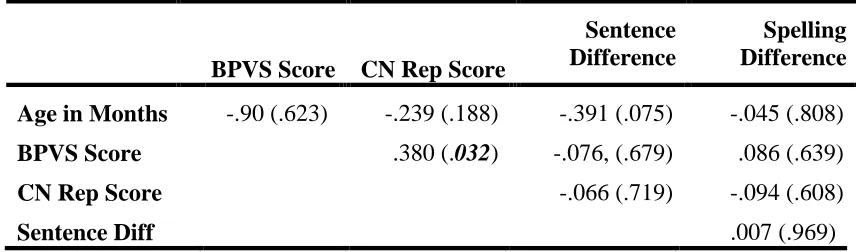
Finally, individual differences were explored by calculating a self-referent
encoding advantage score (i.e., other-referent performance subtracted from
self-referent performance) for both sentence generation and spelling by each child.
Correlational analyses were conducted to determine whether individual differences in
age verbal mental age (BPVS scores) or non-verbal working memory (CNRep scores)
predicted the self-referent encoding advantage. No correlations approached
significance, other than a marginal tendency for the effect of self-referencing on
sentence generation to reduce with age, r(32) = -.32, p = .075, 2-tailed (see Table 3), suggesting that this manipulation may be more profitable for children earlier in earlier
educational stages. The issue of which age group is most susceptible to the benefits of
self-referential encoding should be the subject of future research, but existing SRE
work suggests that the value of self-referencing is consistent in early childhood, then
grows toward adult levels between 7 – 10 years (Cunningham et al., 2014; Halpin,
Puff, Mason, & Marston, 1984). This implies that a much wider age range may be
appropriate for this sort of intervention. The absence of reliable relationships between
individual difference measures and the size of the advantage for self-referenced words
is difficult to interpret as materials were tailored to accommodate differences in
ability (i.e., children were taught in different spelling groups). This should have the
impact of maximizing performance across the ability range, and as the data show,
approximately half of the participants in this study were at ceiling levels of spelling
4. GENERAL DISCUSSION
The findings of the current inquiry demonstrate the significant power of
referencing to enhance children’s learning. The two experiments confirm that
self-referencing increases children’s engagement in literacy tasks (as indicated by the
number of words produced in children’s sentences) and improves spelling accuracy
for both nonsense and real words. Given that the only task manipulation was a verbal
instruction to change the subject of each sentence, this study reveals a simple but
effective mechanism to improve children’s literacy that could easily be
accommodated into current teaching practices.
The independence of the behavioural engagement and spelling performance in
the current tasks also alludes to multiple mechanisms of self-support to learning new
spelling words. The self is generally understood to operate through multiple routes,
enhancing memory through increased attention and arousal (hence increased task
engagement), but also by providing a familiar, easily accessible construct through
which incoming information can be elaborated and organised (Klein & Kihlstom,
1986, Klein & Loftus, 1988; Symons & Johnson, 1997, Turk et al, 2008; Turk, van
Bussel, Brebner et al., 2011; Turk, van Bussel, Waiter et al., 2011), giving rise to rich,
recollective retrieval from memory (Van den Bos, Cunningham, Conway & Turk,
2010). In this regard, the self is not regarded as providing a ‘special’ route to
enhanced encoding, although it may be especially efficient at eliciting these multiple
routes (see Gillihan & Farah, 2005). The extent to which some or all of these routes to
memory enhancement are exploited by the current task is a potentially fruitful avenue
of future research.
(Bandura, 1997) agentic control of educational materials may provide an additional
route through which self-referential encoding can provide a learning enhancement.
Illustrating the relationship between self and agency, Cunningham et al. (2011)
engaged participants in an ownership task in which they were able to view and choose
objects for themselves or others. Personal choice elicited a greater memory bias for
self-owned objects than when ownership was assigned by the experimenter. What is
perhaps most interesting in this study is that even when participants made their choice
blindly (i.e., by ticking numbers on a grid to correspond to items they would receive)
the same effect of choice on memory was observed. In this way, the participant’s perceived agentic control over the allocation of items to self also provided a boost to
memory. One possibility for further research is that a similar act of choosing,
whether blind or overt, could also offer a mechanism to increase agentic engagement
in spelling tasks and further improve learning outcomes (see Patal, Cooper & Wynn,
2010).
The current findings are presented as an initial test of an innovative
intervention, raising many questions that need to be addressed by future research. For
example, in the current study, the words used as stimuli were not systematically
manipulated and did not have a high difficulty variance. Spelling performance was
also skewed towards ceiling levels, perhaps contributing to the weak correlations
between sentence length and spelling performance, as well as between the
self-advantage and individual differences in verbal ability and age. More rigorous memory
tests would offer increased chances of finding relationships with individual
differences. Further, sentence production was relatively short and in future, analysis
of the quality of material generated by self- and other-referent instructions could be
sentences). It seems plausible that such outputs would reveal qualitative differences
between responses generated by self- and other-cues, providing further insight into
the mechanisms supporting improved spelling performance. Self-reported
engagement would also be a useful measure. Furthermore, different levels of
self-referencing may also be engendered by different types of self-cues, the identification
of which would allow more focused use of self-referencing in the classroom.
The learning benefits provided by self-referential encoding are unlikely to be
limited to the improvements in spelling and writing identified in the current inquiry.
We suggest that the current findings should be extended to assess the impact of
self-referencing across education, as similar manipulations could be applied to the whole
range of knowledge learning, in both arts and sciences. The work of d’Ailly and
colleagues (d’Ailly, Murray, & Corkill, 1995; d’Ailly et al., 1997) showing that
including self-referent terms improves performance on math tasks is indicative of this.
d’Ailly et al. (1997) argue that self functions to decrease the cognitive load of the
relational tasks, but there is no direct evidence of the route through which the self
improves performance. The engagement argument expounded here may offer an
additional explanation (Christenson et al., 2012; Fredericks et al., 2004).
While the experiments reported here indicate a self-referential encoding effect
upon the learning of real and nonsense words, it may also be possible that the
variance between learning materials (i.e., words and nonwords) may have additionally
impacted the results (Clark, 1973; Quené & Van den Bergh 2008). In the present
study we did not have the statistical power to speak to this concern so it remains a key
area to address in future work in this area. Additional work is also required to
determine the long-term benefits of self-referencing, beyond the relatively short
can provide a long-term learning scaffold (Craik & Lockhart, 1972; Thomas & Wang,
1996), but this remains to be established for self-referencing specifically. Education
often requires repeated exposure to learning materials, so the effects of repeated
self-referential encoding of to-be-learned information may further enhance its
effectiveness.
5. CONCLUSIONS
In conclusion, the current study paves the way for future research on the
efficacy of using self-referential learning tasks to enhance young children’s learning.
Together, the studies reported here demonstrate that applying the self in learning to
spell enhances both engagement and retention of information in children, potentially
providing a high-impact, cost neutral and valuable application of cognitive science to
Table 1: Analysis of performance for each of the stimulus materials in Experiment 1. Standard error in parentheses.
Alien Name Self Words Other Words % Self Accuracy % Other Accuracy
Genful 9.83 (4.33) 7.67 (2.51) 91 (29) 71 (46)
Winead 9.65 (3.08) 7.92 (2.89) 56 (50) 41 (50)
Arror 9.65 (3.45) 8.29 (3.80) 91 (29) 71 (46)
[image:23.595.96.586.283.356.2]Swarty 8.96 (3.60) 7.46 (3.10) 78 (42) 46 (51)
Table 2: Descriptive statistics for group size, age, CNRep, sentence length, spelling accuracy and total number of participants at ceiling for each encoding group in Experiment 1, standard deviation in parentheses.
Encoding
Group N
Age (Months) Standardized CNRep Score Mean Words per Sentence Mean % Spelling Accuracy Number at Ceiling For Spelling Self 24 97.96 (6.54) 105.75 (2.17) 9.68 (2.53) 77.08 (27.50) 11
Other 23 96.48 (1.33) 106.04 (2.41) 7.82 (2.23) 58.70 (28.81) 5
Table 3: Means sentence length and spelling accuracy for each encoding condition, and total number of participants at ceiling in Experiment 2, standard deviation in parentheses.
Table 4: Correlation coefficients and p-values (in parentheses) for the relationship between age in months, verbal fluency (BPVS) phonological processing ability (CNRep) and performance differences in sentence length and spelling performance
BPVS Score CN Rep Score
Sentence Difference
Spelling Difference
Age in Months -.90 (.623) -.239 (.188) -.391 (.075) -.045 (.808)
BPVS Score .380 (.032) -.076, (.679) .086 (.639)
CN Rep Score -.066 (.719) -.094 (.608)
Sentence Diff .007 (.969)
Encoding Condition Words per Sentence Spelling Accuracy (Max 10) Number at Ceiling on Spelling Test (N=32) Self 6.08 (1.30) 84.1 (23.94) 16
[image:23.595.87.374.443.530.2] [image:23.595.82.510.604.730.2]REFERENCES
Bandura, A. (1997) Self-efficacy: The exercise of control. New York NY: Freeman Bargh, J. A. (1982). Attention and automaticity in the processing of self-relevant
information. Journal of Personality and Social Psychology, 43, 425–436. Bloodgood, J. W. (1999). What’s in a name? Children’s name writing and literacy
acquisition. Reading Research Quarterly, 34, 342–367.
Both-de Vries, A. C., & Bus, A. G. (2008). Name writing: A first step to phonetic
writing? Does the name have a special role in understanding the symbolic
function of writing? Literacy Teaching and Learning, 12, 37–55.
Both-de Vries, A.C., & Bus, A.G. (2010). The proper name as starting point for basic
reading skills. Reading and Writing, 23, 173-187
Bower, G. H., & Gilligan, S. G. (1979). Remembering information related to one’s
self. Journal of Research in Personality, 13, 420–432.
Brown, R. (1973). A first language: The early stages. Cambridge, MA: Harvard
University Press.
Christenson, S. L., Reschly, A., L., & Wylie (Eds). (2012) The handbook of research on student engagement. New York NY: Springer
Clark, H. H. (1973). The language-as-fixed-effect fallacy: A critique of language
statistics in psychological research. Journal of Verbal Learning and Verbal Behavior, 12, 335-359.
Craik, F. I. M. & Lockhart, R. S. (1972). Levels of processing: A framework for
memory research. Journal of Verbal Learning and Verbal Behavior, 11, 671-684.
Conway, M. A. & Dewhurst, S. A. (1995). The self and recollective experience.
Cunningham, S. J., Brebner, J. L., Quinn, F., & Turk, D. J. (2014). The self-reference
effect on memory in early childhood. Child Development, 85, 808–823 Cunningham, S. J. Turk, D. J., Macdonald, L. M. & Macrae, C. N. (2008). Yours or
mine? Ownership and memory. Consciousness and Cognition, 17, 312-318. Cunningham, S. J., Van den Bos, M., & Turk, D. J. (2011). Exploring the effects of
ownership and choice on self-memory biases. Memory, 19, 449-461
Cunningham, S. J., Vergunst, F., Macrae, C.N., & Turk, D. J. (2013). Exploring early
self-referential memory effects through ownership. British Journal of Developmental Psychology, 31, 289-301
d'Ailly, H., Murray, H. G., & Corkill, A. (1995). The cognitive effects of
self-referencing. Journal of Contemporary Educational Psychology, 20, 88-113. d’Ailly, H. H., Simpson, J., & MacKinnon, G. E. (1997). Where should “you” go in a
math compare problem? Journal of Educational Psychology, 89, 562-567. Davis-Dorsey, J., Ross, S. M., & Morrison, G. R. (1991). The role of rewording and
context personalization in the solving of mathematical word problems.
Journal of Educational Psychology, 83, 61-68.
Dunn, L. M., Dunn, L. M., Whetton, C., & Burley, J. (1997). The British Picture Vocabulary Scale (2nd. Ed.). London: National Foundation for Education -Nelson.
Eccles, J. S., Wigfield, A., & Schiefele, U. (1998). Motivation to succeed. In W.
Damon (Series Ed.) & N. Eisenberg (Volume Ed.) Handbook of child psychology (5th ed., Vol. III, pp. 1017-1095). New York: Wiley.
Fredricks, J. A., Blumenfeld, P. C., & Paris, A. H. (2004). School engagement:
Potential of the concept, state of the evidence. Review of Educational Research, 74, 59-109.
Gathercole, S. E. (2006) Nonword repetition and word learning: The nature of the
relationship. Applied Psycholinguistics 27, 513–543
Gathercole, S. E., Willis, C. E., Baddeley, A. D. & Emslie, H. (1994). The children’s
test of nonword repetition: A test of phonological working memory. Memory, 2, 103-127.
Gillihan, S. J.; Farah, M. J. (2005). Is Self Special? A critical review of evidence
from experimental psychology and cognitive neuroscience. Psychological Bulletin, 131, 76-97.
Giordano, G. (1990). Strategies that help learning-disabled studentssolve verbal
mathematical problems. Preventing School Failure, 35, 24–28.
Halpin, J. A., Puff, C. R., Mason, H. F., & Marston, S. P. (1984). Self-reference
encoding and incidental recall by children. Bulletin of the Psychonomic Society, 22, 87-89.
Hart, J. M. (1996). The effect of personalized word problems. Teaching Children Mathematics, 2, 504–505.
Klein, S. B., & Kihlstrom, J. F. (1986). Elaboration, organization, and the
self-reference effect in memory. Journal of Experimental Psychology: General, 115, 26-38.
Klein, S. B., & Loftus, J. (1988). The nature of self-referent encoding: The
Levin, I., Both-de Vries, A. C., Aram, D., & Bus, A. G. (2005). Writing starts with
own name writing: From scribbling to conventional spelling in Israeli and
Dutch children. Applied Psycholinguistics, 26, 463–477.
Lewis, M. (2003) The emergence of consciousness and its role in human
development. Annals of the New York Academy of Science, 1001, 104–133. Lombardo, M. V., Barnes, J. L., Wheelwright, S. J., & Baron-Cohen, S. (2007)
Self-referential cognition and empathy in autism. PLoS ONE 2(9): e883.
Meece, J. L., Blumenfeld, P. C., & Hoyle, R. H. (1988). Students’ goal orientation
and cognitive engagement in classroom activities. Journal of Educational Psychology, 80, 514-523.
Mood, D. M., (1979) Sentence comprehension in preschool children: Testing an
adaptive egocentrism hypothesis. Child Development, Vol. 50, No. 1, pp. 247-250
Newmann, F., Wehlage, G. G., & Lamborn, S. D. (1992). The significance and
sources of student engagement. In F. Newmann (Ed.), Student engagement and achievement in secondary schools (p. 11- 39). New York NY: Teachers College Press.
Nuttin, J. M. (1985). Narcissism beyond Gestalt and awareness: The name letter
effect. European Journal of Social Psychology, 15, 353-361.
Paivio, A. (1986). Mental representations: A dual coding approach. New York: Oxford University Press.
Parker, M. D. (2005) A comparative study between mean length of utterance in
Patall, E. A., Cooper, H., & Wynn, S. R. (2010) The effectiveness and relative
importance of choice in the classroom. Journal of Educational Psychology, 102, 896-915.
Pfeifer J. H., Lieberman, M. D., & Dapretto, M. (2007) ‘‘I know what you are but
what am I?!’’: Neural bases of self- and social knowledge retrieval in children
and adults. Journal of Cognitive Neuroscience 19, 1323–1337.
Pressley, M., Borkwski, J. G., & Schneider, W. (1989). Good information processing:
What it is and how education can promote it. International Journal of Education Research, 13, 857-867.
Pressley, M., Levin, J. R., Kuiper, N. A., Bryant, S. L., & Michener, S. (1982).
Mnemonic versus nonmnemonic vocabulary-learning strategies: Additional
comparisons. Journal of Educational Psychology, 74, 693-707.
Quené, H., & Van den Bergh, H. (2008). Examples of mixed-effects modeling with
crossed random effects and with binomial data. Journal of Memory and Language, 59, 413-425.
Reeve, J. (2013) How students create motivationally supportive learning
environments for themselves: The concept of agentic engagement. Journal of Educational Psychology, 105, 579-595.
Ross, J., Anderson, J. R., & Campbell, R. N. (2011). I remember me: Mnemonic
self-reference effects in preschool children. Monographs of the Society for Research in Child Development, 76, 1-102.
Rogers, T. B., Kuiper, N.A., & Kirker, W.S. (1977). Self-reference and the encoding
of personal information. Journal of Personality and Social Psychology, 35,
Sadoski, M. (2001). Resolving the effects of concreteness on interest, comprehension,
and learning important ideas from text. Educational Psychology Review, 13,
263-281.
Sadoski, M., Goetz, E. T., & Fritz, J. (1993). A causal model of sentence recall:
Effects of familiarity, concreteness, comprehensibility, and interestingness.
Journal of Reading Behaviour, 25, 5-16.
Sadoski, M., Goetz, E. T., & Rodriguez, M. (2000). Engaging texts: Effects of
concreteness on comprehensibility, interest, and recall in four text types.
Journal of Educational Psychology, 92, 85–95.
Scottish Survey of Achievement: Reading and Writing (2009). Scottish Government: http://www.scotland.gov.uk/Resource/Doc/303481/0095146.pdf
Sui, J. & Zhu, Y. (2005). Five-year-olds can show the self-reference advantage.
International Journal of Behavioral Development, 29, 382-387.
Symons, C. S., & Johnson, B. T. (1997). The self-reference effect in memory: A
meta-analysis. Psychological Bulletin, 121, 371–394.
Thomas, M. H. & Wang, A. Y. (1996). Learning by the keyword method: Looking for
long-term benefits. Journal of Experimental Psychology: Applied, 2, 330-342. Treiman, R., Kessler, B., & Bourassa, D. (2001). Children’s own names influence
their spelling. Applied Psycholinguistics, 22, 555–570.
Turk, D. J., Cunningham, S. J, & Macrae, C. N. (2008). Self-memory biases in
explicit and incidental encoding of trait adjectives. Consciousness and Cognition, 17, 1040–1045.
Turk, D. J., van Bussel, K., Brebner, J. L., Toma, A., Krigolson, O., & Handy, T. C.
(2011) When IT becomes MINE: Attentional biases triggered by object
Turk, D. J., van Bussel, K., Waiter G. D., & Macrae, C. N. (2011) Mine and me:
Exploring the neural basis of object ownership. Journal of Cognitive Neuroscience, 23, 3657-3668.
Van den Bos, M., Cunningham, S. J., & Turk, D. J. (2010). Mine to remember: The
effects of minimal ownership on remembering and knowing. Quarterly Journal of Experimental Psychology, 63, 1065–1071.
Wigfield, A., Eccles, J. S., Schiefele, U., Roeser, R., & Davis-Kean, P. (2006).
Development of achievement motivation. In W. Damon (Series Ed.) & N.