City, University of London Institutional Repository
Citation
:
Gato, Gonçalo (2016). Algorithm and Decision in Musical Composition.(Unpublished Doctoral thesis, Guildhall School of Music and Drama)
This is the accepted version of the paper.
This version of the publication may differ from the final published
version.
Permanent repository link:
http://openaccess.city.ac.uk/17292/Link to published version
:
Copyright and reuse:
City Research Online aims to make research
outputs of City, University of London available to a wider audience.
Copyright and Moral Rights remain with the author(s) and/or copyright
holders. URLs from City Research Online may be freely distributed and
linked to.
Algorithm and Decision in Musical
Composition
Gonçalo Alves Gato Lopes
DMus
Guildhall School of Music & Drama Composition Department
Table of Contents
List of Illustrations ... 9
List of Tables ... 17
Attached CD-ROM Contents ... 19
Acknowledgments ... 21
Author’s Declaration ... 23
Parts Published or Submitted for Publication ... 23
Abstract ... 25
I Introduction ... 27
I.1 Research Question ... 27
I.2 Algorithms and Computer-Assisted Composition ... 27
I.3 Decision in Composition ... 33
I.4 OpenMusic Software and Literature ... 35
I.5 Definitions and Terminology ... 39
I.5.1 Terms as Used in this Research ... 39
I.5.2 Interval Notation ... 40
II Analytical Commentary on Folio Pieces ... 43
II.1 Scope, Overview and Methodology ... 43
II.2 Algorithm Design ... 45
Completeness of Results ... 45
Music Cognition Concerns ... 45
II.2.1 Determinism and Control ... 47
II.2.1.1 Vectorial Harmony ... 47
II.2.1.2 Melodic Colouring: Testing and Assessing a Compositional Technique ... 49
II.2.1.3 Gradual Processes ... 51
Pulse Unfocusing ... 51
The Harmony/Melody Interface ... 53
Rhythm-focusing Heterophony ... 55
II.2.1.4 Microtonality ... 56
Bell-like Sonority and Variation ... 56
Consonance and FM Synthesis ... 59
Circular and Helicoidal Harmony ... 64
II.2.1.5 Fractal Research ... 67
II.2.2 Indeterminism, Chance and Automatism ... 69
Constraints and Rules ... 71
II.2.2.1 Complexity and Randomness ... 72
A Sense of Failure ... 74
II.2.2.2 Simulated Creativity: Novelty ... 77
Juxtaposing Melodic Figurations ... 77
Musical Object Generators ... 80
Folk Analysis and Resynthesis ... 85
Percussive Ostinati ... 87
II.2.2.3 Counteracting Mechanicalness ... 89
Gradual Stream Segregation and Distortion ... 89
A Critical Reflection on Duet ... 92
II.2.2.4 Processing Found Material and Preparing Manual Composition ... 92
II.2.2.5 Discovery ... 96
Creative Accidents ... 96
Sonority/Mode Relationships and Microtonality ... 99
II.3 Score Implementation ... 106
II.3.1 Manual Implementation ... 106
II.3.1.1 Harmonic Progressions ... 107
Cognitive Principles and Spontaneity ... 107
Intuition and Aesthetic Choice ... 108
Chord Articulation and Musical Complementation ... 109
II.3.1.2 Mixed Complementation and Elaboration ... 110
II.3.1.3 Modes and Gestural Spontaneity ... 112
II.3.1.4 Discovery and Human Creativity ... 114
II.3.2 Automatic Implementation ... 117
II.3.2.1 Manual Intervention ... 118
Instrument Range, Articulation, Dynamics, Rhythm ... 118
Metre ... 119
Percussion Notation ... 121
MIDI Limitations ... 122
Creative Reshaping: Stream Segregation ... 125
Unwelcome Aspects ... 126
Cadences ... 126
Microtonality and Instrumentation ... 127
II.3.2.2 Manual Elaboration ... 128
Remote Manual Elaboration ... 133
II.3.2.3 Manual Complementation ... 135
II.4 Manual Composition ... 139
II.4.1 To the Muses ... 139
II.4.1.1 The Composition Project ... 139
II.4.1.2 Manual Procedures ... 139
II.4.1.3 Reflections ... 141
II.4.2 Two Different Pieces ... 141
II.4.2.1 The Composition Project: Not Knowing ... 141
II.4.2.2 Analytical Notes ... 142
Vortex ... 143
Arch ... 144
II.4.2.3 Reflections ... 145
III A Concluding Reflection ... 147
IV Appendix ... 155
IV.1 Vectorial Harmony ... 155
IV.2 Modular Harmony ... 156
IV.3 Circular and Helicoidal Harmony ... 157
IV.4 Algorithm descriptions ... 159
IV.4.1 Pulse Unfocusing ... 159
IV.4.2 Rhythmic Complex ... 160
IV.4.3 Melodic Figuration Juxtaposition ... 161
IV.4.4 Musical Object Generators ... 162
IV.4.4.1 Algorithm 1: Note Value Rhythmic Notation ... 162
IV.4.4.2 Algorithm 2: Time-based Rhythmic Notation and Quantization ... 163
IV.4.5 Rhythmic Nesting ... 166
IV.4.6 Folk Cross-Resynthesis ... 168
IV.4.7 Rhythm-focusing Heterophony ... 170
IV.4.9 Helicoidal Harmony and Virtual Fundamentals ... 175
IV.4.10 Sonority and Modalism – Cyclic Harmonic Process ... 176
IV.5 Rhythmic Morphology ... 178
IV.6 Polyrhythmic Textures ... 178
IV.6.1 Regarding Metre ... 178
IV.6.2 Regarding Pulse ... 179
IV.7 Gestalt Grouping Principles ... 180
IV.8 A Reflection on Consonance ... 181
IV.9 Fractal Numerical Analysis ... 183
List of Illustrations
Figure I.2-1 – Timeline showing important historical events of algorithmic
composition. _______________________________________________________________________ 29 Figure I.4-1 – The OpenMusic patch window. Classes are named as uppercase and
functions as lowercase. ____________________________________________________________ 36 Figure II.1-1 – Timeline of research showing the balance between manual and
algorithmic composition. __________________________________________________________ 43 Figure II.2-1 – Rotational vectorial harmony used in the first bars of the piece
Shapes along with the morphology of the interval vectors. ____________________ 47 Figure II.2-2 – OpenMusic patch showing the automation of vectorial harmony. _ 48 Figure II.2-3 – Algorithm for melodic colouring. The timbre evolution is shown
here as an interpolation of a chord to a unison in 12 steps. ____________________ 50
Figure II.2-4 – Melodic colouring used in the main climax of The Life is Ours (bars
128-131). ___________________________________________________________________________ 51 Figure II.2-5 – Pulse unfocusing. _______________________________________________________ 52 Figure II.2-6 – Raw algorithm output of pulse unfocusing, implemented in bars
37-46. ___________________________________________________________________________________ 53 Figure II.2-7 – Depiction of the onsets processing by the algorithm. Durations
processing is not depicted. ________________________________________________________ 54
Figure II.2-8 – Raw algorithm output implemented in the first bars of Duet. ______ 55
Figure II.2-9 – Rhythm-focusing process by diminution. ____________________________ 56 Figure II.2-10 – Last bars of the rhythm-focusing algorithm output showing the
synchronization points of the voices. ____________________________________________ 57 Figure II.2-11 – OpenMusic patch excerpt showing the construction of a bell-like
sonority (left) and the generation of the chord progression (right). __________ 58 Figure II.2-12 – Algorithm output after being imported into music notation
software. Enharmonic spellings were changed for clarity purposes.
Accidentals apply only to the chord on which they appear. ____________________ 59 Figure II.2-13 – Algorithm for the generation of a series of sonorities using
frequency modulation. ____________________________________________________________ 60 Figure II.2-14 – Sequence of sonorities used. The first chord was implemented at
Figure II.2-15 – Algorithm for finding the virtual fundamental of a pitch collection
and calculate n first harmonic partials. __________________________________________ 62
Figure II.2-16 – Calculation of the pitch collection transpositions using integer-ratios in frequency. Boxed numbers indicate partials of the virtual
fundamentals (bottom staff). _____________________________________________________ 63 Figure II.2-17 – Algorithm for the calculation of pitch reservoirs related by
integer-ratios in frequency. ________________________________________________________________ 64 Figure II.2-18 – Circular harmony used for the beginning of the piece. ____________ 64 Figure II.2-19 – Interpretative drawing of Kuma’s installation. _____________________ 65 Figure II.2-20 – 2-part (a) and 3-part (b) helicoidal harmony. Implemented at bar
11 and 16 of the score, respectively. _____________________________________________ 66 Figure II.2-21 – 4-note helicoidal harmony in pure form (top system) and with
harmonic rhythm plus added partials from virtual fundamental estimation (bottom system). Numbers to the left indicate voice number, boxed numbers indicate chord number and staff labelled 'F’ shows the virtual fundamental. Bottom system was implemented at bar 88-98 of the score with anacrusis. _ 66 Figure II.2-22 – First step of fractal pitch sequence generation. ____________________ 67 Figure II.2-23 – Algorithm for the generation of a fractal melodic sequence. ______ 68 Figure II.2-24 – Musical analysis of the fractal melodic sequence showing the
various internal pitch canons. Top staff shows the complete melody (having P1 as pitch sequence), with the starting material in diamond-shaped notes.
Other staves retain every xth pitch starting on y: labelled as x,y where 0 is the
first pitch. __________________________________________________________________________ 68
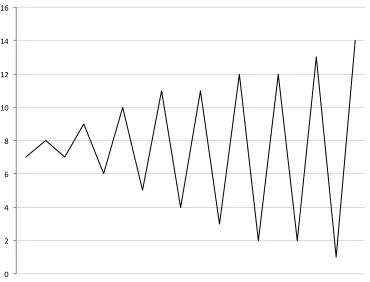
Figure II.2-25 – OpenMusic BPFs of Δonsets for voice 1 to 3. Vertical axis is the
amount of time between two note onsets (Δonset) and the horizontal axis is
the note order (i.e. first, second, third, and so on). _____________________________ 73 Figure II.2-26 – Vectorial harmony underlying the rhythmic complex. Only sharps
are used and they apply only to the chord on which they appear. ____________ 73 Figure II.2-27 – Raw algorithm output. Rectangles indicate leading roles for the
parts. ________________________________________________________________________________ 74 Figure II.2-28 – Rejected excerpt from the workshop score used while composing
Vacuum Instability. ________________________________________________________________ 76
Figure II.2-30 – Ranges constraining the melodic figures. Lower staff sounds two octaves lower. ______________________________________________________________________ 78
Figure II.2-31 – Raw algorithm output implemented in bars 1-33 of Dégradé.
Rectangles indicate melodic figure source with reference to Figure II.2-29 and Figure II.2-30. ______________________________________________________________________ 79 Figure II.2-32 - Ranges constraining the melodic figures. Top and bottom staffs
sound two octaves higher and lower, respectively. _____________________________ 80
Figure II.2-33 – Raw algorithm output implemented in bars 45-83 of Dégradé. ___ 81
Figure II.2-34 - OpenMusic patch for the automation of modular harmony. The harmonic sequence is shown just for illustrative purposes, not corresponding to the piece’s actual harmony. ____________________________________________________ 82 Figure II.2-35 - Harmonic progression used to build the musical texture. Sharps
affect only the chord on which they appear. _____________________________________ 82 Figure II.2-36 – Algorithm output after being imported into the music notation
software. Some clefs were added for visual clarity, avoiding many ledger lines. Accidentals last one bar. The large amount of rests comes from the beat
subdivisions, which are written into the parts. _________________________________ 84
Figure II.2-37 – Transcription of the folk melody Senhora do Almurtão. ___________ 85
Figure II.2-38 – Initial brass melody showing the rhythmic cells in parenthesis. __ 86 Figure II.2-39 – Ostinato generator algorithm. _______________________________________ 88 Figure II.2-40 – The raw 21-note ostinato and its score notation. __________________ 89 Figure II.2-41 – Raw 5-note ostinato. __________________________________________________ 89
Figure II.2-42 – Illustration of the algorithmic idea. a and b are groups of pitches. V
is a vector of intervals. ____________________________________________________________ 90 Figure II.2-43 – Algorithm output. Solid rectangles show the groups subjected to
transposition and distortion. Dashed rectangles show results of those
operations. D stands for distortion, Ti stands for transposition by interval i. _ 91
Figure II.2-44 – Production of cantus firmus 1 from Gesualdo’s madrigal Gioite voi
col canto. On top, an excerpt of the original madrigal is shown (Harmer 2009). ______________________________________________________________________________________ 93
Figure II.2-45 – Algorithm for the generation of canti firmi from segmentation and
filtration of the madrigal. _________________________________________________________ 94
Figure II.2-47 – The algorithm for the proliferation of a melody. The number of notes to retain is defined by a fraction interval (0.6 to 0.9 as shown) and the number of notes to add is defined by the Fibonacci series. ____________________ 97 Figure II.2-48 – Algorithm output selected and implemented in the score at letter
A. Rhythmic notation and accidentals are shown in raw, unprocessed form. The brackets show retained segments, which begin the next voice. __________ 98 Figure II.2-49 – Hyperbolic cosine 3D shape inside a hollow reference cube. ___ 100 Figure II.2-50 – The first harmonic and modal progression used: family A. Each
mode contains its corresponding sonority. The vertical lines show how the initial sonority is maintained throughout. The curve illustrates the
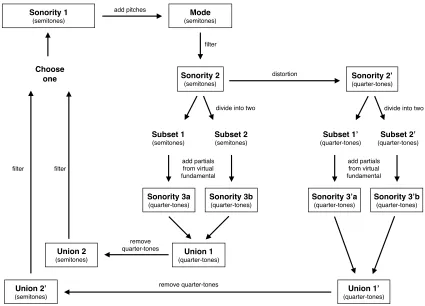
correspondence between density and architectural shape. __________________ 101 Figure II.2-51 – Diagram of the Cyclic Harmonic Process guiding the generation of
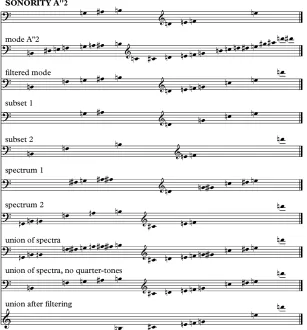
the pitch reservoirs. Numbering of sonorities applies only to this diagram, not to the sonorities used throughout the piece. __________________________________ 102 Figure II.2-52 – Cyclic Harmonic Process (no distortion) at work on one of the
sonorities used (A’’2). ___________________________________________________________ 104 Figure II.2-53 – Cyclic Harmonic Process at work on the distorted branch of
sonority A’’2. Arrows indicate whether the distortion raised or lowered the corresponding pitch. ____________________________________________________________ 104 Figure II.3-1 – Duration contour for the chord sequence. _________________________ 108
Figure II.3-2 – Score extract from Vacuum Instability. Notated in C. First chord of
the FM progression is at bar 9 and chromatic lines are indicated by rectangles. ____________________________________________________________________________________ 109
Figure II.3-3 – Excerpt from The Life is Ours showing mixed complementation
(indicated by the brace). ________________________________________________________ 111 Figure II.3-4 – Focusing region of the rhythm-focusing heterophony (unboxed) and
mixed elaboration (boxed). First bar shown is bar 88. Dashed line indicates the point from which the texture becomes homorhythmic. __________________ 111
Figure II.3-5 – The first cantus firmus coming out of algorithmic filtering and score
implementation at bar 1. ________________________________________________________ 113 Figure II.3-6 – Raw algorithm output of pulse unfocusing and implementation in
bars 37-43 of Shapes. ____________________________________________________________ 119
Figure II.3-7 – Excerpts from the rhythmic nesting algorithm output and its
Figure II.3-8 – Excerpt from the rhythmic nesting algorithm output (top) and score excerpt (bottom) showing the implementation of rhythmic nesting in
Stochafrica. Solid and dashed boxes represent starting and arriving rhythmic material respectively. The first duration of the raw algorithm output was deleted. ___________________________________________________________________________ 120 Figure II.3-9 – The raw 21-note ostinato and its score notation. __________________ 121 Figure II.3-10 – Raw 5-note ostinato and its 3-line staff score implementation. _ 122 Figure II.3-11 – Algorithm output of musical objects based on the pitch reservoirs
shown at the top (OpenMusic accidental notation). Quarter-tones had to be added by hand. Notes featuring a rectangle are errors produced by OpenMusic quantization (many times easy to spot because they default to middle C). The instrumental ranges used were: cl., vln., vc., pno. (top to bottom). __________ 123
Figure II.3-12- Passage from bars 28-32 of Dégradé showing the melodic
segregation by means of transposition. ________________________________________ 125
Figure II.3-13 – Annotated score excerpt from Dégradé. __________________________ 126
Figure II.3-14 – Score excerpt from Dégradé showing an intermediate cadence. 127
Figure II.3-15 – Annotated score excerpt from Dégradé showing manual
elaboration. ______________________________________________________________________ 129
Figure II.3-16 – Annotated score excerpt from Dégradé showing more intricate
manual elaboration. _____________________________________________________________ 129
Figure II.3-17 – Annotated score excerpt from Dégradé. Solid boxes indicate
algorithm output. Dashed boxes indicate manual elaboration procedures. 130 Figure II.3-18 – Mode arising from all the notes in the progression after
transposing them up one octave. _______________________________________________ 130
Figure II.3-19 – Annotated score excerpt from Dégradé showing manual
elaboration. ______________________________________________________________________ 131
Figure II.3-20 – Annotated score excerpt from Duet. Boxes indicate the algorithm
output. ____________________________________________________________________________ 132 Figure II.3-21 – Spectral enrichment (melodic colouring) of a melody. The initial
melody is shown at the bottom staff. Allowed partials were the odd numbers 3, 5, 7, 9, 11, 13 and 15. __________________________________________________________ 133 Figure II.3-22 – Score implementation of the algorithm output shown in the figure
above. _____________________________________________________________________________ 133
Figure II.3-24 – Sketches for the derivation of melodic figures from a rhythm. Numbers represent intervals in semitones. ___________________________________ 134 Figure II.3-25 – Preliminary score showing manual composition based on the
melodic figures. __________________________________________________________________ 135
Figure II.3-26 – Excerpt from the score of Dégradé showing manual
complementation. _______________________________________________________________ 136
Figure II.3-27 – Excerpt from the first page of the score of The Life is Ours. Solid
boxes indicate automatic implementations of algorithm outputs. Dashed boxes indicate manual procedures. ___________________________________________________ 137 Figure II.3-28 – Score implementation of the algorithm-generated fractal (boxed)
and manual complementation (unboxed) in Agnostos. _______________________ 138
Figure II.4-1 - The melodic variation process in four main steps. Numbers indicate intervals in semitones, their sign indicating direction. _______________________ 140
Figure IV.1-1 – Rotational vectorial harmony used in the first bars of Shapes along
with the morphology of the interval vectors. See page 47 for a deeper
discussion. _______________________________________________________________________ 156 Figure IV.2-1 – Modular harmony example. Notation from the software OpenMusic:
only sharps are used and they apply only to the chord on which they appear. Top staff and bottom staff sound two octaves higher and lower, respectively. Some sharps appear superimposed (fourth and seventh chord, top pitches). ____________________________________________________________________________________ 157 Figure IV.3-1 – Chord sequence and graphical depiction of circular harmony. __ 158 Figure IV.3-2 – A depiction of helicoidal harmony in space. _______________________ 158 Figure IV.4-1 - Excerpt of the OpenMusic patch used for creating pulse unfocusing.
Only two voices are shown for clarity. _________________________________________ 159 Figure IV.4-2 – OpenMusic patch for the construction of one voice of the rhythmic
complex. __________________________________________________________________________ 160 Figure IV.4-3 – OpenMusic patch excerpt. __________________________________________ 161 Figure IV.4-4 – Excerpt of the patch used to create the complete texture. Only the
construction of a single voice (bottom) is shown. ____________________________ 163 Figure IV.4-5 – OpenMusic patch for the generation of chords based on the
Figure IV.4-6 - First excerpt of the OpenMusic patch used to generate musical objects. ____________________________________________________________________________ 165 Figure IV.4-7 - Creation of the melodic sequence for one voice. Second excerpt of
the OpenMusic patch used to generate musical objects. ______________________ 165 Figure IV.4-8 – OpenMusic patch excerpt showing the main part of the rhythmic
nesting algorithm. _______________________________________________________________ 167 Figure IV.4-9 – Rhythmic polymerization from cells and pauses. _________________ 168 Figure IV.4-10 – Algorithm for the creation of a pitch sequence based on an
interval set. _______________________________________________________________________ 169
Figure IV.4-11 – Folk cross-resynthesis. Rhythmic material from a folk source is
combined with intervallic material from another. The resulting melody was subsequently transposed two octaves down and its durations doubled. ___ 169 Figure IV.4-12 – Rhythm-focusing process by diminution. ________________________ 170 Figure IV.4-13 – Algorithm for rhythm-focusing. The BPFs show the durational
contours of melodies. The graph on the lower left corner shows the progressive augmentation for the durations of a given voice. The patch
window on the right is the interpolation abstraction. ________________________ 170
Figure IV.4-14 – Algorithm for melodic colouring. The timbre evolution is shown here as an interpolation of a chord to a unison in 12 steps. __________________ 172 Figure IV.4-15 – The abstraction ‘melody_timbre_with_bpf’ (left) and its internal
loop (right). ______________________________________________________________________ 173 Figure IV.4-16 – Algorithm used for spectral enrichment. _________________________ 174 Figure IV.4-17 – Helicoidal harmony plus virtual fundamental algorithm. _______ 175 Figure IV.4-18 – Algorithmic environment for the automation and assessment of
List of Tables
Table I.5-1 – Interval notation. Top row indicates the number of semitones. Bottom row indicates the qualitative abbreviated notation. ____________________________ 41 Table II.1-1 – Instrumentation and duration of folio pieces. ________________________ 44 Table II.2-1 – Integer-ratios for transposition. _______________________________________ 63
Table II.2-2 – Intervallic analysis of Senhora do Almurtão. __________________________ 85
Table II.3-1 – Formal plan of the piece Canti Firmi. ________________________________ 112
Table II.3-2 – Key developments for creating the underlying harmony of the second movement. _______________________________________________________________________ 116 Table II.3-3 – Harmonic rhythm. _____________________________________________________ 124 Table IV.9-1 – Analysis of the fractal pitch sequence’s intervals to show the canons.
The top numbers in bold designate the internal pitch sequences: x,y meaning
every x pitches starting on the yth pitch (y=0 meaning the first pitch). Intervals
Attached CD-ROM Contents
So as to permit full inspection of algorithmic programming by the reader, a CD-ROM containing the files that correspond to algorithm illustrations throughout the text is attached to the back cover of this document.
The file named GATO WORKSPACE is a workspace file, which can be opened
after installing the OpenMusic application (currently at version 6.10) freely available from the IRCAM website:
http://forumnet.ircam.fr/shop/en/forumnet/43-openmusic.html
The Esquisse library must be enabled for certain patches to run properly. This is configured in OpenMusic preferences and should be done at startup.
Acknowledgments
I wish to firstly thank the ones most directly involved in this research: main supervisor Prof. Julian Anderson — always caring for my development through both guidance and challenging enquiry — and second supervisor Prof. Paul
Newland, who always provided clarifying perspective and aesthetic reflection. I've learned a great deal with their expertise and I'm thankful for their dedication to this research.
I shall also thank Prof. Kate Romano, Doctoral Programme Director during the first years of the research, for her valuable support, insights and feedback, and Prof. Julian Philips, Head of Composition at the school, for his enthusiasm, ongoing encouragement and support. During the final years, Dr. Biranda Ford also provided very valuable support and feedback.
This research couldn’t have started without the reference letters from Prof. Carlos Caires (my master's thesis co-supervisor, ESML-IPL, Portugal), Prof. Luís Tinoco (ESML, Portugal), Prof. Christopher Bochmann (my master's thesis supervisor, Universidade de Évora, Portugal) and Prof. João Soeiro (FCSH-UNL, Portugal), so here is my acknowledgment and gratitude. Relevantly, Prof. Carlos Caires introduced me to the world of Computer-Assisted Composition during my undergraduate studies and so deserves a special mention. Lastly, I wish to thank my first composition teacher Eurico Carrapatoso for showing me quite early, and with remarkable elevation and elegance, how composing always goes hand in hand with clear thinking.
Author’s Declaration
I, Gonçalo Alves Gato Lopes, the author, do hereby grant powers of discretion to the Librarian of the Guildhall School of Music & Drama to allow the thesis to be copied in whole or in part without further reference to the author.
[Note: This permission covers only single copies made for study purposes, subject to normal conditions of acknowledgement.]
Parts Published or Submitted for Publication
1. The vectorial harmony technique, first used on this research to compose the
piece Shapes, was the subject of a publication written during this doctorate
(Gato 2013).
2. Material relating to the piece The Life is Ours was submitted and accepted
for publication as a chapter in the upcoming The OM Composer’s Book 3
Abstract
Algorithm and Decision in Musical Composition Gonçalo Alves Gato Lopes
Through a series of creative projects this doctorate set out to research how computer-assisted composition (CAC) of music affects decision-making in my compositional practice. By reporting on the creative research journey, this doctorate is a contribution towards a better understanding of the implications of CAC by offering new insights into the composing process. It is also a contribution to the composition discipline as new techniques were devised, together with new applications of existing techniques.
Using OpenMusic as the sole programming environment, the
manual/machine interface was explored through different balances between manual and algorithmic composition and through aesthetic reflection guiding the composing process. This helped clarify the purpose, adequacy and nature of each method as decisions were constantly being taken towards completing the artistic projects.
The most suitable use of algorithms was as an environment for developing, testing, refining and assessing compositional techniques and the music materials they generate: a kind of musical laboratory. As far as a technique can be described by a set of rules, algorithms can help formulate and refine it. Also capable of incorporating indeterminism, they can act as powerful devices in discovering unforeseen musical implications and results.
Algorithms alone were found to be insufficient to simulate human creative thought because aspects such as (but not limited to) imagination, judgement and personal bias could only, and hypothetically, be properly simulated by the most sophisticated forms of artificial intelligence. Furthermore, important aspects of composition such as instrumentation, articulation and orchestration were not subjected to algorithmic treatment because, not being sufficiently integrated in OpenMusic currently, they would involve a great deal of knowledge to be specified
and adapted to computer language.1 These shortcomings of algorithms, therefore,
1 The most developed current algorithmic software for orchestration is Orchids (Esling et al. 2014),
implied varying degrees of manual interventions to be carried out on raw materials coming out of their evaluations. A combination of manual and algorithmic composition was frequently employed so as to properly handle musical aspects such as cadence, discourse, monotony, mechanicalness, surprise, and layering, among others. The following commentary illustrates this varying dialogue between automation and intervention, placing it in the wider context of other explorations at automating aspects of musical composition.
I
Introduction
I.1 Research Question
The principal research question is:
How does computer-assisted composition of music affect decision-making in my compositional practice?
Subsidiary questions arise and are addressed by this research:
• Why use algorithmic tools to compose music?
• In what ways can I implement algorithmic results into scores?
• How do aesthetic concerns guide algorithm design?
• Do aesthetic concerns dictate whether automated algorithms are used or
not?
• What kinds of compositional procedures are most adequately handled by
computer algorithms?
• What are the fundamental differences between manual and machine
composition?
• What aspects of human thought and creativity can’t machines simulate?
I.2 Algorithms and Computer-Assisted Composition
Three important definitions are of utmost relevance to this doctorate:
Algorithm – “a process or set of rules to be followed in calculations or other problem-solving operations, especially by a computer” (Oxford University Press 2013a).
Automation – “the use or introduction of automatic equipment in a manufacturing or other process or facility” (Ibid.).
Automatism – “[Art] the avoidance of conscious intention in producing works of art, especially by using mechanical techniques or subconscious associations” (Ibid.).
follows that algorithms as defined above are familiar to all composers, and they have been used for a long time. As David Cope writes:
Most composers employ algorithms when composing. That is, most composers apply rules, steps, or sets of instructions when composing music, especially when composing music in a particular style (Cope 2000, p.2).
I would perhaps replace the expression “in a particular style” with ‘using
well-defined techniques’. Algorithms in composition can, therefore, be considered
to be any systematic2 compositional procedure. Consequently, manual composition
can, at least conceptually, encompass algorithmic composition. Nevertheless, the term algorithm is usually reserved for computerized processes.
The term automatism, by definition, already implies a certain aesthetic
attitude. Ligeti, in his influential article on Boulez’s Structure Ia, employs the term
to denote procedures where:
Elements and operations . . . are, as it were, fed into a machine, to be woven into structures automatically (Ligeti 1960, p.36).
This ‘unconscious’ method of composing is, thus, not exclusive of automated composition nor does it always have to be associated with it.
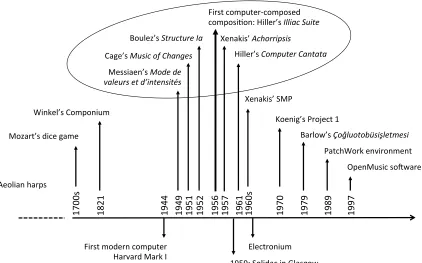
Roads (1996a) gives us a good historical account of important
developments related to algorithmic composition. In Figure I.2-1 a timeline is shown, listing the most relevant for this research.
What we could consider to be the first instances of algorithmic thinking in music date back to Aeolian harps: defined arrangements of tubes (the mechanical device) that are blown by the wind to produce melodies and harmonies. One of the first instances of real algorithmic composing though, is, curiously, the
Musikalisches Würfelspiel, attributed to Mozart. It was a “dice game for assembling minuets out of a set of prewritten measures of music. The sequence of measures was determined by a set of dice throws” (Roads 1996a, p.823).
Figure I.2-1 – Timeline showing important historical events of algorithmic composition.
Winkel’s Componium, from the nineteenth century, is the first known purpose-built composing machine. It is currently maintained at the Musical Instruments Museum in Brussels, which, on its website, makes reference to a “unique aleatory mechanism, which enables it to produce a stream of endlessly diverse music. […] To achieve this, Winkel used two cylinders which take it in turns to play two measures of music. An ingenious system . . . determines quite unpredictably whether or not the cylinders move, the traditional way to change tune. This creates a sort of musical collage which is almost never repeated” (Musical Instruments Museum of Brussels 2014).
After the invention of the modern computer in the 40s, scientists soon
began exploring its potential for the automation of musical composition. The Illiac
Suite (1956) for string quartet, composed by LeJaren Hiller, was the first computer-assisted composition. Hiller (originally a trained chemist) and his collaborator Isaacson programmed it jointly by using binary machine language, a
remarkable achievement. He would later assist John Cage in writing HPSCHD
(1967-69), a piece which, importantly, uses material from Mozart’s dice game, an homage Cage wanted to pay. “It gradually evolved into a large intermedia
environment held in the Assembly Hall at Urbana; an enormous theater-piece with fifty-two channel tape-orchestra, seven performing harpsichordists, and equally
Important events -meline
First modern computer Harvard Mark I
1944 1997
OpenMusic so<ware
1989
PatchWork environment Mozart’sdice game
1700s
Winkel’s Componium
Aeolian harps
1821
Xenakis’ SMP
1956
First computer-composed composi-on: Hiller’s Illiac Suite
1961
Hiller’s Computer Cantata
1949
Messiaen’s Mode de valeurs et d’intensités
1952
Boulez’s Structure Ia
1960s
1959: Solidac in Glasgow Electronium
1970
Koenig’s Project 1 Xenakis’ Achorripsis
Cage’s Music of Changes
Barlow’s Çoğluotobüsişletmesi
1979
impressive visual resources and unique audience circumstances” (Husarik 1983, p.1).
The circle in Figure I.2-1 groups the aesthetic trends surrounding the Illiac
Suite; namely highly formalized, automatic music composition. Accordingly,
Hiller’s total-serialization method used during the composition of the Computer
Cantata (1961) “was taken almost in toto from György Ligeti's account of the
compositional procedures which Pierre Boulez used for his Structure Ia” (Hiller
and Baker 1964, p.78). If in Structure Ia (1952) automatism corresponded to very
prescriptive serial procedures controlling pitch, duration, dynamics and
articulation (Ligeti 1960), in Cage’s Music of Changes (1951) it corresponded to
(also very prescriptive) chance procedures controlling “sonority, duration and dynamics” (Pritchett 1996, p.79). Importantly, instead of defining individual pitches, durations and dynamics, Cage’s charts cells define “sonorities of various complexity”, rhythmic cells juxtaposing “several different simple durations”, and constant or evolving dynamics.
The idea of algorithm can be closely linked to the idea of compositional
technique. Xenakis’ development of ‘Stochastic Music’ (his own term) provides a good example of a group of compositional techniques created out of aesthetic reflection, later to be automated in his Stochastic Music Program (SMP, developed
in the 1960s). In the important article The Crisis of Serial Music, from 1956, he laid
out the fundamental reasoning behind the development of these techniques:
Linear polyphony destroys itself by its very complexity; what one hears is in reality nothing but a mass of notes in various registers.
[…]
There is consequently a contradiction between the polyphonic linear system and the heard result, which is surface or mass.
[…]
[This] macroscopic effect can then be controlled by the mean of the movements of elements which we select. The result is the introduction of the notion of probability (Xenakis 1992, p.8).
The adjective ‘stochastic’ relates to the use of probability theory (statistics) to deal with mass phenomena that can’t be predicted precisely (indeterminism).
According to Gibson (2011, p.66), Pithoprakta (1955-56) was the first piece
therein used to calculate glissandi speeds. In Achorripsis (1956-57), he extended the application to all parameters: “besides speeds, densities, intervals of durations and pitch, the whole structure of the work is based on laws of probability” (Gibson 2011, p.71).
If a given technique can be strictly described and formalized in terms of the process it involves, then it can be regarded as an algorithm. In 1967, Koenig was claiming that:
Every rule of composition that can be formulated can also be programmed and carried out by a computer (Koenig 1967).
One should note that, although the use of a formalized technique implies a set of
rules to be obeyed, that does not imply that musical results be always the same (determinism). It depends on the starting musical material and on the degree of flexibility and control (adjustment) the technique admits. A deterministic
algorithm3 can be desired when composers have a precise idea of what they want.
This can provide the composer with the musical results to be incorporated directly into the score or with a starting material to be fed into yet some other process, whether manual or automated. Koenig goes on to write about the relevance of computers for composition theory research:
Naturally, one does not programme known rules of composition but also tries to find out whether events not yet expressed in the form of rules are feasible. The computer thus has a stimulating effect on research in composition theory (Koenig 1967, p.3).
Later in 1970, he created the Project 1 program, which “composes by applying seven selection principles to a database of five musical event parameters: instrument, rhythm, harmony, register, and dynamics” (Roads 1996a, p.839).
Composer-programmers kept playing a key role in the development of algorithmic composition throughout the later quarter of the twentieth century.
Clarence Barlow’s Çoğluotobüsişletmesi (1979), composed using extremely
automatic procedures, preceded the creation of his program Autobusk (Barlow 2000) written from 1986 to 2000. He said:
3 An algorithm in which every step is uniquely determined (Basu 2013, p.133). A non-deterministic
I remember in the 70s I would definitely have been very strict, but I would have changed the rules if I didn't like the result and gone back to the beginning. Çogluotobüsisletmesi is like that, exactly worked out in all its details (Barlow 2009).
The PatchWork environment (Laurson and Duthen 1989) came in the late 80s and is of particular importance since it laid ground for the software OpenMusic (Assayag et al. 1999), the main tool used to carry out the research contained in this doctorate. Composers such as Tristan Murail and Mikhail Malt, among others, developed and shared user libraries for use inside PatchWork, a practice that has continued with OpenMusic.
Within the realm of algorithmic composition, so-called Computer-Aided Composition (CAC) constitutes the main interest of the present research. Anders and Miranda, in their recent article (2009), wrote:
When doing computer-aided composition, composers apply or even develop certain technical means, but these technical means are not the actual purpose; the main result of their work is the artistic output. Composers decide which compositional parts or aspects of the music the computer generates, and which parts are composed manually (p.134).
The authors discuss some strategies of interfacing 'manual' and 'machine' composition particularly through the use of constraint programming. What composers decide, and how, constitutes a nuclear subject of this doctorate.
Important reflections surround the purpose of automation tools in composition. Some of them have been mentioned above. To sum up, I’ll list the ones I find most relevant to my practice. I would consider using algorithms in musical composition mainly because they:
1. speed up formalized processes, can be readily tested, customized and
refined on a computer.
2. can be very helpful to achieve precise calculations and prevent errors in
application of some compositional procedures.
3. can model and crystalize a given compositional technique. Testing helps
4. can be a physical necessity if the composer is basing his material on a large amount of data, or if he/she wants to use sound analysis and processing techniques.
5. can be in some degree non-deterministic, and thus a source of
unforeseen musical material that can reveal great potential.
6. can come from other disciplines — such as biological algorithms for
growth, for instance — and reveal new creative compositional
possibilities. However, this was not researched in the present doctorate.
I.3 Decision in Composition
While composing, composers have to take many decisions so as to direct the progress of a work towards a desired goal. Being able to take appropriate
decisions is, thus, an important part of a composer’s thought, although this varies from individual to individual. Unlike science, art does not search for general truths, so given decisions taken by a particular artist can be inappropriate for another
artist. These choices define an aesthetic — “a set of principles underlying and
guiding the work of a particular artist or artistic movement” (Oxford University Press 2013a) — and, being crystalized in a work, constitute authorship:
In aesthetics, art forgeries are banished to the basement because the relationships reproduced were not created — not chosen — by the forger (Meyer 1998, p.17).
With all relevance to this research, in an interview given to Rozalie Hirs in 2007, Tristan Murail said:
I’m interested in the experience of the listener. [...] I’ve become
increasingly interested in what we could call syntax, in general, and how harmonies, sound objects, or timbres interfere with or contribute to the syntax of a piece. I think that’s why creating musical structures merely through algorithms doesn’t work for me, because I need objects that have a meaning: expectation, closure, opening, or whatever (Murail 2009, p.11).
algorithms alone are not musically satisfying because he is mostly interested in
‘the experience of the listener’. That is the reason he decides not to create musical
structures solely on the basis of algorithms. These kinds of considerations are inherent to computer-assisted composition.
More general considerations about decision-making in composition abound in the literature. In 1994, Birtwistle said:
[Y]ou can’t control everything, every possible parameter — it’s been tried and we know what the results sound like... (Birtwistle 1994, p.334)
What this interesting (and still very relevant) statement reveals is a concern with the 'negative' effects that can arise from using too much control in composing; not leaving enough space for spontaneity, intuition and other things that can’t quite be systematized. In all probability, Birtwistle was referring to the most serialized forms of music, where every aspect is controlled by some mechanism.
Nevertheless, the first pieces of minimalist music were also strongly process-based. On that account, Steve Reich and John Adams also give evidence of this shift from process to intuition. According to Schwarz (1990), by 1974, Reich was
emphasizing intuition rather than process:
In fact, although there is always a system working itself out in my music, there would be no interest in the music if it were merely systematic (p.246).
In this light, composing is taken to be an active process, taken over a time span, and not just a mere realization of an intended program. Ligeti clearly articulates this important tension by saying:
In my music the musical instinct plays an important role. Nevertheless, this instinct must never be over evaluated, so that this alone guides the compositional result… During the composing, the instinctive and the constructive are complementary modes (Ligeti et al. 1983, pp.33–34).
Aesthetic decisions direct the artistic production of the composer.
with algorithmic composition. What can be the role of spontaneity and intuition in computer-assisted composition?
All these reflections and associated issues were to remain constantly on my mind throughout the research. As new artistic situations arose, I’d reflect about the musical goals and composition strategy. This implied aesthetic decisions to be
taken regarding the modus operandi I’d choose to follow. Then an experimentation
period followed where I would assess preliminary results and possibly reformulate the strategy. As I progressed, more and more decisions would
accumulate and start to shape the artistic work more and more definitely. I would then try and assess the impact of those decisions in order to either make more changes to the composing process, or take conclusions about what was it that did not go well. Frequently, the next artistic project would in some way address the shortcomings of the previous one.
I.4 OpenMusic Software and Literature
All automated compositional algorithms discussed in this doctorate were programmed using IRCAM's software for computer-assisted composition
OpenMusic (Assayag et al. 1999).
This application was built for musicians and provides an object-oriented
visual programming environment4 in which music materials — from very
elementary to more complex ones — can be represented and manipulated. It
contains a set of predefined objects called classes such as NOTE, CHORD and
CHORD-SEQ - used for directly inputting musically notated materials and/or to represent them - but also more abstract ones like INTEGER and FLOAT that are used for inputting numbers. Besides these, one can choose from another set of
objects called functions. These perform operations on the classes. By visually
connecting classes and functions, the user can define a particular algorithm that will look similar to a flowchart. By evaluating the process, information flows from top to bottom, entering patches, feeding the functions or classes that are daisy-chained to one another but that can also bifurcate.
4 The term object-oriented means “using a methodology which enables a system to be modelled as a
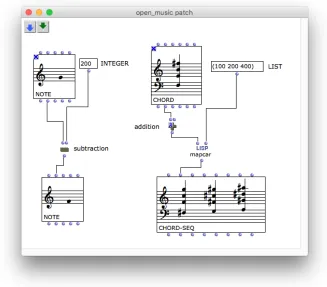
Figure I.4-1 – The OpenMusic patch window. Classes are named as uppercase and functions as lowercase.
Algorithms (or processes) are contained inside windows called patches (see
Figure I.4-1). These constitute the main working unit of the application and
provide inputs and outputs, so that the user can also interconnect them. When a
particular patch is contained inside another, it is called an internalabstraction.
Abstractions can thus be used to clean up the visual environment because they enclose processes, making them visible only by double-clicking (opening the abstraction in a new window). Also, they can be generalised in order to be usable
in the same form inside different patches. In that case they are called global
abstractions. For further information, the online documentation is available for browsing (see Diatkine 2011).
Three important books have been published so far, devoted exclusively to the use of OpenMusic by composers:
• The OM Composer’s Book 1 (Bresson et al. 2006) • The OM Composer’s Book 2 (Bresson et al. 2008)
• Contemporary Compositional Techniques and OpenMusic (Hirs and Gilmore
These three books provide a good panoramic view of composers’ practice in the field, apart from compiling an invaluable set of compositional techniques and associated aesthetic reflection.
Despite the unquestionable value of each author’s contribution to this literature — whether composer or musicologist, describing mainly algorithm’s construction principles and musical purposes — relatively small importance is given to describing the alternation between algorithmic and manual composition in producing the finished score, as well as to the score implementations and manual interventions carried out on algorithm-generated materials. Only scarcely can one find instances of this sort of reflection.
In The OM Composer’s Book 1, the readability of score excerpts is many times, and unfortunately, strongly hindered by insufficient graphic resolution. Score excerpts serve almost always to show that the algorithmic calculations find their way into the final score. But a more complete comparison between the algorithm outputs and their score implementation, together with the aesthetic discussion of the choices involved, is not carried out.
For instance, on page 40, Bloch discusses a score excerpt of an algorithm’s implementation, but neither a score of the algorithm output that served as a basis, nor an aesthetic discussion of the choices involved, is provided; only a
correspondence between the score excerpt and the ‘structure’ of the underlying canons. In page 104, Kretz shows a score excerpt featuring many parts, but only the piano part is (not very clearly) corresponded with an algorithm-generated pitch sequence and a rhythmic rationale in the text. We’re left with no information regarding the other parts of the score excerpt or how exactly was the piano part derived from the pitch sequence. So I would say that some parts of CAC are not sufficiently addressed and discussed.
In The OM Composer’s Book 2, Mawhinney, reporting on his use of algorithms, writes that:
CAC often refined and improved imagined musical ideas, whereas my own sense of taste often led me to re-write by hand the music generated by OpenMusic (p.105).
discover what [he] want[s] to do. […] When the simulations are effective and credible . . . the computer has fulfilled its maieutical task:
strengthened by the acquired experience, I resume composition by hand (p.111).
but this is used just as an introductory text to the algorithmic descriptions, the actual transition from algorithmic to manual methods never being exposed. In yet another chapter, PerMagnus Lindborg writes that:
the various compositional elements were collected in a poly object and transferred to Finale, where minor editing such as chord spelling, as well as substantial and detailed orchestration work were carried out (p.211).
but again, we’re left with no actual example and aesthetic discussion of how this happens.
In the previously cited Murail interview featured in the book Contemporary
Compositional Techniques and OpenMusic, he admits: “creating musical structures merely through algorithms doesn’t work for me” (p.11). So I ask: how do
algorithmic materials actually end up in the finished work? This is only partly
analysed musicologically by Hirs in the chapters On Tristan Murail’s Le Lac
(pp.45-92) and Frequency-based compositional techniques in the music of Tristan Murail
(pp.93-196). The correspondence between the algorithm outputs and the score implementations is carried out and discussed, but we miss the composer’s perspective: his own words describing the various phases of the composing process along with the aesthetic reflection involved.
The present doctorate aims at bridging the various gaps mentioned above by proving detailed discussions referring to all the stages involved in various, and diverse, CAC projects:
1. Algorithm design and aesthetic underpinnings.
2. The algorithm output creation/selection.
3. The steps and choices involved in implementing the output into the score.
4. The coexistence of manual and algorithmic materials in the score.
5. Post-compositional reflection.
I.5 Definitions and Terminology
I.5.1
Terms as Used in this Research
Algorithm – this term, previously defined on page 27, will be reserved for the automation of processes or set of rules. It can be used interchangeably with the
term ‘automated procedure’.
Algorithmic tool – the particular mechanical device and software in which algorithms can be programmed and executed.
Compositional technique – any process or set of rules to be followed in order to organize sound, or the elements of sound, so as to create music.
Deterministic algorithm – an algorithm in which every step is uniquely
determined (Basu 2013, p.133). This means that the result will be exactly the same each time the same set of initial parameters is fed into the algorithm in question. Algebraic operations — such as sum and multiplication — are good examples.
Non-deterministic (or indeterministic) algorithm – an algorithm in which action corresponding to one or more steps is dependent on a number of alternatives (Basu 2013, p.133). These algorithms frequently — but not necessarily — rely on verification criteria to test the correctness of a given alternative.
Aesthetic decision – a decision taken according to principles underlying artistic creation of a particular composer. These principles involve criteria of judgement that enable the selection or rejection of materials and procedures.
Operational decision – a decision taken purely for technical reasons.
Manual complementation – manual composition performed so as to coexist with algorithm-generated materials of a different conception, thus completing a given musical texture. It typically creates an additional musical layer with varying degrees of relatedness to the pre-existing algorithmic materials.
Manual elaboration – manual composition performed so as to develop
pre-existing algorithm-generated materials. This presupposes a shared conception between the two.
Manual intervention – manual modification/alteration of algorithm-generated materials. This can encompass simple actions such as assigning or changing the instrumentation or dynamics, or more ‘destructive’ actions such as changing or deleting some of the pitches or durations.
Algorithmic elaboration – an automated procedure designed and performed so as to develop a certain initial material.
Manual implementation – using an algorithm output as reference so that its incorporation in the score is carried out manually. This means that it is up to the composer to write the notes on the score, generally implying manual composition.
Automatic implementation – copying an algorithm output into the score by using automated procedures.
Spontaneity – “performed or occurring as a result of a sudden impulse or inclination and without premeditation or external stimulus” (Oxford University Press 2013a).
I.5.2
Interval Notation
notation is particularly useful because it is similar to the way intervals are defined
in OpenMusic.5 Nevertheless, it is not the most informative.6 For that reason, I also
use an abbreviated traditional notation: a major third would be notated as 'M3'
(uppercase M), whereas a minor third would be notated as 'm3' (lowercase m). The
following table gives the complete conversion for one octave.
Table I.5-1 – Interval notation. Top row indicates the number of semitones. Bottom row indicates the qualitative abbreviated notation.
0 1 2 3 4 5 6 7 8 9 10 11 12
U m2 M2 m3 M3 P4 A4/D5 P5 m6 M6 m7 M7 P8
The prefix 'c' indicates a compound interval and '↑/↓' indicate quarter-tone sharp
and flat. Therefore, 'c-M7↑' is a compound major seventh, a quarter-tone sharp.
The plural of each interval is notated by appending the letter 's': for example, major ninths would be notated as 'M9s'.
5 Inside OpenMusic the unit used is the Midicent, which corresponds to the number of semitones
multiplied by 100 cents (1 semitone = 100 cents). A minor third is, thus, 3 × 100 = 300 midicents.
6 Numeric notation treats every interval as a number, whereas an abbreviated traditional notation
II
Analytical Commentary on Folio Pieces
II.1 Scope, Overview and Methodology
The analytical commentary contained in this chapter reflects the creative, practice-based research carried out during the research period. Although the analyses and discussions deal with nuclear topics — such as aesthetics,
compositional techniques, CAC7 methodologies, algorithm design, pre-composition
and personal reflections — complete and exhausting music analyses were not carried out. The research topic and associated questions are indeed what define the scope of the analytical commentary.
The research journey can roughly be depicted as an exploration of different balances between manual and algorithmic composition as shown in Figure II.1-1. This constituted a substantial part of the research methodology.
Figure II.1-1 – Timeline of research showing the balance between manual and algorithmic composition.
Composing for different instrumentations was also methodologically relevant as it had an impact on composition strategy. This is summed up in Table II.1-1, along with pieces’ durations.
7 Computer-assisted composition.
Algorithmic+ Manual+
Shapes' To'the'Muses' Dégradé' Duet' Vacuum'Instability' The'Life'is'Ours' Two'Different'Pieces' CanB'Firmi' Agnostos' Stochafrica'
!me
Table II.1-1 – Instrumentation and duration of folio pieces.
Piece Instrumentation Duration
Shapes String quartet 5’
To the Muses Soprano and Piano 6’
Dégradé 5-part Ensemble 10’
Duet * Two Pianos 7’30’’
Vacuum Instability 8-part Ensemble 7’30’’
The Life is Ours Symphonic Wind Band 8’
Two Different Pieces + Violin and Piano 7’
Canti Firmi 8-part Ensemble 4’
Agnostos * Symphony Orchestra 12’
Stochafrica * Percussion 8’
* not premiered yet; + premiered but not recorded 75 minutes total
The creative research was constantly recorded by means of sketches, analytical notes, analysis drafts, audio notes, research notes, references, computer files of algorithms, preliminary scores and finished scores. These were either exposed or subjected to reflective analysis as I wrote the commentary.
II.2 Algorithm Design
Algorithms, as stated in the Introduction, can be equated to compositional techniques if one considers only their function: an initial material (either musical or non-musical) is fed into a process, which finally produces musical results. This means that algorithm design always encompasses compositional technique formulation, and in this sense, aesthetic principles. These principles embody
aesthetic decisions. But automating a compositional technique requires the composer's ability to program a machine so that it performs as intended. This
purely technical dimension of algorithm design embodies operational decisions.
Completeness of Results
As the following sections will show, many times I did not program the computer to output finished musical results. To get complete and definite music materials — that would simply be copied to the score, needing no further change nor any addition of other materials — was seldom the aim, less and less so as I approached the end of the creative research journey. There were many strong reasons for leaving enough space for manual composition, increasingly so as the purpose, adequacy and nature of each method (algorithmic and manual) became clearer. Thus, the fact that algorithms frequently produced incomplete musical materials (needing further manual procedures) cannot be related to insufficient, incomplete or inadequate programming. At the core of computer-assisted
composition (CAC) is the balance between manual and automated methods and, as I explored each of them, I learned to select the aspects I found artistically most useful.
Music Cognition Concerns
An engagement with cognitive principles strongly influenced the
compositional decisions taken during the first projects of the portfolio: Shapes, To
Aural and cognitive impacts were aspects I valued very much after critically reflecting about highly formalized music composition: it focused too much on technique formulations but often did not care enough for their aural impact, let alone their musical significance. Arguably, this issue was firstly raised in the late
fifties by Ligeti in his article about Boulez’s Structure Ia (Ligeti 1960). Criticizing
Boulez’s aesthetic choice of treating musical elements of a different nature in equal fashion — namely pitch-class (a note quality) and note duration (a quantity) — he wrote:
What is unorganic is this pointless transplantation of a system; note-qualities labelled with numbers, the dematerialised numbers organized into tables, and the tables finally used like a fetish, as a measure for duration-quantities (pp.39-40).
Hence, Ligeti was reacting against certain aspects of automatism where, above all, composers would let a system impose its mechanism, even if that meant sacrificing sound musical judgement. This is further discussed by Jonathan Bernard in his
article Inaudible Structures, Audible Music: Ligeti's Problem, and His Solution:
He found problematic ‘the organization of all the musical elements’ — that is, pitch, duration, timbre, dynamics, mode of attack — 'within a unified plan' because he 'detected within it a discrepancy: quantification applied equally within the various areas produced, from the point of view of our perception and understanding of musical processes, radically different results, so that there was no guarantee that a single basic order would produce analogous structures on the various levels of perception and understanding. […] Pre-planning had become so important that it was the real compositional act (Bernard 1987, pp.207–8).
In Ligeti’s words:
In working out a notional compositional structure the decisive factor is the extent to which it can make its effect directly on the sensory level of musical perception (Ligeti et al. 1983, p.131).
are so relevant and why I relied so much on music cognition principles to design algorithms, along with their associated compositional techniques and subsequent manual procedures. This strong reliance gradually faded throughout the research period, giving way to more poetic and imaginative means of musical expression.
II.2.1
Determinism and Control
A deterministic algorithm is desirable when a composer wants to control
every aspect of the technique he/she is programming and is after a single result, univocally calculated. Once programmed and given the same initial conditions, a
deterministic algorithm will always output the same result. To obtain different
results, the composer would have to change the initial materials and/or parameters.
Apart from the technicalities of programming, I always tried to focus on the musical process at hand, together with its musical implications. This continuous aesthetic judgement is of prime importance because the programming tasks and sense of technical achievement can potentially overshadow what is fundamentally, and in effect, compositional research.
II.2.1.1Vectorial Harmony
Figure II.2-1 – Rotational vectorial harmony used in the first bars of the piece Shapes along with the morphology of the interval vectors.
The automation of vectorial harmony (a personal technique defined in Appendix IV.1, page 155) constitutes a deterministic algorithm and was used in the
first piece of the portfolio — Shapes — to calculate the progression shown in
Figure II.2-1. The interval vector is v = (+2, -11, +1, +7) and it starts with a chord of
ro
ta
ti
on
o
f v
ec
to
r
+2
-11
+1 +7
+2 -11
+1 +7
+7 +2
-11
+1
+7
+1 +2
M9s (14 semitones). I wanted to get a very pure sound of M9 and this explains why the middle notes are in unison. Instead of one, I used two M9s so as to avoid a purer, but poorer sonority. We apply the vector as many times as we want to the
lowest note. After that, we apply the first rotation of the vector to the second
lowest note; then the second rotation of the vector to the third lowest note, and so forth. What we get is a sequence of four chords that is transposed one semitone down with each reiteration.
Figure II.2-2 – OpenMusic patch showing the automation of vectorial harmony.
The automation of vectorial harmony inside OpenMusic is shown in Figure II.2-2. The initial chord is fed into an abstraction (labelled 1 on the Figure)
configured to produce 11 cycles of application of vector v = (+2, -11, +1, +7). The
output is fed into a CHORD-SEQ object (labelled 2) configured so that each voice is
featured on a different MIDI channel (carried out by the abstraction labelled 3). The bottom abstraction exports a MIDI file, which is then imported into a music notation application.
The intervallic structure for each chord obtained is as follows:
1st 2nd 3rd 4th 1st 2nd 3rd 4th
in semitones, 14 20 15 2 or M9 c-m6 c-m3 M2
0 12 18 13 U P8 c-D5 m9
14 1 11 19 M9 m2 m9 c-P5
1.
2.