City, University of London Institutional Repository
Citation
:
Lavelle, F., McGowan, L., Spence, M., Caraher, M., Raats, M., Hollywood, L., McDowell, D., McCloat, A., Mooney, E. and Dean, M. (2016). Barriers and facilitators to cooking from 'scratch' using basic or raw ingredients: A qualitative interview study. Appetite, 107, pp. 383-391. doi: 10.1016/j.appet.2016.08.115This is the accepted version of the paper.
This version of the publication may differ from the final published
version.
Permanent repository link: http://openaccess.city.ac.uk/15260/
Link to published version
:
http://dx.doi.org/10.1016/j.appet.2016.08.115Copyright and reuse:
City Research Online aims to make research
outputs of City, University of London available to a wider audience.
Copyright and Moral Rights remain with the author(s) and/or copyright
holders. URLs from City Research Online may be freely distributed and
linked to.
1
Barriers and facilitators to cooking from ‘scratch’ using basic or
raw ingredients: A qualitative interview study [DOI
:10.1016/j.appet.2016.08.115.
]
Fiona Lavellea, Laura McGowana, Michelle Spencea, Martin Caraherb, Monique Raatsc, Lynsey Hollywoodd, Dawn McDowelld, Amanda McCloate, Elaine Mooneye, Moira Deana*.
a
Institute for Global Food Security, School of Biological Sciences, Queen’s University Belfast, UK
b
Centre for Food Policy, Department of Sociology,School of Arts and Social Sciences, City University London, UK
c
Food, Consumer Behaviour and Health Research Centre, School of Psychology, University of Surrey, UK
d
Department of Hospitality and Tourism Management, Ulster Business School, Ulster University, UK
e
DepartmentofHome Economics, St. Angela's College, Sligo, Ireland.
Email addresses:
*Corresponding author: Dr Moira Dean, Institute for Global Food Security, School of Biological
Sciences, Queen’s University Belfast, Belfast BT9 5AG, UK. Phone: +44(0)28 9097 6561; fax: +44(0)28
2
Background: Previous research has highlighted an ambiguity in understanding
1
cooking related terminology and a number of barriers and facilitators to home meal
2
preparation. However, meals prepared in the home still include convenience products
3
(typically high in sugars, fats and sodium) which can have negative effects on health.
4
Therefore, this study aimed to qualitatively explore: (1) how individuals define
5
cooking from ‘scratch’, and (2) their barriers and facilitators to cooking with basic
6
ingredients.
7
Methods: 27 semi-structured interviews were conducted with participants (aged
18-8
58 years) living on the island of Ireland, eliciting definitions of ‘cooking from
9
scratch’ and exploring the reasons participants cook in a particular way. The
10
interviews were professionally transcribed verbatim and Nvivo 10 was used for an
11
inductive thematic analysis.
12
Results: Our results highlighted that although cooking from ‘scratch’ lacks a single
13
definition, participants viewed it as optimal cooking. Barriers to cooking with raw
14
ingredients included: 1) time pressures; (2) desire to save money; (3) desire for
15
effortless meals; (4) family food preferences; and (5) effect of kitchen disasters.
16
Facilitators included: 1) desire to eat for health and well-being; (2) creative
17
inspiration; (3) ability to plan and prepare meals ahead of time; and (4) greater
self-18
efficacy in one’s cooking ability.
19
Conclusions: Our findings contribute to understanding how individuals define
20
cooking from ‘scratch’, and barriers and facilitators to cooking with raw ingredients.
21
Interventions should focus on practical sessions to increase cooking self-efficacy;
22
highlight the importance of planning ahead and teach methods such as batch cooking
23
and freezing to facilitate cooking from scratch.
24
3
Keywords: Scratch Cooking, Qualitative, Skills, Barriers, Facilitators1
26
27
Introduction
28
Over recent years, there has been concern that the culture of domestic cooking has
29
rapidly evolved alongside broader social, environmental and technological changes to
30
the potential detriment of our diet and resulting nutritional health. Research has
31
indicated: less time is being spent on domestic food preparation (Soliah, Walter, &
32
Jones, 2012; Pettinger, Holdsworth, & Gerber, 2006), a breakdown of traditional meal
33
patterns (Buckley, Cowan, & McCarthy, 2007), a greater availability and
34
consumption of high energy ultra-processed ready-made foods (typically high in
35
sugars, fats and sodium) (Monteiro, Moubarac, Cannon, Ng, & Popkin, 2013; Moodie
36
et al., 2013; Monteiro, Levy, Claro, deCastro, & Cannon, 2011; Stuckler, McKee,
37
Ebrahim, & Basu, 2012), and an increase in food produced and consumed outside the
38
home environment (Mintel, 2014). Moreover, it has been suggested that whole
39
cultures have experienced a dramatic change in their ability to select, prepare and
40
consume food (Lang & Caraher, 2001), with fewer and/or different cooking skills
41
(Beck, 2007; Worsley, Wang, Wijeratne, Ismail, & Ridley, 2015). Some researchers
42
have also suggested a loss of the necessary skills to prepare a meal from raw
43
ingredients (from ‘scratch’) (Caraher, Dixon, Lang, & Carr-Hill, 1999). In light of
44
this, several community diet projects have been developed to increase cooking skills
45
among the consumer. Although such interventions lack theoretical underpinning and
46
rigorous outcome evaluations (McGowan et al., 2015) they do have the potential to
47
reduce overreliance on convenience foods. Indeed, previous research has shown that
48
4
those who frequently prepare a meal in the home (Wolfson & Bleich, 2015) and use a
49
greater number of cooking skills make healthier food choices and have a better dietary
50
quality (Chen, Meei-Shyuan, Yu-Hung, & Wahlqvist, 2012; McGowan et al., 2015),
51
whereas a lack of cooking skills has been associated with increased consumption of
52
convenience food products (van der Horst, Brunner, & Siegrist, 2011).
53
To gain insights into the state of domestic meal preparation, research has
54
investigated the perceptions of what constitutes home-cooking and the barriers and
55
facilitators to cooking (Wolfson, Smith, Frattaroli & Bleich, 2016a; Wolfson, Smith,
56
Bleich & Frattaroli, 2016b; Bowen, Elliot & Brenton, 2014; Soliah, Walter & Jones,
57
2012). Previous studies have alluded to several barriers to home meal preparation,
58
such as parental employment (Devine et al., 2006; Jabs et al., 2007; Devine et al.,
59
2009), lack of time (Jabs & Devine, 2006), cost of convenience foods (Brunner, van
60
der Horst, & Siegrist, 2010), poor cooking skills (van der Horst et al., 2011; Stead et
61
al., 2004), and limited food resources (Vidgen & Gallegos, 2014). In a recent
62
American study Wolfson et al. (2016b) found a continuum in what home-cooking
63
meant to participants, from cooking from scratch (CFS) at one end to heating up a
64
ready-made microwave meal at the other. Different use of terminology was debated
65
by participants illustrating the highly individualised nature of the terms used. This
66
lack of consensus has been previously highlighted (Short, 2006; Short, 2003). In
67
addition, the motivators to home meal preparation have been explored using focus
68
groups (Jones, Walter, Soliah & Phifer, 2014), highlighting the cost effectiveness of
69
cooking in the home, having a cooking role model, familiarity with cooking
70
techniques and having time for the preparation, cooking and cleaning.
71
In relation to the use of terminology, encouraging some to increase their
home-72
cooking, may encourage the use of convenience products, as Wolfson et al. (2016b)
5
demonstrated that some view heating a ready-meal as home-cooking. Recent
74
European research found that only 30% of total household food expenditure was on
75
‘scratch’ ingredients (Daniels & Glorieux, 2015), with the rest being spent on
76
convenience food and meals consumed outside the home. Another study showed that
77
only 20% of Belgian families spend the majority of their food budget on raw or fresh
78
ingredients, with the remainder combining fresh ingredients with some level of
79
convenience food (Daniels, Glorieux, Minnen, van Tienoven & Weenas, 2015).
80
Convenience foods are normally high in saturated fat, sugars, sodium and additives
81
(Monteiro, Moubarac, Cannon, Ng, & Popkin, 2013; Moodie et al., 2013; Monteiro,
82
Levy, Claro, deCastro, & Cannon, 2011; Stuckler, McKee, Ebrahim, & Basu, 2012),
83
and the consumption of convenience food has been associated with overweight and
84
obesity (van der Horst et al., 2011; Smith, McNaughton, Gall, Blizzard, Dwyer &
85
Venn, 2009; Malik, Willett and Hu, 2013). Further, the additives in these products
86
have been linked to the increase in autoimmune diseases (Lerner & Matthias, 2015).
87
In light of this, it is important to understand what CFS means to the consumer and
88
what barriers consumers face moving away from convenience products towards using
89
basic or fresh ingredients in their cooking. Thus, this study explicitly explored the
90
barriers and/or facilitators to cooking with basic or raw ingredients and how they may
91
be different to the barriers faced in home meal preparation in general.
92
Interviews were chosen as the method of data collection as it would allow for
93
maximum individual clarity with the already confusing terminology, as participants
94
within a focus group can be influenced by other dominant participants. Therefore this
95
study qualitatively explored in a European population: (1) how individuals define
96
cooking from ‘scratch’, and (2) the barriers and facilitators to cooking a meal with
97
basic or raw ingredients.
6
Material and Methods
99
Participant Recruitment
100
Male and female participants from the island of Ireland (IOI) were recruited via
101
convenience and snowball sampling with purposive acceptance to take part in a
semi-102
structured interview. Recruitment methods included announcements in the form of an
103
email circulated to staff at a NI (Northern Ireland) and ROI (Republic of Ireland)
104
university, interviewer contacts, and face-to-face invitations at a range of ROI
105
community classes aimed at the unemployed. Every effort was made to include
106
participants from different educational backgrounds and age groups, with a range of
107
perceived cooking abilities. Of the thirty-one participants that responded with interest
108
and completed a screening questionnaire; three did not meet the eligibility criteria (i.e.
109
aged between 18-65 years; not involved in professional cookery; responsible for
110
preparing at least one household meal per week) and a further one was unable to
111
commit the necessary time. In total, 27 participants (17 females and 10 males) were
112
interviewed (Table 1). All participants provided informed verbal consent and the
113
study was approved by the School of Biological Sciences Ethical Committee at
114
Queen’s University Belfast.
115
116
Table 1 Characteristics of interview participants.
117
Characteristic N = 27
N %
Country Northern Ireland 15 56
Republic of Ireland 12 44
Age 18-34 years 12 44
35-44 years 5 19
45-58 years 10 37
Highest Education level Basic School (age 15/16, Junior
Cert/GCSE)
2 8
Secondary School (age 17/18, Leaving Cert/A Level)
4 15
Professional Training 3 11
7
Postgraduate level 9 33
Occupational Status Employed full-time (>30h per week) 18 67
Employed part-time (8-29h per week) 3 11
Retired 1 4
Student 2 7
Unemployed 3 11
Life Stage Single/Married with children in the
household
9 33
Married with no children in householda 4 15
Single 4 15
Single with cohabitees 6 22
Single lives with family 4 15
Number in Household 1 4 15
2 9 33
3 8 30
4-6 6 22
Type of ingredients used in meal preparation
All Ready-made 2 7
Mostly pre-prepared, some fresh/basic/raw ingredients
7 26
Mostly fresh/basic/raw, some pre-prepared ingredients
17 63
All fresh/basic/raw ingredients 1 4
Perceived Ability
1 1 4
2 2 7
3 2 7
4 7 26
5 9 33
6 2 7
7 4 15
a
Includes couples with grown children no longer residing in their household.
118
119
Interview Questioning Guide
120
Based upon a review of previous literature (McGowan et al., 2015) and a small
121
number of interviews (n=4) with experts working to improve cooking and food skills
122
(defined here as food planning, organising, shopping, budgeting), the research team
123
developed the interview questioning guide. The interview guide was piloted for
124
clarity, comprehension, reliability and timing with five individuals and refined prior
125
to implementation. The questions were designed to elicit participants perceptions
126
regarding their experiences with domestic cooking including terminology relating to
127
cooking, their motivations and barriers for cooking with basic or raw ingredients, how
8
they learned their cooking and food skills, and how they had/could improve their
129
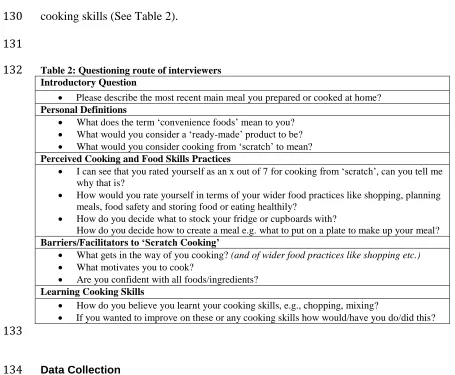
cooking skills (See Table 2).
130
[image:9.595.50.505.91.466.2]131
Table 2: Questioning route of interviewers
132
Introductory Question
Please describe the most recent main meal you prepared or cooked at home?
Personal Definitions
What does the term ‘convenience foods’ mean to you?
What would you consider a ‘ready-made’ product to be?
What would you consider cooking from ‘scratch’ to mean?
Perceived Cooking and Food Skills Practices
I can see that you rated yourself as an x out of 7 for cooking from ‘scratch’, can you tell me why that is?
How would you rate yourself in terms of your wider food practices like shopping, planning meals, food safety and storing food or eating healthily?
How do you decide what to stock your fridge or cupboards with?
How do you decide how to create a meal e.g. what to put on a plate to make up your meal?
Barriers/Facilitators to ‘Scratch Cooking’
What gets in the way of you cooking? (and of wider food practices like shopping etc.) What motivates you to cook?
Are you confident with all foods/ingredients?
Learning Cooking Skills
How do you believe you learnt your cooking skills, e.g., chopping, mixing?
If you wanted to improve on these or any cooking skills how would/have you do/did this?
133
Data Collection
134
Interviews were conducted by telephone (n=26) or face-to-face (n=1), between
135
October and December 2014, by one of two experienced interviewers (FL; a Sport
136
and Health Scientist: and LM; a Health Psychologist) who had completed courses on
137
qualitative data collection. As an ice-breaker, participants were asked to introduce
138
themselves and describe the most recent main meal that they had prepared.
139
Interviewees were given some assurances (e.g. that there were ‘no right or wrong
140
answers’, their anonymity would be kept intact and they could opt out at any point)
141
before the interviewer proceeded to ask a series of guided open-ended questions
142
(Table 2). The interview concluded when all topics had been covered and no new
143
information emerged. Interviews were audio-recorded and lasted between 20 and 60
144
minutes (mean duration 36 minutes).
9
Data analysis
146
Audio recordings were professionally transcribed verbatim, checked for precision
147
(FL, LM), and, coded thematically (Braun & Clarke, 2006) using the qualitative
148
programme NVivo 10 (QSR International Pty Ltd, Victoria, Australia). Initially,
149
interviewers (FL, LM) independently read and coded two randomly selected
150
transcripts before jointly reaching a consensus on the validity and reliability of the
151
application of their codes to the data. This process was repeated for a further three
152
transcripts, afterwards, minor revisions were made to the terminology of some codes.
153
The remaining transcripts were then coded (FL) and independently checked for
154
coding consistency (LM) before consensus was reached (with FL). Both coders
155
agreed that data saturation had occurred as no new codes emerged from the final six
156
interviews. Subsequently, codes were grouped into potential barriers and facilitators
157
and inspected for overlap to ensure that there were clear distinctions within and
158
between barriers and facilitators. To increase intra-observer reliability, four members
159
of the research team who were experienced in qualitative data analysis (FL, LM, MS;
160
a Nutritionist and MD; a Consumer Psychologist) immersed themselves in the data
161
and critically discussed the emerging barriers and facilitators, together with their
162
interpretations. As a final step, FL, LM, MS, and MD discussed the results and
163
selected key quotes to exemplify each barrier and facilitator. Socio-demographic data
164
was summarized using IBM SPSS Statistics version 19 software (SPSS, Chicago, IL).
165
Results
166
The sociodemographic characteristics of the 27 participants are shown in Table 1. To
167
ensure a wide range of cooking abilities (see Table 1), a question was included in the
168
screening questionnaire on perceived ability; “On a scale from 1 to 7 where 1 means
169
very poor and 7 means very good, how good are you at preparing and/or cooking
10
meals from ‘scratch’ at home (i.e. using basic/fresh/raw ingredients etc.)?”.
171
Participants responses ranged from 1 to 7 (Mean 4.6, SD 1.6). An overview of these
172
participants’ definitions of CFS and their barriers and facilitators to cooking with raw
173
or basic ingredients is presented respectively.
174
Perceptions of cooking from ‘scratch’ using basic ingredients
175
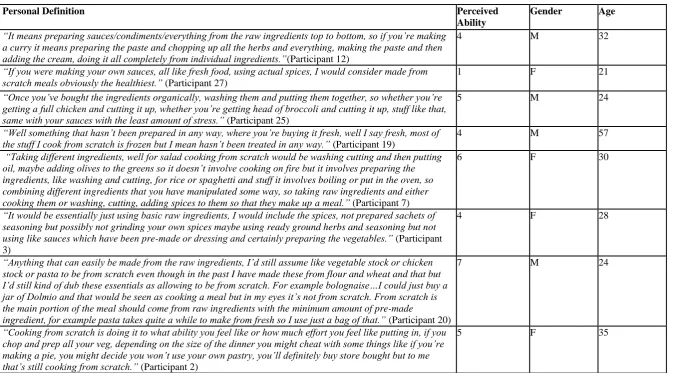
Illustrative quotes of participants’ personal definitions of CFS can be seen in Table 3,
176
these appeared to be individualized with no clear patterns across perceived ability,
177
gender or age. Perceptions of the degree of preparation allowed for classification of a
178
meal as made from ‘scratch’ varied considerably. These perceptions spanned a
179
continuum from traditional understandings of the term (using raw ingredients
180
entirely) to a more inclusive modern version, which incorporated some convenience
181
products (e.g. store bought pasta). There was consensus that CFS was the “healthiest”
182
method of preparing a meal; with natural, fresh and unprocessed ingredients being
183
key components, yet, for some, the use of frozen foods (such as frozen fish fillets)
184
was also included. The degree of time and effort needed for CFS was perceived as
185
being greater than that required for convenience products, however, for many, it was
186
viewed as the goal to strive towards.
11
Table 3: Illustrative quotes to demonstrate the spectrum of ‘cooking from scratch’ perceptions.
188
Personal Definition Perceived Ability
Gender Age
“It means preparing sauces/condiments/everything from the raw ingredients top to bottom, so if you’re making a curry it means preparing the paste and chopping up all the herbs and everything, making the paste and then adding the cream, doing it all completely from individual ingredients.”(Participant 12)
4 M 32
“If you were making your own sauces, all like fresh food, using actual spices, I would consider made from scratch meals obviously the healthiest.” (Participant 27)
1 F 21
“Once you’ve bought the ingredients organically, washing them and putting them together, so whether you’re getting a full chicken and cutting it up, whether you’re getting head of broccoli and cutting it up, stuff like that, same with your sauces with the least amount of stress.” (Participant 25)
5 M 24
“Well something that hasn’t been prepared in any way, where you’re buying it fresh, well I say fresh, most of the stuff I cook from scratch is frozen but I mean hasn’t been treated in any way.” (Participant 19)
4 M 57
“Taking different ingredients, well for salad cooking from scratch would be washing cutting and then putting oil, maybe adding olives to the greens so it doesn’t involve cooking on fire but it involves preparing the ingredients, like washing and cutting, for rice or spaghetti and stuff it involves boiling or put in the oven, so combining different ingredients that you have manipulated some way, so taking raw ingredients and either cooking them or washing, cutting, adding spices to them so that they make up a meal.” (Participant 7)
6 F 30
“It would be essentially just using basic raw ingredients, I would include the spices, not prepared sachets of seasoning but possibly not grinding your own spices maybe using ready ground herbs and seasoning but not using like sauces which have been pre-made or dressing and certainly preparing the vegetables.” (Participant 3)
4 F 28
“Anything that can easily be made from the raw ingredients, I’d still assume like vegetable stock or chicken stock or pasta to be from scratch even though in the past I have made these from flour and wheat and that but I’d still kind of dub these essentials as allowing to be from scratch. For example bolognaise…I could just buy a jar of Dolmio and that would be seen as cooking a meal but in my eyes it’s not from scratch. From scratch is the main portion of the meal should come from raw ingredients with the minimum amount of pre-made
ingredient, for example pasta takes quite a while to make from fresh so I use just a bag of that.” (Participant 20)
7 M 24
“Cooking from scratch is doing it to what ability you feel like or how much effort you feel like putting in, if you chop and prep all your veg, depending on the size of the dinner you might cheat with some things like if you’re making a pie, you might decide you won’t use your own pastry, you’ll definitely buy store bought but to me that’s still cooking from scratch.” (Participant 2)
12 “I suppose in the traditional meaning it is totally everything, practically growing your own, but I think times
have moved on. I think cooking from scratch is…it’s actually washing the vegetables, getting the earth off them and peeling them and cutting them yourself, it’s more vegetables, maybe with chicken, I do buy whole chickens but chicken fillets are easier, I tend to go for ones that are marinated so that’s really convenience too, I wouldn’t be marinating.” (Participant 14)
3 M 51
“For the curry I used mushrooms, onions, chicken fillets but I normally use a dry curry mix, Mayflower, you just mix it with about 10 ounces of water and it gives you a curry sauce which actually tastes like proper [bought/takeaway] Chinese curry but everything else would have been fresh ingredients.” (Participant 4)
5 F 47
“Cooking from scratch means opening the jar and putting it into the saucepan, adding my own blend of herbs and spices to it, making the meatballs, I make the meatballs from scratch and then putting the pasta on.”
(Participant 23)
13
Barriers to cooking from ‘scratch’ using basic or raw ingredients
189
Five barriers to CFS using basic or raw ingredients were identified: (1) time
190
pressures; (2) desire to save money; (3) desire for effortless meals; (4) family food
191
preferences; and (5) effect of kitchen disasters.
192
(1) Time pressures
193
Almost all participants said that they were so busy that they found it difficult to cook
194
from basic or raw ingredients. The strongest time pressure appeared to come from
195
work and/or family commitments:
196
“…I don’t get time to do that [cook from basic ingredients] now, because now I’m 197
a dad…it’s all rush rush rush now.” (Participant 16)
198
“You’ve got a very limited amount of time to cook after work before you want to 199
eat, so unless you’re organised you don’t have any time, and if you don’t have any 200
time you can’t make things from scratch, it takes too long.” (Participant 12)
201
The feeling that there was not enough time, especially mid-week, was implicated
202
in the increased consumption of convenience foods:
203
“You’d probably have a little bit more processed food throughout the week just 204
due to time constraints… just less time to prepare food.” (Participant 25).
205
In addition, participants were not willing to spend the majority of their ‘free’ time
206
engaged in meal preparation and compromised by moving away from using basic
207
ingredients.
208
(2) Desire to save money
209
Participants, (particularly smaller households and ROI), felt that it was cheaper for
210
them to eat partially or fully prepared foods. For them, price was a major disincentive
211
to cook with basic or raw ingredients.
212
“It works out cheaper for me to buy pre-packaged dinners in Aldi.” (Participant
213
23)
14
Moreover, their negative attitude towards cooking with basic or raw ingredients was
215
further driven by the concern that cooking in this way would generate more food
216
waste. Reasons for this concern stemmed from the observation that more food would
217
be bought in excess and not used:
218
“I didn’t realise when I was buying all those fresh stuff in the summer like veg and 219
like broccoli and chicken and that kind of stuff … I’ve gotten not much in my basket 220
and this is coming to like 20 euro and I’d be afraid that I’m wasting…if I’m buying it 221
for just me I wouldn’t eat a whole thing of like broccoli or whatever so then I’d nearly 222
feel like half the food would end up getting half wasted then.” (Participant 27)
223
Interestingly, some of these participants expressed their fondness for cooking in
224
general and perceived that CFS may have the greatest health benefits, however,
225
financial restraints and waste reduction strategies overpowered their positive
226
dispositions.
227
(3) Desire for effortless meals
228
For some participants, cooking from basic ingredients was viewed as a “chore” which
229
was not high on their list of priorities but cooking was seen as a necessity:
230
“[Cooking from scratch] is a lot of time and effort and if you’re already hungry 231
and you’re standing there smelling the food and stuff, that’s a nightmare so if it can’t 232
be prepped and cooked within 30 to 40 minutes I won’t bother and it’s the same at 233
weekends.” (Participant 2)
234
Their desire for effortless meals stemmed from a ‘lack of energy,’ ‘lack of 235
motivation’ and ‘laziness’ and led to participants choosing convenience products or 236
consuming take-away food:
237
“There’s no point in buying a whole turnip that’s going to take me ages to cut into 238
and cook so I would buy the convenient packs which are already diced up and washed 239
and prepared.” (Participant 15)
15 “My mood and energy levels would dictate how adventurous I would be with the 241
meal or possibly I’d just have a takeaway.” (Participant 3)
242
4) Family food preferences
243
Participants voiced that that their family’s tastes and preferences for certain foods
244
were highly influential in determining meal choices which, in turn, governed the
245
degree to which they relied on convenience products and cooked with basic or raw
246
ingredients. Participants felt that they had ‘ate what they were given’ when they were
247
growing up, whereas nowadays, children have their food preferences catered for.
248
Some alluded to the food preferences of their family and their efforts to meet these in
249
order to avoid power struggles about food as a result of food refusal and selective
250
eating. An overreliance on certain foods and convenience products were often utilised
251
as an easier way to cater to the varying food preferences of each family member. For
252
example:
253
“I know what people like and what I’ll get away with so I just make sure I don’t 254
stray too far from that…otherwise you’re in revolt.” (Participant 18)
255
“.. last night we had pizza and I didn’t want pizza but my daughter did and …I 256
went with pizza because I knew she would eat it but with the pizza there was no extra 257
vegetables… it was quite cardboardy so there was no thought in it really.” 258
(Participant 15)
259
Family influence also restricted participants’ ability to experiment with new
260
ingredients. Even if the participant felt inspired to try something new they often felt
261
restricted:
262
“If I do something different like try something new in the house probably no one 263
would eat so it’s a bit disheartening making something and no one eat it.” 264
(Participant 24).
16
It seemed family preferences were more influential than the desire to experiment,
266
so that meals will be eaten.
267
(5) Effect of Kitchen Disasters
268
When faced with personal cooking failures, such as strange tasting and
269
unappealing looking dishes, participants recalled occasions in which they became
270
discouraged and vowed not to make particular dishes from basic ingredients again. In
271
these instances, partially or fully prepared convenience foods were often praised for
272
their consistent taste and handiness. For example:
273
“I just got a basic recipe for cheesecake…my dad was sprinkling sugar on it and I 274
didn’t know why…I tried it, how disgusting it was! I was thinking they must really 275
love me for having eaten that cheesecake… I’ll not bother next time…I’ll just buy one 276
from the shop. Things like that can be a bit disheartening when you do try something 277
and then it turns out awful…you can get food, for example, from a trusty Dolmio pack 278
of sauce, put it in the microwave and it would of turned out nice and be ready in a 279
minute.” (Participant 27)
280
Personal disasters or stories from others appeared to instil fear in some participants
281
in relation to raw ingredients and food safety and appeared to create a reluctance to
282
use these ingredients:
283
“you hear about …people [who] have been touching raw meat or something and 284
then cooked meat and then they end up with e-coli and ..[it’s] to make sure that I 285
don’t poison anybody.” (Participant 8)
286
Facilitators to cooking from ‘scratch’ using basic or raw ingredients
287
Four facilitators to cooking with basic or raw ingredients were identified: (1) desire to
288
eat for health and well-being; (2) creative inspiration; (3) ability to plan and prepare
289
meals ahead of time; and (4) greater self-efficacy in one’s cooking ability.
17
(1) Desire to eat for health and well-being
291
Within this theme, participants described how they cooked with “as much basic 292
ingredients as possible” in order to improve the health andwell-beingof themselves
293
and their families (e.g. “A desire to be healthy drives you to cook”).Specifically,
294
compared to convenience foods, participants viewed that preparing food from basic or
295
raw ingredients was healthier as it contained less undesirable components (i.e. fat,
296
added sugars, salt, additives and preservatives) and more fruit and vegetables. For
297
example:
298
“I’ve become aware…about cooking from scratch to reduce the salt content and to 299
reduce the sugar content because a lot of pre-prepared food is high in salt or sugar.” 300
(Participant 14)
301
Various factors motivated participants’ to eat for health and well-being, such as
302
their: nutritional knowledge; bad health (e.g. cancer); and a desire to reduce and
303
maintain body weight while avoiding the negative physical side effects of processed
304
food on the body (“reflux”, “bloating”, “migraines”, “poor athletic performance”).
305
“I know that if I cook it… natural ingredients, proper ingredients that I can eat it 306
and it doesn’t irritate my stomach.” (Participant 22)
307
Some participants voiced that their motivation and behaviour towards eating more
308
healthily had increased with age:
309
“As I’ve got older I’ve noticed that sometimes processed foods and things 310
…doesn’t always agree with me the best, so I try to do the best for my family; we’re 311
trying not to use processed food.” (Participant 4)
312
(2) Creative inspiration
313
Participants voiced that they often received inspirational meal ideas and recipes from
314
numerous sources which encouraged them to cook with basic or raw ingredients.
315
Recipes available through traditional (TV, newspapers, magazines, cookbooks) and
18
digital media (social media, internet search engines) both clearly impacted upon the
317
cooking habits of those who viewed them. In many cases, participants described
318
coming across recipes “by chance” and being inspired to cook them (or a modified,
319
simplified or achievable version):
320
“When I’m sort of flicking through the papers at the weekend and you see a recipe 321
and you think and you look at that and ok well actually I might not actually fancy 322
doing that particular recipe but what they are suggesting you might do there I might 323
bring into something which I’ve cooked another time.” (Participant 1)
324
When participants’ did actively seek recipes, they showed a preference for digital
325
media (such as webpages and websites) in contrast to print media (such as cookbooks)
326
as it was viewed as being “handy” and “in-front” of them:
327
“I would look up a recipe on the internet…I would look up to see some sort of 328
chicken dish and maybe get ideas on that BBC good food website. But yes I would 329
tend to find myself looking up the stuff on the internet as it’s easier than reading a 330
cook book.” (Participant 6)
331
In addition to print/printable recipes, some participants noted getting a ‘spark of 332
inspiration’ from browsing in the shops. Individuals also received inspiration from 333
meals that they had tried in a restaurant or seen a friend make:
334
“You know if I tasted something maybe nice in a restaurant and I thought that’s 335
lovely I would kind of look up how to do it and maybe try and make a wee bit of it 336
myself.” (Participant 13)
337
(3) Ability to plan and prepare meals ahead of time
338
Within this theme participants described how organising (meals planning and grocery
339
shopping) and preparing meals ahead of time permitted them to cook with basic and
340
raw ingredients more frequently. Specifically, by batch cooking (refrigerating or
19
freezing portion(s) for another meal) and using left-over ingredients, participants were
342
able to minimise the time and energy required to cook in this way:
343
“It’s just convenience more than anything else you know if I’m going to cook I 344
might as well cook you know a big load of it so I don’t have to do it every night.” 345
(Participant 19)
346
“I have to sort of plan ahead…one reason why I like to do a roast on Sunday is 347
because then I know I’ve got leftovers and it makes it easier for me for my lunches”. 348
(Participant 8)
349
(4) Greater self-efficacy in one’s cooking ability
350
Participants who self-identified as a good cook tended to cook more from basic or raw
351
ingredients and enjoy doing so:
352
“I can cook anything really, a bake or make pizzas or make bread, whatever; I 353
don’t mind, I enjoy it.” (Participant 18)
354
This greater self-efficacy appeared to enable these participants to experiment more
355
with different food combinations and flavours. As a result they had a greater
356
repertoire of dishes that they were able to make and were able to take full advantage
357
of supermarket special offers:
358
“I can cook a variety of things and combine in different ways and make some 359
different tasty things.” (Participant 7)
360
“Shop smart, and don’t go out with set things in your mind…such as ‘I’m going to 361
cook this and this’. You can often shop off what’s on offer and that can then dictate 362
your rough menu for the week so then you get a more efficient shop; bang for your 363
buck.” (Participant 20)
364
In most cases, participants who had confidence in their cooking ability attributed
365
this to earlier visual and experiential learning opportunities. Specifically, participants
20
talked about how their home and/or school environment had enabled them to learn by
367
“seeing” or by “doing”:
368
“I think sometimes you pick up things that you maybe would have watched your 369
mum cook when you were a kid and you know they’re there in the back of your 370
memory and you don’t realise until you’re doing them yourself.” (Participant 4)
371
“We’d be in pairs and the teacher would be at her station at the top of the room 372
and she would just kind of be guiding us, like obviously, after in our first second or 373
third times we kind of knew how to chop stuff properly but for the first few times she’d 374
guide us and then she would walk away and if we needed any help she would show 375
us.” (Participant 21)
376
Discussion
377To the best of our knowledge, this is the first study to specifically explore how
378
individuals define CFS as well as the barriers and facilitators to cooking a meal with
379
basic or raw ingredients. Our rich descriptive data highlighted that CFS lacks a single
380
definition, however, participants viewed it as a goal to strive towards. Overall, nine
381
themes meaningfully hindered or enabled participants to cook with raw and basic
382
ingredients.
383
Wolfson et al (2016b) found that there was a continuum in home-cooking
384
definitions from CFS to heating a microwavable meal. Our results show that even
385
within ‘scratch’ cooking, participants’ definitions spanned a continuum from
386
traditional understandings of the term (the entirety of the meal from basic or raw
387
ingredients) to a modern version which included some ‘essential’ convenience
388
products. This heterogeneity in CFS perspectives is reflective of previous literature
389
which explored meal preparation in the home environment (Wolfson et al., 2016b;
390
Short, 2006). Wolfson et al. (2016b) concluded a definition for CFS as “all or almost
21 all scratch ingredients are used and time and energy are invested,” however, our
392
results show that this still leaves room for ambiguity. Daniels and Glorieux (2015),
393
also had difficulty concluding on what constituted a convenience product and created
394
six categories, with one category being labelled other. This ‘Other’ category consisted
395
of food products that may be considered as staples in our current cooking and eating
396
habits such as bread and milk products, which are original convenience products. Our
397
findings show the necessity for interventions, researchers and public health
398
practitioners to clearly and consistently define what it means to cook from ‘scratch’ or
399
an open acknowledgement that a continuum exists and that the aim of the intervention
400
is to move people along the continuum towards the use of as many fresh ingredients
401
as possible. This is an essential first step in acquiring a more accurate understanding
402
of the relationship between cooking and healthy eating behavior in the broader
403
population.
404
Similar to results recently reported by Wolfson et al. (2016), participants viewed
405
cooking from basic and raw ingredients as the best method of cooking, ‘real cooking’
406
(as mentioned by participants in Wolfson et al. 2016), and they placed a higher value
407
on this method in terms of health and nutritional quality. In the American population
408
it was accepted that although CFS had high importance, it was not seen as the norm
409
standard for cooking (Wolfson et al., 2016b), whereas, in this current sample, some
410
participants considered it quite common depending on their definition. Interestingly,
411
motivations for cooking with basic and raw ingredients did not extend beyond
412
concerns for nutritional health and well-being. This suggests that while familial
413
motivations for home-cooking (Simmons and Chapman, 2012) addressed social (i.e.
414
connecting to family and friends), cultural (i.e. retaining family culinary traditions
415
and practices and/or breaking away from them to explore new ways of eating) and
22
personal factors (i.e. gaining independence through cooking skills) the main motivator
417
for CFS is primarily health. Further, Simmons and Chapman (2012) showed that the
418
ability to cook enabled the ‘cook’ to regulate the family food supply, whereas, our
419
results highlight a shift where the family decides the choice of food to be made rather
420
than the ‘cook’, similar to the findings of Soliah et al. (2012) and Dixon and Banwell
421
(2004).
422
The emergent barriers to cooking with basic and raw ingredients suggest that
423
participants require meals that are time efficient, convenient, reasonably priced, and
424
in alignment with their family’s food preferences. Some of these factors were also
425
found in Wolfson et al. (2016) with cost and time being barriers to CFS. Effort also
426
appeared to act as a barrier to cooking from scratch as mentioned in previous research
427
relating to home meal preparation (Wolfson et al., 2016b; Kaufmann, 2010;
428
Lappalainen et al., 1997; Gatley, Caraher, & Lang, 2014). Some participants in this
429
study felt meal preparation was a necessity, and the effort needed for CFS was too
430
excessive. Daniels and colleagues (2012) also found that half the time spent cooking
431
is purely out of necessity. Interestingly, Wolfson et al. (2016) noted a link between
432
time, cost and health in home-cooking, where one of the elements was sacrificed to
433
prioritize the others. However, in relation to CFS this was not apparent. Here, those
434
that cooked from ‘scratch’ for health reasons did not mention time and cost although
435
time and cost were inevitably linked to other facilitators such as planning and
436
preparing ahead of time to compensate for time and cost.
437
The fear of failure associated with previous negative cooking experiences acted as
438
a barrier to some to CFS. Fearfulness has been previously noted in cooking (Stead et 439
al., 2004) but not explored in detail. The use of convenience products to overcome
440
possible negative cooking experiences appears to be a form of avoidance motivation
23
rooted in the psychological concept of approach-avoidance. Elliot (2006) defines
442
approach-avoidance motivation as “Approach motivation may be defined as the
443
energization of behavior by, or the direction of behavior toward, positive stimuli 444
(objects, events, possibilities), whereas avoidance motivation may be defined as the 445
energization of behaviour by, or the direction of behavior away from, negative stimuli 446
(objects, events, possibilities).” Those usingavoidance for survival (using
447
convenience products instead of risking a potentially disastrous meal), forgo
448
opportunities for development and improvement (learning new cooking skills) (Elliot,
449
2006).
450
Further, participants who had a greater self-efficacy in their cooking ability and
451
experienced greater inspiration from multiple sources were more inclined to cook
452
with basic and raw ingredients and have a greater repertoire of dishes that they were
453
able to make. Stead et al. (2004) also found that confident cooks had a wider
454
repertoire of recipes and had more knowledge of cooking techniques. Wriden et al.
455
(2007) also found that some of those that had an increase in cooking confidence after
456
a practical cooking intervention reported using more basic ingredients in their
457
cooking.
458
Our results collectively suggest that it is essential to provide opportunities for
459
people of all ages to gain hands-on experiences with food (i.e. cook) to both acquire
460
and perfect their food preparation skills (i.e. menu-planning and food shopping skills)
461
in order to organise and prepare a meal from basic and raw ingredients. Indeed, in this
462
study, those that self-identified as a good cook attributed their ability to cook from
463
scratch to earlier visual and experiential learning. These skills provide consumers
464
with strategies to overcome the barriers identified. Specifically, strategies such as
465
shopping more thriftily (e.g. bulk buying, taking advantage of supermarket special
24
offers), batch cooking (refrigerating or freezing portion(s) for another meal), and
467
being able to easily adjust recipes to meet family preferences all facilitate CFS.
468
Thus, the best way to facilitate a shift from using convenience products towards
469
basic ingredient cooking, points in the direction of teaching basic cooking and food
470
skills. This need for practical cooking experience has been previously noted both in
471
research and the media (Jones et al., 2012; Caraher, Seeley, Wu, & Lloyd, 2013;
472
Oliver, 2015). These opportunities provide an environment where people can
473
experiment, fail and learn from their failure, and may enhance their ability to cook
474
from scratch which in turn may boost their cooking self-efficacy. The content of these
475
cooking interventions should focus on teaching strategies (such as ones employed by
476
the participants in this study) to overcome barriers and emphasise the facilitators such
477
as the health benefits of using fresh ingredients over convenience products and they
478
should also be tailored to the individual as previously stressed by Daniels et al.
479
(2012). Interventions should include components on: 1) the cheapness of using basic
480
ingredients; 2) batch cooking without the use of convenience products whereby
481
reducing the immediate effort required ; 3) enabling individuals to cook simplified
482
versions of scratch meals they have been inspired by or their usual convenience
483
product; and 4) family interventions allowing the children to experiment and handle
484
new food. Children helping has been shown to increase their willingness to try new
485
food (Nicklas et al., 2001) increasing variety in food choice. These suggestions add to
486
the work of Short, Caraher, Lang and Halkier (Short, 2006; Caraher & Lang, 1999;
487
Halkier, 2009) who advocate the importance of home-cooking. Alternatively, or
488
concurrently, hospitality and food industries should be encouraged to continue
489
product reformulations of convenience foods to make them healthier.
25
An important strength of this study was that it employed qualitative interviews to
491
directly assess consumer perceptions about their definitions of CFS and their barriers
492
and facilitators to cooking with basic ingredients. A few limitations deserve
493
consideration. Firstly, despite our efforts to recruit a range of education levels, our
494
sample where highly educated which may limit the transferability of our findings to
495
those with lower education. However, Daniels et al. (2015) found no difference in
496
consumption of convenience products between different levels of education. It would
497
be interesting to repeat this study in those with a lower level of education to identify
498
additional barriers and facilitators. Furthermore, the participants volunteered without
499
any incentives for the study thus the majority of our participants indicating a level of
500
interest in food and/or cooking, although a number of participants noted that they
501
actually had no interest in cooking. Although a wide range of participants from
502
varying backgrounds were included in this study, it is worth noting that these results
503
need to be considered within the cultural context of the UK and Ireland. Participants
504
also self-rated their cooking abilities so caution must be taken considering
over-505
inflations and socially desirable responses. This was addressed, with reassurance to
506
the participants that all answers were valid and that the study was about the
507
participants’ personal understandings and barriers and facilitators. Further, due to the
508
nature of the study design and the sample size, direct comparisons between age,
509
gender and abilities is not applicable, a survey of 1000 individuals on the IOI was
510
conducted as a follow up (McGowan, Pot, Stephen, Spence, Raats, Lavelle et al.,
511
Under Review).
512
Conclusions
513
Our findings contribute to a greater understanding of how individuals define
514
cooking from ‘scratch’, and barriers and facilitators to cooking a meal with basic or
26
raw ingredients. Interventions should focus on practical sessions to increase
self-516
efficacy in cooking skills; highlight the importance of planning ahead and teach
517
methods such as batch cooking with basic ingredients and freezing. More research is
518
needed to explore these parameters in other diverse populations to fully understand
519
potential further barriers, any additional interpretations of cooking from ‘scratch’ and
520
to implement these strategies within interventions to evaluate their effectiveness in
521
increasing cooking with basic ingredients and in turn improving dietary quality.
522
Competing interests
523
The authors declare they have no competing interests.
524
Authors’ contributions
525
MD, MS, LH, MR, MC, AM and EM were involved in the conception of the research
526
and funding acquisition; LM and FL drafted the interview schedule and conducted the
527
research; FL, LM, MS and MD performed the analysis and interpreted the data; FL
528
and LM drafted the manuscript and MD and MS edited. All authors read and
529
approved the final manuscript, and agree to be accountable for all aspects of the work.
530
Acknowledgements
531
The authors would like to thank all of the participants for taking the time to share
532
their views for this study. This material is based upon work supported by safefood,
533
The Food Safety Promotion Board, under Grant No. 11/2013. The Institute for Global
534
Food Security, Queen's University Belfast, 18-30 Malone Road, Belfast, gratefully
535
acknowledges the financial sponsorship of safefood in supporting FL in the
536
attendance of the ISBNPA 2015 conference to present this research.
537
References
27
Beck, M. E. (2007). Dinner preparation in the modern United States. British Food 539
Journal, 109(7), 531-547.
540
541
Bowen, S., Elliott, S. and Brenton, J. (2014). The joy of cooking?. Contexts, 13(3),
542
20-25.
543
544
Braun, V., & Clarke, V. (2006). Using thematic analysis in psychology. Qualitative 545
research in psychology, 3(2), 77-101.
546
547
Brunner, T. A., Van der Horst, K., & Siegrist, M. (2010). Convenience food products.
548
Drivers for consumption. Appetite, 55(3), 498-506.
549
550
Buckley, M., Cowan, C., & McCarthy, M. (2007). The convenience food market in
551
Great Britain: Convenience food lifestyle (CFL) segments. Appetite, 49(3), 600-617.
552
553
Caraher, M., Dixon, P., Lang, T., & Carr-Hill, R. (1999). The state of cooking in
554
England: the relationship of cooking skills to food choice. British food journal,
555
101(8), 590-609.
556
557
Caraher, M., & Lang, T. (1999). Can't cook, won't cook: A review of cooking skills
558
and their relevance to health promotion. International Journal of Health Promotion 559
and Education, 37(3), 89-100.
560
561
Caraher, M., Seeley, A., Wu, M., & Lloyd, S. (2013). When chefs adopt a school? An
562
evaluation of a cooking intervention in English primary schools. Appetite, 62, 50-59.
28 564
Chen, R. C. Y., Lee, M. S., Chang, Y. H., & Wahlqvist, M. L. (2012). Cooking
565
frequency may enhance survival in Taiwanese elderly. Public health nutrition, 15(07),
566
1142-1149.
567
568
Daniels, S. and Glorieux, I. (2015). Convenience, food and family lives. A
socio-569
typological study of household food expenditures in 21st-century Belgium. Appetite,
570
94, 54-61.
571
572
Daniels, S., Glorieux, I., Minnen, J. and van Tienoven, T.P. (2012). More than
573
preparing a meal? Concerning the meanings of home-cooking. Appetite, 58(3),
1050-574
1056.
575
576
Daniels, S., Glorieux, I., Minnen, J., van Tienoven, T.P. and Weenas, D. (2015).
577
Convenience on the menu? A typological conceptualization of family food
578
expenditures and food-related time patterns. Social science research, 51, 205-218.
579
580
Devine, C. M., Farrell, T. J., Blake, C. E., Jastran, M., Wethington, E., & Bisogni, C.
581
A. (2009). Work conditions and the food choice coping strategies of employed
582
parents. Journal of nutrition education and behavior, 41(5), 365-370.
583
584
Devine, C. M., Jastran, M., Jabs, J., Wethington, E., Farell, T. J., & Bisogni, C. A.
585
(2006). “A lot of sacrifices:” Work–family spillover and the food choice coping
586
strategies of low-wage employed parents. Social science & medicine, 63(10),
2591-587
2603.
29 589
Dixon, J., & Banwell, C. (2004). Heading the table: parenting and the junior
590
consumer. British Food Journal, 106(3), 182-193.
591
592
Elliot, A.J. (2006). The hierarchical model of approach-avoidance motivation.
593
Motivation and emotion, 30(2), 111-116.
594
595
Gatley, A., Caraher, M., & Lang, T. (2014). A qualitative, cross cultural examination
596
of attitudes and behaviour in relation to cooking habits in France and Britain.
597
Appetite, 75, 71-81.
598
599
Halkier, B. (2009). Suitable cooking? Performances and positionings in cooking
600
practices among Danish women. Food, Culture & Society, 12(3), 357-377.
601
602
Jabs, J., Devine, C. M., Bisogni, C. A., Farrell, T. J., Jastran, M., & Wethington, E. 603
(2007). Trying to find the quickest way: employed mothers’ constructions of time for 604
food. Journal of nutrition education and behavior, 39(1), 18-25.
605
606
Jabs, J., & Devine, C. M. (2006). Time scarcity and food choices: an overview.
607
Appetite, 47(2), 196-204.
608
609
Jamie Oliver Food Foundation: Our Mission.
610
http://www.jamieoliverfoodfoundation.org.uk (2015). Accessed 16.07.15.
611
30
Jones, M., Dailami, N., Weitkamp, E., Salmon, D., Kimberlee, R., Morley, A., &
613
Orme, J. (2012). Food sustainability education as a route to healthier eating:
614
evaluation of a multi-component school programme in English primary schools.
615
Health education research, 27(3), 448-458.
616
617
Jones, S.A., Walter, J., Soliah, L. and Phifer, J.T. (2014). Perceived motivators to
618
home food preparation: Focus group findings. Journal of the Academy of Nutrition 619
and Dietetics, 114(10), 1552-1556.
620
621
Kaufmann, J. C. (2010). The meaning of cooking. Polity.
622
623
Lang, T., & Caraher, M. (2001). Is there a culinary skills transition? Data and debate 624
from the UK about changes in cooking culture. Journal of the HEIA, 8(2), 2-14.
625
626
Lappalainen, R., Saba, A., Holm, L., Mykkanen, H., & Gibney, M. J. (1997).
627
Difficulties in trying to eat healthier: descriptive analysis of perceived barriers for
628
healthy eating. European journal of clinical nutrition, 51.
629
630
Lerner, A. and Matthias, T. (2015). Changes in intestinal tight junction permeability
631
associated with industrial food additives explain the rising incidence of autoimmune
632
disease. Autoimmunity reviews, 14(6), 479-489.
633
634
Malik, V.S., Willett, W.C. and Hu, F.B. (2013). Global obesity: trends, risk factors
635
and policy implications. Nature Reviews Endocrinology, 9(1), 13-27.
636
31
McGowan, L., Caraher, M., Raats, M., Lavelle, F., Hollywood, L., McDowell, D.,
638
Spence, M., McCloat, A., Mooney, E. and Dean, M. "Domestic Cooking and Food
639
Skills: A Review." Critical reviews in food science and nutrition just-accepted
640
(2015): 00-00.
641
642
McGowan, L., Pot, G.K., Stephen, A.M., Spence, M., Raats, M., Lavelle, F.,
643
Hollywood, L., McDowell, D., McCloat, A., Mooney, E., Caraher, M. and Dean, M.
644
(Under Review).The influence of socio-demographic, psychological and
knowledge-645
related variables alongside perceived cooking and food skills abilities in the
646
prediction of diet quality in adults: a nationally representative cross-sectional study.
647
International Journal of Behavioral Nutrition and Physical Activity. 648
649
Mintel. Report: ‘From Grab to go: Take it Slow.’ (2014).
650
www.academic.mintel.com/display/711487/?highlight Accessed 18.05.14.
651
652
Monteiro, C. A., Levy, R. B., Claro, R. M., de Castro, I. R. R., & Cannon, G. (2011).
653
Increasing consumption of ultra-processed foods and likely impact on human health:
654
evidence from Brazil. Public health nutrition, 14(01), 5-13.
655
656
Monteiro, C. A., Moubarac, J. C., Cannon, G., Ng, S. W., & Popkin, B. (2013). Ultra‐
657
processed products are becoming dominant in the global food system. Obesity
658
reviews, 14(S2), 21-28.
659
660
Moodie, R., Stuckler, D., Monteiro, C., Sheron, N., Neal, B., Thamarangsi, T., ... &
661
Lancet NCD Action Group. (2013). Profits and pandemics: prevention of harmful
32
effects of tobacco, alcohol, and ultra-processed food and drink industries. The Lancet,
663
381(9867), 670-679.
664
665
Nicklas, T. A., Baranowski, T., Baranowski, J. C., Cullen, K., Rittenberry, L., &
666
Olvera, N. (2001). Family and child-care provider influences on preschool children's
667
fruit, juice, and vegetable consumption. Nutrition reviews, 59(7), 224-235.
668
669
Oliver J. Food Revolution Day. 2015.
670
http://www.foodrevolutionday.com/campaign/#Woy8QlrxPxoTMpf1.97 Accessed
671
16.07.15.
672
673
Pettinger, C., Holdsworth, M., & Gerber, M. (2006). Meal patterns and cooking
674
practices in Southern France and Central England. Public health nutrition, 9(08),
675
1020-1026.
676
677
Short, F. (2006). Kitchen secrets: The meaning of cooking in everyday life. Berg.
678
679
Short, F. (2003). Domestic cooking skills - what are they. Journal of the HEIA, 10(3),
680
13-22.
681
682
Simmons, D., & Chapman, G. E. (2012). The significance of home-cooking within
683
families. British Food Journal, 114(8), 1184-1195.
684
685
Smith, K.J., McNaughton, S.A., Gall, S.L., Blizzard, L., Dwyer, T. and Venn, A.J.
686
(2009). Takeaway food consumption and its associations with diet quality and
33
abdominal obesity: a cross-sectional study of young adults. International Journal of 688
Behavioral Nutrition and Physical Activity, 6(1), 1.
689
690
Soliah, L. A. L., Walter, J. M., & Jones, S. A. (2012). Benefits and barriers to
691
healthful eating what are the consequences of decreased food preparation ability?.
692
American Journal of Lifestyle Medicine, 6(2), 152-158.
693
694
Stead, M., Caraher, M., Wrieden, W., Longbottom, P., Valentine, K., & Anderson, A.
695
(2004). Confident, fearful and hopeless cooks: findings from the development of a
696
food-skills initiative. British Food Journal, 106(4), 274-287.
697
698
Stuckler, D., McKee, M., Ebrahim, S., & Basu, S. (2012). Manufacturing epidemics:
699
the role of global producers in increased consumption of unhealthy commodities
700
including processed foods, alcohol, and tobacco. PLoS Med, 9(6), e1001235.
701
702
van der Horst, K., Brunner, T. A., & Siegrist, M. (2011). Ready-meal consumption: 703
associations with weight status and cooking skills. Public Health Nutrition, 14(02),
704
239-245. 705
706
Vidgen, H. A., & Gallegos, D. (2014). Defining food literacy and its components. 707
Appetite, 76, 50-59. 708
709
Wolfson, J.A., Smith, K.C., Frattaroli, S. and Bleich, S.N. (2016). Public perceptions 710
of cooking and the implications for cooking behaviour in the USA. Public health
711
nutrition, 19(9), 1606-1615.
34 713
Wolfson, J. A., Bleich, S. N., Smith, K. C., & Frattaroli, S. (2016). What does
714
cooking mean to you?: Perceptions of cooking and factors related to cooking
715
behavior. Appetite, 97, 146-154.
716
717
Wolfson, J. A., & Bleich, S. N. (2015). Is cooking at home associated with better diet
718
quality or weight-loss intention?. Public health nutrition, 18(08), 1397-1406.
719
720
Worsley, T., Wang, W. C., Wijeratne, P., Ismail, S., & Ridley, S. (2015). Who cooks
721
from scratch and how do they prepare food?. British Food Journal, 117(2), 664-676.
722
723
Wrieden, W. L., Anderson, A. S., Longbottom, P. J., Valentine, K., Stead, M.,
724
Caraher, M., ... & Dowler, E. (2007). The impact of a community-based food skills
725
intervention on cooking confidence, food preparation methods and dietary choices–an
726
exploratory trial. Public Health Nutrition, 10(02), 203-211.