0022-538X/83/010200-06$02.00/0
Copyright © 1983, American Society forMicrobiology
Requirement for
Host
Transcription
in the
Replication
of
Sindbis
Virust
RALPHS. BARIC,tLISA J. CARLIN, AND ROBERT E.JOHNSTON*
Departmentof Microbiology, North Carolina State University, Raleigh, North Carolina 27650
Received 19 July1982/Accepted 12 October 1982
Host cell involvementin Sindbis virus (SB) replicationwas examined in cells
which had been treated with either actinomycin D (AMD) or a-amanitin (a-A).
Treatmentwith theseinhibitors of host transcription before infection reduced the
ability of cellsto supportSB growthby 1to2ordersof magnitude, while having
littleor noeffecton the replication of vesicular stomatitis virus. SB replication
was sensitive toa-A in wild-type Chinese hamster ovary (CHO) cells but was
resistanttoa-A in CHOama-1 cells,aline whichcontainsana-A-resistantRNA
polymeraseII. AmutantofSB, SB", wasisolated bymutagenesis followed by
selection in cells which had been treated with AMD. SBamrgrew normally not
only in cells treated with AMD but also in a-A-treated cells. Our resultssuggest(i)
that the synthesis ofcellular mRNA (and presumably protein) is required for
replication of SB, (ii)thatpriortreatmentwith either drugaffects the same aspect
ofSB replication, and (iii) that mutations in the SB genome allow the virus to
overcome theeffect of inhibitors of hosttranscription.
The replication ofavirus inaparticular host
cell depends upon the ability of the virus to
utilize key constituents of the cell's synthetic
machinery. These host cell contributions to
vi-rus growth range from the translation of viral
messages by cellular ribosomes to the direct
participation of specific cellular components in
viral transcriptase and replicase enzymes. The
foremost exampleof the lattertypeof virus-host
interaction among RNA virusesis thereplicase ofbacteriophage Q, (2). Considerable evidence
suggesting the direct participation of host con-stituents in viral synthetic processes also has
beenreported for RNA-containing animal
virus-es, such as foot-and-mouth disease virus (1),
encephalomyocarditis virus (8), poliovirus (6),
influenza virus (3, 10, 15, 16), and vesicular
stomatitisvirus (VSV) (9, 20, 28).
Several observations indicate that the type
andphysiologicalstateofthehost cell
profound-ly influence alphavirus replication. Sindbis virus
(SB) and Semliki Forest virus producean acute
cytolytic infection in vertebrate cells, whereas
cells of invertebrate origin becomepersistently
infected and donotexhibitacytopathic effect (7,
12, 18, 22).However, mutantsof Singh'sAedes
albopictus cells have been isolated in which a
cytopathic effect is evident after SB infection tPaperno.8433of thejournalseries of the NorthCarolina AgriculturalResearchService,Raleigh,NC 27650.
t Present address:DepartmentofNeurology, Universityof Southern California School ofMedicine, Los Angeles, CA 90033.
(11, 23).Tooker and Kennedy(29) haveisolated
anumberof A.albopictus cell clones which they
classified as high or low yielders of Semliki
Forest virus. Therestrictionof virus replication
inthelow-yielder clones seemedtooccur atthe
level of nonstructural protein or minus-strand
RNAsynthesis. A requirement forahost com-ponent present in the high-yielding clones but
absent or at reduced concentration in the
low-yielding clones could account for these
differ-ences.Inadditionto arole inRNAsynthesis, a
hostfactor(s)maybeinvolved later in the
alpha-virusreplication cycle in A. albopictus cells, as
Scheefers-Borchel et al. (25) have shown that
SBmaturation is inhibited in A.albopictus cells
treated withactinomycin D (AMD).
Alphavirusreplication in vertebrate cells also
may be dependent upon the specific
participa-tion of host components: a host protein was
associated with a partially purified preparation
of the Semliki Forest viruspolymerase (5), and
Ulmanenetal. (30) havesuggested thepossible
participationof hostproteins intheformation of
intracellular viral ribonucleoprotein. More
re-cently,MentoandSiminovitch(17)have
select-ed alineof SB-resistant Chinesehamster ovary
(CHO) cells, and Kowal and Stollar (14) have
isolatedtwohost-dependent,
temperature-sensi-tivemutantsofSB.
To assess theinvolvement of cellularfactors in thelyticreplication of SB, we have reexam-ined theeffect of inhibitors ofhosttranscription
onvirusgrowth. Ourresults suggest (i)that the
200
on November 10, 2019 by guest
http://jvi.asm.org/
synthesis of cellular mRNA (and presumably
protein) is required for replication ofSB, (ii)that
prior treatment with eitherAMD ora-amanitin
(a-A) affects the sameaspectof SBreplication,
and (iii) that mutations in the SBgenomeallow
the virus to overcome theeffect of inhibitorsof
hosttranscription.
MATERIALS AND METHODS
Virus and cell culture. SB strain AR339 (our
wild-typestrain)wasoriginallyisolated by Taylor et al. (27)
and was obtained from H. R. Bose, University of
Texas.The Indiana strain of VSVwassupplied byGail
Wertz, University of North Carolina. Stocks of both
viruses were grown on monolayers of BHK cells in
Eagle minimal essential medium (MEM;GIBCO
Lab-oratories) supplemented with 10%o donor calfserum
(Flow Laboratories, Inc.), 10%o tryptose phosphate
broth (Difco Laboratories), and 50 U of penicillin (Sigma Chemical Co.) and 50 ,ug of streptomycin (Sigma) perml. BHK cells werepurchasedfrom the
American Type Culture Collection(ATCC)in passage
52, and onlycells from passages 52 through64were
used in experiments. The VSW cell line (ATCC
CCL129) wasisolated byZeigelandClark(32) from
Russell'sviper.This linewaschosenforusein these
experiments because it was highly unlikely that our
virusstrains hadeverbeenpassagedin these cells and
thus had ever been adapted to them. CHO and
CHOama-1 cells(13)werethe kindgiftof C. J.Ingles,
University of Toronto. BHK and the CHO cell lines
were maintained at 37°C in MEM containing 10o
donorcalfserumand 10% tryptose phosphate broth
but noantibiotics. The VSW cell line was grownat
29°C in MEM supplemented with 10%o donor calf
serum. Experiments were performedat 37°C with all
celllines.
Chemicals. AMD and a-A were purchased from
SigmaChemical Co. and usedat2 ,ug/mland 5to10
p.g/ml, respectively. N-Methyl-N'-nitro-N-nitroso-guanidine (K & K Laboratories, Inc.) was used for
mutagenesis.
Virusreplicationinthepresence of inhibitorsof host
transcription.Replicatecultures of BHKorVSW cells
were seeded at 1 x 10⁶to 2 x 10⁶ cells per 60-mm
culturedish;thetwoCHO cell lineswereseededat5
x 105cells per plate. After seeding at these densities,
the cultures were still subconfluent at the time of
infection. Treatment with either AMD (2p.g/ml)ora-A
(5
ILg/ml
in CHO cellsor10 pLg/mlin BHKcells)wasbegun at 4 to 12 h after seeding. In BHK cells,
inhibition ofcellularRNAsynthesis requiredalonger
treatmentwith ahigher concentration ofa-Athan it
did in CHO cells(datanotshown).Atintervals after
addition of thedrug,the culturefluidswereremoved,
andthe cellswereinfected with 5to10PFUof SBor
VSV per cell. After 1 h for virus adsorption, the
inoculawereremoved, the cultureswerewashed with
phosphate-buffered saline, and thepreinfection
treat-mentmediumwasreturned to the infected
monolay-ers. Virus yields were determined by plaque assay.
Maximumtiterswereobtainedat12 hpostinfection for
VSV and at 18 hforSB in BHK and CHO cells; in
VSWcells,maximum titerswereobtained at 18 h for
both VSV and SB. Cell numberand viability atthe
timeof infection were monitored by a hemacytometer
countand exclusion oferythrocinB.
Isolation of SB mutants capable of growth in
AMD-treated cells. A stock of SB was mutagenized by
incubation with
N-methyl-N'-nitro-N-nitrosoguani-dine (250Fg/ml inphosphate-bufferedsaline)for 1 h at
37°C, conditions which reduced the infectious titer by
95%. After treatment, the
N-methyl-N'-nitro-N-nitro-soguanidine was removed by centrifuging the
muta-genized stockthrougha5%sucrosecushion(wt/wtin
0.05 MTris [pH7.2]4.1MNaCI4.001MEDTA) for
2 hat 27,000 rpm in an AH627 rotor(Sorvall). The
viruspelletwassuspended in MEM and used to infect
BHKcells which had been treated with 2 Fgof AMD
per mlfor 18 h beforeinfection. After four passages in
AMD-treatedcells, several isolates were obtainedby
plaquepurification.
RESULTS
Effect ofAMDonSB replication. Addition of
AMD at orshortlybefore infection ofcells with
SB has little or no effect on viral synthetic
processes while suppressing host transcription.
However,Pfefferkornand Burge(19)found that
longer treatment of chicken embryo cells with
AMD resulted in the loss of their ability to
support SB growth. Treatment of BHK cells
with AMDfor increasing periods of time before
infection inhibited thereplication of SB; inhibi-tion was greater than 90%o in cells which had
been incubated inthe presence of 2 ,ug of AMD
per mlfor 18 h (data notshown).This effectwas
more apparent in VSW cells, aviper cell line,
where SB growth was reduced by almost 2
orders of magnitude (Fig. 1). Two alternative
explanations for this result come readily to
mind: (i)thatinhibitionof cellular transcription
by AMD leads to the loss of a specific host
function requiredfor SB replication or (ii) that
thereduction in SB yield simply reflects a
pro-gressiveloss ofcell viabilityin the presence of
AMD. With respect to the latter possibility, we
found that cell viability, as measured by dye
exclusion, was not affected significantly even
after 24 h. Clearly, however, prolonged
treat-mentwith AMD couldproduceprofound effects,
short ofdeath, on cellularmetabolicand
struc-tural integrity. To control for these types of
effects, we examined the replication of VSV, a
negative-strand, RNA-containing, enveloped
vi-rus, in AMD-treated cells. Although other
cell-specific effects on thereplication of VSV have
been documented previously (9, 20, 28), we
found that thegrowth of VSV was notaffected
byAMDpretreatment inVSWcells (Fig. 1) or in
BHK cells (data not shown). Therefore, the
effect ofAMD treatment upon SB replication
wasnot secondary to a generalized disruption of
cellular synthetic activities or structural
ele-mentswhich also wouldhavebeenrequired for
the replication of VSV. Rather, this result was
45,
on November 10, 2019 by guest
http://jvi.asm.org/
@0\
(a
-J
_ \
0
0
0
-j w
0
0 -j
7
0 6 12 8
[image:3.489.57.235.58.379.2]HOURS OF TREATMENT
FIG. 1. Effectof AMDonvirusreplicationinVSW
cells. Culturesof VSW cellsweretreatedwith2,ugof
AMDperml for2, 6, 12,or18 hbefore infection with
eitherVSVorSB. The culture fluidsweresampled 18
hpostinfectiontodetermine virus yield. Virus growth
inAMD-treatedcellswascompared withvirusyields
fromcontrol cells which receivednoAMD.Symbols:
SB-infected,untreated control(E);SBinfected, AMD
treated (0); VSV-infected, untreated control (A);
VSV infected, AMD treated(0).
consistent witharequirementforaspecific host
function in SB replication.
Effect of a-AonSBreplication. AMDcauses a
general inhibition of transcription from DNA
templates by intercalating into DNA at
gua-nine * cytosine base pairs (21). If the reduction in SB yield from AMD-treated cells resulted from inhibition of mRNA transcription, then SB also should be sensitive toother, more specific
inhibitors of cellular mRNAsynthesis. One such inhibitor isa-A,afungal toxin whichspecifically inhibits transcription of mRNA in eucaryotic cells by selectively binding tothe P-subunit of
RNApolymerase II (31). As in cells treated for various intervals before infection with AMD,
treatment of BHK cells with a-Abefore
infec-tionsuppressed SBgrowth by2orders of magni-tude relative to the effect of the drug on VSV
replication (datanotshown).
Torule out thepossibility that a-A wasacting
directly to inhibit some aspect of SBreplication,
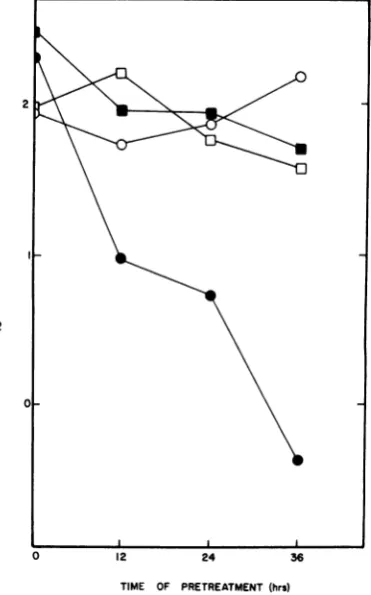
orthat some secondary effect of the drug was responsible, we utilized a CHO cell mutant (CHOama-1) which is permeable to a-A but contains an altered RNA polymerase II that neitherbinds a-A nor is inhibited by the toxin in intact cells or in vitro (13). This allowed us to examine SB growth under conditions where a-A was presentbut hosttranscriptionwas normal.
Figure 2 shows the results of anexperiment in
which CHO and CHOama-1 cells were treated with thetoxinfor increasing times before infec-tion with SB. Compared with the virus yield from cultures of each cell type in the absence of a-A, it is evident that SB replication was sensi-tive to a-Aonly in the a-A-sensitive cell line and wasresistant to a-A in the line characterizedby ana-A-resistant RNApolymerase II. These data
stronglysuggestthat a-A had no direct effecton
2
0
0
0-.I
0 12 24 36
[image:3.489.262.448.304.602.2]TIME OF PRETREATMENT(hrs)
FIG. 2. Effect of a-AonSBreplicationinCHO and
CHOama-1 cells. Cultures of CHOorCHOama-1 cells
weretreatedwith 5,ugof a-A per ml for 12, 24,or36 h
before infection with SB. Virus yieldswere
normal-izedtocell numberatthe time of infection.Symbols:
CHO, untreated (0); CHO, a-A treated (@);
CHOama-1, untreated (E); CHOama-1, a-A treated
(U).
VIROL.
on November 10, 2019 by guest
http://jvi.asm.org/
9.0
8.5
I
U.
0
0
8.0 _
0 6 12 i8
HOURS OF PRETREATMENT
FIG. 3. Replication of SB and SBa"r in
AMD-treated BHK cells. Cultures ofBHKcellsweretreated
with 2 ,ug of AMD per ml for 6, 12, or18 h before
infection with SB or SBa"rasdescribed in thetext.
Symbols: SB infected (0);SB rinfected(0).
SB synthetic processes and that synthesis of cellular mRNA (and presumably protein) was
required for SB replication.
Isolation of AMD-resistantmutants.The inter-action of viral products with particular host factorsorthe utilization of hostfunctionsin viral
synthetic processes isdependentnotonlyupon
theavailability of such host constituents but also
uponthenatureof the viralproduct involvedin
the interaction. Reasoning that the inhibition of SB replication observed in AMD-treated cells resulted from the depletion ofa required host factor, we explored the possibility of obtaining
viral mutations which couldcompensatefor the reduced concentration or lack of the putative
factor and allow viralreplication in AMD-treat-ed cells. An enrichment for such mutants was
accomplished by passage ofa mutagenized SB
stockonBHKcells which had been treated with
AMDfor 18 h before infection. An
AMD-resis-tant mutant, SBamr, was isolated by plaque purification from the fourth passage in AMD-treated cells. This mutantwasmuch less
sensi-tive to AMD than was wild-type SB in both
BHK(Fig. 3) and VSW cells (datanotshown). Treatment with either AMDor a-A reduced
the ability of BHK, VSW, and CHO cells to
support the replication of SB, even though the
mechanisms by which these compounds inhibit cellularRNAsynthesisarefundamentally differ-ent. Itwasconceivable, therefore, that the
inhi-bition of SBreplication observedin
AMD-treat-ed cellswasunrelatedtothe inhibitionmediated
by a-A. However, the data presented in Fig. 4 demonstrate that SBamr, a mutant selected for its
ability to replicate in AMD-treated cells, was
also capable of replication incells treated with
a-A. These resultsindicate that both AMD and
a-A acted to cause the depletion of the same
required host factor by inhibiting the synthesis
of itsmRNA, thus rendering treatedcells
incom-petent with respect to the same aspect of SB replication.
DISCUSSION
The results presented in this report strongly
suggestthatlytic replication of SB is dependent
upon transcription of host mRNA and
presum-ably the synthesis ofaparticular host protein.
Because thisconclusion is baseduponthe action
of chemical inhibitors, alternative
interpreta-tionsmustbeconsidered. For instance,
second-aryeffects of the drugs, unrelated to
transcrip-tion, could have caused theinability of treated
cellsto supportSBreplication; the drugs could
have acted directly upon some viral synthetic
activity;ortheeffect onSBgrowth could have
been due to a loss of cellular metabolic and/or
structural elements which would have been
re-quired for virus replication in general. The
re-sults obtained did notsupport these alternative
explanations. If theinhibition ofSBreplication
8
IL
a. 0 0
7
12 24 36
HOURS OF TREATMENT
FIG. 4. Replicationof SB andSBamrin a-A-treated
CHO cells. Cultures of CHO cells were treated with5
p,gof a-A per ml before infection with SB or SB,r.
Culture fluids were harvested at 18 h postinfection.
Symbols: SBinfected(0);SB,r infected(0).
VOL.45,1983
on November 10, 2019 by guest
http://jvi.asm.org/
[image:4.489.64.221.58.291.2] [image:4.489.272.422.413.626.2]by AMDweredueto some secondary effect of
the drug rather thantoits effectontranscription,
wewouldnothaveexpected a-A, amuchmore
specificinhibitor of cellular mRNAsynthesis,to exert asimilar effect. That the twocompounds
affected the same aspectof SB growth is
sup-ported bythefindingthatenrichment foraviral
mutant that replicated in AMD-treated cells
simultaneously selected for the ability to
repli-catein cells treated with a-A. Another
alterna-tive, that cellular metabolic and/or structural
integrity or both may have been compromised
by the drugtreatment, cannot explain the
con-tinued replication of VSV under conditions
which depressed SB growth by 2 orders of
magnitude. Also, if the effect on SB resulted
from a generalized loss ofenergy metabolism,
membrane structure, or ribosome function, it
would seem unusual to be able to isolate viral
mutantssuchas SB' which could replicate in
such debilitatedcells.
The mostcompelling evidence that SB
repli-cationrequiresthesynthesisof hostmRNA, and
by inference, the synthesisofahostprotein(s),
is the finding that a-A inhibited SB growth in
wild-type CHO cells but had no effect in
CHOama-1, a mutantcell line containing an a-A-resistant RNA polymerase II. This result
rulesoutthepossibilities that(i)secondarytoxic
effectsonthecellor(ii)directeffectsof the toxin
onviralsyntheticfunctionswereresponsiblefor
the inhibition. We feel that these data strongly
suggest the participation ofa specific host
fac-tor(s) in SBreplication.
Thenormal cellular role of the host factor is
unknown.However, itor acloselyrelatedfactor
musthave beenconserved throughevolution in
all of the phylogenetically diverse celltypes in
which SB growth can occur. Given that
selec-tion of SBamr in BHK cells would haveproduced
a mutant which could interact efficiently with
the BHKcellfactor, theobservation thatSBa,
was also less sensitive to AMD than the wild
type in VSW cells indicates that the BHK and
VSW cell factorsare similar. However, growth
of SB" in VSW cells remained somewhat
sensitive toAMD, suggestingthat the mutation
didnotabolish the hostrequirement entirely.
The precise point inthe replication of SB at
whichahost factormay functionhas yet to be
determined, although several observations
sug-gestthepossibility ofahostinvolvement in viral
RNA synthesis. Kowal and Stollar (14) have
isolatedtwohost-dependent,
temperature-sensi-tivemutants of SB which failed tocomplement ts6, an RNA- mutant isolated by Burge and
Pfefferkorn (4) and assigned to the F
comple-mentation group by Strauss et al. (26). The
product of the F cistron is important in the
synthesis of both positive- and negative-strand
RNA (24), and the host dependency of these
newlyisolated mutantsmay reflecta cell
influ-ence upon F cistron function. Ahost
polypep-tide isassociated withpartially purified
prepara-tions of the Semliki Forest viruspolymerase (5),
althougharequirement for this protein for
poly-meraseactivity hasnotbeen demonstrated.We
presently are approaching this question by
in-vestigating SBandSB51rreplicationin the
pres-ence of inhibitors of host transcription. Incells
treatedwithAMDbeforeinfection, synthesis of
both 42 and 26S positive strand was inhibited
coordinately, and the levels of all three RFs
were reduced (unpublished observations); the
synthesis of SBamr RNA continuedathigh levels
even after prolonged treatment with the drug.
Therefore, the results presented here strongly
indicateadirect host involvement in SB growth
and, considered with the work ofothers andour
preliminary data, suggest that thisinvolvement
isatthelevel of viral RNA synthesis.
ACKNOWLEDGMENTS
This research wassupportedbytheNorthCarolina Agricul-tural ResearchService, project03554, andby PublicHealth Service grant AI 15196 from the National Institute ofAllergy and Infectious Diseases. R.S.B. was the recipient of an Agricultural FoundationPre-DoctoralAssistantship.
Wewishtothank C. J.Inglesfor thegift oftheCHOama-1 cell line.
LITERATURECITED
1. Black, D. N., and F. Brown.1969. Effect of actinomycin D and guanidine on the formation of a ribonucleic acid polymeraseinducedbyfoot-and-mouth disease virus and on the replication of virus and viral ribonucleic acid. Biochem. J. 112:317-323.
2. Blumenthal, T., and G. G.Carmichael.1979. RNA repli-cation: function and structure ofQ1 replicase. Annu. Rev. Biochem.48:525-548.
3.Bouloy, M., S. J. Plotch, and R. M. Krug. 1978. Globin mRNAs areprimers for thetranscriptionof influenzaviral RNA in vitro. Proc. Nati. Acad. Sci. U.S.A. 75:4886-4890.
4. Burge, B. W.,and E. R.Pfefferkorn. 1966.Isolation and characterization ofconditionallethal mutants ofSindbis virus. Virology30:204-213.
5.Clewley, J. P.,andS. I. T.Kennedy.1976.Purificationand polypeptide composition of Semliki Forest virus RNA polymerase. J. Gen. Virol. 32:395-411.
6. Dasgupta, A.,P.Zabel,andD.Baltimore.1980. Depen-denceof theactivityof the poliovirusreplicase on a host cellprotein.Cell 19:423-429.
7. Davey, M. W., and L. Dalgarno. 1974. Semliki Forest virus replication in cultured Aedes albopictus cells: stud-ies on the establishment of persistence. J. Gen. Virol. 24:453-463.
8. Dmitrieva,T.M.,M. V.Scheglova, andV. I.Agol. 1979. Inhibition of activity ofencephalomyocarditis virus-in-duced RNA polymerase by antibodies against cellular components.Virology92:271-277.
9. Hamilton,D. H.,R. W.Moyer,andS. A.Moyer. 1980. Characterization ofthenon-permissiveinfection of rabbit corneacellsby vesicular stomatitis virus. J. Gen. Virol. 49:273-287.
10. Herz, C.,E.Stavnezer,andR. M.Krug. 1981.Influenza virus, an RNA virus synthesizes its messenger RNA in the nucleusof infected cells. Cell 26:391-400.
J. VIROL.
on November 10, 2019 by guest
http://jvi.asm.org/
HOST INVOLVEMENT IN SINDBIS VIRUS GROWTH 205
11. Igarashi, A. 1978. Isolation of aSingh'sAedesalbopictus cell clonesensitive toDengueandChikungunyaviruses. J. Gen. Virol. 40:531-544.
12. Igarashi,A., R.Koo, and V.Stoilar. 1977. Evolution and properties of Aedesalbopictus cell cultures persistently infectedwith Sindbis virus.Virology82:69-83.
13. Ingles,C.J., A. Guialis, J. Lam, and L. Siminovitch. 1976.
a-Amanitin resistance of RNApolymeraseII in mutant Chinese hamster ovary cell lines. J. Biol. Chem. 251:2729-2734.
14. Kowal, K.J., and V. Stollar. 1981.Temperature-sensitive host-dependent mutants of Sindbis virus. Virology 114:140-148.
15. Lamb, R.A., and C.-J. Lai. 1980.Sequenceofinterrupted anduninterrupted mRNAs and cloned fulllength DNA codingfor the twooverlappingnon-structuralproteinsof influenzavirus. Cell 21:475-485.
16. Lamb, R. A., C.-J. Lai, and P. W. Choppin. 1981. Sequences of mRNAs derivedfromgenome RNA seg-ment 7 of influenza virus: colinear and interrupted mRNAscodeforoverlappingproteins.Proc. Natl.Acad. Sci. U.S.A.78:41704174.
17. Mento, S. J., and L. Siminovitch. 1981. Isolation and preliminary characterization of Sindbis virus-resistant Chinesehamster ovarycells.Virology111:320-330. 18. Peleg, J. 1969. Inapparent persistent virus infection in
continuouslygrown Aedes aegyptimosquitocells. J.Gen. Virol. 5:463-471.
19. Pfefferkorn, E. R., and B. W.Burge. 1967. Genetics and biochemistryofarbovirustemperature-sensitivemutants, p. 403-426.InJ.S.Colter and W.Paranchych(ed.), The molecularbiology of viruses. Academic Press, Inc., New York.
20. Pringle,C.R.1978. The tdCE andhrCEphenotypes:host range mutants of vesicular stomatitis virus in which polymerasefunction is affected. Cell 15:597-606. 21. Reich, E., and I. H. Goldberg. 1964. Actinomycin and
nucleic acidfunction.Prog.NucleicAcid Res. Mol. Biol. 3:183-234.
22. Riedel, B.,andD.T.Brown. 1977.Roleofextracellular
virus in the maintenance of the persistent infection in-duced inAedesalbopictus (mosquito) cells by Sindbis virus. J. Virol. 23:554-561.
23. Sarver, N., and V. Stoilar. 1977. Sindbis virus-induced cytopathic effect in clones of Aedes albopictus (Singh) cells. Virology 80:390-400.
24. Sawicki, D. L., S. G. Sawicki, S. Keranen, and L. Kiir-ilinen. 1981. Specific Sindbis virus-coded function for minus-strand RNA synthesis. J. Virol. 39:348-358. 25. Scheefers-Borchel, U., H. Scheefers,J.Edwards, and D. T.
Brown.1981.Sindbisvirus maturation in cultured mosqui-tocells is sensitive to actinomycin D. Virology 110:292-301.
26. Strauss, E. G., E. M. Lenches, and J. H. Strauss. 1976. Mutants of Sindbisvirus. I.Isolation and partial charac-terization of 89 newtemperature-sensitive mutants. Virol-ogy 74:154-168.
27. Taylor, R. M., H. S. Hurlbut, T. S. Work, J. R. Kingston, and T. E. Frhingham. 1955. Sindbis virus: a newly recognized arthropod-transmitted virus. Am. J. Trop. Med.Hyg.4:844-862.
28. Thacore, H. R., and J. S. Younger.1975.Abortive infec-tion of a rabbit cornea cell line by vesicular stomatitis virus: conversion to productive infection by superinfec-tion with vacciniavirus. J. Virol. 16:322-329.
29. Tooker, P., and S.I.T.Kennedy. 1981. Semliki Forest virusmultiplication in clones of Aedes albopictus cells. J. Virol.37:589-600.
30. Ulmanen, I., H. S6derlund, and L. KArilnen. 1976. Semliki Forest viruscapsid proteinassociates with the 60S ribosomal subunit ininfectedcells. J. Virol. 20:203-210.
31. Wieland, T., and H. Faulstich. 1978.Amatoxins, phallo-toxins, phallolysine and antamanid: the biologically active components of poisonous Amanita mushrooms. Crit. Rev. Biochem.5:185-260.
32. Zeigel, R. F., and H. F. Clrk. 1969. Electron microscopic observationson a"C"-type virusin cell culturesderived fromatumor-bearingviper. J. Natl.CancerInst. 43:1097-1102.
VOL.45,1983
on November 10, 2019 by guest
http://jvi.asm.org/