Experimental demonstration of a compact epithermal neutron source based on a high
power laser
S. R. Mirfayzi,1 A. Alejo,1 H. Ahmed,1 D. Raspino,2 S. Ansell,3 L.A. Wilson,4 C. Armstrong,4, 5 N.M.H. Butler,5 R.J. Clarke,4 A. Higginson,5 J. Kelleher,2 C. Murphy,6 M. Notley,4 D.R. Rusby,4, 5 E. Schooneveld,2 M. Borghesi,1 P. McKenna,5 N.J. Rhodes,2 D. Neely,4 C.M. Brenner,4 and S. Kar1, 4,∗
1
Centre for Plasma Physics, School of Mathematics and Physics, Queen’s University Belfast, BT7 1NN, UK 2
ISIS Facility, Rutherford Appleton Laboratory, Chilton, Didcot, OX11 0QX, UK
3European Spallation Source, 22100 Lund, Sweden
4Central Laser Facility, Rutherford Appleton Laboratory, Didcot, Oxfordshire, OX11 0QX, UK
5
Department of Physics, SUPA, University of Strathclyde, Glasgow, G4 0NG, UK
6Department of Physics, University of York, York, YO10 5DD, UK
Epithermal neutrons from pulsed-spallation sources have revolutionised neutron science allowing scientists to acquire new insight into the structure and properties of matter. Here we demonstrate
that laser driven fast (∼MeV) neutrons can be efficiently moderated to epithermal energies with
intrinsically short burst durations. In a proof-of-principle experiment using a 100 TW laser, a
significant epithermal neutron flux of the order of 105n/sr/pulse in the energy range 0.5-300 eV was
measured, produced by a compact moderator deployed downstream of the laser-driven fast neutron source. The moderator used in the campaign was specifically designed, by the help of MCNPX simulations, for an efficient and directional moderation of the fast neutron spectrum produced by a laser driven source.
There has been over the last decades a sustained in-terest in laser-driven neutron sources, which are capable of producing sub-ns bursts of fast (MeV energies) neu-trons with high brightness[1–5]. Although fast neuneu-trons are useful for many applications, such as imaging [6] and material testing for fusion reactor vessels [7], the arena of neutron science and applications mainly requires slow neutrons (with energies ranging from sub-meV to keV) which are provided at reactor and accelerator based facil-ities by moderating fast neutrons. In particular, sources of epithermal neutrons (eV-100keV) are of high inter-est for a wide range of applications, from material sci-ence [8–10] to nuclear waster transmutations [11] and healthcare [12, 13]. However, the scale and operational costs involved in accelerator-based facilities not only limit their availability to the scientific community, but also hinder their wide promotion in the industrial, security and healthcare sectors.
In this paper we report the first experimental demon-stration of producing epithermal neutrons from a laser driven source. By directing laser-driven fast neutrons produced by p-Li reactions onto a compact (10 cm×10 cm×8 cm) moderator placed at∼11 cm from the source, a significant flux of epithermal neutrons ∼ 5 × 10⁵ n/sr/pulse in the range 0.5-300 eV was produced. The epithermal neutrons were measured at a distance of 2.58 m from the moderator using3He detectors in ToF mode. The proof-of-principle results presented here indicate a significant scope for further improvement in terms of at-tainable flux by optimising the setup and the fast neu-tron source, as will be discussed in the final section of the paper. In light of the latest development in diode-pumped, high repetition rate high power laser systems, laser-based sources in the future may offer the
possibil-(b)
Catcher holder
Moderator to 3He and ND-1 to ND-2 Pitcher Wheel
Moderator pitcher
2.58 m Vacuum chamber
pitcher
B4C collimator
3He detectors ND-1
4.5 m catcher
35o (a)
[image:1.595.320.560.318.392.2]11 cm
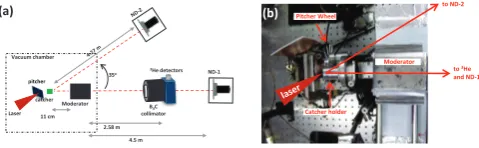
FIG. 1. (a)Schematic of the experimental setup (figure not
to scale).(b)Image of the setup inside the interaction
cham-ber. The fast neutrons were generated by nuclear reactions in the catcher target induced by the MeV ions accelerated from the laser irradiated pitcher target. ND-1 and ND-2 are EJ232Q scintillator detectors, placed inside lead and plastic housings, employed in ToF mode to diagnose the fast neutron spectra[18]. Epithermal neutrons produced by the moderator
were diagnosed by the3He proportional counters employed in
ToF mode, placed behind a B4C collimator.
ity of developing compact beamlines, closely coupled to the moderator, thanks to the significantly less hostile en-vironment offered by a laser-based system compared to reactor-based and pulsed-spallation facilities.
The experiment was carried out employing the 100 TW arm of the VULCAN laser facility of the Ruther-ford Appleton Laboratory, STFC, UK. A schematic of the experimental setup is shown in Fig. 1. The ∼750 fs FWHM laser pulses with energy of ∼50 J after the compressor were focused onto 10 µm Au targets by an f/3 off-axis parabola, delivering peak intensities of
pro-duced at the catcher were diagnosed by a time of flight (ToF) technique, employing two fast scintillator detectors (EJ232Q [16] plastic scintillator coupled to Hamamatsu R2083 PMT [17]). As shown in Fig. 1, the detectors (henceforth called ND-1 and ND-2 respectively) were lo-cated at 4.37 m and 4.27 m from the source, respectively, measuring fast neutrons spectra along the lines 0◦ (on axis) and 35◦(off axis) with respect to the ion beam axis. The scintillator detectors were absolutely calibrated for fast neutrons as reported in ref. [18].
After characterising the fast neutron spectra along 0◦ and 35◦, a pair of Reuter Stokes 3He filled (at 10 bar pressure) proportional counters [19] were placed along the beam axis at a distance of 2.83 m from the catcher. The3He detectors were placed inside a shielded housing with high voltage (2 kV) applied across the anodes and cathodes. Due to the high sensitivity of the 3He detec-tors, the gamma flash produced by the laser interaction saturated the signal at early times, and only neutrons of energy up to ∼300 eV could be detected by the 3He detectors in a ToF mode. The efficiency of the detec-tors with respect to the incident neutron energy is given by the formula, η = 1−exp(−0.00482P dλ), where P is the gas pressure in bar, d is the tube diameter in mm and λis the wavelength of neutrons in angstroms. One of the 3He detectors was wrapped with a few mm thick cadmium sheets in order to identify the background level of stray thermal (≲0.5 eV [20]) neutrons hitting the de-tector. The 3He detectors were placed behind a B
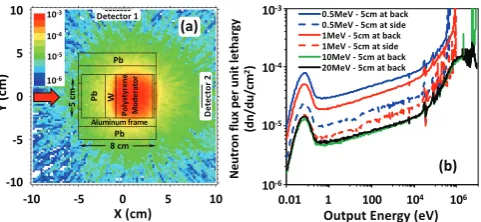
4C cylindrical collimator (∼30 cm long with ∼30 cm outer diameter and∼5 cm inner diameter) as shown in Fig. 1. The configuration of the compact moderator used in the experiment is shown in Fig. 2(a). The fast neutrons from the catcher, were directed to impinge onto the mod-erator, which was aligned along the beam axis as shown in Fig. 1. The thickness and materials used in the mod-erator were chosen based on MCNPX [21] simulations, with the aim of optimizing the flux of epithermal neu-trons from the exit plane of the moderator. The choice of materials for the experiment was restricted by radiation safety and manufacturing constraints. Within the overall moderator size, the main component was a 5 cm×5 cm×4 cm block of high density polystyrene, which was designed to slow down ∼MeV neutrons to the epithermal range (mean free path of 1 MeV neutron is∼3 cm [22]). Under the condition of the experiment, the high Z front layers (2.4 cm thick lead and 1.2 cm thick tungsten) mainly served as reflectors to the moderated neutrons produced by the polystyrene block. However in presence of higher energy (≥10 MeV) neutrons, this design would also in-crease the neutron population by (n,xn) reactions inside the thick layers of lead and tungsten. The polystyrene, tungsten and lead blocks were housed in a cm-thick alu-minium structure, surrounded by 1.5 cm thick lead to reduce neutron leakage from the side walls of the mod-erator. In order to produce a pure epithermal beam and
!"
#
"
$#
$!"
$!" $# " # !"
% & '( )* ( +, -, . / & 0 , +1 *& + % 2 3 . 4'567-56 8+16, %2 %2 9.:;6< = .: ;6 < >.;6 # .; 6 :2< !"$? !"$@ !"$# !"$A B , 5 *+ & -.8 '5 C. D , +. 5 -7* .' , *E 1 +F ( ... . :0 -G0 5 G; 6 H< "I#/,J.$ #;6.1*.21;K "I#/,J.$ #;6.1*.)70, !/,J.$ #;6.1*.21;K !/,J.$ #;6.1*.)70, !"/,J.$ #;6.1*.21;K H"/,J.$ #;6.1*.21;K
[image:2.595.320.561.52.163.2]"I"! ! !"" !"@ !"A L5*D5*.M-,+F(.:,J< N,*,;*&+.! N , *, ;* & +. H !"$# !"$@ !"$? !"$A :1<
FIG. 2. (a) The design of the moderator superimposed on
the neutron (in the range 1eV-1keV) flux distribution across the mid-plane of the moderator, obtained from MCNPX sim-ulation for 1 MeV neutrons entering the moderator from the
left side (shown by red arrow).(b)Comparison between
neu-tron spectra at the two detectors,detector-1 and detector-2
respectively (shown in (a)), placed 5 cm away from the side and exit faces of the moderator for different incident neutron energies as obtained from MCNPX simulations.
filter the lower energy neutrons, a 2 mm cadmium sheet was placed at the exit plane the moderator.
As can be seen in Fig. 2(a), the moderator pro-duces an anisotropic flux distribution of epithermal neu-trons. While the front layers of lead and tungsten may contribute by pre-moderating and multiplying high en-ergy neutrons, the sub-MeV neutrons are efficiently mod-erated to the epithermal range inside the polystyrene block. The neutron spectra emerging from the exit plane and the side of the moderator for different input neutron energies are shown in Fig. 2(b), which illustrates the ef-fectiveness of the design in moderating neutrons of MeV energies, as produced in abundance in our experiment (see Fig. 3(a)).
The experiment was carried out in two stages. Since the moderator and the3He detector restrained us from measuring the fast neutrons produced along the beam axis, the first stage was devoted to characterising the spectra and angular distribution of the fast neutrons pro-duced by the catcher, before deploying the moderator and the3He detectors. The data collected by the two scintil-lator detectors over a number of dedicated shots showed fairly similar spectral profiles as shown in fig. 3(a)). The neutron flux above 2.5 MeV was measured as∼107n/Sr, whereas the spectra indicates that the highest flux lies in the sub-MeV region (estimated to be of the order of 109 n/sr between 0.1-1 MeV). The ratio of the fast neu-tron fluxes recorded by ND-1 and ND-2 was found to be
∼0.6 over a number of shots taken at similar laser and pitcher/catcher conditions. When the ND-1 became re-dundant in the following stage (due to the installation of the on-axis 3He detector, see Fig. 1), the data obtained by the ND-2 was used as a reference to infer the on-axis fast neutron spectra.
-0.3 0.2 0.7 A m p li tu d e [ V ] -0.25 0.25
20 70 120 170
A m p li tu d e [ V ] -0.3 0.2 0.7 A m p li tu d e [ V ] Without Moderator With Moderator
(b)
(c)
(a)
Neutron hits300 3 0.03Energy [eV]
(d)
-0.3 0.2 0.7
10 100 1000
A m p li tu d e [ V ] Time [μs] -0.25 0.25
20 70 120 170
A m p li tu d e [ V ] Time [μs] Time [μs]
(e)
105 106 107 108 109 1010 10110.1 1 10
N e u tr o n F lu x [ /M e V /s r/ p u ls e ]
Neutron Energy [MeV] On Axis Off Axis 103 104 105 106
0.5 5 50 500
N e u tr o n F lu x [ d n /d u /s r]
Neutron Energy [eV]
0.001 0.1 10
C ro ss S e ct io n [ b ] Energy [eV] 106 104 102 100
[image:3.595.61.558.53.300.2]With Moderator + Cadmium
FIG. 3. (a)Typical spectrum of fast neutrons produced in the experiment, as measured by the ND-1 (on-axis) and ND-2 (35◦
off axis) detectors. (b), (c) Raw data (from three shots for each case) obtained in the3He detectors without and with the
moderator, respectively. (d)Raw data in presence of the moderator obtained in the3He detectors wrapped with Cd foil, which
is a good absorber of neutrons of energies below∼0.5 eV, as can be seen from the cross-section of113Cd(n,total) [20] plotted in
the insert. The zoomed plots of the raw data in linear X-scale are shown in the inserts. Epithermal neutron hits are identified by the voltage spikes in the output signal (as shown in the insert in (b)) and the neutron energy is calculated by ToF (as shown
in a separate axis under (d)). (e)Epithermal neutron spectra produced by the moderator, averaged over 16 measurements,
where the red line is a eye-guide to the data points.
neutrons along the beam axis, in contrast to what de-tected in shots without the moderator. This is appar-ent from the increased number of voltage spikes in the voltage versus time/energy plots of Fig. 3(c) and (d), compared to the plot of Fig. 3(b). Each voltage spike is created when a neutron is absorbed in the 3He de-tector via 3He(n,p)3H reaction, and the released proton and 3H ionize the gas inside the detector generating an electron avalanche. While the incident neutron energy was determined from the ToF, the neutron flux was cal-culated by counting the number of voltage spikes in the output signal. As expected, the Cd wrapped3He detec-tor showed rapidly decreasing number of neutron hits in the signal trace after ∼300 µs, as shown in Fig. 3(d), which is consistent with the absorption cross-section of Cd for low energy neutrons. Taking into account the de-tector efficiency (as mentioned earlier) and normalising the signal with respect to the incident neutron flux mea-sured by the ND-2 detector in the same shot, the spec-trum of the epithermal neutrons was obtained. Fig. 3(e) shows the epithermal neutron spectrum produced by the moderator in the detectable energy range of 0.5-300 eV, by averaging over 8 shots (i.e. 16 measurements). The high energy cut-off is due to the saturation of the 3He detectors at early times by the gamma flash. As can be seen in Fig. 3(b), the number of neutron hits in this
en-ergy range was insignificant in shots without the moder-ator. The background-subtracted neutron flux produced by the moderator in the energy range 0.5-300 eV was (5.1±0.15)×105 n/sr/pulse.
As mentioned earlier, the experiment was designed to assess and demonstrate the feasibility of driving intense bursts of epithermal neutrons with short pulse lasers. The moderator in the current experiment was placed at a distance of∼11 cm from the catcher to monitor shot-to-shot variations in the fast neutron spectra by the ND-2. If the moderator were placed in contact with the catcher, using a minimal (∼cm) thickness of high Z material in its front layer, the fast neutron flux per cm2incident on the polystyrene would have increased by two orders of magnitude, producing a commensurate increase in ep-ithermal flux at the moderator output. A prudent esti-mation based on MCNPX simulations suggests that an epithermal flux of∼104n/cm2/pulse in the energy range 0.5-300 eV (∼3×10⁴ n/cm2/pulse for 1 eV - 100 keV) was produced in the current experiment at a nominal dis-tance of 5 cm from the moderator (i.e. at thedetector-2
position in Fig. 2(a)).
flux of fast neutrons can be significantly enhanced by increasing the energy and number of incident ions on the catcher. Order of magnitude higher fast neutron fluxes than produced in the current experiment have been al-ready reported [2–4], and, in principle, can be further improved upon by taking advantage of ongoing develop-ments in laser-driven ion acceleration[23–25]. A credi-ble source of fast neutrons can also be obtained by de-ploying MeV electron jets from laser-driven exploding foils [5]. High energy electrons efficiently produce neu-trons inside a metal converter via photo-nuclear reactions by generating high flux of bremsstrahlung photons. Al-beit isotropic, such sources produce neutrons of energy in the MeV range highly desirable for moderation. In terms of optimsing the moderation process, laser driven sources offer greater flexibility compared to the other facilities, where the formidable heat and extraneous radiations con-strain significantly the choice of material, temperature and geometry of a moderator. Finally, it is to be noted that the epithermal bursts produced by the laser-driven neutrons of sub-ns duration would also have an intrinis-cally short duration (solely determined by the charac-teristics of the moderator), beyond the capability of the accelerator-driven spallation sources, typically set by the duration (sub-µs - ms) of their proton pulses [26–28].
Laser-based sources are fast approaching a crucial stage in their development for neutron science and ap-plications to complement large-scale facilities. Although sources such as the National Ignition Facility report record yield in fusion neutrons per pulse [29, 30], its scale and repetition rate are inadequate for any credible appli-cation related to neutron science. On the other hand, the repetition rates achievable on smaller scale installations could still be too low to guarantee successful exploita-tion for the aforemenexploita-tioned applicaexploita-tions. The future of a laser-based approach would be relient on the progress in diode-pumped technologies, such as the DiPOLE [31, 32] and HAPLS [33] projects, aiming towards developing 10 Hz, Petawatt-class laser systems.
We gratefully acknowledge funding from EPSRC [EP/J002550/1-Career Acceleration Fellowship held by S. K., EP/L002221/1, EP/J500094/1, EP/K022415/1 and EP/J003832/1] and STFC [ST/P000142/1]. This work was also supported by STFC’s Business and Inno-vation Directorate. Authors would like to acknowledge valuable discussions with J. Collier (Director of CLF, STFC, UK), S. Langridge (Head of diffraction & ma-terials division, ISIS, STFC, UK) and R. Dalgliesh (In-strument Scientist, ISIS, STFC, UK). Authors also ac-knowledge support from the members of the experimental science group, A. Cox (mechanical engineering) and D. Haddock (target fabrication group) of the CLF, STFC, UK.
[1] T. Ditmire, J. Zweiback, V. P. Yanovsky, T. E. Cowan,
G. Hays & K. B. Wharton, Nature,398, 489 (1999).
[2] M. Roth, D. Jung, K. Falk, N. Guler, O. Deppert, M. Devlin, A. Favalli, J. Fernandez, D. Gautier, M. Geissel
et al., Phys. Rev. Lett.,110, 044802 (2013).
[3] S. Kar, A. Green, H. Ahmed, A. Alejo, A.P.L. Robin-son, M. Cerchez, R. Clarke, D. Doria, S. Dorkings, J.
Fernandezet al., New J. Phys.,18, 053002 (2016).
[4] A. Alejo, A.G. Krygier, H. Ahmed, J.T. Morrison, R.J. Clarke, J. Fuchs, A. Green, J.S. Green, D. Jung, A.
Klein-schmidtet al., Plasma Phys. Control. Fusion,59, 064004
(2017).
[5] I. Pomerantz, E. McCary, A.R. Meadows, A. Arefiev, A.C. Bernstein, C. Chester, J. Cortez, M.E. Donovan,
G. Dyer, E.W. Gaulet al., Phys. Rev. Lett.,113, 184801
(2014).
[6] A. Buffler, Rad. Phys. Chem., 71, 853 (2004).
[7] L.J. Perkins, B.G. Logan, M.D. Rosen, M.D. Perry, T. Diaz de la Rubia, N.M. Ghoniem, T. Ditmire, P.T.
Springer, S.C. Wilks, Nucl. Fusion,40, 1 (2000).
[8] R. Senesi, A. Pietropaolo, A. Bocedi, S.E. Pagnotta & F.
Bruni, Phys. Rev. Lett.,98138102 (2007).
[9] C.A. Chatzidimitriou-Dreismann & I.C. Tietje, J. Phys.
Conf. Series237, 012010 (2010).
[10] E.P. Cippo, A. Borella, G. Gorini, W. Kockelmann, M. Moxon, H. Postma, N.J. Rhodes, P. Schillebeeckx, E.M.
Schoonenveld, M. Tardocchi et al., J. Anal. At.
Spec-trom.,26, 992 (2011).
[11] E. Mendoza, D. Cano-Ott, C. Guerrero, E.
Berthoumieux, U. Abbondanno, G. Aerts, F. lvarez-Velarde, S. Andriamonje, J. Andrzejewski, P.
Assi-makopoulos, L. Audouinet al., Phys. Rev. C.90, 034608
(2014).
[12] N. Burgio, L. Maciocco, K. Abbas, F. Simonelli, A. San-tagata, S. Buono, N. Gibson, G. Cotogno, I. Cydzik, U.
Holzwarthet al., IEEE Trans. Nucl. Sci.,58, 445 (2011).
[13] R. Terlizzi, N. Colonna, P. Colangelo, A. Maiorana, S.
Marrone, A. Rain´o, G. Tagliente & V. Variale, Appl.
Rad. Isotopes,67, S292 (2009).
[14] http://www.isis.stfc.ac.uk
[15] A. Pietropaolo & R. Senesi, Phys. Reports, 508, 45
(2011).
[16] http://www.eljentechnology.com
[17] http://www.hamamatsu.com/jp/en/R2083.html [18] S.R. Mirfayzi, S. Kar, H. Ahmed, A. G. Krygier, A.
Green, A. Alejo, R. Clarke, R. R. Freeman, J. Fuchs,
D. Junget al., Rev. Sci. Instrum.,86, 073308 (2015).
[19] GE Energy, http://www.gemeasurement.com/ [20] https://www-nds.iaea.org/exfor/endf.htm
[21] D.B. Pelowitz,MCNPX users manual version 2.5.0., Los
Alamos National Laboratory,76(2005).
[22] W.J. Nellis, Am. J. Phys.45, 443 (1977).
[23] A. Macchi, M. Borghesi & M. Passoni, Rev. Modern
Phys.,85, 751 (2013)
[24] F. Wagner, O. Deppert, C. Brabetz, P. Fiala, A. Klein-schmidt, P. Poth, V.A. Schanz, A. Tebartz, B. Zielbauer,
M. Rothet al., Phys. Rev. Lett.,116, 205002 (2016).
[25] S. Kar, K. F. Kakolee, B. Qiao, A. Macchi, M. Cerchez, D. Doria, M. Geissler, P. McKenna, D. Neely, J.
[26] N. Watanabe, Rep. in Prog. in Phys.,66, 339 (2003). [27] E.V. Iverson, B. J. Micklich and J. M. Carpenter, KEK
PROCEEDINGS. High Energy Accelerator Research
Or-ganization,6-91372 (2000)
[28] K. Kino, M. Furusaka, F. Hiraga, T. Kamiyama, Y. Kiyanagi, K. Furutaka, S. Goko, K.Y. Hara, H. Harada,
M. Harada et al., Nucl. Instrum. Methods A., 736, 66
(2014).
[29] A. Taylor, M. Dunne, S. Bennington, S. Ansell, I. Gard-ner, P. Norreys, T. Broome, D. Findlay & R. Nelmes,
Science,315, 1092 (2007).
[30] T. D¨oppner, D.A. Callahan, O.A. Hurricane, D.E.
Hinkel, T. Ma, H.-S. Park, L.F. Berzak Hopkins, D.T.
Casey, P. Celliers, E.L. Dewald et al., Phys. Rev. Lett.,
115, 055001 (2015)
[31] S. Banerjee, K. Ertel, P.D. Mason, P.J. Phillips, M. De Vido, J.M. Smith, T.J. Butcher, C. Hernandez Gomez,
R.J.S. Greenhalgh & J.L. Collier, Optics Express, 23,
19542 (2015).
[32] S. Banerjee, P.D. Mason, K. Ertel, P.J. Phillips, M. De Vido, O. Chekhlov, M. Divoky, J. Pilar, J.M. Smith, T.J.
Butcheret al., Optics Express,41, 2089 (2016).