City, University of London Institutional Repository
Citation
:
Oderanti, F. O., Li, F. and De Wilde, P. (2012). Application of strategic fuzzy
games to wage increase negotiation and decision problems. Expert Systems with
Applications, 39(12), pp. 11103-11114. doi: 10.1016/j.eswa.2012.03.060
This is the accepted version of the paper.
This version of the publication may differ from the final published
version.
Permanent repository link:
http://openaccess.city.ac.uk/14105/
Link to published version
:
http://dx.doi.org/10.1016/j.eswa.2012.03.060
Copyright and reuse:
City Research Online aims to make research
outputs of City, University of London available to a wider audience.
Copyright and Moral Rights remain with the author(s) and/or copyright
holders. URLs from City Research Online may be freely distributed and
linked to.
City Research Online:
http://openaccess.city.ac.uk/
[email protected]
Application of Strategic Fuzzy Games to Wage Increase Negotiation and Decision
Problems
Festus Oluseyi Oderantia,∗, Philippe De Wildeb, Feng Lia The Business School, Newcastle University, England, United Kingdom
Department of Computer Science, Heriot-Watt University, Edinburgh, EH14 4AS, UK
aNewcastle University Business School, Newcastle upon Tyne NE1 4SE, United Kingdom
bSchool of Mathematical and Computer Sciences, Heriot-Watt University, Edinburgh, United Kingdom
Abstract
We propose a flexible decision support scheme which could be used in managing the wage negotiation between employers and employees. This scheme uses fuzzy inference systems and game theory concepts in arriving at decisions on future wage increase which could be more mutually agreeable. For example, rather than specifying 5%yearly increaseof wages, we propose that the uncertain factors which are mostly difficult to predict and that could affect wage decisions need to be taken into consideration by the wage formula. These include business revenues or (profit), inflation rate, number of competitors, cost of production, and other uncertain factors that may affect business operations. The accuracy of the fuzzy rule base and the game strategies will help to mitigate the adverse effects that a business may suffer from these uncertain factors. Based on our scheme, we propose that employers and employees should calculate their future wage by using a fuzzy rule base and strategies that take into consideration these uncertain variables. The proposed approach is illustrated with a case study and the procedure and methodology may be easily implemented by business organisations in their wage bargaining and decision processes.
Keywords: fuzzy logic, membership, functions, decision, wage negotiation, business games, game theory, zero sum.
1. Introduction
Wage negotiation has always caused persistent prob-lems in business organisations [1, 2]. On many occasions, there have been cases in which the entire workforce of countries embarked on industrial strikes that resulted from wage negotiation problems. Gielen and VanOurs in [1] in-vestigated what determines quits and layoffs that usually result as problems of poor wage negotiations by using a unique matched worker-firm dataset from the Netherlands. They concluded that in wage negotiation, the wage growth of a worker that stays in the firm is larger if that worker had a high quit probability and smaller when that worker had a high layoff probability.
In most cases, annual escalation clauses in employment contracts do specify future percentage increases in wages which are not tied to any index or rules. However, very often employers do find it difficult to meet these rigid [3, 4, 5] percentages and therefore, on various occasions, these have resulted into industrial disputes between employers and employees (or their unions) [6, 7, 5]. The percentages
∗Corresponding author.
Email address: [email protected](Festus Oluseyi Oderanti)
are mostly based on predictions of future inflation which are often misleading and based on historical data.
Many authors have agreed that wages ought to be pos-itively linked to financial performance of the business and some also have detected some links between wages and profits [4].
In this paper however, rather than pre-setting a rigid future and yearly percentage increase in wages, we pro-pose a flexible scheme for employers and employees which they can use as a decision support system for their future salary increase. This scheme uses a fuzzy inference system in arriving at more mutually agreeable decisions on wage increase.
The root causes of wage negotiation [8, 1] disputes, in most cases, are often connected to the inability of ei-ther of the two parties involved (employers and employees’ unions) to sustain or maintain thestatus quo contained in their earlier agreement on wage increase [5]. This may be as a result of many uncertain factors that surround busi-ness environment such asinflation and change inprofit of the business.
1.1. Decision Making Processes in a Firm
A decision is a goal-directed behaviour made by the individual, in response to a certain need, with the intention
of satisfying the motive that the need occasions [9]. The decision process begins with identification of a problem and ends with achoice. The problem arises when a sought-after goal can be obtained via alternative and sometimes competing avenues.
Decision makers in an organisation are expected to be aware of and to be able to assess the information they generate and the potential use (or otherwise) of that in-formation [10]. Nowadays, decision making [11] processes are becoming increasingly very complex for managers [10], therefore, the information needs of a manager are equally becoming more complex and highly demanding.
1.2. Employers’ Perspective
On the employers’ part, a once prosperous business might have run into an economic turbulence as a result of diverse and adverse uncertainties that surround the busi-ness environment. Several of these cases were witbusi-nessed during the recent global economic recession which affected several businesses globally and during which many busi-nesses went underground (closed).
Therefore, when the revenue of a business goes down, it may be economically impossible for management to sus-tain the earlier agreements signed when the revenues of the companies were booming. The same situation may oc-cur if the rate of inflation adversely and grossly affects the cost of production (CP) in a firm without a corresponding increase in revenue.
1.2.1. Wage Negotiation in Developing nations.
In developing nations [12] such as Nigeria, wage nego-tiation has always been a chronic problem [13, 14] and this menace has been directly and indirectly running down the nation’s economy for many decades. This is because many trade unions have always insisted on international wage scales for their respective professions but irrespective of whether the revenues of the countries attain the standards on which those scales were designed.
For example, Medical Doctors, under the umbrella of the Nigeria Medical Association (NMA) [15, 16] will al-ways insist on World Health Organisation (WHO) salary scales standard for their profession, not minding whether the revenues and resources of the nation match those ex-pected by these standards.
Also the academic staff in the universities, under their union, Academic Staff Union of Universities (ASUU) [14, 15, 16], have always insisted on the international pen-sion scale called universities superannuation scheme (USS) which may certainly be obtainable in developed nations like the United State of America (USA) and the United Kingdom (UK). However, the unions would never consider the fact that their country’s revenues are very far below
those of the developed nations mentioned.
1.3. Employees’ Perspectives
Generally in any country and on the side of the employ-ees however, the rates of inflation in the country mighty
have shot up astronomically such that earlier wage increase agreements becomes unrealistic. This is because inflation affects the purchasing powers of the consumers. Example of this high inflation otherwise known as hyperinflation is what is being currently experienced in Zimbabwe, a South-ern African country.
1.4. Fuzzy Logic and Fuzzy Sets
Fuzzy logic is a problem solving technique that was introduced by Lotfi Zadeh in [17] to deal with vague or imprecise problems [18, 19, 20, 21, 22, 23, 24, 25, 26, 27]. A fuzzy set is a set containing elements that have varying degree of memberships in the set [18, 28]. It can simply be defined as a set with fuzzy boundary [29]. Fuzzy sets are denoted by different symbols in different literatures, however, in this paper; a fuzzy set will be represented by a letter with a tilde on top of it. That is, fuzzy set A will be represented by ˜A and membership of a set will be represented byµ. Therefore the functional mapping given by:
µA˜(x)∈[0,1]
denotes the degree of membership of elementxin fuzzy set ˜
A. Therefore, µA˜(x) is a value on the unit interval that
measures the degree to which element xbelongs to fuzzy set ˜A.
1.5. Fuzzy Decision Making System
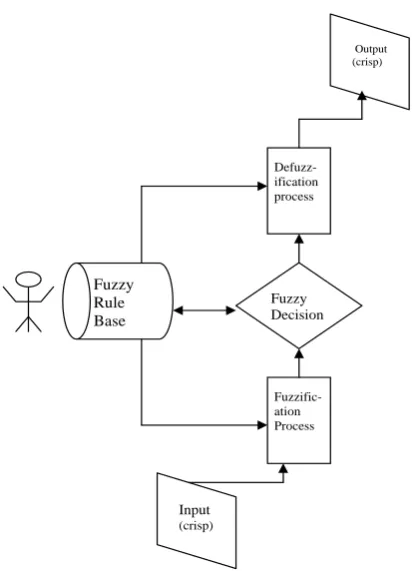
In general, a fuzzy decision making system (FDMS) uses a collection of fuzzy membership functions (Figure 5) and decision rules that are solicited from experts in the field to reason about data [18]. Typical components of a fuzzy decision making system are as shown in Figure 1. The components of an FDMS, as shown in the figure are; a fuzzification section, a fuzzy rule base, fuzzy decision logic and defuzzification section [30, 31].
1. Fuzzification section: This is the section where the process of making a crisp quantity fuzzy [32] is car-ried out. This is done by simply recognising that many of the quantities that we considered to be crisp and deterministic are actually not deterministic at all. They carry considerable uncertainty. If the form of uncertainty happens to arise because of impreci-sion, ambiguity, or vagueness, then the variable is probably fuzzy and can be represented by a mem-bership function.
inputs. This compact graphical form is called fuzzy associative memory table, or FAM table. The im-plication is implemented for each rule and in Mat-lab, many built-in methods are supported such as the functions that are used by the AND method:
min(minimum), which truncates the output fuzzy set, prod (product), which scales the output fuzzy set. Here, the AND method was used and the cen-troid was computed using the Mamdani-type infer-ence system which requires the output membership functions to be fuzzy sets after the aggregation pro-cess. It (Mamdani FIS) integrates, according to equa-tion 1, across a two-dimensional funcequa-tion to find the centroid [33].
3. The decision making logic (DML): The decision mak-ing logic is analogous to classical logic for reasonmak-ing [32] and it is similar to simulating human decision making in inferring fuzzy control actions based on the rules of inference in fuzzy logic [18].
4. Defuzzification process: This is the procedure that converts the fuzzy results into a crisp output. It con-verts a fuzzy control action (a fuzzy output) into a non-fuzzy control action (a crisp output) [18]. De-fuzzification has the result of reducing a fuzzy set to a crisp single-valued input, or to a crisp set; of con-verting a fuzzy matrix to a crisp matrix; or making a fuzzy number a crisp number. Fuzziness helps to evaluate the rules, but the final output of a fuzzy sys-tem has to be a crisp number and the input for the defuzzification process is the aggregate output fuzzy set and the output is a single number [29]. Math-ematically, the defuzzification of a fuzzy set is the process of ‘rounding off’ from its location in the unit hypercube to the nearest (in a geometric sense) ver-tex. If one thinks of a fuzzy set as a collection of membership values, or a vector of values on the unit interval, defuzzification reduces this vector to a sin-gle scalar quantity - presumably to the most typical (prototype) or representative value [32].
Several defuzzification methods have been discussed in the literatures such as [18, 29, 32]. In this paper, we are using centroid method and we shall give a brief explanation on it.
Centroid defuzzification method: This method is also referred to as centre of area (COA) or centre of grav-ity (COG). It is the most commonly used [18], most popular [29], most physically appealing [32] defuzzi-fication technique and it finds the point where a ver-tical line would slice the aggregate set into two equal masses. In theory, the centroid method of defuzzifi-cation is calculated over a continuum of points in the aggregate output membership function but in prac-tice, a reasonable estimate can be obtained by cal-culating it over a sample of points. Mathematically,
the centroid method can be expressed as:
COG=
R
µA˜(x)∗x dx R
µA˜(x)dx
(1)
COG=
P
µA˜(x)∗x
Pµ
˜
A(x)
(2)
Fuzzy inference techniques: In general, fuzzy deci-sion making system can be implemented using any of the three common methods of deductive inference for fuzzy systems based on linguistic rules [32] listed as follows: Mamdani system, Sugeno systems and Tsukamoto models
In this work, the design and implementation of this fuzzy decision making system was achieved with the aid of Matlab software. Matlab is a menu driven software that allows the implementation of fuzzy constructs like membership functions and a database of decision rules [18].
2. Game Theory
Game theory is the study of the ways in which strate-gic interactions among rational players produce outcomes with respect to the preference (or utilities) of those play-ers, none of which might have been intended by any of them [34]. It is part of a large body of theories concerning decision making [35]. It deals with decision-making pro-cesses involving two or more parties, also known as players with partly or completely conflicting interest [36, 37] and it is one of the methodologies designed for application to the social sciences. All situations in which at least one agent can act to maximize his utility through anticipat-ing (either consciously, or just implicitly by his behaviour) the responses to his actions by one or more other agents, are called games. Agents involved in games are referred to as players [38, 34, 30, 39] and could represent people, military, firms, countries or other organisations [40, 36].
For any game, there are three very important require-ments and these are listed as follows [41]:
1. Players
2. Strategies which are permitted with respect to the rules of the game and
3. Payoffs (that is, utilities or outcomes)
Further readings on game theory can be found in [36, 34, 42, 38, 34].
3. Proposed Fuzzy Model for Wage Negotiation (FGAW)
Implementing our fuzzy reasoning (FGAW) model ap-proach to wage negotiation will alleviate some of the con-cerns mentioned in Section 1 above. The model takes effec-tive cognisance of the factors that affect wage negotiation and effectively grasps and captures the uncertainty therein
using fuzzy rules solicited from experts in the field. That is, the model considers varying ranges of inflation trends as they affect both parties and also considers the varying ranges of possible revenue increase of the organisation. It arrives at an agreed rate for wage increase which can be more sustainable for both the present and the future. This will also be more agreeable and acceptable to both parties. For instance, rather than specifying 5%yearly increase, we propose a scheme such as:
IF Inflation is very high AND Revenue is very low
THEN Wage increase is medium.
We verified this scheme and proved its validity with our algorithm and we discovered that it could be an invaluable tool in the hands of entrepreneurs. Details of the scheme are as explained in the sections that follow.
4. Justification for the Scheme and Contributions
• The scheme will reduce the level of industrial dis-putes and revenue or profit losses. This is because both the employers and the employees already know the factors on which their wage increases are based and both parties can calculate the expected wage in-crease for a particular year right from their own desk based on the factors specified in the fuzzy rule base.
• Rather than management pushing or driving workers to work hard, for the betterment or success of the firm, this scheme would indirectly rest these duties in the hands of the workers or their unions who will encourage employees to work hard so as to increase the revenues of the firm and hence, directly increase their wages.
• The scheme will reduce man hours lost on yearly wage negotiation.
• It puts fate of the workers regarding salary increase in their own hands. The harder they work, the better the firm’s revenue and the better the increase in their wages.
• It will reduce unemployment rate. This is because firms will no longer embark on sudden staff cut [1] as a results of unregulated agitation for wage increase which firms are occasionally forced to pay.
• There will be no need for staff to take abrupt pay cuts [2, 1, 5] in bids to keep the company afloat as was the case in Highland Airways [43], British Broad-casting Corporation (BBC) [2] and many other com-panies during the 2009 economic recession.
5. Factors in Wage Negotiation
In competitive labour markets, wage rates are deter-mined by the forces of supply and demand for labour [44]. Even though, there may be many factors to be considered
during wage negotiation, there are two major inevitable factors: inflation and revenue. These two concepts are as explained below.
5.1. Inflation
Inflation in simple terms can be defined as a decline in the purchasing power of money for goods and services. It is a rise in the aggregate level of prices of goods and services in a particular economy over a certain period of time [44].
Inflation is one of the major factors that are usually considered in wage bargaining [45, 46]. Den Butter and van de Wijngaert in [46] definedwage space as the sum of price inflation and labour productivity growth. In eco-nomics, inflation is commonly calculated by using con-sumer price index (CPI) [47]. Raffaela Giordano in [45] stated that the relationship between labour cost and in-flation is statistically significant and quantitatively non-trivial.
5.2. Company’s Profit
On wage bargaining and company’s profit, many au-thors have worked on the idea of profit (Net income) shar-ing schemes to replace simple wage rates. One of such is [48] in which Norman Ireland explained the argument that profit sharing concerns microeconomic efficiency and relates to incentives in the place of work. He further ex-plained that if workers see how their labour turns into profit from which they benefit, and particularly if they have some say in determining their work practices, then work will be better motivated, better performed and more highly valued.
Reinhilde Veugelers in [49] reports a model that applies a generalized Nash-Zeuthen-Harsanyi asymmetric bargain-ing theory [50]. She explained that the bargainbargain-ing outcome from this scenario is that workers receive the competitive wage plus a fraction of the firm’s price-cost margins.
6. Players’ Strategies in Wage Negotiation
A strategy is a decision rule that specifies how the player will act in every possible circumstance [51]. It is a specific course of action taken by the firm. This will involve the firm allocating values to its policy variables [44].
In this experiment, we assume that the business has five units of initial resources (profit say £5M). Both the employer (represented as fuzzy playery) and the employ-ees (represented as opponent playerg) are deliberating on how this profit should be spent and also, how subsequent (future) profits generated by the company should be spent. Both players agreed on a three variable-vector [C, W, M]. This forms the strategies for both players. That is, em-ployer (y) strategy is [Cy, Wy, My] while that of the
proportion of this£5M should be allocated to each of these strategic variablesC,W andM?.
In each round, the players may choose to allocate their resources to one of these three roles: consolidation ef-forts(C),reserved wealth(W) andmarket expansion(M). The allocations are denoted as a vector [C, W, M] for each player and constitute thestrategy of that player.
Consolidation efforts C refer to the proportion of the profit that adds to the wage increase of the employees and it is the most important variable to the employees as they would want to maximise this as much as they could. Mar-ket expansion M denotes the part of this profit designated for market expansion of the business including advertising, marketing and promotional campaigns. These are con-sidered as the most important variables to the employers which they would like to maximise as much as they could.
Reserved wealth W refers to part of the resources that are kept unused or those distributed to the firm’s shareholders. As examples of players’ strategies, consider a case where the employer Y decides to allocate £4M out of the £5M on market expansion M = 4, and retaining £1M to be distributed to shareholders as shares,W = 1. This means that for that financial year, there would be no wage in-crease for (or to consolidate the) workers, C = 0. Then, employer strategy implies:
[Cy, Wy, My] = [0,1,4]
On the other hand, workers, represented by their union, may embark on negotiation with their employer with a proposal that£3M be allocated to wage increase (C= 3),
£1M to shareholders (W = 1) and the remains on market or business expansion M = 1. Therefore, the workers’ strategy becomes:
[Cg, Wg, Mg] = [3,1,1]
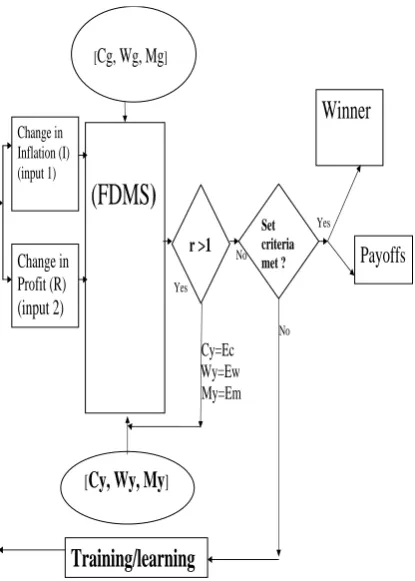
The variables in our models can be tailored to the busi-ness situations in the real world and therefore are not lim-ited to those variables that we have used in designing the system. Therefore, this model can be applied to any real business situation and the variables can be adapted to suit the situation in question. The model can also work for sys-tems that have more strategic variables than those that we have used in this model. The proposed decision model is as illustrated in Figures 1 and 2.
7. Assumptions
In this simulation, while we are considering only infla-tionary trends and business revenue as the most important factors in determining wage increase, we are assuming that other factors remain constant and that decision makers are rational in their views. These other factors that are kept constant include the labour force and the market trends.
We are also assuming that the labour force of the or-ganisations are represented jointly by their unions and that all necessary information about the company (such
Input
(crisp)
Fuzzific- ation Process
Fuzzy Decision
Defuzz-ification process
Output (crisp)
[image:7.595.329.539.81.368.2]Fuzzy Rule Base
Figure 1: Fuzzy decision making system (FDMS) for fuzzy inference. This is used as part of the components of the FGAW model shown in Figure 2.
as the company account details) are available to both the union and the employer’s representatives in the decision processes.
Further more, the fuzzy rules ought to be solicited from experts in the field in order to implement the model more accurately and effectively in a real system. In this paper, due to time limitation and other factors, we have relied on assumed fuzzy rules which are based on heuristic and from our business knowledge.
8. Methodology and a Case Study of the Fuzzy Game Approach to Wage Negotiation (FGAW)
We assume that the company has initial resources (say
£5M) profit. These resources are being deliberated upon by the two parties namely:
1. Employer (represented as fuzzy player (yellow)y) 2. Employees (or their union as representative,
repre-sented as player (green)g)
These resources are to be allocated initially between three variables [C, W, M] that form the strategy of each player. The subsequent allocation will follow the outcome of the fuzzy rules from the fuzzy inference system formu-lated by each party and the expected outcome will deter-mine the winner.
No Yes Yes
No
Yes
No
Cy=Ec Wy=Ew My=Em Change in
Inflation (I) (input 1)
Change in Profit (R)
(input 2)
r >1
[
Cy, Wy, My
](FDMS
)
Payoffs
Set criteria met ?
Training/learning
Winner
[Cg, Wg, Mg]Figure 2: A model of fuzzy game approach to wage negotiation (FGAW) game showing inputs, processes and outputs. The FDMS components are as shown in Figure 1
.
The procedures necessary for implementing the pro-posed FGAW automatic decision system are as listed in the steps below:
1. List all uncertain (fuzzy) factors that will be consid-ered in taking the business decision: the uncertain or fuzzy information we are taking into consideration are changes in business profitR and in the inflation I.
2. Determining the strategy: the game strategies are as explained in Section 6. The business has five units of initial resources (profit say £5M). Both the em-ployer (represented as fuzzy player y) and the em-ployees (represented as opponent player g) are de-liberating on how this profit should be spent and also, how subsequent profits generated by the com-pany should hence be spent. Both players agreed on three variable-vector [C, W, M]. This forms the strategies for both players. That is, employer (y) strategy is [Cy, Wy, My] while that of the
employ-ees is [Cg, Wg, Mg]. The bone of contention is “what
proportion of this£5M should be allocated to each of these strategic variablesC, W and M?. Further details on player strategies are as explained in Sec-tion 6.
3. Determine the input and output variables ofFGAW
FIS: The inputs are the values of change in infla-tion (∆I), and change in business profit (∆R) and
the outputs are expected wage increase ( consolida-tion efforts) (Ec), expected wealth (Ew) and
ex-pected market expansion efforts (Em) where: Em=
5−(Ew+Ec) because the total (expected) resource
of each player at any point is five. The variablesEc,
Ew, andEmrelate to the fuzzy playery, and we will
not index them byy.
4. Develop fuzzy sets, subsets and membership func-tions for all the input and output variables. This can be accomplished by soliciting knowledge from the experts or searching through literature data. Our adopted fuzzy sets, subsets and membership func-tions are as shown in Figure 5.
5. Formulate decision rules for the rule base. These also ought to be solicited from experts [24]. The rules shown in figure 5 also depict our adopted decision rules.
6. Establish relationships between input values and their fuzzy sets and apply the decision rules using the re-lationships shown in Figure 5. The fuzzy rule base was coded into a Fuzzy Inference System (FIS) using the Matlab toolbox.
7. Play the game: Procedures for playing the game are as follows: The game state is represented as vec-tor S = [g, y, Aw, r], where g represents the green
player’s amount of resources, y represents the fuzzy player (yellow) amount of resources, Aw represents
opponents’ accumulated wealth (profit) and ris the number of rounds that the game is played. Both the green and fuzzy player strategy are as stated in step 2 above.
• Initial state of the game is [5,5,0,5] (i.e accord-ing to vector [g, y, Aw, r]).
• At every state [g, y, Aw, r], green chooses his
move by allocating to his strategies [Cg, Wg, Mg]
where: Cg+Wg +Mg = g = 5 and yellow
who is the fuzzy player chooses his strategy [Cy, Wy, My] where Cy+Wy+My=y= 5.
• The game changes states as follows:
r=r−1, (3)
Aw=Aw+Wg−Wy, (4)
g=g+Cg+Mgr−(y+Cy+Myr), (5)
y=y+Cy+Myr−(g+Cg+Mgr), (6)
[image:8.595.60.268.78.369.2]wheretemprepresents game payoff. Then,
Em= 5−(Ew+Ec) (8)
This is because the total or expected resources of each player at any point amount to five. Now, the outputs of each round of the game are ex-pected wage increase(consolidation efforts) (Ec),
expected wealth (Ew) and expected market
ex-pansion efforts (Em). This then forms the input
strategies for the fuzzy player in the subsequent rounds of the game.
In order to calculate inflation (input for FIS) for a particular year, we simply calculate the per-centage change of consumer price index (CPI) as follows:
Inf lation(I) = CP I1−CP I0 CP I0
∗ 100
1 (9)
whereCP I0is the initial value andCP I1is the
final value.
However, an entrepreneur may want to base his own inflation on the changes in the cost of pro-duction (CP) of his goods or services such that inflation is calculated as:
Inf lation(I) =CP1−CP0 CP0
∗ 100
1 (10)
WhereCP0 is the initial value andCP1 is the
final value.
and change in profit (∆R) of the business is calculated as
∆R= R1−R0 R0
∗ 100
1 (11)
where R0 is the initial profit value and R1 is
the final value.
The game ends when r = 0 and if temp is greater than zero (temp >0), the green player (the employees) wins, if less than zero (temp < 0), then the fuzzy player (yellow or employer) wins else, the game is a draw (i.e. iftemp= 0).
Sample rules of the fuzzy inference system are as copied below:
Rule Base 1:
(a) If (Net Profit is High) and (Inflation is Medium) then (Expected Wage Increase is Medium) (b) If (Net Profit is Medium) and (Inflation is Low)
then (Expected Wage Increase is Small)
(c) If (Net Profit is Medium) and (Inflation is Medium) then (Expected Wage Increase is Medium) (d) If (Net Profit is Medium) and (Inflation is High)
then (Expected Wage Increase is Large)
(e) If (Net Profit is Low) and (Inflation is Low) then (Expected Wage Increase is Medium) Rule Base 2
(a) If (Net Profit is High) and (Inflation is Medium) then (Expected Market Expansion is High) (b) If (Net Profit is Medium) and (Inflation is Medium)
then (Expected Market Expansion is Medium) (c) If (Net Profit is Medium) and (Inflation is High)
then (Expected Market Expansion is Low) (d) If (Net Profit is Low) and (Inflation is Medium)
then (Expected Market Expansion is Very High) These rules are as coded in Figure 4.
8. Evaluate the fuzzy inference system (FIS): Using Mat-lab fuzzy toolbox, all the fuzzy inputs are passed into the Mamdani type FIS.
9. Get the defuzzified output from the FIS: The crisp output for the FGAW is computed using centre of gravity method (COG) method. Figure 5 shows the FIS interface for the output variableExpected Wage Increase or consolidation(Ec) and a defuzzified (crisp)
output interface is as shown in Figure 6.
10. Determine whether the conditions for the end of the game have been met: In this case study, the condi-tion for the end of the game is when the number of roundsrreaches 1 counting down from 5 (i.e. when r= 1).
11. Training and performance evaluation: Training and learning of the FGAW decision agent was accom-plished through the optimization of the fuzzy logic parameters while using the game payoff as the basis for the performance measure after playing a series of the game as in [40]. This training or learning of the fuzzy agent to optimize its performance was achieved through the use of the fminsearch function in Mat-lab having considered other optimization algorithms such as gradient descent and genetic algorithm.
Fminsearch uses the Nelder-Mead Simplex Search Method for finding the local minimumxof an uncon-strained multivariable functionf(x) using derivative-free method and starting at an initial estimate. This is generally referred to as unconstrained non-linear optimization. If n is the length of x, a simplex in n-dimensional space is characterized by the n+ 1 distinct vectors that are its vertices. In two-space, a simplex is a triangle; in three-space, it is a pyramid. At each step of the search, a new point in or near the current simplex is generated. The function value at the new point is compared with the function’s values at the vertices of the simplex and, usually, one of the vertices is replaced by the new point, giving a new simplex. This step is repeated until the diameter of the simplex is less than the specified tolerance [52]. We maximized the fuzzy agent’s payoff based on the fuzzy membership functions (MFs) and therefore, al-gorithm stops when opponent’s wealth is minimized. However, during the optimization, the membership functions need to retain a valid shape.
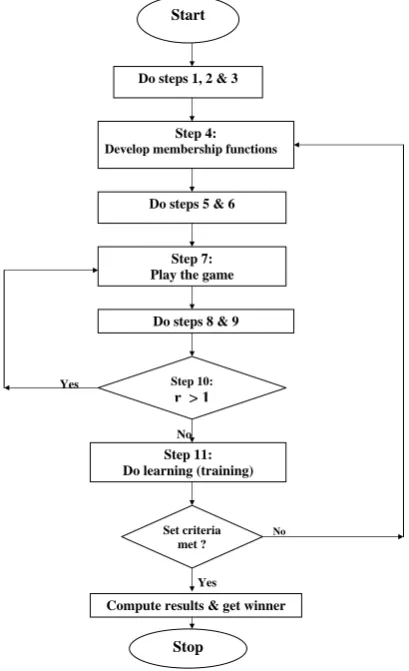
All these steps that are necessary for playing this game are as summarized in the flowchart shown in Figure 3.
Start
Do steps 1, 2 & 3
Yes
No
No
Yes
Step 4:
Develop membership functions
Step 7: Play the game
Step 10:
r > 1
Step 11: Do learning (training)
Set criteria met ?
Do steps 5 & 6
Do steps 8 & 9
Compute results & get winner
[image:10.595.328.537.80.255.2]Stop
Figure 3: Chart showing the two loops of the wage game. The first loop stops whenr= 1 (this means the fifth round of the game) and the second loop represents learning of the fuzzy player and it stops when the set performance criteria have been met as explained in step 11 .
9. Results Discussion for Fuzzy Game Approach to Wage Negotiation
Based on the procedures highlighted in Section 8 above and from the results in Table 1, the results of the game show that yellow (employer) wins more often than green (employees’ union) because the business wage decision was based on the output of fuzzy reasoning from the fuzzy inference system (FIS) and learning was used. This shows the extent to which fuzzy reasoning can help a business if it wants to make use of fuzzy rules plus learning for their decision support tools. Fuzzy rules make the wage negotiation more flexible and were able to capture both the present and the future uncertainty inherent in the business environment.
These results on Table 1 (columns six and seven) show that the fuzzy player (Yellow which represents the em-ployer) in FGAW iterations was able to win more often
[image:10.595.61.266.123.459.2]Figure 4: The rule base for the inflation rate and business profit coded using Matlab software.
Figure 5: FIS interface for the membership functions of the output variableExpected Wage Increase or consolidation(Ec).
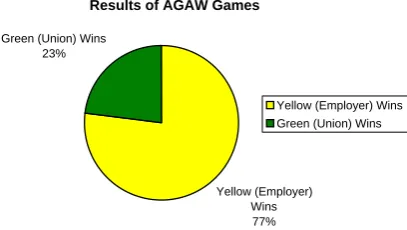
than the employees’ union (Green) because the manage-ment of the business made use of the fuzzy inference sys-tem in making the business decisions. Out of the thirteen FGAW iterations on the table, yellow won a total of ten iterations.
The results of the control experiments in columns four and five of the table (in which business did not use fuzzy rules to make decisions) show that green wins as often as yellow does. These two results (the FGAW games and the control experiment simulations) are as summarized in the pie chart of Figure 7. The results of the control experi-ment (where fuzzy rules were not used) may be considered dangerous for the business. This is because if employees continue to win and wages continue to grow without corre-sponding market expansion, the trend may lead to gradual demise of the business.
[image:10.595.324.536.293.471.2]Figure 6: Defuzzified (crisp) values forExpected Wage Increase or Consolidation (Ec) at inputsI=R= 2.5.
Yellow (Employer) Wins 10
Green (Union) Wins 3
Results of AGAW Games
Yellow (Employer) Wins 77% Green (Union) Wins
23%
Yellow (Employer) Wins Green (Union) Wins
Figure 7: This chart summarises the performances of the fuzzy player (employer) and the union in the FGAW simulations shown on Ta-ble 1.
to survive, decision makers may need to allocate more re-sources to marketing.
After training, the fuzzy player performs better with higher payoffs. This shows that the learning is important as the fuzzy player is able to adapt with fuzzy reasoning over time.
10. Conclusion
We have used a fuzzy inference system in designing an effective and efficient decision system that models wage bargaining processes in organisations. The model took ef-fective cognisance of the aims of the two parties involved and effectively captures the uncertainty therein using fuzzy rules solicited from experts in the field. The model con-siders varying ranges of inflation trends as it affects both parties and also considers the varying ranges of possible revenue increase of the organisation. It arrives at an agreed rate for wage increase which may be sustainable for both present and in the future. This may also be more agreeable and acceptable to both parties.
The result of the model showed that the employer wins most often because the management implemented fuzzy rule base and used learning in taking their wage decisions.
[image:11.595.308.546.94.283.2].
Table 1: Results of the FGAW game decision system
Player Moves Control Expmt FGAW Players
S/N Green Yellow Winner Payoff Winner Payoff 1 1, 1, 3 1, 0, 4 Yellow -22.0 Yellow -63.9 2 2, 1, 2 1, 1, 3 Yellow -52.7 Yellow -94.8 3 3, 0, 2 2, 0, 3 Yellow -26.7 Yellow -68.8 4 4, 0, 1 4, 0, 1 Green 40.8 Yellow -8.2 5 1, 0, 4 2, 0, 3 Green 351.6 Green 302.2 6 3, 1, 1 4, 0, 1 Yellow -16.1 Yellow -65.2 7 3, 0, 2 2, 1, 2 Green 136.8 Green 94.9 8 3, 1, 1 3, 1, 1 Green 14.8 Yellow -34.2 9 3, 1, 1 2, 0, 3 Yellow -289.3 Yellow -305.0 10 0, 5, 0 1, 4, 0 Yellow -99.8 Yellow -142.2 11 0, 5, 0 0, 1, 4 Yellow -704.8 Yellow -747.2 12 0, 0, 5 0, 5, 0 Green 1054.5 Green 1012.0 13 0, 5, 0 0, 0, 5 Yellow -863.8 Yellow -906.2 l1 From the table, the first column shows the serial numbers of the iterations, the second column contains playergreen’s strate-gies while the third column contains that ofyellow. For exam-ple, in the first iteration,green’sstrategy shows [1,1,3], this in-dicates how resources are allocated to green strategy [C, W, M]:
C= 1,W= 1 andM= 3. The fourth and fifth columns contain the control experiments in which the business management did not use fuzzy rules in the wage negotiation. The sixth and sev-enth columns show FGAW players and the results, that is, the simulations in which the business uses fuzzy rules in taking its decisions. Detailed results are discussed in Section 9 and are as further summarized in the pie chart of Figure 7.
This helped to formulate sustainable wage agreements be-tween employers and employees.
However, the fact that the employer wins most often may not necessarily mean that the employees are cheated but rather guarantees the continue survival of their firm (or organisation) and therefore guarantees the continuity of their jobs. If our scheme could be employed by en-trepreneurs, it would help to greatly reduce deadlocks that usually plague wage negotiations between employers and employees (or their union) and will therefore increase pro-ductivities.
11. Future Research
We will apply this model in a wider range of micro and macroeconomic models that are targeted to specific indus-tries and international trades among counindus-tries. We will do experiments to determine the actual duration and num-ber of steps in the business games. We plan to apply the model to other different strategic games and to replace the adaptation of the membership functions by operations on type-2 fuzzy sets [53]. Also, the model can be applied for optimizing bidding in auctions and in a variety of human resource allocation decisions. It could also be applied for pension negotiations in determining what percentages the employers and employees should contribute toward their pension pots.
[image:11.595.62.266.300.415.2]References
[1] A. C. Gielen and J. C. van Ours, “Layoffs, quits and wage ne-gotiations,”Economics Letters, vol. 109, no. 2, pp. 108 – 111, 2010.
[2] L. Holmwood, “BBC no 1 will take£162,000 wage cut,”The Sun Newspaper, Aug. 10 Aug 2010.
[3] J. Aizenman, “Optimal wage re-negotiation in a closed and open economy,”Journal of Monetary Economics, vol. 13, no. 2, pp. 251 – 262, 1984.
[4] A. Dhillon and E. Petrakis, “A generalised wage rigidity result,” International Journal of Industrial Organization, vol. 20, no. 3, pp. 285–311, 2002.
[5] S. Holden, “Wage bargaining and nominal rigidities,”European Economic Review, vol. 38, no. 5, pp. 1021–1039, 1994. [6] G. Corneo and C. Lucifora, “Wage formation under union threat
effects: Theory and empirical evidence,” Labour Economics, vol. 4, no. 3, pp. 265–292, 1997.
[7] D. G. Blanchflower and N. Millward, “Trade unions and employ-ment change: An analysis of British establishemploy-ment data,” Eu-ropean Economic Review, vol. 32, no. 2-3, pp. 717–726, March 1988.
[8] G. Fethke and A. Policano, “Monetary policy and the timing of wage negotiations,”Journal of Monetary Economics, vol. 19, no. 1, pp. 89–105, 1987.
[9] A. G. McGrew and M. J. Wilson,Decision making : approaches and analysis. Manchester: Manchester University Press,, 1982. [10] M. Wisniewski, Quantitative methods for decision makers.
London: Pitman,, 1997.
[11] P. Vasara, V. Krebs, L. Peuhkuri, and E. Eloranta, “Competi-tive safety analysis: robust decision-making in multi-agent sys-tems,”Computers in Industry, vol. 50, pp. 127–140, 2003. [12] S. Pratap and E. Quintin, “Are labor markets segmented in
developing countries? a semiparametric approach,”European Economic Review, vol. 50, no. 7, pp. 1817–1841, 2006. [13] O. Owoye, “Wage determination and strike activity in Nigeria,”
Journal of African Economies, vol. 3, no. 3, pp. 448–480, 1994. [14] P. Oribabor, “Recent trends in collective bargaining in Nigeria,”
Industrial Relations Journal, vol. 15, no. 4, pp. 47–55, 2007. [15] C. N. Okolie, “Trade unionism, collective bargaining and nation
building: the Nigerian experience,”OGIRISI: a New Journal of African Studies, vol. 7, no. 9, pp. 137–148, 2010.
[16] D. Otobo, “The Nigerian general strike of 1981,” Review of African Political Economy, vol. 8, no. 22, pp. 65–81, 1981. [17] L. A. Zadeh, “Fuzzy sets,” Information and Control, vol. 8,
no. 3, pp. 338–353, 1965.
[18] F. T. Dweiri and M. M. Kablan, “Using fuzzy decision mak-ing for the evaluation of the project management internal effi-ciency,”Decision Support Systems, vol. 42, no. 2, pp. 712–726, 2006.
[19] E. E. Karsak and E. Tolga, “Fuzzy multi-criteria decision-making procedure for evaluating advanced manufacturing sys-tem investments,” International Journal of Production Eco-nomics, vol. 69, no. 1, pp. 49–64, 2001.
[20] C. Kahraman, U. Cebeci, and R. D., “Multi-attribute compari-son of catering service companies using fuzzy AHP: The case of Turkey,” International Journal of Production Economics, vol. 87, no. 2, pp. 171–184, 2004.
[21] S.-H. Chen, C.-C. Yang, T.-W. Lin, and T.-M. Yeh, “Perfor-mance evaluation for introducing statistical process control to the liquid crystal display industry,” International Journal of Production Economics, vol. 111, no. 1, pp. 80–92, 2008. [22] Z. Gungor and F. Arikan, “Application of fuzzy decision making
in part-machine grouping,”International Journal of Production Economics, vol. 63, no. 2, pp. 181–193, 2000.
[23] W. K. Kim and K. H. Lee, “Generalised fuzzy games and fuzzy equilibria,”Fuzzy Sets and Systems, vol. 122, no. 2, pp. 293– 301, 2001.
[24] L. Shuliang, “The development of a hybrid intelligent system for developing marketing strategy,”Decision Support Systems, vol. 27, no. 4, pp. 395–409, 2000.
[25] E. W. T. Ngai and F. K. T. Wat, “Fuzzy decision support system for risk analysis in e-commerce development,”Decision Support Systems, vol. 40, no. 2, pp. 235–255, 2005.
[26] L. Chinho and H. Ping-Jung, “A fuzzy decision support system for strategic portfolio management,”Decision Support Systems, vol. 38, no. 3, pp. 383–398, 2004.
[27] G. F. Royes and B. R. C., “Uncertainty analysis in political forecasting,”Decision Support Systems, vol. 42, no. 1, pp. 25– 35, 2006.
[28] Z. Irani, A. Sharif, P. E. D. Love, and C. Kahraman, “Apply-ing concepts of fuzzy cognitive mapp“Apply-ing to model: The IT/IS investment evaluation process,”International Journal of Pro-duction Economics, vol. 75, no. 1-2, pp. 199–211, 2002. [29] M. Negnevitsky,Artificial Intelligent Systems. England:
Pear-son education, 2005.
[30] F. O. Oderanti and P. De Wilde, “Dynamics of business games with management of fuzzy rules for decision making,” Interna-tional Journal of Production Economics, vol. 128, no. 1, pp. 96–109, 2010.
[31] F. O. Oderanti and P. D. Wilde, “Automatic fuzzy decision making system with learning for competing and connected busi-nesses,”Expert Systems with Applications, vol. 38, no. 12, pp. 14 574 – 14 584, 2011.
[32] T. J. Ross,Fuzzy Logic with Engineering Applications. Eng-land: John Wiley and Sons Limited, 2005.
[33] E. H. Mamdani and S. Assilian, “An experiment in linguistic synthesis with a fuzzy logic controller,”International Journal of Man-Machine Studies, vol. 7, no. 1, pp. 1–13, 1975. [34] D. Ross, “Game theory,”Stanford Encyclopedia of Philosophy,
2010.
[35] M. Shubik, “On gaming and game theory,”Management Sci-ence, vol. 18, no. 5, pp. 37–53, 1972.
[36] K. W. Li, F. Karray, K. W. Hipel, and K. M., “Fuzzy approaches to the game of chicken,”IEEE Transactions on Fuzzy Systems, vol. 9, no. 4, pp. 608–623, 2001.
[37] M. Shubik, “The uses of game theory in management science,” Management Science, vol. 2, no. 1, pp. 40–51, 1955.
[38] T. H. Naylor and J. M. Vernon,MicroEconomics and Decision
Models of the Firm. USA: Harcourt, Brace and World Inc,
1969.
[39] F. O. Oderanti and P. De Wilde, “Fuzzy game approach to in-vestigate impact of poor infrastructures on business profitability in developing economies,” in Proceedings of the IEEE Inter-national Conf. on Emerging And Sustainable Technologies For Power and ICT In A Developing Society (NIGERCON), vol. 1, 2010, pp. 131–145.
[40] S. Braathen and O. J. Sendstad, “A hybrid fuzzy logic/constraint satisfaction problem approach to automatic de-cision making in simulation game models,”IEEE Transactions on Systems, Man, and Cybernetics-Part B: Cybernetics, vol. 34, no. 4, pp. 1786–1797, 2004.
[41] B. Tapan, Decision-making under uncertainty. New York, USA: Macmillan,, 1997.
[42] A. Kandel and Y.-Q. Zhang, “Fuzzy moves,” Fuzzy Sets and Systems, vol. 99, no. 2, pp. 159–177, 1998.
[43] K. Miskelly, “Airline staff took£750k pay cuts,”Metro News-papers pp 4, 16th July, 2010.
[44] A. Griffiths and S. Wall,Intermediate Microeconomics Theory and Applications. England: Pearson Education Limited, 2000. [45] R. Giordano, “Wage bargaining and inflation,”Research in
Eco-nomics, vol. 55, no. 4, pp. 359–387, 2001.
[46] F. A. G. den Butter and R. F. van de Wijngaert, “Wage inflation and labour conflicts in the Netherlands : An empirical investi-gation using the co-integration approach,”European Journal of Political Economy, vol. 8, no. 4, pp. 527–541, 1992.
[47] R. J. Buesa, “Salaries in histology,” Annals of Diagnostic Pathology, vol. 12, no. 2, pp. 122–127, 2008.
[48] N. J. Ireland, “Profit sharing to counter restrictive practices,” European Journal of Political Economy, vol. 5, no. 2-3, pp. 347 – 357, 1989.
power in Belgian manufacturing,”European Economic Review, vol. 33, no. 1, pp. 169–180, 1989.
[50] V. P. Crawford, “A note on the Zeuthen-Harsanyi theory of bargaining,”The Journal of Conflict Resolution, vol. 24, no. 3, pp. 525–535, 1980.
[51] N. Banerjee, S. Biswas, and S. Chintada, “A game-theoretic analysis of converged cellular-voip services,” inIEEE 3rd Con-sumer Communications and Networking Conference, 2006. CCNC 2006., vol. 2. Nevada, USA: IEEE, 2006, pp. 715–719. [52] J. C. Lagarias, J. A. Reeds, M. H. Wright, and P. E. Wright, “Convergence properties of the Nelder-Mead simplex method in low dimensions,”SIAM Journal of Optimization, vol. 9, no. 1, pp. 112–147, 1998.
[53] G. M. M´endez and M. A. Hernandez, “Hybrid learning for inter-val type-2 fuzzy logic systems based on orthogonal least-squares and back-propagation methods,”Information Sciences, 2008.