City, University of London Institutional Repository
Citation: Grant, S. (2015). Gaze-grasp coordination in obstacle avoidance: differences
between binocular and monocular viewing. Experimental Brain Research, 233(12), pp. 3489-3505. doi: 10.1007/s00221-015-4421-7This is the accepted version of the paper.
This version of the publication may differ from the final published
version.
Permanent repository link: http://openaccess.city.ac.uk/12422/
Link to published version: http://dx.doi.org/10.1007/s00221-015-4421-7
Copyright and reuse: City Research Online aims to make research
outputs of City, University of London available to a wider audience.
Copyright and Moral Rights remain with the author(s) and/or copyright
holders. URLs from City Research Online may be freely distributed and
linked to.
City Research Online: http://openaccess.city.ac.uk/ [email protected]
1
Gaze-Grasp Coordination in Obstacle Avoidance:
Differences between Binocular and Monocular Viewing
Simon Grant
The Henry Wellcome Laboratories for Vision Research
Department of Optometry & Visual Science
City University London
Northampton Square
London EC1V 0HB, UK
e-mail:
[email protected]
2
Abstract
Most adults can skillfully avoid potential obstacles when acting in everyday cluttered scenes. We examined how gaze and hand movements are normally coordinated for obstacle avoidance and whether these are altered when binocular depth information is unavailable. Visual fixations and hand movement kinematics were simultaneously recorded while 13 right-handed subjects reached-to-precision grasp a cylindrical household object presented alone or with a potential obstacle (wine glass) located to its left (thumb’s grasp-side), right or just behind it (both closer to the finger’s grasp-side) using binocular or monocular vision. Gaze and hand movement strategies differed significantly by view and obstacle location. With binocular vision, initial fixations were near the target’s centre of mass (COM) around the time of hand movement onset, but usually shifted to end just above the thumb’s grasp-site at initial object contact, this mainly be made by the thumb, consistent with selecting this digit for guiding the grasp. This strategy was associated with faster binocular hand movements and improved end-point grip precision across all trials than with monocular viewing, during which subjects usually continued to fixate the target closer to its COM despite a similar prevalence of thumb-first contacts. While subjects looked directly at the obstacle at each location on a minority of trials and their overall fixations on the target were somewhat biased towards the grasp-side nearest to it, these gaze behaviours were particularly marked on monocular vision-obstacle behind trials which also commonly ended in finger-first contact. Subjects avoided colliding with the wine glass under both views when on the right (finger-side) of the workspace by producing slower and straighter reaches, with this and the behind obstacle location also resulting in ‘safer’ (i.e., narrower) peak grip apertures and longer deceleration times than when the goal-object was alone or the obstacle was on its thumb-side. But monocular reach paths were more variable and deceleration times were selectively prolonged on finger-side and behind obstacle trials, with this latter condition further resulting in selectively increased grip closure times and corrections. Binocular vision thus provided added advantages for collision avoidance, known to require intact dorsal cortical stream processing mechanisms, particularly when the target of the grasp and potential obstacle to it were fairly closely separated in depth. Different accounts of the altered monocular gaze behaviour converged on the conclusion that additional perceptual and/or attentional resources are likely engaged compared to when continuous binocular depth information is available. Implications for people lacking binocular stereopsis are briefly considered.
3
Introduction
Most people are adept at avoiding potential obstacles during goal-directed actions in multi-object environments. When sitting at the dining table, for example, it is an everyday occurrence to successfully reach out and pick up a desired object – a salt pot, say – without colliding with any nearby non-target objects amongst the general clutter. A number of studies (e.g., Jackson et al. 1995, 1997; Tipper et al. 1997; Tresilian 1998; Kritikos et al. 2000; Mon-Williams and McIntosh 2000; Mon-Williams et al. 2001; Tresilian et al. 2001; Watt and Bradshaw 2002) have mimicked natural table-top settings of this kind to examine how reach-to-precision grasp movements are adapted in the presence of non-targets (a.k.a., ‘flankers’) in the workspace. These have revealed that actors have a repertoire of conservatively-principled anti-collision strategies at their disposal, with which to subtly alter spatial and/or temporal features of their movements compared to when the same goal-object is presented in isolation. One priority is usually given to maintaining a safe distance, this being achieved by programming a reach that veers slightly away from any potential obstruction(s) and an initial (‘peak’) grip opening that stays relatively narrow to avoid unwanted contact(s) during grasp formation. Another is to slow down and prolong the time available to acquire visual feedback, especially during the later (deceleration or grip closure) phase, which may be needed for adjusting the final approach to the intended target.
The current experiments aimed to extend this work in several important ways. Our first questions focussed on how gaze is deployed to facilitate successful grasping in obstacle avoidance. Specifically, where do adults subjects normally look when reaching to precision grasp isolated table-top objects? And do they use different gaze/fixation strategies in the presence of obstacles at different locations relative to the moving hand? These questions were prompted, in part, by our recent evidence (Melmoth and Grant 2012) supporting a long-standing suggestion that the thumb is employed as an on-line guide to initial contact when precision grasping isolated (cylindrical) table-top objects (Wing and Fraser 1983; Haggard and Wing 1997). Movement of the finger, by contrast, appeared mainly responsible for opening the initial grip aperture, while also avoiding a subsequent collision with the target’s opposite, less visible, surface, both findings being in line with other recent evidence that collision avoidance is prioritized during single-object grasping too (Verheij et al. 2012, 2014a).
4
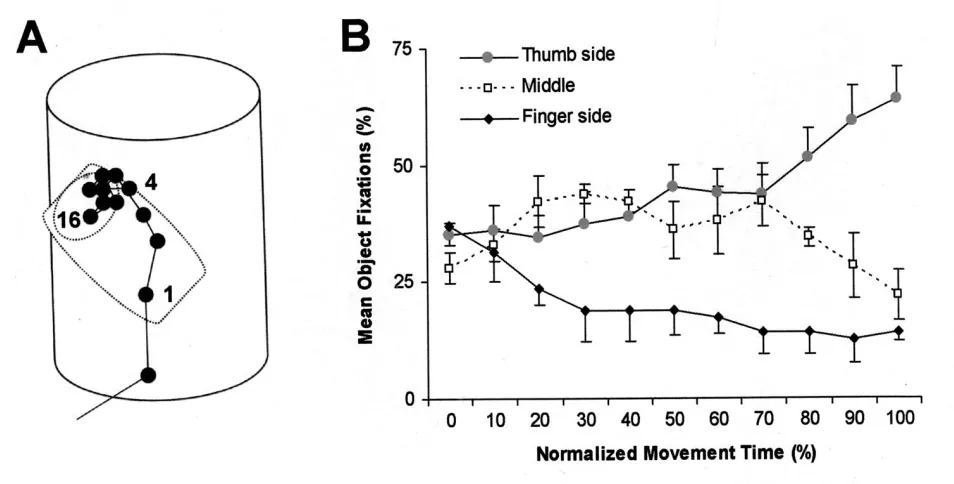
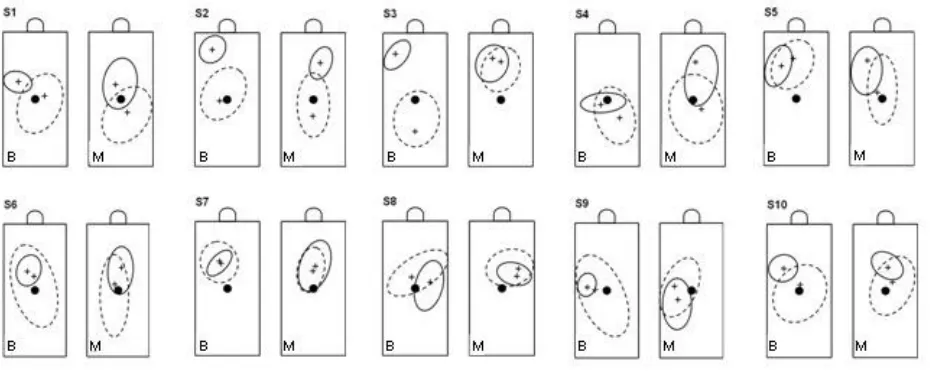
thumb landing-site late in the movement in order to guide initial contact with the target, and had obtained some preliminary data in support of this possibility (see Fig.1).
[Figure 1, near here]
There is, however, more extensive and, apparently, contradictory evidence that the finger’s landing-site – when this is the digit of first-contact – or, sometimes, the target’s centre of mass (COM) are the regions selectively fixated during other precision grasping tasks (de Grave et al. 2008; Brouwer et al. 2009; Desanghere and Marotta 2011; Prime and Marotta 2013; Cavina-Pratesi and Hesse, 2013). Moreover, selection of the thumb or the finger as the guide to contact appears less dependent on whether their respective grasp-sites are visible and, hence, available for fixation (de Grave et al. 2008; Melmoth and Grant, 2012; Voudouris et al. 2012a), but more on the end-point grip orientation adopted, a postural constraint also known to be influenced by the presence of obstacles (Rosenbaum et al. 2001; Voudouris et al. 2012b; Verheij et al. 2014b). In this context, Mon-Williams and McIntosh (2000) have speculated that choosing the thumb or finger as the guide for coordinating grasping in multiple-object scenes might depend on the relationship between obstacle proximity to each digit’s preferred contact-site. Their specific suggestions were that an obstacle located close to the thumb contact-side of the target might result in thumb guidance and fixation of its landing-site or, perhaps, the gap between this site and the nearby obstacle, and vice versa for an obstacle located near the finger’s grasp position. Indeed, there are strong hints in the literature that collision avoidance strategies, such as reducing the peak grip, are enhanced when obstacles are located near the finger, compared to thumb, path to table-top objects (e.g., Jackson et al. 1995; Tresilian 1998; Mon-Williams et al. 2001), so gaze deployment may differ according to these flanker locations as well.
5
cortical functioning (McIntosh et al. 2004; Schindler et al. 2004; Rice et al. 2006), probably involving areas with privileged access to binocular 3D (e.g., near-space, absolute and dynamic disparity) information useful for hand movement programming and on-line guidance (Quinlan and Culham 2007; Verhagen et al. 2008, 2012; Gallivan et al. 2009; Srivastava et al. 2009; Cottereau et al. 2012).
But it is only partly supported by results obtained in the two studies that previously examined the issue. Jackson et al (1997) reported that the key advantages of binocular vision were only evident when adults reached-to-grasp an object in the presence of flankers. Their consistent findings were that monocular peak grip apertures were selectively increased for movements performed in a cluttered workspace, rather than to an isolated target, this greater risk of collision being further associated with
selectively prolonged deceleration times (after peak velocity) indicative of increased ‘uncertainty’ approaching the goal-object when obstacles were present. Watt and Bradshaw (2002), though, found that general problems associated with monocular viewing – including wider peak grips and longer deceleration times (expressed as a percentage of movement duration after peak deceleration) – occurred to a similar extent when participants grasped objects presented alone or with one, two or even four non-targets nearby. The reasons for this discrepancy are not immediately clear as aspects of experimental design in the two studies were similar.
Our particular interest in this arises, in part, from the fact that a significant minority of adults lack binocular 3D vision, for reasons that include the persistent consequences of childhood amblyopia or eye-related disorders of more recent onset. Moreover, adults with binocular dysfunctions due to these conditions exhibit similar deficits when reaching to grasp isolated objects (e.g., Grant et al. 2007; Melmoth et al. 2009; Pardhan et al. 2011) to those of normal subjects forced to perform equivalent actions using one eye alone. This raises final questions as to whether sub-optimal gaze strategies are adopted when binocular vision is reduced or absent and whether this contributes to poorer hand action control. One possibility is that when the available 3D cues are monocular and mainly pictorial in nature, rather than fixating on a specific digit contact-site, gaze is preferentially directed to the target’s COM. Such a ‘decoupling’ between fixations and grasp-points occurs during movements to remembered targets (Flanagan et al. 2008; Prime and Marotta 2013) and when subjects are just required to extract perceptual information about objects without a specific intention to act (Brouwer et al. 2009), processes thought to engage ventral, rather than dorsal, stream cortical representations.
6
Participants were given a brief (1 sec) preview of the task, allowing sufficient time for them to encode the visual scene and fixate the target, which was a household object (resembling the salt pot), before the imperative signal to begin their hand movement. This goal-object was presented at the same location within the upper comfortable range of adult arm’s length, necessitating fairly large amplitude movements and affording substantial time to use feedback in order to acquire it. On different trials, the target was presented alone or with an obstacle – a real wine glass, to which a particularly high cost of collision would likely be ascribed (Tresilian 1998) – as a flanker, placed on its ‘thumb-side’ or ‘finger-side’ on the same horizontal plane or just behind it in the depth plane, this latter being hypothesized to pose a particular problem for avoidance with monocular viewing. The specific object-obstacle distances employed were different in each case, but were based on the spatial extents of the thumb and finger paths during typical movements to the isolated target and on reviews of equivalent data from previous related studies (e.g., Jackson et al. 1995, 1997; Tipper et al. 1997; Tresilian 1998; Kritikos et al. 2000; Mon-Williams and McIntosh 2000; Mon-Williams et al. 2001; Tresilian et al. 2001; Watt and Bradshaw 2002), indicating that the wine glass would be treated as an obstacle to the movements on each flanker trial without physically impeding them.
Materials & Methods
Participants
Thirteen adults (median age 23 years, 7 males) participated in the experimental procedures, conducted in accord with Declaration of Helsinki and local City University London ethical approval. Subjects were selected on the basis that they were strongly right-handed (> +80), as assessed by an abbreviated version of the Edinburgh Handedness Inventory (Oldfield 1971); right eye dominant for monocular sighting; had normal or corrected-to-normal vision through contact lens wear; and possessed high-grade (at least 40 arc secs) binocular stereo acuity (Randot, Stereoptical Inc., Chicago, USA).
Procedures
7
the target on all trials. It was placed on a plinth (30 cm wide x 20 cm deep x 10 cm high) at a midline distance of 40 cm from the start button, such that its geometric COM was typically ~10-20 cm below eye level. The target was presented in isolation (control condition) or with the potential obstacle flanking it in one of three possible locations on the plinth, chosen so that they posed no physical obstruction to the moving hand. These locations were centered 6.5 cm (~9o) to the left (‘thumb side’) of
the target; 13 cm (~18o) to the right (‘finger side’) of the target; or 10 cm directly behind it. Additional
to our review of previous literature, we chose to double the relative separations between the target and the left/thumb-side versus right/finger-side obstacle locations, to allow sufficient space for the maximal deviations of each digit away from their contact sites to occur at peak grip and which are typically double the relative distance for the finger compared to the thumb (see Melmoth and Grant, 2012). Consistent trial-to-trial object and obstacle placements were achieved by aligning their lower centres with 0.5 cm diameter stickers attached to the upper plinth surface. When unoccupied by the obstacle, the stickers on either side of the target would have been within the subject’s field of view.
Subjects closed their eyes between trials and opened them on verbal command from the experimenter who simultaneously triggered the hand movement recording. This contained a programmed delay of 1 sec permitting a preview of the scene, before an auditory tone was delivered as the cue for the subject to begin their reach. Participants were instructed to pick up the target at about half its height using a precision grip, place it on the table to their right, and return their hand to the start button. They were told to move as naturally as possible, with the specific counsel to avoid contact with the wine glass, when present. A number (typically 3-5/view) of practice trials were given prior to the main experiment, to ensure that the instructions were properly followed. Subjects completed 2 blocks of 20 experimental trials (4 obstacle conditions x 5 repeats); one block performed with normal binocular viewing and the other with their right (dominant) eye alone (left eye occluded with a black patch). Obstacle presentations in each block were in different pseudo-randomized orders, with viewing order counter-balanced between subjects. Obstacle avoidance was uniformly successful: none of the subjects collided with the wine glass in any of its 3 positions under either viewing condition.
[Table 1, near here]
Hand movement recordings and data processing
8
Hz. The system was calibrated to a spatial resolution of <0.25 mm prior to each session, with the x, y, z
coordinates of the markers representing their lateral, forward, and vertical axes, respectively. Recorded data were processed off-line using purpose-written routines in MATLAB software, which generated a number of dependent kinematic measures and ‘profiles’ of each movement.
We used established definitions (e.g., Melmoth and Grant 2006, 2012) to describe the movement onset (planning/programming) and duration (execution) times, along with different spatial and temporal features of the reach and the grasp expected to be altered by the demands of obstacle avoidance (see Table 1). In brief, the reach was analyzed from both its programmed (peak reach velocity; time to peak velocity; hand path length; lateral deviation) and later guidance components (final approach time), with a similar division between the programmed (time to peak grip; peak grip aperture) and feedback phases (grip closure time; grip size at contact; on-line grip adjustments immediately before or after contact; grip application time) applied to parameterization of the grasp. We also included three versions of the more general ‘deceleration time’ measure of feedback control (from peak velocity or from peak deceleration to object lifting and this latter as a percentage of total movement duration; Table 1) for direct comparability with Jackson et al (1997) and with Watt and Bradshaw (2002), respectively. In addition, several ‘end-point’ grip parameters (Table 1), including the digit making first-contact with the target; the contact asynchrony between the two digits (in which positive values represent thumb-first and negative values finger-first contacts); and the final grip orientation (in which 90o is parallel to the subject’s midline axis and 0o corresponds to the horizontal
plane) were determined from the locations of the thumb- and finger-tips at initial object contact and at the moments of minimum velocity of each digit, with reference to the x,y origin of the marker centred on the target. In this way, we could determine which spatiotemporal aspects of the two movement components were affected by the different obstacle locations and viewing conditions.
Gaze recordings and data processing
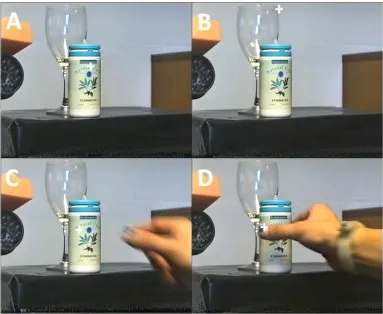
Gaze tracking used an infrared pupil-corneal reflex video-camera system (ISCAN RK-464, Iscan Inc., Burlington, USA) operating at a frame rate of 50Hz, to record the visual fixations of the subject’s right (dominant) eye on each trial. The infrared source of this equipment was placed on the table ~20 cm (or ~30o) to the left of the plinth from the subject’s viewpoint and far enough away from the target (see
9
superimposed on the image defining their instantaneous point-of-regard (POR). The system was calibrated prior to each block of trials and at intervals of 6-7 trials within each block, as a check on tracking accuracy. The calibration procedure required the subject to sequentially fixate the centre and four corners of a rectangular surface (20 cm wide x 15 cm high) positioned on the same horizontal viewing plane as the target’s centre. The rectangular device was then replaced by the target itself, and subjects were instructed to repeatedly move their gaze up and down the centre of the object (i.e., passing from the marker on its upper surface through its COM to the base of the target), and then to repeatedly look up and down its left-(thumb)-side and right-(finger)-side edges. These procedures resulted in determination of the POR with an accuracy of ±0.5 degrees of visual angle at the mean average viewing distance of ~50 cm (i.e., equivalent to 4-5 mm on the target).
The DVD footage of each subject’s gaze data was first segmented into individual trials, from the first appearance of the POR at eye-opening to lifting of the object from the plinth, using VirtualDubMod (http://virtualdubmod.sourceforge.net) video-editing software. Purpose-written routines were used to record the x, z coordinates of the POR frame-by-frame for each trial. Dependent measures were the number and location of fixations occurring on each trial relative to the various x, z coordinates derived from the most temporally contiguous calibration procedure. Fixations were defined as stable points-of-regard within 0.5 degrees of visual angle (the limit of spatial accuracy of the system) between consecutive tracking frames. Gaze locations on the target were specified by dividing it into three equal (left, middle, right) vertical strips across its width. The two borders of the middle strip contained the object’s COM, with the left and right sides including the thumb- and finger- contact sites, respectively. Formulae were applied to calculate the x, z positions of the tracked POR in each frame in relation to these boundary lines and to the target’s COM. Fixations falling exactly on the borders of the middle strip were, conservatively, assigned to the central target zone. Gaze locations were analyzed for 5 specific time points in each trial with reference to the hand movement recording data obtained from the same trial. These were: (1) the first fixation on the target (which invariably occurred during the 1 sec interval between eye-opening and the auditory cue to move); and the fixations occurring at the moments that were temporally most contiguous with; (2) hand movement onset; (3) peak reach velocity; (4) peak reach deceleration; and (5) initial object contact.
Hand and gaze data analyses
10
application of the Huynh-Feldt correction for lack of sphericity, as necessary. Post hoc tests of significant main effects of obstacle were followed up using the Bonferroni adjustment for multiple pair-wise comparisons, with 1-way ANOVA employed to elucidate any view x obstacle interactions. Probabilities of p<0.05 were accepted as significant. Variants of these procedures were also applied to the gaze data, as given in the following text.
Results
We begin by summarizing the hand movement data obtained from our current subject group. We then examine their patterns of gaze deployment and relate these to our primary questions of how they were coordinated with their reach-to-grasp by viewing condition and obstacle location.
[Table 2, near here]
Reach-to-grasp performance: main effects of view and obstacle location
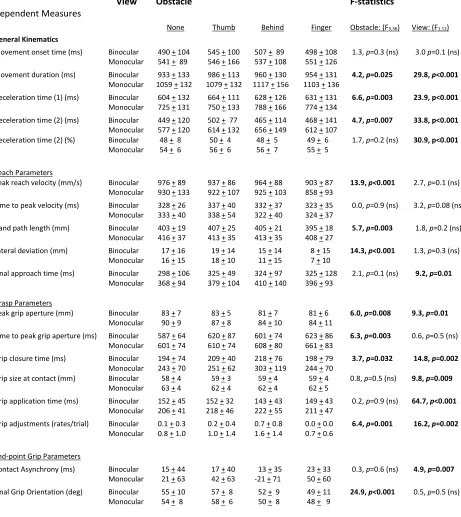
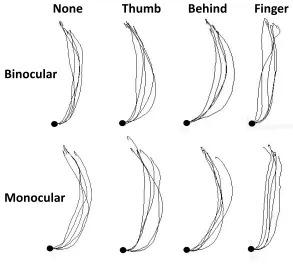
Table 2 presents the main effects of binocular versus monocular viewing and of obstacle location on our subject’s hand movement kinematics. Times spent to movement onset in responding to the auditory ‘go’ signal and in the very first part of the reach up to peak velocity were unaffected by any experimental factor, suggesting that participants were in a similar state of preparedness after the preview. But their overall movement execution times (Fig.2) were affected by their view of the tasks (F(1,12)=29.8, p<0.001). This occurred because movement durations were significantly prolonged (by
~125 ms) with monocular compared to binocular vision, due to increased time spent decelerating (on all 3 measures) and with contributions to this from each of its sub-phases, including the final approach to the target after peak deceleration and in closing and applying the grip (all F(1,12)≥9.2, p≤0.01). With
monocular viewing, participants also formed significantly wider (i.e., less accurate) grips at peak aperture and at initial object contact, and they made more on-line adjustments to their digit positions before and after contact than when binocular information was available (all F(1,12)≥9.3, p≤0.01). We thus
replicated data from a number of previous studies showing general advantages of binocular vision over one eye alone, especially for programming the grasp and for on-line movement guidance.
[Figures 2 & 3, near here]
In line with this, several programmed features of reach performance were affected equally under both views by the need to avoid the obstacle (Table 2; all F(3,36)≥5.7, p≤0.003). Post hoc
11
mm/s) while covering a slightly shorter (by ~7.5 mm) distance to acquire the target compared to when it was alone or the obstacle was located elsewhere (p<0.01 for all comparisons). Indeed, the subject’s reach trajectories (Fig. 3) were notably straighter in this condition with reduced lateral deviations, that sometimes even veered slightly to the left of their midline (i.e., resulting in negative values for this parameter), compared to the more rightward curved paths produced on other trials, and they also selectively delayed (by ~50 ms) the opening time of their peak grip (p<0.05 for all comparisons).
These effects are all mutually consistent with maintaining a safe distance, as were differences in final grip orientations that occurred across all obstacle locations (Table 2; F(3,36)=24.9, p<0.001),
regardless of view. In fact, this parameter was the only one significantly affected by positioning the wine glass close to the left (thumb-) side of the target, whereby avoidance was achieved by applying the digits in a slightly (p=0.048) more counter-clockwise orientation (mean = 57.5o) compared to the
isolated object condition (mean = 54.7o); that is, with the thumb rotated away from the obstacle.
Although it was the more horizontal (i.e., rotated clockwise away from the obstacle) orientations (of 48-52o) adopted in the finger-side and behind conditions that contributed most (both p<0.001) to the main
flanker effect on this end-point grip parameter.
Binocular advantages for collision avoidance
There were also main effects of obstacle presence in prolonging movement durations (F(3,36)=4.2,
p=0.025), associated with the finger-side and behind wine glass locations. But more importantly, given our experimental questions, there was a significant obstacle by view interaction for this (F(3,36)=6.1,
p=0.005) and for several other measures, all of which were indicative of more proficient binocular performance. Specifically, this interaction resulted from greater effects of the finger-side and behind locations (both p≤0.001) in prolonging monocular versus binocular execution times (by ~150-160 ms) compared to the smaller increases (both p≤0.032) in monocular movements (of ~100-125 ms) occurring in the isolated target and thumb-side flanker conditions (Fig.2). Similar interactions occurred for the same reasons in relation to deceleration times (in milliseconds), both for the periods after peak velocity (c.f., Jackson et al. 1997; F(3,36)=3.6, p=0.025) and after peak deceleration (F(3,36)=3.0, p=0.043), although
this latter, expressed as a percentage of movement duration (c.f., Watt and Bradshaw 2002), did not achieve significance (F(3,36)=2.3, p=0.11). Further comparisons showed that the placing the wine glass
12
In addition to these apparent advantages for on-line movement guidance, there was a further obstacle by view interaction for the programmed peak grip aperture (F(3,36)=3.9, p=0.026). This arose
because, whereas our subjects kept their peak grip equivalently narrow under both views when avoiding the finger-side and behind obstacles, they opened their digits equally wider (by 4-7mm) on monocular compared tobinocular thumb-side flanker and target only trials (both p<0.005). That is, our subject’s average avoidance behaviour with respect to maintaining a safe distance from the obstacles at each location when initially opening their digits was no different when using binocular or monocular vision. It is notable, however, that between-subject standard deviations were generally greater for most parameters during monocular movements (Table 2), an increased variability (i.e., reduced precision) that also applies to within-subject performance across repeated equivalent trials as well (e.g., Melmoth and Grant 2006). Because this propensity could increase the risk of collision, we sought evidence of obstacle x view interactions in further (unplanned) ANOVAs of the mean standard deviations by trial-type across subjects for some selected spatial parameters associated with this aspect of obstacle avoidance. These revealed significant interactions for two key measures of the reach (hand path length and lateral deviation; both F(3,36)>3.2, p<0.04), but not for the grasp (e.g., peak grip
aperture; end-point grip orientation). In both cases, the interaction was driven by greater within-subject variability on monocular compared to binocular trials involving the finger-side (x1.75-2.5) and behind (x1.25-1.5) obstacle locations, with no equivalent monocular effects (x0.9-1.15) for either the thumb-side or no obstacle conditions.
[Figures 4 & 5, near here]
Gaze-Hand Coordination
Gaze tracking was compromised in one subject due to loss and instability of point-of-regard data. Of the remaining participants, 10 made a number of separate (3-10) saccades and fixations on each trial, while the other 2 subjects locked their gaze, after the first fixation, on essentially the same target location near its COM, regardless of the view or obstacle conditions. This created a dilemma as to whether to include these 2 statistical ‘outliers’ in the analyses. The findings presented focus on the ~2500 fixations recorded in the 10 subjects who showed variety in their patterns of gaze deployment. Results of additional analyses that incorporated data from the two unusual subjects are also given in relation to our main findings, to indicate that their initial exclusion did not unduly influence the outcomes. Possible reasons for their marked ‘centre-looking’ behaviour are considered in Discussion.
13
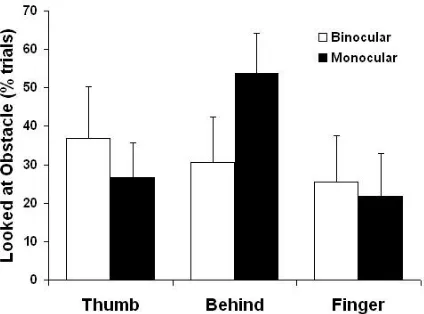
both digits. But gaze directions in the majority of subjects showed systematic changes in relation to different stages of their reach-to-grasp movements; participants typically (on ~62% of trials) fixated the middle region of the target (i.e., in the vicinity of its COM) at reach onset, but then increasingly shifted their gaze towards its thumb-side (and, particularly, away from the finger-side) as their reach progressed, so that fixations were more often near the eventual landing-site of the thumb at peak deceleration and stayed there during grip closure until initial object contact. When subjects looked directly at the obstacle (Fig.4B), which they did on 33.2% of the trials in which it was present, this occurred only once and typically in the period from just before hand movement onset to just after its peak velocity. They rarely directed their gaze at the wine glass during the late deceleration/grip closure phase of the movement (just 3 times, all on ‘monocular-behind’ trials) and only once fixated the gap between the obstacle and its nearest potential grasp-point (on a ‘binocular thumb-side’ trial).
[Figures 6 & 7, near here]
Effects of viewing condition and of obstacle location
ANOVA confirmed that gaze deployment changed with time between the first and last fixations during both binocular (F(8,72)=8,7, p<0.001) and monocular (F(8,72)=3.3, p=0.006) reach-to-grasps. However, as
shown in Figure 5, the late shift in gaze towards the target’s thumb-side appeared to be more marked with binocular than monocular viewing, as also indicated by a strong 3-way (view x time x gaze location) trend in the data (F(8,72)=2.1, p=0.079). Inclusion of the other 2 subjects increased the proportion of
overall mean fixations on the middle region of the target (by ~5-10%) from movement onset onwards, as would be expected, and mainly at the expense of the thumb-side averages, which were reduced at object contact to 44% and 33% for binocular and monocular viewing, respectively. But it did not materially affect the view-dependent trend in altered gaze location with time (F(8,88)=2.0, p=0.088).
To examine this interaction further, we made separate plots of the locations of the first and last fixations on the target on each trial for each of the 10 subjects under each view. Figure 6 compares these data, with the elliptical regions depicting the majority (>90%) of the gaze locations in each case and with the mean fixation positions within these regions of ‘best fit’ shown for the two time points by view. As indicated here and in Table 3, the subject’s first fixations were quite widely dispersed on the target (covering ~15-20% of its total surface area), but with their average locations within just a few mm (<0.5o) of the object’s COM – both in its horizontal (x) and vertical (z) axes – irrespective of view.
14
mm/3o) towards the thumb-side of the target (view x time interaction; F
(1,9)=37.6, p<0.001) compared
to those made with monocular vision, these being still deployed more often within the target’s central zone (c.f., Fig.5B). Again, inclusion of equivalent data from the 2 ‘outliers’ did not affect the findings of significantly smaller final dispersion areas (F(1,11)=6.0, p=0.032) or greater x-axis gaze shifts (F(1,11)=18.5,
p=0.001) on binocular versus monocular trials.
On average, the 10 participants made 1 additional fixation when viewing monocularly (7.1 ± 0.93 sd) compared to binocularly (6.0 ± 0.63 sd), with increased fixations also occurring on trials in which the wine glass was in the behind (6.9 ± 0.91 sd) or finger-side (6.6 ± 0.89 sd) positions compared to when it was absent (6.1 ± 0.71 sd), yielding main effects for both view (F(1,9)=32.2, p<0.001) and
obstacle (F(3,27)=4.1, p=0.028). While these effects remained equally statistically significant across all 12
subjects, they were most likely trivial consequences of their increased hand movement durations – and, hence, gaze-tracking recording times – under these conditions. More interestingly, further analyses uncovered some subtle influences of obstacle location. First, separate ANOVA conducted for each view revealed significant effects on gaze locations (both F(6,54)>3.7, p=0.006; and F(6,66)>3.5, p≤0.009 for all 12
subjects) which occurred for the same reasons and in accord with one suggestion of Mon-Williams and McIntosh (2000); that fixations were attracted slightly more (by 9-11%) towards the target’s left or thumb-side in the presence of the thumb-side obstacle and more towards (by 5-8%) its right or finger-side in the presence of the finger-finger-side obstacle compared to the isolated object condition. Second, there was an obstacle x view interaction (F(3,27)=5.1, p=0.015; and F(3,33)=5.0, p=0.011 for all 12 subjects)
for fixation numbers. This was mainly due to their selective increase on monocular-obstacle behind trials, a contributory factor being that gaze was attracted to the wine glass itself much (2-3x) more often in the majority of participants than when it was elsewhere during monocular viewing (Fig.7).
The digit(s) of first contact and their relationship with final gaze locations
As demonstrated by the mainly positive values obtained for contact asynchrony of the end-point grip (Table 2) and consistent with general use of the ‘thumb as visual guide’, the overall majority of first-contacts with the target were made by the thumb (63.5%) with similar smaller proportions of finger-first (20%) or simultaneous ‘pincer’ contacts by both digits (16.5%). There was, however, a main effect of view on mean contact asynchronies (F(1,9)=4.9, p=007), whereby binocular vision was associated with
15
for monocular viewing (F(6.54)=5.7, p=0.001) due to finger-first contacts being markedly increased on
trials (n=18/50; 36%) in which the wine glass was behind the target compared to the other three (10-22%) obstacle conditions (all p<0.025). On 50% of these 18 monocular-behind trials, the last fixation was also on the target’s finger-contact side, a 5-fold increase on the overall mean (~10%; Fig.5B) of such final gaze locations. This suggests increased adoption of a ‘finger as visual guide’ strategy to ensure that this digit avoided collision with the behind flanker located quite close to its grasp point towards the rear of the object on these trials in which reliable target-obstacle depth information was reduced.
Nonetheless, with binocular – but not monocular – viewing, there was also a near-significant digit contact-type by final gaze location interaction (F(4,36)=3.0, p=0.067). The main contributor to this
across all 12 participants was a roughly 2-fold increase in the relative proportion of synchronous pincer grips accompanying thumb- (23%) compared to finger-side (12.5%) final fixations at object contact. Since pincer-grip size is near-perfectly matched to the target’s width, this would suggest that last-fixation directed towards the thumb’s grasp position on the object represented a better gaze strategy for end-point grip precision than last-fixation on the finger contact-site. It is further consistent with the more accurate mean grip sizes at initial contact (Table 2) achieved with binocular compared to monocular vision by our participants, regardless of obstacle presence or location.
Discussion
goal-16
object through which the reaching hand would normally move to acquire it compared to flankers situated on its opposite side, even when these latter obstacles are physically much closer to the target. These spatial locations conform to the finger- and thumb-side wine glass positions, respectively, in our experiments. Indeed, our right-handed subjects reduced their peak reach velocity and produced straighter and shorter hand paths only when the obstacle was positioned to the right of the target. These altered reach trajectories represent sensible precautions in deviating their moving limb to a safe distance away from the obstacle to reduce the risk of collision.
But this obstacle location also resulted in a significant narrowing (c.f., Jackson et al. 1997; Tresilian 1998; Mon-Williams and McIntosh 2000; Mon-Williams et al. 2001) and delayed opening of their initial grasp at hand pre-shaping, followed by clockwise rotation of the end-point grip (Table 2), so that the finger landed more laterally on the object rather than travelling around to its rear, as in the isolated target condition. Why? We and others have shown (Schlicht and Schrater 2007; Melmoth and Grant 2012) that outward movement of the finger almost entirely accounts for the width of the peak grip aperture when subjects are preparing to precision grasp isolated table-top objects. We suggest that the smaller and later peak grips along with their altered end-point orientations in the presence of the finger-side obstacle resulted from a plan to maintain this digit at a safe distance throughout the movement, an unnecessary precaution for the thumb-side obstacle location due to the much straighter path typically adopted by the thumb in moving to its usual contact site (Wing and Fraser 1983; Haggard and Wing 1997; Melmoth and Grant 2012).
This major difference in thumb- compared to finger-side obstacle avoidance was, however, rather more marked than reported in previous work in which equivalent relative distances between the target and a (nearer) left/thumb-side versus (further) right/finger-side flanker were employed. Specifically, overall effects of the two obstacle locations were less and greater, respectively, than anticipated from this work. Several elements of our experimental design probably contributed to this. First, the close proximity of the obstacle when on the target’s left, near the thumb’s contact side, may have biased the participant’s attention to that side of the goal object. In fact, post hoc analysis showed that with natural, binocular viewing, the wine glass more often attracted direct inspection (see Fig.7) when placed on the thumb- (~38%) compared to finger-side (~26%) of the target (F(1,9)=7.2, p=0.025).
17
of collision compared to the more neutral obstacles – typically wooden blocks or dowels – used in previous studies. Finally, it is also possible that our instruction to participants to place the goal-object to their right on the table after removing it from the plinth may have inadvertently biased their avoidance of the right-side obstacle location, since the ultimate intention of an action can influence its performance (Rosenbaum et al. 2001).
It has also been reported before (e.g., Tresilian 1998) that a potential obstacle located directly behind a goal-object mainly affects components of the grip kinematics. Our results confirm this as well (Table 2). With the wine glass behind the target, participants produced more cautious grasps, characterized by smaller peak grips followed by slower closure of their thumb and finger, compared to when the goal-object was alone, and even when binocular disparity information about relative target-obstacle depth was available to them. Their end-point grips were also systematically rotated clockwise, away from the obstacle, presumably because it posed a potential obstruction to the usual finger contact site towards the object’s rear.
Against this background, the present study aimed to examine three main questions.
Does the additional 3D information provided by binocular vision afford benefits for obstacle avoidance compared to the reduced-3D-cue conditions of monocular viewing?
18
Goodale 2001; Melmoth and Grant 2006; Keefe and Watt 2009). Following this argument, one might attribute the fact that movement onsets and times to peak reach velocity, which are accepted indicators of the programming efficiency, did not differ between obstacle conditions or views (Table 2) to such task familiarization. It should be noted, however, that these two particular parameters do not always exhibit the benefits of binocular vision that are consistently found for kinematics specifically associated with the end-phase reach or with the grasp (e.g., Servos et al. 1992; Watt and Bradshaw 2000, 2002; Marotta and Goodale 2001; Melmoth and Grant 2006; Keefe and Watt 2009).
In accordance with the intuition that such benefits might be accentuated in a more complex multi-object scene – that is, over and above those occurring when the target was alone – we obtained evidence for three main problems associated with monocular obstacle avoidance. First, reach paths were more variable with monocular than binocular vision for the right/finger-side and behind obstacle locations, this less consistent performance potentially increasing the collision risk. Second, deceleration times throughout the period after peak reach velocity were extended for these same two obstacle locations, perhaps reflecting a need to ameliorate the increased risk by exercising extra caution while navigating to the target. Third, and as we originally hypothesized, the behind-the-target-in-depth obstacle location posed additional problems for monocular viewing, during which our participants were denied access to potentially important motion parallax cues to relative target-obstacle depth (Watt and Bradshaw 2003) due to their head-restraint, and so were forced to rely mainly on pictorial 3D information. In line with evidence that binocular disparity processing has special significance for controlling the grasp (e.g., Bradshaw et al. 2004; Melmoth et al. 2007, 2009), these additional problems were manifest by selective increases in grip closure times and in late adjustments to the digit positions, compared to all other task conditions. We note that all of the above effects were also relatively subtle, even with a real wine glass as the flanker, and involved some movement parameters and/or a behind obstacle location not examined in otherwise similar previous (Jackson et al. 1997; Watt and Bradshaw 2002) or contemporaneous (Gnanaseelan et al. 2014) work that found little or no difference in binocular compared to monocular avoidance of less salient non-target objects.
Where do subjects normally look when reaching to grasp an isolated table-top object? And do they alter
their gaze strategy in the presence of obstacles at different locations relative to the moving hand?
19
often looking towards the left/thumb grasp-side of the target just before and at initial object contact. This finding supports a generalization of the just-in-time principle for visually guided grasping to our particular ‘dining table’ set-up, whereby the object’s thumb-side was most often fixated late in the movement because the thumb was most often the digit that contacted it first. Importantly, this strategy would be further consistent with specific monitoring of the reducing (near/crossed) disparity between the moving thumb-tip and its fixated grasp-point, as the key source of information underlying the advantage of binocular vision for controlling the final approach to the target (Bradshaw et al. 2004; Melmoth et al. 2007; Anderson and Bingham 2010). The thumb is also known to move more directly to its landing site in our set-up, a site that was closer to the subject’s body than the finger’s grasp point. Other evidence, however, indicates that neither the relative directness of the digit’s trajectories (Volcic and Domini 2014) nor the proximity of their grasp points (Voudouris et al. 2012a; Cavina-Pratesi and Hesse 2013) strongly influence final fixation locations on the target or the particular digit that makes first-contact with it, so these factors are less likely explanations for the binocular gaze-grasp coordination that we observed. Another finding with normal viewing was that, on average, our subject’s gaze also shifted vertically during their hand movement so that final fixations were not exactly on the thumb’s landing site, but just above it; that is, this grasp site was generally within their lower, para-foveal vision. This was unexpected, but conforms to a suggested lower field advantage for visually guided movements associated with over-representation of the lower visual quadrant in several key areas of the dorsal stream ‘action’ pathway (Previc, 1990; Danckert and Goodale 2001).
Neither the presence nor location of the obstacle had major effects on the overall gaze strategy adopted when our subjects were viewing binocularly. We did, however, obtain support for the specific conjecture of Mon-Williams and McIntosh (2000) related to a likely flexibility in deploying the gaze for obstacle avoidance, in that final fixations were found to be attracted slightly, but significantly, more
20
The arguments erected above are linked to the fact that only the thumb’s contact site on the goal-object was visible, which seems an obvious reason for selecting this digit for guidance rather than the finger. Yet there is clear evidence that occluding vision of the preferred grasp-site of first-digit contact on an object, including vertically-oriented cylinders, does not alter this preference or discourage subjects from looking towards it (de Grave et al. 2008; Voudouris et al. 2012a). These findings and the flexibility in gaze deployment that we observed suggest alternative explanations for the digit selected for first-object contact. A possibility is that the selection is for the one judged to be associated with minimizing the risk of colliding with the target and knocking it down during the attempted grasp. That is, the preference would be contingent on multiple factors related to the goal-object itself and its immediate environment, as well as differences in individual perceptions (e.g., subject S8) of the task specifics. Perhaps had we precariously balanced our target cylinder towards the back of the plinth, where thumb-first contacts could easily push it over the edge, more of our participants would have chosen to guide their finger to its safer, though invisible, contact-site.
Are different (sub-optimal) gaze strategies adopted under monocular viewing conditions that might
contribute to poorer hand action control in single or multi-object scenes?
21
generally improved end-point grip precision, as indicated by better calibration of grip-to-object size and thumb-finger contact synchrony.
The other difference was that gaze patterns were selectively altered in the monocular viewing-obstacle behind condition compared to all other task combinations. In this condition, fixations shifted more often towards, and ended on, the right side of the target, and were accompanied by increased finger-first contacts (e.g., negative mean contact asynchronies; Table 2) suggesting frequent guidance of safer finger placement to avoid hitting the wine glass when it is was close to this digit’s usual grasp-point in depth. This approach also appeared quite effortful, though, in that, compared to all other tasks, the location of the wine glass was checked by direct fixation most often on monocular-behind trials (Fig.7) including, uniquely, on a few occasions during the very late deceleration/grip closure period, which was selectively prolonged and contained the most grip corrections.
22
these circumstances, the subject’s point-of-regard was clearly directed to a position well above the target (see Fig.4B), something that only occurred under this particular task condition.
We note, though, that the average number of fixations recorded across all trials, including when the target was presented alone, was around 3-times greater than usually reported in similar work involving the grasping of flatter 3D objects (e.g., Brouwer et al. 2009; Desanghere and Marotta 2011). It is possible that this latter technical limitation resulted in over-estimation of fixation numbers due to some local 3D ‘instability’ in determining our subject’s point-of-regard. Because of this, we re-analyzed the data using a more conservative value of a 1 degree visual angle between consecutive gaze recording frames as the definition of stable points-of-regard, a procedure that reduced our estimate of the mean fixation numbers by a factor of ~25%, but made no difference to our main conclusions regarding the differences in binocular versus monocular gaze deployment.
These issues bring us now to deferred discussion of why two of our participants showed a further limitation, by just looking at the same central location on the goal-object for the entire duration of every single trial. A ‘centre looking’ approach is often used in the multiple-object tracking paradigm devised by Pylyshyn and Storm (1988). In performing this task, subjects commonly fixate the central region of ‘empty space’ between several moving targets, a gaze strategy reported to enhance tracking accuracy and to be consistent with a ‘multifocal’ division of attention (Tombu and Seiffert 2008; Fehd and Seiffert 2010). Such divided attentive tracking has further been shown to involve perceptual grouping of the targets into a coherent ‘virtual’ object (Yantis 1992) from which its COM is derived and to generate cortical activations that extend beyond parieto-frontal eye movement networks into ventral stream object processing-related areas (Culham et al 1998). One possibility is that our two extreme participants always, for whatever reason(s), employed an analogous strategy of dividing their attention equally to keep track of the two significant ‘targets’ either side of their central focus – that is, their moving thumb- and finger-tips. Indeed, such divided-attention could also account for the predominant ‘centre looking’ behaviour adopted by the majority of our other subjects when using one eye and is, perhaps, favoured by the fact that their monocular gaze shifted by the same degree as with normal viewing in the vertical (z axis) dimension of the target during the hand movement (Table 3), so that initial contacts by both digits also occurred within lower parafoveal vision.
23
which reach-to-grasp movements are also, selectively, susceptible to dual-task (cognitive) interference (Singhal et al 2007; Pardhan and Zuidhoek 2013). It would be interesting to determine whether people lacking normal binocularity for developmental or later acquired reasons exhibit impaired reach-to-grasp collision avoidance behaviours – as reported when such individuals step over obstacles (Buckley et al 2010) or drive on a ‘slalom’ course (Bauer et al 2001) – and whether sub-optimal gaze shifts during their hand movements contribute to any such difficulties.
Acknowledgments
Thanks to TrackSys (Nottingham, UK) and Michael Morgan for loans of gaze recording equipment, and to Ken Cocker, Asim Hyder, Dean Melmoth, Keval Sejpar and Colin Vallance for help with the experiments. Supported by grants 066282 and 093280/Z/10/Z from the Wellcome Trust.
References
Anderson J, Bingham GP (2010) A solution to the online guidance problem for targeted reaches: proportional rate control using relative disparity τ. Exp Brain Res 205:291-306.
Bauer A, Dietz K, Hart W, Schiefer U (2001) The relevance of stereopsis for motorists: a pilot study. Graefe’s Arch Clin Exp Ophthalmol 239:400-406.
Bradshaw MF, Elliot KM (2003) The role of binocular information in the ‘on-line’ control of prehension. Spat Vis 16:295-309.
Bradshaw MF, Elliot KM, Watt SJ, Hibbard PB, Davies IT, Simpson PJ (2004) Binocular cues and the control of prehension. Spat Vis 17:95-110.
Brouwer A-M, Franz VH, Gegenfurtner KR (2009) Differences in fixations between grasping and viewing objects. J Vision 9:1-24.
Buckley JG, Panesar GK, MacLellan MJ, Pacey IE, Barrett BT (2010) Changes to control of adaptive gait in individuals with long-standing reduced stereoacuity. Invest Ophthalmol Vis Sci 51:2487-2495.
Cavina-Pratesi C, Hesse C (2013) Why do the eyes prefer the index finger? Simultaneous recording of eye and hand movements during precision grasping. J Vision 13:1-15.
24
Culham JC, Brandt SA, Cavanagh P, Kanwisher NG, Dale AM, Tootell RBH (1998) Cortical fMRI activation produced by attentive tracking of moving targets. J Neurophysiol 80:2657-2670
Danckert J, Goodale MA (2001) Superior performance for visually guided pointing in the lower visual field. Exp Brain Res 137:303-308.
de Grave DDJ, Hesse C, Brouwer A-M, Franz VH (2008) Fixation locations when grasping partly occluded objects. J Vision 8:1-11.
Desanghere L, Marotta JJ (2011) “Graspability” of objects affects gaze patterns during perception and action tasks. Exp Brain Res 212:177-187.
Fehd HM, Seiffert AE (2010) Looking at the center of the targets helps multiple object tracking J Vis 10:1-13.
Flanagan JR, Terao Y, Johansson RS (2008) Gaze behavior when reaching to remembered targets. J Neurophysiol 100:1533-1543.
Gallivan JP, Cavina-Pratesi C, Culham JC (2009) Is that within reach? fMRI reveals that human superior parieto-occipital cortex encodes objects reachable by the hand. J Neurosci 29:4381-4391.
Gnanaseelan R, Gonzalez D, Niechwiej-Szwedo E (2014) Binocular advantage for prehension movements performed in visually enriched environments requiring visual search. Frontiers Human Neurosci doi: 10.3389/fnhum.2014.00959
Grant S, Melmoth DR, Morgan MJ, Finlay AL (2007) Prehension deficits in amblyopia. Invest Ophthalmol Vis Sci 48:1139-1148.
Greenwald HS, Knill DC, Saunders JA (2005) Integrating visual cues for motor control: a matter of time. Vision Res 45:1975-1989
.
Haggard P, Wing AM (1997) On the hand transport component of prehensile movements. J Mot Behav 29:282-287.
Jackson SR, Jackson GM, Rosicky J (1995) Are non-relevant objects represented in working memory? The effect of non-target objects on reach and grasp kinematics. Exp Brain Res 102:519-530.
Jackson SR, Jones CA, Newport R, Pritchard C (1997) A kinematic analysis of goal-directed prehension movements executed under binocular, monocular, and memory-guided viewing conditions. Vis Cogn 4:113-142.
Johansson RS, Westling G, Bäckström A, Flanagan JR (2001) Eye-hand coordination in object manipulation. J Neurosci 21:6917-6932.
25
Knill DC (2005) Reaching for visual cues to depth: the brain combines depth cues differently for motor control and perception. J Vis 5:103-115
Kritikos A, Bennett KMB, Dunai J, Castiello U (2000) Interference from distractors in reach-to-grasp movements. Q J Exp Psychol 53A:131-151.
Land MF, Mennie N, Rusted J (1997) The roles of vision and eye movements in the control of activities of daily living. Perception 28:1311-1328.
Landy MS, Maloney LT, Johnston EB, Young M (1995) Measurement and modeling of depth cue combination: in defense of weak fusion. Vision Res 35:389–412
Loftus A, Servos P, Goodale MA, Mendarozqueta N, Mon-Williams M (2004) When two eyes are better than one in prehension: monocular viewing and end-point variance. Exp Brain Res 158: 317-327. Makris S, Grant S, Hadar AA, Yarrow K (2013) Binocular vision enhances a rapidly evolving affordance priming effect: behavioural and TMS evidence. Brain Cogn 83:279-287.
Marotta JJ, Goodale MA (2001) The role of familiar size in the control of grasping. J Cogn Neurosci 13:8-17
McIntosh RD, McClements KI, Dijkerman HC, Birchall D, Milner AD (2004) Preserved obstacle avoidance during reaching in patients with left visual neglect. Neuropyschologica 42:1107-1117.
Melmoth DR, Grant S (2006) Advantages of binocular vision for the control of reaching and grasping. Exp Brain Res 171:371-388.
Melmoth DR, Grant S (2012) Getting a grip: different actions and visual guidance of the thumb and finger in precision grasping. Exp Brain Res 222:265-276
Melmoth DR, Storoni M, Todd G, Finlay AL, Grant S (2007) Dissociation between vergence and binocular disparity cues in the control of prehension. Exp Brain Res 183:283-298.
Melmoth DR, Finlay AL, Morgan MJ, Grant S (2009) Grasping deficits and adaptations in adults with stereo vision losses. Invest Ophthalmol Vis Sci 50:3711-3720.
Mon-Williams M, Dijkerman HC (1999) The use of vergence information in the programming of prehension. Exp Brain Res 128:578-582.
Mon-Williams M, McIntosh RD (2000) A test between two hypotheses and a possible third way for the control of prehension. Exp Brain Res 134:268-273.
Mon-Williams M, Tresilian JR, Coppard VL, Carson RG (2001) The effect of obstacle position on reach-to-grasp movements. Exp Brain Res 137:497-501.
26
Pardhan S, Zuidhoek S (2013) Dual cognitive task affects reaching and grasping behavior in subjects with macular disorders. Invest Ophthalmol Vis Sci 54:3281-3288.
Pardhan S, Gonzalez-Alvarez C, Subramanian A (2011) How does the presence and duration of central visual impairment affect reaching and grasping movements? Ophthal Physiol Optics 31:233-239. Previc FH (1990) Functional specialization in the lower and upper visual fields in humans: its ecological origins and neurophysiological implications. Behav Brain Res 13:519-575.
Prime SL, Marotta JJ (2013) Gaze strategies during visually-guided versus memory-guided grasping. Exp Brain Res 225:291-305.
Pylyshyn Z, Storm R (1988) Tracking multiple independent targets: evidence for a parallel tracking mechanism. Spat Vis 3:179-197.
Quinlan DJ, Culham JC (2007) fMRI reveals a preference for near viewing in the human parieto-occipital cortex. NeuroImage 36:167-187.
Rice NJ, McIntosh RD, Schindler I, Mon-Williams M, Demonet JF, Milner AD (2006) Intact automatic avoidance of obstacles in patients with visual form agnosia. Exp Brain Res 174:176-188.
Rosenbaum DA, Meulenbrook RJ, Vaughan J, Jansen C (2001). Posture-based motion planning: applications to grasping.Psychological Review 108:709-734.
Schlinder I, Rice NJ, McIntosh RD, Rossetti Y, Vighetto A, Milner AD (2004) Automatic avoidance of obstacles is a dorsal stream function: evidence from optic ataxia. Nat Neurosci 7:779-784.
Schlicht EJ, Schrater PR (2007) Effects of visual uncertainty on grasping movements. Exp Brain Res 182:47-57.
Servos P, Goodale MA, Jakobson LS (1992) The role of binocular vision in prehension: a kinematic analysis. Vision Res 32:1513-1521.
Servos P, Goodale MA (1994) Binocular vision and the on-line control of human prehension. Exp Brain Res 98:119-127.
Singhal A, Culham JC, Chinellato E, Goodale MA (2007) Dual-task interference is greater in delayed grasping than in visually guided grasping. J Vis 7:1-12.
Srivastava S, Orban GA, De Mazière PA, Janssen P (2009) A distinct representation of three-dimensional shape in macaque anterior intraparietal area: fast, metric and coarse. J Neurosci 29:10613-10626. Tipper SP, Howard LA, Jackson SR (1997) Selective reaching to grasp: evidence for distractor interference effects. Vis Cognit 4:1-38.
27
Tresilian JR (1998) Attention in action or obstruction of movement? A kinematic analysis of avoidance behavior in prehension. Exp Brain Res 120:352-368.
Tresilian JR, Mon-Williams M, Coppard VL, Carson RG (2001) The effect of obstacle position on reach-to-grasp movements. Exp Brain Res 137:497-501.
Verhagen L, Dijkerman HC, Grol MJ, Toni I (2008) Perceptuo-motor interactions during prehension movements. J Neurosci 28:4726-4735.
Verhagen L, Dijkerman HC, Medendorp WP, Toni I (2012) Cortical dynamics of sensorimotor integration during grasp planning. J Neurosci 32:4508-4519.
Verheij R, Brenner E, Smeets JBJ (2012) Grasping kinematics from the perspective of individual digits: a modelling study. PLoS One 7 (3):e33150. doi:10.1371/journal.pone.0033150
Verheij R, Brenner E, Smeets JBJ (2014a) The influence of target object shape on maximum grip aperture in human grasping movements. Exp Brain Res
Verheij R, Brenner E, Smeets JBJ (2014b) Why does an obstacle just below the digits’ paths not influence a grasping movement while an obstacle to the side of their paths does? Exp Brain Res 232:103-112.
Volcic R, Domini F (2014) The visibility of contact points influences grasping movements. Exp Brain Res 232:2997-3005.
Voudouris D, Smeets JBJ, Brenner (2012a) Do humans prefer to see their grasping points? J Motor Behav. 44:295-304.
Voudouris D, Smeets JBJ, Brenner (2012b) Do obstacles affect the selection of grasping points? Human Movement Sci. 31:1090-1102.
Watt SJ, Bradshaw MF (2000) Binocular cues are important in controlling the grasp but not the reach in natural prehension movements. Neuropsychologica 38:1473-1481.
Watt SJ, Bradshaw MF (2002) Binocular information in the control of prehensile movements in multiple-object scenes. Spat Vis 15:141-155.
Watt SJ, Bradshaw MF (2003) The visual control of reaching and grasping: binocular disparity and motion parallax. J Exp Psychol Hum Percept Perform 29:404-415.
Wing AM, Fraser C (1983) The contribution of the thumb to reaching movements. Q J Exp Psychol 35A:297-309.
28
Table 1
:
Definitions of reach and grasp parameters
Dependent Measures
Definition
General Kinematics
Movement onset time (ms) From auditory “go signal” to wrist velocity first exceeding 50mm/s Movement duration (ms) From movement onset to object lifting (target displaced > 10 mm)
Deceleration time (1) (ms)
From peak reach velocity to movement end (object lifting)Deceleration time (2) (ms)
Deceleration time (2) %
From peak deceleration to movement end (object lifting)
The post-peak deceleration time as a percentage of movement duration
Reach Parameters
Peak reach velocity (mm/s) Maximum wrist velocity before object contact Time to peak velocity (ms) From movement onset to maximum wrist velocity Hand path length (mm) Length of wrist trajectory from movement onset to end
Lateral path deviation (mm) Average deviation of the wrist trajectory in the lateral (x) axis from a straight line between its start and the target’s centre
Final approach time (ms) From peak deceleration to initial object contact (target displaced > 1 mm)
Grasp Parameters
Peak grip aperture (mm) Maximum aperture between thumb and finger before object contact Time to peak grip aperture (ms) From movement onset to maximum grip aperture
Grip closure time (ms) From maximum grip aperture to initial object contact Grip size at contact (mm) Aperture between thumb and finger at initial object contact Grip application time (ms) From initial object contact to lifting
On-line grip adjustments Additional opening or alterations in digit positions occurring between peak aperture and object lifting
End-Point Grip Parameters
Digit of First Contact Contact Asynchrony (ms) Final Grip Orientation (deg)
Digit nearest the target centre at initial contact
Difference in initial time to contact (minimum velocity) of each digit after peak grip aperture and before object lifting
29
Table 2. Mean (+ SD) hand movement kinematics by viewing and obstacle conditions
Dependent Measures
View Obstacle F-statistics
General Kinematics
None Thumb Behind Finger Obstacle: (F3,36) View: (F1,12)
Movement onset time (ms) Binocular Monocular
490 + 104 541 + 89
545 + 100 546 + 166
507 + 89 537 + 108
498 + 108 551 + 126
1.3, p=0.3 (ns)
3.0 p=0.1 (ns)
Movement duration (ms) Binocular Monocular
933 + 133 1059 + 132
986 + 113 1079 + 132
960 + 130 1117 + 156
954 + 131 1103 + 136
4.2, p=0.025 29.8, p<0.001
Deceleration time (1) (ms) Binocular Monocular
604 + 132 725 + 131
664 + 111 750 + 133
628 + 126 788 + 166
631 + 131 774 + 134
6.6, p=0.003 23.9, p<0.001
Deceleration time (2) (ms) Binocular Monocular
449 + 120 577 + 120
502 + 77 614 + 132
465 + 114 656 + 149
468 + 141 612 + 107
4.7, p=0.007
33.8, p<0.001
Deceleration time (2) (%) Binocular
Monocular
48 + 8 54 + 6
50 + 4 56 + 6
48 + 5 56 + 7
49 + 6 55 + 5
1.7, p=0.2 (ns)
30.9, p<0.001
Reach Parameters
Peak reach velocity (mm/s) Binocular Monocular
976 + 89 930 + 133
937 + 86 922 + 107
964 + 88 925 + 103
903 + 87 858 + 93
13.9, p<0.001 2.7, p=0.1 (ns)
Time to peak velocity (ms) Binocular Monocular
328 + 26 333 + 40
337 + 40 338 + 54
332 + 37 322 + 40
323 + 35 324 + 37
0.0, p=0.9 (ns)
3.2, p=0.08 (ns)
Hand path length (mm) Binocular Monocular
403 + 19 416 + 37
407 + 25 413 + 35
405 + 21 413 + 35
395 + 18 408 + 27
5.7, p=0.003 1.8, p=0.2 (ns)
Lateral deviation (mm) Binocular Monocular
17 + 16 16 + 15
19 + 14 18 + 10
15 + 14 11 + 15
8 + 15 7 + 10
14.3, p<0.001
1.3, p=0.3 (ns) Final approach time (ms) Binocular
Monocular
298 + 106 368 + 94
325 + 49 379 + 104
324 + 97 410 + 140
325 + 128 396 + 93
2.1, p=0.1 (ns)
9.2, p=0.01
Grasp Parameters
Peak grip aperture (mm) Binocular Monocular
83 + 7 90 + 9
83 + 5 87 + 8
81 + 7 84 + 10
81 + 6 84 + 11
6.0, p=0.008 9.3, p=0.01
Time to peak grip aperture (ms) Binocular Monocular
587 + 64 601 + 74
620 + 87 610 + 74
601 + 74 608 + 80
623 + 86 661 + 83
6.3, p=0.003
0.6, p=0.5 (ns)
Grip closure time (ms) Binocular Monocular
194 + 74 243 + 70
209 + 40 251 + 62
218 + 76 303 + 119
198 + 79 244 + 70
3.7, p=0.032 14.8, p=0.002
Grip size at contact (mm) Binocular Monocular
58 + 4 63 + 4
59 + 3 62 + 4
59 + 4 62 + 4
59 + 4 62 + 5
0.8, p=0.5 (ns)
9.8, p=0.009
Grip application time (ms) Binocular
Monocular
152 + 45 206 + 41
152 + 32 218 + 46
143 + 43 222 + 55
149 + 43 211 + 47
0.2, p=0.9 (ns)
64.7, p<0.001
Grip adjustments (rates/trial) Binocular
Monocular
0.1 + 0.3 0.8 + 1.0
0.2 + 0.4 1.0 + 1.4
0.7 + 0.8 1.6 + 1.4
0.0 + 0.0 0.7 + 0.6
6.4, p=0.001
16.2, p=0.002
End-point Grip Parameters
Contact Asynchrony (ms) Binocular Monocular
15 + 44 21 + 63
17 + 40 42 + 63
13 + 35 -21 + 71
23 + 33 50 + 60
0.3, p=0.6 (ns)
4.9, p=0.007
Final Grip Orientation (deg) Binocular
Monocular
55 + 10 54 + 8
57 + 8 58 + 6
52 + 9 50 + 8
49 + 11 48 + 9