City, University of London Institutional Repository
Citation
:
Caraher, M. and Machell, G. (2012). Defining food co-ops. In: Viljoen, A. M. and Wiskerke, J. S. C. (Eds.), Sustainable food planning: evolving theory and practice. (pp. 223-232). Wageningen Academic Pub. ISBN 9789086861873This is the submitted version of the paper.
This version of the publication may differ from the final published
version.
Permanent repository link:
http://openaccess.city.ac.uk/7858/Link to published version
:
http://dx.doi.org/10.3920/978-90-8686-187-3Copyright and reuse:
City Research Online aims to make research
outputs of City, University of London available to a wider audience.
Copyright and Moral Rights remain with the author(s) and/or copyright
holders. URLs from City Research Online may be freely distributed and
linked to.
City Research Online: http://openaccess.city.ac.uk/ [email protected]
Defining Food Co-ops
Martin Caraher, Professor of Food and Health Policy and Georgia Machell, Researcher and PhD Candidate
Centre for Food Policy, City University London Northampton Square, London EC1V 0HB
[email protected]@city.ac.uk
[Caraher, M. & Machell, G. (2012). Defining food co-ops. In: A. M. Viljoen & J. S. C. Wiskerke (Eds.), Sustainable food planning: evolving theory and practice. (pp. 223-232). Wageningen Academic Pub. ISBN 9789086861873]
Abstract
In the UK, the term food co-op is used to describe a range of food projects and initiatives. This paper explores the current meaning of the term food co-op and presents original research that draws on data collected for the first phase of an evaluation for the Making Local Food Work Programme. Data for this paper is based on ranking exercises completed by food co-op stakeholders in the UK as well as semi structured interviews with food co-op volunteers, organisers and customers. The research is part of the first stage of a larger impact evaluation of food co-ops. Different types of food co-op operations will be presented. These include locations in an urban church, a community centre, a primary school, a pub, and a market stall. This is a practical study that aims to discuss analyse the range of benefits food co-ops can have as well as addressing the challenges.
Key Words
Food project, alternative food network, evaluation
Introduction
Food ops deliver a range of functions for different demographics. To help define food co-ops it is necessary to explore the role and impacts that food co-co-ops make within the communities they operate within. The aim of this research paper is to explore how food co-ops respond to the needs of the communities they operate within, to help us come closer to defining the modern British food co-op and to look at the future role of food co-ops as an alternative food network in this age of austerity.
Over a decade ago McGlone, Dobson, Dowler and Nelson (1999) established through their research for the Rowntree Foundation, that ‘food projects mean different things to different people’ (p.4). McGlone et al., scratched the surface of what is a complex and relevant issue. Today, there is still a lot of detail missing from the bigger picture of what food projects are, who uses them and why. It is important to note, that food projects are often aspects of alternative food chains that are responses to the dominant food chain, They do not address the status quo, but rather operates on its periphery (Whatmore, Stassart and Renting,. 2003). By taking ‘food co-ops’ as one type of food project that appears to encompass a range of activities we will start to fill in the gaps and investigate the context in which this one type of food project develop and operate. The term ‘food co-op’ is used to describe a range of food projects including fruit and vegetable box or bag schemes, community owned food retail stores, social enterprise managed markets stalls, urban agriculture projects etc.
Research and evaluation in the area of English food co-ops and buying groups is not extensive. The existing literature and evaluations focus on the potential health benefits of food co-ops (Caraher and Cowburn 2004; Caraher and Dowler 2007; Elliot, Parry & Ashdown-Lambert 2006;).
There is little research on the impact of food co-ops in the UK. Notably, Elliot, Parry & Ashdown-Lambert (2006) present an initial impact evaluation of the Welsh Assembly pilot food co-op project in Wales. Specifically Elliot et al. assessed the health impacts on the food co-op stakeholders as well as the impact on the communities they were operating in. The evaluation was limited to one type of co-op, a consumer co-op that worked on a bag scheme from one centralised supplier where customers could order a bag of fruit or vegetables for £1 or £3 and collect it a week later. Findings indicate that food co-ops are most valued in areas of deprivation and emphasized that multi-agency partnership working was necessary to ensure a co-ops sustainability. Elliot et al., emphasize the challenges of conducting real life evaluation of these types of projects. They attribute this to the lack of internal monitoring and data collection by projects themselves. Towers, Nicholson and Judd (2005) also emphasize the health benefits of food co-ops in their evaluation of the Food Co-operative Groups established by the Rural Regeneration Unit in Cumbria. Both evaluations (Elliot et al. 2006; Towers et al. 2005) evaluate only one model of co-op or community food project and thus cannot necessarily be extrapolated into the wider discussion of food co-ops in general.
The challenge of evaluating community food projects has been recognized (Caraher, Dixon, Felton, South and Tull 2001; Dowler and Caraher, 2003; Freathy and Hare 2004). Challenges can be attributed to varying food co-op models and inconsistent record keeping. The Caraher et al., 2001 study in Hastings, recognized that successful community food projects are often driven by an individual ‘champion’ who is dedicated and enthused to make the food project work. Their work concludes, that although food co-ops were aligned with the government 5-A-DAY programme, and research demonstrates the impact the Hastings food co-ops had in increasing local residents intake of fruit and vegetables, there was still need for further research into the features of food co-ops that make them sustainable. Freathy and Hare’s (2004) work evaluating food co-ops in Scotland led to similar conclusions and began to develop a broad food op typology reflecting features of three different phases of food co-op develco-opment based on research undertaken at Scottish food co-co-ops. The evaluation requirements of food projects are noted as not being as rigorous and relevant enough to have impactful consequences. Evaluations are too general and regarded more as a funding compliance requirement than a valuable asset to inform future project direction (Caraher and Cowburn 2004).
Methodology
We undertook this research as part of the scoping phase of a larger impact evaluation of food co-ops supported by Making Local Food Work. The work is commissioned by Sustain: The Alliance for Better Food and Farming. Sustain suggest that social benefits, health benefits, economic benefits and environmental are the key areas where food co-ops make an impact. Using these four categories as a preliminary framework, ranking exercises were developed to gauge the impacts that stakeholders from nine food co-ops in London, the North East and Somerset recognised.
involved a number of approaches including: semi-structured interviews, graffiti walls, partnership mapping exercises, ranking exercises and observation.
Findings from Case Studies
The Ferrier Estate Food Co-op
The Greenwich Community Food Co-op (GCFC) in South London is a social enterprise that manages 10 food co-ops in Greenwich. For this evaluation, we visited the Ferrier Estate Food Co-op. The Ferrier Estate food co-op is managed by two part-time members of staff and volunteers and is open one morning a week. The food co-ops were set-up in response to food access issues in South Greenwich. The GCFC also supports a number of healthy tuck-shops and is part of the wider Greenwich Community Food Initiative that supports cookery clubs, food growing projects and community cafes. The Ferrier Estate food co-op is a market stall where customers can choose the produce they desire. The Ferrier Estate food co-op sells a range of African produce such as plantain, yams and a range of chilli peppers. There was less emphasis on ‘local’ produce and more emphasis on central buying from wholesale markets to provide produce of cultural significance. The multi-cultural aspect of this co-op is also reflected in the volunteers – of fifteen volunteers they represent nine different nationalities. The food co-op coordinator reports that four volunteers have gone on to paid employment. From observations it is clear that the food co-op plays a significant cultural role on the estate.
St Andrews Food Co-op
St Andrews Food Co-op is run and set in a church in West London and is open one morning a week. It has a simple structure and is not linked to any other co-ops or community food projects. They buy their fruit and vegetables through a market stall operator at a local street market, at wholesale prices. Customers place an order a week in advance and have the option of a £3 mixed fruit selection and/or a £3 mixed vegetable selection. Volunteers from both the Church and the local community organise the fruit and vegetable selection into selections that are placed on a table or pew for collection. The food co-op has roughly forty orders per week and customers are split with 50% from the church congregation and 50% from the local community. There were a high percentage of parents with young children, including Polish immigrants.
Semi-structured interviews with the food co-op coordinator highlighted the community outreach mission of the co-op and the use of food as a vehicle to bring people from the community together. The Church also operates a coffee morning that occurs at the same time as the food co-op. An important aspect of this food co-op was the social outlet. The most represented groups were elderly people and mothers with young children or infants.Semi structured interviews with volunteers and co-ordinators illuminated the cross-cutting impact the co-op was making:
“…from the fruit and veg we are also then able to produce a very nice soup the following day for the lunch club, and again a lot of the mums and toddlers will make use of that at 12 o’clock on the Wednesday after the stories, nursery rhymes and so on.”
Food Chain North East England
the North East region. FCNE have also developed their business to provide wholesale fruit and vegetable deliveries to community kitchens and local businesses. From visiting the food co-ops that FCNE support it is clear that FCNE is central to the success and conception of these food co-ops. FCNE are the champions of the NE food projects. One food co-op coordinator suggested that FCNE were the food co-op and that the project she worked at was a ‘community project’.
Many of the areas that FCNE are connecting with are former mining communities and have existing community infrastructures that are poorly funded. In many of the areas, food access is an issue and the co-ops are seen as offering value for money. FCNE provide strategic support, training and marketing materials to the community co-ops in the NE. Two out of the three co-ops in the NE visited for this study were based in and operated out of community centres. From the semi-structured interviews, ranking exercises and observations it is clear that community centres present opportunities for overlapping activities with the food co-op and has the benefit of full-time employees who can support the tasks associated with the food co-op.
A coordinator from one of the new co-ops indicated that the co-op had enabled them to learn about the community they were operating in and respond to these needs. The first week the co-op was in operation ‘Premium Boxes’ of vegetables had been delivered by mistake, they should have been Family Boxes. The Premium Boxes are ‘premium’ as they include more uncommon vegetables such as aubergine and butternut squash. The customers who received the Premium Boxes did not recognize much of produce and did not feel confident cooking it. As a consequence, community cooking classes for parents have been developed.
Froots, Roots and Shoots
This is a co-op located in the south west of the country in a county called Somerset. A dedicated team of nine-to-eleven year-olds at a rural primary school manages Froots, Roots and Shoots. Every Friday during morning break, the group divides into a finance team, customer services team, recipe team, produce checking team and bag packing team. The children collect orders for the following week are placed with the producer/distributer Somerset Organic Link and paid for a week in advance. The children develop skills and an acumen for business at an early age. One pupil in the finance team remarked that she liked her role in the finance team as it was a fun way to help practice maths. The older pupils (age 10-11) are responsible for placing orders, customer service, marketing and the financial aspects of the co-op. As the co-op is well established in the school, the younger children who are responsible for sorting and organizing the produce into mixed bags are very enthusiastic about becoming old enough to take on the more managerial responsibilities of the older pupils thus ensuring continuity. The teacher supervising the co-op remarked that the only real responsibility she has, is to sign off on any orders to suppliers as the children are unable to do this as they are under eighteen. Once the mixed bags of fruit and vegetables are collated, customers come and pick them up from the school. Most of the customers are parents of current and former pupils and teachers.
Elderflowers
provide by SOL and dried goods are provided by Essential Trading Co-operative. Local users of the co-op often bring baked goods, jams etc. to sell.
FindingsPerceived benefits of co-ops
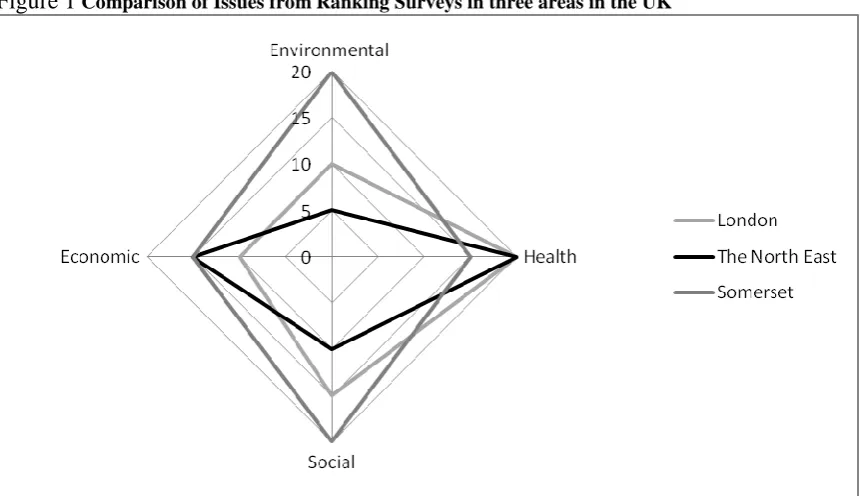
[image:6.595.73.504.289.537.2]Figure 1 indicates that health benefits are the primary perceived impact from most co-ops. A striking finding from this chart is the different perceived food co-op impacts from rural and urban stakeholders. Those co-ops located in the largely rural country of Somerset have indicated that social and environmental impacts are the biggest impacts that food co-ops make. Whereas, in London and the NE, there is more emphasis on the health and economic impacts.
Figure 1 Comparison of Issues from Ranking Surveys in three areas in the UK
The results from the ranking exercise indicate that although co-ops in all three areas ranked health as the primary benefits of food co-ops, other responses varied. Both the North East and London emphasised the value of the social benefits of food co-ops, specifically the impact that food co-ops have on revitalising community facilities and engaging people in community activities. The perceived economic impacts were the most disparate across the three regions. The North Eastern Co-ops ranked ‘Help support local producers, growers or other smaller or more ethical suppliers by providing an outlet for their goods’. London ranked ‘offer new skills and work experience that could be used in other settings and possibly help them get paid employment’ and Somerset ranked highest ‘help ensure money spent stays in the local community’.
Discussion
increasing access to fresh produce. , however bBeyond this commonality the focus and priorities of food co-ops differ and reflect the varied communities they operate within. Within the ethnically diverse communities –largely in urban areas such as London- co-ops played a crucial role in providing culturally specific produce to a wide range of African immigrants. Whereas in rural food co-ops the co-ops appeared to present an opportunity to connect with local economies and the environmental principles of organically farmed produce.
As McGlone et al. suggest that the term ‘food project’ is an umbrella term for a range of activities it appears that so is the term ‘food co-op’. The first stage of research has led us to recognize the fluid and evolving definitions of the term co-op. Within the co-ops visited, the range of responses to the question ‘what makes this operation a co-op?’ suggests that the term ‘food co-op’ is an umbrella term for a range of food projects, while the term ‘co-op’ is used to describe a range of relationships within each project. Given the wide range of food co-op types, when discussing food co-ops in relation to strategy development, it would be of value to be able to define the type of co-op applicable to the situation and the features that would enable it to be sustainable.
Like the range of food co-op types, there are as many partnership types that keep the wheels turning in all of the food co-ops we visited. Partnerships vary depending on the priorities of each individual food co-op. For example in Somerset where there is a focus on organic produce, maintaining the relationship with the producer networks is fundamental to sustain the goals of the food co-ops. Whereas in the urban settings, low cost fresh food is a primary focus of the food co-ops therefore maintaining a partnership with the wholesale distributors is key. This may indicate a shift in the role of food co-ops in the last decade from largely health focussed responses to primarily low-income food access issues to wider community responses to issues affecting residents.
It is clear that there is a distinction that needs to be made between those food co-ops that are a part of wider food project and those that are independent. When discussing this issue with independent food co-op coordinators, it was made clear that if a food co-op became part of a larger project it detracted from the fundamental principles of co-operatives: equal democratic decision making responsibility of shareholders (International Coopertative Alliance Statement of Cooperative Identity 2010).
Funding is an area that demands further examination. The faith based food co-op which has the least financial dependance on outside funding also appears to be the most sustainable. This can in part be attributed to the existing infrastructure of the church in which it operates which includes an exisitng building to operate out of and and a willing set of people prepared to volunteer provide a range of services linked to the Tuesday morning food co-op.
It is clear that in order for food co-ops to remain as an alternative food system the dominant mainstream food system would need to remain inaccessible to many or people would have to choose to shop at a food co-op. This is, unless the food co-ops could provide a service that the mainstream food system would be incapable of. The strengths of many of the food co-ops we visited and perhaps the key to their sustainability are the factors that mainstream food systems cannot provide, such as the social aspect of many food co-ops or the volunteer opportunities.
Conclusion
This phase of research has indicated that food co-ops that have some form of linkage to larger food projects respond to the needs of the communities they operate within in a variety of fashions. There continues to be gaps in the big picture of British food co-ops, however we are more informed of the diversity of food co-op types and food co-op impacts.
Defining food co-ops continues to be a challenge. The food co-ops visited are very different to the original food co-op model based on democratic decision making and equal ownership (Ronco 1974) and this evolution is still largely unaccounted for. As opposed to defining a British food co-op, at this stage we have concluded it to be of more practical value to define the range of co-op types in operation today and to accept the term ‘food co-op’ as an umbrella term.
Figure 1
Reference List
Caraher, M. & Cowburn, G. 2004, "A Survey of Food Projects in the English NHS Regions and Health Action Zones in 2001", Health Education Journal, vol. 63, no. 3, pp. 197-219.
Caraher, M., Dixon, P., Felton, M., South, L. & Tull, A. 2001, Making fruit and vegetables the east choice - Report of a Five-a-day pilot project in Hastings and St Leonards, Hastings and St Leonards PCT, St Leonards-on-Sea.
Caraher, M. & Dowler, E. 2007, "Food projects in London: Lessons for policy and practice--A hidden sector and the need for more unhealthy puddings... sometimes'", Health education journal, vol. 66, no. 2, pp. 188.
Conservative Co-operative Movement , Conservative Co-operative Movement. Available:
http://www.conservativecoops.com/ [2010, 8/16/2010] .
Dowler, E. & Caraher, M. 2003, "Local food projects: the new philanthropy?", The Political Quarterly, vol. 74, no. 1, pp. 57-65.
Freathy, P. & Hare, C. 2004, "Retailing in the voluntary sector: the role of the Scottish food co-operatives", European Journal of Marketing, vol. 38, no. 11/12, pp. 1562-1576.
McGlone, B. Dobson, B. Dowler, E. Nelson, M. 1999, Food projects and how they work, Joseph Rowntree Foundation, York.
Ronco, W. 1974, Food co-ops, an alternative to shopping in supermarkets, Beacon Press.
Towers, A., Nicholson, G. & Judd, P. 2005, Evaluation of the Food Co-operative Groups established by the Rural Regeneration Unit, North West Food and Health Task Force and University of Central Lancashire, Cockermouth, West Cumbria.