Cross Programme Collaboration between
Regional Territorial Cooperation Programmes
Irene McMaster,* Arno van der Zwet,** Heidi Vironen***
There are increased pressures to improve linkages between European Structural and Invest-ment (ESI) Funds programmes. This article identifies three models that can assist more col-laborative approaches. It goes on to draw practical lessons on issues around the establish-ment of such mechanisms. The article draws on the authors’ experiences in relation to for-mulating and consulting on proposals for a collaborative mechanism in the Euro-Arctic re-gion. Regional territorial cooperation is considered an important driver for development in the Arctic and adjacent northern European regions and is supported by European Arctic States and the European Union (EU). Experience from the Arctic demonstrates the added value of regional collaboration. However, formalised cooperation and collaboration need to be highly tailored to specific regional needs and conditions. The development of formal mech-anisms needs to build trust and acceptance among the key stakeholders.
I. Introduction
There are increased pressures to improve linkages be-tween European Structural and Investment (ESI) Funds programmes. Increased budget constraints at national levels, together with the growing emphasis on EU programmes delivering results, present a strong incentive for the European Territorial Cooperation (ETC) and European Neighbourhood Instrument (ENI) programmes to collaborate. Related, the emphasis on delivering results both at the national and EU level pro-vides a strong rationale for increased collaboration, co-operation and coordination between programmes.
The drive for greater collaboration is reinforced by explicit references in the Cohesion policy regula-tions for 2014-2020 to sectoral and territorial
coordi-nation of Union intervention under the ESI Funds and, in turn, with other relevant Union policies and instruments.1 The Common Provisions Regulation calls for coherence and consistency in the program-ming of the ESI Funds.2The Regulation for the ETC
programmes specify requirements in relation to con-tributions to marine and macro-regional strategies, establishing coordination mechanisms with other sources of EU and European Investment Bank (EIB) funding, and cooperation with ‘third’ countries.3
Guidance for theex-anteevaluations of the 2014-2020 programmes require the assessment of the coherence of the programmes with other relevant instruments at regional, national and EU levels.4Also, the
Euro-pean Commission (EC) has produced a guide for ben-eficiaries of ESI Funds, which gives an overview of
* Dr Irene McMaster, Senior Research Fellow, European Policies Research Centre, Strathclyde University.
** Dr Arno van der Zwet, Research Fellow, European Policies Research Centre, Strathclyde University.
*** Heidi Vironen, Research Fellow, European Policies Research Centre, Strathclyde University.
1 Regulation (EU) No 1303/2013 of the European Parliament and of the Council of 17 December 2013 laying down common provi-sions on the European Regional Development Fund, the European Social Fund, the Cohesion Fund, the European Agricultural Fund for Rural Development and the European Maritime and Fisheries Fund and laying down general provisions on the European Re-gional Development Fund, the European Social Fund, the Cohe-sion Fund and the European Maritime and Fisheries Fund and repealing Council Regulation (EC) No 1083/2006.
2 Regulation (EU) No 1303/2013 of the European Parliament and of the Council of 17 December 2013 laying down common provi-sions on the European Regional Development Fund, the European Social Fund, the Cohesion Fund, the European Agricultural Fund for Rural Development and the European Maritime and Fisheries Fund and laying down general provisions on the European Region-al Development Fund, the European SociRegion-al Fund, the Cohesion Fund and the European Maritime and Fisheries Fund and repealing Council Regulation (EC) No 1083/2006, Article 11, p. 344. 3 CEC (2013) Regulation (EU) No 1299/2013 of the European
Parliament and of the Council of 17 December 2013 on specific provisions for the support from the European Regional Develop-ment Fund to the European territorial cooperation goal. 4 CEC, (2014) Monitoring and Evaluation of European Cohesion
complementary instruments available at the EU lev-el,5and internal discussions have been initiated on
how cooperation between programmes works. Options to pursue highly formalised forms of territorially-based cooperation are available, most no-tably through the development of macro-regional strategies. Macro-regional strategies are integrated frameworks endorsed by the European Council, which may be supported by the ESI Funds, among others. Such strategies have now been established for the Baltic Sea region, Danube Region, Adriatic and Ionian Region and Alpine region. Macro-regional strategies focus on concrete, common (integrated, joint or coordinated) action on the ground in order to mobilise synergies between development initia-tives in different programmes, countries and regions, and to realise economies of scale.6
However, not all regions need or want to follow such an approach. Yet, a commitment remains to practical, ‘operationally oriented’ collaboration to complement and support existing cooperation and tailored to the specific needs of regional economic development partners. For example, collaboration can take place on issues such as regional innovation systems, environmental practices, transport and con-nectivity.7In these cases, rather than a highly
struc-tured form of cooperation a more loosely organised form of collaboration appears preferable. How would such an arrangement be organised? What would sup-port collaboration? What services should be provid-ed? How should it be structurprovid-ed?
This article identifies three models that can assist more collaborative approaches. It goes on to draw practical lessons on issues around the establishment of such mechanisms. The article draws from authors’ experiences in relation to formulating and consult-ing proposals for a collaborative mechanism in the Euro-Arctic region.8Rapid environmental and
eco-nomic change in the Arctic has an important region-al dimension. Regionregion-al territoriregion-al cooperation is con-sidered an important driver for development in the Arctic and adjacent northern European regions and is supported by European Arctic States and the EU.
II. Cooperation and Collaboration in
the Euro-Arctic
Territorial cooperation, cross-regional planning and coordinated policy formulation are well-established
processes in the Euro-Arctic region and they bring well-recognised benefits, such as: increasing the pro-file of a territory or issue; reinforcing links; new and joint solutions to policy challenges; opportunities for learning and exchange; and pooled financial re-sources. In the past, cooperation in the region has been described as a ‘cob-web’,9which was based on
numerous thematic/sectorally-based linkages and connections within the area. Based on an assessment of contemporary cooperation arrangements in the re-gion, it is now more accurate to talk about ‘cob-webs’ of cooperation, involving a wider array of linkages and differing layers of cooperation.10Not only are
there EU cooperation programmes, there are net-works of Nordic cooperation, additional layers of in-tergovernmental arrangements and sub-regional connections. Some of the key arrangements in terms of regional development are set out inTable 1. This wide range of experience of territorial cooperation in the region offers a strong base upon which to build, a number of experienced partner institutions and or-ganisations, and numerous lessons to draw on. How-ever, the webs of cooperation that currently exist al-so make it difficult for new coordination efforts to add value and have a visible effect on developments in the region.
However, new challenges have emerged in the re-gion, which arguably demand new responses. Change in the Arctic has an important regional di-mension. Regional territorial cooperation is
consid-5 CEC (2014) Guidance for Beneficiaries of European Structural and Investment Funds and related EU Instruments’, CEC Brussels. 6 D. Ahner, ‘Foreword’, in Stefan Gänzle and Kristine Kern (eds)A
Macro-Regional Europe in the Making: Theoretical Approaches and Empirical Evidence, (Basingstoke: Palgrave MacMillan, 2016).
7 A. van der Zwet, J. Bachtler, and I. McMaster,‘Arctic Connec-tions: Mapping Regional Cooperation in the Arctic’, Paper pre-pared for the Arctic Connections Conference in Glasgow, 10-11 June 2014.
8 Significant sections of this article are based on the final report for a preparatory project of the 2007-2013 INTERREG transnational ‘Northern Periphery Programme’: I. McMaster, A. van der Zwet, H. Vironen, F. Gaskell, and Jawahir, ‘Northern Periphery Pro-gramme Preparatory Project – Arctic Collaboration Mechanism’, Report for the Northern Periphery Programme Monitoring Com-mittee, August 2015, EPRC, Glasgow, Integritas Liaison, and Troms Council, 2015.
9 N. Andren, ‘Nordic Integration: Aspects and Problems, Coopera-tion and Conflict,(1967) Vol 2. No. 1 pp. 1-2.
10 I. McMaster, ‘Governance and co-operation in the NORA region’,
ered an important driver for development in the Arc-tic and adjacent northern European regions and is supported by European Arctic States and the EU. It has intensified considerably in the Arctic region over the last two decades. Related to this, there are a num-ber of interlinked rationales for increased collabora-tion between the different regional territorial coop-eration frameworks in the Arctic region.
Critical Mass
The Nordic countries and regions in the Arctic have a long history of cooperation, and many institutions and organisations are involved in many different co-operation frameworks which include ETC pro-grammes, ENI Propro-grammes, Nordic Council of Min-isters, Barents and Euro-Arctic Council, Arctic Coun-cil and Northern Dimension framework. At the same time, the region is characterised by sparse popula-tion and a limited number of stakeholders.
Thematic Rationale
While the Euro-Arctic is a diverse region, specific de-velopment issues linked to extreme environments, peripherality, and a sparse population are common threads linking the geographically large Arctic and near-Arctic regions in Europe, and they provide sol-id, proven areas for collaborative working. Collabo-ration provides an opportunity to address issues and opportunities which may appear marginal in a do-mestic context but may be relevant to similar regions across a wide number of countries.
Strategic Policy Rationale
[image:3.643.98.540.135.452.2]Policy development in the Euro-Arctic is a topic of global interest and concern. This has led to a pletho-ra of sectopletho-ral policy initiatives, stpletho-rategies and action plans. Since 2006, all Arctic states have formulated strategies in an attempt to address effectively the
Table 1: Territorially-based Cooperation in the Euro-Arctic
Arctic Council Intergovernmental forum promoting cooperation, coordination and interaction among the Arctic states, Arctic Indigenous communities and other Arctic inhabi-tants on common Arctic issues.
Nordic Council and Nordic Council of Ministers
The Nordic council is an inter-parliamentary body in which five countries (Den-mark Finland, Iceland Norway and Sweden) and three self-governing territories (the Faroe Islands, Greenland and Åland) are represented. The Nordic Council of Ministers was established to complement the Council. The Nordic Council of Min-isters consists of ten thematic councils of minMin-isters which meet twice per year. Northern Dimension A joint initiative between four partners - the EU, Russia, Norway and Iceland -
re-garding the cross-border and external policies. Geographically covers North-West Russia, the Baltic Sea and Arctic Regions, including the Barents Region. Barents Euro-Arctic Council and Barents
Regional Council
Forum for intergovernmental cooperation on issues concerning the Barents Re-gion. Thirteen counties from Finland (three), Norway (three), Russia (five) and Sweden (two) currently cooperate in the Barents Regional Council (BRC) in order to improve living conditions and encourage sustainable social and economic de-velopment in the northernmost part of Europe.
ETC Transnational Programmes • NPA 2014-2020 – Northern Periphery and Arctic Programme • BSRP 2014-2020 – Baltic Sea Region Programme
ETC Cross-border Cooperation (CBC) Programmes
• CBC Botnia-Atlantica 2014-2020 • CBC Nord 2014-2020
ENI CBC Programmes • ENI Karelia 2014-2020
• ENI Kolarctic 2014-2020
• ENI South East Finland Russia 2014-2020
challenges and exploit the opportunities that the re-gion faces. Near-Arctic states including the UK are al-so formulating policies that set out their interest in the Arctic and how they will work with Arctic states and the wider international community. The EU is also looking at its role in the region, and its Arctic policy is evolving.11As part of this, the Commission
is actively encouraging collaboration between pro-grammes in the region, calling for “proposals for the further development of an integrated and coherent Arctic Policy by December 2015. As part of this exer-cise, the Council encourages the Commission to en-sure effective synergies between the various EU fund-ing instruments in the Arctic region”.12
Operational Rationale
Collaborative working offers a way for projects to ex-tend their influence and deepen their results. Infor-mation is made available for project partners on how to work, for example, across funds, and to up-scale their ideas etc. However, for partners, particularly those engaged in comparatively small-scale territor-ial cooperation programmes, taking the ‘step up’, e.g. from an INTERREG project to involvement in a Hori-zon 2020 project, and applying for new or addition-al sources of funding is demanding and gathering the knowledge and understanding of the options available is highly time consuming. A vast array of support is available through EU, national, and region-al initiatives, each with differing expectations and re-quirements, e.g. the administrative demands differ, new networks are required. Operationally-oriented support through, e.g. partner search facilities or re-views of available initiatives, could help stakehold-ers quickly identify new/additional options.
1. Background to Developing a
Collaboration Mechanism in the
Arctic
In this context, two interrelated processes aimed to bring together stakeholders in the Arctic region to explore the possibilities for establishing a mecha-nism through which the existing regional territorial cooperation programmes could collaborate. First, the 2007-2013 Northern Periphery Programme (NPP) previously funded a preparatory project that helped scope out the new 2014-2020 Northern Periphery and
Arctic (NPA) Programme’s involvement in the region and, in particular, established how the Programme as a whole might engage with an Arctic dimension. This study identified a number of challenges in rela-tion to Arctic cooperarela-tion and led to increased aware-ness in the NPA of how it could better link with oth-er coopoth-eration programmes in the region.13The NPA
programme has, because of its geography covering the whole of the Euro-Arctic region, taken a lead role in looking for mechanisms to facilitate collaboration and funded a second preparatory project which crit-ically assessed the potential for synergies, the bene-fits for stakeholders of improved collaboration, and options for systems/platforms for collaboration and knowledge sharing and building.
Second, the so-called ‘Bodø process’ was initiated in March 2013 by the Norwegian Government in Bodø and explored the prospects for greater collabo-ration through territorial coopecollabo-ration programmes in the Euro-Arctic and near-Arctic. Following semi-nars in Bodø and Brussels hosted by the Norwegian and Scottish governments, a conference was held in Glasgow in June 2014. The conclusions of the Glas-gow Conference confirmed broad interest among rel-evant stakeholders in establishing a network for re-gional collaboration to promote information sharing, knowledge exchange, project cooperation, project support and capacity-building across programmes and other regional initiatives in the north of Europe. This is particularly pertinent given current uncertain-ties in the Arctic ‘arena’ and concerns that the focus will shift to the “classical” Arctic cooperation themes (security and environment) and away from broader development themes. Following the conference, a meeting in Tromsø, January 2015, reviewed progress.
2. Consultation, Consensus and
Challenges
Consultation and engagement with stakeholders has been at the heart of these processes. Areas of
consen-11 Developing a European Policy towards the Arctic Region – Joint communication to the European Parliament and the Council, 26 June 2012.
12 Council conclusions on developing a European Union Policy towards the Arctic Region - FOREIGN AFFAIRS Council meeting, Brussels, 12 May 2014.
sus were established early in discussions and were based around the key rationales set out in Section 2. However, challenges and questions about the need for, and utility of, a formal collaboration mechanism were also noted. First, the scope and role of a pro-posed mechanism needed to be clear. In particular, a distinction had to be made between the aims of co-ordination, cooperation and collaboration. As op-posed to a formal form of coordination or coopera-tion, what was sought was collaboration and mutual support. The aim was not top-down coordination, or enforced cooperation. The need for clarity was par-ticularly important in relation to an area as strategi-cally important and politistrategi-cally charged as the Arctic, and in an environment where organisations and stakeholders have to work to their own agendas and justify their actions to domestic interests.
Second, the high risk of institutional and informa-tional overlap caused some significant concerns. The risk of duplication of effort and the sense that much was already being done through existing structures working in related areas were noted. As discussions about the precise role and function of a collaboration mechanism developed, the scope and scale of the con-cept expanded and contracted. At some points, the aims of the mechanism came too close to the activi-ties of other organisations, and risked losing focus on their initial intentions. A lack of clarity and vary-ing interpretations of the concept led to additional concerns.
Third, concerns were raised about the perceived value of adding another ‘arrangement’ to an already congested policy and institutional environment. An additional set of meetings, an additional ‘layer’ of de-bate and deliberation, and another set of require-ments to liaise and share information could simply add weight to existing institutional and administra-tive burdens. Given the already complex and de-manding task of engaging in territorial cooperation, would organisations and stakeholders have the time and resources to engage with the facility?
Fourth, initial discussions of the mechanism ‘set the bar high’ in terms of the services and structures proposed. The need to build in a period to trial, test, and, if appropriate, grow the mechanism was not re-flected. Consideration of the location of any proposed structure encountered considerable sensitivities, with various locations proving attractive, but the se-lection of some places over others proving challeng-ing.
While there have been concerns and challenges, common points of consensus emerged and were re-turned to throughout the various events and discus-sions. These points formed the basis of a new start-ing point for considerstart-ing a collaborative mechanism for Euro-Arctic regional development programmes. Consensus centres around:
– Practical, ‘operationally oriented’ activities and in-formationto complement and support existing co-operation and tailored to the specific needs of re-gional economic development partners in the Arc-tic and near-ArcArc-tic. Besides the operational bene-fits, collaboration provides potential for policy-relevant thematic and strategic action to be gener-ated (e.g. through liaison with policy-oriented part-ners such as BEAC, Northern Dimension and the Arctic Council working groups).
– Activities and informationthat complement and build on existing cooperation networks; and – Arrangements that support and facilitate the work
of partners in the regionand do not unnecessarily add to an already complex institutional and poli-cy environment. Every level from the respective managing authorities through the stakeholders to the beneficiaries will benefit from improved sup-port, intelligence and partnership access.
III. Collaboration Models
Working from this basis of understanding, work was undertaken to identify potential models as a means to progress discussions. Collaboration mechanisms can take an extremely wide variety of forms. These can range from online information resources to dy-namic networks and involve differing levels of e.g.: – ‘Push’ vs ‘pull’ of the knowledge flow – systems
can be based around the collection and wide dis-semination of data and information; alternatively they can respond to an information demand from users and providing tailored responses to individ-uals’ preferences, or offer a combined approach; – Internal vs external expertise – the information
provisions can be based on internally generated knowledge (peer to peer) or brought in expertise (i.e. by using thematic experts), or a combination of the two;
– Networks vs core institution/s - there is scope for loose arrangements bringing together multiple partners or having a clear lead institution; and – Conference vs ongoing contact – cooperation can
operate through regular meetings or conferences or via a sustained, permanent presence.
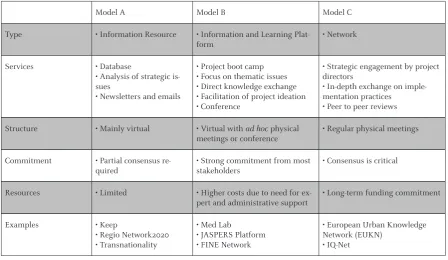
However, it is possible to group the options available into three main types, differing in terms of the ser-vices they provide, their structure, stakeholder com-mitment, inputs and outputs, services, and resources involved. Each option could be treated as distinct, but could also be viewed as points on a continuum, where collaboration evolves from a ‘light touch’ online re-source to a more developed extensive network of en-gagement over time,
1. Model A – Online Information
Resource: Virtual Portal
Online information resources are numerous and used extensively. These models have the potential to reach a broad audience at a comparatively low cost. Online information resources vary in terms of the level of interactivity. Required inputs would be based on external information in the case of a non-interac-tive resource. An interacnon-interac-tive resource requires com-munity generated information. In both cases the in-formation can be centrally managed. Different ‘nodes’ can provide informational inputs depending on their expertise. The online resource needs to be animated and promoted among its target audience. Additionally, a level of on-going commitment is re-quired from stakeholders to inform and update the information available.
Setting up the resource will involve an initial out-lay to cover development costs and set-up. To be an engaging, useful and up to date resource, the avail-able information must be regularly maintained and updated, which implies continued running costs as well as on-going levels of commitment. Nevertheless, overall, the level of investment can be expected to relatively modest.
Typically Model A provides the following services: – E-library of regional development research; – Database of project activities and outcomes; – Case studies;
– Manuals; – Fact sheets;
– Quick reference guides; – Partners databases; – Contact database; – Events diary;
– Depository and ‘digest’ of event materials; – Online newsletter;
– Blog post on current issues;
– Online forums organised around themes or imple-mentation issues.
Examples of such approaches include the Knowledge and Expertise in European Programmes (KEEP) data-base14developed by INTERACT which offers an
on-line database of territorial cooperation projects. KEEP fills a gap by offering aggregated information regarding the projects and beneficiaries of EU pro-grammes dedicated to cross-border, transnational and interregional cooperation in Europe. It provides information to potential beneficiaries, lead partners and partners, programme bodies, and the wider public.
A second example of a virtual model is Regio Net-work 202015which is an online professional
network-ing platform for cooperation and exchange of good practice between European regions. Partners can use the site to tell the rest of the regional policy commu-nity about their priorities and achievements. They can also interact with their counterparts in other EU countries. The main features are: thematic groups; share examples of good practice; create profiles for a region; and create profiles for an individual.
A third example is Transnationality16which is a learning network on transnational cooperation in Eu-ropean Social Fund (ESF) and community of practice on transnational cooperation. The aim of the Net-work is to foster learning and build capacity among ESF programme managers to help ensure successful implementation and promotion of transnational ac-tions under ESF. The Network is led by the Czech Re-public and supported by England, France (Racine), Germany, Greece, Poland, Slovenia, Spain and Swe-den. It receives financial support from the EC. The online resource offers a calendar of calls, partner search database, news, e-library and external links.
14 See <http://www.keep.eu/keep/>, accessed May 2014. 15 See <http://regions202020.eu/cms/sec/eu-actions/regionetwork
-2020/>, accessed May 2014.
2. Model B – Information and Project
Support
Model B builds on Model A providing direct project support services, in addition to information services. Key in this model is that resources are more tailored to the needs of target user groups. The Model A ele-ment can remain broad but the more targeted sup-port is provided to a more targeted group of stake-holders based on their specific requirements.
The resources needed for the project support ele-ment of this model depend on the services that are offered. Some secretariat functions would be re-quired. However, there are examples of such models which organise face-to face meetings on a regular ba-sis at relatively low cost (see below). In these cases, the model supports a direct exchange of experience rather than a deeper analysis of implementation is-sues or thematic focussed discussion. However, Mod-el B requires strong commitment levMod-els from a core group of participants.
The required inputs are to an extent self-generat-ed and rely on the expertise and knowlself-generat-edge of stake-holders. The organisation is based around the facili-tation of discussion rather than relying on external expert analysis.
Crucially, Model B offers a forum for direct, face-to-face interaction between programme stakehold-ers in relation to specific implementation issues. As such it goes beyond knowledge exchange and shar-ing experiences and facilitates discussions to explore collaborative approaches between programmes. Typically Model B could provide the following ser-vices:
– Strategic support;
– Project boot camps (a strategically focussed semi-nar to support potential beneficiaries in develop-ing projects);
– Capacity building activities (ad hocworkshops); – Project review and recommendations;
– Webinars and policy labs;
– Conference.
Examples of Model B are the Mediterranean Labora-tory (Med Lab)17, the Joint Assistance to Support Projects in European Regions (JASPERS) Network-ing Platform and the UK Financial Instruments Net-work (FINE).
The Med Lab provides a platform for the exchange of ideas and the cross fertilisation of projects. The overall aim is to improve the quality of overall coop-eration in the Mediterranean region and facilitate thematic discussions. Other more specific aims in-clude: create synergies between programmes and projects; re-use outcomes; promoting durability of projects; and promotion and communication of project achievements in order to raise the profile of activities in the region.
The JASPERS18Networking Platform19aims to
ad-dress specific project preparation issues of a horizon-tal nature, enhancing knowledge sharing activities, dissemination of best practice and exchange of expe-rience among JASPERS stakeholders, as well as im-plementing capacity building activities. Participation in the activities of the Networking Platform is open to JASPERS partners and relevant public authorities from EU Member States and pre-accession countries. Activities include: workshops on project preparation and implementation; seminars, horizontal studies and dissemination of guidelines, case studies, mod-el projects and standard toolkits; interactive forums, dissemination of best practices and lessons, network-ing; capacity building events; and activities directly requested or promoted by Members.
FINE network brings together a group of man-agers four times a year to discuss current issues in relation to financial instruments. Services include a restricted access website which is a depository of key documents. The model offers possibilities for further expansion (e.g. research projects on specific themes). The model is low cost and minimum secretariat func-tions are required. Members can join on a needs ba-sis but requires a core group that keeps things going.
3. Model C – Project Support and
Knowledge Exchange Network
Knowledge exchange and support networks have be-come increasingly popular. These networks can facil-itate understanding and developing solutions for 17 See <http://www.interact-eu.net/med_lab_group/mediterranean>,
accessed May 2014.
18 JASPERS (Joint Assistance to Support Projects in European Re-gions) is a technical assistance facility for the 12 EU countries that joined the EU in 2004 and 2007, and which provides these Member States with support to prepare high-quality major projects, which will be co-financed by EU funds.
complex policy issues. They can also provide a basis for integrated approaches and a deepening of work-ing relations between stakeholders.
Model C is an extension of Model B. It offers in-formational services and project support. The sup-port functions are however more structured and tar-geted. A key aspect of such models is that they offer a stable and long-term environment for partners in which informed discussions can take place in an open atmosphere.
Networks generate information according to a structured research programme and input from ex-ternal experts. The running costs of networks are usually covered by fees paid by partners on a regu-lar basis. The network requires a dedicated team of specialist experts that collect and analyse informa-tion which informs discussion. Similar to Model B different nodes could provide functional or themat-ic expertise, the main difference being the depth of skills and knowledge that is required from the team of researchers and support staff to manage the net-work.
Model C could provide the following services: – Regular meetings;
– A structured research programme providing an overview of changes in the region;
– Peer to peer review;
– Ad hoc and immediate support;
– Thematic research papers selected by members; – Master classes;
– Study trips.
Examples of Model C include the European Urban Knowledge Network (EUKN), which is a Member State driven network (eight members) that provides specialist urban knowledge in the form of tailor-made services, expert analysis, topical dossiers and specif-ic practspecif-ical assistance. The network offers various membership packages depending on each Member State’s ambition and country size. It is organisation-ally structured around national focal points and has a secretariat in the Hague.
The IQ-Net network20brings together regional and
national partners from Structural Funds pro-grammes across the EU. Its aim is to improve the quality of Structural Funds programme management through exchange of experience. The network in-volves a structured programme of applied research and debate; network partners meet twice a year, with conferences being hosted by the partners on a
rota-tion basis. IQ-Net enables programme managers and their partnerships to exchange experience and share good practice on specific themes relating to the de-sign, delivery, management and evaluation of the Structural Funds programmes. The network is man-aged by the European Policies Research Centre and has a dedicated team of specialist researchers. It cur-rently has 16 members from 12 Member States.
Table 2provides a summary of the varying mod-els for cooperation. Based on consultation and feed-back on the models in relation the specific case of the Euro-Arctic, the main conclusions with regards to the different models are summarised in Table 3. The clearest point to come from the consultation was that any approach had to be tailored to the specific situa-tion in the region.
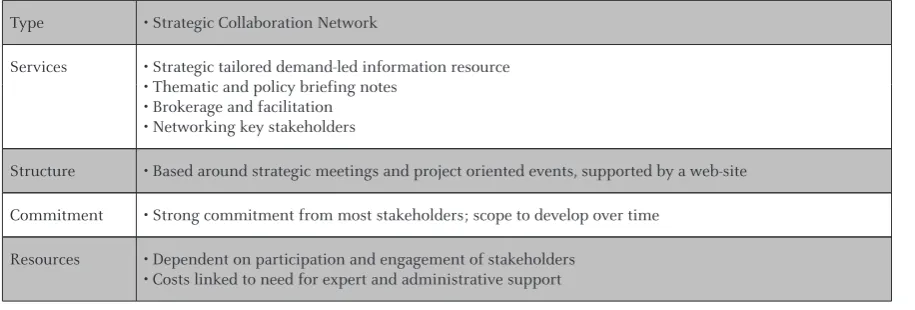
On this basis, a revised model was developed, (Table 4), and a wider consultation was initiated. The consultation exercise identified significant consen-sus around the model, with respondents comment-ing on potentials and opportunities. Where concerns and reservations were expressed, respondents com-monly followed up with a proposal of how to address or work round the issue. Additionally, despite exten-sive support for the high level aims and objectives of the model, some respondents expressed that there still is a lack of clarity on the exact focus of the mech-anism. In a more limited number of cases, opposi-tion or significant reservaopposi-tions were expressed to the idea of a collaboration mechanism for the Euro-Arctic.
IV. Lessons from the North
At this point discussions are still ongoing as to the how the concept of Arctic Regional Collaboration will be taken forward.
However, the process to date establishes some valuable points and lessons for further and future discussions and debates on regional coordination, co-operation, and collaboration.
First, while considerable policy and academic at-tention has been focussed on the more ‘formalised’ forms of cooperation, e.g. most recently macro-re-gions, there is significant interest in looser forms of collaboration.
Table 2: Models for Cooperation
Model A Model B Model C
Type • Information Resource • Information and Learning Plat-form
• Network
Services • Database
• Analysis of strategic
is-• Project boot camp • Focus on thematic issues
• Strategic engagement by project directors
sues
• Newsletters and emails
• Direct knowledge exchange • Facilitation of project ideation • Conference
• In-depth exchange on imple-mentation practices
• Peer to peer reviews Structure • Mainly virtual • Virtual withad hocphysical
meetings or conference
• Regular physical meetings
Commitment • Partial consensus re-quired
• Strong commitment from most stakeholders
• Consensus is critical
Resources • Limited • Higher costs due to need for
ex-pert and administrative support
• Long-term funding commitment
Examples • Keep
• Regio Network2020 • Transnationality
• Med Lab
• JASPERS Platform • FINE Network
• European Urban Knowledge Network (EUKN)
• IQ-Net
Source: Authors’ own compilation.
Table 3: Critical Review
Model Assessment
Model A
√
• Value in the provision of background materials for meetings • Information could be requested and built up over time • Some kind of web presence required
x
Questions over the utility and ‘usability’ of another web-based information resource, including potential overlaps with existing sources, to what extent will stakeholders have the time to engage, the time effort and cost in initially gathering information together is high and maintaining data bases and online resources would be substantial. A purely virtual resource means the mechanism lacks scope to build substantial links and relationships.
Model B
√
• More practical orientation
• Engagement at project, as well as strategic levels valuable. • Potential to turn ideas and ‘talk into action
x
Lacks a strategic, forward looking element. Also, initially, too wide a thematic focus and trying to cover all themes/issues could weaken the contribution of the mechanism. There are already fora for exchange of best practice and peer-peer learning.
Model C
√ • Strategic engagement• In-depth informed engagement
x
• May not be confined to programme directors
• Does not want to just be another talking shop and network, want to have a practical element to the work
Second, the experience from the Arctic demon-strates the added value of collaboration more generally.
A more collaborative approach:
– Provides a wider, forward looking and strategic analysis;
– Looks at developments in the wider policy envi-ronment in the region to make connections to con-cerns/opportunities for regional programmes; – Facilitates a strategic, proactive dialogue on areas
for practical collaboration;
– Contributes to building better, more strategic, in-novative projects, new ways of working, new part-ners and partpart-nerships and maximising project re-sults;
– Facilitates the development of critical mass and widening the pool of potential project partners, given the particular challenges faced by regional development programmes in sparsely populated areas;
– Could aim to offer a brokerage/ facilitator service and possibly a ‘pre-pilot’ phase for project ideas; and
– Offers a better use of existing financing and re-sources.
Third, the development of a mechanism needs to build trust and acceptance among the key stakehold-ers. An evolving or rolling process in which different options are presented offers the advantage of
provid-ing a broad base for discussion. Political actors at EU, national and regional level have overlapping, but of-ten also distinctive agendas, squaring these agendas requires constant engagement and negotiation, par-ticularly in relation to issues such as resources and geographical location(s). Although a key element of success is engagement of a broad range of stakehold-ers, having a small number of central stakeholders that drive the process is equally important. These key actors can be national or regional government repre-sentatives but also programme officials play an im-portant role. They have to provide resources, vision and commitment for taking forward the discussions without putting their particular interests at the fore-front.
[image:10.643.98.556.135.290.2]Fourth, although models for collaboration have certain common characteristics, there is no blueprint that can be applied to more than one form of collab-oration. The complex environments in which region-al territoriregion-al cooperation programmes operate mean that each region has different needs and stakehold-ers. Any model must be structured according to those specificities. For example, macro-regional strategies offer a relatively top-down, formalised and institu-tionalised framework for collaboration which can be appropriate in some cases. For others a more flexible and less formalised form of collaboration may be pre-ferred to achieve a more collaborative and bottom up approach to the coordination of funding ultimately aimed to benefit the European communities.
Table 4: Model ‘D’: Strategic Collaboration Network
Type • Strategic Collaboration Network
Services • Strategic tailored demand-led information resource • Thematic and policy briefing notes
• Brokerage and facilitation • Networking key stakeholders
Structure • Based around strategic meetings and project oriented events, supported by a web-site Commitment • Strong commitment from most stakeholders; scope to develop over time
Resources • Dependent on participation and engagement of stakeholders • Costs linked to need for expert and administrative support