Investigation into initiation and propagation of cracks in the
coated surfaces of spur gears with submodelling and
irreversible cohesive-zone modelling techniques
Jiling Feng
1,*, Yi Qin
2, and Hanshan Dong
3 1Division of Mechanical Engineering, School of Engineering, Manchester Metropolitan University, Manchester M1 5GD, UK
2
Department of Design, Manufacturing and Engineering Management, University of Strathclyde, Glasgow G1 1XJ, UK
3 Surface Engineering, University of Birmingham, Birmingham B15 2TT, UK
Received 30 September 2015 / Accepted 10 March 2016
Abstract –Spur gears are one of the commonly used transmission parts in industry, due to its simplicity in structures and low cost in manufacturing. Due to a performance requirement, a spur gear may be coated with a specific coating arrangement. Under working conditions, the coating on the teeth may be damaged due to contact fatigue, in the forms such as micro-pitting and/or delamination. The failure mechanism of the coated surface under the gearing contact loading has been investigated intensively through experiment. A comprehensive computational model, which could be used to investigate the propagation of cracks in the coated surfaces, is still lacking. In the research reported in this paper, several finite element modelling techniques, including that for submodelling and irreversible cohesive zone modelling (CZM), have been developed to investigate the failure mechanisms of the coated surfaces of gears under the gearing contact fatigue loading. These techniques not only allow the localized stresses distribution and deforma-tion in the interested locadeforma-tions in the coating and the substrate to be investigated in detail but also enable visual obser-vation on the development of fatigue damages in the coating.
Key words:Coated surface, Spur gear, Fatigue damage, FE modelling, Submodelling, Cohesive-zone modelling
1. Introduction
Thin, hard PVD (physical vapour deposition) and CVD (Chemical Vapour Deposition) coatings have been widely used in a variety of industrial applications, due to the enhanced hardness and wear resistance of the contact surface [1]. Thin hard coatings have positive influences on the fatigue and cor-rosion fatigue behaviours of the mechanical components, which justifies their uses in some critical systems such as auto-motive systems [2] and aeronautic systems [3]. Prior to the ini-tiation of the research reported in this paper, it was found that there was a need to develop a more reliable, theoretical and numerical model for the analysis of coating surfaces in the gears, although some effort had been made on the analysis of the fatigue damages of the coated gears [4,5]. To-date, anal-ysis of the coatings in engineering surfaces still largely relies on the uses of empirical formulas or is based on experience. Clearly, a more accurate computational model, allowing for the specific working conditions to be taken into account, is much needed from the point of view of the coating design
and analysis. Most recently, an innovative modelling method, which combined with the parameterized modelling, sub-modelling technique and cohesive zone model (CZM), was developed to determine the load-bearing capacity for the coated products [6,7]. This comprehensive modelling method allows for many key factors, including geometry, material properties and pre-heated treatment, to be considered in the coating design and analysis. This method and model have been validated by a series of micro-indentation tests and gearing contact tests [6, 8]. In this study, the innovative modelling method was developed further by implementing irreversible cohesive law with unloading-reloading hysteresis, with which the failure mechanisms of the coated spur gear under the contact fatigue loading has been investigated.
2. Localizations of the damage on the tooth
flank
Based on a conventional standard procedure for gear design, pinions are more apt to pit than gears [9]. This is because the sliding motion of the pinion tends to pull metal
*Corresponding author:[email protected]
DOI:10.1051/mfreview/2016008
Available online at:
http://mfr.edp-open.org
This is an Open Access article distributed under the terms of the Creative Commons Attribution License (http://creativecommons.org/licenses/by/4.0), which permits unrestricted use, distribution, and reproduction in any medium, provided the original work is properly cited.
away from the pitch line due to its role as a driver. In addition, the pinion has more cycles of operation than the gear wheel and therefore more apt to fail due to fatigue damage. In this study, investigation of damage behaviour only focuses on the teeth flank of the pinion.
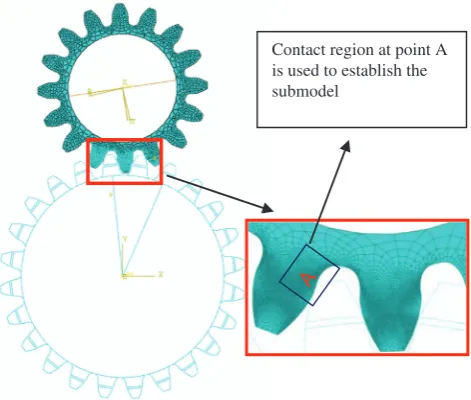
In the teeth flank of pinion, there are two locations where micro-pitting is most likely to occur due to the severe contact loading conditions. These two locations are based on the two extremely points (point A and point B inFigure 1). The point A refers to the location, where the wheel tip touches pinion root and engagement begins. As the pinion has small number of teeth, the radius of curvature of involute profile at the root tends to reduce toward zero, which induces extremely high localized stresses, and hence gives rise to pitting away of the metal. Point B is a typical location, where the load is only sup-ported by one pair of teeth, and hence the highest contact stress is expected to occur. Therefore, Point B is considered as the area where the micro-pitting is easily to occur. In the following sections, the damage performance such as localized contact stresses, plastic deformation and cracks at these locations under the cyclic loading, will be investigated using the devel-oped methodology.
3. Methodology
In this paper, the fatigue damage of the coated surface of a pair of spur gears was investigated using the newly developed modelling procedure, which combines several modelling tech-niques, including the parameterised FE modelling, irreversible CZM and sub-modelling. Parameterised modelling allows for materials and geometrical parameters as well as loading condi-tions to be described using parameters, enabling many key fac-tors to be incorporated in the analysis as a whole. CZM enables the reproduction of the initiation and propagation of cracks in the coating-layer under complex gear/pinion contact loading conditions. The sub-modelling helps to scale down the geom-etry of the global model from the macro-scale to the micro/ nano-scale. The sub-modelling is a powerful tool for develop-ing understanddevelop-ings of the performance of coatdevelop-ing structures and its failure mechanism in a great detail. The case examined in this study was line contact between a pair of gears, where pinion and wheel have 16 and 24 teeth, respectively. The cen-tral distance between gears is 91.1 mm, where addendum
diameter for pinion is 82.405 mm and for wheel is 118.417 mm. The surface of the gears will be deposited a very thin coating layer with the thickness of 2 micron. Evidently, there is significant difference existed in the geometrical dimen-sions of gears and thickness of coatings, which causes diffi-culty in the establishing of a unified model to consider different length scales. In order to address the significant differ-ence of dimensions between the wheel/pinion and coating thickness, a two-step analytical procedure was used: (1) deter-mining the contact conditions (pressure and friction) in the contact area using a global model; and (2) generating a repre-sentative sub-model within the contact region so that coating performance can be investigated at the micron-scale level. The techniques described above was shown inFigure 2, where a finite element global model is used to capture the features of geometrical shape and engagement of gears and a sub-model is used to predict the detailed performance of the coated surface. It is scaled down to a micron level where cohesive elements
A
B
[image:2.595.131.466.73.202.2](a) (b)
Figure 1. (a) Point A represents the location where the pinion starts to engage with the wheel; (b) Point B represents the location where only one pair of teeth is subjected to the load.
A
Contact region at point A is used to establish the submodel
[image:2.595.313.549.257.457.2]were introduced in order to predict the performance of the coating system and its damage micro mechanism.
4. Cohesive zone model
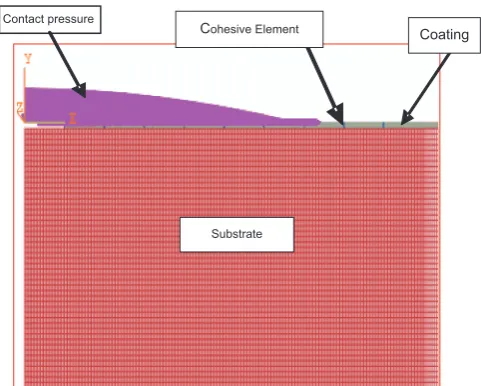
The cohesive law, specifying the relationship of the traction and separation across the two virtual adjacent surfaces, pro-vides a phenomenological description for the progressive dam-age and eventual fracture of the material [10]. Implementation of a cohesive zone model between the continuum elements has been proved to be an efficient technique for the simulation of nucleation and propagation of cracks in the coating surface under monotonic loading [1]. An example of incorporating cohesive elements in a sub-model is shown inFigure 3.
As well known, under the fatigue loading, deterioration of the coating material and cohesive strength are expected to be related largely to the loading history. Accordingly, CZM with unloading-reloading hysteresis would need to be implemented in a model, allowing for the fatigue failure mechanisms under the contact cyclic loading to be investigated.
4.1. Cohesive-zone model under the monotonically loading
An irreversible bilinear cohesive-zone modelling approach under the monotonically loading was incorporated with the other modelling techniques including parameterized modelling technique and sub-modelling technique to investigate the crack initiation within the coating layer. The bilinear cohesive-zone law, characterised as the linear function of softening relation-ship of traction-separation of material degradation, can be written as:
Gc¼ 1
2Tmaxdc ð1Þ
where: Gc (45 J/m2) is the critical energy-release rate gov-erning the damage evolution and Tmax indicates the maxi-mum traction; and dc (1%) is the characteristic cohesive-zone length to which the separation reaches when the crack surfaces will be generated. A crack in the coating layer may be initiated when the separation reaches the critical value of, d0, at which point the traction achieves its maxi-mum value, Tmax. The parameters of cohesive properties, including the energy-release rate, are crucial to the accuracy of simulation of the cracking within the coating and delami-nating of a bonding interface. In this study, the adhesive energy at the atomistic level, was calculated using CASTEP software, which provides an alternative way to determine the value of the cohesive properties. It also provides an approach of linking micro- and nano-mechanical modelling. By means of the cohesive-zone modelling, the critical load in terms of the initiation of the first crack could be predicted. More details on the bilinear cohesive constitutive law, the imple-mentation and applications can be found in author’s previous work [6].
4.2. Cohesive-zone model under cyclic loading
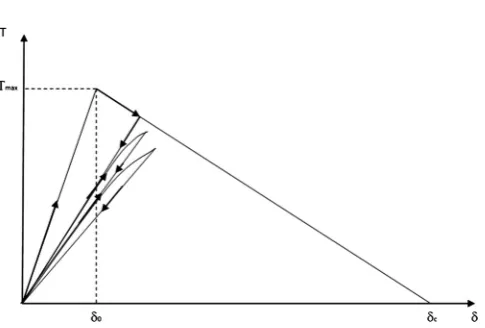
The fatigue can be considered as one of the major causes that induce the failures in many coated surface-systems. Under a fatigue loading condition, the material deteriorates with the time and the prevailing cohesive strength must be related to the loading history. The cohesive constitutive equation described in equation(1) has been approved an efficient way to simulate the crack within the coating and the delamination of the interface between coating and substrate under the mono-tonic loading [6]. This equation, however, may results in infi-nite life under cyclic loading since the dissipation mechanism during the process unloading and re-loading is not taken into account. To develop a model that considers cyc-lic loading, an irreversible cohesive law with an unloading-reloading hysteresis function, as shown in Figure 4, is employed to simulate the mechanical response of the cohesive zone. This cohesive constitutive law, through introduction of damage variable,D, enables the degraded cohesive properties [11]. The modified constitutive equation incorporating the damage variable,D, is written as:
tn ts tt 8 > < > : 9 > = > ;¼
Knnð1DÞ
Kssð1DÞ
Kttð1DÞ 2 6 4 3 7 5 en es et 8 > < > : 9 > = > ;
ð2Þ
With the condition of cyclic loading, the modified cohe-sive properties, as described above, are considered in the developed FE model by use of an UMAT subroutine in ABA-QUS 11. Each cohesive element possesses four nodes and two integration points. Two types of unloading process, described in equations(1)and(2), respectively, were consid-ered in the subroutine programme. The degraded stiffness of cohesive element during the unloading/reloading process is determined by the current state of displacement, where both of the damage mechanism under monotonic and cyclic load-ing are considered.
Contact pressure
Cohesive Element Coating
[image:3.595.45.286.72.265.2]Substrate
5. Results
5.1. Configuration of the coating surface of gears
Crack initiation and propagation analysis had been carried out for a 42CrMo4 spur gear with deposited multilayer TiN/ CrN coatings. Two different surface systems were investigated in this study and they are defined as the following: (1) Model I: a model PVD TiN/CrN coating on a T-conditioned 42CrMo4, where the substrate was in the simple quenched-and-tempered state; (2) Model II: a model PVD TiN/CrN coating on a nitride 42CrMo4 substrate.
The spur gears were manufactured in 42CrMo4 steel and then the gears were super-finished. For the Model I, the steel substrate of spur gear was directly coated with TiN/CrN coat-ing. For the Model II, prior to the coating deposition, the part of steel substrates was subjected to active-screen plasma nitrid-ing, whereas the other part was in the simple quenched-and-tempered state. This type of surface system was referred as nitrided 42CrMo4 substrate. Coating deposition was performed with an industrial cathodic arc evaporation PVD system. The configurations of the two types of gears are summarizes as:
d Model I: PVD TiN/CrN coating on a T-condition
42CrMo4,
d Model II: PVD TiN/CrN coating on a nitride 42CrMo4
substrate.
In both FE global and the model, the coating and sub-strate are characterised as homogenous elastic plastic material. The depth-dependent hardness of the hardened layer (after case-hardening) was converted into yield strength, which was
obtained by a least square fitting-technique, and the strength values were defined with a field method in the FE model.
The main material properties for both substrate and coating are given inTable 1.
5.2. Computational and experimental results
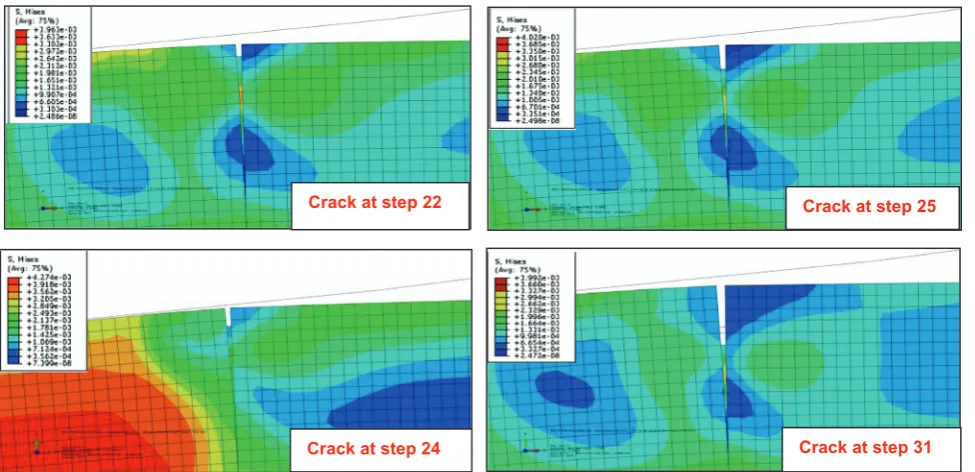
To determine the critical load at which a crack was initi-ated, different levels of loading (Toque) were applied on the global model (pinion/gear system). The pressure distribution at the contact region (point A and point B) from the global model was then transferred to the sub-model as a boundary condition. The critical loads predicted through the FE simula-tion for two types of configurasimula-tions of the gears are shown in Table 2. An example of crack propagation in the surface of coating as the loading cycles increases is shown inFigure 5.
The results from the FE model in this study were compared with the experimental results obtained from DGMK-FZG (Deutsche Wissenschaftliche Gesellschaft für Erdöl, Erdgas und Kohle, Forschungsstelle für Zahnräder and Getriebebau der TU München) short micro-pitting test. In such tests, differ-ent levels of load (Torque) were applied on the pinion/gear sys-tem. During the experiment, the critical loads were defined as the loads under which surface cracks nucleate, where the cracks were observed with scanning electron microscopy (SEM) (Figure 6).
6. Discussion
As shown in Table 2, average pressure at point A was greater than that at point B for both types of gears although the normal force acted on this region was much smaller than that in the region around point B. The reason for that was the small radius of curvature of involute profile at the root leading to the high localized stresses and eventually giving rise to early nucleation of a crack in this area. It was found from both experimental and computational results that pre-treatment with plasma nitriding improved the surface properties dramat-ically, where the critical load associated with initiation of the first crack for the Model II system is nearly twice higher than that for the Model I system. The greater critical load with the TiN/CrN on the nitrided 42CrMo4 substrate is largely due to the improved strength in the hardened case. As a consequence, the load-bearing capacity is increased for such a system.
[image:4.595.46.289.61.225.2]The critical loads predicted from the simulation results in both conditions are greater than from experimental test, for instance, the normal force predicted in point B with Model I coated teeth is 1644 N, which is about 20% greater than from Table 2.Critical loads for two types of surface systems.
Critical load for crack initiation Model I Model II Point A Point B Point A Point B Maximum pressure (MPa) 1438 1534 3768 3245
Average pressure (MPa) 1321 1279 3331 2918 Normal force (N) 1644 5014 4883 10,588
[image:4.595.305.552.88.161.2]Torque (Nm) 170 358
[image:4.595.42.289.276.346.2]Figure 4. Cohesive traction-separation law under cyclic loading.
Table 1.Material properties of coating and substrate. Materials TiN/CrN
coating
Substrate
the experimental test. This discrepancy existed between the experimental and simulation results may be caused by the rea-son that the lubrication and effect of the roughness of surface were not considered in the FE modelling.
The simulation results also show that the strength of the coated layer degraded with increase of the loading cycles, which led to damages of the coated surface once the crack was nucleated. With an increase of the contact loading cycles, the cracks propagate rapidly to the depth of the coating, which will eventually result in the debonding of the coating from the substrate.
7. Conclusions
Several numerical modelling techniques were combined to develop a comprehensive model for the prediction of the
failures of the coated surfaces on engineering components, and contact spur-gears were used as a test case in this study. The developed model not only allows localized stress distribu-tions and deformadistribu-tions in the interested locadistribu-tions in coatings and substrate materials to be investigated in detail but also enables visual observation on the development of fatigue dam-ages in the coating, due to the inclusion of a numerical capa-bility of simulating multi-cycle loading in cohesive-zone modelling. The experimental observation on the damages of the coated tooth-surfaces of the gears suggests that similar phe-nomenon can be predicted with the numerical model devel-oped. Further work is being carried out for improving accuracy of the predicted adhesion energy in coatings and for optimizing the arrangement of cohesive elements in order to further improve accuracy and efficiency of numerical mod-elling for predicting failures of the coated layers in engineering surface systems.
Crack at step 22 Crack at step 25
[image:5.595.55.543.72.308.2]Crack at step 24 Crack at step 31
Figure 5. Crack propagation with an increase of the loading cycle.
(a) (b)
[image:5.595.87.513.340.502.2]Acknowledgements. The research reported in this paper was sup-ported by the EU FP7 project ‘‘Multiscale Modelling for Multilay-ered Surface Systems (M3-2S)’’, Grant No. CP-FP213600-2 M3-2S. Beneficial discussion with and support from the project partners are acknowledged.
References
1. S. Baragetti, F. Villa, The Open Materials Science Journal 8 (2014) 87–98.
2. K. Bobzin, N. Bagcivan, N. Goebbels, et al., Surface and Coatings Technology 204 (2009) 1097–1101.
3. A. Feuerstein, A. Kleyman, Surface and Coatings Technology 204 (2009) 1092–1096.
4. S. Baragetti, F. Tordini, Engineering with Computers 27 (2011) 127–137.
5. M. Sraml, J. Falsker, The International Journal of Advanced Manufacturing Technology 31 (2007) 1066–1075.
6. J. Feng, Y. Qin, Q. Zeng, E. Alamandoz, G. Fuente, H. Dong, R. Raghavan, J. Michler, Journal of Multiscale Modelling 1 (2011), 1–22.
7. J. Feng, Y. Qin, Applied Mechanics and Materials 446 (2014) 491.
8. J. Feng, Y. Qin, et al., Steel Research International, Proceeding of Metal Forming (2012), 1059–1062.
9. D.W. Dudley, Handbook of Practical Gear Design, Dudley Engineering Co. McGraw-Hill Book Company, US, 1984. 10. X.P. Xu, A. Needleman, Journal of the Mechanics and Physics
of Solids 1397 (1994) 42.
11. A. Abdul-Baqi, P.J.G. Schreurs, M.G.D. Geers, International Journal of Solid and Structure 42 (2005) 927.