Nonlinear interactions in deformable container cranes
Andrea Arena
∗, Walter Lacarbonara
†, Matthew P. Cartmell
‡July 27, 2016
Abstract
Nonlinear dynamic interactions in harbour quayside cranes due to a two-to-one internal
resonance between the lowest bending mode of the deformable boom and the in-plane pendular
mode of the container are investigated. To this end, a three-dimensional model of container
cranes accounting for the elastic interaction between the crane boom and the container
dynam-ics is proposed. The container is modelled as a three-dimensional (3D) rigid body elastically
suspended through hoisting cables from the trolley moving along the crane boom modelled as
an Euler-Bernoulli beam. The reduced governing equations of motion are obtained through
the Euler-Lagrange equations employing the boom kinetic and stored energies, derived via a
Galerkin discretisation based on the mode shapes of the two-span crane boom used as trial
functions, and the kinetic and stored energies of the rigid body container and the elastic
hoist-ing cables. First, conditions for the onset of internal resonances between the boom and the
container are found. A higher order perturbation treatment of the Taylor expanded equations
of motion in the neighbourhood of a two-to-one internal resonance between the lowest boom
bending mode and the lowest pendular mode of the container is carried out. Continuation of
the fixed points of the modulation equations together with stability analysis yields a rich
bi-furcation behaviour, which features Hopf bibi-furcations. It is shown that consideration of higher
∗Research Associate, Department of Structural and Geotechnical Engineering, Sapienza University, Rome, 00184,
Italy, email: [email protected]
†Associate Professor, Department of Structural and Geotechnical Engineering , Sapienza University, Rome, 00184,
Italy, email: [email protected]
‡Professor, Department of Mechanical Engineering, University of Sheffield, Sheffield S1 3JD, England, UK, email:
order terms (cubic nonlinearities) beyond the quadratic geometric and inertia nonlinearities
breaks the symmetry of the bifurcation equations, shifts the bifurcation points and the
stabil-ity ranges, and leads to bifurcations not predicted by the low order analysis.
Keywords: Crane dynamics; Perturbation analysis; Modal autoparametric interactions; Two-to-one internal resonances; Higher order approximation; Boom elasticity.
1
Introduction
A rich variety of factors can influence the dynamics of container crane systems, such as the
trol-ley motion during working maneuvers or wind-induced excitations [2, 3]. A typical modelling
approach for describing the container crane dynamics relies on the assumption of
undeforma-bility of the crane supporting structure, of which the boom is the main elastic component.
However, this assumption is not always valid since the dynamics of the boom undergoing
bending motion in the vertical plane may interact with the dynamics of the suspended
con-tainer in specific configurations. Indeed, the trolley vertical motion induced by the boom
elastodynamic response acts as a parametric excitation for the payload. In particular,
reso-nant autoparametric couplings may be induced if the vertical bending oscillation frequency of
the two-span boom is in a suitable ratio with the frequency of one of the container/payload
modes. Different modelling approaches are proposed in the literature such as those based
on simplified one-degree-of-freedom (one-dof) pendulum models. Although largely employed,
these models are not appropriate to describe the overall dynamics of a container crane
multi-body system, and to capture the geometric nonlinearities affecting the container motion and
arising from the hoisting system. A refined planar model was proposed in [13] where a double
pendulum, two-dimensional (2D) model was adopted although neglecting the hoisting cables
deformability. Planar (2D) pendulum-type crane models were also employed to study
pay-load oscillations control via a nonclassical vibration absorber in [12], via an active open-loop
strategy [20] or fuzzy controls using a variable truss geometry [8].
A three-dimensional (3D) analytical model of suspended containers was first proposed in [9]
where the motion of the container was described accounting for the deformability of the
hoist-ing cables and for disturbances. A comprehensive classification of these models is given in [1]
where applications and limitations of the different theories are discussed. A recent work [3]
provided a detailed and accurate fully nonlinear analytical model of the dynamics of container
of the hoisting cables elasticity. Among other features, in [3] the theoretical studies were
cor-roborated by experimental results. In consonance with what experimentally and numerically
demonstrated in [3], the dynamic behaviour of a container crane system is characterised by
lightly damped motions which can show rich frequency content, characteristic of a typical
nonlinear behaviour, when large-amplitude oscillations are induced through some resonance
mechanism.
The majority of the works available in the literature, in particular those based on analytical
modelling, typically neglect the dynamics of the crane structure (i.e., the supporting frame
and boom) which, instead, should be taken into account when the flexibility of the boom can
affect the payload oscillations or when seismic excitations cannot be neglected. A theoretical
study of the kinematics of a typical multi-cable suspension system was proposed in [15] and
in [7] the same authors illustrated the steps necessary to model the dynamics of a
rubber-tyred gantry crane and discussed various modelling criteria with emphasis on the importance
of nonlinear coupling between the chosen coordinates. In [5, 6], modelling of a variety of
pendular structures was proposed and suitable control strategies were thoroughly examined
by highlighting the computational implications of the models on the control implementations.
In [21] the dynamic behaviour of gantry cranes was investigated taking into account also
the flexibility of the crane structure, and in [4] a six-dof analytical model was developed to
investigate the behaviour of container cranes under seismic excitation. In [19] a finite element
model of a quayside crane was employed to show that, for particular crane configurations, the
analysis of container oscillations should take into account the boom deformability.
In the present work, a multi-dof model describing the dynamics of container crane systems
is presented. The likelihood of dynamic interactions between the deformable boom and the
container is investigated considering all possible operational positions of the container and
payload masses. In particular, 2:1 and 3:1 ratios between the fundamental boom frequency
and the in-plane and out-of-plane container pendular frequencies are found as potential triggers
of internal resonances for particular container crane configurations. For two-to-one internal
resonances, the method of multiple scales [17, 18, 16] is employed to obtain second and third
order asymptotic expansions of the crane response. A thorough bifurcation analysis carried
out via path-following of the fixed points of the modulation equations sheds light onto several
2
Mechanical formulation of container cranes with
deformable boom
The proposed mechanical model of container cranes is based on a fully nonlinear kinematic
formulation to describe the overall 3D motion and accounts for the elasticity of the hoisting
cables. A key novel aspect, with respect to the formulation recently proposed by the same
authors in [2, 3], is the deformability of the crane boom that can interact with the suspended
container motion. The deformability of the cantilever boom can play an important role in
the dynamics of the suspended container since particular configurations of the container crane
system may lead to nonlinear interactions (i.e., transfers of energy) between the boom dynamics
and the container pendular motion.
Figure 1 (top) shows a typical crane employed in harbour quays to move containers in and
out of cargo ships while Fig. 1 (bottom) portrays a schematic representation in the vertical
plane where most of the container motion occurs. The boom geometric and mechanical
charac-teristics are such that the truss girder presents negligible deformations in the horizontal plane,
whereas its deformability in the vertical plane gives rise to low-frequency, flexural oscillations.
When the frequency of the boom bending oscillations is in a suitable ratio with one of
the container natural frequencies, internal resonance phenomena can take place. In particular,
when the ratio between the boom lowest frequency and the container pendular frequency is 2:1,
the directly excited boom motion can suffer saturation so that, upon increasing the excitation
amplitude, energy is transferred into large-amplitude pendular oscillations of the container.
Next, the derivation of the nonlinear equations of motion of the container crane system
ac-counting for the crane boom deformability is shown. The truss girder of the crane is modelled
as an Euler-Bernoulli beam whose equivalent stiffness and inertial characteristics are extracted
from the geometry and the elasticity of a quayside-crane (Fantuzzi-Reggiane crane
manufac-turer) utilised at the Cagliari International Container Terminal (CICT) in Cagliari (Sardinia,
Italy). These characteristics have been identified by employing an in-house developed finite
element model of the truss girder. The boom deforms in the vertical plane in which it sustains
its weight and the moving trolley with the suspended payload. Due to its geometric features,
shear deformations can be neglected and thus the Euler-Bernoulli purely flexural behaviour
dominates its response. Moreover, due to its stiffness characteristics, the boom does not
BOOM
CONTAINER CABLES
e
1
x,
e
3
h
h
min
h
max
boom tip
Figure 1: (Top) Quayside crane at CICT in Cagliari (Italy), (bottom) 2D representation of the
container crane system.
theory.
On the other hand, the container is modelled as a rigid body elastically suspended from the
trolley that can move along rails mounted on the crane boom. The description of the kinematic
parameters governing the motion of the container crane system is based on the formulation
proposed in [3] enriched by the introduction of the boom elasticity.
2.1
Three-dimensional kinematic modeling
Before discussing the kinematics and mechanics of the crane model, few remarks on the adopted
[image:5.595.139.477.50.460.2]functions are denoted by lower-case, italic, bold-face symbols. The dot product and cross
product of (vectors) uand v are denotedu·v and u×v. The length of vectoru is denoted
by ||u||.
In the fixed Cartesian frame (e1,e2,e3), with origin in the left terminal section of the
crane boom,e1 is taken co-linear with the vertical direction and e3 is collinear with the crane
boom direction in its reference configuration (see Fig. 1). The current crane configuration
at time t is described by vectors pb(x, t) and pc(t) denoting, respectively, the position of the trolley moving along the boom centerline and the position of the container centre of mass.
Their representation in the frame (e1,e2,e3) is given as
pb(x, t) =v(x, t)e1+xe3,
pc(t) =p1(t)e1+p2(t)e2+p3(t)e3,
(1)
wherexis the trolley coordinate along the boom centerline,v(x, t) is the vertical displacement
of the boom andpi(t) (i= 1,2,3) are the components of the container position vector. In this
modelling approach, the boom out-of plane dynamics are neglected for the reasons discussed
above.
b2 b1
b3
C
T
e1
e3
e2
pS 1(t)
pc(t)
pb(x,t)
pT
1(x,t) d1
r1 e1
e3
e2
b2 b1
b3
T1 T2
T
3
T4
S1
S3 S
4
S2
s2
s1 s3
c1
c3
c2
T
C
t3
t2
b2
(a) (b)
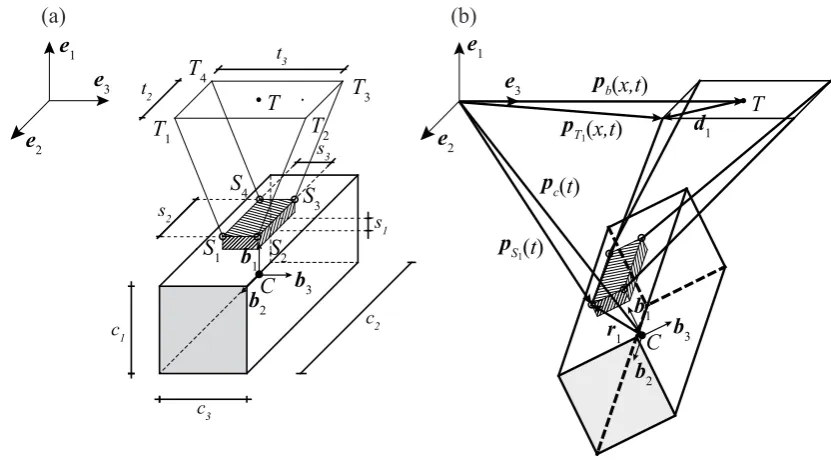
Figure 2: (a) Container reference configuration and (b) current configuration.
The local frame (b1,b2,b3), having its origin in the container centre of massC, is considered
[image:6.595.103.519.381.615.2]spreader bar on the top of the container and its expression isri(t) =ri,1b1+ri,2b2+ri,3b3.
Thus, in the current container configuration, the position ofSi is given by the vectorpSi(t) = pc(t) +ri(t). Similarly, the position of points Ti (i = 1,2,3,4), denoting the pulleys on the
trolley, with respect to the trolley mid-pointT, are described bydi =di,1e1+di,2e2+di,3e3
when the trolley mid-pointT lies in the left terminal section of the crane boom; therefore, their
position in the current configuration of the trolley can be expressed aspTi(x, t) =pb(x, t) +di.
The expressions of the components ri,j and di,j (i = 1,2,3,4 and j = 1,2,3) depend on the
geometric parameters of the container crane and are reported in Tab. 1.
i 1 2 3 4
di,1 0 0 0 0
[image:7.595.200.416.225.379.2]di,2 t22 t22 −t22 −t22 di,3 −t23 t23 t23 −t23 ri,1 c21 +s1 c21 +s1 c21 +s1 c21 +s1 ri,2 s22 s22 −s22 −s22 ri,3 −s23 s23 s23 −s23
Table 1: Components of the pulleys position vectors.
e
1e
3, x
C
b1 b3
v(L,t) L
L1 L2
T T
S
S
p
c(t)
p
b(L,t)
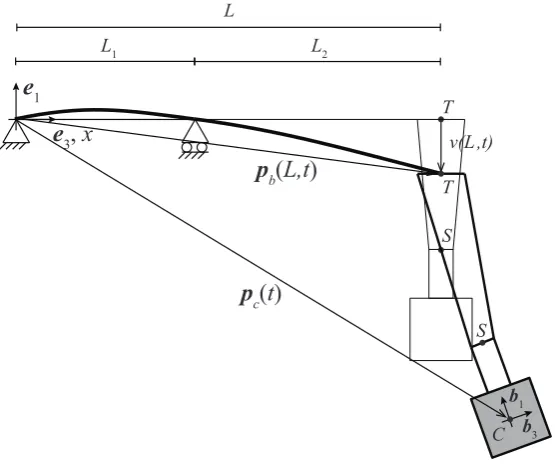
Figure 3: Planar view of the reference (thin lines) and current (thick lines) configurations of the
[image:7.595.166.444.428.660.2]The rotational motion undergone by the container is described by the orthogonal tensor
R(t), whose expression can be found in [2, 3], representing the change of orientation of the frame (b1,b2,b3) with respect to the fixed frame (e1,e2,e3). The finite rotations of the
frame are parametrized by a sequence of rotations described by the angles ϕ1(t), ϕ2(t), and
ϕ3(t). Thus, the container angular velocity vectorωc(t) =ω1(t)b1+ω2(t)b2+ω3(t)b3 can be
expressed in terms of nonlinear combination of angular rates ˙ϕj(t) (j = 1,2,3) as
ωc(t) =
(
˙
ϕ1(t) + ˙ϕ2(t) sinϕ3(t) )
b1
+
(
˙
ϕ2(t) cosϕ1(t) cosϕ3(t) + ˙ϕ3(t) sinϕ1(t) )
b2
+
(
˙
ϕ3(t) cosϕ1(t)−ϕ˙2(t) sinϕ1(t) cosϕ3(t) )
b3,
(2)
where the overdot indicates differentiation with respect to time tand ωc(t) satisfies the
rela-tionship ˙bj =ωc(t)×bj (j= 1,2,3).
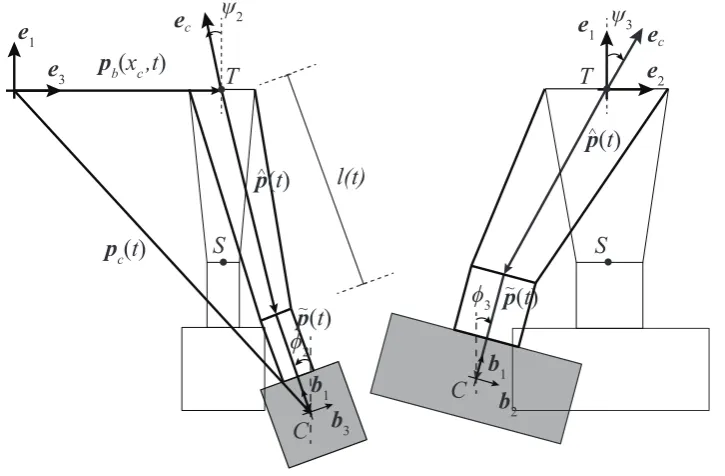
Natural coordinates. By introducing a natural parametrization of the motion of the pendulum-like system here considered, a suitable description of the container crane kinematics can be
achieved using the natural coordinates {l(t), ψ2(t), ψ3(t),ϕ1(t),ϕ2(t), ϕ3(t)} whose meaning
is shown in Fig. 4.
ψ
3e
ce
2b
1b
2p
(
t
)
p
(
t
)
^
~
e
1e
3b
1b
3p
c(
t
)
p
b(
x
c
,t
)
p
(
t
)
p
(
t
)
^
~
e
cψ
2e
1l(t)
T
T
S
S
C
C
ϕ
2 [image:8.595.84.447.417.655.2]ϕ
3Figure 4: Parameterisation of the crane kinematics based on the choice of natural coordinates.
sinψ3(t)e2−sinψ2(t) cosψ3(t)e3. In turn, the vectors ˆp(t) and ˜p(t), defined as ˆp(t) =−l(t)ec
and ˜p(t) =−(c1
2 +s1
)
b1, can be written in the form
ˆ
p(t) =l(t)
(
−cosψ2(t) cosψ3(t)e1−sinψ3(t)e2+ sinψ2(t) cosψ3(t)e3 )
,
˜
p(t) =(c1 2 +s1
) (
−cosϕ2(t) cosϕ3(t)e1−sinϕ3(t)e2+ sinϕ2(t) cosϕ3(t)e3 )
.
(3)
Thus, for each fixed position xc of the trolley along the boom, the position vector of the
container centre of mass can expressed in terms of natural coordinates as
pc(t) =pb(xc, t) + ˆp(t) + ˜p(t). (4)
2.2
Equations of motion
Based on the kinematic model described in the previous section, the equations governing the
3D motion of the container crane system are obtained using the Euler-Lagrange equations
based on the system Lagrangian L computed below [14]. The stored and kinetic energies
associated with the boom motion are computed according to
Vb = 12
∫ L
0
v′′(x, t)EJ v′′(x, t)dx ,
Kb = 12
∫ L
0
˙
v(x, t)ρAv˙(x, t)dx ,
(5)
where the prime indicates differentiation with respect to the coordinatexalong the boom
cen-terline,EJ is the equivalent bending stiffness of the truss girder, ρAindicates the boom mass
per unit reference length, andLis the total boom length. Vb is the boom elastic energy stored
in pure bending and Kb is the purely translational boom kinetic energy in consonance with
the Euler-Bernoulli beam theory according to which the deformation is solely characterized by
the elastic curvatureµ=v′′ and rotary inertia is neglected.
On the other hand, the container potential and kinetic energies are expressed as
Vc=M gpc(t)·e1,
Kc= 12Mp˙c(t)·p˙c(t) +12ωc(t)· (
JM· ωc(t)
)
,
(6)
where g is the gravity acceleration, M is the container mass, and JM
is the tensor of second
mass moments whose nontrivial diagonal components JM
j (j = 1,2,3) are the second mass
moments calculated with respect to the local frame axesbj.
By assuming a linearly elastic constitutive law for the hoisting cables, the stored energy is
given by
Wc= 12
4 ∑
i=1
Ni(t)li(t)
(
νi(t)−1
)
where li, Ni, and νi are the length, the tension, and the stretch of the ith hoisting cable at
time t. The tension is constitutively expressed as Ni(t) = EcAc
(
νi(t)−1
)
where Ec is the
cables Young’s modulus, Ac the cables cross-section area, and the nonlinear expression of the
stretch is given by
νi(t) =
||pTi(t)−pSi(t)||
li(t)
, i= 1, . . . ,4. (8)
The length li(t) of the ith cable can be evaluated by prescribing the vertical position h(t) of
the container with respect to the boom (i.e., the vertical distance between pointsT andS)
ac-cording to the expressionli(t) =
[
h(t)2+(t2
2 −
s2 2
)2
+(t3
2 −
s3 2
)2]1/2
. Finally, the Lagrangian
of the system can be written as L=Kb+Kc−(Vb+Vc+Wc).
Linear viscous damping forces fpdj(t) and couples cdϕ
j(t) are taken into account using the
expressions:
fpdj(t) = 2ζcωpjMp˙j(t), c
d
ϕj(t) = 2ζcωϕjJ M
j ϕ˙j(t), j= 1,2,3, (9)
where ζc is an equivalent container damping ratio and ωpj and ωϕj are the natural circular
frequencies of the jth mode associated to the translational and rotational components of
the container motion, respectively. Similarly, the linear damping force associated with the
dissipation in the boom is expressed as
fb(t) = 2ζbωb
1 2
∫ L
0
ρA ∂ ∂v˙
(
˙
v(x, t)2
)
dx (10)
where ζb is the boom damping ratio (in the lowest mode) and ωb is the natural circular
fre-quency of the lowest vibrational mode of the boom.
Discretisation of the equations of motion. The mechanical modeling of the container crane system features the coupling between a distributed-parameter system, the crane boom,
and a six-dof rigid body represented by the container. Therefore, the kinematics of the
over-all system are described by the container position vector (i.e., the three components pj(t),
j = 1,2,3), the three container finite rotations ϕj(t) (j = 1,2,3) and the boom vertical
dis-placement v(x, t), a function of space and time. In this work, the well-known discretisation
technique based on the Faedo-Galerkin method is employed to reduce the space-dependence
in the continuum part of the system and, therefore, to reduce the mixed partial-ordinary
dif-ferential equations of motion of the coupled continuum-discrete system into a set of ordinary
The lowest Nm mode shapes of an unshearable beam subject to the boundary conditions
of the crane boom (see the schematic representation in Fig. 3) are assumed as trial functions.
The boundary conditions for the boom are
v(0, t) = 0 =v′′(0, t), v′′(L, t) = 0 =v′′′(L, t),
v(L1, t) = 0, ∆v(L1, t) = 0, ∆v′(L1, t) = 0, ∆v′′(L1, t) = 0,
(11)
where ∆, applied to the unknown function v(L1, t) and its derivatives, indicates the jump of
the function at x=L1 (i.e., the difference between the values attained atL+1 =L1+εand at
L−1 =L1−εwhere εis an infinitesimal quantity compared toL1). According to the adopted
discretisation procedure, the vertical displacement of the boom can be then expressed as
v(x, t) =
Nm
∑
m=1
¯
vm(t) Φm(x) (12)
where Φm(x) represents the mth mode shape of the boom and ¯vm(t) is the mth generalized
coordinate. By introducing the vector of generalised coordinates
ξ(t) ={v¯1(t), . . . , v¯m(t), l(t), ψ2(t), ψ3(t), ϕ1(t), ϕ2(t), ϕ3(t)},
it is possible to obtain the equations of motion of the container crane system in the form
d dt
(
Lξ˙ k
)
− Lξk +dkξ˙k=Qk, (13)
where ξk represents the kth generalized coordinate (k = 1, . . . ,6 +Nm), the subscripts in L
denote partial differentiation with respect to the argument indicated by the subscript and dtd indicates the total derivative with respect to time. The term dkξ˙k is the kth component of
the linear viscous-type generalized force expressed in terms of natural coordinates and derived
from Eq. (9). The representation of Eq. (9) in terms of natural coordinates can be obtained
by substituting Eq. (4) into Eq. (9) and by linearising the resulting expressions. The right-end
side of Eq. (13) is thekth component of the generalized force due to external excitations and
its expression will be presented in the following sections.
2.3
A quayside container crane example: modal characteristics
The analytical model presented in the previous section is here specialised by taking into account
the characteristic parameters of the container cranes employed at the Cagliari International
by the Italian company Fantuzzi-Reggiane is shown in Fig. 1. A 40 ft high cube container,
having a maximum massM of 30 tonnes, is considered in the calculations. The geometric and
mechanical characteristics of the case-study container crane are reported in Table 2.
t2 [m] t3 [m] s1 [m] s2 [m] s3 [m]
4.896 1.93 1.95 4.8 0.95
c1 [m] c2 [m] c3 [m] N◦ cables [-] ζb [%]
2.896 12.192 2.4384 4 0.1
Ac [m2] Ec [N/m2] M [kg] J1M, J M
3 [kg m2] J M
2 [kg m2] 7.561×10⁻⁴ 9×10¹⁰ 17.7 to 42.7×10³ 230 to 560×103 21 to 51×103
L [m] L1 [m] L2 [m] ρA [kg/m] EJ [N m2]
90 36 54 2910.17 2.5×10¹¹
Table 2: Characteristic parameters of the Fantuzzi-Reggiane quayside container crane at CICT.
An experimental campaign was carried out on the quayside container crane in [3]. The
experiments enabled a parameter identification of the container crane system and a testing of
the fidelity of the mechanical model employed in [3] which neglected the deformability of the
boom. Together with the main modal features (mass and stiffness) characterising the dynamics
of the crane, the crane damping, one of the most uncertain parameters in these lightly damped
systems, was evaluated for several container configurations. The experimental results led to
the evaluation of the following expression of the container damping factor as a function of the
heighth:
ζc= 0.0167−2.69·10−5h+ 3.419·10−7h2
+ 4.310·10−8h3−4.394·10−10h4−9.878·10−11h5
(14)
Moreover, to characterise the overall nonlinear dynamic behaviour of the container crane
system, including the onset of internal resonances, the investigation of its modal properties is
carried out next. The eigenproblem obtained from Eq. (13) is solved in terms of generalised
coordinates collected in ξ(t) to give the 6 +Nm eigenvalues and eigenvectors. These modal
features are computed for all possible configurations of the crane. In particular, the effects of
the hoisting cables length (here, for convenience, the vertical componenth is considered) and
5 10 15 20 25 30 35 40
h
[m]
0 10 20 30
f [H z]
m=1 m=2 m=3 m=4
a)
5 10 15 20 25 30 35 40
h
[m]
0 0.2 0.4 0.6
f [H z]
Yaw Pend. out Pend. in
b)
5 10 15 20 25 30 35 40
h
[m]
0 2 4 6
f [H z]
Heave Roll out Roll in
[image:13.595.66.549.51.405.2]c)
Figure 5: Container crane frequencies vs h: a) boom lowest four frequencies (m = 1, . . . ,4), b)
pendulum in-plane mode (solid line), pendulum out-of-plane mode (dashed line), yaw mode
(dashed-dotted line), c) roll in-plane mode (solid line), roll out-of-plane mode (dashed line), heave mode
(dashed-dotted line).
The container crane system behaves like a double pendulum in the planes (e1,e2) and
(e3,e1) and like an elastic oscillator for the degrees of freedom ¯vm(t) (m = 1, . . . , Nm), l(t)
andϕ1(t). The modes of the continuum-discrete system feature a coupling between the degrees
of freedom of the boom and those of the container. Depending on the ratio between the modal
components, the eigenvectors involving coordinates ψ2(t) and ϕ2(t) are here classified as
in-plane pendulum mode and roll mode, respectively, whereas those involving coordinates ψ3(t)
and ϕ3(t) are the corresponding out-of-plane pendulum modeand roll mode, respectively. On
the other hand, the modes related toϕ1(t) andl(t) are classified respectively as the yaw mode
and the heave mode, while the eigenvectors featuring ¯vm(t) (m = 1, . . . , Nm) with dominant
of the system is carried out assuming the container positioned at the boom tip (xc=L) with
its full payload (see Table 2).
Figures 5a-c show variation of the container crane eigenfrequencies increasing with the
heighthof the container relative to the boom. The frequencies of the lowest four modes of the
boom are reported in Fig. 5a from which, as expected, it is apparent that these frequencies
are not influenced by the parameter h and that only the first mode possesses a frequency
(about 0.9 Hz in the whole range of h) close to that of the container frequencies. The latter
are reported in Fig. 5b for the yaw and pendular modes and in Fig. 5c for the heave and roll
modes, respectively.
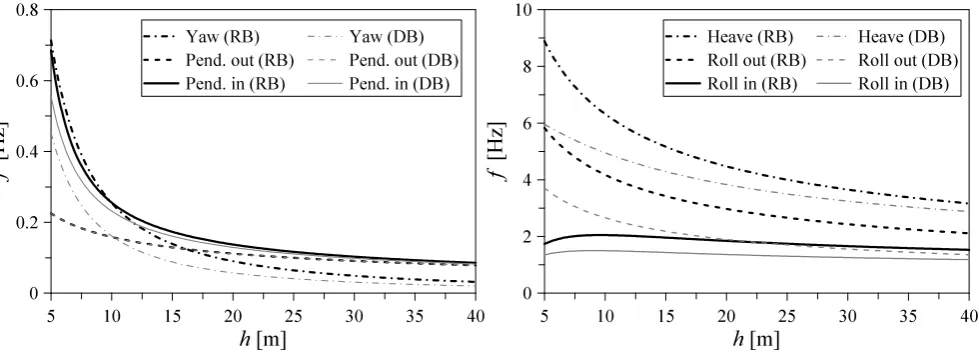
Figure 6 contrasts the frequencies of the container modes obtained by neglecting or
consid-ering the boom deformability. The boom deformability has negligible influence on the pendular
modes, in particular, the in-plane mode is slightly affected by the boom elasticity in a small
range ofh (h= 5 m to 15 m) whereas the out-of-plane mode, operating at a lower frequency,
is barely affected by the crane deformability. Finally, the yaw, heave, and roll modes, which
involve the elongation of the hoisting cables and, as such, the vertical boom displacement,
show frequencies which can be 20−30% (to 55% in the case of the out-of-plane roll mode)
lower than those possessed by the crane model with undeformable boom.
5 10 15 20 25 30 35 40
h
[m]
00.2 0.4 0.6 0.8
f [H z]
Yaw (RB) Pend. out (RB) Pend. in (RB)
Yaw (DB) Pend. out (DB) Pend. in (DB)
5 10 15 20 25 30 35 40
h
[m]
02 4 6 8 10
f [H z]
Heave (RB) Roll out (RB) Roll in (RB)
[image:14.595.64.554.407.584.2]Heave (DB) Roll out (DB) Roll in (DB)
Figure 6: Container frequencies vsh: (left) pendulum in-plane mode (solid line), pendulum
out-of-plane mode (dashed line), yaw mode (dashed-dotted line), (right) roll in-out-of-plane mode (solid line),
roll out-of-plane mode (dashed line), heave mode (dashed-dotted line). Comparison between rigid
2.4
Onset of autoparametric resonances
As known [17, 16], when the frequencies of two or more modes are in a suitable integer ratio
(1:1, 2:1, 3:1, etc.), internal (autoparametric) resonances may occur between the corresponding
modes. Thus, for certain initial conditions or excitations injecting energy into one of these
modes, the energy can be transferred to the autoparametrically coupled modes giving rise
to undesired coupled-mode motions. This is indeed a dynamic instability of the considered
equilibrium state of the crane multibody system.
To highlight conditions for the onset of such resonances, the evaluation of the ratio between
the frequencies of the container modes and those of the boom modes is a necessary step.
In particular, specific attention is paid to potential interactions between the lowest boom
mode (possessing a frequency close to those of the container) and the in-plane and
out-of-plane pendular modes. Since the modal characteristics of the container crane vary depending
on the inertial and geometric configurations of the multibody system, parametric analyses
are performed to evaluate the ratio between the above mentioned modes for several crane
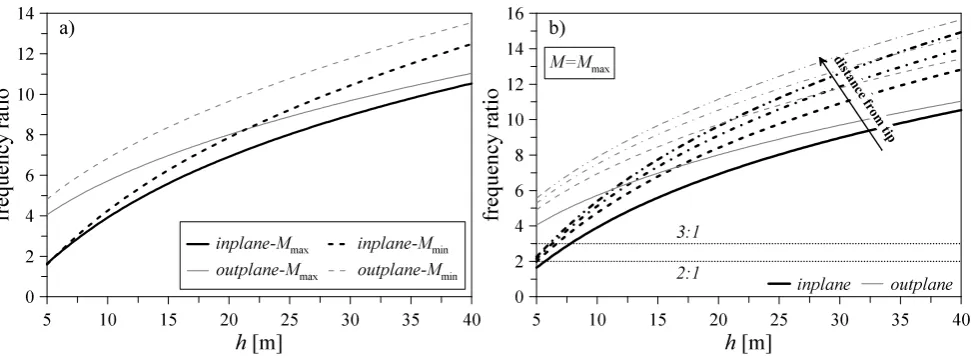
configurations. Figure 7a shows these frequency ratios varying the length of the hoisting
cables (height h) with the container positioned at the boom tip (xc=L). Two payloads are
considered, namely, the minimum and maximum allowable payload. As shown in Fig. 7a, the
boom lowest flexural frequency and the out-of-plane pendular frequency can be in ratios higher
than 4 : 1, representing higher-order resonances devoid of practical meaning. On the other
hand, 2 : 1 and 3 : 1 ratios can take place among the boom lowest frequency and the in-plane
pendular frequency. In particular, a range ofh giving rise to 2 : 1 and 3 : 1 ratios occurs when
the container has its maximum payload due to the fact that, although the pendular mode is
not influenced by the mass, the boom flexural modes strongly depend on the lumped mass
which induces a decrease of the corresponding flexural frequencies. Moreover, as highlighted in
Fig. 7b, by moving the container along the boom (i.e., by increasing the trolley distance from
the boom tip), the modal mass contribution of the container in the flexural motions decreases
and thus the ratio between the boom lowest frequency and that of the pendular modes (which
does not vary with the container position along the boom) increases.
In conclusion, the sensitivity analyses carried out to study the influence of the main
ge-ometric and mechanical parameters of the container crane system on the modal behaviour
allows determination of the crane configurations in which 2 : 1 or 3 : 1 nonlinear interactions
5 10 15 20 25 30 35 40 h
[m]
0 2 4 6 8 10 12 14
fr eq ue nc y ra tio
inplane-Mmax
outplane-Mmax
inplane-Mmin
outplane-Mmin
a)
5 10 15 20 25 30 35 40
h
[m]
02 4 6 8 10 12 14 16
fr eq ue nc y ra tio
inplane outplane
M=Mmax dista
nce from
tip
3:1
[image:16.595.65.551.52.232.2]2:1 b)
Figure 7: Frequency ratios of the in-plane and out-of-plane pendular modes and the lowest boom
mode vs. h. (a) The container is positioned at the boom tip (xc=L), (b) the container positions
are varied along the boom considering the maximum container size (M =Mmax).
This happens when the container is positioned high, close to the boom tip. The corresponding
range ish= 5 m to 8 m. This may occur before the descending phase of the bell representing
a typical trajectory during cargo loading on the cargo ship. This configuration is adopted next
to investigate the nonlinear 2:1 interaction between the boom and the container modes. To
this end, the method of multiple scales [17, 18, 16] is employed together with pathfollowing
tools for continuation analysis of the solutions of the modulation equations. Ranges of
stabil-ity/instability of the single-mode and 2:1 resonant coupled-mode responses will be highlighted
together with the relevant bifurcations.
3
Perturbation Analysis
The method of multiple scales [17, 18, 16] is here employed to perform the perturbation analysis
of the equations of motion governing the dynamics of the container crane system. Due to the
fact that the 2:1 internal resonance involves the lowest boom bending mode and the in-plane
pendular mode, the resonant dynamics take place in the vertical plane (e3,e1) thus allowing
reduction of the mechanical model to a planar model. Consequently, the kinematics of the
sys-tem are restricted to the subset of four generalized coordinatesξ(t) ={¯v1(t), l(t), ψ2(t), ϕ2(t)}
ensuing reduced equations of motion read
d dt
(
Lξ˙k )
− Lξk+dkξ˙k=Qk (k= 1, . . . ,4). (15)
The system is subject to a harmonic direct excitation given in the formF(t) =AFcos(Ωt)
so that the right-end side term Qk in Eq. (15) represents the kth Lagrangian component of
the excitation.
Nondimensionalization. Equation (15) can be cast in nondimensional form adopting the total boom length L and the characteristic frequency ¯f =
√
EJ
ρA L4 as scaling parameters.
Thus, the nondimensional Lagrangian coordinates, collected in the 4×1 column vector x= [x1 x2 x3 x4]⊤, become
x1 =
¯
v1(t)
L , x2= l(t)
L , x3 =ψ2(t), x4=ϕ2(t), (16)
while, by introducing the nondimensional time ¯t = ¯f t, the nondimensional time rates are
expressed as
˙x1=
1 ¯
f L dv¯1(t)
dt , ˙x2=
1 ¯
f L d l(t)
dt , ˙x3 =
1 ¯
f
d ψ2(t)
dt , ˙x4 =
1 ¯
f
d ϕ2(t)
dt , (17)
where the overdot indicates, here and henceforth, differentiation with respect to the
nondimen-sional time. Moreover, assuming the amplitude of the external excitationF(t) proportional to
the total weight of the crane boom yields F(t) = λ(ρA gL) cos Ωt which, in nondimensional
form, becomes ¯F(¯t) =cfλcos ¯Ω ¯t withcf =g/(Lf¯2) and ¯Ω = Ω/f¯.
State-space representation. Equations of motion (15), cast in nondimensional form and not explicitly reported here for the sake of conciseness, represent a set of four fully nonlinear
ordinary differential equations. To obtain asymptotic expansions of the solutions of Eqs. (15)
by the method of multiple scales, the equations of motion are Taylor expanded up to third
order. The thus reduced four-dof system is described by the following nondimensional
vector-valued equations of motion [10]:
M1x¨+C1x˙ +K1x
+M2( ˙x,x˙) +M∗2(x,x¨) +K2(x,x)
+M3(x,x˙,x˙) +M∗3(x,x,x¨) +K3(x,x,x) +λcos ΩtF= 0
(18)
where the overbar denoting nondimensional variables and parameters, here and henceforth, is
and positive-defined matrices representing the linear mass, damping and stiffness operators,
respectively; M2, M∗2, M3, M∗3 are 4×1 noncommutative and multilinear operators which
represent the quadratic and cubic parts of the nonlinear inertia, respectively, whereas K2
and K3 are analogous operators representing the quadratic and cubic parts of the nonlinear
stiffness. Finally, Fis a 4×1 vector collecting the amplitude of the external excitation. Let
Ψ represent the linear modal tensor such that, introducing the transformation x=Ψ q, the set of equations (18) can be rewritten in normal coordinates qj as
¨
q+Λ q=−Zq˙ −G2(q,q)−I2( ˙q,q˙)−I∗2(q,¨q)
−G3(q,q,q)−I3(q,q˙,q˙)−I∗3(q,q,q¨)−λcos ΩtP,
(19)
whereΛ=Ψ⊤K1Ψ=ω2iδij is the diagonal matrix collecting the square of the system
eigen-frequencies andΨ is such that Ψ⊤M1Ψ=I with I=δij and δij being the Kronecker delta.
Moreover,Z=Ψ⊤C1Ψis the diagonal matrix of the linear modal damping,P=Ψ⊤Fis the modal projection of the external excitation, and the operators appearing in the right-end side
are expressed as
G2(q,q) =Ψ⊤K2(Ψ q,Ψ q), G3(q,q,q) =Ψ⊤K3(Ψ q,Ψ q,Ψ q),
I2( ˙q,q˙) =Ψ⊤M2(Ψq˙,Ψq˙), I3(q,q˙,q˙) =Ψ⊤M3(Ψ q,Ψq˙,Ψq˙),
I∗2(q,q¨) =Ψ⊤M∗2(Ψ q,Ψq¨), I3∗(q,q,q¨) =Ψ⊤M∗3(Ψ q,Ψ q,Ψq¨).
(20)
The second order (in time) set of equations (19) is conveniently reduced to a first-order
system (state-space representation) as follows:
˙
q−p=0
˙
p+Λ q=−Z p−G2(q,q)−I2(p,p)−I∗2(q,p˙)
−G3(q,q,q)−I3(q,p,p)−I3∗(q,q,p˙)−λcos ΩtP.
(21)
By lettingϵdenote a small nondimensional parameter representing the norm of the
devia-tion of the current crane configuradevia-tion form its reference state, a third-order expansion of the
solutions of (21) is sought in the form
q=
3 ∑
i=1
ϵiqi(T0, T1, T2), p= 3 ∑
i=1
ϵipi(T0, T1, T2) (22)
where T0 = t is the nondimensional fast time scale and T1 = ϵ t and T2 = ϵ2t are the
nondimensional slow time scales in terms of which the nondimensional time derivative isd/dt=
The perturbation analysis will be carried out studying, first, the effects of quadratic
non-linearities, thus only terms up to order ϵ2 will be retained. Subsequently, cubic nonlinearities
will be added enriching the asymptotic treatment to include the perturbation problems up to
order ϵ3.
3.1
Two-to-one internal resonance: second order
approxima-tion
The perturbation treatment requires a preliminary rescaling of the damping force and
excita-tion with the guiding principle that the internal/external resonant forces, the inertia and the
damping forces should balance each other. The linear damping force is assumed to be a second
order effect which, analytically, implies a re-scaling ofC1 asϵC1 in Eq. (18) thus making the
damping forces appear at second order in Eq. (21). Also the forcing term is rescaled to appear
at second order, namely, λ= ϵ2λ. By substituting (22) into (21), the following hierarchy of
linear problems is obtained by equating to zero coefficients of like powers of ϵ:
Order ϵ:
D0q1− p1 = 0
D0p1+Λ q1 = 0
(23)
Order ϵ2:
D0q2− p2 =−D1q1
D0p2+Λ q2=−D1p1−Z p1−G2(q1,q1)−I2(p1,p1)−I∗2(q1, D0p1)−λcos ΩT0P
(24)
Since two modes only are involved in the 2:1 internal resonance, the general solution of
Eq. (23) can be expressed as
q1 =Am(T1, T2)ei ωmT0um+An(T1, T2)ei ωnT0un+cc
p1=i ωmAm(T1, T2)ei ωmT0um+i ωnAn(T1, T2)ei ωnT0un+cc
(25)
whereum and un are the eigenvectors of the two resonant linear normal modes of the system
(in terms of modal coordinates, obtained as eigensolutions of Eq. (21) by setting its
right-side to zero), ωm and ωn are the associated nondimensional eigenfrequencies, Am(T1, T2) and
An(T1, T2) are the unknown complex-valued amplitudes of the mth and the nth modes and
cc stands for complex conjugate. By substituting Eq. (25) into Eq. (24) the ϵ2 order system
reads
D0q2− p2=g21(Am, An;ωm, ωn) +cc
D0p2+Λ q2 =g22(Am, An;ωm, ωn) +cc
The system (26) exhibits secular terms due to the primary resonance of the external excitation
with the nth mode (expressed as Ω = ωn+ϵ σ1, with σ1 being a detuning parameter) and
the autoparametric resonant terms caused by the 2:1 frequency ratio, ωn≈2ωm. To remove
the singularity, solvability conditions must be enforced. By introducing the solutions of the
adjoint homogeneous problem of Eq. (26) in the form:
q∗m =i ωme−i ωmT0um+cc , p∗m =e−i ωmT0um+cc , (27)
q∗n=i ωne−i ωnT0un+cc , p∗n=e−i ωnT0un+cc , (28)
the solvability of Eq. (26) is enforced requiring the orthogonality between (27) and (28) and
the inhomogeneous term (right-end side) in Eq. (26). That is,
ωm
2π
∫ 2π ωm
0 [
q∗m p∗m ]
g21 g22
dT0 = 0,
ωn
2π
∫ 2π ωn
0 [
q∗n p∗n ]
g21 g22
dT0= 0 (29)
To express the closeness of the internal resonance, we let ωn= 2ωm+ϵ σ2, with σ2 being
a further detuning parameter. Moreover, to make use of complex algebra, let cos ΩT0 =
1 2e
i(T0ωn+T1σ1)+cc. Thus substituting the external and internal resonance conditions into the
solvability conditions (29), the following modulation equations for the amplitudesAm andAn
are obtained:
−2i ωm(D1Am+µmAm) +
(
αm1 +αm2ω 2
m
)
eiT1σ2A¯
mAn= 0
−2i ωn(D1An+µnAn) +
(
αn1 +αn2ω 2
n
)
e−iT1σ2A2
m+
1 2λfn e
iT1σ1 = 0
(30)
where ¯Am is the conjugate of Am ( ¯An is the conjugate of An). The coefficients of Eq. (30)
represent the coefficients of the quadratic nonlinear stiffness terms (αm1 < 0, αn1 < 0), the
quadratic nonlinear inertial terms (αm2 <0, αn2 <0), the linear damping (µm >0, µn >0)
and the modal projection of the forcing term (fn=u⊤nF<0).
By expressing the complex amplitudes Am, ¯Am,An and ¯An in polar form
Am(T1, T2) = 12am(T1, T2)ei θm(T1,T2), An(T1, T2) = 12an(T1, T2)ei θn(T1,T2) (31)
and substituting the polar form into Eq. (30), separating real and imaginary parts yield the
and relative phases:
D1am =−µmam+
1 4ωm
(
αm1+αm2ω 2
m
)
amansinβ2
D1an=−µnan−
1 4ωn
(
αn1 +αn2ω 2
n
)
a2msinβ2+
λfn
2ωn
sinβ1
D1β1 =σ1+
1 4ωnan
(
αn1+αn2ω 2
n
)
a2mcosβ2+
λfn
2ωnan
cosβ1
D1β2 =σ2−
1 4ωnan
(
αn1+αn2ω 2
n
)
a2mcosβ2−
λfn
2ωnan
cosβ1+
1 2ωm
(
αm1 +αm2ω 2
m
)
ancosβ2
(32)
whereβ1(T1, T2) =σ1T1−θn(T1, T2) andβ2(T1, T2) =σ2T1−2θm(T1, T2) +θn(T1, T2) are the
relative phases.
3.2
Third order approximation
To study the effects of cubic nonlinearities, after substituting (22) into (21) and rescaling the
terms Z p and λ to appear at order ϵ3, a hierarchy of linear problems is obtained where the first perturbation problem is Eq. (23), while the second and third perturbations are given by
Order ϵ2:
D0q2− p2=−D1q1
D0p2+Λ q2 =−D1p1−G2(q1,q1)−I2(p1,p1)−I∗2(q1, D0p1)
(33)
Order ϵ3:
D0q3− p3 =−D1q2−D2q1
D0p3+Λ q3=−D1p2−D2p1−Z p1−G2(q1,q2)−I2(p1,p2)−I∗21(q2, D0p1)−I∗22(q1, D0p2)
−I∗23(q1, D1p1)−G3(q1,q1,q1)−I3(q1,p1,p1)−I∗3(q1,q1, D0p1)−λcos ΩT0P
(34)
whereI∗21(q2, D0p1),I∗22(q1, D0p2),I∗23(q1, D1p1) are inertial terms with quadratic nonlinear-ities ensuing fromI∗2(q,p˙).
The perturbation treatment up to second order follows the same steps shown in the previous
section. However, to investigate the effects of the cubic nonlinearities in the two-to-one internal
resonance, the external resonance condition is recast as Ω = ωn+ϵ2σ1 because the forcing
term is of orderϵ3. The consequence is thatλcos ΩT0= 12λ ei(T0ωn+σ1T2)+cc.
Substituting Eq. (25) into Eq. (33) and enforcing the orthogonality of the inhomogeneous
solvability condition) yield the following modulation equations:
−2i ωmD1Am+
(
αm1 +αm2ω 2
m
)
eiT1σ2A¯
mAn= 0,
−2i ωnD1An+
(
αn1+αn2ω 2
n
)
e−iT1σ2A2
m = 0,
(35)
from which the rates (with respect to the slow scale T1) of the complex-valued amplitudes,
D1Am and D1An, are obtained.
By substituting the thus obtained amplitude rates into the second order problem given
by (33), its solution can be sought in the form
q2 = ˜q1A2me2i T0ωm+ ˜q2A2ne2i T0ωn+ ˜q3AmAnei T0(ωm+ωn)
+ ˜q4A¯mAnei T0(ωn−ωm)+ ˜q5A¯mAm+ ˜q6A¯nAn+cc ,
p2 = ˜p1A2me2i T0ωm+ ˜p2A2ne2i T0ωn+ ˜p3AmAnei T0(ωm+ωn)
+ ˜p4A¯mAnei T0(ωn−ωm)+ ˜p5A¯mAm+ ˜p6A¯nAn+cc ,
(36)
where ˜qi and ˜pi (i= 1, . . . ,6) +ccare the combination of the 4 eigenvectors uj of the system
˜
qi =
4 ∑
j=1
˜
qi,juj, p˜i=
4 ∑
j=1
˜
pi,juj. (37)
Then, the solution (36) is substituted into the second order problem (33). Next, the
orthogo-nality conditions are imposed between the solution of the adjoint homogeneous problem and
the components of the second order solution resonant inωm and ωn, respectively; that is, the
terms proportional to ei T0ωm (i.e., (˜q4,p4˜ )) and ei T0ωn (i.e., (˜q1,p1˜ )). Finally, by equating
coefficients of like terms (i.e., having the same frequency) in the second order problem (33),
coefficients ˜qi,j and ˜pi,j (i = 1, . . . ,6, j = 1, . . . ,4) can be determined. After obtaining the
second order solution (36) and substituting it into the third order problem (34), the following
inhomogeneous problem is obtained:
D0q3− p3=g31(Am, An;ωm, ωn) +cc
D0p3+Λ q3 =g32(Am, An;ωm, ωn) +cc.
(38)
The solvability condition of (38) can be determined again by enforcing the orthogonality of
(g31,g32) to the solutions of the adjoint homogeneous problem
ωm
2π
∫ 2π ωm
0 [
q∗m p∗m ]
g31 g32
dT0 = 0,
ωn
2π
∫ 2π ωn
0 [
q∗n p∗n ]
g31 g32
dT0 = 0 (39)
which yields the following modulation equations for the amplitudesAm and An:
−2i ωm(D2Am+µmAm) +αm3(ωm) ¯AmA 2
m+αm4(ωm)AmA¯nAn= 0,
−2i ωn(D2An+µnAn) +αn3A¯nA 2
n+αn4(ωn) ¯AmAmAn+
1 2fnλ e
iT2σ1 = 0,
where αn3 > 0 and αm3(ωm), αm4(ωm) and αn4(ωn) are nonlinear functions of the resonant
frequenciesωmandωn, respectively. From Eq. (41) it is then possible to obtain the amplitudes
rates (i.e., with respect to the slow time scaleT2),D2Am andD2An.
By using the method of reconstitution [16, 11], it is then possible to express the time rates
of the modal amplitudes as ˙Am =ϵD1Am+ϵ2D2Am+. . ., ˙An=ϵD1An+ϵ2D2An+. . . and
thus obtain the modulation equations up to third order as
2i ωmA˙m=−2i ωmµmAm+
(
αm1+αm2ω 2
m
)
eiσ2tA¯
mAn
+αm3(ωm) ¯AmA 2
m+αm4(ωm)AmA¯nAn,
2i ωnA˙n=−2i ωnµnAn+
(
αn1+αn2ω 2
n
)
e−iσ2tA2
m
+αn3A¯nA 2
n+αn4(ωn) ¯AmAmAn+
1 2fnλ e
iσ1t.
(41)
where the ordering parameter ϵ has been reabsorbed into the detuning parameters and
am-plitudes. Finally, introducing the polar form (31) of the complex amplitudes Am(t), ¯Am(t),
An(t) and ¯An(t), and substituting it into Eq. (41), separating real and imaginary parts yield
the four differential equations governing the modulation of the (real) amplitudes and relative
phasesβ1(t) =σ1t−θn(t) and β2(t) =σ2t−2θm(t) +θn(t).
4
Bifurcation Analysis
The aim of the bifurcation analysis carried out on the second and third order modulation
equations is twofold: (i) to shed light onto the crane response regimes in the neighbourhood
of the 2:1 internal resonance, (ii) to compare the scenarios predicted by the two expansions,
the low and higher order expansions. We first discuss the results of the bifurcation analysis
carried out on the second order modulation equations (32).
Second order bifurcation analysis. We consider the fixed points of the second order modulation equations (32), D1am = 0,D1an= 0, D1β1 = 0 andD1β2 = 0, which give rise to
periodic solutions of the original crane system.
The ensuing system of four nonlinear algebraic equations in the unknowns am, an, β1
and β2 can be solved, for fixed values of the detuning parameters σ1 and σ2, in terms of
the forcing amplitude λto obtain the force-response curve represented by thick solid lines in
Fig. 8. The stability is ascertained by monitoring the eigenvalues of the Jacobian matrix of the
2 4 6 8
λ
0 2 4 6 8 10
a
m,
a
nSecond order Third order
0
a
na
n [image:24.595.160.453.50.271.2]a
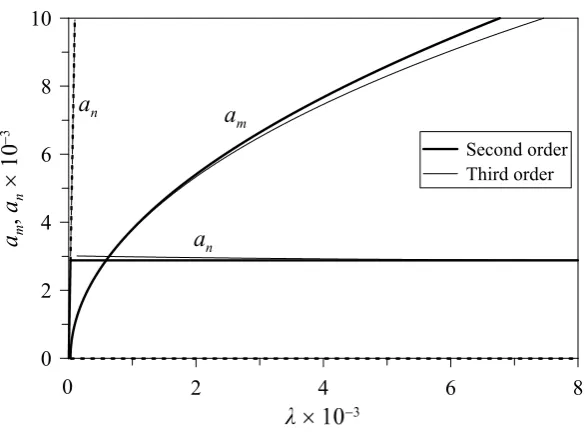
mFigure 8: Force response curves for σ1 = 0 andσ2 = 0.
force-response curve shows a paradigmatic behaviour in the context of 2:1 internal resonances
for a variety of nonlinear systems, the so-called saturation phenomenon. The response of
the directly excited mode grows linearly up to a threshold excitation amplitude past which
the single-mode response becomes unstable through a pitchfork bifurcation in favour of a
two-mode response characterised by the fact that the directly excited response saturates at
a constant amplitude while the autoparametrically excited mode grows nonlinearly with the
force amplitude. In this figure we also show the bifurcation scenario (thin solid lines) predicted
by the third order equations (41). The third order effects are such that past the pitchfork
bifurcation, the amplitude of the saturated mode slightly decreases with the forcing amplitude
instead of being constant as in the second order solution while the amplitude of themth mode
increases at a slightly lower rate than that of the second order solution.
The bifurcation behaviour is further studied in terms of frequency-response curves
ob-tained by pathfollowing (using a continuation code written in Mathematica by the authors)
the fixed points of the modulation equations while monitoring the stability by simultaneously
pathfollowing the eigenvalues of the Jacobian matrix.
The frequency-response curves are obtained by setting the forcing amplitudeλand internal
detuningσ2 while selecting the external frequency detuning σ1 (i.e., detuning between Ω and
the frequency ωn of the high-frequency mode) as control parameter. Two excitation levels
are considered in the range where the autoparametric resonance is activated (i.e., coupled
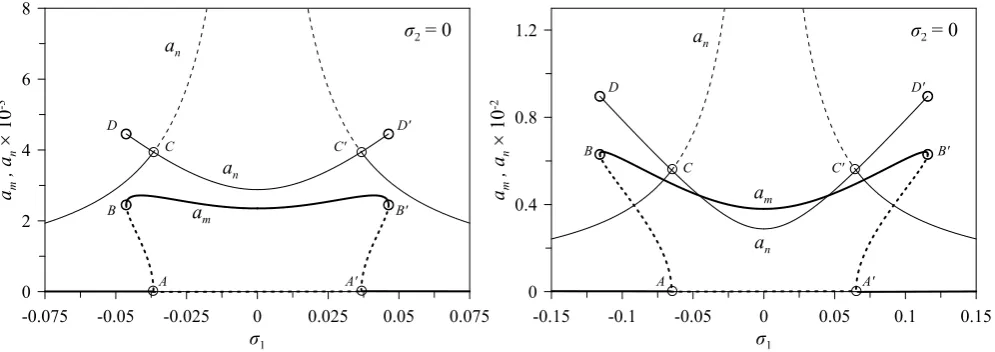
perfect tuning among the frequencies of the resonant modes (σ2 = 0), the frequency response
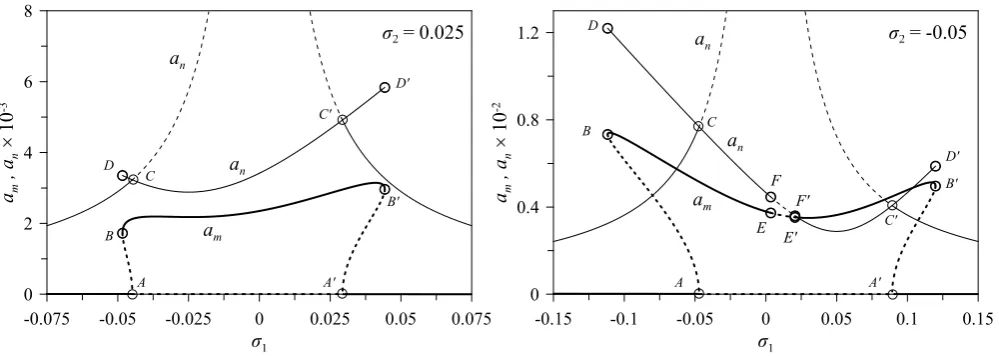
curves are reported in Fig. 9 while the frequency-response curves obtained for a positive or a
negative detuning σ2 are shown in Fig. 10. The first observation is that these curves enjoy
a full symmetry with respect to the frequency detuning parameter. As expected, at A (A′)
and C (C′), the single-mode response (am = 0, an ̸= 0) loses its stability via a subcritical
pitchfork bifurcation (the solution am ̸= 0, branching off from am = 0, is unstable). Upon
decreasing the frequency (to the left of point A) or increasing the frequency (to the right of
point A′), saddle-node bifurcations occur at B and B′ where the solutionam becomes stable
and preserves the stability over the entire range between B and B′. The only difference between
the two excitation levels is that while for weak excitations (see Fig. 9 left) the high-frequency
modal amplitude is always higher than the low-frequency amplitude, for harder excitations
(see Fig. 9 right) there is a frequency range in which the low-frequency amplitude exceeds the
high-frequency amplitude.
When the internal frequency detuning is nontrivial (see Fig. 10), the mentioned symmetry
is lost although the bifurcation scenarios are preserved but for the harder excitation, which
gives rise to a small frequency range in which the stable fixed point (i.e., periodic
coupled-mode solution) loses its stability via Hopf bifurcations at E, F and E′, F′. In such a range of
frequencies the response becomes quasi-periodic and may further bifurcate.
-0.075 -0.05 -0.025 0 0.025 0.05 0.075
σ 0
2 4 6 8
am
,
an
1
0
-3
am
an
an σ
= 0
D D'
B' B
A A'
C C'
-0.15 -0.1 -0.05 0 0.05 0.1 0.15
σ
0 0.4 0.8 1.2
am
,
an
1
0
-2
am
an
an σ = 0
D D'
B' B
A A'
[image:25.595.59.557.446.622.2]C C'
Figure 9: Second order frequency-response curves for σ2 = 0 and (left) λ = 0.4×10⁻³, (right)
λ= 10−3.