Rochester Institute of Technology
RIT Scholar Works
Theses Thesis/Dissertation Collections
2011
Mitigating the risk of social engineering attacks
Matthew Spinapolice
Follow this and additional works at:http://scholarworks.rit.edu/theses
This Thesis is brought to you for free and open access by the Thesis/Dissertation Collections at RIT Scholar Works. It has been accepted for inclusion in Theses by an authorized administrator of RIT Scholar Works. For more information, please [email protected].
Recommended Citation
Mitigating the Risk of Social Engineering Attacks
by
Matthew Spinapolice
Committee Members
Daryl Johnson
Peter Lutz
Bill Stackpole
Thesis submitted in partial fulfillment of the requirements for the degree of
Master of Science in
Master of Science in
Networking and System Administration
Rochester Institute of Technology
B. Thomas Golisano College
of
Computing and Information Sciences
i
Abstract
Social engineering is a topic that is briefly covered in today’s system administration and security
coursework. With emphasis primarily on securing and administering computer network
technologies, ample time has not been given to discussing how to administer the users. In
addition to their technical training, administrators need to comprehend the potential severity and
likelihood of social engineering attacks. Teaching administrators how to minimize the risk of
hacking attempts or computer virus infections does not fully equip administrators with the
knowledge to defend their networks. Administrators need to be able to answer the question of
how they can also mitigate the risk of social engineering attacks against their network.
To properly answer the question of how to mitigate the risk of social engineering attacks, several
facets of social engineering needed to be discussed to fully understand how it works. These
topics include the:
• Definition of social engineering
• Human factors social engineers exploit
• Motivation for using social engineering
•
Types of social engineering attacksDefining social engineering was necessary to have a firm basis of what is social engineering.
For the context of this thesis, social engineering is defined as using subversive tactics to elicit
information from end users for ulterior motives.
Research into exploitable human factors is necessary to understand how social engineers think.
ii
devise methods to protect themselves, and their users, from having these traits exploited. These
traits were defined to give a clear picture of what attackers look for in an individual when
planning their method of attack.
Methods of attack were researched to clearly define attack types and make administrators aware
of how attacks are typically carried out. By knowing these methods, best practices for
administrators can be determined.
A three vector approach is necessary to successfully combat social engineering attacks. Using
this approach, administrators must focus on:
• Creating best practices for themselves
• Training users on the dangers and methods of social engineering
• Reviewing organization’s policies and procedures
The creation of best practices for administrators allows administrators to have a checklist of
items to ensure proper protection. This best practice guide covers physical security
implementations, personnel security measures and network security hardware, software and
policies. All three levels of security must be given equal assessment to ensure there is no weak
link in the security chain.
Training end users, part of the personnel security best practices, is very crucial if administrators
are going to successfully mitigate the risk of social engineering attacks. The users need to have a
iii
done if an attack occurs. Like any emergency preparedness training, users must be reminded
time and again of the risk of attack and precautions to take.
In today’s age of digital security, it is the users who pose the weakest link to information security
and computer networks due to their lack of knowledge of the potential risk. Armed with the
knowledge of social engineering methods and tactics, administrators can be better equipped to
protect their networks from attack. Apart from understanding the knowledge themselves, an
administrator must be able to train the end users about the dangers of social engineering. Today,
ensuring a fully protected computer network cannot be done by administrators alone. It takes the
entire organization to realize each individual is responsible for ensuring information security. By
implementing best practices, conducting regular training classes, and auditing current policies
and procedures for compliance, accuracy, and effectiveness, system administrators can mitigate
iv
Contents
Abstract ... i
List of Figures and Tables... vi
Introduction ... 1
Social Engineering Defined ... 2
Why Use Social Engineering? ... 3
What Social Engineers Prey On ... 4
Reciprocation ... 4
Commitment ... 5
Social Proof ... 5
Friendliness ... 6
Authority ... 7
Scarcity ... 8
Attack Vectors ... 9
Carelessness ... 9
Comfort Zone ... 10
Helpfulness ... 10
Fear ... 10
Ultimate Goal for Successful Attacks: Trust ... 11
Taxonomy of Social Engineering Attacks ... 12
Dumpster Diving ... 12
Pharming ... 13
Phishing... 15
Pretexting ... 18
Quid Pro Quo ... 19
Reverse Social Engineering ... 20
Shoulder Surfing ... 21
Trojan Horse/Gimmies... 22
Mitigating the Risk ... 24
Determine Value ... 24
Risk vs. Threat ... 25
Security Measures ... 26
Best Practices ... 28
v
Personnel Security ... 30
Digital Security ... 31
User Training ... 36
Classroom-Based Course ... 38
Course Objectives ... 39
Course Layout ... 39
Introduction and Knowledge Transfer ... 39
Group Participation Activities ... 40
Review of Organization’s Rules and Policies ... 40
Objectives Review and Q&A... 40
Course Length and Recurrence ... 41
Audit Guidelines ... 42
Audit Preparation ... 42
Audit Timeline ... 44
Example Audit ... 45
Conclusion ... 46
Impact of Social Engineering... 46
Appendices ... 48
Appendix A – Administrator’s Best Practices ... 48
Appendix B – Visitor Log Example ... 51
Appendix C – User Workshop Agenda ... 52
Appendix D – User Workshop Sample Questionnaire ... 53
Appendix E – Sample Procedure Review Audit Form ... 55
Appendix F – Sample Procedure Testing Audit ... 56
Appendix G – Sample Audit: Survey Method ... 57
vi
List of Figures and Tables
Figure 1 - How Pharming Works ... 14
Figure 2 - Phishing Email Example ... 16
Figure 3 - Phishing Email Example 2 ... 17
Figure 4 - Best Practice Security Model ... 27
1
Introduction
Network and systems administrators are faced with the potential of having to deal with any
number of network attacks. These attacks may come in the form of viruses, worms, hackers,
malware, and “bot nets.” When it comes to these types of attacks, administrators have a number
of tools at their disposal to defend their network. For example, routers can be deployed utilizing
Network Address Translation (NAT) to hide their systems from the external Internet. For
filtering and blocking, administrators can employ high-end firewalls to block unsolicited traffic
or Access Control Lists (ACLs) to block traffic from unwanted locations. With all these tools in
place, many administrators feel they are adequately protected, from attack. At the very least,
they feel if an attack is to happen, they would be notified immediately and be ready to act. The
problem with this heavy reliance on technology is that administrators now focus solely on the
technology to solve their problems. As information security author Bruce Schneier stated, “If
you think technology can solve your security problems, then you don’t understand the problems
and you don’t understand the technology” (Schneier, Secrets & Lies, 2002, p. xxii).
The problem administrators face today when dealing with security is not a technical one. Kevin
Mitnick emphasized this after attending his first Rivest, Shamir and Adleman (RSA) conference:
“No sessions were offered covering physical attacks or social engineering. You could
spend a fortune purchasing technology and services from every exhibitor, speaker and
sponsor at the RSA Conference, and your network infrastructure could still remain as
vulnerable to old-fashioned manipulation” (Mitnick K. , 2001).
The issue revolves around the human aspect of the network, not the technological aspect. Like
2
advances in network security, humans are now the weakest link in the chain. Attackers have
time on their side. Attackers can take as long as they want in planning out their attacks. These
attackers will plan out their attacks and attempt to go for the weakest link in the security chain
with the hopes of gaining the most information or inflicting the most damage. In contemporary
networks, this weakest link is the end user him or herself (Orgill, Romney, Bailey, & Orgill,
2004). Routers, firewalls and other defenses are meaningless if an attacker is standing in front of
a client’s machine, or worse, gains physical access to the server room. If an attacker can exploit
a user to gain information, administrators need to devise new measures to secure their networks
and data. An administrator’s arsenal of network security tools and software is rendered useless
if those tools can be circumvented simply by the attacker walking through the organization’s
front door.
Social Engineering Defined
When attackers focus on the human element of a computer network, they typically employ social
engineering tactics. Social engineering relies predominately on establishing and exploiting trust
(Russell, et al., 2003). By building trust with an individual the attacker may be able to gain
privileged information he or she would not otherwise be able to attain. The ultimate goal of a
social engineering attack is to gain direct access to the targeted information system (Thornburgh,
2004). Successful social engineering attacks allow attackers to gain the information they want
without having to resort to hacking. Based on what social engineering attempts to accomplish,
when dealing with computer network administration, the following definition of social
engineering can be surmised: using subversive tactics to obtain information from an individual or
3
Why Use Social Engineering?
With social engineering defined, the next question to ask is why would one conduct such an
operation in the first place? Lafrance (2004) identifies four distinct motives that may drive one
to conduct a social engineering attack.
• Economic Profit
An attacker may see the information that could be obtained as a quick means of
earning money whether by attempting to then blackmail the victim or sell the
information to the highest bidder.
• Personal Interest
An attacker may simply be curious as to what goes on with an organization and
see social engineering as the best means to obtain information without causing
alarm.
• Revenge
Former employees, competitors, or someone who disagrees with a corporation’s
business or its practices may resort to social engineering in an attempt to damage
the corporation or its reputation.
• External Pressure
External pressure may come from other hackers where hacking is viewed as a
game to see who can obtain the most information or do the most damage for
4
What Social Engineers Prey On
Before one can understand and attempt to identify the tactics social engineers may employ, it is
important to understand what human traits social engineers prey on to exploit their victims. The
research by Robert Cialdini (2001) gives insight into just these traits.
In his book, Influence, Cialdini (2001) listed several innate human conditions that practitioners
of social engineering will prey on (and exploit any combination of) to gain a victim’s trust in an
effort to obtain desired information. The six conditions described are:
• Reciprocation
• Commitment
• Social Proof
• Friendliness
• Authority
• Scarcity
Reciprocation
Reciprocation is one of the most influential rules ingrained into the human culture. This rule
states that people should attempt to repay what another person has provided to them (Cialdini,
2001). When provided with a good or service, the human response is to feel a sense of debt to
the provider, so they do not later feel a sense of guilt for getting something for nothing. In most
cases of receiving goods or services, this debt is repaid in monitory amounts. Exploiting this rule
is easy and one of the most common tactics used by social engineers. The reciprocation rule is
5
Besides being an overpowering influence on the human psyche, the reciprocation rule also can
result in unequal exchanges of favors or information (Cialdini, 2001). This unequal exchange is
typically displayed when a person feels indebted to another. In the course of paying back their
debt, the person will pay (monetarily or by actions) more than is owed to relieve their feeling of
guilt. Exploiting reciprocation requires the social engineer to make the first move during the
attack (rather than waiting for the victim to engage the attacker).
Commitment
Commitment is another human condition social engineers prey on. This condition suggests once
a person makes a decision, he or she feels a sense of responsibility, whether intrinsically or
extrinsically, to commit to it. Social engineers use this to their advantage in numerous ways to
coerce their targets into divulging sensitive information. If the target has already been answering
questions from the attacker, divulging unnecessary information for future attacks, he or she will
feel a sense of pressure when finally asked a question where the answer will yield important
information. For example, an attacker could ask a series of questions about a particular
employee. Anything from when the employee goes to lunch, how long they take lunch, etc. The
attacker could finally ask the office number of the employee. While all this information seems
benign, the attacker now has now compiled a window of opportunity to search the employee’s
office for useful information.
Social Proof
“The principle of social proof states that one important means that people use to decide what to
believe or how to act in a situation is to look at what other people are believing or doing”
6
within an organization, he or she can use the concept of social proof to further coerce someone
into divulging information. By instilling a sense of conformity upon the victim, the victim will
be more likely to believe others have done what the attacker is asking him or her to do (Manjak,
2006). For instance, the attacker may create a form that asks for the individual’s computer logon
credentials, which are needed for an annual security assessment. Upon presenting the form to
the target, the attacker may say “Many of your coworkers [dropping names of other members in
the organization to help legitimize the request] have already completed this form, it is necessary
for you to please do the same.” The victim, now presented with proof (albeit false) of his or her
coworkers’ compliance, now feels more at ease thanks to the (false) assumption that others have
followed suit in filling out the faux security assessment form. Social proof is very effective
when the victim is not around his or her peers. Without being able to confirm the attacker’s
statements, lone victims can be more easily persuaded to divulge information than those who are
within a group (Orgill, Romney, Bailey, & Orgill, 2004).
Friendliness
People tend to be more responsive to others whom they are friendly with and like. This increase
in responsiveness aids attackers aiming to exploit the friendliness condition. Responsiveness
means that people will be more willing to say “yes” to requests from friendly acquaintances.
Due to this likelihood, an attacker utilizing social engineering will compliment and befriend a
target during their interactions. A person is more willing to divulge information to someone who
is kind, social, and courteous.
A receptionist at an organization may be the most likely target for the friendliness exploit due to
7
to high visibility and ease of access. For example, an attacker will walk in mentioning how he is
late for a meeting with an executive within the organization. He cannot remember the office or
phone number of the higher up and asks the receptionist for the executive’s information,
remembering to be polite and smile. Whether the receptionist is male or female, the attacker will
attempt to interject a compliment to further the friendliness façade.
Within the concept of friendliness lies the idea of similarity and familiarity. Increased
familiarity with someone and discovery of similarities are factors that lead people to like another
(Cialdini, 2001). During attacks that take several months or more, the attacker can put the victim
at ease by remaining in contact, being friendly, or finding (or more commonly falsifying)
similarities between the attacker and victim. The more at ease and friendly the victim is with the
attacker, the more likely he or she will be willing to give up proprietary information.
Authority
The concept of authority lends itself to obedience (Cialdini, 2001). When someone is seen as an
authoritative figure, others will follow the figure’s rules, requests, or orders for one of two main
reasons:
• Hope of reward
• Fear of reprimand
Social engineers strive to illicit responses based on these two stimuli. To do so, one must first
convey the sense of authority. People associate several visual cues with authority status:
• Titles (such as director, president, sergeant, professor, or dean)
8
• Clothing
• Automobiles
Having (or pretending to have) any combination of these and other status symbols allows a social
engineer to feign a higher authority and increase the chances of getting sought after information.
Arriving to a target organization in a freshly pressed suit and stepping out of an expensive car
will help convey the sense of authority and therefore the assumption that the attacker is
privileged to otherwise inaccessible information. The same is true over the phone (or computer)
if the attacker uses managerial titles such as “Director of Information Security” or “Manager of
Information Systems.”
Scarcity
Scarcity affects people every day thanks to advertisements on television and on the Internet
claiming limited inventory. People are bombarded every day with advertisements claiming, “Act
quickly, supplies limited!” or “Hurry, this is a limited time offer!” (The advertisements
themselves are examples of social engineering, but in the pursuit of corporate profit, not
necessarily deception). Cialdini’s scarcity rule states, “…people assign more value to
opportunities when they are less available…. The scarcity principle holds for two reasons. First,
because things that are difficult to attain are typically more valuable…. Second, as things
become less accessible, we lose freedoms” (Cialdini, 2001, p. 231).
Nefarious social engineers will use the same tactics as their legitimate counterparts. A social
engineer may set up a bogus website offering a rare, once in a lifetime available item on sale for
a very low price. This website will be in the form of either a fake online retailer, or more
9
thought of being one of a few people to own such a rare item, buys the item, sending the social
engineer his or her name, address, and credit card information. In return, the buyer receives a
false receipt. Meanwhile, the attacker quickly buys multiple items with the newly acquired
credit card information.
Attack Vectors
Building upon these six human conditions, Charles Lively, Jr., (2004) states social engineers
prey on and utilize four primary attack vectors:
• Carelessness
• Comfort Zone
• Helpful
• Fear
These attack vectors help link what social engineers prey on to the types of attacks social
engineers will use.
Carelessness
The carelessness vector is exploited by having victims fall prey to their own false sense of
security. Not properly disposing of sensitive material or not following security guidelines allows
an attacker to exploit a victim’s carelessness and gain access to potentially damaging
information. Carelessness often aids social engineers in pre-social engineering attacks when
they are in the planning phase of the attack and need information on how to gain the more
lucrative information during the main attack. Lively (2004) states, “[Carelessness] is often the
10
Comfort Zone
A victim’s comfort zone is exploited only after the attacker has made the victim at ease both with
the attacker and the environment. By being in a more comfortable, relaxed state, the victim’s
threat perception is lowered, making it easier for an attacker’s exploit to succeed. This vector
relies heavily on locations to conduct the attack such as a victim’s office. Friendliness and social
proof conditions are more easily exploited via the comfort zone vector. These attacks are more
commonly used from within the organization. A survey conducted in 1998 found that up to
two-thirds of all social engineering attacks emanate from within an organization (Lively Jr., 2004).
Helpfulness
The helpfulness vector exploits the victim’s compassionate side. Relying on the notion that
people generally want to help another (Jones, 2003), attackers will pose as someone in need of
assistance in an attempt to solicit information. Posing as a new employee, the attacker may ask
where certain resources are located throughout the organization, such as the server room or
security office. Both of these locations should be red flags that a potential social engineering
attack is taking place.
Fear
The fear vector exploits a victim by exploiting the emotions and states that make up fear, such as
anxiety and stress. Lively states the fear vector is often the most aggressive type of attack a
social engineer can perform (Lively Jr., 2004). Using the fear vector often means exploiting the
victim’s conditioned sense of authority and preying on the victim’s fear of reprimand. Social
proof exploits also help in these scenarios as victims want to be seen as team players and can be
11
Ultimate Goal for Successful Attacks: Trust
The previous human conditions and attack vectors social engineers exploit and utilize all build
up to one ultimate goal (aside from gaining information): trust. If the attacker can gain the trust
of the victim, the attacker will have a much easier time obtaining any information he or she
desires. The more a person trusts another, the less likely they are to have their suspicions raised
(Mitnick & Simon, 2002). Once the attacker has the trust of the victim, the hard work of the
attack is over. The attacker can now ask for more information while raising little, if any,
12
Taxonomy of Social Engineering Attacks
Focused on exploiting the above human characteristics and learned social behaviors, social
engineers have come up with many intuitive ways to trick their prey into divulging information.
Social engineering attacks typically combine any number of methods in hopes of obtaining as
much information as possible. While commonly used in a combined state, the attack types
themselves can be categorized into several distinct methods with unique features.
Dumpster Diving
Technically, dumpster diving is not considered a method of social engineering since there is no
human interaction while gathering data. Even so, it warrants mentioning as it can play a vital
role in deciding which type of future social engineering attack (or attacks) to use. Dumpster
diving is defined as searching through, or “diving”, through the trash of a person or organization
in an attempt to gain potentially useful information (Authurs, 2003). Names, phone numbers,
email addresses, physical addresses, credit card numbers and other personal or proprietary
information can be easily obtained by one or more dumpster diving sessions.
While it is in the attacker’s best interest to stay hidden during a dumpster diving session, so as to
not to blow his or her cover for future attacks, in most cases the would-be attacker does not have
to worry about any legal issues if spotted. In the Supreme Court decision of California v.
Greenwood (1988) the Court found that the fourth amendment prohibiting warrantless searches
does not apply to trash left outside of a residence or Curtilage (an enclosed area on property but
not housed within a building). The Court’s ruling stated that Mr. Greenwood relinquished the
right to reasonable expectation of privacy to any belonging he put into the trash. As a result of
13
exception to this expectation of privacy is if the trash is on private property with posted “no
trespassing” signs (Robinson, 2007).
Pharming
Pharming is an example of a passive attack where the victim comes to the attacker. Pharming is
the recreation of an otherwise legitimate website, such as a bank or online retailer. The goal is to
trick the victim into thinking he or she is on a real, legitimate site and have the victim enter
confidential information. Depending on the type of website, this could be one’s social security
number, credit card information, or username and password for a legitimate website (Filte,
2006).
Setting up the malicious website is typically not enough for an attack to be successful. For the
ruse to be completely hidden, attackers may opt to make the address of their website appear
legitimate too. This deception could be accomplished via several means. The most common
methods involve registering a domain name with a slight variation on the legitimate website’s
address or using a different domain name suffix.
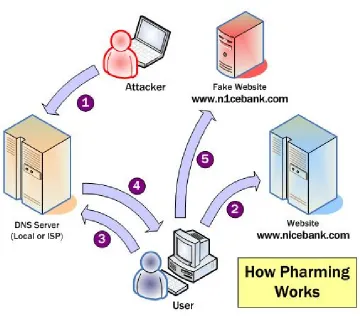
An even more intrusive pharming attack would compromise files locally on the victim’s
computer. By editing the “hosts” file of the computer (limiting the range of the attack only to
machines that are compromised), or by exploiting Domain Name Service (DNS) servers,
attackers can create false domain records so that the legitimate DNS entries for a given website
direct victims to a malicious website’s IP address (otherwise known as DNS poisoning). By
compromising the DNS server(s), attackers will be able to bring many more users to their
website, since any requests the DNS server(s) receives for the legitimate website will be
14
[image:22.612.122.482.128.444.2]Figure 1 shows how this type of pharming attack is conducted.
Figure 1 - How Pharming Works
15
An example of pharming would be a malicious site of www.bankofamerica.net instead of the
correct www.bankofamerica.com. When a user arrives at the bankofamerica.net website, he or
she should not see much difference to the legitimate .com site. Unaware of this being a
pharming site, the victim inputs his or her confidential information (username/password/credit
card number) as well as identifiable pin number(s) to gain access to the site. After submitting the
information, the malicious website may report an error saying the page temporarily cannot be
found due to technical errors. More advanced websites may even pass the information to the
legitimate website and forward the user to the site. Either way the victim is unaware of falling
victim to the attack.
Phishing
Phishing is arguably the most common computer based form of social engineering. Unlike
pharming, where the attacker waits for the victim to come to him, phishing attacks seek out the
victim (McQuade III, 2006). These attacks typically prey on the friendliness and scarcity human
conditions. Phishing is most commonly attempted through email but can also come in the form
of an instant message, phone call, or even in person. In almost all attempts, the attacker
impersonates someone to exploit the idea of authority and gain the victim’s trust and acceptance.
The most common examples of phishing are the Nigerian email scams. These scams usually
involve a supposed high-ranking member of an organization or government based in Nigeria
stating a large sum of money is available to the victim due to some odd circumstances. All the
victim needs to provide is specific personally identifiable information. Typically this
information consists of, but is not limited to a name, social security number, checking account
and routing numbers, and address. In some cases, the victim is even asked for a modest sum of
16
Figure 2 shows an example of a phishing email received by the author during the research of this
thesis.
Figure 2 - Phishing Email Example
From: [email protected] Sent: Tuesday, November 06, 2007 9:28 PM To: *********************
Subject: I Request Your Urgent Consent
Dear Friend,
I am Mr. Abii Debe, staff of Citco Trust & Finance House Accra Ghana,I am the Credit management and recovery manager with the Company office in Ghana before I was transferred to our head office here in Abuja Nigeria, Late Engineer
Wilson was my personal Client before he died in an accident, he was a contractor with Shell Development Company and he is from your Country.
On the 21st of April 2004, Engr. Wilson, his wife and their two children were involved in a car accident along Platue express road and all occupants of the vehicle unfortunately lost their lives. Before the time of his death, he had a deposit of $14.5 Million which he declared as family treasure in the Finance House Accra office where I was working then, which is only I and his lawyer knows the true content, Unfortunately, till this moment no person has come as his relation for his chattels with us. I humbly request your attention to
this matter so that I can present you as his next of kin and beneficiary to his chattels. It is not a very difficult thing to do and it will not take time.
All I will need is to put your name and particulars as his next of kin to in our computer database and we file in an application for the release of the fund in Ghana to conclude the deal, we may request that the money be sent to Europe for your collection.
Please contact me as quickly as possible through this email address
([email protected]) treat this matter as very important and confidential.
When I hear from you, we shall discuss the terms of sharing of the money after the claim. Contact me now so that I can delegate the Attorney who is also going to be part of the deal.
I await your urgent response.
17
Mr. Abii Debe
This email has several signs of being a phishing scam. First, there are constant grammatical
errors and punctuation mistakes. A second red flag is the reply email address. The sender says
he is located in Nigeria, yet the email address ends in the suffix ".hk" which is the domain for
addresses emanating from Hong Kong. Finally, the use of a “Yahoo!” email address when the
sender says he works for a division of Citco Trust is yet another item to note.
The email in Figure 3 goes one step further and even details what information is desired from the
victim. The attacker could then easily commit identity fraud if the victim provided all of the
[image:25.612.62.546.440.715.2]requested information.
Figure 3 - Phishing Email Example 2
From: worthsman kalvin [[email protected]] Sent: Saturday, July 21, 2007 12:46 PM
To: ******************
Subject: part time worker needed
Hello,
My name is Worthsman Kalvin and I am an artist.I live in England,with my two kids and the love of my life. It is definitely a full house. I have been doing artworks since I was a small child when i was in Canada , that should give me about 23 years of experience. I majored in art at high school and took a few college art courses.
Most of my work is done in either pencil or airbrush mixed with color pencils. I have recently added designing and creating artwork on the computer.
I have been selling my art for the last 4 to 5 years and have had my work featured on trading cards,prints and in magazines.I have sold in galleries, museums and to private collectors from all around the world.
I am always facing serious difficulties trying to sell my art works to
Americans and Canadians,they are always offering to pay with a US POSTAL MONEY ORDER,which is difficult for me to cash here in England.
18
for me as a partime worker and i am willing to pay for every transaction,which wouldn't affect your present state of work,Basically someone who would help me receive payments from my customers in the states/Canada .i mean someone that is responsible and reliable,because the cost of coming to the states and
getting payments is very expensive,Presently i am working on setting up a branch in the states and Canada, but for now i need a representative in the united states who will be handling the payment aspect.
These payments are in money order and they would come to you in your name,so all you need to do is cash the money order deduct your percentage and wire the rest back.But the problem i have is trust,But i have my way of getting anyone that gets away with our money,I mean the Security gets involved.It wouldn't cost you any amount,you are to receive payments which will be sent to you by fedex or ups from my business partners,which would come in form of a money order then you are to cash it and send the cash to me via western union money transfer. All western union charges will be deducted from the money.
If you are interested your percentage is 10% out of any transaction , please provide this information below as this assures our partnership.
FIRST NAME--- LASTNAME--- ADDRESS--- CITY--- STATE--- ZIP CODE--- COUNTRY---
PHONE NUMBER (S)---
GENDER--- MARITAL STATUS--- OCCUPATION---
AGE---
NATIONALITY---
Regards Susana
BEACON ST,BIRKBY, HUDDERSFIELD, WEST YORKSHIRE HD2 2RS,
Worthsman
Phone--+447024095475
Pretexting
Pretexting is a technique used by many social engineers. The United States government defines
pretexting as “the practice of getting personal information under false pretenses” ( Pretexting:
19
since the people behind the emails and websites are not actually part of the legitimate
organizations they claim to be a part of. BecauseNot all social engineering attempts are made
under false pretenses. Therefore social engineering is not synonymous with pretexting.
Quid Pro Quo
The Latin word, quid pro quo, is defined as “something for something.” When used for social
engineering purposes, the attacker promises the victim something in return for cooperation. This
method is often aided by an impersonation, where the attacker will pretend to be another worker
within an organization (mixing in pretexting techniques). If necessary, the attacker will
impersonate a superior if the attack is not in person (preying on the realm of authority). The
attacker’s goal is to make the victim feel as if he or she will benefit from helping the attacker
complete his or her goals. These goals are often not seen as malicious in nature to the victim,
while the “reward” is seen as very tantalizing. The classic example of a quid pro quo attack
comes in the form of a survey. Manjak (2006) explains why surveys provide such an easy means
for staging a social engineering attack,
“Surveys are an information gathering instrument tailor made for attackers. They require
no special relationship between the attacker and the victim, and are by their very nature
designed to elicit information in a question and answer format” (p. 9).
In a notable study, organizers of the Infosecurity Europe conference conducted three surveys
from 2006 through 2008 asking random people in London, England if they would divulge their
work usernames and passwords in return for a chocolate candy bar. The organizers also hired
attractive females to administer the survey to further entice people. After reviewing the data, the
20
passwords in exchange for a candy bar. In 2007, that percentage decreased to 64%. In 2008, the
percentage dropped again to 21% out of 576 people asked (Infosecurity Europe, 2008). While
the research shows there are many people willing to part with sensitive, private, and potentially
damaging information, these surveys also suggest that people are beginning to be more cautious
when giving out personal information. However, it must be noted that the organizers were not
able to determine if the usernames and passwords recorded were legitimate.
Reverse Social Engineering
Reverse social engineering aims to gain information by having the victim ask the questions
rather than the attacker. Typically, when employing this type of attack, the attacker will don the
persona of an authority figure within the organization. Utilizing this authority characteristic can
yield a great deal of information to the social engineer based on the questions asked by the
victim.
Reverse social engineering attacks are one of the hardest types of attacks to perform due to the
time and patience necessary to properly prepare one’s self to step into the authority figure’s role.
A social engineer needs to make his or her ruse believable to the victim or else he or she will be
exposed. Employing this attack method usually means having to give up some information to
ensure the victim never knows an attack took place.
Malcolm Allen (2007) describes a reverse social engineering attack as being comprised of three
parts: sabotage, marketing, and support. With sabotage, the attacker will attempt to corrupt or
give the appearance of corruption to a user’s workstation or other device. The attacker will then
21
dropping. Once contacted, the attacker will then switch into support mode and “assist” the
victim with the problem while gaining the desired information.
A typical scenario for reverse social engineering involves the attacker impersonating a member
of an organization’s Information Technology (IT) helpdesk. Selecting his or her victim, the
attacker may sabotage the victim’s computer. This sabotage can be as simple as unplugging the
user’s network cable. The attacker will then make himself or herself known to the victim as the
person who can help fix the computer’s problem. A simple, “Hi, I’m Henry, the IT guy, can I
help you?” will do. Once the attacker is in direct contact with the victim, the final phase,
support, or assisting, begins (Dubin, 2003). Throughout the conversation, the attacker listens to
and attempts to answer questions asked by the victim. As the victim asks questions related to the
issue, the attacker can gain valuable information that may aid in further attacks. When ending
the dialog with the victim,, the attacker fixes the victim’s computer problem, obtains the desired
information and break contact. The victim is unaware of the attack because his or her computer
is back up and operational. Additionally, a trust has been established between victim and
attacker that could be used for further information gathering attacks.
Shoulder Surfing
Shoulder surfing is the act of watching what someone is typing or doing on the computer by
watching the screen (or keyboard) with or without the victim’s knowledge (Robinson, 2007).
The act of shoulder surfing itself is not a true form of social engineering, as the attacker is not
actively engaging the victim (Allen, 2007). Even so, other social engineering methods are used
to lead up to this attack, as the attacker needs the victim’s trust and must make the victim feel at
22
without a sense of trust by the victim. This action will almost surely cause the potential victim to
ask what on the attacker’s motive is and why the attacker is standing behind them. Gaining the
victim’s trust, engaging the victim in conversation and finding (or creating) similarities between
attacker and victim will increase the chances of this attack succeeding. As the victim falls into a
false sense of trust around the attacker, he or she will be less likely to notice, or care, if the
attacker happens to be watching what he or she is typing into the computer. Once this trust is
established, the attacker only needs to watch for usernames, passwords, or other valuable
information, and then disappear. Once again, the victim has no idea an attack has taken place.
Trojan Horse/Gimmies
Trojan horse attacks, also known as “gimmies,” aim to exploit the victim’s curiosity as well as
exploit the victim’s sense of scarcity. Trojan horse attacks are unique in that they may never
require contact (directly in person or indirectly via email) to be accomplished. The attack is
performed by leaving something the victim will find as valuable laying around such as a CD or
flash drive. The item is the Trojan Horse.
While at first sight it appears to be nothing more than a harmless piece of technology, it is the
software contained on it that is a danger. Prior to planting the device in a location where the
victim will find it, the attacker will load any number of malware utilities on it. These utilities
include key loggers, spyware viruses, root kits, etc. Once the victim finds the item and inserts it
into his or her computer, the software will automatically install and/or activate without the
victim’s consent or knowledge. The scarcity condition is exploited when the victim picks up the
item after seeing it lying in an inconspicuous space. The victim’s curiosity is exploited when the
23
This exact scenario was tested in June of 2006 by Secure Network Technologies Inc. during a
security audit of a credit union. Twenty USB flash drives were preloaded with a Trojan Horse
that would collect user’s passwords, logins, and computer system information and then email
that information back to the auditors. The USB drives were placed in various areas throughout
the credit union’s parking lot. After letting the “attack” go for three days, the auditors found that
15 out of the 20 flash drives were found by credit union employees and were plugged into the
company computers, giving them access to all the information they would need to further
24
Mitigating the Risk
Armed with the knowledge of what human conditions social engineers exploit during their
attacks, as well as the methods they use, administrators can begin to mitigate the risk of social
engineering attacks. In devising such methods, administrators must first determine the value of
the data they are trying to protect. Administrators must also understand the difference between
risk and threat when dealing with prioritizing their data. Administrators must take into account
users’ daily needs to create a ratio of usability to security. As Schneier (2008) has stated:
“Procedures are a tough balancing act. If they're too lax, there will be security problems.
If they're too tight, people will get around them and there will be security problems”
(Schneier on Security - People and Security Rules).
Only after understanding a risk verses a threat can administrators effectively implement security
measures that would be best suited for their environment.
Determine Value
One key detail administrators must first review is determining what has value in their
organization. Administrators should learn to think beyond the traditional terms of value such as
a computer costing $2,000 to replace. In addition to such asset values, one needs to think of
what the data they manage could be worth. Most organizations tend to underestimate the value
of their data, only to realize this error after an attack (Gragg, 2002).
Determining the value of information and resources will help prioritize the level of protection
given to the information. By prioritizing and ranking systems by a value metric, administrators
can better allocate safeguards and countermeasures to protect them. Administrators should also
25
greatly outweighs the value of the resource itself, it may not be in the best interest of the
organization to spend the money to protect it (Dubin, 2003).
Risk vs. Threat
The difference between risk and threat is very important for an administrator to understand. Not
fully grasping the definition of these terms can lead to weak security measures that will not
provide adequate safeguards when tested.
Bruce Schneier (2006) identified risk and threat as the following:
“A threat is a potential way an attacker can attack a system” (p. 20).
A risk takes “into consideration both the likelihood of the threat and the seriousness of a
successful attack” (p. 20).
To summarize, the threat is the type of attack that can be used, while the risk is the chance or the
probability that the attack will occur and be successful.
In today’s post 9/11 world, think of the threat as a terrorist attack. The media constantly states
how another terrorist attack is a threat to the United States. The risk, however, can vary greatly.
For instance, a terrorist attack would be more likely to occur in Washington, D.C. than Bismarck,
ND. Therefore, it can be said that the risk of a terrorist threat is greater in Washington, D.C. than
in Bismarck.
This same reasoning is used when dealing with social engineering. In a new startup
organization, there is the threat that someone could use social engineering to discover the
username and password of a given employee; however, the risk of such an attack is low because
26
engineering attempt against an employee of a high profile, well established company is greater
than that of a company that was created recently.
Administrators need to evaluate the data to be protected and place values on it. Using the
information’s determined value will help in deciding risk if the information were to be
compromised. Higher value information may be at greater risk from the same attack than lower
value information. Establishing these criteria is what will lead to being able to apply the
necessary security measures on the appropriate data.
Security Measures
If a Systems Administrator is to protect the assets of his or her network, he or she must think like
an attacker. What data would be sought? Which people would easily give up information?
These questions should be asked and answered before any specific policy or procedure is put in
place. Even after policies or procedures are implemented, administrators must still remember
that they and their network are never one hundred percent protected. When it comes to social
engineering, the administrator must strive to mitigate every attack attempt. An attacker need
only be successful once.
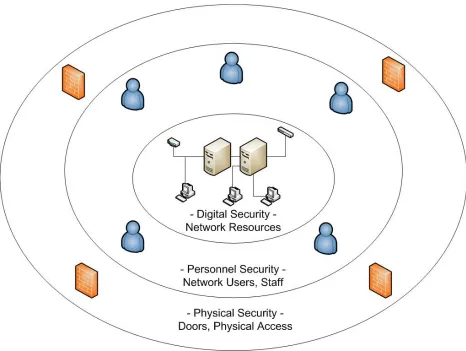
To combat social engineering attacks, an administrator’s best practices guide has been developed
and have been divided into three separate categories:
• Physical Security
• Personnel Security
27
These three categories, working from the top down should form a shell around valuable network
[image:35.612.74.540.171.522.2]resources and data, as seen in Figure 4.
Figure 4 - Best Practice Security Model
This “onion” layered approach to mitigating the risk of social engineering attacks aims to ensure
that if the outer layer of protection is broken, the damage an attack can cause will be limited to
that layer and stopped before access to network resources has been achieved. Once network
security measures have been breached, an attacker will have access to any and all desired
28
Best Practices
Detailed practices and procedures that can be implemented are broken down under each of the
three security layers. A quick reference version of these best practice guidelines can be found in
Appendix A.
Physical Security
Physical security includes all physical entry and exit points to the facility, including exterior
building access as well as access to network resources such as datacenters and wiring closets.
These assets must be protected and monitored to ensure only properly authorized personnel can
gain access. Being vigilant and ensuring only authorized personnel have permission helps to
lower the risk of physical security breaches stemming from social engineering attacks.
Physical security should employ multiple means to secure and monitor all entrances to a facility.
Such methods and tools are:
• Auto locking doors
• Closed Circuit video surveillance equipment
Utilizing auto locking doors provides a failsafe against users. These types of doors help to
alleviate the user forgetting to lock entrance ways that lead to sensitive areas or resources. Auto
locking doors can be classified as the counterparts to the auto lock feature on a user’s
workstation, ensuring no one can access network resources without proper access in the event the
user forgets to lock his or her workstation while away.
Administrators should emphasize the danger of tailgating users when entering or exiting secured
locations. Attackers may attempt to exploit an individual’s courtesy of holding a door open for
29
2006). Users may find it rude to let the door shut behind them when another individual is trying
to pass through the door as well. This tactic further ensures the locking doors are not defeated
via any social engineering attempt.
• Photo identification (ID) badges
Issue ID badges that incorporate copy protection countermeasures, such as printed
holograms or microscopic text. These badges should also contain technology such as
mag-stripe or RFID encoded information linked the user’s name and access permissions
to grant/deny the user access to various areas throughout the organization.
• Biometric access devices
Using biometric access devices such as hand scanners or retina scanners offer another
level of security that has proven to be very difficult, but not impossible to defeat. Using
this technology in tandem with photo ID badges establishes a multifactor authentication
scheme for ensuring a secure physical environment.
• Security cameras
Security cameras add a logging mechanism to physical security. Not only can video
recordings provide a log of successful logins and logouts of users from the premises, but
they also serve to review the events leading up to, during, and after an attempted or even
a successful breach of physical security.
30
Badges should be issued to every visitor that enters the premises, no matter how trusted
the individual is. Assigning visitor badges to every visitor establishes an auditable policy
that shows all visitors are accounted for during their visit.
• Sign-in sheets
In addition to visitor badges, guests should be required to fill out a sign-in sheet, or
visitor log, recording, at a minimum, their name, organization they are from, who they
are visiting, their time checking in, and their time checking out (see Appendix C for an
example sign in sheet). Sign-in sheets provide an auditable log of all visitors to the
organization and provide information on who in the organization is accountable for a
given visitor. An example visitor log with recommended fields can be found in
Appendix B.
Personnel Security
Strong personnel security is critical, as it is the last barrier before physical access to a network.
There are several policies that can bolster the effectiveness of personnel security.
• Protect user information
Inform users not to give out their personal information or others’ via the Internet in
person, or over the phone to unknown parties. If someone calls asking for an associate
who is unavailable, instruct users not to tell the caller how to contact the individual.
Instead instruct users to ask the caller for callback information and to provide that
31
• Conduct background checks on potential employees
Background checks should be conducted on all potential new employees before they start
to check for criminal records and get a better idea of the character and ethics of the
individual (Dolan, 2004).
• Training
Training the members of an organization helps to support both the physical and digital
security measures. Training personnel on what signs to watch out for that could signal an
attack and what information is acceptable to give out is crucial. Sample training course
outlines are discussed in the “User Workshop” section of this paper.
Prior to implementing personnel training, meetings with leadership should be held to
reviewing what the organization deems as sensitive information. Meeting hosts should
review steps organization members should take to verify a person’s identity before
granting anyone access to material or information.
Digital Security
The final barrier in mitigating social engineering attacks is the digital one. Securing the network
is the administrator’s last hope of stopping an attack from. Administrators should employ
multiple security measures to make it as difficult as possible for an attacker to successfully
infiltrate the network. At the very least, such measures should be:
32
Ensure passwords meet a predetermined complexity requirement. Also, force users to
change their passwords at a predetermined interval to ensure compromised passwords do
not become a significant liability. Establishing a policy on password delivery retention
will ensure users cannot soon reuse a password (Mitnick & Simon, 2002).
Randomly generated passwords consisting of a variety of key types (i.e., capitals, special
characters, and numbers) and at least 8 characters in length are considered very secure
from a technological perspective, but are not necessarily secure from a user perspective.
When working with most users, the more complex a password becomes the less secure it
may become. For example, the password “1_Lik3_T@c03s!” can be considered to be
more secure from a user perspective than “&G9f4jh8%vcS,” as it meets typical password
complexity requirements as well as can be easily remembered compared to the second,
randomly generated password. While the second password is more secure from a
technical perspective, it illustrates the dilemma of how the more complex a password
becomes, the less likely users will remember it. If they cannot easily remember their
password(s), users will resort to writing it down; defeating is purpose of being secure.
Social engineers know this. The classic location to check is for a sticky note stuck under
one’s keyboard, or worse, on the side of a user’s monitor.
In an everyday environment, it may be better to compromise. Dissuade users from
choosing easily guessed passwords such as birthdays or a pet’s name. At the same time,
provide users with tips to make secure, easy to remember passwords. Suggest users
33
recommend users reverse the password string to make it less likely to be guessed by an
attacker or broken by a password cracking program, utilizing brute force or dictionary
based attacks.
• Strict firewall rules
Configuring and maintaining strict firewall rules helps to keep an attacker out. Ensure
content filters are up to date when utilizing website blocking technology to help prevent
users from stumbling across websites that could be a source of Trojan Horses or are
known pharming sites.
• Strong email filtering
Setting up and maintaining email spam filters will further ensure users do not become
prey to phishing attacks, chain emails, viruses, or worms that could harm or steal
personal information.
• Multifactor authentication
Multifactor authentication, commonly implemented as two-factor authentication,
provides challenges to ensure the user is allowed access. In two-factor authentication, a
user is challenged with what he or she knows and what he or she has. Under this method,
the user (determined by the username) must enter what he or she knows (e.g., a
password) and provide information on what he or she has (e.g., a token that generates a
34
Incorporating two-factor authentication via the use of a token such as a SafeWord or RSA
token helps to protect users in the event their username and password are compromised.
Even with their account information in the wrong hands, the risk of that information
leading to a further breach is unlikely without the acquisition of the security token.
To establish three-factor authentication, the user must also provide information pertaining
to who they are. Thisthird authentication step can incorporate biometric security, as
discussed in the physical security section of this paper.
• Strong (128+bit) encryption
For sensitive information, protecting it with at strong encryption scheme of at least 128bit
provides another safeguard against information tampering. Encryption should be used
whenever possible, if the data warrants it, to ensure the data’s confidentiality if it were to
fall into unauthorized hands. Encryption should also be used to secure websites, emails,
VPN tunnels, hard drives, or any resource that can be accessed from outside the physical
location.
• Limited wireless network access (none if possible)
Wireless network access significantly increases the risk of a breach by removing the need
to be on the premises to access the local network. If a social engineer were able to obtain
a user’s login credentials, he or she would not even need to step foot into the building if a
wireless access point was present. If the need for wireless access cannot be avoided, then
35
method such as WPA 2. WEP has proven far too easy an encryption protocol to break.
In independent testing, weaker WEP key strings (64bit WEP keys) were able to be
passively sniffed and cracked within several minutes (Kaliburn, Sienkiewicz, &
Spinapolice, 2007). Second, choose a strong passphrase, similar to a password, but
typically longer, to be used with the encryption method. Third, use a RADIUS server to
help authenticate users onto the wireless network. Finally, segment the wireless network
onto its own subnet or VLAN. This subnet should be created especially if the wireless
network will be available to visitors and provide only limited internal network access.
• Access control lists
Create policies to manage and enforce access control lists. Whether device-based,
role-based, or user-role-based, access controls are one of the final lines of defense against losing
information. Ensuring people do not have global access to important information helps
mitigate the risk that a user’s stolen credentials will compromise the entire network. It
cannot be said enough that administrators need to ensure devices and users are only
granted access to the information they need and nothing more. Users should never be
granted administrative rights to their own workstations, no matter how tech-savvy they
claim to be. Even the administrator should not use the administrator or root account
unless it is explicitly necessary. Do not use these accounts for day to day activities.
Implementing and maintaining these policies and procedures at the administrative level will
greatly lower the risk of a successful social engineering attempt on one’s network. To ensure
36
protection against attack attempts, administrators still need to provide adequate training to users
to ensure they follow similar best practices in protecting the network. Establishing guidelines for
future audits to test the policies and procedures will further solidify their effectiveness by
revealing any weaknesses in the current setup. The audit results will then aid in rectifying any
discovered issues.
User Training
In addition to following their own best practices, administrators need to ensure users are aware of
the practices and that they obey security guidelines. If users do not see administrators following
their own best practices, then the users will follow suit (Dubin, 2003). To combat a weak
security atmosphere, administrators should develop several strategies to train and remind users of
the danger of attacks and best practices on how to mitigate them. One method of preventing
users from letting their guards down is to educate them as to what social engineering is and how
to protect against it is via a series of communication, training, and awareness workshops
(Twitchell, 2006).
These user workshops enable the administrators to teach users signs to look out for regarding
potential attacks and what to do when they identify them. Mitnick (2002) states:
“The central goal of any security awareness program is to influence people to change
their behavior and attitudes by motivating every employee to want to chip in and do his
part to protect the organization’s information assets” (p. 250).
Before any training begins, it is recommended that the entire IT staff, including helpdesk
37
In doing so, administrators can reduce the risk of an impersonation attack where an attacker may
pose as a helpdesk worker or other staff member. Far too often the network support staff is
segregated from the rest of the organization’s population.
Manjak (2006) argues, “Employees will not be motivated to change behaviors if they see no
reason to change” (p. 12). During user training sessions, Mitnick (2002) notes one way to
motivate users to protect an organization’s information is to make them understand that doing so
not only helps protect the organization but also themselves, since the organization retains
personal information about all employees. This point is particularly important with payroll
information containing salaries, social security numbers, and contact information.
During these training sessions, administrators should cover four basic topics:
• Social engineering terms
When gauging users’ knowledge of social engineering, Gross and Rosson (2007)
found while many users knew terms such as phishing, none had heard of social
engineering nor did they fully understand its meaning. To this end, users must be
educated as to what social engineering is and what aspects of the human condition
social engineers prey on. Simply being aware of such information will begin to
make users more vigilant in their day-to-day activities.
• Types of social engineering attacks
The training should highlight to users various attack methods, starting with the
38
reverse-social engineering, may require a role playing demonstration to fully
illustrate the to the user the anatomy of such an attack.
• Ways to defend against attacks
After users understand the types of attacks and how they occur, administrators
must review prevention methods. This section of the training session can focus
on various techniques pertaining to the best practices security model (see Figure
4).
• Steps to take when an attack is suspected
Emphasize that while the goal is to prevent an attack, security can never be one
hundred percent effective. In light of this, users should be instructed to notify
support staff when they think an intrusion is taking place. Typically, the
personnel to be notified would be the network administrative and security teams.
If the attack is happening in person, advise users to notify any onsite security
personnel.
Classroom-Based Course
To further examine the benefits and structure of a social engineering training session, the author
collaborated with an instructional design consultant at ICF International, located in Fairfax,
Virginia. The goal laid forth was to devise an outline for a classroom-based course to educate
39
Course Objectives
Three main objectives for the course were isolated. By the end of this training session, learners
will be able to:
1. Recognize social engineering techniques.
2. Describe techniques for mitigating the risks of social engineering attacks.
3. List security rules of the organization.
4. Describe the importance of following corporate security policies, practices, and
procedures.
Course Layout
The devised course was broken down into four main sections:
1. Introduction and knowledge transfer
2. Class participation and activities
3. Review of organization’s rules and policies
4. Objectives review and Q&A
Introduction and Knowledge Transfer
The course would commence with introductions from the security, systems and network team,
allowing employees to put names to faces and know who manages the organization’s IT
infrastructure. Definitions of social engineering would follow accompanied by reasons
employees should care about and be aware of social engineering attacks. Students would be
taught the various human conditions attackers attempt to exploit as well as methods employed to
40 Group Participation Activities
The activities section of the course would open with several case studies of successful attacks.
Details and examples would be given describing the attacks, including information attackers
were after, methods used, and their motivation for the attack.
Several questions were devised to ask to the class after each case study to verify participants
understand the anatomy of the attack and can actively devise ways to identify and prevent the
attack. Three such questions are:
1. What was the objective of the social engineering attack?
2. What techniques were used?
3. How could the victim(s) have prevented the attack?
4. What would you do if you detected or suspected this attack in your office?
Review of Organization’s Rules and Policies
After the case studies and class discussions, review of the organization’s policies and procedures
would commence. Types of sensitive information that could be compromised would be
discussed. Additionally, incentives for following rules in addition to consequences for lack of
compliance would be disseminated to the group.
Objectives Review and Q&A
Following the review of the organization’s policies, students would be asked to answer questions
reviewing the objectives of the course. Students would be asked to define social engineering in
their own words as well as to describe steps they would take to prevent themselves from falling
41
Following the course review, the floor would be open to questions and answers by the class. The
questions would be directed to both the instructor as well as the network and systems
administrators.
Course Length and Recurrence
In discussion with the instructional designer, it was agreed that such a proposed course would
last for approximately two hours in length. Maximum students per session should be kept to
roughly 30-50 employees to ensure adequate time and resources for knowledge transfer and any
questions from the students. Employees should be required to repeat the course once a year