Teaching Materials and Authentic Language: A Report of an Action Research Study
Chunmei Ma
Xi’an International Studies University YanJun Wang
University of Tasmania Abstract
Chinese has by now been considered an increasingly important global language, and in addition, Chinese online users are rapidly multiplying. It is clear that Putonghua will become more and more essential for online communication and e-commerce. China’s growing importance in the increasingly global community gives many foreigners an impetus to learn Chinese. In Australia, Chinese is recognized as one of the fastest growing languages and has one of the largest groups of non-English background speakers. How are we to make full use of this opportunity brought about by the confluence of positive international situations? The tonal language with its characters bearing no resemblance to European scripts makes it one of the most complicated languages in the world to learn. In this context, more efficient and effective ways of learning the language are of vital importance. The goal for teaching Chinese is to train students’ ability to apply speaking, listening, reading and writing skills in this language. The development of multiple language skills is needed to teach students Chinese as well as its associated culture. In the field of second language acquisition, the main focus is to cultivate students’ communicative competence in real-life situations.
A case study was conducted to examine the significance of teaching authentic materials in a language classroom. Participants from a local college and a university were invited to participate in workshops to experience this flexible and less stressful approach of learning a second language. This paper will discuss the results of the workshops which were twofold, first, to determine whether or not students like this approach; second, if there are differences among the participants as they relate to this pedagogical approach. Finally we draw the conclusion that the implementation of this methodological approach is practical, feasible and enjoyable for the participants. There were differences between these two groups in performance; however, both groups showed that this methodology was helpful in Chinese language learning. Keywords: communicative competence, authentic materials, pedagogical approach
Introduction
competence, which opens doors to opportunities in the worlds of business, academic study, government, entertainment, for non-Chinese speakers. Any country or person who is prepared to operate globally in accordance with current and expected global trends can benefit from such an initiative.
In our global village, the ability to use foreign languages is the guarantee of multi-cultural understanding and a better job on a globalized market. Spoken by over one billion of the world’s population, already the third spoken language in 18 countries and an official language of the UN, Chinese is considered an increasingly important global language, and Chinese online users are rapidly multiplying. As a result, Putonghua will become more and more essential for online communication and e-commerce. In Australia, Chinese is recognized as one of the fastest growing languages and has one of the largest groups of non-English background speakers. Mandarin, comparatively, is spoken by fewer Westerners than most European languages spoken by non-natives (Chan, 2008). However, Mandarin is expected to become a new international language in the 21st century. Thus, generating a greater demand for Chinese speakers is part of the new economic, political and social reality. Those with a grasp of the Chinese language will produce better opportunities for themselves on the global economic and political stage, and their knowledge about one of the most accomplished ancient cultures will simultaneously be enriched through language learning.
Background
Linguistic background
However, the harsh reality facing most English speakers is that Chinese is rated one of the most difficult languages to learn, posing problems such as the tones, the pictorial script, homophones and idioms.
Standard Mandarin has five tones---flat, rising, falling-rising, falling and neutral tones, which are used to distinguish meanings, while other Chinese dialects have more tones. The meaning of a single word varies dramatically depending on different tones. Incorrect usage will incur a problem for understanding.
Most Chinese characters are classified as semantic-phonetic compounds, which are utterly indecipherable unless one has obtained some elementary knowledge of the basic meaning and a certain amount of reading of most Chinese characters. Westerners trying to acquire reading or writing competency of the language are faced with the challenge of unfamiliar ideograms. Though a lot of Chinese characters do include phonetic clues which are not phonetic equivalents but the Pinyin transliterations, they require advanced language skill to recognize and are of almost no value to beginning and intermediate learners. The difficulty of writing the Chinese archaic script, which is like drawing pictures, is due to the structure of the Chinese characters, which consist of several components, one phonetic indicating the pronunciation and one symbolic called the radical or basic picture conveying the meaning, and the writing pattern acts accordingly.
may not always be drawn from context when the homophones are in the same written form, because of the quantity of them.
As in other languages, idioms are a significant feature of the Chinese language. They are a means through which native speakers relate to their culture, history and tradition and create metaphysical or philosophical discourse beyond surface meaning (Zein, 2004). Idioms are one of the language elements that make written Chinese texts more elegant and hence are more difficult for learners to comprehend because of very limited prior exposure (Feng, 2006). Given the fact that Chinese idioms come in tens of thousands comprising more than 18,000 entries, it is extremely difficult to cover all or the majority of them in any Chinese teaching. How to tackle these problems relies on an enjoyable, acceptable and effective teaching method so as to build up students’ confidence and enhance their motivation for learning.
Music literature
Singing to learn a foreign language has been used as a successful pedagogical strategy to achieve this goal.
According to Dr. John Feierabend, an experienced Kodály music educator, “One should learn with his/her ears before learning with his/her eyes” (as cited in Brown and Lamb, 2004). Singing focuses on tone, it is not as hard as reading or reciting the same Chinese text. Melody is a very powerful mnemonic. Another advantage over saying words and sentences is that the music tempo can be changed to suit the level of learning of the students without distorting the sounds or words (Kirkham, 2004). Through listening and singing which will not make students nervous, they can imitate naturally and easily and pronounce correctly without worrying so much about their own pronunciations and the tones as when the whole class is listening to them quietly. The anonymity from singing as a group gives confidence which is very useful for pronunciation, and many errors of pronunciation are self-corrected (Kirkham, 2004).It has been demonstrated that children and adults can be taught to sing foreign language songs with excellent pronunciation (Wall et al., 1990).
The question of why one should learn a language through the use of music is an important one and part of the answer is that the rhythm of music helps us remember and music opens ‘closed gates’ in our brain. When the rhythm of the song is connected to the foreign words and phrases, learning the words in the target language will be made easier. Studies conducted by Weikert (as cited in Gadzikowski, 2007) also indicated that language learning is enhanced when we experience the rhythm of music. When the whole group sings the same song simultaneously with the rhythm of music, the teachers can hear clearly where the mistakes are coming from and correct them as part of the rhythm or intonation without identifying any particular student(s). Furthermore, Gadzikowski (2007) also stated, “Recent brain research tells us that when children sing and move to music, their developing brains are entirely engaged and stimulated…Both the left and right sides of the brain are activated when we sing. And the process of singing stimulates both new learning and memory”.
that use be made of the learners’ daily experience of foreign languages. Music and songs are part of our lives; many songs are universally famous and are deeply embedded in our minds. The use of something familiar to all means that the learning of a new language is accomplished with less effort and a great deal more enjoyment (Kirkham, 2004). When you sing, which is a type of entertainment and not perceived as work, learning is considered to be fun, and participants find learning a language full of fun rather than tedium, and then the learners become more active in the learning process. As stated by Lo and Li (as cited in Bonner, 2008), music and songs help create and sustain an environment which evokes positive emotions, lowering the affective filter, and thus facilitating language acquisition, and also provide a break from classroom routine, and learning through songs creates a non-threatening classroom atmosphere in which the four language skills can be enhanced and developed. The relaxed atmosphere brought about in the language classroom by singing shortens the study period. Once confidence in the learning ability is heightened, students will be greatly encouraged and highly motivated to continue their study. Listening to songs improves comprehension skills, while singing increases vocabulary and speech patterns and greatly helps the acquisition of oral fluency. Music aids concentration and memory retention and brings culture alive (Farrug, 2008).
All of the above suggests, therefore, that learning by singing is an enjoyable and successful approach to learning Chinese.
A study and its aims
Our attempt to teach by singing was to let students learn simultaneously through different learning modalities---visual, auditory and kinaesthetic. The theoretical basis is that the more sensory organs engaged, the more learning will take place and the more impressive and effective the learning will be. When singing, we are using the voices produce, the ears to listen, the eyes to follow the lyrics and the whole body to develop rhythm and coordination. This active learning enormously helps language recognition, acquisition and retention. (Gadzikowski, 2007) It was crucial that at the beginning stage, learning Chinese was to be interesting so that students’ interest was sparked, the motivation for learning was enhanced and their enthusiasm was maintained.
In our workshop, songs with simple lyrics were picked. The language was basic, and the tunes were catchy. Many activities were designed and conducted to make the class active and facilitate interaction between teachers and students so that their communicative competence is improved.
Participants
experience. The great mass of learners was fond of singing,only one student in the university group reported that he disliked singing. There were other discrepancies among the students, such as: Chinese background knowledge, ability of imitation, love of music, personal preference of songs, degree of acceptance, personality, motivation.
Teaching content
There were 10 lessons with 6 Chinese and 6 foreign songs including folk songs, children’s songs and popular songs. The general view of all components in each lesson was described in the Teaching Outline. Every lesson had the background of the song, the bilingual lyrics with Pinyin, language points, vocabulary, inside and outside class activities and oral exercises, four different types of written exercises, questions to discuss, assignments and open-ended questions. There were pre-tests and post-tests at the beginning and end of the workshop. The pre-test was to inform us of the students’ Chinese level, while the post-test, the results of learning from this workshop. Procedure
The same teaching content was applied to both groups so that the results of the two groups could be compared.
Each lesson was delivered in the following steps:
• Listen to the song to ‘taste’ the Chinese lyrics. Questions such as: what is the meaning of the song? What is the theme? What are the words you recognize? What are the words you can speak out or imitate? It might be raised in this part of the class session.
• Introduce the song briefly both by teachers and students with information about the lyric writers, composers, the type of the song, its origin, why it is famous, what it expresses.
• Follow the song either after the teacher or other media to learn the pronunciation and intonation, read the lyrics to understand with the help of the explanation and discussion of teacher and classmates.
• Brush up what students have learned in a light-hearted way through oral exercises and activities.
• Do the written exercises first to ensure students have a correct comprehension of the words and lyrics.
• Give assignments to review and enhance the understanding of what had been learnt in class.
• Discuss mainly cross-cultural issues, such as, what do you think of the Australian folk songs and the Chinese ones?
The procedure suggested above may be modified according to the specific situation and students’ demands.
Data analysis and results
contrasts and differences; similarities of the exercises and tests are not included here. Some statistical analysis was not based on 26 students due to the lack of data or their dissimilarities. For instance, one student failed to respond to the questions of personal information like age, gender and period of study of Chinese.
The participants were contrasted in the following aspects: the percentage of each group concerning the score, the number, their attitudes to this teaching method; the relation between the length of study and the result; age and language study; differences between high school students and university students and differences between male students and female students.
The satisfactory results of this workshop were shown by students’ feedback. In the following presentation the words and phrases used by the participants will be used directly to provide insight into their perceptions. They reported it was enjoyable, interesting, motivating, and different and it helped with memory retention, and was a good way to learn vocabulary. “Learning Chinese by singing is actually help(ful).” “It’s fun. (It) Helps you remember words and sentence patterns.” Some learners even
responded in beautifully written Chinese like ‘太好了!’ (Means ‘fantastic!’), ‘很
好!’ (Meaning ‘terrific!’), ‘好’ (Equals ‘good!’). The effect was also illustrated by students’ responses to our open-ended questions, “It’s easier for me to memorise words with singing rather than just trying to memorise words.” And “It helps me to remember words and is more fun than just reading and writing it out over and over.”
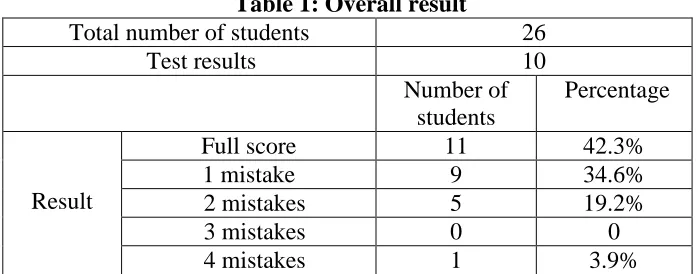
The following tables present the descriptions of exercises of 10 items, tests of 10 items and some open-ended questions.
Table 1: Overall result
Total number of students 26
Test results 10
Number of students
Percentage
Full score 11 42.3%
1 mistake 9 34.6%
2 mistakes 5 19.2%
3 mistakes 0 0
Result
4 mistakes 1 3.9%
[image:6.595.124.473.450.587.2]Among 26 students, 20 received High Distinction, 5 received Distinction and one Credit which indicated 96% of the participants had excellent outcomes in the tests; in addition, they also found this approach was enjoyable. (See Table 1).
Table 2: Perceptions of the teaching methodology Perception Total number
of students
Percentage
Positive 20 77%
Neutral 5 19%
The vast majority of the students appreciated the method---learning Chinese by singing. Students reported learning through songs was much more enjoyable. For instance, students answered the survey in the following words, “It’s good fun. (It) makes learning a bit more interesting and different.” “I think it is very nice and I enjoy trying to sing them.” “It is very [sic] fun! It is a good way to learn new words.” “(It is) a different experience in learning Chinese, (the) more I hear the song, (the) more I understand.” Among the 26 participants, only one in the adult group reported that he disliked singing. (See Table 2)
Table 3: Study period and the result Study period
One year or less More than one year Total
Number of students
16 9
Items Number of students
Percentage Number of students
Percentage
Full score 6 37.5% 5 55.56%
1 mistake 7 43.75% 2 22.22%
2 mistakes 2 12.5% 2 22.22%
3 mistakes 0 0 0 0
4 mistakes 1 6.25% 0 0
(One student’s detail is unclear, thus not included.)
The relation between Chinese study period and this teaching method is revealed above in Table 3. From the result of doing the exercises, it was found 93.75% of those who had studied Chinese for one year or less and 100% of those who had studied Chinese for more than one year received a Distinction grade. This method proved effective to both learners with longer or shorter study period, though the former ones did it better due to their solid foundation.
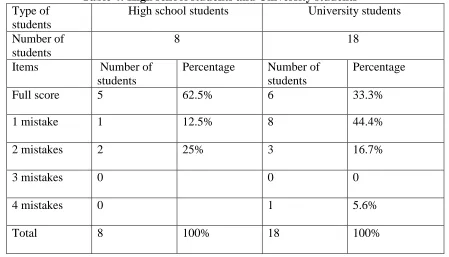
Table 4: High school students and University students Type of
students
High school students University students Number of
students
8 18
Items Number of
students
Percentage Number of students
Percentage
Full score 5 62.5% 6 33.3%
1 mistake 1 12.5% 8 44.4%
2 mistakes 2 25% 3 16.7%
3 mistakes 0 0 0
4 mistakes 0 1 5.6%
[image:7.595.78.527.491.748.2]The results of the same tests of high school students and university students showed high school students performed better than university students. This is, perhaps, due to the fact that the high school students had studied Chinese for 2-5 years while the university students only had one year’s study period (except for one). Another comparison of students, who had studied for the same period, but who were of various ages is given in Table 5.
Table 5: Age Differences
Age 12-19 20-39 40-59
Total Number of students
2 10 4
Number of students
Percentage Number of students
Percentage Number of students
Percentage
Full score 2 100% 2 20% 2 50%
1 mistake 0 5 50% 2 50%
2 mistakes 0 2 20% 0 0
3 mistakes 0 0 0 0 0
4 mistakes 0 1 10% 0 0
Students sharing the same study period in the workshop were categorized into three age groups, and were compared to see whether age affected the language study. From the comparison of the different age groups doing the same exercises, teenagers were found to perform better than others, but the result that 100% of the people aged between 40-59 obtained High Distinction, 90% of those aged between 20-39 got Distinction showed this method was effective for people of all ages, and most of them love music, irrespective of their age.
[image:8.595.82.514.459.686.2]
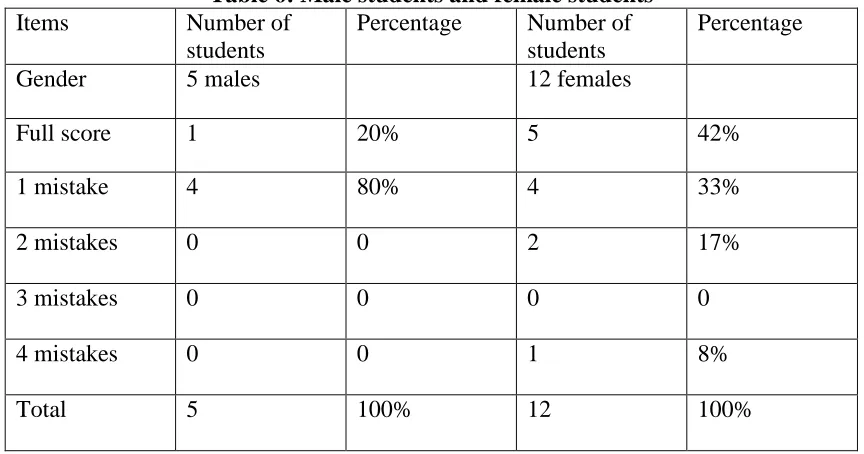
Table 6: Male students and female students
Items Number of
students
Percentage Number of students
Percentage
Gender 5 males 12 females
Full score 1 20% 5 42%
1 mistake 4 80% 4 33%
2 mistakes 0 0 2 17%
3 mistakes 0 0 0 0
4 mistakes 0 0 1 8%
Total 5 100% 12 100%
this singing-assisted teaching method. It is anticipated that whether or not males enjoy a music-assisted approach to teaching more than females, further research will be undertaken with more students, more exercises or tests and a longer duration to add to our knowledge of this area of learning Chinese.
Conclusion
Due to the difficulty of learning Chinese, especially the tones, based on the theory that music helps language learning enormously, we tried to teach Chinese by singing in our workshop. The feedback collected showed that using this approach is practical, feasible and enjoyable for the participants. From the responses, mostly done anonymously, to the open-ended questions, it was revealed the overwhelming majority of the students have a strong preference for this method. Only one student was not positive and this was for a personal reason. There were differences between these two groups in performance, but neither of them showed that this methodology was not helpful in Chinese language learning.
Limitations of the study
The limiting factors of this study are:
•The comparison between students’ language competences may result from the differences of their Chinese background knowledge, their Chinese level, ability of imitation, love of music, personal preference of songs, degree of acceptance, personality, motivation, the Chinese study period, the time they want to consume, how hard they work, the number of students.
•The ungrammatical lyrics in some songs: because pop-song writers are not usually concerned that their songs should be understood by non-native speakers of the language they do not always express themselves grammatically.
•All the linguistic items are from the lyrics which are not like a textbook whose language teaching content is systematically selected and gradually arranged according to the level of difficulty.
•Attenuation, ellipsis and liaison of certain sounds in some characters of the songs will make recognition and listening comprehension of the lyrics difficult for which students needs to be helped.
•If there is more time available and more subjects in the workshop, a better quantitative analysis study can be undertaken; such as, the comparison between male and female students.
Suggestions for future research
Due to the uncontrolled factors, instructors need to be very flexible in delivering the lessons.
•If there is a control group and an experimental one, the traditional pedagogy and this music-assisted one could be compared.
•If necessary, the content can be changed or replaced, a different method used and another activity organized. For instance, according to the weather, you can sing songs about rain, snow, wind or sing songs about seasons, flowers, and holidays.
•Preparing more useful materials for as many occasions as possible, for various situations with their equivalent expressions will make the Chinese more impressive and more memorable.
•If the workshop could last from the beginner to the advanced for years continuously, more songs with language ranging from the basic to high-level could be presented to learners, students will be very fluent in the language skills, and their Chinese proficiency will be stabilized.
•Some classical poems and more difficult songs could be introduced to students of a high-level class to indicate how rich but laconic and terse Chinese is.
•The Pinyin would be better taught in pairs in one lesson so as to compare and distinguish easily if not limited by the lyrics.
•Singing may tend to have little communication unless we purposely create opportunities for students to exchange something relevant.
References
Bonner, G. (2008). Singing the Praises of Songs: Some Practical Ideas for Using Music with your EFL Students. Retrieved December 6, 2008, from
http://www.developingteachers.com/articles_tchtraining/songs1_gabi.htm Brown, N., & Lamb, D. (2004). Parallels between Music Learning and Language
Acquisition: From Fluency to Literacy. The ACIE Newsletter, Vol. 8 (1)
Chan, T. (2008). The Importance of Learning Mandarin. Retrieved October 20, 2008, from http://bestchineselearning.blogspot.com/2008/10/importance-of-learning-mandarin.html
Farrug, D. (January 22, 2008). How Music Helps Language Learning. Retrieved May 24, 2008, from http://languagestudy.suite101.com/article.cfm
Feng, S. (2006). Written Chinese. Beijing: Beijing Language and Culture University Press.
Gadzikowski, A. (2007). Born to Sing: How Music Enriches Children's Language Development. Retrieved August 15, 2008, from
http://www.chicagochildrensmuseum.org/learn_sing.html
Guo Y., & Wang H. (2003). Speaking Chinese 100 Daily Expressions. Beijing: New World Press.
Kang Y. & Lai S. (2006). Conversational Chinese 301(3rd Ed.). Beijing: Beijing Language and Culture University Press.
Kirkham, M.G. (2004).The Development of English Pronunciation through Music. Unpublished Master of Education thesis. Launceston: University of Tasmania, Laroy, C. (1991). Music in Humanistic language Teaching. Spain: University of
Barcelona.
Laroy, C. (1995). Pronunciation. Oxford: OUP.
Wall, J., Caldwell, R., Gavilanes, T., & Allen, S. (1990). Diction for Singers. Perth: Western Australia.