Group Knowledge in Interrogative Epistemology
A. Baltag, R. Boddy and S. Smets
Institute for Logic, Language and Computation.
University of Amsterdam
Abstract
In this paper we formalize an approach to knowledge that we call Interrogative Epistemology, in the spirit of Hintikka’s “interrogative model” of knowledge. According to our approach,an agent’s knowledge is shaped and limited by her interrogative agenda (as defined by her fundamental questions or “epistemic issues”). The dynamic correlate of this postulate is our Selective Learning principle: the agent’s agenda limits her potential for knowledge-acquisition. Only meaningful information, that is relevant to one’s issues, can really be learnt. We use this approach to propose a new perspective ongroup knowledge, understood in terms of theepistemic potential of a groupof agents: the knowledge that the group may come to possess in common (and thus act upon in a coordinated manner) after all members share their individual information. We argue that the standard notions of group knowledge studied in the literature, ranging from distributed knowledge to common knowledge, do not give us a good measure of a group’s epistemic potential. Common knowledge is too weak and too “static”, focusing on what the agents can coordinate upon only based on their actual, current knowledge (without any intra-group communication), thus disregarding testimonial knowledge. In contrast, the concept of distributed knowledge is too strong, being based on the assumption that agents can completely internalize all the testimonial evidence received from others, irrespective of the limitations posed by their own interrogative agendas. We show that a group’s true epistemic potential typically lies in between common knowledge and distributed knowledge. We propose a logical formalization of these concepts, which comes together with a complete axiomatization, and we use this setting to explain both the triumphs and the failures of collective knowledge, treating examples that range from “collective scientific knowledge” (Wray, 2007; Rolin, 2008; Fagan, 2012) to the so-called “curse of the committee”.
1
Introduction
The idea that groups can be treated as collective agents capable of knowledge and beliefs has gained increasing attention (List et al., 2011; List, 2005; Gilbert, 1987; Wray, 2007). Issues such as the social dimensions of knowledge, the various types and varieties of “collective knowledge”, the epistemology of testimony, the truth-tracking value of democracy etc., which were traditionally confined to Social Sciences, have recently become subject of philosophical reflection, as part of Social Epistemology (Goldman, 2004; Goldman and Whitcomb, 2011).
In a parallel evolution, logicians and computer scientists have perfected new formal tools for reasoning about knowledge and its dynamics. Various formal notions of group knowledge have been formalized by epistemic logicians, e.g. ‘mutual knowledge’, ‘distributed knowledge’ and ‘common knowledge’ (Fagin et al., 2003; Baltag et al., 2008; Barwise, 1988; Lewis, 1969), while Dynamic Epistemic Logic focused on the underlying dynamics of testimony, communication, deliberation and other social-informational interactions (Baltag et al., 1998; van Ditmarsch et al., 2007; Baltag et al., 2008; van Benthem, 2011). Yet, despite the increasing interest in the logical understanding of various forms of group knowledge, until now formal logical approaches to this topic have remained largely disconnected from philosophical discussions on collective knowledge.
By highlighting the role of questions and answers, we stay close to Hintikka’s interrogative approach to episte-mology (Hintikka, 2007). We analyze known propositions—both individual and collective—as answers to an agent’s questions. To formalize ‘potential group knowledge’, we use logic and draw on resources from formal epistemology and formal approaches to modelling questions. Following (van Benthem and Minica, 2012; Minica, 2008) we add anissue relationto the standard models for knowledge from epistemic logic, and extend this language further with collective epistemic modalities. Using these formal tools, we develop a logical framework for group knowledge that internalizes the dynamic properties of potential knowledge acquisition through inter-agent communication, and that can be used to address issues regarding the relation of group knowledge to individual knowledge and to group decision-making.
1.1
Questions and Knowledge Acquisition
“All knowledge involves a question. To know is to know the answer” (Schaffer 2007: 401)
The inquiry-based approach in Epistemology amounts to shifting the focus from knowledgepossessionto knowl-edgeacquisition. The shift, which fits well with the “dynamic turn” in Logic championed by the Dutch school (van Benthem, 2011) and with the learning-theoretic approach to epistemology (Kelly, 1996), is also closely aligned with the “inquisitive” move in Logic (Groenendijk, 1999, 2007; Groenendijk et al., 2009; Ciardelli and Roelofsen, 2009). This trend is very much in the spirit of the Interrogative Model of Inquiry initiated by Jaakko Hintikka in the 1970’s, and later developed by him into a ‘Socratic epistemology’ (Hintikka, 2007), which took the act of questioning as fundamental:
“Its basic idea is the same as that of the oldest explicit form of reasoning in philosophy, the Socratic method of questioning orelenchus. In it, all new information enters into an argument or a line of reason-ing in the form of answers to questions that the inquirer addresses to a suitable source of information.” (Hintikka, 2007, p18)
Hintikka here adopts a broad view on what establishes an answer to a question by including as “sources of answers” witnesses providing testimonies, databases, observations, experiments, and also memory and tacit knowledge. Central to his approach is that “all information used in an argument must be brought in as an answer to a question” (Hintikka, 2007, p19).
But when taking interrogative inquiry as the basis of epistemology, what is the role that knowledge plays? Hintikka discusses this point in (Hintikka, 2007, p26) where he explains that “questions of knowledge do not play any role in the questioning process itself, only in evaluating its results”. He takes the process of inquiry (rather than any attempt to define the concept of knowledge) to be the main concern in epistemology:
“The criteria of knowledge concern the conditions on which the results of epistemological inquiry can be relied on as a basis of action” (Hintikka, 2007, p30).
In line with Hintikka’s model of inquiry as a goal-directed process, we mention the learning-theoretic approach to epistemology of (Kelly, 1996), who stresses the role of fundamental questions as long-term goals directing the learning process. Similarly, Interrogative Belief Revision stresses the role played by the agent’s research interests (her ‘research agenda’) in guiding and informing her belief-revision strategy (Olsson and Westlund, 2006). Schaffer’s ‘contrastive’ theory of knowledge (Schaffer, 2005, 2007; Aloni et al., 2013) is also based on the idea that all knowledge implies a question. According to this account, the knowledge that an agent can acquire is dependent on her questions, which determine what alternative states (or answers) she must eliminate in order to acquire knowledge (Schaffer, 2005, 2007; Aloni et al., 2013). Schaffer’s stance can be seen as a version of Dretske’s Relevant Alternatives approach to knowledge: one knows p only as an answer to a question, and this is known only by contrasting it with the other possible answers.
1.2
Questions as Epistemic Filters: the ‘Relevant Distinctions’ Theory of Knowledge
Our starting point is the same as Hintikka’s: inquiry is driven by questions. An agent’s questions shape her knowledge and guide her learning. But as a consequence, they also impose limits on the agent’s knowledge and ability to learn. In “normal” situations, agents can only learn information that fits their agendas: according to this view, all we (can) know are answers to our own questions. As a consequence, the agents’ divergent interrogative agendas can limit a group’s epistemic potential.
Our conception of the epistemic role of questions can be best understood as a“Relevant Distinctions” approach to knowledge (rather than focusing on Relevant Alternatives, like Dretske and Schaffer). Information that does not fit with the agent’s questions involves irrelevant or meaningless distinctions, and thus cannot be learned without breaking (or changing) the agent’s conceptual space. This would involve a change of paradigm (essentially, the raising of new fundamental questions and the abandoning of some old questions). In most of this paper, we deal with “normal” epistemic situations, in which the interrogative agenda remains fixed. In “normal” science, the investigator sticks with the same paradigm, based on the same fundamental issues, and thus she may be unable (or uninterested) to process information that is not relevant to her questions. This is the essence of our Selective Learning Principle: One cannot find what one is not looking for.
Our concept of potential group knowledge is formally related to other group attitudes, such as ‘distributed knowledge’ and ‘common knowledge’, that have been studied in epistemic logic. But in this paper we argue that these standard notions do not give us a good measure of a group’s epistemic potential. Common knowledge captures one feature of group knowledge, namely the fact that group knowledge is what allows coordinated action. Hence the stress on its “shared” nature: it has to be held in common. But common knowledge is too “static”, focusing on what the agents can coordinate upon only based on theiractual, current knowledge (without any intra-group communication), thus disregarding testimonial knowledge. This view gives a too modest assessment of a group’s epistemic powers: according to the common-knowledge account, a group knows almost always less than its members! So the concept of common knowledge is too weak to capture a group’s knowledge, giving only a
lower limit for a group’s potential. In contrast, distributed knowledge (defined as the result of pooling together all the individual knowledge of the group members, and closing under logical consequence) may seem at first sight to accurately capture the potential knowledge of a group. But this is based on the unrealistic assumption that agents can completely internalize all the testimonial evidence received from others, irrespective of the limitations posed by their own interrogative agendas. This assumption contradicts the principle of Selective Learning (as well as everyday experience). In typical situations, not all the distributed knowledge can actually be “internalized” by all the members of the group. This is due to the discrepancy between different agents’ interrogative agendas. Hence, the concept of distributed knowledge is too strong, giving only anupper limit for a group’s potential.
In this paper, we propose a new logical formalization of the concept of group knowledge, based on our ‘Relevant Distinctions’ version of Interrogative Epistemology. We define the “epistemic potential of a group” asthe knowledge that the members of the group may come to jointly possess (and thus act upon as a group, in a coordinated manner) by (selectively) learning from each other all the available information that is relevant to their own issues). We show that group knowledge typically lies in between common knowledge and distributed knowledge. We investigate the relationship between these concepts, and study their logic, which comes together with a complete axiomatization. We also look at the logical dynamics of information sharing in order to understand how the group’s potential knowledge is actualized (i.e. converted into common knowledge) by in-group communication. We use this setting to explain both the triumphs and the failures of collective knowledge, treating examples that range from “collective scientific knowledge” (Wray, 2007; Rolin, 2008; Fagan, 2012) to the so-called “curse of the committee”.
1.3
Examples
Our formal account in this paper is guided by the philosophical discussions on scientific knowledge, which in “normal” times is one of the most successful and most consensus-based forms of collective knowledge, but which sometimes may also lead to clashes between different conceptual frameworks and interrogative agenda. Our other motivation is provided by well-known common-day examples of failures of cooperative deliberation and information-sharing to maximize a group’s epistemic potential: the so-called “curse of the committee”.
into the essence of reality with the help of LSD. Questions such as “‘what new things can I see in the sky using mirrors, that nobody else ever saw before?”, or “why does the telescope show me mountains on the moon, which were never seen before?”, were not considered by many scholastics to be meaningful questions worthy of “scientific” investigation. Common wisdom said that with a cleverly-designed mirror you can make anybody see anything. Among other things, you might also see something real, but not necessarily so. And especially when they were showing things that went totally against common sense and tradition, there was no reason to believe in the reality of these visions. And so there was no reason to look for an explanation for them. As a result, Galileo’s facts were not accepted by many of his learnt contemporaries. A failure of collective scientific knowledge, if there ever was any.
Eventually, things did change. But we are not concerned here with the change: in this paper, we do not yet aim to formalize the paradigm shift that changed the interrogative agenda (though see the last section on how one may use dynamic epistemic logic and question-raising actions to model paradigm shifts). But we are simply concerned to model the situation at the time when the larger community did not share yet Galileo’s “facts” and his questions.
Example 2. Our second example refers to the theory of continental drift in the history of science. For centuries geographers noted the almost perfect fit between the coasts of Western Europe and North America, and between the ones of Africa and South America But this piece of information did not answer any scientific question of the day: it simply did not fit with any scientific hypothesis or theory about the formation of the earth. In our terms, this fact, though noticed by scientists, was not really “known”; instead, it was disregarded as an irrelevant quirk of Nature, a mere coincidence or maybe a play of God. The question “why do the continents appear to fit together?” was not considered a scientifically relevant question, similarly to the way we would now consider a child’s question about “why does that cloud in the sky look like the face of an old lady?”. We assign no special meaning to the fact that some cloud resembles a human shape, and treat it as an irrelevant coincidence. The same applied for centuries to the apparent resemblance between the coasts on the two sides of the Atlantic. Occasionally, some lay people did speculate about the possibility that America and Europe were once closer, united into one continuous continent, but since there was absolutely no plausible explanation for how they may have drifted apart, no scientist took such speculation seriously.
In 1912 Alfred Wegener introduced the principle of continental drift as an “attempt to explain the origins of large Earth features, or the continents and ocean basins with a comprehensive principal” (Wegener, 2002). One of his pieces of evidence was the almost perfect fit of the coasts on the two sides of the Atlantic. Wegener stated that “wherever once continuous old land features are interrupted at the sea, we will assume continental separation and drift. The resulting picture of our Earth is new and paradoxical, but it does not reveal the physical causes.” He accumulated a large body of circumstantial evidence in favor of his hypothesis (e.g. similarity of plant and animal fossils on the two sides etc). In this way, the above-mentioned question came closer to becoming a “scientific” question. At this point, itwas a valid question, at least for Wegener (and a few other scientists).
But not for everybody. Wegener almost totally lacked the support of the scientific community for a long time. The reason is that he wasn’t able to answer the question about the “cause of the drift”: there seemed no way to explain how continents could ‘float’. Continents are not icebergs floating on the sea, but huge solid masses of heavy rock. As a result, most scientists continued to consider continental drift to be a fanciful hypothesis. The fact that continents’ coasts fit together, far from being regarded as a ’proof’ of continental drift, remained for a while still what it always was: a weird, meaningless coincidence.
Gradually though, as other evidence accumulated, geologists started to look again at that old quirky question “why do the continents appear to fit together?”. Slowly, this became a legitimate scientific question, its modern version being: “what caused the continental drift?”. As such, this was the basis of a research program that lead to the contemporary theory of tectonic plates. And so in our times, that old coincidence is no longer meaningless. It became a solid scientific “fact”: a piece of knowledge, a partial answer to a good question, that fits well within our current framework and continues to fuel our research agenda.
Once again, in this paper we are not addressing the paradigm shift that converted the old irrelevant information into common knowledge. But we are simply concerned to model the situation facing young Wegener and his contemporaries. His relevant questions were not regarded as valid questions by many other scientists, and as a result his “facts” and his evidence were not generally accepted at the time (and for a long time after).
committee consists of two members, Alan and Betty. Alan is our philosophy expert, who doesn’t understand much formal logic. He knows that John’s philosophical writing is slightly better than Mary. But Alan can’t judge the logic proofs of the candidates. Betty is a formal logician, she knows that Mary’s logical work is really great, it fully backs her philosophical claims: indeed, Mary’s work is much better than John’s (John’s proofs are full of mistakes). Both Alan and Betty can see that John has much better references than Mary, so this iscommon knowledge in the groupG={Alan,Betty}. We assume that these three facts together imply thatMary is the best candidate overall. Moreover, this fact is distributed knowledge in the group G ={Alan,Betty}. But is this really the decision that the committee will reach? As we’ll see later on, the answer to this will depend on the issues that the committee members consider to be relevant for this hiring. The winner will be the candidate who performs better on (all and only) the issues which areagreed to be relevant by the committee members.
2
Background
Questions and Answers. Following (Groenendijk and Stokhof, 1985), we take aquestion to be just a partition1 of the set S of all possible worlds into cells. This means that every cell corresponds to a possible answer to the question. And following (van Benthem and Minica, 2012), weidentify a question with the corresponding equivalence relation ≈Q (relating states lying in the same cell of the partition). We denote the set of questions over S as
QuestS :={≈Q:≈Q is an equivalence relation on S}. A binary question is a special kind of question≈P given
by a binary partition {P, S\P}, where P is some proposition P ⊆S. Formally, the equivalence relation ≈P is
given by
s≈P t iff either s, t∈P ors, t6∈P.
The cells of the partitionQcoincide with the equivalence classes modulo≈Q, and represent the possiblefull answers
to questionQ. Apartial answertoQis any union of such≈Q-cells. A (partial or total) answerP to a question≈Q
is “correct” at worldsif it is true ats(i.e. s∈P). Every family of questionsQuest⊆QuestS can be ‘compressed’
into one big ‘conjunctive’ question, whose cells (answers) are all the non-empty intersections of ≈Q-cells for each
question ≈Q∈ Quest: this is the least refined partition that refines every question inQuest. The corresponding
equivalence relation is≈Quest=T{≈Q:Q∈Quest}.
Agent’s Issues: Conceptual Indistinguishability. Following (van Benthem and Minica 2009), we assume a group G of “agents”, such that each agent is assumed to have a number of fundamental questions or “issues”, pertaining to all the world-properties or distinctions that she considers as relevant. As explained above, we can take the ‘conjunctive’ question ≈a that collects all agent a’s fundamental questions (by taking the intersection
of all the corresponding equivalence relations). van Benthem and Minica call ≈a the agent a’s issue relation, or
agent a’s total question; it essentially captures agenta’s conceptual indistinguishability relation, since it specifies the finest relevant world-distinctions that agent a makes. Together, the relevant distinctions form the basis of the agent’s conceptual space: the way she represents the possible worlds. Two worlds s ≈a s0 are conceptually
indistinguishable for agent a(since the answers to alla’s questions are the same in both worlds): one can say that
sands0 will correspond to thesame world in agenta’s own “subjective model”.
Knowledge. As common in epistemic logic, each agenta∈Gis also endowed with anepistemic indistinguishability relation →a, assumed to bereflexive. s→a s0 means that at worlds agentaconsiders s0 to be an
epistemically-possible world (i.e. an un-excluded alternative to the actual world s). Following (Hintikka, 1962), knowledge is then defined as truth in all the epistemically-possible worlds.
2.1
Epistemic Issue Models
Definition 1 (Epistemic Issue Model) (van Benthem and Minica 2009)Given a finite group (set)Gof “agents”, and a set Φ of atomic sentences (to be interpreted as “ontic facts”), anepistemic issue model over(G,Φ)is a tuple
S= (S,→,≈,k • k), consisting of a finite setSofpossible worlds (or “states”); a map→associating to each agent
a ∈ G some reflexive binary relation →a⊆ S×S, called epistemic accessibility relation (where read s →a t as
saying that world t is an epistemically possible alternative to worlds); a map≈associating to each agenta∈G
some equivalence relation≈a⊆S×S, capturing agenta’sissue partition; and avaluation which maps the atomic
sentences p∈Φ to sets of worldskpk ⊆S.
1Our restriction to work with a setting in which all answers to a question are mutually exclusive, can be lifted if one works with
A proposition is a set P ⊆ S of possible worlds.2 We use the standard notations ¬P :=S\P for the negation (complement) of propositionP,P∧Q:=P∩Qfor theconjunction (intersection) ofP andQ,P∨Q:=P∪Qfor theirdisjunction(union),>:=Sfor thetautologically true proposition and⊥:=∅for theinconsistent proposition.
Epistemic States. For a given worlds, we puts(a) :={s0∈S :s→
as0} for agenta’s epistemic state ats: this
is the set of all worlds that are epistemically possible foraats.
Current Issues: the agent’s open questions. The restriction≈a|s(a) :=≈a∩(s(a)×s(a)) of the issue relation
≈a to agenta’s current epistemic states(a) represents agenta’s current (open) issue(s) at world s. This relation
encodes a partition of the epistemic states(a) into cells, corresponding to the answers to agenta’s open questions at s.
Since binary relationsR⊆S×S play an important role in epistemic logic, we also use the following notations for the usual operations on relations: converse of a relationR−1={(s, t)∈S×S: (t, s)∈R};union of relations
R1∪R2; intersection of relations R1∩R2; relational composition R1R2 = {(s, t) ∈ S×S : ∃w ∈ S(s, w) ∈
R1∧(w, t)∈R2}; thenth iteration of a relationRn (defined recursively by putting R0 =id:={(s, s) :s∈S}to be theidentity relation and Rn+1 =RnR); the transitive closure of a relation R+, defined as the least transitive relation R+ ⊇ R; and the reflexive-transitive closure R∗, defined as the least reflexive and transitive relation
R∗⊇R. It is easy to see that we have: R+ =S
n≥1R
n :=R∪R2∪R3∪ · · ·, andR∗=id∪R=S
n≥0R
n. One
should also note thatR∗=R+ wheneverRis itself reflexive.
Definition 2 (Kripke Modalities) For any binary relation R ⊆S×S on the set S of all possible worlds, the corresponding Kripke modality [R] can be introduced, as a function mapping any proposition P ⊆ S to some proposition[R]P ⊆S, given by:
s∈[R]P iff ∀t∈S(sRt⇒t∈P).
Definition 3 (Knowledge) (Hintikka, 1962)
Given an epistemic issue model, the knowledge operatoris defined as the Kripke modality for the epistemic indis-tinguishability relation:
KaP := [→a]P, for all propositionsP ⊆S.
Equivalently: KaP ={s∈S :s(a)⊆P}.
The reflexivity of→a means that our models validate the modal axiom (T), expressivity thatknowledge is factive
(KaP ⇒P). But note that in general we donot require knowledge to be introspective, since the assumption of
full introspection has long been attacked by many philosophers. However, we are also interested in those special situations in which knowledgeis introspective, and so we will also consider two special classes of models:
An epistemic issue model is positively introspective if all the epistemic accessibility relations are transitive. A model isfully introspectiveif all the epistemic accessibility relations are transitive and symmetric. Note that the class of positively introspective models validates the modal axiom (4), encoding Positive Introspection (KaP ⇒KaKaP).
Similarly, the class of fully introspective models validates both the axiom (4) and the axiom (5), encoding Negative Introspection (¬KaP ⇒Ka¬KaP).
Definition 4 (Common Knowledge) (Lewis, 1969)
The common knowledge operator Ck(for our group Gof agents) is the Kripke modality for the transitive closure of the union of all epistemic relations:
CkP:= [→Ck]P, where →Ck= (
[
a∈G
→a)+.
(where recall that R+ is the transitive closure ofR). Equivalently,Ck can be defined as the infinite conjunction of
iterated knowledge (about others’ knowledge...):
CkGP =
^
a∈G
KaP∧
^
a,b∈G
KaKbP∧. . .
Intuitively, the concept of common knowledge captures the knowledge that all the agents of the group can act upon in a coordinated manner, without the need to communicate3: e.g. if the rules of the road, as well as the fact that everybody respects them, are common knowledge, then everybody can safely drive; similarly, if it is common knowledge among the units of an army that they all need to attack the enemy at dawn, then they can rely on each other to attack simultaneously (at dawn), without any need for further communication.
Definition 5 (Distributed Knowledge) (Fagin et al., 2003)
The distributed Knowledge operator is the Kripke modality for the intersection of all knowledge relations:
DkP := [→Dk]P where →Dk:=
\
a∈G
→a.
Distributed knowledge is meant to capture the sum of all the information carried collectively by the group. Next, we follow (van Benthem and Minica, 2012) by introducing anissue modality Qa:
Definition 6 (Intended Knowledge: the Issue Modality) (van Benthem and Minica, 2012)
We say that proposition P isa true fact abouta’s issues(or ana-relevant truth), and writeQaP if it is entailed by
the true answer(s) to (all) a’s question(s). Formally, this corresponds to taking the Kripke modality for the issue relation:
QaP = [≈a]P.
The issue modality captures the information carried by the answers to (all) a’s question(s). As we’ll see, in our framework QaP expresses something akin to intended knowledge: if a would know the true answers to all her
questions then she would know P. In the original framework of van Benthem and Minica, this role was played by a different modality, namely by theresolution modality Ra, given byRaP := [≈a ∩ →a]P. However, as we’ll see in
the next section, these two modalities will coincide in our more restricted framework (i.e. we will have Ra =Qa),
so thatQa will indeed capture agenta’s intended knowledge.
Relevant Partial Information. Besides full answers, agents may have some partial information relevant to another agents’ question ≈a. Such partial information of an agent b is given by the set of answers to ≈a that
she considers possible, viz. by the worlds t that are ≈a-equivalent to any worlds that are considered by b to be
epistemically possible alternatives of the actual worlds. So the composite relation →b≈a encodes all knowledge of
agent babout (the answers to)a’s question(s): all the information inb’s possession that is relevant fora’s issues.
3
Interrogative Epistemology and Selective Learning
Knowledge and Issues. Intuitively,conceptual indistinguishability implies epistemic indistinguishability: indeed, we will require that ≈a⊆→a. In other words: s ≈a s0 will imply s →a s0. This is a natural condition, easily
justifiable by counterposition: suppose that s6→as0; then, at (actual) world s, the agent knows that s0 isnot the
actual world, so there should exist some a-relevant property that distinguishess0 from the actual world (s); i.e. s
should differ froms0 with respect to at least some of the answers toa’s questions (hences6≈a s0). But this poses
a fundamental restriction on an agent’s knowledge: we will always have Kaϕ⇒Qaϕ, i.e. an agent can only know
answers to her (implicit or explicit) question(s). We think of this as a natural limitation: we can truly ‘know’ (in the active sense, of being capable to act upon) only facts that are meaningful to us and relevant to our issues.
To Know is to Know the Answer to a Question. In fact, we will require a slightly stronger condition, namely that (→a≈a)⊆→a, in other words: s→a≈a s0 will implys→a s0. This condition is even closer in spirit
to the Schaffer quote above: to know P is to know that P is an answer to (one of ) your question(s). This is indeed stronger than the above condition (≈a⊆→a) as it implies it. In fact, the two conditions are equivalent for
positively introspective epistemic agents. But the stronger condition can also be justified independently, again by counterposition: suppose thats6→as0; then, at (actual) world s, the agent knows thats0 isnot the actual world,
so she would be able topoint outsomea-relevant property that distinguishess0 from the actual world (s). In other words, she shouldknow that the true answer (ats) to some of her questions is not the same as the answer at s0
(hence we donot haves→a≈a s0).
3Indeed, the notion of common knowledge traces back to the work of David Lewis (Lewis, 1969), who investigated it in the context
3.1
Interrogative Epistemic Models
Putting this all together, we arrive at the following notion:
Definition 7 (Interrogative Epistemic Model) Given a set G of agents and a set Φ of atomic sentences, an
interrogative epistemic model over (G,Φ) is an epistemic issue modelS= (S,→,≈,k • k) satisfying the condition:
(∗) →a≈a ⊆ →a .
Observation On positively introspective models, condition(∗)can be simplified to:
≈a⊆ →a .
Our additional requirement (∗) is meant to capture our specific interpretation of the issue relation4 (as encoding all the fundamental issues or conceptual distinctions that are relevant and meaningful for agent aand that define her research agenda). Using the issue modality, we can see that our semantic condition (∗) corresponds to assuming the validity of the following statement:
KaP ⇒KaQaP
This statement literally captures Schaffer’s quote, though only when interpreted according to our Relevant Dis-tinctions conception: if an agent knows P, she knows that P is (entailed by) the answer to one of her questions. In other words: all one’s knowledge is knowledge about one’s issues.
3.2
The Hiring Committee: Example 3 reviewed
To analyze Example 3 above, let us make things precise by giving “scores” (on a scale from 1 to 10) to each candidate for each of the three areas (References, Philosophy, Logic). We represent the epistemic state and issues of each of the agents in the following tables, as well as the group’s common and distributed knowledge.
Alan’s Knowledge References Philosophy Logic
John 10 10 ?
Mary 6 8 ?
Betty’s Knowledge References Philosophy Logic
John 10 ? 0
Mary 6 ? 10
We assume that the candidate with a higher overall score (given by the sum of his/her three scores) is “better”. So, if somehow we could pull together the information of Alan and Betty oneach of the three questions, then Mary should get the job!
Distributed Knowledge References Philosophy Logic
John 10 10 0
Mary 6 8 10
But this is not always what happens in reality! What if Alan doesn’t care about Logic, and Betty doesn’t care about Philosophy? Suppose that Alan doesn’t consider the question about the Logic score to be relevant for the hiring issue; and dually, Betty doesn’t regard the Philosophy score as relevant. In this case, they won’t be able to learn anything from each other’s expertise: they’ll simply disregard the additional information possessed by the other! In order to reach any agreement at all, they will have to fall back on the only thing they agree: their common knowledge that John has better references. In this case, John might get the job after all!
Common Knowledge References Philosophy Logic
John 10 ? ?
Mary 6 ? ?
To encode this example as an interrogative epistemic model, let ascoring functionbe a mapσ:{J ohn.M ary} → {0,1, . . . ,10}that assigns a score from 0 to 10 to each of the candidates. Let Σ be the set of all scoring functions. A possible world/state in our model is a maps:{Ref erences, Logic, P hilosophy} →Σ that associates a scoring function to each of the three topics; e.g. s(Ref erences)(M ary) is the answer to the question “what is Mary’s performance as far as References are concerned?”, etc. So, essentially, any such mapsis a complete description of a table of numbers like the ones above. The set of worlds of our models is the setS of all these maps: so the model consists of all possible such tables. We have two agents, Alan (agenta) and Betty (agentb). As epistemic relation for Alan, we puts→a tiff: s(Ref erences) =t(Ref erences) ands(P hilosophy) =t(P hilosophy). This encodes the
fact that Alan knows the scores for references and for philosophy. His issue relation is the same (≈a=→a), since the
Logic score is not a relevant question for Alan. Dually, we put for Bettys→btiff: s(Ref erences) =t(Ref erences)
ands(Logic) =t(Logic), which expresses the fact that Betty knows the scores for references and for logic; we also put and ≈b=→b, which means that she does not consider Philosophy scores to be relevant. None of them has any
open question: they already know the answers to all their issues. One can easily see that it isdistributed knowledge
among Alan and Betty that Mary’s total score (the sum of all her scores) is higher than John’s, i.e. that Mary is overall better than Alan. But, as we’ll see, this fact isnot potential group knowledge.
3.3
Dynamics: Selective Learning from Testimony
Moving on to the dynamics of information flow, let us considerpublic testimony (shared with the whole groupG), understood in the spirit of Dynamic Epistemic Logic (Baltag et al., 1998; van Benthem, 2011; van Ditmarsch et al., 2007). Suppose a proposition P ⊆S is publicly announced in the above-mentioned sense. What will an agenta
learn from this announcement? The above considerations lead us to the following:
Principle of Selective Learning. When confronted with information, agents come to know only the information that is relevant for their issues.
The usual semantics of public announcements does not fit with our framework, since it assumes that agents can automatically absorb any new information, irrespective of how it fits with their issues. So we need to modify this semantics. But we also aim to give our agents the benefit of the doubt by endowing them with the maximal learning capacity that is compatible with the Selective Learning Principle. So we assume that they don’t just disregard a testimony when it’s not directly relevant to them, but are able to extract from it the maximal (i.e. strongest) relevant information that is entailed by the announcement (and disregard the rest). For this, we need the following notion:
Definition 8 (Strongest a-relevant proposition) For any proposition P ⊆S and agent a∈G, we denote by Pa the strongesta-relevant proposition entailed byP, and we formally define it as:
Pa:={s∈S:s≈as0 for somes0∈P}.
We can now state our modified semantics for public announcements:
Definition 9 (Selective Public Announcements) Given an interrogative epistemic modelS= (S,→,≈,k • k)
and some proposition P⊆S, a (selective) public announcement !P is an action that changes the modelSinto an updated modelSP = (SP,→P,≈P,k • kP)in which each agentahas updated her knowledgeonlywithP
a. Formally:
1. the set of possible worlds stays the same: SP =S;
2. the new epistemic relations →P
a:=→a ∩ ≈Pa are formed by taking the intersection of the initial epistemic
relations→a with the equivalence relation ≈Pa for the binary question{Pa,¬Pa};
3. the issue relations stay the same: s≈P
a t iffs≈a t.
4. the valuation stays the same: kpkP =kpk, for p∈Φ.
Definition 10 (Information Pooling: “Sharing All We Know”) Given an interrogative epistemic modelS= (S,→,≈,k • k), the action ! of information pooling is the one by which all the agents in the group share all their knowledge. This means that they simultaneously and publicly share all they know: formally, at each world s the conjunction of all their knowledge T
a∈Gs(a)is publicly announced; so locally this is equivalent to a (selective)
pub-lic announcement ! T
a∈Gs(a)
. As a global model-transformation though, this cannot be simulated by any specific announcement !P, so we need to define independently the resulting modelS! = (S!,→!,≈!,| • k!), by putting:
1. the set of possible worlds stays the same: S!=S;
2. →!
a:=→Dk≈a is the composition of the distributed knowledge relation anda’s issue relation. (Formally, if we
use the local version of the definition of public announcement! T
a∈Gs(a)
, we get→!
a:=→a∩ →Dk≈a, but
the intersection with→a is redundant here.)
3. the issue relations stay the same: s≈!
at iffs≈at.
4. the valuation stays the same: kpk!=kpk, for p∈Φ.
One can easily check that agent a’s new epistemic state s(a)! in the model S! is the intersection of her old epistemic state with the a-relevant information carried by the group’s distributed knowledge: s(a)! = s(a)∩
T
a∈Gs(a)
. This shows that at each world s the information pooling action ! behaves indeed locally like a selective public announcement ! T
a∈Gs(a)
with all the distributed knowledge of the groupG.
Observation IfSis an interrogative epistemic model then so isS!.
However, the above observations do not extend to Introspection properties.
Proposition 1 Transitivity and symmetry arenotpreserved by (selective) public announcements !Por information pooling !. The update of a positive introspective model with the action ! may fail to be positively introspective, and the same holds for negative introspection.
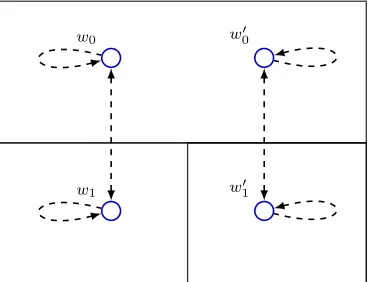
w0 w00
[image:10.612.215.399.392.533.2]w1 w01
Fig. 2. An Epistemic Issue Model: the dashed lines represent agent b’s epistemic relation →b. We do not draw
agenta’s epistemic relation, but we assume that agentadoesn’t have any non-trivial knowledge: so→ais the total
relation, connecting every two worlds. The three cells drawn as black squares represent agent a’s issue partition
≈a. We do not draw here agent b’s issue partition (since it is not important), but one can just assume e.g. that
≈b=→b (i.e. b knows the answers to all his questions).
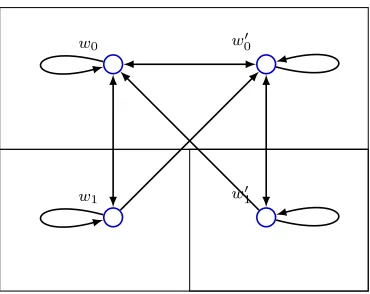
We illustrate this proposition via Fig.2 and Fig.3. Note that both agents are fully introspective in the initial model drawn in Fig. 2, but this is no longer the case after information-sharing. Fig.3 illustrates the updated model after information sharing. Agenta’s new epistemic relation→!
a after information sharing is obtained by composing
→Dk≈a, which in this case is the same as→b≈a. As depicted, this relation is not positively introspective: e.g.
w0→b≈aw00→b≈aw10 holds but we donot have w0→b≈aw10.
w0 w00
[image:11.612.214.399.54.201.2]w1 w01
Fig. 3. Failure of positive introspection. The continuous arrows represent agent a’s relation after information-sharing: →!
a=→Dk≈a=→b≈a.
some of the information in her possession, possibly including some of the newly acquired information. It is a matter of philosophical choice or taste whether we use the term “knowledge” to cover all the information learnt by an agent, or on the contrary we restrict the use of this term to cover only the information possessed in an introspective manner. Formally, this corresponds to restricting the models to positively introspective, or to fully introspective, ones. If one chooses one of these options, then one can then do the same in the definition of update: focus only on the introspective knowledge acquired through this update. This leads us to the following alternative definitions:
Definition 11 (Introspective Public Announcements) Given a (positively, or fully) introspective interrogative-epistemic model S= (S,→,≈,k • k) and some propositionP ⊆S, the introspective public announcement !P+ is
an action that changes the modelSinto an updated modelSP+= (SP,→P+,≈P,k • kP), whereSP,≈P,k • kP are
the same as in the modelSP above (for non-introspective public announcement!P), and the epistemic accessibility
relations→P+
a are given by the transitive closure(→Pa)+ of the relations →Pa from the modelSP:
→P+
a := (→a ∩ ≈Pa)+=→Pa ∪ → P a→
P a ∪ →
P a→
P a→
P a ∪ · · ·
Observation If an interrogative epistemic modelSis (positively, or fully) introspective, then so isSP+.
Definition 12 (Introspective Information Pooling) Given a (positively, or fully) introspective interrogative epistemic model S= (S,→,≈,k • k), the action !of introspective information pooling !+ is an action that changes
the model Sinto an updated modelS!+= (S!,→!+,≈!,k • k!), whereS!,≈!,k • k! are defined the same way as in
the model S! above (for non-introspective information sharing !), and the epistemic accessibility relations →!+
a are
given by the transitive closure (→!
a)+ of the relations→!a from the modelS!:
→!+
a := (→Dk≈Pa)+ =→!a∪ →
!
a→
!
a∪ →
!
a→
!
a→
!
a ∪ · · ·
Observation If an interrogative epistemic modelSis (positively, or fully) introspective, then so isS!+.
Note that if we compare the updated modelsS!andS!+for the same initial modelS, then agents will typically
know lessafter introspective information pooling !+than after simple (non-introspective) pooling !. So, interestingly enough, introspection can act as a barrier to learning! Once again, we think this is more natural than it looks at first sight: by focusing on introspective knowledge, we “screen out” the information that was acquired in a non-introspective manner. Of course, on the other hand, the agentknows more about the things that she knows in this introspective manner: in addition to knowing them, she knows that she knows them, etc. But typically there areless things that are known in this way. So the conclusion is that “introspective agents know more about less”. One very important observation is that (unlike knowledge or distributed knowledge), the common knowledge after an update does not depend on whether the update is introspective or not:
Proposition 2 The same propositions are common knowledge inSP as inSP+. Similarly, the same propositions
The reason is that common knowledge is already introspective by definition, so the choice of update does not make a difference. Formally:
→!Ck=
[
a∈G
→Dk≈a
!+
= [
a∈G
(→Dk≈a)+
!+
=→!+Ck,
and the same for →P
Ck versus→ P+
Ck.
4
The Epistemic Potential of a Group
In the philosophical literature, group knowledge is typically argued to be non-summative—that is,notfully reducible to the knowledge of the group members (Gilbert, 1987; Rolin, 2008; Wray, 2007).5 In essense this implies a form of epistemic holism, of the type that one encounters in physical studies of correlated or entangled systems. In this context, the non-summative ingredient refers to a complex interplay or the existence of a non-trivial correlation between the epistemic states of each of the individual members. Note that an analysis of group knowledge that is summative effectively eliminates group knowledge, and can thus do no additional explanatory work. Indeed, such a notion would merely be shorthand for ‘every body knows that’ or ‘someone in the group knows that’, but there would not be such a thing as the knowledge that is held by a group (as a group) over and above the knowledge of the individual group members. Specifically, philosophers who use the notion of group knowledge in order to explain scientific knowledge typically insist that group knowledge should at least be non-summative. As such, the standard formal group-epistemic notion of distributed knowledge does not seem to fully meet the same requirements as typically envisioned in the philosophical literature; to compute distributed knowledge, it is enough to be given the knowledge of each of the agents in the group.6
Additionally, one can argue that scientific group knowledge should imply potential individual knowledge: al-though a scientific community as a group has knowledge that cannot be reduced to the knowledge of any of its members, these members must nonetheless be able to come to know it (through the group’s testimony) (Corlett, 1996; de Ridder, 2014; Rolin, 2008; Wray, 2007). Hence the correlation between the individual epistemic states has to be in principle accessible to the individuals.
To summarize, we propose a non-summative notion of group knowledge that each individual member can potentially acquire. Moreover, one can make the non-summative mechanism of epistemic correlations explicit, indicating how the group members’ potential individual knowledge can be combined to yield our concept of ‘potential group knowledge’. As we show formally later on, such a mechanism relies in essence on the role of the agents’ epistemic issues (questions). So, to compute a group’s knowledge, we have to be given both the knowledge and the issues of each of the agents.7
4.1
Potential Knowledge of an Individual or Group
Based on the above considerations, we first introduce the following informal definitions:
Definition 13 (Potential Knowledge of an Agent in a Group) We say that an agenta(belonging to a group
G)potentially knows that P within the groupG, and writeKG a, if:
(1) P is entailed by a true answer to (some of )a’s question(s);
(2) the fact that (1) holds is distributed knowledge in groupG: i.e. this fact is entailed by some set of premisses, each of which is (individually) known by at least one member of the group.
In other words, an agenta’s potential knowledge within a groupKG
a, is given by putting togethera’s (individual)
knowledge with the group’s answers to all her questions. Formally, KG
a is the Kripke modality for the group G’s
distributed-knowledge-about-a’s-question(s) relation:
KaGP :=DkQaP = [→G≈a]P.
5The term ‘summativism’ was introduced by Anthony Quinton in (Quinton, 1975) in an epistemic context.
6Though one should note that a fact can be distributed knowledge without being known to any member of the group: distributed
knowledge encompasses everything that is logically entailed by the combination of all the individual pieces of knowledge.
7We agree that in fact this is still a rough idealization. Other factors should be taken into account when computing group knowledge,
This definition produces a not-necessarily-introspective notion of potential knowledge (even when the individ-ual’s actual knowledge is introspective). An alternative definition (which pre-encodes the effect of Introspective Information Sharing) can be obtained by taking the “introspective” version of the above notion, i.e. putting
KaGP := [(→Dk≈a)+]P,
where recall thatR+ is the transitive closure ofR. This alternative definition gives a different notion of potential
knowledge, which extracts only the “introspective part” of the concept of potential knowledge from the first defi-nition: i.e. the information that is “introspectively known” according to the first notion. The fact that we use the same notation for two distinct notions may sound confusing. But this is motivated by the fact that they will provide two different semantics for the same syntactic construct (KaG). The first is to be used when a non-introspective interpretation of knowledge is desired, while the second applies when we are talking about higher-level, “reflexive” knowledge (i.e. the introspective kind). Moreover, this systematic ambiguity is also justified by the fact that our focus in this paper is on the concept of (potential)group knowledge. And, as we’ll see, the two definitions above will make no difference for the group’s potential: both notions of potential individual knowledge lead to the same concept of group knowledge.
Definition 14 (Potential Group Knowledge) A group’s potential group knowledgeGkis given by the Kripke modality for the transitive closure of the union of all the potential individual knowledge relations:
GkP := [→Gk]P, where →Gk= (
[
a∈G
→Dk≈a)+,
where recall thatR+ is the transitive closure of relationR.
Observation. Potential group knowledge is common potential knowledge. More precisely,no matter which of the two above alternative definitions we adopt for potential individual knowledgeKG
a, we have that a groupGpotentially
knows thatP iffeverybody inGpotentially knowsP withinG, and everybody inGpotentially knows withinGthat everybody potentially knows P within G,etc.:
GkP = \
a∈G
KaGP∩ \
a,b∈G
KaGKbGP∩. . .
SoGkis the “common” version of potential knowledge. But as we’ll see, it is alsopotential common knowledge:
it is essentially given by what will become common knowledge after each agent in the group updates her knowledge with the group’s information concerning all her questions. This can already be seen from the fact that the acces-sibility relation for potential group knowledge in a model S coincides with the accessibility relation for common knowledge in the updated model after information-sharing (in both versions S! andS!+):
→Gk= (
[
a∈G
→Dk≈a)+= (
[
a∈G
→!
a)
+=→!
Ck= (
[
a∈G
→!+
a )
+=→!+
Ck.
So potential group knowledge is potential common knowledge: this is the motivation behind our definition. Potential group knowledge “pre-encodes” the information that all the agents of the group can come to possess in common (and thus act upon in a coordinated manner) after they pool together all their knowledge. As a consequence, group knowledge shares some of the properties of common knowledge:
Proposition 3 Potential group knowledge Gk, as well as common knowledgeCk, are always “positively introspec-tive”:
GkP =GkGkP, CkP =CkCkP.
Moreover, ifall agents in Gare fully introspective, then potentially group knowledge and common knowledge are also fully introspective (i.e. ¬GkP =, ¬CkP =Ck¬CkP).
Similar introspection properties hold for distributed knowledgeonlyif we assume them for individual knowledge:
Proposition 4 If all agents in G are positively introspective, then distributed knowledge is as well (i.e. DkP =
In fact, distributed knowledge and common knowledge can be seen as two ‘extreme’ versions of potential group knowledge, givingthe upper and lower limits for a group’s epistemic potential:
Proposition 5 CkP ⊆GkP ⊆DkP.
Moreover, these extremes can be reached in certain conditions:
Proposition 6 If every agent in G is interested in the information possessed by all the other agents, then the potential group knowledge ismaximal (and matches the group’sdistributed knowledge):
If ≈a⊆→Dk for everya∈G then GkP =DkP.
Proposition 7 If each agent’s questions are ‘orthogonal’ to the other agents’ knowledge (i.e. no agent has any open questions that can be answered by the group), then the potential group knowledge is minimal (and reduces to the group’s initialcommon knowledge):
If →a⊆(≈a ∩ →Dk) for everya∈G then GkP =CkP.
Application: from the “Wisdom of the Crowds” to the “Curse of the Committee”. What we can conclude from these results is that a group formed of agents with very dissimilar agendas will have a very poor joint epistemic power, whereas a group with very cohesive agendas will have a very strong epistemic potential. This is a consequence of our Selective Learning Principle, which we think to correctly reflect some features of real-life groups. Even in a scientific deliberation, researchers from different areas of science or philosophy will typically process successfully only the information that is relevant to the fundamental questions of their own area. Skeptical questions such as “How do I know that the universe exists, or that it’s all an illusion?” or “Do we have a logically infallible proof of this or that fact?” are typically regarded as irrelevant in Physics or Biology, though the first is essential in Epistemology and the second is essential in Mathematics. The situation gets even worse when scientists who adopted different paradigms meet each other (or read each other’s books): an Aristotelian physicist has very few things to learn from a Newtonian one, and vice-versa. Even if they agree on the actual observations, they cannot agree on what are the fundamental questions, and as a result some of one’s facts may look meaningless from the other’s perspective. The fact that a group’s potential can be severely reduced due to the agents’ very dissimilar agendas may also help us explain phenomena such as “the curse of the committee”, in which long episodes of deliberation and communication between apparently rational agents end up agreeing only on what was already common knowledge to start with. The group falls back onto the “lowest common denominator”, since the agents are unable to learn each other’s information (due to the extreme discrepancy between their agendas). The usual explanation is that people are ‘irrational’, but our analysis suggests that even ideally rational agents may end up in the same situation, if their agendas are ‘orthogonal’ to the others’ knowledge. The fact that a group may have a very low epistemic potential is not a matter of individual irrationality. Agents can be fully rational while still disagreeing on what are the relevant issues, or what are the fundamental questions that need to be asked.
Illustrating the Curse (Example 3 continued). We can for instance check now that in the model in Example 3, potential group knowledge equals common knowledge. This is because Alan’s information is irrelevant for Betty’s issues, and vice-versa. So, although it is distributed knowledge among them that Mary has overall a better score, this fact cannot be converted into common knowledge by any amount of information sharing.. At the end of their deliberation, the only thing that Alan and Betty can agree is what was common knowledge to start with: namely, that John had better references. The group fails to process all the available information. John gets the job: a “curse of the committee” indeed!
4.2
The Logic of Potential Group Knowledge
Syntax and SemanticsIn this section, we present an axiomatic system for thelogic of (potential) group knowledge
(LGK), as well as variants for positively introspective knowledgeLGK+and fully introspective knowledgeLGK±,
and some other extensions. We first fix a pair (G,Φ) consisting of a finite set of agents with|G| ≥2 (i.e. we have
at least two distinct agents) and a set Φ of atomic propositions. The language of LGK is given in BNF form by the following recursive definition:
Intuitively, Kaϕ means that agent a knows ϕ; Qaϕ means that the answer to agent a’s issue(s) entailsϕ; Dkϕ
means thatϕis distributed knowledge;Ckϕmeans thatϕis common knowledge; andGkϕmeans thatϕis potential group knowledge.
The formal semantics is given by an interpretation map which associates with each sentence ϕ a proposition
kϕkS ⊆S in any given epistemic issue model S. Intuitively, kϕkS is the set of all worlds in S satisfyingϕ. The definition is by induction, in terms of the obvious compositional clauses, starting by taking the valuation mapkpk
for atomic sentences and inductively using the Boolean operators on P(S) and the epistemic operators defined above to compute the interpretation of complex sentences: e .g. kKaϕk=Kakϕk, etc.
Proof system. The axiomatic systemLGKconsists of the following:
• the rules and axioms of propositional logic,
• Necessitation Rules for all five modalitiesKa, Qa, Dk, Ck, Gk: e.g. fromϕinferKaϕ, etc.
• Kripke’s axiom for all five modalitiesKa, Qa, Dk, Ck, Gk: e.g. Ka(ϕ⇒ψ)⇒(Kaϕ⇒Kaψ), etc.
• theT axioms (Factivity) for all five modalitiesKa, Qa, Dk, Ck, Gk: e.g. Kaϕ⇒ϕ, etc.
• Qaϕ⇒QaQaϕ
• ¬Qaϕ⇒Qa¬Qaϕ
• Kaϕ⇒KaQaϕ
• Kaϕ⇒Dkϕ(for all a∈G)
• Ckϕ⇒KaCkϕ (for all a∈G)
• Ck(ϕ⇒V
a∈GKaϕ) ⇒ (ϕ⇒Ckϕ)
• Gkϕ⇒DkQaGkϕ (for alla∈G)
• Gk(ϕ⇒V
a∈GDkQaϕ) ⇒ (ϕ⇒Gkϕ)
The systemLGK+ is obtained by adding toLGK the following Positive Introspection Axioms:
• Kaϕ⇒KaKaϕ
• Dkϕ⇒DkDkϕ
(The corresponding positive introspection statements forCkandGkare provable inLGK+.)
Finally, the systemLGK± is obtained by adding toLGK+ the following Negative Introspection Axioms:
• ¬Kaϕ⇒Ka¬Kaϕ
• ¬Dkϕ⇒Dk¬Dkϕ
(The corresponding negative introspection statements forCkandGkare provable inLGK±.)
Theorem 1 Let G and Φ be fixed, with |G| ≥ 2. The system LGK is sound and complete over the class of interrogative epistemic models. Similarly, LGK+ is sound and complete over positively introspective models, and LGK± is sound and complete over fully introspective models. Moreover, all these logics are decidable.
Proof: See the Appendix.
One can also add to the syntax a “potential individual knowledge” modality KG
aϕ capturing the potential
knowledge of agent a within groupG. For the logicLaGK obtained by extendingLGK with this modality, the semantics of KG
a is given by the Kripke modality [→Dk≈a], as explained in Section 4; while for the introspective
versions LaGK+ and LaGK±, obtained by extending LGK+ and respectively LGK± with this modality, the
semantics of KG
a is given by the Kripke modality [(→Dk≈a)+] (whereR+ is the transitive closure of R), as also
explained in Section 4.
For this enriched syntax, the axiomatic systemLaGK is obtained by adding toLGK the following axiom:
KaGϕ⇔DkQaϕ;
while the systems for the positively introspective versionLaGK+, and for the fully introspective version LaGK±,
• Necessitation Rule forKG
a : fromϕinferKaGϕ.
• Kripke’s axiom forKG
a: KaG(ϕ⇒ψ)⇒(KaGϕ⇒KaGψ).
• theT axiom (Factivity) forKaG: KaGϕ⇒ϕ.
• KaGϕ⇒DkQaKaGϕ
• KaG(ϕ⇒DkQaϕ)⇒(ϕ⇒KaGϕ).
Theorem 2 Let G and Φ be fixed, with |G| ≥ 2. The system LaGK is sound and complete over the class of interrogative epistemic models over (G,Φ). Similarly, LaGK+ is sound and complete over the class of positively
introspective models, and LaGK± is sound and complete over the class of fully introspective models. Moreover, all these logics are decidable.
Proof: See the Appendix.
4.3
Actualizing the Group’s Epistemic Potential
We use the concept ‘potential’ to indicate that we are dealing with epistemic states that can in principle be ‘actualized’, i.e. internalized by the agents. In this section we show how communication can convert potential group knowledge into common knowledge, and potential individual knowledge into actual individual knowledge.
In the spirit of Dynamic Epistemic Logic (Baltag et al., 1998; van Benthem, 2011; van Ditmarsch et al., 2007), we can extend our syntax with dynamic modalities for public announcements and information pooling. We only do this here for information pooling, since we are interested in formalizing the way in which potential knowledge is converted into actual knowledge by information pooling. So we extend each of our “static” logics
L∈ {LGK, LaGK, LGK+, LaGK+, LGK±, LaGK±}above to a dynamic version denoted byL!, and obtained by
adding to the syntax a new construct operator [!]ϕ, whose intended meaning is that ϕbecomes true after infor-mation pooling within the group G. The semantics in the case of the general (non-introspective) logic is given by evaluatingϕin the updated modelS!:
k[!]ϕkS=kϕkS!,
while for the (positively, or fully) introspective logics we evaluate ϕin the modelS!+:
k[!]ϕkS=kϕkS!+.
Theorem 3 The dynamic logicsLGK!,LaGK!,LaGK+!,LaGK±!have the same expressivity as the
correspond-ing static logics (while the logics LGK+! andLGK±! appear to be more expressive8 than their static fragments).
Moreover, sound and complete axiomatizations are obtained for these logics by extending the above axiomatic sys-tems with the following “Reduction Axioms”:
• [!]p⇔p
• [!]¬ϕ⇔ ¬[!]ϕ
• [!](ϕ∧ψ)⇔([!]ϕ∧[!]ψ)
• [!]Kaϕ⇔KaG[!]ϕ
• [!]KaGϕ⇔KaG[!]ϕ
• [!]Dkϕ⇔Dk[!]ϕ
• [!]Gkϕ⇔Gk[!]ϕ
• [!]Ckϕ⇔Gk[!]ϕ
(where in LGK!the notation KG
a is just an abbreviation forDkQa).
8We don’t have a proof of this difference in expressivity, but this conclusion is suggestion by the fact that reduction laws do not
Proof: See the Appendix.
If we restrict ourselves to ontic facts, i.e. we take ϕ :=p to be an atomic sentence in the above Reduction Axioms, we obtain nice characterizations of (both individual and group) potential knowledge in terms of its possible actualizations:
Proposition 8 For atomic sentences p∈Φ, we have:
KaGp ⇔ [!G]Kap.
In words: an agent’s potential knowledge within a group is the knowledge that she can acquire (by extracting the relevant information) from the others’ testimony. Similarly we have:
Gkp ⇔ [!G]Ckp.
In words: potential group knowledge is the information that can become common knowledge by information-sharing within the group (given the limits posed by the agents’ different questions).
5
Related Work and Future Outlook
Connections to Other Work in Dynamic Epistemic Logic. On the formal level, our approach in this paper is fully in line with the dynamic-epistemic logic treatment of questions. The main goal of dynamic epistemic logics is to model informational actions, including the posing of questions and other acts of communication. In this context, it is natural to highlight the role of questions with respect to the potential or actual knowledge that may be obtained. In this paper, we built on the earlier work by Baltag (2001) on modelling queries and interrogative actions, on the formalization of the action of learning the answer to a question in (Baltag and Smets, 2009), and most importantly on the more recent work on epistemic issue models by (van Benthem and Minica, 2012; Minica, 2008). We took this last framework as the main building-block of our approach, while adding a semantic condition reflecting our view of questions as epistemic filters, and using this setting to formalize the Selective Learning Principle and to develop a new theory of group knowledge.
Connections with Erotetic Logics and Inquisitive Semantics. From a broader perspective, our investi-gation relates to the line of work on ‘erotetic logics’ including (Belnap Jr, 1966; Groenendijk and Stokhof, 1985; Wisniewski, 1995) as well as to the models for interrogation that recently culminated in the approach on inquisi-tive semantics (Groenendijk, 1999, 2007; Groenendijk et al., 2009; Ciardelli and Roelofsen, 2009). For details on the relations and differences between the dynamic-epistemic issue models and the inquisitive semantics account, we refer to (van Benthem and Minica, 2012; Minica, 2008). It is worth contrasting the aim of our proposal to that of Inquisitive Semantics, as given in (Ciardelli and Roelofsen, 2009) (Groenendijk, 2007) (Groenendijk and Stokhof, 1990). Inquisitive Semantics proposes a semantics to capture a layer of meaning that is not captured by the standard semantics of classical logic, namely, a layer of inquisitive meaning. On this picture, when an agent utters a sentence p, her utterance may have inquisitive content (raise a question) next to assertive content (assert a proposition). This second layer of meaning motivates new pragmatic principles that e.g. guide possible responses to an utterance. Here, however, we are not concerned with the role of questions as informational actions, but rather with the role of questions as a precondition for learning and the possibility of group knowledge.9
Further Work: Testimonial Knowledge Conditions. While we impose only one constraint (∗) on our inter-rogative epistemic models, in special cases one may want to impose two further ‘testimonial knowledge conditions’, which can be philosophically motivated as follows. There are restrictions on what agents can learn from the tes-timony of others (Coady, 1992). In particular, in order to rely on the testes-timony of a fellow researcher, and thus acquire knowledge from her, a scientist should (epistemically) trust the testifier. Testimonial knowledge is acquired from recognized experts or collaborators, as their testimonies are presumed to be trustworthy. In fact, Hardwig has argued that modern science rests (primarily) on trust (Hardwig, 1991).10 Agents do not acquire knowledge from the testimony of others if they do not recognize them as experts. Furthermore, if an expert in the field sets the stage and looks for answers in a certain direction, then all his followers/collaborators will do the same.
9We further remark that there are essential technical differences between our setting and the work in inquisitive semantics. 10In his words, “the trustworthiness of members of epistemic communities is the ultimate foundation for much of our knowledge”
The testimonial knowledge conditions are thus meant to capture the epistemic dependence among agents, i.e. the fact that agents explicitly rely on the knowledge (and questions) of others. In order to acquire knowledge through the testimony of group members, agents must recognize the other group members as experts, and hence be interested in their knowledge and questions. Thus, the first further condition we may want to impose is that for agentato view the other group members as experts and collaborators,what the others know about her issues must be a part of her issues; a’s questions should include “what do others know about my questions?”. Formally, this can be captured by the requirement thats≈a→b s0 impliess→b≈a s0. This condition is important, not only for
allowing an agent to (statically) represent the others’ knowledge, but also for allowing her to dynamically enrich her knowledge, by learning the relevant facts entailed by the others’ testimonies. Similarly, a second condition can require an epistemic agent to be able to learn from the testimony of other agents only if she is interested in what (the answers to) the others’ questions can tell about her own questions. So a’s questions should include “what can the answers to the others’ questions tell me about my questions?”. Since this last question is encoded by the composite relation≈b≈a, we can formally capture this by the requirement thats≈a≈bs0 impliess≈b≈as0. This
second “social rationality” condition is also important for learning: it allows the agent the possibility of learning relevant facts, not for only from the other agents’ current testimonies (about their present state of knowledge), but also from any of their future testimonies (after they had learned more about their relevant questions).
In this paper we aimed at maximum generality, so we did not assume any of the special testimonial knowledge conditions mentioned above. But this line of inquiry is pursued in the third author’s Master thesis (Boddy, 2014), and will form the topic of a future publication.
Changing the Agenda: Paradigm shifts and Issue Negotiation. In this paper, each agent’s issues were fixed, playing only a directing role in the agent’s learning. But one can also look at actions thatchange the agents’ conceptual space by e.g. raising new questions, negotiating issues etc. For example, (van Benthem and Minica, 2012) study the action of publicly raising a question. They define it an action ?ϕ that adds question ϕ? to all agendas, thus changing all the issue relations. The new issue relations are given by≈?ϕ
a :=≈a∩ ≡ϕ. In other words,
ϕ? becomes a relevant issue for everybody. Another example that we plan to investigate is the action ?b, by which
agent b convinces everybody to include all her questions into the group’s agenda. This changes the issue relations to ≈?b
a :=≈a ∩ ≈b. Even more complex actions of negotiating the issues can also be introduced. Based on these
and other examples, we can make a general distinction betweentwo types of learning, namely learning of new facts (propositions) versus learning of new issues (questions). The former type corresponds to eliminating worldssfrom the model, as in the usual updates by public announcements; the latter type of learning entails the re-evaluation of the agents’ conceptual frameworks. In on-going work, we investigate the behavior of group knowledge under issue-changing actions. We think this line of work can play a role in the logical-epistemological understanding of key topics in History and Philosophy of Science, such as paradigm change and the possibility of interdisciplinary cooperation (between members of different scientific communities, with initially different interrogative agendas).