Extensions Of The Garden-hose Model
MSc Thesis
(Afstudeerscriptie)
written byMerlijn Koek
(born December 1st, 1992 in Breda, the Netherlands)
under the supervision of Prof Dr Harry BuhrmanandDr Leen Torenvliet, and submitted to the Board of Examiners in partial fulfillment of
the requirements for the degree of
MSc in Logic
at theUniversiteit van Amsterdam.
Date of the public defense: Members of the Thesis Committee:
July 3rd, 2017 Prof Dr Harry Buhrman
Yfke Dulek, MSc Dr Christian Schaffner Dr Florian Speelman Dr Leen Torenvliet
Abstract
This thesis is a study of new models related to the Garden-hose model, in search of new mathematical tools for a better understanding of the Garden-hose complexity.
After providing a detailed introduction of the Garden-hose model, we intro-duce an extension of the model that admits multiple parties. In addition to proving several bounds on the complexity of functions in this new model, we prove the complexity of the 1-bit, k-player equality function. We sketch the applicability of the Multiparty Garden-hose model on a natural multidimen-sional extension of the position-verification scheme that gave rise to the original Garden-hose model.
Acknowledgement
First and foremost, I would like to thank Harry Buhrman and Leen Torenvliet for their supervision, and for showing me once again the power of creativity when combined with intelligent trial and error.
I would like to thank in particular Harry Buhrman, Christian Schaffner and Ronald de Wolf for their excellent teaching. While teaching me the necessary skills to write this thesis, they have motivated me to learn more about their fields of research.
Special thanks to Yfke Dulek, Christian Schaffner, Florian Speelman and Leen Torenvliet for our meetings, and for dedicating some of their time to proof-read key chapters.
Motivation and Introduction
The subject of this thesis is the Garden-hose model, which has its origin in the field of position-based cryptography. The goal of this recent field of research in computer science is to use location as the key for secure communication. For example, such a cryptographic system would allow the sender of a message to be able to prove that he is at a specific geographical location. In the analysis of a position-based quantum cryptographic scheme, a family of attacks was found in
Buhrman et al.[2011] that requires a number of EPR-pairs (a precious resource in quantum communication). It was found that in order to lower bound the number of EPR-pairs required in such an attack, there has to exist a function for which there are no efficient strategies to compute it in the Garden-hose model. This leads us back to the question “What is the Garden-hose model, and how are function values computed within that model?”.
The Garden-hose model shares its main setting with the field of communica-tion complexity, which is as follows. There is a publicly known Boolean funccommunica-tion in two variablesf :{0,1}n× {0,1}n → {0,1}, and two parties, Alice and Bob, who each have access to the value of one variable,xand y respectively. Now, suppose Alice and Bob are allowed to agree on a protocol before receiving their inputsxandy. How much communication between Alice and Bob is necessary before at least one of them is able to compute the value off(x, y)?
The precise quantification of the necessary communication depends on the model of communication. In communication complexity, communication con-sists of sending bit strings back and forth, and it is quantified by the number of bits exchanged. In the Garden-hose model communication is done differently.
In the Garden-hose model, Alice and Bob have a number of water pipes in between them, with every pipe having two ends, each pipe end either being accessible only to Alice, or only to Bob. Alice and Bob are both allowed to connect pipe ends on their own side, depending on their individual input, and according to the protocol which they have agreed upon beforehand. Alice then connects a water tap to one of the pipes, as specified by the protocol, and turns on the tap. The water will then flow from the tap into the pipes, redirected by the connections made by Alice and Bob, and eventually it will spill from one of the pipes: either on Alice’s side, or on Bob’s side. For the protocol to correctly compute a functionf(x, y), the value of the function has to correspond to where the water spills.
Contents
1 An Introduction to the Garden-hose Model 6
1.1 The Garden-hose Model . . . 6
1.1.1 Formal definition of the Garden-hose model . . . 7
1.1.2 The Garden-hose complexity of functions . . . 9
1.2 The Configuration Matrix . . . 10
1.3 Known Related Results . . . 12
1.4 The Connection with Position-based Cryptography . . . 14
2 The Multiplayer Garden-hose Model 17 2.1 Introducing the Multiplayer Garden-hose Model. . . 17
2.2 A General Upper Bound . . . 21
2.3 Position-based Cryptography in 3D . . . 22
2.4 The Multiplayer Equality Function . . . 23
2.4.1 Example protocol: the double-circle protocol . . . 24
2.4.2 Analyzing the double-circle protocol . . . 24
2.4.3 An approach to proving optimality: a new proof technique 25 2.4.4 The exact value ofMPGH(EQk 1) . . . 27
2.4.5 The complexity ofn-bit,k-player equality . . . 30
2.4.6 Comparison to 2-player equality . . . 34
3 Leaking Pipes and Time Bounds 36 3.1 Leaky Garden-hose Model . . . 36
3.1.1 Complexity upper bounds . . . 37
3.1.2 Two example protocols for the equality function . . . 39
3.1.3 Intermediate models: bridging the gap . . . 41
3.2 The Time Bounded Garden-hose Model . . . 42
3.2.1 Connection with thes-Limited Leaky Garden-hose model 43
4 Open Problems 44
Chapter 1
An Introduction to the
Garden-hose Model
1.1
The Garden-hose Model
First introduced inBuhrman, Fehr, Schaffner, and Speelman[2013], the Garden-hose model is a communication complexity model, meaning that here is a pub-licly known Boolean functionf(x, y) in two variables, and there are two parties, Alice and Bob, who have access to the variablesxandy respectively. The goal for Alice and Bob is to compute the value off, on inputsx, y.
Tap
A A
A
B
[image:7.612.200.406.123.323.2]B
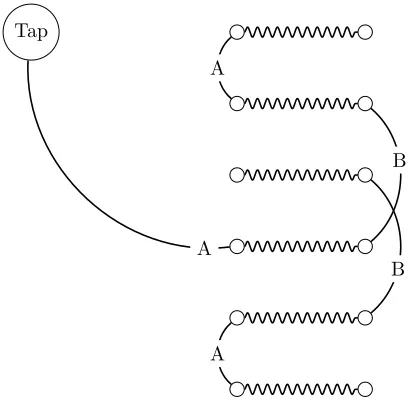
Figure 1.1: A possible combination of pipe connections.
Figure 1.1 above depicts an example where Alice and Bob share six water pipes, depicted by the waving lines. The pipe connections are depicted by the curved lines. Alice is always thought to be on the left side in these figures, and Bob on the right side. Alice has made all connections labeledA, and Bob connected his ends of the pipes with the edges labeledB. If we then follow the water from the tap, we see that in this example the water flows to the fourth pipe, then goes through pipe number two to the first pipe and ends up spilling on Bob’s side.
1.1.1
Formal definition of the Garden-hose model
Formally, we define the Garden-hose model as a graph, on which certain edges are connected. This formal definition is added for clarity, even though the informal definitions of water pipes and pipe connections will be used in most parts of this thesis.
Alice
Bob
Figure 1.2: GraphG6.
Letmbe the number of pipes between Alice and Bob, and letEm
A be the set of all non-empty∗ sets of pairwise pipe connections that Alice is able to make. This includes connecting an additional vertexw (the water tap) to one of the pipes. Similarly, letEm
B be the set of all sets of pairwise pipe connections that Bob is able to make†.
Formally, we will identify all possible sets of pairwise pipe connections with the set of involutions of the symmetric group onmor m+ 1 elements. Define EAm={σ∈S(m+ 1) :σ2 =id, σ(w)6=w} where S(m+ 1) is the symmetric group onm+ 1 elements, the firstmelements being thempipes between Alice and Bob, and the remaining element being the water tapw. Two pipes,e1and
e2, are connected on Alice’s side by an involutionπ∈EAm, ifπ(e1) =e2. Note
that the identity permutation is not inEm
A, since Alice has to connect the water tap to some pipe. Similarly, defineEm
B ={σ∈S(m+ 1) :σ2=id}.
For example, labeling the three pipes simply with e1, e2, e3 and the water
tap withwwe have:
EA3 ={(we1),(we2),(we3),(we1)(e2e3),(we2)(e1e3),(we3)(e1e2)}
Let f : {0,1}n× {0,1}n → {0,1} be a Boolean function. A Garden-hose protocol P = (m, hA, hB) consists of the number of pipes m, corresponding to the graph Gm, and two functions hA and hB, where hA : {0,1}n → Em A describes which pipe connections are made when Alice has input x∈ {0,1}n, and similar forhB :{0,1}n→Em
B.
Consider the graphGm, where additionally, on Alice’s side the vertices are connected according to hA(x), with one of the vertices connected to an addi-tional vertex w, the water tap, and on Bob’s side the vertices are connected according tohB(y). Then compute the longest path within this graph with the restraint that one of the endpoints of this path is vertexw. This path, which we will call the water flow path, corresponds to the way the water will flow when the tap is turned on. We will refer to all pipes that occur in the water flow path to bewet pipes. Similarly, we will say these pipesbecame wet on input (x, y). A dry pipe is a pipe that is not wet. If the other endpoint e, which is not w, of this longest path is on Alice’s side, we say that the water
spills at Alice’s side (from pipe e). It is easy to see that if this is not the case, the other endpoint must be a vertex at Bob’s side, and then we say the water spills at Bob’s side. Similarly, we call a pipeea spilling pipe if for some input (x, y) the water spills from pipee.
Definition 1. A Garden-hose protocol P = (m, hA, hB) computes a Boolean functionf if, on inputx, y∈ {0,1}n, and on pipe connectionsh
A(x)andhB(y), the water spills on Alice’s side iff(x, y) = 0 and on Bob’s side iff(x, y) = 1.
Notation. We will write GHspill(hA(x)∪hB(y)) = 0 if on pipe connections hA(x) and hB(y), the water spills on Alice’s side. Similarly, GHspill(hA(x)∪ hB(y)) = 1 if on pipe connections hA(x)and hB(y), the water spills on Bob’s side.
It follows that a Garden-hose protocol P = (hA, hB) computes a binary Boolean functionf ifGHspill(hA(x)∪hB(y)) =f(x, y) for allx, y∈ {0,1}n.
1.1.2
The Garden-hose complexity of functions
Definition 2. Let f : {0,1}n× {0,1}n → {0,1} be a Boolean function. The Garden-hose complexity off, GH(f),is defined to be the minimum number of pipes needed for a Garden-hose protocol to computef.
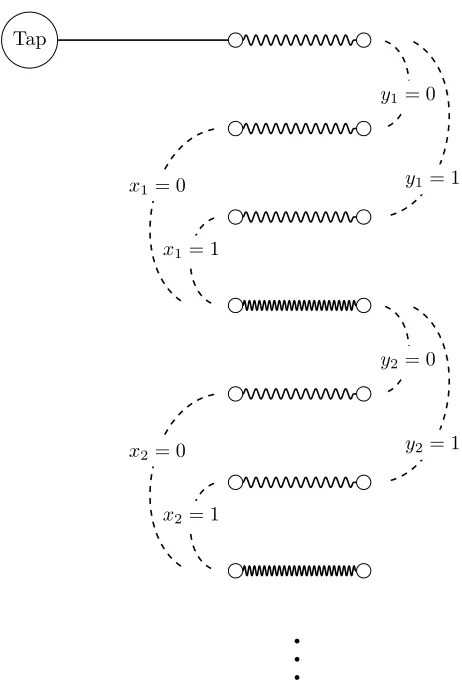
Consider then-bit equality functionEQn:{0,1}n× {0,1}n → {0,1}, where EQn(x, y) equals 1 if and only if x=y. The Garden-hose protocol depicted in Figure 1.3 computesEQn using 3n+ 1 pipes, and can be found in Speelman
[2011]. Writex as a series of bits x1x2. . . xn, and writey as y1y2. . . yn. For
each 1 ≤ i ≤ n, the dashed line labeledxi = 0 indicates a connection made wheneverxi= 0, similar forxi= 1 and for theyi.
The protocol works by checking the equality of x and y bit by bit. When x=ythen the water flows all the way to the bottom, always re-routed by Alice to the next darker dashed line in Figure1.3, and ends on Bob’s side, evaluating EQn(x, y) correctly. When x6= y then at the first pair of bits xi 6= yi Alice does not connect the pipe where Bob sent the water to, and so the water spills on Alice’s side. As this protocol uses 3n+ 1 pipes, we have shown the following.
Lemma 1 (Speelman [2011]). Let EQn : {0,1}n× {0,1}n → {0,1} be n-bit equality function. It holds that
GH(EQn)≤3n+ 1
Tap
..
.
y1= 0
y1= 1
x1= 0
x1= 1
y2= 0
y2= 1
x2= 0
[image:10.612.185.416.119.461.2]x2= 1
Figure 1.3: Garden-hose protocol forEQn.
1.2
The Configuration Matrix
Attempting to connect the Garden-hose model and classical communication complexity, we consider a configuration matrix Mm as introduced in Chiu,
Szegedy, Wang, and Xu[2014]. This approach resembles the fooling set method in communication complexity (a lower bound technique, described in Kushile-vitz and Nisan [1997]); We will see that the number of pipes in an optimal Garden-hose protocol computing equality is lower bounded by the smallest con-figuration matrix that does not contain a permutation submatrix of the required size.
pipe connections and letting entry (i, j) equal GHspill(i∪j). This meansMm is of size|EmA| × |EBm|, and describes where the water comes out for all possible combinations of sets of pipe connections of Alice and Bob.
ConsiderM3andM4. We label the water tap with 0. The pipes are labeled
simply 1 to 3 (or 4) and we describe the rows and columns by a list of pipe pairings. We have left out trivial combinations where all pipes are connected as in this case the water can only come out at the other side. Moreover, the player connecting all of its pipes will know so beforehand.
M3=
12 13 23
01 1 1 0
02 1 0 1
03 0 1 1
M4=
12 13 14 23 24 34
01 1 1 1 0 0 0
02 1 0 0 1 1 0
03 0 1 0 1 0 1
04 0 0 1 0 1 1
01,23 0 0 1 0 0 0
01,24 0 1 0 0 0 0
01,34 1 0 0 0 0 0
02,13 0 0 0 0 1 0
02,14 0 0 0 1 0 0
02,34 1 0 0 0 0 0
03,12 0 0 0 0 0 1
03,14 0 0 0 1 0 0
03,24 0 1 0 0 0 0
04,12 0 0 0 0 0 1
04,13 0 0 0 0 1 0
04,23 0 0 1 0 0 0
Lemma 2(Chiu, Szegedy, Wang, and Xu[2014]). GH(EQn)≤m if and only ifMmcontains a permutation submatrix of size 2n.
Proof. (Chiu, Szegedy, Wang, and Xu [2014]) ( =⇒ ) GH(EQn) ≤m means EQn can be computed by usingmpipes. Take such a protocolP = (m, hA, hB) that computesEQn. In the configuration matrix Mm, the intersection of Al-ice’s configurations {hA(x)|x ∈ {0,1}n} and Bob’s configurations {hB(y)|y ∈
{0,1}n} is a permutation submatrix, because the entry (h
A(x), hB(y)) is 1 if and only ifx=y.
(⇐= ) We take the permutation submatrix of size 2n. Then, we label the rows with elements in {0,1}n and label the columns with a permutation of
indicated by the row labeled withx, andhB(y) be the configuration indicated by the column labeled y. We claim (m, hA(x), hB(y)) is a protocol computing EQn. This is proven by the configuration matrixMm. We can simply look up inMmwhere the water spills on what combinations of sets of pipe connections, and conclude that the water spills at Alice’s side ifx6=y, and on Bob’s side if x=y.
This method allows us to computeGH(EQn) for very smallnby brute-force searching throughMmfor increasingly biggerm. For example, fromM4we can
learn that the maximum size of a permutation submatrix in M4 is six. This
means that using four pipes is not enough to compute equality on a set of eight elements, and we can concludeGH(EQ3)≥5.
Leaving the proofs to be described in Chiu, Szegedy, Wang, and Xu[2014], we present two of the results that this notion of a configuration matrix has lead to.
Lemma 3(Chiu, Szegedy, Wang, and Xu[2014]). If there existm andk such thatMmcontains a permutation submatrix of size k, then it holds that
GH(EQn)≤ m
logk·n+O(1)
Proof sketch. The idea here is to show that one can build a protocol for equal-ity out of smaller protocols that solve equalequal-ity on smaller input sizes. Specifi-cally, it is shown that if there exists a permutation submatrix inMmof size k, then there exists a permutation submatrix of sizektin Mm
·tfor every t∈N.
Lemma 4(Chiu, Szegedy, Wang, and Xu[2014]).
GH(EQn)≤ 28
log 313·n+O(1)≈1.359n+O(1)
1.3
Known Related Results
The field of communication complexity knows a number of ‘usual suspects’: functions which are extensively studied for their simple definitions while achiev-ing high complexity. Exemplary functions are those of equality, (distributed) majority and inner product. We list definitions of these functions together with several results of bounds on their Garden-hose complexity.
Additionally, in order to gain a better insight into the context of all results in this thesis, we list a selection of general results on Garden-hose complexity. Proofs of the results below are to be found in the cited sources.
• Equality: EQ(x, y) = 1 ⇐⇒ x=y
• Majority: MAJ(x, y) = 1 ⇐⇒ P
ixi·yi≥ d n
• Inner Product: IP(x, y) =P
ixi·yi mod 2
Lemma 5(Klauck and Podder[2014]).
GH(MAJ)≤O(n·log3n)
Lemma 6(Speelman[2011]).
GH(IP)≤4n+ 1
Lemma 7 (Buhrman, Fehr, Schaffner, and Speelman [2013]). Every Boolean function f : {0,1}n× {0,1}n → {0,1} has Garden-hose complexity of at most 2n+ 1.
Proof sketch. Use 2n+ 1 pipes and label them each with an element in{0,1}n , with the exception of the last pipe which we will call the reserve pipe. Let Z(y) = {a ∈ {0,1}n : f(a, y) = 0}, group this set into pairs, and let Bob connect all pipes labeled with elements ofZ(y) in a pairwise manner according to this pairing. If|Z(y)|is odd, connect the remaining pipe to the reserve pipe 2n+ 1.
Although no function in particular is known to have exponential Garden-hose complexity, it does exist.
Lemma 8 (Buhrman, Fehr, Schaffner, and Speelman [2013]). There exists a Boolean function f : {0,1}n× {0,1}n → {0,1} with exponential Garden-hose complexity.
However, since separating PandL has been an open problem for decades, the following lemma suggests functions with exponential Garden-hose complex-ity to either be very hard to find, or not be inP.
Lemma 9 (Buhrman, Fehr, Schaffner, and Speelman[2013]). If f :{0,1}n× {0,1}n→ {0,1}is in PandGH(f)is superpolynomial, thenP 6=L.
The following trick can be used in designing Garden-hose protocols, as it allows to combine several protocols by using the spilling pipe of one protocol as a water tap for another protocol. Recall that a pipeeis called a spilling pipe if for some input (x, y) the water spills from pipee.
Lemma 11 (Buhrman, Fehr, Schaffner, and Speelman[2013]). Every Boolean function f : {0,1}n× {0,1}n → {0,1} has Garden-hose complexity of at most 2D(f)+1−1, whereD(f)is the deterministic communication complexity off.
A general lower bound on the Garden-hose complexity was shown in 2014.
Lemma 12(Klauck and Podder[2014]). For all Boolean functionsf :{0,1}n× {0,1}n→ {0,1},
GH(f)≥N(f)−1
whereN(f)is the nondeterministic communication complexity of f.
As shown inKushilevitz and Nisan[1997] it holds thatN(IP)≥n+1, which results in the following corollary.
Corollary(Klauck and Podder[2014]).
GH(IP)≥n
1.4
The Connection with Position-based
Cryp-tography
The goal of position-based cryptography is to use a geographical location as a key for performing cryptographic tasks. An important example is the task of position-verification, where a player, the prover, wants to prove to a group of (honest) verifiers that he is at a specific location. It was shown inChandran et al.
[2009] that if different attacking parties are allowed to collaborate, position-verification cannot be done securely in the classical setting, and later it was also shown in the quantum setting in Buhrman et al. [2011], assuming the attackers have unbounded quantum resources. Here, not being able to securely verify positions means that the attackers can prove that someone is at a specific location, without any of the attackers located there.
However, as shown inBeigi and K¨onig[2011], the general attack that breaks such a scheme uses an exponential number of EPR-pairs, which renders it prac-tically impossible to execute. It seems that there exists a trade-off such that more classical computation done by the honest prover results in more EPR-pairs necessary to attack the scheme for the dishonest adversaries. In the intro-duction of the Garden-hose model inBuhrman et al. [2013], the basic scheme of position-based cryptography studied is PVfqubit, which is situated in one-dimensional space and consists of two verifiersV0 andV1 located far apart on a
one-dimensional line, with the proverP somewhere between the verifiers. The job of the proverP is to deliver a proof of his location to the verifiersV0 and
V1.
The scheme PVfqubit is as follows. Verifier V0 randomly chooses two n-bit
strings x, y∈ {0,1}n and privately sends y to V1. Verifier V0 also prepares an
EPR-pair √1
function f{0,1}n × {0,1}n → {0,1} then decides where V
0 sends the qubit
in register V to; If f(x, y) = 0, it remains in register V with verifier V0, if
f(x, y) = 1, verifier V0 sends the qubit in register V privately to V1. The
verifiersV0 and V1 then sendxand y to the prover, and V0 additionally sends
the qubit in registerP to the prover. Everything is sent such that it arrives at the prover at the same time. Note that this qubit in registerP is entangled with the other qubit, now located at Vf(x,y). In order to satisfyingly answer
the challenge presented by the verifiers, the prover has to correctly transmit the qubit sent by V0 to verifier Vf(x,y). The response of the prover is verified by
checking whether the qubit arrives in time atVf(x,y), together with performing
Bell measurements of the received qubit and the other qubit sent toVf(x,y)by
V0, and checking whether it results in the correct outcome.
This verification uses the location of the prover to ensure an upper bound on the response time necessary to answer the challenge. It takes a certain amount of time for the input strings xand y to reach the prover, after which another stretch of time is needed to send the qubit to the correct verifier, which together upper bounds the response time of the honest prover. Any adversary trying to prove to the verifiers that he is at a specific location has to be able to answer the verifiers within this upper bound.
In an attempt to attack PVfqubit, we assume two adversaries Alice and Bob working together, trying to prove to the verifiers that they are at a locationL (this locationL being the location of the honest proverP), without either of the two adversaries being there. We position Alice betweenV0 andL, and Bob
betweenLandV1. The goal for Alice and Bob is to re-route the qubit sent to
LtoVf(x,y), using the stringsx, y that are also sent toL. This has to be done
in the same time that the honest prover would take to complete this task. It follows from their locations that Alice is the first player to receive xand the qubit sent byV0, and Bob is the first to receive y.
V0 Alice P Bob V1
Figure 1.4: The positioning of the verifiers V0 and V1, the prover P and the
adversaries Alice and Bob, in one-dimensional space.
What they want to achieve is a method such that iff(x, y) = 0, Alice holds the qubit, and iff(x, y) = 1, Bob holds the qubit. This has to be achieved with-out loss of time relative to the honest prover: if Alice and Bob first determine f(x, y) in a classical communication complexity setting, their response time will be longer than the upper bound on the time the honest prover will take. If this can be done without losing time, the player in control of the qubit can then transmit the qubit toVf(x,y), and that qubit then can travel to the correct
To execute this attack, Alice and Bob share a number of EPR-pairs (pipes in the Garden-hose model), which Alice and Bob each can ‘connect’ on their side by performing Bell measurements, depending onxandyrespectively. (Performing such Bell measurements results in something called entanglement swapping and works such that if Alice and Bob share two EPR-pairs, and Alice performs Bell measurements on her two qubits of the two EPR-pairs, then Bob’s qubits of the two EPR-pairs are entangled afterwards. A detailed introduction to quantum computation can be found inNielsen and Chuang[2010].) In the attack, Alice teleports to Bob the qubit she receives from V0, using the EPR-pair (pipe)
that she wants to connect to the water pipe in the Garden-hose model. Then after Alice and Bob perform Bell measurements ‘to connect their pipes’ (which basically results in the qubit to be teleported back and forth), Alice sends x together with the outcomes of her measurements to Bob. Simultaneously, Bob sendsytogether with the outcomes of his measurements to Alice. If a Garden-hose protocol exists for f, the qubit ends in the hands of the correct player, and the strategy of the attack then allows Alice and Bob to also recover the qubit and send it to the correct verifier within the required time. We leave the details of how Alice and Bob recover the qubit to be explained in Buhrman et al.[2013]. Unfortunately, this attack only proves that the number of pipes necessary to compute a functionf in the Garden-hose model is an upper bound on the number of EPR-pairs needed. The exact number of EPR-pairs necessary to attack PVfqubitremains unknown and requires further investigation.
Even though the results on the Garden-hose model may not conclusively an-swer the question whether practically secure position-based cryptography exists, research has shown the model to have deep connections to established fields of mathematics. This, in our opinion, justifies attention to the Garden-hose model itself, as exemplified by the fact that the Garden-hose model has been linked to the long-standing question whetherP=L, inBuhrman et al.[2013]. (Lemma
Chapter 2
The Multiplayer
Garden-hose Model
2.1
Introducing the Multiplayer Garden-hose Model
We introduce a multiplayer version of the Garden-hose model. In this model there are k players where each pair of players has a number of pipes located between them. Naturally we allow more than one edge between a pair of vertices. This forms an undirected multigraph onkvertices, where each edge corresponds to a pipe and each vertex corresponds to a player.
For each 1 ≤i ≤k, playeri is allowed to pairwise connect with hoses the edges incident to vertex i. All players make their connections based on their individual input value and the protocol that all players agreed upon. For each vertex, it holds that all edges incident to that vertex are connected accord-ing to some pairaccord-ing, where we will identify such a pairaccord-ing with an involution (permutation) in the following way.
Let HCi be the set of possible combinations of the pipe connections that player i can make†, and let Ei be the set of edges incident to player i. For 2≤i ≤k, we identify HCi with{σ∈ Sym(Ei) : σ2 =id} where Sym(Ei) is
the symmetric group onEi. Two edges e1,e2 ∈Ei, are connected by player i
with an involutionπ∈HCi, ifπ(e1) =e2. Without loss of generality, we assume
player 1 is the one to connect the water tapwto one of the edges incident to him. This means that HC1 = {σ ∈ Sym(Ei ∪ {w}) : σ2 = id, σ(w) 6= w}.
Note that player 1 has to connect the water tap to some pipe, so the identity permutation is not inHC1.
Two edgese1ande2 are ‘connected’ in the sense of the Garden-hose model
if they both are incident to a vertexisuch that player ihas connectede1 and
e2with a pairing fromHCi.
†This corresponds toEm
We will write {{0,1}n}k for the collection of k input values, each input an n-bit string belonging to a single player.
Definition 3. AMultiplayer Garden-hose protocol P = (M, h1, h2, . . . , hk) for an n-bit, k-player function f : {{0,1}n}k → {0,1} consists of the undirected multigraphM describing how many pipes any two players share, andkfunctions of the form hi : {0,1}n → HCi describing which pipe connections are made when playerihas inputx∈ {0,1}n.
Definition 4. The output of a protocol P equals i∈ {1,2, . . . , k}when run on inputx∈ {{0,1}n}k exactly when the water spills at playeriwhen connections are made as described by the protocol.
Definition 5. A Multiplayer Garden-hose protocol Pcomputes a Boolean func-tionf :{{0,1}n}k → {0,1}, if the set of outputs of P, when runningP on all inputs in the set{x∈ {{0,1}n}k|f(x) = 1}, is disjoint from the set of outputs ofP, when runningP on all inputs in{x∈ {{0,1}n}k|f(x) = 0}.
That is, if the function has different outputs for two inputsxandy, then the water must spill at different locations. From the location of the spilling water one of the players learns the function value. This player is the one at whose side the water spills.
We define the complexity of a function in the multiplayer model, similarly to the Garden-hose complexity, as follows.
Definition 6. Letf :{{0,1}n}k
→ {0,1} be a Boolean function with k vari-ables, each input variable of lengthn. TheMultiplayer Garden-hose Complexity off is the minimum number of pipes needed for a Multiplayer Garden-hose pro-tocol to computef. This number is denoted byMPGH(f).
Note that all definitions are set up such that the following lemma holds.
Lemma 13. For all Boolean functions fk
n :{{0,1} n
}k→ {0,1}, it holds that
MPGH(fn2) =GH(fn2)
Proof. Let P = (m, hA, hB) be an optimal Garden-hose protocol computing fn2, usingmpipes. ThenP can be transformed into a Multiplayer Garden-hose protocolP0computingf2
nby takingP0= (M, h1, h2) whereM is the multigraph
with two vertices andmpipes between them, andh1=hA,h2=hB.
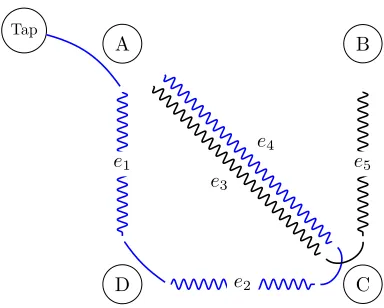
Let us take a look at an example in Figure2.1for four players, Alice, Bob, Charlie, and Dick (players 1, 2, 3 and 4 respectively), where Alice controls the water tap. This is not a complete protocol computing a function, but an instance where all players have connected the edges incident to their own vertex, depending on their inputs. The example is just to see what connections are legal and how the output is determined.
D C B A
Tap
e4
e3
e1
e2
[image:19.612.208.400.121.275.2]e5
Figure 2.1: Multiparty Garden-hose example for four players. Pipes and hoses that have become wet for this configuration are drawn in blue.
σ3 = (e2, e4)(e3, e5) andσ4= (e1, e2). The water flow path will be (e1, e2, e4),
spilling at Alice from pipee4. The output is 1, as Alice is player number 1.
In Section 1.3, in Lemma 10, we have seen that all Garden-hose protocols can be transformed to a protocol that has only one spilling pipe for Alice, and one for Bob. We show that this result can be translated to the Multiplayer Garden-hose model in Lemma14below.
Recall that a pipeeis called a spilling pipe if for some input (x, y) the water spills from pipee. We use an analogous definition in the multiplayer model: a pipe e is called a spilling pipe of player Pi if for some input (x1, . . . , xk) the water spills from pipeeat playerPi.
Lemma 14(Multiplayer One Spilling Pipe Lemma). Every Multiplayer Garden-hose protocolP computing a Boolean functionf with kinputs can be converted to a protocolP0 which also computes f, but with P0 constructed such that for all inputsx1, x2, . . . , xk and corresponding pipe connectionsh1(x1), . . . hk(xk)it
holds that: for every playerPi with1≤i≤k, there exists one pipesei such that if the water spills at some playerPi, it must spill from pipe sei. The number of pipes in such a protocolP0 is at mostk+ 1times the number of pipes inP plus k−1.
Proof. The proof here is similar to the proof of Lemma 10given in Klauck and Podder[2014]. LetP be ak-player protocol for computing the Boolean function f :{{0,1}n}k→ {0,1}. Name the playersP1 up toPk. LetEM be the edge set of the multigraphM corresponding to P. We construct the multigraphM0 of P0 by copying the structure of the original protocolk+ 1 times, such that for all pairs of playersPi andPj with 1≤i < j≤kit holds that if in protocolP they shared m pipes then in protocol P0 they sharem·(k+ 1) pipes. In addition to this, playerP1, which is the player connecting the water pipe, will share one
We will label the pipes as follows. For all pairs of players (Pi, Pj), with 1 ≤ i < j ≤ k, we will label subsets of the set of pipes they share, with their copy number. Letm(i, j) be the number of pipes thatPi andPj share in protocol P. We will labelm(i, j) of them(i, j)·(k+1) pipes betweenPiandPjin P0 with the labels (e(1i,j), C0),(e
(i,j)
2 , C0), . . . ,(e (i,j)
m(i,j), C0), anotherm(i, j) pipes
are labeled with (e(1i,j), C1), . . . ,(e (i,j)
m(i,j), C1), et cetera, until allm(i, j)·(k+ 1)
pipes are labeled.
Thus we labelm·(k+ 1) pipes inP0 with an index and their copy number, such that for each copy we have a one-to-one correspondence between the pipes in that copy and the pipes inM. The remaining pipes that are not yet labeled after this step are thek−1 pipes betweenP1 and the other players. (That is,
one between P1 and Pi for every player Pi not equal to P1, with 2≤ i ≤k.)
Label these pipes withei
P1 for all 2≤i≤k.
Next is the description of the pipe connections made by the players. Let the players connect their pipes labeled with C0 the same as they would have
connected them inP, including the water pipe, whichP1connects to some pipe
labeled C0. Additionally, all players connect the pipes in copies C1 to Ck as
they would have connected them inP, but now playerP1 does not connect the
water tap to any of the pipes.
For all 0≤q≤kand all 1≤i≤k, define the following setSCq
i of pipes in copyCq that correspond to spilling pipes for playerPi in protocolP.
SCq
i =
n
e∈Ei| eis labeled by (er(i,j), Cq) for some 1≤r≤ |Ei|,
∃x∈ {{0,1}n}k: the water spills frome(ri,j) atPi in protocolP
o
Where in the second line in the definition above,e(ri,j) is taken to be∗ the pipe that corresponds to pipee(ri,j)in M.
Now, for every 1≤i≤k, playerPi connects all the pipes (er, C0)∈SiC0 to their counterpart (er, Ci)∈SCi
i in copyCi. This means that for all 1≤i≤k, copyC0 is connected to copyCi only by the spilling pipes ofPi.
Letewdenote the pipe thatP1connects to the water pipe in copyC0. If the
water spills atPiin protocolP, then in protocolP0, the water will flow through the corresponding wet pipes labeled withC0 and then flow through some pipe
in the setSC0
i , corresponding to a spilling pipe forPi in P. At that point the water will be redirected to the related pipe in SCi
i and it will have the exact same flow path as in C0 but backwards, going through the pipes in copy Ci,
before spilling from the pipe in copyCithat corresponds to pipeew in copyC0.
We now know that if the water spills at player Pi in protocol P, then the water will spill at the side of P1 from the pipe corresponding to ew in copy
numberCi. Here is where the remainingk−1 pipes come in.
All that is left, is for playerP1 to connect the pipe corresponding to ew in
copy numberCi to the extra pipe eiP
1 betweenP1 andPi. In our construction
∗The protocolP0 is such that inM0 there arek+ 1 copies of the graphMof protocolP,
we then havese1= (ew, C1) andsei=eiP1for all 2≤i≤k, as being the spilling
pipe for playerP1 and all players Pi 6=P1. This protocol has only one spilling
pipe per player, and uses a total number of pipes of (k+ 1) times the number of pipes inP, plusk−1.
2.2
A General Upper Bound
Similar to Lemma7, we can show that all functions can be computed in the Multiparty Garden-hose model in exponential time.
Lemma 15. For all Boolean functions f :{{0,1}n}k→ {0,1}, it holds that
MPGH(f)≤
k−1
X
i=1
2ni+1 2 ·2
nk< k·2nk
Proof. Let f be a Boolean function with k n-bit variables. We construct a protocol that computesf, usingPk−1
i=1 2
ni+1 2·2
nk pipes. Name the playersP
1
up toPk. Players P1 and P2 share 2n pipes. Players P2 andP3 share 2n·2n
pipes (2n extra pipes for each pipe thatP
1 andP2share). This continues, such
that for all 1≤i < k, playersPi and Pi+1 share (2n)i pipes. Additionally, P1
andPk share 12·2nkpipes.
Let xi denote the input of player Pi. We will label all the pipes in the following way. Label the 2n pipes betweenP1 andP2each with a unique input
string in{0,1}n. Label the 22n pipes between P2 and P3 each with a unique
input string in{0,1}n× {0,1}n. Label the 23n pipes between P
3 and P4 each
with a unique string in {0,1}n × {0,1}n × {0,1}n. Et cetera, labeling, for all 1 ≤ i < k, the 2ni pipes between P
i and Pi+1 with a unique string in
i times
z }| {
{0,1}n× · · · × {0,1}n.
Having described the structure of the multigraph, we then describe the pipe connections made by the players. PlayerP1 connects the water tap to the pipe
labeled with his inputx1. For everyy∈ {0,1}n, playerP2connects the pipe
be-tweenP1andP2that is labeledy, to the pipe labeled (y, x2). Similarly, for every
3≤i < k, and for every y= (y1, . . . , yi−1)∈
i−1 times
z }| {
{0,1}n× · · · × {0,1}n, player Pi connects the pipe labeled withy to the pipe labeled with (y1, y2, . . . , yi−1, xi). This means that eventually the water will flow from Pk−1 to Pk through the pipe labeled (x1, x2, . . . , xk−1).
Player Pk then decides where the water should spill. Before connecting his pipes, PlayerPk determines which set is smaller: I0={x∈ {{0,1}n}k:f(x) =
0} or I1 ={x∈ {{0,1}n}k : f(x) = 1}. Letz ∈ {0,1} be such that Iz is the
smallest of the two sets I0 and I1. If I0 and I1 are both of size 2nk−1, pick
PlayerPkthen connects all pipes betweenPk−1andPk that are labeled with
a y=y1y2. . . yk−1∈
k−1 times
z }| {
{0,1}n× · · · × {0,1}n such thatf(y1, y2, . . . , yk−1, xk) =
z, to one of the pipes betweenPk andP1.
By construction, the water will follow the pipes labeled with the inputs of the players, and it will spill at P1 if f(x1, . . . , xk) = z and at player Pk
otherwise. Note thatzcan be computed before knowing the inputs. The above construction is thus a correct Multiplayer Garden-hose protocol forf, and note that the total number of pipes, excluding the pipes betweenP1and Pk, equals
Pk−1
i=1 2
ni. Adding the pipes between P
1 and Pk, which adds another 12 ·2nk
pipes, finishes the proof.
2.3
Position-based Cryptography in 3D
As we have seen in Section1.4, the Garden-hose model models a class of attacks on a one-dimensional position-verification scheme. While for obvious practical reasons we are mainly interested in doing position-verification in 3-dimensional space, a natural follow-up of the PVfqubitscheme would be to extend the scheme to k-dimensional space. In this section we will sketch the outline of such a scheme and discuss the applicability of the Multiplayer Garden-hose model.
In thek-dimensional space of this extended scheme we placek+ 1 verifiers, such that the verifiers together form a convex hull of dimensionk. We require the prover to be situated within that convex hull. This is to allow verification of the location of the prover by comparing the distance upper bounds to the verifiers. The verifiersV0, V1, . . . , Vk then sendk+ 1n-bit stringsx0, x1, . . . , xk
to the prover. VerifierV0again prepares an EPR-pair √12(|0iV |0iP+|1iV |1iP), sends the qubit in register V to verifierVf(x0,x1,...,xk) and sends the qubit in
register P to the prover. Everything is sent such that it all simultaneously arrives at the prover. The prover then has to relay the qubit he received to Vf(x0,x1,...,xk), using the information that was sent to him. Here,f is a publicly
known function ink+ 1 variables that can take onk+ 1 possible values. Again, suppose there were k+ 1 adversaries, P0, P1, . . . , Pk, working
to-gether to attack this scheme, then assuming the adversaries are using a number of EPR-pairs between each pair of adversaries, such an attack corresponds to a Multiparty Garden-hose protocol forf. However, the applicability of the Mul-tiplayer Garden-hose model as defined in this thesis is limited to some degree by two factors.
First, in the Multiplayer Garden-hose model we only consider functions of the form f : {{0,1}n}k → {0,1}, whereas in the k-dimensional extension of PVfqubit, verifierV0can send his qubit in registerV to any of the other verifiers.
We could alter the scheme to restrictV0 by allowing V0 to only send the qubit
to himself or V1, which would mean that the water should only be allowed to
for an attack to work. Typically one designs cryptographic schemes in order to protect against possible attacks. A more elegant workaround is to redefine the Multiplayer Garden-hose model such that it deals with more general functions of the form f : {{0,1}n}k+1 → {0,1,2, . . . , kl} with 1 ≤ kl ≤ k. Then if f(x0, x1, . . . , xk) =ithe water must spill at playerPi. In this case, the original
Multiplayer Garden-hose model is simply a special case of the general model, as we can always restrict the number of players where the water can spill.
This can be done by connecting all open pipes on a player’s side to extra dummy pipes. By connecting every spilling pipe of one player to an extra dummy pipe which redirects the water to another player∗, we ensure that the number of players where the water can spill is reduced by one. We can do this for more than one player in order to reduce the number of spilling locations to exactly the size of the codomain off. Note that the total number of spilling pipes, summing over all players, is upper bounded by twice the total number of pipes†. Thus we can change any Multiplayer Garden-hose protocolP which computes a Boolean function f (in the original definition), to a protocol P0 which computes f such that there are only two players where the water can spill, with protocolP0 using at most three‡ times the number of pipes in P.
Second, with more than two adversaries it seems possible that more com-plicated entangled states can be used: the attackers are not necessarily limited to using only EPR-pairs between every pair of adversaries. The Garden-hose model is already a special (although big) class of attacks, and it merely upper bounds the number of EPR-pairs needed to break the scheme PVfqubit. Since the adversaries might also use entangled states other than EPR-pairs, the Mul-tiparty Garden-hose model represents an even smaller class of attacks on the k-dimensional extension of PVfqubit. Nevertheless, the Multiparty Garden-hose model does model a class of attacks on the natural k-dimensional extension of PVfqubit, which means it could prove a useful tool in the development of practical implementations of secure position-based cryptographic schemes in three-dimensional space.
2.4
The Multiplayer Equality Function
Let the n-bit, k-player equality function be the function EQk
n : {{0,1} n
}k → {0,1}whereEQk
nequals one for inputs of the form{x} k
wherex∈ {0,1}n, and zero otherwise. Before studying the complexity of the equality function in full generality in Section2.4.5, we will take a closer look at a special case: the 1-bit equality function, starting with the double-circle protocol.
∗A player that is allowed to have spilling pipes.
†Note that every pipe can have water spilling from it on two sides.
‡Using the original pipes, plus at most two dummy pipes extra for every pipe that can be
2.4.1
Example protocol: the double-circle protocol
Consider the protocol depicted in Figure2.2. The protocol is forkplayers with a 1-bit input, computesEQk
1, and is named the double-circle protocol.
In this protocol player 1 has control over the water tap, and all the players are positioned in a circle. Every two players that are next to each other in the circle share two pipes: one pipe on the outside of the circle, and one pipe on the inside of the circle, with the exception of player 1 and player number k, who only share one pipe. The water will flow clockwise, regardless of the input.
In this protocol player 1 connects the tap to the pipe going to player 2 on the outside of the circle if his input equals 0, and he connects the water tap to the other pipe going to player 2 (on the inside of the circle) if his input equals 1. For all the other players, with the exception of playerk, the protocol is to connect the two pipes on the outside of the circle if their input equals 0 and leave the remaining two pipe endings open. If their input equals 1, the protocol is to do the opposite, to connect the two pipes on the inside of the circle, and to leave the pipes on the outside unconnected.
For playerk, if his input equals 0 he connects the pipe that he shares with player k−1 on the outside of the circle to the pipe going to player 1. If the input of playerk equals 1, he will connect the pipe that he shares with player k−1 on the inside of the circle to the pipe leading back to player 1.
2.4.2
Analyzing the double-circle protocol
The protocol is such that if all the players have input 0, the water will flow along all the pipes on the outside of the circle and it will spill at player 1. If all players have input 1, the water will flow in a circle along the inner pipes and it will again spill at player 1, hence the name.
If not all players have the same input, the water will spill at the location of the first playeri such that this player’s input is not the same as the input of all the players that are closer to player 1 on the circle, counting anti-clockwise∗. Note that this player is never player 1. The water only spills at player 1 if all players have the same input.
This protocol uses 2k−1 pipes to compute EQk
1. It turns out a better
protocol is possible, as shown in Lemma17.
P1 P2
P3
P4
..
.
. .
.
. . .
. ..
..
.
Pk Tap
1 0
[image:25.612.166.441.121.414.2]1 0
Figure 2.2: Double-circle protocol computingEQk
1.
2.4.3
An approach to proving optimality: a new proof
technique
In an attempt to prove the optimality of the double-circle protocol, one can try to show that the following two properties must hold for every optimal protocol computingEQk
1.
The first property is that the number of pipes the water flows through on input{0}k (i.e. when all players have input zero) must be greater than or equal tok−1. The same is true for the number of pipes the water flows through on input{1}k. The second property is that the set of pipes that become wet on input{0}k is disjoint from the set of pipes that become wet on input{1}k, with the exception of the last pipe the water flows through.
The proof structure used here uncovers a new proof technique for Garden-hose problems: show that in any optimal protocol some input sets A and B exhibit a water flow path of significant length, and prove that the intersection of their water flow paths is small.
In the case ofEQk
1, if these two properties hold, then at least 2k−3 pipes
are necessary to computeEQk
second property. It turns out that these two sets∗of pipes are only disjoint when the following is true: whenever a pipes is an element of both sets, the water always flows in the same direction through pipes. We prove this in Lemma16.
Lemma 16. Let I0 be the set of pipes that become wet on input {0}
k
, and let I1 be the set of pipes that become wet on input{1}
k
. The double-circle protocol is optimal up to a constant, in the set of protocols computingEQk
1 that have the
following property: whenever a pipe sis an element of both sets I0 andI1, the
water always flows in the same direction through pipes on every input.
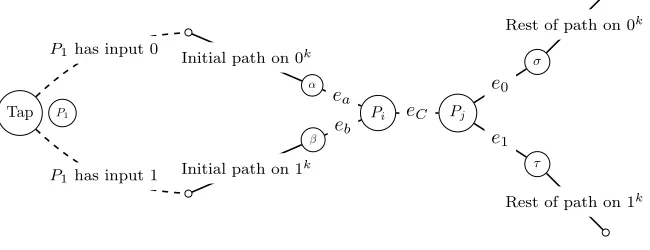
Proof. Suppose, in protocolP, that the set of pipes that become wet on input
{0}kisnotdisjoint from the set of pipes that become wet on input{1}k. Suppose there is a pipe that is in both sets, which is not the last pipe to become wet for either of the two inputs {0}k and{1}k, for which the water flows in the same direction on every input.
Let eC be the first† pipe that gets wet both on input {0}k and on input
{1}k. Without loss of generality we assume pipeeC is located between playeri and playerj for somei and j such thati 6=j. Figure 2.3depicts a schematic view of the situation.
Tap P1
α
β
Pi Pj
σ
τ Initial path on 0k
Initial path on 1k
Rest of path on 0k
Rest of path on 1k
ea
eb
eC
e0
e1 P1 has input 0
[image:26.612.142.467.362.487.2]P1 has input 1
Figure 2.3: Schematic view of the water flow paths in protocol P.
Without loss of generality, player 1 has control over the water tap, and he directs the water to one of two different‡ pipes according to his input. The players (depicted by nodes in the figure) namedαandβare the players incident to the pipesea andeb respectively, such that the water flows through pipeea to playeri if everyone has input 0, and the water flows through pipeeb to player iif everyone has input 1.
∗The set of pipes that become wet on input{0}k, and the set of pipes that become wet on input{1}k.
†Meaning that on input{0}k, before flowing through pipeeC, the water flows through a set of pipesEX, and on input{1}k, before the water flows through pipeeC, this setE
X remains dry.
‡Suppose they were the same, then an immediate improvement can be made by having
The two paths coincide on edge eC. From there, playerj connects eC to the pipe labelede0 if his input is 0, and he connectseC to the pipe labeled e1
if his input is 1. Note that the players σ and τ are possibly the same player, but we can assume that the two pipes labelede0 ande1 respectively must be
two different pipes; Suppose they are the same pipe, then changing pipeeC to be between playeriand σand leaving out pipee0 would result in an identical
protocol with fewer pipes.
We will show that in the situation depicted in Figure2.3, the protocol is not optimal. An alternative protocolP0 is depicted in Figure2.4.
Tap P1
α
β
Pi Pj
σ
τ Initial path on 0k
Initial path on 1k
Rest of path on 0k
Rest of path on 1k
ea
eb
e0
e1 P1has input 0
[image:27.612.152.456.245.370.2]P1has input 1
Figure 2.4: Eliminating pipeeC from P, resulting in protocolP0.
In Figure 2.4 pipe eC is removed, and pipes ea and eb are changed to be incident toPj. In this alternative protocolP0, what is different is that player Pj connects pipeea to the pipe labelede0 if he has input 0, and he connectseb
to the pipe labeled e1 if he has input 1. It is easy to see that on inputs{0}
k
and{1}k, protocolP0 behaves the same asP.
Now suppose there exists an input x ∈ {0,1}k not equal to {0}k or {1}k
for which, in protocol P, the water comes out at pipe ea or eb, before being channeled into pipeeC. The water will then end up at the same pipe in protocol P0 and eventually spill at the same location it would have spilled in protocolP.
Hence,P0 is correct and uses fewer pipes thanP, contradicting the optimality ofP.
2.4.4
The exact value of
MPGH
(
EQ
k 1)
From Lemma16we know that if there exists a better protocol forEQk1, it must use a construction such that, in some pipe that occurs in both water flows, the water flows in the opposite direction for some input set. This hints towards the following protocol.
Lemma 17. Fork≥3, it holds that
MPGH(EQk1)≤l3k
2
P1
Tap
P2
P3
P4
P5
P6
P7
P8
ex 1
0
0 1 1 0 0 1
1 0 0 1 1 0
0
[image:28.612.138.473.156.256.2]1
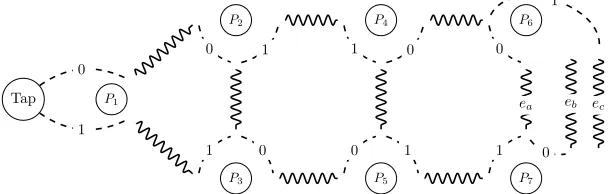
Figure 2.5: Protocol structure computingEQk1 ifkeven.
P1
Tap
P2
P3
P4
P5
P6
P7
ea eb ec
1 0
0 1 1 0 0
0
1 0 0 1 1
1
Figure 2.6: Protocol structure computingEQk
1 ifkodd.
Proof. The lemma is proven by the construction of a protocol with the correct number of pipes, separating cases fork odd andk even. (Strictly speaking, we construct a family of protocols: one for eachk ≥ 3.) Consider the protocols depicted in Figures2.5and2.6. Note that by adding or removing vertical pairs of players in the middle, these protocols work for allknumber of players bigger than two and even or odd respectively.
We start by proving the correctness of the protocol in Figure2.5. It is easy to see that the water spills atP8if all players have the same input bit. To prove
that the water does not spill atP8 if not all players have the same input bit,
consider the possible ways the water can spill atP8.
If P8 has input zero and the water spills atP8, then the water must spill
from the pipe between P7 and P8 that is left open on the side of P8; Name
this pipeex, as in Figure2.5. Pipeex only becomes wet whenP7 has input 0.
Subsequently, whenP7 has input 0, the pipe thatP7 connects to pipeex only
becomes wet whenP6 has input 0. By repeating this argument we can follow
this trail all the way back toP1, concluding that for water to spill at P8 when
[image:28.612.151.456.324.421.2]holds for the case where P8 has input 1. This proves the correctness of the
protocol for even numbers of players.
Proving the correctness of the protocol in Figure2.6is done similarly. Here the water spills atP6 if all players have input 0, and also when all players have
input 1, as is easily checked. Label the pipes betweenP6 andP7 in Figure2.6
withea,ebandec. Suppose the water spills atP6andP6has input 0. Then the
only possible spilling pipes are the two rightmost pipes, pipeebandec. SinceP6
has input 0, pipeec is not connected to any pipe and thus will not spill water. Pipeeb will only spill water ifP7has input 0, and backtracking from there leads
to pipeea spilling water when all players have input 0.
Now suppose the water spills at P6, andP6 has input 1. The two pipesea
andeb betweenP6 andP7 are possible spilling pipes in this case. Pipe eb will
only spill water if bothP7 andP6have input 0. So if the water spills atP6and
P6 has input 1, it can only come out of pipe ea, which only happens when all
other players also have input 1.
In order to check the number of pipes, changing pipe ex to be betweenP8
andP1results in all players being incident to exactly three pipes, making it easy
to see that for evenk, the protocol in Figure 2.5uses 32k pipes. For oddk, the protocol in Figure2.6uses two pipes forP1and three extra pipes for every other
pair of players, summing up to a total of 2+3(k2−1)= 3k2+1 =k+k2+12 =k+dk
2e
pipes.
Lemma 18. If k≥3 is even, it holds that
MPGH(EQk1)≥3k
2
Ifk≥3is odd, it holds that
MPGH(EQk1)≥k+
jk
2
k
Proof. Let P be an optimal protocol computing EQk
1. We will prove that in
P, all players, with the exception of one player, are incident to three or more pipes. The proof is by contradiction, separating two cases.
First suppose that in protocolP there is a player iwho is incident to only one pipe. Since there is only one pipe, it cannot be connected to another pipe. Consider the location where the water spills on input 0k. If the water spills at playeri, then the water will also spill at player i when everybody else has input 0 and playerihas input 1. If it does not spill at playeri, the water will again spill at the same location as where it would spill if everybody else has input 0 and playerihas input 1. Basically, playeridoes not have any effect on the water flow. HenceP is not a protocol computingEQk1 and we see that all players are incident to at least two pipes.
first to player A and then to playerB. (If the water flow does not reach one of the two at all, then changing this player’s input to 1 will not change the spilling location andP would not be computingEQk1.) This means that player
Aconnects her two pipes on input 0, and disconnects them on input 1. (Player Amust do something different for different inputs, otherwise the water flow on input 0k is the same as when everybody else has input 0 and playerAhas input 1.)
Now consider the water flow on input 1k. If the water flows towards player Afirst, then the water will never reach playerB, as playerAhas disconnected her two pipes on input 1. So the water will flow through the pipes of player B first. This means that the pipes of playerB must be connected on input 1, and be disconnected on input 0, so the water spills at player B on input 0k, otherwise the water never reaches playerA.
Because playerB disconnects his pipes on input 0, and since the water will flow through his pipes when everyone has input 1, the water also must∗ spill at player B when everybody else has input 1 and player B has input 0. This contradicts the assumption ofP computing EQk1, as the water spills at player B if all players have input 1, but the water spills again at playerB if the only player with input 0 is playerB.
Note that if k is even, it can’t be the case that k−1 players are incident to exactly three pipes and one player is incident to exactly two pipes: the sum of the degrees (number of incident pipes) of all vertices (players) would be an odd number. This means the sum of the degrees has to increase by at least one. Dividing the sum of the degrees by two, we conclude there must be at least 32k pipes if k is even. If k is odd, the total number of pipes equals
3(k−1)+2
2 =
3k
2 −
1
2 =k+
j
k
2
k
.
Combining Lemmas17and18results in the following theorem.
Theorem 1. Fork≥3, it holds that
j3k
2
k
≤MPGH(EQk1)≤l3k
2
m
2.4.5
The complexity of
n
-bit,
k
-player equality
Using the result of Theorem1, we are able to start to answer a bigger question: “How many pipes are needed to computen-bit, k-player equality?”.
An upper bound
An upper bound can be achieved by stringing together copies of the protocol in Lemma17. Figure 2.7shows how this can be done for oddk. In the upper
∗This is only true because with just two pipes incident to him, playerBhas no influence
copy, all players check their first input bit: all connections in the upper copy are made according to all players’ first input bit. An extra pipe eX is added between playerk−1 and player 1. For inputi∈ {0,1}, playerk−1 additionally connects pipeeb toeX ifi= 0 and pipeeatoX ifi= 1. Player 1 now uses the water that spills from pipeeX as a water tap for use in the second copy. In the lower copy, all players check their second input bit.
Note that this protocol now means that all players except players 1,k−1 andk are incident to exactly six pipes. By repeating this process of stringing together copies, such that in each copy another input bit location is checked to be equal for all players, we arrive at a protocol forn-bit, k-player equality that usesn· d3k
2e+ (n−1) pipes.
P1
Tap
P2
P3
. . .
. . .
Pk−1
P
kP1
P2
P3
. . .
. . .
Pk−1
P
kea eb ec
eX
e0
a e
0
b e0c 1
0
0 1 0
0
1 0 1
1
1 0
1 0
0 1 0
0
1 0 1
[image:31.612.137.463.286.549.2]1
Figure 2.7: Protocol structure computingEQk2 ifkodd.
Lemma 19. Fork≥3 it holds that
MPGH(EQkn)≤n·l3k
2
m
+ (n−1)
eX in Figure2.7. Similar to the correctness proof in Lemma 17, we can show that the water only spills at playerk−1 if all players have the same input. For each 1≤l ≤(n−1), copy Cl checks whether all players agree on input bitl, and if that is the case, the water gets transmitted to copyl+ 1. Note that the water spills at player k−1 if all players have the same input bit for each bit location 1≤l≤(n−1).
To complete the correctness proof, we claim that the water only spills at player k−1, and, specifically, only from a pipe in then-th copy, if all players agree on their entire input. This can be seen by noting that the water only flows towards playerk−1 at copy number lif: all players agree on their input on all bit locations lower thanl, and all players except possibly playerk−1 and player k agree on input bit i. Three situations can occur if the water flows towards player k−1 at copy number l: the water spills before it reaches player k−1; Playerk−1 disagrees with some player on input bit location l, and the water spills somewhere else; Or playerk−1 agrees with all other players on input bit l, and the water gets redirected to copyl+ 1.
For evenk, we can analogously combine copies of the protocol for evenkin Lemma17. On input 0, playerkthen connects the pipe where the water would spill from if all players have input 0 to pipeeX, connecting two copies, and the water tap is again replaced by pipe eX. Checking the correctness of this new protocol is done in the same way.
A lower bound
Although finding the exact value ofMPGH(EQk
n) is likely to be difficult, as is shown by the complex nature ofMPGH(EQ2n) =GH(EQ), we can find a loose lower bound by an analysis similar to the one used in Lemma18.
Lemma 20. Let T(m)be the number of different combinations of pipe connec-tions a player can make when incident to m pipes, and let L(m) be the least m∈Nsuch that T(m)≥2n. Then it holds that
MPGH(EQkn)≥1
2 ·k·L(n)
Proof. Let P be a protocol computing equality, and suppose there exist an x, y ∈ {0,1}n such that there is a player 1 ≤ i ≤ k that makes the same combination of pipe connections on inputxas he does on inputy, according to protocolP. Then if all players have input x, the water must spill somewhere else than in the case where playerihas inputybut all other players have input x. But since the pipe connections are the same in this case, this contradicts the assumption thatP is a protocol computing equality.
The number of different combinations of pipe connections onnpipes is equal to the number involutions. This integer sequence T(n) for n∈ Nis known as
the ‘telephone numbers’, and can be found inSloane and Plouffe [1995] and at
https://oeis.org/A000085.
The table below shows the first fifteen telephone numbers T(n) and the values ofL(n) for 1≤n≤15.
n T(n) 2n L(n)
1 1 2 2
2 2 4 3
3 4 8 4
4 10 16 5
5 26 32 6
6 76 64 6
7 232 128 7
8 764 256 8
9 2620 512 8
10 9496 1024 9
11 35696 2048 9
12 140152 4096 10 13 568504 8192 10 14 2390480 16384 11 15 10349536 32768 11
Comparing the upper and lower bounds of respectively Lemma 19 and Lemma20for 1≤n≤15, we see a slowly widening gap in the table below.
lower bound upper bound
n 1
2 ·k·L(n) n·
l
3k
2
m
+ (n−1)
1 k 1.5k
2 1.5k 3k+ 1
3 2k 4.5k+ 2
4 2.5k 6k+ 3
5 3k 7.5k+ 4
6 3k 9k+ 5
7 3.5k 10.5k+ 6
8 4k 12k+ 7
9 4k 13.5k+ 8
10 4.5k 15k+ 9
11 4.5k 16.5k+ 10
12 5k 18k+ 11
13 5k 19.5k+ 12
14 5.5k 21k+ 13
2.4.6
Comparison to 2-player equality
By using the One Spilling Pipe Lemma (Lemma10 from Section 1.3) we can relateMPGH(EQk
n) toGH(EQn), shown in Lemma21below.
Lemma 21. For allk∈N
MPGH(EQkn)≤(k−1)·(3·GH(EQn) + 1)
Proof. Let P be an optimal protocol computingMPGH(EQ2
n). Let P0 be a protocol computingMPGH(EQ2
n) with only two spilling pipes as provided by Lemma 10, meaning that there is a pipe asuch that if x6= y then the water spills at Alice’s side from her end of pipea, and there is a pipe b such that if x = y then the water spills at Bob’s side from his end of pipe b. Note that protocolP0 uses at most 3·GH(EQn) + 1 pipes.
We construct a multiplayer protocol of the requested size such that the water spills at player k if and only if all players have the same input. This is done by setting up a string of copies of protocol P0 between the players in a linear pairwise fashion as shown in Figure2.8.
P1
Tap P0 P2 P0 P3 P0
. . .
P0 PkFigure 2.8: ComputingEQkn using copies of an optimal protocol forEQ2n.
PlayersP1andP2run protocolP0, playerP2then uses his only spilling pipe
betweenP1 and P2 as a water tap for another copy op P0 betweenP2 and P3.
Similarly, each player other thanP1andPk uses their spilling pipe from a copy of the protocolP0 on the left as a water tap for the copy ofP0 on their right.
In this manner, first P1 and P2 check if they have the same input. If not,
then the water spills at playerP1. If so, then the next coupleP2 andP3 check
their input for equality. This continues in the same way up to playerPk. If all players have the same input, the water spills at playerPk. If not, then the water spills at the first playerPi∗ such that the input ofPi+1 is not equal
to the input of playerPi. This uses a number of pipes exactly k−1 times the size ofP0.
Although no exact value for GH(EQn) =MPGH(EQ2n) is known, several bounds exist. The best current upper bound, from Lemma 4 in Section 1.2, shows that GH(EQn) ≤ log 32813 ·n+O(1) ≈ 1.359n+O(1). Together with
Lemma21this results in the following upper bound onMPGH(EQk n).
Lemma 22. For allk∈N
MPGH(EQkn)≤(k−1)·3· 28
log 313·n+O(1)
Recall Lemma 19 from Section 2.4.5, as repeated below, and note that it implies thatMPGH(EQk
n)≤n·
3k+3 2
for allk≥3.
Lemma 19. Fork≥3 it holds that
MPGH(EQkn)≤n·l3k
2
m
+ (n−1)
Chapter 3
Leaking Pipes and Time
Bounds
In the first part of this chapter, we introduce a stronger version of the Garden-hose model: the Leaky Garden-Garden-hose model. The second part of this chapter revisits a model in which the time it takes for the water to spill is limited, a model which was first introduced inKlauck and Podder[2014].
3.1
Leaky Garden-hose Model
We introduce the Leaky Garden-hose model. The Leaky Garden-hose model has the same setting as the original Garden-hose model, but in this model, the pipes are leaking; Alice and Bob are allowed to measure which pipes get wet when running the protocol on input (x, y), which is coded in an m-bit string LGHP(x, y), wheremis the number of pipes used in the protocol. Each bit at location 1≤i≤mof LGHP(x, y) corresponds to whether pipei became wet or not. Them-bit stringLGHP(x, y) is calledthe auxiliary output, as it will be used to help compute the function value.
We say that the Leaky Garden-hose protocol P computes a function f if, after the water spills somewhere, and after Alice and Bob learnLGHP(x, y), it holds that for all inputsx, y, at least one player knows with certainty the value off(x, y).
learns the value of the function, while other players (possibly) do not.
As before, we define the Leaky Garden-hose complexity of a function as follows, using the number of pipes as a complexity measure. Letf :{0,1}n×
{0,1}n→ {0,1}be a Boolean function.
Definition 7. The Leaky Garden-hose complexity of f, LGH(f) is the min-imum number of pipes needed for a Leaky Garden-hose protocol to compute f.
Note that the Leaky Garden-hose model has no natural correspondence to the position-verification scheme in Section 1.4. After Alice and Bob have re-ceived the input value of the other player in scheme PVfqubit, they both don’t know which EPR-pairs were used (i.e. which pipes became wet). Moreover, in the Garden-hose model the water has to spill at the correct player in order to compute a function ∗, as opposed to Alice and Bob learning the value of the
function after executing the protocol. Nevertheless, even though a direct cor-respondence is lost here, we believe that studying related models can improve our understanding of the underlying mathematics of the Garden-hose model.
3.1.1
Complexity upper bounds
Lemma 23. For all Boolean functions f :{0,1}n× {0,1}n → {0,1},
LGH(f)≤GH(f)
Proof. LetP = (m, fA, fB) be an optimal Garden-hose protocol that computes f. We claim that protocolPis also a Leaky Garden-hose protocol that computes f. This holds becausef(x, y) can be computed using the parity of the Hamming weight ofLGHP(x, y). The water spills at Bob’s side when the number of wet pipes is odd, and the water spills at Alice’s side when the number of wet pipes is even.
In contrast to the existence of functions with exponential complexity in the Garden-hose model, all functions have a complexity inO(n) in the Leaky Garden-hose model.
Lemma 24. For all Boolean functions f :{0,1}n× {0,1}n → {0,1},
LGH(f)≤4n−2
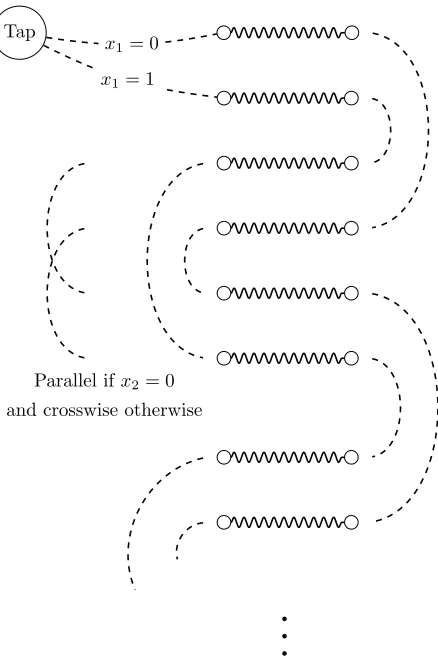
Proof. The protocol that shows this to be true can be seen in Figure3.1: Bob always redirects the water to the next set of two pipes, and except for the first two pipes, Alice connects her pipes in parallel or crosswise, depending on the values ofx=x1, x2, x3, . . . , xn. That is, labeling the pipes from top to bottom
∗Corresponding to sending the qubit to the correct verifier in PVf
Tap
Parallel ifx2= 0
and crosswise otherwise
..
.
x1= 0
[image:38.612.183.402.122.452.2]x1= 1
Figure 3.1: Leaky Garden-hose protocol, communicating x to Bob in 4n−2 pipes
with a number between one and 4n−2, the protocol describes the following connections. Alice connects the water tap to pipe one if x1 = 0, and Alice
connects the water tap to pipe two ifx1= 1. Also, for alli∈Nwithi≤n−1
it holds that: if xi+1 = 0 then Alice connects pipe 4i−1 to pipe 4i+ 2, and
pipe 4ito pipe 4i+ 1; Ifxi+1= 1 then Alice connects pipe 4i−1 to pipe 4i+ 1,
and pipe 4ito pipe 4i+ 2.