912093 781326
9
ISBN 978-1-326-91209-3
90000
Computational social choice is concerned with the designand analysis of methods for collective decision making. It is a research area that is located at the interface of Computer Science and Economics. The central question studied in computational social choice is that of how best to aggregate the individual points of view of several agents, so as to arrive at a reasonable compromise. Examples include tallying the votes cast in an election, aggregating the professional opinions of several experts, and finding a fair manner of dividing a set of resources amongst the members of a group. _
This volume reports on a number of recent research trends in computational social choice. It has three parts. The first part presents novel scenarios in which methods for collective decision making are required. The second part introduces novel techniques for the analysis of such methods. The third part, finally, discusses a range of innovative applications enabled by recent research in computational social choice. _
The 20 chapters making up this volume have been written by leading experts in the field. They will be of interest to senior researchers and students alike, coming from a wide variety of disciplines, such as Computer Science, Artificial Intelligence, Mathematics, Economics, Political Science, and Philosophy. __
Edited by Ulle Endriss
Trends in Computational
Social Choice
Ulle
En
dri
ss
(ed.)
Trends
in
Computational
So
cia
Trends in Computational
Social Choice
AI Access
AI Access is a not-for-profit publisher with a highly respected
scientific board that publishes open access monographs and
col-lected works. Our texts are available electronically for free and in
hardcopy at close to cost. We welcome proposals for new texts.
c The Authors 2017
ISBN 978-1-326-91209-3
AI Access
Managing editor: Toby Walsh
COST
This volume is the result of the work of COST Action IC1205 on
Computational Social Choice, funded by COST (European
Coopera-tion in Science and Technology). COST is an EU-funded programme
that enables researchers to set up their interdisciplinary research
networks in Europe and beyond. We provide funds for organising
conferences, meetings, training schools, short scientific exchanges,
or other networking activities on a wide range of scientific topics.
By creating open spaces where people and ideas can grow, we
unlock the full potential of science.
www.cost.eu
Contents
Preface vii
Contributors xvii
PART I: SCENARIOS
1 Rolling the Dice: Recent Results in Probabilistic Social Choice 3 Felix Brandt
2 Multiwinner Voting: A New Challenge for Social Choice Theory 27 Piotr Faliszewski, Piotr Skowron, Arkadii Slinko, and Nimrod Talmon
3 The Mathematics of Seat Allocation and Political Districting 49 Federica Ricca, Andrea Scozzari, and Paolo Serafini
4 Iterative Voting 69
Reshef Meir
5 Group Activity Selection Problems 87
Andreas Darmann and Jérôme Lang
6 Popular Matchings 105
Ágnes Cseh
7 Belief Merging and its Links with Judgment Aggregation 123 Patricia Everaere, Sébastien Konieczny, and Pierre Marquis
8 Strategic Behavior in Judgment Aggregation 145
Dorothea Baumeister, Jörg Rothe, and Ann-Kathrin Selker
9 Social Choice and Social Networks 169
Umberto Grandi
PART II: TECHNIQUES
10 Structured Preferences 187
Edith Elkind, Martin Lackner, and Dominik Peters
12 Approximation Algorithms and Hardness Results for Fair Division 231 Evangelos Markakis
13 Computer-aided Methods for Social Choice Theory 249 Christian Geist and Dominik Peters
14 An Introduction to Voting Rule Verification 269
Bernhard Beckert, Thorsten Bormer, Rajeev Goré, Michael Kirsten, and Carsten Schürmann
15 A PREFLIB.ORGRetrospective: Lessons Learned and New Directions 289
Nicholas Mattei and Toby Walsh
PART III: APPLICATIONS
16 US vs. European Apportionment Practices 309
László Á. Kóczy, Péter Biró, and Balázs Sziklai
17 Recent Advances in Large-Scale Peer Grading 327
Ioannis Caragiannis
18 Applications of Matching Models under Preferences 345 Péter Biró
19 School Placement of Trainee Teachers: Theory and Practice 375 Katarína Cechlárová
20 Social Choice on the Web 387
Preface
Ulle Endriss
Computational Social Choice
Computational social choice is an area of research at the interface of Computer Science and Economics that is concerned with the design and analysis of meth-ods for collective decision making. The central question studied in the field is that of how best to aggregate the individual points of view of several agents, so as to arrive at a reasonable compromise.
For example, each individual agent might be a voter in a political election, us-ing her ballot sheet to express her individual views regardus-ing the candidates, i.e., to report her preferences. In this context, the relevant methods of social choice are the various voting rules we could use to aggregate the individual preferences to arrive at an election outcome that appropriately represents the preferences of society as a whole. But those individual points of view could also be very different things, such as the recommendations of different experts on climate change, the choices made by the participants of a marketing survey, or the legal opinions of the members of a panel of judges. In fact, the agents whose points of view are to be aggregated need not even be human beings, but could also be, say, machines (e.g., robots that need to agree on a joint plan of action), institutions (e.g., schools that need to agree how to divide a pool of applicants amongst them), or abstract entities such as algorithms (e.g., different search engines producing alternative rankings of websites that need to be aggregated into a single view).
mathemat-ically precise terms. This development initially occurred in the Economics liter-ature, sparked by the seminal contribution of the American economist Kenneth J. Arrow, who analysed what kinds of desirable properties we can possibly hope to see satisfied by a rule for aggregating individual preferences into a collective preference relation (Arrow, 1963). Political scientists, philosophers, and mathe-maticians joined soon afterwards. Finally, in the early years of the 21st century, social choice theory got established as a mainstream research topic in Computer Science. This development is due to two reasons. First, several application do-mains studied in Computer Science involve collective decision making (between autonomous computer systems rather than between people) and, maybe even more importantly, the tools and techniques of Computer Science turned out to be helpful in better understanding the intricacies of collective decision making.
The state of the art in computational social choice is represented by the Hand-book of Computational Social Choice (Brandt et al., 2016). The present volume builds on this body of knowledge and offers insights into some of the latest re-search trends in the field that have developed since the conception of the Hand-book. This concerns both novel scenarios in which methods for collective decision making are required and novel techniques for the analysis of those methods. The book also introduces a number of innovative applications of the insights obtained and techniques developed in recent research in computational social choice.
COST Action IC1205
This volume has been produced by COST Action IC1205 on Computational So-cial Choice, a European research network set up to advance the state of the art in computational social choice by supporting the international research com-munity in this domain. It was running for four years, from November 2012 to November 2016, and received a about two-thirds of a million euros in funding. COST (Cooperation in Science and Technology), founded in 1971, is the longest-running European framework facilitating the cooperation of scientists, engineers, and scholars across national borders. COST funds networking activities rather than research itself. It does so by allowing researchers, in a bottom-up fashion, to set upActions, i.e., research networks, on specific innovative themes that are of emerging importance and that have a certain scientific and societal urgency.
Activities of COST Action IC1205
The activities of the Action were plentiful and wide-ranging. First, there were the large Action Meetings, organised around the formal gatherings of the Ac-tion’s Management Committee in the form of 3-day workshops with 10–12 in-vited speakers each. For every such meeting, the Action was able to fund the participation of 40-50 individuals, with participation being open to (and free of charge for) others as well. These meetings enabled in-depth scientific interaction between the participants, without the usual pressures of quickly getting through as many presentations as possible, as is often the case at regular scientific con-ferences. Such meetings were held in Oxford (April 2013), Barcelona (October 2013), Maastricht (April 2014), Sibiu (October 2014), Glasgow (April 2015), and Istanbul (November 2015). In addition, aWorkshop on Future Directions in Com-putational Social Choicewas held in Budapest in November 2016.
The Action also organised four one-week Action Summer Schools, each at-tracting between 40 and 80 participants—typically PhD students, but also a few Master’s students, postdoctoral researchers, and senior faculty members. This included theSummer School on Matching Problems, Markets and Mechanismsin Budapest in June 2013, the Summer School on the Interdisciplinary Analysis of Voting Rules in Caen in July 2014, and the Summer School on Fair Division in Grenoble in July 2015, each of which focused on a specific topic within com-putational social choice. It also included the Summer School on Computational Social Choicein San Sebastián in July 2016, which provided a broader overview of several of these individual topics.
In addition to these two main types of events, the Action also organised several smaller workshops on specific topics, such as simple games, network formation, iterative voting, and logical models of collective decision making. The Action also contributed to the organisation of events chiefly organised by others, e.g., by pro-viding a keynote speaker or by financially supporting early-career researchers to allow them to attend the event. This included two summer schools on au-tonomous agents and multiagent systems (in Chania in 2013 and 2014), the International Workshop on Matching under Preferences in Glasgow in 2015, two editions of the International Workshop on Computational Social Choice (in Pitts-burgh in 2014 and in Toulouse in 2016), and theMeeting of the Society for Social Choice and Welfarein Lund in 2016.
While the focus of the Action and its activities has been on scientific founda-tions, it also reached out to stakeholders outside of the academic community and to the general public. For instance, in June 2014 the Action organised a panel session on Democracy in the Digital Age at the EuroScience Open Fo-rum in Copenhagen. And in June 2016 the Action organised an Industry Day in Toulouse, with a technical programme consisting of invited keynote talks by practitioners, from both the private and the public sector, who make innova-tive use of collecinnova-tive decision making technologies for which computational social choice provides the scientific foundations. These keynote talks were delivered by representatives of Google Research, Orange Labs, the Association for Interactive Democracy, National Matching Services Inc., and NHS Blood and Transplant.
promi-nent use of another networking instrument available to a COST Action, namely the facilitation of so-called short-term scientific missions. A short-term scientific mission is a research visit, of between one week and three months, of an in-dividual researcher to an institution in another country. COST Action IC1205 financed over 130 individual research visits of this kind.
Resources Collected by COST Action IC1205
Another important aspect of the mission of COST Action IC1205 has been the dissemination of knowledge on computational social choice. The production of this volume forms an important part of these efforts. In addition, the Action collected a number of resources, all of which are available via its public website:
http://research.illc.uva.nl/COST-IC1205/
These resources include information on social choice mechanisms used in practice, particularly information on voting rules used in different European countries and information on matching schemes used around the world for stu-dent admission, job markets, and kidney exchange. The website also lists links to datasets available to researchers in computational social choice and to sev-eral online software tools for experimenting with different types of social choice mechanisms. Finally, the website makes available a list of surveys, books, and expository articles, and it provides access to educational resources that can be used for teaching computational social choice at a variety of levels.
Overview of the Book
This book consists of three parts. Part I is dedicated toscenariosin which some form of collective decision making is required, Part II reviews a number of tech-niques that are useful for the analysis of such scenarios, and Part III presents several innovative applications that illustrate the wide-ranging relevance of the field of computational social choice.
Part I: Scenarios
The scenarios that have most commonly been studied in the literature on compu-tational social choice to date include the election of a single official on the basis of the preferences of a group of voters, the fair allocation of a set of goods to a number of agents, and the partitioning of a group of agents into coalitions in a manner that satisfies some notion of stability. The chapters in Part I go beyond these familiar scenarios in a number of ways.
Nimrod Talmon introduce the topic of multiwinner voting. In this setting, the out-come of an election is a set of winning alternatives rather than a single winning alternative. Gaining a better understanding of multiwinner voting is important for a number of scenarios in which people vote, e.g., when shortlisting job ap-plicants (rather than choosing one applicant to offer the job to) or when electing a parliament (rather than a president). In Chapter 3, Federica Ricca, Andrea Scozzari, and Paolo Serafini address a specific instance of multiwinner voting in great detail by reviewing several algorithmic methods for the apportionment problem, i.e., for the problem of allocating parliamentary seats to political parties in a manner that reflects, as best as possible, the vote share each party received. They also discuss the related problem of political districting, i.e., the problem of dividing the land, and thus the voters living on it, into electoral districts in a manner that does not give one party an undue advantage.
The next two chapters also deal with voting, but move away from the standard scenario even further. In Chapter 4, Reshef Meir discusses a model of iterative voting, where voters can inspect the outcome of an election and choose to respond to that outcome by changing their vote. If we iterate this process, a number of interesting questions arise, the most fundamental of which is whether such a process can be guaranteed to terminate eventually. Iterative voting can model, for instance, the deliberations of the members of a committee who take a number of straw polls before coming to a final decision. In Chapter 5, Andreas Darmann and Jérôme Lang introduce the family of group activity selection problems, where the members of a group each have to vote on a number of joint activities they may wish to participate in. Their preferences depend not only on the activities as such, but also on the number of fellow group members choosing the same activity. Thus, this novel scenario is related both to voting and to coalition formation.
In Chapter 6, Ágnes Cseh gives an introduction to popular matchings. In matching theory, the goal is to find a way of pairing up agents with either each other or with objects in a way that is socially optimal in some sense, such as not giving anyone an incentive to look for an alternative match. In the context of popular matchings, optimality is defined in terms of the preferences of the majority of the agents, i.e., we are looking for a matching such that no majority of agents would rather implement a different matching.
The next two chapters deal with the aggregation of judgments and beliefs, rather than with the aggregation of preferences. In Chapter 7, Patricia Everaere, Sébastien Konieczny, and Pierre Marquis compare the frameworks of proposi-tional belief merging and judgment aggregation. While both frameworks offer means to aggregate the views of several agents regarding the truth of a number of logically related statements, the approaches taken to formalise this scenario and the types of results obtained differ significantly. In Chapter 8, Dorothea Baumeister, Jörg Rothe, and Ann-Kathrin Selker focus on one specific family of questions within judgment aggregation, namely those that relate to the strategic behaviour of agents. For instance, an agent may try to obtain a more favourable outcome by misrepresenting her own judgments, or an outside party may seek to do the same by bribing some of the agents.
analysis. This symbiosis goes two ways: we may try to take the social structure of a group into account when designing (or reasoning about) a collective decision making rule for them, and we may use aggregation rules, as studied in social choice theory, to model the manner in which agents on a social network update their opinions based on those of their neighbours.
Part II: Techniques
Research in computational social choice makes use of a wide-ranging set of techniques from a variety of disciplines, including in particular Mathematics, Economics, and Computer Science, whilst also regularly looking for inspiration to Philosophy and Political Science. Part II of this book presents a number of techniques, particularly techniques of a computational nature, that have gained prominence in computational social choice research in recent years.
In Chapter 10, Edith Elkind, Martin Lackner, and Dominik Peters review re-cent work on structured preferences. While social choice in its most general form is notoriously difficult, both from a normative and a computational point of view, positive results are often within reach when we can assume that the preferences of the agents share some underlying structure. The most famous example is the condition of ‘single-peakedness’, which is satisfied in case all agents agree that the alternatives can be arranged on some common axis (e.g., modelling how ‘rightwing’ a given party is on the political spectrum) and the plot of each agent’s preferences relative to that common axis only has a single peak.
The analysis of the computational complexity of problems arising in the con-text of collective decision making has always had an important place in compu-tational social choice. The next two chapters introduce the reader to two specific sets of techniques within this broad domain. In Chapter 11, Britta Dorn and Ildikó Schlotter give an introduction to parameterized complexity analysis and review how this technique has been applied to a variety of problems in compu-tational social choice. The central idea in parameterized complexity theory is that computational intractability of a problem is often due to specific parameters only, and if these parameters can be held relatively small, then practical algo-rithm design may still be feasible. In Chapter 12, Evangelos Markakis shows how approximation techniques can be put to good use in computational social choice, and specifically so in the context of computing approximately fair alloca-tions of goods to agents when finding a (not just approximately) fair allocation is computationally intractable. Besides such positive results, the chapter also dis-cusses inapproximability results, i.e., cases where even finding an approximately fair solution is intractable.
social choice, such as a voting rule. In Chapter 14, Bernhard Beckert, Thorsten Bormer, Rajeev Goré, Michael Kirsten, and Carsten Schürmann show how logic-based program verification technology can be used to formally verify that a given implementation of a voting rule satisfies a given property of interest. This, cru-cially, is a different question from the question traditionally studied by social choice theorists, namely whether a given voting rule (a mathematical object, rather than a piece of software) satisfies a given property.
Concluding this part of the book, in Chapter 15, Nicholas Mattei and Toby Walsh, the creators of PREFLIB, an online reference library for preference data, reflect on some of the lessons learned from building this important resource. PREFLIBprovides the computational social choice researcher with a host of data on people’s preferences in real-world decision making scenarios, ranging from voter preferences in political elections, to ratings of athletes in sports competi-tions, to reviewer choices when bidding for papers to review for a conference.
Part III: Applications
Questions of social choice are directly relevant to a wide range of applications. The obvious one is the analysis of political elections and the systems by which we conduct such elections, but it goes much further than that. Part III of this book discusses several examples.
In Chapter 16, László Kóczy, Péter Biró, and Balázs Sziklai survey the appor-tionment methods used in different countries for allocating parliamentary seats to parties, given the vote shares received by these parties. They then discuss how these different methods fare in view of the recommendations of the Euro-pean Commission for Democracy through Law, better know as the Venice Com-mission. They also demonstrate how some of these policy recommendations can conflict with basic monotonicity requirements. Thus, work in computational so-cial choice can help clarify what are and what are not reasonable requirements to impose when designing electoral laws.
In Chapter 17, Ioannis Caragiannis explains how ideas from computational social choice can be helpful in designing systems for large-scale peer grading. Such systems are needed, for instance, in the context of massive online open courses (MOOC’s), where there are too many students for it to be feasible for the work of the students to get graded by teaching assistants. The setting is similar to a voting scenario, except that the set of voters (the graders) and the set of alternatives (the students) coincide. One of the main challenges here is to arrive at an accurate ranking of the full student population, even though each grader only gets to see the assignments of a tiny subset of that population.
In Chapter 18, Péter Biró offers an overview of the application of matching mechanisms, i.e., algorithms for matching agents with either other agents or objects on the basis of the preferences of those agents. These applications include matching students with college places, children with kindergarten spots, and kidney patients with donors. The chapter covers a large number of specific case studies, explaining the intricacies of designing algorithmic solutions that account for specific legal or cultural requirements in different countries of the world.
technology, namely the placement of trainee teachers into schools. The chapter specifically focuses on the case of trainee teacher allocation in Slovakia, where each trainee specialises in two disciplines, say, Mathematics and French, and thus a school needs to be found where there is a teachers who is formally qual-ified to act as the supervisor of a trainee teacher for each of the two disciplines in question. This combinatorial feature of the problem significantly increases the computational complexity of finding a good match for all trainees. Nevertheless, it turns out that designing algorithms that work well in practice is possible.
Finally, in Chapter 20, Sylvain Bouveret points out the enormous potential for using social choice theory in helping people with their everyday problems. This potential is created by the Internet in combination with the ubiquity of mobile devices. It is nowadays feasible to implement sophisticated collective decision making methods that are grounded in social choice theory and that can be used by anyone with very little effort through their own personal mobile device. The chapter exemplifies these possibilities by reviewing one such online tool, WHALE, and by reviewing some of the lessons learned in designing and fielding it.
Acknowledgments
I owe a debt of gratitude to a great many people. First and foremost, there are the authors of this volume: thank you very much for agreeing to provide a chapter at such short notice and for delivering such outstanding work! Zoi Terzopoulou did an excellent job as editorial assistant. Thank you! I also would like to ac-knowledge the various organisations that have made the publication of this book possible: thanks to COST for financing the production of the book; thanks to the AI Access Foundation for creating a community-driven open-access publishing outlet that seems ideal for book projects such as this one; and thanks to my own research institute, the Institute for Logic, Language and Computation (ILLC) at the University of Amsterdam, for providing administrative support.
This book is the final piece of output produced by COST Action IC1205, so this seems like a good place to also acknowledge my gratitude to everyone who helped make this enterprise a success. To start with, I would like to thank my good friends and colleagues who, in 2010, encouraged me to put together a pro-posal for a COST Action on Computational Social Choice. History is somewhat murky on this point, and it is not entirely clear anymore how the idea was born exactly. What I do remember is that Iannis Caragiannis was, if not its earliest, then certainly its most persistent supporter. I also recall warming to the idea during a get-together in Coimbra, just before the eruption of the Eyjafjallajökull left several of us stranded all over Southern Europe. Coincidentally, that get-together in Coimbra was happening thanks to a meeting of another COST Action, COST Action IC0602 on Algorithmic Decision Theory. I’m very grateful to Alexis Tsoukiàs, the chair of that Action, for his advice and his support of the idea to create a new Action. And, of course, I wholeheartedly want to thank the dozens of people who have contributed to or have given feedback on the proposals I wrote in 2010 and 2011 to get the project funded.
par-ticipants has made a valuable contribution, including Management Committee members, organisers and attendees of workshops and summer schools, and peo-ple who carried out or hosted short-term scientific missions. Still, a few peopeo-ple deserve a special mention. Mike Wooldridge, Péter Biró, Flip Klijn, Hans Peters, Annick Laruelle, Vincent Merlin, Constantin-Bala Zamfirescu, David Manlove, Bahar Rastegari, Sylvain Bouveret, Nicolas Maudet, Murat Ali Çengelci, Umberto Grandi, Elena Iñarra, Jérôme Lang, and Ági Cseh were the organisers of one or more of our main meetings and summer schools. I was personally present at most of them and remember them fondly. Bettina Klaus, Britta Dorn, Annick Laruelle, Nicolas Maudet, Jérôme Lang, Péter Biró, and myself formed the Steer-ing Committee of the Action, and I was most fortunate to be able to rely on their advice and counsel. Special thanks are due to Britta, who invested many, many hours into running the Action’s short-term scientific mission programme.
At the ILLC in Amsterdam, which hosted the grant from COST used to run the Action, I was lucky to be able to count on the support of Andreea Achimescu, Inés Crespo, and Laura Biziou-Van Pol, who all spent some time working on the project as administrative assistants. Special thanks to Jan-Willem Bleeker for his most efficient handling of all financial matters during these four years.
At the COST Office in Brussels, our Action was supported by Ralph Stübner, Giuseppe Lugano, Rose Cruz Santos, Aranzazu Sanchez, Philippe Callens, Svet-lana Voinova, and François Riccobene. I thank them all for their contribution.
Finally, I would like to express my gratitude to the wise men and women who have set up the COST framework and ensured its continued thrive throughout the years. If used the right way, a COST Action is an exceptionally effective means for doing scientific networking. I find it difficult to imagine a funding instrument that would have greater impact on scientific activity ‘on the ground’ at this scale and for such a relatively modest price.
Bibliography
K. J. Arrow. Social Choice and Individual Values. John Wiley and Sons, 2nd edition, 1963. First edition published in 1951.
F. Brandt, V. Conitzer, U. Endriss, J. Lang, and A. D. Procaccia, editors. Hand-book of Computational Social Choice. Cambridge University Press, 2016.
Contributors
Dorothea Baumeister
Institut für Informatik
Heinrich-Heine-Universität Düsseldorf
Bernhard Beckert
Institute of Theoretical Informatics Karlsruhe Institute of Technology
Péter Biró
Institute of Economics
Centre for Economic and Regional Studies Hungarian Academy of Sciences
Thorsten Bormer
Institute of Theoretical Informatics Karlsruhe Institute of Technology
Sylvain Bouveret
Laboratoire d’Informatique de Grenoble Université Grenoble-Alpes
Felix Brandt
Institut für Informatik
Technische Universität München
Ioannis Caragiannis
Department of Computer Engineering and Informatics University of Patras
Katarína Cechlárová
Institute of Mathematics P.J.Šafárik University Košice
Ágnes Cseh
Institute of Economics
Andreas Darmann
Institute of Public Economics University of Graz
Britta Dorn
Department of Computer Science University of Tübingen
Edith Elkind
Department of Computer Science University of Oxford
Ulle Endriss
Institute for Logic, Language and Computation University of Amsterdam
Patricia Everaere
Centre de Recherche en Informatique Signal et Automatique de Lille Université de Lille
Piotr Faliszewski
Department of Computer Science
AGH University of Science and Technology
Christian Geist
Institut für Informatik
Technische Universität München
Rajeev Goré
Research School of Computer Science The Australian National University
Umberto Grandi
Institut de Recherche en Informatique de Toulouse (IRIT) University of Toulouse
Michael Kirsten
Institute of Theoretical Informatics Karlsruhe Institute of Technology
László Á. Kóczy
Institute of Economics
Centre for Economic and Regional Studies Hungarian Academy of Sciences
Sébastien Konieczny
Martin Lackner
Department of Computer Science University of Oxford
Jérôme Lang
Laboratoire d’Analyse et de Modélisation des Systèmes pour l’Aide à la Décision CNRS and Université Paris-Dauphine, PSL Research University
Evangelos Markakis
Department of Informatics
Athens University of Economics and Business
Pierre Marquis
Centre de Recherche en Informatique de Lens Université d’Artois
Nicholas Mattei
Cognitive Computing Group
IBM Thomas J. Watson Research Center
Reshef Meir
Faculty of Industrial Engineering and Management Technion—Israel Institute of Technology
Dominik Peters
Department of Computer Science University of Oxford
Federica Ricca
Dipartimento di Metodi e Modelli per l’Economia, il Territorio e la Finanza Università degli Studi di Roma, La Sapienza
Jörg Rothe
Institut für Informatik
Heinrich-Heine-Universität Düsseldorf
Ildikó Schlotter
Department of Computer Science and Information Theory Budapest University of Technology and Economics
Carsten Schürmann
Computer Science Department IT University of Copenhagen
Andrea Scozzari
Faculty of Economics
Ann-Kathrin Selker
Institut für Informatik
Heinrich-Heine-Universität Düsseldorf
Paolo Serafini
Dipartimento di Scienze Matematiche, Informatiche e Fisiche Università di Udine
Piotr Skowron
Electrical Engineering and Computer Science Technische Universität Berlin
Arkadii Slinko
Department of Mathematics University of Auckland
Balázs Sziklai
Institute of Economics
Centre for Economic and Regional Studies Hungarian Academy of Sciences
Nimrod Talmon
Faculty of Mathematics and Computer Science The Weizmann Institute of Science
Toby Walsh
PART I
Rolling the Dice: Recent Results in
Probabilistic Social Choice
Felix Brandt
Casting the lot puts an end to disputes and decides between powerful contenders. — Solomon, c. 900 BC (Proverbs 18:18, RSV)
1.1 Introduction
When aggregating the preferences of multiple agents into one collective choice, it is easily seen that certain cases call for randomization or other means of tie-breaking. For example, if there are two alternatives,aandb, and two agents such
that one prefersaand the other oneb, there is no deterministic way of selecting a
single alternative without violating one of two basic fairness conditions known as anonymityandneutrality. Anonymity requires that the collective choice ought to be independent of the agents’ identities whereas neutrality requires impartiality towards the alternatives.1 Allowing lotteries as social outcomes hence seems like a necessity for impartial collective choice. Indeed, most common “deterministic” social choice functions such as plurality rule, Borda’s rule, or Copeland’s rule are only deterministic as long as there is no tie, which is usually resolved by drawing a lot. The use of lotteries for the selection of officials interestingly goes back to the world’s first democracy in Athens, where it was widely regarded as a principal characteristic of democracy (Headlam, 1933), and has recently gained increasing attention in political science (see, e.g., Goodwin, 2005; Dowlen, 2009; Stone, 2011; Guerrero, 2014).
It turns out that randomization—apart from guaranteeing impartiality—allows the circumvention of well-known impossibility results such as the Gibbard-Satterthwaite Theorem. Important questions in this context are how much “ran-domness” is required to achieve positive results and which assumptions are made about the agents’ preferences over lotteries. In this chapter, I will survey some recent axiomatic results in the area of probabilistic social choice.
Probabilistic social choice functions (PSCFs)map collections of individual pref-erence relations over alternatives to lotteries over alternatives and were first
for-1Moulin (1983, pp. 22–25) has provided a complete characterization that shows for which numbers
mally studied by Zeckhauser (1969), Fishburn (1972), and Intriligator (1973). Perhaps one of the best known results in this context is Gibbard’s characteriza-tion of strategyproof (i.e., non-manipulable) PSCFs (Gibbard, 1977). An impor-tant corollary of Gibbard’s characterization, attributed to Hugo Sonnenschein, concerns the most studied PSCFs: random dictatorships. In random dictator-ships, one of the agents is picked at random and his most preferred alternative is implemented as the social choice. Gibbard (1977) has shown thatrandom dicta-torshipsare the only strategyproof and ex post efficient PSCFs. While Gibbard’s result might seem as an extension of classic negative results on strategyproof non-probabilistic social choice functions (Gibbard, 1973; Satterthwaite, 1975), it is in fact much more positive (see also Barberà, 1979b). In contrast to determin-istic dictatorships, the uniform random dictatorship (henceforth, RD), in which every agent is picked with the same probability, enjoys a high degree of fair-ness and is in fact used in many subdomains of social choice that are concerned with the fair assignment of objects to agents (see, e.g., Abdulkadiro˘glu and Sön-mez, 1998; Bogomolnaia and Moulin, 2001; Che and Kojima, 2010; Budish et al., 2013).
One may wonder how Gibbard defined strategyproofness for PSCFs since, in his framework, agents submit their preferences over alternatives, but no prefer-ences over lotteries. Preferprefer-ences over lotteries are often defined by assuming the existence of avon Neumann-Morgenstern (vNM) utility functionwhich assigns car-dinal utility values to alternatives. A lottery is preferred to another lottery if the former yields more expected utility than the latter. The notion of strategyproof-ness considered by Gibbard is a rather strong one. According to his definition, a PSCF is strategyproof if, for all vNM utility functions that are compatible with the ordinal preferences, submitting one’s true preferences yields at least as much expected utility as submitting any other preference relation. This notion of strat-egyproofness is sometimes also referred to as strong SD-strategyproofness (see Section 1.3.2). According to strongSD-strategyproofness, a PSCF may be deemed manipulable just because it can be manipulated for some contrived and highly unlikely vNM utility representations. While it is good to know that RD satisfies such a high degree of strategyproofness, an interesting question is whether there are other—perhaps more attractive and “less randomized”—PSCFs that satisfy weaker notions of strategyproofness.
Since there are various problems associated with asking agents to submit their complete preference relations over all lotteries, a common approach to defining axiomatic properties of PSCFs is to systematically extend the agents’ preferences over alternatives to (possibly incomplete) preferences over lotteries via so-called lottery extensions.2 In Section 1.3, I will define a number of lot-tery extensions, which will in turn lead to varying notions of strategyproofness, efficiency, and participation. On top of that, I will discuss several consistency conditions, which are not based on the individual preferences over lotteries. One such condition is population-consistency which requires that whenever a PSCF
2Preference relations over lotteries may, for example, not allow for a concise representation.
returns the same lottery for two disjoint electorates, then this lottery should also be returned for the union of both electorates. In Section 1.4, I will review positive and negative axiomatic results for PSCFs. Particular attention will be paid to the case of weak individual preferences, i.e., preferences that may contain ties. Al-lowing weak preferences can lead to results that significantly differ from those for strict preferences; positive results may turn into impossibilities and easy com-putational problems may become intractable. In many important subdomains of social choice such as assignment, matching, and coalition formation, ties are unavoidable because agents are indifferent among all outcomes in which their allocation, match, or coalition is the same.
It is impossible to completely cover the topic of probabilistic social choice in this chapter. The selection of results is certainly biased towards work that I was involved in and I apologize in advance for any omissions. In particular, there has been interesting computational work on establishing hardness of manipula-tion via randomizamanipula-tion (Conitzer and Sandholm, 2003; Elkind and Lipmaa, 2005; Walsh and Xia, 2012), approximating deterministic voting rules (Procaccia, 2010; Birrell and Pass, 2011; Service and Adams, 2012), and measuring the worst-case utilitarian performance of randomized voting rules (Anshelevich et al., 2015; An-shelevich and Postl, 2016; Gross et al., 2017).
1.2 Probabilistic Social Choice Functions
Let N = {1, . . . , n} be a set of agents and A a finite set of m alternatives. Every
agent i2 N is equipped with a complete and transitivepreference relation %i ✓
A⇥A, the strict (or asymmetric) part of which is denoted by i. A preference relation %i is called strict if it is antisymmetric, i.e., it is identical to its strict part up to reflexivity. Otherwise, the preference relation is said to beweak. A preference profilemaps each agent i2N to a preference relation.
The set of all lotteries(or probability distributions) over A is denoted by (A),
i.e.,
(A) = (
p2Rm:p(x) 0for allx
2Aand X
x2A
p(x) = 1 )
.
For convenience, I will also write lotteries as convex combinations of alternatives, e.g.,1/2a+1/2bdenotes the uniform distribution over{a, b}.3 A lotterypis degen-erateif its support is of size 1, i.e., it puts all probability on a single alternative.
Our central object of study are PSCFs, i.e., functions that map a preference profile to a non-empty convex subset of lotteries.4 A PSCF is anonymous if its outcome is invariant under permutations of the agents. Similarly, a PSCF is neutral if permuting alternatives in the preference profile leads to lotteries in which alternatives are permuted accordingly.
3The lotteries returned by PSCFs do not necessarily have to be interpreted as probability
distribu-tions. They can, for instance, also be seen as fractional allocations of divisible objects such as time shares or monetary budgets.
4We consider set-valued PSCFs becauseRSDandMLmay return more than one lottery. If there
In this chapter, we will consider four exemplary PSCFs, all of which are anony-mous and neutral: random dictatorship, two probabilistic variants of Borda’s rule, and maximal lotteries.5
Random Dictatorship (RD). Perhaps the most-studied PSCF is random dicta-torship, where one of the agents is picked uniformly at random and this agent’s most-preferred alternative is selected. Thus, the probabilities assigned byRDare directly proportional to the number of agents who top-rank a given alternative (or, in other words, the alternative’s plurality score). RD is only well-defined for strict preferences. In order to be able to deal with ties in the preferences, RD is typi-cally extended to random serial dictatorship (RSD). RSD selects a permutation of the agents uniformly at random and then sequentially allows agents in the order of the permutation to narrow down the set of alternatives to their most preferred of the remaining ones. This will always result in a single alternative unless there are two alternatives among which all agents are indifferent.6 While implementing RSDis straightforward, computing the resultingRSDprobabilities is #P-complete and therefore intractable (Aziz et al., 2013a). Also, checking whether the RSD probability of a given alternative exceeds some fixed value from the interval(0,1) is NP-complete. Subsequent work has studied the parameterized complexity of these problems (Aziz and Mestre, 2014).
The remaining three PSCFs considered in this chapter are based on pairwise majority comparisons between alternatives. For a given profile of preferences, the
m⇥mmatrix ofmajority marginsM is defined by
Mxy=|{i2N:x%i y}| |{i2N:y%i x}|.
If the output of a neutral PSCF f only depends onM, f is calledpairwise. Pair-wiseness is an informational requirement and is formally defined by demanding that the output for two preference profiles, which give rise to the same majority margin matrix, has to be identical. An advantage of pairwise PSCFs is that they are applicable even when individual preferences are incomplete or intransitive.
Borda’s Rule. Traditionally, Borda’s rule is defined as a scoring rule in which each agent assigns a score ofm 1to his most-preferred alternative,m 2to his second-most preferred alternative, etc. The alternatives with maximal accumu-lated score win. Alternatively, Borda scores can be obtained from the majority margin matrix.7 The Borda score of alternative x is P
y2AMxy/2 +n. We will discuss two probabilistic variants of Borda’s rule. The first one, Bordamax yields all lotteries that randomize over alternatives withmaximal Borda score. The sec-ond one,Bordapro, involves much more randomness and assigns probabilities to
5Other PSCFs not covered in this chapter include the recently proposed maximal recursive rule
(Aziz, 2013),egalitarian simultaneous reservation rule(Aziz and Stursberg, 2014), and2-Agree(Gross et al., 2017).
6Simpler extensions ofRDto weak preferences such as returning a uniform lottery over all
first-ranked alternatives of a randomly selected agent typically suffer from a lack ofex postefficiency.
7This also yields a natural generalization of Borda’s rule for preferences that fail to be
the alternatives that areproportional to their Borda scores. Examples are given below.
One of the most influential notions in social choice theory is that of a Con-dorcet winner, i.e., an alternative that is preferred to every other alternative by some majority of agents. Formally,M admits aCondorcet winner if it contains a row in which all entries but one are strictly positive. Example 2 below shows that Borda’s rule may fail to select a Condorcet winner. It is well-known that Con-dorcet winners do not exist in general (see Example 3 below). In fact, the absence of Condorcet winners—the so-called Condorcet paradox—is the root cause for central impossibility theorems in social choice theory such as Arrow’s Theorem or the Gibbard-Satterthwaite Theorem. The essence of Condorcet’s paradox is that there are voting situations in whichno matter which alternative is selected, there will always be another alternative that is preferred by a majority of the agents. In other words, it is impossible to select an outcome that cannot be over-turned by an organized majority of agents who all agree with which alternative it should be replaced.
Maximal Lotteries (ML). Maximal lotteries were first considered by Krew-eras (1965) and independently rediscovered and studied in detail by Fishburn (1984a).8 A lottery pis maximal iff pTM 0. A maximal lottery pcan thus be seen as a “randomized weak Condorcet winner”, i.e., a lottery that is weakly pre-ferred to every other lottery by an expected majority of agents: pTM q 0 for all
q 2 (A).9 See Example 3 below for a profile with no Condorcet winner, but a
unique maximal lottery. Maximal lotteries are equivalent to the mixed maximin strategies (or Nash equilibria) of the symmetric zero-sum game given by M. In
contrast to Condorcet winners, maximal lotteries are thus guaranteed to exist by von Neumann’s Minimax Theorem. Moreover, most profiles admit aunique maxi-mal lottery. This is, for example, the case when there is an odd number of agents with strict preferences (see Laffond et al., 1997; Le Breton, 2005). More gener-ally, if the number of agents goes to infinity, the number of profiles with multiple maximal lotteries goes to zero. Maximal lotteries can be found in polynomial time by solving a linear feasibility problem.10
8Interestingly, maximal lotteries or variants thereof have been rediscovered again by economists
(Laffond et al., 1993), mathematicians (Fisher and Ryan, 1995), political scientists (Felsenthal and Machover, 1992), and computer scientists (Rivest and Shen, 2010). In particular, the support of maximal lotteries, called thebipartisan setor theessential set, has received considerable attention. A number of scholars have recommended maximal lotteries for practical use (Felsenthal and Machover, 1992; Rivest and Shen, 2010; Brandl et al., 2016c; Hoang, 2017). Within the domain of random assignment, maximal lotteries are known as popular mixed matchings (see Chapter 6 of this book).
9pTM q > 0 iff the expected number of agents who prefer the alternative returned byp to that
returned byqis at least as large as the expected number of agents who prefer the outcome returned by q to that returned by p. This is reminiscent of the PC lottery extension (see Section 1.3.2). However, when not taking the expectation over the number of agents and directly comparing lotteries using lottery extensions such asSDorPC, all lotteries can be overturned by some majority of agents in the absence of Condorcet winners (see, also Zeckhauser, 1969; Aziz, 2015).
10Brandt and Fischer (2008, Thm. 5) have shown that deciding whether an alternative receives
Example 1. In the case of only two alternatives, a and b, the four considered
PSCFs break down to two prototypical rules: the proportional lottery (left) and the simple majority rule (right).
RD andBordapro
n 0 +n
0 1
Mab
p(a)
MLandBordamax
n 0 +n
0 1
Mab
p(a)
It is easily seen that the simple majority rule maximizes the agents’ average ex ante satisfaction (Fishburn and Gehrlein, 1977). For example, consider three agents, two of which prefer ato b and one of which prefers b to a. Then, under
the proportional rule, the former two will be satisfied with probability2/3and the latter one with probability1/3. Hence, the average probability of satisfaction is5/9, which is lower than that of the simple majority rule (2/3). This gap widens when agents are risk-averse.
The proportional rule, on the other hand, steers clear of the “tyranny of the majority” by giving agents with a minority opinion at least the chance of being satisfied. Depending on the concrete setting, this can be very desirable. How-ever, one should be aware that the proportional rule (and, in fact, any rule dif-ferent from the simple majority rule) can return alternatives that are majority-dominated and therefore subject to strong opposition or even resistance. In other words, there is the possibility ofex post majority dissatisfaction.11
Example 2. Consider the following preference profile and its corresponding ma-jority margin matrix.
3 2
a b b c
c a
M =
a b c
!
a 0 1 1
b 1 0 5
c 1 5 0
TheRD lottery is 3/5a+2/5b. The Borda score ofais (0 + 1 + 1)/2 + 5 = 6, that of
b is( 1 + 0 + 5)/2 + 5 = 7, and that ofcis ( 1 5 + 0)/2 + 5 = 2. Hence,Bordamax returnsbandBordapro returns6/15a+7/15b+2/15c. The profile admits a Condorcet
11Note that this is not possible when the outcomes of PSCFs are implemented as fractional
winner because the first row ofM is positive, except for the first entry. MLthus (uniquely) returnsabecause
1 0 0 ·M = 0 1 1 0.
Example 3. Consider the following preference profile and its corresponding ma-jority margin matrix.
2 2 1
a b c
b c a
c a b
M =
a b c
!
a 0 1 1
b 1 0 3
c 1 3 0
In this example,RD yields2/5a+2/5b+1/5c. The Borda scores ofa,b, andc are5, 6, and3, respectively. Hence,Bordamax returnsbandBordapro 5/14a+6/14b+3/14c. The pairwise majority relation is cyclic and there is no Condorcet winner. The unique maximal lottery returned byMLis3/5a+1/5b+1/5cbecause
3/5 1/5 1/5 ·M = 0 0 0 0.
1.3 Axioms
The axioms considered in this chapter can be roughly divided into two subgroups: those that are independent of the agents’ preferences over lotteries and those that do require preferences over lotteries.12
1.3.1 Consistency
We first discuss consistency axioms belonging to the first category. Non-probabilistic versions of these axioms have been widely studied in the literature.
Condorcet-consistency. A PSCF is Condorcet-consistent if it uniquely returns a lottery that puts probability 1 on the Condorcet winner whenever a Condorcet winner exists. Condorcet-consistency, which goes back to the 18th century, is one of the oldest formal axioms in social choice theory and considered by many to be desirable (see, e.g., Black, 1958; Fishburn, 1977; Campbell and Kelly, 2003; Dasgupta and Maskin, 2008).
Agenda-consistency. Part of the motivation of Condorcet-consistency is that an alternative that emerges as the unequivocal winner in all pairwise compar-isons should also be chosen from the entire set of alternatives. Rational choice theory continues this train of thought by specifying a number of axioms that
12Apart from the axioms considered here, some authors have proposed “fairness” conditions for
deal with choices from variable subsets of alternatives and postulating whether these choices are consistent with each other. These axioms can be transferred to probabilistic social choice simply by restricting the preference profile in question to a subset of alternatives and observing which lotteries a PSCF returns for the reduced profile. Letpbe a lottery andA, B two subsets of alternatives such that
p’s support is contained in bothAandB. Then, what we callagenda-consistency requires thatpis returned forAandBiff it is returned for the union ofAandB. The implication from left to right is known as Sen’s orexpansion, whereas the implication from right to left is Sen’s↵orcontraction(see Sen, 1971, 1977, 1986; Schwartz, 1976).
Population-consistency. A PSCF is population-consistent if, whenever it re-turns the same lottery for two preference profiles (defined on disjoint sets of agents), it also returns the same lottery for a profile that results by merging both profiles.13 Population-consistency is merely a statement about abstract sets of outcomes, which makes no reference to lotteries whatsoever. It was first con-sidered independently by Smith (1973), Young (1974), and Fine and Fine (1974) and features prominently in the characterization of scoring rules by Smith (1973) and Young (1975) as well as the characterization of Kemeny’s rule by Young and Levenglick (1978).
Cloning-consistency and Composition-consistency. Cloning-consistency re-quires that the probability that an alternative receives is unaffected by introduc-ing new variants of another alternative. Alternatives are variants of each other if they form a component, i.e., they bear the same relationship to all other alter-natives and therefore constitute a contiguous interval in each agent’s preference ranking. This condition was first considered by Tideman (1987) (see also Zavist and Tideman, 1989). Cloning-consistency imposes no restrictions on the rela-tive probabilities of alternarela-tives within a component. Composition-consistencyis stronger than cloning-consistency and additionally requires that the probability of an alternative within a component should be directly proportional to the proba-bility that the alternative receives when the component is considered in isolation. It was first considered by Laffond et al. (1996) and has been analyzed from a computational point of view by Brandt et al. (2011). Cloning-consistency implies neutrality (Brandl et al., 2016c, Lem. 1).
Apart from their intuitive appeal, these axioms can be motivated by the desire to prevent a central planner from strategically tampering with the set of feasible alternatives (e.g., by removing irrelevant alternatives or by introducing variants of alternatives) and the set of agents (e.g., by partitioning the electorate into subelectorates). For formal definitions and examples, the reader is referred to Brandl et al. (2016c).
1.3.2 Efficiency, Strategyproofness, and Participation
Several important axioms require the specification of preferences over lotteries. We will generate these preferences by systematically lifting a preference relation over alternatives to possibly incomplete preferences over lotteries. Formally, for any given preference relation%onAand any pair of lotteriesp, q2 (A), a lottery extension E prescribes whether p %E q. The strict part E of %E is defined by lettingp E qiffp%E qand notq%E p. We will consider five different lottery exten-sions in this section. For all examples we assume that the underlying preference relation isa b c.
The first, and most conservative, lottery extension we consider is called deter-ministic dominance (DD0)and postulates thatpis preferable toqiff any alternative
possibly returned bypis strictly better than any alternative possibly returned by q. In other words,
p%DD0 q iff 8x, y: [p(x)·q(y)>0)x y]. (DD0)
A variant of this extension can be defined using the weak preference relation rather than the strict one.
p%DD q iff 8x, y: [p(x)·q(y)>0)x%y]. (DD)
Hence,p DD qiff every alternative returned bypis at least as good as every alter-native returned byqwith at least one strict preference. An agent may thus strictly
prefer one lottery to another even though he is eventually indifferent between par-ticular instantiations of the lotteries. Clearly, whetherp DD q or p DD0 q only depends on the supports ofpandq.14 DD0 only allows the comparison of lotteries with disjoint supports whereas the supports may overlap forDD as long as the agent is indifferent between all alternatives contained in the intersection of both supports. For example, 2/3a+1/3b DD0 c and 2/3a+1/3b DD 1/2b+1/2c. DD0 andDD may seem rather crude, but very risk-averse agents who seek to avoid uncertainty under any circumstances may subscribe to these preference exten-sion. Furthermore, many PSCFs based on deterministic social choice functions already violateDD0-strategyproofness.
The second extension we consider is called bilinear dominance (BD) and re-quires that, for every pair of alternatives, the probability that pyields the more preferred alternative andqthe less preferred alternative is at least as large as the
other way round. Formally,
p%BD q iff 8x, y2A: [(x y)p(x)·q(y)>p(y)·q(x)]. (BD)
Apart from its intuitive appeal, the main motivation for BD is that p bilinearly dominatesqiffpis preferable toqfor every skew-symmetric bilinear (SSB) utility function consistent with%(cf. Fishburn, 1984b; Aziz et al., 2015).15 For example, 1/2a+1/2b BD1/3a+1/3b+1/3c.
14Within the context of set-valued social choice functions,DDis known as Kelly’s preference
exten-sion (see, e.g., Kelly, 1977; Brandt, 2015).
15SSB utility theory is a generalization of von Neumann and Morgenstern’s linear expected
Perhaps the best-known lottery extension isstochastic dominance (SD), which prescribes that, for each alternativex2A, the probability thatpselects an
alter-native that is at least as good asxis greater or equal than the probability thatq
selects such an alternative. Formally,
p%SD q iff 8x: X y:y%x
p(y)> X y:y%x
q(y). (SD)
For example, 1/2a+1/2c SD 1/2b+1/2c. It is well-known thatp%SD qiff, for every vNM utility function compatible with %, the expected utility for p is at least as
large as that forq(see, e.g., Brandl et al., 2016a, Lem. 2).
The last lottery extension we consider is called pairwise comparison (PC) and postulates that pshould be preferred toqiff the probability thatpyields a better
alternative thanq is at least as large as the other way round (Aziz et al., 2015).
Formally,
p%PC q iff X
x,y:x y
p(x)·q(y)> X x,y:x y
q(x)·p(y). (PC)
For example, 2/3a+1/3c PC b. The terms in the inequality above can be as-sociated with the probability of ex ante regret. Then, a lottery is PC-preferred to another lottery if its choice results in less ex ante regret. The PC extension can alternatively be defined using canonical SSB utility functions. Blavatskyy (2006) gave a characterization of the PC extension which relies on the axioms that characterize SSB utility functions (cf. Fishburn, 1982, 1988) plus an addi-tional axiom that singles out PC. In contrast to the previous three extensions, PC yieldscompletepreference relations over lotteries.
The five lottery extensions introduced here form a hierarchy, i.e., for any pref-erence relation %,
%DD0
✓ %DD
✓ %BD
✓ %SD
✓ %PC.
The examples mentioned also show that these inclusions are strict ifm 3. Other extensions that have been considered in the literature include the down-ward lexicographic (DL), the updown-ward lexicographic (UL) (Cho, 2016), and the sure-thing (ST) (Aziz et al., 2013b) extensions.
Standard axioms such as efficiency, strategyproofness, and participation can now be defined in varying degrees depending on the underlying lottery extension.
Efficiency. Arguably one of the most fundamental axioms in microeconomic theory, Pareto efficiency prescribes that social outcomes should be “optimal” in a well-defined weak way. For a lottery extension E,pE-dominatesq ifp%E
i q for all i 2N and p E
i q for some i 2N. A PSCF is E-efficient if it never returnsE -dominated lotteries. A common efficiency notion that cannot be formalized using lottery extensions is ex post efficiency. Ex post efficiency requires that whenever
x%iyfor alli2N andx iyfor somei2N (i.e.,yisPareto dominatedbyx) then
y should receive probability 0. It can be shown thatSD-efficiency impliesex post
PC-efficiency
SD-efficiency
ex postefficiency
BD-efficiency
strong
SD-strategyproofness
PC-strategyproofness
SD-strategyproofness
BD-strategyproofness
DD-strategyproofness
DD0-strategyproofness
very strong
SD-participation
strong
SD-participation
PC-participation
SD-participation
[image:34.536.80.456.70.275.2]DD-participation
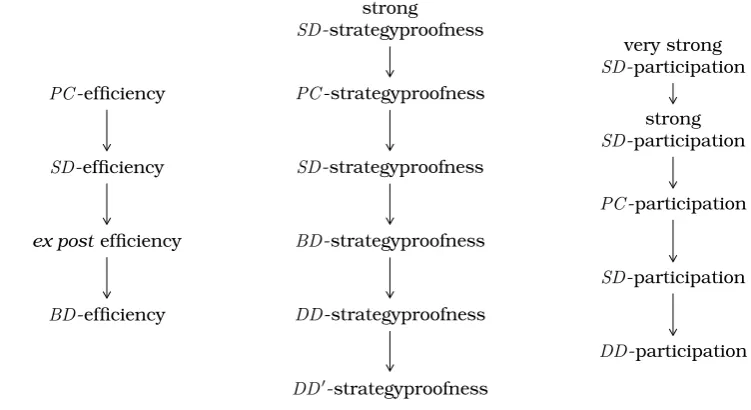
Figure 1.1: Logical relationships between varying degrees of efficiency, strate-gyproofness, and participation. PC-efficiency, for example, impliesSD-efficiency. A PSCF is ex post efficient if it puts probability 0 on all Pareto dominated al-ternatives. Strong SD-strategyproofness is equivalent to the strategyproofness notion considered by Gibbard (1977). Very strongSD-participation requires that a participating agent is alwaysstrictlybetter off (unless he already obtains a most preferred outcome).
Strategyproofness. Strategyproofness demands that agents cannot benefit from misrepresenting their preferences. Since most lottery extensions return in-complete preference relations, there are two fundamentally different ways how to define strategyproofness. Consider a preference profile, a resulting lotteryp, and
a lottery extensionE. The strong notion of strategyproofness, first advocated by Gibbard (1977), requires that every misreported preference relation of an agent will result in a lotteryq such that p %E q. According to the weaker notion, first
used by Postlewaite and Schmeidler (1986) and then popularized by Bogomolnaia and Moulin (2001), no agent can misreport his preferences to obtain a lotteryq
such thatq E p. In other words, the strong version always interprets
Participation. Like population-consistency, participation is a variable-electorate condition. It requires that no agent is ever better off by abstaining from an election or—equivalently—that an agent can never be worse off by par-ticipating in an election. Again each preference extension yields a corresponding notion of weak and strong participation. On top of that, we define the notion of very strong participation, which demands that a participating agent is always strictlybetter off (unless he already obtains a most preferred lottery). While pro-hibitive in non-probabilistic social choice, this condition is satisfiable by reason-able PSCFs because incentives can be arbitrarily small. In analogy to group-strategyproofness, a PSCF satisfies group-participation if no group of agents is individually strictly better off by abstaining from an election.
In principle, every lottery extension leads to corresponding notions of effi-ciency, weak and strong strategyproofness, and weak, strong, and very strong participation. The relationships between the most relevant concepts are de-picted in Figure 1.1. Some combinations such as DD-efficiency or strong BD-strategyproofness are omitted because they are extremely weak or prohibitively strong.
The sets of efficient lotteries for the various lottery extensions given above already constitute an interesting research subject (see Aziz et al., 2015). For example, it has been shown that whether a lottery is BD-efficient or whether it is SD-efficient only depends on its support. Perhaps surprisingly, the set of SD-efficient lotteries and the set of PC-efficient lotteries may fail to be convex. As a consequence, the convex combination of two SD-efficient PSCFs may violate SD-efficiency. Finding and verifying BD-,SD-, and PC-efficient lotteries can be achieved in polynomial time.
1.4 Results
A complete overview of which properties are satisfied by which PSCF is given in Table 1.1. Interestingly, some combinations of these axioms are prohibitive in deterministicsocial choice while they can be satisfied by reasonable PSCFs. This is, for example, the case for population-consistency and Condorcet-consistency (Young and Levenglick, 1978), participation and Condorcet-consistency (Moulin, 1988), and population-consistency and cloning-consistency (Brandl et al., 2016c). Each of agenda-consistency and very strong participation is prohibitive on its own when paired with minimal further assumptions.
Gibbard (1977) provided a complete characterization of strongly SD-strategyproof PSCFs for strict preferences in terms of convex combinations of so-called unilaterals (where only one agent affects the outcome) andduples (where only two alternatives may receive positive probability). The most well-known con-sequence of this result is known as theRandom Dictatorship Theorem.
Theorem 1.1 (Gibbard, 1977).RD is the only anonymous, strongly SD -strategyproofness, and ex postefficient PSCF when preferences are strict.
RSD (RD) Bordamax Bordapro ML
efficiency ex post(SD) SD – PC
strategyproofness strongSD – strongSD DD0(DD)
group-strategyproofness DD(SD) – DD (BD) DD0(DD)
participation very strongSD strongSD strongSD PC
group-participation DD SD DD (BD) PC
Condorcet-consistency – – – X
population-consistency – (X) X X X
agenda-consistency X – – X
composition-consistency – – – X
cloning-consistency X – – X
pairwiseness – X X X
computational complexity #P-complete (in P) in P in P in P
randomness a lot little a lot some
Table 1.1: Properties of PSCFs. In general, results hold for weak preferences. A property that is only satisfied for strict preferences is given in parentheses. All results are tight in the sense that each cell contains the strongest version of a satisfied property. The cells of PSCFs that satisfy the strongest version of the corresponding property are highlighted in gray. Non-trivial results are due to Gibbard (1977); Barberà (1979b); Aziz et al. (2013a,b); Brandl et al. (2015b, 2016b,c); Brandt (2015).
variations (e.g., Gibbard, 1978; Barberà, 1979a; Hylland, 1980; Barberà et al., 1998; Benoît, 2002; Dutta et al., 2002, 2007; Nandeibam, 2008; McLennan, 2011; Nandeibam, 2013; Picot and Sen, 2012; Chatterji et al., 2014).16
Since Bordamax and ML are ex post efficient, Theorem 1.1 entails that these PSCFs violate strong SD-strategyproofness (in fact, ML fails to satisfy BD-strategyproofness while Bordamax does not even satisfy DD0-strategyproofness). Another, less obvious, consequence of Gibbard’s characterization is thatBordapro satisfies strong SD-strategyproofness (Barberà, 1979b).17 While the results on stronglySD-strategyproof PSCFs are encouraging, these PSCFs involve an enor-mous amount of randomization (it follows from Theorem 1.1 that Bordapro even fails to put probability 0 on Pareto dominated alternatives). In general, there appears to be a pervasive tradeoff between efficiency and strategyproofness. For example, it quickly follows from Theorem 1.1 thatPC-efficiency and strong SD-strategyproofness are incompatible, even when preferences are strict: sincePC -efficiency is stronger thanex post efficiency, the only candidate for such a PSCF would be RD, which is easily seen to violate PC-efficiency. A number of im-possibilities illustrating this tradeoff (and other incompatibilities) are given in Table 1.2. Among these, the following result deserves special mention.
16See also Barberà (2010, Section 7).
17This result has been rediscovered several times (see Heckelman, 2003; Procaccia, 2010;