How Equitable is Rational Negotiation?
Sylvia Estivie
1, Yann Chevaleyre
1, Ulle Endriss
2and Nicolas Maudet
1 1LAMSADE, Universit ´e Paris-Dauphine, France2ILLC, University of Amsterdam, The Netherlands
1{
estivie,chevaley,maudet
}@lamsade.dauphine.fr,
2[email protected]
ABSTRACT
Notions of fairness have recently received increased attention in the context of resource allocation problems, pushed by di-verse applications where not only pure utilitarian efficiency is sought. In this paper, we study a framework where alloca-tions of goods result from distributed negotiation conducted by autonomous agents implementing very simple deals. As-suming that these agents are strictly self-interested, we in-vestigate how equitable the outcomes of such negotiation processes are. We first discuss a number of methodologi-cal issues raised by this study, pertaining in particular to the design of suitable payment functions as a means of dis-tributing the social surplus generated by a deal amongst the participating agents. By running different experiments, we finally identify conditions favouring equitable outcomes.
Categories and Subject Descriptors
I.2.11 [Artificial Intelligence]: Distributed Artificial In-telligence—Multiagent systems; J.4 [Social and Behav-ioral Sciences]: Economics
General Terms
Economics, Theory, Experimentation
Keywords
Multiagent resource allocation, Negotiation, Social welfare, Fair division
1.
INTRODUCTION
In many applications of multiagent systems it is important to achieve afair, orequitable, allocation of the available re-sources amongst the agents in the system. However, this fairness requirement will often compete with the rational interests of individual agents. If agents are allowed to freely negotiate their preferred allocations of resources, the emerg-ing allocations will typically be good on average, but give a
Permission to make digital or hard copies of all or part of this work for personal or classroom use is granted without fee provided that copies are not made or distributed for profit or commercial advantage and that copies bear this notice and the full citation on the first page. To copy otherwise, to republish, to post on servers or to redistribute to lists, requires prior specific permission and/or a fee.
AAMAS’06 May 8–12 2006, Hakodate, Hokkaido, Japan.
Copyright 2006 ACM 1-59593-303-4/06/0005 ...$5.00.
rather low payoff to an unfortunate minority. In this paper, we investigate to what degree it is possible to reconcile ratio-nality and equitability requirements. We do this by running a number of simulations where agents negotiate in a rational manner and where we track the evolution of allocations in view of their equitability.
Negotiation Problems
Take a set of (indivisible) goodsRand a set of agentsA. A resource allocation is a partitioning of the resources of the setRamongst thenagents inA(that is, every resource has to be allocated to a unique agent). As an example, alloca-tion A, defined through A(i) ={r1}and A(j) = {r2, r3},
would allocate resourcer1to agenti, while resourcesr2 and
r3 would be owned by agent j. Each agent has
individ-ual preferences regarding the bundles of resources it may hold. We are going to model the preferences of agents by means ofutility functions mapping bundles of resources to real numbers. Assuming that agents are only concerned with resources they personally own, we will use the abbreviation ui(A) forui(A(i)), representing the utility value assigned by
ito the bundle it holds for allocationA.
Definition 1 (Negotiation problems). A negotia-tion problem is a tupleP=hR,A,U, A0i, where
• R is a finite set of indivisible resources;
• A={1, . . . , n}is a finite set of agents (n≥2);
• U =hu1, . . . , uni is a vector of utility functions, such
that for alli∈ A, uiis a mapping from2R toR;
• A0:A →2R is an initial allocation.
From a designer’s perspective, we will be interested in as-sessing the well-being of the whole society, or itssocial wel-fare [1], which is often defined as the sum of utilities of all the agents:
swu(A) =
X
i∈A
ui(A) (1)
This is theutilitariandefinition of social welfare (swu), but
Resource allocation problems are typically addressed from a centralized point of view (this is the case for instance in combinatorial auctions [4]). When no central authority is available, or when the computational burden would over-whelm a single agent, this approach is not well suited. A different approach, advocated by several authors [15, 7, 5], consists of distributing this process.
Distributed Approach
In the distributed perspective, instead of trying to centrally compute the optimal allocation, we shall progress in a step-wise manner towards an optimum. To do so, agents may agree on adeal to exchange some of the resources they pos-sess. It transforms the current allocation of resources A into a new allocation A0; that is, we can define a deal as
a pair δ = (A, A0) of allocations (with A 6= A0). When such a deal improves the utilitarian social welfare (i.e.when swu(A0) > swu(A)), we say that it is socially beneficial.
Note that a single deal may involve the displacement of any number of resources between any number of agents. This level of generality is hardly realistic in practice. Sand-holm [15] has proposed a typology of different types of deals, such asswap dealsinvolving an exchange of single resources between two agents orcluster deals involving the transfer of a set of items from one agent to another. In this paper, we shall only consider the simplest type of deals (1-deals), i.e.those involving only a single resource (and thereby only two agents). The set of agents involved in the dealδwill be denoted asAδ.
The above is a condition on thestructureof a deal. Other conditions relate to the acceptability of a deal to a given agent. We assume that agents arerational in the sense of aiming to maximise their individual welfare. Furthermore, agents are assumed to bemyopic. This means that agents will not accept deals that would reduce their level of welfare, not even temporarily, because they are either not sufficiently able to plan ahead or not willing to take the associated risk (see also [15] for a justification of such an agent model). Also agents will not behave strategically by, for instance, post-poning a rational deal in the hope of finding an even better opportunity. We will, however, permit agents to enhance deals withmonetary side payments, in order to compensate for a possible loss a utility. This is modelled using a so-called payment function p:A → RsatisfyingP
i∈Ap(i) = 0. A
positive valuep(i) indicates that agentipays money, while a negative value means that that agentreceives money. In summary, the following rationality criterion will define the acceptability of deals:
Definition 2 (Rationality). A deal δ = (A, A0) is
individually rational iff there exists a payment function p such thatui(A0)−ui(A)> p(i)for alli∈ A, except possibly
p(i) = 0for agentsiwithA(i) =A0(i).
The following result, due to Endriss et al. [7], makes the connection between the local decisions of agents and the global behaviour of the system explicit:
Lemma 1. A dealδ = (A, A0) is individually rational iff swu(A)< swu(A0).
A corollary of Lemma 1, originally due to Sandholm [15], is thatany sequence of rational deals will eventually result in an allocation of resources with maximal social welfare.
However, deals involving any number of agents and resources may be required to do so [15, 7]. In particular, 1-deals alone are certainly not sufficient for negotiation between agents that are not only rational but also myopic. Of course, for some particular negotiation problems, rational 1-deals will be sufficient. This is, for instance, the case when all agents are usingmodular utility functions [7].1
Paper Overview
The remainder of this paper is structured as follows. Section 2 presents the challenges posed by the study of egalitarian outcomes of distributed negotiation. Different types of pay-ment functions are then introduced (Section 3), and we dis-cuss how the choice of a particular function would affect the egalitarian nature of negotiation outcomes. Our experimen-tal setup is introduced in Section 4. We then report results on different series of tests, both in modular (Section 5) and non-modular domains (Section 6). Section 7 concludes.
2.
EGALITARIAN FRAMEWORK
While the utilitarian interpretation of the concept of social welfare is the definition usually adopted in the multiagent systems literature [16, 17], there are also several other formal tools for assessing the level of welfare of a society of agents that have been developed in the socio-economic sciences [1, 3, 12] and that have potential applications in the context of multiagent resource allocation as well [7].
Efficiency and Fairness
The well-known Pareto condition and the utilitarian social welfare ordering address the efficiency of an allocation of resources. In many situations, however, the efficiency of an outcome alone is not sufficiently accurate a criterion to as-sess the quality of an allocation of goods. Rather, the quest for efficiency needs to be balanced with certainfairness re-quirements.
This is, for instance, the case when a multiagent resource allocation system is used to automatically allocate airport slots to different airlines [9]: we want to minimise the overall delay of all flights (efficiency), without risking to completely ignore the requests of a particular flight that may be difficult to integrate into the current schedule (fairness). Another ex-ample are reverse combinatorial auctions for industrial pro-curement, where a single buyer solicits offers for, say, the parts required to assemble 500 cars [8]. Here it may be in the interest of the buyer to try to contract deals with more than one seller, even when that agreement does not entail the lowest possible price, in order to avoid being dependent on the good will of a single provider. This kind of safety constraint (from the viewpoint of the buyer) may also be interpreted as a fairness requirement (from the viewpoint of the competing sellers). The case of earth observation satel-lites discussed by Lemaˆıtre et al. [10] offers a particularly interesting and original example. In this application, sev-eral stakeholder (e.g. countries) are jointly funding a satel-lite that is circling the earth and can take photos, subject to various technical constraints. Different stakeholders re-quest different (and often incompatible) photos, and a solu-tion needs to be found that is both efficient (in the sense of
1A utility function is modular iff the utility assigned to a
exploiting the satellite as well as possible) and fair (in the sense of honouring an appropriate share of the requests of each of the stakeholders). Finally, Porter et al. [13] justify their study of fairness by invoking the following application: In many countries, in crisis situations, the state can com-mandeer diverse resources (e.g. aircrafts) from companies to cope with the emergency. However, this should be done in such a way that it minimizes the total true cost incurred by airline carriers (and by the state), and distribute this cost fairly amongst all carriers (so as not to penalize a carrier).
What these examples show is the relevance of notions such asfairness,equitability, orenvy-freeness in many (diverse) applications. This paper will focus on what may be consid-ered the most “basic” measure of the equitability of given allocations of goods, known as theegalitarian social welfare. The egalitarian social welfare is given by the utility of the agent that is currently worst off [1, 12]. That is, maximising egalitarian social welfare amounts to maximising the mini-mum utility in the system. Thismaxmin principle is also called 1-efficiency in the work of Porter et al. [13].
Optimal Outcomes and Local Deals
We are going to be interested in mechanisms that allow agents to reach an allocation with high (and ideally, max-imal) egalitarian social welfare by means of a sequence of locally agreed deals. These deals should belocal also and particularly in the sense that the agents should be able to decide locally within the group of agents about to agree on a given deal whether or not that deal should be deemed ac-ceptable. In other words, we are not looking for just any algorithm to optimise with respect to egalitarian social wel-fare, but for a distributed negotiation scheme.
The first kind of deal we are going to consider are the individually rational deals introduced earlier. It is easy to show that individually rational deals alone are not sufficient to allow agents to find an allocation with maximal egalitar-ian social welfare in all cases (while, on the contrary, this is possible in the case of utilitarian social welfare [15, 7]). This can be seen in the following example. Assume there are two agents and two possible allocations (i.e.there may be just a single resource):
u1(A) = 5 u1(A0) = 2
u2(A) = 1 u2(A0) = 3
ThenA0 has maximal egalitarian social welfare, but in case
A is the initial allocation there is no individually rational deal leading from A to A0 (because the amount of utility lost by agent 1 would be greater than the utility gained by agent 2).
Another approach would be to change the notion of in-dividual rationality and to require agents to use a different criterion when deciding on the acceptability of a given deal. This idea has been followed in previous work where the class of so-calledequitable dealshas been proposed [7]. This crite-rion, which requires the minimum utility within the group of agents contracting a deal to increase, can guarantee conver-gence to an egalitarian optimum. However, as also pointed out in [7], this is not a precise criterion in the sense that it is still possible to contract further equitable deals after an allocation with maximal egalitarian social welfare has been found. In fact, it isimpossibleto design a deal acceptability criterion that would be precise in this sense. This is related to the fact that the egalitarian social welfare ordering is not
separable [12], which means that it is not possible to decide whether or not egalitarian social welfare has increased sim-ply by looking at the utility levels of the agents that have experienced a change in utility after a deal. Hence, it is also not possible for the agents involved in a deal to locally verify whether the deal they are about to implement would affect egalitarian social welfare in a positive manner.
Besides such technical considerations, of course, the indi-vidual rationality criterion is also much more realistic than the idealised concept of equitable deals. Therefore, in the present paper, we are going to follow a different approach. Rather than designing agents that are “good” for egalitar-ian social welfare, we are going to study just how “bad” the standard utility-maximising agents are from an egalitarian point of view. To put it differently, we are going to analyse how egalitarian social welfare develops in a society where agents negotiate a sequence of individually rational deals.
Egalitarian Social Welfare and Money
Before getting further in that direction, we need to address the first challenge this approach poses. Typically, a social welfare measure does not take a monetary component into account. There is an obvious reason for that when utilitarian social welfare is concerned: the payment functionphas been defined in such a way that the sum of payments is always zero. Hence, side payments can never change the sum of utilities,i.e.they can never affect utilitarian social welfare. Things are different for egalitarian social welfare. Not taking into account monetary payments would amount to assessing buyers as being more satisfied than sellers, whatever the price they pay to get the resource(s) may be. In the most extreme case, an agent selling all its goods for very good (high) prices (and thereby certainly being “happy”) would still provoke a very low egalitarian social welfare (because its utility function defined over bundles of resources alone would return a zero value).
To circumvent this problem, payments have to be included into agents’ utility functions. Let thebalance of agentibe defined as the sum of all the paymentsp(i) of that agent paid out (or received, in the case of negative payments) during all previous deals. By Lemma 1, if agents only negotiate individually rational deals, no allocation can be visited more than once. So we can index an agent’s balance with the name of the allocation in question: balA(i) is the balance of
agentionce allocation Ahas been reached. Then we define for each agentia second utility functionu0
i that combines
the utility derived from the bundle of resources it currently holds and its monetary balance:
u0i(A) = ui(A)−balA(i) (2)
In the literature, such utilities are often calledquasi-linear utilities, in which caseuwould be referred to as a valuation andu0as the actual utility [4]. The egalitarian social welfare of an allocation with money is now simply defined as the egalitarian social welfare with respect to the utilitiesu0
i:
swe(A) = min{u0i(A)|i∈ A} (3)
3.
PAYMENT FUNCTIONS
what payments to implement in a simulation context, where agents do not actually negotiate prices with each other. Choosing a payment function p for an individually ratio-nal deal δ = (A, A0) means deciding how to distribute the social surplusswu(A0)−swu(A) amongst the agents in the
system. The only condition that the payment function has to meet is to ensure that side payments add up to zero.
Amongst these payment functions, some will ensure that any socially beneficial deal is indeed individually rational (and vice versa), that is that for each agent iinvolved in the deal, we indeed haveui(A0)−u(A)> p(i): we shall call
theserational-compatible payment functions.
Locally Uniform Payment Function
We begin with what we call the locally uniform payment function, which ensures an equal payoff amongst all the agents involved in the deal (and gives no payment to any of the non-involved agents):
p(i) =
(
ui(A0)−ui(A)−swu(A 0
)−swu(A)
|Aδ| ifi∈ A
δ
0 otherwise
Note that these payments do indeed add up to 0 as required, and that each agenti∈ Aδreceives the same positive payoff ui(A0)−ui(A)−p(i) = swu(A
0
)−swu(A)
|Aδ| .
The uniform payment function is not an arbitrary choice, but intended to be a reasonable approximation of actual payments that agents would agree upon in a real negotiation context (rather than a simulation). Equally dividing the social surplus amongst all the agents concerned also means maximising the product of individual payoffs. In the case of deals between just two agents, this corresponds to the result we would get if agents were to adopt the well-known Zeuthen strategy to negotiate the payments for a given deal [14]. This is true, at least, if we assume that agents calculate their “willingness to risk conflict” with respect to the payoff for the deal at hand (which is a reasonable assumption if agents have comparable levels of utility to begin with).
Globally Uniform Payment Function
The next type of payment that we introduce is one which ensures an equal payoff amongst all the agents within the society:
p(i) = ui(A0)−ui(A)−swu(A 0)−sw
u(A)
|A|
Observe that this function is also rational-compatible (for the same reason that the locally uniform one is), although agents involved in deals will typically receive a much more modest share of the social surplus. Note that this payment function is not inequality reducing, but not inequality in-creasing either. By distributing the social surplus equally amongst all agents of the society, everyone simply benefits with any deal and enjoys the same welfare increase.
It is easy to see that with such a payment function, the egalitarian social welfare depends both on the gain of util-itarian social welfare during the entire negotiation, and on the initial satisfaction of the agents. More precisely, consider a sequence [A0, A1, . . . , Af] of allocations visited during a
negotiation process. For all t∈ {0..f−1}, we have (where
pt(i) denotes the payment of agentiat timet):
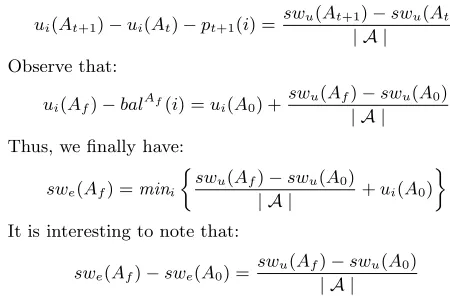
ui(At+1)−ui(At)−pt+1(i) = swu(At+1)−swu(At)
| A |
Observe that:
ui(Af)−balAf(i) =ui(A0) +swu(Af)−swu(A0)
| A |
Thus, we finally have:
swe(Af) =mini
swu(Af)−swu(A0)
| A | +ui(A0)
ff
It is interesting to note that:
swe(Af)−swe(A0) =swu(Af)−swu(A0)
| A |
This has two important consequences: first, the gain of egal-itarian social welfare is proportional to the gain of utilegal-itarian social welfare. Also, the optimal allocation(s) w.r.t. utili-tarian social welfare is/are thesame as the optimal alloca-tion(s) w.r.t. egalitarian social welfare.
It should also be pointed out that in the case of two agents, locally uniform payment functions are of course equivalent to globally ones. As reported later on in this paper, we carried out experiments to find out from what number of agents on do locally uniform payment functions give rise to negotiations exhibiting significantly different outcomes (see Fig. 3).
Fully Locally Equitable Payment Function
In theory, it is possible to conceive an equitable payment function which would, at each step, compute a payment such that each agent (involved in the deal) would enjoy the same utility level after the deal has been achieved. This idea is very similar to that offair impositionproposed in [13]. Such a payment would take the following form:
p(i) =
(
ui(A0)−balA(i)−
P
j∈Aδ(uj(A0)−balA(j))
|Aδ| ifi∈ A
δ
0 otherwise
Note that here, the balance balA(i) refers to the balance
of the previous allocation (A). The above must be read as follows: compute the restricted social welfare divided it by the number of agents involved (that would be the optimal repartition), then subtract the payment such that each agent reaches exactly that level of satisfaction. This is exemplified on the following example (assuming this is the first deal taking place, hence a balance of 0 for each agent):
u1(A) = 3 u1(A0) = 2
u2(A) = 1 u2(A0) = 6
The final allocation exhibits a restricted (utilitarian) social welfare of 8, hence 4 for each agent would be the optimal sit-uation. This is obtained by computing the payment function which pays +2 to agent 1 and -2 to agent 2. However, such a payment would not always be rational: in many situations, the payment would be such that at least a self-interested agent would have no interest in implementing the deal. This is for instance the case on the following example:
u1(A) = 3 u1(A0) = 2
[image:4.612.313.538.70.218.2]In this case, the computed payment is +/- 0.5, and it is easy to see that agent 1 would not rationally accept such a deal. In general, a deal is only rational if every agent enjoys before the deal takes place a utility that is strictly lower than the mean of the restricted social welfare after the deal. This is then an example where a socially beneficial deal would not be individually rational for agents if they were to use this payment function, i.e. this proves that this payment function is not rational-compatible. The consequence is that it will change the structural properties of the framework: by restricting the number of feasible deals, certain sequences of deals (that could be rational with a different payment function) would not be explored. Clearly, this can be a good thing in some situations, as exemplified below:
u1({r1}) = 2 u1({r2}) = 2 u1({r1, r2}) = 104
u2({r1}) = 100 u2({r2}) = 0 u2({r1, r2}) = 100
u3({r1}) = 0 u3({r2}) = 101 u3({r1, r2}) = 101
We first suppose that agents use any rational-compatible payment function, and that a2 initially holds the bundle
{r1, r2} (initial social welfare is 100). Now the following
deal sequence takes place: (i)a2 givesr2 to a1 (leading to
a social welfare of 102), (ii) a2 gives r1 to a1 (leading to
a social welfare of 104). No more rational deal is possible (giving any resource would result in a loss of 102).
Of course, a social welfare of 201 would have been attain-able, by simply offeringr2 to a3 as a first deal. Equitable
deals (payment 0.5) would indeed have discarded the deals implemented in the suboptimal sequence, leaving only this deal possible. Whether this is a good thing or not in general, i.ewhether this payment function behaves as a good heuris-tic in this context will be experimentally evaluated later on in this paper (see Fig. 2 and 4).
Rational Locally Equitable Payment Function
What would be the “most equitable” payment function that would still be rational-compatible? A slight modification of the previous payment function would in fact suffice to make it rational-compatible: compute the payment function such that it makes every agent marginally better off, then allocate the remaining payments induced by the deal so as to reduce inequalities as much as possible (that is, give the remaining social surplus to the agent currently worse off).
For a deal δ = (A, A0), formally, this payment can be
defined as the functionpmaximizing
mini∈Aδ
n
ui(A0)−balA(i)−p(i)
o
wherebalA(i) is the balance of agentibefore the deal, and
under the two following constraints: phas to be a payment function (P
i∈Ap(i) = 0) and the deal must be rational
(∀i∈ Aδ, u
i(A0)−ui(A)> p(i)). Obtaining an analytic
for-mulation forpin the general case is difficult. However, in the case of bilateral negotiation, the solution to the above con-straint equation for any socially beneficial dealδ= (A, A0)
involving agents i and j, can easily be computed. First note that in case the deal is rational with the fully locally equitable payment, this defines our payment function. Oth-erwise, observe that there is necessarily a single agent, sayi, such thatui(A)≥(ui(A0) +uj(A0))/2. This is so, because
if both agents met this condition, then the deal would be fully equitable, while if neither of them met the condition,
the deal would clearly not be be individually rational. Now we fix the payment for that agenti, in such a way that this agent is just marginally better off, in order to make the deal rational. That is,p(i) =ui(A0)−ui(A)−for some suitably
small constant >0. Note thatp(i) could be a positive or negative value; the payoff foriwill be +either way. Then we define the other payment asp(j) =−p(i).
We take again our previous example (that proved fully equitable payment functions not to be rational-compatible), to show how this works. Agent 1 has been better off before the deal than the average utility after the deal. Its payment will p(1) = 2−3−, i.e. it receives an amount of 1 + from agent 2. After the deal, we have the following utilities (assuming there have been no earlier payments):
u01(A0) = 3 +
u0
2(A0) = 2−
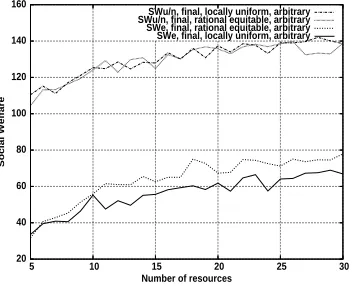
Whether this payment function outperforms other functions (as far as egalitarian social welfare is concerned) will be evaluated experimentally in this paper (see Fig. 1 and 5).
4.
EXPERIMENTAL METHODOLOGY
Our experimental results are based on the following method-ology: we first create the system (agents’ utility functions and the initial allocation of goods), we then compute the optimal utilitarian social welfare, and we finallyrun negoti-ations (that is, let agents negotiate until no more deals are possible). Agents typically desire to hold several bundles (the details of how these utility functions are generated de-pends on the domain studied, and will be given later on). To avoid favouring a specific agent, the negotiation protocol is randomized: we pick an agent at random, and try to iden-tify one rational deal involving this agent. Remember that as soon as one such rational deal meets the rationality con-straints of the seller and the buyer, the deal is implemented and the allocation is updated. The results are averaged over 500 negotiation runs.
The reason why we compute the optimal utilitarian social welfare is that it serves to derive a (very generous) upper bound on optimal egalitarian social welfare: The best you can do is to optimize overall utility (=swu) and then use
pay-ments to distribute the overall wealth as evenly as possible (it is then simply 1/n times the maximal utilitarian social welfare). In the restricted negotiation framework that we investigate here, this optimal value will seldom be attained. What will be highly significant will be the value of the final utilitarian social welfare, which would represent an upper bound under the constraints of the negotiation framework (e.g. restrictions to 1-deals, rationality constraints). Note that affecting the class of acceptable deals by employing a non-rational-compatible payment function falls into that category. Again, distributing the overall wealth as evenly as possible would be the optimal egalitarian outcome (recall that a theoretical equitable payment function would allow to attain this value).
To sum up, the experimental results reported in this paper will typically mention the following outcome values:
(1) the value of theoptimal utilitarian welfare (swopt
u /n),
upper bound in unrestricted negotiation frameworks;
(2) the value of the final utilitarian welfare (swu/n),
(3) the value of the final egalitarian welfare (swe), after
negotiation took place.
The difference between (1) and (2) is an indicator for what we shall call theprotocol bias. The difference between (2) and (3), more interesting to us, permits to appreciate the payment function bias. Comparison with the initial value of the egalitarian welfare proved to present very little inter-est in our experiments: it has been omitted for the sake of readability.
Figures presented in the next two sections exhibit curves defined by the following parameters: (1) the type of so-cial welfare measured (SWe or SWu/n); (2) whether the so-cial welfare shown is theoptimalvalue or thefinalvalue; (3) the payment function used; and (4) the type of distribu-tion used.
5.
MODULAR DOMAINS
We start with very simple domains of negotiation, where no synergies can occur between different items of the bun-dles agents hold. In this case agents’ utility functions are said to bemodular. We generate these functions by simply picking 50 resources for each agent, and assigning random coefficients between 0 and 100. Note that in this case the optimal utilitarian social welfare can be easily computed: It suffices to assign each item to the agent who values it the most. (This allows in particular to run experiments with a large number of items). A recent (somewhat surprising) complexity result, due to Bouveret and Lang [2], shows that the difficulty of the corresponding problem largely differs for egalitarian frameworkswithout money: Optimising the egalitarian social welfare is an NP-hard problem, even when agents use modular functions (this is even true when they all use the same utility function). This isnot the case in our setting though, because of the use of money (which allows us to separate the process of maximising overall utility and then distributing that utility evenly amongst the agents). A final important point to note is that the complexity of the overall negotiation process remains polynomial in this case, because the length (number of deals) of rational negotiations in modular domains is known to be linear [6].
Locally Uniform vs. Rational Locally Equitable
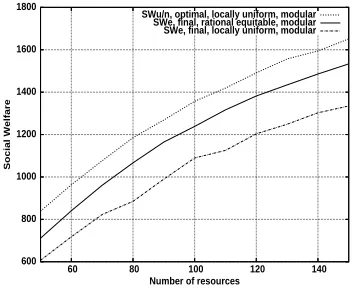
[image:6.612.346.522.58.202.2]The first set of experiments has been run with 5 agents us-ing modular utility functions, deals enhanced with rational-compatible payment functions. The number of resources varies between 50 and 150. Recall that in this case, we know that the optimal utilitarian social welfare will be reached (i.e.there is no “protocol bias”): the experiment will really measure the “payment function bias”. To put it another way, if there were such a thing as a rational-compatible fully equitable payment function, both curves would be equiva-lent.
Fig. 1 shows the final egalitarian social welfare attained when locally uniform or rational equitable payments are used. It is striking that, first, both payment functions per-form reasonably well (the ratio (swe/swoptu ) is constantly
higher than 70% and improves when the number of resources increases). The rational equitable payment is, as expected, significantly above the locally uniform one (84% vs. 70% for 60 resources, 93% vs. 80% for 120 resources, 96% vs. 83% for 150 resources). However, given that this latter pay-ment is, as argued before, the “most equitable” conceivable
600 800 1000 1200 1400 1600 1800
60 80 100 120 140
Social Welfare
Number of resources
SWe, final, rational equitable, modular SWe, final, locally uniform, modular SWu/n, optimal, locally uniform, modular
Figure 1: Modular Domains (I)
rational-compatible payment function, it is still surprising to see how close the “strategically justified” locally uniform payment stands.
Fully Locally Equitable
The second series of experiments (Fig. 2) carried out in mod-ular domains tests the assumption that fully equitable deals can be a good heuristic in our negotiation setting, despite reducing the number of feasible deals. The results are un-ambiguous: in modular domains, this is far from being the case. The protocol bias (which exists in this case), is illus-trated by the ratio between the optimal value and the final swu/nreached when allowing only fully equitable deals. For
50 resources already, the figure is around 75%, and drops to 50% for 150 resources. This really measures the loss due to the restriction put on the framework. Worse than that, the final swe exhibits a figure (swe/swoptu ) of 45% for 50
resources, shrinking down to 16% for 150 goods. Actually, the final egalitarian social welfare hardly increases in this setting. This really proves that this restriction is simply too hard to be met, and almost freezes the negotiation process.
200 400 600 800 1000 1200 1400 1600 1800
60 80 100 120 140
Social Welfare
Number of resources
SWe, final, fully equitable, modular SWu/n, final, fully equitable, modular SWu/n, optimal, rational uniform, modular
Figure 2: Modular Domains (II)
6.
NON-MODULAR DOMAINS
[image:6.612.345.523.479.619.2]envisaged were produced using a uniform distribution for the generation of the structure of utility functions. The results (not reported here), regarding the final egalitarian welfare, turned out to be very good. This simply reflected the fact that uniform distributions tended to distribute evenly the participants’ needs: agents were seldom in conflict.
Realistic Distributions
In order to get realistic agent preferences we decided to make use of the CATS bid generator [11], primarily designed for the use with combinatorial auctions. The output of the CATS software is a set of bids, taking the form of XOR de-mands hb1, p1i. . . ,hbn, pni, where bi stands for the bundle
of resources, andpistands for the value the agent assigns to
this bundle. One problem that we faced when using CATS is the fact the output file contains only anonymous bids. This is perfectly suited for the case of studies of algorithms for the Winner Determination Problem in combinatorial auc-tions [4], because then you are not really concerned with associating resources with agents who claimed them, but only with computing the optimal solution. What we did to deal with this was to generate a (large) number of bids in a single shot (interacting in the same domain, it is likely that agents share a common dependency structure between goods). However, by allowing dominated bids to be gener-ated, we permit agents to express different degree of pref-erences over the same bundles of goods. And finally, by picking (at random) only a subset of these generated bids, we allow agents to demand different bundles and admit that they may only partially share this common structure. The experiments reported in this section have been conducted using the CATSarbitrary distribution.
[image:7.612.346.523.429.572.2]Locally Uniform vs. Globally Uniform
Fig. 3 shows the egalitarian social welfare reached when an increasing number of agents negotiate over 15 resources us-ing locally uniform payments. Each agents claims 10 bun-dles. Recall that, as mentioned in the previous section, when there are no more than two agents, the locally uniform pay-ment and the globally uniform paypay-ment coincide.
0 50 100 150 200 250
2 3 4 5 6 7 8 9 10
Social Welfare
Number of agents
[image:7.612.86.260.491.635.2]SWe, final, locally uniform, arbitrary SWu/n, final, locally uniform, arbitrary
Figure 3: Non-Modular Domains (I)
First notice that, as expected, the final swu/n decreases
exactly as a 1/ncurve. Intuitively, we could have expected the finalswe to decrease at the same speed. This turns out
not to be the case: from 2 to 3 agents,swedecreases by 65%,
whereas a 1/ndecrease rate would have been of 33%. This
observation can be explained in the light of the locally uni-form payment function singularity: when there are no more than two agents, the locally and globally uniform payment are identical, in which case the inequalities between both agents will not increase during the negotiation. In other words, as explained in the previous section, the gain ofswe
between the beginning and the end of the negotiation will be equal to the gain ofswudivided byn. This explains why
the finalswe for two agents is close to the finalswu.
On the contrary, for more than 2 agents, each bilateral deal will only favor the two agents involved in it, and will thus potentially increase inequalities between agents con-tracting many deals, and others. This allows us to explain the rapid decrease ofswe at the beginning of the curve.
Fully Locally Equitable vs. Locally Uniform
Next we compare fully locally equitable payment functions and locally uniform payment functions (Fig. 4). The re-sults show that negotiation using fully equitable payments is notably less equitable than negotiation with uniform pay-ments. This is so because the criterion is, again, too restric-tive and prevents agents from contracting deals that could be rational (and hence improve social welfare). The fact that this function helps to select highly beneficial deals does not compensate for the loss incurred by these missed oppor-tunities. This completes the answer to the question we left pending in Section 5: this payment function does not behave as a good heuristic, in this type of domains neither. The reason why the difference is far less important with uniform payment functions in these domains lies mainly in the fact that, typically, much fewer deals are contracted, and that values assigned to bundles are typically higher than those assigned to single resources (augmenting the probability to contract a fully equitable deal).
20 40 60 80 100 120 140 160
5 10 15 20 25 30
Social Welfare
Number of resources
SWe, final, locally uniform, arbitrary SWu/n, final, locally uniform, arbitrary
SWe, final, fully equitable, arbitrary SWu/n, final, fully equitable, arbitrary
Figure 4: Non-Modular Domains (II)
Rational Locally Equitable vs. Locally Uniform
but becomes slightly larger when this number increases. This is explained as follows: when there are few resources to be distributed, the number of deals that will take place during a negotiation will typically be very small. Each con-tracted deal increases the probability of redistributing some wealth to the poorest agent, the more deals contracted the happier that agent should get (on average).
20 40 60 80 100 120 140 160
5 10 15 20 25 30
Social Welfare
Number of resources
[image:8.612.86.262.145.288.2]SWe, final, locally uniform, arbitrary SWu/n, final, locally uniform, arbitrary SWe, final, rational equitable, arbitrary SWu/n, final, rational equitable, arbitrary
Figure 5: Non-Modular Domains (III)
7.
CONCLUSION
This paper has investigated the egalitarian properties of some distributed resource allocation processes. An impor-tant aspect of the framework, that has radical consequences on egalitarian outcomes, is the choice of a specific payment function (i.e.the way to redistribute the social surplus in-duced by any given deal). We have discussed a variety of payment functions, and shown in particular that a per-fectly equitable payment function is not rational-compatible. Our study has been complemented with several experiments, that have allowed us to identify conditions favourable to egalitarian outcomes. In particular, we should stress that:
• In modular domains, we observed that locally uniform payments give rise to reasonably equitable outcomes, which becomes comparatively more equitable as the number of resources grows. This remains significantly below (but closer than expected) to what could be achieved at best within the class of rational-compatible payments.
• It is typically not beneficial to enforce agents to obey to implement a fully equitable payment function, because this would conflict with rationality principles and pre-vent agents from conducting socially beneficial deals. This is striking in modular domains, less obvious in non-modular domains where there are typically fewer deals taking place during the negotiation.
• Locally uniform payment functions significantly dif-fer from globally uniform payment functions for more than 2 agents. More generally, as the number of agents grows, we cannot expect any local payment to compen-sate for the inequalities.
A possible extension of this work will be to investigate how the conclusions drawn here will vary for other “standard” CATS distributions. A longer-term issue will be the study of
other equitability measures: themaximinegalitarian princi-ple is but one (admittedly rough, because it only takes into account the poorest agent) equitability measure. To refine our study, we plan to investigate other measures, such as Gini-like indexes for instance [12], which give a more global measure of a society’s wealth distribution.
8.
REFERENCES
[1] K. J. Arrow, A. K. Sen, and K. Suzumura, editors. Handbook of Social Choice and Welfare.
North-Holland, 2002.
[2] S. Bouveret, H. Fargier, J. Lang, and M. Lemaˆıtre. Allocation of indivisible goods: A general model and some complexity results. InProc. AAMAS-2005. ACM Press, 2005.
[3] S. J. Brams and A. D. Taylor.Fair Division: From Cake-cutting to Dispute Resolution. Cambridge University Press, 1996.
[4] P. Cramton, Y. Shoham, and R. Steinberg, editors. Combinatorial Auctions. MIT Press, 2006.
[5] P. E. Dunne, M. Wooldridge, and M. Laurence. The complexity of contract negotiation. Artificial Intelligence, 164(1–2):23–46, 2005.
[6] U. Endriss and N. Maudet. On the communication complexity of multilateral trading: Extended report. Journal of Autonomous Agents and Multiagent Systems, 11(1):91–107, 2005.
[7] U. Endriss, N. Maudet, F. Sadri, and F. Toni. Negotiating socially optimal allocations of resources. Journal of Artificial Intelligence Research, 2006. To appear.
[8] A. Giovannucci, J. A. Rodr´ıguez-Aguilar, A. Reyes, F. X. Noria, and J. Cerquides.iBundler: An
agent-based decision support service for combinatorial negotiations. InProc. AAAI-2004. AAAI Press, 2004. [9] G. Jonker, J.-J. Meyer, and F. Dignum. Efficiency and
fairness in air traffic control. InProc. 17th
Belgian-Dutch Conf. on Artificial Intelligence, 2005. [10] M. Lemaˆıtre, G. Verfaillie, F. Jouhaud, J.-M.
Lachiver, and N. Bataille. Selecting and scheduling observations of agile satellites.Aerospace Sciences and Technology, 6:367–381, 2002.
[11] K. Leyton-Brown, M. Pearson, and Y. Shoham. Towards a universal test suite for combinatorial auction algorithms. InProc. EC-2000, 2000. [12] H. Moulin.Axioms of Cooperative Decision Making.
Cambridge University Press, 1988.
[13] R. Porter, Y. Shoham, and M. Tennenholtz. Fair imposition.Journal of Economic Theory, 118(2):209–228, 2004.
[14] J. S. Rosenschein and G. Zlotkin.Rules of Encounter. MIT Press, 1994.
[15] T. W. Sandholm. Contract types for satisficing task allocation: I Theoretical results. InProc. AAAI Spring Symposium: Satisficing Models, 1998. [16] T. W. Sandholm. Distributed rational decision
making. InMultiagent Systems: A Modern Approach to Distributed Artificial Intelligence. MIT Press, 1999. [17] M. Wooldridge.An Introduction to Multiagent