Uptake, Clarification and Argumentation
MSc Thesis(Afstudeerscriptie)
written by Julian J. Schl¨oder
(born June 20, 1989 in M¨unster, Germany)
under the supervision of Dr Raquel Fern´andez, and submitted to the Board of Examiners in partial fulfillment of the requirements for the degree
of
MSc in Logic
at theUniversiteit van Amsterdam.
Date of the public defense: Members of the Thesis Committee: July 7, 2014 Dr Raquel Fern´andez
Abstract
In a theory of conversations as joint projects, communicative success is established upon uptake of the project, and failure is dealt with through clarification. Founded in a deeper investigation into uptake and clarification, this thesis develops a theory of conversational arguments. I examine the notion of uptake and separate it into two distinct uses of the term, strong and weak uptake, that are both relevant to discourse obligations in different ways. Failure to take up a proposal is a communicative failure and must be repaired by the interlocutors, either through clarification or through self-repair.
I outline preparatory conditions that at least partially govern the facili-tation of uptake and that express part of the clarification potential of any utterance. This clarification potential is visible in excerpts of naturally oc-curring dialogues. Complementing clarification, speakers can also self-repair by anticipating clarification requests and resolving them preemptively.
Acknowledgements
My supervisor, Raquel Fern´andez, deserves more gratitude than I can express here; for patiently introducing me to the research area when I knew nothing about it, for motivating me to pursue it further, for meeting me whenever I needed it, and for encouraging me to apply for a PhD position. The mentorship and supervision I have received in the last months has been truly outstanding, and I look forward to continuing it in the future.
I thank the German National Academic Foundation (Studienstiftung) for their financial support, without which I could not have come to Amsterdam to study Logic. For the later months of my studies, this research was supported by the Marie Curie Networks project “ESSENCE” (PITN-GA-2013-607062).
But I would not have ended up here if it weren’t for my previous supervisor from the University of Bonn, Peter Koepke. I thank him again for sparking my interest in logic, for deepening my knowledge of the field, and for raising my attention to the intricacies of natural language.
Additionally, I would like to thank all the people at the ILLC for providing such an engaging and nourishing environment for people interested in logic. I am happy to have participated in so many enlightening conversations, in particular with Thomas Brochhagen and Matthijs Westera. Thomas deserves additional gratitude for his help with a corpus study that did not make it into the thesis.
Contents
1 Preliminaries 7
1.1 Overview . . . 7
1.1.1 Introduction . . . 7
1.1.2 Outline of the Thesis . . . 9
1.1.3 Original Contribution . . . 10
1.2 Background . . . 10
1.2.1 Speech Acts and Illocutionary Force . . . 11
1.2.2 Conversations as Joint Projects . . . 14
1.2.3 Grounding . . . 16
2 Uptake 20 2.1 Executing Joint Projects . . . 20
2.1.1 Projects and Obligations . . . 21
2.1.2 Strong and Weak Uptake . . . 25
2.1.3 Project Felicity Conditions . . . 31
2.2 Literature Comparison . . . 35
2.2.1 Speech Acts . . . 36
2.2.2 Joint Projects . . . 37
2.2.3 Bids and Games . . . 38
2.3 Summary . . . 39
3 Clarification 41 3.1 Background . . . 41
3.1.1 KoS: Conversation-oriented Semantics . . . 42
3.1.2 Clarification on Uptake Level . . . 44
3.2 Failure of Strong Uptake . . . 46
3.2.1 Strong Uptake Clarification Potential . . . 47
3.2.2 Self-initiated Repair as Support . . . 50
3.3 Summary . . . 54
4 Argumentation 56 4.1 Background . . . 56
4.1.2 Accommodation of Social Roles . . . 59 4.2 Argumentation and Strong Uptake . . . 60 4.2.1 Clarification Potential as Disagreement Relevance . . 61 4.2.2 Project Felicity and Social Roles . . . 64 4.2.3 Argumentative Discourse in Terms of Strong Uptake . 66 4.3 Summary . . . 68
5 Conclusion 69
1
|
Preliminaries
An author never does more damage to his readers than when
he hides a difficulty.
´
Evariste Galois
This thesis presents the theoretical foundation of a much larger research project on the semantics and pragmatics of argumentation. It is meant to establish a conceptual basis and terminology for my further research on argumentative dialogue and its properties in a theory of conversation as joint action. I will first describe the motivation, content and structure of this thesis, and then give an exposition of the scientific and philosophical context.
1.1
Overview
In this first section, I will describe why I have researched this topic and what it is that I am trying to establish in this work. Then I will give an outline of the structure of the thesis, what the topic of each chapter is and how the chapters relate to each other, and give an overview over the novel results I will discuss.
1.1.1 Introduction
The results obtained in this thesis form part of an overarching research effort onNegotiation and Noncooperative Uptake, my PhD project:1 In any conversation, cooperative or not, we can expect that some misalignment of the interlocutors becomes visible; the prototypical case of such a misalignment being a disagreement. The conventions of dialogue include mechanisms to resolve such problems in what is commonly calledargumentation.
1
Which is in turn part of a yet larger project: The investigation of semantic alignment from a multitude of interdisciplinary standpoints in the ESSENCE project;
Overview 1. Preliminaries
Argumentation has been researched from many different angles, but these efforts largely focussed on how a single argument works; be it to establish truth (Toulmin, 1958), to discuss tenability (van Eemeren and Grootendorst, 2004) or to convince a sceptical audience (Cialdini, 1994). However, to the best of my knowledge, little research has been done on how argumentations arise, why which argument is made when, and generally what their conversational functions or their pragmatic uses are; the theory of disagreement relevance by Jackson and Jacobs (1980) being a notable exception.
Delving deeper into these questions, I recognized that the conversational properties ofagreement, even in cooperative dialogue, have received insuffi-cient attention. Before I could make substantial claims on how disagreement is resolved to agreement, I needed to form a tractable theory of agreement and full communicative success first—which is the content of this thesis. The term that has been used to denote such success in the extant literature is uptake. However, many different authors use that term in different senses, so what precisely should be understood as uptake is the starting point of my investigation.
The failure to achieve uptake, in whatever meaning of the word, has seen little research as well, but simpler forms of misalignment,e.g., on the auditory or semantic level, are well-described in terms ofrepairandclarification. There is no reason to assume that these ideas do not generalize to my needs, and indeed: The notion of a clarification request seems immediately relevant to argumentation—any justification for a claim might be considered a response to an (anticipated) criticism, or a critical question.
In this thesis, I will establish a more fine-grained notion of pragmatic alignment by investigating different forms of uptake described in the literature, and why conversationalists might fail to achieve uptake. Such failures of uptake will turn out to be repairable by conversational means,e.g., through clarification requests. These investigations intouptake andclarification will result in a theory ofargumentation, including some of the social dynamics surrounding argumentative dialogue.
1. Preliminaries Overview
activity. Instead of fully and only relying on my linguistic intuitions, I made an effort to back up my claims and distinctions with examples from actual language use, as spoken by everyday people. Unless marked otherwise, all these examples are taken from the British National Corpus (BNC) (Burnard, 2000), and have been found using the SCoRE tool (Purver, 2001).
Where examples could not be used to support my claims, due to a high level of abstraction, I can only support them by saying that they indeed make a lot of sense, logically and intuitively, and that they fit seamlessly into the broader theory that I have built, which is—on a whole—empirically backed. Indeed, my refinement of the notion uptake, driven by corpus examples, is the keystone of my whole theory on argumentation. Starting from the simple principle that conversational success is only established upon what I call strong uptake, more complex linguistic patterns are explained by merely expanding the investigation on uptake and how it might be achieved.
1.1.2 Outline of the Thesis
Following its title,Uptake, Clarification and Argumentation, this thesis has three main chapters,Uptake, Clarification andArgumentation. Each chapter consists of one section reviewing the relevant literature for its area, a section containing my contribution to the topic, and a summary. The broader context of the thesis, speech act theory, joint actions and grounding, is established and reviewed in the preliminaries, section 1.2.
The chapter on uptake is devoted to a deeper investigation on what that word should denote precisely. I introduce an empirically motivated distinction of two different kinds of uptake, one prior to the other, which I callweak and strong uptake. I present an expansion of the Austinian notion offelicity conditions to project felicity, amending the theory of joint projects, and relate this to my notion of strong uptake. In the literature comparison, I compare my distinction to previous usages of the term uptake.
Background 1. Preliminaries
The work done on uptake and clarification was devised to conduct research into argumentative dialogue; the chapter on argumentation combines the notions from the previous two chapters into a theory of argumentation in terms ofdisagreement relevance and social roles. I will review a paper that characterizes argumentations as stemming from disagreement relevant events, as well as a formal theory of social roles. Then I will put forward a theory of disagreement relevance in terms of strong uptake and clarification, and a theory of social roles in terms of project felicity.
In the conclusion, I will again review the major contributions this thesis made, and give an outlook on how they fit into my overarching research agenda on argumentation and uptake through noncooperative means.
1.1.3 Original Contribution
The major contributions of this thesis are:
• Considering discourse obligations as separated into conversational and project obligations.
• A novel, and empirically backed, distinction of the term uptake into weak and strong uptake.
• The empirically motivated list of project felicity conditions, explaining failures of strong uptake.
• A discussion of strong uptake clarification potential in terms of project felicity.
• An analysis of pre-sequences and insertion sequences in terms of strong uptake, clarification and support.
• The definition of argumentative social roles in terms of project felicity. • The analysis of argumentative dialogue in terms of strong uptake
clarification and support.
I will review and summarize my main findings again, after they have been discussed in length, in the conclusion.
1.2
Background
1. Preliminaries Background
brief recapitulations of Austin’s (1962) speech act theory, Clark’s (1996) conversation as joint action and discuss some contemporary models for common ground (Clark and Schaefer, 1989; Traum, 1994, 1999).
1.2.1 Speech Acts and Illocutionary Force
Austin (1962) pioneered the influential viewpoint that speech events are not merely descriptive (constative, in Austin’s terms), but can and are actually used to actively change the state of the world,i.e., todo things. In this sense, an utterance is seen as theperformance of an action with little distinction from nonlinguistic actions. Searle (1976) classifies suchperformatives by the change they bring forth, by what they do, into different types of speech acts: assertives, directives, commissives, expressives and declaratives, see below. The potential of an utterance to change something is called theillocutionary force of the speech act performed.
Speech Acts(Searle, 1976)
assertives commit the speaker to the truth of a proposition. e.g. stating, reporting or testifying.
directives cause the addressee to perform a certain action. e.g. ordering, requesting, or asking.
commissives commit the speaker to a certain action. e.g. promising, pledging or arranging appointments. expressives express the speakers attitudes.
e.g. thanking, apologizing or offering condolences. declaratives cause some property of the world to change.
e.g. christening, convicting, or charging someone with a crime.
Background 1. Preliminaries
a performative speech act therefore depends on certain preconditions, the felicity conditions.
Felicity Conditions(adapted from Austin (1962)) Misinvocations
A.1 There must be a conventional procedure having an effect. A.2 The circumstances must be as specified by the procedure. Misexecutions
B.1 The procedure must be executed correctly by all participants. B.2 The procedure must be executed completely by all participants. Abuses
C.1 The participants must have the requsite thoughts, feelings and intentions as specified by the procedure.
C.2 The participants must conduct themselves appropriately in the consequent.
The example of the ship-naming already shows that the felicity conditions do not lie with the speaker alone—he might very well believe that he possesses sufficient authority to name the ship. A different example lies in the analysis ofpromises by Searle (1965); he names as apreparatory condition for promises that the addressee finds it desirable that the speaker fulfills her promise, lest it be athreat. Thus, the same utterance ‘I’ll come over tomorrow!’ can be a threat or a promise, depending on the speaker’s intention and the addressees reception.
1. Preliminaries Background
by saying that every utteranceexpresses a proposition (has propositional content) and has an independent illocutionaryforce: Uttering a proposition is not the same as asserting it, but might also ask for its truth2 (Searle, 1965, p. 19).
As Austin (1962, p. 110) himself readily acknowledges, the distinction between illocution and perlocution is not always easy to make. Austin (1962, p. 131) suggests the test of explicating the act with an operator like hereby: One can state ‘I hereby promise you. . . ’, but not‘I hereby surprise you’. Another important distinction between the notions of illocution and perlocution is that every possibleillocutionary act,i.e., the act performed by uttering a locution with certain illocutionary force, is conventionalized, while the perlocutionary effect may be accidental (Austin, 1962, p. 110, p. 121). The felicity condition (A.1) requires a preexisting procedure which determines the illocution of the utterance, but perlocutionary effects can be unintended: An addressee can be, against the speaker’s intention, surprised or frightened by almost any locution.
While one might define the perlocutionary effect of an utterance as just the consequences of uttering it to an audience (Levinson, 1983, p. 237), the matter is more complicated with illocutionary acts. Some procedures require merely that the audience understands the intended illocution, yet others requireratification of the speech act: The illocutionary act‘I hereby warn you’ requires mere understanding of the audience to establish the conventional procedure in which the addressees of this utterance have been warned. But contrarily, the act‘I hereby bet you 5 euro that. . . ’ requires the audience to accept the bet before the convention—the existence of a bet with mutual obligations—is established. Making this distinction is not trivial. In the example of naming a ship, it is not entirely obvious if ratification is required—or even if any audience is required at all to successfully name something. Austin (1962, p. 116) refers to this process as the audiencetaking up the illocutionary act, with regard to both understanding and ratification. I will further discuss the topics of obligations and uptake in chapter 2.
2
Background 1. Preliminaries
1.2.2 Conversations as Joint Projects
A pervasive notion in dialogue research, pioneered by Herbert Clark (Clark, 1996; Clark and Schaefer, 1989; Clark and Wilkes-Gibbs, 1986), is the idea that language is an inherentlyjoint activity, consisting of a series of joint projects which are realized through joint actions.
For a group of people to perform ajoint action, it is not sufficient that they merely perform related and complementary actions. Rather, for an action to bejoint, there must be active collaboration and mutual awareness of that collaboration shared between the participants. The classical examples are playing a duet and carrying a piano (Clark, 1996; Hulstijn and Maudet, 2006): To successfully carry a piano, or any heavy object, the participants must each apply upward force to the piano (this being theirparticipatory actions). But they have to carefully coordinate how much strength to apply individually. For if one applies to little or too much strength, the carrying will become imbalanced and the action would fail. But what is factually the right amount of strength, neither too little nor too much, is not determined beforehand—instead, the participants jointly determine this amount while performing the joint action. Hulstijn and Maudet (2006) derive from this the following necessary conditions for joint actions: The participants share the knowledge of what their individual participatory actions are and possess a mechanism to coordinate these in active support of one another.
The example of the duet is slightly different: All individual actions that ensure successful execution are determined or agreed on beforehand, e.g., the rhythm, tempo and sequence of notes to be played. This means that there is no live coordination required, making it possible for A and B to be rehearsing the same duet in separate rooms, unaware of the other person, but by chance simultaneously. A passer-by hearing the music might assume that they are jointly playing a piece of music. However, it doesn’t seem warranted to say that they are performing ajoint action without intending it, not even being aware of each other.
1. Preliminaries Background
adaptive actions, where one person adapts fully to another’s actions, without reciprocity. For example, A (covertly) following B through town is adaptive (B is fully adapting to A, possibly without A’s knowledge), whereas A leading B through town is joint (B is adapting to A, but A is also taking care that B can keep up). So, in a joint action, each participant must intend their own actionsas being participatory,i.e., as being part of a joint action while holding the belief that all other participants intend the same (about their parts) and believe the same. Clark (1996) points to this difference in intent as the dividing factor between individual and participatory actions.
Now, to establish this intention collectively, one participant must take theinitiative and propose ajoint project to one or more possible participants. A group of people engages in a joint action after one person projects that joint action and this proposal istaken up by the other participants (Clark, 1996, p. 191). I will conduct a thorough investigation into this notion of uptake in chapter 2.
The keystone of Clark’s theory is that every speech event is a joint project proposal. For example, a question projects an answer, an assertion projects acceptance, and an order projects compliance. These projected actions cannot be interpreted as individual actions, but are participatory to the speech event that elicited them: An answer cannot stand alone, but it answers a question; the jointness is even more pronounced, for it answers a question for the person asking—a scientist will answer the same question differently to a colleague or a layman. In addition, interlocutors align their speech to their particular conversational partner,e.g., by formingconceptual pacts, concepts which are unique to this pair of speakers (Brennan and Clark, 1996).
Furthermore, the nature of the joint project is directly influenced by how the participants choose to participate. The following example, due to Herbert Clark (1996), contains a joint project proposal (’Sit here’) and three possible reactions.
(1) A: Sit here. a. B: Yes, sir. b. B: Okay. c. B: Good idea.
Background 1. Preliminaries
anadvice in (1c)—each answer utterance fits precisely one of these three possible joint actions, and none of the others. However, in this case the speaker A might be dissatisfied with how the addressee B has construed A’s projection: if ’Sit here’ was intended as an order, A might object to the follow-up’Good idea’. Therefore, the joint construal of a joint project proposal, what the speaker is happily taken to mean by the addressee, is itself a joint activity (Clark, 1996, p. 212). I will further discuss the relationship between construals and projects in chapter 2.
Crucially, since every utterance projects a joint action, the reply to a joint project proposal must again project a joint project, e.g., the answer to a question itself projects an evaluation. The repeated application of this process leads to long and complex conversations when conversationalists chain joint projects in succession (Clark, 1996, p. 207).
1.2.3 Grounding
Broadly speaking, over the course of a conversation, the interlocutors will (attempt to) make their beliefs or intentionscommon. The notion of making a belief common goes beyond merely making the belief public—speakers usually intend that a publicised belief is not only understood by the attending listeners, but also adopted by them. The repository of thusly establishedjoint beliefs has been called common ground (Stalnaker, 1978) and the process by which it is establishedgrounding (Clark, 1996).
Describing common ground is a highly non-trivial matter. Just as joint actions go beyond related individual actions, for conversationalists A and B to hold the belief thatpjointly, it is not sufficient that A and B individually hold the belief thatp. For p to be common ground between A and B it is necessary that both speakers are aware of their mutual beliefs.
The na¨ıve representation of iterated belief statements,’A believes p’ and ’B beliefs that A believes p’ and ’A believes that B believes that A believes
1. Preliminaries Background
The Shared Basis Model for Common Ground (Clark, 1996)
A propositionp is common ground for members of community C iff there is a shared basis b forp, that is:
1. every member of C beliefs (individually) thatb,
2. bindicates to every member of C that every member of C (individually) beliefsb,
3. bindicates to every member of C that p.
Thus, to ground a propositionp, to make it common ground, they must estab-lish a shared basis for pwhich Clark and Schaefer (1989) call thegrounding criterion—the information sufficient to establish mutual understanding. In a conversation, a typical shared basis consists of a proposal–acceptance pair: The subsequent uttering of pand accept(p) indicates to both interlocutors thatp and that p∧accept(p). However, as Traum (1999) points out, there is an infinitary trap in this viewpoint: If A utters pand B utters accept(p), and B is to believe that this indicates p∧accept(p) to A, B would need confirmation of A that A perceivedaccept(p); but then, for A to recognize that this criterion is satisfied for B, A would need confirmation of that confirmation on B’s side again, and so on ad infinitum.
The saving observation is that the amount of evidence contained in the shared basis is allowed to be smaller at each point, e.g., an acceptance need not be grounded by another acceptance, but mere acknowledgement is sufficient; I will come back to the difference between acknowledgement and acceptance in chapter 2. Clark and Schaefer (1989) call this theStrength of Evidence Principle: If the basis b1 is required to establish pandb2 is needed
to establishb1, then b2 is strictly weaker thanb1. Nevertheless, the doubts
of infinite recursion are not completely removed with this approach; the resulting indefinite-length sequence of continuously weakened evidence might converge to 0, but possibly not after finitely many steps. An alternative model is presented by Traum (1994): He isolates a class ofgrounding acts, speech acts meant to facilitate the grounding process, that themselves do not require further grounding.
Background 1. Preliminaries
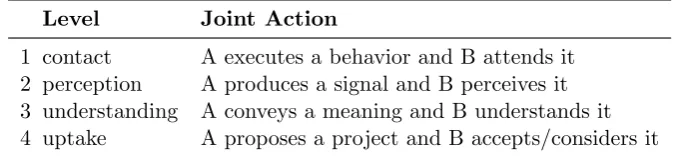
Level Joint Action
[image:18.595.151.490.129.207.2]1 contact A executes a behavior and B attends it 2 perception A produces a signal and B perceives it 3 understanding A conveys a meaning and B understands it 4 uptake A proposes a project and B accepts/considers it
Table 1.1: Grounding hierarchy for speaker A and listener B, adapted from Clark (1996) and Fern´andez (2013).
paying attention or not hearing properly. Both Clark (1996) and Allwood (1995) propose a four-level model of a collaborative understanding process, see table 1.1: A speaker A executes a behavior (by vocalizing a sequence of phonemes) that B grounds by paying attention to it; A produces a signal (by uttering an utterance) which B grounds by perceiving it; A tries to convey a meaning (by uttering a meaningful utterance) which B grounds by understanding it; and finally A proposes a project (by meaning something B can react to) which B grounds by reacting appropriately.
To establish a basis for common ground, B has to signal the level reached in that hierarchy—and that signal has to be picked up by A in the same way, by going through the hierarchy with reversed roles. These signals can take vastly different forms, and may be specific to some level. For example, B can signalcontact by holding eye contact, perception by repetition, and understandingby paraphrasing. A special case is signalling uptake by making a relevant next contribution, e.g., replying to a question with an answer. Addressees only have to signal successful grounding at the highest level they have reached, following the principle of downward evidence (Clark, 1996, p. 148): Grounding at one level signals grounding at all lower levels.
In accordance with the discussion above, not every exchange needs to be grounded at all four levels and the required level may vary with the intended joint project. A typical example is the communication of a telephone number where every single digit must be understood; the addressee might even give fine-grained evidence of understanding by repeating every single digit to both communicate successful grounding and to catch failures to ground quickly. On the other hand, it is often unnecessary to understand every word in an extended valediction or salutation (Fern´andez, 2013).
1. Preliminaries Background
2
|
Uptake
General terms [. . . ] must
themselves be subject to
contextualized description.
Akihiro Kanamori
The termuptake finds frequent use in dialogue research: speakers are taken to mean something, addressees take up illocutions, project proposals are taken up, and in Clark’s hierarchy, table 1.1, the final level of understanding is calleduptake. My central claim in this chapter is that all these different uses obscure a distinction between two different types of uptake, which I will separate. A central methodological tool in this investigation are the clarification requests addressees ask when they do not fully complete uptake.
I will expand on clarification and related notions in chapter 3.
I first introduce the theoretical framework I shall use to discuss the issue, namely how conversations can be seen as joint activities and that the projects constituting that activity carry certain obligations. Then, I will introduce my distinction ofweak vsstrong uptake and discuss the conditions for strong uptake. Armed with my novel terminology, I will then discuss the major previous usages of the term uptake, and where they fall in this distinction.
2.1
Executing Joint Projects
2. Uptake Executing Joint Projects
2.1.1 Projects and Obligations
Following Clark (1996), I adopt the notion that in any dialogue, every utterance, particularly any speech act, proposes ajoint project that needs both interlocutors’ participatory actions to succeed. In particular, for the project to be grounded, it needs to be taken up by the addressee; what precisely this taking up means and entails will be discussed further in this chapter.
In particular, Clark has described the structure of conversations in terms ofminimal joint projects: every proposal projects a response1that is appropri-ate to the proposal (Clark, 1996, p. 201). Indeed, systematic examinations of recorded conversations have lead to the observation that there are recurring pairs of particular speech acts which co-occur frequently, e.g., question– answer, valediction–valediction or request–acceptance/rejection. These pairs have been calledadjacency pairs (AP) in conversation analysis (Schegloff, 1968; Schegloff and Sacks, 1973) and correspond to Clark’s minimal joint projects (Clark, 1996, p. 201).
The term “adjacency” here does not necessarily mean immediate adja-cency, but a first-part (FP), e.g., a question, projects the corresponding second-part (SP),e.g., an answer, in a way that any intermediate utterance will be perceived as subordinate to the AP. Clark describes these intermedi-ates as sub-projects which areembedded into the minimal proposal–response pair, in order to facilitate successful execution of the proposed project. These sub-dialogues are called insertion sequences (Fern´andez, 2013). In general, speakers show a remarkable capability for contextualizing responses with the right proposal even after long inserted sub-conversations (Levinson, 1983, p. 305). The following excerpt shows an example of such an embedding.
(1) A: the mower’s out the shed, can you fetch it [. . . ] please? B: Is it, is it warm out there?
A: Well, it’s, it’s perhaps a bit cool without a coat on. B: Okay.
The initial request by A projects granting it, but before doing so, B asks an inserted question. By virtue of this embedding, B’s question is perceived as relevant to the proposal: B relates the outside temperature to the request
1
Executing Joint Projects 2. Uptake
for getting the lawnmower. A gives an informative response to the question, thereby concluding the embedded project. Then, B replies appropriately to the initial request by granting it, and (supposedly) proceeds to retrieve the lawnmower.
Thus, any proposal raises an expectation for a relevant response, but that response might be delayed. These delays are constrained by the interlocutors’ mutual expectations: They are expected to only initiate embedded projects that are relevant to the active proposal, e.g., sub-projects that serve to establish some preparatory condition for the initial project. Later in this chapter, I will further discuss whatrelevance should mean here.
Going back to speech act theory, every speech act can be considered a joint project proposal: Speech acts project certain effects, and these effects are usually established jointly by speaker and audience. The following overview shows a general characterization of speech acts in terms of joint projects.
Speech Acts as Projects
assertives project the grounding of their propositional content.
directives project the addressee doing something for/with/to the pro-poser.
commissives project the proposer doing something for/with/to the ad-dressee.
expressives project the addressee sympathizing with the proposer. declaratives project a collaborative change to the world.
2. Uptake Executing Joint Projects
So, to be conversationally appropriate, the response itself need not be working towards the success of the proposed project; an addressee of a question will give some answer, but not necessarily aninformative answer. While an answer like ‘I can’t tell you’ is appropriate to a question, the proposed project ofinformation exchange can be considered failed.2 On the other hand, if an addressee signals acceptance of the joint project, he should give a response that is a participatory action for the proposed project; in this case giving an informative answer.
It has been suggested to account for these effects in terms of discourse obligations (Traum and Allen, 1994; Kreutel and Mann, 2003): At certain points in a dialogue, e.g., after a FP has been uttered, interlocutors are obliged to give a particular response. In particular, these obligations override the intentions of the interlocutors involved,e.g., an interrogee might intend to not reply at all, but does. This even applies in cooperative dialogue: An interlocutor intending to share information via a sequence of informative speech acts is obliged to deal with clarification requests immediately, instead of finishing the intended sequence (Traum and Allen, 1994). The following example3 shows A informing B of a plan for future action, in the middle of which B asks a clarification question which A immediately attends before continuing.
(2) A: so we should move the engine at Avon engine E to B:engine E1
A:E1 B:okay
A: engine E1 to Bath to
However, there is a clear difference between the obligation to give some answer and the obligation to give aninformative answer to a question. The former is a general property of coherent conversation, whereas the latter only occurs after the addressee has committed to actually answer the question. In general, returning to Clark’s terms, if a project has been proposed, an addressee is obliged to reply to this proposal appropriately, but not to accept it. If the project has been accepted, however, it must be executed.
2Yet something, namely the project proposal itself, has become grounded; I will discuss this in the next section.
Executing Joint Projects 2. Uptake
Thus, I propose to separate the notion of discourse obligations into what I from now on will call conversational obligations and project obligations: While a question conversationally obliges the addressee to give anappropriate response, it does not oblige him to give aninformative response. However, if he were to accept theproject of investigating a matter, he would indeed be obliged to be informative. Similarly, a request obliges to accept or reject (Traum and Allen, 1994), but only if the addressee actually accepts the
request is he obliged to to carry out what was asked of him.
Obligations
A joint project proposal carries
conversational obligations to maintain dialogue coherence.
project obligations to execute the project; in particular, to plan, carry out and coordinate participatory actions in the project.
Both types of obligations require a certain level of understanding of what the speaker has intended: A question does not project any answer if it was rhetorical, and a declarative4 like ‘I think it’s cold in here’ can be a request. In general, different project proposals entail different obligations, and determining the obligations from the surface form of an utterance is not trivial. To account for this level of understanding, and to clarify when conversational or project obligations take effect, I will investigate the level of understanding that Clark (1996) has calleduptake in the next section.
What I call project obligations has, in principle, also been described in terms of dialogue games (Mann, 1988); also see section 2.2.3. In this framework, certain dialogue moves open up conventionalized games that have a particular goal and a particular set of rules, indicating which dialogue moves are allowed in what context. For example, asking a question opens up an information seeking game (Kreutel and Mann, 2003) with the goal to share or investigate an issue, and the rules include the permissible answers.5 As Traum and Allen (1994) and Kreutel and Mann (2003) point out, for the interlocutors to jointly take part in agame it is required that the 4Note the difference between uttering a declarative sentence and making an assertive speech act.
2. Uptake Executing Joint Projects
addressee of a proposal recognizes the speaker’s intention and adopts this goal as his own. This cannot be assumed in non-cooperative dialogue,e.g., in an interrogation setting. The formal theory of Traum and Allen (1994) deviates from the dialogue game setting in another way: While the rules, the obligations associated with a dialogue game, are typically described as being active until the exit conditions of the game have been reached, Traum and Allen (1994) phrase obligations in terms of singular actions: A discourse obligation in their sense obliges to make an appropriate dialogue act, and is then immediately discarded.
The viewpoint of obligations as dischargeable one-time events makes sense for conversational obligations, but in general the approach of the enduring game rules seems to be more sensible. Enduring commitments seem to be required for project obligations: If, for example, A instructs B to ‘be careful’ about something, and B accepts this warning, B is (as mutually considered by A and B) obliged to heed this warning over the whole course of his undertaking. Thus, I model project obligations as staying active until the project is concluded; either in success or failure. I will further elaborate on these distinctions in the following section.
2.1.2 Strong and Weak Uptake
I will now discuss how I separate the notion ofuptake into what I call weak and strong uptake, giving a more fine-grained account of the grounding process and unifying the different notions of uptake found in the literature. This account is an elaboration of what has been reported in (Schl¨oder and Fern´andez, 2014). I will give a introductory explanation of my terminology, and then elucidate it with explanatory examples.
Suppose a speaker A proposes a project p to an addressee B. In the process ofgrounding p, what I call weak uptake refers to A and B grounding what the project is, i.e., A’s intended illocutionary force, and the project obligations and constraints required to successfully fulfillp. In contrast,strong uptake—which presupposes weak uptake—denotes the joint commitment to participate and coordinate inp, the adoption of everything jointly recognized in weak uptake.
Executing Joint Projects 2. Uptake
strong uptake. Upon strong uptake, in turn, the project obligations take effect until the project is concluded. For example, if speaker A makes a request to addressee B and B understands this (weak uptake), B is conversationally obliged to either grant or deny the request—but is permitted to ask questions relating to the request, as I will discuss in chapter 3. Should B grant (strongly take up) the request, he is obliged to carry out the request, and this obligation holds until the request has been fully completed.
Strong and Weak Uptake
A project p isweakly taken up if it is common ground: The fact thatp has been proposed,
The knowledge ofp’s project obligations.
A project isstrongly taken up if it takes effect,i.e., it is grounded: both interlocutors are subject top’s project obligations; in par-ticular they are obliged to determine, carry out and coordinate participatory actions inp.
Implicit in this treatment are the expectations of the interlocutors: if an obligation of one interlocutor is common ground, the other interlocutor will (rightfully) expect adherence to that obligation. In turn, the obliged interlocutor is aware of that expectation, and vice versa. Analogously, the same holds for projected actions: If it is grounded that B will execute some action, A will expect that action, B will be aware of this expectation, and A will be aware of this awareness etc.
2. Uptake Executing Joint Projects
strong uptake, the addressee is indeed required to give an informative answer to the question. Whether or not this answer then is satisfactory is subject to the original asker strongly taking it up or not—each answer is in turn a joint project, and the expected reaction of the asker is an evaluation.
The constructed example of A warning B again shows the distinction: Suppose that a speaker A issues the warning ‘This looks dangerous.’, and the addressee B hears and understands this utterance, including the illocutionary force that it is a warning—which is not immediate from the utterance’s surface form. Then there is something being grounded at the level of weak uptake: we can surely state that ‘B has been warned by A’ is common ground: If B gets hurt in his undertaking, A can felicitously say ‘I warned you.’ However, this does not ensure that B is indeed heeding the warning: While A proposed the project of being more careful, it is entirely unclear whether B will do so. Indeed, maybe just to spite A or to show off, he even may be more reckless.
So, to make the warning effective,i.e., B heeding it, something more is required: strong uptake. The warning utterance contained the proposal to be more careful, andstrongly taking up this proposal would oblige B to be, indeed, more careful. This also affects the common ground, but in a different way: It is still common ground that A warned B, but both interlocutors now also assume thatB heeds the warning. Analogously, B can explicitly refuse A’s intended project: By saying ‘Nah, I’ll be fine’, he indicates that he indeed has been warned, but is refusing to assume the project obligations contained in the warning.
This last example shows that after having understood the proposed joint project, an addressee can refuse participation in it,cancelling the proposed joint project. Similarly to B consciously refusing to heed A’s warning above, assertives can be rejected, commissives can be declined, directives can be refused, expressives can be dismissed and declaratives can be invalidated. Generally, any speech act can fail if the addressee does not (strongly) take it up (Austin, 1962). The cancellation function of these speech events is what makes them dispreferred moves, as observed by conversation analysts (Schegloff, 1968; Schegloff and Sacks, 1973).
Executing Joint Projects 2. Uptake
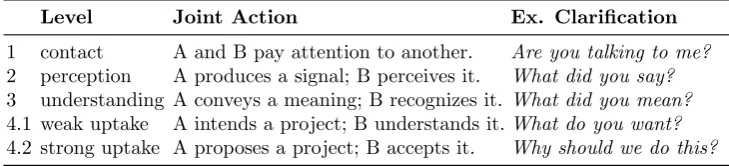
Level Joint Action Ex. Clarification 1 contact A and B pay attention to another. Are you talking to me?
2 perception A produces a signal; B perceives it. What did you say?
3 understanding A conveys a meaning; B recognizes it. What did you mean?
4.1 weak uptake A intends a project; B understands it.What do you want?
[image:28.595.140.505.130.213.2]4.2 strong uptake A proposes a project; B accepts it. Why should we do this?
Table 2.1: Grounding hierarchy for proposer A and addressee B with refined uptake level and examples for possible clarification requests.
/ rejections are not (immediately) strongly taken up, and the proposal they reject stays conversationally active. In the possible cancellation or refusal of strong uptake also lies the difference of strong uptakevs perlocutionary effect. In the example above, B being spitefully more reckless after being warned by A is a perlocutionary effect of A’s warning, but a clear refusal of strong uptake.
To account for the difference in grounding the proposal of a project and grounding the project itself as joint, I therefore propose a refinement of Clark’s ladder of mutual understanding. Namely, splitting up the fourth level, uptake, into what I have calledweak andstrong uptake,cf. table 2.1. In particular, I only consider a projectfully grounded if it has been strongly taken up. The distinction between level 3—understanding—and weak uptake lies in Searle’s distinction between propositional content and illocutionary force: An addressee might very well be able to retrieve the content of an utterance without being sure what the illocution, respectively the proposed joint project, is.6 I will discuss a naturally occurring example for this effect (ex. (5)) further below.
2. Uptake Executing Joint Projects
addressee—corresponding to strong uptake—would ensure just that. It is notable that weak uptake, as a level of grounding, is itself a joint action. Addressees have some leeway in interpreting the speakers intended project, as Clark has shown with the example of the utterance ‘Sit here’, discussed in the introduction. Weak uptake presupposes what Clark (1996) has called the joint construal of the proposed project: Before a project can be grounded, the interlocutors must jointly agree on what they take the project to be. So when I speak of the addresseesignalling weak uptake, it would be more accurate to say that he signals a construal of the project he is willing to ground on level 4.1; the proposer still has the opportunity to protest this construal if she finds it inappropriate. As my focus lies on the effects surrounding strong uptake, this will not be the case in any of the examples.
Note that grounding on the level of weak uptake does not require full knowledge of the necessary participatory actions for the project, as it is possible to understand the obligations a project carries,i.e., weakly take it up, while the precise actions required by the participants are only determined upon strong uptake / execution: Two people can ground the proposal tolift a piano, and accept—or reject—this proposal without having determined who lifts what side of the piano with how much strength. The following dialogue excerpt is an example where the participatory action is a speech act.
(3) A: We’re making a pact now, okay? B: Alright, how do you do that?
A: Therehpausei I hereby make a pact that I [. . . ]
Here, B has arguably (as signalled by‘alright’) understood A’s project to form some sort of covenant and that this would entail certain project obligations, so he grounds on weak uptake level. B is even signalling a willingness to take this project up strongly,i.e., to subject himself to these obligations. However, he is unable to do so, as he is unsure what his participatory action would be in this project, so he needs to ask first. A clarifies that the participatory action required is a declarative speech act.
Executing Joint Projects 2. Uptake
uptake. Evidence for these distinctions can be found in naturally occurring dialogue excerpts. Usually, failure to ground is visible inclarification requests raised by the addressee; I will delve deeper into this matter in chapter 3. The following is a constructed example exemplifying the type of evidence I am looking for:
(4) A: Can you get the butter?
a. B: Salted or unsalted? failure on level 3.
b. B: Should I bring it to you? failure on level 4.1. c. B: Why would I bring it to you? failure on level 4.2.
d. B: Sure. [proceeds to fetch and hand over butter] full grounding. The utterance (4a) clarifies the propositional/semantic content of A’s ut-terance, namely the specification of the determiner phrase the butter; in contrast, in (4b) B has successfully resolved this phrase, but is uncertain if A’s utterance asks for B’s ability to bring it, or requests B to do so. In contrast, in (4c), B has solved both these issues, but still does not execute the project for some personal reason. Finally, in (4d), there are no such issues and B strongly takes up—and subsequently executes—the joint project.
The following example shows a typical clarification request and shines a light on the difference between level 3 (understanding) and level 4.1 (weak uptake). For indeed, it is sometimes unclear to an addressee what precisely it is the speaker is proposing, even if the utterance has been understood semantically, i.e., up to level 3 in table 2.1.
(5) A: And we’re going to discuss [. . . ] who’s gonna do what and just clarify
B: Are you asking me whether I wanna be in there? A: I was just mentioning it to you in case you wanted to B: Don’t wanna.
2. Uptake Executing Joint Projects
This example furthermore shows how the distinction of weak vs strong uptake is important in discerning the discourse obligations imposed on the interlocutors. As mentioned, weak uptake obliges the addressee to respond with an appropriate reply—and B adheres to this obligation with his final rejection move, but he could do so only after weak uptake has succeeded. On the other hand, taking up A’s proposed projectstrongly would have obliged B to, in fact, attend the meeting.
The next examples show clarification requests on level 4.2, i.e., failures of strong uptake.
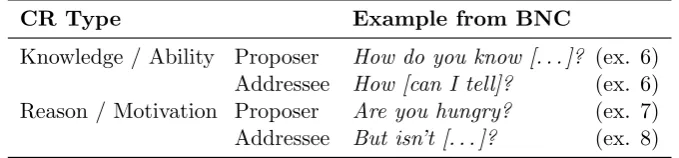
(6) A: I know Vic has cream in his [food] and B: How do you know?
A: Well it said so on the menu, that’s why. (7) A: Daddy can we swop places now?
B: Why?
A: Cos I wanna sit next to you and Lee.
In these examples, B has recognized A’s intention—a request to swap places, and the assertive that Vic has cream in his food—but does not complete strong uptake: After B’s utterance in (6), it is not common ground that Vic has cream in his food, and similarly in (7), it is not grounded that A and B will perform the necessary actions to swap places. However, in both examples, weak uptake has taken place: In (6) B has understood that A wants him to believe her assertion, he just does not do it (yet); in (7), B has understood A’s request, and knows that taking this up strongly would oblige him to move, but does not (yet) want to do so. These are failures of (immediate) strong uptake. I will explore what conditions might cause strong uptake to fail in the following section.
2.1.3 Project Felicity Conditions
The examples (3), (6) and (7) all show failures of strong uptake, evidenced by clarification questions. However, it seems that each question indicates a different reason for this failure. While in (6), the addressee doubts A’s knowledge, he indicates a lack of motivation in (7), and a lack of personal knowledge in (3).
Executing Joint Projects 2. Uptake
Conditions for Joint Purposes(Clark, 1996, p. 203). Identification A and B know aboutp;
Ability A and B are able to do the participatory actions in p; Willingness A and B must be willing to engage in p;
Mutual Belief The previous three are common ground forAand B.
These categories are related to the framework I built up so far: Weak uptake is on par with Clark’s Identification condition, and I will discuss how Mutual Belief is presupposed by strong uptake. The examples (6) and (7) seem to indicate failures of ability7 and willingness, respectively.
Deviating from Clark’s analysis, I propose an asymmetry in the Willing-ness condition for cooperative dialogue: For someone to propose a project, merewillingness is not sufficient; the proposer must have positive reason to take the initiative on the project. Therefore I claim that on the speaker’s side, this condition must be strengthened to sufficient reason to propose the project. On the other hand, an addressee who is assumed to be gener-ally cooperative might be completely indifferent towards the project, and still take it up if it is proposed to him. Hence I propose to weaken the willingness-condition on addressees to only require the absence of adverse reasons. Possible adverse reasons for an addressee include a desire for secrecy if the project is a question, conflicting already made commitments in the case of commissives, or contradictory beliefs in case of assertives: In each of these cases, the addressee has good cause against answering the question, committing to the commissive, or adopting the asserted belief.
Austin (1962, p. 14) introduces felicity conditions as “the things which are necessary for the smooth or ’happy’ functioning” of a performative speech act. In analogy, I call the conditions required to successfully and, indeed, happily, execute a joint projectproject felicity conditions. I claim that the categories ofreason and ability, defined above, are the general conditions necessary for the execution of any joint project. This is not to say that specific projects cannot have more particular felicity conditions; Searle (1965) defines specific conditions for different speech acts, and these are neither subsumed nor made obsolete by my general project felicity conditions.
7
2. Uptake Executing Joint Projects
General Project Felicity Conditions
Proposer Reason The proposer has sufficient reason to propose the project.
Addressee Reason The addressee does not have reason not to take part in the project.
Proposer Ability The proposer has sufficient ability and knowledge to take part in the project.
Addressee Ability The addressee has sufficient ability and knowledge to take part in the project.
Evidence for these conditions can again best be found in instances where they fail or where an addressee expresses uncertainty about their fulfillment. The following example shows that interlocutors are aware of the asymmetry I proposed on thereason felicity conditions. The two clarification requests the speakers raise exemplify the project felicity conditions addressee reason and proposer reason.
(8) A: Oh, oh you can pop in and get your fishing magazines while you’re down here
B: Why?
A: Well why not?
Executing Joint Projects 2. Uptake
satisfy the proposer reason condition, the rejected project proposal must have some defective project felicity condition.
A typical example for a failure of proposer knowledge is the example (6) I already discussed, whereas failures ofaddressee knowledge are visible in examples like (9): The example, a discussion between a waitress and a customer, is due to Clark (1996):
(9) A: What’ll have ya girls? B: What’s the soup of the day? A: Clam chowder.
B: I’ll have a bowl of clam chowder and a salad.
Here, the customer has recognized the question content and the question force of the waitress’ initial utterance, but sees himself unable to respond to her, due to a lack of knowledge. Only after the waitress has supplied the missing knowledge, by strongly taking up the clarification request and giving a satisfactory answer, the customer is able to strongly take up the initial question and give an informative answer. The customer’s final utterance is notable, as it strongly takes up both the initial question and the answer to the clarification request: By strongly taking up the question, the customer signals that the felicity conditions he clarified towards is now satisfied, thereby evaluating the answer to his question as satisfactory.
Generally, the initiator of a joint project must presuppose that the project can indeed be happily executed, i.e., that the project felicity conditions are satisfied. If this can not be presupposed, the initiator might preliminarily check some conditions in form of pre-sequences which I will discuss in chapter 3. Naturally, the initiator cannot be entirely certain that the felicity conditions on the addressee’s side are indeed satisfied, and conversely the addressee cannot be certain of the initiator’s conditions. However, upon strong uptake it becomes grounded that the project will, and thereforecan, be executed;8 this must include grounding of the project felicity conditions. However, if it cannot be established from information already grounded that all conditions are satisfied, the interlocutors can accommodate their presupposition upon strong uptake. The mechanisms surrounding the satis-faction, or perceived satissatis-faction, of the project felicity conditions are the
2. Uptake Literature Comparison
topic of chapter 3. For now, this discussions shows that Clark’s Mutual Belief condition on joint purposes is not a precondition for strong uptake, but rather aneffect of it: On strong uptake, the interlocutors ground the joint belief that the project is felicitous.
Now I can also state in a more precise way what theappropriate responses from the first section are: After completing weak uptake, the conversational obligation to be appropriate takes effect. That means that the addressee either takes the project up strongly, confirming the projected action as joint, or proposes to cancel the proposal—which is itself a project proposal. The occurring sub-dialogues are considered relevant by virtue of clarifying or establishing project felicity.
In this work, I do not advocate in favor of any particular framework for modelling the conditions of reason and knowledge. There are many different theories that seem to be suitable candidates for a formal-computational operationalization of the project felicity conditions. For example, the BOID architecture (Broersen et al., 2001) models beliefs and obligations, and Hulstijn and Maudet (2006) have proposed a mechanism for strong uptake in this framework. Gaudou et al. (2006) present a framework more focussed on grounding, but that also accounts for personal beliefs. In any way, the conditions as they are presented here are accessible to each advanced interactive agents framework; in a classical BDI (Beliefs–Desires–Intentions) model (Georgeff et al., 1999), the proposer reason condition can be realized by requiring that the project advances some desire of the agent, whereas addressee reason would mean that the obligations carried by the project are not at odds with an already held belief or desire. Furthermore, in an ISU (Information State Update) setting (Larsson and Traum, 2001; Larsson, 2002), knowledge-conditions can be linked to the agents’ private beliefs, and reason-conditions would be related to the agents’ agendas and their available resources (Breitholtz and Cooper, 2011).
2.2
Literature Comparison
Literature Comparison 2. Uptake
2.2.1 Speech Acts
According to Austin (1962, p. 116), an illocutionary act is not happily performed, is infelicitous, if it does not bring forth some effect particular to the act. In his own words, “I cannot be said to have warned an audience unless it hears what I say and takes what I say in a certain sense.” The audiencetaking an utterance in a certain sense is what Austin callsuptake, and he includes thesecuring of uptake—making sure the audience completes uptake—as a necessary condition for the felicitous performance of a speech act. This first notion of uptake corresponds to what I callweak uptake—as I have discussed along the same example of warning someone: If the audience retrieves thewarning force of the utterance, it has been warned, irrespective of the subsequentheeding of the warning.
However, Austin also mentions that certain illocutions can be cancelled, aborted in his terminology: For example, bets need to be taken on (‘You’re on’) and the declaration of a marriage must be explicitly confirmed by both partners (‘I do’9)—in both cases, the act can fail due to the audience refusing to perform a requisite constituent act,‘I’m not betting with you’,‘I do not’ (Austin, 1962, p. 37). In these cases, one can hardly state that any effect has been achieved at all, for there has been established neither bet or marriage. While in the case of betting, the consequent statement of an effect‘A has betted B 5 euro (but B refused)’ might still be warranted, stating ‘C married A to B, but B refused’ is clearly absurd.
The requisite completion act need not be linguistic, as a marriage cer-emony might even be considered incomplete until the marriage has been consummated (Austin, 1962, p. 43). Austin categorizes these failures as infelicities under his condition B.2: The procedure has not been executed completely by all participants. Yet, these cases seem to presuppose what Austin calls uptake, in my weak sense, from their addressees: Before one refuses a bet, or cancels a marriage, one must have understood that the illocutionary force of the antecedent utterance indeedhas betting or marrying force.
Thus, in my terminology, the failures due to rejection, cancellation or abortion correspond to the refusal of strong uptake. Failures due to the lack or the failure of subsequent actions then cause theproject contained in
9
2. Uptake Literature Comparison
the taken up, and itself successful, utterance to fail. Indeed, it seems odd to have an audiencetaking up an illocutionary act that is itself infelicitous, defective, by virtue of the audience’s following actions. Thus, the weak– strong distinction separates the notion of uptake, as in understanding the illocutionary force, from the notion of achieving the conventional effect of the illocution.
Austin’s felicity conditions B and C are reflected in the definition of the general project felicity conditions that require both participants to be able and willing (in a certain sense) to execute their respective actions: Participants might be unable (B) or unwilling (C) to complete the project. However, these infelicities are in my framework considered infelicities of the project and not of the utterance proposing it.
As a final remark, Austin acknowledges, but does not delve into, the problem of discerning a constituent action of a speech act from a merely consequent action (Austin, 1962, p. 43). This issue can be explicated in the language of projects, obligations and participatory actions: The project proposed in an utterance carries the obligation to perform participatory (con-stituent) actions, and the fact that they occur—even after longer stretches of time—is explained in terms of lastingproject obligations. However, conse-quent actions, which do not work towards the project, but are still connected with the utterance, are the result ofconversational obligations to maintain coherence.
2.2.2 Joint Projects
Clark (1996) describes the conceptuptake in at least two contexts. In the discussion of the four-level grounding hierarchy (Clark, 1996, p. 152) (cf. table 1.1), he describes the third level (understanding) as the addressee understanding what project the speaker is projecting,i.e., what I call weak uptake. In the same place, he describes the fourth level, uptake, as the addressee “considering” the speaker’s proposal for a joint action—which is less than what I describe as strong uptake. In particular, that consideration might still result in a rejection move,i.e., the addressee not taking part in the proposed joint project.
Literature Comparison 2. Uptake
updating the information states of the participants with the intended move of the last speaker (Traum, 1994; Poesio and Traum, 1997; Traum, 1999; Ginzburg, 2012). This viewpoint considers an utterance fully grounded after what I call weak uptake is completed.
Later in his book, Clark offers an elaboration of the grounding hierarchy, in which (semantic) understanding happens on level 3, but proposals of projects on level 4: “When Jane produces ’Who is it?’ shemeans (at level 3) that Kate is to say who she is and, thereby,proposes (at level 4) that Kate tell her who she is” (Clark, 1996, p. 199, emphasis mine). In this reading, the addressee (Kate) resolves the illocutionary force of Jane’s utterance only at level 4.
In contrast to the description of uptake as consideration, in his chapter on joint projects Clark explicitly points out that uptake can fail due to the inability or unwillingness of the addressee: “when respondents are unwilling or unable to comply with the project as proposed, they can decline to take it up” (Clark, 1996, p. 204). In this discussion, uptake is the agreement of the speaker to participate in the project: “such joint projects [questions] become complete only through uptake” (Clark, 1996, p. 199). This is what I have called strong uptake. In addition, in the discussion of joint projects (Clark, 1996, pp. 191–220), Clark introduces the notion ofjoint construals: the determination of speaker meaning, including the jointly agreed upon illocutionary force of the speaker’s utterance (Clark, 1996, pp. 212–213). This notion corresponds to my weak uptake.
2.2.3 Bids and Games
2. Uptake Summary
The formal theory of Hulstijn and Maudet (2003, 2006) centers on how two people agree to enter such a game together. The cornerstone of their theory is that one participant puts forward a bid to a dialogue game that entails certain rules and obligations. The addressee of that bid then has the opportunity to take up or reject the bid; uptake obliges the addressee to respond appropriately, and to be committed to the game, including its rules. Both interlocutors continue to respond appropriately according to the rules of the game until its exit condition is reached. A simple example is the information seeking game, initiated by a question: If the addressee of a question takes it up, he is obliged to respond with relevant information. Hence, Hulstijn’s and Maudet’s use of the term uptake corresponds to my strong uptake.
A similar approach has been outlined by Kreutel and Mann (2003), who propose an obligation-based model for game bids. They stay clear of the term uptake, but define an operationAccept-Bidthat corresponds to strong uptake: “Acceptance of a bid results in the content of the bid being added to the common ground”, thecontent of a bid being the obligations associated with it. Their theory of obligations also includes a general obligation to reply to an utterance, even if the addressee of that utterances has no prior intention to do so. However, again, addressees are only obliged to reply informatively to a question if they have accepted it as a bid for an information seeking game.
2.3
Summary
Over the course of a dialogue, the interlocutors can be considered bound by certain obligations. These obligations arise for different reasons and influence the dialogue in different ways. I have separated conversational obligations, establishing the duty to maintain a coherent dialogue, from project obligations, ensuring successful joint execution of a (conversational) project.
Summary 2. Uptake
of the term “uptake” corresponds roughly to my weak uptake, while research on dialogue games usually understands the term in its strong sense. Clark’s theory of joint projects makes use of both categories, but without a clear distinction.
3
|
Clarification
Perfect clarity would profit the
intellect but damage the will.
Blaise Pascal
In the previous chapter, I already made use of clarification requests to point out certain communication failures observable in naturally occurring dialogue. Generally, when a conversation encounters a problem, the interlocutors will jointly attempt to fix it; clarification requests are among the options they have for doing this. I make use of my grounding hierarchy, table 2.1, from the previous chapter, wherefull grounding is only established upon strong uptake of the joint project proposed. Thus I consider failures of strong uptake as communicative problems that need to be addressed and repaired in much the same way as, e.g., failures to hear or to understand.
I will first discuss a theory of conversational semantics that treats clarifica-tion as not only as ancillary, but as in fact central to successful conversaclarifica-tion; then I will review computational and empirical investigations into the topic and relate them to the theory I have built up so far. For a more detailed investigation of clarification requests on the level of strong uptake, I will make use of theproject felicity conditions defined in the previous chapter. Then I will discuss other mechanisms to prevent or repair communicative failure, also in relation to strong uptake.
3.1
Background
Background 3. Clarification
on uptake level, and relate these approaches to the distinction of weakvs strong uptake made in the previous chapter.
3.1.1 KoS: Conversation-oriented Semantics
KoS1 is a semantic theory of conversation created by Jonathan Ginzburg
(2012) within the framework of TTR (Type-Theory with Records (Cooper, 2005)). KoS is notable for its rigorous treatment of clarification requests, treated as central to the model—and as central to conversation in general— and not just as some auxiliary function: “The ability to characterize for any utterance type the update that emerges in the aftermath of successful grounding and the full range of possible CRs otherwise” (Ginzburg and Fern´andez, 2010, p. 10). I will briefly outline how this notion of grounding corresponds to my weak uptake and explain how KoS accounts for clarification by having the interlocutors keep track of rich information states with specific update rules.
In contrast to most of the other work presented here, and to the thesis itself, this theory is not rooted in the tradition of the four-level grounding process by Clark and Allwood: KoS is less concerned with the abstract level of understanding on which clarification requests occur, but rather how they are to be interpreted semantically. This is of particular interest, since clarification requests are usually fragmented or elliptical.
In KoS, dialogue participants keep track of their common ground and the state of their interaction, including their conversational history, by maintaining adialogue game board2 (DGB). A DGB records lists ofFacts (the common ground),Moves (the dialogue history), QUD (questions under discussion), the current utterance and—most relevant for this chapter— the field Pending, containing the yet ungrounded moves. The grounding protocol proceeds as follows: Immediately after an utterance is completed, the Pending field is updated with the utterance’s locutionary content and a grammatical type for the utterance. If this grammatical type corresponds to a full dialogue act, the DGB is modified with an appropriate update rule that, if appropriate, modifies the Facts or the QUD. If the grammatical type is in some way incomplete, the addressee of the utterance must ask for clarification: An appropriate clarification request is generated from the
1Not an acronym. 2
3. Clarification Background
partially recognized utterance and is added to the questions under discussion QUD.
As already mentioned, this theory of clarification finishes grounding at what I have characterized asweak uptake: If the addressee can fully recognize the speaker’s intention, the intended move, he updates his own information state (DGB) with this information and sends acknowledgement so that the speaker may do the same. Of course it would be unreasonable to ground a proposition into Facts after only this weak kind of mutual understanding has been achieved, so understanding a proposition only raises it as an issue to discuss. The content of a proposition becomes common ground as a fact only after an acceptance move by the addressee. So, KoS accounts for what I call strong uptake in a different way: Since the interlocutors keep track of the dialogue history and the questions under discussion, acceptance moves can make use of this information. By a general Fact Update / QUD Downdate update rule, invoked after an acceptance move, an issue under discussion becomes a fact and is no longer up for doubt. The following overview, due to Ginzburg and Fern´andez (2010), shows the processes of strongly taking up propositions and questions:
LatestMove = Assert(A,p) LatestMove = Ask(A,q)
A: push p? onto QUD; A: push q onto QUD;
release turn; release turn;
B: push p? onto QUD; B: push q onto QUD;
take turn; take turn;
either make q-specific utterance;
discuss p?
or
accept p;
The move accept p, after possible clarification has taken place, will addp
to Facts and remove it from QUD—this corresponds to strong uptake. In the case of a question q, the addressee is required by the protocol to make a