COMMISSION OF THE EUROPEAN COMMUNITIES
PROGRESS REPORT 1993
COM(94) 81 final Brussels, 25.03.1994
CONCERNING THE COORDINATED INTRODUCTION OF THE INTEGRATED SERVICES DIGITAL NETWORK (ISDN)
IN THE EUROPEAN COMMUNITY
2
-0 Executive Summary
1 Introduction
1.1 Purpose of this report
2 Progress of ISDN implementations in the Member States
· 3 Progress in standardisation
3.1 Introduction
3.2 Status of EURO-ISDN standards
· 3.3 Freezing of EURO-ISDN standards
3.4 Further ISDN standardisation
3.5 Software interfaces for ISDN terminals
3.6 Conclusion on standardisation
3.7 ISDN test standards and conformity testing
4 Introduction plans for EURO-ISDN
4.1 Scope of EURO-ISDN
4.2 Deployment plans for EURO-ISDN
5 Migration to EURO-ISDN: issues and problems
5.1 Migration: network related aspects
5.2 Migration: user/ terminal related aspects
5.3 Private ISDN networking
5.4 Speed of deployment and range of services
5.5 ISDN tariff issues
5.6 The "Telematic Gap" in ISDN
5.7 ISDN and the "Review 92"
5.8 Universality of the ISDN offering
3
-6 ONP, Data protection (fariffs)
6.1 Progress with open network provision (ONP) and ISDN 6.2 Data protection and user privacy
7 Progress ofiSDN in the less favoured regions: STAR, Telematique and future plans 7.1 Contribution of the STAR programme in the implementation of ISDN
7.2 ERDF operational programmes in telecommunications 7.3 Telematique
7.4 Implementation of the MoU on ISDN in the less favoured regions 7.5 Future plans
8 ISDN development outside the Community 8.1 ISDN in the EFT A countries
8.2 ISDN in the US 8.3 ISDN in Japan
9 Initiatives and new proposals
9.1 European ISDN User Forum (EIUF)
9.2 EC-Japan ISDN interconnection experiment (EJIX) 9.3 EURO-ISDN Event (EURIE '93)
9.4 ISDN as trans-European network
Figure 1: Figure 2:-Figure 3:
Table 1: Table 2: Table 3: Table 4: Table 5: Table 6: Table 7:
Table 8: Table 9: Table 10: Table 11: Table 12:
Annex 1: Annex 2: Annex 3: Annex 4: Annex 5: Annex 6:
-4-Index of Figures and Tables The universal multi-purpose access platform Progress towards completion of ISM standards Overview on the private public ISDN interworking
ISDN coverage - subscriptions - migration to EURO-ISDN International ISDN connections - protocols
National and international supported services Current CTS project relevant to ISDN
Laboratories that will provide the testing service and the scheduled availability Essential elements which are an integral part of EURO-ISDN
Information related to the introduction to the Basic Rate Access conforming to the relevant ETSI standards
Summary of the current ISDN tariffs ISDN Tariff ratios in Member States
Offerings that should be available in all Member States by 1.1.94 Minimum set of ISDN Offerings
Additional offerings which may be implemented in acco~dance with progress in international standardisation
Index of Annexes Addresses of ETSI and EIUF
Minimum list of offerings
National Tariffs for Basic/Access Rate ISDN in Japan
-5-0 EXECliTIVE SUMMARY
This founh Progress Report has been prepared for submission to the Council and the European Parliament in accordance with Article 7 of the Council Recommendation on the "Coordinated Introduction of the Integrated Digital Services Network" (ISDN) in the European Community (86/659/EEC).
Since the previous report five further operators have been added to the list of commercial providers of ISDN offerings. ISDN is now available in nine Member States and there are about 350.000 ;soN accesses installed in these countries. All commercially opened networks in the Member States are interconnected. Only in Greece and Portugal no commercial ISDN offering exists currently. In Luxembourg, which will start its own ISDN early 1994, it is possible to obtain ISDN accesses from France T~l~m. While current ISDN implementations are based on national specifications which have some differences, ETSI, the European Telecommunications Standards Institute, had finalised all harmonised EURO-ISDN requirement standards by the end of 1992.
Upon a proposal from the Commission, an event for the introduction of EURO-ISDN, EURIE '93, was successfully held in December 1993.
In its Resolution from 5 June 19921 the Council has recognised the importance of ISDN to be developed as a trans-European network. The Commission has meanwhile adopted a Communication and two proposals for Council Decisions2 to this end. A rapid deployment of
EURO - ISDN will facilitate the functioning of the single market.
Furthermore, on 05 June 1992 the Council adopted a Recommendation3 concerning the
application of the open network principles to ISDN.
In September 1993 the Commission submitt~>.d a proposal to the Council and the European Parliament for the development of ISDN as ·~rans-European network. The White Paper for growth, competitiveness and employment, that was approved by the heads of state and government on 10/11 December, includes proposals for EURO-ISDN.
Issues raised in previous reports like the European User Forum (EIUF) and the ISDN terminal interconnection testing with Japan are further discussed.
Type approval standards for EURO-ISDN remain an issue for urgent resolution. Further work is also required for private ISON networking.
Finally, importance is attached to the development possibilities of ISDN in the changing regulatory context. Telephony is an important service for ISDN and therefore the continued liberalisation (c/f Review '924> has a direct bearing on ISDN.
OJ No. C 158/1-2, 25.06.92
2 COM(93) 347, 1.9.93
-
7
-1 INTRODUCTION
In the beginning of 1993, a period of seven years of intensive efforts towards the achievement of the single market for goods and services, for capital and persons has been completed.
Also for the introduction of ISDN in the Community the change of the years 1992/1993 marks a turning point.
While so far the investments made in the Member States went into national versions of ISDN, all Public .Network Operators (PNO's) in the Community have started in 1993 to introduce EURO-ISDN.
As for the single market, the efforts for a coordinated introduction of ISDN have been started eight years ago.
This Coordinated Introduction of ISDN in the Member States is the main objective of the Community's telecommunications policy in this field.
EURO-ISDN, is the implementation of a common set of compatible ISDN functionalities and services based on harmonised standards and with full interconnectivity between all Member States.
When~analysing the policy efforts for ISDN in the Community, it is interesting to consider the impact of the changed regulatory environment on the ISDN introduction.
Two major aspects are of interest:
the impact of the "separation of powers" between regulatory and operational functions and the impact of an eventual further liberalisation, notably of the public real time switched voice service.
While these aspects are further deepened later in this report, it is worth noting here, that the questions, wheth~r ISDN remains a priority for the telecommunications policy in the Community, can be answered clearly.
Title XII of the Maastricht Tree1ty establishes the context between the operation of the single market and the trans-European networks: a proper functioning of the single market where the full benefits of the economic area without internal frontiers can be exploited, is only feasible on the basis of the availability of truly trans-European-networks (TEN).
Given the nature of ISDN as the general switched infrastructure being developed as the successor of todays telephone network, the right answer to ·the general (tel e-) communications needs of the single market is EURO-ISDN.
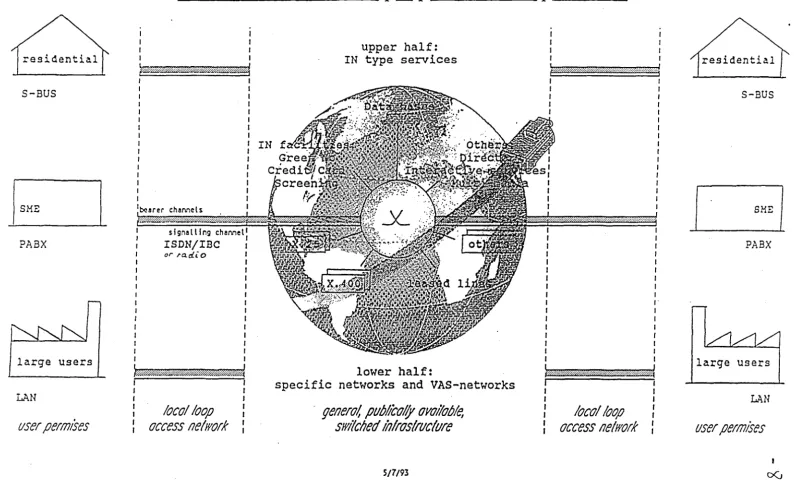
Owing to this universal vocation, ISDN is ideally suited (and targeted) to develop within a few years to a mass service which satisfies the needs in particular of small and medium sized businesses (SME's) which count for more than 14 million in the Community.
Figure 1
S-BUS
SME
PABX
large users
LAN
.
C!Ser perm;ses
The universal multi-purpose access platform
I I
I
I I
I I I I I I I I I ~::w-~~.dW$~-1 I I I I I I I I I I I I I I I
1~arer chaMels
signalling chaMel
ISDN/IBC
or ra.d.i 0
~$.@}'/.@'d]/~~AW',#-1 I
I I
I I
:
loco! loop
:
: occess nellf'orl :
IN
upper half:
IN
type services
lower half:
specific networks and VAS-networks
generot
pu!Juco~oro;1o!Jie,
Slf'llc!Jed tillros/ruclure
5/7/93 >wffi'ZP/0W%W'JYJ¥W/.4k//4¥///j I I I I I I I I I I I I I I I I I I I I I I I I I I. I I I I I I I hx~~p~ II I
I I
:
loco/ loop
:
: OCCC'SS llC'/If'O!'K
l
residential
S-BUS
- - -
-BME
PABX
large users
LAN
Clser perm;'ses
[image:8.840.29.823.38.519.2]-
9-Leading edge customers will equally benefit from the advantages of ISDN. At the same time they will also be able to make use of most advanced technical solutions which by their nature can neither be afforded (in an early period of their market availability) by small businesses nor is it feasible to reach rapidly a full coverage for those solutions for all businesses.
In line with the Resolution of the Council from 05 of June 1992 and without prejudice to further changes in the regulatory environment, the answer to the above question is therefore that, ISDN continues to be a high priority of the Community's telecommunications policy.
Consequently, the continued efforts for the introduction of ISDN aim at a rapid deployment of EURO-ISDN in the whole Community. These efforts will be addressed anew, by the initiatives currently prepared under the framework of TEN proposals.
The Recommendations of the Council on the application of the ONP principles to ISDN will contribute to the achievement of these objectives.
Owing to its nature of general public infrastructure, ISDN was included in the range of topics discussed in the context of the growth initiative. Following the Council meetings in Edinburgh and Copenhagen where the growth initiative was decided, several measures have been brought on its way. One important aspect of relevance also for telecommunications networks is the plan to shift expenditure to public infrastructure projects.
In order to promote this plan, a temporary lending instrument, in the first place with an envelope of 5 BECU and managed by the European Investment Bank was put in operation. EURO-ISDN projects can benefit from this new instrument.
1.1 PURPOSE OF THIS REPORT
The purpose of this report is to give an account of the progress on the Council Recommendation 86/659/EEC of 22 December 1986 concerning: "The Coordinated Introduction of the Integrated Services Digital Network {ISDN) in the Member States of the European Community".
It is the fourth Annual ISDN Report produced in accordance with Article 7 of the said Recommendation. The report provides information on:
Section 2: Section 3: Section 4: Section 5: Section 6: Section 7:
Section 8: Section 9:
Progress of c~rrent implementations in the MS Progress in standardisation
Introduction plans for EURO-ISDN
Migration to EURO-ISDN: issues and problems ONP, Data protection, (Tariffs)
Progress of ISDN in the less favoured regions: STAR, Telematique and future plans
10
-2 PROGRESS OF ISDN IMPLEMENTATIONS IN TilE MEMB\•,R STATES
This Section concerns the progress of the implementations of the current pre-EURO-ISDN
offerings in the Member States made until the end of 1993.
Current ISDN offerings are based on national standards which show some variations with regard to the options and range of services provided. The type uf dif:t!rences between the various current ISDN implementations and the reasons for them were described in more detail in the Third Annual ISDN Report and have not changed in essence (please refer Section 2.1 of that report).
Chapter 4 gives au account of the planning for the EURO-ISDN based on hannonised European standards.
ISDN has been offered in the Community since 1987 and by the l,!nd of 1992 seven Member States (B, D, DK, F, I, UK and NL) had commercial ISDN offerings.
Except Greece, the PNO's of all other Member States were operating ISDN pilots in the course of 1992.
By the end of 1993 the PNO's in three further Member States, Ireland Spain and Portugal had also introduced commercial ISDN services.
At the same time the operators of three countries (D, DK and F) provided full geographical coverage of their ISDN offerings (D: in the old BundesHinder), i.e., throughout the whole country the option to subscribe to ISD • .J existed in 1992.
Deutsche Bundespost TELEKOM and France TELECOM have achieved a significant penetration of ISDN. At the end of 1993, the D"utsche Bundespost TELEKOM counted 281 thousand subscribers of Basic Rate Accesses (BRA)5 and 18 thousand Primary Rate
Accesses (PRA). France TELECOM accounts showed 91 thousand users of the BRA and 12 thousand installed PRA.
With regard to the PRA, it is worth mentioning that almost 100 % of new PABX (beyond a certain size) are connected to ISDN, owing to the attractiveness of the tariffs in Germany for this connection type.
Owing to the later introduction and to some other reasons the numbers of ISDN accesses in operation in the other Member States are lower (also in comparative terms).
Interconnections exist, either direct or in transit, between all Member States with ::ommercial ISDN offerings. This is remarkable in so far as inten:onnectivity for newly introduced· networks is frequently a problem.
11
-Table 1 provides an overview comprising the following type of data per Member State and PNO (geographical coverage, number of subscriptions, terminal addressing, migration to EURO-ISDN).
[image:11.577.43.513.294.789.2]Table 2 provides an overview of the status of international interconnections and the signalling protocol in use.
Table 3 provides an overview of the services provided nationally and internationally.
Acknowledgement
Table 1: ISDN coverage· aubsribtlons ·migration to EURO-ISDN
I
territorial coverageI
number of subscribtians terminal addressing migration to EURO-ISDNBRA(%) PRA (%) BRA PRA E 164 MSN HLC Subaddr. offering existing . offering tariffs
(001) ISDN until EURO-ISDN from fixed
Belgium
15 100 1500 15 yes yes no yes end 1994 1993 1993
Denmark
Tele Denmark 100 100 1217 62 yes yes yes yes only EURO-ISDN Jan-92 Jan-92
france
100 100 91000 12000 yes yes yes upgrade Dec-93
Germany 281000 18000 yes yes yes no 2000 1993 Apr-93
old Laender 70 70
new laender ded. cftles ded. cities
Greece
-
- --
-
-
-
--.
early-94 noIreland pilot ISDN subscribers commercial start of ISDN In July 93
Dec-93 Dec-93
Ita~
37 37 1000 20 yes yes yes In 1994 Nov-93 Nov-93 Nov-93
luxembourg only aera of the commercial start of ISDN begin 1994
cfty of Luxembourg 12 earfy-94 no
Netherlands (70% end 1994)
~
/:-J
40 40 850 42 yes yes yes yes 1998 Jun-93 Apr-93
Portugal pilot ISDN subscribers Iaten
TLP 40 40 68 16 _yes yes yes _'£"S only EURO-ISDN end 1992 end 1993
CPRM
plot ISDN subscriber latest
TP 60 60 100 15 yes yes _yes y_es only EURO-ISDN end 1992 end 1993
Spain pilot IS ON subscribers commercial start of ISDN In June 93
10 10 150 yes yes yes yes
UK
8T < 90 100 44000 6000 yes yes limfted yes 2000 Oct-93 Jul-93
I
I Mercury - - - · - - - · · · · - - -- - -
[image:12.836.93.796.72.522.2]Teble 2: Intern~tlcnel ISO~ conr.ectlcns • protocol&._
international ISDN connections from EC countries / protocol
Belgium
I
Denmark
France
I
Germany
I
Greece
I
Ireland
Italy
I
Luxembourg
I
Netherlands
Belgium
TU?j TUPj 2) TU?j C10·93) 3) TU?jDenmark
TU?j TU?+ 2) 3) TUP+France
TU?j TU?+ TU?+ 2) I TU? J (9·93) TU?+ 3) TUP+Germany
TUPJ TU?+ 2) TU?+ 3) TUP+Greece
2) 3)I
Ireland
2) 3)Italy
TUP+ 2) 3)Luxembourg
2) 3)Netherlands
TU? j TU?+ TU?+ 2) TU?j!
3)-
I
I
Portugal
2) 3)I
Spain
TU?j TU?j TUPj 2) TU?j 3) I I TU? jUK
TU?j TU?+ TU?+ 2) ISU? (11·93) TU?+ 3) TU?+Japan
TU?j TU?j TU?j 2) TUP J (9·93) 3) TU?jUSA
TU?j TUPj 2) TU?j 3) TUP JSwitzerland
TU? J TU? j 2) 3) TU?jFinland
TU?] TUPJ TUPj 2) 3) HI?]Sweden
TU?j TUPj 2) TUP J 3) TU? jNorway
TU?] TUPj 2) TUP J 3) TUPJAustria
2) 3)Srngopore
TU?j TUPj 2) 3) TU? JAustralia
TU?j TU?j TUPj 2) 3) TU?jHong Kong
TU?j TUPJ 2) 3)1) to be set up until the end of 1993 2) ISU? Is now lnstall~ng In Greek network 3) Pre·ISD~ In cooperation with France Telec~
~--~---
-Status: 01.01.93
Portugal
I
Spain
I SUP V. 1 TU?j
I SIP V. 1 TU?j
I
TU?jI SUP V. 1 TU?j
I
I St.:? V. 1
I
TU?j1St:? V.1
TU?j
TU? j ISUP V.1 1)
TU?j
I SUP V. 1 1) TU?j
Teble 3: llatlcnal and International 5u;::>?Orted 5ervlce5·
n-
1ionol
(.~I)and
in1~r~a~:---l(I)
-u~M·'ed"e".:"e" ·
Vl I n I Ill;; II liVllU :> ~fJVll :> lVI\. :>
Belgium
Denmark
France
Germany
Greece
Ireland
l!aly
luxembourg Nel herlarid s Portu_gol
Spain
u~"
PTT T. Tel eO. (Dec 93) TLP CPR ~ TP a; .~er:.
64 Kblt/s unr. H,l ~ H, I H H, I II, I H, I H, I H,l I H,l H, I ~-
__
,3.1 KHz audio H, I H, I H, I II II, I H, I s H, I I H,I
"
.,
.
- ~-- - ·
speech H, I H, I II, I
"
H, I H,l H, I I !ol,l"
H,~ - - ·X.31 H H,l
"
H II H- - ·
Telef"'l_. 3.1 KHz H H,l H,l H, I H,l
"
H,l ~ II, I-
_ ;fAX gr 4 II H,I H, I H,I H,I H, I H ~ H H - - - !
Telete,;· ~ H H
-
--Tele~cny 7 KHz H H H,l
- - - ·
Vldeote,; H II, I I II I II II
' - - --- - - ·
Vldeotelephony H H H, I H,l H,I I II H
-CLIP h II, I H,l II H, I II, I II, I ~ II, I II fi,I j
CLIR H H, I H,l H H, I II,! ~ ~ H,l H HI! I
DOl H H H,l H H, I H H, I I 11,1 H
"
--1-MSH H H H,l H H,l II II,I ~ H,l II
,.
ITP H H, I H,l ' H H, I H H I H, I H
-C\1 H H H,l H,l H,l H,l II
-
-ccas
-H,l I II,!
cue
H I II I I-c
uus H H,l II,! II, I I II, I II
-SUB II 11,1 H,l I II, I II N
-
f-3PTY H,l
IAOC H II, I II, I II II II H
COLP II II, I H I H H H
t - - -
r----COLR H II,! H ~ II II fl
.'!CID II 11,1 H,l ~ II
-COHF
f
-MMC-
-FPH ECT-
~ CfB- Q II, I
- -
-CFIIR 11,1 II, I II, I
:fu II II, I II, I 11,1 II
--j
-:o
'fOLD H,l I
- - - -
15
-3 PROGRESS lN STANDARDISATION
3.1 INTRODUCTION
The transition from the national ISDN offerings to EURO-ISDN depends as one prerequisite on the availability of a complete set of basic standards which enable the implementation of EURO-ISDN in an unambiguous and compatible 111anner throughout Europe.
ETSI, the European Telecommunications Standards Institute is responsible for all standards
related to EURO-ISDN. .
A detailed description of the method adopted by ETSI to organise this huge standardisation task, notably with the creation of the ISDN Standards Management (ISM) committee has been given in the preceding report.
ISM, which's mandate was confined to the management of the standards·related to the EURO-ISDN has come with its 13th meeting in November 1991 to the end of its terms. Its successor, the new ISDN Management and Coordination Committee (IMCC), which had taken over the responsibilities of ISM and which's tasks had been enlarged to cover in particular also the interest of standardisation for private ISDN networks, finished its work after the 6th meeting.
3.2 STATUS OF EURO-ISDN STANDARDS
The scope of work in relation to the EURO-ISDN comprises 180 standards devided into 196 work items. These standards cover areas like network aspects, interfaces, services, test standards a.o.m.
These EURO-ISDN standards including the technical reports which go along with them fill several thousand pages.
A comprehensive overview on those standards is given in the ETR6 10 which can be procured from ETSI. The address of ETSI is found in Annex 1.
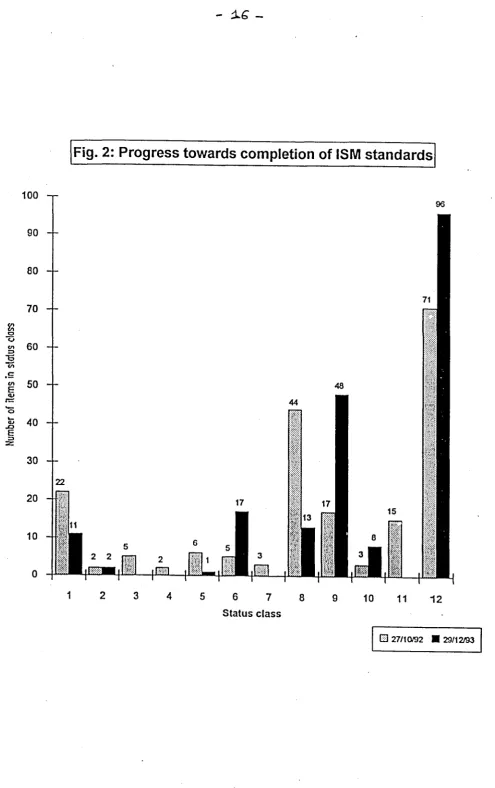
In order to d~cribe the status of ISDN standards, ETSI documents identify 12 "Status classes" indicating the progress of a standards towards completion (from "No draft available" to "publication of the standard").
According to the prevailing interpretation, standards which are in status class 8 (= approval by relevant Technical Committee) or higher arc considered as technically stable and suitable as basis for implementation.
From Figure 2 it can be seen that 165 work items (cq~als 84
%)
are in status class 8 or higher. All standards required for the implementation of EURO-ISDN were finished by the end of 1992..1..6"
-Fig. 2: Progress towards completion of ISM standards
100
90
80
70
~
0 <:i
(1'1 60
::>
-s
U> .E
(1'1 50
E
cv
r:::
...
0.... 40
cu
.D
E
::> ::<::
30
20
10
0
1 2 3 4 5 6 7 8 9 10 11 "12
Status class
[image:16.574.21.516.34.822.2]-
17-From the remaining 31 work items, 24 concern test standards, which have often been started later and 7 relate to general and interworking aspects which are not required for implementation purposes.
In conclusion, all requireraent standards related to the MoU services and network aspects are stabilised. The difficulties. which have existed for the standards concerning two supplementary services, CCBS7 and ECT8 have been resolved. It remains in essence to finalise part of the test standards.
The CEC has substantially contributed to this work programme, also by two standardisation mandates.
3.3 FREEZING OF EURO-ISDN STANDARDS
Upon a proposal from the CEC, DG XIII ETSI has worked out and decided about a freezing of EURO-ISDN standards.
The purpose of the freezing of EURO-ISDN standards is to enable a stable implementation of the EURO-ISDN facilities, so that at least for a certain period the compatibility of the functionalities concerned (first and foremost the user/network interfaces but also services) can be ensured.
Normal maintenance of the concerned standards, work on compatible extensions and work on other standards (not concerned by the freezing) will continue.
It was decided that the period of freezing is three years ending in June 1995.
3.4 FURTHER ISDN STANDARDISATION
In the area of public ISDN standardisation work continues related to services not covered by the MoU on ISDN (sometimes referred to· as "Priority 3" standards). Further ongoing work is related to private ISDNs.
As it was referred to above, the task of the successor committee IMCC has been enlarged by · the interests for. private ISDN networks taken over from CENELEC9 • Also this work programme which started in 1988 in CENELEC was covered by a mandate from the CEC. This mandate (BC-IT-74 to BC-IT-77) aimed at an adequate level of interworking between private and public ISDN services enabling interoperability of terminals, ISPBX's and CENTREXs in a multi-vendor environment. A taxonomy for the standardisation aspects of this area is given in M-IT-05.
The programme of work in this area is of a similar size and complexity as the one for EURO-ISDN. While the existing EURO-ISDN standards take account of private and public ISDN interworking in particular for ISDN bearer services and ISDN telematic services, more elaborated requirements from the private ISDN area have meanwhile been put forward in the standardisation committees.
7 Completion of Calls to Dusy Subscribers
8 Explicit Call Transfer
18
-ECMA10 and the IPNS11 Forum have and continue to contribute for a good deal of this work area for which within ETSI the Technical Committee Business Telecommunications (BT) is formally responsible.
As it can be derived already from thr. sheer size of the task, it will not be possible to finalise these work items within a short period of time.
In order to permit an orderly coexistence of public and private ISDNs, two scer1ario's have been described.
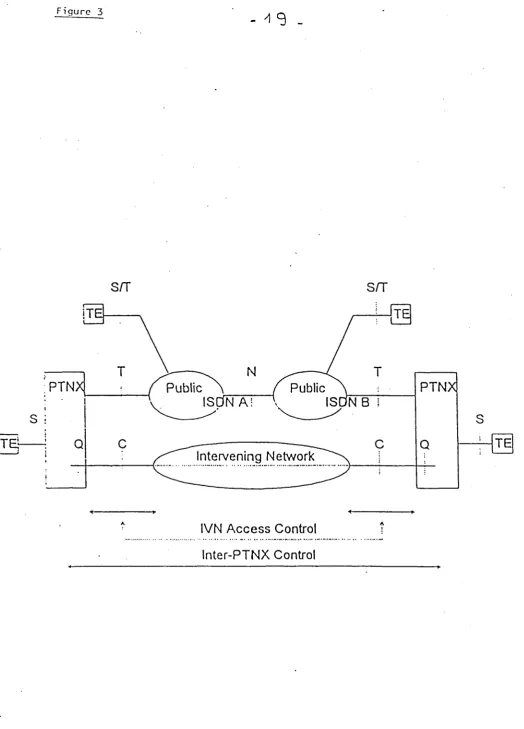
The overlay scenario means that the intervening network (IVN), eg. the public ISDN is used to provide transparent end-to-end connections between private networks (PTN). The IVN does not take part in the call establishment of the PTN or in the service provision of the PTN. In other words the public ISDN as IVN is working according to the definition of the existing interface standards. Hence, this scenario does not imply any significant modifications or upgrades to the existing EURO-ISDN standards.
In contrast, the second scenario, called integrated scenario, assumes that -a public and a private ISDN interwork in a way where the signalling protocols defined for the interface between the two networks are adapted to the specific/additional requirements stemming from the private network. Those specific requirements arise in particular from the (richer set of) services features of the private side. For this second scenario, the ETSI work programme contains a pre-normative work item which is examining the conceptual aspects and the standards required. Figure 3 provides a schematic overview on the private and public ISDN interworking.
The Commission recognised the importance of ISDN standards for private network with the continued political validity of the standardisation mandates BC 74-77 (c/f Section 3.5 of the 3rd Annual Progress Report).
A proper interworking between public and private ISDNs is important, already for the reason that today the vast majority of ISDN user is connected to an ISPBX, the most common form of a private ISDN.
However, it must be avoided that the EURO-ISDN standards are destabilised by the new requirements, since this would jeopardise their implementation, if not the credibility of EURO-ISDN as such.
Therefore, the sector actors have voluntarily agreed on the freezing discussed above.
Finally, one further most important standardisation aspect, EURO-ISDN type approval standards, is not mentioned. ETSI, which has the responsibility for the prpduction of the technical basis for such type approval standards, foresees to finalise them only by October 1994. Adding the necessary administrative times for adoption by the formal committees and their publication leads to their availability in spring 1995. This presents a major drawback for the introduction of EURO-ISDN terminals.
10 European Computers Manufacturers Association
Figure 3
srr
srr
PTN
s
c
Q ~~TEIntervening Network
-+--~--{·-····-· .. ···-····-· ... _, ___ ... -·-·-·-·-... ·-}---:---!_;__
...
IVN Access Control
[image:19.575.34.559.27.757.2]-
20-3.5 SOFTWARE INTERFACES FOR ISDN TERMINALS
One standardisation aspect which is crucial for the ISDN terminal development in Europe but which is · not included in the scope of the EURO-ISDN standards, is the so-called "Programmable Communication Interface" (PCI).
A PCI is a software interface which allows to have common access methods to ISDN services from a PC (or another type of computer) which implements an interface for ISDN. In practice a harmonised PCI would allow to install software from various sources on an existing hardware platform (eg. ISDN access card for a PC). In technical terms this capability is called software portability.
Network related and telematic services related PCI's are distinguished. Standardised PCI's are a prerequisite for the portability of application software, eg. for a telematic service like file transfer and hence are important for the development of a truly multi-vendor ISDN terminal market.
ETSI, again with the support of the Commission is developing currently P.CI standards.
The rapid availability and implementation of this type of interface in ISDN terminal equipment is required.
Following a mandate from the Commission, in the meantime ETSI has prepared a standard which was also accepted as a base for the international standardisation work in that area.
3.6 CONCLUSION ON STANDARDISATION
In conclusion it can be said that ETSI has mastered the huge task of the production of the EURO-ISDN standards successfully.
Apait from some test standards, all standards required for the implementation are stabilised. ETSI has a clear leading position in ISDN standardisation in the world-wide context, which will also contribute to a leading position of Europe with respect to deployment of ISDN. In order to accomplish this success also in terms of commercial offerings available to users throughout Europe, it is required that those standards are now fully implemented.
3.7 - ISDN TEST STANDARDS AND CONFORMITY TESTING
As mentioned in the preceding section, test standards for ISDN now account for an important part of the ongoing EURO-ISDN standardisation work in ETSI. For the implementation of these (and other) test standards the CEC launched in 1985 the Conformance Testing Services {CTS) programme with the aim of supporting the development, and provision of services which · will test conformity of manufacturers' equipment to standards. Applicable standards comprise (inter alia): ISO norms, CCITT recommendations, ETSI ETSs and CEN/CENELEC ENVs and ENs.
•
21
-All these European standards have a voluntary status and the Conformance Testing Services are thus also conducted on a voluntary basis.
Preference and priority arc given to relevant European standards where available. Moreover, strong emphasis is given to harmonisation and testing equivalence aspects so that the services offered by different laboratories involved in each CTS project can be recognised as equivalent. In the context of type approval of telecommunications terminal equipment obligatory testing is used. For this purpo~e tecrnical regulations (known as CTRs12 and, where these arc not yet available, NETs13 ) arc derived as subsets from the corresponding harmonised standards.
The following CTS projects concern particularly the definition of test specifications and the establishment of testing centres in the ISDN area:
CTS 2 CTS2 CTS 2bis CTS 2bis CTS 3 CTS 3 CTS 4 CTS 4 CTS 4
ISDN-BA ISDN-TA ISDN-PA ISDN-RA ISDN-VP NI-ISUP ISDN-SS ISDN-VTX SS7
Table 4: Current CTS projects relevant to ISDN
(ISDN Basic Access) (ISDN Terminal Adaptors) (ISDN Primary Access) (ISDN Rate Adaptor) (ISDN Video Phone)
·(Network Interworking- ISUP+X.75) (ISDN Supplementary Services) (ISDN Videotex)
(Signalling System no. 7)
The total CEC commitment for these ISDN projects is 10.6 MECU.
During 1992 the latest phase of CTS (CTS 5) was launched and technically acceptable proposa.ls were received in the following areas:
-ISDN-PCI CTR-DNET
(Programmable Communications Interface for ISDN) (CTR Testing for Digital Networks; CTRs 2,3,4,8)
Negotiations (subject to budgetary limitations) have taken place which have lead to the placing of contracts with the consortia for ISDN-PCI and CTR-DNET.
One of the objectives of t!1e CTS projects is the contribution of the relevant Abstract Test Specifications (ATS) to the European and world standardization bodies concerned, where they will serve as a primary input for future test standards. So far, the Abstract Test Suites (ATSs) developed in the ISDN-BA, ISDN-TA, ISDN-PA, ISDN-RA projects have been submitted to ETSI, while the ISDN-BA and ISDN-SS projects have cabled submissions to CCITT S.G. XI. The uptake of the CTS material by ETSI has been sporadic but improved cooperation procedures are being developed which should make this process more effective in future.
12 Common Technical Regulation
-
22-Another objective· of the CTS ISDN projects, particularly where they support clearly different profiles, is the provision of a "modular" testing service. A kernel service is offered which involves the testing to the obligatory technical regulations (NETs and CTRs}; however full conformity testing to the voluntary standards will also be offered.
In a carefully coordinated and complementary manner to the CTS programme, a series of mandates for the standardisation of ISDN test specifications has been placed with ETSI. Prominent amongst those are:
BC-T-234 BC-T-245 BC-T-246 BC-T-293 BC-T-294 BC-T-296
Test specifications for D~channel signalling QSIG
ISDN telematic services ISUP protocols
ISDN videophone ISDN PCI
Table 5 shows the laboratories that will provide the testing service and the scheduled availability: Project ISDN-BA ISDN-TA ISDN-PA ISDN-RA ISDN-VP NI-ISUP ISDN-SS ISDN-VTX SS7
Testing service provided by
organisation (country)
CET (P), CNET (F),
CSELT (1), EOLAS (IRL), FTZ (D), PTT-NL (NL), TID (E), TD (DK) CET (P), EOLAS (IRL)
CNET (F), CSELT (1), EOLAS (IRL) FTZ (D), TID (E), TD (DK)
CET (P), EOLAS (IRL) CSELT (1), EOLAS (IRL) CSELT (1), NCSR (GR) CNET (F), CSELT (1),
EOLAS (IRL), FTZ (D), TD (DK), TELEVERKET (S) SEMA (F), TID (E), ISPT (I) BT (UK), CSEL T (1), NCSR (GR)
Table 5: CTS test laboratories
-
23-4 INTRODUCTION PLANS FOR EURO-ISDN
This Section concerns the plans of the PNO's for the introduction of EURO-ISDN.
The term EURO-JSDN is used to refer to the ISDN introduction as defined in the respective Memorandum of Understanding (MoU) signed by 26 PNO's from 20 European countries. EURO-ISDN means the introduction o( a common set of compatible ISDN interfaces and services implemented on the basis of harmonised standards (discussed in Section 3).
With the start or the commercial offering or EURO-ISDN during EURIE '93 n major
milestone or the Community's telecommunications policy efforts since 1985 towards the
"Coordinated Introduction or ISDN11 was accomplished.
-
24-4.1 SCOPE OF EURO-JSDN
The scope or the EURO-ISDN is defined in the MoU mentioned earlier.
A group called IMIMG14 consisting of the PNO's which have signed the MoU coordinates the measurers to ensure the introduction of EURO-ISDN.
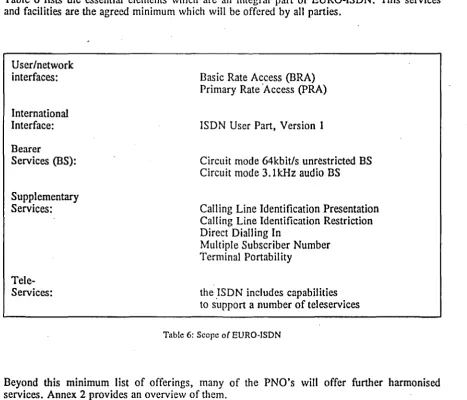
Table 6 lists the essential elements which are an integral part of EURO-ISDN. This services and facilities are the agreed minimum which will be offered by all parties.
User/network interfaces:
International Interface: Bearer
Services (BS):
Supplementary Services:
Tete-Services:
Basic Rate Access (BRA) Primary Rate Access (PRA)
ISDN User Part, Version 1
Circuit mode 64kbit/s unrestricted BS Circuit mode 3.1kHz audio BS
Calling Line Identification Presentation Calling Line Identification Restriction Direct Dialling In
Multiple Subscriber Number Terminal Portability
the ISDN includes capabilities to s·upport a number of teleservices
Table 6: Scope of EURO-ISDN
Beyond this minimum list of offerings, many of the PNO's will offer further harmonised services. Annex 2 provides an overview of them.
[image:24.578.54.522.155.555.2]-
25-4.2 DEPLOYMENT PLANS FOR EURO-ISDN
From the Working Group TEN-ISDN \Y{G TEN-ISDN)15 information from the PNO's
concerning the timing and geographical coverage of the roll-out of EURO-ISDN are available. It is noted that the approaches of the operators regarding the introduction of EURO-ISDN vary. One way of introducing EURO-ISDN is to install a second software capability (the one of EURO-ISDN) into the local ISDN switch which will (during a certain period of.time) co-exist with the software for the existing national ISDN service.
Another migration strategy is to upgrade in steps the existing ISDN software to become (gradually) conformant to the definition of the EURO-ISDN standards.
Consequently, it may be the case that some of the data indicated below, refer to a software capability which is very close but not 100% identical (at a given point in time) to the · harmonised standards. It is, however, assumed, that in all cases the software capability referred to below will cater for 'terminal interchangeability (one of the prime objectives of the EURO-ISDN standardisation).
Deployment timing
[image:25.576.54.512.420.764.2]All PNOs participated in EURIE' 93 with demonstrations of EURO-ISDN implementations. By the end of 1993, all Member States were offering commercial EURO-ISDN, except for Greece and Luxembourg. EURO-ISDN service will be launched in Luxembourg in March 1994. Geographical coverage will already be achieved some months later. A EURO-ISDN Pilot project will be implemented in Greece in 1994.
Table 7 gives detaiiCd information related to the introduction of EURO-ISDN.
lS The Working Group TEN ISDN was established for the elaboration of the proposal to develop ISDN as a
-
26-Tahle 7: EURO-TSDN in the EC
Basic Rate Acccss16 Geographical Coverage
Belgium
Denmark
France
Germany
Greece
Ireland
Italy
Luxembourg
Nether lands
Portugal
Spain
UK
n. pl.:
>blank<:
21-40 %
07/95
01/94
01/94
01/94
01/94
no planning data exists
information not available
16 eonfonnant to ETS 300.153
bis 60%
07/94
01/94
07/96
01/95
07/94
bis 80 % 100 %
01/94 01195
01/94
01195
01/95
01/98 n.pl.
07/94 01/97
07/95 01/96
07/94
01/95 01/96
01/94 01/95
01/96
- 27 _.
With the start of EURO-ISDN the efforts for the coordinated introduction of this infrastructure are not finalised yet.
The following sections discuss further issues and problems (eg. migration problems) related to the successful introduction of EURO-ISDN.
-
28-5 MIGRATION TO EURO-TSDN: ISSUES AND PROBLEMS
It is evident that migration problems as such essentially concern the PNO's which have already pre-EURO-ISDN offerings in service. The dimension of the problem is influenced, amongst other factors by the number of current ISDN users.
There are some problems related to the migration which impact also on the other PNO's, eg, terminal related matters.
Regarding the pure migration problems two categories, network and terminal/user related aspects can be distinguished.
5.1 MIGRATION: NETWORK RELATED ASPECTS
Section 4.2 above has already discussed the principal approaches regarding the transition from national offerings to EURO-ISDN. The existing networks are either (step by step) upgraded or EURO-ISDN functionalities are offered in coexistence with current implementations.
The latter strategy is mainly useful if the set of functionalities of the current ISDN service is richer than the initial set of services of EURO-ISDN. It depends also on the number and nature of differences between the two implementations.
A crucial question of this latter strategy is during .which period the current offering will co-exist with the EURO-ISDN service.
5.2 MIGRATION: USER/TERMINAL RELATED ASPECTS
From the perspective of an user of national ISDN offerings, the main questions are:
whether existing ISDN terminal equipment can be used in connection with EURO-ISDN and
which services which have been used so far, are offered on the EURO-ISDN.
The first question, in technical terms, relates to the objective of terminal interchangeability, i.e., the usage of ISDN terminal equipment at either network implementation.
Depending on the approach adopted on the network side the following options occur: existing terminals cannot be used on EURO-ISDN
existing terminals can be used with some restrictions existing terminals can be used without restrictions.
-
29-Usage with restriction may typically mean that basic (eg. telephone or facsimile connections) can be set up, but not all of the facilities (eg. a supplementary service) may be available (or compatible) with the current implemer]tation.
To current users of ISDN which have further questio~s related to this issue, it is recommended to address to the customer service of their respective operator.
5.3 PRIVATE ISDN NETWORKING
As mentioned in Section 3.4 (Further Standardisation) ISPBX are important for the development of ISDN per se, because the majority of ISDN terminal equipment (which generate the traffic) is connected to them.
While ISPBX - for example in the context of type approval - are considered as attachments (to the public network), from the perspective of the user, they can be regarded as {private) networks.
Like a public switching node, an ISPBX is essentially a switching arid call processing apparatus and can consist of several nodes (PTNX).
PTNX can be interconnected by various transmission means, by leased lines, by satellite connections or for example by public switched networks like the ISDN.
The interworking of public and private ISDN nodes is subject to further standardisation efforts.
All major PABX manufacturers have products with ISDN capabilities (ISPBX), typically with a number of additional features.
For PABX manufacturers the current differences of the public ISDN interfaces (c/f. Chapter 2) imply as for the producers of other terminal equipment additional development efforts.
Owing to the often very diverse needs of business users, the (I)PBX manufacturers have implemented proprietary interfaces on the extension line side. This has in principle the disadvantage that terminals from other manufacturers cannot be used. However, (I)PBX manufacturers will now implement harmonised interfaces on the extension line side.
The achievern~:!~t of a harmonisrrl interface (in the case of a PABX at the T-Reference Point) at the public as well as at the private network for the sake of terminal interchangeability is a prime target.
According to a position of the European ISDN User Forum (EIUF) the harmonised interface
should be available on all ISPI3X.
-
30-5.4 SPEED OF DEPLOYMENT AND RANGE OF SERVICES
A further general issue related to the introduction of EURO-ISDN is the timing of its roll-out, i.e., its geographical availability over time.
Section 4.2 provides a general overview on the roll-out schedule of EURO-ISDN.
With reference to the important role of a modern general telecommunications infrastructure for the functioning of the single market, ideally a fully fledged ISDN would have been required for
1993.
While, notably in central. parts of the Corr..nunity, EURO-ISDN is available, many of the· less favoured regions will again be disadvantaged by a roll- out which may extend to the year 2000 and after.
A third aspect is the range of services of national ISDN versions compared to the offering of services of EURO-ISDN.
For example, there will be cases where the current ISDN offers a richer set of services than available with the initial offering of EURO-ISDN. Some supplementary services may also be implemented on the basis of differing standards. Again, it is recommended to ISDN customers who face this kind of question to obtain details from their operator.
Reference is made again to the concept to develop ISDN under the TEN framework, which contains proposals which address this problem.
Given the volume of investment which is required, but looking also to the macro-economic effects (eg. growth initiative) of this type of investment, particular efforts from the side of the structural funds will be required to narrow this new infrastructural gap.
5.5 ISDN TARIFF ISSUES
From the perspective of a user, the tariffs, beside the question of terminal availability, are probably the most important factor influencing the choice of networking offerings to which one may subscribe.
Some PNO's, at the occasion of the introduction of EURO-ISDN have lowered eg. the monthly subscription as compared to existing offerings.
Since ISDN (BRA) provides two independent B-channels (comparable to two telephone lines, but with the speed and other advantages inherent to JSDN), it should be envisaged that the tariff (monthly subscription) approaches the level of the subscription of a double telephone line (which is often cheaper than twice a single line). On the longer run, such a tariff policy would stimulate the residential subscriber market to migrate to ISDN.
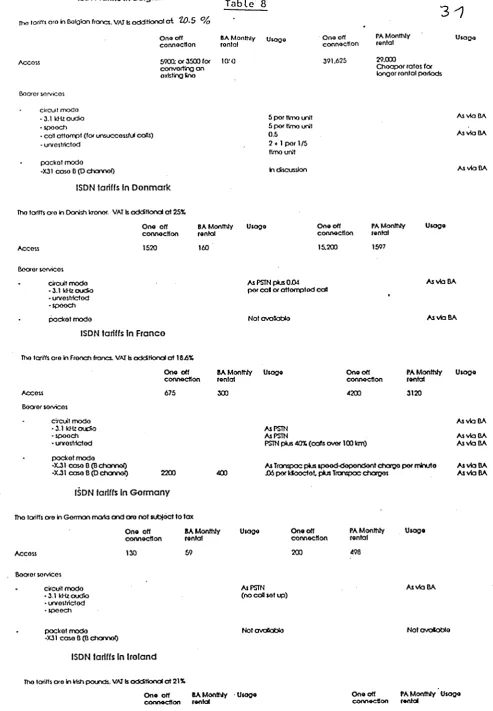
Table 8 provides a summary of the current ISDN tariffs.
ISDN lariffs In Belgium
Table 8
3·1
ThO toritts oro In llololon francs. V,AJ 1s additional crt 1.0. 5 °/o Ono off connocflon
IIA Monthly Usogo rontol Onootl connoc~on PAMonlhly r<~ntot Accos.s lloorcr wrvicos circuit modo - 3.1 kltz audio
·spooch
• con atf~l (far unsuccouf\A calls)
- urvcsfriclod
packet modo
·X31 coso B (0 cho'Ylol)
5'100; ar 3500 far 1 ~ o convortlno on oxlslinO W\0
ISDN larifrs In Denmark
Tho toitls oro In Danish kronor. VAT Is oddiHonal at 25'r.
5 por 11mo unit 5 por l1mo unit
0.5 2 + 1 porl/5
l1mo unit
391.625 29.CXXl
O'loapor rates far lon()or rontal porlods
As via llA
As via llA
As via llA
Ono ott
connocHon
BA Monthly Uwgo Onoo«
connocflon
PA Monthly
ronlol
Usogo
Acceu
Bearer SC<Yicos
citcuit modo • 3.1 I<Hz audio
• urvestrlclod
·spooch
Poclo:otmodo
1520
ISDN tariffs In Franco
Tho I otitis are In Fronch francs. V/IJ Is oddiHonal at 18.6'r.
ronlol
1l£l 15.200 1597
As PSTN plus 0,04 As via llA
por col ar ott~tod call
Not ovollablo As via llA
Ono ott !A Monthly Usogo Onoo« PAMonlhly Usogo conno<:11on ronlal
Access 675 300
lloorersoMc:os
c'Jcuit modo • 3.1 I<Hz Ol..dio
-spooch
• urtostrlclod
pod:otmodo
·x.31 coso B (B chomoQ
·X.31 coso B (0 channoQ 2200
ISDN tariffs In Gormany
Tho toritfs are In German mat1a and oro not IUbfGct to tax Ono off
COMocflon
!A Monthly
ronlal Accos.s Boarer services dcuitmodo •3.11<Hzaud'IO • urvostrictod -speech pocket modo
·X31 cosa B (B cho'YloQ
I~ 59
ISDN tariffs In !roland
Tho toritfs oro In Irish pounds. V/IJ Is~ at 21'J:.
connocflon ronlol
4200 3120
AsPSTN AsPSTN
PSTN plus ~ (co!ls CMlC' 100 km)
As Tronspoc plus spood<Sopondont Ch:lrQO por miN..rto .Q6 por l<looctot, plus Tronspoc c:ht::rQo$
Uwgo
AsPSTN (no cohet up)
Not avallablo
Onootf connocllon
200
PAMonlhly ron tal
Uwgo
As via llA
NotOII'Oiotllo
As via llA
As via llA As via llA
As via llA As via llA
Ono ott BA Monthly · Uwgo Ono ott PA Monthly Usogo connodlon r.nlal
Accos.s
drcUtmodo
• 3.1 I<Hz OJCSo
·spooch • UtY01frlclod
pod:ot rrod<t
connodlon ronlal
420
As PSTN (no COli sot up Cho'Qo)
AsPSTN
1..2.5 tmos PSTN ro1os far not1onal oat1s.. 1.5 tmos PSTN ro1os far ntomatlonol cx::111s
Not (]YCIIIOOio
[image:31.572.39.533.29.741.2]ISDN Jarifts in llaly
lh<l tariffs oro In l~o. VM Is additional at 19% lor busi""ss usors
3
~ Ooootf PAMonltllyU•ooo Ono otf BA Monltlly
connocllon rontol Usaoo
Access
!lnoror sorvicos circuit modo • 3.1 I<Hz audio
·spooch
• l'fYOStriclod
400.001 50.001
AsPSTN~consotup 12~
As PSTN con sot up 12
Double N rotos (notionO coils). PSTN +1()')'...3()'X. for lntomotional coils
COOMC!Ion ron tal
t00.001 690.001
As via llA Asvlo llA As via llA
poci<ot modo
·X31 coso B (B c:honnol) 20.1XXJ (up to 100.00J (up to 9.6kblt/s). 64kti!/s) As PSPON As via llA As via llA
ISDN tarifrs In tho Nothortands
Tho tariffs oro In Dutch guRdors and oro not subloct to tax
Access
Beoror IONicos
cirClilmodo • 3.1 I<Hz oud'IO • urvosfllctod
·spooch poclcol modo
Ono off BA Monthly connocllon rontal
85
Usogo
A!.PSTN
(ncludlnQ OD625 for
coasotup)
Not (M)IIablo
Onootf connocHon
8IXXJ
PA Monltlly Usooo ron tal
850
Not OIIOIIoblo
col sot up 0.0!>88 for local cons to
0.15 for hlomotlord calls
A!.vloBA
ISDN tariffs In Spain
lho tariffs oro h pesetas. VN Is additional at 15'r.
8()(](or services
circiJit mode
·3.11<Hzoucfl0 • urvostrictod
·spoech
poclcot mode
·X31 coso 6 (B c:hotYv3l)
Ono oH
connocllon
45.00J
ISDN tartffs In Portugal
BAMonlhly ron tal
800J
AsPSTN
(no coa sot up) Not QIIOiloblo
Tho ton«s oro In PortvQuoso ESC\Jdo1. VN Is additional at 16'r.
Access 6aowr sorvicos
clrClit modo • 3.1 1<Hz oud'IO • urvostrictod
·spooch poclcol modo ·X31 COSO A (B choMC()
Ono off COMOCIIOn
30,172
ISDN tariffs In tho UK - BT
Tho torilts oro In pounds stot1in0. VPJ Is additional at 17.5-r.
BAMonthty ron tat
4310
AsPSTN
(no coli sot up dlorgo)
Ono off BA Monthly Usogo connocllon rontal
Access 400 26
6oorors~cs
dreutmodo • 3.1 I<Hz audio ·spooch
• UfYOStrictod
r>Od<ot modo
·X31 coso B fT1 .-.y,nnol)
AsPSlN AsPSTN
As PSTN for not1onol cans.
N loost 2.5 limOS PSTN roto foe
htomotloool coas. Sot up chorgo to Nortn ,AmOOco 0.546 "'
.
.._...,:,~OnooH connocHon 1.254.652 Onooff connGcllon 129.310 PAMonltlly rental 146.583 PAMonthly ron tal 36.638 AsvloBA
Not OVOI'IobiO
AsvloBA
AsvloBA
Ono on PA Monthly Usogo connedlon rontal
2970 338.7
-
33-Rentals
There are three significant ratios to be considered:
the ratio of the monthly rentals for ISDN basic rate access against a single PSTN exchange line
the ratio between the monthly rentals for ISDN Primary rate access against a single PSTN exchange line.
the ratio between the monthly rentals for ISDN primary rate access and basic rate access.
The first two ratios are crucial factors for users to consider in assessing the benefits of migrating from the PSTN to ISDN. The third indicates the internal consistency in the ISDN tariffs.
The table below indicates differences between Member States in these ratios. The large differences indicate that tariffs for ISDN are far from being cost oriented in some Member States, as required under ONP Principles (see also Section 6).
As pointed out in the preceding report, there are also differences in the tariff structures of the current ISDN offerings.
Country ISDN BA/PSTN ISDN PRA/PSTN ISDN PRA/BA
BE 3,1 85 28
GE 2,4 20 8
DK 2,0 20 10
FR
3,7 39 10NL 4,0 40 10
UK 2,6 32 12
Table 9: ISDN Tariff ratios in Member States
[image:33.574.79.531.390.606.2]-
34-5.6 THE "TELEMATJC GAP" JN JSDN
As it is well 'mown, the "S" in ISDN stands for "Services". Services integration via one user/network interface is one of the key features of ISDN. Three categories of services are usually distinguisht>.d in the con•-.xt of ISDN:
bearer services;
teleservices and
supplementary servicest7.
In EURO-ISDN, these three categories of services are fully harmonised services, and , if implemented, then on the basis of common standards.
Beside these categories of services, there is a further category usually referred to as applications. Applications may be standardised or may be of proprietary nature (not standardised, i.e., incompatible with other applications).
While the bearer services generally do not present problems in terms of availability and compatibility and there is a good number of well defined supplementary services, there is .a
lack of compatible non-voice telematic services.
Non-voice telematic services are for example facsimile, text services, videotex, file transfer, electronic mail a.o.m.
While it cannot be denied that all of these services are offered somewhere and somehow, the problem is that apart from facsimile group 3 (which is rather a telephone network service, but an ISDN service), non of these services is offered on a harmonised and European-wide basis.
This absence of non-voice telematic services is referred to as the "Tclcmatic Gap in ISDN".
The reasons for this telematic gap are manifold. One crucial factor apparently is the question of the "responsibility" for the provision of them.
In order to discuss this problem in more detail, a further distinction needs to be introduced.
Regarding such tele(matic) services two categories can be distinguished:
end-to-end services and
services with added functionalities (V AS)18 •
Services of the first category, are transparent for the network, which means that the functionality specific to a given service, say facsimile, is implemented (solely) in the end system.
-
35-In the other category, additional functionalities like store and forward mechanisms, database or conversion facilities are added to the network or between the network and the end system. To simplify the analysis of the "telematic gap", here only the first category is further discussed.
One pre-requisite for the development of telematic services as basic services for the general public at large (eg. all businesses), is the ensurance of their end-to-end compatibility in a multi-vendor environment.
Given that in the case of the first category the specific telematic functionality is implemented (only) in the end system (eg. telecom terminal), the terminal manufacturers decide with their· designs whether the products are multi-vendor compatible or not..
The negative experience of the past years shows, that apart from facsimile group 3, where the design leadership is in the hands of Japanese manufacturers, there is not a single new compatible non-voice basic telematic service which has any tangible European penetration. In other words, the forces of the markets have not led to achieve end-to-end interoperability for basic services.
A typical example is file transfer, a basic mechanism for the transfer of data, which is of interest to be "re-used" in many applications.
Already from the recognised standardisation organisations in Europe currently five different standards/profiles for file transfer exist. On top of that there is a large variety of proprietary implementations. In essence, most of these protocols are incompatible which each other. This situation also prevents that a mass market can develop; the market stays fragmented.
"Averages users" suffer from this failure of absence of compatible end-to-end services available throughout Europe.
In discussions of this point in the European ISDN User Forum (EIUF), users have made clear, . that end-to-end interoperability is a key issue for them. At the same time this is a key objective
of the Community's telecommunications policy.
The major reason for this failure is apparently the enormous competitive pressure under which terminal manufacturers operate. It is clear, that in a competitive environment, the market participants will attempt to differentiate their products. Differentiation of products leads in a digital and software oriented environment necessarily to incompatibility.
Manufacturers of such equipment pursue their own product strategy.
Also the work of the standardisation organisations have not allowed to remedy this situation brcause the problem is rather an implementation problem than a standardisation problem. On the other hand, the public network operators, who's general networks nrc indispensable as delivery mechanism for basic services, are hesitating to take the lead for the solution of this problem.
-
36-Consequently, the provision of terminals and the offering of telematic services were excluded from the scope of the activities of the MoU on the introduction of EURO-ISDN.
On the other hand, a general network like ISDN is indispensable for the access/ delivery of any basic service, i.e., for which the aim is ubiquity.
In view of these problems, the Commission and the PNO's of the Community, under the heading of the TEN have taken now the initiative to create the conditions which will allow to achieve a market of compatible telematic services and terminals across Europe.
For example (refer to Section 5.3 for more details), this problem of incompatibility is today the predominant situation in a specific important ISDN sector, the one of the private ISDN (ISPBXs). Almost every ·ISPBX manufacturer has a propriety solution already at the level of the interface for the attachment of terminals, which means for the user, that once he has chosen a ISPBX, he cannot, in principle, connect terminals from another manufacturer to it. .
It is therefore necessary, that in particular all public procurements of such equipment, require the provision of standardised interfaces for the attachment of terminal equipment.
5.7
ISDN AND THE "REVIEW 92"As an introductory remark, it is to be noted that the ISDN is a general switched public infrastructure designed to carry voice and other services.
Voice over ISDN will remain at least for another ten years the main source of traffic (it is assumed that by the year 2000 still more than 60% of the traffic on ISDN is voice traffic). In other words, the regulatory regime applicable to the voice service, which cannot be dissociated from the underlying network, will be fully applicable to ISDN.
For this reason it is necessary to study fully the implications of eventual changes of the regulatory regime for ISDN.
-
37-5.8
UNIVERSALITYor
THE ISDN OFFERINGOn 7.12.93 the Commission adopted a Resolution on universal service principles in a competitive environment.
This Resolution also includes ISDN as recommended offering for the definition of such a universal service.
5.9 NETWORK INTEGRITY
One essential requirement defined in Community legislation regarding the public switched network infrastructure is network integrity.
Network integrity is defined equally in the services and the ONP framework directive as one of the essential requirements meaning non-economic reasons in the general interest which have to be taken into account.
It is therefore urgently required to come to a clear definition of what is understood by network integrity. This will be the subject of one or two key studies planned by the Commission.
Without prejudice to any future definition of this key essential requirement regarding the public switched networks, it can be noted, that the non-economic implications of this issue go way beyond the question of the definition of "points of presence" as this is required in certain scenario's for the interconnection of networks.
-
38-6 QNP. DATA PROTECTION ITARIFFS)
6.1 PROGRESS WITH OPEN NETWORK PROVISION (ONP) AND ISDN ISDN is one of the priority areas for the application of Open Network Provision (ONP) under the ONP framework Directivet9.
ONP aims to stimulate the development and growth of a wide range of competitive services in Europe, by ensuring that the conditions for access and use of public telecommunications networks and services are harmonised. This includes not just technical specifications, but such· aspects as the conditions under which services are supplied, and tariff conditions.
On 5 June 1992, the Council of Ministers adopted a Recommendation on the application of ONP to- ISDN20, which seeks to strengthen the implementation of ISDN in the Community. Major features of the Recommendation are described below.
1) Minimum set of offerings
The R~commendation call for a •.. ;nimum set of ISDN offerings to be made available in all MS. These offerings are divided into two categories, those which are to be made available by
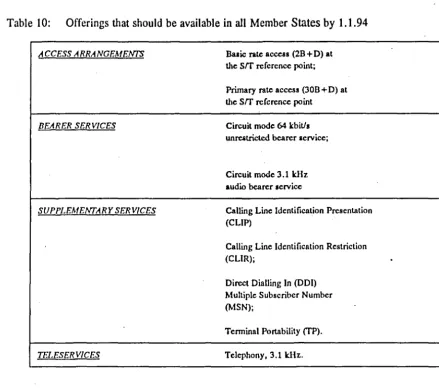
1 January 1994, and those which are to be provideti as soon as the demand in an individual Member State justifies it. For this second category, target dates for the provision of the facilities have to be published. Tables 10 & 11 list the facilities in the two categories; those in Table 10 coincide with priority facilities in the ISDN MoU; those in Table 11 emerged as priorities during the consultation carried out by the Commission on the ISDN
Analysis
Report21 •
19 Council Directive 90/387/EEC of 28 June 1990 on the establishment of the internal market for
telecommunications services through the implementation of open network provision (OJ No. L192, 24.07.90)
20 OJ No. L200, 18.07.92, p.10
-39.;
Table 10: Offerings that should be available in all Member States by 1.1.94
ACCESS ARRANGEME!'VTS Basic rate access (28+D) at the
srr
reference point;Primary rate access (308 +D) at the
srr
reference pointBEARER SERVICES Circuit mode 64 kbit/s unreatrictcd bearer aervice;
Circuit mode 3.1 kHz audio bearer service
SUPPLEMENTARY SERVICES Calling Line Identification Presentation (CLIP)
Calling Line Identification Restriction
(CLIR);
.
Direct Dialling In (DDI) Multiple Subscriber Number (MSN);
Terminal Portability (TP).
TELESERVTCES Telephony, 3.1 kHz.
Table 11: Minimum set of ISDN Offerings, to be provided according to published target dates and the availability of international standards
BEARER SERVICES
SUPPLEMENTARY SERVICES
Circuit mode 64 kbit/a unrestricted bearer service on reserved or permanent mode; Packet mode bearer service
provided over the 8 and/or D channels
Call transfer services Call forwarding services Reverse charging; Freephone/green number
Kioslc billing or equivalent features; Cloaed user group
[image:39.579.63.549.50.772.2] [image:39.579.97.536.57.448.2]