Den Europæiske Investeringsbank Europäische Investitionsbank Ευρωπαϊκή Τράπεζα Επενδύσεων European Investment Bank
Banco Europeo de Inversiones Banque européenne d'investissement Banca europea per gli investimenti Europese Investeringsbank
Banco Europeu de Investimento
September 1988 - No 57
ISSN 0250-3891
E/B-information
EIB Operations
in the Mediterranean countries In brief .
While the European Investment Bank's activities have always beenconcentrated within the Member States of the European C o m m u -nity, for the past 25 years the Bank has been providing a growing volume of finance for priority investments in countries outside the EEC. Since being established in 1958, the European Economic Community has envolved a policy of development cooperation w i t h non-EEC countries, complementary to that of its individual M e m b e r S t a t e s . The C o m m u n i t y ' s development aid policy has been to adopt measures and finance investments designed to strengthen the economies of those developing countries which traditionally have had close ties w i t h its M e m b e r States.
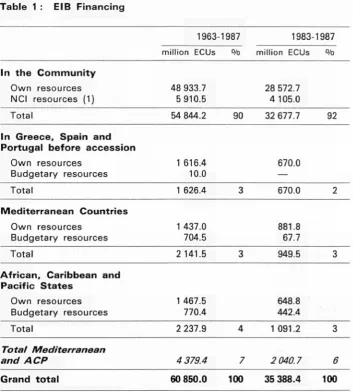
The EIB finances projects located outside the EEC specifically within the context of assisting in the implementation of the C o m m u n i t y ' s development cooperation policy. This development cooperation mainly covers t w o groups of countries, those in the Mediterranean region under individual country agreements, and the African, Carib-bean and Pacific states under the Lomé Convention. This issue of EIB-Information reviews the Bank's activities in the Mediterranean basin to date, and provides a perspective on its operations in the region over the coming years (See Table 1).
The Community's external economic and financial cooperation began relatively modestly in the early 1960s with the conclusion of Associ-ation Agreements with Greece and Turkey, and with 18 African States under the first Yaoundé convention. Today this relationship, imple-mented through specific coopera-tion agreements and convencoopera-tions, has greatly expanded to cover 12 countries in the Mediterranean basin and 66 in the African, Carib-bean and Pacific regions. In a parallel decision to the Lomé Convention, the Council of the Euro-pean Communities also makes specific provision for aid for the Overseas Countries and Territories enjoying special ties with certain Community Member States.
From the beginning, as the Commu-nity's external cooperation deve-loped, the EEC has called on the ElB's expertise as a project
finan-cing bank to contribute to imple-mentation of this policy.
An essential element of this coope-ration includes specified amounts of finance provided by the EIB and the EEC through the Commission of the European Communities. It is within this overall framework that the EIB has financed projects in support of economic development outside the EEC with a total of over 4.4 billion ECUs, representing about 7 % of the Bank's overall financing operations between 1965, when operations began in Turkey and end-1987. In addition the EIB has lent over 1.6 billion ECUs to finance projects in Greece, Spain and Portugal under special financing arrangements prior to their joining the EEC.
These activities are an important complement to the ElB's main area of operation in the European Community. Established as the
While EIB financing is concentrated within the EEC, for some 25 years the Bank has also helped to imple-ment the Community's developimple-ment policy. In this context, its operations are confined to two areas : the 66 African, Caribbean and Pacific sta-tes, signatories to the Lomé Con-vention, and 12 countries in the Mediterranean region under terms of financial protocols negotiated with the Community.
Within the EEC, the ElB's lending is principally demand led, subject to projects meeting the Bank's specific objectives and its financing criteria. Outside, maximum amounts are set for its financing in the framework of these protocols and the Convention.
The Bank's interest rates are depen-dent on the cost of its borrowings. However, in most countries outside, the convention and relevant proto-cols foresee interest rate rebates, within certain limits, from budge-tary funds managed under mandate by the Bank. Outside, the EIB is also mandated to manage concessionary financing from budgetary resources known as risk capital finance. Risk capital operations are accounted off balance sheet in the Bank's 'Special Section'. To date the EIB has advanced in these two geographical areas some 2.9 billion ECUs from its own resources and 1.5 billion from budgetary resources.
Community's bank for long-term finance under the EEC Treaty, over the past 30 years the EIB has made loans amounting to 61 billion ECUs (end-1987) for investment projects meeting priority objectives further-ing European integration.
The C o m m u n i t y ' s Mediterranean approach
Development of closer ties The aim of the Community's deve-lopment cooperation in the region is to stregthen mutual economic inte-rests. Sustained economic develop-ment in the Mediterranean area holds substantial advantages for the EEC as a sizeable market for its products, with considerable poten-tial for expansion. In turn the EEC itself, as the largest single unified economic zone in the region is the biggest market with a population of over 320 million. For most of the Mediterranean states the EEC represents a major outlet for their exports, and a vital source of tech-nical and industrial assistance. The complexity of this interdepen-dence has meant that the evolution of the Community's relationship with the other states in the Medi-terranean region has been relatively gradual. A particular impetus to the development of closer ties with the Mediterranean states came with the first enlargement of the EEC in 1973. At that time the Heads of State and Government called for the estab-lishment of an overall Mediterra-nean policy that defined a coherent and balanced approach to the EEC's relationships with countries in the region wishing to maintain or develop close ties with the Commu-nity.
Referred to as the Community's "overall Mediterranean approach", the policy evolved in a series of separate negotiations with the southern Mediterranean countries, involving aspects such as trade arrangements, including the removal or reduction of customs duties on most imports, and tech-nical and financial assistance. In its declaration the European Council (meeting of Heads of State and
Government) emphasised that they attached vital importance to the implementation of commitments that the Community had made with countries in the region which had concluded cooperation agreements or were in the process of negoti-ating them.
By 1977 such agreements had been concluded with the Maghreb states of Algeria, Morocco and Tunisia and Mashreq states of Egypt, Jordan, Lebanon and Syria, as well as Israel, and also with Yugoslavia, followed shortly afterwards by Cyprus and Malta.
In general the EEC's cooperation with developing countries involves many different forms of assistance, ranging from trading arrangements, technical, commercial and industrial cooperation, to export stabilisation schemes, and investment finance involving budgetary resources and EIB loans.
Mobilising resources
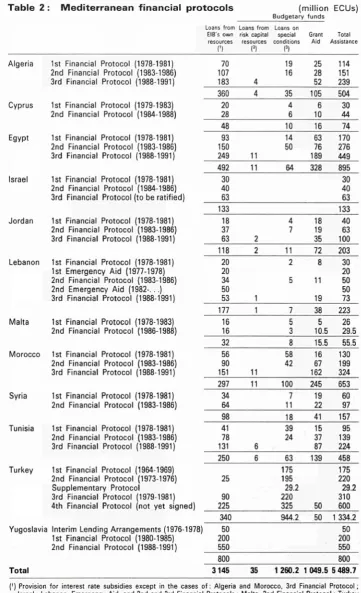
In the Mediterranean region the Community's technical and financial cooperation is covered by Financial Protocols, which normally run for five years, and are attached to the Cooperation or Association Agree-ments. These Protocols, as well as establishing the framework for the Community's cooperation, include participation by the Community in financing investment intended to contribute towards economic and social development. The amounts of finance written into the Protocols are established at a political level by the European Community with the Mediterranean country concerned.
The EIB is consulted about its readi-ness to participate as an instrument of the Community's developement policy. It thus operates under these Protocols with the approval of its Board of Governors.
As the EIB raises its finance on capital markets, the Bank's involve-ment in the Community's develop-ment cooperation means that funds can be mobilised in addition to those provided as grant aid or on concessionary terms.
Within the framework of the Finan-cial Protocols the Community's developement finance currently is made up of loans from the ElB's own resources, essentially the proceeds of its borrowings on capital markets ; risk capital assis-tance granted and managed by the EIB under mandate from the Euro-pean Economic Community; and grant aid through the Commission. The funds for risk capital operations and grant aid are drawn from the Community's budget. Under most of the Protocols some of the grant aid is used to provide an interest subsidy of 2 % on EIB loans, with the amounts involved being managed under mandate by the EIB.
As an instrument for the implemen-tation of the EEC's cooperation policy, the ElB's role has been significant. The financing operations it has carried out represent 75% of the Community's financial coopera-tion programme in the region. Inclu-ding pre-accession arrangements in Greece, Spain and Portugal, the EIB has advanced over 3.7 billion ECUs (from its own resources and under mandate) for project finance in Mediterranean countries.
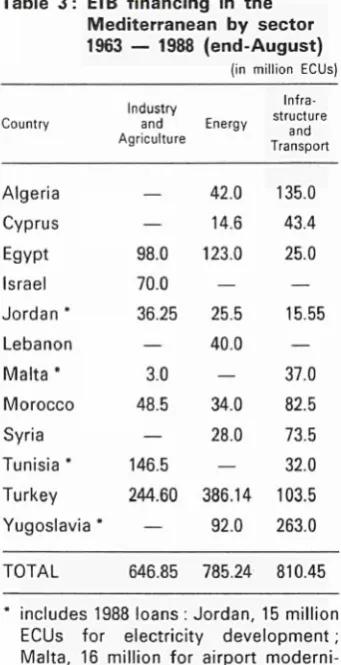
Excluding pre-accession financing operations in Spain and Portugal, over the past five years (1983 to end-August 1988) the EIB has chan-nelled over 1 billion ECUs into a wide range of key economic invest-ment, mainly in industry, agro-industry, energy and economic infrastructure in the 12 Mediterra-nean Countries. (This total includes 1988 financing operations amoun-ting to over 100 million ECUs to date in Jordan, Malta, Tunisia and Yugoslavia.)
ElB's role under the Financial Protocols
The Treaty of Rome and the ElB's Statute, which is a protocol attached to the Treaty, envisaged that the role of the EIB was to support projects within the territo ries of the EEC. However, it was also foreseen under article 18 that, with special authorisation, the EIB could finance projects implemented in whole, or in part, outside the Member States.
O w n resources
Authorisation for the EIB to grant loans from its o w n resources
outside the EEC comes from the Bank's highest decision making body, the Board of Governors (one Minister from each Member Country, usually the Minister of Finance), acting unanimously on a proposal from the Bank's Board of Directors. The Board of Governors authorises the global amounts under each Financial Protocol which is given after considering a request from the Council of Ministers. The amounts foreseen under each protocol can only be utilised if suffi cient good investment projects are brought forward.
The amounts approved for the Protocols in turn fall within a broader overall limit set by the Governors for the total volume of Bank operations outside the EEC. In the current period (1985-1991) the Governors have established an upper ceiling of 3 000 million ECUs. As for all its operations, individual loans are approved by the Bank's Board of Directors.
Under the terms of the various Protocols, the emphasis is placed on the EIB financing projects in those sectors most suited to loans rather than grant aid, which is the responsibility of the Commission. Generally, EIB loans go to support industry, particularly small and medium-sized enterprises through its global loans (see box), agro-industry projects, including on-farm investments, and to energy deve lopment schemes, such as power stations, transmission lines, as well
as infrastructure such as roads, ports, water supply and treatment, all necessary prerequisites for economic development.
The loans which the EIB provides from its own resources are basically
made on the same terms and condi tions as those within the Commu nity with interest rates that reflect the cost of borrowing. The EIB operates on a non-profit-making basis and having the finest credit rating — "AAA" — is able to raise
funds on the best terms available on capital markets, passing on the benefits to its own borrowers. In accordance with the Bank's prac tice, interest rates are determined at the time of signature of each loan contract.
In most cases in the Mediterranean states, however, the Bank's interest rates have been further softened with subsidies, normally about 2 % , drawn from the grant aid element of the relevant Financial Protocol where the State has opted for this.
Table 1 : EIB Financing
1963-1987 million ECUs %
1983-1987 million ECUs °/o
In the C o m m u n i t y
Own resources NCI resources (1)
48 933.7 5 910.5
28 572.7 4 105.0
Total 54 844.2 90 32 677.7 92
In Greece, Spain and Portugal before accession
Own resources Budgetary resources
1 616.4 10.0
670.0
Total 1 626.4 670.0
Mediterranean Countries
Own resources Budgetary resources
1 437.0 704.5
881.8 67.7
Total 2 141.5 949.5
African, Caribbean and Pacific States
Own resources Budgetary resources
1 467.5 770.4
648.8 442.4 Total
Total Mediterranean and AC Ρ
Grand total
2 237.9
4 379.4
60 850.0
4
7
100
1 091.2
2040.7
35 388.4
3
6
100
(1) New Community Instrument
[image:3.595.214.568.319.712.2]Risk capital
Under the latest Financial Protocols for the first time a certain amount of risk capital finance is included. This is in preference to loans on special conditions (40 years at 1°/o) which have been phased out. Risk capital assistance is a particu-larly adaptable form of financing devised by the EIB and refined under the Lomé Conventions in the ACP countries. It may be used as a complementary form of finance to lending from the Bank's own resources. Risk capital is geared mainly towards assisting both public and private industrial enter-prises.
As it is drawn from Community budgetary resources, risk capital allows for greater flexibility in setting terms and conditions. These depend on the nature of the project being financed, are on highly concessionary interest rates, and for terms ranging up to 25 years. The Protocols specify that such financing may be in the f o r m of subordinated loans where repay-ment of capital and interest is not made until other bank loans have been settled ; or conditional loans where repayment or length of loan will depend on the attainment of conditions specified at the time of contract signature, such as profit or production levels. The Bank can also utilise risk capital resources to acquire equity participations as temporary minority holdings in the name of the Community ; or for the purchase of shareholdings through a conditional loan granted to a state, or with government agree-ment — directly, or through an intermediary financial institution — to a local undertaking. In addition the funds can be granted for specific feasibility studies, helping undertakings during start-up or for rehabilitation invest-ment.
The funds drawn from budgetary resources, such as the risk capital finance under the latest Protocols, are managed under mandate by the EIB, for the account and at the risk of the European Community. These operations are accounted for off
balance sheet in what is called the ElB's Special Section, first set up in 1963 by the Bank's board of Gover-nors to take account of such opera-tions in Turkey under mandate from the Member States.
A strictly banking approach In financing projects, both inside and outside the Community, the EIB takes a strictly development banking approach. The viability of each project is assessed by teams of qualified financial analysts, economists, and engineers, able to draw on wide ranging experience built up by the Bank over the past 30 years. The EIB adopts the same rigorous approach used for project appraisal inside the Community to the assessment of investment in countries outside. Through an in-depth analysis of the economic, financial and technical viability of each project, the Bank ensures that the investment it finances will have a long-term positive impact on economic and social development.
25 years of activity
in the Nothern Mediterranean
By far the largest part of EIB finan-cing operations under the Financial Protocols over the past 25 years has been in the Northern Mediterranean countries. Of the over 2.2 billion ECUs channelled into non-EEC countries in the region between 1963 and end-August 1988, over 1 billion has gone to just two states — Turkey and Yugoslavia. If finan-cing in Malta and Cyprus is added, these four states account for 53 °/o of the total volume of EIB opera-tions in the Mediterranean.
Turkey
The Association Agreement with Turkey was intended to build closer links, and reduce the economic disparity between the country and the EEC Members. Emphasis in the agreement is on support for projects designed to improve productivity in the Turkish economy by financing investments in econo-mic infrastructure and industry and to raise agricultural output.
To date, three Protocols attached to this agreement have been completed, including a Supplemen-tary Protocol to the Second Finan-cial Protocol, for a total of some 734 million ECUs. Well over 8 0 % was in the form of loans on special condi-tions, with all financing operations in the country under these Protocols being carried out by the EIB. The first Financial Protocol came into operation in 1964, a year after the signing of the Association Agreement, and provided for 175 million ECUs in finance entirely on special conditions to be committed over the period 1964-1969. The funds were drawn from the budge-tary resources of the then six Member States of the EEC.
A Second Financial Protocol, running from 1973-1976, provided for 195 million ECUs in loans on special conditions, again from the budgets of the Member States, and 25 million from the ElB's own resources. A Supplementary Proto-col was concluded after the first enlargement of the EEC, and was made up of budgetary contribu-tions, totalling the equivalent of 29.2 million ECUs, of the then new members, Denmark, Ireland and the United Kingdom. Of this 18.7 million ECUs was lent in 1986 for a hydro-electric scheme involving the construction of a dam and a power station in Eastern Anatolia, and the balance going towards the erection of 220 km. of 380KV electricity transmission line in south-west of the country in 1987.
The Third Financial Protocol (1979 to 1981) included 220 million ECUs in loans from the Community's budget (instead of that of the Member States as before) and 90 million in loans from the Bank's own resources. A Fourth Protocol for a total of 600 million ECUs (225 million from the ElB's own resources) has
been negotiated, but not yet signed.
to Ankara and Istanbul, the construction of a dam and hydro electric power station at Karakaya, also on the Euphrates, the exploit ation of a lignite deposit at Elbistan (Eastern Anatolia) and the construc tion of an associated thermal power station, and the installation near Ankara of a national electricity grid control centre, along w i t h improve ments to the highvoltage supply grid.
The industry sector attracted some 235 million ECUs, equivalent t o 32 % of total lending in the country. An important part was channelled through t w o intermediary institu tions, the Industrial Development Bank of Turkey (TSKB) and the Industrial Credit and Investment Bank (SYKB), to support both largescale investment in industry and, through global loans, small and mediumscale ventures.
Direct loans also went t o w a r d s larger industrial projects mainly involving paper, petrochemicals and fertilizer schemes. Examples of projects financed included the construction of pulp, paper and board mills near Zonguldak on the Black Sea, at Dalamän, South W e s t Anatolia, and an integrated saw mill and paper mill near Mersin on the Mediterranean coast.
A smaller amount also went to the Turkish Government to finance public sector preinvestment expen ditures, such as feasibility studies.
For agriculture the Bank has lent 47 million ECUs for irrigation, land levelling and consolidation works to combat soil erosion and f l o o d protection in the Gediz and Berdan Valleys in Western and Southern Anatolia. Loans to projects in the transport sector totalled over 67 million ECUs. Amongst the projects supported was the construction of the first Bosporous suspension bridge and 19 km of associated urban motorway, an important link between Europe and Asia Minor. Finance also w e n t towards the modernisation of the Turkish railway system through the construction and introduction of diesel locomotives, electrification of the IstambulAdapazari line as well
Table 2 : M e d i t e r r a n e a n financial protocols ( m i l l i o n ECUs) Budgetary funds Loans from Loans from Loans on
ElB's own risk capital special resources resources conditions
ΓI (2) P )
Grant
Aid Assistance Total Algeria 1st Financial Protocol (19781981) 70
2nd Financial Protocol (19831986) 107 3rd Financial Protocol (19881991) 183 Cyprus 1st Financial Protocol (19791983)
2nd Financial Protocol (19841988) Egypt 1st Financial Protocol (19781981)
2nd Financial Protocol (19831986) 3rd Financial Protocol (19881991) Israel 1st Financial Protocol (19781981) 2nd Financial Protocol (19841986) 3rd Financial Protocol (to be ratified) Jordan 1st Financial Protocol (19781981)
2nd Financial Protocol (19831986) 3rd Financial Protocol (19881991)
Lebanon 1st Financial Protocol (19781981) 20 1st Emergency Aid (19771978) 20 2nd Financial Protocol (19831986) 34 2nd Emergency Aid (1982...) 50 3rd Financial Protocol (19881991) 53 Malta 1st Financial Protocol (19781983)
2nd Financial Protocol (19861988) Morocco 1st Financial Protocol (19781981)
2nd Financial Protocol (19831986) 3rd Financial Protocol (19881991) Syria 1st Financial Protocol (19781981) 2nd Financial Protocol (19831986) Tunisia 1st Financial Protocol (19781981)
2nd Financial Protocol (19831986) 3rd Financial Protocol (19881991) Turkey 1st Financial Protocol (19641969) 2nd Financial Protocol (19731976) Supplementary Protocol
3rd Financial Protocol (19791981) 4th Financial Protocol (not yet signed)
25 90 225 340 Yugoslavia Interim Lending Arrangements (19761978) 50 1st Financial Protocol (19801985) 200 2nd Financial Protocol (19881991) 550 800
Total 3145 35
19 16 25 28 52 11 19 114 151 239 360 20 28 48 93 150 249 492 30 40 63 133 18 37 63 118 4 11 11 2 2 35 4 6 10 14 50 64 4 7 11 105 6 10 16 63 76 189 328 18 19 35 72 504 30 44 74 170 276 449 895 30 40 63 133 40 63 100 203 30 20 50 50 73 177 16 16 32 56 90 151 297 34 64 98 41 78 131 250 1 11 11 6 6 7 5 3 8 58 42 100 7 11 18 39 24 63 38 5 10.5 15.5 16 67 162 245 19 22 41 15 37 87 139 223 26 29.5 55.5 130 199 324 653 60 97 157 95 139 224 458 175 195 29.2 220 325 50
175 220 29.2 310 600
944.2 50 1 334.2 50 200 550 800 1260.2 1049.5 5 489.7 ) Provision for interest rate subsidies except in the cases of: Algeria and Morocco, 3rd Financial Protocol;
Israel ; Lebanon, Emergency Aid, and 2nd and 3rd Financial Protocols ; Malta, 2nd Financial Protocol ; Turkey and Yougoslavia. The subsidies are drawn from grant aid and managed by the EIB under mandate from the EEC.
[image:5.595.203.565.159.753.2]as the purchase of five aircraft for domestic air services.
Yugoslavia
The 1976 joint "Declaration of Belgrade" signalled the intention of Yugoslavia and the EEC to streng-then and diversify contacts and trade, and underlined the Commu-nity's commitment to further constructive good-neighbour rela-tions. Following this declaration the EIB has lent 310 million ECUs for projects in the country of common interest to both Yugoslavia and the Community, with the loans coming from the Bank's own resources without subsidies.
Under an interim lending arrange-ment the EIB provided 50 million ECUs in loans between 1976 and 1978. Following the conclusion of a formal cooperation agreement, a First Financial Protocol came into effect in 1980 and provided for 200 million ECUs in finance up to 1985. Under special authorisation from the Bank's Board of Governors a further 60 million loan was approved in 1984.
By far the largest share of EIB finance — some 218 million ECUs — has gone towards investments in Yugoslavia's transport sector. Of this 151 million has supported works to up grade and improve the Trans-Yugoslav Highway, including Yugoslavia's share of a tunnel through the Karawanken mountains on the border with Austria. The highway plays a central role in Yugoslavia's transport system and, as the main route across the country, forms an important connection between Greece and other EEC countries, as well as between Europe, Turkey and the Middle East. The Bank also provided 67 million ECUs to moder-nise and electrify stretches of the main Trans-Yugoslav railway line. In addition the EIB has supported projects to improve and develop the Yugoslavian electricity network, which through interconnections widen the possibilities of exchanges in supplies between the grids of neighbouring European Community countries. As well as the erection of transmission lines.
works financed have involved link-ups with the Italian and Greek grids, and modernisation of the country's electricity control and monitoring systems.
Cyprus
The EIB has financed projects in Cyprus for a total of 58 million ECUs, fully utilising the amounts foreseen in Bank finance under t w o Financial Protocols, the first coming into effect in 1979 covering the period up to 1983. This Protocol included 20 million in loans on the Bank's own resources, and, from Community budgetary funds, 4 million in loans on special condi-tions. The Second Financial Protocol running from 1984 to 1988, provided for 28 million ECUs in loans from the Bank's own resources, with 6 million in special loans from the Community's budget.
Most of the finance through the EIB, some 43.4 million (8.9 million in special loans) went towards infras-tructure investment involving impro-vements in water supply and treat-ment, including tapping water resources in the Troodos mountains and piping the supplies to the main urban centres.
The balance of 14.6 million ECUs (1.1 million as a loan on special conditions) went for energy sector investments, involving the installa-tion of two 60MW generating units at a thermal power station and for a scheme to improve the electricity power distribution system.
As the Protocols stipulate, projects financed have benefitted both the Greek and Turkish Communities on the Island.
M a l t a
In Malta, the EIB has deployed finance under two protocols — the first coming into effect in 1978 that provided for 16 million ECUs in loans from the Bank's own resources, and 5 million on special conditions. The second which expires this year, also allowed for 16 million ECUs in loans from own resources, with a further 3 million on special conditions managed by the Bank.
Investments supported by the EIB in the island have been largely in the
infrastructure sector, with the largest portion, 24 million ECUs (of which 5 million on special condi-tions) going towards essential transport investment. This included a project to redevelop the Island's commercial port, Valetta Harbour, which plays a vital role in Malta's economic development as it handles virtually all the Island's imports and exports. In May this year the EIB lent 16 million ECUs for the construction of a new modern air terminal at Malta's only airport, to cater for increasing numbers of tourists who are of major impor-tance to the country's economy. The balance of 16 million ECUs went for a project to rehabilitate and expand the island's national and international telecommunica-tions and for the construction of a domestic waste recycling plant producing compost for farmers, land reclamation and forestry schemes being implemented by the governement.
The M a g h r e b , Mashreq and Israel
Up until 1987 the ElB's operations in the Maghreb and Mashreq states were covered by two series of Financial Protocols following on from the conclusion of Cooperation Agreements that came into effect at the end of the 1970s. In the case of Lebanon additional amounts have been foreseen under special Emer-gency Aid arrangements.
These Financial Protocols, covering the periods 1978-1981 and 1983 to 1986, provided for a total of 1 684 million ECUs in finance to support economic and social development in these countries, of which 962 million was foreseen in loans from the ElB's own resources, 298 million in loans on special conditions, and 424 million in the form of grant aid. W i t h the exception of Lebanon, where the current internal crisis has held up implementation, the amounts foreseen in finance from the EIB under these Protocols have
been committed. During the period the EIB has granted nearly 880
million ECUs in loans from its own resources and 70 million in loans on special conditions.
Projects financed have been in keeping with the orientations of the Protocols to support schemes designed to complement the objec-tives and priorities of national de-velopment plans. While the trend has been for EIB financing to be concentrated on productive and economic infrastructure sectors, the emphasis has varied according to each country's specific needs and the evolution in its economic devel-opment.
Algeria
In Algeria, under the two Financial Protocols, the ElB's activities were entirely in loans from its own resources, totalling 177 million ECUs. Projects in the transport sector took the largest share, amounting to 135 million ECUs. Funds went towards the improve-ment, upgrading and removal of communication bottlenecks on major routes linking important economic centres in the country, which will also help development in less accessible regions. Schemes financed include the main road linking the port of Jijel and Constantine, Algeria's third largest city, and the motorway from Algiers to Blida. In addition funds went for a scheme to develop and expand general freight handling capacity at the port of Bejaia.
The remaining 42 million ECUs financed schemes in the energy sector for expansion of electricity generating capacity in towns in the south of the country to meet increa-sing demand for power from industry and a growing population, as well as helping to develop facili-ties to exploit tourism potential.
Morocco
Total EIB financing in Morocco during the same period amounted to 165 million ECUs, of which 19 million was on special conditions. About half went to support deve-lopment of economic infrastructure — 68.5 million ECUs in own
resources, and 14 million from budgetary resources — for trans-port and water schemes.
Projects included construction of facilities at the port of Jorf Lasfar to handle some of Morocco's exports of phosphate rock, the country being the world's leading exporter, as well as the expansion and impro-vement of existing facilities at the ports of Safi and Agadir. In the same context the Bank has financed a scheme to extend the petroleum handling facilities at the port of Mohammedia.
The EIB also lent 18 million ECUs towards the construction of a dam at Ait Chouarit in the Atlas Moun-tains which will provide resources for irrigation and improved water supplies to Marrakech. This was followed up with 34 million ECUs for a hydroelectric power station at Amougguez dependent on water power from the same dam.
In the productive sector the EIB has channelled some 48.5 million ECUs towards small and medium-scale investment in industry and agro-industry in the form of global loan to financial intermediaries for on-lending in smaller amounts.
These global loan schemes included one to the government's Office pour le Développement Industriel (ODI) to be used for acquiring equity holdings in small and medi-um-sized industrial undertakings. A similar loan to the Banque Nationale pour le Développement Economique (BNDE) was earmarked to be on-lent to a number of commercial banks to support smal-ler-scale ventures, as well as for financing such ventures directly. Finance in the form of global loans to the Caisse Nationale de Crédit Agricol (CNCA), in keeping with the government's priority to encourage greater agricultural self-sufficiency, has gone to small on-farm invest-ment and agro-industrial ventures.
Tunisia
The greater part of EIB lending in Tunisia — 153.5 million ECUs, of which 35.5 million on special condi-tions — has been channelled directly or indirectly into investment aimed at modernising and expan-ding agricultural and agro-industrial output to meet growing domestic demand. This was particularly the case in the second Financial
Global· loans
A key element in establishing an industrial base in countries striving for economic development is the encouragement of investment in small and medium-sized enterprises. These are crucial both in terms of job creation and in encouraging industrial expansion and innovation.
In this context the bulk of EIB loans in support of industrial, agro-industrial, and agriculture development in the Mediterranean countries has been for such small-scale projects. For practical reasons the Bank itself does not handle numerous small-sized loans spread throughout the Mediterranean region. As it does within the Community, the EIB reaches small and medi-um-sized enterprises through its global loan schemes. These are basically lines of credit made available to a financial intermediary, normally national and local development banks or official financing institutions in the Medi-terranean countries.
Protocol, which went entirely towards supporting investment to strengthen agriculture and agro-industry.
[image:8.595.20.191.397.730.2]Some 59.5 million ECUs has gone towards larger agricultural projects such as the development of farm complexes to improve meat and milk production in north and central parts of the country as well as to raise productivity on date palm plantations in the south ; for on-farm investments to boost live-stock and fruit production on estates of the Office des Terres Dominiales (OTD) ; and the construction of a dairy to produce long-life milk and butter. Similar
Table 3: EIB financing in the Mediterranean by sector 1963 — 1988 (end-August)
Country
Algeria Cyprus Egypt Israel Jordan * Lebanon Malta * Morocco Syria Tunisia * Turkey Yugoslavia *
TOTAL
Industry and Agriculture
— —
98.0 70.0
36.25
— 3.0
48.5
—
146.5
244.60
—
646.85
(in million ECUs) Energy
42.0
14.6
123.0
—
25.5
40.0
—
34.0
28.0
—
386.14
92.0
785.24
Infra-structure Transport
135.0 43.4 25.0 — 15.55
— 37.0 82.5 73.5 32.0 103.5 263.0
810.45 * includes 1988 loans : Jordan, 15 million
ECUs for electricity development ; Malta, 16 million for airport moderni-sation ; Tunisia, 25 million for small and medium-sized industry and tou-rism ventures ; Yugoslavia, 45 million for construction of the Karawanken Tunnel.
schemes supported include the construction and fitting out of ferti-lizer storage centres in north and central regions, and the purchase of trawlers to expand Tunisia's fishing potential.
Small and medium-sized agricul-tural, agro-industrial, and fishing ventures have also been financed with a total of 50 million ECUs through global loans granted to Banque Nationale de Développe-ment Agricol (BNDA), including one for investments by farm co-operatives (Unités Coopératives de Production).
The balance of 44 million ECUs, has been in the form of a global loan to Banque de Développement Écono-mique de Tunisie (BDET) for on lending to small and medium-sized industry and tourism ventures, for the relocation of a railway line that would have been flooded through the construction of a dam, and for construction of another railway line mainly to transport phosphate rock from deposits at Gafsa to the processing centre of Gabes.
Egypt
EIB financing operations in Egypt to date have totalled 246 million ECUs, of which 3 million was on special conditions. About half — 123 million ECUs — went to support develop-ment of the country's energy poten-tial. The largest portion was in a series of loans for the construction and later expansion of the Shoubra el Kheima oil/gas fired power station, as well as its connection to the national electricity grid. The power station forms part of a national programme to increase electricity generating capacity to meet rising demand from domestic and industrial users. The Bank has also supported the development of natural gas deposits near Alexan-dria.
A total of 98 million has helped investment in the industrial sector, the largest being a loan for the construction of a white cement plant near Samalut to meet domestic demand. Funds also went for the construction of a gypsum
calcination plant at El Sadat City, and for a desert clay brick-works at Béni Mazaar. Global loans through the Development Industrial Bank (DIB) have supported investments by small and medium-sized industry and tourism ventures, and included a 3 million ECUs facility on special conditions to enable DIB to acquire participations in ventures operating in these areas.
In the transport sector the EIB advanced 25 million ECUs as one of its first loans in Egypt for a scheme to deepen and widen the Suez Canal, upgrade the Canal's facilities and construct a new canal section to bypass Port Said.
Jordan
EIB financing in Jordan, totalled 62.3 million ECUs (7.3 million on special conditions) under the first t w o Protocols. Emphasis was given to supporting industrial develop-ment, which accounted for 28.3 million ECUs of the total. Of parti-cular significance was the Bank's support for the first and second phases of the preparation of a large industrial estate at Sahab, near Amman, involving provision of basic service infrastructure (roads, electri-city, water supplies, administrative buildings, standard factory buil-dings). Global loan finance also went to the Industrial Development
million, the funds going to five sheep fattening units that will help increase domestic meat production, and as global loans to the Jorda-nian Cooperative Organisation (JCO) and the Agricultural Credit Corporation for small on-farm investment such as land reclama-tion and irrigareclama-tion schemes, buil-dings, farm equipment and live-stock.
Lebanon
To date, EIB finance totalling 40 million ECUs from the Bank's own resources, has gone towards the expansion of capacity at the Jieh power station involving the addition of three 70MW generating sets, and for equipping Zouk thermal power
station with two 125MW units, both near Beirut.
These projects utilised the amounts foreseen under the first Emergency Aid which the Community agreed to extend in Lebanon in 1977 to assist its economic recovery, as well as the loans from the Bank's own resources foreseen under the First Financial Protocol (1978-1981).
Syria
In Syria the bulk of the Bank's lending — 98 million ECUs from own resources and 3.5 on special conditions — was concentrated on infrastructure investments. A total of 36.5 million ECUs helped finance major road schemes, including the construction of the 530 km road
connecting Aleppo in the west with Tall Kojak on the Iraqi border, and a new dual-carriage highway joining Damascus with Jordan which forms an important link for international traffic between Europe and the Middle East. The Bank also approved finance for a major scheme to develop and extend Aleppo's sewerage system, which will lead to environmental benefits and improve the quality of water used for irrigation.
Other projects financed by the Bank include 20 million ECUs for an irri-gation and drainage scheme on the Lower Euphrates which will contri-bute to greater agricultural self-suf-ficiency. 28 million ECUs also went towards expansion of the Mehardeh thermal power station with t w o 165MW turbine units.
Protecting the Mediterranean's environment
An in-depth study pinpointing environmental problems affecting the Medi-terranean sea is being jointly carried out by the EIB and the World Bank. The study will help define a global approach to environmental protection involving both Community Members and other states bordering the sea.
As well as evaluating particular environmental problems, the research will focus on priority investment needed to reduce pollution, as well as sources of finance for such projects. The first stage of the study is likely to be com-pleted by the end of the year and provide an orientation on the priorities and the volume of finance needed.
The joint research takes into account work already carried out by interna-tional organisations in particular that connected with the UNEP's "Mediter-ranean Action Programme", and that of the OECD and the Commission of the European Communities.
Analysis is being concentrated on current and prospective trends threa-tening to damage the ecosystem, the policy and attitude of authorities and institutions, and examination of existing programmes to safeguard and en-hance the environment. Equally, the amount of capital needed for improve-ments, and possible alternatives in order of importance, are to be asses-sed.
Besides a country-by-country review, the key problem areas to be covered include: urban environment; pollution by shipping, industry, power-supply systems and tourism ; and protection of natural resources.
Israel
EIB operations in Israel have also been covered by two Financial Protocols, from 1978 to 1981, and 1984 to 1986, which foresaw a total of 70 million ECUs in loans from the ElB's own resources. Israel being a provision has been made under these protocols for grant aid or loans on special conditions.
The amounts provided for have been fully used in the form of four global loans to the Industrial Deve-lopment Bank of Israel (IDBI) for on-lending to small and medium-sized industrial ventures. These funds have gone to 54 such projects, ranging from ventures in the chemical industry, mining, metal working and light engineering, to food processing, construction, and preparation of industrial estates.
The n e w round of protocols
funds from its own resources within the Mashreq, Maghreb and Israel, up to 1991. This is a 6 7 % increase on the previous round of Protocols, and accounts for 6 2 % of Commu-nity aid in the area.
In addition the Community's coope-ration aid provides for up to 615 million ECUs in concessionary finance drawn from budgetary resources, mainly in the form of grant aid managed by the Commis-sion, but with up to 37 million ECUs to be allocated in the form of risk capital by the EIB under mandate. The risk funds will be used primarily to make equity capital available to assist the realisation of projects, particularly joint ventures involving enterprises from the EEC and Medi-terranean countries.
A Second Financial Protocol with Yugoslavia has also come into operation this year which provides for 550 million ECUs entirely in EIB
loans.
On the basis of the new financial arrangements, therefore, the EIB can be called on in the coming years to commit over 1.5 billion ECUs in loans from its own resources for investments suppor-ting economic development in the Mediterranean region.
In the current economic environ-ment, most of the Mediterranean countries have seen a decline in their economic activity, an increase in external debt, and rapidly growing food imports. In response most of the countries in which the Bank has been operating are adop-ting structural adjustment measures within the framework of programmes supported by the World Bank (IBRD) and the IMF. The emphasis for the EIB under the Financial Protocols will be to support investment that ties in with these countries' structural adjust-ment programmes.
Under the new Protocols with the Mediterranean Arab states, the main new aspect in their orientation is a stronger emphasis on support for investment in the agricultural sector, given the growing food
defi-cits which form an increasingly heavy burden on these countries' balance of payments.The emphasis is on supporting the development and diversification of agricultural production.
Implementation o f the Protocols
Following the signing of a Protocol, the EIB and the Commission carry out programming missions to estab-lish with the national authorities a mutually agreed indicative aid programme. This is to prepare the ground for implementing the Finan-cial Protocols and to identify specific objectives for financial and technical cooperation. These programmes are relatively flexible and may be reviewed and revised during the Protocol's life to take into account changes in the economic situation or in the objec-tives and priorities laid down in the relevant country's development plan.
For instance, in the case of Jordan, an indicative programme has been mutually agreed in which the orien-tation foreseen for EIB loans is to support, in particular, agriculture, water resource development and industry, as well as energy and economic infrastructure. In August this year a 15 million ECUs loan, under the new Protocol went for the extension and reinforcement of the electricity distribution system in Amman and the nearby town of Zarqa.
In Tunisia the emphasis under the indicative programme is similarly placed on agriculture and industry, as well as on tourism development. The first financing under the new round of Protocols was in June in Tunisia, with 12 million ECUs from the ElB's own resources going to the Banque de Développement Economique de la Tunisie (BDET) to support smaller-scale industrial sector projects in keeping with the government priority to develop private investment and labour inten-sive small and medium-sized
ventures. BDET at the same time received 3 million ECUs under the first risk capital operation in the region, to be used for equity partici-pation in industry with an emphasis on joint-projects with partners from the Community. The funds will be utilised by BDET either to subscribe directly to shares, or to help finance participation by Tunisian business interests, in the capital of a produc-tive enterprise. A further 10 million ECUs has gone to Banque Nationale de Développement du Tourisme (BNDT) for financing tourism related projects.
In Algeria it is foreseen that the greater part of the Bank's financing will go towards investment invol-ving water resources (irrigation and sewerage). Other possible areas for EIB operations include agriculture and economic infrastructure.
In the case of the new Second Financial Protocol for Yugoslavia, the emphasis is on financing invest-ments in transport infrastructure of common interest to both the EEC and Yugoslavia. W i t h Greece's membership of the Community in 1981, Yugoslavia has become
important as a transit country, carrying 85 % of the traffic between Greece and the rest of the Commu-nity, the majority by road.
Under this Protocol the EIB lent 45 million ECUs in July towards the construction of the final stages of the trans-alpine Karawanken Tunnel on the Yugoslav-Austrian border. The tunnel will join the Trans-Yugoslav Highway with the Tauern route through Austria, linking up with the EEC motorway network in Germany.
Loan arrangements
contacts from potential project promoters can be quite informal. However, every project that the Bank finances, including those from risk capital resources, is subject to the same in-depth project appa-raisal by the ElB's own staff. The Financial Protocols specify that EIB financing shall be made in accor-dance with the arrangements, conditions and procedures as laid down in the Bank's Statutes.
In keeping with this policy, an EIB loan may cover up to 50 % of the total capital cost of the new
invest-ment being financed. An EIB loan must, therefore, be combined with other sources of funds necessary to ensure the project's success, inclu-ding the promoters own contribu-tion, outside credit, risk capital if necessary, government funds or support from other banks or deve-lopment agencies. The ElB's loan
thus forms part of the overall finan-cing plan for the project.
EIB loans are generally disbursed in currency mixes with repayments made in the same currencies and proportions as originally borrowed. While the term of loans will depend on the nature of the project, within the Mediterranean region finance for industrial investment generally ranges from about 10 to 12 years and for infrastructure between 15 and 20 years.
In the interest of the project, special attention is accorded to ensuring that appropriate tendering arrangements are followed. After the EIB and the borrower have agreed on the best approach, tender notices are normally published in the Official Journal of the European Communities, and possibly in other specialist publica-tions. Bidding must be open at least
to untertakings in the Mediterra-nean state and EEC Member
Coun-tries, although where appropriate, firms based in countries which have
offered the Bank access to their capital markets or which, in the ElB's opinion, afford the project particular advantages, may also be accepted.
The EIB cooperates with other project financing institutions such as bilateral aid organisations of the Community Member States, the World Bank (IBRD) and its affiliates, as well as bilateral and multilateral aid institutions such as the African Development Bank or the Arab funds, and commercial banks. Such cooperation may range from identi-fying possible projects, to co-financing investments in the form of separate loans to the same project, or funding specific compo-nents of a larger integrated deve-lopment project.
The EIB Prize "Investment and Financing
#/
The European Investment Bank invi-tes entries for its 1989 EIB Prize which will be awarded next June. Established on the occasion of the 25th anniversary of the Bank in 1983, the EIB Prize is awarded every two years for a doctoral dissertation on the topic of investment and f i -nancing. It consists of 10 000 ECUs and a diploma signed by the Chair-man of the Prize Jury and the Presi-dent of the Bank. An internal jury of experts has been appointed, consis-ting o f :
Beniamino ANDREATTA, Professor of Economics, University of Bologna ; Jacques LESOURNE, Professor of Economics,
Conservatoire National des Arts et Métiers, Paris ;
Wilhelm HANKEL,
Honorary Professor for
Develop-ment and Monetary Policy, Johann Wolfgang Goethe Universi-ty, Frankfurt ;
Michael MacCORMAC,
Professor emeritus of Business A d -ministration,
University College, Dublin ; Arnold HEERTJE
Professor of Economics, University of Amsterdam ; Lord ROLL of IPSDEN, Chairman,
S.G. Warburg & Co, Ltd., London. Lord Roll has been elected Chair-man of the Jury.
To qualify, theses must have been accepted as doctoral dissertations by a university or equivalent institu-tion in a Member Country of the Eu-ropean Community between Janu-ary 1985 and 1 FebruJanu-ary 1989. Can-didates must have the nationality of
one of the Member Countries and be under 40 years of age on the da-te the thesis is sent to the EIB as an entry for the Prize. The closing date for submission of theses is 1 Febru-ary 1989.
The first EIB Prize was presented in 1985. It was awarded to Ms Giovan-na Nicodano for her thesis "Struttu-ra finanziaria, costo del capitale e decisioni d'investimento", for which she obtained her doctorate at the Università Commerciale Luigi Boc-coni in Milan in 1983. In 1987 the se-cond EIB Prize was awarded to Ja-nette Rutterford for her thesis "An empirical investigation into the ef-fects of corporate taxation on com-pany capital structure". Ms Rutter-ford obtained her doctorate at the London School of Economics in 1986. (See page 12 for EIB prize ru-les).
IXAA88057ENC
Rules for the EIB Prize
Article 1. The EIB Prize was instituted by the European Investment Bank on the occasion of its 25th anniversary in 1983.
Article 2. The EIB Prize was instituted to promote in the academic insti tutions of the European Community Member States the study of invest ment and financing in all its various aspects.
Article 3. The EIB Prize shall be awarded for a thesis on the topic of investment and financing in their broadest sense.
Article 4. To qualify as an entry for the EIB Prize, each thesis will have to have been successfully presented as a doctorate dissertation to a univer sity or equivalent academic institution in a Member State of the European Community.
Article 5. The EIB Prize may be awarded to any person having the nationality of one of the Member States of the European Community, who is under 40 years of age on the date the thesis is sent to the EIB. Article 6. The jury will accept as entries for the Prize theses by which doctorates have been obtained during the four calendar years prior to the year in which the Prize is to be awarded and up to the final date of submis sion in the year of award.
Article 7. The Prize shall consist o f : (a) the sum of 10 000 ECUs; (b) a diploma signed by the chairman of the Prize jury and the President of the European Investment Bank.
Article 8. The Prize was awarded in 1985 and 1987 and will be again in 1989. The terms for its award may be reviewed following the conferral of the Prize.
Article 9. The Prize shall be announced in the Official Journal of the European Communities and in relevant economic and financial publications published in the Member States at least three months prior to the closing date for the submission of entries.
Article 10. The Prize jury shall consist of six independent learned experts of high repute, to be appointed by the Management Committee of the European Investment Bank.
Article 11. The Prize jury shall make known its decision to the President of the European Investment Bank, no later than 1 June of the year of the award, in the form of a summary report, stating its grounds. The Manage ment Committee shall a ward the Prize on the basis of that report. The Prize jury shall have the option of not recommending a candidate for the award.
The Prize jury's findings shall be final, and not open to appeal.
Article 12. The name of the prizewinner will be announced and the Prize will be awarded on the day of the Annual Meeting of the EIB Board of Governors of the year in question.
Article 13. The costs of adjudication and award shall be borne by the European Investment Bank.
Article 14. EIB staff members shall not be eligible to enter for the Prize. Article 15. Theses can be submitted in any of the official languages of the European Community. An elaborate summary in any of the official langu ages of the European Community has to be annexed.
Article 16. Candidates for the 1989 Prize should send two copies of their entries by registered mail to the EIB, 100, Boulevard Konrad Adenauer, L-2950 Luxembourg, by 1 February 1989.
For additional information please contact the Information Division of the European Investment Bank, L-2950 Luxembourg,
tel. : 4379-4223 (Mr. Cees Post)
Ecu
Below are the ECU's values in national currencies, as at 30 June 1988; these rates are applied to the third quarter in preparing financial statements and operational statistics of the Bank :
DM £ FF Lit Hfl Ptas
2.07521 0.667628 6.99875 1 539.75
2.34037 138.686
FB Flux DKr Dr £irl. Esc US$
43.4741 43.4741 7.88073 166.434
0.772392 169.319
1.14098
EIB-Information is p u b l i s h e d p e r i o d i cally b y t h e European I n v e s t m e n t B a n k in nine d i f f e r e n t l a n g u a g e s ( D a n i s h , D u t c h , E n g l i s h , F r e n c h , G e r m a n , Greek, I t a l i a n , P o r t u g u e s e and S p a n i s h ) .
Material which appears in
EIB-Information may be freely reproduced ;
an acknowledgement would be appre ciated and also a clipping of any article published.
100, bd Konrad Adenauer L-2950 Luxembourg
tel. 4379-1 — telex 3530 bnkeu lu
telecopier 43 7704
Department for Italy:
Via Sardegna, 38 — 1-00187 Rome
tel. 4719-1 — telex 611130 bankeu i
telecopier 474 58 77
Liaison Office for the United Kingdom :
68, Pall Mall London SW1Y 5ES
tel. 8393351 telex 919159 bankeu g
telecopier 930 9929
Liaison Office in Lisbon :
Avenida da Liberdade, 144-156, 8? Ρ-1200 Lisbon
tel. 328989 or 328848 telex 15576 bnkeu ρ
telecopier 3704 87
Representative Office in Athens: Ypsilantou 13-15
GR-10675 Athens tel. 7249811 telex 222126 bkeu gr
telecopier 7249 814
Representative Office in Brussels : Rue de la Loi 227
Β-1040 Brussels
tel. 2309890 — telex 21721 bankeu b telecopier 230 5827
Printed in Luxembourg by Imprimerie Centrale, 15, rue du Commerce, Luxembourg