UNIVERSITY OF SOUTHERN QUEENSLAND
SELF-DIRECTED LEARNING AND APPRENTICES:
A CONSTRUCTIVIST GROUNDED STUDY
This thesis is submitted by:
Damien Phillip Pearce
VGCMgt(Learn), GradDipTertTeach, MEdLead
For the award of
Doctor of Education
Abstract
Developing the capacity of learners to be self-directed is beneficial for both individual workers and economies alike. This study investigates the development of capability for self-directed learning in a group of apprentices in the building and construction industry and suggests that such capability is best developed in the early years of entry into the workforce. For tradespersons this time is during their apprenticeship.
The purpose of this study was to develop a deep understanding of how apprentices develop the capacity to be self-directed learners. The aim was to develop a substantive theory that illuminated and provided insight into this phenomenon.
The methodology of constructivist grounded theory was used to conduct the study. A sample size of 13 participants in the building and construction industry was recruited. This included apprentices who were employed by a group training organisation (GTO) and a representation of their host employers and vocational teachers located within the southern New South Wales and the Australian Capital Territory geographic regions. The substantive theory presented in this dissertation makes a contribution to knowledge of value to apprentices, employers, vocational teachers and others who seek to develop an understanding of the process of learning and development associated with apprenticeships and vocational and professional education more broadly.
The substantive theory was achieved through discovering, describing, analysing abstracting and explaining how apprentices moved through the phases (or categories) of committing effort, experiencing work, confirming value, and heightening motivation towards becoming self-directed learners. The substantive theory reveals that as the apprentices progressed through these phases they were constantly engaged in decision-making processes, evaluating and re-evaluating experiences throughout their apprenticeship. The evaluation outcomes could be positive or negative and were dependent upon the expectancies that the apprentices placed on themselves as well as their interpretation of the expectancies placed on them by others.
In this study the manner in which the various conceptual elements, processes and categories connect revolves around the apprentices’ experiences of sponsorship. Sponsorship is the term used to describe the more experienced or confident other who has both a personal and professional interest in the apprentice’s development and uses their influence to create a safe learning environment to enable the apprentice to develop expertise.
sponsor was the most important factor determining the quality of the learning environment. Effective sponsors were able to manage the learning context in a manner where the apprentice felt safe to ask questions, make mistakes, develop expertise and eventually accept responsibility, be autonomous and solve complex problems. Indeed, the apprentices became tradespeople who were not only competent but were true self-directed learners.
Certification of Dissertation
I certify that the idea, result, analysis and conclusions reported in this dissertation are entirely my own effort, except where otherwise acknowledged. I also certify that the work is original and has not been previously submitted for any other award expect where otherwise acknowledged.
Signature of Candidate
Damien Pearce
Date
Endorsement
Signature of Supervisor
Dr. Mark Dawson
Date
Signature of Supervisor
Dr. Janice Jones
Acknowledgements
There are many people that I need to thank.
Dr. Mark Dawson and Dr. Janice Jones as my supervisors from the University of Southern Queensland (USQ). Thank you for your professional and personal support throughout this study and for guiding me through my apprenticeship as a researcher, including the peculiarities of academia. This thanks is also extended to the research support office, library and members of the ethics committee at USQ. I would also like to acknowledge the editing services provided by Ms. Katie Poidomani from Edge Editing.
A big thank you to the apprentices, host employers, vocational teachers and the supporting organisations that willingly gave up their time to participate within this research and their combined interest in increasing the quality of apprenticeships and their industry stewardship.
I would also like to thank all of my friends, family and colleagues for their ongoing support, robust discussions and humour. This helped to keep me motivated and on task. At the risk of leaving someone out, I do not want to name anyone specifically. You know who you are!
Lastly, a deep and sincere thank you to my wife and best friend, Beck. I wouldn’t have even got close to this point without your love, support and, as it seems, unlimited patience.
Table of Contents
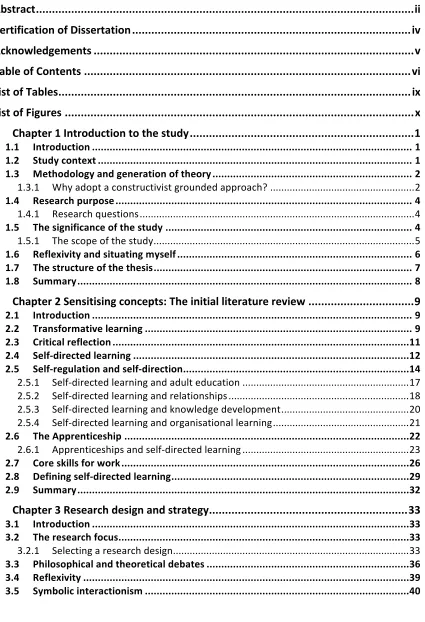
Abstract ... ii
Certification of Dissertation ... iv
Acknowledgements ... v
Table of Contents ... vi
List of Tables ... ix
List of Figures ... x
1 Chapter 1 Introduction to the study ... 1
1.1 Introduction ... 1
1.2 Study context ... 1
1.3 Methodology and generation of theory ... 2
1.3.1 Why adopt a constructivist grounded approach? ... 2
1.4 Research purpose ... 4
1.4.1 Research questions ... 4
1.5 The significance of the study ... 4
1.5.1 The scope of the study ... 5
1.6 Reflexivity and situating myself ... 6
1.7 The structure of the thesis ... 7
1.8 Summary ... 8
2 Chapter 2 Sensitising concepts: The initial literature review ... 9
2.1 Introduction ... 9
2.2 Transformative learning ... 9
2.3 Critical reflection ... 11
2.4 Self-‐directed learning ... 12
2.5 Self-‐regulation and self-‐direction ... 14
2.5.1 Self-‐directed learning and adult education ... 17
2.5.2 Self-‐directed learning and relationships ... 18
2.5.3 Self-‐directed learning and knowledge development ... 20
2.5.4 Self-‐directed learning and organisational learning ... 21
2.6 The Apprenticeship ... 22
2.6.1 Apprenticeships and self-‐directed learning ... 23
2.7 Core skills for work ... 26
2.8 Defining self-‐directed learning ... 29
2.9 Summary ... 32
3 Chapter 3 Research design and strategy ... 33
3.1 Introduction ... 33
3.2 The research focus ... 33
3.2.1 Selecting a research design ... 33
3.3 Philosophical and theoretical debates ... 36
3.4 Reflexivity ... 39
[image:6.612.120.545.118.740.2]3.6 Constructivist and social constructivist perspectives ... 42
3.7 Selecting grounded theory ... 42
3.7.1 Constructivist grounded theory ... 44
3.8 Generalisability ... 46
3.9 Substantive and formal theory ... 46
3.10 Ethical considerations ... 47
3.11 Data collection and analysis ... 49
3.11.1 Initial sampling ... 50
3.11.2 Interviewing ... 51
3.11.3 Analysis (coding) ... 52
3.11.4 Theoretical sampling ... 54
3.11.5 Theoretical saturation ... 55
3.12 Summary ... 55
4 Chapter 4 Exploring the categories: Putting it all together ... 57
4.1 Introduction ... 57
4.2 Overview of the categories ... 58
4.2.1 Committing effort ... 60
4.2.2 Experiencing work ... 60
4.2.3 Confirming value ... 61
4.2.4 Heightening motivation ... 61
4.3 Evaluation and decision making ... 62
4.4 Sponsorship ... 62
4.5 The categories ... 63
4.5.1 Committing effort ... 63
4.5.2 Influence of family and friends ... 66
4.5.3 Experiences with work ... 69
4.5.4 High expectancy of completion ... 70
4.6 Experiencing work ... 71
4.6.1 Gaining employment ... 73
4.7 Discovering place ... 78
4.8 Developing expertise ... 81
4.9 Confirming value ... 86
4.9.1 Learning from others ... 89
4.9.2 Becoming confident ... 92
4.9.3 Developing identity ... 96
4.10 Heightening motivation ... 98
4.10.1 Becoming accepted ... 99
4.10.2 Learning with others ... 101
4.11 Sponsorship within the workplace ... 104
4.12 Summary ... 105
5 Chapter 5 Discussion ... 107
5.1 Introduction ... 107
5.2 Decision making ... 109
5.2.1 Normative decision making ... 112
5.2.2 Descriptive decision making ... 112
5.3 Decision-‐making styles ... 117
5.4 Learning context ... 118
5.5 Transfer of learning ... 121
5.6 Quality of apprentice experience ... 125
5.6.1 Role of the apprentice’s sponsor ... 129
5.7 Belongingness ... 130
5.8 Motivation ... 133
5.8.1 Social cognitive career theory ... 133
5.8.2 Interest model ... 135
5.8.3 Choice model ... 135
5.8.4 Performance model ... 136
5.8.5 Contextual support and barriers ... 137
5.9 Sponsorship and the development of self-‐directed learning in apprentices ... 138
5.10 Summary ... 147
6 Chapter 6 Conclusion ... 149
6.1 Introduction ... 149
6.2 Study’s contribution to knowledge ... 149
6.3 Evaluation of the research ... 151
6.3.1 Answering the research questions ... 151
6.3.2 Substantive theory ... 152
6.4 Observation ... 155
6.5 Implications ... 156
6.6 Future research opportunities ... 157
6.7 Personal reflection ... 157
References ... 159
Appendices ... 183
7 Appendix A ... 183
8 Appendix B ... 185
9 Appendix C: Permission to conduct research (ACT Apprenticeships) ... 187
10 Appendix D: Sample interview questions ... 188
11 Appendix E: Participant letter of consent ... 194
List
of Tables
Table 2.1: Primary characteristics for fostering self-directed learning and transformative learning ... 10
Table 2.2: Core skills for work – skills area and skills cluster (Department of Industry & Department of Education, 2013, p. 1) ... 26
Table 2.3: Summary of learning journey ... 31
Table 3.1: Predispositions of quantitative and qualitative approaches to research (Glense, 2006, p. 5) ... 35
Table 3.2: Epistemological underpinnings of grounded theory (Charmaz, 2009, p. 139) ... 44
Table 3.3: Schedule of interviews ... 53
Table 4.1: Dreyfus model of skill acquisition (Dreyfus, 2004; Dreyfus & Dreyfus, 1986) ... 83
List
of Figures
Figure 2.1: PPC model of self-directed learning (Hiemstra & Brockett, 2012, p.
158) ... 19
Figure 3.1: Example of coding ... 52
Figure 3.2: Example of reflective memo ... 54
Figure 4.1: Relationship between categories and subcategories ... 58
Figure 4.2: Evaluation and decision making of the journey towards self-directed learning by apprentices ... 59
Figure 4.3: Conceptualisation of the wider benefits of learning (based on Schuller, 2004, p. 13) ... 64
Figure 4.4: Reflective memo (12 February 2014) – Commodification of labour ... 65
Figure 4.5: Reflective memo (31 August 2014) – Parental values ... 68
Figure 4.6: Reflective memo (10 December 2013) – Seeking an apprenticeship ... 76
Figure 4.7: Reflective memo (17 July 2013) – Conceptualising the apprenticeship ... 80
Figure 4.8: Reflective memo (20 January 2014) – Learning ways ... 85
Figure 4.9: Reflective memo (5 March 2014) – Developing apprentices ... 90
Figure 4.10: Reflective memo (15 December 2013) – Grading competency based training ... 94
Figure 4.11: Reflective memo (25 March 2013) – Excellence in trades ... 95
Figure 4.12: Reflective memo (10 August 2014) – Developing and not developing identity ... 97
Figure 4.14: Reflective memo (10 September 2014) – Being proud ... 100
Figure 4.15: Reflective memo (15 December 2014) – What is happening here? ... 101
Figure 5.1: Evaluation and decision making by apprentices ... 109
Figure 5.3: Examples of complex trade tasks ... 121
Figure 5.4: The expansive-restrictive continuum for apprenticeships (adapted from Fuller & Unwin, 2011, p. 36) ... 126
Figure 5.5: Employer tiers (adapted from Bardon, 2010, p. 10) ... 127
Figure 5.6: Apprentice tiers (adapted from Bardon, 2010, p. 10) ... 128