A TWO-PARAMETER WIND TUNNEL RIGGING SYSTEM
Thesis by Bradley H .. Young
In Partial Fulfillment at' the Requirements
for the Degree of
Master
of Soience in Aeronauties
California Institute of Technology
CONTE~JTS
Page
:ro.
1. Forewa.rd 1
2e The Wind Tunnel as a Scientific Instrument 3
?i. The Purpose of Wind Tunne 1 Tests 5
4.
Parameters
of WindTunnel
Testing 65o The ,.:agnitude and T.:easurement of the ::•orces 9
6. The I)re sent 'Vind '.I'un.ri.el Rigging 2ystem 12 r;
I • Requirements of the Two Position i·arameter System 13
8. Structural Requirements l '7
s1., Evolution of the H.igging systen to Satisfy Requirements 19 1. Various Overhead .:::upport Systel?ls 22 2. The Incidence Varyirn::~ t:echanism 25 3. Various Pitching I.loment Systems 26 4 •. support .P:i.rms and Align ins System 28
FORE':iORD
In January of 1935 , definite steps were taken in u two ps.rt program to modernize the ten-foot wind tunnel of the Guggenheim ~Aeronautical Laboratory at the California Institute of Technology. Fart one of the program was the
desi~n and construction of a new wind tunnel rigging system
based on concepts originally laid down by Dr.
A.L.
Klein, Lssociate Professor at the same institution. Part two of the pro8ram, to be carried on intensively immediately after completion of part one, will be the development of anentirely new force measuring system to replace the present modified steelyard type balances.
one of the modernizing program.
In a latter section of the paper some of the desired fentures of the contemplated force measuring system will be Rst down in the hope that they may be a skeletal set of requirements for the second pert of the modernizing program.
'rhe author wish'3s to ackno'Hledge here the aid of those people 'iiho have contributed to the solution of the problem
and thank them for thGi r help. In p2rticu lnr Dr. Klein, who has had the whole project under supervision, al::30 Dr.
:~.~;. c;echler,
::m.
Bowen and Dr. C.13. 11illilc1n, 'ilhO h3.VBcontributet1 largely to more specific phases of the work.
-THE ·:;IND J:'UN?;EL L~ __ 0CIEWTH'IC INST'\UM:iNT
~ithout doubt the major item of equipment in any
aeroneutical laboratory whether it be sot u~ for rese8rch, commercial testing, or both, is a wind tunnel. '.2riefly a wind tunnel ls a device for producing artifici~lly a moving airstream, with the exact manner in ':1hich the airstream is produced being dependent on the result desired.
Investigations carried out with the aid of o. wind tunnel fall generally in two groups, the first being phenomena peculiar to the airstresm itself a:' it is made
to flow over various bodies or boundaries and the second being investigations of the forces exerted on bodies placed
in the airstream. Researches made in the first case come under the head of fluid mechanics and in the second case under the more general head of aerodyne:.mi cs. 1'l1e division here is not absolutely rigorous, and
be found where an overlapping exists.
some instances, can
Research in fluid mechci.nic~> ~-i;enerally re::uires a quite different type of apparatus th2n ~oos rescsrch in :1erodyn:::i.:o.ic:,. Fi tot tubes, , itot co'11bs, hot :·:ire sets,
smoke producinf~ apparatus, etc., h:=_:_ve all found ·,·1ide application in this field and will not be considered in further d0tail here.
items which will only be indicated and not described as more detailed infor!Ilation can be found in a number of
texts, reports, etc., covering the subject. 1. ,:'ind channel
n
G •
'"Z
L ) .
4. 5.
:r.1eans of Adequate !1!eans of Eeans of
obtaining model wit!-: supportin['; measuring
and controlling the airstream. which to make tests.
mode 1 in the airstream. forces on the r;-,ocl e 1.
6. Suitable connection between the model and force measuring system.
TH::i fURl'C:;;~ OF
.:nm
TUNNEL TIViTSDefore goin3 into some of the variables of wind tunnel testing it will probably be well to outline the purpose of such work. Usually wind tunnel testing on
mode 1 s arises from one of two res.sons, t'.1e first be inc:; the desire to predict, particularly wlth ressrd to control, stability, and performance, the behavior of a f~ll scale aircraft of conventional type whose construction is contem-plated. The second is the lnve~tigation of behavior of new and unconventional aircraft types or featureG whose
in
construction/full scale may or may not be planned. In the first case the tests are usually commercial in the strict sense of the ~ord and the results are hi~hly quanti--tative. The benefits that accrue here are mostly economic.
it be ins cheaper for the nanufacturer to ma1{8 wind tunnel
tests and change his product in the desicn sta2e than to forec;o such testc; and make nocessnry chances 3-fter the first pl3ne is completed. All of this may also be true in wind tunnel tests on unconventional types, but in addition the r8 sul t;c, are qualitative in tlm t pro1ierti es as we 11 o.s magnitudes of effectR may be brou:(ht out thutvere only
P~HffiMETERS OF 1·; IND TUNNEL· TESTING
In tests of both sorts there are a sood many
para-meters that can be used and are used in the course of a
complete investigation. These are listed and described
o.s follows.
1. Geometry of the wind tunnQl model. This
para-meter is taken care of by correct model design and
construc-tion. ~1th a model made up of ports that can be easily
attached and removed the effect of each on the
whole
canbe measured. Generally the first part at least of w~nd
tunnel tests is carried on with the model geometry as one
of the parameters. It is usual to make runs on the
wing
alone, then say wing plus fuselage, then wing plus fuselage
plus tail, continuing a piece by piece building up process
until the final model configuration is reached. By using
this part by part method and evaluatinz individual effects,
an optimum configuraticn can often brJ arrived at. This
sche;:Je is Ufied to determine the best enelne nacelle shape
or locntion, the necessary size of tail surfaceG, etc.
Ordlno.rily the model construction is left to the
organiza-tion :'lavinc the tests made and is a bigger factor in the
test costs than is genernlly realized. A well made, easily
adjusted model contributes greatly to the speed with which
2. The second parameter in wind tunnel testing is
the :leynolds number
1\
==f. \/
L
/~
p
=
Fluid density (air)'{ • Velocity of airstream
where
L
a Characteristic len~th of modelfl ::
Coefficient of viscosity of fl'iid (air)Unfortunately some aircraft characteristics r-ouch as the
maximum lift and minimum drag coefficients vary considerab1y
with this factor and in order to extrapolate the test data
from nodal to full scale it is necessary to ~ake rune with
R as a parameter. ::.:1 can be varied in a good msny ways as
can be seen fro::.1 its expression above. Tl1e !'lost common
way to change ~{ is to ma1rn runs at different ve.lu'.c:s of
V;
another common way is to vary
p ,
the last requiring atunnel of special construction capable of being 11purr.pe'1 up"
to a pressure of perhaps fifteen or twenty atmospheres.
Other methods that might be used to vary l ere improbable
almost to the point of impossibility, involving such
diffi-culties as changing the model scale or using several test
mediums with v1idely varying viscosities.
3. The last psr8.meter is the posi.tion of the :-n.od.el
relative to the airstream. is shown in Piz. 1 there are
three possible axes of rotation, the ro1ling axis X, the
pitching axis Y, and the yawin~ axis
z.
If a wind axes-7-system is considered, that is if the direction of the free
ai rstream
Y-
is ehmys taken al nc the Y axis, the angleof roll
~·.
is no longer a necessary pare.meter 2s therelative position of the airstreum and model is the same
for any v2lue of ~ For a vind axes system there ore
really two position paraneters t~rnn, the nngl e of pitch
e
and the angle of yaw
'f
strictly speaking, for a bodyaxes system there are three parameters of position, the above
THE 1Ll\.GNITUDE LND MKASUJErnrnT CF THE F'ORCES
With the test parameters indicated the forces and
their measurement can be considerecl. ~s in any problem
in mechanics the forces to be measured can be broken down
into six components and in aerodynamics theiOe forces are
designated as follows:
L
=
Lift forceD : Drag force
C • ~~ide force
L • ~olling moment
M c Pitching moment
N
=
Yawing momentIn a wind axes system the3e forces and moments ure referred
to a set of rectilinear axes through some arbitrary reference
point in the airplane, usually the center of gravity. Here
one axis is taken parallel to the free airstre3m, one
hori-zontal, and one vertical. Using body axes the coordinate
system has one axis X generally take~ throuch the center of
gravity parallel to the thrust axis, one, the Z perpendicular
to the X axis, t~rough the center of gravity, and in the
pl::ine of sym.'Tietry of tile airplane. The third o..xis Y is also
taken through the center of gravity ond is at risht angles
to the other tRo. In Pig. 2 the forces ana moment~ are
sl101.rvn on a body nxeG syste::t. In an idaal -:;ind tunnel rigging
systezi it ::hould be possible to measure all forces and
mo~ents in a resolved state about either set of axes at will.
T~is is not easily possible and the best solution is probhbly
moment with reference to both wind and body axes.
The magnitude of the forces and moments depend on items .that can be most easily seen in consld0 r!ng the
expressions for any of the forces or moments, those for lift c.nd pitching say
2
Lift
-
-
L ::CL
1i..
f '(
5
•
Pitching Moment
=
};~•
c~Y.t
p(
c,S
...
1.
c
1 , Cm are dimensionless coefficients dependent mainly on model 8Bometryand position relative to the airstream. 2.
f
=
Fluid density of air.3.
v
: Velocity of e.i rstree.m.4.
s
: Wing area of model5. r t
Chord of wing.
u
=
It
is obvious that knowing the usual model sizes to bet.3~.;ted in a given .vind tunnel, the c1elocities that can be re:.:lched, and from past experience some li:ni tine» values of force and moment coefficients to be expected a basis for
ratlonal structural design of a wind tunnel rigging is
immedio.tely uvail3.ble.
a drag measurement small portions of tho lift force add in and with hi3h lifts and 10w dra~s considerqble e~~ors result. This is only given as an example. Ul possibilities of
this sort must be investigated at least and if serious, steps must be taken in the design to eli'linate or reduce such
effects to a mininum. bVen 'ni th the forces beine; measured in a resolved state there 3re some ad :itLonal f0sturos that are very desirable. If after the te~t l2ta is avnilsble, it is necessary to make a great many involved co~put~tions
in
and corrections to present the data/its f innl 2nd ~ost use-ful form the value of the te3ts is redu~ed. ~uc~ co~putations
take time and increase the cost as well ss the ch~nccs for errors due to unavoidable inaccuracies end errorJ due to mistakes. Any thing that can be done to reduce calculation
THE F1ES~NT NI:m TUNNEL RI3GING 3YSTEM
In the weakness of the wind tunnel rigging system
as shown in Fig. 3 lies the instigation of the present
problem of a new design. No implication is made here that
the present system is poorly designed or builtt on the
con-trary. Airplane design has progreGsed greatly in the last
few
years and cheracteristi~s that did not interest theairplane manufacturer 'Tvhen the present system was built
are becoming more and more vital.
Two
of thesecharacter-istics are the directional stability and control, that is,
stability and control around the Z
or
yawing axis. As canbe seen the present system has no provision for using angle
of yaw as a parameter. In order to make measurBments of
yawing moment at angles of yaw the model must be turned
on its side and placed in the tunnel as shown in Fi~. 4.
Using the :rigging of Pig. 4, the only measurements that can
be made are those of the yawing moment, a one component
set up. In addition to being very restricted this system
ls difficult to install and rig, resulting in slow and
expensive tests. The fact that the system of Fig, 3 was
limited to use with one position parameter was the prime
reason for the decision to design a new system.
-12-~~~i;,ur13H3NTS OF THE T'.'/O P.OSITION PA'lAM3TBR SYSTEM
When a new rigging was contemplated a set of
non-structural requirements were set-down. In addition a go~d
many were more or less implied and as the design has
progressed new requirements have been added. All of these
will be enumerated below and the ones not obvious explained.
ORIGINAL REQUIREMENTS
1. Complete resolution of forces. (All l i f t on one
balance, drag on another, etc.)
2. Ability to make measurements with model in yawed
posi-tion up to
'f =
+25°.
3. Trunnions. (It had seemed that a threrJ point supp?rt as
shown in Fig. 5 would be the most satisfactory).
1. Wing trunnion spacing variable and ensily
measur-able from Qom. to 1.20 rn. (This per~its models
of wide range in size and configuration to be
tested.
2. &bility to run with one main support arm and tail
strut. (Necessary for tests on airship models).
3. Trunnion' axis variable ~from 3" below to 12" above
tunnel :center line in 311 steps. (To accommodate
wide range in high or low wing models).
4. Tail strut (see Fig. 5)
1. Tail strut length measuring scale to be part of
rigging. (For ease and rapidity in setting up
2. Tai 1 length fully adjustable fro11 50 cm. to as long as possible. (To accornn1odate a wide range of models.
The short tail lengths have a p'.:1rti cular advent age when making runs of the wing alone type in that no auxiliary
arm must be added to the wing and lat er corrected
tor
in the co mputa.tions.)
5. No counterweight attacbed to 1he model. See Fig. 3. (Handling of 300 lbs. or so of counterweight every time the model is changed is a laborious process. Also. if the stability of the system under load depends on the magnitude of the counter-weight attached to the ma:1.el. there is too much chance for the tunnel operators to make eITors of judgroon
t
leading to dis-astrous results.6. Rigging stiffness. (The interaction of forces mentioned before is largely dependent on thls item
am
fer small errorsstiffness should be high.
1. Fore and aft. equal
to
present2. Lateral. minimum five times p:ra
sent
3. I;it ching,
,,
fl"
"
4. Rolling,
"
"
"
"
5. Other stiffness
not
less than pre sent(At the time the above criteria were established the values
or
"present stiffness" wore unknown.)frame and become unstable. The mal.el would then pull loose and be carried downstream.)
8. Tail strut vertical adjustment. (To facilitate riggip.g) 1. Fine mot ion
2. Wide range of adjustment
3. J.,1easuring scale incorporated for adjusting
4. Tail strut easily removable
9. Trunnion support
arms
winds~ielded, streamlined. and arranged so as to have the major axis of cross-section parallel to the wind axis. (This is necessary if the air flow over the modela.t
anclesar
yaw is to be affected the minimum amount by the support arras and their windshiel ding. It al so keeps the tare drag. or drag due to the support arms and their interference with the model invariant with angles of yaw tothe greatest possible extent.)
10. Tail strut windshield must move vertically with tail strut. (This is another measure taken to keep the tare drag low and
it is
hoped fairly constantfor
all anglesof
pitch.In
I!l.Odern aircraft the drag is low and if the tare drag is alarge portion of that measured by the balances the drag of the model is obtained by subtraction of two quantities of nearly equal magnitude leading to the usual large errors.
Hence, the constant effort to have the tare drag
=
constant= o.)
B:PLD~D REQUIRE?.1ENTS
1. Low cost.
2. Ability to use present set of balances.
3. Operation of rigging to be as fool proof as possible. This requirement is made necessary by the large percentage of
mechanically inexperienced stulent help used in running tests. 4. Design such that constructicn can te carried out to the greatest
possible extent in the laboratory shops.
5. :To major structural changes to be made in the tunnel or in the building housing the tunnel.
6. Design such that breakage of any part shall not cause collapse of the whole system. Also parts replacement in case of breakage or abnormal wear should be reasonably easy.
?. Accuracy and sensitivity as great as possible.
ADDED REQUIREMENTS
1. Provision for making increases in tail length up to 10 feet. This was thought advisable in case airship tests were to be made in the future.
ST:'UCTURAL REQ~JIRE!.:l!:NTS
The first step in formulating strmtural requirements was
to set up the maximum lead conditions that cruld be expected.
In this respect a rather long range viewpoint was taken and
etforts made to plan for future needs as we 11 as pre sent • An
upper limit was set on tunnel speed and '.110del size then past
wind tunnel reports were consulted for li11iting eases on force
and moment coeffi ci en ts. The result was a a et of maximum applied
loads with values as follows:
v
=
Velocity
=
300 ft./seo. b=
Wing
Span=
9ft.
c
=Wing
Chord=
3 :f't.s
=
Wing
AreaCL= + 2.00
CD
=
+ 0.50Cc
=
+ 0.20Lift = 5?80
Drag
=
1445Side Foroe
=
580Rolling rv:oment :::
Pitching '.\Coment
=
Yawing Moment
=
Model '.Vei ght (Max.)= 27
rt.
2- 0.50
c
=- 0.02 Cm=
- Oo20 Cn
=
Lbs
""
1445Lbs~ 58
Lbs~
25 ,000 in Lbs
~ ~
31 ,200 in Lbs~ ~
18,700 in Lbs~
5
::: 400 Lbs
a.cs
0.30
o.oei
Lbs Lbs
t
....-C.G. 20 in aft of trunnions
( .;&: )
With the maximum applied loads determined four design
criteria were established.
1. On those ne mber s whose strength alone is important
the design shall be made on the basis of the ultimate strength
of the materials used with the design loads equal to twioe the
maximum applied loads.
2. On members whose deflections are important the
de-flections shall be such that errors introduced in the drag ehall
be not greater than
o.1%
of the drag load and errors in theother forces and moments shall be 0.5% or lass wherever possible.
3. !loving parts subject to wear shall be designed to
operate for forty hrurs par week over a. ten-year r:er iod wi't bout
re plao em en
t.
4. .Members coming under none
o-r
the above three groupsshall be moo
e
to withstand a normal amount of rough usage andEVOLUTION O!i"' THE RIGGING TO SATISFY REQUIREMENT_§_
In tbis section the rigging will be broken into parts and
the changes made and reasons for them will be shown. As a
starting point the system as originally conceived by Dr. Klein
and shown in Fig. 6 will be used.
An
explanation of thisarrangement which was in no way supposed to be final but mo:re a
basis for change is as rollows. The model, a wing as shown, was
supported by
two
armsand a
tailstrut. The
support armswere
c~rried on the under s :I.de of a large cross tube which in turn
was fastened to a gib or slide on the under side of the
semi-circular yaw track.
The
tail strut was carried at the upperend by the tail boom, the tail boom being held in bearings on
the cross tube. Mounted on the tail boom was a geared motor unit
(Ilot shown) to turn the incidence drive worm. On the same axis
of rotation as the tail strut the incidence worm gear was carried.
The lower port ion of this member was made so as to form a lever,
the lever being conriected through the pi tchinc moment bell crank
to the pitoh:i,ng moment wire. Any moment tending to rotate the
mod~l about the trunnion axis (the pitching moment) was carried
through the tail strut. the tail boom, the worm and worm gear,
the pitching moment bell crank and finally the pitching moment
wire. In this
way
themagnitude
of load in the pitching momentwire
was a zmasure of the pitchingmoment
around thetrunnion
axis. If the tail strut length is equal to the distance from
trunnion axis to tail boom axis, and the tail arm length is equal
maintained between these par ts, then if the tail boom is rotated
through a given anele in pitch the :nod el will also rotate through
the same angle in pitch. A selsyn motor mounted so as to show
the angular relationship between the cross tube and tail boom
can be used to ·indicate remotely the angle of attack of the model
in the tunnel. (The selsyn is not shown in Fig. 6). For changes
in angle of yaw it was planned to shut down the tunnel, unclamp
the cross tube and slide it to a new position on the circular
yaw track. The support arms would then be unclam:ped and reset
with their axes parallel to the tunnel axis. It can be seen that while this could be done in a reasonable tine changes in angle
of yaw would still be much slower than changes in angle of pitch.
The axis of rotation of the parts
ar
rigging moving inyaw
wasto be the pitching moment wire, made in this way no changes in
rigging support need be ma.de with angles of yaw. The rigging
was to be c onneoted to the balances by six sup par ts, one for each
force component. These forces were resolved as
ta
ken off therigging in the following way:
1. Drag.
The only
restraint on the rigging'fore and aftis tbrougb the drag-rolling moment torque tube. The
forward end of this tube is connected throuGh a
universal joint to the vertical arm of a right angled
bell crank as shown. Then if a nember is carried from the horizontal a.rm of the bell crank to the drag balance
the lood indicated on the balance will be a measure of
the air force exerted on the model and rigging to
2. Side Force. The rigcing is restrained laterally only
by the side force wire which is carried over a sector
and then to the side force balance.
3. Rolling Moment. At the forward end of the
drag-roll ing moment torque tube an arm extends horizontally.
A meni:>er is attached to this arm that connects to the
rolling moment balance and the tendency of the rigging
and model to rotate around the rolling axis is measured
in this way. It can be seen that the rolling moment
about an axis through sons point in the model, the
C .G. say, will have to be aITived
at
by computations involving the side force and the distance from thereference point in the model to the rolling axis. In
this sense then the rollinr..£ moment is not wholly re-solved.
4. Yawing M:oment. At the upper end of the lift-yawing
moment torque tube an arm is extended horizontally
and a member attached that is carried over a bell
crank to the yawing moment balance. The whole ripging
is thus restrained in yaw by torsion in the
lift-yawing moment member and loads on the yaw balance will
be a measure of the yawing moment around th is tube
axis. If moments around any other arbitrary axis are
desired computations must be CTade involving the distance
between the arbitrary and torque tube axis and ·the side
5. Lift.. The only restraint on the rigging vertioally
is thr oueh the front lift and pitching moment wires and
the lift-yawing moment torque tube.. The lift yawing moment tube is hung from the cent er of main lift beam
which is anchored at the rear end and hung on the lift
balance at the front end. Any load in the lift-yawing moment member will register then as one half this amount
on the balance. The load in the front lii't wire is
split in half by the front 1 ift beam and therefore
registers one-half its value on the lift balance. The load in the pitching moment wire is doubled by the lower
pitching moment beam. halved to its original value by
the upper pitching moment beam, is -put in to the main li1't
beam at the midpoint and thus registers as half its value
on the lift balance. 'Ni th th is arrangement the lift
balance records at all times one-half the vertical rigging
load.
6. :Pitching Moment. T1he
a.rt
end of the upper pitching momentbeam is hung on the pitching moment balance which for this
reason indicates the load in the pitching moment wire.
It can be seen that all of the forces are measured
around wind axes with the except ion of the pi tohing ~~oment, this
being measured with res}:e ct to body axes.
V.ABIOUS OVERHEAD SUPPORT sYSTETu'.E.
One of the first changes found. necessary in the system of
Fig. 6 was in. the part between the yaw track and the balances.
Calculations of the size 'tubes necessary for the drag-rolling
arranee-:ne:nt would }lTobnl:ly not he satisfactory. Using tubes of a
reasonable size and wall thickness cave small enough deflections in roll and yaw but it was felt that the difficulty in building
s11ake or "slopt1 free universal joints at each end would be too
creat. In adr1ition to deflection troubles it was feared that the friction in the c,reat number of bearinr,s lh'1ed would. reduce the sensitivity too much. A way "vas sour~ht to talrn out the rolling
by
e.nc1 ya wing moments/ other than pure torques resulting in the arrangement shown schematical1y in i~ig. 7. Here the yaw and roll wires are attached directly to the circular yaw trac}:. As the rolling moment wire nov.' carries a portion of the lift it must be added in some way to the 11 ft balance, similarly, the
load in the yav1inc :1oment wire must be e.d.ded
to
the side force if complete mechanical force resolution is to 'te maintained. A change wac also made in the geometry of' the upper support beam so that the load on the lift balance would be one-third of the total instead of one-half as shown in ~rig. 6. 'rhis was thought more satisfactory in view of the fact thRt the balances were designed to carry a maximum load of 2000 lbs. while the maximum applied lift lead was to be about three times this amount.namely 5780 lbs. A more detailed layout of the upper beam
re-vealed that a far from simple knife edge arrangement as shown in Fig. 8 would probably be necessary. AnythinG as complex as is shown is almost sure to be bad and an analysis of stresses in the system also showed that for a main beam as long as the
members were a direct function of their spacinc and for the arrangement planned excessive. lf the spacing were increased by lengthening the horns to which the members were attached, the horn deflections became excessive. About this time. it
was decided to abandon the plan to resolve the forces mechanically in the rigging system itself. An alternative is to re solve
forces either mechanically or electrically after they are regis-gered on the balances. Done in th is way the resolving will not affect the accuracy and sensitivity w:i.:t h which force readings
are made. /\.solution for reducing the loads in the front and rear lift members was obtained by running a bridge momber across the yaw track aft of the pitching moment axis; in addition, this bridge member will provide needed rigidity to the yaw track. The lone; ma in beam we.s discarded in place of two shorter and far more stiff beaLlls for deflection reasons mentioned before with a final arrangement of the overhead support system as shown in Fig. 9. A surnrnary of cha~es from the original is as follows:
1. Discard of rolling and yawing moment torque tubes. 2. Discard of total mechanical resolution of forces. 3. Distance between front and rear lift supports
in-creased.
4. Rear lift merdber horn discarded for bridge member. 5. Long upper lift beam discarded in favor of a short,
two-beam system.
The loads are now tak:en off in the follov1inc r1anner:
1. rl'otal lift =
L
3 tir.1es lift + rolling moment3. ~)ide force =
L
::~id e f' or ce + yav:inc mom.en t balances. 4. Pitohing moment= ?itching moment balance.5. Rolling moment= Holline; moment balance times dr. 6. Yawing moment= Yawing moment balance times dy.
In addition to the arrangement shown in Pif. 9, plans are being made to carI""J the front and rear lift wires each directly to
a balance so that use of the bear:1s can be done awa:r wt th
fo:r-models with small total lift.
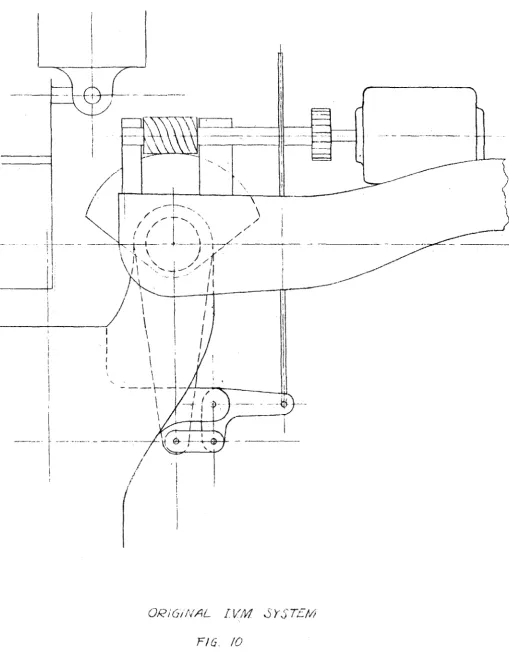
As originally laid out the mechanism for changing the onc:le of attac'c was as shown in l'ie. 10. It i'las seen almost at once that the arrangement would be unsatisfactory. '.'he incidence mechanism in the system of Fit;:. 3 utilizes a reC:iuc-tion between the :notor, with a normal speed of 8000 r.p.:1., and
the tail boom of 29,664 to l giving a tail boom speed of 0.3'7 rep.·:i. As this system. had proven very satisfactory it was decided to
use about the same tail boom rotational speed in the new system • . .,i th gears of any reasonable size the reduction could not be obtained as shown in Fig. 10.
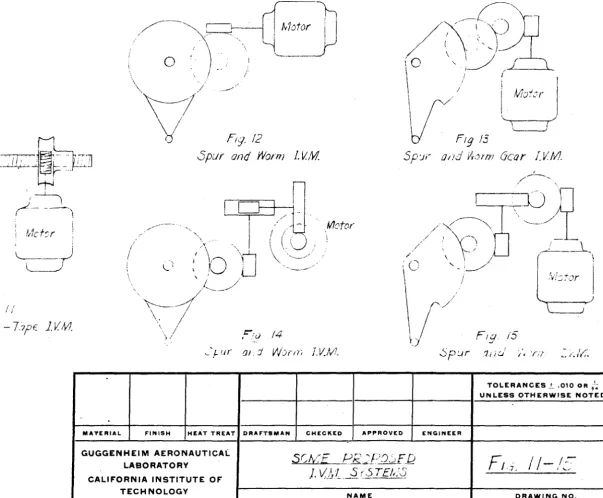
Fig. 11 shows a. reduction laid out with a lead screw and
worm drive. the end of the screw being fastened to st eel tape
pas~~ing over a pulley sector. '11
his was abandoned because of
backlash. A worm drive in the last stage was decided to be necessary and this resulted in the arrangements of Figs. 16 and
17. · Other reasons for the change to a worm drive were that greater strength could be obtained for a given gear size and also the mechanism could be disengaged. The reason for
dis-eneagement lies in the development of the zero static moment
device and will be discussed later. The incidence mechanism in its present stake is that shown in Fig. l?. Va"t'i cus other arrangements not shown were tried, most of them involving planetary gear systems of one sort or another.
VARIOUS PITCHING ::OMZNT SYSI1ET.!So
The original method of taking out the pitching moment has been sh ovm in Fig. 6
am
previously described. It was'
found, for the loads to be carried, that this bell-crank system
became too large and could not be plaaed in the space allowed;
also, the large number of joints wruld cause an undesirable
decrease in sensitivity. An overhead beam was laiQ. ou:t as shown
so hema tically in Fig. 18. This device was laid out wi
tth
an eyeto simplicity and clearance problems, but was discarded after making a preliminary stress analysis. The mechanical advantage of the system was so small that loads in the pitcl:iing m~ment
wire ran to 12
,ooo
lbs. Another arrangement of an overh~adbeam was tried as sh own in Fig. 18. The mechanical advantage of this is such that a load of 1000 lbs. applied at a
tatl
arm length of 58 inches shows as a 1000 lb. load in the pi.tch;lngtinn. In the wind tunnel rie:;gine; system in use at present, it is necc[1S:Jry, "\','ith no nir f'lowinc in the t:xnrel, "7;o rulJ tr1roueh
t-11e ancJe of attack ranc;e and re cord t·he r:nrrierii-t hn 1.::t 11c e 11eo.din~e
for various ancles. As the ;~10a.e1 ancle c::a'1:-·es the effecti.ve moment arm of its weirht changes and causes
"r:h'
chani-·e instatic moment VIhich must r)e recorded an\1 corrected for ]n co.lculaticm of the destred pitchinc :1 oment. ~h8 bo.lancec do
:r:.ot operate successfully unless t·e tunnel i['. run1j:'1G, enc -r-cir
this reason tho determinati -n of the static oment is laborious, long e.nd a rJossible source of error in co1:1r11ts.tion. ·.·:ith a two-parameter system of this ty~;e, it would oe necess3ry to determine
the static moments both in roll and yaw for every a::rle of
pitch in every ant?~le of yaw, an obviously unoesirai'!le situaHon. To eliminate this, a counter-weicht systa'TI has been ]Jrovided as
shovm in Fie;. 20. By setting the syst'em at zeTo anc;le of attac~c
and adjusting the horizontal position of the counter-weight for balance, then coin(". to some other ancle of attack and
o.d-5usting only the vertical 9osition of the counter-weight for balance. it will be found that the system is in ':Jalance for all anclos of attac1c and the readjn13 of the ''omont b slance wi 11 not chance due to chanve i.n po~oit ion of the · ·od8l g_ncl ri[': 'in,'? weirht. ···1th tbis arrenr:errJent, ustnc al wa7/s t1'e sanr: gr:ioi..1rt of count8r-weir.ht on the pi +;c~:1inr moment syste·n, t~1e ~:iomcnt of tli8 nodel weight and those perts of the ri;~:i::t;" m::wi.r1·'· jrt ·1.n:le of attack
Tiill be constnnt fer any set-u'.. 1'o eli~nin<itn i;hr::: static ·10rnent
i'1 roll fixed cc:i.nter-wci('hts can e ;11,Jurtc(1 c•n
f 1.xed cotU,J.te:r-w•ights need not be dtsturbed so long as the
magnitude of the pitching mom~nt counter-night is not changed.
Changes in model weight will make no dti'ferenoe.
SUPPORT ARMS AND .ALIGNING SYSTE:.~.
The supp0rt arms have not changed basically to any great
extent
from the ortg;tnal plan. The lower part of the arm willprobably be solid for ab'out 20 in. and removable from the upper
part of heavy bent and welded she et stee 1. By hewing a lower
removable section variable "vertical" trunnion spacing oan be
provided and it is thought that rigging can be facilitated. In
order. to k~ep t·he tare ~~ag and side forces low and nea~ly
oonst~nt, the support arms are to be rotated about a vertical
a.xis through the trUlllli on points so that the 1r major axi:;,
r1ongi-tudinal) will be ~way$ pai'allel to wind axes. Originally it
was p;\.ann~d to ~i,111ply shu~ dONn the tunnel between runs
at
anglesof
yaw, unolamp
and rn,anue:lly rotate the support arms,re-clamp
.el\d prooeed
with another run. With the decisionto na
ke yaw aremotely cont~o~led para~ter a parallelogram linkage was designed
to
maintain
support armalignment.
This was discarded as beingtoo
bulkyin
faV01" of aworm
sector and worm drive on the upperend of the arm designed to wo~k simultaneously with the yaw
drive
and
po$sible
on apower
bleed-off from that source.'NI!-IDSHIELDS AND ·CONNING TOWER •
ln'order to keep the tare forces and moments as small as
possible, it was dee ided to windshield the support arms and tail
~trut to the greatest possible extent. This then calls for a
-2s-windshield system that will closely
follow
the support membersboth in pitch and in yaw. Details of a
system
for doing thishave not been considered so oompletely as have details of the
rigging proper. Directly on top of the tunnel it is prop<>sed
to mount a large ciruula.r track carrying a platform to rotate
in yaw simultaneously with the rige;: ing. On th is will be
mounted
the w.i.ndshieldtng and such drives and. controls as are necessary ..
This platfarm will also serve as a place to stand while rigging
adjustments are being made. In order that the windshielding may
have small clearances on the support members it should. have the
same reference frame as the rigging proper. For tb is reason
suspension from the same ceiling beams that support the rigging
will probably be advisable. As with most· other details that
of windshield oontrol has not been decided upon.
Thoss
tb$.t
are being considered
are
synchronous drive, simple contacty
x
/
v
....___
__
_,,,/
,,,_,,-/,.,
~
YAW
MATERIAL FINISH HEAT TREAT I DRAFTSMAN CHECKED APPROVED ENGINEER
GUGGENHEIM AERONAUTICAL LABORATORY
CALIFORNIA INSTITUTE Of
AX~5
OF RCTAl\ON
OF THE. A\RPL.ANE
TOLERANCES' .010 OR<'~ UNLESS OTHERWISE NOTED
~~
ORt~
L\FT
fl!
~
~
Ge/Ii/
~-~-'i~~
~-
~:
/
-J~l~~c
_):: /}
('\\ \>
' 'i--·' . !
....
_____________ _
-
---
. / ,.,..-...\---I ,
- -
--
~ROLi iN·?· ... ~
\:;\-MOM E \',~ T '
CD
YA\"' i t·'\\ G10MLt\1 T
P:l~CJ-.L~ f'"'O ML\'.jl
TOLERANCES .010 OR,_
UNLESS OTl::iERWISE NOTED
1
FINISH HEAT TREAT DRAFTSMANI
CHECKEDI
APPROVED ENGINEERGUGGENHEIM AERONAUTICAL FOf<CES A\',.iD p\0'.-·'1ENT:i Fl·~..
,..-·)
LABORATORY r , . A .. E '<. ~'-1 • ~
~" B o :..J , x _ _,
''--',..:.., _ __:_. i T
/ : '
,,,,....---/ ..
TO STATIC RINGS IN ENTRANCE AND WORKING SECT10NS
NINO
TUNNEL \
\
\
\
\
\
\
~
r f:'l-,' f
l _.
J . WINCHI_,.
1:
TO SE~SYN GENERATOR
/
/
SIX COMPONENT SETUP FOR TEN FOOT WINO TUNNEL TESTS
~,,
I
1fl
1'
I
, I;f
(f
;1 ' Id
V1 V'v
v
'/,~i
I
/',
/ .,..,
'.,/\
,,"'<"'
II
f '<'>JJ"~<"'>--~
l //
-~r//
....___,__~_/ / T J l ' '
D
~)-~-V' .,,, ' / '/ '/ ·i ~ ) .; } /., \/ ~;;
-f1
t
I:
/
/TO t:r:1 BALANCE
~
I
!I
I \
I \
E \
I- - - L-1
--r-1f }.
CG.
.
'I
I
~
\Ji
I
!
I'
I
1
I i \
\ !
I
f<t
,I
-1/f/
I
I I·1
\
(
I
! .L
z z-zr__zazzZTnl
a.?JZ77~Vi'
; 7 z .r; / L ?j
I DCOUNT£RW£1GHT G1 )> r
n
--j Al r: l jTJ ""tJ
- l>
0
G)---
~----· 7"---·
A.·· ' '·--.._
---
~. I
·-... i
--~
A.- TA\L ARM--
~--I LEN~TH
.I.
B - TRUNN\ON
I
--
~11
SUPf-'O~\
.r---~-
~ 5PA.C\NG-AR~> .. 'i
I
~ ... _~--- - -·-,,~
B
---
/ ' ·\
)J--
-
\ i I IITA.l L.. STR'\JT
TRUNNION AX\~
. _ /
.~·
~
TOLERANCES .010 OR-~
UNLESS OTHERWISE NOTED
MATERIAL fl NISH HEAT TREAT I DRAFTSMAN I CHECKED APPROVED ENGINEER
I I ' - - ,
GUGGENHEIM AERONAUTICAL
LABORATORY THRE .. E.
POli'--lT
o--R.:JL!..j_/.:l .. :. .r.J:~.:!~:J.{~~
MCNfli;JT A!CA;f_;,;7
----=u -- --
,-j
UPPf/? .SiPPGRT-BEAMS._:::--:?'-!---~~] 1 _ -~ __ =- / J_.';,,'J; __ f:__:]p.::;;:_ C.::llvTl_f2r\f:'c'·~T' A L - .I L.__rt I TJ /'/ ---- - - ' '
-I
I
_fl__4
I l\.J1 / r /~1
I r I I
4/
I I rA.V~c'l'NTt"Pl'.--:;.;,r1-' ' I,~ 1--'-~ --~ --- - ---~
--'"'-"'-'-- I I I I I
I
I
RO: ,',1;:;1'
/t:='
1
- - - ' , / I ___ ,
- - - , , - - _ - .... I
I I '
'
I /
i
.
I---_.::-:c-~~--=--=-=----.
---
/(~
_, -
I-:
.__:__---r---~
--- /--i:_____
~{
(
~)~·~
;1
-1------ --
/_,,.______
/' ~qCIR~JUIP-
r-;w TRii_(_fS ' \~
/ 'I/
r_l __
Is--\,, ', "--- --.____,~ / l i I I I , ____ ~ I Licf];;_ __ ,JJj_c'<,;_"nT·flGHT
-r-1
,I I
-.+ i--
i-i I I ~
' I
--i~ 1 \ I
11
• 'l!I \I I
v' i L I
: I
1
\f ii
\ ; i \f-i II
12m ;
~/
/_'>
Ii
---c
77-:-'.;__/-
--' '
I ' .5~/v
er
\'ml/1Pm
-~
b
J
""- ~- _ _ ,_____ - - - I
~Y1!R.E
-~ IC:E F?f.':_.T
r-°r---rr-+----+---11o-v
't;:..N!N:J -\1DM.c/J7"
---MATERIAi.;. FINISH HEAT TREAT I DRAFTSMAN
GUGG~NHEIM-AERONAUTICAL
LABORATORY
• 1-.~, ~
TOLE-RANCES±. .010 OR.;1 ,,.
UNLESS OTHERWISE NOTED
• ·:i:~.
cHEcKEo·, . ..:i:; ... ··.,;.,.,.o~ED ENGINEER
J
z.
Ll
. " - , - .
60
so"-
[
40"1-1
I
I
I
I
I
I
II
1
[
I
I I 6'
5 6~
I
w
2 '
~
,~.
131
~
47
I
I
'f
L3 ;. I
r -
-5"--+-
5':_"'"1"
k
,,
30 --- · - - - 20
!
/"
/ 12"/
II---+-i-<Ja - - - I 0 ,,
_....,
IPm
I
(I
l
~~-- ~18
If-,.~ 1
i\T'~; I
~ lb --,:sz_:il
14 ~
0n
PrnTOLERANCES ' .010 OR 514 UNLESS OTHERWISE NOTED
[image:39.780.87.738.22.531.2]MATERIAL FINISH !HEAT TREAT I DRAFTSMAN I CHECKED APPROVEO ENGINEER
GUGGENHEIM AERC:>NAUTICAL LABORATORY
CALIFORNIA INSTITUTE OF'
UPPER_ ___ Bf:./iAl
QOLLING MOMENT
M4TIRl.AL:r FllUSH · IHEAT TllEAT~~ilA"9~AN·
GUGGENJIEIM'-AERONAUTICAL·· LAllORA'TORY •
~·!·i-·'""i~''.,
EN"CllNEER
-TOLERANCES±.010 OR;; UNLESS O"FHERWISE NOTED
I
I
/
(
- --~
I
OR/GiNAL fl//V1 SYSTEM FIG. 10
)
[image:41.551.21.530.58.717.2]---..
/-,_ ,-, M
JJ
·
'\'°-<
Motor
i.; \ . ,\
~
I
i
0
··)
I '-·, J .. ;"
/
~{\?!;'
--!\ \ , ... ,
.· \ \ J
10 ';.__/"
..1
I
/
(
I
/
j1-,.; .•,-\ / ' !Viv•<.'
\
''\_-"/
____ __,.,.~\
,---;
·~~p]
I
i~
v
Fiq. 12Spur ond Worm 1. VM
,
-v
F1gl3Sp'Ji' Ol)d i{;nm Gear f VM.
,
/,,,,,.-·-, -·•Dr
//
:'/\~-i-
\ ,_/ .
I
. ~--
--.
'
! Mcf-::r
i i
\_~
1 __ )
Fig. • i
I i
Lc'dd :)1JE i'• - T7p€
1.
VM.I I ' '· ,,, ... --.. --~· . ~;
'·.
i/c
(.
\,__) '....,______
,,,,~
__
.-.~;(.) 14
Mct'ar·
\
/ ' . ' JJ
/ I \
: r} ' , / - '
\
'-· '
- ,_/.
.r
. --
_ _ L-\
\(/!
~
~J - F1-' ·-:;r I:)
~·1-ur a1j V1hrir1 J.V.lv7. :•
.Sp:.Ar .11 ic.i Ir f·,:/ .~ .-. /(,~
MAl'ERIAL FINISH IHEAT TREAT I DRAFTSMAN I CHECKED APPROVED
GUGGENHEIM AERONAUTICAL LABORATORY
CALIF'ORNIA INSTITUTE OF'
5Uv:E Pk' ... "':f)'..J,'_yF_Q
J.
V1~lc-~r:2 TE/,,·:J_ENGINEER
TOLERANCES .L .010 OR ; ;
UNLESS OTHERWISE NOTED
[image:42.789.154.757.30.528.2]/'-,,,, •,
i '• ·~-0
I ',,\ -"'' \
I '~ \ \
I ' \ \
I
.
~
)
'
~\\\\
rlG. 17
~---..--- i ~
(/·' ' t -
~"-------
-3.~-~
-~--I·,-~
.. ...
f.}.>·
-·-/ ~:...---··-··· /il,z,'.t:.~- :;HAU
/
1-i.c--::.--:::--, /Fi Ci, 16
C_.:::__.,)
'B I
l
/7J f() 1
"''(p .>/ /'::. ""'·1·:::.-:t::. , .. ,
-1
I )
\\
/'
· . ; '\\,
'\
. \/
' \
I
\
\\\
//
\
/
'\., /'
~\·v---
/,,/\ \ ,/"\, .. ·.·. .x\
U
,.,,,
1,
, I
i I ..
:· I )
, I
( I 11
cy:r.,
I I·' '
·y
1 .... ~
l
'.-.'
.!: .. :-- '/1 ' r/
.. /"i._!j / )
,. "0/
···:r~ -I·· ·~ ,~ · -li::: r)
r'...__..,. ___
.. /
\I/:))
\>·~~~-~('
/r-:'S ra~ /2 ... ;5 "/ 70 = -...:'.:::~:\}
TOLERANCES ~ .010 OR:~ UNLESS OTHERWISE NOTED
M'-TERIAL V1Nt8H j).11.AT T'Ri:ATI DAAnUU;N ~ CHECK!'~' ):::!~R_o_v_•_o_,_j _••_•_•_•_•_•"-a.1---·---t
GUGGENHEIM AERONAUTICAL
0
• lo.I •
l-a: 0
0 z 0 w
0 Ill
~
Ill a: lo.I w
u ::c
z
I-C 0
IC al
w Ill
.J w
0 .J
I- z ::::>
I
a: w w z"
z w Q ... > 0 a: L L " Q..
-= u w :c 0 z c :I•
I-..."
a: QI-..
... a: I-"..
:c:t
Ill
z:
i::
... " a: ... ... c
:II!
·-r-,,i • 1 ~ 1.7
~1 z
ll
c
'.J a:
~
0h.
-?
l;j
~
~
li J
"
-$.
~-=\~_:-..:::.
~:---"ti
C/'-li.JI ·-.<
CQ'= w
f--~' :E
~> c
'-· 4-.. z
~
.---::~~i ~ l;.~1
I \....,.
al
~
~-
'•--l J.
,-___ ,
Q:i
I
..J
t(
...
0 0 .... w
:::>
C( .... j
z > >
0 =::: .... CJ
a: 0 .... 0
w .... I/I ..J
c
"'
z 0a: z :E 0 c l: w m c z 0
w l: ..J IC ....
z 0
w
...
CJ ::;
CJ c
:::> 0
/
/ /
;/
_,,\
I/ \ \_J i /
0 •W
- •
1-IC 0
0 z:
2 w 0 Ill
J
Ill a:
w w
0 J:
z I-C( 0
a: Ill
Ill Ill
... Ill
0 ..I
I- z :::> IC w w z i; z w Q w > 0 IC L L
..
Q..
"
u..
:t u z..
IE•
I-.....
II: QI-..
..
II: ... .....
..
J:x ID z ;;:: .J
..
iC w .....
IE(-y· .. ..,_ __ ; J 0
z ...__ ___
Cl
z
..
,
JC(
-
a:~
0~~:
~ ~~ Ll~
't:' ~;
t..j
CQ! 4..J,
;' \~~
<:
C:I q:::
~
Cb~ :ti "t; w
Cic1 :t
~ t---..,. ~ 11(
• I .~ z
0. ~~_jj
I :{,
~ ~j
~t
~-:J I
,.:.; ;_.-.,j
:--... , .::::., -:;5'
l~ -..;:
-...,.;
~1:1 ~~:; ...
Q: .
..J
II( I.I.
0 0 I- II.I :::> I-< :::>
z >-
>-a: I- .~
0 ...,
IC 0
"'"
0II.I I- C/) ..J < < z 0
It z
~ 0 < :I
m 0
II.I < z II.I
1:. .J a::
I-z 0
II.I i..
CJ ::; CJ <
0
~: ~
0: 0
0 z 0 w
(__)I ci
Q UI I z
ii c 1! I CJ
a:
I
zfll
-w Iii J
0 l: '""" c
z I- • 1 a:
c 0
W::!
0a: Ill
w fll
..J w
0 ..J
PITCHING _A/)r_Yl_f:N
r
_p_fi_..__@!{Cf. I- :> zc w
~ '~·-1
..
z:u
BT<::HIN.:J AICAdf),,L 8<'CM z: ~;
w
INvD COLNTE1<:··j.1..Ei-j-/T
~·s
---~-~-- ~----
---·-\ 0
w /
'1
\ >/
\ 0 L..J: ./)a:
-I
L<
~-- ~ \
IL w
,.__
\
21
~:;:~r--.__
J
c Ji
c
/
<-.:.:. z2
t U_JJ/ / \ 0 -~!
~D
4fjf/
- - w\u-=I
-"
g ..;:::.:~·t--i t.ul w
:z: ,....,... 'I--'
I,)
;::1
i \;I
Cr)l~t</ '_:(
"-... z:c:;I
c \...)
·---a
-:-AL f' ~ C·A7
•
---
... .../ \
ca:
0
...
//J
c ...JI
>J1
... ... c c 0 ....0
I
... I- II.I
/
... c :>
I-/' % C( :>
l
/
/
z > I- >r 0 IC Cl
a: 0 I- 0
111
/I
I
!! l: II.I t- I/) ...J c c( z 0z II: - z
... ~ 0 c( :c
i:i m z 0
/7~~'
:I: ~ a:...
... z 0
I-~ w ....
a: Cl ::;
... ... Cl c(
c :::> 0
a Cl