A
ut
omatic
all
y
gener
at
ed
rough
by
Pr
oo
fCheck
fr
om
Ri
ver
V
alle
y
Tec
hnologies
Lt
d
Katherine Harris
1/ Christopher Fellows
2/ Frances Quinn
2/ Nadya Rizk
2/ Neil Taylor
2/
Robert Whannell
2/ Manjula Sharma
3/ Subhashni Taylor
4Physical separation techniques in water
purification: an inquiry-based laboratory
learning experience
1Good Shepherd Lutheran College, 115 Eumundi Road, Noosaville, Queensland 4566, Australia 2University of New England, Armidale, New South Wales, 2351, Australia, E-mail: [email protected].
https://orcid.org/0000-0002-8976-8651.
3University of Sydney, New South Wales, 2006, Australia
4James Cook University, College of Arts, Society & Education, Cairns, Queensland 4878, Australia, E-mail:
Abstract:
This article outlines a structured investigative activity for students in lower secondary school. It was developed for the Australian Mathematics and Science Partnership Programme, a government initiative intended to pro-mote the employment of more hands-on investigations in secondary science within Australian schools. The investigation focuses on water purification and is intended to develop conceptual knowledge of this topic and also high-level skills such as experimental design, particularly in relation to identifying and controlling vari-ables. The investigation is outlined in detail and was trialed with practicing science teachers, school students and preservice secondary teachers. All of these groups provided feedback in various forms that indicated the investigation was valuable, relevant, interesting and allowed students to take some responsibility for their own inquiry learning.
Keywords:inquiry, investigation, scaffolding, water purification
DOI:10.1515/cti-2018-0018
Background and introduction
This activity is presented in the context of Australian lower secondary science. Concerns about the declining numbers of students in Australia progressing beyond compulsory science in upper secondary school have been expressed for some decades, yet those declines are still occurring (Kennedy, Lyons, & Quinn, 2014). Govern-ment funding was provided through the Office of the Chief Scientist (Australian Mathematics and Science Partnership Programme, AMSPP) to various bodies in 2014 (Ministers for the Department of Education and Training Media Centre., 2014) to develop hands-on investigative activities for lower secondary science in the hope of increasing engagement with science and the number of students proceeding to senior science. This arti-cle outlines one suite of investigative activities that spanned the different subdisciplines of science, with a focus on chemistry, at the lower secondary level. The activity was developed with AMSPP support, and undertaken by both teachers and students in a series of in-service teacher professional learning workshops run as part of the AMSPP. The learning sequence relates to water purification and has been designed to be easy to organize and complete and allows students to access progressively increasing levels of inquiry, while providing students with opportunity to develop a range of scientific understandings, skills and generic capabilities.
This article has two interlinked aims. The first is to provide a detailed descriptive account of a sequence of inquiry-based activities suitable for Year 8 Chemistry, and links to extensive resources that teachers can adopt and adapt as they see fit. The second aim is to report some data from a limited number of in-service and pre-service teachers and students who undertook the sequence of activities to provide some evidence as to how it was received.
Frances Quinnis the corresponding author. © 2019 IUPAC & De Gruyter.
A
ut
omatic
all
y
gener
at
ed
rough
by
Pr
oo
fCheck
fr
om
Ri
ver
V
alle
y
Tec
hnologies
Lt
d
derstandings and requests for equipment, to some extent“on the fly”, without the time advantages afforded by more teacher-centred approaches. Moreover, some researchers (e.g. Kirschner, Sweller, & Clark, 2006) have claimed that inquiry learning is ineffective because of insufficient student guidance.
It has been argued (Hmelo-Silver, Duncan, & Chinn, 2007) that the key to successful inquiry is appropri-ate scaffolding. In line with these researchers, our conceptualisation of inquiry learning is an appropriappropri-ately
scaffoldedprocess of investigation which helps learners to engage with the disciplinary practices of science and construct scientific understandings, as well as to develop other generic capabilities such as collaboration. In addition, providing scaffolds that offer different levels of staged support as a tool can reduce some students’
reliance on their teacher, thus allowing the teacher to spend more time managing the practicalities of support-ing the participation of all students and maintainsupport-ing productive and enjoyable learnsupport-ing.
The learning sequence
The sequence was designed to help Year 8 students (aged about 14 years) achieve the following aspects of the
Australian Curriculum in Science(ACARA, 2018):
– Science as a Human Endeavour: Science knowledge can develop through collaboration across the disciplines of science and the contributions of people from a range of cultures
– Use and Influence of Science: People use science understanding and skills in their occupations and these have influenced the development of practices in areas of human activity
– Science Inquiry Skills:
– Collaboratively and individually plan and conduct a range of investigation types, including fieldwork and experiments, ensuring safety and ethical guidelines are followed
– Measure and control variables, select equipment appropriate to the task and collect data with accuracy using a range of techniques
– Summarise data, from students’own investigations and secondary sources, and use scientific understand-ing to identify relationships and draw conclusions based on evidence
– Chemical World: Mixtures, including solutions, contain a combination of pure substances that can be sepa-rated
While the learning sequence may not always cover all of the points listed above depending on how teachers present it, it is particularly effective in helping students design experiments and control variables. The article focuses particularly on this skill. Other elements of the syllabus that may be foregrounded are sustainability and literacy.
To achieve the intended outcomes the learning sequence begins with a discussion of the properties of water and a clarification of terminology such as solutes, solvent and the resulting mixture, a solution. It is explained that because many things dissolve in water it is easily polluted, but water is naturally cleaned when it trickles through sand and gravel (a process known as filtration) and when it evaporates. In order for water to be safe for human consumption, and to be pleasing to drink in terms of odour, colour and taste, it needs to be purified. Many types of scientists including civil, chemical and environmental engineers, chemists, health scientists and biologists work together to enhance and develop water treatment systems.
A
ut
omatic
all
y
gener
at
ed
rough
by
Pr
oo
fCheck
fr
om
Ri
ver
V
alle
y
Tec
hnologies
Lt
[image:3.595.186.413.69.299.2]d
Figure 1:How scientists work together. Figure 1 was created by Katherine Harris.
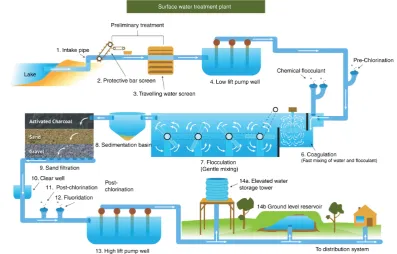
The process of water purification on a macroscopic scale is then discussed with the students using the flow diagram in Figure 2, and the students then focus on steps 6 and 7,“coagulation” and“flocculation”, which involve the removal of suspended solids using substances called flocculants. This leads into a series of investi-gations where students compare different manufactured and plant-derived flocculants, and design experiments to test the effectiveness of these. The procedures for these investigations are presented below in a narrative style.
Figure 2:The physical separation techniques used in the treatment of surface water at a water treatment plant. Figure 2 was designed by Katherine Harris and created by University of New England.
Investigations
[image:3.595.96.494.401.655.2]A
ut
omatic
all
y
gener
at
ed
rough
by
Pr
oo
fCheck
fr
om
Ri
ver
V
alle
y
Tec
hnologies
Lt
d
these roles helped to minimise student traffic around the lab (as only the manager could collect equipment), particularly useful when students are carrying glassware containing liquids. During the workshops the stu-dents and worked together with their classroom teachers.
Investigations 2–4 required participants to explicitly plan their experiments on paper and discuss this with the facilitator prior to carrying it out, in order to promote students’skills in this aspect of science inquiry, and to locate, discuss and incorporate any potential areas of improvement, including any safety issues. Students write up their investigations in the form of a written scientific report, to incorporate and foster development of generic and scientific literacies.
Investigation 1
How does a flocculant work in“cleaning”water?
In this first investigation students are provided with some dam water in a clear plastic cup and initially record observations of the water using their senses of sight, touch and smell (not taste!) over a period of 3 min. They then add 1 mL of the flocculant aluminium sulfate solution to the cup and stir using a paddle pop stick and watch the cup for 4 min, recording their observations about the water in the cup over this time. Finally, they write a brief conclusion about how they think flocculants“clean”water.
Investigation 2
Flocculants–making sure they work
In the second investigation the students engage in a student-directed inquiry process to determine if stirring helps a flocculent work more effectively and they also carry out a comparison of the efficacy of different man-ufactured flocculants. These investigations require students to design and carry out their own controlled ex-periments (in primary schools often known as“fair tests”), where they need to decide on the independent and dependent variables. As well as dam water and paddle pop sticks, students are provided with:
– 10 mL of aluminium sulfate flocculant solution
– 10 mL of a polymer-based flocculant solution (readily available commercially as swimming pool cleaners)
Investigation 3
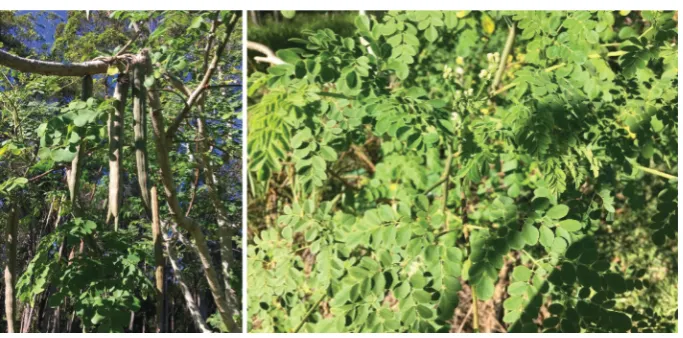
Using a natural flocculant made from the seeds of theMoringa oleiferatree to“clean”dam water
A
ut
omatic
all
y
gener
at
ed
rough
by
Pr
oo
fCheck
fr
om
Ri
ver
V
alle
y
Tec
hnologies
Lt
[image:5.595.128.470.66.235.2]d
Figure 3:Moringa oleiferatree and seed pods. Photograph by Katherine Harris.
Note:Moringa oleiferaseeds can often be obtained from local trees, depending on location. They can also be purchased online but the buyer needs to be very careful that the product meets all biosecurity requirements for the jurisdiction into which it is being imported.
Investigation 4
Using a variety of physical separation techniques to“clean”a sample of muddy dam water
In this final investigation, students use the skills and knowledge developed in the previous activities to“clean”
a sample of muddy dam water. This involves simulating Steps 6, 7, 8 and 9 (used in the water treatment plant shown in Figure 2), by developing and following a logical sequence of steps (algorithm) to achieve their aim of cleaning the water. The treatment plant takes in“surface water”and so it is unlikely to be as“stirred-up”
as our dam water sample. For this reason, they may need to add a sedimentation step and a decantation step to the beginning of their purification process. They need to make observations after carrying out each step in their purification process, identifying any contaminants that may have been removed in the process.
An elaboration to this investigation may be undertaken to test whether the purification steps remove micro-scopic organisms that often occur in unpurified water. Students can add a drop of water to an agar plate, which can be incubated (with appropriate safety guidelines) for 30 h at 33 degrees Celsius to see if anything grows.
Investigation resources
The teacher and student handbooks detailing this learning sequence and including the“inquiry slider” of Cornish et al. (2019) are available for free download as follows:
Teacher & Student Notes: https://asell.org/page-5/.
In addition, two annotated video clips of approximately 28 min are available showing four students un-dertaking the activities outlined above. For a link to these video clips, please email [email protected]. The intended learning outcomes of these activities should be applicable (with locally relevant modification) to a range of educational contexts.
Research findings
The remainder of this article reports on research findings associated with two trials of this suite of investigations:
1. One local workshop (Workshop 1) with 11 middle-school aged students (aged between 13 and 15) and six in-service science teachers. All of the student participants were selected by their teachers from their year 8 or 9 classes and had previous experience of completing some investigations in science, although this was generally limited.
A
ut
omatic
all
y
gener
at
ed
rough
by
Pr
oo
fCheck
fr
om
Ri
ver
V
alle
y
Tec
hnologies
Lt
d
that scaffolding inquiry using aids such as these needs to be carefully and explicitly built-in over time to regular classroom activity so that this expectation becomes part of the student inquiry routine. Issues for students that might need to be addressed include physical accessibility and perceived stigma, which depending on context and class size, may be addressed by issuing each group with its own set of scaffolds, or having the teacher distribute them at need based on discussions. It is important that the students know what areas the scaffolds cover in enough detail to be able to decide which scaffold might be useful at given stages in the inquiry.
The students’plans for investigation 2 were quite detailed, however in the context of our workshop became somewhat rushed and abbreviated for the later investigations particularly towards the end of the day. In addi-tion, the time it took for different groups to complete their plans varied considerably, adding to the challenge of marrying student-centred work with scheduled lesson times of 45 min to an hour. A recommendation we would make based on this experience is to spread out the series of investigations over several lessons (dependent on school context) with negotiated goals for achieving certain steps including dedicated planning time.
In this workshop, looking at the students’written and drawn plans was particularly useful in quickly gaug-ing student progress and understandgaug-ing.
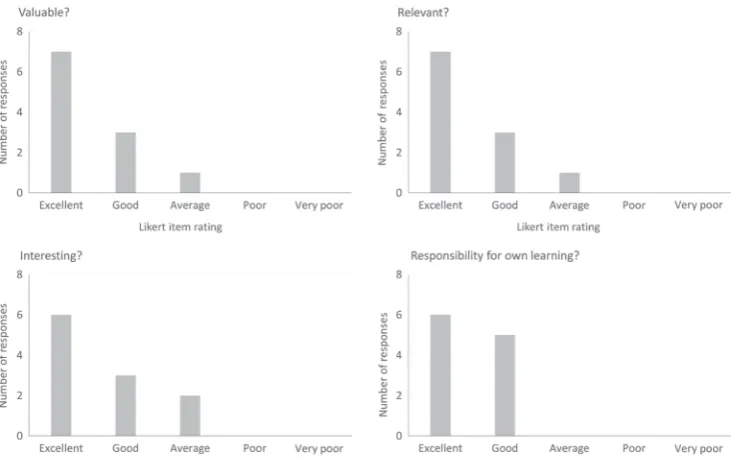
Following the workshop, the students completed a survey in which they rated the first two parts of the investigation, with the final two parts not rated due to time constraints on the day. Four criteria of perceived value, relevance, interest and the extent to which the activities allowed independent (inquiry-based) learning were rated on a five-point Likert scale (“very poor”,“poor”,“average”,“good”,“excellent”) for the following items:
1. Overall, I found this investigation a valuable learning experience
2. I see the relevance of this investigation to my science studies.
3. I found the investigation interesting.
4. I took responsibility for my own learning when doing this investigation.
A
ut
omatic
all
y
gener
at
ed
rough
by
Pr
oo
fCheck
fr
om
Ri
ver
V
alle
y
Tec
hnologies
Lt
[image:7.595.115.481.82.312.2]d
Figure 4:Student feedback from an individual workshop comprising Investigations 1 and 2, containing 11 students. Figure 4 was created by the authors.
The six teachers who attended the same workshop provided free-response feedback on the activity. All said that they would use the investigation with their students. Most teachers claimed to like the structure and the way the activity was designed to provide autonomy, for example:
The different experiments were structured to have a step-up effect that reduced the guidance at each level.
A
ut
omatic
all
y
gener
at
ed
rough
by
Pr
oo
fCheck
fr
om
Ri
ver
V
alle
y
Tec
hnologies
Lt
d
their density I suppose and sink them to the bottom so you have clean water left.
Interviewer: Have you come across that term, flocculants, before?
Janet: No, I’ve never actually
All three pre-service teachers commented that the activity had been very engaging, because they were conduct-ing first-hand investigations which were novel, relevant, and yielded easily observable and rapid results:
John: I found it very engaging because I’ve never done this before, so you’re seeing it in action, you can see the sediments clumping together very quickly, and so it’s quite exciting watching the differences and having three different beakers, with water in them and then each one changing.
Alice: I found it really enjoyable actually. I found it really interesting to see the differences in how each substance contributed to the purification and we did have an experiment at the end where we added all sort of different substances to see which one worked the best and to see if maybe we could come up with something new that wasn’t maybe tested. But yes, it was really good to be able to visualise what was happening rather than just like the theory.
Janet: Yes, I found it engaging, I really enjoyed being able to see first-hand the particles sinking to the bottom and being able to compare which one was the clearest and things like that, I found that I really enjoyed being able to see it and do it first-hand like we were actually causing that to happen.
The pre-service teachers were also asked about the types of skills the investigation might help their own stu-dents to develop. Janet mentioned social skills related to the cooperative groupwork involved in the activities as well as the skill of planning or designing a scientific investigation:
…there are cooperative group work skills like communication and interpersonal skills, also, learning how to design their own experiments; because it’s scaffolding there, as they go along in the experiment, they’re getting less and less scaffolded and they actually have to put in more thinking and effort to create their own experiment…
This was echoed by John:
One of the biggest skills would be“plan investigations”because the way the activity is set out; like the first part was set up for us but the second one we had to plan ourselves, we had all the tools around us but we had to decide how to plan investigations to test a theory or an idea that was given to us; and then we did the same again to test the seeds, to test its effectiveness.
Janet noted that the activity was effective for teaching about experimentation in which students have to identify which variables to control, one of the most important skills in experimental science.
A
ut
omatic
all
y
gener
at
ed
rough
by
Pr
oo
fCheck
fr
om
Ri
ver
V
alle
y
Tec
hnologies
Lt
d
Conclusion
This article has presented an investigation on water purification, a topic that has relevance globally. The investi-gation is designed not only to develop conceptual knowledge of the topic but just as importantly to develop sig-nificant scientific skills particularly experimental design in the area of controlled experimentation. The“helping hands”scaffolding was an integral part of the activities that facilitated student access to the inquiry process and allowed the teachers more time to manage the overall classroom dynamic and interact with students as required. Feedback from participants, although limited in scope, consistently indicated that the activity was valuable, relevant, interesting and allowed them to take responsibility for their own learning.
Appendix 1
Moringa oleifera
seeds as a natural flocculant
–
current research
Written by Katherine Harris UNE
Background
The United Nations Millennium Development Goal Target 7.C was to“Half, by 2015, the proportion of the population withoutsustainableaccess to safe drinking water andsanitation”. Between 1990 and 2015, 2.6 billion people worldwide gained access to safe drinking water in their communities and the United Nations’goal was met ahead of time (United Nations 2017).
Although there have been significant improvements in access to safe drinking water there is still much work to be done with 663 million people still relying on untreated drinking water in their communities and 502,000
diarrhoeal diseasedeaths per year estimated to be a result ofexposureto contaminated drinking water (World Health Organisation (Media Centre), 2016).
One of the key problems withimplementingwater treatment processes in developing countries is the large cost and difficulty in buying and transporting flocculants. For centuries natural materials have been used to purify water. Research suggests that the idea of usingMoringa oleiferaseeds to purify water first originated in the country of Sudan where the women would clean the muddy water from the Nile River.
Moringa oleiferais a native tree from the sub-Himalayan regions of India. It is able to be grown anywhere along thetropical belt of the earthand grows well in Queensland, Australia where it can be readily found in parks and gardens and is locally known as the“drumstick” tree. The tree is extremely fast growing and produces seeds within a year of planting. The leaves, flowers, seeds and roots are a nutritious food source and the oil from the seeds has many uses.
In addition to theMoringatree being an exceptionally nutritious food source, a protein found within the seeds is able to combine with suspended materials in the water to clarify it and another identified protein in the seeds is capable of destroying the bacterial cell membrane of bacteria (Shebek et al., 2015).
Recently scientists around the world and right here in Australia have been investigating the use ofMoringa
seeds as natural flocculants (Jerri, Adolfsen, McCullough, Velegol, & Velegol, 2011; Mustapha, 2013; Swales, J. PennState, 2017). Dr Vikashni Nand from the Australian National University has been working, in partnership with the University of the South Pacific, on investigating the use ofM. oleiferaseeds and other local seeds as a natural flocculant to purify water in three developing countries in the South Pacific Islands (Sanchez-Martin, Beltran-Heredia, & Peres, 2012). A botanist from the University in Zaria, Nigeria has teamed up with scientists from Pennsylvania State University to research whether the season in whichM. oleiferaseeds are harvested influences the ability of the seeds to clarify the water and remove bacteria from the water (Swales, J. PennState, 2017). Recently, researchers have found that when the crushed seeds are mixed by stirring with sand the active positively charged protein in the seeds irreversibly binds to the sand. This“sticky killer sand”can be recycled over and over again to purify water (Jerri et al. 2011).
A
ut
omatic
all
y
gener
at
ed
rough
by
Pr
oo
fCheck
fr
om
Ri
ver
V
alle
y
Tec
hnologies
Lt
d
Kirschner, P. A., Sweller, J., & Clark, R. E. (2006). Why minimal guidance during instruction does not work: An analysis of the failure of con-structivist, discovery, problem-based, experiential, and inquiry-based teaching.Educational Psychologist,41(2), 75–86.
Ministers for the Department of Education and Training Media Centre. (2014).Innovation in maths and science in Australia. https://ministers.education.gov.au/pyne/innovation-maths-and-science-australia. Accessed 17 July, 2018.
Mustapha, H. (2013). A review of the applications ofMoringa oleiferaseeds extract in water treatment.Journal of Civil and Environmental Re-search 3(8). Retrieved on 13thJune 2017 from http://www.iiste.org/Journals/index.php/CER/article/view/6576.
Pablico, J., Moustapha, D., & Lawson, A. (2017). Differentiated Instruction in the high school science classroom: Qualitative and quantitative analyses.International Journal of Learning, Teaching and Educational Research, 6, 30–54.
Sanchez-Martin, J., Beltran-Heredia, J., Peres, J. (2012). Improvement of the flocculation process in water treatment by us-ingMoringa oleiferaSeeds extract.Brazilian Journal of Chemical Engineering, 29(3), 495–501. Retrieved on 13thJune from
http://www.scielo.br/pdf/bjce/v29n3/06.pdf.
Shebek, K., Schantz, A., Sines, I., Lauser, K., Velegol, S. & Kumar, M. (2015). The flocculating cationic polypeptide fromMoringa oleiferaseeds damages bacterial cell membranes by causing membrane fusion.Langmuir, 31(15), 4496–4502. Retrieved on 14thJune from American
Chemical Society Publications http://pubs.acs.org/doi/abs/10.1021/acs.langmuir.5b00015.
Subramanium, S., Nand, V, Matakite, M, & Kanayathu, K. (2011).Moringa oleiferaand other local seeds in water purifica-tion in developing countries.Research Journal of Chemistry and Environment, 15(2), 135–138. Retrieved on the 14thJune from
https://www.researchgate.net/publication/255484408_Moringa_oleifera_and_Other_Local_seeds_in_Water_Purification_in_Developing_Countries. Swales, J. PennState (2017).Researchers study inexpensive process to clean water in developing nations. Retrieved on 13thJune 2017 from
http://news.psu.edu/story/358048/2015/06/09/research/researchers-study-inexpensive-process-clean-water-developing.
Trautmann, N., MaKinster, J., & Avery, L. (2004). What makes inquiry so hard? (and why is it worth it?). Refereed presentation to the annual meeting of the National Association for Research in Science Teaching, Vancouver, BC, Canada (April, 2004).
Tytler, R. (2007).Re-imagining science education: engaging students in science for Australia’s future. Australian Council for Educational Research. United Nations. It’s your world! (2017).Millennium Development Goals and Beyond 2015.Retrieved on 13thJune 2017 from
http://www.un.org/millenniumgoals/environ.shtml.
Vygotsky, L. S. (1978).Mind in Society: the Development of Higher Psychological Processes. Cambridge, MA: Harvard University Press. World Health Organisation (Media Centre). Reviewed Nov 2016Drinking-water.Retrieved on 13thJune 2017 from