JOURNALOFVIROLOGY, Feb. 1994,p.611-618 0022-538X/94/$04.00+0
Copyright (© 1994,American Society for Microbiology
A
Specific Orientation
of RNA Secondary Structures
Is
Required for
Initiation
of Reverse
Transcription
ASHOK AIYAR, ZHENG GE, ANDJONATHAN LEIS*
Departmentof Biochemistry, Case Western Reserve UniversitySchool of Medicine, Cleveland, Ohio44106 Received 2 September 1993/Accepted 19 October 1993
The 5' end of avian retrovirus RNAneartheprimer-bindingsite(PBS) formstwosecondarystructures,the U5-invertedrepeat(U5-IR) and the U5-leaderstems,andcontainsa7-nucleotidesequencethat annealstothe TIC loop of the
tRNATrP
primer. Mutationsthat disruptanyof these basepair interactionscausedefects ininitiation ofreverse transcription both in vivo and in vitro (D. Cobrinik, A. Aiyar, Z. Ge, M. Katzman, H.
Huang, and J. Leis, J. Virol. 65:3864-3872, 1991; A. Aiyar,D.Cobrinik,Z.Ge,H.-J.Kung,and J.Leis,J.Virol. 66:2464-2472, 1992). We havenowexamined the effect of perturbingthenon-base-pairedintervening "spacer" sequences between these secondary-structure elements. Small deletions or insertions in these intervening
sequencesdecreased initiation ofreversetranscription in vitro. Incontrast,base substitutions,which maintain thespacing distances between thestructures, hadnodetectableeffect.Additionally, asmalldeletionatthe3' end of the PBS caused a significant decrease in initiation of reverse transcription whereas substitution
mutations again hadnoeffect. Together, these results indicate thatreverse transcriptase formsacomplexin
which the different structural elements are maintained ina specific orientation that is required for efficient
initiation of reverse transcription. Specific sequence recognition of the duplex structures by reverse
transcriptase is also required since mosaic RNAs thatcombine the human immunodeficiency virustype1PBS
with aviansequencesisnotefficiently utilized forreversetranscriptioneventhough theprimer usedcananneal
tothesubstituted PBS.
Retroviruses are competent to initiate DNA synthesis shortly after budding from the cell,yetformostvirusesthere is
no evidence that significant reverse transcription occurs in
intact, extracellular virions. This suggests the existence of a
mechanismthatdelays initiation of DNA synthesis until infec-tion ofahost cell. Details of initiation of DNAsynthesis are notfully understood. However, theprocess isinfluenced bya
series of viral 5' noncoding RNAsecondary structureswhich
are capable of modulating the efficiency of the reaction (1, 7,
8). These secondarystructuresare neartheprimer-binding site (PBS) andarecalled theU5-leaderstem,theU5-IRstem,and theU5-TifiCinteractionregion. Direct evidence for the forma-tion ofsomeof thesestructureshas beenprovided by nuclease sensitivity studies of viral RNA transcripts (5, 6). The U5-leaderstemis formedbysequencesin themiddle ofU5 andin the leader (8). Mutations which disrupt the structure impair initiation of reverse transcription in infected cells, whereas mutations which alter the sequence but retain the structure have no effect. The U5-IR stemis composed of an inverted repeat in U5 directly adjacent to thePBS. Disruption of this structure results in the same defect in initiation of reverse
transcription (7). Independent studies by Murphy and Goff (16) with murine leukemia virus support a role for U5-IR
sequences in reverse transcription. In Rous sarcoma virus
(RSV) DNA, the U5-IRstem fallswithinU5 sequences that have been shown to be recognized and utilized by IN for integration (11). Thus, mutations that disrupttheU5-IRstem structure and alter its nucleotide sequence cause defects in
integrationaswellas reverse transcription (7).
Inaddition to theU5-IR and U5-leader stems, an
interac-tion between seven nucleotides of the T4iC arm of the
*Correspondingauthor.Mailingaddress:Departmentof
Biochem-istry,Case WesternReserveUniversity,2119Abington Rd., Cleveland, OH 44106. Phone: (216) 368-3360. Fax: (216) 368-4544. Electronic mail address:[email protected]
611
tRNATrP and the U5 sequences lying between the stem structures is necessary forefficient initiation ofreverse tran-scription by aviansarcoma/leukosis virusreverse transcriptase (RT). An in vitro reconstituted system was used to demon-strate that stimulation of reverse transcription by the U5
RNA-TtiC interactions depends on both the U5-leader and U5-IRstemstructures (1). Inthepresentstudy,we showthat
the non-base-paired sequences between the various RNA secondary structures are also important for efficient reverse
transcription,mostprobably by maintaining the duplex regions ataspecific distanceororientationwith respecttoeach other.
MATERIALSAND METHODS
Reagents. Escherichia coli DNApolymeraseI,Klenow
frag-ment(5 U/jjl), various restrictionenzymes,and RNaseAwere
purchased from Boehringer Mannheim Biochemicals. T4 polynucleotide kinase (10U/pl), T4 DNA ligase (400 U/,lI), and various restriction enzymes were purchased from New England Biolabs. T7 RNA polymerase (20 U/,ul), RNasin (RNase inhibitor) (40 U/,ul), and RQlDNase (1 U/,ul) were
purchasedfrom Promega. Avianmyeloblastosis virus (AMV)
reverse transcriptase (RT) (30 U/pl)was obtained from Mo-lecular Genetics Resources. Human immunodeficiency virus type 1 (HIV-1) RT (15 U/,ul) was a gift from S. LeGrice,
Department of Medicine, Case Western Reserve University. Vent DNA polymerase (2 U/pul) was obtained from New England Biolabs. The sequencing kit (Sequenase v2.0) and shrimp alkaline phosphatase (20 U/,ul) were obtained from United States Biochemicals. All enzymes wereused as
speci-fiedbythe manufacturers.Deoxynucleoside triphosphatesand ribonucleoside triphosphates were obtained from Pharmacia.
[ax-32P]dCTP (3,000 Ci/mmol) and [y-32P]ATP (6,000 Ci/
mmol) were obtained from New England Nuclear. Oligode-oxynucleotides were synthesized on an Applied Biosystems 380B Nucleic Acid Synthesizer and purified as previously Vol. 68,No. 2
on November 9, 2019 by guest
http://jvi.asm.org/
described (1). pGEM3z DNAwas purchased from Promega.
Otherchemicalswereof the highestgrade available andwere purchased fromSigma Biochemicals orFisher Chemicals.
Bacterial strains and plasmid purifications. All vectors were introduced into E. coli DH5a (Bethesda Research Lab-oratories). pDC1O1B and pDC103B were propagated as
pre-viously described (8). Plasmids were isolated by the alkaline lysis procedure and purified by equilibrium cesium chloride
density gradient centrifugation (22).
Mutagenesis. All mutations were made by using the PCR mutagenesis method described by Aiyar and Leis (2). The following mutagenesis oligonucleotideswere used:
A3LS 5'CCCTGACGA CGAGCACCTGCATGAAGC3'
S5LS 5'CCCTGACCTTCGCGAGCACCTGCATGAAGC3'
I2LS 5'CCCTGACGATGATTCGAGCACCTGCATGAAGC3'
I4LS 5'CCCTGACGACTGACTACGAGCACCTGCATGAAGC3'
I4US 5'GCTTCATGCTGGCAGGTGCTCG3' (minusstrand)
S4US 5'ACGAGCACGCATATGAAGCAGAAGGC3'
Lys3PBS5'GGCTTCATTTGGCGCCTGAACAGGGACAGTTAGGGAATAGTGGTCGG3'
A3PBS 5'GGCTTCATTTGGTGACCCCGACGT... AGTTAGGGAATAGTGGTCGG3'
S3PBS 5'GGCTTCATTTGGTGACCCCGACGTACGAGTTAGGGAATAGTGGTCGG3'
The nomenclature used to described these mutations is as
follows. The first letter indicates that there is a deletion (A),
insertion(I),or substitution (S);Lys3indicates substitution of
theHIV-1PBSfortheRSV PBS; the number indicatesthesize of thedeletion, insertion, orsubstitution; the remainingletters
indicatethe site, i.e., lowerspacer(LS),upperspacer(US), or
primer-binding site (PBS) (see Fig. 1A). Within the sequence
the underlined letters represent either an insertion or a
substitution. The periods indicate a deletion. The Lys3PBS
mutationcontainsan unintended C-to-T mutation atposition
71. This mutation is boxed in Fig. 2A. The 12LS mutation
contains both a 2-nucleotide insertion and a 3-nucleotide
substitution. For simplicity, we will refer to this mutation as
primarilyan insertion.
In every instance, except for the I4US mutation, the
mu-tagenesis oligonucleotide was of the same orientation as the
viral RNA.The mutationswere cloned in pDC1O1Bby using
theRsrII site in U5 (nucleotide 47) and the SacI site in the leader (nucleotide 259) to create plasmids pAAS4US,
pAAI4US, pAAI2LS, pAAI4LS, pAAA3LS, pAASSLS,
pAALys3PBS, pAAA3PBS, and pAAS3PBS, respectively. A BstEII(cutsatposition 103)-to-Sacl fragmentfrom pAAI2LS
was replaced with the corresponding fragment from
pAAA3PBSto createthedouble mutation containingplasmid
pAAI2LS,A3PBS.
Production of synthetic templates. pDC1O1B (wild type),
pDC103B(A3US), pAAS4US, pAAI4US, pAAI2LS,
pAAI4LS, pAAA3LS, pAAS5LS, pAALys3PBS, pAAA3PBS,
pAAI2LS-A3PBS, and pAAS3PBS (100 ngeach) were
linear-ized withEcoRI. Then 20ng oflinearizedDNAwas usedas
the template for individual PCR amplification reaction with thefollowingprimers:
T71-18 5'CCCTAATACGACTCACTATAGCCATTTTACCATTCACc3'
ASLV400-3805'CACCTTTATGACGGCTTCCAT3'
The T71-18 primer contains a T7 promoter immediately
preceding nucleotides1to 18 of the directrepeat,R,sequence
in the plus orientation. The ASLV400-380 primer is the
sequencefromnucleotides380to400in the minus orientation.
Thethermostableerror-correcting polymerase,Vent,wasused
fortheamplification reactiontominimizeerrorsduringDNA
synthesis. The PCRs were fractionated by 2% agarose gel
electrophoresis, and the productswerepurifiedby transferto
DEAE-cellulose membranes and eluted with high salt (22). Thepurified DNAwasthen used as atemplate for T7 RNA
polymerase as previously described
(1).
Thetranscription
reactions were stopped by incubationwith 10 U ofRQlDNase
for 1 h at37°C.
Protein was removedby
extraction with phenol-chloroform, and RNAwasprecipitated
with 2 volumes of ethanol and collected. The RNA was suspended in 10 mM Tris * HCI (pH 7.6)-20 mMNaCl-2
mM EDTA. Eachtran-scription reaction typically yielded about 10
,ug
of RNA for every 1,ug
of DNA template used. RNAs werebrought
to aconcentration of 0.3
,ug/ml
and stored at -20°C.
Template
RNAs were storedin1.2-,ug
aliquots.Immediately priortouse, RNAs were heated to80°C
in a dry bath and slowlycooled to room temperature to permit the formation of stable RNAsecondary structures.
Production of synthetic RNA primers. RNA primers were synthesized by the
technique
ofMilligan
et al.(15)
with the modifications as described by Aiyar et al. (1). Briefly, RNA transcripts were prepared by in vitrotranscription catalyzedby T7 RNA polymerase, using the duplex oligodeoxynucleotides, which were purified by 20% polyacrylamide gel electrophoresis (22). Care was taken to avoid contamination by incomplete products of synthesis. After transcription, a 1/20 aliquot of the transcription reaction mixture was incubated with shrimp alkalinephosphatase
followed by T4 polynucleotide kinase plus [y-3 P]ATP. The 5' [32P]RNA was added to the total transcription reaction mixture and subjected to gel electro-phoresis through 15% polyacrylamide gels under denaturing conditions (1). Approximately 50% of the RNA was found to be of the correct size. This band was cut from thegel
and eluted with 50% efficiency overnight in 1 ml of 0.5% ammo-niumsulfate-100 mM EDTA at 37°C. The RNA was precipi-tated with 3 volumes of ethanol, collected by centrifugation, and suspended in RNase-free distilled water. The concentra-tion of RNA was estimated by measurement ofitsA260.
Unlike the template RNA synthesis, RNA primer synthesis was not very efficient.We obtained 1.5 nmol of RNA primer from 0.5 nmol of duplex deoxynucleotide. Primers were stored in RNase-free distilled water at a concentration of 50pmolV,l
(50 ,uM). Primers were used directly in the reconstitution reac-tions. The following RNA primers were synthesized:Trp2O 5'GAAUCACGUCGGGGUCACCA3'
Trp28 5'GCGUGUUCGAAUCACGUCGGGGUCACCA3' Trp28S3PBS5'GCGUGUUCGACGACGUCGGGGUCACCA3'
Trp55 5'GCGCGUCUGACUCCAGAUCAGAAGGCUGCGUGUUCGAAUCACGUCGGGGUCACCA3'
Lys2O 5'AAGUCCCUGUUCGGGCGCCA3'
Lys28 5'CAGGGUUCAAGUCCCUGUUCGGGCGCCA3' LysTrp28 5'GCGUGUUCAAGUCCCUGUUCGGGCGCCA3'
Lys55 5'GAGCAUCAGACUUUUAAUCUGAGGGUCCAGGGUUCAAGUCCCUGUUCGGGCGCCA3'
LysTrp55 5'GAGCAUCAGACUUUUAAUCUGAGGGUCGCGUGUUCAGUCCCUGUUCGGGCGCCA3' The nomenclature for the primers is as follows.
Trp20
and Lys2O are the terminal 20 nucleotides of tRNAT1" andtRNA3Ys,
respectively. Trp28 and Lys28 are the 28 nucleotides of tRNATrP andtRNALYS,
respectively, which includes theTlJC
stem-loop of the tRNAs.Trp28S3PBS is the 28 terminal nucleotides of tRNATrP but containing a 3-base substitution that allows the primer to anneal to a PBS containing the complement of the underlined sequences. LysTrp28 contains theT4C sequences of tRNATrP juxtaposed to the terminal 20 nucleotides oftRNALYs.
The55-nucleotide primers can form the anticodon stem-loop in addition to theT*C
loop of the respective tRNA primers. LysTrp55 is another mosaic primer thatcontains thetRNATrP TiC loop sequences embedded into abackground of thetRNA'YS
sequences.Reconstitution of reverse transcription in vitro. Reverse transcription reactions were reconstituted in vitro by a modi-fication of the procedure described by Prats et al. (19) and Barat et al. (3). Various synthetic template RNAs (1.2 jig) were each mixed with 50pmol of unlabeled RNA primer (as
on November 9, 2019 by guest
http://jvi.asm.org/
RNA STRUCTURES IN INITIATION OF REVERSE TRANSCRIPTION 613 indicated) and 25 pmol of unlabeled long terminal repeat
(LTR) DNA primer in a 10-pLI annealing reaction that
con-tained 40 mMTris-HCl (pH 8.0), 60 U AMV RT, and 60 mM
NaCl. The reactionmixture was incubated at
40°C
for 30 to 40min, at which time it was brought to a final volume of 20
,ul
containing 60 mM NaCl; 6.7 mM MgCl2; 5 mMdithioerythri-tol; 25 mM Tris* HCl (pH 8.0); 50
,umol
each of ATP, dATP,dGTP, and TTP; and 12.5,umol of
[a-32P]dCTP
(3,000Ci/
mmol; 60 ,uCi). An additional 30 U of AMV RT was added,and the reaction mixturewas incubated for 40min at
37°C.
TheDNA products from this reverse transcription reaction were
treated with 10,ug of RNaseA for 30min at room temperature
and then extractedwith phenol-chloroform. One-third of each
reaction mixture was analyzed by polyacrylamide gel
electro-phoresis under denaturing conditions (22). Newly synthesized
cDNAs were detected by autoradiography with Kodak
XR-OMAT film. Each experimentwas repeated three times with
similar results. The amountof product DNA was estimated by
densiometric tracing analysis of the autoradiograms with a
SciScan 5000 (U.S. Biochemical Corp.).
RESULTS
The RSV RNAsequence extending from nucleotides 56 to
130 is shown in Fig. 1A. The U5-IR and U5-leader stem
structures and the
U5-T4iC
interactionregion are as depicted.Using a reconstituted in vitro system, we previously
demon-strated that all of these structural interactions were required
forefficient initiation of reversetranscription (1). Additionally,
disruption of either the
U5-leader
stem or the U5-IR stemabrogated the
U5-T*C
interaction (1). Lying between theU5-IR and
U5-TtPC
region and between the latter and theU5-leader stem are 4- and 5-nucleotide non-bapaired se-quences, respectively. These sequences will be referred to as the upper andlowerspacers, respectively. We have previously introduced a 3-nucleotide deletion into the upper spacer and shown that it decreased viral replication in vivo as a result of a defect in initiation of reverse transcription (1, 7). To investi-gate whether this type of defect was caused by adistortion of
a
specific
conformation or orientation between the differentsecondarystructures, we have introduced a series of insertions, deletions, or substitutions into the upper and lower spacers as wellas the
3'
end of the PBS.Reconstitution of reverse transcription in vitro.To analyze
the effect of these mutations, a series of T7 transcripts that
represent the 5'nontranslated U5 RSV templateRNA and the
tRNATrP primer were prepared as described in Materials and
Methods. The viral RNA templatesbegin at nucleotide 1 in R
(numbering of Schwartz et al. [23]) and extend to nucleotide 400 in the gag gene. The RNA primers represent the
3'-terminal 20, 28, and 55nucleotides, respectively, oftRNATrP. The templates and primers were annealed in amolar ratio of 1:5 (template to primer) in the presence of AMV RT under conditions described in Materials and Methods. As a control for the amount of RNA added to a reaction, an excess of an
LTR
deoxynucleotide
primer was also added. Both annealedprimers were then extended by the addition of deoxynucleoti-des(one of which was a-32P labeled) and an additional 30 U of AMVRT (1). Following extension, the protein was removed by phenol extraction, and reaction products were treated with
RNaseand separated on 8%polyacrylamide gels under dena-turing conditions. A DNA extension from the RNA primer annealed atthePBSproduces a runoff cDNA transcript of 101 deoxynucleotides for the wild type. Extension from the DNA
primer
plus the primer itself is 40 deoxynucleotides. This isschematically depictedinFig. 1B.
A
GAA
Upper spacer
U5-
TWC
Interactionregion
PBS
Lower spacer
C.G US-Leaderstem
C. G
U.A
U.A
A.U
130
B
101nt(WTtemplate) R
5'
40nt(allblenabs)
U5 _ LX_ 31___
PBS
FIG. 1. Predicted RNAsecondary structure forthe 5' noncoding region of wild-type RSV (SR-A) RNAnear the PBS. (A) Numbers indicate nucleotides from the viral RNA 5' end. U5, nucleotide sequences derived from the 5' endofviralRNA; PBS, minus-strand primer-binding site. TheU5-leader stem and the U5-IR stem are as shown. The acceptor stem and the
T*C
stem-loops of the tRNATrP havebeen unwound to permitinteractionswiththePBSandU5 RNA sequences. Also shown are non-base-paired regions between the secondary-structure elements referred to as the Upper Spacer and Lower Spacer, respectively. (B) Schematic representation of the reconstituted reverse transcription system. Template RNA was an-nealed to the RNAprimers (as described in thetext) and the LTR DNA primer in the presence of AMV RT as in Materials and Methods. The DNA products from primer-dependent reverse tran-scription were treated with RNase, and the newly synthesized DNAs wereanalyzed on a 8% denaturing polyacrylamide gel. The extension product from thewild-type (WT) RNA primer is 101 nucleotides long; the extension product from the LTR DNA primer is 40 nucleotides long. L, nucleotide sequence derived from the leader region of viral RNA. Symbols: _, PBS; EiI,control DNA primer-annealing site. VOL.68, 1994on November 9, 2019 by guest
http://jvi.asm.org/
[image:3.612.331.528.103.519.2]GA
AC.G G.C
A.U A.U
G.C
U .A A.U U
c UUG
G R°* C GC 3,CC C
U G G
C c C
CGCG GGC
AU GU
CG U
co cG
GU uA
AU U A
GC G C
UiA U A
A GG
C.G ACA A.U
G.U
U.A
C.G
C.G C.G U.A
U.A
56 A.U130
1 2 3 4 5 6 7 8 1 2 3 4 5 6 7 8
-..ff
"E,X,.
L i j j*1wri4-rri-' --101
-101
-_ 40
- 40
FIG. 2. (A) Schematic representation of the RSV Lys3 mosaic RNA annealed tothe LysTrp28 primer. The RSV Lys3 RNA containsan
additional mutationatposition 71, aC-to-T nucleotidechange (boxed). (B)DNAproductsfromreconstitutedreversetranscriptionreactionsin whichwild-type RSV RNA (lanes Ito3) and RSV Lys3RNA(lanes4 to8)wereusedastemplateRNAs with RNAprimers Trp2() (lane 1), Trp28 (lane 2), Trp55 (lane 3), Lys20 (lane 4), Lys28 (lane 5), LysTrp28 (lane 6), Lys55 (lane 7),andLysTrp55 (lane 8).AMV RTwasusedduringthe
annealing and extension reactions. The cDNA synthesizedfromthe PBS RNAprimeris101 nucleotideslong,whereasthat from theLTRDNA
primer is 40 nucleotides long. (C) RNA templates and primerswere asin partB exceptthat theHIV-1 RTwasusedduringtheannealingand
extension reactions.
The effect of size of the RNA primeron reconstitution of reversetranscription with wild-type RSV RNAispresented in Fig. 2. As previouslyshown, the primer (a 28-mer) containing the T4iC sequenceoftRNATrP, whichcananneal toU5 RNA inaddition tothePBS, is approximatelyfivefoldmoreefficient
thanaprimer (20-mer)whichcanannealonlytothe PBS(Fig. 2B, lanes 1 and2). Theuseofalonger primer(55-mer), which
includes the anticodon stem-loop, does not increase the effi-ciency of synthesisof the101-deoxynucleotidecDNAoverthat observed with the 28-mer (lane 3). Differences in cDNA synthesis observed with these various primers do not reflect differences in primer annealing to template RNA (data not shown). On the basis of these results, all subsequent experi-ments were performed with the 28-mer primer unless other-wise indicated.
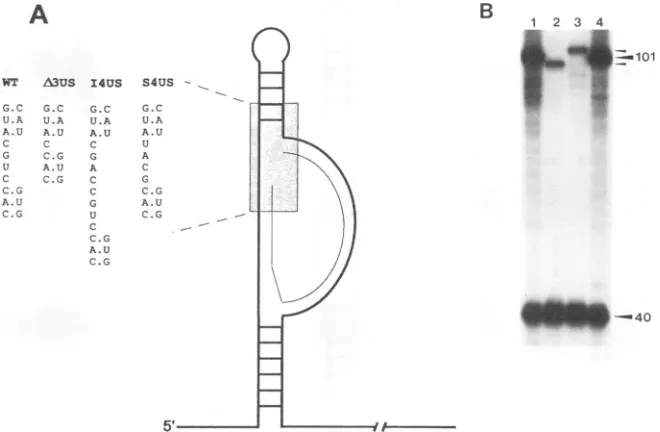
Mutations in the upper spacer region.The series of inser-tions, deletions, and base substitutions in the upper spacer
analyzed are summarized in Fig. 3A. The effect ofplacing a
4-nucleotide insertion mutation into theupper spacerisshown inFig. 3B (lane 3). Forreference,thewild-typeRNA(Fig. 3B, lane 1) and the RNA template containing the 3-nucleotide deletion(lane 3), whichwepreviously characterized (1),were
included in this analysis. The cDNA product expected for a
4-nucleotide insertion is 105 deoxynucleotides, whereas that for the3-nucleotide deletion is 98deoxynucleotides. As shown in Fig. 3B (lane 3), thepresence of the 4-nucleotide insertion caused a two- to threefold decrease in the amount of the 105-deoxynucleotide cDNA synthesized compared with the wild-type 101-deoxynucleotide cDNA(lane 1).Themagnitude of the decreasewas similar to that observed for the 3-nucle-otide deletion(lane 2). In contrast,a4-nucleotidesubstitution
in the same region of the RNA had no detectable effect on
101-deoxynucleotide cDNA synthesis (lane 4). As a control,
the amount of the DNA-primed 40-deoxynucleotide cDNA productwasfoundtobe thesamefor all reactions. Thesize of this product does not change since the LTR DNA primer anneals 5' tothe U5 RNAmutations. These results indicate that thesequences intheupper spacerarenotrecognizedina
sequence-specific manner during cDNA synthesis. However,
changesinthe size ofupperspacerinducedby either deletions
or insertions of sequence reduce the efficiency of reverse
transcription.
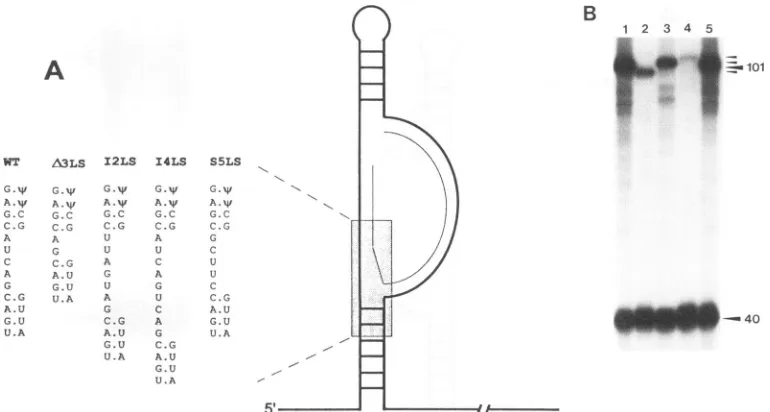
Mutations in the lower spacer region. A similar set of mutationswereintroducedinto the lowerspacer(Fig.4A) and
analyzed for cDNA synthesis in vitro (Fig. 4B). These muta-tions include a2-nucleotide (12LS) anda4-nucleotide (I4LS)
insertion, a3-nucleotide deletion (zA3LS), and a 5-nucleotide substitution (S5LS). The sizes of the cDNA products expected for I2LS, I4LS, A3LS, and S5LS mutations are 103, 105, 98,
and 101 deoxynucleotides, respectively. Asintheupperspacer,
perturbationsthatalter thelengthof the lowerspacerresult in defects in strong stop DNA synthesis (Fig. 4B). The magni-tudes of the decrease for the 2-nucleotide insertion and the 3-nucleotide deletion were similar to one another (Fig. 4B,
lanes 2 and 3) and to that observed for the comparable insertion and deletion in theupper spacer(Fig. 3B, lanes2and 3). The 4-nucleotide insertion (Fig. 4B, lane 4), however, had
amuchstrongerinhibitory effecton reversetranscription than didthe 2-nucleotideinsertion(lane 3). Thisresultsuggeststhat there isa relationship between thesize ofthe insertion inthe
lowerspacerandtheseverity of the effecton reverse
transcrip-tion. Incontrast tothese results, the 5-nucleotide substitution had no apparent effect on initiation of reverse transcription
(lane 5).
Mutations in the PBS. The results shown in Fig. 3 and 4 suggest that the RT-RNA initiation complex has a defined
A
Is"I'Mr-IMPEP"77PF777.".77"r777W
iiatfili
1-B
C
on November 9, 2019 by guest
http://jvi.asm.org/
[image:4.612.119.512.76.308.2]RNA STRUCTURES IN INITIATION OF REVERSE TRANSCRIPTION 615
A
NT A3US I4US G.C G.C G.C
U.A U.A U.A A.U A.U A.U C C C
G C.G G
U A.U A
C C.G C C.G C
A.U G
C.G U C
C.G
A.U C.G
-40
FIG. 3. (A)Schematic representation of theRNAsecondarystructuresof the 5'noncoding RSVRNAshowingmutationstotheupper spacer
sequence.Thethin linerepresentsthetRNAprimer, and thethick linerepresentsthe RNAtemplate.The expandedregion shows thesequence
of the mutationswhich delete 3nucleotides (A3US), insert4nucleotides(14US),orsubstitute 3nucleotides (S3US)oftemplate RNA. WT,wild
type.(B) cDNA products from reconstitutedreversetranscriptionreactions withwild-type (lane1),A3US(lane2), 14US(lane3),orS3US (lane
4) templateRNA.TheTrp28RNAprimerwasusedinall reactions. Extensionfromthe wild-type and the substituted RNAtemplates from the RNAprimeris 101nucleotides long. Extension from the template RNAcontaining the3-nucleotide deletionorthe4-nucleotide substitutionare
accordinglysmallerorlarger (small arrowheads). The extensionproductfrom the LTR DNAprimer is40nucleotides long.
tertiary structure,which, when distorted, results inadecrease
in the efficiency of initiation ofreverse transcription. If this is
correct,onewouldpredict that defects inreversetranscription
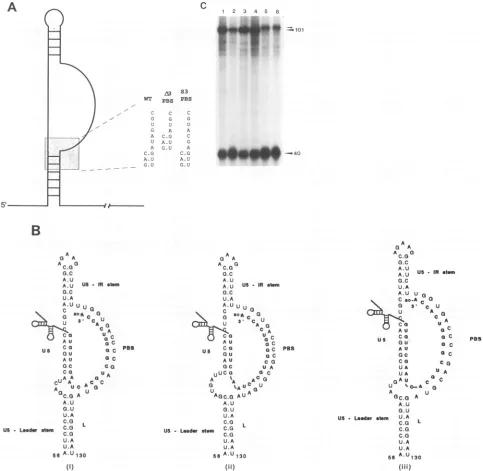
could be causedby distortions ofstructureintroducedinto the PBSregion. Totestthis hypothesis,a3-nucleotidedeletionwas
placedatthe 3'end of the PBS(M3PBS),reducing its abilityto anneal to the tRNATrP from 18 to 15 complementary nucle-otides. Asacontrol,a3-nucleotide substitutionwasalsoplaced in the same region (S3PBS). Both mutations are depicted in
Fig. SA. As with the deletions in the upperand lowerspacers,
the deletion in the PBS reduced the in vitro efficiency of initiation of reverse transcription two- to threefold (Fig. SC, lane 2)compared with the wild type (lane 1). In contrast, the 3-nucleotide substitution had little or no effect on reverse
transcription (Fig. SC, lanes 3 and 4). This was the case
whether the wild-type 28-mer primer (lane 3) or a mutant primer, which containsa3-nucleotide substitutionpermitting it tofully anneal to the modified PBS (lane 4),was used. Note that PBS mutations will not change the size of the cDNA products. These results indicate that the loss in the base pairing at the 3' end of the PBS is not responsible for the loss in efficiency ofreverse transcription. This conclusion is further
substantiated by combining the 3-nucleotide PBS deletion mutation withthe 2-nucleotide substitution in the lowerspacer
(Fig. 5B). The combination of these two mutations, which would restore the primer RNA base pairing to the wild-type level, did not restore the efficient reverse transcription (Fig.
5C, lanes 5 and 6). Thus the reverse transcription complexis sensitive toperturbations that alter the relative orientation of any of theduplex regions.
Substitution of the RSV PBS for that from HIV-1. We and others have shown that RT is required toefficiently anneal a
primer tRNA to the PBS (1, 4, 24). In an effort to further elucidate the role of RT in this process, a mosaic RNA
containingU5 andleadersequencesfromRSVwerecombined
with the
tRNA'-Ys
PBSof HIV-1 (Fig. 2A). A set ofprimerswhichcorrespondtothe 3'-terminal 55 (Lys55), 28 (Lys28),or
20 (Lys2O) nucleotides, respectively, of tRNA!3Yswere
synthe-sizedasT7transcripts. Thenameof theprimer is indicatedin parentheses. Additionally, two mosaic primers of 28 and 55 nucleotides, in which the TtJC loop sequences in Lys28 and Lys55 were replaced with those from tRNATrP, were
synthe-sized.Thesehybrid primersarecalledLysTrp28andLysTrp55, respectively. Each of the primer-template combinations was
examinedinvitroby usingeither AMV RT(Fig. 2B)orHIV-1 RT(Fig. 2C) duringtheannealing and extensionreactions. In contrast towhat isobservedwith the RSVtemplateand RSV primer (Fig. 2B, lanes 2 and 3), none of the mosaic RNAs
supported efficient initiation ofreverse transcription (lanes 4 to 8). There was a difference in the small amount of DNA synthesis observed with the various
tRNA'-Ys
primers. Those that could anneal to the RSV TqiC interaction region wereslightlymoreefficient thanthose that couldnot(comparelanes 6 and 8 with lanes4, 5, and 7). Taken together, these results suggest that there must be sequence-specific interactions be-tween RT and the duplex regions of the primer-template combinationinthe initiationcomplexwhich are lost when the
sequence of the PBS ischanged.
Ifthe PBS-primer duplexis theprimary siteforspecific RT interaction, one might reconstitute the efficient initiation of
reverse transcription by addition of the HIV-1 RT to the in vitro reaction. However, even though equivalent units of
HIV-1RTwereadded, theamountof DNAsynthesisobserved with the same primer-templates was small (Fig. 2C). This suggests that efficient initiation of reverse transcription
re-quires multiple specificinteractionsbetween the PBS and the U5 RNA T4iCregion. The latter is consistent with the higher activity observedwith theLysTrp28 primerandAMV RT(Fig. 2B, lane 6).
B
S4US
-G.C U.A A.U U
A
C G C.G A.U C.G
5'. VOL.68, 1994
on November 9, 2019 by guest
http://jvi.asm.org/
[image:5.612.143.473.78.294.2]B
A
WT A3LS I2LS I4LS
A.Wt
G.C C.G
A
U C
A
G C.G A.U G.U U.A
G.W G.W
A.W A.w
G.C G.C C.G C.G
A U
G U C.G A
A.U G
G.U U
U.A A
G C.G A.U G.U U.A
GA.W
A.W G.C C.G
A
U C
A G
U C A G C.G
A.U
G.U
U.A
S5LS
"I
G.W
A.W G.C C.G G C U U C C.G A.U G.U
[image:6.612.118.503.76.282.2]U.A
FIG. 4. (A) Schematicrepresentation of theRNAsecondarystructuresof the 5'noncoding RSVRNAshowing mutationstothe lower spacer sequence. Primer andtemplateare asindicated in thelegendtoFig.3. Theexpandedregion shows the sequence of the mutations whichdelete 3 nucleotides (A3LS),insert 2 or4nucleotides(I2LSandI4LS,respectively),orsubstitute 5 nucleotides(S5LS) of thetemplateRNA.WT,wild type. (B)cDNAproductsfrom reconstitutedreversetranscriptionreactions withwild-type (lane 1), A3LS (lane 2), I2LS (lane 3), I4LS(lane 4), or S5LS (lane 5) template RNA. The Trp28 RNA primerwas used in all reactions. Extension from thewild-type and the substituted RNA templates from theRNAprimer is 101 nucleotides long. Extension from the template RNAcontaining the3-nucleotide deletion orthe 2- or 4-nucleotidesubstitutionareaccordingly smallerorlarger(small arrowheads).The extensionproduct from theLTRDNAprimeris 40nucleotides long.
DISCUSSION
The initiation complex formed with avian sarcoma/leukosis virus U5 RNA and the tRNATrP primer in the presence of avian sarcoma/leukosis virus RT appears to be complex. As wellasthe interaction ofthe PBS with the tRNAprimer, there are a series ofsecondary structures, U5-IR stem, U5-leader
stem, and U5 RNA-T4iC interaction region, all required for efficient initiationofreversetranscription (1, 7, 8). Moreover,
theseduplex structural elementsappeartobemaintained ina
specific orientation relative to oneanother foroptimum initi-ation ofreversetranscription. Insertionsordeletions of similar
sizeplacedinspacerregions between these elements resultin similar reductions incDNAsynthesis. Furthermore, the
mag-nitude of the reduction in cDNAsynthesis is relatedtothesize of the insertion. In contrast, nucleotide substitutions intro-duced into thesameregions havenoeffectoncDNAsynthesis.
The simplest explanation for these data is that insertions or
deletions in the spacer regions structurally distort the
RT-RNAcomplex, reducing the efficiency of initiation ofreverse
transcription. This interpretation is further supported by the observation thatadeletion inthe 3' end of the PBS alsocauses
a reduction in reverse transcription. This is in contrast to a
3-base substitution, which has little effect, irrespective of whether the primercan anneal to the substituted bases. The changes in synthesis observed here are due to defects in initiation rather thanDNAelongation synthesis sincewehave
previously shown that mutations that disrupt the duplex
re-gions result in a decrease in incorporation of the first
de-oxynucleotide, dATP (1, 7, 8). For increased sensitivity,
how-ever, wehave monitored strong stop DNAsynthesis in these experiments.
Characteristic 5' RNA structures and primer interactions
are conserved in other typeC and D retroviruses, suggesting that these virusesuse a commonmechanism for the initiation of reverse transcription (13). Direct evidence for the U5-IR
and U5-leader stem structures, in the absence ofprimer, has
recently been obtained by nuclease sensitivity studies of
Bau-din et al. (5) for murine leukemia virus and HIV-1 RNAs.
Under these conditions, the PBS is annealed to U5 RNA as
predictedfromstudiesofRSV(1). The mutational studiesof Rizvi and Panganiban (21)haveledtosimilarconclusionsfor simian immunodeficiency virus RNA. Berkhout and Schon-eveld (6) have extended the in vitro observations to HIV-2 RNA annealed to
tRNALYs.
Inthiscase, both nuclease sensi-tivity studies and structural interference with DNAsynthesis initiated from a primerannealed downstream 3' to the PBS signal thepresenceofthe U5-IRstem,U5-leaderstem,andU5RNA-T14C interaction regions.
The deletion mutagenesis studies of Rhim et al. (20) also
provide evidencefordefined spatial relationships betweenthe structural elementsofthePBSregion ofHIV-1 (HXB2strain)
RNA. Theseinvestigators deletedbetween 9 and 12 nucleoti-des from the 3' end of the PBS. Upon passage of viruses
containing these deletions in cell cultures, wild-type growth
revertants were rapidly recovered. These stable revertants werecloned and sequenced. Of 43 clones examined, all but 1
possessed 18-nucleotidePBSregions, suggestingthatthere was a selection against an alteration in the size of the PBS. In contrast to the conservation of size, several stable revertants
possessed sequence changes at two orthree positions within the PBS that would reducebasepairingtotheprimer. The fact
that these are stable revertants indicates that the loss of base
pairing does not interfere with reverse transcription. These results are similar to those described here for the S3PBS
mutation, which had wild-type levels of initiation of reverse
transcription when using an 18-nucleotide PBS but with re-duced base pairingto theprimer. Smaller butfunctional PBS
regions, 10or 12 nucleotides long, are also foundin retroele-ments such as Drosophila copia (12). Together these results
suggest that changes in the normal size of the PBS cause
,.Mill
40
on November 9, 2019 by guest
http://jvi.asm.org/
RNA STRUCTURES IN INITIATION OF REVERSE TRANSCRIPTION 617 VOL. 68, 1994
A
WT
- C
G U G A U A C.G A. U _ _ G.U
1 2 3 4 5 6
-.ioi
4*~~P
-
40
B
A A
aC.G
0G.C
A.U
A.U US Mat..
o.C
U.A A.UU U
c 2 a
u S. CC U
dO U CACGA
A U C US Coa O C ps
AU oC
OC CO
CO UA
CUAA ac
cu UC ACa
A0Q
UUC.o A
A.U
G.U
U.A
C.G L US Leder C.G
C.G
U.A U.A
6A.U130
(I)
A A 0
AC.GG
G.C
A.U
A.U US -IRad
G.C U.A
A.UUU
3.cc U
AG
CuA
A U C
G
au a c
AU CG
GC UA
uuca a C
A ' ACO3
AGC.G AUA
A.U
O.U U.A
C.G us - Leae ala C.G
U.A U.A
5 A.U130
(I1)
GA
A AAC.Go.0a
G.C
A.U
A:U USIRetai
G.C U.A
A.U U 0
Cao-A C 0
Co C
d S.-C U^
AU oC aAU Uoc GC a C
Co Co
UA
UA UA
oxAU Co C
U v0oA o
AU U
OC.G A
A.U
G.U
US LeaderL a U.A
C.G L C.G C.G
U.A U.A
56 A.U 130
[image:7.612.61.544.77.548.2](111)
FIG. 5. (A) Schematicrepresentationof the RNAsecondarystructuresof the5'noncodingRSV RNAshowingmutationstothePBSsequence.
Theexpanded region showsthesequenceof themutations whichdelete3nucleotides (A3PBS)orsubstitute3nucleotides (S3PBS)ofthePBS.
WT,wildtype.(B)Putative RNA secondarystructureof theA3PBS(i),I2LS(ii),andcombinedA3PBS-12LS (iii)mutantRNAsshowingpotential
basepairingwith theTrp28 primer.Allothernotationsare asin thelegendtoFig. IA.(C)cDNAproductsfrom reconstitutedreversetranscription
reactions withwild-type (lane 1), A3PBS (lane 2), S3PBS (lanes3 and4), 12LS (lane 5), and A3PBS-12LS (lane 6) templateRNAs.TheTrp28 RNAprimerwasused inallreactionsexceptforthatshown in lane4,wheretheTrp28S3 primerwasused. Size ofcDNAproductswereasinFig.
3 and 4.
structural distortions in the RT-RNA initiation complex that decrease theefficiency ofreverse transcription.
In some revertant clones obtained by Rhim et al. (20), deletions 3' to the PBS of 6 to 11 nucleotides were detected.
These deletionsremoveduplications ofsequencesthatappear
tobepresentin the HXB2(20)and MAL strains(5)of HIV-1. Theduplication of thesesequences causes theformationofan
additionalstem-loopatthe3' end ofthePBS. Removalofthis duplication will not interfere with the formation of the
U5-leaderstempredicted bythe structural studies of Baudinetal. (5). Spatial relationships are also supported by the studies of Olsen et al. (17), which introduced small insertions into the lowerspacerofareticuloendotheliosisvirus-basedvector.The altered lower spacers rapidly reverted towild-type sizewhen thevectorwasintroduced into cell cultures. Inafewrevertants, small variations from thewild-type sequencewere found.
In addition to thestructural requirements for formation of the initiation complex, we have begun to look for specific
c
3 S3 PBS PBS
C C
G G
U U
A A
C.G C
A.U G
G.U A
C.G A.U G.U
PBS
on November 9, 2019 by guest
http://jvi.asm.org/
RT-RNA interactions. There is considerable evidence for
specific
interactions between RT and the tRNA primer.Ret-roviruses
encapsidate
a relatively small number of tRNAspecies,
with preference shown for the specific tRNA used toprime
reverse transcription. Peters and Hu (18) described anavian sarcoma virus mutant that lacked RT and no longer
specifically
encapsidated tRNATrP. Similar mutantsofmurineleukemia virus
(14)
and HIV-1 (10) have been described.However, it is notyet clear how RT specifically recognizes its cognate
primer. Early experiments
by Hu and Dahlberg (9)suggested
that a fragment of tRNA'rpwhich retains the TipCloop
and the acceptor stem was bound by AMV RT with about 80% oftheefficiency
of anintact tRNATrP. Barat et al.(4)
havereported
that HIV-1 RT interacts with its cognateprimer
(tRNALYS)
by virtue of specific interactions with theanticodon
stem-loop.
More recent experiments (24), however, have demonstrated that the terminal 24 nucleotides oftRNA,-
yS interacts with HIV-1 RT almost as well as intactauthentic or
synthetic
tRNALys does. These results are in agreementwithourobservations thata28-mer RNAprimerismuch more
efficiently
used during initiation than a 20-merRNA
primer
and that the 55-mer does not improve theefficiency
ofthe initiation reaction. Moreover, sequencecom-parisons
oftRNAsencapsidated
intoHIV-1virions(10) donot reveal any conservation in the anticodon stem-loop. Such conservation ofsequencedoesexist forthe DHU andtheT4C armsof the tRNAs(2a).
Whether a full-length tRNAprimer is moreefficient than theprimers used here isnotyet known.To further search for RT-specific interactions, we examined
the
efficiency
of initiation complexes to prime DNAsynthe-sis
catalyzed by
AMVorHIV-1 RT andformed with amosaictemplate
RNAthatcontains thetRNA Ys PBS substitutedforthe tRNATrP PBS. Even
though complementary
mosaicprim-erswhich could annealto the altered PBSwere used, neither
enzymewasableto
efficiently catalyze
cDNAsynthesis underthese conditions. The RSV Lys3PBS mutation contains an
additional mutation at
position
71. Wehavepreviously
shownthat a 6-nucleotide substitution immediately adjacent to this
position
hasnoeffectonstrong stop DNAsynthesis when theRNA
primer
usediscomplementarytothesubstitution(1),asare the
primers
used in theexperiments
described above.While we cannot eliminate the
possibility
that the C-to-Tsubstitution is
responsible
fortheeffectswehaveobserved,wedo not think that this likely. Taken together, these results suggestthat there are
sequence-specific
RT interactions withthe
duplex regions
that may be lost in the mosaic RNAinitiation
complexes.
A systematic search for such specific interactionsisnow under way.ACKNOWLEDGMENTS
We thank Ed Houts, Molecular Genetic Resources, for AMV RT and Stuart LeGrice, Case Western Reserve University School of Medicine,forHIV-1 RT.
This work was supported in part by Public Health Service grant CA38046 fromthe National Cancer Institute andby Cancer Research CentergrantP30 CA 43703.
REFERENCES
1. Aiyar, A., D. Cobrinik, Z. Ge, H.-J. Kung, and J. Leis. 1992. Interactionbetween retroviral U5 RNA and the
TWC
loop of the tRNA'rp primer is required for efficient initiation of reverse transcription. J.Virol. 66:2464-2472.2. Aiyar, A., and J. Leis. 1993. Modification of the megaprimer method of PCRmutagenesis: improved amplificationof thefinal product. BioTechniques14:366-367.
2a.Aiyar, A.,andJ.Leis.Unpublished data.
3. Barat, C., S.LeGrice, andJ.-L.Darlix. 1991. Interaction ofthe
HIV-1 reversetranscriptase with asynthetic formof itsreplication primer, tRNALYS-3. Nucleic Acids Res. 19:751-757.
4. Barat, C., V. Lullien, 0. Schatz, G. Keith, M. T. Nugeyre, F. Gruninger-Leitch, F. Barre-Sinoussi, S. F.J. LeGrice, andJ.-L. Darlix. 1989. HIV-1 reverse transcriptase specifically interacts withthe anticodondomain of its cognate primer tRNA. EMBOJ. 8:3279-3285.
5. Baudin, F., R. Marquet, C. Isel, J.-L. Darlix,B.Ehresmann, and C. Ehresmann. 1993. Functional sites in the 5' region of HIV-1 RNAfrom defined structuraldomains. J. Mol.Biol. 229:382-397. 6. Berkhout, B., andI. Schoneveld. 1993. Secondarystructure of the HIV-2 leader RNA comprising the tRNA-primer binding site. Nucleic Acids Res. 21:1171-1178.
7. Cobrinik, D.,A.Aiyar, Z.Ge, M. Katzman, H. Huang,andJ.Leis. 1991. Overlapping retroviral U5 sequence elements are required for efficient integration and initiation ofreverse transcription. J. Virol. 65:3864-3872.
8. Cobrinik, D., L. Soskey, and J. Leis. 1988. A retroviral RNA secondary structure required for efficient initiation of reverse transcription. J. Virol. 62:3622-2630.
9. Hu, J. C.,and J. E. Dahlberg. 1983. Structural featuresrequired for thebinding oftRNATrp to avian myeloblastosis virus reverse transcriptase. Nucleic Acids Res. 11:4823-4833.
10. Jiang, M., J. Mak, A. Ladha, E. Cohen, M. Klein, B.Rovinski, and L. Kleinman. 1993. Identification of tRNAs incorporated into wild-type and mutant human immunodeficiency virus type 1. J. Virol. 67:3246-3253.
11. Katzman,M.,R. Katz, A.M. Skalka,andJ. Leis.1989. The avian retroviral IN cleavesthe terminal sequences of linear viral DNA at the in vivo sites of integration. J.Virol. 63:5319-5327.
12. Kikuchi, Y., Y. Ando, and T. Shiba. 1986. Unusual priming mechanism of RNA-directed DNA synthesis in copia retrovirus-like particles in Drosophila. Nature (London) 323:824-826. 13. Leis, J., A. Aiyar, and D. Cobrinik. 1993. Regulation of initiation
of reverse transcription of retroviruses, p. 33-47. InA. M.Skalka and S. P. Goff (ed.), Reverse transcriptase. Cold Spring Harbor Laboratory Press,Cold Spring Harbor, N.Y.
14. Levine, J. G., and J. G.Seidman. 1979. Selective packaging of host tRNAs by murine leukemia virus particles does not require genomicRNA. J. Virol. 29:328-335.
15. Milligan, J., D. Groebe, G. Witherell, and 0. Uhlenbeck. 1987. Oligoribonucleotide synthesis using T7 RNA polymerase and synthetic DNA templates. Nucleic Acids Res. 15:8783-8798. 16. Murphy, J., and S. Goff. 1989. Construction and analysis of
deletion mutations in the U5 region of MuLV: effects on RNA packaging and reverse transcription. J. Virol. 63:319-327. 17. Olsen, P., H. Temin, and R. Dornburg. 1992. Unusually high
frequency of reconstitution of the long terminal repeats in U3-minusretrovirus vectors by DNA recombination or gene conver-sion. J. Virol.66:1336-1343.
18. Peters, G.G., and J. Hu. 1980. Reverse transcriptase as the major determinant for selective packaging of tRNAs into avian sarcoma virusparticles. J. Virol. 36:692-700.
19. Prats, A.-C., L. Sarih, C. Gabus, S. Litvak, G. Keith, and J.-L. Darlix. 1988. Small finger protein of avian andmurineretroviruses has nucleic acid annealing activity and positions the replication primer tRNA ontogenomic RNA. EMBO J. 7:1777-1783. 20. Rhim, H., J. Park, and C. D. Marrow. 1991. Deletions in the
tRNALYS primer-binding site of human immunodeficiency virus type 1 identify essential regions for reverse transcription. J. Virol. 65:4555-4564.
21. Rizvi, T. A., and A. T. Panganiban. 1993. Simian immunodefi-ciency virus RNA isefficiently encapsidated by human immuno-deficiencyvirus type 1 particles. J. Virol. 67:2681-2688.
22. Sambrook, J., E. F. Fritsch, and T. Maniatis. 1989. Molecular cloning: alaboratory manual, 2nd ed. Cold Spring Harbor Labo-ratory Press, Cold Spring Harbor, N.Y.
23. Schwartz, D. E., R. Tizard, and W. Gilbert. 1983. Nucleotide sequence of Roussarcoma virus. Cell 22:853-869.
24. Weiss, S., B. Konig, H. J. Muller, H. Seidel, and R. S. Goody.1992. SynthetichumantRNALys,3 and natural bovine tRNALYS,3 interact with HIV-1 reverse transcriptase and serve as primers for retro-viral cDNA synthesis.Gene 111:183-197.