JOURNALOFVIROLOGY,Sept. 1994,P. 5969-5981 Vol. 68, No. 9 0022-538X/94/$04.0O0+0
Copyright © 1994, AmericanSociety forMicrobiology
Efficiency and Selectivity of RNA Packaging by Rous Sarcoma
Virus Gag Deletion Mutants
MICHAEL SAKALIAN,1t JOHN W. WILLS,2ANDVOLKERM.
VOGT`*
Section ofBiochemistry, Molecular and Cell Biology, Cornell University, Ithaca, New York 14850,1 and Departmentof Microbiology and Immunology, Hershey Medical Center, The Pennsylvania
State UniversitySchoolof Medicine, Hershey, Pennsylvania 170332 Received 7 March 1994/Accepted 16 June 1994
In allretrovirus systems studied, the leader region of the RNA contains a cis-acting sequencecalled W that
isrequired for packaging the viral RNA genome. Since thepol and env genes are dispensablefor formation of
RNA-containing particles,thegag gene product must have anRNAbindingdomain(s) capableofrecognizing W. To gain information about which portion(s) of Gag is required for RNA packaging in the avian sarcoma and leukemia virus system, weutilized a series ofgag deletion mutants that retain the
ability
to assemble virus-like particles. COS cells were cotransfected with these mutant DNAs plus a tester DNA containing W, and incorporation of RNA into particles was measured by RNase protection. The efficiency of packaging wasdetermined by normalization of theamountof 'I RNA to the amountofGag protein released in virus-like
particles.Specificity of packagingwasdeterminedby comparisons of'W' and I- RNA inparticles and in cells. Theresults indicate that much of theMA domain, much of the plO domain, half of the CA domain, and the entirePRdomainofGag are unnecessary for efficient packaging.Inaddition, none of these deleted regions is neededforspecificselection ofthe I RNA. Deletions within theNC domain, as expected, reduce or eliminate boththeefficiency and thespecificityofpackaging. Amongmutants thatretain the
ability
topackage,adeletionwithin the CAdomain (which includes themajor homology region) is the least efficient.We also examined
particles of the well-known packaging mutant SE21Q1b.The data suggestthat therandom RNApackaging behaviorof this mutant is not due to aspecific defectbutrather is the resultofthecumulative effectofmany pointmutationsthroughoutthegag gene.
Assembly and budding of retroviruses depends on the product ofasingle viral gene, gag. For type C retroviruses, this process appearstooccur attheplasma membrane. In contrast, typeB and Dretroviruses assemble capsidsin thecytoplasm, which then travel to and bud from theplasma membrane(52). During assembly, in a process that is notunderstood but for whichnoviral geneproduct other than Gag is necessary, two copies of the viral RNA genome are packaged (45). Upon budding, the virusparticle undergoes maturation whereby the Gag polyprotein precursor is cleaved into the several structural proteins of the virus. These mature proteins then assume the roles that their names imply: matrix ormembrane associated (MA), capsid (CA), nucleocapsid(NC), and in aviansarcoma
and leukemia viruses (ASLVs), proteinase (PR) (26). The triggeringevent forproteolysis isnot known.
In all retroviruses analyzed to date, the RNA genome contains in the 5' untranslated region a sequence element, termed
I,
that identifies this RNA as the viral RNA to be incorporated into virions (23, 29). In most retroviruses, this element is near to, or perhaps coincident with, the dimer linkage site,asequence throughwhich the two identicalRNAsubunits in each virion are held together. At least in some
retroviruses, stem-loop structures are important components of T (25, 59). While T is necessary for packaging, in many
cases it isnotsufficient forefficient incorporation ofanRNA
into virions. Forexample, in murine leukemia virus (MuLV), sequences within the 5' portion of the gag gene stimulate
*Correspondingauthor. Mailingaddress: Section ofBiochemistry,
Molecular and CellBiology, BiotechnologyBuilding,Cornell Univer-sity, Ithaca,NY14853.Phone: (607)255-2443. Fax:(607)255-2428.
tPresent address:DepartmentofMicrobiology, Universityof Ala-bamaatBirmingham,Birmingham,AL35294-2170.
packaging (5).These and similar studiesby others(reviewedin reference29)suggestthatmorethanonesequenceelement in the viralRNAmayberecognized bythepackagingmachinery. InASLVs, three classes of elements other than T have been implicated directly or indirectly in packaging of RNA into virus particles. The first is the DR(directrepeat,sincesomeASLVs carry two of thesesequences), located in the 3' untranslated region, which was shown to be essential for packaging of partially deleted viral RNAs containing T (47). In a subse-quentstudy,this sequencewasfoundtoincrease the incorpo-ration of a TP nonviral RNA by 10-fold (4). The second consists oftwoveryshort openreadingframes in the 5' leader sequencebefore the gag gene. Mutationof the AUG initiation codonat thebeginningof either shortreadingframe reduced packaging 50- to 100-fold (12). The observation that the sequence of the predicted oligopeptides encoded by these readingframes isunimportant suggests that ribosomebinding and translation are required in order for the RNA to be recognized bythepackaging machinery. The third element is the dimer linkage (DL),which in ASLV is atypical in that it
occurs in the 5' region of the gag gene(38, 41, 44). However,
more recentstudies indicate that theDLmaynotbe required forpackaging,at leastnotforheterologous
TP
RNAs (3).What corresponding determinants in Gag recognize and bindtoTRNA? Extensive studies of the NCprotein,asapart of the gag precursor, have established the importance of this domain inthepackagingofgenomicRNA. Achimeric ASLV Gag protein carrying an MuLV NC domain substituted for normal ASLV NC preferentially packages MuLV-derived RNAs (14). Also, point mutations within the single Cys-His motif of MuLV NC affect specificity (15, 33). However, the role that theCys-Hismotifplaysinpackagingiscontroversial. According to early reports with several retrovirus systems, 5969
on November 9, 2019 by guest
http://jvi.asm.org/
deletion of Cys-His motifs abrogates packaging of viral RNA
by Gag (10, 15, 16,34, 35).More recentdatasuggestthat such
deleted Gag proteinsmay still be able packageviral RNA but
that thisRNAis degraded into small fragments (3). Thus, the
Cys-His motifs may play a structural role in protecting the
RNAratherthan in packagingper se.Moreover, their absence in the NC of the spumavirus subclass of retroviruses (32) suggeststhat these motifsare notessential for packaging in all
retroviruses. Recently, specific binding of human
immunode-ficiency virus type 1 (HIV-1) NC to viral RNA (7) and to a
smallportion of theHIV-1N sequence wasdemonstrated (42).
However, there has been no such demonstration of specific
binding by ASLV NC to RNA. In addition to its part in
packaging, this protein performs other functions essential to
the life cycle of the virus. The ability of NC to promote
annealing both toform the viral RNA dimer and to position
thetRNA on the primer binding site is well described (8, 40).
While the role for NCseemsfirmly established, it isnotclear
whatroles other domains inavian Gag might have in assisting NC in specific packaging. The ASLV MA protein binds
nonspecifically to RNAin vitro and thusmight be expected to
havea function in packaging (48). TheMA protein of bovine
leukemia virus (BLV) is reported to specifically bind RNA
fragments containing the putative BLV T sequence (22). The PRdomain ofASLV Gag also is implicated in packaging. In
chicken cells, Gag deleted ofPRis reported to assemble into particles devoid of viral RNA(39). Specific, in vitro binding of the intact Gagprecursor toviral RNAhas been reported only
for HIV-1 (7,30).
Certain domains of the Gagprecursor have been shown to
be responsible for particle assembly. The effect of deletions
within gag was studied in an expression system based upon Myrl, a Rous sarcomavirus(RSV)gagin which the N-terminal 10codons have beenreplaced with those of src. The src amino
acidsequencedirects themyristylation and subsequentplasma
membranetargeting of the Gagprecursor,resulting in efficient particle production in the mammalian COS-1 cell line (57). Deletion analysis has led to the conclusion that this myristy-lated Gag derivative contains three regions that are essential
forassembly ofparticles with normal density (56). The first is the N-terminal eight amino acids of the Src protein, which directs myristylation (57). The second is in a stretch of
polypeptide called p2, between the MA and the plO coding
sequences(54),andthethird is in NC. This third regionmaybe
present as two functionally equivalent elements within NC. One of these elements is necessary for the dense packing of Gag molecules within the particle (54) and can be replaced with functionally equivalent sequences from the HIV Gag
protein (6).
Wehaveutilizedthe Myrlvariant of Gag expressedinCOS
cells toinvestigatetherole of avian Gag domainsinpackaging.
In this system, Gag protein is efficiently assembled into
virus-like particles that, by electron microscopy, are indistinguish-able from authenticRSVvirions(53). SinceMyrlproduces an RNAwithout
P,
we modified the expression system bypro-viding a TP RNA in trans. Assembly-competent deletions were examined with the intent to identify domains that con-tribute topackaging. Wefound that much of Gag is unneces-sary for efficient and specificpackaging. In addition, we also examined the Gag of SE21Q1b, an RNA packaging mutant.
Becauseof its abilitytopackage random RNA, it has long been
assumed that analysis of thismutantwould reveal the domain
within Gag responsible for specificity. The sequence of
SE21Qlb indicatesseveral aminoacid differences with Prague C RSV.Acluster ofdifferences in the C terminus of the NC
domain, when tested in a wild-type background, did not
reconstitute the mutant phenotype (2). The results reported here are consistent with those of Anderson et al. (2), who
suggest that the behavior of SE21Q1b Gag is not due to a single defect.
MATERIALS AND METHODS
DNAconstructs. PlasmidpSV.MyrlA, a derivative of plas-mid pSV.Myrl (57), is a simianvirus 40 (SV40)-basedvector whichproduces a transient overexpression of gag when trans-fected into COS-1 cells. pSV.MyrlA differs from pSV.Myrl by the addition of a poly(A) signal inserted within the XbaI site 3' to the gag sequences (Fig. 1A). Mutantconstructs pSV.Myrl.
MAI (58), pSV.Myrl.R-3J and pSV.Myrl.SmBs (56), and pSV.Myrl.3h (53) are described elsewhere. Plasmid pSV. Myrl.Es-Bg wasconstructed by digesting pSV.Myrl with EspI and BglII followed by treatment with Klenow polymerase
before ligation.The resulting construct lacks gag codons 349 to 417. Plasmid pSV.Myrl.Bg-Xm was constructed by digesting
pSV.Myrl with BglII and XmaI. Treatment with Klenow
polymerase resulted in an out-of-frame alignment but
hap-pened to recreate the XmaI site. Subsequent digestion with XmaI and treatment with S1 nuclease allowed realignment of the gag sequences. One foreign arginine residue is inserted between amino acids 418 and 520. Plasmids pSV.Myrl.PR-L1 and pSV.Myrl.SP-S1 were constructed by
oligonucleotide-directed mutagenesisasalready described(57).Thesequences
of the mutagenic oligonucleotides were 5'-GCCGTCTCGT
AAGCGATG and 5'-GGCCATGTAGTCTGC, respectively. Plasmid pSV.Myrl.PR-L1 is an exact deletion of the PR domain beginning at amino acid 577 and is identical to the
CM5mutant of Oertle and Spahr (39), whilepSV.Myrl.SP-S1
is a truncation from the C terminus of the CA domain through the spacerpeptide, NC, and all of PR (Fig. 1B).Theexpressed products of these clones will be referred to by the abbreviation Myrl orby thedesignationof the deletion; e.g., Es-Bg refers to
Gagproteinandparticles produced by clonepSV.Myrl.Es-Bg. Achimeric gag gene was constructed by replacing fragments
of thegag geneof pSV.MyrlA with analogous sequences from plasmid pSE21Q (2), kindly provided by Maxine Linial.
pSV.MyrlA.QXE (Fig. 1B) contains the SE21Qlb XhoI-EcoRIfragment(nucleotides630 to 2319; see reference 44 for
numbering). pSV.MyrlA.QXB contains theXhoI-BglII frag-ment(nucleotides 630 to 1630), while pSV.MyrlA.QBE
con-tains theBglII-EcoRI fragment (nucleotides 1630 to2319).
Plasmid pSV.Pl8A was constructed to provide an encapsi-dation-competent RNA. Plasmid pSV.MyrlA was digested withSacl(nucleotide 255), and anEcoRI linker was inserted to create pSV.MyrlAE. This plasmid was then digested with EcoRItoexcise the RSV sequences (nucleotides 255 to2319), which were replaced with the EcoRI fragment (nucleotides
-53to9238) of plasmid P18. P18, provided byJoe Sorge,isa derivative of the plasmid pr770/-273/P#3 (47), in which a set ofXbaIlinkers had been inserted into theClaI site(nucleotide
-850), thus providing a stop codon near the end ofthe MA
encodingregion (Fig. 1A).
T7 transcriptionclones were made by inserting appropriate sequences into the multiple cloning site of the phagemid pBluescript II KS+ (Stratagene). Plasmid pL(-)T7contains the EcoRI-SacI (nucleotides -53 to 255) fragment from P18
(Fig. 1A). pMyr(-)T7 contains theXhoI-SphI fragment (nu-cleotides 630 to 1006) of pSV.MyrlA, blunted with Klenow
fragment atthe SphI site, between theXhoI and EcoRV sites in the vector. P3-76 (48) produces a plus-sense RNA that
correspondstothe RNA made by pSV.P18A in vivo, with the
exception that since this plasmid was made with sequences
on November 9, 2019 by guest
http://jvi.asm.org/
RNA PACKAGING BY Gag DELETION MUTANTS 5971
A
pSV.MyrlA
SV40 --|| NC J PR AI PolyA
pSV.P18A
pL(-)T7
EcoRI SacI
pMyr(-)T7
LF
XhoI SphI
B
Myrl(wt)
MAl R-3J
Es-Bg
Bg-Xm Sm-Bs PR-Li SP-S1 QXE QXB QBE
( N-terminus of Src
\,10 155 177 239
MHR Cys-His
3974410 Motifs
397
1.
410 47988 577MA
plo
j
C
AA
uICPRJ|
j8 85~
192 364'
l-
' 348, 418,418 517I
=1. . 515
-
I 577-| I 1 ~~~~~~~479~ ~
Q
'85
~~~~~~418:
418 647:
1~~~-551
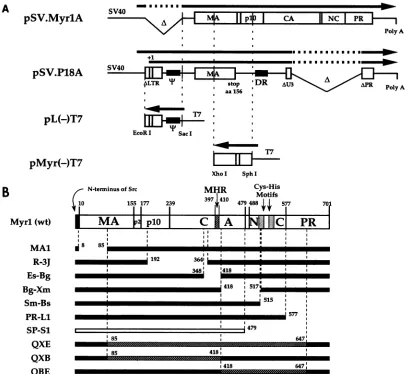
FIG. 1. (A) Transcription units ofSV40-based and T7expression vectors.Transcription ofpSV.MyrlA produces an RNAthatencodes a
full-length gagpolyprotein precursor but doesnot contain the T packaging element. PlasmidpSV.P18A produces anRNAthat contains all
elements knowntobe associated withpackaging.ThetwoT7transcriptionclones encoderiboprobestodetectthecomplementarysequences,as
indicatedby the vertical dashed lines. Darkarrowsillustrate transcribedRNAs, plussensepointingtotherightand antisensepointingtothe left. Note thattranscriptioninitiationonpSV.P18Aoccursat twoplaces,attheSV40late promoter and alsoat +1 inthelongterminalrepeat(LTR).
aa,aminoacid.(B) PolyproteinprecursorMyrland its derivatives.Myrl (wildtype[wt])isamodification of theGagprecursorPr76 in whichthe N-terminal 10amino acids have beenchangedtothesequenceofthe Srcprotein.Thematureproteinscleaved from theprecursor,MA, p2, plO, CA, NC,andPR,areshown inthebox,with amino acid numbersdefiningtheir ends above. MHR isaconserved amino acidsequenceinretrovirus CAproteins. Cys-His motifsareconserved amino acid sequences inmost retrovirus NCproteins. Dark bars depict assembly-competent Gag deletionmutants;theopenbardepictsanassembly-defectivedeletion. The numbers indicate amino acid residue numbers that define each deletion. Cross-hatchedsections of barsdepict regionsofSE21Q1bsequencewithinMyrl-SE21Qlb chimeras.
frompr770/-273/P#3 (47), it doesnotcontain the Xbalinkers (see aboveandFig. 1A).
Cells and virus. COS-1 cells were grown in low-glucose Dulbecco's modified Eagle medium supplemented with 10% fetal bovineserum(LifeTechnologies), 1.0% vitamins,20 mM L-glutamine, 100 U of penicillin G per ml, and 100 ,ug of streptomycin sulfate perml.Schmidt-Ruppin strain A(SR-A) RSVwas harvested from turkey embryo fibroblasts that had been stably transfected with plasmid RCASneo (49). These cells, which continuously shed SR-A virus,weremaintained in the medium described aboveplus25 jigof active G418perml. Transfection and metabolic labelingofCOS-1 cells. SV40-basedgagexpressionconstructswerepreparedfortransfection by digestion with XbaI followed by ligation, as previously described(57),topositiontheSV40 polyadenylation signal just
3'tothegagsequence.Theseplasmidswerethen cotransfected
with undigested pSV.P18A into COS-1 cells. Although pSV. MyrlAneednotbe cut andligatedsince it hasan additional polyadenylation signaldownstream ofgag, itwasnevertheless treated as were the gag deletion plasmids which lack this additional signal. The exception was in the experiments to
compare Myrlwith SR-A RSV. In thesecases, plasmid pSV. MyrlAwascotransfected withpSV.P18Aasis. Plasmid pSV. P18Awas nevercut andligatedin anyexperiment.
COS-1 cellsweretransfectedbyaslightmodification of the DEAE-dextran method of Mortlocketal.(37).Briefly,theday before transfection, COS-1 cells were plated in transfection medium (growthmedium with fetalbovineserumreplaced by 10% Nu-serumIV [Collaborative Research])atadensityof 5
x 105 cells per 60-mm-diameter plate. Cut and ligated
gag-701
-VOL.68, 1994
i
on November 9, 2019 by guest
http://jvi.asm.org/
[image:3.612.107.516.73.447.2]expressingDNA
(1.25
to2.0 ,ug)wascombinedwith 1.5 ,ug of uncutpSV.P18Ain 600[lI
ofphosphate-bufferedsaline(PBS)containing
0.2mg ofDEAE-dextran per ml and then addedtoPBS-washed 75 to 85% confluent 60-mm-diameter plates. Aftera 60-min incubation at 37°Cin 5% CO2, the DNAwas
removedby aspirationandreplacedwith 2 ml of10%dimethyl sulfoxide in transfection medium. Plateswere incubated fur-ther for 2.5 minat room temperature, the
dimethyl
sulfoxide medium was replaced with 4 ml of transfection mediumcontaining
100 FLMchloroquine,
and theplates
werereturnedto the
CO2
incubator. After 4h,
thechloroquine-containing
mediumwas
replaced
with transfection medium. Transfectionefficiency
wasmonitoredby parallel
transfection withplasmidpHPAPr-1-,Bgal,
which contains the bacterial ,B-galactosidase gene drivenbythe human ,B-actinpromoter(37). Efficiencies wereestimated from in situ,-galactosidaseassaysusing5-bro-mo-4-choro-3-indolyl-13-D-galactopyranoside
(X-Gal) (37)
and ranged from 1 to 25%. Transfections with less than 10%efficiency
werediscarded.Forty-eight hours posttransfection, cells were labeled with
L-[35S]methionine
(>1,000 Ci/mmol;
ICNBiomedicals, Inc.).
After three washes withPBS,cellswerelabeled with 75 ,uCiof
[35S]methionine
in 1.5 ml of serum-free Dulbecco's modifiedEagle
medium minus methionine. Five hours later, 2.5 ml oftransfection medium was added. Labeled particleswere col-lected the next
day.
Isolation of virus-like particles. Particles were collected from COS-1 cells either 48 h posttransfection or, if labeled with
[35S]methionine,
72 hposttransfection. SR-A RSV pro-ducedby
turkey embryofibroblastswascollected after1dayof production infresh transfection medium. Afterpreclearingof mediumby centrifugation
at 10,000rpm for 10min, particleswere
pelleted
through a 20%(wt/vol)
sucrosecushion in 100mM NaCl-10mMTrishydrochloride (pH 7.5)-l mM EDTA
by ultracentrifugation
at 30,000 rpm for 2 h in a BeckmanSW60rotor.
Western blotting (immunoblotting), immunoprecipitation,
and protein quantitation. For
quantitation
by Westernblot-ting,
viruspellets
were dissolved in sodiumdodecyl
sulfate(SDS) sample
buffer and then loaded onto an SDS-15%polyacrylamide gel.
Proteinsweretransferredto anImmobilonP membrane
(Millipore Corp.), probed
first with rabbitanti-capsid (aCA)
serum at adilution of1:2,000,
andthenprobed
once more with 2
,uCi
of['251]protein
A(>30
VuCi/pug;
ICN Biochemicals). The film exposure was used to locate theprotein
bandsonthe blot for excision andcounting.Astandardcurve was constructed with known amounts of
purified
CA protein. Values of nanograms of CA for virus samples werethen read offofthis standard curve.
For
quantitation
by immunoprecipitation,[35S]methionine-labeled
particles
were dissolved in 1 ml ofradioimmunopre-cipitation
assay buffer(17),
and viralproteins
wereprecipi-tated with the addition of 5 [L of
aCA,
otPR, and/or aMA serum.Antigen-antibody complexes
were eluted frompro-tein
A-Sepharose
beads(Pharmacia
LKB Biotechnology,Inc.)
inSDSsamplebuffer and then loadedonto anSDS-15%poly acrylamide gel.
Afterpolyacrylamide gel electrophoresis(PAGE),
radioactive bands were visualized by fluorographyafter the
gels
wereimpregnatedwith sodiumsalicylate. Bands werethen excised from thegelandcountedwithout additional scintillant.Quantitation
wasdoneby comparingthe number of countsin eachsample's
bands with those inMyrl control lanes.RNA purification, RNase protection analysis, and RNA
quantitation. Total cellular RNA was purified from COS-1
cells48hposttransfection bythe acidguanidinium-thiocyanate method of
Chomczynski
and Sacchi (11). Viral RNA wasextracted from viralparticle pellets directly without resuspen-sionby the addition of 100 ,ul of phenol-chloroform, 2.5
RI
of 20% SDS, 100[lI
of diethyl pyrocarbonate-treated H20, and 25pug of yeasttRNAcarrier, in that order. The aqueous phasewasthen further extracted with chloroform and finally precip-itated in ethanol-sodium acetate. Purified RNAs were stored at -70°C until needed. 32P-labeled probes for RNaseprotection assays were made by transcription reaction using T7
poly-merase as instructed by the manufacturer (Promega Corp.).
RNA size standards were transcribed by using the RNA Century template set (Ambion, Inc.). RNase protection anal-ysis was performed with slight modification as described by Aronoff and Linial (4). Briefly, approximately 106 cpm of probe (not gel purified)and10 ,ug of yeast tRNAcarrier were added to sample or to standard quantities of in vitro-made RNAina10-pA reaction mixturecontaining 0.4 M NaCl, 0.1 M morpholinepropanesulfonic acid (MOPS), and10 mMEDTA. Reaction mixtureswereheated at95°Cfor2min, transferred
to65°C foratleast 3 htoallowhybridization, and then treated with 90
RI
ofanRNasecocktailcontaining 0.3 M NaCl, 10 mM Tris hydrochloride (pH 7.5), 5mM EDTA,3 ,g of RNase A perml, and4,000 U of RNaseT,
(Life Technologies)perml. Aftera 30-minincubation at room temperature, the sampleswerefurther treated with 0.2 mg ofproteinaseK(Boehringer Mannheim Biochemicals) per ml for 15 min at 37°C. An additional 10 ,ug of tRNA carrier was added, and the samples
were phenol-chloroform extracted, ethanol-sodium acetate precipitated, and then loaded onto either a 6 or an 8% polyacrylamide-8M urea sequencing gel. After electrophore-sis, the gelwasadheredtoblot paper and dried ina vacuumgel drier before exposuretofilm. The region of the gel containing theprotected bandswascut outandexposed for 30to60 min in a Betagen Betascope 603 blot analyzer. Protected bands
werequantitated by comparing the number ofcountsin each bandofsample lanes with those in Myrl control lanes.Forthe experiment to compare Myrl with SR-A RSV, a standard
curve wasconstructedbyusing thecountvaluescorresponding
tothe nanograms of in vitro-made RNAstandardsinput into the assay.
RESULTS
Adaptation ofCOS-1 cellgag expression system to study
RNA packaging. COS-1 cells have been used extensively to
study particle assembly of wild-type and partially deleted versions of the ASLV Gag protein (54, 56-58). The parent
vectorinthis system,pSV.MyrlA, contains the ASLV gag gene driven by the SV40 late promoter. This vector also includes the SV40 Tantigen and the SV40origin of replication. pSV. MyrlA and all its derivatives lack the core Tregion of the leader sequence (Fig. 1A), which is essential for viral RNA packaging(3,23,50).Thus, particles produced by expressionof
thesevectorswouldnotbeexpected tocontain viralRNA. To provide a
T'
RNA that would be a substrate for packaging, we constructed the expression vector pSV.P18A (Fig. 1A). Since the parental construct ofP18
was shown previously to produce an RNAthat could be packaged into virusparticlesbudding from chicken cells(47),weexpected theRNA transcribed from pSV.P18A to be also packaged into particles produced byCOS cells. Thisvectorcontains all viral
RNA elements that have been implicated in packaging for ASLV, namely, the entire leader sequence ofRSVincluding the T packaging sequence (23), the three upstream open readingframes(12),and onecopyof theDRsequence(4, 47).
Italsoincludes part of the gag openreading frame
on November 9, 2019 by guest
http://jvi.asm.org/
RNA PACKAGING BY Gag DELETION MUTANTS 5973
M - Myr - 18 - Co
3 18- -3 08
-255
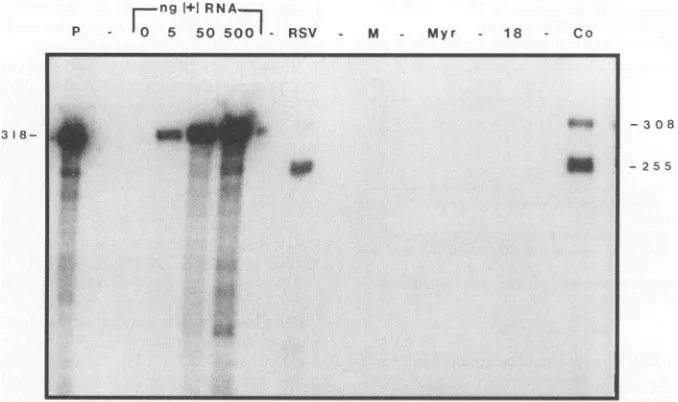
FIG. 2. RNase protection analysis of particle RNA. COS-1 cells were transfected with pSV.MyrlA orpSV.P18A, alone or together. The medium was collected 48 h posttransfection. Alternatively, medium was collected after 24 h of particle production from turkey cells expressing SR-A RSV. RNA extracted from pelleted particles and in vitro-made RNA standards was analyzedby RNase protection, using the probe transcribed from
pL(-))T7.
Samples were loaded onto a6% sequencing gel. P, undigested probe; ng(+) RNA, in vitro-made RNA standards, designatedby amounts in nanograms; M, mock transfection; Myr, single transfection with pSV.MyrlA; 18, single transfection with pSV.P18A; Co, cotransfectionofpSV.MyrlAwith pSV.P18A. Empty,unloadedlanes are marked by dashes. The sizes(innucleotides)of protectedfragments are indicatedatthe left andright.ing to most of the MA domain of Gag, which contains the dimerlinkage.
Totestif this systemindeed could be usedtostudy packag-ing, wetransfected COS-1 cells, singly or in combination, with pSV.P18A and pSV.MyrlA. Forty-eight hours posttransfec-tion, mediumwasharvested, particles were collected by ultra-centrifugation, and RNAwas extracted. Packaged RNA was then analyzed by RNase protection. This method has the advantage of being both more sensitive than Northern (RNA) blot analysis and more tolerant of partial RNAdegradation. The probe was transcribed from vector pL(-)T7 (Fig. 1A), whichhybridizes to the 5' part of the viral RNA genome, from the R and U5 sequences of the long terminal repeat to the Sacl site atnucleotide 255. Only theRNAproducedby pSV.
P18A can be recognized by this probe, because the gag-encoding RNAfrom pSV.MyrlA does not contain any viral sequences upstream of the Sacl site. As a positive control,
RNA fromvirus produced by turkey embryo fibroblast cells stablyexpressingRCASneo,aninfectious clone of SR-A RSV, was tested in parallel. Also included was in vitro-synthesized (plus)-stranded RNAfromplasmid P3-76, which corresponds
tothe P18 RNA made invivo, in order to gauge the sensitivity of the assay.
Analysis of RNA from single transfections with either pSV.MyrlA or pSV.P18A resulted in no protected bands, indicatingthat therewasno
TP
RNAin thesesamples(Fig.2, lanes Myr and 18). In the case of pSV.MyrlA, Pr76gag was expressed, assembled into particles, and then shed into the medium, butnoT' RNAwasavailable to be packaged.Inthecase ofpSV.P18A,
TP
RNA was made in the cells, but the shortN-terminalportion of Gag didnotassemble intoparticles (data not shown). In contrast, cotransfection of the twoplasmids (Fig. 2, lane Co) yielded two clusters of protected fragments. (Digestion of the single-stranded regions of the annealedprobeby the combination ofRNases A and
T,
resultsinacluster of similar-size protectedfragments). Both Gagand
T+
RNAwereproduced in the cell atthe same time, and so particles assembled, packaged RNA, and were released into the medium. Thepresence of two clusters ofprotectedfrag-mentsis aconsequenceof the utilization of both theSV40 and the RSV initiation sites by the SV40 late promoter. The antisense probe detects both transcripts because it extends upstream ofthe RSV initiation site (Fig. 1A). Identification ofthelarger fragment cluster,at308 bases inlength,isbased
on comparison with the fragments protected bythe in
vitro-made RNA (Fig. 2, lanes 0 through 500). These bands are notdue toundigestedprobe,which is 318bases inlength; the
size difference is more clearly evident after electrophoresis for longer times (datanotshown).Identification of thesmaller protectedfragment cluster, at 255bases, is basedon compar-ison with the fragment of identical size produced by
au-thentic RSV (lanes RSV and Co). That the two P18-derived RNAspecies arepresentintransfected cellsin approximately
the same relative proportion as in Myrl particles, as
deter-mined by RNase protection analysis of whole cell RNA, indicates that one RNA is not preferentially packaged (data
notshown).
Myrl particles and authentic RSV package comparable
levelsofRNA.Althoughtheonly difference between wild-type
and myristylated Pr769ag resides at the N terminus of the
protein andnot nearthe NCdomain, it seemedpossiblethat this difference nevertheless might influence packaging. In
addition, Myrl and its derivativesare derivedfromPrague C RSVsequences(57),while theTP testerRNA isderived from the SR-A strain of RSV (47).These considerations ledus to
directly compare the ability of Myrl to package RNA with
infectious SR-A RSV (Table 1). The data for individual
samples in this experiment are shownto illustrate the repro-ducibility of results. RNA was quantitated byRNase protec-tion followed by exposure in a Betagen blot analyzer. The amount of RNA is expressed in nanograms of the
P3-76-derived T7 transcripts used as standards in the assay. The VOL. 68,1994
-
Fo-
ng1+1RNA--p 5 50
5001
RSVon November 9, 2019 by guest
http://jvi.asm.org/
[image:5.612.141.480.72.273.2]TABLE 1. Comparison of RNA packaging by Myrl and RSV particles amongindividual samples
Virus ng ofCA' ng ofRNAh RNA/CA
Myrlc 15 1.0 0.067
25 2.0 0.079
24 1.8 0.075
RSVd 86 3.0 0.035
104 2.5 0.024
95 3.6 0.038
Quantitation of protein is by comparison with known amounts of avian
myeloblastosis virus CA standards.
bQuantitation of RNA is inequivalents of in vitro-made RNA standards.
'Sampleseach representvirus from oneplateof COS-1 cellscollected 48 h
posttransfection.
dSampleseach represent virus from oneplateofturkey embryofibroblast cells
expressing RSV collected for oneday.
actualmassofRNAinRSV virions would beroughlyfive times
higher since the fullgenomicRNAis five timeslargerthan the P18 RNA orthe T7transcript. Thus, after correction for the slight difference in size (255versus 308)and conversion of the number ofcounts tonanogramsofP3-76RNA, the valuesare
directly proportional to the number of molecules of RNA
packaged (Table 1).
Tocontrolfor thedifference in particleproduction, half of each medium sample was analyzed for RNA as described above,and theother half was analyzed for theamountof CA by Western blotting. The membrane was probed with otCA
serum followed by ['25I]protein A, and the radioactivity in excised bands was quantified. Avian myeloblastosis virus CA
was used as a standard to allow conversion of counts per
minutetonanogramquantities. TheamountofRNApackaged isexpressedby the ratio ofnanogramsofRNAtonanograms
of CA. By this analysis, Myrl particles and RSV contained
0.074± 0.006and0.032 ±0.007 gofRNA,respectively,per g
of CA.Thus, Myrlparticles producedinCOS cellsare atleast
asefficient in packagingRNAasinfectious virusproduced in
avian cells (see Discussion).
Efficiencyofpackaging by partialgag deletion mutants. To
investigatethepossible role ofthe several domains oftheGag
precursorinpackaging,weassayed theability of a set ofGag deletionmutants (Fig. 1B)toincorporateRNAinto virus-like particles. Deletions MA1, R-3J, Es-Bg, Bg-Xm, Sm-Bs, and
PR-Li span the entire length of the precursor, with the exceptionofaregionencompassingthe C-terminal half ofMA, p2, and the N-terminal portion of plO, which contains a
domain essential for assembly (54, 56). All but oneofthese
mutants are capable of assembly and release as virus-like particles (53,56, 58); mutantSP-S1 isassemblydefective and
wasusedas anegativecontrol.Particles shed fromtransfected, [35S]methionine-labeled COS-1 cellswere collected and ana-lyzedfor proteinand RNA.
Theproteininvirus-likeparticleswasanalyzed by immuno-precipitation with appropriate antisera followed by
SDS-PAGE (Fig. 3). The selection of antiserumwasmade on the basisof thelocationofthe deletion. ForMAl,themature CA wasprecipitated, and for R-3J, Es-Bg, andBg-Xm,themature PR waschosen since theseconstructscontain deletionsin CA.
For
PR-Li
and Sm-Bs,the Gag precursor protein wasprecip-itated since theseconstructs lack thePRdomainand thusno
cleavage occurs. Precipitations using oxCA serum (Fig. 3A) showed that MAl and
PR-Li
can assemble into virus-like particleswhereas SP-S1cannot.Precipitations withoPRserum or acombination of cxPR plusoLMA
sera, in the case oftheexperiment including Sm-Bs (Fig. 3B), showed that R-3J,
Es-Bg, Bg-Xm, andSm-Bscanassemble as well. Each panel in Fig. 3 includes Myrl, as this is thewild-typepositive control
withwhich all mutants are compared.
RNaseprotectionanalysis revealed thosemutantGags that
can package the tester RNA into particles (Fig. 4). MAI, PR-Li, and R-3J contained amounts of RNAcomparable to
that of Myrl. Mutants Es-Bgand Bg-Xmpackaged RNA but appeared to have done soless well than Myrl. The negative
control, SP-Si, produced no protected bands in the assay.
What little signal that did appear after avery long exposure
(notshown)wasused toestablish abackground, perhaps due to RNA released from dead cells. Sm-Bs also packaged no testerRNA by this assay, asmight be expected, since in this mutant mostofNChasbeen deleted.
To account for thedifferent levels of particle production, immunoprecipitated proteinbands (Fig. 3)were cutfrom the
gel andcounted. The numberof counts was then dividedbythe numberof methioninesin thedifferent proteinspecies selected foranalysis. The resulting values thus are proportional tothe
number ofGagprecursormolecules shed inaparticulateform
into the medium. These values were then normalized to the
value forMyrltogive a relative measureof particleproduction
(Fig. 5A). The efficiencyofpackagingwasthen calculated by dividing the quantity of protectedRNAby the relative levelof
particle production. The packaging efficiency for Myrl was
definedas 1.0(Fig. 5B).Notethatnovalue for SP-SI isgiven inFig. SB. SP-Slis the background control, andsotheamount of RNA signal that it gives relative to Myrl has been sub-tracted fromall other values.
Bythismeasureofefficiency, onlytwo regionsofGagwere
found toinfluence packaging. Evenafter taking intoaccount
its low level ofvirus production, Sm-Bs is still incapable of
packaging the testerRNA(Fig. SB). Thismutantis similarto one made by Meric and Spahr (PrC 10.8), in which NC is
deleted from within the proximal through the distal Cys-His motif, and gives the same result-particles devoid of viral
RNA(35). However,ourmutation also deletesPR, while PrC
10.8 does not. Es-Bg is only 25% as efficient as Myrl. This deletion is entirely within CA, yet it is the most severely affected ofallthemutantsthatretain theabilitytoincorporate
RNAinto particles.
Incontrast, the remainingmutants package RNArelatively efficiently. Even Bg-Xm, which deletes the proximal Cys-His motif of NC (Fig. 1B),was found to have RNAlevels within
a factor of2ofRNA levels of Myrl. This result is consistent
with the work of Meric et al., which showed that single deletions of either of the Cys-His motifs reduced but didnot abrogate RNA encapsidation in chicken cells (34). Deletions
MAI and R-3J each haveamodest effectuponpackaging,and PR-Li canpackage efficiently aswell. Weattribute the obser-vation that PR-LI particles contain 1.5 timesmore RNAthan Myrl particles to a technical artifact. In our hands, the Gag polyproteinproduct of PR-LIsmearsinSDS-PAGE(Fig.3A). Thus, when the band is excised to be counted, some of the
signal is lost, leadingto an underreporting ofthe number of particlesproduced. Weestimate that thisdiscrepancy
contrib-utes no more than a twofold error, and hence PR-Li is certainly efficient at packaging. This conclusion is in direct
contrast to the results ofothers, who reported that a mutant Gagdeleted of the PR domain failed topackageviral RNA(3, 39).
Efficiency of packaging by Myr1-SE21Q1b chimeras. Al-though virus particles of SE21Qib package T' RNA, when produced in avian cells, this mutant Gag protein is roughly fivefold less discriminating than the wild type in that it also
packages random RNAs (4). To compare the packaging
on November 9, 2019 by guest
http://jvi.asm.org/
[image:6.612.58.297.90.164.2]RNA PACKAGING BY Gag DELETION MUTANTS 5975
A
M y r M A 1 PR-Li
a b a b a b
200 9 7.4
69
46
30
21.5
14.3
My r SP-Si
a b a b
4-Pr.aPR
-C A
B
M yr R-3J Sm-Bs
a b a b a b
200
-97.4
-69
-46
-30
-21.5
-14.3
-My r Es-Bg Bg-Xm
a b a b a b
_- Pr.aNC-P R
4-C A
[image:7.612.146.476.83.495.2]4-P R
FIG. 3. Immunoprecipitation ofMyrl anddeletion mutantvirus-like particles. Precipitated proteinswere electrophoresedon an SDS-15%
polyacrylamide gel.Pairsof lanesareasmarked forcotransfections ofgagexpressionconstructswith pSV.P18A.Lanesaand bare 1/12and 1/6,
respectively, of total pelleted particles per transfected plate. Numbers indicate the positions of molecular size standards in kilodaltons. (A)
Precipitations using oxCAserum.CA,positionof thematurecapsid protein; Pr.APR, position ofprecursordeleted in theproteinasedomain(lanes PR-LI).CAandPr.APR bandswereexcised forsubsequentquantitation. (B) Precipitations using csPRplusoxMAsera(left)orctPRserumalone (right). PR, positionofproteinase; Pr.ANC-PR,position ofprecursor deleted in nucleocapsid andproteinase domains (lanes Sm-Bs).PR and
Pr.ANC-PR bandswereexcised forquantitation.
ciency of the SE21QIb Gag precursorwith that ofMyrl, we madeaseriesof clones in whichMyrl sequenceswerereplaced
with the corresponding ones from SE21Qlb. The largest replacement, clonepSV.MyrlA.QXE, produces aGag precur-sorinwhich amino acid 85 in the MA domainto amino acid 647 in the PR domain is derived from SE21QIb sequences (Fig. 1B). Two complementary half replacement clones cen-tered aroundamino acid 418 in the CA domain, pSV.MyrlA. QXBandpSV.MyrlA.QBE,werealso made.Cotransfections,
metabolic labeling, and assays were performed as before for
the Gag deletionmutants (not shown).
Allthreechimeric clonesproduced somewhatmoreparticles thanMyrl (Fig. 6A). The packaging efficiencies of thetwohalf
replacements, QXBandQBE,werehigherthan thatof the full replacement but lower than thatofMyrl.
Specificity ofpackaging. While efficiency is a measure of how muchRNAispackagedintoaparticle,it doesnotprovide information about the abilityofGag to discriminate between RNA species. To investigate the capacity of each of the mutants to specifically recognize and select the T+ tester RNA, we compared the levels ofincorporation of this RNA and theT- RNAthat encodesGagfor eachmutant(Fig. 1A).
To detectboththegagand theT'I testerRNAssimultaneously in the RNase protection assay, we constructed the T7
tran-scription vector pMyr(-)T7 (Fig. IA). The riboprobe made from this construct can base pair with 376 bases of the gag
-m i,z"
'3.
---...
-VOL.68, 1994
.-.
M
on November 9, 2019 by guest
http://jvi.asm.org/
A
P My r MAl
Wm: _
4
0
P Myr PR-L1
_
_P Myr SP-S1
P Myr R-3J Sm-Bs
:. '. _0
.S
.
b
*
P Myr Es-Bg Bg-Xm
."U
*0
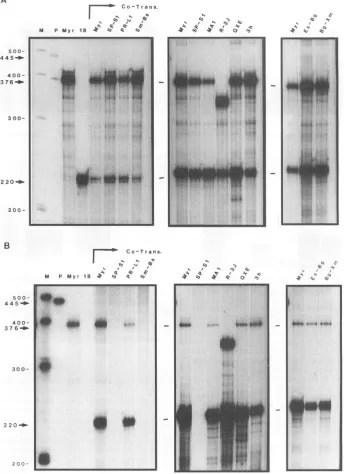
"",;.'..:-FIG. 4. RNaseprotection of Myrland deletionmutantparticles. AssaysweredoneasforFig.2 except thatelectrophoresiswasperformedon
8%sequencing gels. Samplelanes inpanelsA and Bcorrespondtothose forprotein analysisinFig.3A and B. Each lane representsprotection of RNA from one-fourth of totalparticlescollected fromonetransfectedplateofcells. Lanes Pare1/1,000ofinputprobe.Numberedarrows
indicate the sizes (in nucleotides) ofthecorrespondingRNAfragments. RNA (fromXhoI in the MA domainsequencetoSphI in the
plOdomain sequence) butonly220 bases ofTP RNA.Thus, two distinct protected fragments should be produced by a
mixture of thesetwoRNAs inaprotectionassay.COS-1 cells
wereagaintransfectedwithpSV.P18A singlyorincombination with each of the Gag-encoding plasmids. RNase protection analysiswasthenperformed onboth cellular RNA and RNA from virus-like particles.
Single transfections of the Myrl- and P18-expressing
con-structs produced the expected protected fragments in both cells and particles (Fig. 7, lanes Myr and 18 at the left). No RNA signal was seen in medium from a single transfection with theP18-expressingconstruct(Fig. 7B,lane18) because,as discussed forFig. 2,noparticleswereproduced.Incontrast,a
single transfection with the Myrl-expressing construct did
produceasignal sincesome gagRNAwaspackaged.
Analysis ofcotransfections showed thatalthough all of the mutantsincorporated thegagRNAalong with the T' RNA, the TP RNAwas enriched in particles comparedwith cells, indicating that this RNA is preferentially selected (compare Fig. 7,lanesMyr, PR-Li, MAl, QXE, 3h, Es-Bg, and Bg-Xm).
Some mutants failed to package any of either RNA, as
expectedfromtheearlierresultstomeasureefficiency(Figs.4 and 7B, lanesSP-S1 and Sm-Bs). Note that for mutantR-3J,
thefragment protected bythegagRNAis smaller. This is due tothe deletion ofsomeof the plOdomain in this construct, such that a slightly smaller fragment of the probe would be
protected (compare Fig. 1A andB). Note also that an addi-tionalmutant,3h,wastested in theseexperiments.Thismutant is similartoPR-Li exceptthat 3hretains the firstsevenamino acids of PR plus a C-terminal lysine residue not normally
found inthatposition (53).
To obtaina quantitative comparison of the abilityof each mutant to specifically select the TP RNA, the data were
analyzed in the following manner. Each protected bandwas
counted, andaratio of P+ togagRNAwas calculated.This ratio for RNA in the particlewas then divided bythe same ratio for RNA in the cell to give a value that we define as
selectivity [selectivity = (PJGV)I(PcIGc) whereTP orTP and
Gv
orGc
are the quantities of TP RNA andgag RNA in particlesorcells, respectively]. Qualitatively, selectivityis theabilityofavirus,on a molarbasis, toselect andpackageone RNAoveranother. Forinstance, inourexperiments, a
selec-tivityof 10wouldmeanthat when thevirus ispresentedwitha
poolofRNAsincludingtheTP testerandtheT-gagRNAs,
ithasa10-fold-higher propensitytochoose theTP RNAover thegagRNA. Aselectivityofoneindicatescompletelyrandom
packaging.We found itnecessarytocalculatespecificityin this
3 18_ 3 0 8
25 5
0.
B
3 18 --_,
3 0 8
2 55-*
on November 9, 2019 by guest
http://jvi.asm.org/
[image:8.612.146.468.77.419.2]RNA PACKAGING BY Gag DELETION MUTANTS 5977
A
2.5
2.0-Po 1.5
v-4 1.0
V
0.5vU
X _
I
A
700 .9
0
u-i
n-t
100.5-0.0
I *I I I I S P-I I
Myrl(wt) MA1 R-3J Es-Bg Bg-Xm Sm-Bs PR-Ll SP-Si
Deletion
Mutant
B
>.,
22.5-u U)
2.0-*i-I U
1.5-bi
1.0
-bO
tv 0.5-P-4 0.0
T
Myrl(w
l
Wt) MA1 R-3J
B
U
*1-'4
*04
w
bO
.O
toto
.U
-r
Es-Bg Bg-Xm Sm-Bs PR-Li
Deletion Mutant
FIG. 5. Summary ofdeletionmutantanalyses. Valuesrepresentthe
averages of four experiments done intwo separate setsoftwofora
total of 4 timesexceptthose formutantsSm-Bs and SP-S1, whichwere
doneatotal 6times, and Myrl (wildtype[wt]), whichwasdoneatotal
of26 times.Error barsrepresentthestandard deviation from themean
foreach mutant.Scalesarerelative toMyrl set at1.0. (A) Relative
measureofparticleproduction.[35S]methionine-labeled protein bands
wereexcised fromthe gel(Fig. 3) and counted. The relativeamountof protein was determined by dividing the number of counts by the number ofmethionines in the selectedprotein species and comparing the result with that for Myrl. (B) Relative measure of packaging efficiency. Protected RNA bandswerequantitated by Betascope image analysisoftheexposure.Thenumber ofcountspersamplewasdivided
by the relative particleproduction and then compared with the value forMyrl. SP-S1 is excluded,asit is theRNA background control.
mannersince the relative expression of thetwocotransfected constructs cannot be precisely controlled. An advantage of measuringpackaging by selectivity is that theassayis indepen-dent of the amount of protein and of total RNA within particles.
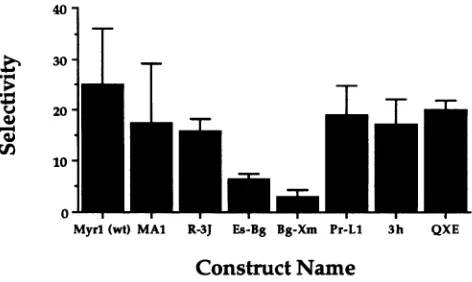
Asfound for theefficiency ofpackaging, few regions of Gag influence the specificity of RNA selection. Myrl has an
average selectivityof about 25(Fig. 8). Most deletionswithin
gaghadlittle effect onthis value andproduce aselectivity of between 15 and 20. These include the neartotalreplacement of Myrl with SE21Q1b sequences (clone QXE). That this chimera is not grossly deficient in specific packaging of
T'
RNA is consistent with previously published data (4). In contrast,Es-Bgisapproximatelyfourfold reduced inpackaging selectivity. However,themutant mostdeficient inselectivity,at onlyaboutone-eighththelevel ofMyrl,isBg-Xm, suggestingthat theportion of the Gag protein deleted contains
informa-tion forspecificrecognition ofviralRNA.
1.5
-1.0
-
os-
0.0-T1
Myrl(wt) QXE
Chimera
QXB QBE
-F
l1-Myrl(wt) QXE QXB QBE
Chimera
FIG. 6. SummaryofanalysesofMyrl-SE21Q1b chimeras. Values forchimeras represent the averagesoffourexperiments doneinsetsof two on two separate occasions. Error bars represent the standard deviation from the mean. Scales are relative to Myrl set at 1.0. Quantitationwas performed as forFig. 5. (A) Relative measureof particle production.(B)Relativemeasureofpackaging efficiency.
DISCUSSION
We have shown that virus-like particles produced by the Myrl avian gagexpressionsystemarecapableofefficientlyand specifically packagingviralRNAcontaining T.Production of RNA-containing particles was achieved by cotransfection, analogoustotheproductionofhelper-freeretroviralvectorsby usingpackaging cell lines (31, 36, 43,50) except that in our
system,thecellswere notalready expressingthe viralproteins. That Myrl can efficiently incorporate RNA during particle assembly isnotsurprisinggiventhatwild-type Gagcandosoin the absence ofpol andenvgene products (39,45) and that in chicken cells, the tester RNA appears fully competent for packaging by RSV (47). Deletion mutants that were still capableofassembling intoparticleswerethen examined. Both the efficiency and specificity of RNA encapsidation were
determinedbystandardizingthe resultsagainst theamountof proteinanda nonspecificT- RNA inreleasedparticles. We
also similarly examined the Gag ofSE21Q1b, a mutant that incorporates randomRNAs(28).
Myrl apparently canpackage RNAabout aswellas SR-A RSV. However,wefound that the number ofRNAmolecules in Myrl particles was approximately twice that in RSV. We
believe this difference tobe significant giventhe
precision
of the measurements. The dispersion within the data for each particle type is small compared with the difference between Myrl and RSV(Table 1). Under theconventionalassumption
thatwild-type retroviruses contain two molecules of
genomic
RNA, Myrl particles therefore contain four tester RNA VOL. 68,1994
on November 9, 2019 by guest
http://jvi.asm.org/
[image:9.612.318.555.74.367.2] [image:9.612.58.294.75.381.2]F-; Co-T r a ns.
MqC 4
M P M yr 18 co q cO
Co-Trans
4. I 'd r
4 - C- T$a M P Myr 18 4 co 01 Co
*eUi
..*
S
A. I 15 4/
$
X¾
* C 4CO *
4 It I * v
v 4 0- 0
FIG. 7. RNaseprotectionusingthe gag antisenseprobe. AssayswereperformedasforFig.2.LanesMaremolecular sizestandards,lanesMyr aresingletransfections withpSV.MyrlA, and lanes 18aresingletransfections withpSV.P18A.Lanes shownbyarrows ascotransfectionswereof pSV.P18Awith thegag-expressing construct asindicated. Numbers denote thesizes, in bases, of molecular size standards. Numberedarrows
indicate thesizes,inbases,of theprobeandprotectedfragments.(A) Analysisof total cellRNA.Each lanerepresentsprotectionofone-fifth of total extracted RNAfromeach transfectedplateof cells.(B)Analysisof RNAin virus-likeparticles.Each lanerepresentsprotectionof one-half of totalRNAfromparticlesproducedbyeachtransfected plateof cells. Exposuretimes areapproximatelyfive times that forpanelA.
molecules. Other than measurementsofthe totalcomposition
ofvirus,inwhich RNA was found tocompose-1% byweight
(52), thequantity ofRNAperparticle hasnot beencarefully addressed in published studies. However, the size limit for
RNAhasbeen studied andfor avian virusesisreportedtobe about 11 kb (18). To ourknowledge, the smallest RNA to be
specificallypackagedis theparental versionof the tester RNA used in our studies (47). How many genomic RNAs might a
retrovirus be expected to package? The genome of ASLV is
approximately 7.5 kb in length, and each virion contains
between2,000and4,000Gagprecursors
(51).
Givenabinding
site sizeoffivebases per NCprotein(20),eachvirioncontainsapproximately enough NC molecules to coat the genomic
RNA dimer. If this stoichiometry determines the amount of RNAincorporatedin a virusparticle,thenmorethantwoT+
RNAsmightbepackagedif the RNAsaresmall.Althoughour A
500-445 -b'-400
-376
-_-3 0 0
-2 -2 0-_
2 0 0
-B
5 0 0
-4 -45 -_ 400-3 7 6 _
3 0 0
-2 -2 0 -_
2
00-07 *
4 X, Oc
M.:.0
_l-4'.1
§:";...:
is *
-0)
ie
?
Ico
_u c
I!te
on November 9, 2019 by guest
http://jvi.asm.org/
[image:10.612.142.486.80.554.2]RNA PACKAGING BY Gag DELETION MUTANTS 5979
T
Myrl(wt) MAl R-3J Es-Bg Bg-xm Pr-Ll
T
3h QXE
Construct Name
FIG. 8. Selectivity of packaging. Data fromprotection experiments
(Fig. 7) todetect both specific(TP)andnonspecific (gag) RNAs are
summarized. Valuesrepresenttheaveragesoffour experiments done as setsoftwo on two separate occasions. Error bars represent the
standard deviationfrom themean.Notethat thescale is absolute.wt,
wildtype.
results are qualitatively consistent with this hypothesis, one
might have expected 10 molecules of the tester RNA per
particle rather thanfour as found. This discrepancy could be
explained by the presence of variable amounts of cellular RNAs in particles. Alternatively, the minimum requirement for RNAin particle assemblymaybe less than the theoretical
capacity of theparticle, with inefficient incorporation ofextra
molecules beyond that minimumthreshold. A careful study of totalRNAinretrovirusparticles, assembled in cells expressing
T- RNA or T' RNA of different sizes, would need to be
carriedout toaddress this hypothesis directly.
Having established that Myrl can serve as a wild-type
control,weexaminedthe packaging abilityof theMyrl-based
gagdeletionmutants.Some deletions had little effect.Because the avian MA protein can bind to RNA in vitro, albeit
nonspecifically (48), we expected that a deletion within this
domain mightinterferewith packaging. Infact,deletionof the N-terminalhalf ofMAhad onlyamodest effect.Incontrast to
avian MA, BLV MA (p15) has been reported to bind viral RNAspecificallyinvitro(21).Thisprotein is processedfurther intotwosmaller proteins,plOandp4,plusaseven-amino-acid
peptide. Only the full MA (p15) species of BLV could bind RNAspecifically (22).In ASLV, asimilarpattern of
process-ingyieldsMA (p19), plO protein, andap2peptide (Fig. iB).
Thus, by analogy with BLV, a determinant for specific RNA recognitionmightlie within the p2-plus-plO regionin ASLV. If such a specific RNA recognition domain exists in ASLV, it must be close toorwithin the assembly domain between the deletions in MAl andR-3J.
With the exception of PR-Li, mutants less efficient at
particle productionwerein general less efficientat
encapsidat-ing RNA (compare Fig. SA and B). For example, deletion Sm-Bs is the most deficientin particle production (except for
SP-S1, which is completely defective) and also the most
deficient in packaging. Its particles contained essentially no
RNAbecause itwasdeleted ofmostof NC. The proximity of thisdeletiontothe third assemblydomain (56)mayexplain its
lowparticleproduction. Deletion Es-Bgwasreduced
approx-imately 50% in particle production but reduced 75% in packaging. The behavior of thismutantwasunforeseen,since it isnot deletedwithin the NC domainand lacks onlyasmall
regioninCA.The phenotype of Es-Bgsuggeststhatthemajor homology region (MHR),which is within the deleted region,
may play some role in packaging, perhaps by assisting NC to obtain the optimum conformation. The MHR is the most conserved amino acid sequence in retrovirus gag genes (56). Deletion Bg-Xm was also low in particle production, as expected because of the deletion within NC, but it still incorporated RNA into particles efficiently. Together, the deletions in mutants Bg-Xm and Sm-Bs cover all of NC. Our results and data from studies of RSV-HIV chimeras (6) suggest that there are two functional copies of the third assembly domain in NC. In addition, it was recently demon-strated that this domain is not always necessary for particle production (54) but that it increases the density of shed particles, perhaps through interaction with RNA.
In direct contrast with the results of Oertle and Spahr (39) and also of Aronoff et al. (3), who found that virus particles formed in chicken cells by Gag deleted of PR (mutant CM5) do not contain viral RNA, we observed that the same Gag protein in the context ofMyrl can encapsidate RNA in COS cells. Even with the worst-case assumption that the PR-LI precursor is underestimated by twofold, PR-Li would still be efficient in RNA packaging (Fig. 5B). A possible explanation of this discrepancy is that the overexpression in the COS cell system somehow compensates for the defect seen in chicken cells when PR is deleted. Compensation for a deletion by overexpression has been seen in a study of Mason-Pfizer monkey virus assembly, in which case mutants deleted in p12 areassembled poorly in HeLa cells but efficiently in COS cells (46). It is also possible that some of the originally published data are inerror. A more recent analysis by Bowles and Spahr shows that mutant CM5 does incorporate RNA but at a level onlyslightly less than thewild-type level (9). The earlier results from the samelaboratory might be explained by the difficulty in quantitating the efficiency of particle formation by the APR mutant.
The reducedpackaging efficiency of mutant QXE, carrying a nearly total substitution of Myrl by the SE21Q1b sequence, wasexpected since similar results have already been reported (4). Wemade the twochimeric mutants QXB and QBE, which represent substitutions of complementary halves of the same sequence, to try to localize the defect(s) within the SE21Q1b precursor that is responsible for its reduced efficiency and random RNApackaging behavior. The fact that each chimera displayed about half the deficient phenotype of QXE suggests that the phenotype of SE21Q1b results from the cumulative effect of the several amino acid substitutions throughout the precursor (2). In addition, our results confirm those of Aronoff andLinial (4) that SE21Q1b can specifically select T' RNA (Fig. 8).
Only deletions within the center of the Gag precursor had a significant effect on specificity (Fig. 8). These two deletions, Bg-Xm andEs-Bg, either are partially within NC or contain a highly conserved region of CA that we hypothesize is impor-tant for thefunction of NC within the precursor. Bg-Xm, which lacks half of the proximal Cys-His motif of NC, is the most defective by measure of selectivity, in agreement with the studies of Dupraz et al. (13), in which point mutations in this sameCys-His motif produced a range of defective phenotypes, including the complete absence of RNA in particles. None of the Myrl deletion mutants tested retained a fully wild-type level ofspecificity when its packaging efficiency was reduced. Thisresultsuggests that there is not adeterminant within Gag, other than NC, that binds to RNA andconfers specificity upon the interaction. We had hypothesized that such a second interaction domain might exist because mature ASLV NC does not bind RNA in a specificmanner. If there is only a single RNAbinding determinant in Gag, then why does the mature VOL. 68,1994
40
-.e:N
30-15
'IO
%J 20
en
on November 9, 2019 by guest
http://jvi.asm.org/
[image:11.612.62.298.73.214.2]NC itself not display this specificity in vitro? It may be that there are elements in Gag thatassists NC in specific binding and that these elements themselves do not directly interact with RNA. As already mentioned, we hypothesize that the MHR mayhave such an
auxiliary
function.Deletions at the ends of the precursor had only a modest effectonspecificitybut are nonethelesssignificant.PR-Li and
the similar C-terminal truncation3h demonstrate that the PR
domain isdispensable for specificaswellasefficientpackaging. Deletion MAl retained theability to select TP RNA. How-ever, in additiontorevealingthat the N-terminal half of MA is
not involved in specificity, this mutant also reveals that the putative DL(deleted in this mutant) is not, in the absence of P, a positive effector forRNAselection. If it were, then the selectivity value for MAl should have been higher than for Myrl. Our resultsare consistent with those ofAronoffet al., whofound that deletion of the DL inaheterologousRNAhad noeffect onthe ability of Ttodirect packaging(3).
Previous studies ofpackaging specificity had shown thatan avian retrovirus isatleast 150-foldmoreefficientatchoosinga
t' RNAthanarandom RNA(4).In ourassay,wefoundthat the selectivity for TP RNA overgag RNAdeleted in Twas about 25. Anexplanationfor this lower numbermightbethat the gagRNAisnot acompletelyneutralcompetitorbecause it is composed of viral sequences, some of which it shares with theTP RNA. However, otherthan the DL,whichwas ruled outbyanalysisofmutantMAl,noobviouspackaging signalis present in the gag RNA. We also attempted to measure the specificityofTP RNApackaging by comparisonwith 3-actin mRNA, perhaps the most abundant cellular mRNA. The analysis wasperformed inthe identical manner asfor the gag RNA,withasingle probeconsistingofantisense viralaswellas
antisenseactin sequences. The
probe recognized
theT'
RNA as before and 141 bases of the COS cell ,-actin mRNA. We found that the ,-actin signal in particles was too low overbackground to make a determination ofselectivity (data not
shown).However, itwaspossibletoestimatealower boundon
theselectivityofMyrlforTP RNAversus 3-actinRNA.This selectivityvaluewas atleastashighasthat determined forTP
RNA versusGagRNA. Whatconstitutesaneutralcompetitor forpackagingisnotunderstood. Forexample,the messagefor glyceraldehyde-3-phosphate dehydrogenase is efficiently
en-capsidated byavianretroviruses yet has little sequence homol-ogywith retroviral RNA(1, 4).
What is thenatureof the
packaging
determinant within the Gag protein? It is noteworthy that those deletions near the middle of Gag that affect assembly also affect both the efficiency and the specificity of RNA packaging(Es-Bg,
Bg-Xm, andSm-Bs).Inaddition, by analogywithBLV, theregion around p2 and the C terminus of MAmight be involved in specificRNAbinding;wecouldnot testdeletions in thisregion because itcontainsanessentialassemblydomain(56).Itisnotknown if formation of retrovirus particles is dependent on
RNA.Aprecedent for the role ofRNAinassembly is provided by the alpha viruses, in which RNA acts as a scaffold for construction of the capsid (55). Clearly, retrovirus assembly
cannotdependon aspecific viral RNA, however, since budding and maturation are not compromised in packaging cell lines andnumerous mutantslacking T(24,28, 31, 36,50)orin cells treated with actinomycin D (19, 27). Nevertheless, given the properties of the Gag deletion mutants,we hypothesize that interaction of Gag with RNA, either viral or cellular, is requiredforassembly. Addressing this hypothesis directly will require anin vitro assembly system.
ACKNOWLEDGMENTS
Wethank Maxine Linial forcriticismof themanuscript.
This workwassupported byPublic Health Service grants CA-20081 toV.M.V. and CA-47482toJ.W.W.andbygrant FRA-427toJ.W.W. from the American CancerSociety.
REFERENCES
1. Adkins, B., and T. Hunter. 1981. Identification of packaged
cellularmRNAin virions of Roussarcomavirus.J.Virol. 39:471-480.
2. Anderson,D.J.,P.Lee,K. L.Levine, J. Sang,S.A.Shah,0.0. Yang,P. R.Shank,and M. L. Linial.1992. Molecularcloningand characterization of the RNA packaging-defective retrovirus
SE21Q1b.J.Virol. 66:204-216.
3. Aronoff,R.,A.M.Hajjar,and M. L.Linial.1993. Avianretroviral RNA encapsidation: reexamination of functional 5' RNA
se-quences and the role ofnucleocapsid Cys-His motifs. J. Virol. 67:178-188.
4. Aronoff, R., and M. Linial. 1991. Specificity of retroviral RNA packaging.J.Virol. 65:71-80.
5. Bender,M.A.,T. D.Palmer,R.E.Gelinas,and A. D. Miller.1987. Evidence that the packaging signalofMoloneymurineleukemia virus extends into the gagregion.J.Virol. 61:1639-1646. 6. Bennett, R. P., T. D. Nelle, and J. W. Wills. 1993. Functional
chimeras of the Roussarcomavirus and humanimmunodeficiency
virusGag proteins.J.Virol.67:6487-6498.
7. Berkowitz,R.D., J. Luban,andS. P.Goff.1993. Specific binding of human immunodeficiency virus type 1 gag polyprotein and nucleocapsid protein to viral RNAs detectedbyRNA mobility shift assays. J.Virol. 67:7190-7200.
8. Bieth, E.,C.Gabus,andJ.-L.Darlix.1990. Astudyofthe dimer formation of Roussarcomavirus RNA and of its effectonviral protein synthesisin vitro.Nucleic Acids Res. 18:119-127. 9. Bowles,N.(BaylorCollegeofMedicine).Personal communication. 10. Bowles, N. E., P. Damay, and P.-F. Spahr. 1993. Effect of rearrangements and duplications of the Cys-Hismotifs of Rous sarcomavirusnucleocapsid protein.J.Virol.67:623-631. 11. Chomczynski, P.,and N. Sacchi.1987.Single-stepmethod ofRNA
isolationbyacid guanidinium thiocyanate-phenol-chloroform
ex-traction.Anal. Biochem. 162:156-159.
12. Donze,O., and P.-F.Spahr.1992. Roleofthe openreadingframes
of Rous sarcomavirus leader RNA intranslation and genome
packaging. EMBO J. 11:3747-3757.
13. Dupraz, P.,S.Oertle,C.Meric,P.Damay,ana P.-F.Spahr. 1990. Point mutations in the proximal Cys-His box of Rous sarcoma
virusnucleocapsid protein.J.Virol. 64:4978-4987.
14. Dupraz, P., and P.-F. Spahr. 1992. Specificityof Rous sarcoma
virus nucleocapsid protein ingenomic RNApackaging.J. Virol. 66:4662-4670.
15. Gorelick,R.J.,L. E.Henderson, J.P.Hanser,andA. Rein.1988. Point mutants of Moloney murine leukemia virus that fail to
packageviral RNA: evidence forspecific RNA recognition bya
"zinc finger-like" protein sequence. Proc. Natl. Acad. Sci. USA 85:8420-8424.
16. Gorelick,R.J.,S.M.Nigida, Jr., J.W.Bess,Jr.,L.0.Arthur,L.E. Henderson,and A.Rein. 1990.Noninfectioushuman immunode-ficiencyvirustype 1mutants deficient ingenomicRNA.J.Virol. 64:3207-3211.
17. Harlow,E.,and D. Lane. 1988.Antibodies: alaboratorymanual. ColdSpringHarborLaboratory, ColdSpring Harbor,N.Y. 18. Herman, S. A., and J. M. Coflin. 1987. Efficient packaging of
readthrough RNA in ALV:implicationsfor oncogene transduc-tion. Science 236:845-848.
19. Jamjoom,G.A.,R. G.Naso,and R. B.Arlinghaus.1976.Selective decrease in the rate ofcleavage ofan intracellular precursorto
Rauscher leukemia virus p30bytreatmentof infectedcells with actinomycinD.J. Virol. 19:1054-1072.
20. Karpel,R.L.,L.E. Henderson,andS. Oroszlan. 1987. Interac-tions of retroviral structuralproteinswithsingle-strandednucleic acids. J.Biol. Chem.262:4961-4967.
21. Katoh, I.,H.Kyushiki,Y.Sakamoto,Y.Ikawa,and Y.Yoshinaka. 1991.Bovineleukemiavirus matrix-associated proteinMA(p15):
furtherprocessing and formation ofaspecific complexwith the
on November 9, 2019 by guest
http://jvi.asm.org/
RNA PACKAGING BY Gag DELETION MUTANTS 5981
dimer of the 5'-terminal genomic RNA fragment. J. Virol. 65: 6845-6855.
22. Katoh,I., T.Yasunaga,and Y.Yoshinaka. 1993. Bovine leukemia virus RNA sequences involved in dimerization and specific gag
protein binding: close relation to the packaging sites of avian, murine,and humanretroviruses. J. Virol. 67:1830-1839. 23. Katz,R. A., R. W. Terry, andA. M. Skalka. 1986. A conserved
cis-actingsequence in the 5' leaderof avian sarcoma virus RNA is
requiredforpackaging.J. Virol.59:163-167.
24. Kawai, S., and T. Koyama. 1984. Characterization of a Rous sarcoma virus mutant defective in packaging its own genomic RNA:biological properties ofmutant TK15 and mutant-induced transformants.J.Virol. 51:147-153.
25. Knight,J. B., Z. H.Si, and C. M. Stoltzfus. 1994. A base-paired structure in the avian sarcoma virus 5' leader is required for efficient encapsidation ofRNA. J. Virol. 68:4493-4502.
26.Leis,J.,D.Baltimore, J. M.Bishop,J. Coffin,E. Fleissner, S. P.
Goff,S. Oroszlan, H.Robinson,A.M. Skalka, H. M. Temin, and V. Vogt. 1988. Standardized and simplified nomenclature for
proteinscommon to allretroviruses.J. Virol. 62:1808-1809. 27.Levin,J.G., P. M.Grimley,J. M. Ramseur, and I. K. Berezesky.
1974. Deficiency of 60 to 70S RNA in murine leukemia virus
particles assembledincellstreatedwithactinomycin D. J. Virol. 14:152-161.
28. Linial, M., E. Medeiros, and W. S. Hayward. 1978. An avian oncovirus mutant(SE21Qlb) deficient in genomic RNA: biolog-ical and biochembiolog-icalcharacterization. Cell 15:1371-1381. 29. Linial,M.L., and A. D.Miller. 1990. Retroviral RNA packaging:
sequence requirements and implications. Curr. Top. Microbiol. 157:125-152.
30. Luban, J., and S. P. Gof. 1991. Binding of human
immunodefi-ciency virus type 1 (HIV-1) RNA to recombinant HIV-1 gag
polyprotein. J.Virol. 65:3203-3212.
31. Mann, R.,R.C.Mulligan,and D.Baltimore. 1983. Construction of
aretroviruspackaging mutantand its useto produce helper-free defectiveretrovirus. Cell33:153-159.
32. Maurer, B.,H.Bannert,G.Darai,andR. M. Flugel. 1988. Analysis oftheprimarystructure of the longterminal repeat and the gag andpol genes ofthe humanspumaretrovirus. J. Virol. 62:1590-1597.
33. Meric, C., and S. P. Goff. 1989. Characterization of Moloney murine leukemia virus mutantswith single-amino-acid substitu-tions in the Cys-His box of the nucleocapsid protein. J. Virol. 63:1558-1568.
34. Meric, C.,E.Gouilloud,andP.-F. Spahr. 1988. Mutations in Rous sarcomavirus nucleocapsidprotein p12 (NC): deletions of Cys-His boxes. J.Virol. 62:3328-3333.
35. Meric, C., and P.-F. Spahr. 1986. Rous sarcoma virus nucleic acid-binding protein p12 is necessary for viral 70S RNA dimer formation andpackaging. J.Virol. 60:450-459.
36. Miller, A. D., and C. Buttimore. 1986. Redesign of retrovirus
packagingcelllinestoavoidrecombination leading to helper virus
production.Mol.Cell.Biol.6:2895-2902.
37. Mortlock, D.,E. B.Keller, C. J.Ziegra, andM. M. Suter. High
efficiency transfection ofmonkey kidney COS-1 cells. J. Tissue CultureMethods15:176-180.
38. Murti, K. G., M. Bondurant, and A. Tereba. 1981. Secondary structural features on the 70SRNAsofMoloney murine leukemia and Rous sarcomaviruses asobservedbyelectron microscopy. J. Virol. 37:411-419.
39. Oertle, S., and P.-F. Spahr. 1990. Role of the gag polyprotein precursor in packaging and maturation of Rous sarcoma virus
genomicRNA. J. Virol.64:5757-5763.
40. Prats,A. C., L. Sarih,C.Gabus, S. Litvak,G. Keith, and J. L. Darlix. 1988. Smallfingerproteinofavianandmurine retroviruses
has nucleic acid annealing activity and positions the replication primertRNAontogenomicRNA. EMBO J. 7:1777-1783. 41. Pugatsch, T.,and D. W.Stacey. 1983.Identificationofa sequence
likely to be required for avian retroviral packaging. Virology 128:505-511.
42. Sakaguchi, K.,N.Zambrano, E. T.Baldwin, B. A.Shapiro, J.W. Erickson, J.G.Omichinski,G. M.Clore,A. M.Gronenborn, and E. Appella. 1993. Identification of a binding site forthe human immunodeficiency virus type 1 nucleocapsid protein. Proc. Natl. Acad. Sci. USA 90:5219-5223.
43. Savatier, P., C. Bagnis, P. Thoraval, D. Poncet, M. Belakebi, F. Mallet, C. Legras, F.-L. Cosset, J.-L. Thomas, Y. Chebloune, C. Faure,G.Verdier, J. Samarut,and V.Nigon.1989.Generationof ahelpercellline forpackaging avian leukosis virus-basedvectors. J. Virol. 63:513-522.
44. Schwartz, D. E., R. Tizard, and W. Gilbert. 1983. Nucleotide sequenceof Rous sarcoma virus. Cell 32:853-869.
45. Shields, A.,0. N.Witte,E.Rothenberg, andD. Baltimore. 1978. High frequency of
aberrant
expression of Moloneymurine leuke-miavirusinclonal infections.Cell14:601-609.46. Sommerfelt,M.A.,S. S.Rhee,andE. Hunter.1992. Importance of p12 proteininMason-Pfizer monkey virus assembly and
infectiv-ity. J. Virol.66:7005-7011.
47. Sorge, J., W. Ricci, and S. H. Hughes. 1983. cis-acting RNA packaging locus in the 115-nucleotide direct repeat of Rous sarcomavirus. J.Virol.48:667-675.
48. Steeg,C.M.,and V. M.Vogt. 1990.RNA-bindingproperties of the matrixprotein
(p19ras)
ofaviansarcoma andleukemia viruses. J. Virol. 64:847-855.49. Stewart, L., G. Schatz, and V. M. Vogt. 1990. Properties of avian retrovirus particles defective inviral protease. J. Virol. 64:5076-5092.
50. Stoker, A. W., and M. J. Bissel. 1988. Development of avian sarcoma and leukosis virus-based vector-packaging cell lines.
J.
Virol.62:1008-1015.51. Stromberg, K., N. E. Hurley, N. L Davis, R. R. Rueckert, and E. Fleissner. 1974. Structural studies of avian
myeloblastosis
virus: comparison of polypeptides in virion and core component by dodecyl sulfate-polyacrylamide gel electrophoresis. J. Virol. 13: 513-528.52. Weiss, R., N. Teich, H. Varmus, and J. Coffin (ed.). 1982. RNA tumor viruses. Cold Spring Harbor Laboratory, Cold Spring Harbor, N.Y.
53. Weldon,R. A., Jr., C.R. Erdie, M. G. Oliver, and J. W. Wills. 1990. Incorporation of chimeric Gag protein into retroviral particles. J. Virol. 64:4169-4179.
54. Weldon, R. A., Jr., and J.W.Wills. 1993. Characterization ofa small (25-kilodalton) derivative of the Rous sarcoma virus Gag protein competent for particle release. J. Virol. 67:5550-5561. 55. Wengler, G., U. Boege, G. Wengler, H. Bischof, and K. Wahn.
1982. The core protein of the alphavirusSindbis virus assembles into core-like nucleoproteins with the viral genome RNA and with othersingle-stranded nucleic acidsin vitro.Virology118:401-410. 56. Wills, J. W., andR. C.
Craven.
1991. Form, function, and use ofretroviral Gag proteins. AIDS 5:639-654.
57. Wills, J. W.,R. C. Craven, and J. A. Achacoso. 1989. Creation and expression of myristylated forms of Rous sarcoma virus Gag protein in mammalian cells. J. Virol. 63:4331-4343.
58. Wills, J. W., R. C. Craven, R.A. Weldon, Jr., T. D. Nelle,
and
C.R. Erdie. 1991. Suppression of retroviralMA
deletions by the amino-terminal membrane-binding domain ofp60"'.
J. Virol. 65:3804-3812.59. Yang, S., and H. M. Temin. 1994. A double hairpin structure is necessary for the efficient encapsidation of spleen necrosisvirus retroviral RNA. EMBO J. 13:713-726.
VOL.68, 1994