Human
Immunodeficiency Virus Type 1 Rev-Responsive
Element RNA Binds
to
Host
Cell-Specific Proteins
RAM R.
SHUKLA,'
PAULL. KIMMEL,2AND AJITKUMAR'*
Departmentsof Biochemistry and Molecular
Biology,'
andofMedicine,2 TheGeorge WashingtonUniversity
MedicalCenter,
Washington,
D.C. 20037 Received 15 October 1993/Accepted7January 1994RNase protection-gel retention studies show human host cell-specific ribonucleoprotein complexes with human immunodeficiencyvirus type 1 Rev-responsiveelement (RRE) RNA. Nuclearproteins from rodentor murinecells appear to lack theabilitytoform thesecomplexes.Human-mouse somatic cellhybrids retaining asingle humanchromosome,either6 or 12,form theRRE-nuclear-protein complexes. One of thecomplexes requires theentire RRERNA,while the other needs RRE RNA stem-loops 1 and 2 only. Two majorproteins with molecular masses of 120 and 62kDa specificallybindtoRRE RNA. Rodent cells (CHO) either lackor containsmall amounts of these RRE-bindingproteins.
The human immunodeficiency virus type 1 (HIV-1) Rev protein is knownto regulate theexpression of viral structural genes gagandenv(forareview, seereferences 14, 16, 30,33, and40). Among the proposed mechanisms of Rev functionare its particular role in splice site selection, inhibition of pre-mRNA splicing, nucleocytoplasmic transport, and efficient translation ofthe Rev-responsive element (RRE)-containing
viralmRNA(1-6, 8, 10, 11, 13, 18-21, 24). The issue is whether HIV-1 Rev accomplishes these goals by selective interaction with hostcellproteins and, ifso,what thesehost-specificRev cofactorsare.
Aunique feature ofRevfunction is itsrequirement,incis, of an RNA target sequence, RRE, a 220-nucleotide sequence element located within theenv gene,which forms acomplex
secondary structure consisting of five stem loops. Deletion analysis shows that hairpin loops 1 and 2 of RRE RNA are required for both Revbinding and the transportofunspliced
viralRNA(17,25, 29,37). TheRev-bindingdomain ofRREis essential but appears tobe insufficient forrev function, since deletion of thenon-Rev-binding domains ofRRE results ina considerable loss of itsbiological activity(17,25, 29,37).These resultssuggestthat interaction ofRRERNAwith factors other than Rev mayberequiredfor rev gene function.
The Rev protein appears to be primarily localized in the nucleus(nucleolus). Amino acids 8to 67ofRev areessential for itsbindingto RRE RNA, nuclearlocalization, multimer-ization, and RNAtransport (23, 25, 27, 31, 33). Although the C-terminal amino acids 67to83areessential forRevfunction in invivo,theyarenot required forRREbinding (16, 23, 30). Mutations in this region generate a nonfunctional, trans-dominant Revmutantwith an RRE-binding affinity similarto that of thewild-typeRev, thussupportingthehypothesis that RRE RNA-Rev interaction is not sufficientfor Rev function and that some accessoryhost cellfactors may be required. The suggestion that host cell factors may be required for Rev function is also supported by the observation that Rev-medi-ated HIV-1 mRNA transport is host cell specific (38). Re-cently, itwasdemonstrated that Rev-mediated RNA transport can be achieved after exchanging the minimal Rev-binding
*Correspondingauthor. Mailing address: Department of
Biochem-istry and Molecular Biology, George Washington University Medical Center, 2300 Eye St., N.W., Washington, DC 20037. Phone: (202) 994-2919.Fax: (202)994-8974.
domain of RRE (88-base element) with the MS2 operator RNA element or HIV-1 transactivation-response element (TAR) RNAinaheterologousexpressionsystemin which the Revprotein is tetheredtothe MS2coatproteinor toTat (22,
26, 41). However, in a similar experiment, exchange of the entire 240-bp RREwith the MS2 elementwas only partially
active in supporting Rev function (22, 26, 41). These experi-ments further support the functional requirement for the entire RRE (rather than the minimal Rev-binding domain)
andsuggest a role forahost factor(s) in Revfunction. Here, wereportthespecific bindingoftwohumancellproteins,with approximate molecularmassesof120and 62kDa,totheRRE RNA,whichmayplayasignificantrole in theregulationofRev function.
MATERIALSAND METHODS
HeLa, CHO, HOS, A9, Jurkat, and NIH 3T3 cells were maintained in cell culture as described earlier (28). Human mouse fibroblast (A9) hybrid cells were obtained from the laboratory ofEricJ. Stanbridge. The experimentalprocedures
for generating microcell hybrids containing single human
chromosomes have been described earlier (35). Nuclear ex-tractfrom these cellswasprepared accordingto the protocol described byDignam et al. (9). Radioactive RRE transcripts wereprepared withacommercially available in vitro transcrip-tion kit (Promega Corp.). The RRE plasmid (obtainedfrom PeterShank,Brown University, Providence, R.I.) containeda 353-nucleotideMboIIfragment of theenvgene(fromthe SF2
isolate)cloned into thepBluescriptvector,andit generateda
375-nucleotide transcript. The RREdeletion mutants, dll2S,
d1345, d145,
andRRE220wereobtained from George Pavlakis and BarbaraFelber, National Cancer Institute,Frederick, Md. (2, 37).HeLa cell nuclear extract (50
jig
ofprotein) was preincu-batedwith2 mMMgCl2and 50jig
oftRNAfor15minatroom temperature before incubation with wild-type or deletion mutant32P-RRE
transcripts(50,000 cpm).After digestion with RNases A(25jig)
andT,
(50 U), the ribonucleoprotein (RNP) complexes were analyzed on a 6% nondenaturing polyacryl-amidegel (60:1 [acrylamide-bis-acrylamide]) (2, 36).Forprotein analysis, theRRERNA-protein complexeswere irradiated for 10 min with shortwave UVlight (8
mW/cm2)
at room temperature, heated in sodium dodecyl sulfate (SDS)-2224on November 9, 2019 by guest
http://jvi.asm.org/
C
1
2
3
4
5
FIG. 1. Binding of host nuclear factor(s)toRRE RNA. Radioac-tiveRREtranscripts,synthesizedinvitro,wereincubated with nuclear extract asdescribed in Materials and Methods. Arrows on the left indicate theRNP complexes. Complexes are labelled A, B, and C in order of decreasing mobilityinthegel.Lanes: 1,RRE RNA transcript alone; 2,NEpreincubated with50 ,ugoftRNAbefore the addition of radioactiveRRERNA; 3 to 5, NEpreincubated with 50 ,ug of tRNA anda 15x, 30x,and50x excessof cold RRE RNA, respectively, before the additionofradioactiveRRE.
samplebuffer,andanalyzedon a3 to17% gradient polyacryl-amide gel containing SDS(Jule,Inc.). The gel was stained and
dried,andautoradiographywasperformed (34).
RESULTS
HeLa cell proteins form RNP complexes with RRE RNA The RNP complexes formed between RRERNA and HeLa cell nuclearproteins are shown in Fig. 1. RRE RNA alone
migratesas adoublet in thenondenaturing condition (Fig. 1,
lane 1), presumably because of its complex secondary struc-ture. Incubation of the HeLa nuclear extract with labelled RRE RNA resulted intheformationof three RNPcomplexes;
however, resolution of thecomplexes wasvery poor (results
notshown). Preincubationof the nuclearextractwith 50 ,ug of
tRNAaccentuatedtheformationof thesecomplexes (referred to asA,B,and C in order ofdecreasingmobility; Fig. 1, lane
2), presumably by sequestering thenonspecific RNA-binding
proteins. Insubsequentexperiments,therefore,nuclearextract
waspreincubatedwith unlabelled tRNA before the addition of
radioactive RRE RNA.
The specificity of the RRE RNA nuclear protein binding
wasdemonstratedbycompetitionwithhomologous transcripts
andavarietyofheterologous transcripts. Insuchcompetition
assays, the nuclear extract was preincubated with 50 ,ug of tRNA and an excess of unlabelled
wild-type
RRE RNA,antisense RRE RNA, HIV-1 TAR RNA
(34),
or 3-globinpre-mRNA (36) prior to incubation with the radiolabelled
RREtranscripts.Asshown inFig. 1, preincubationof nuclear
extractwith unlabelled RREtranscripts results in thegradual
lossof RRE-RNPcomplexes.Themoreslowly
migrating
RNPcomplexesBand Care
largely
inhibitedby
a50-fold excessofunlabelled RRE RNA
(Fig.
1, lane5).
However, inhibition(Fig. 1, lanes 3 to5) requires a300-fold excess of unlabelled
RREtranscripts(Fig. 2,lane
4).
The results of theexperiments
withnonspecificRNAtranscriptsareshown inFig.2.
Compe-tition with uptoa300-foldexcessof unlabelled antisenseRRE
1 2 3 4 5 6 7 8 910
FIG. 2. Competitionof RRE RNA-RNPformationby nonspecific
RNAs. Unlabelled RRE RNA, antisense RRE RNA, HIV-1TAR,
and P3-globin pre-mRNA transcripts were synthesized in vitro as described above. Nuclear extract was preincubated with a 150X or 300x excessofaparticularcold RNA before theaddition of
radiola-belled RRE RNAtothebindingreaction mixture. Afterdigestionwith
RNase,the RNPcomplexeswereresolvedon nativegelasdescribed above. Lanes: 1, RRE RNA; 2, the RRE RNA-protein-binding
reaction in the presence oftRNA; 3 and4,thebindingreaction in the presence of 150x and 300x cold RRERNA,respectively; 5 and6,
binding reaction in the presence of 150x and 300x cold antisense
RRERNA,respectively;7and8,the reaction in the presence of 150X and 300x cold HIV-1 TAR RNA; 9 and 10, the reaction in the presenceof 150x and 300x coldP-globinpre-mRNA.
RNA (lanes 5 to 6), TAR RNA (lanes 7 to 8), or 3-globin
pre-mRNA (lanes 9 to 10) did not affect the formation of RRE-RNP complexes A, B, and C (Fig. 2). These results suggest that theRRE-RNPcomplexes are formed byaspecific interaction between RRE RNA and HeLa cell nuclear pro-teins.
Hostcell specificity ofRRERNA-protein interactions. The host cell specificity of HIV-1 tat-mediated transactivation, as well as Rev-mediated transport of unspliced RNA, has been reported elsewhere (15, 28, 38). The issue is whether Rev functionrequires the cooperation of relevant cellular proteins. To determine whether the binding of nuclear proteins to the RRE RNAcould be responsible for such host cell-specific rev
function, westudied the binding of nuclear proteins to RRE
RNA in several human and nonhuman cell lines. Nuclear extracts from CHO (rodent), A9 (murine), HOS (human
osteosarcoma),Jurkat (humanT-cellline),andNIH3T3 cells
wereprepared as described elsewhere (9). Equal amounts of nuclearproteins from various cell typeswere incubatedwith radioactiveRRE RNAinthe presence oftRNA, and theRNP
complexes were resolved on a 6% native gel as described
previously. The results are shown in Fig. 3. As is evident in
lanes 2, 4, and 5, the human cells HeLa, HOS, and Jurkat formed similar RNP complexes in the native gel. However, nuclear extracts from CHO, NIH 3T3, and A9 cells didnot
producethecharacteristic RRE-RNPcomplexes(Fig. 3,lanes
3and6,andFig.4, lane3).To ensure thatthelack ofbinding was specific to RRE RNA and was not due to an inactive nuclearextract,theCHO,NIH3T3, andA9cellextracts were also tested for their abilities to bind to HIV-1 TAR RNA.
Indeed, these extracts formed normal RNP
complexes
withHIV-1 TAR RNA (resultsnot shown). Theseresults suggest thatthe host cellspecificityofrevfunction maybe mediatedby
thespecificbindingof humanproteins tothe RRE RNA.
Tofurther demonstratethe human
cell-specific
natureofthe nuclearproteinsbinding to RRERNA,weprepared nuclearon November 9, 2019 by guest
http://jvi.asm.org/
[image:2.612.108.252.77.254.2] [image:2.612.344.527.80.222.2]R IR
A,..*
RRE_
1
2
3
4
5
6
FIG. 3. Host-specific binding of nuclear proteins to RRE RNA.
Nuclearextractsfrom various cell lines were incubated with
radiola-belledRRE RNA transcripts, and the binding reactionwascarriedout
asdescribed above. A, B, and Crepresentthe RNP complexesinorder of mobilityonthe nativegel. Lanes: 1, RRE RNA transcript; 2,HeLa
cells; 3, CHO cells; 4, Jurkat cells; 5, HOS cells; 6, NIH 3T3cells.
extract from human-mouse somatic cell hybrids retaining single human chromosomes. The hybridomas containing
hu-man chromosome 6, 8, 11, or 12 were obtained from the
laboratory of Eric Stanbridge (University of California at
Irvine). Nuclear extracts from the hybridomas and A9 cells (theparentcells)wereprepared, and the RRE-bindingstudies wereperformedas describedabove. Nuclearproteinsfromthe
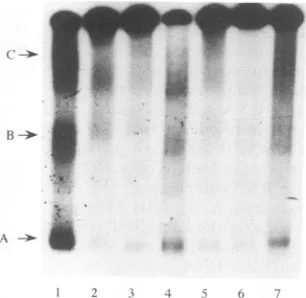
parentcells (A9) didnotform distinctRRE-RNPcomplexesB and C; instead, a smear was observed (Fig. 4, lane 3). A9
nuclear proteins formed complex A, albeit weakly (Fig. 4,lane 3). Nuclear extract from the hybrid cells containing human chromosome 6 formed all three of theRNPcomplexes(Fig. 4, lane 4). Chromosome 11 cells did not form any complexes,
while chromosome 8-containing cells produced one complex
that migratedmore slowlythan complex C(Fig. 4, lanes 6and
5 respectively). Cells containing chromosome 12 also formed complexesA,B,and C,althoughless efficiently, andtheywere
A_311.
1 2 3 4 5 6 7
FIG. 4. Bindingof nuclearproteinsfromhuman-mousehybridcells
containing singlehuman chromosomestoRRE RNA.Nuclearextracts
from the A9 cells (parent cell line) or the microcell hybrids were
prepared, and the binding reactions were carried out as described
above. A, B,and Crepresentthe RNPcomplexesin order ofmobility on the nativegel. Lanes: 1,HeLa cells; 2, CHOcells; 3,A9 cells; 4,
CH6 cells;5,CH8cells; 6,CH11cells; 7,CH12cells.
chromosome 12-containing cells may indicate that all of the required RRE-binding factors are not encoded by a single chromosome. This is supported by arecent report that chro-mosome12-containing human-mousemicrocellhybrids,which can support tat-mediated trans activation, were unable to support Rev-mediated RNA transport of unspliced viral mRNA (42). Furthermore, it is possible that these RNP complexes are formed by an interaction ofmultiple proteins with the RRE RNA, either directly or indirectly through a protein-protein interaction. These results thus show the host cell-specificnature ofthe RRE RNA-nuclearprotein interac-tion, and they show that the active complex of HIV-1 RRE RNA and the host cells factor(s) requires gene products contributedbyhumanchromosomes 6, 8,and 12.
RRE RNA domain recognized by the host proteins. To ascertain that the observed RNP complexes are formed by essential RRE RNA domains and are not due to the extra sequences at the5' or 3' ends,we synthesized minimal RRE transcripts from the plasmid RRE220 (derived from an HIV HXB2clone).TheRRE220 transcripts formed RNPcomplexes similar to those seen with the extended RRE (results not shown).
Todefine the regionofRRE RNA recognized bythe host cell proteins,we used three deletion mutants ofRRE, dll2S,
d145, and d1345. The secondary structures of RRE RNA and of the deletion mutants were determined by MacDNASIS, ver-sion 2. The predicted secondarystructuresofthe RRERNA and itsmutants arediagrammed in Fig. 5. Thebinding ofHeLa nuclear proteinstothemutantRREtranscripts shows thatthe deletion mutant d145 (lacking hairpin loops 4 and 5) forms complexesA and Cefficiently,whilecomplexBis not formed (Fig. 6,lane3).Itshould benoted thatd145is55%asactiveas the wild-type RRE inrev function as assayed in vivo (2,37). The deletion of hairpin loops 3, 4, and 5 (d1345) results in complete loss ofcomplexBand thepartial loss of complexC (Fig.6,lane2). As noted before (2, 37), the RREmutantd1345 is only 26% active compared with wild-type RRE in in vivo assays.Thedeletionmutantdll2S, which lacks the Rev-binding domain and isfunctionallyinactive(2, 37), showsnobindingto the nuclear factors (Fig. 6, lane 4). These results are further substantiatedby the competition experiments with unlabelled RNA transcripts of the selected RRE mutants. Competition using up to 300-fold excess of the unlabelled RRE mutant dll2S did not affect formation of the specific RRE RNA-nuclear protein complexes (Fig. 7, lanes 2 to 4). However, unlabelled d1345 and d145 RNAs inhibited the formation of complexes B and C (Fig. 7, lanes 5to10). These results further suggestthat thebinding of host proteinstoRRE RNArequires hairpin loops 1 and 2. Loss of host protein RNP complexes upondeletion ofhairpin loops4and 5 or3,4, and 5 suggests the requirement of these loops in the direct binding of host proteins. Alternatively, these non-Rev-binding RRE RNA stem-loopsmaystabilize the RRE-host protein RNPcomplex formation. The fact that d1345andd145do notformcomplexC but inhibit itsformationby wild-typeRRE RNAsuggests that these non-Rev-binding RRE RNA stem-loops help in the nucleation of theRNPcomplexes.
Theproteinsin the RRE RNA-RNPcomplex. To character-ize the proteins which form the RNPcomplexwith the RRE RNA, the complexes were stabilized by UV irradiation and analyzedona3 to17%gradientpolyacrylamidegelcontaining
SDS(34).Aheterogeneousgroup of nuclearproteins appear
tobindtothe RRE RNAevenin the presenceofnonspecific
on November 9, 2019 by guest
http://jvi.asm.org/
[image:3.612.107.247.78.230.2] [image:3.612.99.252.509.658.2]RRE
DL45
DL12s
DL345 FIG. 5. Predicted secondary structures of the RRE RNA and various deletion mutants. Secondary structures weredetermined by
using M4acDNASIS, version 2. Numbersrepresent the stem-loops of RRE RNA,double linesrepresentthestems,and circlesrepresentthe bulges. We have followed thepatterndescribed by Solominetal.(37) fornumbering various RRE RNA stem-loops.
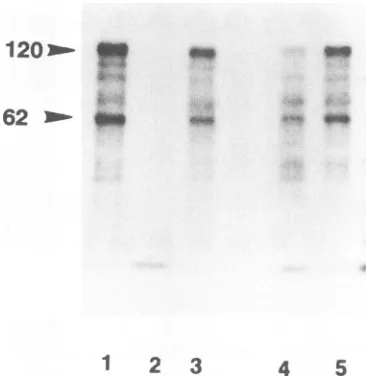
tRNA (Fig. 8, lane 1). Prominent among these are proteins
with apparent molecular masses of 120 and 62 kDa. The specificitiesof theirinteractionsweredemonstratedby efficient competition with unlabelled RRE RNA and the lack of competition byTAR RNAtranscripts (Fig. 8, lanes 2 and 3, respectively). To determine whether these proteinswerehost
1 2 3 4
FIG. 6. Host factorbindingsite in the RRE RNA.Binding
reac-tions withwild-type and variousmutantRRE RNAswerecarriedas
described previously. Lanes: 1, binding ofwild-type RRE RNA; 2, binding ofmutantd1345; 3, bindingofmutantd145; and4, bindingof
mutantd112S.
C~~~~~~~~~~~~~~~~~~~~~~~~~~~~~~~'
A
1
2
3
4
5
6
7
8
9
10
FIG. 7. Competitionof RRE RNP formationbycold RRE deletion
mutant RNAs. Unlabelled deletion mutant RRE RNA transcripts
were synthesized in vitro as described above. Nuclear extract was
preincubated with a 75x, 150 x, or 300x excess of a particular
unlabelled RNA before the addition of radiolabelled RRE RNAtothe
binding reaction mixture. After digestion with RNase, the RNP
complexeswereresolvedonnative gelsasdescribed above. Lanes: 1,
RRERNA-protein bindingreaction in the presence oftRNA; 2,3,and
4,thebindingreaction inthe presence of 75 x, 150 x, and 300x cold
d112S RNA, respectively; 5, 6, and 7, the binding reaction in the presenceof 75 x, 150x,and300x coldd1345RNA,respectively;8, 9,
and10,thebindingreaction in the presence of 75x, 150 x, and 300x
coldd145 RNA.
cell
specific,
we UV cross-linked the RRE RNA-nuclearprotein complexes
formed from CHO and HOS cells andanalyzed
themusing
SDS-polyacrylamide gel electrophoresis.
It wasreported
earlier that CHO cells did not support tat-mediatedtransactivationaswellasRev-mediatedtransportofunspliced
HIV-1 mRNA(15,
28,38,42).
CHO nuclearextract, which doesnotform characteristicRRE-RNPcomplexes,
does not containasignificant
amountof the 120-and62-kDaRRERNA-binding
nuclearproteins
(Fig.
8,lane4). Conversely,
the levels of theseproteins
incomplexes
formed from HOS cells werecomparable
to thoseseen inHeLacells(Fig.
8,lane5).
The 62- and 120-kDa
protein
bands were detected in A9 cells and in all of the human-mousehybrid
celllines,
although
the
intensity
among cellscontaining
different chromosomes varied(results
notshown).
It isimportant
to note that the 62-kDaRRERNA-binding protein
described here is different from the 56-kDa RRERNA-binding
protein reported by
Vaishnav et al.
(39).
The 56-kDaprotein
waspresent
in CHOcells,whereas our62-kDa
protein
is not.Furthermore,West-eRm blot
(immunoblot) analysis
ofapartially
purified
nuclear fraction enriched for the 62-kDaprotein
shows that it is different from double-stranded RNA-activated kinase(data
notshown)
(antibody
for double-stranded RNA-activated ki-nase waskindly
providedby
Charles Samuel,University
of California at SantaBarbara).
DISCUSSION
HIV-1 rev
gene
functionhasbeenimplicated
intheregula-tion ofacomplex series of host cellfunctions, such as RNA
splicing
andtransport,whichthevirusmustevade toexpress its structural genes.A crucial role of RNP complexes in mRNAsplicing
andnucleocytoplasmic
transporthas beenreported
for avariety
ofsystems (12).
Several studies havesuggested
aon November 9, 2019 by guest
http://jvi.asm.org/
[image:4.612.62.301.71.365.2] [image:4.612.320.559.81.249.2] [image:4.612.133.228.535.677.2]12:0
w
w
t ~~~~~~~~
1 23 4 5
FIG. 8. UV cross-linking of host proteins to RRE RNA. The binding of nuclear proteins to RRE RNA, RNase digestion of the unprotected RNA transcripts, and competition of the binding with unlabelled RRE RNAwerecarriedoutasinthegel shiftassays.After RNasedigestion, sampleswereexposedtoUVrays,heatedwith SDS
sample buffer,andanalyzedon a3to17%gradientpolyacrylamidegel containing SDS. The molecular masses of the major RRE RNA-binding proteins are listed on the left. Lanes: 1, control binding
reaction; 2, competition with cold RRE RNA; 3, competition with cold TARRNA; 4,CHO nuclearextract; 5, HOS nuclearextract.
regulatory role of host cell factors in HIV-1 gene expression, particularly that of tat-mediated trans activation. The role of host factors in HIV-1 Rev function has beenproposed, but the evidence which corroborates this hypothesis is not sufficient. Possibleroles of thehost factors which bindtoRRE RNAmay
betoallow theRRE-containing mRNAtoescapethe hostcell splicing machinery and facilitate thetransport ofunspliced or
singly spliced viral mRNA. It is likely that the host factor(s) also facilitates the multimerization of Rev for optimal Rev function in vivo. Additionally, host proteins interacting with RRE RNA may contribute to the function of Rev in the translation of RRE-containing mRNA. We have taken the initialstepsincharacterizing such human cell-specific proteins thatare likelytoregulate HIV-1 Rev function.
Astrongsuggestion for the regulatory role of host proteins
in Revfunctionemerged from results showing the loss of Rev function, i.e., the transport of unspliced RNA, when the non-RRE-RNA-binding domains of Revwere deleted (2, 23,
27). Such trans-dominant Revmutantsefficiently bind toRRE RNAbutcannot supportitsfunction (2, 23, 27). Vaishnavetal. (39) reported the binding ofa56-kDa nuclear protein to the Rev-binding domain of RRE. The precise role of this protein isnotknown.Recently, Constantoulakisetal. (7) reported the binding of a 17-kDa protein to RRE RNA. This protein is encodedby theinterferon-inducible 9-27geneand caninhibit
Rev-mediated HIV-1geneexpression, presumablyatthe
post-transcriptional level. However, the mechanism of this inhibi-tion isstill unknown. Trono and Baltimore (38) demonstrated the host dependence of Rev function, since nonhuman cells, suchasrodentormurine cells, didnotshow Rev function. Our results substantiate a host cell dependence for Rev function,
sincecells whichdonotsupportRevfunctioncannotefficiently form specific RRE RNA-nuclear protein complexes. It is possible that rodentor murine cells lack certain RRE
RNA-supposition willpredict thateventhoughsomenonhuman cells maycontain RRERNA-binding proteins,aproper posttrans-lational modification may be required for the formation ofa functionalRNPcomplex made up of RRE RNA, host proteins, and Rev. Itis likely that the interaction ofa host protein(s)
with RRE RNAis an essential step toward the formation of such functional RNP complexes. The formation of similar RNP complexes between RRE RNA and nuclear proteins
from murine hybridoma cellscontainingasinglehuman chro-mosomefurthersubstantiates the role of human cell cofactors in Revfunction. Two HeLa cell nuclearproteinsinparticular,
with apparentmolecularmassesof 120 and 62kDa, bindtothe
RRE RNA in a hostcell-specific manner and maybe
candi-dates for such host cell regulators of HIV-1 Rev function. Defining thepreciserole(s)of these proteinsmustawait their further purification and the cloning of the cDNA sequences whichencode them.
ACKNOWLEDGMENTS
This work was supported by grants A125531 (A.K.) and NIDDK 1-RO-1-DK40811 (P.L.K.)from theNationalInstitutes ofHealthand byagrant from theNational Kidney Foundation (R.R.S.),National Capital Chapter.
REFERENCES
1. Arrigo, S. J., and I. S. Y. Chen. 1991. Rev is necessary for translationbutnotcytoplasmic accumulation ofHIV-1vif,vpr, and env/vpu2 RNAs.Genes Dev. 5:808-819.
2. Benko, D. M.,R.Robinson,L.Solomin, M. Mellini, B. K. Felber, and G. N. Pavlakis. 1990.Bindingof trans-dominant mutant Rev protein of humanimmunodeficiencyvirus type 1tothecis-acting rev-response elementdoesnotaffect the fate of viral mRNA. New Biol. 2:1-11.
3. Chang, D. D., and P. A. Sharp. 1989. Regulation of HIV Rev depends uponrecognitionofsplicesites. Cell 59:789-795. 4. Chang,D.D.,andP. A.Sharp. 1990. MessengerRNAtransport
andHIVrevregulation. Science 249:614-615.
5. Chin, D. J. 1992.Inhibition ofhumanimmunodeficiencyvirus type 1 Rev-Rev-response element complexformationby complemen-taryoligonucleotides. J.Virol. 66:600-607.
6. Clawson, G. A.,Y. L. Song,A. M. Schwartz, R. R. Shukla, S. G. Patel, L. Connor, L. Blankenship, C. Hatem, and A. Kumar. 1991. Interaction of human immunodeficiency virus type 1 Rev protein with nuclear scaffold nucleoside triphosphatase activity. Cell Growth Diff. 2:575-582.
7. Constantoulakis, P., M.Campbell,B. K.Felber, G. Nasioulas, E. Afonina, and G. N. Pavlakis. 1993. Inhibition of Rev mediated HIV-1 expression by an RNA binding protein encoded by the interferon-inducible 9-27 gene. Science 259:1314-1318.
8. D'Agostino, D. M., B. K. Felber, J. E. Harrison, and G. N. Pavlakis.1992. The Revproteinofhumanimmunodeficiency virus type 1 promotespolysomal association and translation ofgag/pol andvpu/envmRNAs.Mol. Cell.Biol. 12:1375-1386.
9. Dignam, J. D.,R.M.Lebovitz, and R. D. Roeder. 1983. Accurate transcriptioninitiation by RNA polymeraseIIin a soluble extract from isolated mammalian nuclei. Nucleic Acids Res. 11:1475-1489.
10. Emerman, M., R. Vazeux, and K. Paden. 1989. The rev gene product of the human immunodeficiency virus affects envelope-specificRNAlocalization. Cell 57:1155-1165.
11. Felber, B. K., M. Hadzopoulou-Cladaras, C. Cladaras, T. Copel-and,andG. N. Pavlakis. 1989. Revprotein of human immuno-deficiencyvirus type 1affectsthe stability and transport of the viral mRNA. Proc.Natl. Acad.Sci. USA 86:1495-1499.
12. Frankel, A. D.,I.W.Mattaj, and D. C. Rio. 1991. RNA protein interactions. Cell 67:1041-1046.
13. Frankhauser, C.,E.Izaurralde,Y.Adachi, P. Winfield, and U. K.
on November 9, 2019 by guest
http://jvi.asm.org/
[image:5.612.83.266.81.269.2]Laemmli. 1991. Specific complex of human immunodeficiency virus type I Rev and nucleolar B23 proteins: dissociation by the Rev responseelement. Mol. Cell. Biol. 11:2567-2575.
14. Green, W.C. 1991. The molecular biology of human immunode-ficiency virus type 1 infection. N. Engl. J. Med. 324:308-317. 15. Hart, C. H., C. Ou, J. C. Galphin, J. Moore, L. T.Bacheler, J. J.
Wasmuth,S. R. Petteway, Jr., and G. Schochetman. 1989.Human chromosome 12 is required for elevated HIV-1 expression in human-hamsterhybrid cells. Science 246:488-491.
16. Haseltine, W. A. 1991. The molecular biology of the human immunodeficiency virus type 1. FASEB J. 5:2349-2360.
17. Heaphy, S., C. Dingwall, I. Ernberg, M. J. Gait, S. M. Green,J. Karn, A. D. Lowe, M. Singh, and M. A. Skinner. 1990. HIV-1 regulator ofvirion expression (Rev) protein binding to an RNA stem-loop structure located within the Rev response element region. Cell 60:685-693.
18. Hope, T. J., D.McDonald,X.Huang, J. Low, andT. G. Parslow. 1990. Mutational analysis of the human immunodeficiency virus type 1 Rev transactivator: essential residues near the amino terminus. J. Virol. 64:5360-5366.
19. Kjems, J., A.D.Frankel,andP. A. Sharp. 1991.Specific regulation ofmRNA splicing in-vitro by a peptide from HIV-1 Rev. Cell 67:169-178.
20. Kjems, J., andP. A. Sharp. 1993. Thebasic domain of Rev from humanimmunodeficiency virus type 1 specifically blocks the entry of U4/U6.U5 small nuclear ribonucleoprotein in spliceosome assembly. J. Virol. 67:4769-4776.
21. Lu, X., J. Heimer,D. Rekosh, and M. Hammarskjold. 1990. UI small nuclear RNA plays a direct role in the formation of a rev-regulated human immunodeficiency virus envb mRNA that remainsspliced. Proc. Natl. Acad. Sci. USA 87:7598-7602. 22. Luo, Y., S. J. Madore,T. G. Parslow, B. R. Cullan, and M. M.
Peterlin. 1993. Functionalanalysis of interactions between Tat and trans-activation response element of human immunodeficiency virus type 1 in cells. J. Virol. 67:5617-5622.
23. Malim, M. H., S. Bohnlein, J. Hauber,and B. R. Cullen. 1989. Functional dissection of theHIV-1 Revtrans-activator-derivation ofatrans-dominant repressor ofrevfunction. Cell 58:205-214. 24. Malim, M. H., J. Hauber, S.Y.Le, J.V.Maize, and B. R. Cullen.
1989. The HIV-1 rev transactivator acts through a structured target sequence to activate nuclear export of unspliced viral mRNA.Nature (London) 338:254-257.
25. Malim,M.H.,L. S.Tiley,D. F.McCarn, J.R.Rusche, J. Hauber, and B. R. Cullen. 1990.HIV-1structural geneexpression requires binding of the Revtranis-activatortoitsRNAtargetsequence. Cell 60:675-683.
26. McDonald,D.,T.J. Hope,and T. G. Parslow. 1992. Posttranscrip-tionalregulationby the humanimmunodeficiencyvirus type I Rev and human T-cell leukemia virus type I Rex proteins through a heterologous RNAbindingsite. J. Virol. 66:7232-7238. 27. Mermer, B.,B. K.Felber, M. Campbell, and G.N.Pavlakis. 1990.
Identification of tranis-dominant HIV-1 rev protein mutants by direct transfer ofbacterially produced protein into human cells. Nucleic Acids Res. 18:2037-2044.
28. Newstein, M., E.J. Stanbridge, G. Casey, and P. R. Shank.1990. Human chromosome 12 encodes a species-specific factor which increases humanimmunodeficiency virus type I tat-mediatedtrans activation in rodent cells. J. Virol. 64:4565-4567.
29. Olsen, H. S., P.Nelbock, A. E. Cochran, andC. A.Rosen. 1990. Secondarystructure is the major determinant for interaction of HIVrevprotein with RNA. Science 247:845-848.
30. Pavlakis, G. N., andB. K.Felber. 1990.Regulation ofexpression of humanimmunodeficiency virus. New Biol. 2:20-31.
31. Perkins, A., A. W. Cochrane,S. M.Ruben, and C. A. Rosen. 1989. Structural and functionalcharacterization of human immunodefi-ciency virus rev protein. J. Acquired Immune Defic. Syndr. 2:256-263.
32. Rosen, C. A. 1991. Regulation ofHIVgene expressionby RNA protein interactions. Trends Genet. 7:9-14.
33. Rosen, C. R., and G. N. Pavlakis. 1991. Tat and Rev: positive regulatorsof HIV gene-expression. AIDS 4:499-509.
34. Rounseville, M. P.,and A. Kumar. 1992. Binding of a host cell nuclear protein to the stem region of human immunodeficiency virus type I trans-activation responsive RNA. J. Virol. 66:1688-1694.
35. Saxon,P.J.,E.S.Srivastan, G.V.Leipzig, J.H.Sameshima, and E. J. Stangridge. 1985. Selective transfer of individual human chromosomes torecipientcells. Mol. Cell. Biol. 5:140-146. 36. Shukla, R. R., Z.Dominski, T. Zwierzynski, and R. Kole. 1990.
Inactivation of splicing factors in HeLa cells subjected to heat shock. J. Biol. Chem.265:20377-20383.
37. Solomin, L.,B. K.Felber,andG. N. Pavlakis. 1990. Different sites of interaction for Rev, Tev, and Rex proteins within the Rev-responsive element of human immunodeficiency virus type 1.J. Virol. 64:6010-6017.
38. Trono, D., and D. Baltimore. 1990.Ahuman cell factoris essential for HIV-1 revaction. EMBO J. 9:4155-4160.
39. Vaishnav,Y.N.,M.Vaishnav,and F.Wong-Staal. 1991. Identifi-cation and characterization of a nuclear factor that specifically bindstothe Rev responsiveelement(RRE) of humandeficiency virus type I (HIV-1). New Biol. 3:142-150.
40. Vaishnav, Y. N., and F.Wong-Staal. 1991. The biochemistry of AIDS. Annu.Rev. Biochem. 60:577-630.
41. Venkatesan,S., S.M.Gerstberger,H.Park,S. M.Holland,and N. Yong-Suk. 1992. Human immunodeficiency virus type I Rev activationcanbe achieved without RevresponsiveelementRNA if Rev isdirectedtothe targetas aRev/MS2 fusionproteinwhich tethers the MS2 operatorRNA.J.Virol. 66:7469-7480. 42. Winslow, B. J., and D. Trono. 1993. The blocks to human
immunodeficiencyvirus type I Tat and Rev functions inmousecell linesareindependent.J. Virol. 67:2349-2354.