Rochester Institute of Technology
RIT Scholar Works
Theses
Thesis/Dissertation Collections
5-1-1978
Cycles and Processes
Linda Brophy
Follow this and additional works at:
http://scholarworks.rit.edu/theses
This Thesis is brought to you for free and open access by the Thesis/Dissertation Collections at RIT Scholar Works. It has been accepted for inclusion
in Theses by an authorized administrator of RIT Scholar Works. For more information, please contact
.
Recommended Citation
Rochester
Institute
ofTechnology
A Thesis
Submitted
to
the
Faculty
ofThe
College
ofFine
And
Applied
Arts
in
Candidacy
for
the
Degree
ofMASTER
OF
FINE
ARTS
CYCLES
AND
PROCESSES
By
Linda
Brophy
APPROVALS
Advisor
:
Name Illegible
Date
:
.<
,
/
d/~
,
;-
¢'
I
T
2
'1
Graduate Academic
/
Counc i I
Representat i ve:
F red Meyer
---~---Date:
r-
-
i l-1';}
______
~
)
~
r
_
-;
--
'
_
'
_r
·
---Dean, College of
Fi ne and App lied Arts:
Dr. Robert H. Joh nston Ph. D.
Date
:
~I.~\l-?
I
,_L_i_n_d_a_B_r_o--=..p_h-:.-Y_
,
herebY
@
deny)
permission to the Wallace Memorial Library
,
of R.I
.
T
.,
to reproduce my thesis in whole or in part
.
Any reproduction
will not be for commercial use or profit.
Date:
5
-
10
-71
CHAPTER
CONTENTS
TITLE
PAGE
Introduction:
Cycles
andProcesses
I
The
Geology
ofthe
Glen:
Foundations
andFuture
II
The
Place:
Insight
andRhythms
III
Technique
andTransformations
IV
The
Prints
andthe
Place
V
The
End
is
aBeginning
3
8
1 1
15
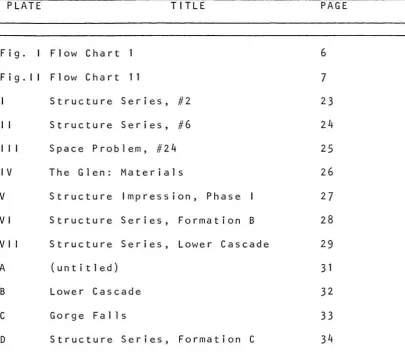
PLATES
AND
ILLUSTRATIONS
PLATE
TITLE
PAGE
Fig.
I
Flow
Chart
1
Fig. I I
Flow
Chart
1 1
I
Structure
Series,
#2
II
Structure
Series,
#6
I I I
Space
Probl
em,
#2k
IV
The
G
1
en :Mater
ial
sV
Structure
Impression,
Phase
I
VI
Structure
Series,
Formation
B
VII
Structure
Series,
Lower
Cascade
A
(unt
i
1
1
ed)
B
Lower
Cascade
C
Gorge
Fa
1 1
sD
Structure
Series,
Formation
C
[image:5.522.58.464.119.472.2]-INTRODUCTION
CYCLES
AND
PROCESSES
To
study
artis
to
study
order,
relativevalues,
to
get atfundamental
constructiveprinciples.
It
is
the
greatstudy
ofthe
inside,
notthe
outside of nature.Robert
Henri
Leonardo
Da
Vinci
once wrote"movement
is
the
cause of2
all life."
|
sensethis
movementin
every
place,
in
every
thing.
It's
anendless,
cyclic chain ofevents,
with eachlink
at once an
independent
cyclic process and also a unit ofthe
universal rhythm.
I
have
always sensedthese
innate
rhythms andcounter-rhythms
;
my
images
are attempts atvisualizing
these
patterns.
I
have
been
ableto
depict
aninstant
of acycle-but
have
neverbeen
ableto
convey
the
unity
andcontinuity
of eachlink.
Each
image
has
remainedtoo
isolated
.The
Watkins
Glen
Series
wasbegun
withthe
idea
ofdeveloping
abody
of workbased
on one ofthe
smaller cyclicpatterns.
Elaborating
on one placein
terms
ofits
own specificprocesses would enable me
to
illustrate
the
more universalapplip
cations of
the
basic
cyclicideas.
Dealing
with one small segmentin
a series of prints would necessitatethe
development
of asophisticated
technical
language
andvocabulary
offorms
suitable
for
conveying
the
ideas.
The
series,
when viewedtogether,
wouldpresent
the
entireGlen
cycle.When
viewedseparately,
the
prints-1-would still
be
ableto
function
as anindependent
yet completethought.
The
production ofthe
Series,
therefore,
wouldfulfill
severalfunctions.
First,
the
images
would serve as a visualdefinition
of
the
cyclicideas.
Second,
the
planning
ofthe
prints wouldinvolve
the
development
of a precisevocabulary
offorms
andtechniques
geared
to
this
specific purpose.All
the
phases ofthe
productionof
the
work are also cyclic and self-perpetuating: each partfeeds
every
other,
andis
dependent
on allthe
othersfor
existance.The
Series
basic
function
is
to
act as a prototypefor
the
documentation
andI:
THE
GEOLOGY
OF
THE
GLEN:
FOUNDATIONS
AND
FUTURE
...
(water)
wearsaway
the
lofty
summits ofthe
mountains.It
lays
bare
and carriesaway
the
great rocks.It
drives
away
the
seafrom
its
ancientshores,
for
it
raisesits
base
with
the
soilthat
it
carriesthere.
It
shattersand
devastates
the
high
banks;
nor canany
stability
everbe
discerned
in
these
whichits
nature
does
notsuddenly
bring
to
naught.It
seeks out with
its
riversevery
sloping
valley
where
it
may
carry
off ordeposit
fresh
soil.Wherefore
many
riversmay
be
saidto
be
those
through
which allthe
elementhas
passed andthe
seahas
goneback
many
times
to
the
sea,
and no
depth
ofthe
oceanis
solow
but
that
the
loftiest
mountainshave
their
bases
there...
One
wouldsay
that
it
suffers changeinto
asmany
natures as arethe
different
placesthrough
which
it
passes.. .withtime
everything
changes.Leonardo
Da
Vinci
3
Since
allthe
phases ofthe
life
cycle ofthe
Glen
were
my
concerns,
I
began
by
investigating
the
geologicprocesses
that
had
determined
its
initial
formation.
Most
geologists agreethat
there
were several majortransformations
which gave riseto
the
present structures.The
first
event wasthe
deposition
ofthe
rocklayers.
This
sequencebegan
about550
million yearsB.P.
(Before
Present),
when most ofNew
York
State
wasbeneath
a vastshallow
inland
sea.Sediment
from
the
nearby
land
was washedinto
the
sea anddeposited
there
in
distinct
layers.
These
layers
accumulated over a period of about325
millionyears,
and grew
to
be
severalhundred
feet
thick.
The
upper stratace-mented
into
sandstone.Underneath
these
two
was athick
deposit
oflimestone,
composed ofbits
ofshell,
and calcium
from
the
bodies
of animalsthat
lived
in
the
seas.About
200
million years agothe
oceanfloor
waslifted
above
the
water;
the
elements nowbegan
to
eataway
atthe
exposed rock.
As
the
beds
werethrust
upward,
streams andrivers carved
just
asrapidly
downward
through
the
strata.This
erosion was aidedfurther
by
the
actions ofrain,
snow,
ice
and wind.The
Ice
Ages
probably
did
the
mostto
determine
the
present structure of
the
Glen.
The
first
ice
sheetto
cover
the
areaflowed
down
from
its
sourcein
Labrador
about one million years ago.
The
ice
was channelled according
to
the
existing
conformations ofthe
land,
picking
up
andmoving
debris
in
its
path.The
majortopo
graphic modifications were
probably
madeby
the
first
ice
advance.
Essentially,
the
second advancefollowed
the
courses carved
by
the
first,
withoutmaking
any
majorchanges of
its
own.->
Glacial
erosion was mostlikely
the
dominant
process
in
the
creation ofthe
existing
gorge and valley.Glaciers
are not rigidunyielding
masses;
they
are extremely
mobile.The
interior
of a glacieris
full
ofcurrents,
much
like
the
currents of adeep
stream.When
a glacierdirected
by
the
land
structures(hills,
valleys,
etc.).The
Seneca
Lake
regionis
a narrowvalley
whichflares
open
to
the
north.When
the
ice
encounteredthe
narrowersouthern
end,
it
had
to
flow
faster
(because
there
wasjust
as muchice,
but
not as muchroom)
soit
cut more6
deeply,
andrapidly,
than
atthe
valley
entrance.After
the
retreat ofthe
last
glacier(about
ten
thousand
yearsago),
running
waterbecame
the
dominant
erosional
factor
in
this
area.These
samestreams,
riversand waterfalls are
shaping
the
glentoday.
The
geologichistory
ofthe
area substantiatedmy
idea
that
water and rock werethe
basic
components ofthe
Glen
cycles.The
rockbeds
werelaid
down
in
water;
the
upliftedbeds
were erodedby
streams and rivers.Even
the
mud and sand whichhardened
into
the
first
rocklayers
came
from
the
erosion ofnearby
land.
The
cycle continues
today:
the
streams carvethe
gorge,
andthe
bits
of earth chipped
away
willbe
deposited
elsewhere,
sothe
MM)
rarr/
LtjLaa
mmim
RAIH
SHOW
Rims
active
released
energy
uncontined
passionate
reflective
rapid
change
ma
minis
fOR
BtPOSITIOH
Of
HfW
imRS
^3
n
5
n
n
"?
10
D
D
D
KJLJ i_i vu
Hc
D
?
?
11:
THE
PLACE
-INSIGHT
AND
RHYTHMS
J
hunt
for
the
rhythmsin
nature,
whetherit
be
small orlarge
measures,intimate
orgrand,
but
internal
rhythmit
is
primarily
.I
am attractedto
the
vista as well asto
the
intima
te
.7
Nell
Blaine
The
patterns of growthhave
alwaysbeen
a centralconcern of
my
imagery.
My
basic
forms
are characteristically
organicin
appearancefluid,
undulating
structures,
unrestricted
by
mechanicallines
ortight
angles.Their
structure
may
be
derived
from
microscopic examinations ofa
leaf,
orbe
based
on visions oflush
mountains orthundering
seas.My
images
are evocations of alandscape,
not renderings of
it.
"It
is
notmy
purposeto
paintthe
surface of
things
which allmay
see,
unaidedby
imagination.
To
imitate
the
outward and visibleforms
ofNature,
to
paint
faithful
des
c ri
p t
i
ons . . . accu rate
in
form
andcolor,
is
aform
oflandscape
art whichdoes
not makethe
slightest appeal
to
me.Great
rocks,
greattrees,
great riversof
themselves
meanvery
little
to
me,
except as symbols ofa great
Universal
Power,
anEternal
Vital
Principle,
whichmakes and shapes
tree
and rock and riverequally
withmy
self.
When
I
feel
that,
I
am awed and reverent.The
wholeworld appeals
to
me as one vastmiracle,
andI
am part ofthe
whole.It
is
this
stupendous miracle of creation whichtakes
possession ofmy
thoughts
and compels meto
seeksome
Q
form
ofexpression."
-8-There
is
a special sort of "landscape"in
every
facet
of nature.Look
beyond
the
surface ofthings,
and seek
instead
the
inner
essence presentin
everything.I
callthis
essencethe
"innerscape1.1.
Each
innerscape
is
like
a cellin
aliving
thing:
it
is
anindependent
unit,
yet also an
inseparable
part of alarger
phenomenon.The
larger
unitis
built
up
ofthese
smallerindependent
cycles,
as well as
being
cyclicin
itself:
it
has
no origin andno
termination.
The
destruction
of one partfeeds
the
building
of another.I
had
previously
tried
to
visualizethis
idea,
but
all attempts
had
failed
to
convey
the
complexities ofthe
cyclic
ideas.
It
wasimpossible
to
translate
allthis
infor
mation
into
one coherentimage.
I
decided
to
changemy
approach,
anddeal
withthe
ideas
from
the
standpoint ofa
single,
smaller cycle unit.Moreover,
I
woulddo
this
by
means of a series of prints.
By
demonstrating
the
integ
rity
of anindividual
cyclein
allits
phasesI
couldbetter
illustrate
how
allthe
parts are critical elementsin
the
larger
movements.I
needed an appropriate examplein
orderto
be
ableto
convey
these
ideas
clearly.I
decided
that
illustrating
the
cyclic nature ofthe
phenomenon atWatkins
Glen,
N.Y.
would
be
ideal
for
my
purposes.The
presently
existing
formations
-the
waterfalls,
There
were great amounts ofenergy
in
the
falls
andstreams;
you could almostfeel
the
power released asthe
water chiseled
the
rock.The
stone and water were complimentary
oppositesto
me.The
rock was passive and somberhued,
but
it
wasmerely
power atrest,
energy
trapped
in
stone.The
water wasthe
active principle:here
the
energy
wasreleased.
The
flood
demolished
the
rock and releasedits
energy:
the
powerin
the
rock wasin
its
des-tiny
to
be
carried
away
andlaid
down
in
quieter waters sothe
stratacould
form
again.No
energy
is
lost
in
this
system.It
is
always
being
transferred
from
one part ofthe
systemto
another,
working
(in
the
form
ofwater)
orresting
(in
stone)
.Because
ofthe
existing
formations
andactivity
ofthe
watercourses,
it
was evidentthese
actionshad
been
continuing
for
eons,
and would continuefor
eons more.Here
were allthe
elementsI
neededto
develop
the
cyclichistory
of one place: a pasthistory,
capturedin
the
present
structures,
and afuture
promisedby
the
ongoing
activities.
Now
that
I
had
chosen afocus
anddirection
for
my
prints,
I
wasfree
to
begin
planning
my
approach.10-111:
TECHNIQUE
AND
TRANSFORMATIONS
To
study
technique
meansto
makeit,
to
invent
it.
To
take
the
raw materials eachtime
anew andtwist
it
into
shape.It
mustbe
made
to
serve a specific purpose...there
is
agreat pleasure
in
the
effortto
invent
the
exactthing
whichis
needed.Use
it.
Break
it
down.
Begin
again.It
is
a greatthing
twhen
one
has
afair
measure of aeeing.Then
to
in
vent
the
means ofexpressing
it.
Robert
Henri
When
I
began
to
work onthe
Glen
Series,
my
attitudesand approach
to
printmaking
began
to
change.In
the
past,
I
would workfrpm
fairly
detailed
masterdrawings.
These
would
be
copied ontothe
stonein
orderto
achieve alithograph
as muchlike
the
original sketch as possible.Technically,
the
results weresatisfactory.
However,
the
final
images
lacked
the
sense offreedom
and vigorI
knew
was needed
to
achieve a successful series.I
had
to
concentrate ondeveloping
technical
abilitiesand visual
language
more suitedto
my
new goals.I
knew
I
had
to
altermy
approachto
the
initial
drawing
ofthe
image
on stoneif
I
wasgoing
to
succeedin
rendering
the
energy
that
impressed
me.I
abandonedpreliminary
drawings
entirely,
andbegan
experimentationto
see whattypes
ofmarks and
textures
couldbe
madethat
wouldbe
usefulin
conveying
my
thoughts.
I
gathered a wide range of materials
to
work with-stick and
liquid
tusche,
lithographic
-11-crayons,
rubbing
sticks,
autographicink,
india
ink,
vaseline
-anything
that
mightbe
greasy
enoughto
print.I
also assembled avariety
oftools
for
applicators,
ranging
from
the
usualpaintbrushes,
to
toothbrushes,
bits
of cloth and
leather,
chips ofwood,
gauze-wrappeddowels,
used
tarlatan,
and severalhomemade
textured
rollers madeof
wood,
aluminum,
cloth and sponge.Solvents
andrazors,
needles and scribes were used
to
alterthe
drawn
images.
Any
vaguely
servicable material ortechnique
that
couldbe
devised
waslegitimate.
This
phase of experimentation revealedmany
newpossibilities
for
working.It
is
important
to
notethat
I
was able
to
approachthe
stone sofreely
only
when confident
in
my
mastery
ofthe
processing
andprinting
problems.
When
I
worked moreconservatively
I
was much moreinvolved
in
learning
how
to
controlthe
medium.Once
these
obstacles were
overcome,
seeing
whatthe
mediumreally
had
to
offer couldbe
explored.I
don't
believe
a successfulSeries
couldhave
been
possible withoutfirst
acquiring
the
ability
to
controlthe
processing
problems.These
free
investigations
made use ofevery
printing
skillI
had,
andhelped
melearn
and perfect afew
I
didn't.
Work
habits
andtechniques
changedto
suitthe
problemat
hand.
Tight
masterdrawings
constrictedmy
imagery,
soI
eliminated
the
preliminary
sketches.My
oldrepertoire
offorms
wereequally
unsuitablefor
the
new motive."Motive
demands
specifictechnique.
The
finer
the
motive,
the
more2-the
artist
sees significancein
whathe
looks
at,
the
morehe
must
be
precisein
his
choice of terms."While
trying
to
develop
ideas
for
lithographs,
I
found
I
couldn't organizemy
thoughts
enoughto
plan a coherentimage.
There
wastoo
muchto
deal
with at once.I
needed arapid method of
working
outideas
for
possibleimages,
but
wanted
to
makeprints,
motdrawings
or paintings.So,
i
began
to
make monoprints.The
monoprinting
began
withthis
idea
ofhaving
analternate experimental
printmaking
methodthat
would nottake
the
time
oflithos.
They
were valuableto
the
develop
ment of
the
lithos
because
many
ofthe
initial
image
rendering
techniques
were similarto
those
possible on stone.Blank
zinc plates were used as a receptive surfacefor
printing;
the
image
was constructedby
applying
any
type
ofink
or paintto
the
surface ofthe
plate,
using
the
sametools
as
for
the
stone.The
monoprints were adefinite
plusbecause
ef
the
ability
to
work out animage
in
many
colors at once:a six color
litho
couldtake
two
weeks;
amonoprint,
with aneven greater color
range,
anhour.
Many
problems couldbe
resolved with
the
monoprintsbefore
moving
to
a stone.The
use ofmonoprinting
slowly
extendedbeyond
that
ofa
visualizing
aid.They
became
resolvedimages
in
their
ownright,
and addedbredth
andcoherency
to
the
wholeSeries.
The
monoprints andlithographs
functioned
within acycle
oftheir
own-each expanded
the
possibilities ofthe
others'13-technical
vocabulary
andimagery
quality.The
mediumsproved
to
be
complimentary
andreinforcing,
andhelped
the
ideas
and execution ofthe
Series
develop
fully.
-14-V:
THE
PRINTS
AND
THE
PLACE
Nature
is
the
unique great realm upon which artfeeds.
Edvard
Munch
Art
is
and
is
th
its
origithe
outpu stands asdeve lopme
the
work progressIt
promisbe
made.in
full
p
passes,
I
touches
b
give evid
The
impre
as
in
souways more
revealing
the
inevitable
conse manifestation
of
n.
The
work
of
artt
of
a progressin
a record and marks
nt.
It
is
not an eindicates
the
coursmade.
The
work
is
es
more,
andfrom
i
It
is
the
impress
lay
of
their
facult
iving
his
life,
and earthe
trace
of
hi
ence
of
the
quality
ss
is
made sometimeIpture
orpainting
,fluid,
dispersed,
of
the
principlesequence
of
growththe
principlesof
is
aresult;
is
development
andthe
degree
of
nd
in
itself,
but
e
taken
andthe
not a
finality
.t
projection canof
those
wholive
ies
.The
individual
the
things
he
s
passing
.They
of
his
growth. sin
materialform,
and sometimes
in
but
nonethelessof
growth.Robert
Henri
The
first
prints ofthe
Series
establishedthe
tech
niques and manner of execution
for
the
subsequentimages.
It
was adefinite
building
process,
andis
best
illustrated
chronological
1
y
.Most
ofthe
problems--and solutions
--to
the
Series
came
up
in
the
printing
ofStructure
Series,
#2
(Plate
1),
the
first
Glen
printto
be
completed.Specifically,
this
image
showedthe
problemsthat
could occurif
my
thoughts
weren't organized
before
I
began
work.The
image
waslaid
out
by
pencilling
in
the
majordiagonal
andthe
lower
circular
form.
I
could seein
my
mind's eye whatI
wantedto
capture:
the
rockstrata,
the
smooth curves ofthe
waterpolished
stone,
the
flakes
of sand caughtin
the
swirling
15-streams.
To
emphasizethe
energy,
the
first
run wasdouble
printed,
first
in
acool,
dark
grey,
then
alighter,
warmergrey,
which was off registered slightly.This
off registrationmade
the
dark
edges ofthe
underlying
color vibrate.The
surface effect was active
-too
active.There
wastoo
muchin
oneimage;
too
many
impressions
that
wouldhave
workedbetter
isolated
werejumbled
together.
There
was no majorstructure,
nofocal
point.I
resolvedthe
confusionby
organizing
large
areas withflat,
fluid
structures,
printed overthe
initial
runsin
somber,
transparent
layers.
The
image
wasreorganized around
the
diagonal
motion andclutching
shape,
which are
free
impressions
of common rockformations.
This
really
emphasizedthe
importance
ofhaving
a clearidea
in
mindbefore
approaching
the
stone."All
satisfying
things
are good organizations.
The
forms
are relatedto
eachother,
there
is
adominant
movementamong
them
to
a supreme conclusion."12
The
basic
proceduresfor
all subsequentSeries
printswere established
in
this
edition.I
preferredto
work guidedby
memories ofthe
place,
ratherthan
from
photos ordrawings.
Working
from
memory
helped
insure
my
images
wouldbe
free
ofthe
previoustendency
to
tight
reproduction.I
did
keep
afull
selection of slides of
the
areafor
reference,
primarily
for
refreshing
my
memory
about specific structuraldetails
andcolor relationships.
The
slides alsohelped
mementally
focus
my
energies soI
would not repeatthe
errors ofSeries
#2
16-At
this
time
the
first
monoprints
were made,I
producedabout
forty
small single and multiple plateimages,
several of which are representedhere
(Plates
11
S
111).
The
smallthree
plate monoprintThe
Glen:
Materials
(Plate
IV)
wasthe
product of
my
first
attempts atmaking
monoprints.The
softtextures
and quiet colors werethe
result of calculatedapplications of
different
types
of solvents.This
print was pulled nearthe
end of aday's
session ofprinting,
somy
palette wasvery
blended
and muted.The
viewis
primarily
anaerial
perspective,
but
is
notbased
onany
actual maps(though
I
had
survey
maps ofthe
area).I
choseto
constructan aerial view
from
my
firsthand
knowledge
ofthe
spot.The
smooth,
curving
quality
ofthe
narrow gorgeline
could alsobe
interpreted
as either a small section of astream,
the
entire stream
bed,
or a microscopic segment of a slice ofrock.
The
Series
images
werefinally
starting
to
fulfill
the
criterion ofthe
cyclicideas:
each segmentfits
in
the
whole
in
many
ways,
implying
the
variable and changes possible within each cycle.It
couldbe
animpression
ofthe
nature ofpast
changes,
or a view of present structures.In
this
manner,
one print offers a solution
to
many
possible eventsin
the
particular
Glen
cycle,
and stressesthe
idea
ofthe
repetitionof events
in
any
cycle.The
Material
print wasthe
direct
inspiration
for
the
lithograph
Structure
Series,
Phase
I
(topographic)
(Plate
V).
The
stone was approachedin
the
same mannerI
executedthe
-17-plate:
the
image
was painteddirectly
onthe
ground surface.The
monoprint
was not used as a guide except whenthe
majorplacement
of structures was pencilledin.
The
first
colorwas printed
twice,
off registeredslightly
the
secondtime
the
paper wasdropped
in
orderto
achievethe
agitated surface.
This
wasthe
first
time
I
used words andletters
in
a
litho:
they
were employedto
givethe
image
the
feeling
of a
familiar
(yet
altered)
topographic
map.The
dashed
lines
and compass markings were also usedto
establish reference points.
The
use offamiliar
symbolslimited
the
number
of possibleinterpretations
ofthe
litho
(as
opposedto
the
monoprint).Structure
Impression
illustrated
the
possibilities
oftranslating
monoprintimages
into
lithographs
without
directly
copying
them:
the
forms
had
to
be
allowedto
growin
the
translation
from
one mediumto
another.Slavish
copying
would stiflethe
rhythmic growth ofthe
ideas.
Structure
Series,
Formation
B
(Plate
VI)
illustrated
my
impressions
of potholeformation
and structure.Potholes
are rounded
depressions
in
a streambed,
which wereformed
where a
rapidly
flowing
streamdeveloped
a circular swirl.The
rockbits
in
the
waterground,
ahollow,
where pebbles andboulders
were caught.The
larger
stones,
trapped
in
the
hollow,
were rolled around and
around,
grinding
the
hole
into
a1
3
broad
bellied
pot.The
print shows a spot wheretwo
potholes
formed
near eachother;
eventually,
the
rock
18-between
them
woreaway,
leaving
only
a rounded peak ofstone.
The
image
suggeststhe
actualformation,
but
alsostresses
the
more general roundedquality
of much ofthe
rock
due
to
the
des
t
r uct
i
veness ofthe
flowing
water.Eventually
the
peak of stone will erodeaway
completely.Even
in
the
printit
seemsto
be
starting
to
shrinkback
against
the
farther
rock wall.The
large
monoprintLower
Cascade
Prototype
wasthe
last
Series
print made.I
began
the
monoprintin
orderto
resolve
ideas
for
alitho
which would show a particularview of a section of a small waterfall.
The
print wasnever
translated
into
alithograph;
I
felt
the
monoprinttechniques
werebetter
suitedto
the
idea.
The
qualities
of
the
color and structure were suchthat
I
could not renderthem
as well on a stonebased
image.
At
this
pointthe
monoprints
became
valuable aswholly
independent
units,
critical
to
the
Series
notonly
for
their
value asideas
to
be
rephrased aslithos,
but
because
they
couldbe
uniqueimages
that
did
notdemand
suchtranslation.
The
quality
of
the
color,
form
and structurein
this
monoprint andin
the
last
litho
(
Forma t
i
onB)
came closestto
the
ideas
I
had
whenthe
Glen
Series
idea
wasfirst
formulated.
Both
went
quickly
anddeveloped
almost effortlessly.The
progression
from
the
initial
ideas,
through
the
drawing,
processing
andprinting
flowed
in
one smooth motion.I
knew
at
this
pointI
had
achieved whatI
hoped
I
would atthe
19-outset
ofmy
efforts:
the
harmony
between
my
theories
and
their
translation
into
successful
images,
20-V:
THE
END
I S
A
BEGINNING
The
greatness of artis
notin
the
display
of
knowledge
, orin
materialaccuracy
,but
in
the
distinctness
with whichit
conveysthe
impressions
of a personal vitalforce,
that
acts
spontaneously
, withoutfear
orhesitation
.George
InnesSl4
Working
back
andforth
from
the
monoprintsto
the
lithographs
allowed meto
produce a seriescovering
a widerange of possibilities.
The
mediums werecomplimentary;
discoveries
in
one openedup
possibilitiesfor
new expressivequalities
in
the
other.Each
fed
the
other:the
Materials
monoprint
inspired
the
Topog
raphi
clithograph;
Formation
B
grew with
the
Lowe
rCascade.
Thus,
working
back
andforth
between
the
lithographs
and monoprints was cyclic also.One
printdeveloped
and expandedthe
ideas
startedin
anotherEach
part wasi
ndes pensi b 1
eto
the
development
ofthe
whole.The
evolution ofmy
cyclictheory
applications andthe
concurrent advance
in
the
technical
language
andvocabulary
that
expressedthem
weretaken
to
newlevels
in
the
Glen
Series.
I
devised
several methodsto
compose a coherentbody
of work whose
individual
images
reflected a common stimulus.While
planning
the
imagery
I
learned
how
to
manipulateprintmaking
media which complimented and reinforcedmy
fundamental
aims.The
visual examples ofthe
cyclicidea
helped
expandthe
theories
anddevelop
them
moreclearly,
and
the
theories
continuedto
feed
the
imagery.
In
the
end,
I
found
that
the
printing
ofthe
Series
andthe
subject
ofit
were as cyclic andinterdependent
asthe
Glen
processes were cyclic unto
themselves.
The
Glen
Series
is
a completebody
ofwork,
but
the
ideas
on whichit
wasbased
arefar
from
finished.
The
Series
openedup
new possibilitiesfor
future
work;
the
eye
1
e cont
i
nues .22-PLATES
ill
I
1
1
+
*&
<p
"'VJ
w^**
Plate
1
STRUCTURE
SERIES
n a2
lithograph
21
x29V2
PLATE
II
STRUCTURE
SERIES
6
(orthanc)
monoprint
24x
36
PLATE
III
SPACE
PROBLEM
24
PLATE
IV
THE
GLEN:MATERIALS
monoprint
8
x3
26-P LATE
V
WATKINS
GLEN:STRUCTURE
IM
PRESSION
,PHASE I
(topographic )
PLATE
VI
STRUCTURE
SERI
ES,
FORMATION
B
I
i
thograph
30
x21PLATE
VII
STRUCTURE
SERIES,
LOWER
CASCADE
(prototype)
ADDITIONAL
WORK,
WATKINS
GLEN
SERIES
PLATE
A
untitled
watercolor
15
x10
PLATE
B
LOWER
CASCADE
acrylics
31
X20
PLATE
C
GORGE
FALLS
acrylics
31
x24
PLATE
D
STRUCTURE
SERIES,
FORMATION
C
I
ithog
raph21
X
30
NOTES
3
4
5
6
7
10
1 1
12
13
14
Robert
Henri,
The
Art
Spirit;
New
York:
J.B.
Li pp
i
ncottCo
.,
I960
,P
.134.
Leonardo
Da
Vinci,
The
Notebooks
ofLeonardo
Da
Vinci;
ed .by
Edward
MacCurdy,
New
York:
Reynalt
Hithcock,
Inc,
1939,
p.72
Ibid.
, p.734
O.D.
VDn
Engeln,
The
Finger
Lakes
Region;
New
York:
Cornell
Univ.
Press
,1
96
1
, pT3Ibid
. ,p
9
-12
Ibid.
, p.79.
Alan
Gussow,
A
Sense
ofPlace;
New
York:
Friends
ofthe
Earth/Seaburg
Press,
1971,
p.
136.
bid
. , p.158.
Henri,
p
.88
Herschel
B.
Chipp,
Theories
ofModern
Art;
Berkeley:
Univ.
ofCa 1 i
forn
i
aPress
,1963
,Henri,
p
.67
Ibid
, p.97.
Enge
In,
p
.7 3
-76
Gussow,
p.94.
B
I BLI OGRAPHY
Chipp,
Herschel
B.,
Theories
ofModern
Art,
Berkeley:
Univ.
ofCa 1 i f
orni
aPress
,1963
Da
Vinci
,Leonardo,
The
Notebooks
ofLeonardo
Da
Vinci
,ed .
by
Edward
MacCurdy,
New
York:
Reynalt
Hitchcock,
Inc.,
1939
Gussow,
Alan,
A
Sense
ofPlace,
New
York:
Friends
ofthe
Ea
rt
h /Seabu
rg
Press.
1971
Henri,
Robert,
The
Art
Spirit,
New
York;
J.B.
Lippincott
Co.,
1960
Von
Engeln,
O.D.,
The
Finger
Lakes
Region,
New
York:
Cornell
Univ.
Press,