0022-538X/96/$04.0010
Copyrightq1996, American Society for Microbiology
Functional Domains of Moloney Murine Leukemia Virus Integrase
Defined by Mutation and Complementation Analysis
COLLEEN B. JONSSON,† GEORGE A. DONZELLA, ELENA GAUCAN, CHRISTINE M. SMITH,
ANDMONICA J. ROTH*
Department of Biochemistry, Robert W. Johnson Medical School, University of Medicine and Dentistry of New Jersey, Piscataway, New Jersey 08854
Received 16 January 1996/Accepted 15 April 1996
Retroviral integrases perform two catalytic steps, 3*processing and strand transfer, that result in the stable insertion of the retroviral DNA into the host genome. Mutant M-MuLV integrases were constructed to define the functional domains important for 3* processing, strand transfer, and disintegration by in vitro assays. N-terminal mutants had no detectable 3* processing activity, and only one mutant which lacks the HHCC domain, ND105, had strand transfer activity. Strand transfer mediated by ND105 showed preference for one site in the target DNA. Disintegration activity of N-terminal mutants decreased only minimally. In contrast, all C-terminal mutants truncated by more than 28 amino acids had no integration or disintegration activity. Activity on a single-strand disintegration substrate did not require a functional HHCC domain but did require most of the C-terminal region. Complementation analysis found that the HHCC region alone was able to function intransto a promoter containing only the DD(35)E and C-terminal regions and to enhance integra-tion site selecintegra-tion. Increasing the reducing condiintegra-tions or adding the HHCC domain to ND105 reaction mixtures restored the wild-type strand transfer activity and range of target sites. The reducing agent affected Cys-209 in the DD(35)E region. The presence of C-209 was required for complementation of ND105 by the HHCC region.
To persist in an eukaryotic cell, retroviruses require the stable insertion of a double-stranded copy of their genome into the host chromosome by the retroviral integrase (IN). This requires a complex series of replication and integration pro-cesses in the early stages of their life cycle (7, 23, 47). The virus-encoded enzymes responsible for these events are reverse transcriptase and IN, respectively. Replication of the single-stranded Moloney murine leukemia virus (M-MuLV) RNA genome by reverse transcriptase to a double-stranded DNA occurs within 2.5 h postinfection (39) within the host cyto-plasm. During the replication process, viral sequences unique
to the 39-terminal (U3) and 59-terminal (U5) regions are
du-plicated and transposed to opposing ends of the linear viral DNA to generate long terminal repeats (LTRs). Each LTR serves as a substrate for the retroviral IN. As few as 7 bp of the terminal M-MuLV LTR sequences are required for a produc-tive integration event and, therefore, recognition by IN (33). The specific protein-DNA contacts responsible for LTR rec-ognition by IN have not been clearly defined.
Prior to formation of the integrated M-MuLV provirus, IN
processes both 39ends of the viral DNA by an endonucleolytic
cleavage of the terminal dinucleotide (39 processing) (39).
Analysis of M-MuLV in vivo has suggested that the two viral
termini must be coordinated by M-MuLV IN for 39processing
to occur (34). Following 39processing, the viral DNA
interme-diate and IN form a stable complex that localizes to the host chromatin, where the second IN-dependent catalytic step
re-quired for retroviral integration occurs, strand transfer (1). In the murine retroviruses, strand transfer follows mitosis (31, 36). It is postulated that the IN and viral DNA complex enters into the nucleus after breakdown of the nuclear membrane (36). Strand transfer occurs precisely at the termini of the LTR
following the ubiquitous 59-CA-39sequence found in all
retro-viral and retrotransposon LTRs. The reaction is a one-step transesterification whereby each end of the viral DNA is inte-grated into a random site in the host’s genome (16). The viral ends are positioned several base pairs apart (4–6), depending on the retrovirus. Repair of the gap created by the staggered integration event generates a duplication of the internal se-quences that flank the provirus.
The 39processing and strand transfer reactions have been
reconstituted in vitro with assays that use oligonucleotide du-plexes containing the DNA sequences of the LTR termini (9, 24). These assays demonstrate that IN is the only protein required for integration. The retroviral IN is also active on an integration intermediate or disintegration substrate (6). The integration and disintegration activities have been character-ized for the M-MuLV IN proteins produced in bacteria (5, 11, 12, 21). Although the activities of the retroviral INs have re-action similarities, we have observed apparent differences in the disintegration substrate requirements of M-MuLV IN and human immunodeficiency virus type 1 (HIV-1) IN (11, 22). This is not unexpected, since M-MuLV IN and HIV-1 IN are proteins with quite different compositions. These differences also extend to the macromolecular composition of their pre-integration complexes and their abilities to infect nondividing and dividing cells (1, 17, 36).
IN proteins from different retroviral species vary in size and amino acid homology (20, 25, 29). Two regions of strong sim-ilarity are shared between retroviral IN proteins, a proposed zinc finger motif or HHCC region in the amino terminus, and a central core region containing the DD(35)E motif. Linker
* Corresponding author. Mailing address: Department of Biochem-istry, University of Medicine and Dentistry of New Jersey, Robert W. Johnson Medical School, 675 Hoes Ln., Piscataway, NJ 08854. Phone: (908) 235-5048. Fax: (908) 235-4783. Electronic mail address: [email protected].
† Present address: Department of Chemistry and Biochemistry, New Mexico State University, Las Cruces, NM 88003.
4585
on November 9, 2019 by guest
http://jvi.asm.org/
insertion and point mutations in the HHCC domain are lethal
in vivo because of their inability to mediate 39processing of the
viral termini (10, 37). The central core domain is proposed to contain a single active site responsible for integration and disintegration activities (23). This region features three invari-ant amino acids essential for catalysis, two aspartic acids and a glutamic acid (15, 25, 26, 45). The C-terminal portion of ret-roviral INs is the least conserved and has been functionally characterized to be the site of nonspecific DNA binding (32, 35, 44, 48, 51, 52). The terminal 28 amino acids of the carboxyl terminus of IN are nonessential for viability of M-MuLV in Rat 2 cells (38). The M-MuLV IN is approximately 14 kDa larger than HIV-1 and avian sarcoma-leukosis virus INs. This larger size of M-MuLV IN is accounted for by differences in its N and C termini. Approximately 50 amino acids precede the HHCC domain of the M-MuLV IN, and the C terminus con-tains a unique 36-amino-acid insertion (20).
In this study, we sought to define the protein domains of M-MuLV IN required for catalysis by a mutation and comple-mentation approach. Mutant INs were examined for enzymatic activity in vitro by assays for integration, disintegration, and single-strand disintegration. N- and C-terminal mutants were hindered more in their ability to catalyze integration than disintegration reactions. The minimal domain for enzymatic activity for M-MuLV IN included a complete DDE region and most of the C terminus. While not required for minimal enzy-matic activity, the HHCC domain restored wild-type (WT) strand transfer activity and target site selection in complemen-tation experiments. Mixing inactive IN mutant proteins more narrowly defined the overlap between complementing pairs of M-MuLV IN than that found for HIV-1 IN (14, 46). These results support a model for the M-MuLV IN in which HHCC forms an independent domain distinct from the DD(35)E and C-terminal regions. Further, the HHCC region can function in
trans to directly influence target site selection.
MATERIALS AND METHODS
Materials.Crude [g-32P]adenosine 59-triphosphate (7,000 Ci/mmol) was pur-chased from ICN. [a-32P]TTP (800 Ci/mmol) was obtained from Amersham. T4 polynucleotide kinase was obtained from GIBCO BRL. Restriction enzymes were purchased from New England Biolabs.
Oligonucleotides.DNA oligonucleotides were purchased from the University of Medicine and Dentistry of New Jersey Biochemistry Department Synthesis Facility. Oligonucleotides used in this study are referred to by their synthesis numbers. Oligonucleotide substrates were32P labeled at the 59end with T4 polynucleotide kinase (GIBCO BRL) and hybridized with a fivefold excess of the complementary strand. Excess radioactivity was removed by using G-25 spin columns (Boehringer Mannheim) or by electrophoresis with 15% native poly-acrylamide gels. For the Y substrates used in disintegration assays, the LTR DNA sequence is underlined. The standard Y substrates are as follows: oligo-nucleotide 3152, 59-CAGCAACGCAAGCTTG; oligonucleotide 3192, 59-AAT GAAAGACCCCGCTGACTA; oligonucleotide 3154, 59-TAGTCAGCGGGG TCTTTCAGGCTGCAGGTCGAC; and oligonucleotide 3527, 59-GTCGACCT GCAGCCCAAGCTTGCGTTGCTG. The dumbbell Y substrate, YDB, is oligo-nucleotide 3808, 59-AATGAAAGTTCTTTCAGGCTGTTCAGCCCAAGCTT GCTTG, which is self complementary. Oligonucleotide 3152 was 59end labeled, purified, and annealed to oligonucleotides 3192, 3527, and 3154 to produce the standard Y substrate or annealed to oligonucleotides 3527 and 3154 to produce the YSSsubstrate as previously described (11). YDBwas 59end labeled, self-annealed, and purified as previously described (11). YCDwas made from strands 3152 and 3527. For integration substrates, oligonucleotides 2784/2785 were pre-pared as described previously (22). The 39-processing substrate sequence is 59 AATGAAAGACCTTGGTCTTTCA-39 and represents a new substrate that forms a hairpin LTR molecule.
Construction of M-MuLV IN mutants.Cloning of the M-MuLV IN into the expression vector pET11C (Novagen, Madison, Wis.) has been previously de-scribed and was used as the parent vector (pETINH1) for many of the subse-quent manipulations (22). This construct has a Met introduced prior to the first amino acid of the M-MuLV IN; however, this residue is not counted in the numbering scheme of our mutant IN proteins. The first amino acid of the M-MuLV IN constructs presented here corresponds to nucleotide 4610 of the
M-MuLV RNA (42). A second parent vector used in these constructions is pETINH3. pETINH3 contains additional nucleic acid sequence at the 59end of the gene, before the first M-MuLV amino acid and after the first methionine ATG, which encodes for a hexahistidine tag. The HindIII site in the vector portion of pETINH3 was removed to facilitate cloning of the C-terminal mu-tants. The site was destroyed by digestion of the vector with HindIII, filled in with Klenow fragment, and religated with T4 DNA ligase. Construction of C97Y (M-MuLV IN mutant with tyrosine at position 97 instead of cysteine) and in5247 has been previously reported (22, 37). ND105 was constructed by introducing a Met prior to amino acid 106 by PCR. The 59-end PCR primer 3807, 59-GAT ATACATATGGCCGTTAAACAGGGA-39, adds an NdeI site (underlined) prior to nucleotide 316; the primer sequence for IN is shown in bold type. The 39-end PCR primer, 2350, 59-GGATCCAGTACTGACCCCTCTG-39 adds a BamHI site (underlined) outside the stop codon of the gene. The PCR product was di-gested with NdeI, and the resulting 475-bp fragment replaced with WT 791-bp NdeI fragment of pETINH1. ND176 was constructed in a similar manner by replacing the WT NdeI fragment with a 259-bp PCR-generated NdeI fragment. The 39-end primer, 2350, was used in conjunction with a 59-end primer, oligo-nucleotide 3904 (59-CATATGCCTCAGGTATTGGGA) to create the deletion fragment. The Cys-to-Ala mutation, C209A, was created by oligonucleotide-directed mutagenesis using overlap PCR (19). The complementary primers, 3811, 59-GGATTGATTGGAAATTGCATGCTGGATACAGACC-39, and 3811C, 59-GGTCTGTATCCAGCATGCAATTTCCAATCAATCC-39introduced a muta-tion at the underlined sequence. PCRs were made with primer combinamuta-tions, prim-ers 3811 and 2350 and primprim-ers 3811C and 2351 (59-end primer [21]). Individual PCR products were separated on a 1.2% agarose gel and glass powder purified (50). The two products were then added to a PCR with primers 2350 and 2351. All PCRs were performed with Vent (New England Biolabs) or Pfu DNA polymerase (Stratagene). K227A and CD311/346 (deletion of the C-terminal 36-amino-acid insertion) were created in pHS by the method of Kunkel (18, 27). The DNA oligonucleotide corresponding to K227A, oligonucleotide 2076 (59-GAACCATCGCGGAGACT TTAAC-39), generates a BstU1 site (underlined) that allowed screening for the mutation by the appearance of one additional BstU1 site. The oligonucleotide for CD311/346, 59-CGAAGTCTGGAGACCTCTGTGGAAAGGACCTTACACAG TCC-39, resulted in the loss of a KpnI site. Following construction of the mutation, a 750-bp fragment was digested with SacII-PmlI and exchanged into pNCA-C (8, 18). The entire coding region was then moved into pETINH1. The construct en-coding the mutant protein CD232 was made in pETINH3 (38). pETINH3 was first partially digested with SphI. Linearized plasmid DNA was isolated, and the DNA termini were blunt ended with T4 DNA polymerase in the presence of deoxynucleo-side triphosphates and ligated in the presence of 100-fold molar excess of NheI linkers (catalog no. 1060; New England Biolabs). The same protocol was followed for CD144; a partial NdeI digest of pETINH3 was made, the full-length linear DNA was isolated and filled in with T4 polymerase, and Nhe linkers were ligated into the linearized plasmid. Carboxyl-terminal deletions were subcloned from previously reported plasmid constructs by isolation of the HindIII-BamHI fragment, and re-placement of the HindIII-BamHI fragment in the pETINH3 vector (38). The nu-cleotide sequence of each construct was verified by dideoxy sequencing with Seque-nase version 2.0 (United States Biochemical) (40).
Protein purification.Mutant and WT M-MuLV IN proteins were expressed in Escherichia coli and purified by nickel nitriloacetate (NTA) chromatography (Qiagen), using methods described previously (21). One additional chromatog-raphy step was added to increase the purity of the preparation. Briefly, the material eluted from the nickel-NTA resin in buffer A (10 mM Tris base, 0.1 M Na2HPO4, 0.1% Nonidet P-40, 10 mMb-mercaptoethanol, 100 mM NaCl, 10% glycerol) at pH 4.5 was pooled, dialyzed for 2 h against buffer A at pH 8.0, and reapplied to the same 1 ml of reactivated nickel-NTA resin reequilibrated to pH 8.0. The column was then washed stepwise with 10 ml each of buffer A at pH 8.0, buffer A at pH 6.3, and buffer A at pH 5.9. M-MuLV IN was finally eluted from the resin with 10 ml of buffer A at pH 4.5 and refolded by a stepwise removal of denaturant (21). Chromatography steps were followed by sodium dodecyl sulfate-polyacrylamide gel electrophoresis and Western blot (immuno-blot) analysis for each protein fraction. The protein concentrations in the frac-tions were quantitated by the Bradford method (2). To assess the enzymatic activity and stability of each mutant, proteins were prepared and isolated a minimum of three times. In vitro assays for 39processing, strand transfer, and disintegration activities were also measured for each protein for a minimum of three independent purifications. Two independent purifications of ND105/ C209A were assayed and demonstrated consistent strand transfer and disinte-gration activities. Protein preparations that showed consistency in their activities are represented herein.
Integration and disintegration assays.Integration substrates were prepared from oligonucleotides, and assays were done as previously described at 30 or 378C (21). Strand transfer activities were assayed in a reaction mixture containing 20 mM MES (morpholineethanesulfonic acid) (pH 6.2), 10 mM dithiothreitol (DTT), 10 mM KCl, 10 mM MnCl2, 20% glycerol, 1 pmol of substrate, and 12 to 30 pmol of M-MuLV IN in a final volume of 15ml. Reaction mixtures for 39 processing were identical to strand transfer except for the inclusion of 10% ethylene glycol. The 39end of the substrate was filled in at room temperature for 30 min using 40 pmol of substrate and 80 pmol of [a-32
P]TTP (800 Ci/mmol) with 5 to 8 U of exonuclease-free Klenow fragment of E. coli DNA polymerase I. The unincorporated deoxynucleoside triphosphate label was removed by using a spin
on November 9, 2019 by guest
http://jvi.asm.org/
column, and the labeled substrate was gel purified on 20% polyacrylamide gels, eluted, and resuspended in 10ml of 0.1 M NaCl. The substrate was self annealed by slow cooling after heating to 958C and subsequently was diluted to 0.5 pmol/ml and used as indicated in integration reactions. Preparation of Y substrates, enzymatic assays for disintegration activity, and product analysis were performed as previously described (11, 21). The standard Y substrate was Y3154, the single-stranded YSSsubstrate was Y3154 without the A strand, and the dumbbell substrate, YDB, was Y3808. All disintegration reactions were performed in a volume of 15ml containing 20 mM piperazine-N,N9-bis(2-ethanesulfonic acid) (PIPES) (pH 6.4), 10 mM DTT, 25 mM MnCl2, 10 mM 3-[(3-cholamidopropyl)-dimethyl-ammonio]-1-propanesulfonate (CHAPS), and 0.05% Nonidet P-40 at 30 or 378C for 1 h, typically with 0.5 to 1.0 pmol of Y substrate, and 5 to 20 pmol of M-MuLV IN. All integration and disintegration reactions were terminated by the addition of 10ml of stop buffer (95% formamide, 1 mM EDTA). Reaction mixtures were heated to 958C for 3 to 5 min and then separated on 20% sequencing gels. Gels were dried, exposed to Kodak X-Omat X-ray film at2708C or room temperature from 30 min to overnight, and analyzed by autoradiogra-phy.
Complementation assays.Equimolar amounts (7.5 pmol) of individual M-MuLV IN proteins were mixed and incubated for 15 min on ice or at 378C in reaction buffer as indicated for integration assays in the absence of substrate. Following preincubation, substrate (1 pmol) for the 39 processing or strand transfer reaction was added to each reaction mixture and placed at 30 or 378C. After 1 h, reactions were terminated with 10ml of stop buffer. Reaction mixtures were examined by the autoradiography method mentioned above.
Complementation (DTT) assay. DTT treatment of WT, C209A, CD232, ND105, and ND105/C209A M-MuLV IN proteins were performed as follows. Each protein (120 pmol) was diluted to a final concentration of 2 pmol/ml with ice-cold 20 mM HEPES (N-2-hydroxyethylpiperazine-N9-2-ethanesulfonic acid) (pH 7.4)–20% glycerol and equilibrated on ice for 5 min. For complementa-tion assays, 60 pmol of each protein was mixed together and then diluted im-mediately to 2 pmol/ml (as above) with respect to total protein concentration. Untreated proteins were not subjected to this dilution step. The DTT concentra-tion was then adjusted to 40 mM, and the mixture was allowed to incubate on ice for 20 min. Reactions were initiated by the addition of 10 or 20 pmol of the untreated or DTT batch-treated protein as indicated to 1 pmol of oligo-nucleotides 2784/2785 or Y standard substrate in their respective reaction buffer. The final DTT concentrations in the reaction mixtures were 10 mM for the untreated proteins and 40 mM for the DTT-treated proteins. Untreated complementation assays were conducted by adding 10 pmol of each protein pair to the sides of the microcentrifuge tube and mixing by a 1-s spin in the micro-centrifuge. Reaction mixtures were incubated at 378C for 1.5 h, and then the reactions were terminated. Both strand transfer and disintegration assays were performed concurrently with the same batch-treated M-MuLV IN preparations. Integration and disintegration assays were repeated three times with three sep-arate DTT treatments of the M-MuLV IN proteins and yielded consistent re-sults.
Product analysis.Data were quantitated directly from dried sequencing gels with a Molecular Dynamic PhosphorImager as previously described (22). Data were collected from gels with ImageQuant 3.1 software. Percent conversion to product was determined by dividing the amount of product by the sum of the substrate and product and multiplying by 100.
RESULTS
Construction and purification of M-MuLV IN mutants.WT and mutant M-MuLV IN proteins were produced in E. coli BL21(DE3). Protein expression was under the control of the T7 lac promoter (21). The open reading frames of the WT and mutant M-MuLV IN genes were constructed so as to contain a
hexahistidine tag at the 59 or 39 end of the gene coding
se-quence. The hexahistidine tag facilitated the purification of IN
proteins on Ni21-NTA affinity chromatography resin as
previ-ously described (21). No difference was noted in the specific activities of amino- and carboxyl-hexahistidine-tagged WT M-MuLV INs during in vitro integration or disintegration assays (data not shown). A schematic representation of each mutant M-MuLV IN protein and the position of the hexahistidine tag for each construct are presented in Fig. 1. In general, IN genes constructed with C-terminal truncations have the hexahistidine
tag at the 59end, while genes with N-terminal truncations have
the tag at the 39 end. Mutants which alter the HHCC finger
include in5247, C97Y, ND105, and ND176. Mutants with single
amino acid substitutions within the catalytic core region in-clude C209A and K227A. The C terminus was progressively
deleted through the catalytic core region. Mutants with these
deletions included CD22, CD28, CD34, CD40, CD45, CD86,
CD144, and CD232. Mutants CD311/346 contains an internal
deletion of the unique 36-amino-acid sequence found in the M-MuLV IN protein (20).
Figure 2 shows the protein products of whole-cell extracts expressing the WT M-MuLV IN and the 14 mutants used in this analysis. The protein products are expressed in large quan-tities, and they migrate to the positions predicted for the full-length product of each construct. A few of the IN proteins were unstable during subsequent solubilization, extraction, and purification, resulting in variable levels of enzymatic ac-tivity and an increased background of nonspecific nuclease
activity (CD311/346 and CD34). Proteolytic degradation of
these mutants was noted from Western blot analysis of crude protein extracts from E. coli cultures as well as in the final fractions eluted at pH 4.5 (data not shown). The poor yields
and stabilities of CD34 and CD311/346 proteins precluded
any further analysis. Activity of CD311/346 was noted in the
standard disintegration reaction but was variable (data not shown).
Defining functional catalytic domains and amino acid resi-dues for integration in M-MuLV IN by mutational analysis.
Previous work with M-MuLV IN found that the HHCC region
was necessary for 39 processing and integration, but not for
disintegration (22). In these experiments, we were interested in further refinement of the domains of M-MuLV IN required for enzymatic activity. Mutations targeted the three major do-mains of the IN protein: the HHCC finger, the catalytic core, and the C-terminal region. Proteins were assayed for strand
transfer activity by using a 39 recessed oligonucleotide
sub-strate, serving as both the viral and target DNA (Fig. 3A). 39
processing activity was also measured with a blunt-ended, self-annealing oligonucleotide substrate (Fig. 3C). The abilities of IN to remove the radiolabeled terminal dinucleotide and to mediate subsequent strand transfer reactions can be monitored by separation of the products on polyacrylamide gels. Under
the assay conditions for 39processing, three forms of the
re-leased dinucleotide were identified previously (49).
The amino-terminal deletion of M-MuLV IN, ND105,
de-letes the HHCC region to a position homologous to the ND105
deletion of HIV-1 IN and Rous sarcoma virus IN (3, 4, 46). The increase in the size of this M-MuLV IN deletion is due to the additional 55 amino acids preceding the HHCC domain.
ND105 is truncated through the 5 amino acids following C-97.
ND176 is truncated through the HHCC region and the first D
(D-125) of the DDE motif. The ability of ND105 to perform
strand transfer varied slightly among protein purifications (Fig.
3A, lane 5, and Fig. 3B, lanes 3 to 5). ND105 had no detectable
39processing activity (FIg. 3C, lane 5). Upon further analysis
of the strand transfer reactions, it was observed that strand transfer selectively occurred at one site approximately 4 to 5
nucleotides from the 39 end of the labeled LTR strand (Fig.
3B). Several preparations of this protein were made to confirm the preference for one integration site. Three other
prepara-tions of ND105 are shown (Fig. 3B, lanes 3 to 5) in direct
comparison with WT IN (Fig. 3B, lane 2). Two of these prep-arations (Fig. 3B, lanes 3 and 5) demonstrated marked speci-ficity for a site-specific integration, while one preparation of
ND105 showed no activity (Fig. 3B, lane 4). We show the
activity of the inactive preparation because this protein was used in the complementation analysis below (see Fig. 5).
ND176 had no detectable strand transfer (Fig. 3A and C, lanes
6) or 39processing activity (Fig. 3C, lane 6).
Additional mutants with mutations in the HHCC region, which were previously described (22) were further analyzed for
on November 9, 2019 by guest
http://jvi.asm.org/
in vitro 39 processing and strand transfer. These mutations include the linker insertion between the histidines, in5247 and the point mutation of the second cysteine for a tyrosine (C97Y;
bi5247 [37]). 39processing and strand transfer activity were not observed with any preparation of in5247 or C97Y (Fig. 3A and C, lanes 3 and 4). The activities of these two mutants are also consistent with previous work in Rat 2 cells where these mu-tations render a nonviable virus with defective processing of the LTR termini (37).
Two amino acid substitutions were made in the catalytic core, C209A and K227A, which flank the conserved E-220 residue in the active site of M-MuLV IN. C209A is located 10 residues N terminal to the active-site E-220 residue, and K-227 is 6 residues C terminal to E-220 (20, 25). K-227 is conserved among retroviral IN proteins (14, 20). K227A did not show
strand transfer or 39processing activity (Fig. 3A and C, lanes
[image:4.612.112.501.67.478.2]8). The products produced with K227A correspond to nonspe-cific cleavage within the single-strand region of the substrate; whether this activity is intrinsic to this mutant or is from a
FIG. 1. Illustration of WT M-MuLV IN and mutant INs used in this study. The name of each mutant is indicated to the left of each protein schematic. The location of the hexahistadine tag (HIS) at the N- or C terminus of each mutant protein is indicated. Insertion of the hexahistadine sequence at the C terminus creates a deletion of the four terminal amino acids of the WT IN, resulting in the 404 amino acids (total) as described previously (20). Asterisks indicate the positions of single amino acid substitutions.
FIG. 2. Coomassie blue-stained sodium dodecyl sulfate-polyacrylamide gel electrophoresis of WT and mutant M-MuLV INs. Recombinant proteins from whole-cell extracts are shown. Lane numbers are shown below the gel, and the corresponding protein is indicated at the top of each lane. Lane M contains molecular mass markers. The arrow to the left of the gel points to the 46-kDa band, which contains WT M-MuLV IN.
on November 9, 2019 by guest
http://jvi.asm.org/
[image:4.612.320.552.541.675.2]limiting contaminant is uncertain. Blunt-ended 39 processing substrate similar to that used for strand transfer did not yield these products. The location of the Cys-209 is not conserved among INs, yet this residue is found between the Asp and Glu of the DD(35)E for many of the retroviruses. IN containing the C209A substitution maintained strand transfer activity (Fig. 3A
and C, lanes 9) and 39processing activity (Fig. 3C, lane 9) but
with an efficiency lower than that of the WT IN. A double
mutant was constructed, ND105/C209A, which in effect
re-moved all three M-MuLV IN cysteines. This mutant demon-strated readily detectable strand transfer activity (Fig. 3A, lane 7) with a full range of target site usage. In contrast to its ability
to catalyze strand transfer, ND105/C209A was inactive in 39
processing assays (Fig. 3C, lane 7). This is consistent with the
lack of 39 processing found with the parental ND105 protein
lacking the HHCC domain.
Seven mutants with deletions of the M-MuLV IN carboxyl terminus were examined. Only two of the seven C-terminal
deletion mutants, CD22 and CD28, were capable of using a
precleaved and blunt-end substrate (Fig. 3A and C, lanes 10
and 11, respectively). CD22 and CD28 represent mutants that
have 22 and 28 amino acids, respectively, removed from the C terminus. These two mutants have been shown previously to be
viable when expressed in the virus (38). CD40, CD45, CD86,
CD144, and CD232 did not exhibit strand transfer and 39
pro-cessing activities (Fig. 3A and C, lanes 12 to 16).
Defining functional catalytic domains and amino acid resi-dues for disintegration in M-MuLV IN by mutational analysis.
Disintegration and single-stranded splicing (6) were examined for all of the M-MuLV IN mutants (Fig. 4). Four disintegration
substrates, Y, YSS, YDB, and YCD, were employed in this
analysis; Y designates the prototype disintegration substrate that is completely double stranded. We have reported
previ-FIG. 3. Integration activities of WT and mutant M-MuLV INs. (A) Strand transfer activities for WT IN (lane 2) and each of the mutant INs (lanes 3 to 16) are shown.32
P-labeled strand transfer product sizes may range from 19 to 36 nucleotides; this region is bracketed. (B) Strand transfer activity of ND105. Three independent preparations of ND105 are indicated in lanes 3 to 5 next to WT IN (lane 2). The arrow to the left of the gel indicates the preferred strand transfer target site of ND105. (C) 39processing activity for WT IN (lane 2) and each of the mutant INs (lanes 3 to 16). The three forms of the 39processing product (48) are indicated by the three arrows. Subsequent strand transfer of the processed LTR mediated by each of the mutants is indicated within the bracket above the input substrate. The substrate in the absence of protein (oligo) is presented in lane 1 for each of the panels. Reactions were performed at 378C as described in Materials and Methods and analyzed on denaturing polyacrylamide gels.
on November 9, 2019 by guest
http://jvi.asm.org/
[image:5.612.59.282.79.713.2]ously that the prototypic splicing substrate, YSS, for WT
M-MuLV IN had a strict requirement for the presence of 17 or more nucleotides on the single-stranded LTR portion of the substrate (11). This activity is substantially different from that reported for HIV-1 IN, which is active even with a single-nucleotide overhang (6). Two alternative disintegration
sub-strates, YDBand YCD, were also included in the analysis. The
dumbbell substrate, YDB, is a self-complementary substrate
that contains a 5-bp duplex of the LTR region. Variation in
M-MuLV IN catalysis with the YDBsubstrate versus the
stan-dard disintegration Y substrate has been observed (11).
Fi-nally, a new substrate variant, YCD, which constitutes only the
C and D strands of the disintegration substrate and lacks LTR
sequences is introduced. No activity with the YCDsubstrate
was expected. Surprisingly, a low level of activity was noted with this substrate.
Representative assays of the M-MuLV IN proteins for each of the Y substrates are shown in Fig. 4. The results of quanti-tation of multiple assays are summarized in Table 1. The WT M-MuLV IN activity was set to 100%, and the activities stated for the mutants are given as percentages of WT activity. The
WT M-MuLV IN activity is shown for the Y, YSS, YDB, and
YCDsubstrates (Fig. 4, lanes 2). Mutant proteins with
muta-tions in the HHCC region, in5247 and C97Y (lanes 3 and 4),
retained activity with Y, YDB, and YSS, although with
efficien-cies lower than that of the WT IN (Table 1). This was in contrast to the lack of activity noted for these enzymes with the integration substrates (Fig. 3A and B, lanes 3 and 4).
In contrast to mutations in the HHCC region, deletion of the
N-terminal HHCC region, ND105, resulted in product
accu-mulation using the Y and YDBsubstrates at levels similar to
WT IN (Fig. 4A and C, lane 5). Activity on YSSremained low
but detectable (Table 1 and Fig. 4B, lane 5). No disintegration activity was retained in an N-terminal M-MuLV IN mutant
ND176 with any of the substrates examined (Fig. 4A to C, lanes
6). K227A had minimal activity with the Y, YSS, and YDB
substrates (Fig. 4A to C, lanes 8; Table 1). C209A showed
activity with all the substrates, Y, YSS, and YDB(Fig. 4A to C,
lanes 9). The highest activity of C209A was noted with the Y substrate, which accumulated product to a level equivalent to that of WT IN (Fig. 4A, lane 9). C209A showed lower levels of
activity with YSS converting 24% of the substrate to product
compared with WT IN (Fig. 4B, lane 9). Similarly, a low level
of activity was also observed with C209A for the YDBsubstrate,
which had converted 27% of the substrate to product (Fig. 4C,
lanes 9). The double mutant ND105/C209A retained activity
with Y substrate (Fig. 4A, lane 7, and Fig. 7B, lanes 10 and 11)
and YSSsubstrate (Fig. 4B, lane 7), both of which averaged less
than 10% of WT IN (Fig. 4B, lane 7). ND105/C209A showed
the least activity with the YDBat 3% of WT IN (Fig. 4C, lane
7). In general, the effects of the mutations and truncations at the N-terminal portions of M-MuLV IN were observed to
produce a loss in 39processing and strand transfer activity, but
not disintegration.
The disintegration activities of all seven of the carboxyl-terminus deletion mutants of M-MuLV IN were examined. The mutants displayed patterns of activity similar to that dem-onstrated for integration (Fig. 3A and C). Disintegration
ac-tivity was readily detected for deletions CD22 and CD28 with
the standard Y, YSS, and YDBsubstrates (Fig. 4A to C, lanes
10 and 11). No disintegration activity was noted for CD40,
CD45, CD86, CD144, and CD232 (Fig. 4A, lanes 12 to 16).
Enzymatic activity for CD40, CD45, CD86, CD144, and CD232
was also not detected with any of the other disintegration substrate analogs (Fig. 4B and C, lanes 12 to 16). Disintegra-tion activities of mutants with C-terminal truncaDisintegra-tions were
affected in manners similar to that observed for both integra-tion activities examined.
The final enzymatic activity examined is one that has not previously been reported. The substrate contains no LTR se-quences and consists of two strands, the 16-nucleotide C strand and a 30-nucleotide D strand that form a DNA molecule with
double- and single-stranded regions. The 59end of the C strand
is32P labeled. The reaction catalyzed by IN is a nucleophilic
attack mediated by the 39OH of the C strand on the D strand,
which results in the formation of a 32-nucleotide product. The
ability to recognize the YCDsubstrate was limited to the WT
IN, C209A (data not shown), and CD22 and CD28 (Fig. 4D,
lanes 2, 9, and 10). The level of activity was lower for this substrate than observed with the other Y substrates analyzed and was not quantified.
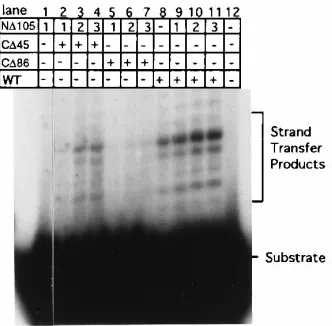
Functional complementation of strand transfer activity us-ing N- and C-terminal deletions of M-MuLV IN.The abilities of two of the seven C-terminal mutants to function in trans with
ND105 and regain integration activity were examined (Fig. 5).
Three concentrations of ND105 were examined, while the
con-centration of each mutant was held constant. ND105 used in
this study did not have integration activity (Fig. 3B, lane 4). Each protein component was mixed in reaction buffer on ice and incubated for 15 min prior to the addition of strand trans-fer substrate.
In Fig. 5, the WT strand transfer activity of M-MuLV IN is
shown in lane 8, and the activity of ND105 at the lowest
con-centration is presented in lane 1. The addition of ND105 to
M-MuLV IN did not affect strand transfer activity, although a slight increase in product was noted (Fig. 5, lanes 8 to 11). A dramatic revival of strand transfer activity was noted in
reac-tion mixtures with CD45 (Fig. 5, lanes 2 to 4) upon the addition
of ND105. Mixing CD86 and ND105 did not reconstitute strand
transfer activity as significantly (Fig. 5, lanes 5 to 7). These results indicate that a viral LTR one-end strand transfer reac-tion can be reconstituted by the assembly of one HHCC main, two DD(35)E domains, and one carboxyl-terminal do-main.
Functional complementation of ND105 and ND176 strand transfer activities by the HHCC domain.In the experiments shown in Fig. 5, complementation was performed with HHCC, DD(35)E and portions of the C-terminal region on one mol-ecule and DD(35)E with the C terminus on the second mole-cule. In these experiments, we ask whether the HHCC region can function as an independent domain. The combinations of proteins used in this complementation analysis are schemati-cally represented in Fig. 6A. The two C-terminal deletions
were tested: CD144, which contains the HHCC and DD(35)E
region, and CD232, which contains the HHCC domain and
sequence up to and including the first D of the DD(35)E
region. The C-terminal deletions were mixed with ND105
[con-tains the DD(35)E region and the C terminus] or ND176 [first
D of the DD(35)E region and the C terminus]. The locations of the HHCC and DD(35)E invariant residues are depicted for the WT M-MuLV IN (Fig. 6A, #1). The terminal 72 amino
acids of CD232 overlap with the first 72 amino acids of ND105
(Fig. 6A, #2). CD144 comprises the first 263 amino acids of
M-MuLV IN and has an overlap of 159 amino acids with
ND105 (Fig. 6A, #3). Again, these 159 amino acids comprise
the entire DD(35)E region. CD232 protein contains the first
176 amino acids of M-MuLV IN. No overlap exists between
CD232 and ND176 (Fig. 6A, #4). The ND176 protein starts
where CD232 stops. CD144 has an overlap of 87 amino acids
with ND176 (Fig. 6A, #5). These 87 amino acids comprise only
the D(35)E portion.
The strand transfer activity was assayed for each of the four
on November 9, 2019 by guest
http://jvi.asm.org/
proteins individually and in combination following a short
pre-incubation period at 378C (Fig. 6B). Strand transfer activity
was measured under identical conditions for individual pro-teins and for protein combinations used in mixing experiments.
ND105 used in these experiments had a low level of the
one-site strand transfer activity (Fig. 6B, lane 3). We expected that our assays would be more sensitive in detecting the minimal domains for activity with this preparation. WT strand transfer
activity for M-MuLV IN is shown in Fig. 6B, lane 2. Strand
transfer activity was not detected for ND176 (Fig. 6B, lane 4),
CD232 (Fig. 6B, lane 5), or CD144 (Fig. 6B, lane 6). CD232 and
CD144 proteins were able to complement strand transfer
ac-tivity with ND105 (Fig. 6B, lanes 7 and 8). Interestingly, ND176
activity was not reconstituted by CD232 or CD144 (Fig. 6B,
lanes 9 and 10). Similar results were also observed with a
blunt-end substrate for 39 processing (data not shown). This
FIG. 4. Disintegration activities of WT and mutant M-MuLV INs. Enzymatic activities of WT and mutant M-MuLV INs with the following substrates: the standard disintegration substrate, Y (A); the single-strand disintegration substrate, YSS(B); the dumbbell substrate, YDB(C); and the non-LTR disintegration substrate, YCD (D). Reactions were performed at 378C as described in Materials and Methods and analyzed on 20% denaturing polyacrylamide gels. In panels A and B, the substrate (input substrate) is 16 nucleotides long and the product (joining product) is 30 nucleotides long. In panel C, the YDBsubstrate is 40 nucleotides long and the product is 16 nucleotides long. In panel D, the YCDsubstrate is 16 nucleotides long and the product is 32 nucleotides long. The corresponding protein in each reaction is presented above each lane number. The substrate in the absence of protein (oligo) is presented in lane 1 in each panel. nt, nucleotide.
on November 9, 2019 by guest
http://jvi.asm.org/
analysis suggests that the central core functions along with the C terminus, rather than the N terminus, and does not need to be present on both molecules. The 71-amino-acid region, res-idues 106 to 177, was required in cis with the C-terminal por-tion of the IN, and not the N-terminal porpor-tion for reconstitu-tion of integrareconstitu-tion activity.
Effects of protein concentration and high reductant levels on strand transfer and disintegration. IN mutants lacking the HHCC domain typically exhibit impaired strand transfer,
al-though a low level of in vitro activity was noted with ND105
(Fig. 3C). Several biochemical observations indirectly corre-lated the redox state of C209A to the level of strand transfer activity. These observations include the following: (i) activities of C209A and WT M-MuLV IN (the activity of C209A was
frequently higher than that of the WT M-MuLV IN), (ii) the
site specificity of ND105 strand transfer, and (iii) increased
yields of active ND105 and other M-MuLV IN proteins
ob-tained when the protein concentration was limited to 2 to 5mM
during renaturation. As C-209 is the sole Cys present in
ND105, these data suggested that the redox state of the
M-MuLV IN proteins may affect activity. To address this possi-bility, the effects of elevated DTT and protein concentration on strand transfer (Fig. 7A) and disintegration reactions (Fig. 7B) were investigated.
Standard assay conditions contain 10 mM DTT, and two levels of protein (10 or 20 pmol) which served as standards for protein concentrations used in complementation reactions. With WT M-MuLV IN, strand transfer was efficient (Fig. 7A,
lanes 2 and 3). The CD232 finger-containing protein was
inac-tive regardless of concentration (Fig. 7A, lanes 4 and 5). C209A, which contains the HHCC domain but lacks the sulf-hydryl group of C-209, was capable of strand transfer at both protein concentrations (Fig. 7A, lanes 6 and 7) with an
effi-ciency slightly lower than that of WT M-MuLV IN. ND105
demonstrated limited strand transfer activity, and integra-tion appeared restricted to a single site (Fig. 7A, lanes 8 and 9).
The ND105/C209A double mutant also displayed limited
strand transfer activity at a lower protein concentration (Fig. 7A, lane 10); however, the sites of integration were more
disperse than observed with ND105 (Fig. 7A, compare lane 10
with lane 8). This was more dramatic at the higher ND105/
C209A protein concentration (Fig. 7A, compare lane 11 with lane 9), with the strand transfer pattern approximating that of
WT M-MuLV IN. In complementation assays, CD232 had a
negligible effect on the strand transfer activity of intermediate concentrations of WT and C209A M-MuLV IN proteins (Fig. 7A, lanes 12 and 13, respectively). The complementation of
ND105 by CD232 restored strand transfer activity to near WT
levels (Fig. 7A, lane 14). Significantly, the ND105/C209A
dou-ble mutant could not be complemented by CD232 (Fig. 7A,
lane 15).
To determine the effects of reducing agents on activity, a fixed concentration of each of the M-MuLV IN proteins was batch treated with 40 mM DTT. The DTT treatments are shown for both standard (10 pmol) and higher (20 pmol) levels
[image:8.612.96.262.486.649.2]FIG. 5. Complementation of mutant M-MuLV INs for strand transfer activ-ity. Strand transfer activity for ND105 (lane 1) and WT IN (lane 8) are presented. Strand transfer activity for pairs are shown for ND105 and CD45 (lanes 2 to 4), ND105 and CD86 (lanes 5 to 7), and ND105 and WT (lanes 9 to 11). Protein pairs were preincubated in reaction buffer on ice for 15 min. Reactions were per-formed at 308C as described in Materials and Methods with 12 pmol of CD45, CD86, and WT IN and 0.5 pmol of oligonucleotide 2784/2785 strand transfer substrate. ND105 was added to each of the reaction mixtures as indicated: 1, 5 pmol; 2, 10 pmol; and 3, 15 pmol.
TABLE 1. Summary of M-MuLV IN activities and complementationa
M-MuLV IN Integration activity Disintegration activity with substrate: Complementation 39processing Strand transfer Y YSS YDB YCD ND105 CD232 ND176
WT 111 111 111 111 111 111 111 111 ND
in5247 2 2 1 1/2 1 2 2 ND 2
C97Y 2 2 1 1/2 1 2 2 ND 2
ND105 2 1/2 111 1 111 2 2 111 2
ND176 2 2 2 2 2 2 2 ND 2
K227A 2 2 1 1/2 1/2 2 1/2 ND 2
CD311/346 2 2 1/2 2 2 2 ND ND 2
C209A 111 11 111 1 1 111 ND 111 ND
CD22 111 111 11 11 111 111 ND ND ND
CD28 111 111 11 11 11 111 ND ND ND
CD34 2 2 2 2 2 2 ND ND ND
CD40 2 2 2 2 2 2 ND ND ND
CD45 2 2 2 2 2 2 11 ND 2
CD86 2 2 2 2 2 2 11 ND 2
CD144 2 2 2 2 2 2 11 ND 2
CD232 2 2 2 2 2 2 11 ND 2
ND105/C209A 2 1 1 1 1/2 2 ND 2 ND
aActivity is based on WT IN activity. Symbols:1/2, 0 to 5%;1, 6 to 35%;11, 36 to 75%,111, 76 to 100%;2, no activity. ND, not determined.
on November 9, 2019 by guest
http://jvi.asm.org/
of protein. The DTT-treated WT M-MuLV IN (Fig. 7A, lanes 16 and 17) and C209A proteins (Fig. 7A, lanes 20 and 21) demonstrated only slight enhancement of their strand transfer activity (compare these lanes with lanes 2 and 3 and lanes 6 and 7, respectively). The strand transfer levels mediated by 10 pmol
of DTT-treated ND105 also showed only slight enhancement
(Fig. 7A, compare lane 22 with lane 8). However, at a higher
enzyme concentration, the DTT-treated ND105 protein
dis-played a dramatic enhancement in strand transfer activity and integration site usage (Fig. 7A, lane 23) versus untreated
ND105 (Fig. 7A, compare lane 23 with lane 9). The basal
strand transfer activity of DTT-treated ND105/C209A was
es-sentially unaffected (Fig. 7A, lanes 24 and 25). The levels of strand transfer activity in complementation reaction
mix-tures containing DTT-treated CD232 plus WT M-MuLV IN
(Fig. 7A, lane 26), CD232 plus C209A (Fig. 7A, lane 27),
CD232 plus ND105 (Fig. 7A, lane 28), and CD232 plus ND105/
C209A (Fig. 7A, lane 29) remained unchanged in comparison with those in the untreated complementation reaction mix-tures.
Since all of the protein domains in M-MuLV IN are more stringently required for integration than for disintegration, it was possible that the effect of reducing conditions on M-MuLV IN activity could be specific to the strand transfer reactions. To more directly address this question, the DTT batch-treated M-MuLV IN proteins were simultaneously assayed in disinte-gration reactions (Fig. 7B). For reaction mixtures containing the WT M-MuLV IN (Fig. 7B, lanes 2 and 3) and C209A (Fig.
7B, lanes 6 and 7), ND105 (Fig. 7B, lanes 8 and 9), and ND105/
C209A mutants, no significant differences were seen for disin-tegration reactions regardless of the reducing conditions. In
the complementation reactions, mixtures of CD232 plus WT
M-MuLV IN (Fig. 7B, lane 12), CD232 plus C209A (Fig. 7B,
lane 13), CD232 plus ND105 (Fig. 7B, lane 14), and CD232 plus
ND105/C209A (Fig. 7B, lane 15) did not show any stimulation
of disintegration. Under stronger reducing conditions,
comple-mentation mixtures containing DTT-treated CD232 plus WT
M-MuLV IN (Fig. 7B, lane 26), CD232 plus C209A (Fig. 7B,
lane 27), CD232 plus ND105 (Fig. 7B, lane 28), and CD232 plus
ND105/C209A (Fig. 7B, lane 29) also did not demonstrate
stimulation of disintegration.
DISCUSSION
Sixteen mutants were generated from the M-MuLV IN to define the domains required for catalysis. Two of the C-termi-nal mutants exhibited proteolysis during expression and extrac-tion and were not examined further. Overall, both N- and C-terminal deletions drastically reduced integration activity, while disintegration was affected more by the C-terminal trun-cations. A deletion into the N terminus through amino acid 105 was observed to retain partial strand transfer activity and near WT disintegration activity. The strand transfer activity showed a target preference for one site. HIV-1 IN with a comparable deletion does not exhibit integration activity (46), but Rous
sarcoma virus IN with the same deletion exhibits 39processing
and strand transfer activities (4). In the case of Rous sarcoma virus, the corresponding N-terminal deletion mutant retains greater activity when a short peptide is fused to its N terminus. The researchers suggest that the peptide may be providing stability to the folding of the protein or orientation of the active multimer. Work with the M-MuLV IN mutants sug-gested that the redox state of Cys-209 may play a role in the
active state of ND105. To address the molecular basis for the
FIG. 6. Complementation of mutant M-MuLV INs for strand transfer activity. (A) Schematic illustration of protein pairs mixed for complementation analysis in panel B. Protein pairs, #1, WT M-MuLV IN shown with HHCC and DDE motifs; #2, CD232 and ND105; #3, CD144 and ND105; #4, CD232 and ND176; #5, CD144 and ND176. The ability of the protein pairs to complement is presented in brackets at the bottom of each set.1, complements;2, does not complement. Amino acids are numbered as described in Materials and Methods. (B) Strand transfer activities are presented for WT IN (lane 2), ND105 (lane 3), ND176 (lane 4), CD232 (lane 5), and CD144 (lane 6) individually and in pairs for CD232 and ND105 (lane 7), CD144 and ND105 (lane 8), CD232 and ND176 (lane 9), CD144 and ND176 (lane 10). Substrate without the addition of protein is shown in lane 1. Equimolar concentrations of protein pairs were preincubated at 378C in reaction buffer without substrate. Reactions were performed at 378C as described in Materials and Methods with the amounts of proteins indicated above and analyzed on 20% denaturing polyacrylamide gels.
on November 9, 2019 by guest
http://jvi.asm.org/
FIG. 7. Enzymatic activities in the presence of DTT (A) Strand transfer activities of untreated enzymes (10 mM DTT) (lanes 1 to 15) and enzymes treated with 40 mM DTT (lanes 16 to 29). Lane 1, substrate alone; lane 2, 10 pmol of WT IN; lane 3, 20 pmol of WT IN; lane 4, 10 pmol of CD232; lane 5, 20 pmol of CD232; lane 6, 10 pmol of C209A; lane 7, 20 pmol of C209A; lane 8, 10 pmol of ND105; lane 9, 20 pmol of ND105; lane 10, 10 pmol of ND105/C209A; lane 11, 20 pmol of ND105/C209A; lane 12, 10 pmol of CD232 and 10 pmol of WT IN; lane 13, 10 pmol of CD232 and 10 pmol of C209A; lane 14, 10 pmol of CD232 and 10 pmol of ND105; lane 15, 10 pmol of CD232 and 10 pmol of ND105/C209A; lane 16, substrate alone; lane 17, 10 pmol of WT IN; lane 18, 20 pmol of WT IN; lane 19, 10 pmol of CD232; lane 20, 20 pmol of CD232; lane 21, 10 pmol of C209A; lane 22, 20 pmol of C209A; lane 23, 10 pmol of ND105; lane 24, 20 pmol of ND105; lane 25, 10 pmol of ND105/C209A; lane 26, 20 pmol of ND105/C209A; lane 27, 10 pmol of CD232 and 10 pmol of WT IN; lane 28, 10 pmol of CD232 and 10 pmol of C209A and 10 pmol of C209A; lane 29, 10 pmol of CD232 and 10 pmol of ND105; lane 30, 10 pmol of CD232 and 10 pmol of ND105/C209A. (B) Disintegration activities of untreated enzymes (10 mM DTT) (lanes 1 to 15) and enzymes treated with 40 mM DTT (lanes 16 to 29). Lane 1, substrate alone; lane 2, 10 pmol of WT IN; lane 3, 20 pmol of WT IN; lane 4, 10 pmol of CD232; lane 5, 20 pmol of CD232; lane 6, 10 pmol of C209A; lane 7, 20 pmol of C209A; lane 8, 10 pmol of ND105; lane 9, 20 pmol of ND105; lane 10, 10 pmol of ND105/C209A; lane 11, 20 pmol of ND105/C209A; lane 12, 10 pmol of CD232 and 10 pmol of WT IN; lane 13, 10 pmol of CD232 and 10
4594
on November 9, 2019 by guest
http://jvi.asm.org/
observed activity of the M-MuLV N-terminal mutant ND105,
reactions were titrated with ND105 protein pretreated with a
reducing agent. At the higher enzyme concentrations
exam-ined, the strand transfer levels of the DTT-treated ND105
protein demonstrated enhanced activity and integration site usage. Further study of the aggregation state of the protein is
warranted. One interpretation of this data is that the ND105
may form disulfide-linked multimers which are limited in ac-cess to the target DNA. High levels of DTT would break the cystine bonds and allow the assembly of active multimers. Similarly, evidence that a cysteine residue proximal to the HHCC domain of HIV-1 IN may assist in multimeric assembly of IN-DNA complexes has been suggested (13). Alternatively,
these data may suggest two conformation states of ND105
brought about by either weak and strong reducing conditions. One can speculate that if the HHCC region were responsi-ble for a more ordered active multimer, then the reduced conformation could promote either strand transfer randomly
along the DNA or random association with DNA. ND176,
which has a larger N-terminal deletion of 176 amino acids, was completely inactivated for integration and disintegration.
The lack of activity for ND176 is not surprising, since the
region deleted in this mutant includes the first D, D-125, of the invariant DD(35)E motif. This residue is absolutely re-quired for mediation of integration and disintegration activity in all retroviral INs examined to date (15, 26, 28). Comple-mentation studies showed that the M-MuLV D-125 residue was essential as part of the central core and C terminus and not the HHCC.
Two specific amino acid substitutions in the catalytic core region were examined, K227A and C209A. K-227 is conserved throughout all retroviral INs. Substitutions at this position in
Rous sarcoma virus and HIV-1 IN retain some 39processing
and strand transfer activity (26). It was thus unexpected that a mutation at this position was not tolerated in M-MuLV IN. This suggests that the K-227 residue plays a greater role in the integration processes for M-MuLV IN. A cysteine (C-209 for M-MuLV) is located within the D35E region of the majority of, but not all, INs. Given the reactive nature of Cys residues, studies addressed whether the residue afforded any specificity to the integration events. Surprisingly, C209A retained near WT levels of integration and disintegration activity. And as
discussed in the context of ND105 above, the reduction of
C-209 was required for a productive integration event in the absence of a HHCC domain. For disintegration, the effect of DTT treatment coupled to the mutation of C-209 to Ala is not as apparent as for integration. Disintegration is a unimolecular reaction, whereas strand transfer requires a bimolecular coor-dination of an LTR (donor) and target (acceptor) molecules. This suggests that the HHCC domain and redox state of C-209 are more important for the multimeric assembly and stability of bimolecular IN-DNA complexes. In unimolecular reactions such as disintegration, complex assembly may be assisted by the fixed structure of the Y substrate. This may diminish the reliance of M-MuLV IN on the mospecific interactions re-quired for assembly of integration complexes. The decreased
activity of ND105/C209A in disintegration might simply be due
to protein-DNA complex instability.
The C terminus of the M-MuLV IN was sensitive to
dele-tions and was observed to lose both integration and disinte-gration activities with deletions of 28 or more amino acids. A linker insertion at amino acid 368 results in a temperature-sensitive protein with defective M-MuLV IN function and
rep-lication (41). CD22 and CD28 functioned in ways similar to the
WT IN and were active on all substrates including YCD. The
lack of LTR sequence in YCDsubstrate indicates a
unimolecu-lar, nonspecific phosphoryl transfer reaction. This type of ac-tivity has been noted previously with M-MuLV IN disintegra-tion substrate variants (22). Recently, HIV-1 IN has also been shown to catalyze a sequence-independent phosphoryl transfer (30, 43). Several of the M-MuLV IN mutants reported in this
study, CD40, CD45, CD86, CD232, and CD144, had no
detect-able integration or disintegration activity. This is in contrast with HIV-1 IN which shows disintegration activity in C-termi-nal mutants with deletions to amino acid 212, albeit at very low levels (3). Several of the M-MuLV C-terminal mutants were
able to function in trans with ND105. In the case of HIV-1 IN,
efficient complementation does not occur if one molecule has more than 50 residues deleted from the N terminus and the other molecule has 70 residues deleted from the C terminus (46). In comparison to the results with HIV-1 IN, domains within the M-MuLV IN were able to act in trans in smaller functional units to promote integration activity. The results of the complementation analysis suggest that the HHCC region functions as one domain and that the catalytic core and C terminus function as a separate domain.
The HHCC region has been proposed to be involved in the recognition of the retroviral LTR termini, multimerization, positioning of the viral DNA into the catalytic core, and main-tenance of the architecture of the protomeric complex (4, 22,
25). Studies of the strand transfer activity of ND105, which
lacks the HHCC region, offered several new insights into a possible function for the HHCC region. Several observations
were made. First, ND105 catalyzed strand transfer reactions at
a low level; however, this activity was limited to one target site
in the DNA substrate. This site is 4 nucleotides closer to the 39
end than the site primarily targeted for strand transfer with the WT M-MuLV IN enzyme. Second, reactions with a mixture of
ND105 with either of the two mutant M-MuLV IN proteins,
CD232 or CD144, produced integration levels similar to that of
WT IN. Thus, in these experiments, the HHCC domain
func-tioned in trans to the core-C terminus to regain 39processing
and strand transfer activities. Third, increasing the amount of
DTT in the reaction environment of ND105 functioned in a
manner similar to the addition of CD232, specifically, through
the stimulation of integration activity. Last, while the
integra-tion activity of ND105 could be increased through the addition
of DTT or CD232, the double mutant, ND105/C209A, could
not be complemented by CD232. This suggests that the C-209
residue is in some manner required for IN-IN interactions
between the ND105 protein and the HHCC region of the
CD232 protein. Similarly, Ellison et al. have proposed a model
for HIV-1 IN multimerization on the basis of interactions between the HHCC domain of one protomer and an N-ethyl-maleimide-sensitive site on a second protomer (13). The lack
of complementation of ND105/C209A could indicate improper
folding of the active site. Although misfolding cannot be pre-cluded, the demonstrated low-level strand transfer activity and
pmol of C209A; lane 14, 10 pmol of CD232 and 10 pmol of ND105; lane 15, 10 pmol of CD232 and 10 pmol of ND105/C209A; lane 16, 10 pmol of WT IN; lane 17, 20 pmol of WT IN; lane 18, 10 pmol of CD232; lane 19, 20 pmol of CD232; lane 20, 10 pmol of C209A; lane 21, 20 pmol of C209A; lane 22, 10 pmol of ND105; lane 23, 20 pmol of ND105; lane 24, 10 pmol of ND105/C209A; lane 25, 20 pmol of ND105/C209A; lane 26, 10 pmol of CD232 and 10 pmol of WT; lane 27, 10 pmol of CD232 and 10 pmol of C209A; lane 28, 10 pmol of CD232 and 10 pmol of ND105; lane 29, 10 pmol of CD232 and 10 pmol of ND105/C209A. Reactions were performed at 378C as described in Materials and Methods and analyzed on 20% denaturing polyacrylamide gels.
on November 9, 2019 by guest
http://jvi.asm.org/
multiple sites of integration demonstrated by ND105/C209A argue against this. These results suggest that the redox state of C-209 affects M-MuLV IN integration activity, particularly strand transfer, and that the HHCC domain assists in control-ling the redox state of the C-209 residue. Whether this effect is due to a direct interaction of the HHCC and the core Cys or an indirect effect is an area of current investigation.
ACKNOWLEDGMENTS
We thank Kimberly C. Gray and Clarivick Macalalad for excellent technical assistance.
This work was supported by American Cancer Society grant VM-134 and by National Science Foundation grant DMB-9105091. M.J.R. was a Stohlmann Scholar of the Leukemia Society of America, Inc. C.B.J. was supported by NIH Postdoctoral Fellowship grant IF32CA09242. G.A.D. was supported by NIH training grant 5T32A107043-02.
REFERENCES
1. Bowerman, B., P. O. Brown, J. M. Bishop, and H. E. Varmus. 1989. A nucleoprotein complex mediates the integration of retroviral DNA. Genes Dev. 3:469–478.
2. Bradford, M. M. 1976. A rapid and sensitive method for the quantitation of microgram quantities of protein utilizing the principle of protein-dye bind-ing. Anal. Biochem. 72:248–254.
3. Bushman, F. D., A. Engelman, I. Palmer, P. Wingfield, and R. Craigie. 1993. Domains of the integrase protein of human immunodeficiency virus type I responsible for polynucleotidyl transfer and zinc binding. Proc. Natl. Acad. Sci. USA 90:3428–3432.
4. Bushman, F. D., and B. Wang. 1994. Rous sarcoma virus integrase protein: mapping functions for catalysis and substrate binding. J. Virol. 68:2215–2223. 5. Chow, S. A., and P. O. Brown. 1995. Juxtaposition of two viral DNA ends in a bimolecular disintegration reaction mediated by multimers of human im-munodeficiency virus type 1 or murine leukemia virus integrase. J. Virol. 68:7869–7878.
6. Chow, S. A., K. A. Vincent, V. Ellison, and P. O. Brown. 1992. Reversal of integration and DNA splicing mediated by integrase of human immunode-ficiency virus. Science 255:723–726.
7. Coffin, J. M. 1990. Retroviridae and their replication, p. 645–708. In B. N. Fields and D. M. Knipe (ed.), Fundamental virology. Raven Press, New York.
8. Colicelli, J., and S. P. Goff. 1985. Mutants and pseudorevertants of Moloney murine leukemia virus with alterations at the integration site. Cell 42:573– 580.
9. Craigie, R., T. Fujiwara, and F. Bushman. 1990. The IN protein of Moloney murine leukemia virus processes the viral DNA ends and accomplishes their integration in vitro. Cell 62:829–837.
10. Donehower, L. A. 1988. Analysis of mutant Moloney murine leukemia viruses containing linker insertion mutations in the 39region of pol. J. Virol. 62: 3958–3964.
11. Donzella, G. A., C. B. Jonsson, and M. J. Roth. 1993. Influence of substrate structure on disintegration by Moloney murine leukemia virus integrase. J. Virol. 67:7077–7087.
12. Dotan, I., B. P. Scottoline, T. S. Heuer, and P. O. Brown. 1995. Character-ization of recombinant murine leukemia virus integrase. J. Virol. 69:456–468. 13. Ellison, V., J. Gerton, K. A. Vincent, and P. O. Brown. 1995. An essential interaction between distinct domains of HIV-1 integrase mediates assembly of the active multimer. J. Biol. Chem. 270:3320–3326.
14. Engelman, A., F. D. Bushman, and R. Craigie. 1993. Identification of dis-crete functional domains of HIV-1 integrase and their organization within an active multimeric complex. EMBO J. 12:3269–3275.
15. Engelman, A., and R. Craigie. 1992. Identification of conserved amino acid residues critical for human immunodeficiency virus type 1 integrase function in vitro. J. Virol. 66:6361–6369.
16. Engelman, A., K. Mizuuchi, and R. Craigie. 1991. HIV-1 DNA integration: mechanism of viral DNA cleavage and DNA strand transfer. Cell 67:1211– 1221.
17. Farnet, C. M., and W. A. Haseltine. 1991. Determination of viral proteins present in the human immunodeficiency virus type 1 preintegration complex. J. Virol. 65:1910–1915.
18. Felkner, R. H., and M. J. Roth. 1992. Mutational analysis of the N-linked glycosylation sites of the SU protein of Moloney murine leukemia virus. J. Virol. 66:4258–4264.
19. Ho, S. N., H. D. Huut, R. M. Horton, J. K. Pullen, and L. R. Pease. 1989. Site-directed mutagenesis by overlap extension using the polymerase chain reaction. Gene 77:51–59.
20. Johnson, M. S., M. A. McClure, D. F. Feng, J. Gray, and R. F. Doolittle. 1986. Computer analysis of retroviral pol genes: assignment of enzymatic functions to specific sequences and homologies with nonviral enzymes. Proc.
Natl. Acad. Sci. USA 83:7648–7652.
21. Jonsson, C. B., G. A. Donzella, and M. J. Roth. 1993. Characterization of the forward and reverse integration reactions of the Moloney murine leukemia virus integrase protein purified from Escherichia coli. J. Biol. Chem. 268: 1462–1469.
22. Jonsson, C. B., and M. J. Roth. 1993. Role of the His-Cys finger of the Moloney murine leukemia virus integrase protein in integration and disin-tegration. J. Virol. 67:5562–5571.
23. Katz, R. A., and A. M. Skalka. 1994. The retroviral enzymes. Annu. Rev. Biochem. 63:133–173.
24. Katzman, M., R. A. Katz, A. M. Skalka, and J. Leis. 1989. The avian retroviral integration protein cleaves the terminal sequences of linear viral DNA at the in vivo sites of integration. J. Virol. 63:5319–5327.
25. Khan, E., J. P. G. Mack, R. A. Katz, J. Kulkosky, and A. M. Skalka. 1990. Retroviral integrase domains: DNA binding and the recognition of LTR sequences. Nucleic Acids Res. 19:851–860.
26. Kulkosky, J., K. S. Jones, R. A. Katz, J. P. G. Mack, and A. M. Skalka. 1992. Residues critical for retroviral integrative recombination in a region that is highly conserved among retroviral/retrotransposon integrases and bacterial insertion sequence transposases. Mol. Cell. Biol. 12:2331–2338.
27. Kunkel, T. A., J. D. Roberts, and R. A. Zakour. 1987. Rapid and efficient site-specific mutagenesis without a phenotypic selection. Methods Enzymol. 154:367.
28. Leavitt, A. D., L. Shiue, and H. E. Varmus. 1993. Site-directed mutagenesis of HIV-1 integrase demonstrates differential effects on integrase functions in vitro. J. Biol. Chem. 268:2113–2119.
29. Lin, T. H., T. P. Quinn, D. Grandgenett, and M. T. Walsh. 1989. Secondary structural analysis of retrovirus integrase: characterization by circular dichro-ism and empirical prediction methods. Proteins Struct. Funct. Genet. 5:156– 165.
30. Mazumder, A., A. Engelman, R. Craigie, M. Fesen, and Y. Pommier. 1994. Intermolecular disintegration and intramolecular strand transfer activities of wild type and mutant HIV-1 integrase. Nucleic Acids Res. 22:1037–1043. 31. Miller, D. G., M. A. Adam, and A. D. Miller. 1990. Gene transfer by
retro-virus vectors occurs only in cells that are actively replicating at the time of infection. Mol. Cell. Biol. 10:4239–4242.
32. Mumm, S. R., and D. P. Grandgenett. 1991. Defining nucleic acid-binding properties of avian retrovirus integrase by deletion analysis. J. Virol. 65: 1160–1167.
33. Murphy, J. E., T. de los Santos, and S. P. Goff. 1993. Mutational analysis of the sequences at the termini of the Moloney murine leukemia virus DNA required for integration. Virology 195:432–440.
34. Murphy, J. E., and S. P. Goff. 1992. A mutation at one end of Moloney murine leukemia virus DNA blocks cleavage of both ends by the viral integrase in vivo. J. Virol. 66:5092–5095.
35. Puras-Lutzke, R., C. Vink, and R. H. A. Plasterk. 1994. Characterization of the minimal DNA-binding domain of the HIV integrase protein. Nucleic Acids Res. 22:4125–4131.
36. Roe, T., T. C. Reynolds, G. Yu, and P. O. Brown. 1993. Integration of murine leukemia virus DNA depends on mitosis. EMBO J. 12:2099–2108. 37. Roth, M., P. Schwartzberg, N. Tanese, and S. P. Goff. 1990. Analysis of
mutations in the integration function of Moloney murine leukemia virus: effects on DNA binding and cutting. J. Virol. 64:4709–4717.
38. Roth, M. J. 1991. Mutational analysis of the carboxyl terminus of the Molo-ney murine leukemia virus integration protein. J. Virol. 65:2141–2145. 39. Roth, M. J., P. L. Schwartzberg, and S. P. Goff. 1989. Structure of the termini
of DNA intermediates in the integration of retroviral DNA: dependence on IN function and terminal DNA sequence. Cell 58:47–54.
40. Sanger, F., S. Nicklen, and A. R. Coulson. 1978. DNA sequencing with chain-terminating inhibitors. Proc. Natl. Acad. Sci. USA 74:5463–5467. 41. Schwartzberg, P. L., M. J. Roth, N. Tanese, and S. P. Goff. 1993. Analysis of
a temperature-sensitive mutation affecting the integration protein of Molo-ney murine leukemia virus. Virology 192:673–678.
42. Shinnick, T. M., R. A. Lerner, and J. G. Sutcliffe. 1981. Nucleotide sequence of Moloney murine leukemia virus. Nature (London) 293:543–548. 43. van Den Ent, F. I., C. Vink, and R. H. A. Plasterk. 1995. DNA substrate
activities of the human immunodeficiency virus type 1 integrase protein. J. Virol. 68:7825–7832.
44. van Gent, D. C., Y. Elgersma, M. W. J. Bolk, C. Vink, and R. H. A. Plasterk. 1991. DNA binding properties of the integrase proteins of human immuno-deficiency viruses types 1 and 2. Nucleic Acids Res. 19:3821–3827. 45. van Gent, D. C., A. A. M. O. Groenger, and R. H. A. Plasterk. 1992.
Muta-tional analysis of the integrase protein of human immunodeficiency virus type 2. Proc. Natl. Acad. Sci. USA 89:9598–9602.
46. van Gent, D. C., C. Vink, A. A. M. O. Groeneger, and R. H. A. Plasterk. 1993. Complementation between HIV integrase proteins mutated in different do-mains. EMBO J. 12:3261–3267.
47. Varmus, H., and P. Brown. 1989. Retroviruses. American Society for Micro-biology, Washington, D.C.
48. Vink, C., A. A. M. O. Groenger, and R. H. A. Plasterk. 1993. Identification of the catalytic and DNA-binding region of the human immunodeficiency virus type 1 integrase protein. Nucleic Acids Res. 21:1419–1425.
on November 9, 2019 by guest
http://jvi.asm.org/
49. Vink, C., E. Yeheskiely, G. A. van der Marel, J. H. van Boom, and R. H. A. Plasterk.1993. Site specific hydrolysis and alcoholysis of human immunode-ficiency virus DNA termini mediated by the viral integrase protein. Nucleic Acids Res. 19:6691–6698.
50. Vogelstein, B., and D. Gillespie. 1979. Preparative and analytical purification of DNA from agarose. Proc. Natl. Acad. Sci. USA 76:615–619.
51. Woerner, A. M., M. Klutch, J. G. Levin, and C. J. Marcus-Sekura. 1992. Localization of DNA binding activity of HIV-1 integrase to the C-terminal half of the protein. AIDS Res. Hum. Retroviruses 8:297–304.
52. Woerner, A. M., and C. J. Marcus-Sekura. 1993. Characterization of a DNA binding domain in the C-terminus of HIV-1 integrase by deletion mutagen-esis. Nucleic Acids Res. 21:3507–3511.