MONTELUKAST SODIUM CHEWABLE TABLETS
Dissertation Submitted to the
THE TAMILNADU Dr.MGR MEDICAL UNIVERSITY, CHENNAI,
TAMILNADU.
In partial fulfillment of the requirements for the award of degree of
MASTER OF PHARMACY
InPHARMACEUTICS
By
NARESH KUMAR GUPTA
(Reg. No. 26104507)
UNDER THE GUIDANCE OF
Mrs. Pheeba Mary Philip M.Pharm.,
Assistant Professor
Department of Pharmaceutics
K.K COLLEGE OF PHARMACY,
GERUGAMBAKKAM, CHENNAI, 600122
TAMIL NADU
This is to certify that the dissertation entitled
“FORMULATION,
DEVELOPMENT AND
EVALUATION OF MONTELUKAST SODIUM
CHEWABLE TABLETS”
is a bonafide and genuine research work carried out at
the Department of Pharmaceutics, K.K College of pharmacy by
NARESH
KUMAR GUPTA,
B.Pharm.,
during the year 2011-2012 under the supervision of
Asst. Prof. Mrs. Pheeba Mary Philip M.Pharm.,
This dissertation is submitted
for partial fulfillment of the requirements for the award of degree of Masters of
Pharmacy (Pharmaceutics), by the Tamil Nadu Dr. M.G.R Medical University,
Chennai-32.
PRINCIPAL
DIRECTOR
Prof. A. MEENA M.Pharm.,( PhD)., Prof. Dr. V.VAIDHYALINGAM. M.Pharm., Ph.D.,
K.K. College of Pharmacy
K.K. College of Pharmacy
This is to certify that the dissertation entitled
“FORMULATION,
DEVELOPMENT AND
EVALUATION OF MONTELUKAST SODIUM
CHEWABLE TABLETS ”
is a bonafide and genuine research work carried out
by
Mr. NARESH KUMAR GUPTA
during the year 2011-2012 under the
supervision of
Mrs. Pheeba Mary Philip, M.Pharm., Asst. Professor
,
Department of Pharmaceutics, K.K College of Pharmacy, Chennai-600122. This
dissertation submitted in partial fulfillment for the award of degree of Master of
Pharmacy (Pharmaceutics), by The Tamil Nadu Dr.M.G.R. Medical University,
Chennai-32.
Prof.Dr. K. SENTHILKUMARAN M.Pharm., Ph.D.,
HEAD,
DEPARTMENT OF PHARMACEUTICS.
K.K. College of Pharmacy,
This is to certify that the Dissertation entitled
“FORMULATION,
DEVELOPMENT AND
EVALUATION OF MONTELUKAST SODIUM
CHEWABLE TABLETS”
is a bonafide and genuine research work carried out at
Department of Pharmaceutics, K.K College of Pharmacy, Chennai-600122, by
Mr. NARESH KUMAR GUPTA
during the year 2011-2012 under my
supervision. This Dissertation submitted in partial fulfillment for the award of
degree of Master of Pharmacy (Pharmaceutics), by The Tamil Nadu Dr.M.G.R.
Medical University, Chennai-32
SUPERVISOR
Mrs. Pheeba Mary Philip, M.Pharm.,
Asst. Professor
,
Dept. of Pharmaceutics,
K.K. College of Pharmacy,
ACKNOWLEDGEMENT
ACKNOWLEDGEMENT
ACKNOWLEDGEMENT
ACKNOWLEDGEMENT
The satisfaction and euphoria that come along with successful completion of any work
would be incomplete unless we mention the names of the people who made it possible, whose
constant guidance and encouragement served as a beam of light and crowned out the efforts.
First of all, it is by the love and blessings of God (my parents) that I am able to
complete my investigation studies successfully and I present this piece of work which I am
eternally indebted.
First and foremost, I wish to express my deepest gratitude to respected Prof. K. R.
Prof. K. R.
Prof. K. R.
Prof. K. R.
Arumugam,
Arumugam,
Arumugam,
Arumugam, M.Pharm.,
M.Pharm.,
M.Pharm., Chairman,
M.Pharm.,
Chairman,
Chairman, K. K. College of Pharmacy, Chennai for his help and
Chairman,
support
.
I now take this opportunity to express sincere thanks to Mrs. A. Meena,
Mrs. A. Meena,
Mrs. A. Meena,
Mrs. A. Meena,
M.Pharm., (Ph.D.,)
M.Pharm., (Ph.D.,)
M.Pharm., (Ph.D.,)
M.Pharm., (Ph.D.,) Principal,
Principal,
Principal,
Principal, K.K. College of Pharmacy, for her support and constant
encouragement throughout my project work.
I wish to express my deep gratitude to Prof.
Prof.
Prof. Dr. V. Vaidhyalingam, M.Pharm., Ph.D.,
Prof.
Dr. V. Vaidhyalingam, M.Pharm., Ph.D.,
Dr. V. Vaidhyalingam, M.Pharm., Ph.D.,
Dr. V. Vaidhyalingam, M.Pharm., Ph.D.,
Director,
Director,
Director,
Director, K.K. College of Pharmacy for his hearty cooperation & valuable guidance throughout
these two years of my M.Pharm, course.
I owe a debt of gratitude to
Prof.
Prof.
Prof.
Prof. Dr. K. Senthilkumaran, M.Pharm., Ph.D.,
Dr. K. Senthilkumaran, M.Pharm., Ph.D.,
Dr. K. Senthilkumaran, M.Pharm., Ph.D.,
Dr. K. Senthilkumaran, M.Pharm., Ph.D., Head of
Head of
Head of
Head of
the Department
the Department
the Department
the Department
,
Department of pharmaceutics, K.K. College of pharmacy
,
for his valuable
guidance and providing facilities during the course of my work.
I owe a debt of gratitude to my Research Guide Mrs. Pheeba Mary Philip M.Pharm.,
Mrs. Pheeba Mary Philip M.Pharm.,
Mrs. Pheeba Mary Philip M.Pharm.,
Mrs. Pheeba Mary Philip M.Pharm.,
Asst Professor
Asst Professor
Asst Professor
Asst Professor Department of Pharmaceutics for spending her valuable time for giving me
source of knowledge and inspiration to me, especially Mrs. Rajarajeswari Hariharan,
Mrs. Rajarajeswari Hariharan,
Mrs. Rajarajeswari Hariharan,
Mrs. Rajarajeswari Hariharan,
M.Pharm., Ms. P. Kavitha, M.Pharm.,
M.Pharm., Ms. P. Kavitha, M.Pharm.,
M.Pharm., Ms. P. Kavitha, M.Pharm.,
M.Pharm., Ms. P. Kavitha, M.Pharm.,
Mrs. Laura, M.Pharm.,
Mrs. Laura, M.Pharm.,
Mrs. Laura, M.Pharm.,
Mrs. Laura, M.Pharm., for their prompt assistance
and cooperative attitude.
I also wish to express my sincere thanks to Mr.
Mr.
Mr. V Naga Prasad, Manager
Mr.
V Naga Prasad, Manager
V Naga Prasad, Manager Formulation
V Naga Prasad, Manager
R&D Department, Aurobindo Pharma Limited, Hyderabad. For his valuable guidance,
dynamic approach, innovative advices, technical and morale support given to me throughout
the course of this dissertation work and for granting me the opportunity to do project with his
kind support.
I express my special thanks to Mr. N Venu,
Mr. N Venu,
Mr. N Venu,
Mr. N Venu, scientist
scientist
scientist
scientist Aurobindo Pharma Limited
,Hyderabad for his valuable advices, morale support and guidance throughout my education.
With his dynamic approach which boosted my morale, which helped me in completion of this
dissertation
I express my special thanks to my friends Veer Raju, Prasad, A.Imthiyas
Veer Raju, Prasad, A.Imthiyas
Veer Raju, Prasad, A.Imthiyas
Veer Raju, Prasad, A.Imthiyas
Khan, Ajay, Gatta Mohan, Kamar, Zuber ,Arul
Khan, Ajay, Gatta Mohan, Kamar, Zuber ,Arul
Khan, Ajay, Gatta Mohan, Kamar, Zuber ,Arul
Khan, Ajay, Gatta Mohan, Kamar, Zuber ,Arul & my Department Friends for their
friendship, encouragement, moral strength that they always showered on me.
I would like to express my heartfelt gratitude to my mother Smt. Tripta
Smt. Tripta
Smt. Tripta
Smt. Tripta
Gupta,
Gupta,
Gupta,
Gupta, father Sh.
Sh.
Sh.
Sh.Tara Chand Gupta,
Tara Chand Gupta,
Tara Chand Gupta, brother and sister-in-law Bharat
Tara Chand Gupta,
Bharat
Bharat
Bharat and Rohini
Rohini
Rohini
Rohini
Gupta,
Gupta,
Gupta,
Gupta, sister and brother-in-law Harsha
Harsha
Harsha and Yogesh Gupta
Harsha
Yogesh Gupta
Yogesh Gupta.
Yogesh Gupta
The completion of this dissertation is not only fulfillment of my dreams but
also the dreams of my parents who have taken a lot of pain for me in completion of
higher studies successfully, whose full hearted co-operation, love and moral support.
A word of thanks to all those gentle people associated with this work directly
or indirectly whose names have been to unable to mention here. I thank for the
blessings showered on me by God.
gm - Gram
ml - Milliliters
mm - Millimeters
cm - Centimeters
BD - Bulk Density
TD - Tapped Density
CI - Carr’s Index
HR - Hausner’s Ratio
Kp - Kilo Pounds
o
C - Centigrade
%RH - Percentage Relative humidity
RPM - Revolutions Per minute
HPLC - High pressure liquid chromatography
% CDR - Percentage Cumulative Drug Release
PO - per os
CDER -Centre for Drug Evaluation and Research
FDA -Food and Drug Administration
S.No LIST OF TABLES Page No
1 Classification of superdisintegrants 15
2 List of excipients used in the formulation of chewable tablets 18
3 Route of administration 36
4 Uses of Microcrystalline Cellulose 38
5 Uses of croscarmellose sodium 40
6 List of equipments 47
7 List of chemicals 48
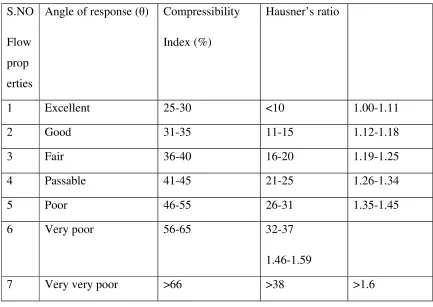
8 Flow properties and corresponding Angle of repose, compressibility
index and Hausner’s ratio
52
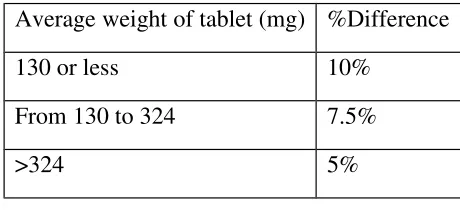
9 Weight variation requirements 53
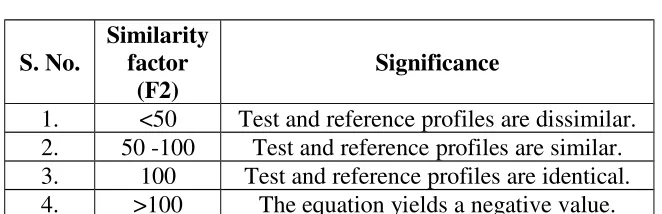
10 Similarity factor F2 and its significance 60
11 Innovator product details 62
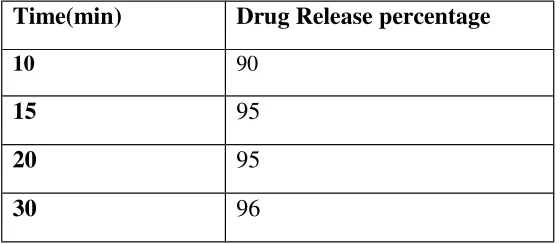
12 Physical parameters of innovator product 62 13 Dissolution profile of innovator product 62
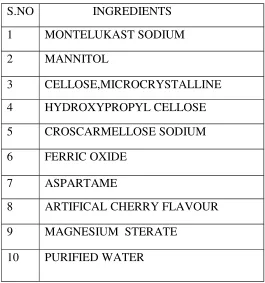
14 Ingredients 63
15 Formula for F1 64
16 Formula for F2 to F8 65
17 Drug–excipients compatibility studies 67
18 Pre-compression parameters for formulation 70
19-20 Post compression parameters 71-72
21 Data for Standard Curve of Montelukast sodium 73
22 In Vitro dissolution data 74
23 In Vitro release profiles study of different formulation 74 24-26 Physical and chemical parameters of Montelukast sodium tablets 77-78 25-27 Dissolution profile of Montelukast sodium tablets after stability 77-78
S.NO
LIST OF FIGURES
Page No
1 Mechanism of disintegrants by swelling and wicking 12
2 Mechanism of disintegrants by deformation and
repulsion
13
3 Air flow obstruction in asthma 20
4 FTIR spectra of Montelukast sodium pure drug 68
5 FTIR spectra of Montelukast sodium final formulation 69
6 HPLC Chromatogram for Formulation-6 at 10 µ g/ml
concentration.
72
7 Comparative In Vitro drug release profile of
Formulation F2 to F8
75
8 In Vitro drug release profile of formulation F2-F8 and
innovator product
CONTENTS
Chapter
TITLE
Pg. No.
1
Introduction
1
2
Literature Review
25
3
Aim and Objective of work
29
4
Plan of Work
30
5
Drug profile
31
6
Excipient profile
37
7
Materials and Method
47
8
Experimental Investigation
62
9
Results and Discussion
67
10
Summary and Conclusion
79
INTRODUCTION
Oral solid dosage form
1,2:
The oral route of drug administration is the most important method of administering
drug for systemic effects. Except in certain case the parental route is not routinely used for
self administration, e.g. insulin. The topical route of administration has only recently been
employed to deliver drugs to the body for systemic effect. The parental route of
administration is important in treating medical emergencies in which the subject is comatose
or cannot swallow. Nevertheless it is probable that at least 90% of all drugs used to provide
systemic effect are administered by oral route. When a new drug is discovered one of the
first question a pharmaceutical company asks is whether or not the drug can be effectively
administered for its intended effect by oral route. Drugs that are administered orally, solid
oral dosage forms represent the preferred class of product. Tablet and capsules represent unit
dosage forms in which usual dose of drug has been accurately placed.
Tablets and capsules represent unit dosage forms in which one usual dose of
drug has been accurately placed. By comparison liquid forms such as syrups, suspensions,
emulsions, solutions and elixirs are usually designated to contain one medication in 5 -30ml,
such dosage measurements are typically error by a factor ranging from 20 -50%, when the
drug is self administered by patient.
Tablets3,4
:
In 1843, the first patent for a hand operated device used to form a tablet was granted. Tablets
are defined as solid dosage forms each containing a single dose of one or more active
ingredients, obtained by compressing uniform volumes of particles. They are intended for the
oral administration, some are swallowed whole, some after being chewed. Some are
dissolved or dispersed in aqueous phase before being administered and some are retained in
the mouth, when the active ingredients are “liberated”.
Tablets are used mainly for systemic drug delivery but also for local drug action. For
systemic use drug must be released from tablet that is dissolved in the fluids of mouth,
stomach and intestine and then absorbed into systemic circulation by which it reaches its site
of action.
The tablet is composed of the Active Pharmaceutical Ingredient (active drug) together with
therapeutic effect or are necessary to construct the tablet. The filler or diluents (e.g. Lactose
or Sorbitol) are a bulking agent, providing a quantity of material which can accurately be
formed into a tablet. Binders (e.g. methyl cellulose or gelatin) hold the ingredients together so
that they can form a tablet. Lubricants (e.g. magnesium stearate or polyethylene glycol) are
added to reduce the friction between the tablet and the punches and dies so that the tablet
compression and ejection processes are smooth. Disintegrants (e.g. starch or cellulose) are
used to promote wetting and swelling of the tablet so that it breaks up in the gastrointestinal
tract; this is necessary to ensure dissolution of the API. Superdisintegrants are sometimes
used to greatly speed up the disintegration of the tablet. Additional ingredients may also be
added such as coloring agents, flavoring agents and coating agents. Formulations are
designed using small quantities in a laboratory machine called a Powder Compaction
Simulator. This can prove the manufacturing process and provide information.
Advantages1
:
• They are unit dosage forms and they offer the greatest capabilities of all oral dosage
forms for the greatest dose precision and the least content variability.
• Their cost is lowest of all oral dosage forms.
• They are the lightest and most compact oral dosage forms.
• They are in general the easiest and cheapest to package.
• Product identification is potentially the simplest and cheapest, requiring no
additional processing steps when employing an embossed or monogrammed punch face.
• They may provide the greatest ease of swallowing with the least tendency for
“hang-up” above the stomach especially when coated provided the tablet disintegration is not
excessively rapid.
• They lend themselves to certain special release profile products such as enteric or
delayed release products.
• They are better suited to large scale production than other unit oral forms.
Disadvantages:
• Some drugs resist compression into dense compacts, owing to their amorphous
• Drugs with poor wetting, dissolution properties, intermediate to large dosages,
optimum absorption high in the GIT or any combination of these features may be difficult to
impossible to formulate and manufacture as a tablet that will still provide adequate full drug
bioavailability.
• Bitter tasting drugs, drugs with an objectionable odour or drugs that are sensitive to
oxygen or atmospheric moisture may require encapsulation or entrapment prior to
compression or the tablets may require coating. In such cases, the tablets may offer the best
and lowest cost approach.
Types of tablets1:
The main reason behind formulation of different types of tablets are to create a delivery system that is relatively simple and inexpensive to manufacture, provide the dosage form
that is convenient from patients perspective and utilize an approach that is unlikely to add
complexity during regulatory approval process. To perceive each dosage form, tablets here
are classified by their route of administration and by the type of drug the delivery system
represent within that route.
Oral tablets for ingestion:
Standard compressed tablets
Multiple compressed tablets
• Compression coated tablets
• Layered tablets
• Inlay tablets
Modified release tablets
Delayed action tablets
Targeted action tablets
• Floating tablets
Chewable tablets
Dispersible tablets
Tablets used in the oral cavity
Lozenges and troches
Sublingual tablets
Buccal tablets
Dental cones
Mouth dissolving tablets
Tablets administered by other routes:
Vaginal tablets
Implants
Tablets used for prepare solution:
Effervescent tablets
Hypodermic tablets
Soluble tablets
METHODS INVOLVED IN FORMULATION OF TABLETS5
:
Direct compression
Dry granulation
Wet granulation
Direct compression:
This method is used when a group of ingredients can be blended and placed in a tablet press
to make a tablet without any of the ingredients having to be changed. This is not very
for the direct compression due to their concentration or the excipients used in formulation
are not conducive to direct compression.
Granulation is the process of collecting the particles together by creating bonds between
them. There are several different methods of granulation. The most popular, which is used
by over 70% of formulation in tablet manufacture is wet granulation.
Advantages of Direct Compression: 1. Cost Effectiveness
2. Stability.
3. Faster Dissolution
4. Less wears & tears of punches
5. Simplified Validation
Limitations of direct compression 1. Segregation
2. Cost
3. Low dilution potential
4. Re-workability
5. Lubricant sensitivity
6. Variation in functionality
Dry granulation:
In dry granulation process the powder mixture is compressed without the use of heat and
solvent. It is the least desirable of all methods of granulation. The two basic procedures are
to form a compact of material by compression and then to mill the compact to obtain
granules. Two methods are used for dry granulation. The more widely used method is
slugging, where the powder is recompressed and the resulting tablet or slug are milled to
yield the granules. The other method is to precompress the powder with pressure rolls using
a machine such as Chilsonator.
Roller compaction
The compaction of powder by means of pressure roll can also be accomplished by a machine
called chilsonator. Unlike tablet machine, the chilsonator turns out a compacted mass in a
contains a spiral auger to feed the powder into the compaction zone. Like slugs, the
aggregates are screened or milled for production into granules.
Use: Use in the production of directly compressible excipients, the compaction of drugs and
drug formulations, the granulation of inorganic materials, the granulation of dry herbal
material and the production of immediate/sustained release formulations.
Processing steps:
Weighing of raw material, screening, mixing, and compression to
slugs-milling-mixing-compression to finished tablets.
Advantages:
The main advantage of dry granulation or slugging is that it uses less equipments and space.
It eliminate the need for binder solution, heavy mixing equipment and the costly and time
consuming drying step required for wet granulation. Slugging can be used for advantages in
the following situations:
i) For moisture sensitive material.
ii) For heat sensitive material.
iii) For improved disintegration since powder particles are not bonded together by a
binder.
Disadvantages:
i) It requires a specialized heavy duty tablet press to form slug.
ii) It does not permit uniform colour distribution as can be achieved with wet granulation
where the dye can be incorporated into binder liquid.
iii) The process tends to create more dust than wet granulation, increasing the potential for
contamination.
Wet granulation:
The most broadly used process of agglomeration in pharmaceutical industry is wet
granulation. Wet granulation process simply involves the wet massing of the powder blend
with a granulating liquid, wet sizing and drying.
Important steps involved in the wet granulation:
i) Mixing of the drug(s) and excipients.
iii) Mixing of binder solution with powder mixture to form wet mass.
iv) Drying of moist granules.
v) Mixing of screened granules with disintegrant, glidant, and lubricant.
Advantages
(a) Permits mechanical handling of powders without loss of mix quality.
(b) Improves the flow of powders by increasing particle size and sphericity.
(c) Increases and improves the uniformity of powder density.
(d) Improves cohesion during and after compaction.
(e) Reduces air entrapment.
(f) Reduces the level of dust and cross-contamination.
(g) Allows for the addition of a liquid phase to powders (wet process only).
(h) Makes hydrophobic surfaces hydrophilic.
Limitation of wet granulation:
i) The greatest disadvantage of wet granulation is its cost. It is an expensive process because
of labor, time, equipment, energy and space requirements.
ii) Loss of material during various stages of processing.
iii) Stability may be major concern for moisture sensitive or thermolabile drugs.
iv) Multiple processing steps add complexity and make validation and control difficult.
v) An inherent limitation of wet granulation is that any incompatibility between formulation
components is aggravated.
Chewable tablets
1:
Chewable tablets are intended to be chewed in the mouth prior to swallowing and
are not intended to be swallowed intact. The purpose of the chewable tablet is to provide
unit dosage form of medication which can be easily administered to infants and children or
to the elderly, who may have difficulty in swallowing a tablet intact.
Chewable dosage forms, such as soft pills, tablets, gums and most recently chewy squares have long been part of the pharmacist armamentarium.
Advantages6
:
Better bioavailability through bypassing disintegration.
Patient convenience through the elimination of the need for water for swallowing. Possible use as a substitute for liquid dosage forms where rapid onset of action is needed.
Techniques used in the formulation of chewable tablets
6:
Coating by wet granulation Microencapsulation
Solid dispersion
Adsorbate formation technique Ion exchange
Spray congealing and spray coating Formation of different salts or derivatives Use of amino acids and protein hydrolysates Inclusion complexes
Molecular complexes
COATING BY WET GRANULATION:
This process may be described as one which agglomerates drug particles through a
combination of adhesion and cohesion using a wetting agent and binder. This process is
primarily intended to impart flow ability and compressibility to imputable substances, under
certain conditions it may be useful in the application of coatings to drug particles in order to
mask or reduce the bitter taste .Taste improvement by coating is attractive in its simplicity,
this method only suffix for mildly to moderately and pleasant tasting drugs .
MICROENCAPSULATION:
Microencapsulation is a method of coating drug particles or liquid droplets with edible
polymeric materials there by masking the taste and forming relatively free flowing
microcapsules of 5 to 5000µm.This process essentially consists of three steps
1. Formation of three immiscible phases.
2. Depositing the liquid polymer coating by sorption around the core material under controlled physical mixing of the three phases.
3. Rigidizing the coating, by thermal cross linking or desolvation techniques, to form a rigid microcapsule.
The resultant coated granules not only mask the taste of the drug but also minimize any
physical and chemical incompatibility between ingredients.
Bad tasting drugs can be prevented from stimulating the taste buds by adsorption onto
substrates capable of keeping the drugs adsorbed while in the mouth but releasing them
eventually in the stomach or gastrointestinal tract. The adsorbent is commercially available
in the form of micronized powder with the drug content of 10% w/w.
ADSORBATE FORMATION TECHNIQUE:
Solvent method
The formation of an adsorbate involves the drug in a solvent, mixing the solution with the
substrate and evaporating the solvent leaving the drug molecules adsorbed up on the
substrate.
Melting method
The drug or drugs and a carrier are melted together by heating the melted mixture. It is then
cooled and rapidly solidified in a ice bath with vigorous stirring .The product is then
pulverized and sized.
ION EXCHANGE:
The reversible interchange of ions between a solid and a liquid phase in which there is no
permanent change in the structure of solid .The solid is the ion exchanger material while the
ion could be a drug ion exchange materials provide a means for binding drugs on to an
insoluble polymeric matrix and can effectively mask the problems of taste and odour, in
drugs to be formulated in to chewable tablets.
SPRAY CONGEALING AND SPRAY COATING:
The process of spray congealing involves cooling of melted substances in the form of fine
particles during their travel in a spray nozzle to the distant vicinity of a spray chamber held
at a temperature below their melting point .The application is best exemplified by the taste
masking of the thiamine mononitrate, riboflavin, pyridoxine hydrochloride and niacinamide
by fatty acids.
This approach is to modify the chemical composition of the drug substance itself , so as to
render it less soluble in saliva and thereby less stimulating for the taste buds , or to obtain a
tasteless or less bitter form.
USE OF AMINO ACIDS AND PROTEIN HYDROLYSATES:
By combining amino acids, their salts, or a mixture of two, it is possible to substantially
reduce the bitter taste of penicillin. Some of the preferred amino acids are sarcosine, alanine,
glycine, glutamic acid.
INCLUSION COMPLEXES
In inclusion complex formation, the drug molecule (guest molecule) fits into the cavity of a
complexing agent (host molecule) forming a stable complex. The complex is capable of
masking the bitter taste of the drug by both decreasing the amount of drug particles exposed
to the taste buds and decreasing the drug solubility on ingestion.
MOLECULAR COMPLEXES:
It involves a drug and a complexing organic molecule and, like inclusion complexes, can be
used in the masking of the bitter taste or odour of drugs by forming complexes.
Role of disintegrants in the manufacturing of chewable tablets7
:
Disintegrants are substances commonly included in tablet formulations and in some hard
shell capsule preparations to benefit penetration and dispersion of the matrix of the dosage
form in dissolution fluids. An oral solid dosage form should admirably disperse into the
primary particles from which it was prepared. Disintegrants are the agents added to tablet
(and some encapsulated) formulations to promote the breakup of the tablet (and capsule
“slugs’) into smaller fragments in an aqueous environment thereby increasing the available
surface area and promoting a more rapid release of the drug substance.
Mechanism of disintegrants:
The most widely recognised general mechanism of action for tablet disintegration is
swelling. Tablets with high porosity and lack of adequate swelling force show poor
disintegration. On the other hand, tablet with low porosity exert sufficient swelling force. It
is worthy to note that if the packing fraction is very high, fluid is unable to penetrate in the
tablet and disintegration slows down.
Porosity and capillary action(Wicking):
Disintegration by capillary action is always the first step. When we add the tablet into a
suitable aqueous medium, the medium penetrates into the tablet and replaces the air
absorbed on the particles, which weakens the intermolecular bond and breaks the tablet into
fine particles. Water uptake by tablet banks on hydrophilicity of the drug/excipient and on
tabletting conditions. For these types of disintegrants sustainance of porous structure and
low interfacial tension towards water is mandatory which helps in disintegration by creating
a hydrophilic network around the drug particles.
Fig No 1: Mechanism of disintegrants by swelling and wicking
Due to disintegrating particles repulsive forces:
Another mechanism of disintegration attempts to elucidate the swelling of tablet made with
on the observation that nonswelling particle also cause disintegration of tablets. The electric
repulsive forces between particles make the basis for disintegration and water is required for
it. Researchers found that repulsion is secondary to wicking.
Fig No 2: Mechanism of disintegrants by deformation and repulsion
Due to deformation:
During tablet compression, disintegrating particles get deformed and these deformed
particles get into their normal structure when they come in contact with aqueous media or
water. Occasionally the swelling capacity of starch was increased when granules were
extensively deformed during compression. This increase in size of the deformed particles
produces a breakup of the tablet.
Method of addition of disintegrants8
:
The ideal disintegrant should have the following characteristics: Poor solubility
Poor gel formation Good hydration capacity
Good molding and flow properties
No tendency to form complexes with the drugs
Disintegrants are essentially added to tablet granulation for making the compressed tablet to
break or disintegrate when placed in aqueous environment. Disintegrating agents can be
External addition (Extra granular) Partly Internal and External
In extragranular method, the disintegrant is added to the sized granules with mixing prior to
compression. In intragranular method, the disintegrant is mixed with other powders before
wetting the powder mixtures with the granulating fluid. Thus the disintegrant is incorporated
within the granules. When these methods are employed, part of disintegrant can be added
internally and part externally. This technique provides immediate disruption of the tablet
into previously compressed granules while the disintegrating agent within the granules
causes further erosion of the granules to the original powder particles. This two step method
usually produces better and complete disintegration than the regular method of adding the
disintegrant to the granulation surface only.
Factors effecting action of disintegrants:
Percentage of disintegrants present in the tablets Types of substances present in the tablets Combination of disintegrants
Presence of surfactants Hardness of the tablets. Nature of drug substances Mixing and screening
Because of the increased demands for improved dissolution requirements, there are
currently, a new generation of “Superdisintegrants”. These novel substances are more
effective at lower concentrations with greater disintegrants swell, hydrate, change volume or
form and produce a disruptive change in the tablet. Effective superdisintegrants facilitate
improved compressibility, compatibility and have no negative impact on the mechanical
strength of formulations containing high-dose drugs. They are widely used in wet
granulation and direct compression applications.
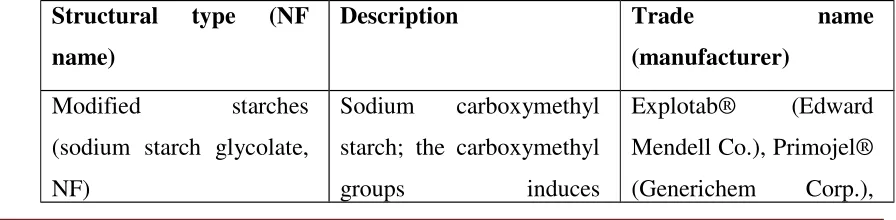
Table No 1: Classification of superdisintegrants9
Structural type (NF name)
Description Trade name
(manufacturer)
Modified starches
(sodium starch glycolate,
NF)
Sodium carboxymethyl
starch; the carboxymethyl
groups induces
Explotab® (Edward
Mendell Co.), Primojel®
[image:25.595.82.530.664.774.2]hydrophilicity and cross
linking reduces solubility
Tablo® (Blanver,
Brazil)
Modified cellulose
(Croscarmellose,NF)
Sodium carboxy methyl
cellulose which has been
cross-linked to render the
material insoluble.
AcDiSol® (FMC Corp.),
Nymcel ZSX® (Nyma,
Nertherlands),
Primellose® (Avebe,
Netherlands) Solutab®
(Blanver,Brazil)
Cross-linked
poly-vinylpyrrolidone
(Crospovidone,NF)
Cross-linked
polyvinylpyrrolidone; the
high molecular weight and
cross-linking render the
material insoluble in
water.
Crospovidone M®
(BASF Corp.), Kollidon
CL® (BASE Corp.),
Polyplasdone XL (ISP
Corp.)
Three major types of compounds have been developed which swell to many times their
original size when placed in water while providing minimal viscosity effects.
1. Modified starches – Sodium Carboxymethyl (Chemically treated Potato Starch) starch i.e. Sodium Glycolate (Explotab, Primogel)
Mechanism of action: Rapid and extensive swelling with minimum gelling.
Effective Concentration: 4-6%. Above 8% disintegration times may actually increase due to gelling and its subsequent viscosity providing effects.
2. Cross-linked polyvinylpyrrolidone - water insoluble and strongly hydrophilic i.e., Crospovidone (Polyplasdone XL, Kollidon CL)
Mechanism of action: swelling, water wicking and possibly some deformation recovery. Effective Concentration: 2-4%
3. Modified Cellulose – cross-linked form of Sodium carboxymethyl cellulose internally. i.e., Ac-Di-Sol (Accelerates Dissolution), Nymcel
Mechanism of action: wicking because of fibrous structure, swelling with minimum gelling.
Effective Concentration: 1-3% (Direct Compression), 2-4% (Wet Granulation)
Advantages:
More effective intragranularly.
Disadvantages:
More hygroscopic (may be problem with moisture sensitive drugs)
Some are anionic and may cause slight in vitro binding with cationic drugs (not a problem in vivo)
Excipients used in the formulation of chewable tablets6,10
:
Excipients are inert (unreactive) substances used as diluents or vehicles for a drug. In the
pharmaceutical industry it is a catch all term which various sub-groups comprising diluents
or fillers, binders or adhesives, disintegrants, lubricants, glidants, flavors, colors and
sweeteners. All of these must meet certain criteria as follows: They must be physiologically inert
They must be acceptable to regulatory agencies They must be physiologically and chemically stable.
They must be free of any bacteria considered to be pathogenic or otherwise objectionable.
They must not interface with the bioavailability of the drug.
They must be commercially available in the form and purity commensurate to pharmaceutical standards.
Cost must be relatively inexpensive.
They must conform to all regulatory requirements.
To assure that no excipient interferences with the utilization of the drug, the formulator must
carefully and critically evaluate combinations of the drug with each of the contemplated
excipients and must have certain compliance of each ingredient with existing standards and
regulations.
The screening of drug-excipient and excipient-excipient interactions should be carried out
routinely in pre formulation studies.
Table No 2: List of excipients used in the formulation of chewable tablets
Excipients Functions Examples
Diluents Diluents are fillers used to make
required bulk of tablet
Lactose, Microcrystalline
cellulose, Mannitol etc. Binders Binders are used to impart
cohesive qualities to powdered
materials.
Gelatin, Glucose, Acacia, ethyl
cellulose, hydroxypropyl
methyl cellulose etc. Superdisintegrants They facilitate tablet breaking
when it comes in contact with
water in oral cavity/GIT
Croscarmellose sodium,
Crospovidone, Sodium starch
glycolate, Starch etc.
Lubricants These are added to prevent
adhesion of tablet material to
surface of dies and punches
reduces inter particulate friction.
Magnesium sterate, Talc,
Paraffin, sodium lauryl sodium,
etc.
Glidants These are added to improve flow
characteristics of powder mixture.
Glidant minimize the friction
between particles.
Colloidal Silicon dioxide
(Aerosil), Corn starch, Talc etc.
Sweeteners These are added to produce a
palatable dosage form.
Sucrose, Saccharin, Aspartame,
etc. Flavours These are added to improve taste
of dosage form
Peppermint, Vanilla, Orange,
Cinnamon, Mango, Cherry etc. Colours These are added for better
appearance of dosage form
Sunset yellow (Supra),Ferric
oxide.
Packaging of chewable tablets:
Some of the chewable tablets are stable during storage, e.g. for 18 months or even 24
months in conventional packaging and these type of dosage forms are stored in HDPE
Some examples of chewable tablets 6
: Acetaminophen chewable tablets Common antacid chewable tablets Children,
s buffered aspirin chewable tablets. Chewable multivitamin tablets.
Vitamin
c
chewable tablets.ASTHMA
11, 12:
Asthma is a chronic inflammatory disorder of the airways in which many cells and cellular
elements play a role: in particular, mast cells, eosinophils, T lymphocytes, macrophages,
neutrophils, and epithelial cells. In susceptible individuals, this inflammation causes
recurrent episodes of wheezing, breathlessness, chest tightness, and coughing, particularly at
night or in the early morning. These episodes are usually associated with widespread but
variable airflow obstruction that is often reversible either spontaneously or with treatment.
The inflammation also causes an associated increase in the existing bronchial
hyperresponsiveness to a variety of stimuli.
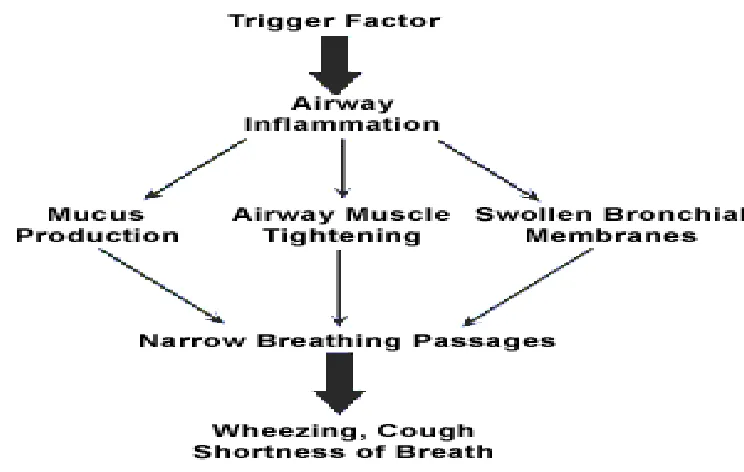
Airflow obstruction (excessive airway narrowing) in asthma result in the contraction of the
airway smooth muscle and swelling of the airway wall due to:
• Smooth muscle hypertrophy and hyperplasia
• Inflammatory cell infiltration
• Oedema
• Goblet cell and mucous gland hyperplasia
• Mucus hypersecretion
• Protein deposition including collagen
• Epithelial desquamation.
This inflammatory process can cause the permanent changes in the airways. Long-term
changes include:
Increased smooth muscle.
Increase in bronchial blood vessels.
Thickening of collagen layers.
Fig No 3: Air flow obstruction in asthma
Types of Asthma13
• Extrinsic asthma
• Intrinsic asthma
• Mixed asthma
• Cough variant asthma:
• Nocturnal asthma
• Gastro-esophageal asthma
Extrinsic asthma:
Extrinsic asthma is also known as atopic asthma or allergic asthma. It is the most common
form of asthma in all age group. It usually affects young age group.
People with allergic asthma and their family members frequently have other allergy related
problems such as fever, skin rashes, hives, eczema, and rhinitis.
The intrinsic asthma is not related with the allergies. In fact it is caused by inhalation of
certain chemical such as cigarette smoke, fumes of motor vehicles and factories, strong
odours, intake of certain medicines like aspirin; chest infections, stress, laughter, exercise,
cold air, food preservatives like azinomoto or a myriad of other factors.
Antibodies are not produced by the body and the cause of developing intrinsic asthma may
be the irritation of the nerves or muscle in the airway.
Mixed asthma:
It is mixture of allergic asthma and intrinsic asthma. These people react to some allergies
but their asthma is also triggered by other things also. For example symptoms are aggravated
in an asthmatic while facing the chest infection
Cough variant asthma:
Cough may be the sole manifestation of asthma or a distressing symptom. Although chronic
cough can be a sign of many health problems, it may be the principal or only manifestation
of asthma, especially in young children.
Nocturnal asthma:
Nocturnal asthma is defined as an overnight fall of more than 20% in the FEV1 or PEFR.
This night time propensity is due to a number of reasons:
• Exposure to dust mite, animal dander.
• Gastro-esophageal reflux.
• Post nasal drip.
• Decreased cortisol level.
• Increased parasympathetic activity.
• Increased level of histamine.
• Increased sensitivity to histamine.
• Early morning fall in circulating adrenaline.
• Overnight changes in vagal tone.
Gastro-esophageal asthma:
Asthma may be caused or worsened by to gastro-esophageal reflux. The symptoms of
GERD are common in both children and adults who have asthma. Medical management of
GERD includes:
• Avoiding heavy meals, fried food, caffeine, and alcohol.
• Avoiding food and drink within 3 hours of retiring.
• Elevating the head of the bed on 6- to 8-inch blocks.
• Using appropriate pharmacologic therapy.
Exercise Induced Asthma:
Exercise induced asthmaonly refers to asthma that occurs only with exercise.
Before exercise pulmonary functions tends to be normal, but within 5 to 10 minutes of
exercise they tend to fall. Pulmonary functions comes back to normal after rest but some
times tend to remain low for a longer time.
DRUGS USED IN ASTHMA14, 15
:
Basic pharmacology of agents used in treatment of asthma
The drugs most used for management of asthma are adrenoceptor agonist or sympathomemetic agents (used as relievers or bronchodilators) and inhaled corticosteroids
(used as controllers or anti-inflammatory agent)
Sympathomemetic agents relax airway smooth muscles and inhibit release of
bronchoconstricting mediators from mast cells. They may also inhibit microvascular leakage
and increase mucociliary transport by increasing ciliary activity. Sympathomimetic agents
are Epinephrine, Ephedrine, Isoproterenol and Albuterol as they increase the rate and force
of cardiac contraction.
BETA2 SELECTIVE DRUGS:
The β2- selective aderenoceptor agonist drugs are the most widely used
sympathomimetic for the treatment of asthma. They are effective after inhaled or oral
administration and have a long duration of action. Some of the drugs are Albuterol,
Terbutaline, Metaproterenol and Pirbuterol.
A new generation of long lasting β2 selective agonist include Salmeterol and Formoterol.
METHYLAXANTHINE DRUGS:
The three important methylxanthines are Theophyline, Theobromine and Caffeine.
Theophylline is most effective bronchodilator and relieves airflow obstruction in acute
asthma and reduces the severity of symptoms.
CORTICOSTEROIDS:
They have been used to treat asthma by their broad anti-inflammatory cytokenins. They
reduce bronchial reactivity and reduce the frequency of asthma exacerbation.
Examples-Beclomethasone, Buderonide, Fluticasone, Mometasone and Triamcinolone.
LEUKOTRIENE PATHWAY INHIBITORS:
Leukotriene results from the action of 5-lipoxygenase on arachidonic acid and are
synthesized by a variety of inflammatory cells in the airways including eosinophils, mast
cells, macrophages and basophils. Leukotriene B4(LTB4) is a potent neutrophil chemo
attractant. Examples-Zileuton, Ziafirlukast and Montelukast
The principal advantage is that they are taken orally. Some patients-especially children
LITERATURE REVIEW
• Janugade B.U et.al.,16 designed an oral press-coated tablet was prepared by using direct
compression and wet granulation methods to achieve the predetermined lag time. The tablet
contained Montelukast sodium in the inner core was formulated with an outer barrier layer by
different compositions of hydrophobic polymer ethylcellulose and hydrophilic polymer
low-substituted hydroxypropylcellulose in different concentrations. From lag time it was observed
that lag time decreases with increasing concentration of low-substituted
hydroxypropylcellulose.The tablets coated by wet granulation method gives less lag time as
compared to dry mixing blend method.
• Ajay et.al.,17 formulated a mouth dissolving tablets of Montelukast sodium by direct
compression method using superdisintegrants such as croscarmellose sodium and
crospovidone. The compatibility of the drug in the formulations was confirmed by IR studies.
The formulations were subjected to precompression and postcompression parameters and the
results were found to be within acceptable limits. The formulated tablets disintegrated in less
than 26.33sec fulfilling the official requirements for dispersible tablets. The rapid drug
release was observed in the formulations containing croscarmellose sodium. Finally, it can be
concluded that mouth dissolving tablets of Montelukast sodium can be prepared by direct
compression method using croscarmellose sodium as superdisintegrant.
• Surender et.al.,18 Formulated and evaluated colonic pulsatile release matrix tablets of
Montelukast sodium. It was formulated by wet granulation method using different
combinations of HPMC K4M and K15M with varying amount of croscarmellose sodium,
formulation was evaluated for in vitro tests such as hardness, friability, weight variation,
disintegration and dissolution. The formulation was evaluated for drug release mechanism by
applying Zero, First, Higuchi and Peppas kinetic models and selection was based on that of
linearity. Dissolution data revealed that formulations having HPMC K4M : K15M in ratio of
20: 0 along with croscarmellose sodium at a level of 2.4% given a release rate of more than
85% in 12h of duration. Drug release data fits well to zero order kinetics and mechanism of
drug release was found to be combination of swelling and erosion.
• Ajay Patil et.al.,19 developed fast dissolving films of Montelukast sodium by using
microcrystalline cellulose as superdisintegrant and crospovidine as plasticizer. Result showed
that formulation F2 and F5 with 4% crospovidine and 10% microcrystalline cellulose gives a
better dissolution profile at the end of 30 minutes.
• N.G Raghavendra et.al.,20 performed a study to improve the improve the bioavailability and
efficacy by designing tablets-filled-capsule system. System comprise of different doses of
immediate release tablets (IRT) and sustained release tablets (SRT) contained in a HPMC
capsule. The drug-loaded core tablets were produced by wet granulation technique using
alcoholic solution of PVP K-30 as a binder. All the pre and post-compression parameter
were evaluated. From this, study it was concluded that, tablets-filled-capsule systems
containing Montelukast sodium showed both sustained release as well as immediate release
may improve the bioavailability and efficacy.
• Ahmed B.Eldin et.al.,21 developed and evaluated a simple, sensitive and accurate stability
indicating analytical method for Montelukast. The chromatogram was performed with the
mobile phase containing a mixture of acetonitrile and 0.01M potassium dihydrogen
phosphate. Validation was done for linearity, accuracy and precision and showed that method
is useful for routine quality control analysis and stability testing.
• Khan et.al.,22 evaluated the process for preparing a chewable tablet of loratidine comprising a
micronized form of an active ingredient, by combining the active ingredient with excipients
by geometric dilution to form a final mixture and applying direct compression at least a
portion of the final mixture to form at least one tablet.
• Shaik et.al.,23 assessed the efficacy of Mebendazole in treatment of worm infestations in both
humans and animals. The chewable tablets of Mebendazole were prepared by using
From the disintegration studies, it was observed that the formulation containing lactose shows
less disintegration time than formulation containing mannitol.
• Rao N.G et.al.,24 formulated the buccal patches Montelukast sodium used in treatment of
chronic asthma attacks. The buccal patches were prepared by using hydrophilic and
hydrophobic polymers. The evaluation were characterized for number of parameters like
physical appearance and surface texture, weight uniformity, thickness, folding endurance,
swelling index, surface pH, drug content uniformity, in vitro residence time, bursting
strength, drug–excipients interaction study, and in vitro drug release study.In-vitro
dissolution was studied and was observed that patches followed zero-order and mechanism
was diffusion rate limited and founded drug release in the range of 68.83 - 92.22 % in 8 hrs.
• Swati Jagdale et.al.,25 evaluated chewable tablet of levamisole which is used in the treatment
of worm infestations. As an anthelmintic, it probably works by targeting the nematode
nicotinergics acetylcholine receptor. The chewable tablets of levamisole were prepared by
using lactose or mannitol along with sodium starch glycolate in concentration ratios
especially for paediatric use. Sodium saccharin and vanilla were used as sweetening agent
and flavouring agent respectively. It was observed that the formulation containing lactose
shows less disintegration time than formulation containing mannitol.
• Kathiresan K et.al.,26 formulated and evaluated 5 batches of loratadine chewable tablets.
Loratadine, which is histamine H1 receptor antagonist used in the treatment of allergic
rhinitis and urticaria. Results showed that thickness, weight variation, friability, hardness,
and content uniformity of all 5 formulations were within the acceptance limits. But in the in-vitro dissolution study, formulations 1, 2, and 5 demonstrated better cumulative drug release
than formulations 3 and 4. However, cumulative drug release of formulation 5 was
comparable with innovator than formulations 1 and 2. Hence the study concludes that
loratadine chewable tablet formulated using avicel CE 15 and starch paste showed better
• Bharat et.al.,27 performed a prospective study of Albendazole which is a benzimidazole
derivative with broad spectrum anthelmenthic activity and excellent tolerability. Orally it is
rapidly absorbed and metabolized to sulfoxide and sulfone, which may be responsible for its
anthelmenthic action. Albendazole chewable tablets (400 mg) were prepared by three
methods viz. non aqueous granulation, aqueous granulation and direct compression. Tablet
prepared by these three methods were evaluated by the different parameters such as Average
weight, Hardness, Carr’s index, Tapped density, Friability, Disintegration, Water content, In vitro dissolution etc. All the parameters were found within the specifications. The study on
the dissolution profile revealed that the product by ‘Direct Compression’ had faster
dissolution rate while compared to remaining batches and marketed product and the assay
AIM AND OBJECTIVE OF WORK
Aim:
Montelukast sodium is used in the treatment of asthma. The usual dose is 4mg, 5mg and 10mg
to children and adults. Now the present aim is to formulation and development of chewable
tablets using different concentration of disintegrants to improve the onset of action and the
bioavailability in the treatment of asthma.
Objectives
:
I. To find out suitable concentration of disintegrant for the formulation of Montelukast
sodium chewable tablets.
II. To evaluate the pre-compression parameters such as bulk density, tap density
compressibility index and hausner’s ratio.
III. To evaluate the post compression parameters such as physical appearance, hardness,
thickness, average weight, friability, disintegration time and assay.
IV. To perform In vitro dissolution studies and compare with that of innovator product.
V. To perform the stability study under the accelerated condition.
PLAN OF WORK
The study was planned to carry out as follows,
1. Preparation of mixed blend of drug and excipients by using superdisintegrant
Croscarmellose sodium in the concentration of 1% to 4% by direct compression and
wet granulation technique.
2. Checking Drug and Excipient compatibility by FTIR Studies 3. Pre compression studies, like
a. Angle of repose
b. Bulk density
c. Tapped density
d. Compressibility index
e. Hausner’s ratio
4. Preparation of chewable tablets.
5. Evaluation of prepared tablets
a. Appearance
b. Weight variation test c. Hardness
d. Thickness e. Friability f. Disintegration g. Water content h. Assay
DRUG PROFILE
MONTELUKAST SODIUM 28
Category : Antiasthmatic
Molecular formula : C35H35ClNNaO3S
Molecular weight : 608.17
Structural formula :
N
Cl
.
HO
COO
-Na
+S
Chemical name: 2-[1-[1(R)-[3-[2(E)-(7-Chloroquinolin- 2-yl) vinyl] phenyl]-3-[2-hydroxy-1- methylethyl) phenyl] propylsulfanylmethyl] cyclopropyl] acetic acid sodium salt
Description: Off white to pale yellow coloured powder.
Solubility: Soluble in water, methanol and ethanol and practically insoluble in acetonitrile.
Mechanism of action29:
The cysteinyl leukotrienes (LTC4, LTD4, LTE4) are products of arachidonic acid
metabolism and are released from various cells, including mast cells and eosinophils. These
eicosanoids bind to cysteinyl leukotriene (CysLT) receptors. The CysLT type-1 (CysLT1)
macrophages) and on other pro-inflammatory cells (including eosinophils and certain
myeloid stem cells). CysLTs have been correlated with the pathophysiology of asthma and
allergic rhinitis. In asthma, leukotriene-mediated effects include airway edema, smooth
muscle contraction, and altered cellular activity associated with the inflammatory process. In
allergic rhinitis, CysLTs are released from the nasal mucosa after allergen exposure during
both early- and late-phase reactions and are associated with symptoms of allergic rhinitis.
Intranasal challenge with CysLTs has been shown to increase nasal airway resistance and
symptoms of nasal obstruction. Montelukast is an orally active compound that binds with
high affinity and selectivity to the CysLT1 receptor (in preference to other pharmacologically
important airway receptors, such as the prostanoid, cholinergic, or β-adrenergic receptor).
Montelukast inhibits physiologic actions of LTD4 at the CysLT1 receptor without
any agonist activity.
Pharmacodynamics:
Montelukast causes inhibition of airway cysteinyl leukotriene receptors as demonstrated by
the ability to inhibit bronchoconstriction due to inhaled LTD4 in asthmatics. Doses as low as
5 mg cause substantial blockage of LTD4-induced bronchoconstriction. In a
placebo-controlled, crossover study (n=12), montelukast inhibited early- and late-phase
bronchoconstriction due to antigen challenge by 75% and 57%, respectively.
Pharmacokinetics:
Absorption:
Montelukast is rapidly absorbed following oral administration. Mean peak plasma
concentration (Cmax) is achieved 3 hours (Tmax) after administration in adults in the fasted
state. The mean oral bioavailability is 64%. The oral bioavailability and Cmax are not
influenced by a standard meal.
Montelukast is more than 99% bound to plasma proteins. The steady-state volume of
distribution of Montelukast averages 8 – 11 liters.
Metabolism:
Montelukast is extensively metabolized in liver by cytochrome P450 isoenzyme CYP3A4,
CYP2A6 and CYP2C9
Excretion:
The plasma clearance of montelukast averages 45 mL/min in healthy adults. Following an
oral dose of radiolabeled montelukast, 86% of the radioactivity was recovered in 5-day fecal
collections and <0.2% was recovered in urine. Coupled with estimates of montelukast oral
bioavailability, this indicates that montelukast and its metabolites are excreted almost
exclusively via the bile.
Dosage and administration:
The dosage for adults and adolescents 15 years of age and older is one 10-mg tablet.
The dosage for pediatric patients 6 to 14 years of age is one 5-mg chewable tablet.
The dosage for pediatric patients 2 to 5 years of age is one 4-mg chewable tablet or
one packet of 4-mg oral granules.
The dosage for pediatric patients 6 to 23 months of age is one packet of 4-mg oral granules.
Overdosage:
CONTRAINDICATIONS
Hypersensitivity to any component of this product
Status asthmaticus
Drug Interactions
Gemfibrozil: Montelukast plasma concentrations may be elevated, increasing the pharmacologic effects and risk of adverse reactions. Monitor the clinical response and
adjust the montelukast dose as needed.
Prednisone: Adverse effects of prednisone (Eg. edema) may be increased. Monitor the clinical response. If an interaction is suspected, consider discontinuing one or both
agents.
Strong CYP2C9 and CYP3A4 inducers (Eg, phenobarbital, rifampin): May decrease montelukast levels. Monitor the clinical response and adjust the montelukast
dose as needed.
Side effects:
Montelukast has manageable side effects such as given below:
Severe allergic reactions such as rash; hives; itching; difficulty breathing; tightness in the chest; swelling of the mouth, face, lips, or tongue; headache (18% to 20%) and
dizziness (2%).
Gastrointestinal: Gastrointestinal side effects have included abdominal pain, dyspepsia, or infectious gastroenteritis in up to 3% of patients. Diarrhea has been
associated with the use of higher than recommended doses
(28%) and worsened asthma (4% to 11%) were associated with the use of this drug.
However, many patients with asthma have some or all of these symptoms, and a
causal relationship has not been proven. Rhinorrhea, sinusitis, otitis, influenza,
epistaxis, and pneumonia have also been reported.
Ocular: Ocular side effects have included conjunctivitis.
Other: Other side effects have included isolated cases of Churg-Strauss syndrome, a rare systemic vasculitis associated with asthma.
PRECAUTIONS
It is not a fast-acting asthma medication and cannot replace fast-acting rescue
inhalers. Do not use montelukast to treat an asthma attack.
Some reports were studied that who were taking an oral steroid may be able to
decrease or stop this medication when starting montelukast.
Chewable montelukast tablets contain phenylalanine. This is important information
for people with phenylketonuria (PKU) is a rare condition in which a baby is born without the ability to properly break down an amino acid called phenylalanine.), who must limit their phenylalanine intake.
In some it can cause liver damage. So care should be taken while taking the
medication.
Patients with known aspirin sensitivity should be advised to continue avoidance of
aspirin or nonsteroidal anti-inflammatory agents while taking montelukast sodium
drug.
Storage/Stability
Store between 59° and 86°F. Protect from moisture and light.
Administration:
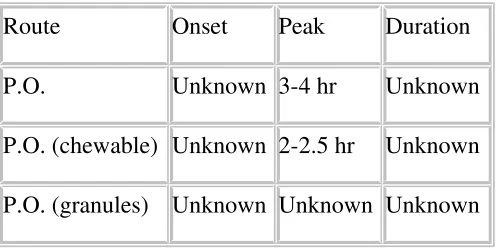
Table No 3: Route of administration
Route Onset Peak Duration
P.O. Unknown 3-4 hr Unknown
P.O. (chewable) Unknown 2-2.5 hr Unknown
P.O. (granules) Unknown Unknown Unknown
EXCIPIENT PROFILE
1.
MICROCRYSTALLINE CELLULOSE30Non-proprietary Names
BP: Microcrystalline cellulose
PhEur: Cellulose microcrystalline
Synonym: Cellulose gel, crystalline cellulose,E460, Emcocel, Fibrocel, Tablose, Vivacel.
Chemical Name : Cellulose
Empirical formula : (C6H10O5)n where n ≈ 220
Molecular weight : 36000
Melting Point : 260-270⁰C
Particle size: (MCC pH102) = 100 µ m
Description: MCC is purified, partially depolymerized cellulose that occur as a white, odorless, crystalline powder composes of porous particle. It is commercially available in
different particle size and moisture grades that have different properties and application.
Functional Category: Adsorbent, suspending agent, tablet and capsule diluent, tablet disintegrants.
Table No 4: Uses of Microcrystalline Cellulose
Use Concentration (%)
Adsorbent 20-90
Antiadherent 5-20
Capsule binder/ diluents 20-90
Tablet disintegrant 5-15
Tablet binder/ diluents 20-90
Stability and Storage: It is stable though hygroscopic material. The bulk material should be stored in well closed container in a cool and dry place.
Incompatibility: It is incompatible with strong oxidizing agent.
2.MANNITOL30
Nonproprietary Name:
BP: Mannitol
JP: D-Mannitol
PhEur: Mannitolum
USP: Mannitol
Synonyms: Cordycepic acid; E421; manna sugar; D-mannite; mannite; Mannogem;
Pearlitol
Chemical Name : D-Mannitol
Empirical Formula : C6H14O6
Molecular Weight : 182.17
Functional Category:Diluent, sweetening agent
Applications in Pharmaceutical Formulation or Technology:
Mannitol is widely used in pharmaceutical formulations and food products. In pharmaceutical
preparations it is primarily used as a diluent (10–90% w/w) in tablet formulations, where it is
of particular value since it is not hygroscopic and may thus be used with moisture-sensitive
active ingredients.
Mannitol may be used in direct-compression tablet applications, for which the granular and
spray-dried forms are available, or in wet granulations. Granulations containing mannitol
have the advantage of being dried easily. Specific tablet applications include antacid
preparations, glyceryl trinitrate tablets, and vitamin preparations.
Mannitol is commonly used as an excipient in the manufacture of chewable tablet
formulations because of its negative heat of solution, sweetness, and ‘mouth feel’.
Description:
Mannitol is D-mannitol. It is a hexahydric alcohol related to mannose and is isomeric with
sorbitol. Mannitol occurs as a white, odorless, crystalline powder, or free-flowing granules. It
has a sweet taste, approximately as sweet as glucose and half as sweet as sucrose, and imparts
a cooling sensation in the mouth.
3. CROSCARMELLOSE SODIUM30
BP: Croscarmellose sodium
PhEur: Carmellosum natricum conexum
USPNF: Croscarmellose sodium
Synonyms : Ac-Di-Sol; crosslinked carboxymethylcellulose sodium; Explocel; modified cellulose gum; Nymcel ZSX; Pharmacel XL; Primellose; Solutab; Vivasol.
Chemical Name : Cellulose, carboxymethyl ether, sodium salt, crosslinked
Functional Category : Tablet and capsule disintegrant.
Applications in Pharmaceutical Formulation or Technology
Croscarmellose sodium is used in oral pharmaceutical formulations as a disintegrant for
capsules, tablets, and granules.
In tablet formulations, croscarmellose sodium may be used in both direct-compression and
wet-granulation processes. When used in wet granulations, the croscarmellose sodium should
be added in both the wet and dry stages of the process (intra- and extragranularly) so