Copyright © 1997, American Society for Microbiology
Activation of Transgene Expression by Early Region 4 Is
Responsible for a High Level of Persistent Transgene
Expression from Adenovirus Vectors In Vivo
DOUGLAS E. BROUGH,* CHI HSU, VICTORIA A. KULESA, GAI M. LEE, LOUIS J. CANTOLUPO,
ALENA LIZONOVA,ANDIMRE KOVESDI
GenVec Inc., Rockville, Maryland 20852
Received 1 July 1997/Accepted 2 September 1997
The persistence of transgene expression has become a hallmark for adenovirus vector evaluation in vivo. Although not all therapeutic benefit in gene therapy is reliant on long-term transgene expression, it is assumed that the treatment of chronic diseases will require significant persistence of expression. To understand the mechanisms involved in transgene persistence, a number of adenovirus vectors were evaluated in vivo in different strains of mice. Interestingly, the rate of vector genome clearance was not altered by the complete
deletion of early region 4 (E4) in our vectors. The GV11 (E12E42) vector genome cleared with a similar kinetic
profile as the GV10 (E12) vector genome in immunocompetent and immunocompromised mice. These results
suggest that the majority of adenovirus vector genomes are eliminated from transduced tissue via a mecha-nism(s) independent of T-cell, B-cell, and NK cell immune mechanisms. While the levels of persistence of
transgene expression in liver or lung transduced with GV10 and GV11 vectors expressing b-galactosidase,
cystic fibrosis transmembrane conductance regulator, or secretory alkaline phosphatase were similar in immunocompetent mice, a marked difference was observed in immunocompromised animals. Levels of trans-gene expression initially from both GV10 and GV11 vectors were the same. However, GV11 transtrans-gene expres-sion correlated with loss of vector genome, while GV10 transgene expresexpres-sion persisted at a high level. Coadministration and readministration of GV10 vectors showed that E4 provided in trans could activate transgene expression from the GV11 vector genome. While transgene expression activity per genome from the GV10 vector is clearly activated, expression from a cytomegalovirus promoter expression cassette in a GV11 vector appeared to be further inactivated as a function of time. Understanding the molecular mechanisms underlying these expression effects will be important for developing persistent adenovirus vectors for chronic applications.
Adenovirus vectors provide an effective means to introduce new genes into cells. However, the initial robust expression of the newly introduced gene is transient (8). While persistent gene expression is not essential for all therapeutic uses of adenovirus vectors, it will be crucial for the treatment of chronic diseases. Therefore, a significant hallmark for vector evaluation is the chronicity of transgene expression in vivo.
Several different factors appear to effect transgene expres-sion persistence in vivo. The current model for lack of persis-tence with adenovirus vectors is thought to be similar to the host response to wild-type virus infection. In wild-type infec-tions, viral proteins are presented to the immune system, and over a period of several days to weeks, the cells expressing the viral antigens are recognized and eliminated. Several reported studies evaluating adenovirus vectors are consistent with this model and demonstrate persistent transgene expression in the absence of antigen-specific immunity (2, 9, 23, 25–27, 31, 32, 45, 51–60, 62). These results have suggested that the immuno-logical response leading to the rapid loss of transgene expres-sion most likely stems from expresexpres-sion of the transgene and production of viral antigens from the vector genome.
These immunological responses have been uncovered by using adenovirus vectors deleted in early region 1 (E1) and/or early region 3 (E3). To further reduce or completely eliminate
the production of viral antigens, additional genome modifica-tions have been constructed and tested. The extent to which these alterations and deletions affect immune system-related clearance mechanisms is not completely clear. The results from analyzing vectors with modifications that introduce only a small alteration in the E2A gene (13–15, 54, 55, 61) or from vectors that delete all or most of adenovirus genes (7, 30, 33) have been contradictory regarding transgene persistence in vivo. In addition, vector modifications that delete E1 and E4 have also shown contradictory results in regard to transgene persistence in vivo (1, 10, 16, 24). Taken together, these studies suggest that in vivo transgene persistence is a problem more complicated than initially suspected.
The deletion of E4 is especially important to the ultimate design of safe adenovirus vectors. Removal of the E4 region severely disrupts viral gene expression in transduced cells and eliminates several viral products that interact and antagonize cellular targets and processes. One of these E4 products, E4-ORF6, has been shown to block p53 function and to have oncogenic potential (11, 36). A similar cellular transforming or oncogenic function has also been linked to E4-ORF1 (19–22, 46–48). E4-ORF6 and E4-ORF3 have also been shown to be involved in altering mRNA expression at a posttranscriptional level (39–44). In addition, E4 products are involved in control-ling the cellular transcription factor E2F (38), in E1A-induced p53-independent apoptosis (34), in modulating the phosphor-ylation status of cellular and viral proteins (28, 35) and have recently been shown to alter the nuclear transport of other proteins (17).
* Corresponding author. Mailing address: GenVec Inc., 12111 Parklawn Dr., Rockville, MD 20852. Phone: (301) 816-5540. Fax: (301) 816-0440. E-mail: [email protected].
9206
on November 9, 2019 by guest
http://jvi.asm.org/
The negative effects of expressing E4 region genes as well as viral late proteins have been eliminated in our E12E42
(GV11) series of vectors (4). Therefore, we compared ge-nomes and transgene persistence profiles of the GV11 vector and of similar vectors containing wild-type E4 (GV10). The levels of persistence of GV11 vector genomes and transgene expression were similar to those for GV10 in immunocompe-tent animals. Similar vector genome persistence profiles were also seen in immunocompromised animals. However, the transgene expression profile for GV11 vectors was significantly altered in GV11 vector-transduced immunocompromised mouse lung and liver. These results suggest that adenovirus vector genomes are eliminated from transduced tissue via a mechanism independent of the well-described vector clearance models. Moreover, these analyses suggest that E4 products play a key role in the maintenance of transgene persistence in immunodeficient mice.
MATERIALS AND METHODS
Animal studies.All animal studies were carried out in accordance with the institutional guidelines of the Biomedical Research Institute and GenVec Inc., Rockville, Md. BALB/c, BALB/c nude, NCR nude, Swiss nude, and SCID/beige mice were purchased from Jackson Laboratories (Bar Harbor, Maine) or Tac-onic (Germantown, N.Y.), were mostly females, were approximately 6 to 8 weeks old at the time of initial vector administration, and were housed in a pathogen-free environment.
Adenovirus vectors and animal administration.Several different matched sets of adenovirus vectors were evaluated. Matched sets of vector stocks were used in this evaluation to ensure that the results obtained were due to deleting E4, not to differences in activity or the physical level of vector in each experiment. A matched set of vectors was defined as a GV10 (E12) vector and a GV11
(E12E42) vector that contained identical transgene expression cassettes, elicited
similar dose-response curves in tissue culture for transgene expression, and had similar active-to-inactive particle ratios as determined by focus-forming unit assay and optical density reading at 260 nm, respectively.
The construction, production, and quantification of GV10 and GV11 vectors have been described previously (4). Vectors containing a Rous sarcoma virus (RSV) expression cassette in the E1 region that expressed b-galactosidase (AdRSVbgal.10 and AdRSVbgal.11) were evaluated. AdRSVbgal.11 contains a complete deletion of E4 as described elsewhere (4). Vectors containing a cyto-megalovirus (CMV) expression cassette in the E1 region that expressedb -galactosidase (AdLacZ.10 and AdLacZ.11A) or that expressed secretory alkaline phosphatase (SEAP) (AdSEAP.10 and AdSEAP.11A) were also evaluated. AdLacZ.11A and AdSEAP.11A contain a genome structure similar to that of the previously described AdCFTR.11A (4). These vectors contain a complete dele-tion of E4 and the described E4 spacer for optimum producdele-tion (4).
For all animal studies, vector stocks were purified through three sequential bandings on cesium chloride gradients. The purified capsids were dialyzed into 10 mM Tris (pH 7.8)–150 mM NaCl–10 mM MgCl2–3% sucrose storage buffer,
aliquoted, and stored at280°C.
Prior to administration, vectors were prepared to the indicated dose by ap-propriate dilution with storage buffer. In all cases, vehicle represents this storage buffer with no adenovirus vector added. Vectors were administered intranasally for delivery to lung and intravenously (via tail vein) for delivery to liver. Animals were anesthetized with an intramuscular injection of anesthetic (Ketaset and Xylazine; Butler, Columbus, Ohio) prior to administration of a 75- to 100-ml total volume of vector.
Molecular analyses of tissue and serum.At the indicated time postadminis-tration, a terminal dose of anesthetic was administered. The target tissue was then removed and washed in phosphate-buffered saline. The tissue was either flash frozen in liquid nitrogen and stored at280°C for molecular analyses or prepared for histological analysis. Frozen tissue was pulverized with a mortar and pestle on dry ice, aliquoted into tubes, and stored at280°C prior to extraction. Total DNA was extracted by a modified proteinase technique (29). After restriction with KpnI, viral DNA was detected by Southern blot analysis. A probe homologous to the adenovirus polymerase gene contained within the internal E2B region of adenovirus was used for optimized detection of vector DNA. Single-copy levels of detection were obtained by using the Southern protocols recommended for the Zeta-Probe GT membrane (Bio-Rad Laboratories, Her-cules, Calif.). Total RNA was extracted with RNAzol or Ultraspec (Biotecx Laboratories, Houston, Tex.), and Northern analysis was performed (Zeta-Probe) with the indicated random-primed DNA probe (Stratagene, La Jolla, Calif.) specific for the RNA species noted.
Total protein was extracted in 13reporter lysis buffer (Promega, Madison, Wis.) with the addition of 0.15 U of aprotinin per ml, 20mM leupeptin, and 100
mg of phenylmethylsulfonyl fluoride per ml. Total protein content was deter-mined with the Bio-Rad protein assay.b-Galactosidase activity was measured by
chemiluminescence with Galacto-Light (Tropix, Bedford, Mass.).b -Galactosi-dase activity is expressed as relative light units per micrograms of protein.
b-Galactosidase was detected histologically by washing the tissue extensively (six or more times) in phosphate-buffered saline, slicing the tissue to allow reagent access, staining with HistoMark 5-bromo-4-chloro-3-indolyl-b-D -galactopyrano-side (X-Gal) substrate set (Kirkegaard & Perry Laboratories, Gaithersburg, Md.), and fixing the tissue in Parafix (Molecular Histology Labs, Gaithersburg, Md.). The stained tissue was observed and photographed on a Nikon dissection scope.
For detection of SEAP in the serum, the animals were administered a light dose of anesthetic intramuscularly at the indicated time, and blood was collected via the ocular sinus. Serum was prepared, aliquoted, and stored at280°C. SEAP expression levels were detected by chemiluminescence using Phospha-Light (Tropix). SEAP activity is expressed as nanograms of SEAP per milliliter of serum.
RESULTS
Vector persistence in immunocompetent mice.Viral protein
expression is greatly reduced and viral replication potential is eliminated in cells transduced with the GV11 (E12E42) series
of vectors compared to GV10 (E12) (3a, 4). Therefore, we
thought that the GV11 vector would exhibit significantly longer transgene persistence in vivo, given its reduced immunogenic load.
The impact of complete E4 deletion in our GV11 adenovirus vectors was first tested in BALB/c mice following intranasal administration of matched GV10 and GV11 vector stocks. The first matched stocks of vectors expressedb-galactosidase from an RSV expression cassette contained within the E1 region of the vectors (AdRSVbgal.10 and AdRSVbgal.11). These anal-yses showed no difference between the two vector backbones in immunocompetent animals in vivo. Similar GV10 and GV11 vector genome clearance profiles were observed (Fig. 1). At 2 days postadministration, approximately 30 to 40% of the input GV10 or GV11 vector genomes were detected. Within 9 to 14 days postadministration, the level of vector genomes was re-FIG. 1. Vector genome persistence in lung tissue of immunocompetent mice. BALB/c mice were administered 1011 total particles of AdRSVbgal.10 or
AdRSVbgal.11 intranasally. At the indicated times postadministration, mice were sacrificed from each group. Total DNA was extracted from tissue and the level of viral DNA detected by Southern blot analysis. V, negative control animals that were administered only vehicle, no vector.
on November 9, 2019 by guest
http://jvi.asm.org/
duced to only;1% of that administered. The kinetics of clear-ance and 30-fold reduction in vector DNA between 2 days and 2 weeks postadministration was also seen with vectors express-ingb-galactosidase from a CMV expression cassette, human cystic fibrosis transmembrane conductance regulator from a CMV expression cassette and SEAP from a CMV expression cassette.
The level and persistence of transgene expression followed similar patterns for both GV10 and GV11 vectors in immuno-competent mice. As shown in Fig. 2, the levels of transduction were identical for the two vector genomes at 2 days postad-ministration. However, within 2 weeks postadministration, transgene expression was reduced at least 30-fold. Interest-ingly, a low level of vector DNA (;0.5 to 1% of input) was found to persist in the BALB/c lung throughout the time course of these experiments (4 to 6 weeks). A low level of transgene expression was also observed by quantitative reverse transcription-PCR (data not shown). The mechanism underly-ing low-level persistent vector genome and transgene expres-sion is currently under investigation. In addition, similar GV10 and GV11 vector DNA and transgene expression persistence profiles were seen after intravascular administration to the liver and in a number of other immunocompetent strains of mice (data not shown). Taken together, these results suggest that clearance of vector genomes and transgene expression in lung or liver tissue of immunocompetent mice was not changed by deletion of the E4 region.
Vector persistence in immunodeficient mice.Transgene
per-sistence can be influenced by several immunological factors in vivo. Some of these immune responses have been shown to result from expression of the transgene and production of viral antigens from the vector genome. To remove these variables, persistence profiles for GV10 and GV11 vectors were evalu-ated in immunodeficient mice. Figure 3 shows AdRSVbgal.10 and AdRSVbgal.11 vector genome persistence profiles in Swiss nude mice after intranasal administration to the lung. Similar genome clearance profiles were seen with these vectors as well as all other GV10 and GV11 vectors evaluated. At 2 days postadministration, 40 to 50% of the input particles could be accounted for, and within 14 days postadministration, a 5-to 10-fold reduction in vec5-tor DNA was detected. By 35 days postadministration, only 2 to 5% of input genomes remained. These results show that vector genomes are cleared in the
immunodeficient mouse lung. Moreover, removal of the E4 region from the vector had no effect on vector DNA persis-tence. Compared to the results for immunocompetent mice, these results confirm that a T-cell-mediated response is in-volved in vector genome clearance. However, this type of im-mune mechanism appears to account for clearance of only a small part of the total particles administered to the lung. From these evaluations, it is apparent that larger portions of vector genomes are removed from the transduced tissue by alterna-tive mechanisms. In addition, similar results comparing GV10 and GV11 vector genome persistence profiles were obtained after intravascular administration to the liver (data not shown). However, in these experiments the level of vector genome at 2 days postadministration was;10-fold lower than that seen in the lung. These findings are consistent with those of Crystal and investigators (49, 50), who suggested that an innate clear-ance mechanism was responsible for substantial elimination of vector genomes and that this mechanism was more pro-nounced in the liver than in the lung.
While genome persistence profiles appeared to be similar for both GV10 and GV11 vectors, transgene expression was considerably different. The levels ofb-galactosidase expression from AdRSVbgal.10 and AdRSVbgal.11 were similar at 2 days postinfection (Fig. 4). At 14 and 35 days postadministration, b-galactosidase expression remained at the 2-day level for AdRSVbgal.10. However, b-galactosidase in AdRSVbgal.11 transduced lung dropped to baseline levels at 14 days. Similar results were also obtained with E12and E12E42vectors (Ad-FIG. 2. Transgene expression in lung tissue of immunocompetent mice.
BALB/c mice were administered 1011 total particles of AdRSVbgal.10 or
AdRSVbgal.11 intranasally. At the indicated times postadministration, three mice were sacrificed from each group. Protein was extracted from tissue, and the level ofb-galactosidase expression was detected by chemiluminescence. Error bars indicate standard error of the mean. RLU, relative light units.
FIG. 3. Vector genome persistence in lung tissue of immunodeficient mice. NIH Swiss nude mice were administered 1011total particles of AdRSVbgal.10 or
AdRSVbgal.11 intranasally. At the indicated times postadministration, mice were sacrificed from each group. Total DNA was extracted from tissue, and the level of viral DNA was detected by Southern blot analysis. Lane V is as in Fig. 1.
FIG. 4. Transgene expression in lung tissue of immunodeficient mice. NIH Swiss nude mice were administered 1011total particles of AdRSVbgal.10 or
AdRSVbgal.11 intranasally. At the indicated times postadministration, three mice were sacrificed from each group. Protein was extracted from tissue, and the level ofb-galactosidase expression detected by chemiluminescence. Error bars indicate standard error of the mean. RLU, relative light units.
on November 9, 2019 by guest
http://jvi.asm.org/
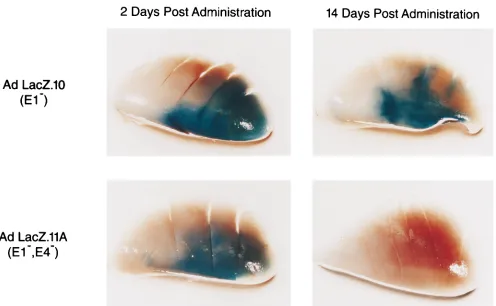
LacZ.10 and AdLacZ.11A) expressingb-galactosidase from a CMV immediate-early promoter expression cassette (Fig. 5). It is incongruous that vector genomes are actively cleared but expression remains constant. Therefore, the GV10 vector ge-nomes at 2 to 5 weeks postadministration somehow differ in the ability to express transgene compared to 2 days postadmin-istration. One possible explanation is that the high-level trans-gene persistence seen with E12 adenovirus vectors in nude
mice is due to E4-induced activation of transgene expression over time.
To explore this possibility and to test if the E4 activation was occurring at a transcriptional level, we compared RNA expres-sion of a polymerase III (PolIII) gene product from the vector
(VA RNA) to that of the PolII transgene expression cas-sette (LacZ). Total RNA was isolated from AdLacZ.10- and AdLacZ.11A-transduced lung tissue at 2 and 14 days postad-ministration, and Northern analysis was performed (Fig. 6). The levels of LacZ mRNA at 2 days postadministration were similar in AdLacZ.10- and AdLacZ.11A-transduced tissue, as suspected from theb-galactosidase activity determinations. At 14 days postadministration, LacZ mRNA levels not only were maintained in AdLacZ.10-transduced lung but were three- to fourfold higher than the 2-day level. As expected, the level of LacZ mRNA from AdLacZ.11A-transduced lung was below detection at 14 days postadministration. Interestingly, the lev-els of VA RNA were similar for GV10 and GV11 vectors and correlated with the levels of vector genome. Therefore, the transcriptional potential of the GV10 transgene expression cassette appears to be enhanced relative to the GV11 trans-gene expression cassette. These results imply that transcrip-tional activation of the transgene expression cassette appears to be critical for persistence from a GV10 vector.
Modulation of transgene expression in immunodeficient
mice.To further explore the implications of these results, the
level of transgene expression per genome was quantitated after intranasal administration of AdSEAP.10 and AdSEAP.11A in different immunodeficient strains of mice. AdSEAP.10 and AdSEAP.11A express a modified SEAP gene from a CMV promoter expression cassette (GenVec) (3). Vector DNA and SEAP levels were quantitated 2 and 21 days postadministra-tion, and the results are represented as relative transgene ex-pression per vector genome (Table 1). In this analysis, if the amount of transgene expression per vector genome is constant, FIG. 6. RNA expression in lung tissue of immunodeficient mice. NIH Swiss
mice were administered 1011total particles of AdLacZ.10 or AdLacZ.11A
[image:4.612.53.549.66.372.2]in-tranasally. At the indicated times postadministration, two mice were sacrificed from each group. Total RNA was extracted from tissue, 20mg of total RNA was loaded per lane, equal loading was confirmed by detection of ribosomal bands, and the level of message was detected by Northern analysis with DNA probes specific to either LacZ or VA RNA. Lane V is as in Fig. 1.
FIG. 5. Transgene expression in lung tissue of immunodeficient mice. NIH Swiss nude mice were administered 1011total particles of AdLacZ.10 or AdLacZ.11A
intranasally. At the indicated times postadministration, the mice were sacrificed and the presence ofb-galactosidase expression was detected by staining.
on November 9, 2019 by guest
http://jvi.asm.org/
the relative level of transgene expression per vector genome will remain the same over time.
In all mouse strains examined, the absolute amount of vector genome decreased over time for both GV10 and GV11. As expected, the level of transgene expression per GV10 genome increased;10-fold over time in all strains of nude mice. The level of transgene expression also increased (;4-fold) in C.B-17/GbmsTac-scid-bgfDF N7 (SCID/beige) mice. SCID/beige mice carry the SCID mutation, which causes a lack of both T and B lymphocytes; and also carry the beige mutation that results in cytotoxic T-cell defects, macrophage defects, and NK cell function impairment. Therefore, a mechanism(s) other than that involving these immune pathways appears to be in-volved in the majority of vector genome clearance from trans-duced tissue.
Interestingly, the relative level of transgene expression per AdSEAP.11A vector genome did not remain constant. Rela-tive transgene expression from the CMV-SEAP transgene was significantly lower (.8-fold) by 21 days postadministration. This result suggests that in addition to a significant loss of vector genome, the CMV expression cassette in a GV11 vector backbone is also inactivated.
E4 products transactivate gene expression.To further
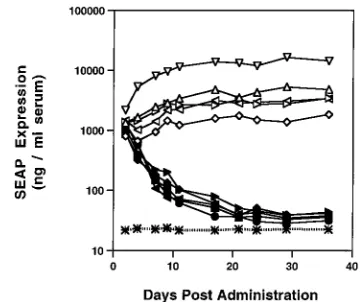
ex-plore the role of E4 products in transgene expression persis-tence in vivo, we compared our vectors in the liver. For these experiments, we chose SEAP as the transgene marker because of (i) ease of transgene expression detection and (ii) the ability to monitor transgene expression persistence in individual ani-mals. AdSEAP.10 or AdSEAP.11A was intravascularly admin-istered via tail vein to five NIH Swiss nude animals, and the level of SEAP expression in the serum of each animal was monitored for 1 month (Fig. 7). As expected, SEAP expression from AdSEAP.10 administered animals remained high for the duration of the experiment. The level of SEAP expression from AdSEAP.11A decreased steadily from the level at 2 days postadministration, reaching;5% of the level at 2 days post-administration after 3 to 4 weeks. The amount of viral DNA was equivalent for both vectors at all time points examined (data not shown). Therefore, the role that E4 plays in trans-gene persistence does not appear to be limited to the lung.
All of these results imply that E4 products activate transgene expression from adenovirus vector genomes. To test this model, NIH Swiss nude mice were coadministered AdSEAP.11A with AdLacZ.10. As seen in Fig. 8, the presence of E4 products in
trans provided from AdLacZ.10 genomes maintained high
SEAP expression levels from the AdSEAP.11A vector genome throughout the duration of the experiment (;5 months). Moreover, activation by E4 products was shown in
readminis-tration experiments where NIH Swiss nude mice were first administered AdSEAP.11A and then after 79 days readminis-tered AdLacZ.10 (Fig. 8). Taken together, these experiments clearly show that E4 products act in trans to activate transgene expression from adenovirus vector genomes. It is interesting that the reactivation of the GV11 genome is not immediate. After readministration, it takes several days to reach the high level of expression found with GV10 alone. A part of this slow accumulation may be due to the long half-life of SEAP in serum (10 to 20 h [3a]). In addition, GV10 transgene expres-sion appears to decrease over time. Whether this is due to normal cellular turnover and gradual loss of vector DNA or to a mechanism of inactivation similar to that seen with GV11 transgene expression has yet to be determined.
DISCUSSION
Studies with adenovirus vectors have shown that their severe limitation is in the persistence of transgene expression. This lack of persistence is probably due, at least in part, to activation of cellular immune responses by the expression of viral and transgene products leading to the ultimate death and clearance of the transduced cell. Vector modifications that reduce viral antigen presentation have been contradictory with regard to transgene persistence (1, 7, 10, 13–16, 24, 30, 33, 54, 55, 61). Our results suggest that an important variable in these studies may be the presence or absence of viral gene products (for example, from the E4 region) that modulate transgene persis-tence.
Our evaluation of E12and E12E42vectors has shown that
[image:5.612.335.515.69.220.2]only a small portion of the administered vector genome per-sists in vivo. Only 0.5 to 1% or 2 to 5% of the input particles persist in lung tissue of immunocompetent or immunodeficient mice, respectively. Therefore, even in an immunodeficient an-imal, at least 95% of the vector genomes are cleared. These results imply that the majority of vector genomes are cleared via a mechanism(s) independent of the well-described cyto-toxic response. Within the detection limitations of these exper-iments, this genome clearance appears to be independent of initial vector dose (3a), which suggests that this mechanism may be a natural process probably tied to normal viral removal.
TABLE 1. Relative transgene expression per vector genome in immunodeficient mice
Vector postadministrationTime
Relative SEAP expression/vector DNAa
NIH Swiss
nude BALB/cnude SCID/beige
AdSEAP.10 2 days 16 10 40
AdSEAP.10 3 wk 195 110 150
AdSEAP.11A 2 days 31 16 30
AdSEAP.11A 3 wk 0.1 2 0.6
aVector DNA was detected from 10mg of total DNA by Southern blot
analysis and quantitated with a Packard Instant Imager as counts per minute per band. At the indicated times postadministration, serum was collected, and SEAP expression was detected by chemiluminescence and quantitated as nanograms of SEAP per milliliter of serum.
FIG. 7. Comparison of GV10 and GV11 transgene persistence after IV ad-ministration in the nude mouse. NIH Swiss nude mice were administered 1011
total particles of AdSEAP.10 or AdSEAP.11A intravenously. At the indicated times postadministration, serum was collected and SEAP expression was de-tected by chemiluminescence. Open symbols represent animals that received AdSEAP.10; closed symbols represent animals that received AdSEAP.11A; cross-hatched symbol and dashed line represent an animal that received only vehicle (no vector) and denotes the baseline for this assay.
on November 9, 2019 by guest
http://jvi.asm.org/
Cells in tissue culture do not appear to exhibit this process since vector genomes can be maintained in transduced primary cells for extended periods of time without loss (3a).
Several models can be invoked to explain these results. Crys-tal and coinvestigators (49, 50) have recently suggested that innate immune mechanisms are involved in substantial clear-ance of vector and may account for at least a part of this dramatic effect. In addition, other models of viral clearance that do not kill the infected cell have been described (18). These noncytopathic processes are mediated through the ex-pression of effectors like gamma interferon and tumor necrosis factor. Recently Bruder and Kovesdi (5) have shown that bind-ing to cell surface receptors and internalization of vector par-ticles can activate expression of cell effectors that may be influencing this process of viral clearance.
In immunocompetent animals, we have detected that 0.5 to 1% of vector genomes can be retained and persist for extended periods of time. Therefore, persistent transgene expression is possible from these genomes. Understanding the nature and mechanisms involved in this genome persistence in immuno-competent animals will be critical for developing persistent-expression vectors for therapy of chronic diseases.
In immunodeficient animals, the 2 to 5% of vector genome that persists is not static in its ability to express transgene over time. This is best seen in the comparison of PolIII viral expres-sion (VA RNA) and the transgene expresexpres-sion cassettes driven by PolII in our vectors. While VA RNA expression appears to correlate with the level of vector genome, transgene expression from a GV10 genome does not. These studies show that the GV11 genome is not activated for transgene expression like the GV10 genome in the immunodeficient mouse.
An interesting question for future investigation is whether transgene expression cassette placement in different regions within the vector genome will alter its ability to be activated. It
is possible that these effects are dependent on how each ex-pression region is sublocalized within the transduced cell nu-cleus. Future analysis of vectors with modified transgene ex-pression cassette placement will help to uncover the dynamic changes that can occur to the viral chromatin and the trans-duced cell during and after transduction.
It can be deduced from these studies that the presence of E4 products provides an enhanced cellular environment for trans-gene expression. Several plausible models could explain how E4 products might be involved in this function. Various E4 gene products have been shown to alter cellular transcriptional potential, and the expression cassettes used in this study may be activated through one of these molecular mechanisms. E4-ORF4 does this by modifying the activity of protein phospha-tase 2A (28, 35). E4-ORF6/7 can complex with the cellular transcription factor E2F and alter expression profiles of a num-ber of cellular and viral genes (38). E4-ORF3 may be able to do this by reorganization of cellular or other viral factors within the nucleus (6, 12, 17). Given that several possibilities exist, the molecular basis of this activation mechanism must await the construction and evaluation of vectors that express only individual E4 products and vectors that utilize other pro-moters and expression cassettes. In this regard, it is interesting that vectors expressing only E4-ORF6 do not activate trans-gene expression from a transtrans-gene expression cassette using a CMV promoter (1, 3a).
[image:6.612.103.499.73.321.2]The E4 promoter is significantly reduced in activity in the absence of E1A (37), which implies that the E4 products provide a very potent function that may be more catalytic in nature than stoichiometric. Alternatively, the low level of E4 products produced in a transduced cell may start a cascade of events wherein multiple cellular and/or viral modifica-tions lead to the activation of the viral transgene expression cassette. Consistent with this model is the observation that FIG. 8. E4 products activate transgene expression in trans. Three animals per group of NIH Swiss nude mice were administered intravenously 1011total particles
of each vector: AdSEAP.10, AdSEAP.11A, or AdSEAP.11A plus AdLacZ.10 (AdSEAP.11A co). In addition, three mice were administered 1011total particles of
AdSEAP.11A at day 0 and then administered 1011total particles of AdLacZ.10 at 79 days postadministration (AdSEAP.11A re). At the indicated times
postadmin-istration, serum was collected, SEAP expression was detected by chemiluminescence, and the average was determined. Error bars indicate standard error of the mean.
on November 9, 2019 by guest
http://jvi.asm.org/
after readministration, it takes several days for transgene expression from the GV11 vector genome to reach the high level of expression found with GV10. While we have been studying the effects of E4 products on transgene and other viral expression cassettes, it is likely that these products also alter cellular gene expression. Therefore, these E4 products are extremely potent cell modulators and from the perspec-tive of a safer gene transfer vector would be best removed. However, reduced transgene persistence is traded for in-creased safety in this vector background. Only future eval-uation into these mechanisms will provide a vector to ac-complish both.
Transgene expression from the RSV and CMV promoter expression cassettes used in these studies is effected by the presence of E4 products. It is clear from this study that the PolIII promoter encoding VA RNA is not altered by the pres-ence of E4 products. The universality of these activation effects has yet to be shown. Armentano and coworkers have shown that expression from an E1A expression cassette does not persist in any vector background tested (1). This finding sug-gests that like VA RNA in this study, the low-level expression from the E1A expression cassette is not altered by the presence of E4 products. These results support the hypothesis that an activation mechanism is responsible for high-level persistent transgene expression in immunodeficient animals. It is as-sumed that each promoter and expression cassette will fall in one of the two categories and that it will be necessary to test each for functionality in a variety of contexts. In this study, we have evaluated the E4 activation effects in liver and lung which appear to function similarly. The universality of these expres-sion effects in other tissues has yet to be shown. It is highly likely that not all expression cassettes are further down-regu-lated by the absence of E4 products as is the CMV expression cassette used in this study. Therefore, the utility of the CMV expression cassette in a GV11 vector backbone is excellent for short-term high-level expression which may be applicable in several acute therapy settings and provide a much safer vector for gene transfer.
ACKNOWLEDGMENTS
We thank Lu Qin, Faith Beams, Angela Appiah, Emmanuel Haney, and Damodar Reddy for excellent technical assistance; Joe Bruder, Rena Cohen, Duncan McVey, and Tom Wickham for critical review of the manuscript; and the staff at GenVec for their contributions and support throughout this project.
REFERENCES
1. Armentano, D., J. Zabner, C. Sacks, C. C. Sookdeo, M. P. Smith, J. A. St.
George, S. C. Wadsworth, A. E. Smith, and R. J. Gregory.1997. Effect of the E4 region on the persistence of transgene expression from adenovirus vec-tors. J. Virol. 71:2408–2416.
2. Barr, D., J. Tubb, D. Ferguson, A. Scaria, A. Lieber, C. Wilson, J. Perkins,
and M. A. Kay.1995. Strain related variations in adenovirally mediated transgene expression from mouse hepatocytes in vivo: comparisons between immunocompetent and immunodeficient inbred strains. Gene Ther. 2:151– 155.
3. Berger, J., J. Hauber, R. Hauber, R. Geiger, and B. R. Cullen. 1988. Secreted placental alkaline phosphatase: a powerful new quantitative indicator of gene expression in eukaryotic cells. Gene 66:1–10.
3a.Brough, D. E. Unpublished data.
4. Brough, D. E., A. Lizonova, C. Hsu, V. A. Kulesa, and I. Kovesdi. 1996. A gene transfer vector-cell line system for complete functional complementa-tion of adenovirus early regions E1 and E4. J. Virol. 70:6497–6501. 5. Bruder, J. T., and I. Kovesdi. 1997. Adenovirus infection stimulates the
Raf/MAPK signaling pathway and induces interleukin-8 expression. J. Virol.
71:398–404.
6. Carvalho, T., J. S. Seeler, K. O¨ hman, P. Jordan, U. Pettersson, G. Akusja¨rvi, M. Carmo-Fonseca, and A. Dejean.1995. Targeting of adenovirus E1A and E4-ORF3 proteins to nuclear matrix-associated PML bodies. J. Cell Biol.
131:45–56.
7. Chen, H. H., L. M. Mack, R. Kelly, M. Ontell, S. Kochanek, and P. R.
Clemens.1997. Persistence in muscle of an adenoviral vector that lacks all viral genes. Proc. Natl. Acad. Sci. USA 94:1645–1650.
8. Crystal, R. G. 1995. Transfer of genes to humans: early lessons and obstacles to success. Science 270:404–410.
9. Dai, Y., E. M. Schwarz, D. Gu, W. W. Zhang, N. Sarvetnick, and I. M. Verma. 1995. Cellular and humoral immune responses to adenoviral vectors con-taining factor IX gene: tolerization of factor IX and vector antigens allows for long-term expression. Proc. Natl. Acad. Sci. USA 92:1401–1405. 10. Dedieu, J. F., E. Vigne, C. Torrent, C. Jullien, I. Mahfouz, J. M. Caillaud, P.
Opolon, P. Delaere, C. Orsini, M. Perricaudet, and P. Yeh.1997. Long-term gene delivery into the liver of immunocompetent mice with E1/E4-defective adenoviruses. J. Virol. 71:4626–4637.
11. Dobner, T., N. Horikoshi, S. Rubenwolf, and T. Shenk. 1996. Blockage by adenovirus E4orf6 of transcriptional activation by the p53 tumor suppressor. Science 272:1470–1473.
12. Doucas, V., A. M. Ishov, A. Romo, H. Juguilon, M. D. Weitzman, R. M.
Evans, and G. G. Maul.1996. Adenovirus replication is coupled with the dynamic properties of the PML nuclear structure. Genes Dev. 10:196–207. 13. Engelhardt, J. F., L. Litzky, and J. M. Wilson. 1994. Prolonged transgene expression in cotton rat lung with recombinant adenoviruses defective in E2a. Hum. Gene Ther. 5:1217–1229.
14. Engelhardt, J. F., X. Ye, B. Doranz, and J. M. Wilson. 1994. Ablation of E2A in recombinant adenoviruses improves transgene. Proc. Natl. Acad. Sci. USA
91:6196–6200.
15. Fang, B., H. Wang, G. Gordon, D. A. Bellinger, M. S. Read, K. M. Brinkhous,
S. L. Woo, and R. C. Eisensmith.1996. Lack of persistence of E1-recombi-nant adenoviral vectors containing a temperature-sensitive E2A mutation in immunocompetent mice and hemophilia B dogs. Gene Ther. 3:217–222. 16. Gao, G. P., Y. Yang, and J. M. Wilson. 1996. Biology of adenovirus vectors
with E1 and E4 deletions for liver-directed gene therapy. J. Virol. 70:8934– 8943.
17. Goodrum, F. D., T. Shenk, and D. A. Ornelles. 1996. Adenovirus early region 4 34-kilodalton protein directs the nuclear localization of the early region 1B 55-kilodalton protein in primate cells. J. Virol. 70:6323–6335.
18. Guidotti, L. G., and F. V. Chisari. 1996. To kill or to cure: options in host defense against viral infection. Curr. Opin. Immunol. 8:478–483. 19. Javier, R., K. Raska, Jr., G. J. Macdonald, and T. Shenk. 1991. Human
adenovirus type 9-induced rat mammary tumors. J. Virol. 65:3192–3202. 20. Javier, R., K. Raska, Jr., and T. Shenk. 1992. Requirement for the
adeno-virus type 9 E4 region in production of mammary tumors. Science 257:1267– 1271.
21. Javier, R., and T. Shenk. 1996. Mammary tumors induced by human ade-novirus type 9: a role for the viral early region 4 gene. Breast Cancer Res. Treat. 39:57–67.
22. Javier, R. T. 1994. Adenovirus type 9 E4 open reading frame 1 encodes a transforming protein required for the production of mammary tumors in rats. J. Virol. 68:3917–3924.
23. Jooss, K., Y. Yang, and J. M. Wilson. 1996. Cyclophosphamide diminishes inflammation and prolongs transgene expression following delivery of ad-enoviral vectors to mouse liver and lung. Hum. Gene Ther. 7:1555–1566. 24. Kaplan, J. M., D. Armentano, T. E. Sparer, S. G. Wynn, P. A. Peterson, S. C.
Wadsworth, K. K. Couture, S. E. Pennington, J. A. St. George, L. R. Good-ing, and A. E. Smith.1997. Characterization of factors involved in modulat-ing persistence of transgene expression from recombinant adenovirus in the mouse lung. Hum. Gene Ther. 8:45–56.
25. Kass-Eisler, A., E. Falck-Pedersen, D. H. Elfenbein, M. Alvira, P. M.
But-trick, and L. A. Leinwand.1994. The impact of developmental stage, route of administration and the immune system on adenovirus-mediated gene transfer. Gene Ther. 1:395–402.
26. Kay, M. A., A. X. Holterman, L. Meuse, A. Gown, H. D. Ochs, P. S. Linsley,
and C. B. Wilson.1995. Long-term hepatic adenovirus-mediated gene ex-pression in mice following CTLA4lg administration. Nat. Genet. 11:191–197. 27. Kay, M. A., L. Meuse, A. M. Gown, P. Linsley, D. Hollenbaugh, A. Aruffo,
H. D. Ochs, and C. B. Wilson.1997. Transient immunomodulation with anti-CD40 ligand antibody and CTLA4Ig enhances persistence and second-ary adenovirus-mediated gene transfer into mouse liver. Proc. Natl. Acad. Sci. USA 94:4686–4691.
28. Kleinberger, T., and T. Shenk. 1993. Adenovirus E4orf4 protein binds to protein phosphatase 2A, and the complex down regulates E1A-enhanced
junB transcription. J. Virol. 67:7556–7560.
29. Klessig, D. F., D. E. Brough, and V. Cleghon. 1984. Introduction, stable integration, and controlled expression of a chimeric adenovirus gene whose product is toxic to the recipient human cell. Mol. Cell. Biol. 4:1354–1362. 30. Kochanek, S., P. R. Clemens, K. Mitani, H. H. Chen, S. Chan, and C. T.
Caskey. 1996. A new adenoviral vector: replacement of all viral coding sequences with 28 kb of DNA independently expressing both full-length dystrophin andb-galactosidase. Proc. Natl. Acad. Sci. USA 93:5731–5736. 31. Kolls, J. K., D. Lei, G. Odom, S. Nelson, W. R. Summer, M. A. Gerber, and
J. E. Shellito.1996. Use of transient CD4 lymphocyte depletion to prolong transgene expression of E1-deleted adenoviral vectors. Hum. Gene Ther.
7:489–497.
on November 9, 2019 by guest
http://jvi.asm.org/
32. Lei, D., M. Lehmann, J. E. Shellito, S. Nelson, A. Siegling, H. D. Volk, and
J. K. Kolls.1996. Nondepleting anti-CD4 antibody treatment prolongs lung-directed E1-deleted adenovirus-mediated gene expression in rats. Hum. Gene Ther. 7:2273–2279.
33. Lieber, A., C. Y. He, I. Kirillova, and M. A. Kay. 1996. Recombinant adeno-viruses with large deletions generated by cre-mediated excision exhibit dif-ferent biological properties compared with first-generation vectors in vitro and in vivo. J. Virol. 70:8944–8960.
34. Marcellus, R. C., J. G. Teodoro, T. Wu, D. E. Brough, G. Ketner, G. C. Shore,
and P. E. Branton.1996. Adenovirus type 5 early region 4 is responsible for E1A-induced p53-independent apoptosis. J. Virol. 70:6207–6215. 35. Muller, U., T. Kleinberger, and T. Shenk. 1992. Adenovirus E4orf4 protein
reduces phosphorylation of c-Fos and E1A proteins while simultaneously reducing the level of AP-1. J. Virol. 66:5867–5878.
36. Nevels, M., S. Rubenwolf, T. Spruss, H. Wolf, and T. Dobner. 1997. The adenovirus E4orf6 protein can promote E1A/E1B-induced focus formation by interfering with p53 tumor suppressor function. Proc. Natl. Acad. Sci. USA 94:1206–1211.
37. Nevins, J. R. 1981. Mechanism of activation of early viral transcription by the adenovirus E1A gene product. Cell 26:213–220.
38. Nevins, J. R. 1991. Utilization of cellular transcription factors for adenovi-rus-induced transcription. Virus Res. 20:1–10.
39. Nordqvist, K., and G. Akusjarvi. 1990. Adenovirus early region 4 stimulates mRNA accumulation via 59introns. Proc. Natl. Acad. Sci. USA 87:9543– 9547.
40. Nordqvist, K., K. Ohman, and G. Akusjarvi. 1994. Human adenovirus en-codes two proteins which have opposite effects on accumulation of alterna-tively spliced mRNAs. Mol. Cell. Biol. 14:437–445.
41. Nordqvist, K., K. Zerivitz, J. P. Kreivi, K. Ohman, and G. Akusjarvi. 1990. Characterization of factors involved in regulated adenovirus-2 major late pre-mRNA splicing. Mol. Biol. Rep. 14:203–204.
42. Ohman, K., K. Nordqvist, and G. Akusjarvi. 1993. Two adenovirus proteins with redundant activities in virus growth facilitates tripartite leader mRNA accumulation. Virology 194:50–58.
43. Sandler, A. B., and G. Ketner. 1989. Adenovirus early region 4 is essential for normal stability of late nuclear RNAs. J. Virol. 63:624–630.
44. Sandler, A. B., and G. Ketner. 1991. The metabolism of host RNAs in cells infected by an adenovirus E4. Virology 181:319–326.
45. Vilquin, J. T., B. Guerette, I. Kinoshita, B. Roy, M. Goulet, C. Gravel, R.
Roy, and J. P. Tremblay.1995. FK506 immunosuppression to control the immune reactions triggered by first-generation adenovirus-mediated gene transfer. Hum. Gene Ther. 6:1391–1401.
46. Weiss, R. S., M. O. Gold, H. Vogel, and R. T. Javier. 1997. Mutant adeno-virus type 9 E4 ORF1 genes define three protein regions required for transformation of CREF cells. J. Virol. 71:4385–4394.
47. Weiss, R. S., S. S. Lee, B. V. Prasad, and R. T. Javier. 1997. Human adenovirus early region 4 open reading frame 1 genes encode growth-trans-forming proteins that may be distantly related to dUTP pyrophosphatase
enzymes. J. Virol. 71:1857–1870.
48. Weiss, R. S., M. J. McArthur, and R. T. Javier. 1996. Human adenovirus type 9 E4 open reading frame 1 encodes a cytoplasmic transforming protein capable of increasing the oncogenicity of CREF cells. J. Virol. 70:862–872. 49. Wolff, G., S. Worgall, N. van Rooijen, W. R. Song, B. G. Harvey, and R. G.
Crystal.1997. Enhancement of in vivo adenovirus-mediated gene transfer and expression by prior depletion of tissue macrophages in the target organ. J. Virol. 71:624–629.
50. Worgall, S., G. Wolff, E. Falck-Pedersen, and R. G. Crystal. 1997. Innate immune mechanisms dominate elimination of adenoviral vectors following in vivo administration. Hum. Gene Ther. 8:37–44.
51. Yang, Y., H. C. Ertl, and J. M. Wilson. 1994. MHC class I-restricted cytotoxic T lymphocytes to viral antigens. Immunity 1:433–442.
52. Yang, Y., K. Greenough, and J. M. Wilson. 1996. Transient immune blockade prevents formation of neutralizing antibody to recombinant adenovirus and allows repeated gene transfer to mouse liver. Gene Ther. 3:412–420. 53. Yang, Y., Q. Li, H. C. J. Ertl, and J. M. Wilson. 1995. Cellular and humoral
immune responses to viral antigens create barriers to lung-directed gene therapy with recombinant adenoviruses. J. Virol. 69:2004–2015.
54. Yang, Y., F. A. Nunes, K. Berencsi, E. E. Furth, E. Gonczol, and J. M.
Wilson.1994. Cellular immunity to viral antigens limits E1-deleted adeno-viruses for gene therapy. Proc. Natl. Acad. Sci. USA 91:4407–4411. 55. Yang, Y., F. A. Nunes, K. Berencsi, E. Gonczol, J. F. Engelhardt, and J. M.
Wilson.1994. Inactivation of E2a in recombinant adenoviruses improves the prospect for gene therapy in cystic fibrosis. Nat. Genet. 7:362–369. 56. Yang, Y., Q. Su, I. S. Grewal, R. Schliz, R. A. Flavell, and J. M. Wilson. 1996.
Transient subversion of CD40 ligand function diminishes immune responses to adenovirus vectors in mouse liver and lung tissues. J. Virol. 70:6370–6377. 57. Yang, Y., and J. M. Wilson. 1996. CD40 ligand-dependent T cell activation: requirement of B7-CD28 signaling through CD40. Science. 273:1862–1864. 58. Yang, Y., and J. M. Wilson. 1995. Clearance of adenovirus-infected hepato-cytes by MHC class I-restricted CD41CTLs in vivo. J. Immunol. 155:2564– 2570.
59. Yang, Y., Z. Xiang, H. C. J. Ertl, and J. M. Wilson. 1995. Upregulation of class I major histocompatibility complex antigens by interferon gamma is necessary for T-cell-mediated elimination of recombinant adenovirus-in-fected hepatocytes in vivo. Proc. Natl. Acad. Sci. USA 92:7257–7261. 60. Yang, Y. P., G. Trinchieri, and J. M. Wilson. 1995. Recombinant IL-12
prevents formation of blocking IgA antibodies to recombinant adenovirus and allows repeated gene therapy to mouse lung. Nat. Med. 1:890–893. 61. Ye, X. H., M. B. Robinson, M. L. Batshaw, E. E. Furth, I. Smith, and J. M.
Wilson.1996. Prolonged metabolic correction in adult ornithine transcar-bamylase-deficient mice with adenoviral vectors. J. Biol. Chem. 271:3639– 3646.
62. Zsengeller, Z. K., S. E. Wert, W. M. Hull, X. Hu, S. Yei, B. C. Trapnell, and
J. A. Whitsett.1995. Persistence of replication-deficient adenovirus-medi-ated gene transfer in lungs of immune-deficient (nu/nu) mice. Hum. Gene Ther. 6:457–467.