1
A STUDY ON
VATHA KARAPPAN
Dissertation submitted to
THE TAMILNADU Dr. M.G.R MEDICAL UNIVERSITY
Chennai-32
For the partial fulfillment of the requirements to the
Degree of
DOCTOR OF MEDICINE (SIDDHA)
(Branch III, SIRAPPU MARUTHUVAM)
DEPARTMENT OF SIRAPPU MARUTHUVAM
GOVERNMENT SIDDHA MEDICAL COLLEGE
PALAYAMKOTTAI – 627 002.
4
Acknowledgement
First of all, I thank god for giving the loving parents and express my
whole hearted gratitude to my parents for their valuable support and
encouragement and blessings in my career, from the very beginning.
I gracefully record my indebtedness to the ravened Vice chancellor, The
Tamilnadu
Dr.M.G.R
Medical
University,
Chennai,
and
special
commissioner, comissionerate of Indian Medicine and Homeopathy, Chennai.
I expressed my honorable gratitude to
Prof. Dr.N.Chandra Mohan
Doss M.D(S
), Principal and
Prof. Dr.S.Soundarajan M.D(S).
, Vice
principal, Govt. Siddha Medical college, Palayamkottai for granting
permission to do this dissertation work in the college premises.
It’s my Unique pleasure to express my whole hearted thanks to
Dr.S.Kaniraja MD(S).
Associate professor& Head of the Department of
Sirappu Maruthuvam (Both UG &PG), Govt. Siddha Medical College,
Palayamkottai. I express my gratitude for his encouragement in this work. I
consider myself extremely fortunate to have him as my guide.
5
and Optimistic approach which influenced me to accomplish this work
successfully.
I express my sincere thanks to
Dr.A.S.Poongodi Ganthimathi
M.D.(S),
lecturer, P.G.Department of Sirappu Maruthvam, Govt. Siddha
Medical College, Palayamkottai for her kind Opinions in this dissertation
work.. It gives me great pleasure to thank her for her effective guidance and
constant encouragement in my dissertation.
I am very much indebted and thankful to
Mr.M.Kalaivanan M.SC.,
Lecturer and all the Staff of Pharmacology. Post graduate Study Centre,
GSMC Palayamkottai for their help in conducting pharmacological studies.
I am also thankful to Professor
N.Nagaprema M.Phil,
Head of the
department and all the staff of Biochemistry, GSMC, Palayamkottai for their
help in Biochemical analysis.
I convey my thanks to
Dr.S.Bageerathi M.B.B.S., M.D.,
and all the
laboratory staff of GSMC and Hospital, Palayamkottai.
6
I express my gratitude to the patients who were the back bone of the
clinical trial.
I convey my thanks to all the laboratory staff and other staff of
GSMC, Hospital Palayamkottai.
7
CONTENTS
PG. N0
INTRODUCTION
1
AIM AND OBJECTIVES
5
REVIEW OF LITERATURES
I. REVIEW OF SIDDHA LITERATURES
7
II. REVIEW OF MODERN LITERATURES
31
MATERIALS AND METHODS
50
OBSERVATION AND RESULTS
52
DISCUSSION
75
SUMMARY
82
CONCLUSION
84
ANNEXURE
ANNEXURE I (Properties of Trial Medicine)
85
ANNEXURE II (Biochemical Analysis)
97
ANNEXURE III (Pharmacological Analysis)
100
ANNEXURE IV (Assessment Form)
108
8
Introduction
9
INTRODUCTION
The Siddha system of medicine is a gift to mankind by ancient Siddhars. Siddha system is basically related to the composition of the Universe and the human beings. Nothing can separate them individually; all are interrelated with each other.
The other systems of medicine, deal only with the prevention and the treatment of the disease. But our Siddha system of medicine not only deals with prevention and treatment but also prolongs the longevity of human life and also improves the quality of life. This is explained by Thirumoolar in Thirumanthiram 800 as follows,
“kWg;gJly; Neha; kUe;njdyhFk;
kWg;gJs Neha; kUe;njdr;rhYk;
kWg;gjpdp Neha; thuhjpUf;f
kWg;gJ rhitAk; kUe;njdyhNk”
The significance in Siddha medicine is the three humors (three thodam) theory. The humors (thodam) are vatha, pitha, and kaba. Diseases are explained as a disturbance in the equilibrium of the above said three humors. When these are in perfect balance and harmony, a person is said to be healthy.
“kpfpDq; FiwapDk; Neha; nra;Ak; EhNyhh;
tspKjyh vz;zpa %d;;;W”
10
In Siddha system, the theory of Pancha Bhutham plays a major role in all aspects. The skin is also formed by the Pancha Bhutham. Skin is one of the components of prithivi (earth).
This is mentioned as
‘Nrug;gh rlkhr;R kz;zpd; $W
nrwpkaph; Njhy; vd;gpiwr;rp euk;ige;jhFk;” - rjf ehb.
Skin is formed by the combination of Mann+ Theyu. So if any derangements in theyu and its components such as sleep, thirst, appetite, firmness and unification, may affect the skin by disturbing the function of Saaram, Senneer, Oon and Kozhupu.
‘thj kyhJ Nkdp nflhJ”
So if any derangement in Vatha, may cause the skin hard and rough, black and reddish with intense pain. Man highly reflects the surrounding. Tactile sensation is achieved by the skin, with the help of vayu and it is also mentioned as,
“tsg;gq;Nfs; G+kp trpf;Fk; ehrpapy;
fsg;gkhk; td;dp jhDwq; fz;zpdpy; msg;gkhk; Nghtlq;fpLk; ehtpdpy;
gsg;g ey;thATk; ghprpf;Fnkq;FNk vq;fpa fhjpypUe;JW khjhak;”
- jpU%yh; ehb
11
Skin or integument is closely related with internal and external environments. If any changes occur with in the body or in the environment it is reflected immediately over the skin by features like dryness, itching, etc., because skin acts as the linking media between the body and outer world. Skin is closely related with mind and soul. Slight distress and strain may cause pathological changes in the skin.
Eczema is the common problem all over the world. The incidence is about 2-3%. Eczema is a non contagious inflammation of the skin characterized by erythema, scaling, oozing and vesiculation. Eczema is a specific type of allergic cutaneous manifestation of antigen antibody reaction. It has been revealed that persons living in urban areas, working in industries and residing near industries, labours and farmers, changing lifestyles and food habits, allergic sensitive individual who suffer from diet and cosmetics are all commonly affected.
Seven types of are Karappan recognized in Yugi Vaithiya Chinthamani. Among the classification of karappan, the author have selected Vatha karappan for the clinical study of the dissertation work on the basis of siddha concept on course of the disease, diagnosis, prognosis, dietic and preventive aspects .
12
The author hopes that this work on Vatha Karappan would provide better information of the clinical trial with the selected drug undertaken at Government Siddha Medical College, Palayamkottai, with all available sources provided here.
Drug of choice:
1. Internal use
Perumarapattai chooranam 1gm with water three times a day.
Reference: Agasthiyar 2000 third part. Pg.no73
2. External use
Pungu thylum
Reference: Yugimuni Vaithiya kaaviyam.Pg.no 299
13
Aim and Objectives
14
AIMS AND OBJECTIVES
Karappan is a dermatological disease that causes many patients in despair. It is a major health hazard in the developing countries like India. People who live in densely populated areas with poor hygiene facilities, lack of personal and environmental hygiene, change in life style, diet habits, and use of artificial cosmetics, chemical constituents are the common factors that precipitate this disease. So when the disease once occurrs, remission and relapse happens subsequently throughout the life of the patient. The frequency of relapse depends upon the individual immune power.
The author has selected this disease for the dissertation work to evolve a better treatment for getting rid of this disease, once for all. When selecting an appropriate drug to try, the author had decided to go for a pure herbal drug
Perumarapattai chooranam internal and Herbo Mineral drug Pungu thylum
external.
1. The principal object of this study is to have a clinical trial on Vatha Karappan patients with trial drugs Perumarapattai chooranam (internal) and Pungu thylam (external).
2. To create awareness about the Siddha science and to highlight the efficacy of Siddha drugs among the public.
15
4. To know how the disease alters the normal conditions under the topics of Mukkutram, Poripulangal, Envagai thervugal, Udar kattugal, Neerkuri and Neikuri.
5. To evaluate the biochemical and pharmacological analysis of the trial drugs. 6. To use the modern diagnostic parameters to endorse the diagnosis and
follow the progression of the disease.
7. To make an awareness among the people about the prevention of the disease.
16
Review of Literature
17
Siddha Aspects
18
REVIEW OF LITERATURES
SIDDHA ASPECTS
fug;ghd;
,ay;(Definition):
clypy; jpkph;> jpdT> nrhwp> Gz;> jbg;G> ntbg;G> ePh;frpjy; Mfpa
FwpFzq;fs; cz;lhf;fp clk;gpd; ,aw;if epwj;ij NtWgLj;Jk;.
Neha; tUk; top (Aetiology)
According to Yugi Vaithiya Chindamani,
“Vohd fug;ghdpd; cw;gj;jp Nfsha;
Vw;wkha; khkprq;fs; Grpf;ifahYk;> $ohd fk;Gjpid tuF rhik
nghbjhd fpoq;Ftif aUe;jyhYk;> ghohd ngz; khia jd;dpw; rpf;Fk;
ghq;fhd tpufj;jhy; Kaw;rpahYk; jhohd gz;lq;fs; rikj;Jj; jpd;dy;
jhf;FNk fug;ghd; jd; rhay; jhNd rhayha;j; jdf;Fj; jhd; %j;j ngz;izj;
jhtpNdhh; jho;r;rpahq;rhjp jd;dpy; fhayha;f; fye;Jz;Nlhh; fyfk; nra;Njhh;
fw;Gila kq;ifaiuf; fUjpNdhh;fs; thayha; tho; kuj;ij ntl;bNdhh;fs;
kUj;Jth;fs; tz;zhh; ehtpjh;fs; $ypf; $ayha;f; nfhlh Njhh;fs; FUepe;jpj;j
nfhLk;ghtp fug;ghdpw; Fwpf; nfhs;thNu”
19
• Excessive intake of fish, meat, cereals like raagi, maize, and rhizomes. • Anti social activities which ultimately end in psychic disturbances leads
to Karappan disease.
According to Sirappu Maruthuvam,
“ngUFQ; Nrhs kpWq;Fk; ngUq;fk;G
tuF fhUld; thioapd; fhNahL ciunfhs; ghfy; nfspw;W kPd; cz;bby;
tphpt jha;f;fug; ghDkp Fe;jNj”
- rpj;j kUj;Jtk; rpwg;G
• This poem specifies the dietary relations with the karappan disease.
• Bitter gourd, ragi, maize, unriped banana, fish items aggravates the disease.
According to Guru Naadi Nool,
‘rq;ifapy; tp\ fug;ghd; tUkhNwJ rhuKld; fpUkp tpOe;jd;ikNaJ cl;bzNk mjpfk; tUkpe;jphpa Nghfj;jh
YoWJUfp aj;jpapNyNtT nfhz;L el;lzkha; nte;j njhU kr;ir jd;dpy;
ehl;lkpl;l fpUkpaJaZFk; NghJ kl;LlNd fpUkpnay;yhk; gwe;jq;Nfwp
tifAlNd khq;fp\j;ijj; Jisj;J NkTk;” jpl;lKld; tpl fug;ghd; gwe;J NkNy
jpdTlNd guguj;Jr; nrhwpAz;lhNk gay;nkhopapu; Njfj;jpy; fpUkpjhNd
fufuj;Jr; nrhwp ngUFq; fug;ghd; jhNd”.
20
Excessive Sexual indulgence aggravates Azhal thathu which inturn affects the “Kozhupphu” and “Thasai” of the seven udal kattugal. The micro organisms enter through these affected thathus and cause the disease Karappan.
Neha; vz;(Classification)
1) According to Yugi Vaithiya Chindamani:
Karappan is classified into seven types.
‘Mnkd;w fug;ghd;jhd; VOtpjkhFk;
mlq;fhj thjj;jpd; fug;ghNdhL fhnkd;w fz;lkhq; fug;ghdhFk;
fUfpa Njhh; twl;rpahq; fug;ghNdhL Njnkd;w jpkph;thj fug;ghd; ehYk;
rpurpdpNy ngUq; fghyf; fug;ghd; Nfhnkd;w gpj;jkhq; fug;ghNdhL
nghpa Nrl;Lkf; fug;ghd; ngah;jhNd”
- A+fp itj;jpa rpe;jhkzp 1. thj fug;ghd;
2. gpj;j fug;ghd; 3. fg fug;ghd;
4. jpkph;thj fug;ghd; 5. fz;l fug;ghd; 6. fghyf; fug;ghd; 7. twl;rp fug;ghd;
2)According to Agasthiyar Rana nool, the Karappan is classified into eighty types as follows,
‘vz;gJ fug;ghd; jd;id apak;gpLkhW NfsPh;
ez;gpLk; thjk; gpj;jk; eyk;nfl;Lj;jhdk; tPq;Fk; Gz;gLk; fuq;fs; re;J Giye;Jly; fLj;J NehFk;
td;ikAld; ntbj;J R+iy tUtJ uzkPnjd;Nd”
21
3) According to Rathina Surruka Naadi Nool, there are eighty five varities of Vatha Karappan.
‘ehslh ehw;gJ ehY E}W
eaKlNd ehw;gj;J vl;LNuhFk;
ghug;gh thjkJ vz;gj;J ehY
gUf;fNt gpj;jkJ ehw;gj;J vl;L
jhug;gh Nrj;Jkq;fs; njhz;Z}w;whW
gPypAlDW trpa kQ;rjhFk;
nghhpfug;ghd; njhd;D}W nfz;ilgj;J”
- ,uj;jpd RUf;f ehb E}y;
4)Asper Pathinen Siddhar Balavagadam, the Karappan affecting children is classified into eighteen types.
1. thj fug;ghd;
2. gpj;j fug;ghd;
3. fg fug;ghd;
4. mhp fug;ghd;
5. XL fug;ghd;
6. R+iy fug;ghd;
7. ntb fug;ghd;
8. kz;ilf; fug;ghd;
9. rl;ilf; fug;ghd;
10. CJ fug;ghd;
11. fUq;fug;ghd;
12. nghhpfug;ghd;
22
14. Njhl fug;ghd;
15. thiy fug;ghd;
16. tws; fug;ghd;
17. tPq;F fug;ghd;
18. nrq; fug;ghd;
fug;ghd; Nehapd; nghJf;FwpFzq;fs;
(General Signs and Symptoms)
“ vz;gJ fug;ghd; jd;ikapak;gpL khW Nfsph;
ez;gpLk; thjk; eyk;nfl;Lj; jhdk; tPq;Fk; --- GifQ;rNkdp ypq;fj;jpw; Gz;NghY Uf;fpg; ; ---
fisQ;RNk ePNuhL kyKq;rpf;Fk; frpANk fug;ghdhk;”
-mfj;jpah; tpuzEhy;
• Swelling all over the body. • Pain in the joints of the body. • Body temperature raises.
• Appearances of papules, vesicles which burst leads to ulcer formation. • Oozing from the lesion.
• Itching all over the body.
23
thj fug;ghd; FwpFzq;fs;:
According to Yugi Vaithiya Chindamani,
‘nfhs;sNt clk;ngy;yhk; ntJk;gha; nehe;J File;JNk kpfr; Rue;J ;khFk;
tps;sNt Njfnky;yhk; Gz;Nghy; nehe;J ntbj;JNk Gz;zhFk; tpuy;fs; re;J Ks;sNt klq;fpNa euk;G fhZk;
nkhopfs; gf;fkpf;f ,lkpf cyh;e;J ks;sNt NkdpaJ tuz;L fhZk;
thjkhq; fug;ghd;wd; td;ikjhNd”
-A+fpKdp itj;jpa rpe;jhkzp
• The body temperature rises.
• The lesion starts as dry vesicles and later becomes exudative in nature leading to ulcers formation with secondary infection.
• The lesion are highly Itching in nature.
• Pain and swelling in the affected areas of flexures of upper and lower limbs (like wrist Knee, ankle joints, etc).
• Difficultly in walking due to swelling in the joints. • The lesion show recurrence and come on and off.
According to Pathinen Siddhar Balavagada Thiratu,
‘njwpf;Fk; tPq;FKlnyq;F Nkjpkph; fLg;gjhfpaOe; NjfNkw;
nghwpg;gwe;jnjdNt Gz;zhfpajpNy ntbj;jjpf nghq;fkha; KWf;fpNa Rukjhfp ehtJ twz;L NehaJ Kjph;e;jpby;
ntwpf; fUq;Foyp khJthj fug;ghnddg; Gfy;th;Nktpl”
24
• Excessive body heat
• pain and swelling all over the body • Appearances of vesicles, exudates • formation of ulcers
• Difficultly to use affected limbs due to pain and swelling • Dryness of the body
According to Agathiyar Vaagadam,
“jiyAq;fdj;J Fuy; nehpj;J jWfh Jlk;G jpkpUz;lh
AisAq; fhYk; tPf;fkhAisahjpUf;Fk; KWg;GisAk; --- aj;j Neha; thpNy thjfug;ghndd epidf;fyhNk”
• Headache
• Hoarseness of voice • Numbness
• Swelling • Weakness
• Pain and swelling in the joints
PINIYARIMURAIMAI:
The method adopted to find out a disease in Siddha system of medicine is termed as ‘piniyari muraimai’’. It is based on the following principles.
1. Poriyal arithal- These are the five sense organs.
2. Pulanal theruthal- These are the functions of the sense organs. 3. Vinathal – Method of interrogation.
25
‘ehb ];ghprk; ehepwk; nkhop tpop kyk; %j;jpukpit kUj;JtuhAjk;”
- Neha;ehly; Neha; Kjy; ehly; (1k; ghfk;)
Envagai thervugal is considered to be physician’s instrument and this can be understood by the above verse. Envagai thervugal constitute,
1. Naadi 2. Sparisam 3. Naa 4. Niram 5. Mozhi 6. Vizhi 7. Malam 8. Moothiram
1. Naadi (Pulse)
In the incidence of Karappan, the following naadi nadai were felt very commonly,
1. Vatha kapham 2. Kapha vatham 3. Vatha Pitham
2. Sparisam(Tactile sensation)
In the case of Vathakarappan, swelling, macule, vesicle, papule, itching, erythema, burning sensation, thickening, roughness of the skin, and pain were noticed.
3. Naa (Tongue)
No abnormalities are noticed.
4. Niram(Colour)
26 5. Mozhi (Speech)
No abnormalities noticed. 6. Vizhi (Eye)
Burning sensation of the eyes is noticed in some cases.
7. Malam (Stools)
In some cases, constipation is noticed.
8. Moothiram(Urine)
Collection of urine for the determination of neerkuri and neikuri is a special diagnostic method.
'mUe;JkhwpujKk; mtpNuhjkha;
m‡fy; myh;jy; mfhyT+d; jtph;e;jow;
Fw;wstUe;jp cwq;fp itfiw
Mbf;fyrj; jhtpNa fhJnga;
njhU K$h;j;jf; fiyf;Fl;gl ePhpd;
epwf;Fwp nea;f;Fwp epUkpj;jy; flNd”
Neha;ehly; Neha; Kjy; ehly; (1k; ghfk;)
Neerkuri,
'te;jePh;f; fhpvil kzk; Eiu vQ;rnyd;
iwe;jpa Ysit aiwFJ KiwNa"
Urine is examined for the following neerkuri:
epwk; - Colour
vil - Specific Gravity
kzk; - Smell
Eiu - Frothy nature
27
NEIKURI:
Neikuri is an important test to assess the predominantly affected humour.Early morning urine of the patient is collected in a glass container and examined within 1 ½ hrs. A drop of gingelly oil is dropped and kept in the sunlight at a calm place. The nature of the oil drop in the urine is noted.
If the oil drop,
1. Spreads like a snake, it indicates vatha disease 2. Spreads like a ring, it indicates pitha disease
3. Appears like a pearl, it indicates kaba disease
In Vathakarappan, the pearl like condition were seen, which is the character of the Kaba neer.
gpw ghpNrhjid Kiwfs;:(Other Diagnostic Parameters)
1. capHj;jhJf;fs;
2. VO clw;fl;Lfs;
3. gUtfhyk;
4. QhNde;jphpak;
28 MUKKUTRAM
Vatham- Vatham is the kinetic energy of all movements.
Vatham Functions Affected
Pranan Responsible for breathing and respiration
Affected.
Abanan Responsible for passing urine, stools, sperms, menstrual flow,ova and foetus etc.
Constipation, Burning or scanty micturition.
Samanan For proper digestion Affected due to other vayus Viyanan Movements of all parts of the
body
Affected.
Udhanan Responsible for vomiting, cough and nausea
Not affected.
Nagan Responsible for opening and closing of the eye
Not affected
Koorman Responsible for vision and yawning
Not affected
Kirukaran Responsible for salivation,nasal secretion and appetite
Not affected
Thevathathan Responsible for laziness,sleeping and anger
Insomnia
Dhanjeyan Produce bloating of a body after death.
Not affected
29 Pitham- Responsible for all transformation
Pitham Functions Affected
Anal pitham Gives appetite and helps digestion
Indigestion, constipation, loss of appetite
Ranjaga pitham Responsible for the colour of blood
Eosinophilia, raised ESR, erythema, boil, ulcer, oozing,anemia
Sathagam Controls the whole body Unable to do regular work properly due to intense itching
Prasagam Gives complexion to skin Dryness, roughness, hyper pigmentation & lichenfication of the skin Alosagam For vision Not affected
In the case of Vatha Karappan, Anal Pitham, Ranjagam, Sathagam and Prasagam are affected.
Kabham- Stabilizes, maintain and lubrication of all movements
Kabam Functions Affected
Avalambagam Controls all other forms of kabam
Affected due to other kabam affected
Kilethagam For digestion Loss of appetite Pothagam Identifying taste Not affected Tharpagam Coolness of the eyes Not affected Santhigam Lubrication of the
joints
Pain in the joints
30 Udal Thathukkal
There are seven udal thathukkal in human body.
Saram Strengthens the body and mind Tiredness, roughness, dryness
Senneer Preserves brightness, boldness Power and knowledge
Tiredness, dryness, anaemia, erythema.
Oon Gives structure and shape to body. Responsible for movement
Erythema, vesicle, pustule, lichenification
Kozhuppu Lubricate the organs and proceed on its own works
Ulcer, boil.
Enbu Protects vital organs and used for movements nominates body structure.
Not Affected.
Moolai It is present inside the bones and gives strength and maintains the normal condition of the bone
Not Affected.
Sukkilam or
Suronitham Meant for reproduction Not Affected.
In the case of Vatha Karappan, Saaran, Senneer, Oon and Kozhupu are affected.
Paruva kaalam (Season)
In every season changes will occur in the land water, plants, animals, and human beings which will modify the physiology and makes them susceptible to certain diseases which are common in that season.
31
valarchi in Koothir kaalam. Vatham sets Thannilai valarchi in Mudhuvenil kaalam and vetrunilai valarchi in kaar kaalam.
Gnanainthriyam
Mei Touch sensation Roughness, heat & buring sensation Naa Analyse taste Not affected
Kan For vision Not affected Mooku For smell Not affected Sevi For hearing Not affected
Udal vanmai :( Body immunity)
Iyarkai vanmai: Natural immunity of the body itself by birth.
Seyarkai vanmai: Improving the health by intake of nutritious food materials, activities & medicines.
Kaala vanmai: Development of immunity according to age and the environment. When udal vanmai is affected, there may be a possibility of Karappan.
Kf;Fw;w NtWghLfs;
‘kpfpDk; FiwapDk; Neha; nra;Ak; E}NyhH tsp Kjyh vz;zpa %d;W”
- jpUf;Fws;
32
thj fug;ghd; Nehapy; jd;tpid> gpwtpidfspd; gadhfj; J}z;lg;gl;l Iaf;Fw;wkhdJ> tsp moy; Mfpa Fw;wq;is Jiz nfhz;L Fwp Fzq;fis cz;lhf;FfpwJ.
‘thjkyhJ Nkdp nflhJ”
-Njiuah;
Nkw;$wpa Njiuahpd; $w;Wg;gb Njfj;jpd; xsp vd;Dk; moFk;> td;ikAk; nfLtjw;F Kf;fpakhd Kjw;fhuzk; tspf;Fw;wkhFk;. ‘thAtpd; $W thjk;. thj Njhlk; td;ikailAk; NghJ fbdk;> twl;rp> ,NyR> Fsph;r;rp> mirj;jy;> mZj;Jtk; Mfpa MW Fzq;fs; cz;lhfpd;wd. Nkw;$wpa Fzq;fs; Njhypy; fhzg;gLfpd;wd.
The changes in the mukkutram form the basis of the pathology of a disease. The changes in the mukkutram may be either in terms of quantity increased or decreased kutram due to their quality, character, function, and type.
In Vatha karappan, there is increase in the vatha kutram and kaba kutram.
Functions of Vatham:
Body pain, redness and roughness of skin, tastelessness, sweating, sleep, constipation, oliguria, blackish discolouration of skin, urine, stool.
If Increased:
Weight loss, weakness, giddiness, constipation, insomnia, abdominal distension, blackish discolouration.
If Decreased:
Body pain, feeble voice, syncope, diminished
Functions of Kabam
33 If increased:
White complexion, loss of appetite, excessive salivation, diminished action, excessive sleep, cough,
If decreased:
Giddiness, dryness of the joints, excessive sweating, palpitation,
Udal thathu verupadugal:
Udal thathu Increased features Decreased features
Saaram Loss of appetite, diminished activity, excessive salivation, sleep, cough.
Dryness of the skin, loss of weight, tiredness, diminished activity.
Senneer Boils in all parts, tumors, loss of appetite, jaundice, and splenomegaly.
Tiredness, anemia, dryness.
Oon Tumors around the neck, face, abdomen and thigh.
Muscle wasting, tiredness.
Kozhuppu Increased features of oon, and dyspnoea.
Splenomegaly, weight loss.
34 NOI KANIPPU VIVADHAM
gpj;j fug;ghd;
‘jhdhff; fz;Jhq;fp eLT ce;jp
jsh;e;JNk cl;fhhe;J ntJg;Gz;lhk; Jhdhf; fpWfpWf;F KlyhQ; NrhUk;
nrhhpe;JNk clk;G kQ;rspf;Fk; Ntzhf tz;zj;ij ,wq;nfhl;lhJ
kpLf;fhd jPgke; jpj;Jg; NghFk; Ngdhf CUtJ Nghyf; fhZk;
gpj;j fug;ghd; Fzj;jpd; ntw;wpahNk”
• Drowsiness.
• Itching over the affected area. • Yellow discolouration of the skin. • Difficulty in swallowing.
• Loss of appetite.
• Lethargy and subjective vertigo.
Nrj;Jkf; fug;ghd;
‘ngw;wpaha;r; ruPukJ ntswpf; fhZk; Ngr;Rj;jjhd; fk;kyha; jhdpUf;Fk; Gjpjha; thh;j;ijaJ nghWf;fpr; nrhy;Yk; gpugye;jhd; kpfg;Ngrp %r;Rz;lhFk;
vj;jpaha;r; rfyiuANkty; nfhs;Sk; <isapUky; %r;Rf; fhjpiur;ry; Kj;jpaha; Nkhl;r top KiwahFk;
Kjph; Nrl;gf; fug;ghdpd; %h;f;fe;jhNd”
• Pale discoloration of the skin.
35
• Cough.
• Tinnitus in the ear.
fghy fug;ghd; :
‘fhzNt fhnjy;yhk; jpdTz;lhFk; fz; jpdthk; fz;le;jhd; fufuf;Fk; G+zNt fz;zpUk; gPisAz;lhk;
Ngr;Rke;j %f;fjdpy; ePNughAk; NjhzNt rpuRjdpw; nrhhpjYz;lhw;
Jk;ky; kpfTz;lhFe; Jbf;Fk; new;wp MzNt mz;zhf;fp oYz;lhFk;
moq;fhj fghy fug;ghd;wd; FzkhNk”
• Itching over the ear lobes and eye lids.
• Excessive lacrimal secretion and plenorrhoea. • Running nose and sneezing.
• Pain in the throat. • Itching over the head.
fz;lf; fug;ghd;:
‘jspuhfr; rpunkq;F kpff; fdj;Jj;
jiyfhJ kz;inlay;yhe; jbj;J NehFk; espuhf tUj;jp tpf;Fk; ehj;jbf;Fk;
eykhd clk;Gjdpw; nrhhpAkhFk; Fspuhff; Fsph;e;JNk kaph;f;$r;rhFk; $g;gpl;lhy; kpfg;gafk; $Rq;fz;jhd; fspuhf Kl;Nghyf; fz;le;jd;dpy;
fufuf;Fk; fz;lkhq; fug;gdhNk” • Headache
36
• Hiccup and swollen tongue • Itching all over the body • Chillness with shivering • Glittering of vision • Roughness in the body
twl;rpf; fug;ghd;
‘;fz;lha; kpftPq;Fk; Fj;jYz;lhk; fdkhf clk;ngq;Fk; kpfNt CWk; Jz;lkhAly; gijj;Jr; nrhwpjYz;lhFk;
NrhUNk nae;Neuk; kaf;fj;jhNy tz;lfe;jhdpy;yhk Ylk;G tw;Wk;
khWghlha;g; gpjw;wp kWFk; thu;ij gpz;lkhf;fp le;Jz;L GyhNy ehWk;
ngUtwl;rp fug;ghd;wd; NghpjhNk” • Puffiness of face with deep seating pain.
• Swelling and pain over the affected area. • Itching all over the body.
• Disoriented words, Foul smell in the body.
jpkph;thjf; fug;ghd;
‘tz;ikah Al;fhh;e;J vOk;Gk; NghJ tUj;jkha; fhy;iffsp ypLg;Gr; re;J
jpz;ikaha;j; jpkph;j;JNk fuL fl;Lk;
nrayope;J tPq;fpa ntbj;Jg; Gz;zhFk; jd;ikaha; rlnkq;F KjyhFk;
jz;zPh;jhd; kpfj;jlj;Jj; jdpr; #Lz;lhk; cz;ikaha; Nkdpnaq;Fk; cisr; rYz;lhk;
37
• Pain in the knee, elbow, wrist, hip, shoulder and fingers during sitting and standing.
• Swelling of the joints which burst to form ulcers. • Pain all over the body, lethargy.
Prognosis of Karappan (rhj;jpak;-mrhj;jpak;)
‘%u;f;fkhk; rhj;jpaj;ij nkhopaf; Nfsha; nkhopfpd;w thj fug;ghd; wd;NdhL Ch;f;fkha; gpj;j fug;ghDkhFk;
cah;fpd;w twl;rpahq; fghyf; fug;ghd; ju;f;kh apJehYQ; rhj;jpakhk;
jSf;fhd jpkph;thjf; fug;ghd; fz;lk; ePh;f;fkhQ; Nrl;g fug;ghd;wd; NdhL
nrg;gpaNjhh; ,J %d;Wk; mrhj;jpakhNk”
-A+fp itj;jpa rpe;jhkzp
rhj;jpak; mrhj;jpak;
1. thj fug;ghd; 1.jpkph;thj fug;ghd;
2. gpj;j fug;ghd; 2.fz;l fug;ghd;
3. twl;rp fug;ghd; 3.Nrj;Jk fug;ghd;
4. fghy fug;ghd;
kUj;Jt topKiw (Line of Treatment):
38
This is stated as follows.
fhg;G - (Prevention)
ePf;fk; - (Treatment)
epiwT - (Restoration)
fhg;G (Prevention):
Nehapdpd;W clypidf; fhf;f rpj;jh;fs; $wpa ehs; xOf;fk;> fhy
xOf;fk;> gpzpaZfh tpjpfis filgpbf;f mwpTWj;j Ntz;Lk;. Nfhgk;>
Jf;fk;> kd mOj;jk; ,tw;wpypUe;J tpLgl %r;Rg;gpapw;rp> Mrdq;fs; nra;a
mwpTWj;j Ntz;Lk;.
thj> gpj;j> fg NjfpfSf;Fj; jf;fthW czTtiffis rhg;gpl
mwpTWj;j Ntz;Lk;
NEEKAM (TREATMENT):
1. To bring the three Dhosas in equilibrium initially Purgation is given 2. Treatment of diseases by internal medicine & external applications 3. Diet & Advices
4. Yoga Therapy
Since siddha system of medicine is based on the Mukkutra theory, the treatment is mainly aimed to bring down the three doshas to its equilibrium state and there by restoring the physiological condition by three thathus.
Purgative:
‘tpNurdj;jhy; thjk; jhOk;”
39 Internal medicine:
Perumarapattai chooranam-1gm tds with water. Reference: Agasthiyar 2000 third part Pg.no 73
External medicine:
Pungu thylum externally
Reference: Yugi Muni Vaithiya Kaaviyam Pg.no 299
Diet:
During the course of treatment, according to the drug administered to the patient and nature of the disease, the patients were advised to follow certain precautions regarding diet and physical activities. This type of medical advice in siddha system of medicine is termed as ‘pathiyam’.
• fug;ghd; Nehapid cz;lhf;ff; $bAkw;Wk;mjpfg;gLj;jf;$ba
czT tiffshd nfhs;, ghfy>; nfha;ah> Kl;il> fj;jhp
khk;gok;> Gsp> cg;G> gaW tiffs;> mfj;jp fPiu> gPh;f;F>
fhl;Lg;G+rzp ,tw;Wld; fk;G> tuF> fhuhprp> thiof;fha;>
jbaq;fha; Mfpatw;iw ePf;f Ntz;Lk;.
• vspjpy; rPuzpf;Fk; czT tiffis vLj;Jf; nfhs;sy; eyk;.
kuf;fwp czT> ghy; kw;Wk; ghy; nghUs;fs;> rj;Js;s czTfs;
cl;nfhs;syhk;. krhyh nghUs;fs;;;(Spicy Foods)kzg; nghUl;fs;>
41
PADMASANAM
42 Yoga:
Skin is the reflex of mind and so we should treat not only the physical but also treat the mind and soul. Thereby they were advised to do yoga practice i.e. Pranayamam, Asanas like pathamasana, Sarvangasana and Poorana Savasanthi Asanam. These asanas relive patient’s stress and strain and also cures the karappan disease.
Asanas or yogic exercise make the mind alert, improves concentration and help to maintain a buoyancy of spirit. They create a sound mind in a sound body-V.G.Rele.
gJkhrdk;: (gJkk; -jhkiu)
rkjsj;jpy; rk;kzkpl;L cl;fhh;e;J tyg;ghjj;ij ,lj;njhilkPJk;
,lg;ghjj;ij tyj;njhil kPJk; Vw;wp ,uz;L iffisAk; Nfhh;j;J
kyh;e;jpUf;FkhW ,Uj;jy; .
gJkhrdk; nrhpkhd rf;jpAz;lhf;Fk;. cly; eyKk; kdkfpo;r;rpAk;
Vw;gLj;Jk.; Kf;Fw;wq;fSk; jd;dpiyg;gLk;.
Gaq;fhrdk; (Gaq;fk; - ghk;G)
fhy;fis ePl;b Fg;Gwg;gLj;J iffis Cd;wp jiy> khh;G> tapw;wpd;
Nky;gFjp tiu NkNy J}f;fp itj;jpUj;jy;.
44
G+uz rt rhe;jpahrdk;
ky;yhe;J gLj;J fhy;fis NeuhAk;> iffis clNyhL
gf;fthl;bYk; itj;J Neuha;g; gLj;jpUj;jy;.
,J fisg;ig Nghf;fp kdJf;F Gj;Jzh;r;rp cz;lhf;Fk;.
- rpj;j kUj;Jtk; rpwg;G
epiwT (Restoration):
The patients needs good discussion, motivation and persuasion to accept the eventually of the disease and prepare for life style that provides a disease free life.
Preventive Methods:
Avoid allergic and dust atmosphere.
45
Modern Aspects
46
MODERN ASPECTS
SKIN ANATOMY
The skin is the largest organ of the body. The skin and its appendages (hair, nails, sweat and oil glands) make up the integumentary system. Among its many functions the skin is an incredible organ always protecting the body from external agents.
Our skin is built up of two main layers. Within these two layers there are a range of different skin cells, sub-layers, nerves, blood vessels, sweat and oil glands, hair follicles, collagen and elastin fibres. The structure of the 3 layers of skin - the epidermis, dermis, and subcutaneous tissue. .
Epidermis
The epidermis is the outer layer of skin. It is the thinnest on the eyelids at .05 mm and the thickest on the palms and soles at 1.5 mm. The entire epidermis is replaced by new cell growth over a period of about 48 days.
The epidermis contains 5 layers. From bottom to top the layers are named,
1. Stratum germinativum:
• Deepest portion of the epidermis. . • Melanocytes are found in this layer. 2. Stratum malpigii:
47
48
3. Stratum granulosum:
• Superficial to the stratum malphigii 4. Stratum lucidum:
• It is present only in the skin of the finger tips, palms and soles. 5. Stratum corneum (Corne-hard (or) hoof like)
• This is the most superficial layer, thickest on palms and soles..
Dermis
The dermis also varies in thickness depending on the location of the skin. It is 0.3 mm on the eyelid and 3.0 mm on the back. The types of tissue are:
• collagen • elastic tissue • reticular fibers
Layers of the Dermis
The two layers of the dermis are the papillary and reticular layers. • The upper, papillary layer.
• The lower, reticular layer.
Subcutaneous tissue
The subcutaneous tissue is a layer of fat and connective tissue that houses larger blood vessels and nerves. The size of this layer varies throughout the body and from person to person.
49
Pilosebaceous unit: It consists of a hair follicle and sebaceous glands opening into follicular canal of hair follicle.
Sebaceous gland:
• Lipid secreting holocrine glands.
• Distributed areas are scalp, face, and upper chest. • Activated under the influence of androgen hormone. Sweat glands
• Eccrine glands and apocrine glands Eccrine glands
• They are abundant on the palms, soles, forehead, and margin of lips, glans penis and axillae.
• Over three million sweat units are present at birth. Apocrine glands
• Occur in the axilla, areola and nipples of breasts, umbilicus, around the anus and genitalia.
• Their secretions are odoriferous with a secondary sexual significance.
Hair
• Hair is found on almost every part of the body surface except on the palms, soles. Hair grows at the rate of 0.3 mm per day.
Nail
• Nail is a continuously growing structure at a rate of 0.1mm per day.
50
PHYSIOLOGY
Function Structure / cell involved
Protection against chemicals, particles ultraviolet radiation antigens, haptens microbes
Horny layer, melanocytes, langerhans cells, lymphocytes, mononuclear phagocytes, mast cells horny layer, langerhans cells, mononuclear phagocytes, mast cells.
Preservation of a balanced internal
environment: Prevent loss of water, electrolytes and macromolecules
Horny layer
Shock absorber Strong, yet elastic and complaint covering
Dermis and subcutaneous fat
Sensation Specialist nerve endings
Calorie reserve Subcutaneous fat
Vitamin D synthesis Keratinocytes
Temperature regulation Blood vessels, eccrine sweat glands
Lubrication and waterproofing Stratum corneum
Protection and prising Nails
Hormonal Testosterone synthesis from inactive precursors and testosterone conversion to other androgenic steroids
Hair follicles, Sebaceous glands
Body odour (more important in animals) Apocrine sweat glands
Psychosocial
51
ECZEMA- MODERN ASPECTS
Definition
Dermatitis and eczema is non contagious inflammation of the skin characterized by erythema, scaling, oedema, vesiculation and oozing.
Eczema has been used as a descriptive term since the sixth century.
Eczema is a Greek word (Ec-means “out”, zeo-means “boil”). The whole word implies “boil out”.
Aetiology:
Basically two factors causes dermatitis and eczema 1) Firstly , an allergic or a sensitive skin
2) Secondly, exposure to an irritant and some endogeneous substances.
The general predisposing factors are,
1. Age
2. Familial predisposition 3. Allergy
4. Debility 5. climate
6. Psychological factors 7. Xeroderma or Ichthyosis 8. A greasy skin
9. Hyperhidrosis
10. Varicose vein causing congestion and focus of lowered resistance. 11. Dysfunction of the intestinal tract
52
The Aggravating factors can be summarized as follows
1. Irritants - Physical, Chemical or electrical 2. Sensitizers - Medicaments, Occupational hazards,
plants, cosmetics and clothing. 3. External infection- Streptococci, staphylococci, Fungus. 4. Mental and emotional conflicts, strains and stresses. 5. Internal septic focus shedding to or causing bacteraemia. 6. Diet and stage of digestion.
7. Diathesis - Allergic, Xerodermic, hyper- hydrotic (or) seborrhoeic. 8. Drugs given for the disease (or) there wise.
9. State of local (or) general nutrition. 10. Climate - temperature and humidity.
Some examples for Occupational hazards are as follows
Agriculturists - Plants, weeds, fertilizers
Automobile - Oil, petrol, solvent, grease, paints Building workers - Cement, lime, paints, insecticides,
wood, kerosene, turpentine oil Pharmaceutical industries - Dyes, Chemicals, explosives,
Solvents, disinfectants, detergents Coal miners - Mechanical injuries
53
Housewives - Soaps, detergents, vegetables,
fruits, nickel, polishes, artificial flavours Nurses and Doctors - Iodine, streptomycin, chlorpromazine,
tincture, benzonin
Photographers - Hardeners, solvents, glass, cellulose esters
Rubber workers - Additives like TMT, MBT, dyes, glues, oils
Tannery workers - Chromate, formaldehyde, arsenic, alkalies, acids.
Textile workers - Formaldehyde, solvents, dyes.
GENERAL SYMPTOMS
• Redness of skin.
• Itching is an essential symptom in diagnosing eczema but not a specific one.
• Skin thickening of the affected area as compared to the unaffected region. • Blisters that emerge on the affected part.
54 CLINICAL FEATURES:
Acute eczema:
Charecterised by intense pruritic papules and papulo vesicles, erythema with oozing and crusting.
Sub acute:
Charecterised by scaling erythematous papules, with moderate erythema or oedema.
Chronic:
The above stages do not last long. In 2-3 weeks, the lesion starts to heal. If the cause persists, the eczema lasts for months or years and become chronic. In such cases, the skin becomes thickened and pigmented with lichenfication.
The natural history of eczema is represented as follows
HISTORY OF ECZEMA
Erythema
Papules with oedema
Vesicels
Weeping, crusting, pustules Lichenification
Scaling
55 Immunology
Immunology is a science which deals with the body’s response to antigenic challenge. This mechanism is involved in the protection of the body against infectious agents but periodically they can also cause damage.
Sensitization develops when a different clone of T-lymphocytes is activated. The sensitized T-lymphocytes yield two sub populations of lymphocytes.
1. Memory cells that is responsible for the persistence of contact allergy. 2. Effector cells that initiate the allergic response when appropriately
challenged. Reaction time:
It is the time taken by a sensitized individual to manifest a clinical reaction following contact with a known sensitizer.
It is usually 12-24 hours but may vary from one hour to 120 hours. Dissemination reaction:
It is a fleeting erythematous macular reaction involving the face and flexures, caused by the escape of lymphokines in the circulation resulting in vasodilatation at distant site.
Flare reaction:
56
amounts of antigen sometimes, escape in the circulation form the new site and find its way to the old site.
PATHO PHYSIOLOGY
Allergy & hypersensitivity:
Both terms are synonyms.
The concept of hypersensitivity was first introduced by Portier and Richet. The term allergy was first used by Von Pirquit (1874 - 1929) to denote changed reactivity of the body to outside chemicals.
Changed reactivity in this context means that the body behaves in a particular way when it is exposed to a chemical substance known as ‘Allergen’ for this first time, but changes the nature of its reaction when it is exposed for the second and subsequent times. This change is due to proteins known as antibodies.
57 Cutaneous Allergy
In the skin there are two important but different allergic reactions occur. Dermal reaction:
• Dermal reaction is commonly seen in urticaria.
• The causuative antigen reaches the skin through ingestion, inhalation or injection of protein substances and the reacting antibodies circulate in the serum.
• Allergic reaction takes place in the dermis • Intra dermal tests (scratch) shows reactivity Epidermal reaction:
• It is seen in allergic dermatitis or eczema.
• The causative substance reach the skin by contact, Intra dermal allergic tests are negative.
• But patch test shows reactivity
• Allergen + Epidermal protein – Antigen formation (probably in lymph glands)
• Circulation - Fixed in epidermal cells on next occasion • Allergen + Antibodies – Eczematous reaction (In epidermis)
58 Status Eczematicus
It is believed that in case of severe allergic states, a state may develop when the patient becomes hypersensitive to even unrelated substances resulting in status eczematicus comparable to status asthmaticus in practice of internal medicine.
Further it must be realized that Dermal or epidermal sensitization affects the entire integument and this sensitization once acquired is life – long. According to
some, a degree of bloating in reactivity may be seen with the passage of time. HISTOLOPATHOLOGY:
Formation of intercellular oedema (spongiosis) and vesicle formation.
In chronic cases, hyperkeratosis, acanthosis, and infiltration of upper dermis with lymphocytes seen.
CLASSIFICATION
There are two groups of eczema.
Exogenous Endogenous
Irritant Atopic Allergic Seborrhoeic Photodermatitis Discoid
Asteatotic Gravitational Neurodermatitis
59 EXOGENEOUS ECZEMA:
Contact dermatitis:
Contact dermatitis is inflammation of the skin (rash) that may result when the skin is touched by chemicals or physical substances that cause an allergic or irritant reaction.
There are three types of contact dermatitis are,
1. Allergic contact dermatitis -- occurs when skin, which has become sensitized to a certain substance (allergens). This is a delayed skin reaction that typically develops 12 to 72 hours after exposure.
2. Irritant contact dermatitis -- occurs when the skin is exposed to a mild irritant (such as detergent or solvents) repeatedly or a strong irritant (such as acid, alkali, solvent, strong soap or detergent).
3. Photo contact dermatitis--PCD is the eczematous condition which is triggered by an interaction unharmful or less harmful substance on the skin and ultraviolet light (320-400 nm UVA).
Contact dermatitis symptoms can range from mild redness and dryness to severe pain and peeling that can be disabling, reddening of skin (either in patches or all over the body), intermittent dry, scaly patches of skin, blisters that ooze, burning or itching that is usually intense without visible skin sores (lesions), swelling in the eyes, face, and genital areas (severe cases) , hives, Sun sensitivity ,
60 Endogeneous eczema:
Atopic eczema:
Atopic dermatitis is an inflammatory chronically relapsing, non-contagious and pruritic skin disorder. The causes of the atopic eczema may be emotional- psychiatric, environment, allergic- Food, external contacts and inhalants, epidermal barrier system and histamine intolerance. Atopic dermatitis often occurs together with other atopic diseases like hay fever, asthma and allergic conjunctivitis.Hand and feet, and on the ankle, wrist, neck and upper chest are the common sites involved.
Atopic dermatitis is also known as infantile eczema, when it occurs in infants. Infantile eczema may continue into childhood and adolescence and it often involves an oozing, crusting rash mainly on the scalp and face, although it can occur anywhere on the body. The appearance of the rash tends to modify, becoming dryer in childhood and then scaly or thickened in adolescence while the itching is persistent. Red, inflamed, and itchy rash and develop into raised and painful bumps are the main clinical symptoms found.
Diagnostic criteria of atopic eczema includes Pruritus, Xerosis, History of asthma/ hay fever, Flexural folds, Early age of onset and Elevated serum IgE level.
Seborrhoeic Eczema:
61
It affects infants and adults and associated with increased sebum production of the scalp and sebaceous follicle. The main Causative factors are Genetic factors and hormonal factors
Nummular eczema (Discoid eczema):
Nummular (meaning "coin-shaped") dermatitis is characterized by prurtic, round-to-oval erythematous plaques found on the arms and legs, bilaterally symmetrical, worsen at night. Secondary infection (Staphylococcus aureus) may result in lesions that ooze serosanguineous exudate.
Lesions are often symmetrically distributed. The etiology is unknown and likely multifactorial.
Pompholyx (Dyshydrosis)
Pompholyx itchy is characterized by deep seated vesiculation on the palms and sides of the fingers and soles of the foot with bilaterally symmetrical. Provoking factors are heat, stress and nickel ingestion.
Aseatotic eczema (winter cczema):
This is seen in elderly and those with atopic dermatitis or ichthyosis vulgaris. Lesion in limbs and trunks with erythematous, dry and itchy (Crazy paving pattern of fissuring) are seen.
Stasis Eczema:
62 Lichen simplex chronicus (Neurodermatitis)
Lichen simplex chronicus is charecterised by lichenified plaque lesion or lesions due to repeated rubbing or scratching or due to stress.it is common among young people and menopausal women.the Clinical features are the skin become thickened, infiltrated and pigmented with irregular margin.the Common Sites involved are ankles and wrists nape of the neck, genitalia (Scrotum or mons pubis).
Infectious eczematoid dermatitis:
This results from sensitization to certain organisms like streptococci, staphylococci, dermatophytes and yeast organisms.the common Sites are Body folds, and hair follicles.the Clinical features are Well defined margin, Erythema, vesiculation, profuse exudates, crusting, creasy, Moist scales are appeared, Small pustules at the advancing edge and Pruritis present.
INVESTIGATION:
Investigation of Eczema
Patch test
Patch test detect type IV (delayed or cell-mediated) hypersensitivity.
63
Patch test reaction is graded in the following degrees + - Only redness
++ - Marked redness and swelling
+++ - Marked redness, swelling and papules ++++ - redness, oedema and vesicles
Specific IgE
Specific IgE levels to antigens can be measured in serum by a specific radio allergic sorbent test (RAST).
These are occasionally performed to support diagnosis of atopic eczema and to determine specific environmental allergens, eg. pet dander, horse hair, house dust mite, pollens and foods.
Prick test
Prick test are a way of detecting cutaneous type I (immediate) hypersensitivity to various antigens such as pollen, house dust, mite or dander.
Bacterial and viral swabs for microscopy and culture
64 Hints of diagnosis for all eczemas
1. Nature of the lesions- size, shape, itching, number of papules, pustules, erythema etc.
2. Distribution – sites of lesion. 3. History of occupation.
4. History of exposure to allergens – i.e. Chemicals, plants, soap, etc., 5. Personal and family History of such diseases – e.g atopic or allergic
eczemas.
6. Climate – eg: Dyshidrosis occurs at the change of seasons particularly in spring, summer.
7. Patch tests (allergy test) in allergic/ atopic eczemas.
8. Biopsy in rare cases when the lesions do not respond to treatment.
General lines of managements
1. Explanation and reassuring the patient.
2. Psychotherapy – counseling and antidepressants mild sedatives learn to live with it, anger, frustration avoided.
3. Correcting or eliminating the etiological factors.
4. Exposure to sunlight or extremes of climate to be avoided, change of place or A/C advised.
5. Scratching and rubbing to be avoided, the nails to be cut short.
6. The health of the patients is improved by multivitamins, iron, protein. 7. Be aware of any foods that may cause an outbreak and avoid those
65
8. Avoid harsh soaps, detergents, and solvents
9. Avoid environmental factors that trigger allergies pollens, molds, mites, and animal dander.
10. Protection of the affected part with cotton bandage, glove and mask. 11. Rest
12. Protect the skin from irritants.
13. Reduce stress with relaxation techniques.
Differential diagnosis:
Psoriasis: Patches of erythema with silvery, typical distribution, little oozing, pin point bleeding and scaling.
Pitriasis rosea: Herald patch, medallion like lesions on back with pointing towards the centre, distribution along the ribs.
66
Materials and Methods
67
MATERIALS AND METHODS
The study on clinical evaluation of the disease Vatha Karappan was carried out in the Post-Graduate Sirappu Maruthuvam department at Government Siddha Medical College, Palayamkottai. Twenty patients were selected for the study and admitted in the post-graduate Sirappu Maruthuvam ward. After discharge of these in-patients, all of them were followed as out-patients in the outpatient department.
Selection of Patients:
For this clinical study, 40 cases were selected from both sexes of varying age groups. All the cases were carefully examined before admission for correct diagnosis and rule out any other co-existing illness.
Study of Siddha clinical diagnosis:
The author prepared a case sheet on the basis of Siddha methodology (ie) poriyal arithal, pulanal theruthal, vinathal, envagai thervugal, ezhu udarkattugal, thinai, paruva kaalam and modern methodology to diagnose the disease. The individual case sheet was maintained for each and every patient.
Evaluation of clinical parameters:
68 Clinical Investigations:
The modern diagnostic investigations such as Blood tests for TC, DC, ESR, HB, sugar, urea, serum cholesterol, urine analysis for sugar, albumin deposits and skin scrapping tests for fungus, stool examination, cyst to rule out any systemic illness.
Efficacy of the trial drugs was found by biochemical analysis, carried out in the Department of the Bio-Chemistry, Government Siddha Medical College, Palayamkottai.
Pharmacological analysis of the trial drug was carried out in the Department of Pharmacology, Government Siddha Medical College, Palayamkottai.
Management:
“Viresanathal vatham thazhum” as per the Siddha aspect of this world, the author has selected the drug name Vellai ennai which is one among the purgatives in Siddha system.
All the patients were advised to take 10 ml of vellai ennai with hot water early morning in empty stomach before treated with trial drug.
Trial drugs
69
Results and Observations
70
OBSERVATIONS AND RESULTS
Results were observed with respect to the following • Sex Reference
• Age Reference
• Kaalam distribution (life span) • Occupational status
• Socio economic status • Diet reference
• Seasonal Reference • Thinai Reference
• Gunam Reference(Characteres) • Mode of Onset
• Aetiological reference • Clinical reference • Associated history
• Incidence of upper and lower limbs • Duration of the illness
• Distribution of Uyir Thathukual • Ezhu (Seven) udar Kattugal reference • Envagai thervugal
71 Table 1
SEX REFERENCE
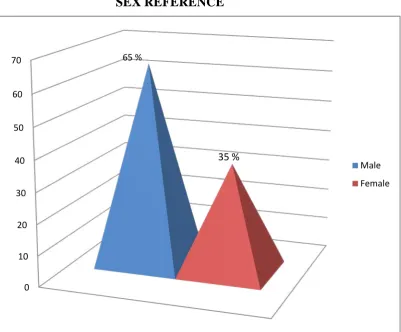
S. No. Sex No. of Cases Percentage
1. 2.
Male Female
26 14
65 35
Out of total 40 patients, who were taking medicine in OP and admitted in the hospital for the trial, 26 were males (65%) and 14 were females (35%).
SEX REFERENCE
0 10 20 30 40 50 60
70 65 %
35 %
72 Table 2
AGE REFERENCE
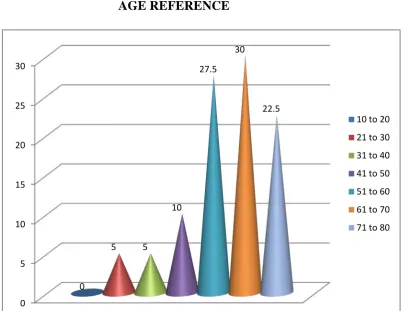
Out of 40 cases selected for clinical trial, most of them were age above 50.
S.No. Age No. of cases Percentage
1. 2. 3. 4. 5. 6. 7. 10-20 21-30 31-40 41-50 51-60 61-70 71-80 - 2 2 4 11 12 9 - 5 5 10 27.5 30 22.5 AGE REFERENCE 0 5 10 15 20 25 30 0 5 5 10 27.5 30 22.5
73 Table 3
KAALAM DISTRIBUTION
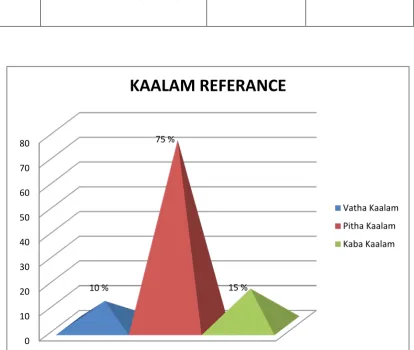
Different age groups were treated out of 40 the cases, most of them were in the Pitha kaalam, next in the Kaba kaalam but very less in Vatha kaalam.
S. No. Kaalam No. of Cases Percentage
1.
2.
3.
Vatha kaalam(0-33)
Pitha kaalam(34-66)
Kaba kaalam(67-100)
4
30
6
10
75
15
0 10 20 30 40 50 60 70 80
10 %
75 %
15 %
KAALAM REFERANCE
74 Table 4
OCCUPATIONAL STATUS
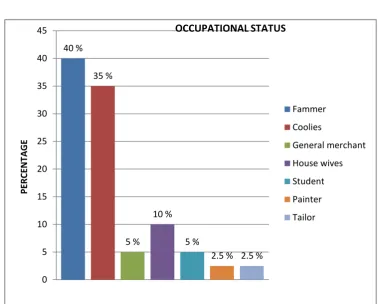
Occupational history is closely associated with Vatha karappan disease. Detailed history about the nature of the work has interrogated and illustrated as follows.
S. No. Nature of status No. of Cases Percentage
1. 2. 3. 4. 5. 6. 7. Farmers Coolies General merchant House wives Student Painter Tailor 16 14 2 4 2 1 1 40 35 5 10 5 2.5 2.5 40 % 35 % 5 % 10 % 5 %
[image:74.595.120.499.426.730.2]75 Table 5
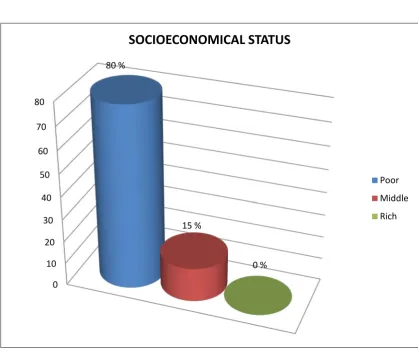
SOCIO ECONOMIC STATUS
The incidence of the disease was found to be higher in lower economic groups.
S. No. Socio economic status No. of Cases Percentage
1. 2. 3.
Poor Middle Rich
32 8 -
80 15 -
0 10 20 30 40 50 60 70 80
80 %
15 %
0 %
SOCIOECONOMICAL STATUS
76 Table 6
DIET REFERENCE
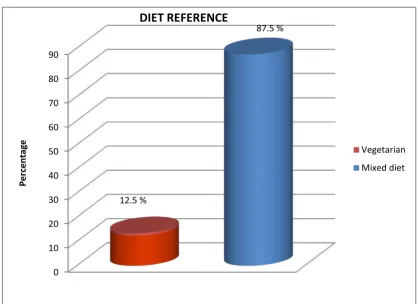
Cases were enquired of their dietary habits, it was noted that 87.5% cases were non-vegetarian and 12.5 % were vegetarian.
S.No. Food Habit No. of cases Percentage
1.
2.
Vegetarian
Mixed diet
5
35
12.5
87.5
0 10 20 30 40 50 60 70 80 90
12.5 %
87.5 %
Pe
rc
en
ta
ge
DIET REFERENCE
77 Table 7
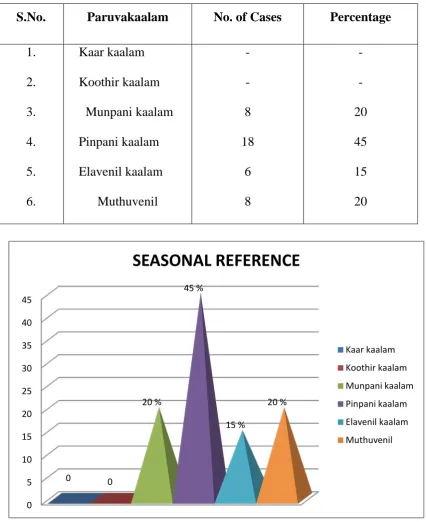
SEASONAL REFERENCE
When these 40 cases were enquired with that of the seasonal link, with occurrence and severity of this disease, it mostly occurred in Munpani kaalam, Pinpani kaalam, Elavenil kaalam, and Mudhuvenil kaalam.
S.No. Paruvakaalam No. of Cases Percentage
1. 2. 3. 4. 5. 6. Kaar kaalam Koothir kaalam Munpani kaalam Pinpani kaalam Elavenil kaalam Muthuvenil - - 8 18 6 8 - - 20 45 15 20 0 5 10 15 20 25 30 35 40 45
0 0
78 Table 8
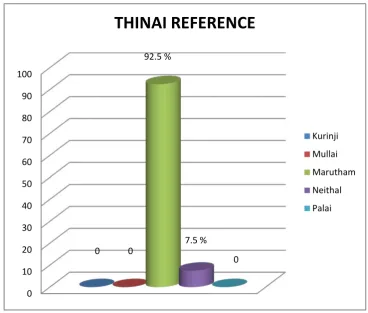
THINAI REFERENCE
Out of the 40 cases, 37 cases are from Marutham (92.5%) and 3 cases from Neithal (7.5%).
S.No. Type of lands No. of Cases Percentage
79 Table 9
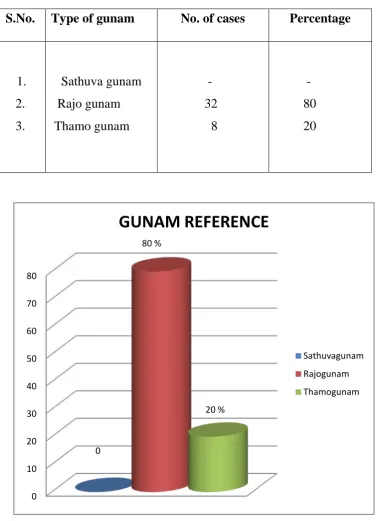
GUNAM REFERENCE
Out of 40 cases 80% had Rajo gunam and 20% cases had Thamo gunam respectively.
S.No. Type of gunam No. of cases Percentage
80 Table 10
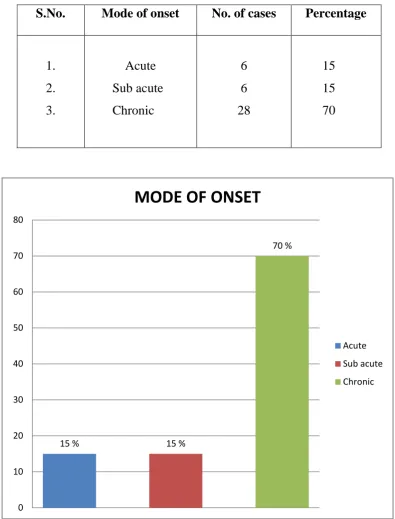
MODE OF ONSET
Out of 40 cases of clinical trials were 70% were found to be chronic sufferers.
S.No. Mode of onset No. of cases Percentage
1. 2. 3.
Acute Sub acute Chronic
6 6 28
15 15 70
15 % 15 %
70 %
0 10 20 30 40 50 60 70 80
MODE OF ONSET
81 Table 11
AETIOLOGY
When the 40 cases taken for the study were observed were due to occupational status, poor hygiene, incompatible diet, anxiety, family history, insect bite and irritants or allergens.
S.No. Aetiology No. of cases Percentage
1 Occupational status 19 47.5 2 Incompatible diet 3 7.5 3 Positive family history 3 7.5 4 Insect bite 5 12.5 5 Irritants or allergens 8 20 6 Psychological stress 2 5
0.00% 5.00% 10.00% 15.00% 20.00% 25.00% 30.00% 35.00% 40.00% 45.00% 50.00% 47.50% 7.50% 7.50% 12.50% 20% 5%
AETIOLOGY
Occupational status Incompatible diet Positive family history Insect bite82 Table 12
CLINICAL FEATURES
Regarding the signs and symptoms
SI.NO Clinical features No. of cases Percentage
1 Erythema 7 17.5
2 Itching 40 100
3 Vesicles 34 85
4 Oedema 11 27.5
5 Pustules 2 5
6 Oozing 34 85
7 Pain 15 37.5
8 Ulcers 4 10
9 Lichenification 6 15
10 Constipation 10 25
[image:82.595.104.514.443.772.2]83 Table 13
ASSOCIATED HISTORY
Vatha karappan is commonly an immunological disorder for all ages, other associated conditions such as bronchial asthma, urticaria were noted in some cases.
S.No. History No.of Cases Percentage 1 Bronchial asthma 6 15 2 Hay fever - - 3 Urticaria 10 25 4 Diabetes 2 5 5 Family History 8 8
0% 5% 10% 15% 20% 25%
15%
0
25%
5%
8%
ASSOCIATED HISTORY
84 Table 14
INCIDENCE OF UPPER AND LOWER LIMBS
S.No. Site of lesion No. of Cases Percentage
1. 2. 3.
Upper Limbs Lower Limbs
Both upper and Lower limb
36 2 2
90 5 5
0% 10% 20% 30% 40% 50% 60% 70% 80% 90%
90%
5% 5%
INCIDENCE OF UPPER AND LOWER LIMBS
Upper Limbs Lower Limbs
85 Table 15
DURATION OF THE ILLNESS
S.No. Duration of the illness No. of Cases Percentage
1. 2. 3. 4. 5. 1-3 months 3-6 months 6months-1year 1-2 years
More than 2 years
16 14 7 7 5 40 35 17.5 17.5 12.5 0% 5% 10% 15% 20% 25% 30% 35% 40% 40% 35% 17.50% 17.50% 12.50%
DURATION OF THE ILLNESS
1-3 months 3-6 months 6 months - 1 year 1-2 years
[image:85.595.89.511.126.661.2]86
DISTRIBUTION OF UYIR THATHUKKAL
[image:86.595.112.502.542.752.2]Table 16
DERANGEMENT OF VATHAM
S.No. Classification of Vatham No. of cases Percentage
1. 2. 3. 4. 5. 6. 7. 8. 9. 10. Piranan Abanan Viyanan Udhanan Samanan Nagan Koorman Kirukaran Thevathathan Dhananjeyan 6 10 40 - 40 - - - 7 - 15 25 100 - 100 - - - 17.5 -
In Dasa Vayu, Viyanan in 40 patients (100%), Samanan in 40 patients (100%), Pranan in 6 patients (15%), Thevethathan in 7 patients (17.5%).
0% 10% 20% 30% 40% 50% 60% 70% 80% 90% 100% 15% 25% 100% 0 100%
87
DERANGEMENT OF PITHAM
S.No. Classification of pitham No. of Cases Percentage
1. 2. 3. 4. 5. Analaga pitham Ranjaga Pitham Sathaga pitham Alosaga pitham Prasaga pitham 3 7 11 - 40 7.5 17.5 27.5 - 100
In Pitham, Prasagam were affected in 40 patients (100%), Analaga pitham were affected in 3 patients (7.5%) and Ranjaga pitham were affected in 7 patients (17.5%) . 0 10 20 30 40 50 60 70 80 90 100
7.5 % 17.5 %
88
DERANGEMENT OF KABAM
S.No. Classification of Kabam No. of Cases Percentage
1. 2. 3. 4. 5. Avalambagam Kletham Pothagam Tharpagam Santhigam 6 - - - 10 15 - - - 25
In Kabam, Avalambagam (15%) and Santhegam (25%) were affected Pothagam, Tharpagam, Santhigam was not affected.
0% 5% 10% 15% 20% 25% 15%
0 0 0
89 Table 17
UDAL KATTUGAL REFERENCE
S.No. Udal Kattugal No. of Cases Percentage
1. 2. 3. 4. 5. 6. 7. Saaram Senneer Oon Kozhupu Enbu Moolai Sukilam/ Suronitham 40 40 40 4 - - - 100 100 100 10 - - -
All 40 patients were affected saaram and senneer, and oon (100%) and kozhupu in 10% cases are noticed. Other udal kattugal were not affected.
0 10 20 30 40 50 60 70 80 90 100 100 %
100 %100 % 100 %
0 0 0
90 Table 18
ENVAGAI THERVUGAL
S.No. Envagai Thervugal No. of Cases Percentage
1. 2. 3. 4. 5. 6. 7. 8. Naadi Sparisam Naa Niram Mozhi Vizhi Malam Moothiram 40 40 2 40 - - 10 - 100 100 5 100 - - 25 -
Naadi and niram, sparisam were affected all of the 40 patients (100%), Naa were affected in 2 patients (5%), Malam were affected in 10 patients (20%).
91 Table 19
NEERKURI AND NEIKURI REFERENCE
S.No. Type of Test No.of Cases Percentage
1 Neerkuri
Vaikol niram
40 100
2 Neikuri
Spreading like snake Spreading like ring Standing like a Pearl
30 - 10 75 - 25
According to Neikuri in 75% cases it spreads like a snake, in 25% cases it stand like a pearl.
0% 10% 20% 30% 40% 50% 60% 70% 80% 90% 100% 100% 75% 0 25%
NEERKURI AND NEIKURI
92 Table 20
RESULTS AFTER TREATMENT
S.No Results No. of Cases Percentage
1. 2. 3.
Good relief Moderate relief Mild relief
29 11 -
72.5 27.5
-
Out of 40 patients, 11 patients got moderate relief, 29 patients got good relief.
0.00% 10.00% 20.00% 30.00% 40.00% 50.00% 60.00% 70.00%
80.00% 72.50%
27.50%
0
RESULTS
93
CASE SUMMARY OF IN-PATIENTS
S.NO IP.N
O NAME
AGE/
SEX D.O.A D.O.D
NO OF
DAYS
TREA <