
Epstein-Barr virus nuclear antigen 3C is a transcriptional regulator.
Full text
Figure


Related documents
(A and B) Fifteen million HEK 293T cells were transfected with expression vectors for HA-tagged Ub, Flag-tagged Mdm2, and Myc-tagged full-length EBNA3C and its various truncated
Increasing levels of c-Myc did not, however, have any effect on transcription from the mu- tated TERT promoter, and EBNA3C repressed transcription from this construct, suggesting a
EBV infection of B lymphocytes results in the expression of six EBV-encoded nu- clear proteins (EBNA-LP, EBNA-2, EBNA-3A, EBNA-3B, EBNA-3C, and EBNA-1) and two integral
In order to better understand the relationship between these EBV and rhesus LCV latent infection genes, we asked if the rhesus LCV EBNA-3 locus could be recombined into the EBV
Identification of cellular EBNA1 binding sites in chromosome 11 and MAP3K7IP2 promoter region To determine if some of the EBNA1 ChIP-Seq sites were bound directly by EBNA1, we
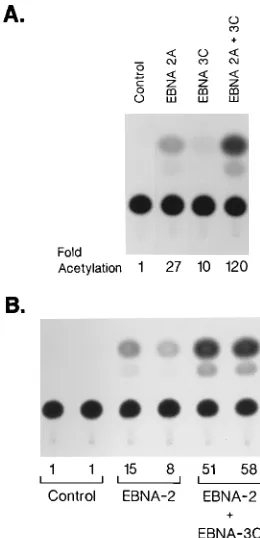
The transactivation function of EBNA2 was also observed in the HeLa epithelial cell line, which suggests that EBV and HIV-1 infection of non-B cells may result in HlV-i
Stable transfection of Epstein-Barr virus (EBV) nuclear antigen 2 in lymphoma cells containing the EBV P3HR1 genome induces expression of B-cell activation molecules CD21 and
A human epithelial line (U) was found that could be directly infected by EBV, and viral functions, the induction of EBV nuclear antigen and cellular DNA synthesis, were
