Age-specific reference ranges for serum prostate
specific antigen in South Indian men
Dissertation submitted in partial fulfillment of the requirements for the degree of
M.Ch (Genitourinary Surgery)
THE TAMILNADU DR.M.G.R.MEDICAL UNIVERSITY CHENNAI
CERTIFICATE
This is to certify that the dissertation entitled Age-specific reference
ranges for serum prostate specific antigen in South Indian men
done under our supervision and is the bonafide work of Dr.K.V.Arasi. It is
submitted in partial fulfillment of the requirement for the M.Ch.
(Genitourinary surgery) examination.
Dr.Kalavathy Ponniraivan, B.Sc., M.D., The Dean
Madras Medical College, Chennai – 600 003.
Prof.A.Balakrishnan,
M.S., M.Ch., Professor and Head of the Department
Department of urology Madras Medical College
ACKNOWLEDGEMENT
I thank Dr.Kalavathy Ponniraivan, The Dean, Madras Medical College
for permitting me to undertake this study.
I extend my respectful thanks to Prof.A.Balakrishnan, Professor and
Head of the Department, Department of Urology for his kind guidance, without
which the study would not have been possible.
I thank Prof.R.Jeyaraman, Additional professor of urology,
Dr.D.Thanikachalam and our retired Prof. P.B.Sivaraman who were
instrumental in taking up this study and evinced keen interest.
I also extend my thanks to Assistant Professors of urology for their kind
co-operation and assistance.
I am grateful to all the patients, who have participated in this study.
CONTENTS
S.No. Page No.
1. Introduction 1
2. Aim 3
3. Review of Literature 4
4. Material and Methods 32
5. Results 35
6. Discussion 37
7. Summary and Conclusion 48
9. Bibliography
10. Proforma
INTRODUCTION
Prostate-specific antigen (PSA) is the most clinically useful
tumour marker available today for the diagnosis and management
of prostate cancer; unlike other tumor markers prostate specific
antigen is not cancer specific. Overlapping serum PSA
concentrations between benign prostatic hyperplasia and
prostatic adenocarcinoma limit the effectiveness of serum PSA in
detecting early prostate cancer.
Several concepts have been devised to optimize the
diagnostic value of serum PSA. Various PSA relation markers
have been advocated for the differentiation between benign
prostate hypertrophy and carcinoma in so called "gray zone"
Age specific PSA reference ranges provide greater
sensitivity for cancer detection in younger men at the expense of
a greater negative biopsy rate. In older men unnecessary biopsies
could be spared.
Studies 3 2 , 3 5 , 4 2 , 4 4 have reported varying concentrations of
PSA in serum of healthy males belonging to different races.
There are very few Indian studies only. Hence we deliberately
felt it was essential to establish our own age specific reference
AIM
To determine age-specific reference ranges for serum prostate-specific
REVIEW OF LITERATURE
PSA is a serine protease secreted exclusively by the
epithelial cells of the prostate and also in minute quantities by
the epithelial lining of periurethral glands. Its major
physiological role is to promote the liquefaction of seminal clot.
It is androgen regulated and one of the most abundant serine
protease in the seminal plasma (1,000,000 ng/ml)
History 2 4
In 1970, Ablin R.J. et al.2 identified two separate prostatic
tissue-specific antigens. One of the antigens was identified, as
prostatic acid phosphatase, while the other, the forerunner of the
current PSA remained unnamed. In 1971, Hara et al. identified a
protein in seminal fluid. They called it gamma-seminoprotein.
A few years later (1979) Wang, Chu et al. purified the
antigen from prostatic tissue and named it prostate-specific
Papsidero and associates detected PSA in human serum in
1980. These researchers were the first to demonstrate the
relationship of PSA to prostate cancer.
Because PSA is produced by the body and can be used to
detect disease, it is sometimes called a biological marker or
tumor marker. Prostatic intraepithelial neoplasia does not cause
disruption of the basement membrane and does not raise serum
PSA.
PSA paradox 37
Normal prostate epithelial cells and benign hyperplastic
tissue produce more PSA than malignant prostatic tissue. In
localized and metastatic prostate cancer the expression of PSA
per cell is reduced, but there is an increase in the level of serum
PSA. Malignancy is typically associated with a lower degree of
differentiation; therefore the relative number of terminally
differentiated cells will decline, as well as the expression of
differentiation markers such as serum PSA. Malignancy results
in loss of polarity and basal cell numbers and disruption of
In prostate cancer, serum PSA is determined by the number
of cancer cells and the expression of PSA per cancer cell.
Considering the more aggressive cancer cells produce less PSA,
the phenomena counteract one another. This explains why PSA is
a poor marker in cancer progression
Nonprostatic sources of PSA
The name PSA reflects the initial widespread belief that
expression of the protein was restricted to the prostate gland.
However this notion has been dispelled. Numerous studies have
shown that PSA is expressed extraprostatically. Low levels of
PSA3 have been detected in various tissues that express steroid
receptor super family, including uterine endometrium, breast
tissue, peri anal & peri uretheral glands, salivary glands, adrenal
and renal neoplasm’s and various other malignant tumours. In
1993 Iwakini et al5 4. showed PSA secretion from periurethral
glands by immunohistochemical studies. Oesterling8 et al
suggested that the periurethral glands do not have a clinically
significant effect on serum PSA concentration after radical
Growth and Development of Human Prostate9:
Human prostate undergoes an increase in size and develops
histological evidence of stimulated growth during three periods
of life9. Before and at birth, during puberty, with advancement of
age. The average weight of prostate is as follows
1 to 10 years – 1.4 g,
11 to 20 years - 10.8 g,
21 to 30 years - 18.g,
41 to 50 years - 20.2g.
In 6t h decade 30.9
8th decade to 38.8 g
The prostate-specific antigen (PSA) test
Gutman and Gutman in 1938, described acid phosphates as
a tumour marker for prostatic cancer. Acid phosphatase was
replaced by serum PSA because of its low sensitivity and
specificity. A PSA test measures the amount of prostate-specific
antigen in the blood. Low amounts of PSA may be found in the
blood of healthy men. The amount of PSA in the blood normally
increased by inflammation of the prostate gland, prostate cancer,
manipulation, and urinary retention
Prostate-specific antigen test is done to determine whether
lumps found during a digital rectal exam or a transrectal
ultrasound may be caused by prostate cancer, to monitor the
development of prostate cancer and the response to treatment. If
PSA levels are increasing, the cancer may be growing or
spreading. Successful treatment of prostate cancer usually causes
PSA levels to drop. The amount of PSA is often undetectable in a
man who has been treated for prostate cancer by having his
prostate gland removed. PSA levels that rise after prostate
removal indicate that the cancer may have spread to another part
of the body or has recurred at the prostate site.
Commercial Assays:
Commercial PSA assays measure the glycoprotein in the
serum using immuno- assays. It is important that the assay be
performed in the same laboratory for comparative purposes over
time. Some assays are immunoradiometric and some are
is based on establishing a baseline value and doing the PSAs
over time on a regular interval, usually one year.
Assay kits for total PSA
Table - 1
Assay kit Capture
antibody Tracer antibody
Minimal detectable limit (micro gram/L)
Bayer ADVIA
centaur
m Sh
(Sheep poly clonal) 0.06
Can Ag
ELISA m m 0.10
CIS ELSA-2 m m
(monoclonal) 0.14
Advice to the patient
1. Refrain from sexual activity for 2 to 3 days prior to testing.
2. To wait for one week after having a cystoscopy2 9. (Baseline
level reached in 3 days)
3. To wait until a urinary tract infection or prostatitis has
cleared up.
4. To wait for 6 weeks2 9 after a needle biopsy or TUR before
Inaccurate test results:
1. Recent sexual activity or a cystoscopy test may cause
prostate-specific antigen (PSA) levels to rise. Osterling and
colleagues5 7 prospectively randomized 69 men into 3
group’s flexible cystoscopy, rigid cystoscopy and control.
Two serum PSA levels were estimated. They found the
median serum PSA after flexible cystoscopy was 0.1ng/ml,
rigid cystoscopy and control was 0.05ng/ml.
2. Large doses of some medications used to treat cancer—such
as cyclophosphamide diethylstilbestrol, and methotrexate -
can interfere with test results.
3. The medication finasteride, used to prevent further
enlargement of the prostate gland in men with benign
prostatic hypertrophy (BPH), can cause inaccurately low
PSA levels. Finastride2 4 decreases total PSA and PSA
density; free PSA is not affected.
4. Herbal supplements can also affect PSA levels.
5. Contamination or inadequate refrigeration of the blood
sample can cause inaccurate test results.
DEFINITIONS.
Sensitivity: Is the capability of a test to identify the presence of
disease expressed as the ratio of true positives to the sum of true
positives and false negatives. . PSA has a sensitivity of 80%.
Specificity: Is the capability of a test to identify the absence of
disease expressed as the ratio of true negatives to the sum of true
negatives and false positives. PSA has a specificity of 35-50%.
Positive predictive value: Is the capability of a test to identify
patients with disease among all patients demonstrating positive
results.
False positive test:
False positive test results occur when the PSA level is
elevated but no cancer is actually present. False positives may
lead to additional medical procedures that have potential risks
and significant financial costs and can create anxiety for the
patient and his family. Most men with an elevated PSA test turn
biopsy due to elevated PSA levels actually have prostate cancer.
In general 5-8 percent of a screening population will have an
abnormal DRE. A value between 4-10 ng/ml has a 15-30%
chance of being positive. Values above 10 are associated with a
positive biopsy in greater than two thirds of cases upper limit of
normal for PSA is controversial. Recent studies2 3suggest that
using a PSA cutoff of 2.5 ng/ml for men younger than 60 years
may be more appropriate.
False negative tests: False negative test results occur when
the PSA level is in the normal range even though prostate cancer
is actually present. Most prostate cancers are slow growing and
may exist for decades before they are large enough to cause
symptoms. Subsequent PSA tests may indicate a problem before
the disease progresses significantly. Cancers missed by the age
specific reference ranges in older men (>69 years) were
predominantly small, organ confined, unlikely to be
life-threatening 2 5 and avoids invasive prostatic biopsies.
Strategies for enhancing Prostate specific antigen specificity;
Attempts to improve the specificity of serum PSA determinations
as a risk indicator for prostate cancer have focused on the
following approaches;
1. Age specific PSA
2. PSA density
3. PSA velocity
4. PSA transition zone density
5. Free to total PSA ratio
6. ACT alpha 1 complex PSA
Age specific reference ranges.
PSA is also age dependent, studies2 5
have shown that age
was found to contribute independently of volume to serum PSA,
accounting for 5% of variance in serum PSA concentration.
PSAD correlates directly with age. Factors intrinsic to the aging
prostate play a role in the variation serum PSA with advancing
age. Osterling et al5 5, showed the clinical usefulness of age
specific PSA by noting an increase in specificity by 11% and
Osterling et al5 6, have concluded that when age specific
reference ranges were used PSAD does not contribute additional
information. Data has shown 96% agreement between PSA and
PSAD.
Age specific reference range sensitivity:
Studies have shown that age specific reference ranges
decrease the sensitivity of PSA in older men (>6o years) but
improve it younger men.
Criley SR et al2 6 has reported that age specific reference
ranges increase the potential for detection of prostate cancer by
18% in men 50 years old or younger and decreased detection by
19% in men 69 years old or older. The following is a guideline
adjusted for age3.
Age 40-49 0.0-2.5 ng/ml
Age 50-59 0.0-3.5 ng/ml
Age 60-69 0.0-4.5 ng/ml
Age specific reference range according to individual year of life 25. (Table -2)
Table – 2
Age PSA range Years ngs/ml
Age PSA range Years ng/ml
Algorithm for the use of age specific reference ranges: 2 5
(Table – 3)
Table – 3(25)
PSA DRE DIAGNOSTIC
ACTION
Less than or equal to
age specific range Negative
Annual PSA, DRE
Greater than age specific range
Negative TRUS; biopsy visible
lesions, systemic
sextant biopsy, with
two cores containing
transition zone
Any value Positive TRUS; biopsy palpable
and visible lesions,
sextant biopsy of
remaining prostate
The normal 4.0 ng/ml is no longer recognized as the cutoff
point. A recent study has reported that 15% of men with a normal
DRE and a PSA level of < 4ng /ml have cancer detected on
systemic needle biopsies. The current American cancer society
and the 2004 National Comprehensive Cancer Center Network
guidelines also recommend considering a biopsy for a PSA level
It is important to recognize that the real value of the PSA
test in early detection is based on establishing a baseline PSA
value and regularly, on a yearly basis, measuring the PSA to
observe changes from the baseline value. Incremental changes of
0.75 ng/ml in a year should be investigated.
Catolona WJ et al 2 3 said that a trend is more important
than any single PSA value and one must always remember that
PSA is not specific for cancer.
Age adjusted PSA.
Concept of raising PSA threshold in older patients and
lowering it in younger patients. Data suggests normal PSA of 2.5
may be more appropriate in men under the age of 60. Many
suggest lowering value for young men and maintaining 4.0 for
older patients to minimize "miss rate" in this population
PSA density
Benson et al4 9 introduced the term PSA density to correct
PSA for prostatic volume. PSA density is the value of the PSA
divided by the size of the prostate. The likelihood of prostate
Prostate biopsy is recommended in men with normal DRE,
PSA between 4 to 10 ng /ml and PSAD of 0.15 or greater The
use of PSA density 1 3 to interpret PSA results is controversial
because cancer might be overlooked in a man with an enlarged
prostate.
Recent large studies conducted by Brawer and associates4 7
have not confirmed the utility of PSA density. Catalona and
associates4 8 documented that approximately 50 % of CaP would
have been missed using a cut off of 0.15, this may be due to
difficulty in obtaining reproducible prostatic volume by TRUS.
PSA transition zone density3 8
Transition zone adjusted PSA were used in an attempt
improve the specificity of prostate cancer. Calculated threshold
for transition zone PSA density of 0.35 ng/ml provided the
highest positive predictive value for prostate cancer detection in
patients with tPSA <10 ng /ml. Because of the greater variability
in the determination of PV the use of transition zone PSA density
remained as an investigational tool for early detection of prostate
PSA velocity:
PSA velocity is based on changes in PSA levels over time.
Carter and colleagues5 0
in a long term prospective study found
the average rate of change of serum PSA over three consecutive
PSA determinations had a better specificity (90 %) for detecting
prostatic cancer as compared to 60 % when PSA greater than 4
ng/ml was the detection criteria. A sharp rise in the PSA level
raises the suspicion of cancer. PSA levels appear to increase
more slowly in men with prostate enlargement.
The rate of changes in the PSA5 0 more than 0.75 ng/ml per
year was a specific marker for cancer. PSA velocity cut offs have
not been determined for men with PSA values less than 4 ng/ml.
Less 5% of men with out a history of prostate cancer have PSA
velocity of more than 0.75 ng/ml/y.
Carter et al2 1, suggested a minimum length of follow up of
18 months is needed to use PSA velocity for cancer detection.
The test is used as a tool to keep track of how PSA levels
If PSA increases dramatically in a short period, it may be
one indicator that prostate cancer has progressed.
Recent study by D'Amico et al5 published in the New
England Journal of Medicine suggested that an annual PSA
velocity of 2 ng/ml or greater was independently associated with
prostate cancer mortality after radical prostatectomy. Potentially
this may serve as a marker for identifying patients who may be
considered for novel neoadjuvant strategies before undergoing
surgery.
Molecular forms of PSA
In 1990, Christensson et al. discovered that PSA exists in
more than one form circulating in serum. These forms are: Free
PSA f), bound PSA ACT) and complexed PSA
(PSA-MG). Most of the PSA in the sera is bound to the antiproteases
ACT and MG Binding of PSA to ACT inactivates the protease,
but it is immunodetectable. Since the complexed form, PSA-MG
is not immunoreactive4; it is not measured by any of the
available commercial assays at the present time. Total PSA is a
Mechanism of formation of different forms of PSA
Prostate
Normal or malignant
pro PSA PSA epithelial cells
cancer
pro PSA
isoforms BPH Normal BPH Cancer
BPSA
Pro PSA isoforms + BPSA = Free PSA
PSA ACT + Free PSA = Clinical Total PSA
Free PSA + PSA MG + PSA ACT = True total PSA
Free PSA:
Free PSA in serum3 7 is composed of three distinct
forms: pro PSA, BPSA, and intact PSA that may have structural
or conformational changes that makes it inactive. All forms of
free PSA are enzymatically inactive BPSA, is a degraded form of
PSA that has been shown to be associated with prostate BPH
transition zone tissue.
Free PSA (BPSA) concentration is more in benign prostatic
hyperplasia, while cancer produces more of the attached form.
This difference may be due to differential expression of PSA
isoforms by transition zone compared with peripheral zone.
Cancer produces more of pro PSA.
In the intermediate PSA range between 4 to 10 ng /ml the
percentage of free PSA1 9 provided important information
regarding the presence of cancer. If percent free PSA is >25%
the probability of a positive biopsy drops from 15-30 percent to
5-7%. Percentage of free PSA cut off 25% detected 95% of
cancers while avoiding 20% unnecessary biopsies .Low free PSA
values (less than 15%) are more likely to be caused by prostate
Percent free PSA20 and Probability of cancer
Free PSA
Probability of
Cancer
Greater than 25% 8%
20 – 25% 16%
15 – 20% 20%
10 – 15% 28%
0 – 10% 56%
The use of f/t PSA has been extensively evaluated and
found to greatly improve the specificity of prostate cancer
detection. At 85 % and 95%sensitivity free PSA provided the
highest Specificity.
Precursor PSA (pPSA).
Molecular form of free PSA. PSA is secreted from the
prostate luminal epithelial cells as pPSA, an inactive proenzyme
containing a 7-amino acid pro-leader peptide and 237 amino
acids of mature PSA. The pro-leader peptide is removed
extracellularly to produce active, mature PSA. Since no pPSA
identified as a serum marker with greater cancer specificity6.
Precursor –PSA2 7 has shown some early results in detecting
prostate cancer at PSA levels of 2 –10 ng/ml
Complexed prostate-specific antigen (cPSA) is a fairly new
test to help detect prostate cancer. Ozdal et al3 8 have suggested
that complexed PSA is similar to the total PSA in sensitivity but
complex PSA is more specific than t PSA. Complex PSA alone
has lower validity than the ratio of free and total PSA. At a
sensitivity of 90% the cPSA /PV ratio with a threshold of 0.08
provided the highest specificity. However, at a sensitivity of 95
% f/tPSA provided the highest specificity3 8. The cPSA test
currently is not widely available. As a single test for screening,
cPSA may improve specificity over total PSA and comparable
specificity to free-to-total PSA for prostate cancer detection, and
may reduce the number of unnecessary prostate biopsies in the
Molecular forms of PSA and age;
Following a community based study; Oesterling et al4 6
concluded that the individual serum concentrations of free PSA,
total PSA and complexed PSA all correlated with the patient’s
age. The ratios of free to total PSA, complexed to total PSA, free
to complexed PSA were constant for men of all ages. Complexed
and total PSA all correlated directly with the patient’s age.
Risk factor for carcinoma prostate
Ries LAG et al5 8, has shown that age is the most common
risk factor, with nearly 70 percent of prostate cancer cases
occurring in men age 65 years and older .The post pubertal
presence of an intact hypothalamo pituitary testicular axis is
required for the development of carcinoma prostate. Men
castrated before onset of puberty have little risk of developing
carcinoma prostate.
Other risk factors for prostate cancer include family
history, race3 0, and possibly diet. Men who have a father or
brother with prostate cancer have a greater chance of developing
Eldon et al3 9 found that female relatives are not at higher
risk of breast cancer but they may be at greater risk of kidney
cancer. African American men have the highest rate of prostate
cancer4 0, while Asian and Native American men have the lowest
rates. In addition, there is some evidence that a diet higher in fat,
especially animal fat, may increase the risk of prostate cancer.
Prostate cancer screening:
Using the PSA test to screen men for prostate cancer is
controversial3 1 because it is not yet known if this test actually
saves lives. Moreover, it is not clear if the benefits of PSA
screening outweigh the risks of follow-up diagnostic tests and
cancer treatments. The PSA test may detect small cancers that
would never become life threatening. This situation, called over
diagnosis, puts men at risk for complications from unnecessary
treatment. Despite these controversies PSA monitoring fulfills
the prerequisites of a screening programme. The estimated
increase in detection lead time1 0 is approximately 5 years.
The American Cancer Society, American Radiological
early detection with an annual DRE and PSA beginning at age 50
for all men with a life expectancy greater than 10 years and age
40 for men of African American race3 0
or a family history of
prostate cancer.
The 2004 recommendation of a consensus panel from the
National Comprehensive Cancer Network recommends a baseline
PSA at age 40 for all men. Those men with a serum PSA equal or
greater to 0.6 ng/ml (the median PSA for that age group) should
undergo yearly screening, whereas those with a value less than
0.6 ng/ml may have another interval PSA at age 45. The same
rule applies at age 45
Catalona WJ et al2 3, recommends:
1. Annual PSA testing and a DRE at 40 years
2. Earlier screening for men with family history
3. Prospectively monitoring PSA velocity
4. Biopsies for men with a suspicious DRE, PSA>2.5 ng/ml
5. Using free PSA, cPSA, PSA density and velocity to
Recommended frequency of prostate specific antigen
measurement2 4
.
1. Annual PSA for men with normal DRE and a stable PSA of
less than 4 ng/ml and greater than 2.5 ng/ml
2. Biannual Screening For Men With a normal DRE and a
serum PSA of less than 2.5 ng/ml
No further screening for PSA level of 1 or less in men aged 65
years. (Baltimore longitudinal study, needs additional
observations)
Transrectal Ultrasound (TRUS)
TRUS1 8 is not recommended as a first line-screening test
because of its low predictive value for early prostate cancer. The
Transrectal Ultrasound (TRUS) guided biopsies are clearly
indicated in men with life expectancy greater than 10 years with
abnormal DRE with or with out an elevated PSA. (TRUS) guided
biopsies are advised in men with a normal DRE and an elevated
PSA.level. Milford ward et al2 9 had shown that DRE or TRUS
Newer tests:
RT- PCR assay
PCA3 formerly called DD3 is the prostate specific gene28 described to
date. Using RT-PCR assay, prostate tumors showed a 66-fold up regulation
of DD3 when compared with normal prostatic tissue. This up regulation was
found in >95% of prostatic cancer specimen studied. This PCA3 based RT-
PCR assay was used to identify prostate cancer in urine sediments obtained
after prostatic massage, sensitivity was found to be 67% negative predictive
value was 90%. This newer study at this stage appears to improve the
accuracy of diagnosis and avoid unnecessary biopsies. Further results are
awaited.
Kallikrein tumor markers
The humen kallikrien gene family encodes three known and
related proteins:tissue kallilerin ,glandular kallikerin and PSA.
There is 78% aminoacid homology between hK2 and PSA. Both
Hk2 and PSA are expressed in prostatic epithelium. They are
released in a precursor zymogen form and are under androgen
regulation. They are present in serum and seminal fluid, and can
Human kallikerin 2 like PSA is found almost exclusively
with in the prostate. The expression with in the prostate is lower
than that of PSA. Black et al5 1 has found the PSA and hK 2
ratios in male sera to be 0.1 to 34 and the ratio in seminal plasma
are 100 to 500.
Takayama et al5 2 believed that human kallikerin 2 plays a
role in regulating PSA activity. It cleaves the precursor form of
PSA. The expression of hK2 is higher in more poorly
differentiated carcinomas than in normal and benign tissues.
Preliminary evidence suggests that the ratio of hk2 to PSA may
improve the ability of PSA to identify men with prostate cancer.
Human glandular kallikrein 2, which belong to the human
kallikrein family as well as PSA, is expected as a tumor specific
MATERIALS AND METHODS
Study design
Cross sectional study
Setting
This study analyzed the PSA value of 117 subjects with out
lower urinary tract symptoms during the period October 2003 to
September 2005 at Government General Hospital. Chennai -3
Inclusion criteria
1. Individuals attending Urology Clinics for minor illness
2. Normal healthy volunteers
Exclusion criteria
1. Subjects with history of lower urinary tract symptoms
2. Subjects with history of recent urethral instrumentation
3. Subjects with history of recent catheterization
4. Patients with history of Prostatitis
Data collection
Our study group consisted of 117subjects belonging to the
subpopulation of chennai from south India of different age
and a complete clinical examination was done. Blood
biochemical analysis and urine analysis were done for all
patients. Ultrasound KUBU, digital rectal examination was done
in all selected subjects. Complete questionnaire is shown in
appendix 1
Serum PSA was estimated2 9 using ELISA, and Bayer ADVIA
centaur assay kits (last 25 patients).
Case definitions
Subjects referred to Urology department for evaluation of
renal cyst, back pain, renal microlith, infertility were included in
the study. Three patients with renal calculi with out urinary tract
infection were also included in the study. Healthy volunteers
(hospital workers, patient’s attenders) after through examination
and history taking were also included in the study group.
Statistical analysis
Statistical analysis by Student‘t’ test. Confidence intervals
decade of age group. Confidence interval high represents 95t h
RESULTS
During the study period October 2003 to September 2005,
serum total PSA of 117 subjects with out lower urinary tract
symptoms and any other major clinical illness between the age
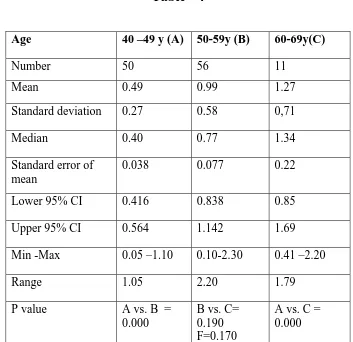
group 40 to 69 years were analyzed. The results are shown in
table - 4
Table - 4
Age 40 –49 y (A) 50-59y (B) 60-69y(C)
Number 50 56 11
Mean 0.49 0.99 1.27
Standard deviation 0.27 0.58 0,71
Median 0.40 0.77 1.34
Standard error of mean
0.038 0.077 0.22 Lower 95% CI 0.416 0.838 0.85
Upper 95% CI 0.564 1.142 1.69 Min -Max 0.05 –1.10 0.10-2.30 0.41 –2.20
Range 1.05 2.20 1.79
P value A vs. B = 0.000
B vs. C= 0.190 F=0.170
A vs. C = 0.000
[image:39.612.146.499.335.677.2]Using the 95t h percentile CI, the recommended age-specific
reference ranges of total PSA values were as follows: for the age
group 40 –49 years 0.564 ng/ml, 50-59years 1.142 ng/ml
respectively, and for the age group 60-69years serum PSA 95t h
percentile value is 1.69 ng/ml. The minimum value of total serum
PSA detected was 0.05 ng/ml and the maximum value of serum
PSA was 2.30 ng/ml
The mean PSA value increased from 0.49 for men aged
between 40 to 49 years to 1.27 for men aged between 60-69
years. The increase was statistically significant (p =0.000).
The mean total PSA value increased from 0.99 for men aged
between 50 to59 years to 1.27 were for men aged between 60 to
69 years. But the increase was not statistically significant (P
=0.190), this may be because of the small sample size (9.4%) in
the age group 60 to 69 years. Serum PSA was detected in the sera
DISCUSSION
Total PSA (tPSA) is a widely used tumour marker for the
early detection and monitoring of patients with prostate cancer.
While PSA testing has resulted in an increase in prostate cancer
detection, its routine use has been questioned because of lack of
specificity. Racial variations of PSA values were observed.
Studies have shown that race may also be an important
factor in setting a reference range Enormous efforts were made
to establish age specific reference ranges through out the world.
Black men with prostate cancer have higher PSA levels3 3 , 4 0 than
whites even after adjustment for age and stage of the disease.
Morgan et al3 3 showed that using standard age specific reference
ranges 41 % of cancers were missed in black men and suggested
the following reference range for black men; for men in their
40s, 0 to 2ng/ml, for men in their 50s 0 to 5ng/ml, for men in
their 60s 0 to 4.5 ng /ml, and 0 to 5.5 ng/ml for men in their 70s.
Extensive work by osterling3 2 , 3 5
group on American whites
and Japanese men clearly showed age specific significant
Our study also shows age specific significant increase for
95-percentile value (fig 1)
Age wise PSA
age
70 60
50 40
30
psa
2.5
2.0
1.5
1.0
.5
0.0
age psa
age Pearson Correlation 1 .526(**)
Sig. (2-tailed) . .000
N 116 116
psa Pearson Correlation .526(**) 1
Sig. (2-tailed) .000 .
N 116 116
** Correlation is significant at the 0.01 level (2-tailed).
Age specific PSA Figure 1
Myrtel5 3 et al found that 100 % of healthy men less than 40
years and 97 % of men over age 40 had a serum PSA below or
equal to 4 ng/ml.
Our study shows a similar finding and in none of our
patients between the age group of 40 –69 serum PSA was more
than 4 ng/ml.
Studies have shown that age-specific reference ranges for
serum PSA were significantly lower for Asians than Western men
1 5 , 3 2 , 3 4 , 4 1
. Our study also shows a low age specific PSA values
0 5 10 15
African America Whites Indian (OS)
Age Specific Serum PSA Among
Different Races
40-49 50-59 60-69
(Fig.2)
Studyconducted at the department of biochemistry punjagutta34
India
has shown the age specific reference ranges were 1.39 for men aged 40-49,
1.48 for men aged 50 to59, 1.609 for men aged 60 to 69years, 2 for men
aged 70 to79 and 2.47 for men aged 80 to 89. Our results were found to be
0 1 2 3 4
Japanese Chinese Arab Indian (OS)
Serum Age Specific PSA in Asians
40-49 50-59 60-69
(Fig.3)
Study conducted at the department of biochemistry punjagutta34 India
has also shown that Indian males have very low serum PSA concentrations
compared with men from other Asian countries. Our study also shows low
age specific PSA concentrations than men from other Asian countries
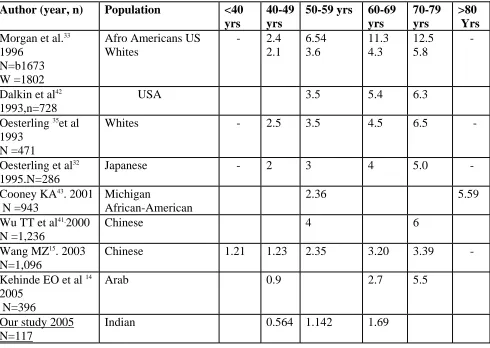
Comparative data’s are shown in table - 5
Table – 5
Age specific PSA -95 Percentile value
Author (year, n) Population <40 yrs
40-49 yrs
50-59 yrs 60-69 yrs
70-79 yrs
>80 Yrs
Morgan et al.33 1996
N=b1673 W =1802
Afro Americans US Whites
- 2.4 2.1 6.54 3.6 11.3 4.3 12.5 5.8 -
Dalkin et al42 1993,n=728
USA 3.5 5.4 6.3
Oesterling 35et al 1993
N =471
Whites - 2.5 3.5 4.5 6.5 -
Oesterling et al32 1995.N=286
Japanese - 2 3 4 5.0 - Cooney KA43. 2001
N =943
Michigan
African-American
2.36 5.59
Wu TT et al41 2000 N =1,236
Chinese 4 6
Wang MZ15 . 2003 N=1,096
Chinese 1.21 1.23 2.35 3.20 3.39 - Kehinde EO et al 14
2005 N=396
Arab 0.9 2.7 5.5
Our study 2005 N=117
Anderson et al4 4 found that the published age specific
reference ranges were too high for men younger than 60 and too
low for men aged 70 –79 years. Their proposed upper limit of
normal were 1.5 ng/ml for men 40-49 years, 2.5 ng/ml for 50 to
59 years, 4.5 ng/ml for 60-69 years, and 7.5 ng/ml for men 70-79
years. Even though our study population did not include men in
there 70s, our study also shows low age specific reference values
for men less than 69 years.
In our study the mean value of serum PSA was 0.49 for 40
– 49 years, 0.99 for 50-59 years and 1.27 for 60-69 years (Fig.4).
There was an increase in mean PSA value with increase in age,
and the difference was statistically significant.
Kamal BA et al1 7 showed similar results in Saudi men. The
0.49
0.99
1.27
0 0.2 0.4 0.6 0.8 1 1.2 1.4
1
Age Group
Mean PSA Value
40-49 50-59 60-69
(Fig.4)
Battikhi MN et al1 6 studied age-specific reference ranges of
TPSA and FPSA. Recommended values of TPSA and FPSA were,
2.3 and 0.51 ng/ml for 30-34 y; 2.9 and 0.59 ng/ml for 35-39 y;
3.2 and 0.63 ng/ml for 40-44 y; 3.75 and 0.71 ng/ml for 45-49 y;
3.8 and 0.83 ng/ml for 50-54 y; 3.75 and 0.96 ng/ml for 55-59 y;
4.3 and 1.26 ng/ml for >60 y old respectively. Similar to our
study (Fig.5) they showed a continuous increase in TPSA. They
also showed increase in FPSA with a significant correlation
Age-specific reference ranges for serum PSA
0 0.5 1 1.5 2 2.5
0 10 20 30 40 50 60
Fig.5
Only two variables are shown in Fig.5. Serum PSA range in
the age group 60 – 69 was not shown due to the small size (9%).
El galley et al3 6 (largest analysis) supported the use of age
specific reference ranges because of demonstrated increase in
sensitivity and increase in specificity in older men and
subsequent decrease in biopsy in older men.
40 –49 y
Catalona WJ et al1 3 found that percent free PSA and
age-specific PSA cutoffs enhanced PSA age-specificity for cancer
detection, but percent free PSA maintained significantly higher
sensitivities. They showed that the %fPSA and PSAD were more
sensitive (95% sensitivity) and age-specific PSA cutoffs missed
20% to 60% of cancers in men older than 60 years of age. The
prostatic volume (KUBU) in our study ranges from 16 – 28ml.
Ito K et al1 2 also found that using the age-specific PSA
reference range the sensitivity, specificity, and efficiency
increased to 92.4%, 91.2%, and 84.3%, respectively. The
diagnostic efficiency of the age-specific PSA reference range
was optimal with cutoff values of 3.0, 3.5, 4.0, 4.0, and 7.0
ng/mL in subjects 60 to 64, 65 to 69, 70 to 74, 75 to 79, and
older than 80 years of age, respectively. All of the cases of
prostate cancer detected were clinically significant.
Studies3 2 , 3 5 , 4 2 , 4 4 have clearly shown the importance of age
specific reference range and the importance of knowing the race.
The clinical meaning of a given PSA varies from one race to the
Investigators have recommended age specific prostate
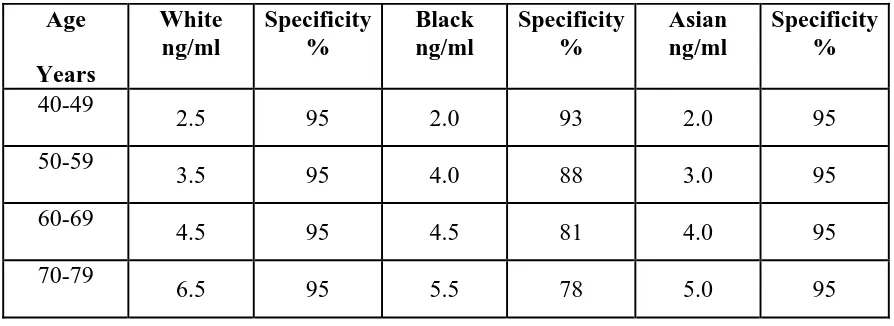
specific reference ranges based on ethnicity3. (Table-6)
Recommended Age Specific Prostate Specific Reference Ranges3.
[image:51.612.101.548.289.452.2](Controversial)
Table – 6
Age Years White ng/ml Specificity % Black ng/ml Specificity % Asian ng/ml Specificity % 40-49
2.5 95 2.0 93 2.0 95 50-59
3.5 95 4.0 88 3.0 95 60-69
4.5 95 4.5 81 4.0 95 70-79
6.5 95 5.5 78 5.0 95
Osterling et al4 5 concluded that by using age specific reference ranges for serum PSA the sensitivity decreased by 9%, the
specificity increased by 11% and the over all positive predictive
SUMMARY
Aim
To determine age-specific reference ranges for serum
prostate-specific antigen (PSA) concentration in South Indian
men.
Study design
Cross sectional study.
Setting
This study analyzed the PSA value of 117 subjects with out
lower urinary tract symptoms during the period October 2003 to
September 2005 at Government General Hospital. Chennai -3
Inclusion criteria
1. Individuals attending Urology clinics for minor illness
2. Normal healthy volunteers.
Exclusion criteria
1. Subjects with history of lower urinary tract symptoms
2. Subjects with history of recent urethral
instrumentation.
3. Subjects with history of recent catheterization
Data collection
Our study group consisted of 117subjects belonging to the
subpopulation of Chennai from south India of different age
groups ranging from 40 to 69 years. Detailed history was taken
and a complete clinical examination was done. Blood
biochemical analysis and urine analysis was done for all patients.
Ultrasound KUBU, digital rectal examination was done in all
selected subjects. Complete questionnaire is shown in appendix 1
Serum PSA was estimated2 9 using ELISA, and Bayer ADVIA
centaur assay kits (last 25 patients).
Case definitions
Subjects referred to urology department for evaluation of
renal cyst, back pain, renal microlith, infertility were included in
the study. Three cases of renal calculi with out urinary tract
infection were also included in the study. Healthy volunteers
(hospital workers, patient’s attenders) after through examination
Statistical analysis
Statistical analysis by Student ‘t’ test. Confidence intervals
mean, minimum and maximum values were calculated for each
decade of age group. Confidence interval high represents 95t h
percentile value in a given group.
Results During the study period October 2003 to September
2005, serum total PSA of 117 subjects with out lower urinary
tract symptoms and any other major clinical illness between the
age group 40 to 69 years were analyzed.
Using the 95t h percentile CI, the recommended age-specific
reference ranges of total PSA values were as follows: for the age
group 40 – 49 years 0.564 ng/ml, 50-59years 1.142 ng/ml
respectively, and for the age group 60-69years serum PSA 95t h
percentile value is 1.69 ng/ml. The minimum value of total serum
PSA detected was 0.05 ng/ml and the maximum value of serum
PSA was 2.30 ng/ml.
The mean PSA value increased from 0.49 for men aged
between 40to49 years to 1.27 for men aged between 60-69 years.
The increase was statistically significant (p =0.000).
The mean total PSA value increased from 0.99 for men
aged between 50 to59 years to 1.27 for men aged between 60 to
69 years. But the increase was not statistically significant (P
=0.190), this may be because of the small sample size (9.4%) in
the age group 60 to 69 years. Serum PSA was detected in the sera
of all the 117 subjects
CONCLUSION
1. The serum PSA concentration directly correlates with the
patient’s age. Thus, rather than relying on a single
reference range for men of all age groups, it is more
appropriate to have age-specific reference ranges.
2. Age-specific reference ranges have the potential to make
serum PSA a more discriminating tumor marker for
detecting clinically significant cancers in older men and to
find more potentially curable cancers in younger men.
3.
Age and race specific reference range will help indeveloping specific algorithm for different population to
BIBLIOGRAPHY
1. Keetch DW, Catalona WJ, Smith DS. Serial prostatic biopsies in
men with persistently elevated serum prostate specific antigen values.
The Journal of Urology 1994; 151(6): 1571–1574.
2. Ablin RJ, Bronson P, Soanes WA, Witebski E: Tissue- and
Species-specific Antigens of Normal Human Prostatic Tissue. Journal of
Immunology. Vol 104, No 6, June 1970
3. Polascik TJ, Osterling JE, Partin AW. Prostate specific antigen a
decade of discovery – what we have learned and where we are going.
J Urol 1999; 162:293
4. Ballentine canter H, Partin AW. Diagnosis and staging of prostate
cancer. Campbell’s Urology. Eighth Edition. Volume 4; 3057
5. D'Amico AV, Chen MH, Roehl KA, Catalona WJ. Preoperative PSA
velocity and the risk of death from prostate cancer after radical
prostatectomy. N Engl J Med. 2004 Jul 8; 351(2): 125-35.
6. Catalona WJ, Bartsch G, Rittenhouse HG, Evans CL, Linton HJ,
Horninger W, Klocker H, Mikolajczyk SD. Serum pro-prostate
specific antigen preferentially detects aggressive prostate cancers in
men with 2 to 4 ng/ml prostate specific antigen. J Urol. 2004 Jun;
7. Parsons JK, Brawer MK, Cheli CD, Partin AW, Djavan R.Complexed
prostate specific antigen (PSA) reduces unnecessary prostate biopsies
in the 2.6-4.0ng/mL range of total PSA.BJU Int. 2004 Jul;94(1):47-50.
8. Oesterling, Joseph E, Tekchandani, Anita H et al: The Periurethral
Glands do not significantly influence the serum prostate specific
antigen concentration. Journal of Urology. May 1996; 155(5):
1658-1660
9. Grayhack JT et al: Benign prostatic hyperplasia. Adult and Pediatric
Urology Chapter 32; Volume 2; 1416
10.Carter HB, Pearson JD. Prostate specific antigen testing for early
diagnosis of prostate cancer: formulation of guidelines. Urology
1999; 54:780.
11.Carter BS, Bova G, et al: Hereditary prostate cancer. J Urology 1993;
150; 797
12.Ito K et al: Usefulness of age-specific reference range of prostate
specific antigen for Japanese men older than 60 years in mass
screening for prostate cancer
.
Urology. 2000 Aug 1; 56(2): 278-82.13.Catalona WJ et al:Comparison of percent free PSA, PSA density, and
age-specific PSA cutoffs for prostate cancer detection and staging.
Urology. 2000 Aug 1; 56(2): 255-60
14.Kehinde EO et al: Age-specific reference levels of serum
prostate-specific antigen and prostate volume in healthy Arab men
.
15.Wang MZ et al: Age-specific reference ranges for serum
prostate-specific antigen in Chinese men. Zhonghua Yi Xue Za Zhi. 2003 Oct
10; 83(19): 1665-7
16.Battikhi MN et al. Age-specific reference ranges for prostate-specific
antigen in Jordanian patients
.
Prostate Cancer Prostatic Dis. 2003;6(3): 256-60.
17.Kamal BA et al: Prostate specific antigen reference ranges in Saudi
men
.
Saudi Med J. 2003 Jun; 24(6): 665-8.18.Flanigan et al: Accuracy of digital rectal examination and trans rectal
ultrasonography in localizing prostate cancer. J Urology 1994;
152:1506.
19.Catolona WJ, Smith DS et al: Evaluation of percentage of free serum
prostate specific antigen to improve specificity of prostate cancer
screening. JAMA 1995 274: 1214.
20.Catolona WJ et al: Use of the percentage of free prostate specific
antigen to enhance differentiation of prostate cancer from benign
prostatic disease. JAMA 1998; 279:1542.
21.Carter HB et al: What is the shortest time interval over which PSA
velocity should be measured? J Urology 1995a; 153: 419A
22.Thompson IM, Pauler DK et al: Prevalence of prostate cancer among
men with a prostate specific antigen level< or =4 .0ng/ml. N Engl J M
23.Catolona WJ et al: Prostate cancer screening. BJU International 2004;
94: 964 –965
24.Kozlowski JM, Grayhack JT. Carcinoma of prostate. Adult and
Pediatric Urology. Fourth edition. Chapter 33; Volume 2: 1497 –1506
25.Marie –Blanche T et al. The role of prostate specific antigen in the
evaluation of benign prostatic hyperplasia. Urological clinics of North
America. Volume 22; 2. May1995; 333-343.
26.Criley SR et al; Standard reference range versus age specific reference
ranges for PSA among 3937 men with clinically localized prostate
cancer. J Urol 151 (suppl): 449 A, 1994
27.Catalona WJ, Bartsch G, Rittenhouse HG et al; Serum pro-prostate
specific antigen improves cancer detection compared to free and
complexed prostate specific antigen in men with prostate specific
antigen 2.4 –4ng/ml. J Urol. 2003; 170: 2185-5.
28.Schalken JA etal; New targets for therapy in prostate cancer;
differential display code, a highly prostate cancer specific gene.
Urology 2003; 62 (suppl .5A): 34-43
29.Milford ward et al: Prostate specific antigen; biology, biochemistry
and available commercial assays.Ann clin biochem 2001;38:635-651.
30.Robin T.vollmer; Race and Linkage Between Serum Prostate –
specific antigen and prostate cancer. Am J Clin Pathol 122(3):
31.Peter C.Albertson: Screening for prostate cancer is neither appropriate
nor cost effective. Urological clinics of North America.
Volume 23; 4.; Nov1996; 521-539
32.Oesterling etal: Serum prostate specific antigen in community based
population of healthy Japanese men: lower values than similarly aged
white men. BJU I995; 75; 347-353.
33.Morgan et al: Age specific reference ranges for prostate specific
antigen in African American men. N Engl J M ed 1996; 335: 304-310
34.Malathi .T, Rajani kumari: Racial and ethnic variation of PSA in
global population: Age specific reference intervals for serum prostate
specific antigen in healthy south Indian males. Indian journal of
clinical biochemistry, 2004, 19(1) 132-137.
35.Richardson TD, Oesterling et al; Age - Specific Reference Ranges for
Serum Prostate Specific Antigen. Urological clinics of North
America. Volume 24; 2; May1997; 339-349.
36.El –Galley et al: Normal range prostate specific antigen verses age
specific prostate specific antigen in screening prostate
adenocarcinoma. Urology 1995; 46; 200.
37.Schalken JA. Molecular and cellular prostate biology: origin of
prostate specific antigen expression and implications for benign
38.Ozdal OL et al: Comparative evaluation of various prostate specific
antigen ratios for the early detection of prostate cancer. BJU 2004; 93,
970-974.
39.Eldon et al. Familial risk of prostate cancer in Iceland.BJU2003;
92,915-919
40.Shlomo YB et al. Prostate cancer in black and white men; are there
differences in risk or prognosis. BJU2003; 92, 878-879
41.Wu TT et al. The clinical usefulness of prostate-specific antigen
(PSA) level and age-specific PSA reference ranges for detecting
prostate cancer Chinese. Urol Int. 2004; 72(3): 208-11
42.Dalken et al; Prostate specific antigen level in men older than 5o years
with out clinical evidence of prostate cancer .J urol150; 1837, 1993.
43.Cooney et al
.
Age-specific distribution of serum prostate-specificantigen in a community-based study of African-American
men
.
Urology. 2001 Jan; 57(1): 91-6.44.Anderson et al. age specific reference ranges for serum prostate
specific antigen. Urology 46; 54, 1995.
45.Oesterling et al: The use of age specific reference ranges for serum
prostate specific antigen in men 60 years or older. J Urology 1995;
46.Oesterling et al: Free, complexed and total prostate specific antigen;
the establishment of appropriate reference ranges for their
concentrations and ratios. J Urology 1995; 154; 1090.
47.Brawer et el .The inability of prostate specific antigen index to
enhance the predictive value of prostate specific antigen in the
diagnosis of prostate cancer .J Urol 1993:150; 369
48.Catalona et al; Comparison of digital rectal examination and serum
prostate specific antigen in the early detection of prostate cancer.
Results of multicenter clinical trial of 6630 men Urol1994; 151; 128
49.Benson et al. Prostate specific antigen density. A means of
distinguishing benign prostatic hypertrophy and prostate cancer.J
.Urol 1992:147;815-6
50.Carter et al; Longitudinal evaluation of PSA levels in men with and
with out prostate disease. JAMA 1992 B; 267; 2215.
51.Black et AL; Development of an ultrasensitive assay for human
gladndular kallikerin with no cross reactivity for PSA. Clin
chem.1999; 45; 790.
52.Takayama et al. Characterization of precursor of prostate –specific
antigen. Activation of trypsin and human glandular kallikerin .J bio
chem.1997; 272; 215 82.
53.Myrtle et al; Normal level of PSA in clinical aspects of prostate
54.Iwakini et al: An Analysis of urinary prostate specific antigen before
and after radical prostatectomy. Evidence for secretion of PSA by the
periurethral glands. J. Urol 149: 783-786, 1993.
55.Oesterling et al: Serum prostate specific antigen in a community based
population of healthy men. Establishment of age specific reference
ranges. JAMA: 270:860, 1993.
56.Oesterling et al: influence of age on serum prostate specific antigen
concentration. Urological clinics of North America. 20:671, 1993.
57.Oesterling et al: Effects of cystoscopy, prostatic biopsy and
transurethral resection of prostate on serum PSA concentration.
Urology 42:3, 1993.
58. Ries LAG, Eisner MP, Kosary CL, et al. (eds). SEER Cancer
Statistics Review, 1975–2001, National Cancer Institute. Bethesda,
APPENDIX I
PROFORMA
Age-specific reference ranges for serum prostate-specific antigen
(PSA) concentration in south Indian men.
Name :
Age :
I.D. No. :
Diabetic : Yes No
Hypertensive : Yes No
Smoker : Yes No
Alcoholic : Yes No
Surgery : Yes No
Medication : Yes No
Inclusion criteria
3. Individuals attending urology clinics for minor illness
4. Normal healthy volunteers
Exclusion criteria
5. Subjects with history of lower urinary tract symptoms
6. Subjects with history of recent urethral instrumentation
8. Patients with history of Prostatitis
Investigations :
Hb Blood Urea
Urine Albumin Sugar
Sugar Creatinine
Deposits
USG KUBU
Serum PSA
Clinical Examination
Per Rectal Examination
Prostate : Consistency
Grade
APPENDIX - II MASTER CHART
S.
No. Name Age Diabetic Hypertensive Surgery Medications
S.PSA ng/ml
1. Thangaraj 44 - - - - 0.79
2. Muthu 48 - - - - 0.54
3. Sundar 44 - - - - 0.74
4. Murugan 42 - - - - 0.23
5. Elappan 45 - - - - 0.67
6. Kandasamy 46 - - - - 0.87
7. Mani 40 - - - - 0.40
8. Annamalai 44 - - - - 0.35
9. Sekar 46 - - - - 0.50
10. Mohammed 47 DM - - Daonil 0.30
11. Padmanaban 44 - - - - 0.22
12. Pakirisamy 44 - - - - 0.48
13. Kumar 47 - - - - 0.40
14. Ranga Rajan 45 - - - - 0.05
15. Arjun 42 - - - - 0.35
16. Chandrasekar 40 - - - - 0.50
17. Shivalingam 46 - - - - 0.45
18. Srinivasan 44 - - - - 0.15
19. Subramani 45 - - - - 0.23
20. Sivakumar 44 - - - - 0.38
21. Ahmed Basha 45 - - - - 0.40
22. Thillai Govindan 47 - - - - 0.30
23. Seetharam 46 - - - - 0.50
24. Muniratnam 45 - - - - 0.30
25. Paneer 45 - - - - 0.40
26. Balakumar 46 - - - - 0.12
27. Venkatesh 43 - - - - 0.20
28. Muthusawmy 44 - - - - 0.30
29. Chandran 45 - - - - 0.25
30. Thangaraj 42 - - - - 0.25
31. Ramakrishnan 46 - - - - 0.30
32. Jaganathan 46 - - - - 0.45
33. Ramalingam 49 - - - - 0.20
34. Shankar 49 - - - - 1
35. Abdul Kareem 46 - - - - 0.78
36. Durai Raj 47 - - - - 0.76
37. Ganesan 47 - - - - 0.35
38. Mohan Raj 43 - - - - 0.82
39. Saunder 42 - - - - 0.21
40. Thangam 49 - - - - 1.10
41. Thirumurgan 48 - - - - 0.85
42. Raman 44 - - - - 0.35
43. Tholkapian 42 - - - - 0.70
44. Umapathy 45 - - - - 0.90
45. Baskaran 46 - - - - 0.80
46. Krishnamoorthy 47 - - - - 1.00
47. Muthaiah 48 - - - - 0.55
49. Prabakaran 49 - - - - 0.75
S.
No. Name Age Diabetic Hypertensive Surgery Medications
S.PSA ng/ml
51. Rajendren 58 - - - - 0.50
52. Kannappan 55 - - - - 0.36
53. Rangasamy 59 - - - - 0.58
54. Swamy 57 - - - - 0.40
55. Esupatham 52 - - - - 0.90
56. Jayamurthy 51 - - - - 0.50
57. Vetrivel 53 - - - - 0.59
58. Thripathy 58 - - - - 2.02
59. Veerasamy 58 - - - - 0.10
60. Muthupandian 55 - - - - 1.40
61. Subramanian 55 - - - - 1.65
62. Sa Mohammed 56 - - - - 0.75
63. Ratinavel 54 - - - - 1.25
64. Subramanian 59 - HT - Atenolol 2.30
65. Narayanasamy 57 - - - - 0.75
66. Sivakumar 58 - - - - 0.60
67. Govindasamy 56 - - - - 0.55
68. Shakir Ahamed 57 - - - - 0.80
69. Balaraman 59 - - - - 0.70
70. Durai Raj 54 - - - - 0.78
71. Rajagopal 55 - - - - 1.10
72. Mohammed 55 - - - - 0.90
73. Ramachadran 56 - - - - 0.90
74. Khader 54 - - - - 0.80
75. Govindan 55 - - - - 0.70
76. Arunachalam 56 - - - - 0.75
77. Poongavanam 50 - - - - 0.68
78. Jawahar 52 - - - - 0.60
79. Subramanian 53 - - - - 1.00
80. Nandalal 52 - - - - 0.70
81. Ardhanari 50 - - - - 1.44
82. Marimuthu 53 - - - - 0.95
83. Kamal Basha 54 - - - - 0.70
84. Mathews 55 DM - - Daonil 0.65
85. Senthamarai 56 - - - - 0.70
86. Malayandi 57 - - - - 0.60
87. Natarajan 56 - - - - 0.40
88. Govinda Rajan 58 - - - - 0.55
89. Krishna Murthy 59 - - - - 1.34
90. Mahalingam 58 - - - - 0.41
91. Amirtham 59 - - - - 1.10
92. Durai 53 - - - - 1.56
93. Desai 59 - - - - 0.80
94. Veeraragavan 58 - - - - 1.02
95. Subramani 58 - - - - 0.36
96. Ranganathan 57 - HT - Atenolol 2.05
97. Mannan 57 - - - - 2.01
98. Jayabal 59 - - - - 0.45
99. Thangaraj 56 - - - - 0.45
S.
No. Name Age Diabetic Hypertensive Surgery Medications
S.PSA ng/ml
101. Jayapal 56 - - - - 2.00
102. Muthu 56 - - - - 2.20
103. Chakaravathy 59 - - - - 1.70
104. Jayavel 58 - - - - 1.95
105. Mani 58 - - - - 2.20
106. Razak 59 - - - - 1.80
107. Rajagopalan 69 - - - - 0.50
108. Govindan 65 - - - - 0.57
109. Krishnamurthy 63 - - - - 1.34
110. Mahalingam 69 - - - - 0.41
111. Karunakaran 69 DM - - Daonil 0.90
112. Krishnasamy 68 - - - - 1.85
113. Ramani 66 - - - - 2.15
114. Subramani 69 - - - - 2.10
115. Perumal 68 - - - - 2.20
116. John Mathews 63 - - - - 1.34