Deviant Acts
Kim Southey
University of Southern Queensland
When an employee is accused of engaging in a deviant act by his/her employer, natural justice affords the employee the right to respond to the allegation. In this study, the texts of unfair dismissal arbitration decisions of the Australian Industrial Relations Commission are examined to identify the defences raised by workers (or their union representatives) to accusations of serious misconduct that ultimately resulted in their immediate dismissal. These defences provide the foundation of a conceptual model of three categories of ‘rationale’ that employees offer in their defence: personal-inside; personal-outside; and workplace related. The model further conceptualises a ‘conflated reason’ in which categories are not mutually exclusive and can result in the employer dealing with a complexity of contexts and issues. The value of this paper is that it provides insight into the range of defences that employees provide for behaviours that cut to the core of damaging the employer-employee relationship.
Introduction
This study examines the employee’s explanation as to why he/she engaged in a deviant act or acts in relation to their work. On that basis, this paper treats an employee’s self reported rationale for engaging in deviant behaviour as potentially distinct from studies that identify antecedents or causes of deviant behaviour. The following example illustrates this point of difference. An employee working in a child related industry did not disclose at his interview that a number of years earlier, he had been investigated and issued a restriction from working with one particular family. In his defence the employee countered that the restriction was not relevant to his current job and to provide details of the restriction to his employer, post appointment, would invade his privacy. This is the employee’s self reported rationale for failing to disclose vital information (and thus engage in a deviant behaviour) and is the phenomenon explored in this study. The true cause or antecedent for his non-disclosure is more likely he knew he was not a suitable candidate and consequently embarrassment, fear, or desperation might be the more valid explanation for his behaviour, but also a non-justifiable defence to provide his employer.
It is noted that employees’ self reported rationales compared to their genuine reason for their behaviour are not always mutually exclusive, and in fact, it is expected in many cases the employees explanation for their behaviour and the real reason they engaged in the behaviour are one and the same. Alternatively, there may be instances where employees provide what they believe is a true and conscious rationale, but had different subconscious triggers that lead to the behaviour.
Employee Deviance: Definition and Research
Whilst a variety of terms and nuances are used in the area of what is collectively known as ‘dysfunctional behaviours’ in the workplace (Griffin & Lopez, 2005) the generally accepted definition of employee deviance is: activities which violate the norms or rules of the formal work organization (Hollinger & Clark, 1982). Not all behaviours that fit within the ‘deviant behaviour’ definition result in negative organisational consequences, for example whistle blowing and innovative thinking can creative positive outcomes (Appelbaum, Iaconi, & Matousek, 2007; Kidwell & Kochanowski, 2005; Litzky, Eddleston, & Kidder, 2006).
The literature on deviant workplace behaviour identifies the typology developed by Robbins and Bennett (1995) as a leading paper to classify employee deviance into four categories: production deviance; property deviance; political deviance and personal deviance. This typology was developed in part on the earlier work of Hollinger and Clark (1982) in which they defined a two category typology of production and property deviance and tested the hypotheses that a statistically significant relationship exists between perceived job satisfaction levels and involvement in these two categories of deviances. Robbins and Bennett further added the categories of political and personal deviance into the typology and suggested these types of behaviours were influenced by individual and interpersonal factors amongst people in the workplace. These studies combined identify two broad antecedents to deviant behaviour: organisational factors and personal factors.
Studies using the Robbins and Bennett typology have proliferated in recent years. For example, Wellen & Neale (2006) used the typology to investigate the effect of an individual’s deviant behaviour on other people within the work group and found that deviant employees threaten a group’s collective commitment to achieving its goals. Lawrence and Robinson (2007) use the typology to assess how power effects workplace deviance, deriving the conclusion that specific forms of power will trigger specific types of workplace deviance. Likewise, the Robbins and Bennett typology is used by Everton, Jolton and Mastrangelo (2007) to frame a review of studies into deviant behaviours.
Many studies have sought to describe, categorise and enhance our understanding of deviant behaviour in the workplace. For example, specific acts of deviance investigated include Lucero et al.’s (2003) categorisation of sexual harassment perpetrators and the characteristics of their behaviours. The issue of ‘incivility’ between professional workers formed the basis of Montgomery, Kane and Vance’s paper (2004) in which they identified cultural and demographic influences on acts that violate norms of respect between workers. Domagalski and Steelman (2005) identified some of the triggers and moderators of anger in the workplace: unjust treatment, interpersonal incivility, employee status and trait anger.
Other researchers have focused on the organisational contexts in which the deviant behaviours occur. For example, Harris and Ogbonna (2002) forward the notion of ‘service sabotage’ and created a typology, antecedents and consequences of deviant behaviour within the employee-customer relationship. Raelin (1986) examined less serious deviant behaviour, such as absenteeism, amongst salaried professionals and developed the ‘adaptive behaviour/deviant behaviour’ continuum which is (ultimately) triggered by conflicting expectations between the professional employee and his/her management.
engagement in personal activities is widespread and easily rationalised by employees in the pursuit of work-life balance and the significant value they place on their personal life realm. In another study, incidences of violence in the workplace were found to be significantly related to organisational triggers of bad management practices; aggressively based reward packages; and unfair personnel policies (Leck, 2005). Similar to Domagalski and Steelman’s (2005) study on workplace anger, Leck also found the personality and demographic characteristics identified within a ‘violent offender profile’, such as age, gender and controlling personality, were also predictors of violent behaviour in the workplace. Avery, Wernsing and Luthans (2008) modelled the relationship between psychological capital, positive emotions and employee behaviour and found that higher psychological capital leads to more positive emotions - an antecedent for more engaged workers and less deviant behaviours. Psychological capital is the grouping of four constructs: hope, efficacy, optimism and resilience (Luthans & Yousef 2007 in Avery et al., 2008). These feeling are found to ‘best meet the criteria for the definition of positive organisation behavior’ (Avery et al., 2008, p. 53). Collectively, studies such as these contribute to building an explanation as to why (and why not) employees engage in deviance. This study will further inform this aspect of deviant behaviour by identifying and classifying employee self reported disclosures on why they engaged in such behaviour.
Methodology
As recommended by Griffin and Lopez (2005, p. 1003) this research uses a methodology that employs ‘the use of archival or unobtrusive measures through government records … to capitalise on such data … to develop a better understanding of patterns and trends associated with at least certain kinds of dysfunctional behaviours.’ Further, this methodology overcomes the challenges of research subjects relying on recall in surveys or asking people to record their ‘reaction’ to a real or hypothetical case. In essence, appropriate conclusions for the type of data collected in this study are more likely because the data were collected in an unobtrusive measure. Obtrusive collection tends to result in people behaving or responding differently because they are aware that some form of measurement is taking place (Leedy & Ormrod, 2001). In this study, the evidence collected from the source documents is factual and not subject to people altering their behaviour or responses because of the presence of a researcher.
Data were collected by downloading full text unfair dismissal arbitration decisions from the website of the Australian Industrial Relations Commission. Decisions from 2005 were selected with it being the final year recording dismissal activity of employers before claim accessibility was limited by the WorkChoices reforms. For that year, 128 unfair dismissal decisions were identified, from which 46 cases were extracted for detailed analysis as they pertained to claims where the employee was summarily dismissed. Summary dismissal is available to an employer when the employee engages in serious behaviour repudiating the employment contract (CCH Australia Limited, 2008). These behaviours also fall within the definition of deviant employee behaviour of violating an organisational norm or rule. Using NVivo8 software as a collation tool, pieces of text were captured where the employee, union representative or arbitrator either addressed or summarised ‘why the employee did what they did’. The collected text was sorted into themes which are presented in the following discussion.
Results
reasons (82) than examined cases (46). The most frequently cited theme was ‘denial’ of the accusation which occurred in 20 of the defence incidents. This was followed by ‘felt inequity or tension’ and ‘accepted employer practice’ each accumulating nine occurrences. Table 1 provides a full account of these themes along with a sample of relevant text identified from the data used to assign the theme.
Table 1: Employee Responses to Accusation of Misconduct
Rationale Examples
Intentional behaviour
Employee ‘conceded he decided to tell a lie during his security interview … he went on to concede that most of the information he had given (the employer) in relation to the assault was, in fact, untrue.’
Employee admits he sent a major customer to a competitor. Employer said ‘I thought (the employee) would try and say something to save his job but he just turned to me and smiled and said ‘that’s okay, so long as I get the money (past co-worker) got’.
Ignorance of rules
Employee admitted sending inappropriate emails but ‘at the time did not fully foresee the ramifications of the email and that he was now aware of the email policy.’
Atypical behaviour
‘His actions were out of character. All the (co workers) giving evidence indicated they had worked well without problems’
Self defence
‘Obviously I would have raised my voice. It is a way of protecting oneself, but I mean, I’m not being the aggressor, I have not been put (sic) my hand up, but I mean, my voice would have been louder, really to stop the argument escalating’.
Employee stated in response to confronting his supervisor: ‘you’ve got to stand up for yourself … you’ve got to pull your own weight, you don’t bludge on the other fellows’.
Genuine mistake
‘The applicant took the magazines from the damaged consignment to read with the intention of returning them. The applicant thought he would return them the next day but genuinely forgot to do so.’
The employee ‘contended that some of the alterations were done in error … he acknowledges the breach; apologises and indicates he acted carelessly’.
Employee failed to provide documentation to employer because ‘an officer at Centrelink told that they would forward a copy of the certificate to my employer. As a result, I did not think I needed to ring (the employer)’.
Felt inequity or tension
Employer reimburses petrol costs via payroll. Employee responds ‘I got to pay tax on that now, and I can’t claim it and it’ll bugger up all my returns at the end of the year again… you can’t do that. It’s not fair’.
Employee claims he ‘was omitted from an email list about a meeting … had received calls from employees warning him to “watch out”’’.
Employee claims ‘he was allocated an unfair workload and allocated unusual bids’.
Felt invasion of privacy
Rationale Examples
Denial
‘He denied being in (supervisor’s) face. He denied making any physical threats to (supervisor). He stated that he may have said ‘this is bullshit’.
Employee ‘denied she had placed’ peanuts in the liquorice and instead she was ‘putting scrape extruded liquorice back into the extruder’.
Employee ‘denied he gave misleading answers at the interview ... everything was ‘fine and true’ at that particular moment in time.’
‘You can’t punch your workers’ to which employee responds ‘I didn’t even know I’d punched somebody’.
‘That is not my behaviour. I would never do that to anybody. I would never get into anybody’s face like that. And it is just not something I would do. It is something so – not me’
‘I’m saying that one of us is telling the truth and I’m telling the truth here so I don’t know why they’re saying that. Maybe they can’t remember.’
Financial pressures
Employee ‘testified that his financial position became so poor that he could not afford to make telephone calls and says this is the reason for any gaps or failure on his part to contact (the employer) as he otherwise should have … he could not afford to telephone every day and as far as he was concerned (the employer) knew about his situation’.
Mood altering substances
Employee ‘estimates he consumed between 11 to 14 drinks … (employee) does not recall much of what happened after 2.30 am’.
Personal tragedy
Employee defence was built on ‘the approaching anniversary of her son’s death that caused (the employee) to be initially upset’ and ‘it is clear (the employee) was particularly concerned over an erroneous reference, in the record of the counselling and warning process to the manner of her son’s death’.
‘At the time of the incident, I had not had the opportunity to properly deal with my father’s death. I felt there was a lot of ‘unfinished business’ between the two of us when he died and I harboured a great amount of emotion, guilt and fear about my father … the comment by (co-worker) about my father was highly offensive to me… reacted instinctively to the offensive remark’.
Personal health
Employee failed to contact employer about his absence because ‘he was “laid up” for three days and could barely move’.
‘It is clear from the evidence that the applicant had a different version of the conduct of his behaviour to that expressed by the rest of his colleagues. However it is also clear from the evidence that the applicant had a diagnosed medical condition called Meniere’s Disease, a condition which affects the hearing causing a constant ringing sound in the ear, which may have caused him some discomfort.’
Family duties or issues
Employee failed to provide medical certificate before a set date because ‘his ex-partner and his children moved house during this period and he helped them do so’.
Rationale Examples
The union representative stated that (the employee’s) wife was unwell and the employer refused to give leave when his wife was sick.
Job changes
Employee wrote to employer ‘complaining that his duties had changed and that he was not working as a boat builder/shipwright’. (Employer) responded in writing the same day. He contended (employee) had not been engaged as a boat builder/shipwright. He made assertions (employee) failed to comply with directions’.
Pressure from another person
Employee accused of leaking confidential information ‘provided the information not at her own initiative but in response to requests from (her former supervisor)… acting out of loyalty to her former longstanding boss’.
Employee sent email of a sexual nature to a co-worker who ‘had requested the email be sent to him and was aware of its content’.
Accepted employer practice
As a night security guard ‘80% of his time was ‘downtime’ and it was accepted practice for staff to perform non work tasks during such periods …. that he generated most of the personal emails.’
‘It was normal practice to claim expenses as cash from the till’.
Employee stated ‘Waste grain had no value and its disposal to farmers was a cost saving … the practice had gone on for a long time without any repercussions on individuals.’
Poor employer policy or practice
‘There were no guidelines or protocols to guide officers on how to behave on field trips … rumours existed about behaviour on field trips. However management paid no attention to such rumours ... This (incident) occurred in circumstances where there were no limits on what he could do imposed by the Department’.
Employee ‘was not given instructions by (the employer) as to correct procedures to be followed to identify a patient, or what to do if a patient was not wearing a wrist band’.
Poor communicat ion
The employee ‘explained the note was not derogatory because “I (the employee) believe it is a factual note” and blamed the fact that (co-worker) hadn’t been spoken to when issues had been raised previously’.
‘There had been difficulties in communications ... Communication was largely by text messages and emails’
Discussion of Results and the Emergence of a Conceptual Model
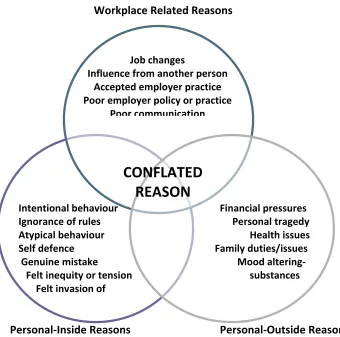
The 18 themes crossed a range of employee defences and required further categorisation to organise them into an easily conceptualised format. The evidence found in studies on antecedents of deviant behaviour by Harris and Ogbonna (2002), Leck (2005), Domoglaski and Steelman (2005) and Avery, Wernsing and Luthans (2008) suggest that organisational conditions and individual characteristics influenced the employee in their decision to engage in deviance. It was clear from the themes collated in this research that the reasons employees gave for their behaviour were similarly following the pattern of being levelled at their employer and at other times, due to personal circumstances. The analysis outlined in this section is presented in the conceptual model in Figure 1.
denied the behaviour or reported that they felt the need to self defend, or that they reacted in response to feelings of tension or inequity.
The remaining personal reasons could be attributed to physical aspects surrounding the employee. These dimensions are consequently classified as ‘personal-outside reasons’ and are defined as those reasons which are non work related and exist in a tangible or measurable form. Typical examples are family responsibility, illness, financial stress and use of mood altering substances.
The employer focused reasons merged into a single category devoted to ‘workplace related reasons’. Workplace related reasons are defined as rationales that pertain either directly or indirectly to the workplace. It may be possible that with further research into the types of rationale provided by employees that this category requires further division. For example, a case occurred where an employee provided confidential information to a former supervisor who had left the company. This case doesn’t directly fit within the domain of something that was in the employer control, nor does it fit directly with personal-outside because the event was triggered by a work related individual. For this reason, the classification of ‘workplace related reasons’ as opposed to ‘workplace reasons’ are used to take into account nuances of the described nature.
The conceptual model also needed to recognise that multiple themes from within and across categories occurred in a number of the cases. These are identified as ‘conflating reasons’ in the model. For example, an employee rationalised that his behaviour occurred because he had to meet a family commitment, he was financially stressed, he was unwell and he misunderstood a company policy. This case invokes both ‘personal-outside reasons’ and ‘workplace related reasons’ in the model. It is far from contended that the dimensions listed under each of the three categories in the model address the full range of reasons. The full range of reasons would be as varied as there are individuals in the workplace. Of more importance and contribution, is that the model provides a framework for classifying a comprehensive range of reasons.
Implications of this Research for Employers and Unions
This study reinforces the complexity of issues that management and unions contend with when dealing with employee defences. It is recommended that each issue nominated within an employee’s defence be dealt with on a piecemeal basis in order to diffuse the conflation of issues.
The research also emphasises the importance of employers to set boundaries on employee behaviours by having clear policies in place. Of particular issue is that of ‘custom and practice’, whereby employees engage in behaviour that has previously been condoned by the employer. This is closely related to the issue of poor employer practice and policies: if there is an absence of policy or policies are not upheld – custom and practice fills in the gaps.
At times, managers and union representatives can expect ‘denial’ of the activity to be used as a defence by employees. This proves challenging for those trying to investigate and/or administer a discipline. Denial causes a roadblock in the investigation process and can ultimately lead the employer to making a determination on ‘the balance of probability’ whether or not the employee engaged in the behaviour. This opens the need for dialogue as to
Workplace Related Reasons
Personal‐Outside Reasons Personal‐Inside Reasons
Job changes
Influence from another person
Accepted employer practice
Poor employer policy or practice
Poor communication
Intentional behaviour Ignorance of rules Atypical behaviour Self defence Genuine mistake
Felt inequity or tension Felt invasion of
Financial pressures Personal tragedy Health issues Family duties/issues Mood altering‐
substances
CONFLATED
[image:8.595.121.461.115.452.2]REASON
how more fruitful investigations can be conducted to reduce the need for employers to make a ‘balance of probability’ decision.
Limitations and Future Research
A limitation of this model is that this research could only assess deviant behaviour of a more serious nature that warranted dismissal. Less overt deviant behaviours such as working slow or taking a sick day when not genuinely unwell do not appear in the source data.
The model presented was also developed in isolation of other discipline areas such as psychological and moral frameworks which also deal with counter-normative behaviour, such as behavioural ethics (Trevino, Weaver, & Reynolds, 2006). In addition, this is an early conceptual model and future work can be devoted to gathering empirical support to further validate the themes in the major categories and mapping whether inter-relationships occur significantly between some of the elements within categories resulting in a conflated rationale. For example, are people who claim they made an honest mistake also more likely to claim poor employer policies and practices? Also open for further exploration is whether relationships exist between particular types of behaviours and particular defences. Being able to associate behaviours with defences can provide insights for the investigation, counselling and discipline processes.
The phenomenon of employee denial was identified in this research and triggers an abundance of further research questions. Why do employees deny behaviour and how often is denial genuine? How do managers, unions, mediators and arbitrators perceive ‘denial’? Does a denial strategy work – are consequences more or less serious for employees who use such a strategy?
Conclusion
Previous studies into antecedents of employee misbehaviour have focused on identifying triggers at psychological and environmental levels. These studies are essential for improving our understanding of the ‘real’ phenomena. This study is the first to assess self reported and potentially sanitised defences that employees provide when confronted with the ‘please explain’ question by their employer.
This paper advances two conceptual contributions to employee deviance research. First it identified, even if at the level of a nuance, the self reported rationale provided by the employee as to ‘why they did what they did’ may not accurately reflect the genuine issue of why employees engage in deviant behaviour. But, it is still essential we research these employee provided explanations as they are relied upon by employers, arbitrators and unions (particularly in the case of sworn testimony) as the real and true reason.
References
Appelbaum, S., Iaconi, G. & Matousek, A. (2007) 'Positive and negative deviant workplace behaviours: causes, impacts and solutions', Corporate Governance, 7(5):586-598.
Avery, J., Wernsing, T. & Luthans, F. (2008) 'Can Positive Employees Help Positive Organizational Change? Impact of Psychological Capital and Emotions on Relevant Attitudes and Behaviors', The Journal of Applied Behavioral Science, 44(1):48-70.
CCH Australia Limited (2008) 'Australian Employment Law Guide', from http://library2.cch.com.au/dynaweb/aem/aem/@CCH__BookView
D'Abate, C. (2005) 'Working hard or hardly working: A study of individuals engaging in personal business on the job', Human Relations, 58(8):1009-1032.
Domaglaski, T. & Steelman, L. (2005) 'The Impact of Work Events and Disposition on the Experience and Expression of Employee Anger', Organizational Analysis, 13(1):31-52.
Everton, W., Jolton, J. & Mastrangelo, P. (2007) 'Be nice and fair or else: understanding reasons for employees' deviant behaviours', Journal of Management Development, 26(2):117-131.
Griffin, R. & Lopez, Y. (2005) '"Bad Behavior" in Organizations: A Review and Typology for Future Research',
Journal of Management, 31(6):988-1005.
Harris, L. & Ogbonna, E. (2002) 'Exploring Service Sabotage: The Antecedents, Types and Consequences of Frontline, Deviant, Antiservice Behaviors', Journal of Service Research, 4(3):163-183.
Hollinger, R. & Clark, J. (1982) 'Employee Deviance: A Response to the Perceived Quality of the Work Experience', Work and Occupations, 9(1):97-114.
Kidwell, R. & Kochanowski, S. (2005) 'The Morality of Employee Theft: Teaching about Ethics and Deviant Behavior in the Workplace', Journal of Management Education, 29(1):135-152.
Lawrence, T. & Robinson, S. (2007) 'Ain't Misbehavin: Workplace Deviance as Organizational Resistance',
Journal of Management, 33 (3):378-394.
Leck, J. (2005) 'Violence in the Canadian Workplace', Journal of American Academy of Business, Cambridge, 7(2):308-315.
Leedy, P. & Ormrod, J. (2001) Practical Research: Planning and Design (7th Ed.), Merrill Prentice Hall, New Jersey.
Litzky, B., Eddleston, K. & Kidder, D. (2006) 'The Good, the Bad, and the Misguided: How Managers Inadvertently Encourage Deviant Behaviours', Academy of Management Perspectives, 20(1):91-103. Lucero, M., Middleton, K., Finch, W. & Valentine, S. (2003) 'An Empirical Investigation of Sexual Harassers:
Toward a Perpetrator Typology', Human Relations, 56(12):1461-1483.
MacLean, T., Anteby, B. & Rudolph, J. (2006) 'Talking Tainted Topics: Insights and Ideas on Researching Socially Disapproved Organizational Behavior', Journal of Management Inquiry, 15(1):59-68. Montgomery, K., Kane, K. & Vance, C. (2004) 'Accounting for Differences in Norms of Respect: A Study of
Assessments of Incivility through the Lenses of Race and Gender', Group and Organizational Management, 29(2):248-268.
Raelin, J. (1986) 'An Analysis of Professional Deviance within Organizations', Human Relations, 39 (12):1103-1130.
Robinson, S., & Bennett, R. (1995) 'A Typology of Deviant Workplace Behaviors: A Multidimensional Scaling Study', Academy of Management Journal, 38(2):555-572.
Trevino, L., Weaver, G. & Reynolds, S. (2006) 'Behavioral Ethics in Organizations: A Review', Journal of Management, 32(6):951-990.